Recognising and Responding to Stalking alicerugglestrust www.alicerugglestrust.org Who are we? The Alice Ruggles Trust is a charity that educates young people under 25 about stalking. It is our vision to prevent what happened to Alice
"Recognising and Responding to Stalking" is the property of its rightful owner. Permission is granted to
download and print the materials on this website for personal, non-commercial use only, and to display it
on your personal computer provided you do not modify the materials and that you retain all copyright
notices contained in the materials. By downloading content from our website, you accept the terms of this
agreement.
Presentation Transcript
01
Recognising and Responding to Stalking @alicerugglestrust www.alicerugglestrust.org<br>
02
Who are we? The Alice Ruggles Trust is a charity that educates young people under 25 about stalking.
It is our vision to prevent what happened to Alice happening to others. To bring stalking to an end. @alicerugglestrust www.alicerugglestrust.org<br>
03
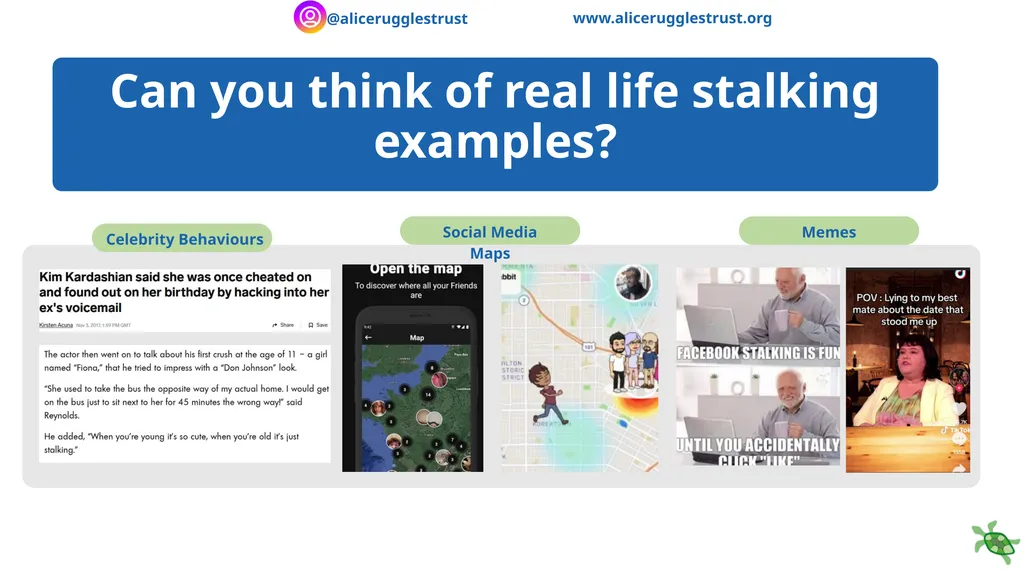
Can you think of real life stalking examples? Celebrity Behaviours Memes Social Media Maps @alicerugglestrust www.alicerugglestrust.org<br>
04
What is stalking? Stalking is a pattern of repeated, unwanted behaviour that makes you feel uncomfortable and uneasy. @alicerugglestrust www.alicerugglestrust.org<br>
05
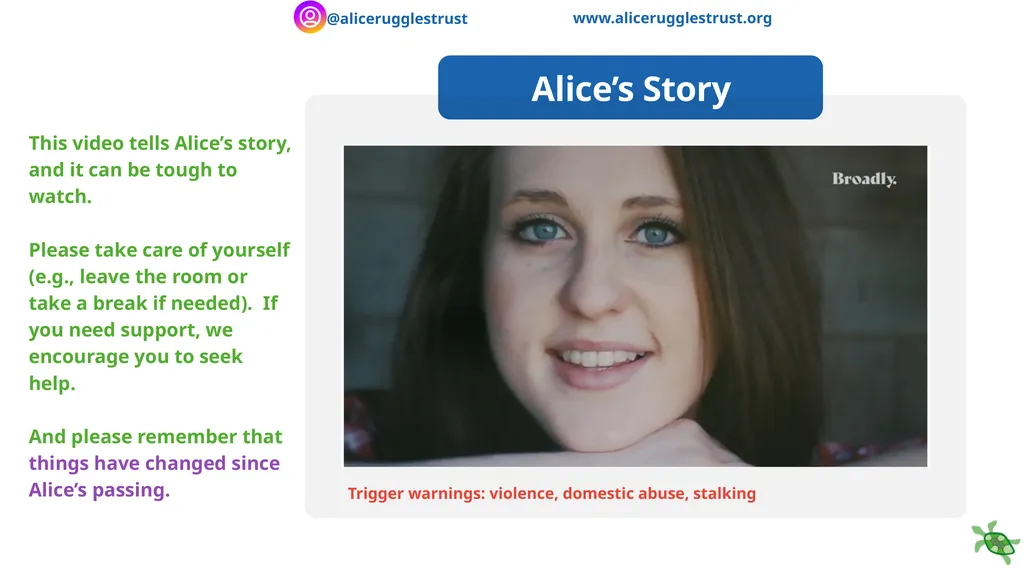
Alice’s Story This video tells Alice’s story, and it can be tough to watch.
Please take care of yourself (e.g., leave the room or take a break if needed). If you need support, we encourage you to seek help.
And please remember that things have changed since Alice’s passing. Trigger warnings: violence, domestic abuse, stalking @alicerugglestrust www.alicerugglestrust.org<br>
06
What is stalking? Many of you will experience, witness or even engage in repeated, unwanted behaviour at some point in your lives, some of which may represent stalking.
Therefore, it is important to develop an understanding of unhealthy relationship behaviours and stalking. @alicerugglestrust www.alicerugglestrust.org<br>
07
Is this stalking? How may Taylor feel? Alex repeatedly sends Taylor gifts and notes despite Taylor’s lack of interest. @alicerugglestrust www.alicerugglestrust.org<br>
08
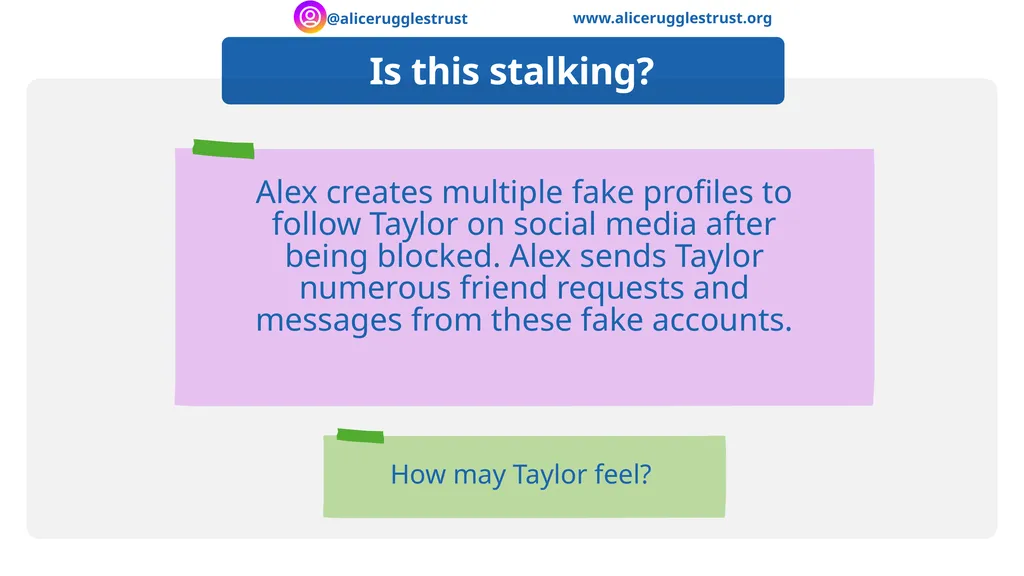
Is this stalking? How may Taylor feel? Alex creates multiple fake profiles to follow Taylor on social media after being blocked. Alex sends Taylor numerous friend requests and messages from these fake accounts. @alicerugglestrust www.alicerugglestrust.org<br>
09
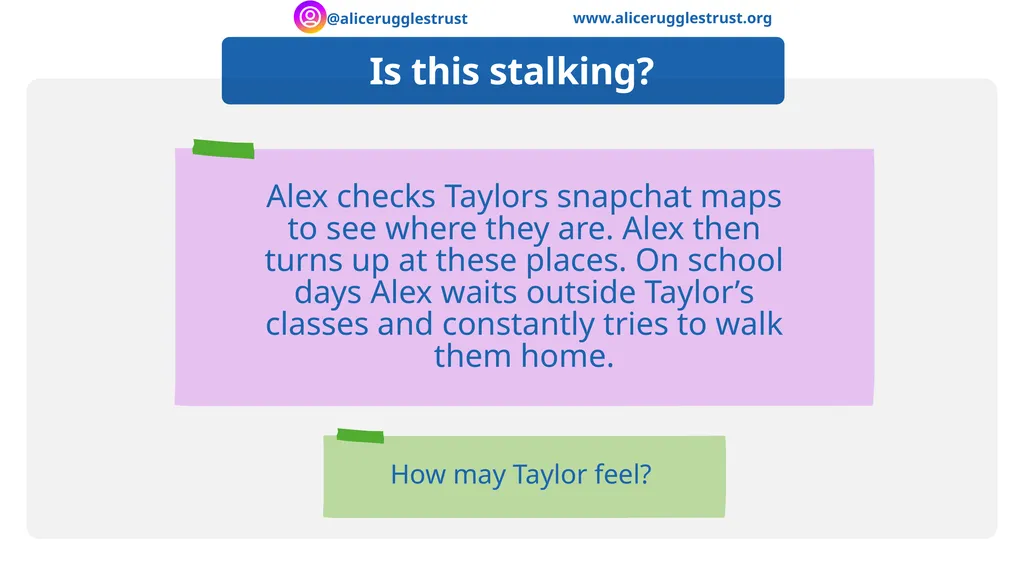
Is this stalking? How may Taylor feel? Alex checks Taylors snapchat maps to see where they are. Alex then turns up at these places. On school days Alex waits outside Taylor’s classes and constantly tries to walk them home. @alicerugglestrust www.alicerugglestrust.org<br>
10
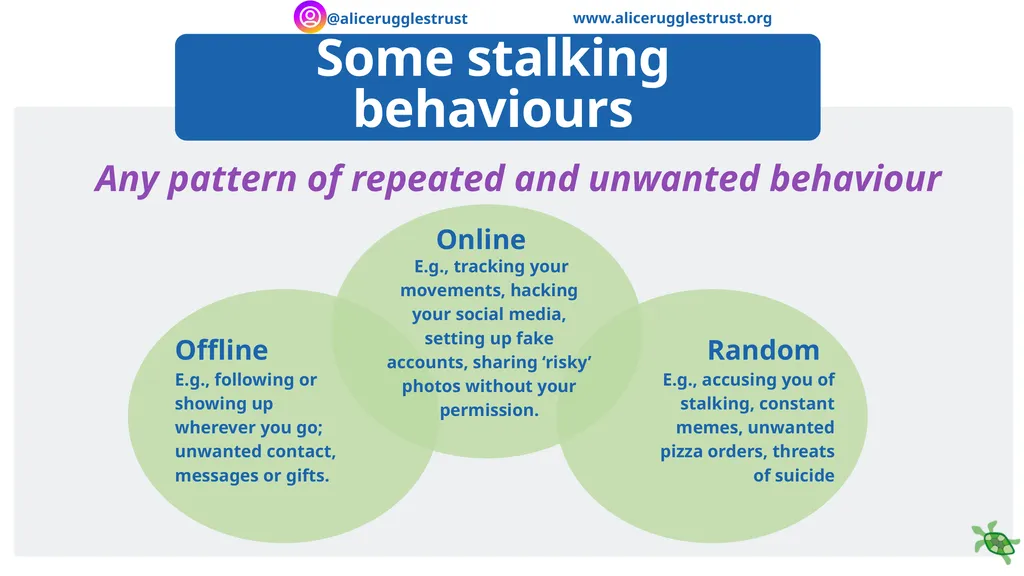
Some stalking behaviours Any pattern of repeated and unwanted behaviour @alicerugglestrust www.alicerugglestrust.org<br>
11
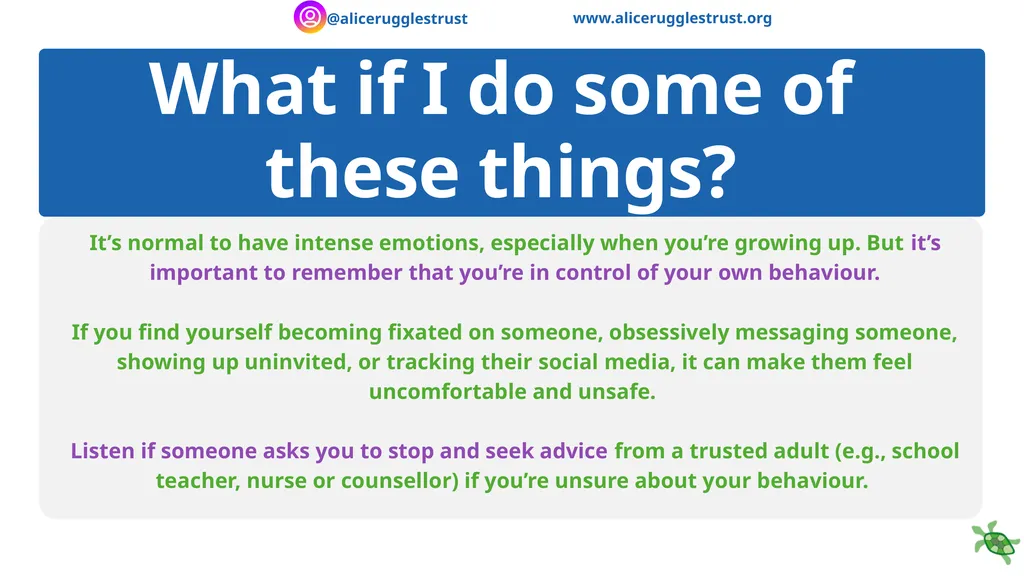
What if I do some of these things? It’s normal to have intense emotions, especially when you’re growing up. But it’s important to remember that you’re in control of your own behaviour.
If you find yourself becoming fixated on someone, obsessively messaging someone, showing up uninvited, or tracking their social media, it can make them feel uncomfortable and unsafe.
Listen if someone asks you to stop and seek advice from a trusted adult (e.g., school teacher, nurse or counsellor) if you’re unsure about your behaviour. @alicerugglestrust www.alicerugglestrust.org<br>
12
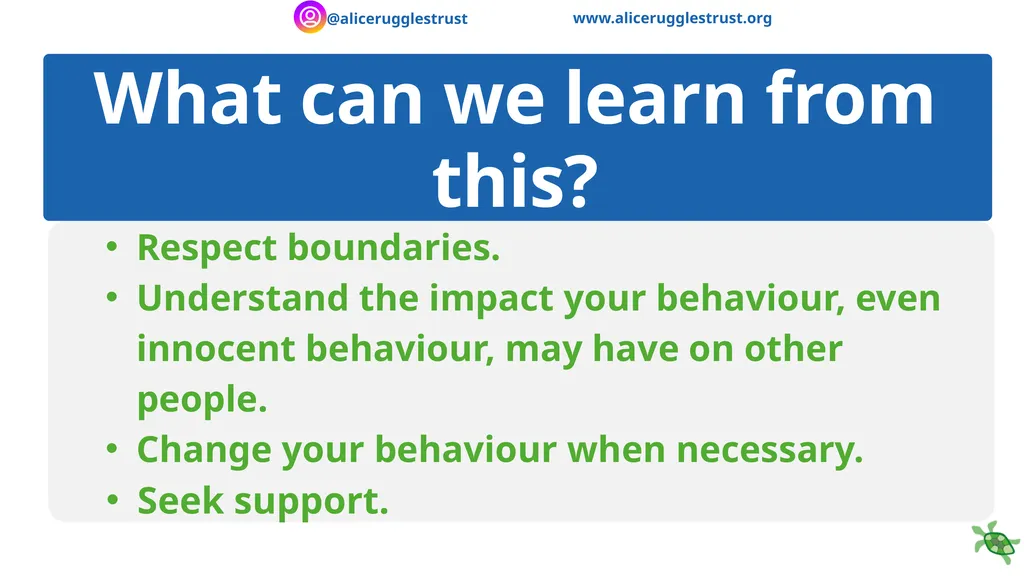
Respect boundaries.
Understand the impact your behaviour, even innocent behaviour, may have on other people.
Change your behaviour when necessary.
Seek support. What can we learn from this? @alicerugglestrust www.alicerugglestrust.org<br>
13
If you think you’re being stalked Trust your instincts and stay safe Log the behaviours (e.g., diary of dates and time) and gather evidence (e.g., screenshots and saved emails).
Talk to people you trust about what is happening (e.g., a friend or guardian, a teacher or school counsellor,
a helpline).
Report the behaviours if you are concerned. @alicerugglestrust www.alicerugglestrust.org<br>
14
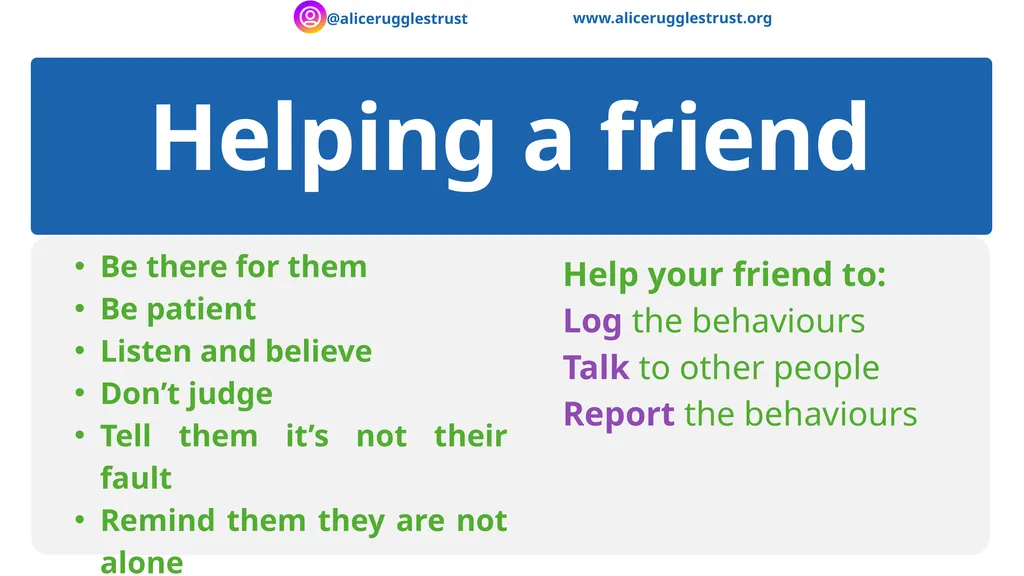
Help your friend to:
Log the behaviours
Talk to other people
Report the behaviours Helping a friend Be there for them
Be patient
Listen and believe
Don’t judge
Tell them it’s not their fault
Remind them they are not alone @alicerugglestrust www.alicerugglestrust.org<br>
15
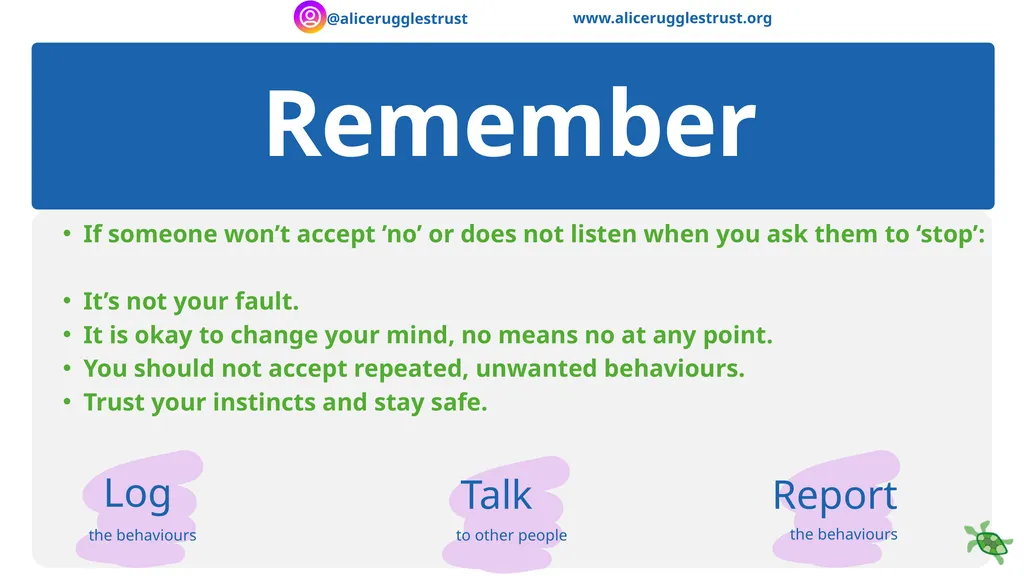
If someone won’t accept ’no’ or does not listen when you ask them to ‘stop’:
It’s not your fault.
It is okay to change your mind, no means no at any point.
You should not accept repeated, unwanted behaviours.
Trust your instincts and stay safe. Remember Log Talk Report the behaviours @alicerugglestrust www.alicerugglestrust.org to other people the behaviours<br>
16
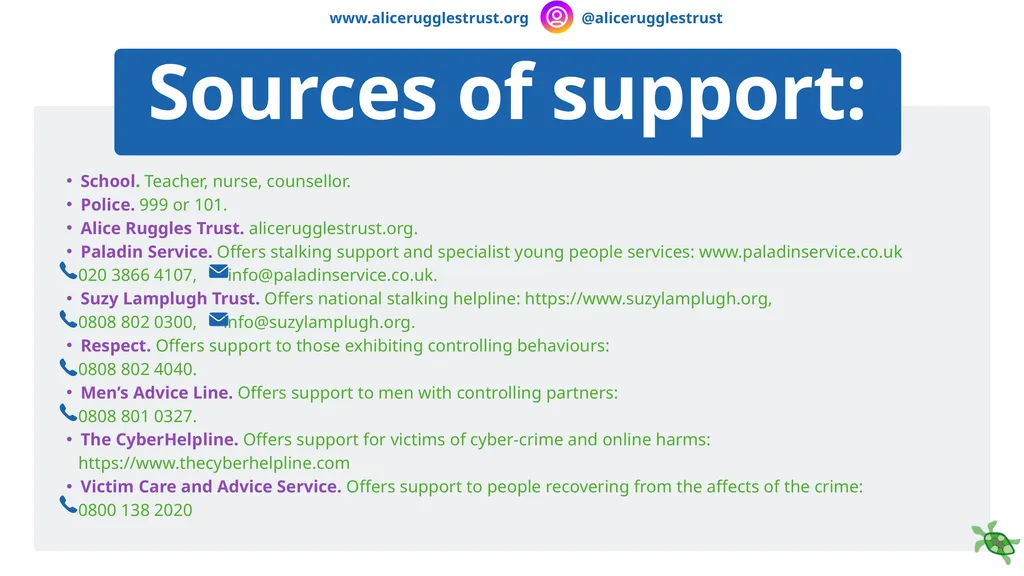
@alicerugglestrust www.alicerugglestrust.org Sources of support:<br>