
Reconciliation Across Social Class Dr. Andrew
BR
Published · 51 slides · 0 views
1 / 1
Description
Reconciliation Across Social Class Dr. Andrew Sears President City Vision University www.cityvision.edu Outline My story of reconciliation across social class Defining Social Class Understanding Class as Culture and Bias The Intersection of
Related Topics
Share
Embed code
Download this presentation From Below
"Reconciliation Across Social Class Dr. Andrew" is the property of its rightful owner. Permission is granted to download and print the materials on this website for personal, non-commercial use only, and to display it on your personal computer provided you do not modify the materials and that you retain all copyright notices contained in the materials. By downloading content from our website, you accept the terms of this agreement.
Presentation Transcript
01
Reconciliation Across Social Class Dr. Andrew Sears
President City Vision University
www.cityvision.edu<br>
President City Vision University
www.cityvision.edu<br>
02
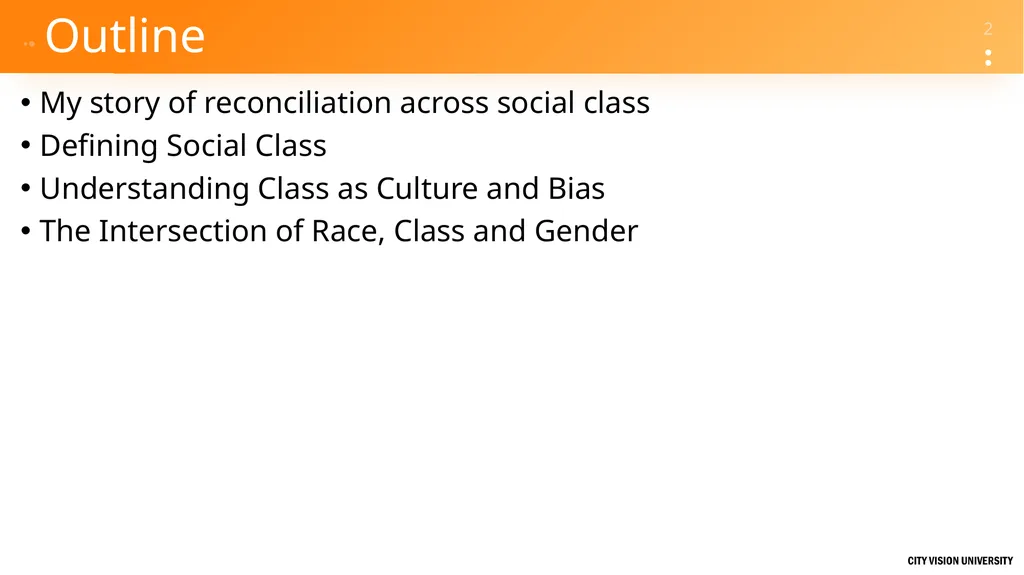
Outline My story of reconciliation across social class
Defining Social Class
Understanding Class as Culture and Bias
The Intersection of Race, Class and Gender<br>
Defining Social Class
Understanding Class as Culture and Bias
The Intersection of Race, Class and Gender<br>
03
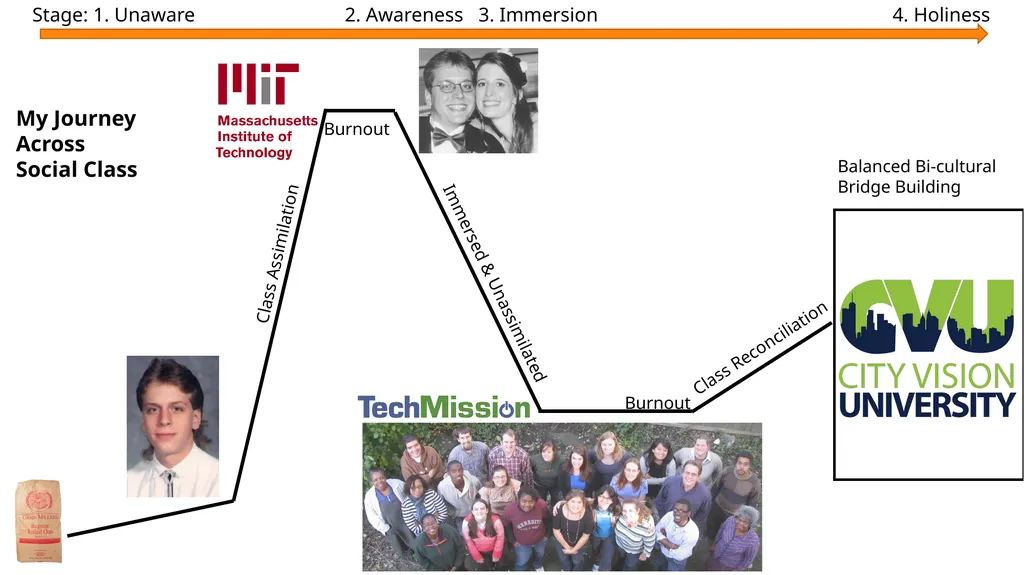
Class Assimilation Immersed & Unassimilated Burnout Class Reconciliation Burnout Balanced Bi-cultural
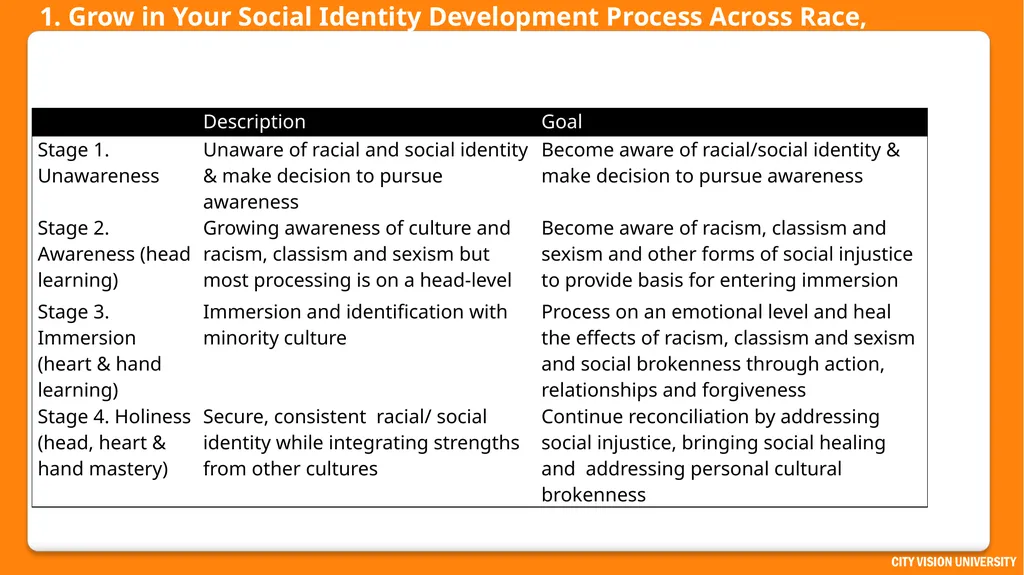
Bridge Building Stage: 1. Unaware 2. Awareness 3. Immersion 4. Holiness My Journey
Across
Social Class<br>
Bridge Building Stage: 1. Unaware 2. Awareness 3. Immersion 4. Holiness My Journey
Across
Social Class<br>
04
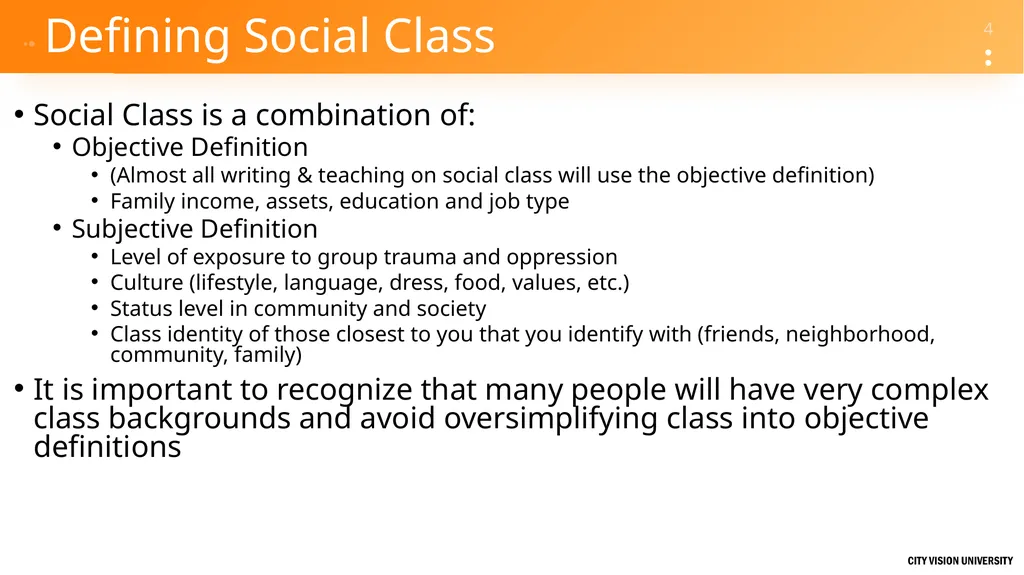
Defining Social Class Social Class is a combination of:
Objective Definition
(Almost all writing & teaching on social class will use the objective definition)
Family income, assets, education and job type
Subjective Definition
Level of exposure to group trauma and oppression
Culture (lifestyle, language, dress, food, values, etc.)
Status level in community and society
Class identity of those closest to you that you identify with (friends, neighborhood, community, family)
It is important to recognize that many people will have very complex class backgrounds and avoid oversimplifying class into objective definitions<br>
05
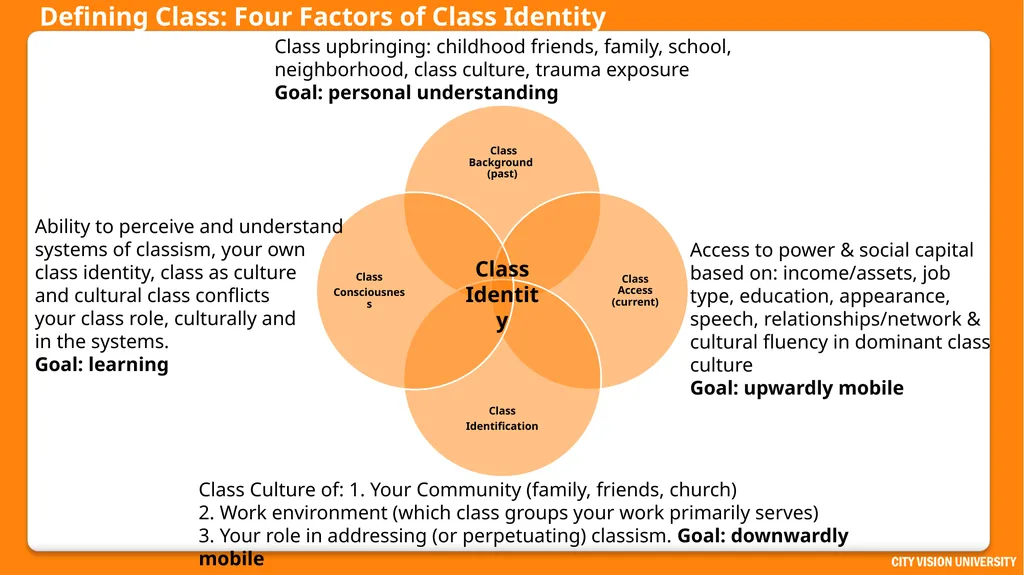
Defining Class: Four Factors of Class Identity Class
Identity Class upbringing: childhood friends, family, school,
neighborhood, class culture, trauma exposure
Goal: personal understanding Access to power & social capital based on: income/assets, job type, education, appearance, speech, relationships/network & cultural fluency in dominant class culture
Goal: upwardly mobile Class Culture of: 1. Your Community (family, friends, church)
2. Work environment (which class groups your work primarily serves)
3. Your role in addressing (or perpetuating) classism. Goal: downwardly mobile Ability to perceive and understand
systems of classism, your own class identity, class as culture
and cultural class conflicts
your class role, culturally and in the systems.
Goal: learning<br>
06
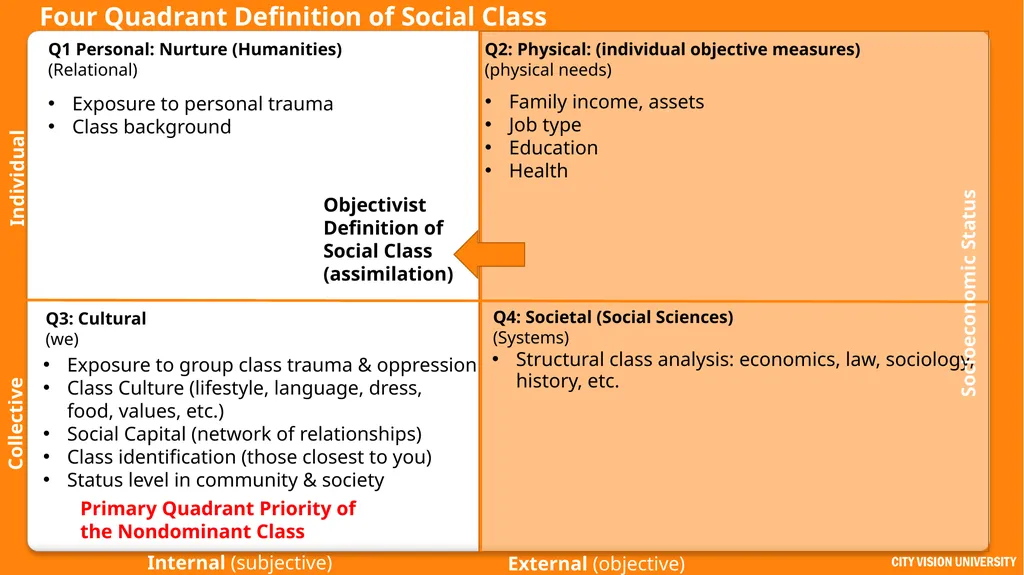
Q1 Personal: Nurture (Humanities)
(Relational) Q2: Physical: (individual objective measures)
(physical needs) Q3: Cultural
(we) Q4: Societal (Social Sciences) (Systems) Individual Collective Internal (subjective) External (objective) Exposure to group class trauma & oppression
Class Culture (lifestyle, language, dress, food, values, etc.)
Social Capital (network of relationships)
Class identification (those closest to you)
Status level in community & society Structural class analysis: economics, law, sociology, history, etc. Exposure to personal trauma
Class background Family income, assets
Job type
Education
Health Four Quadrant Definition of Social Class Objectivist
Definition of Social Class (assimilation) Primary Quadrant Priority of
the Nondominant Class Socioeconomic Status<br>
07
Understanding Class as Culture and Class Bias Dr. Andrew Sears
President City Vision University<br>
President City Vision University<br>
08
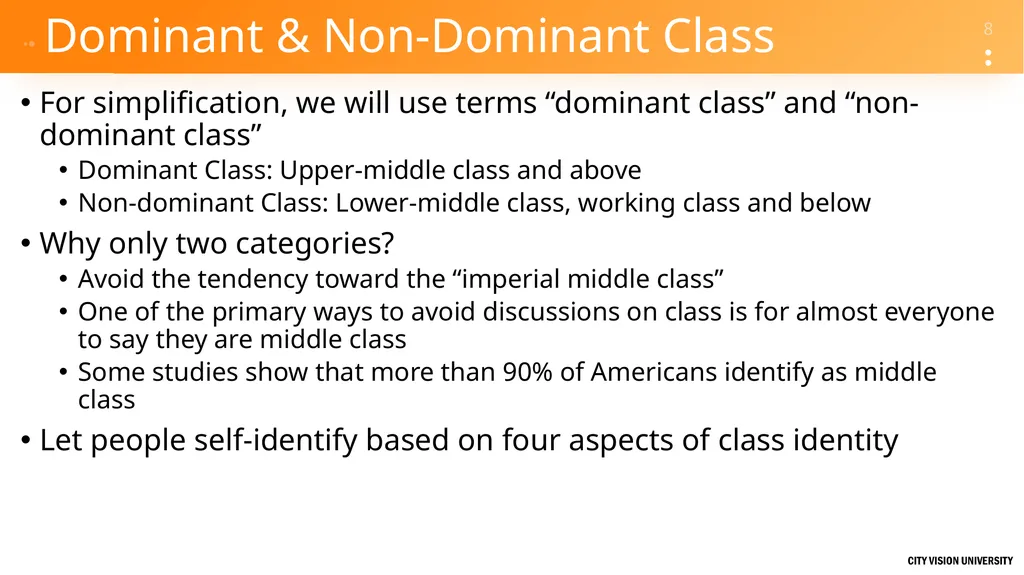
Dominant & Non-Dominant Class For simplification, we will use terms “dominant class” and “non-dominant class”
Dominant Class: Upper-middle class and above
Non-dominant Class: Lower-middle class, working class and below
Why only two categories?
Avoid the tendency toward the “imperial middle class”
One of the primary ways to avoid discussions on class is for almost everyone to say they are middle class
Some studies show that more than 90% of Americans identify as middle class
Let people self-identify based on four aspects of class identity<br>
09
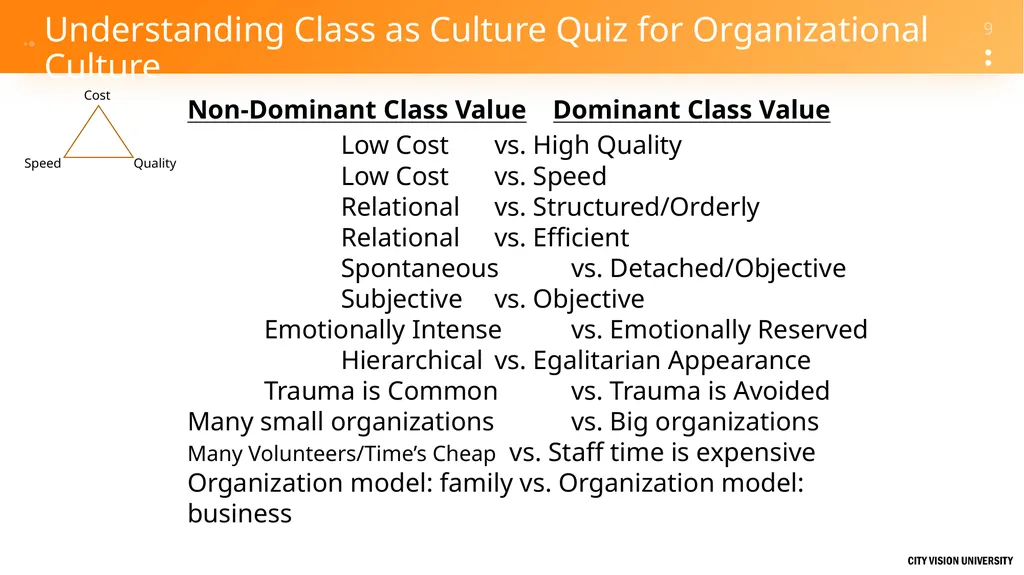
Understanding Class as Culture Quiz for Organizational Culture Non-Dominant Class Value Dominant Class Value
Low Cost vs. High Quality
Low Cost vs. Speed
Relational vs. Structured/Orderly
Relational vs. Efficient
Spontaneous vs. Detached/Objective
Subjective vs. Objective
Emotionally Intense vs. Emotionally Reserved
Hierarchical vs. Egalitarian Appearance
Trauma is Common vs. Trauma is Avoided
Many small organizations vs. Big organizations
Many Volunteers/Time’s Cheap vs. Staff time is expensive
Organization model: family vs. Organization model: business Cost Speed Quality<br>
10
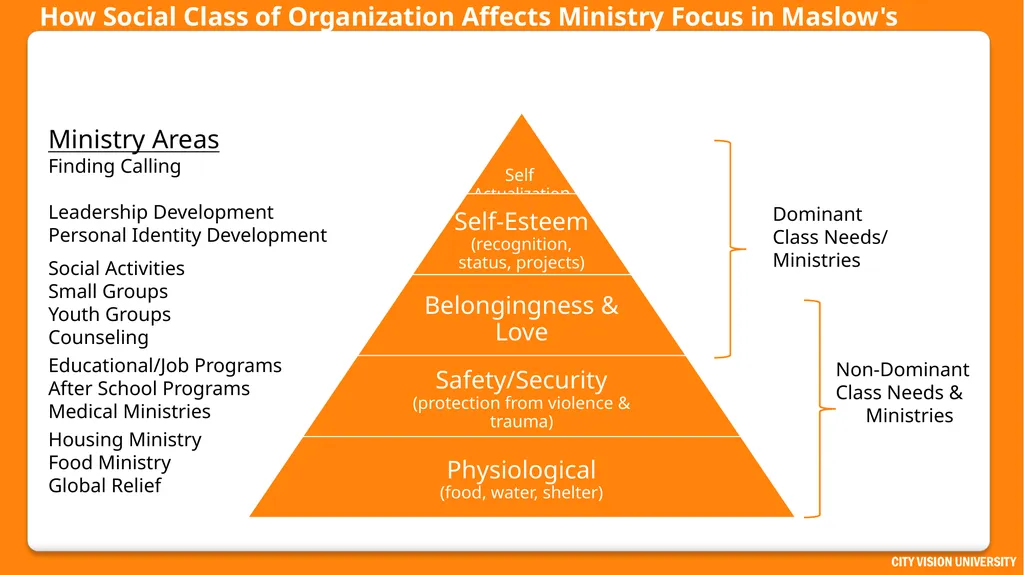
How Social Class of Organization Affects Ministry Focus in Maslow's Hierarchy of Needs Dominant
Class Needs/
Ministries Non-Dominant
Class Needs &
Ministries Ministry Areas
Finding Calling
Leadership Development
Personal Identity Development
Social Activities
Small Groups
Youth Groups
Counseling
Educational/Job Programs
After School Programs
Medical Ministries
Housing Ministry
Food Ministry
Global Relief<br>
11
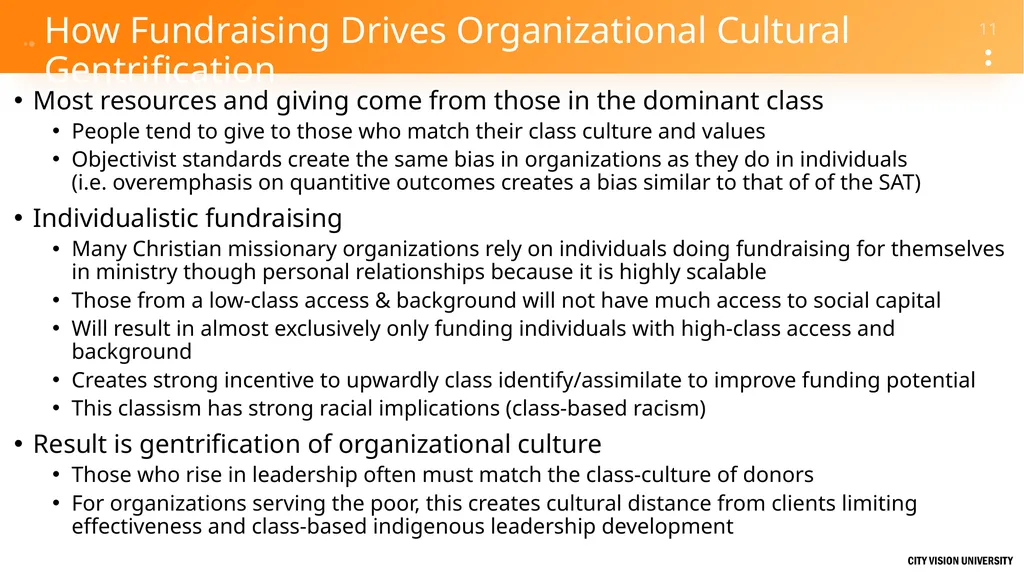
How Fundraising Drives Organizational Cultural Gentrification Most resources and giving come from those in the dominant class
People tend to give to those who match their class culture and values
Objectivist standards create the same bias in organizations as they do in individuals (i.e. overemphasis on quantitive outcomes creates a bias similar to that of of the SAT)
Individualistic fundraising
Many Christian missionary organizations rely on individuals doing fundraising for themselves in ministry though personal relationships because it is highly scalable
Those from a low-class access & background will not have much access to social capital
Will result in almost exclusively only funding individuals with high-class access and background
Creates strong incentive to upwardly class identify/assimilate to improve funding potential
This classism has strong racial implications (class-based racism)
Result is gentrification of organizational culture
Those who rise in leadership often must match the class-culture of donors
For organizations serving the poor, this creates cultural distance from clients limiting effectiveness and class-based indigenous leadership development<br>
12
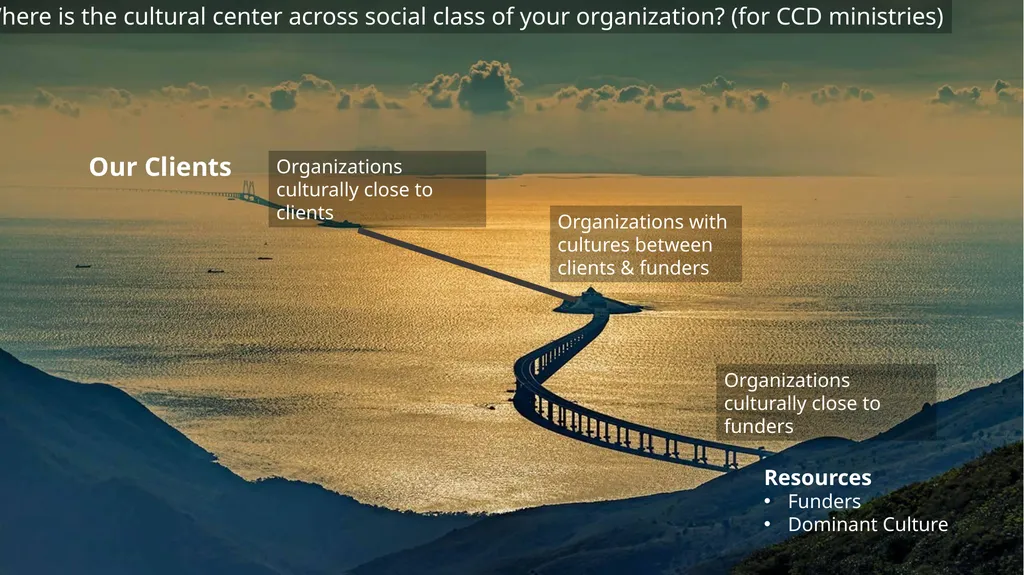
Our Clients Resources
Funders
Dominant Culture Where is the cultural center across social class of your organization? (for CCD ministries) Organizations with cultures between clients & funders Organizations culturally close to clients Organizations culturally close to funders<br>
Funders
Dominant Culture Where is the cultural center across social class of your organization? (for CCD ministries) Organizations with cultures between clients & funders Organizations culturally close to clients Organizations culturally close to funders<br>
13
The Intersection of Race, Class
and Gender Dr. Andrew Sears
President City Vision University<br>
President City Vision University<br>
14
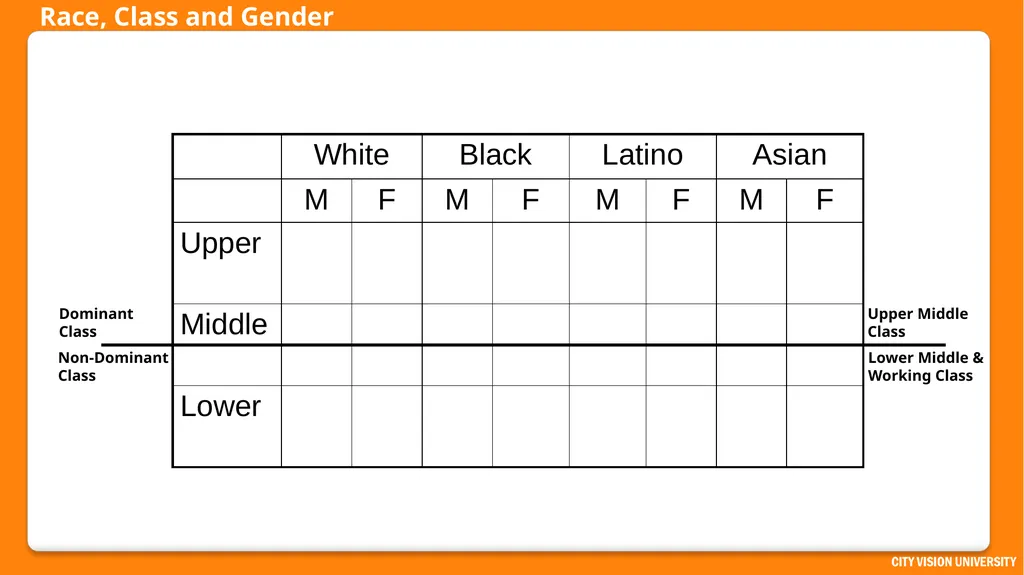
Race, Class and Gender Dominant
Class Non-Dominant
Class Upper Middle
Class Lower Middle & Working Class<br>
Class Lower Middle & Working Class<br>
15
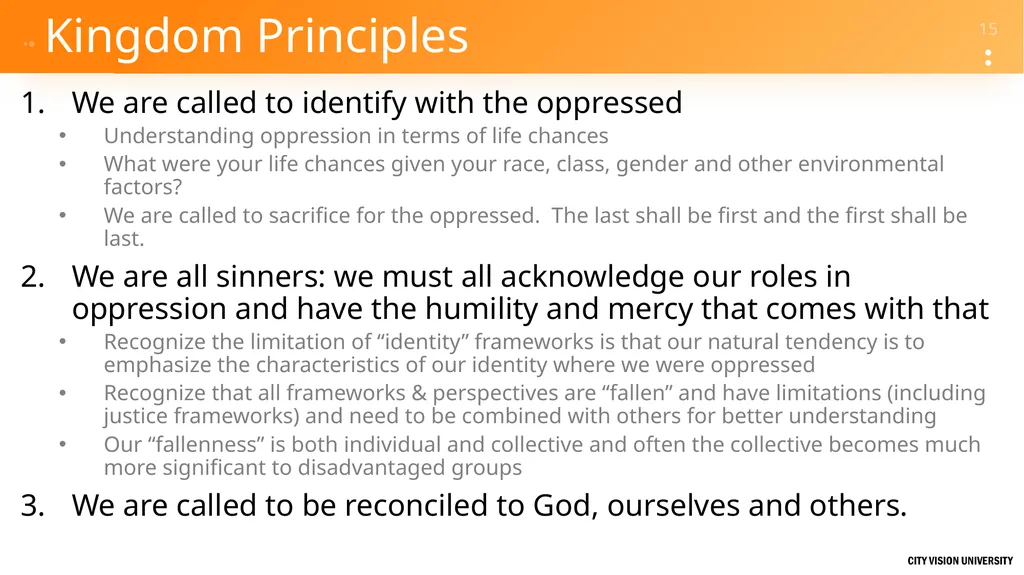
Kingdom Principles We are called to identify with the oppressed
Understanding oppression in terms of life chances
What were your life chances given your race, class, gender and other environmental factors?
We are called to sacrifice for the oppressed. The last shall be first and the first shall be last.
We are all sinners: we must all acknowledge our roles in oppression and have the humility and mercy that comes with that
Recognize the limitation of “identity” frameworks is that our natural tendency is to emphasize the characteristics of our identity where we were oppressed
Recognize that all frameworks & perspectives are “fallen” and have limitations (including justice frameworks) and need to be combined with others for better understanding
Our “fallenness” is both individual and collective and often the collective becomes much more significant to disadvantaged groups
We are called to be reconciled to God, ourselves and others.<br>
16
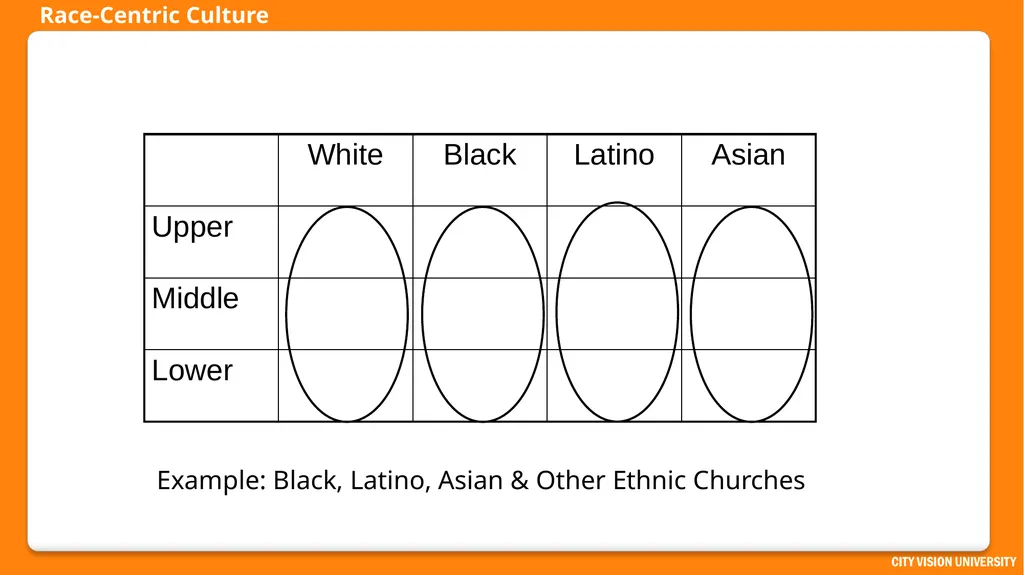
Race-Centric Culture Example: Black, Latino, Asian & Other Ethnic Churches<br>
17
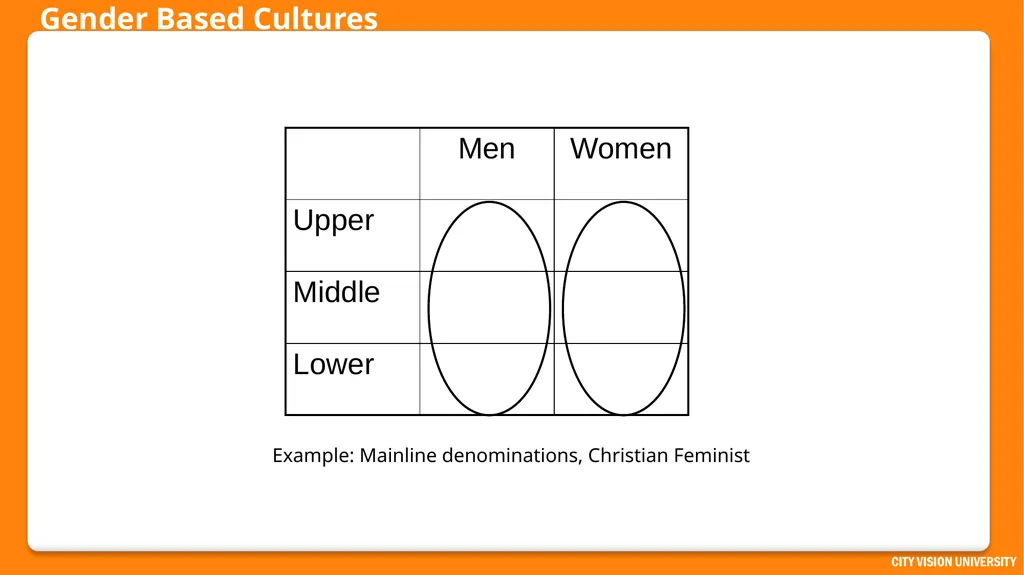
Gender Based Cultures Example: Mainline denominations, Christian Feminist<br>
18
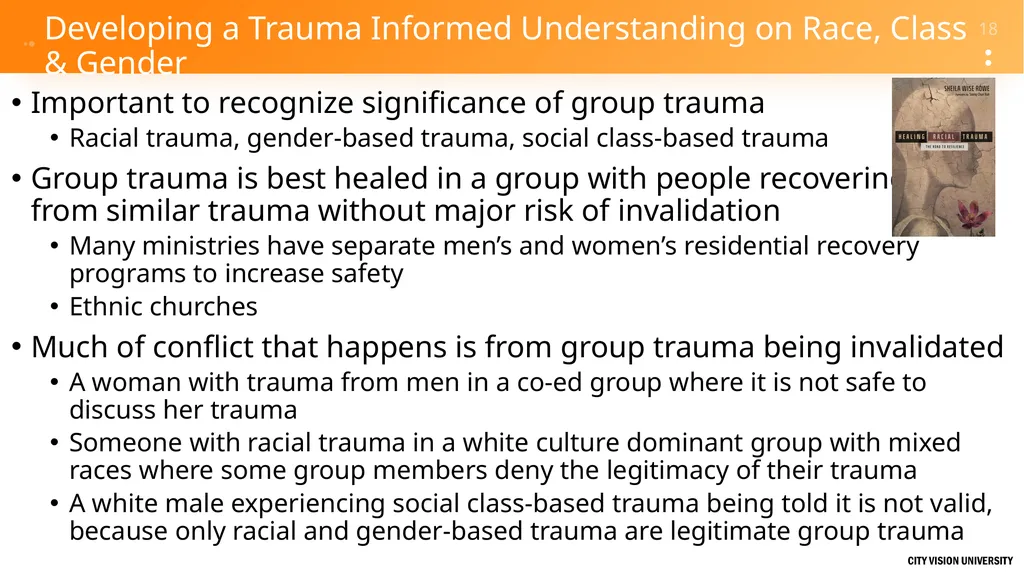
Developing a Trauma Informed Understanding on Race, Class & Gender Important to recognize significance of group trauma
Racial trauma, gender-based trauma, social class-based trauma
Group trauma is best healed in a group with people recovering from similar trauma without major risk of invalidation
Many ministries have separate men’s and women’s residential recovery programs to increase safety
Ethnic churches
Much of conflict that happens is from group trauma being invalidated
A woman with trauma from men in a co-ed group where it is not safe to discuss her trauma
Someone with racial trauma in a white culture dominant group with mixed races where some group members deny the legitimacy of their trauma
A white male experiencing social class-based trauma being told it is not valid, because only racial and gender-based trauma are legitimate group trauma<br>
19
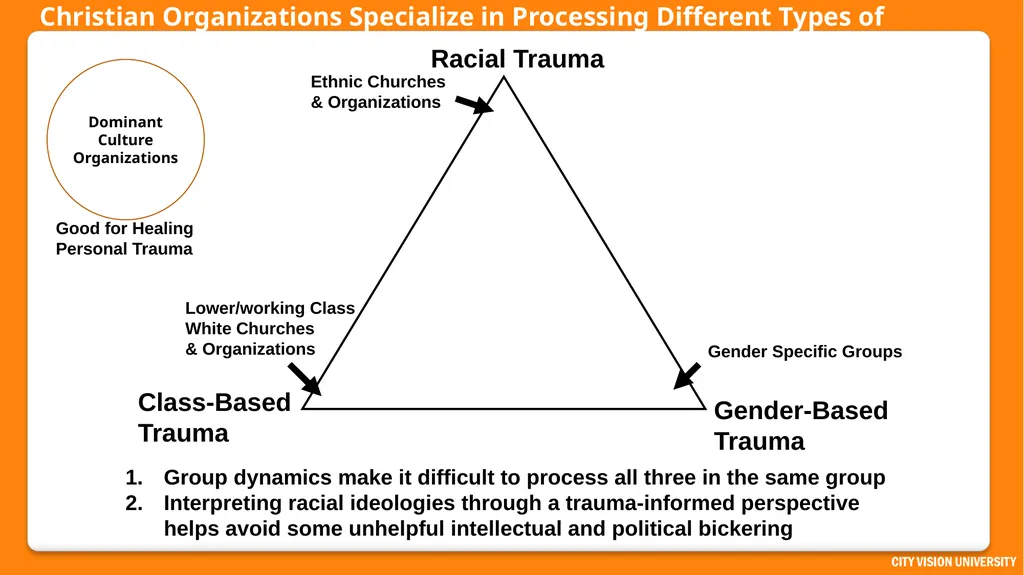
Christian Organizations Specialize in Processing Different Types of Group Trauma Racial Trauma Class-Based
Trauma Gender-Based
Trauma Dominant Culture
Organizations Good for Healing
Personal Trauma Group dynamics make it difficult to process all three in the same group
Interpreting racial ideologies through a trauma-informed perspective helps avoid some unhelpful intellectual and political bickering<br>
Interpreting racial ideologies through a trauma-informed perspective helps avoid some unhelpful intellectual and political bickering<br>
20
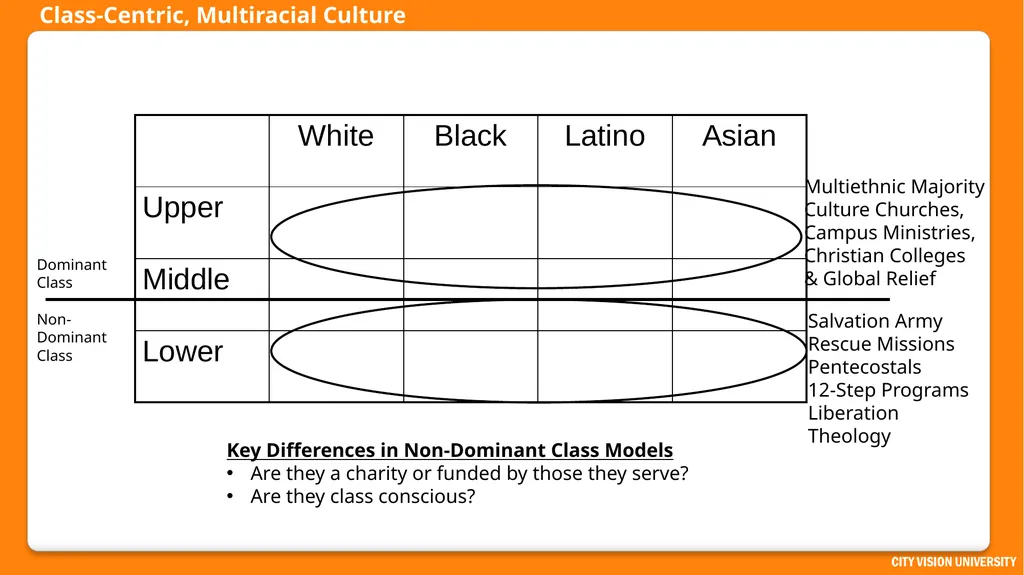
Class-Centric, Multiracial Culture Multiethnic Majority
Culture Churches,
Campus Ministries,
Christian Colleges
& Global Relief Salvation Army
Rescue Missions
Pentecostals
12-Step Programs
Liberation Theology Key Differences in Non-Dominant Class Models
Are they a charity or funded by those they serve?
Are they class conscious? Dominant Class Non- Dominant Class<br>
21
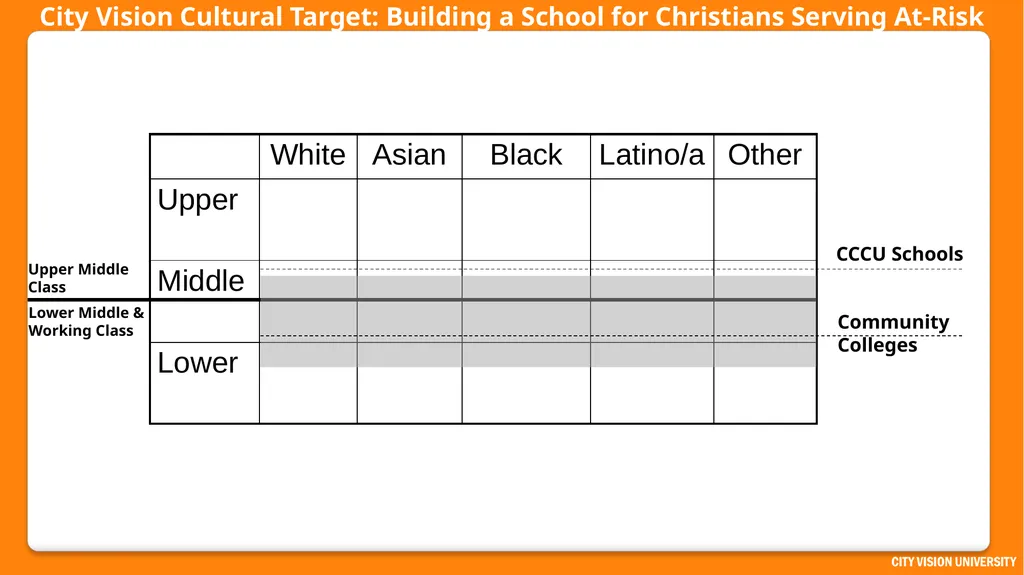
City Vision Cultural Target: Building a School for Christians Serving At-Risk Commmunities Upper Middle
Class Lower Middle & Working Class CCCU Schools Community Colleges<br>
Class Lower Middle & Working Class CCCU Schools Community Colleges<br>
22
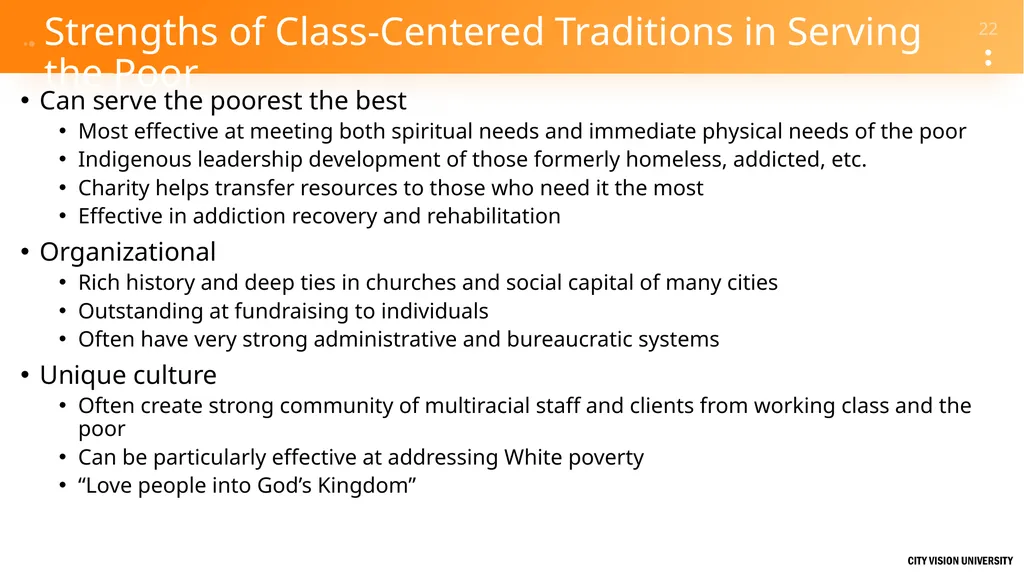
Strengths of Class-Centered Traditions in Serving the Poor Can serve the poorest the best
Most effective at meeting both spiritual needs and immediate physical needs of the poor
Indigenous leadership development of those formerly homeless, addicted, etc.
Charity helps transfer resources to those who need it the most
Effective in addiction recovery and rehabilitation
Organizational
Rich history and deep ties in churches and social capital of many cities
Outstanding at fundraising to individuals
Often have very strong administrative and bureaucratic systems
Unique culture
Often create strong community of multiracial staff and clients from working class and the poor
Can be particularly effective at addressing White poverty
“Love people into God’s Kingdom”<br>
23
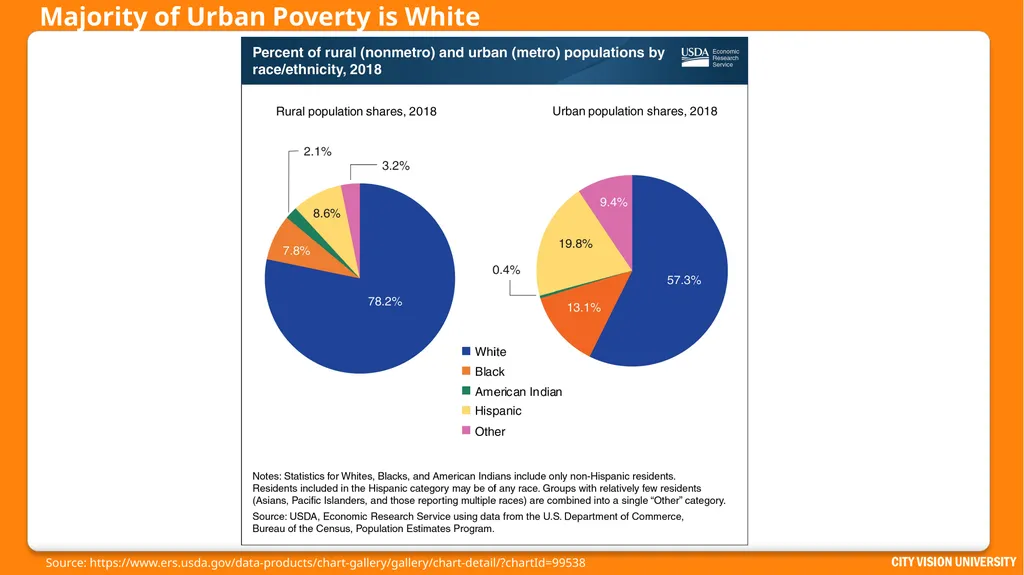
Majority of Urban Poverty is White Source: https://www.ers.usda.gov/data-products/chart-gallery/gallery/chart-detail/?chartId=99538<br>
24
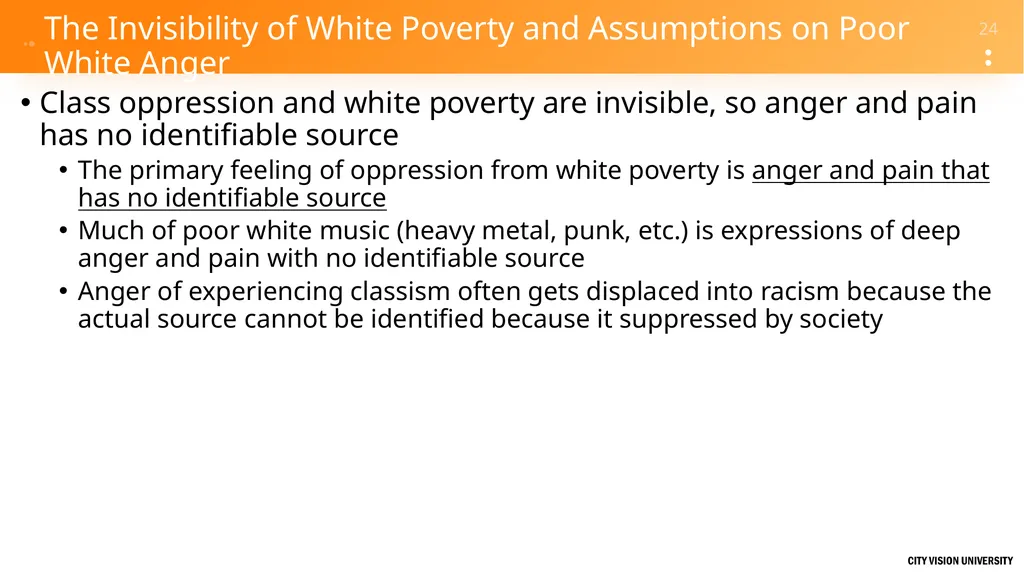
The Invisibility of White Poverty and Assumptions on Poor White Anger Class oppression and white poverty are invisible, so anger and pain has no identifiable source
The primary feeling of oppression from white poverty is anger and pain that has no identifiable source
Much of poor white music (heavy metal, punk, etc.) is expressions of deep anger and pain with no identifiable source
Anger of experiencing classism often gets displaced into racism because the actual source cannot be identified because it suppressed by society<br>
25
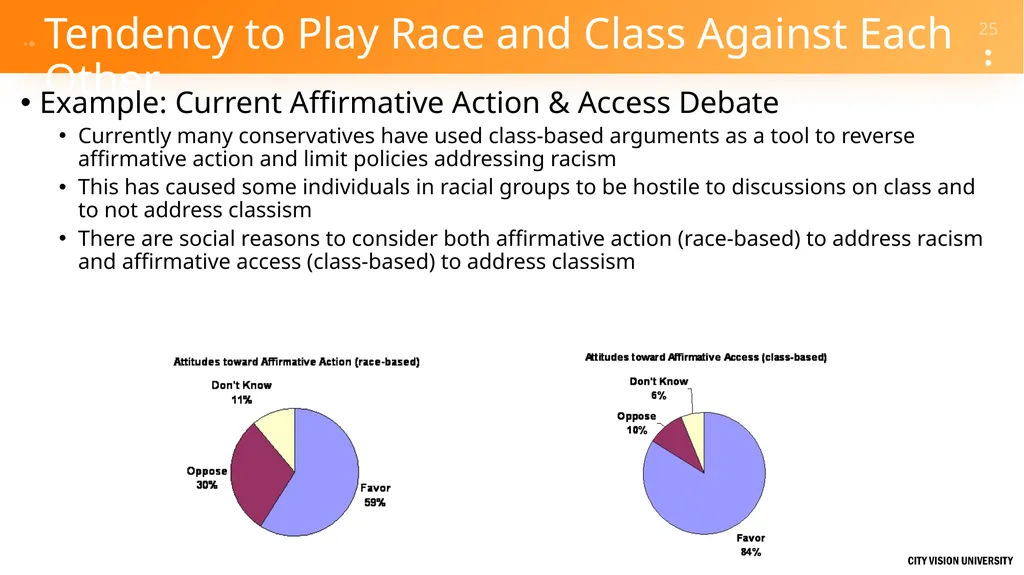
Tendency to Play Race and Class Against Each Other Example: Current Affirmative Action & Access Debate
Currently many conservatives have used class-based arguments as a tool to reverse affirmative action and limit policies addressing racism
This has caused some individuals in racial groups to be hostile to discussions on class and to not address classism
There are social reasons to consider both affirmative action (race-based) to address racism and affirmative access (class-based) to address classism<br>
26
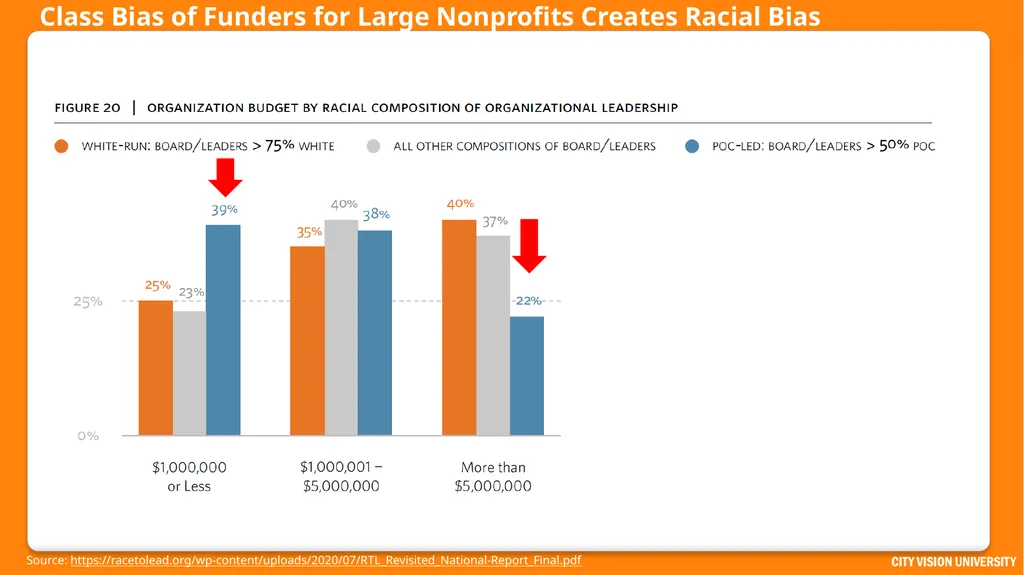
Class Bias of Funders for Large Nonprofits Creates Racial Bias Source: https://racetolead.org/wp-content/uploads/2020/07/RTL_Revisited_National-Report_Final.pdf<br>
27
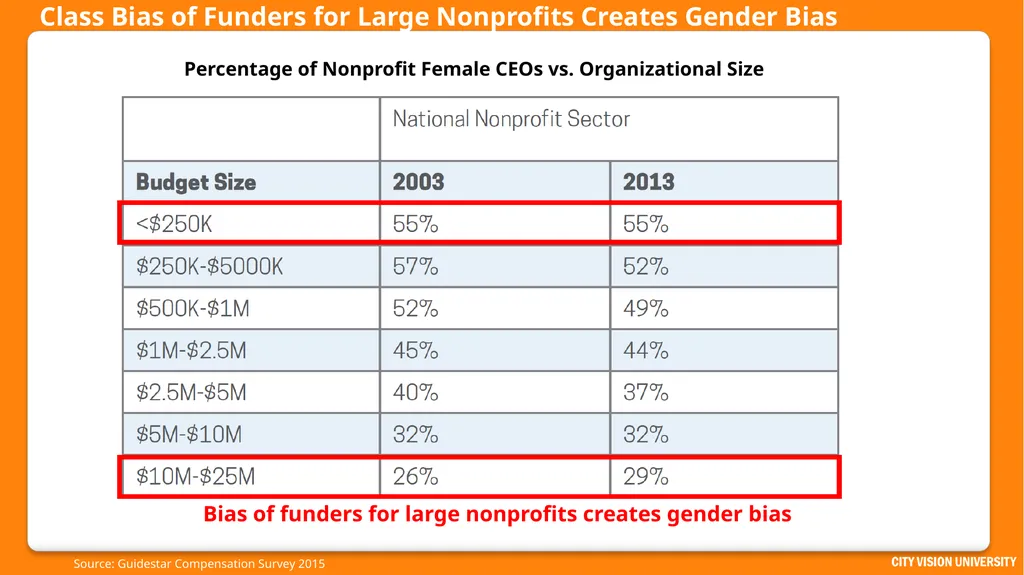
Class Bias of Funders for Large Nonprofits Creates Gender Bias Source: Guidestar Compensation Survey 2015 Bias of funders for large nonprofits creates gender bias Percentage of Nonprofit Female CEOs vs. Organizational Size<br>
28
What to Do Dr. Andrew Sears
President City Vision University<br>
President City Vision University<br>
29
1. Grow in Your Social Identity Development Process Across Race, Class and Gender<br>
30
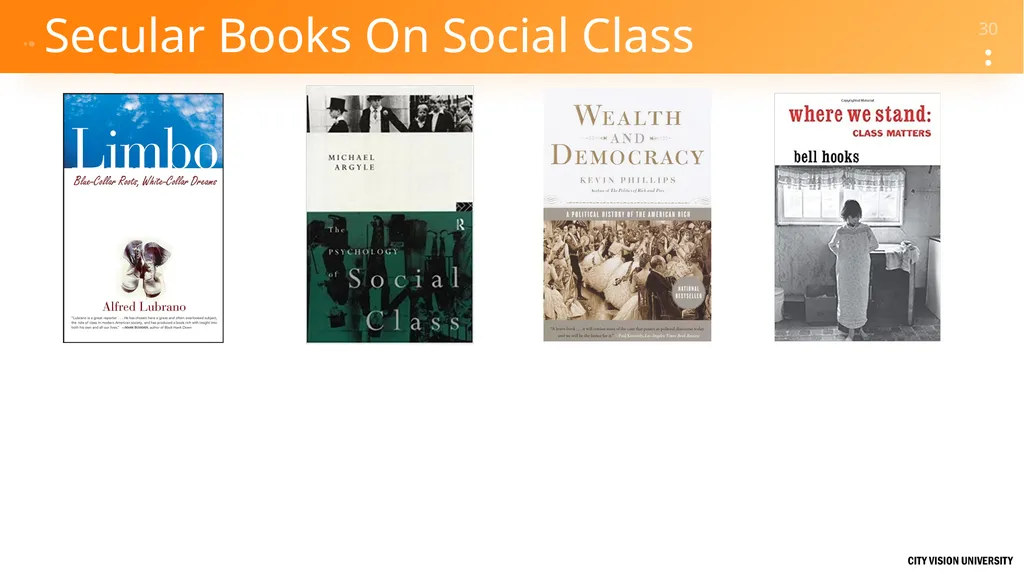
Secular Books On Social Class<br>
31
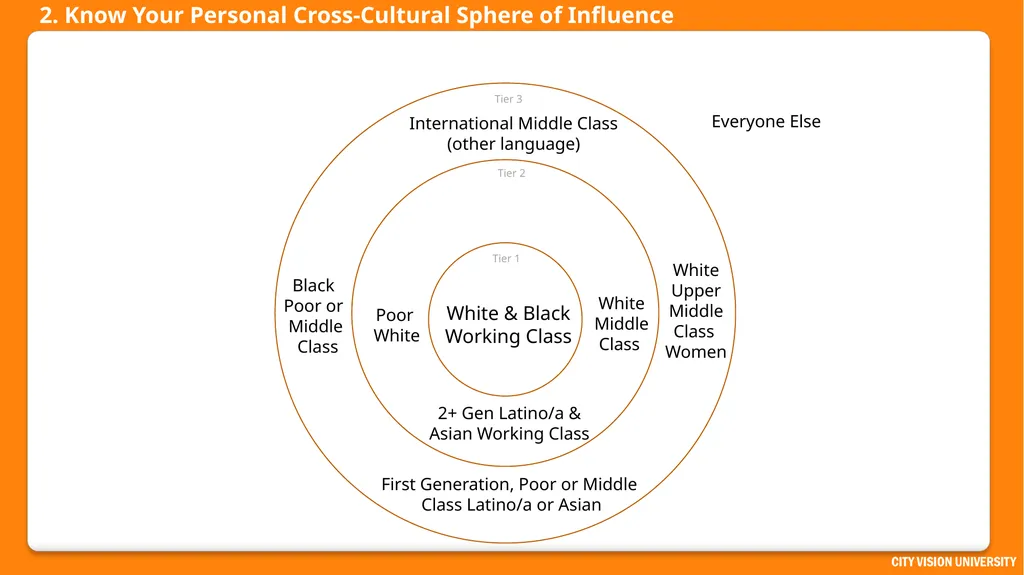
Poor
White First Generation, Poor or Middle
Class Latino/a or Asian 2. Know Your Personal Cross-Cultural Sphere of Influence White & Black
Working Class Black
Poor or
Middle
Class White
Middle
Class 2+ Gen Latino/a &
Asian Working Class White
Upper
Middle
Class
Women Tier 1 Tier 2 Tier 3 International Middle Class
(other language) Everyone Else<br>
32
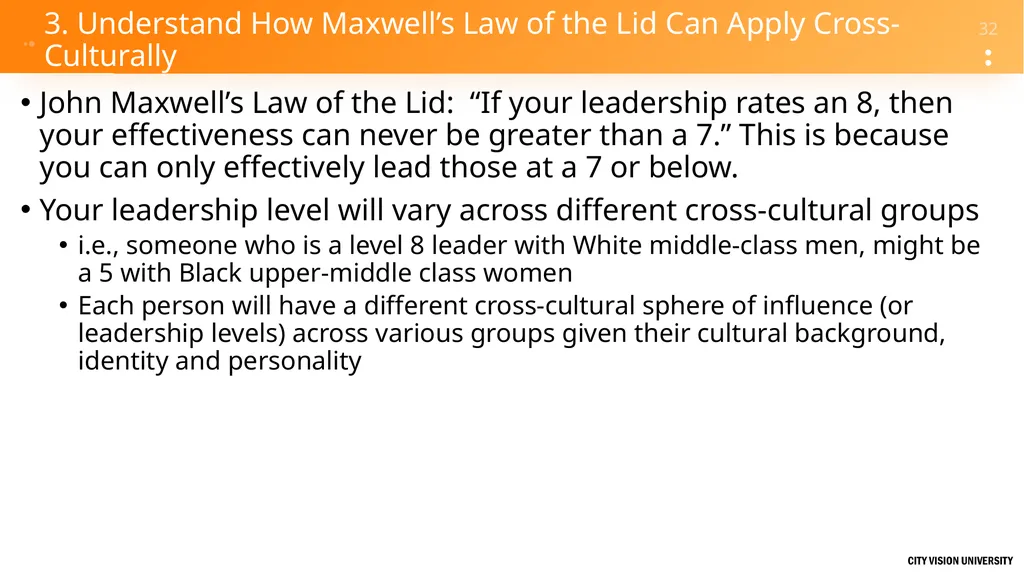
3. Understand How Maxwell’s Law of the Lid Can Apply Cross-Culturally John Maxwell’s Law of the Lid: “If your leadership rates an 8, then your effectiveness can never be greater than a 7.” This is because you can only effectively lead those at a 7 or below.
Your leadership level will vary across different cross-cultural groups
i.e., someone who is a level 8 leader with White middle-class men, might be a 5 with Black upper-middle class women
Each person will have a different cross-cultural sphere of influence (or leadership levels) across various groups given their cultural background, identity and personality<br>
33
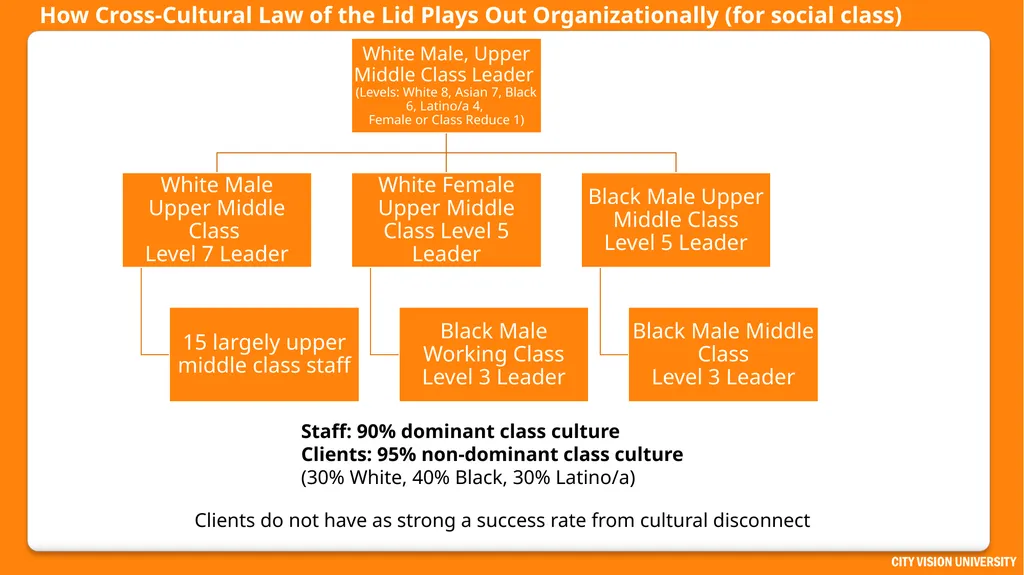
How Cross-Cultural Law of the Lid Plays Out Organizationally (for social class) Clients do not have as strong a success rate from cultural disconnect Staff: 90% dominant class culture
Clients: 95% non-dominant class culture
(30% White, 40% Black, 30% Latino/a)<br>
Clients: 95% non-dominant class culture
(30% White, 40% Black, 30% Latino/a)<br>
34
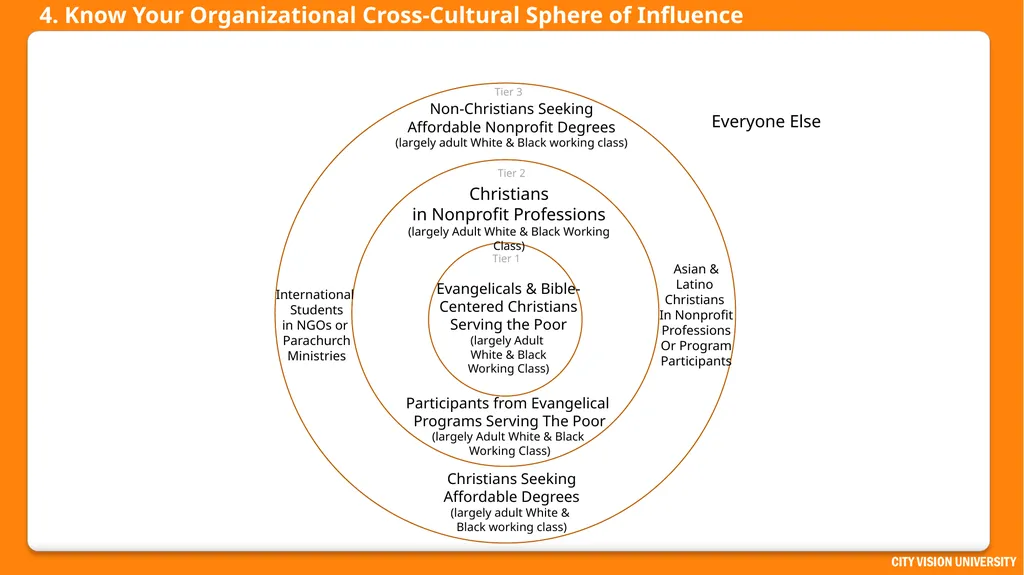
Participants from Evangelical
Programs Serving The Poor
(largely Adult White & Black Working Class) Christians Seeking Affordable Degrees (largely adult White & Black working class) 4. Know Your Organizational Cross-Cultural Sphere of Influence Evangelicals & Bible- Centered Christians Serving the Poor
(largely Adult White & Black Working Class) Christians
in Nonprofit Professions
(largely Adult White & Black Working Class) Non-Christians Seeking Affordable Nonprofit Degrees (largely adult White & Black working class) Tier 1 Tier 2 Tier 3 Asian & Latino Christians
In Nonprofit Professions
Or Program Participants International Students in NGOs or Parachurch Ministries Everyone Else<br>
35
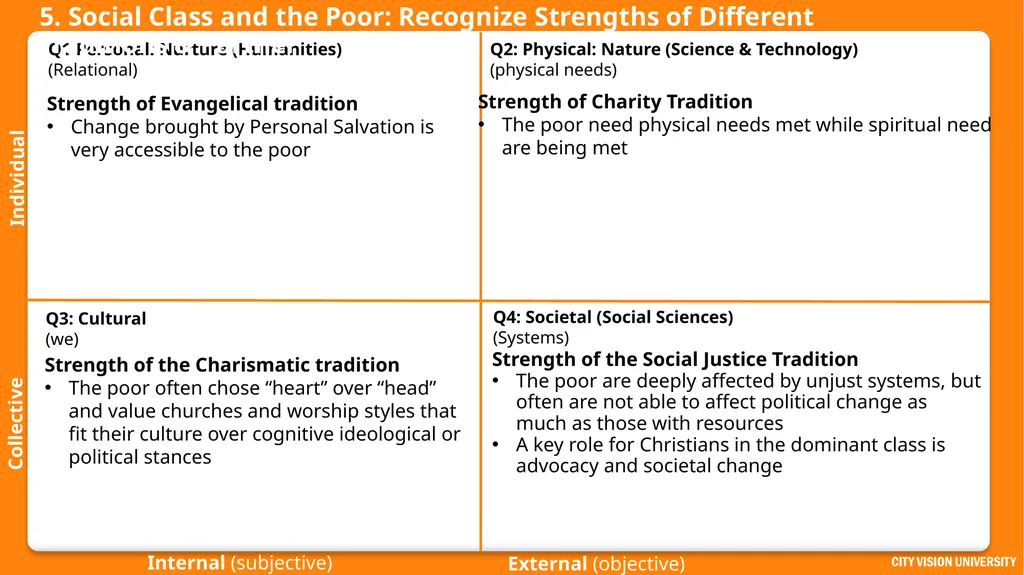
Q1 Personal: Nurture (Humanities)
(Relational) Q2: Physical: Nature (Science & Technology)
(physical needs) Q3: Cultural
(we) Q4: Societal (Social Sciences) (Systems) Individual Collective Internal (subjective) External (objective) Strength of the Charismatic tradition
The poor often chose “heart” over “head” and value churches and worship styles that fit their culture over cognitive ideological or political stances Strength of the Social Justice Tradition
The poor are deeply affected by unjust systems, but often are not able to affect political change as much as those with resources
A key role for Christians in the dominant class is advocacy and societal change Strength of Evangelical tradition
Change brought by Personal Salvation is very accessible to the poor Strength of Charity Tradition
The poor need physical needs met while spiritual need are being met 5. Social Class and the Poor: Recognize Strengths of Different Traditions & Partner<br>
36
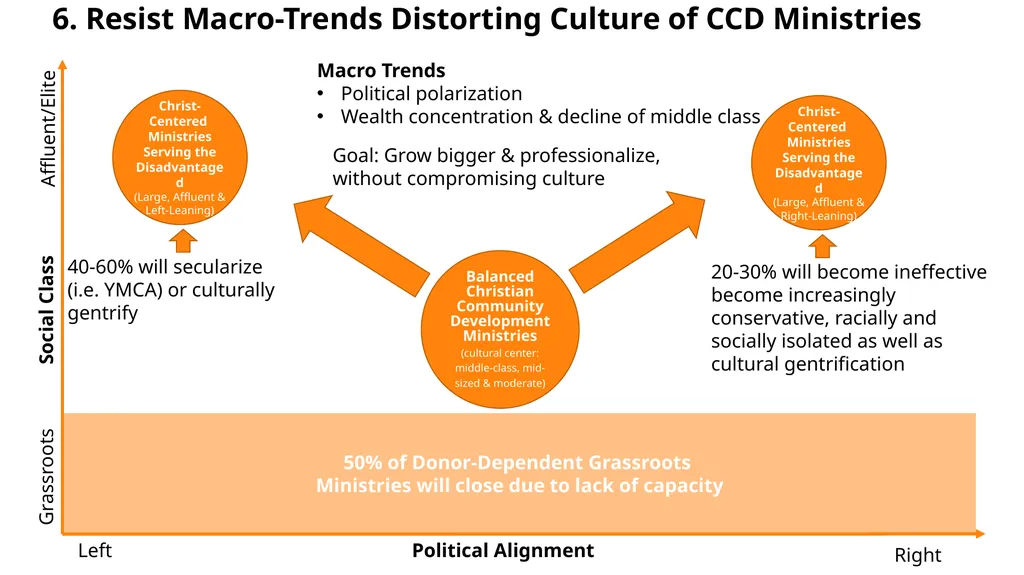
Affluent/Elite Social Class Left Right 6. Resist Macro-Trends Distorting Culture of CCD Ministries Political Alignment Grassroots Balanced Christian Community Development Ministries
(cultural center: middle-class, mid-sized & moderate) Christ-Centered
Ministries Serving the Disadvantaged
(Large, Affluent & Left-Leaning) Christ-Centered Ministries Serving the Disadvantaged
(Large, Affluent & Right-Leaning) Macro Trends
Political polarization
Wealth concentration & decline of middle class 50% of Donor-Dependent Grassroots Ministries will close due to lack of capacity Goal: Grow bigger & professionalize,
without compromising culture 20-30% will become ineffective become increasingly conservative, racially and socially isolated as well as cultural gentrification 40-60% will secularize (i.e. YMCA) or culturally gentrify<br>
37
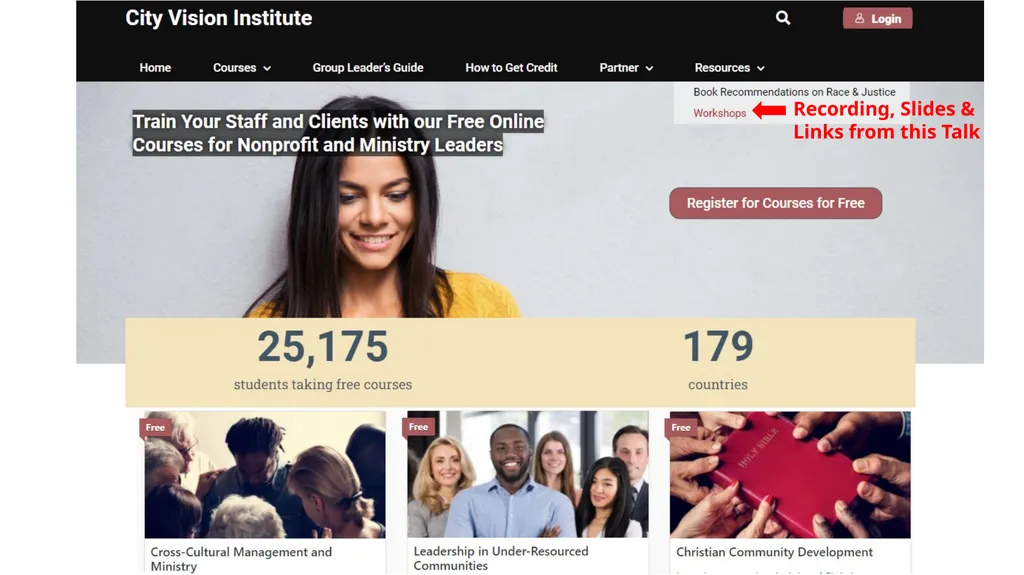
Recording, Slides &
Links from this Talk<br>
Links from this Talk<br>
38
Appendix<br>
39
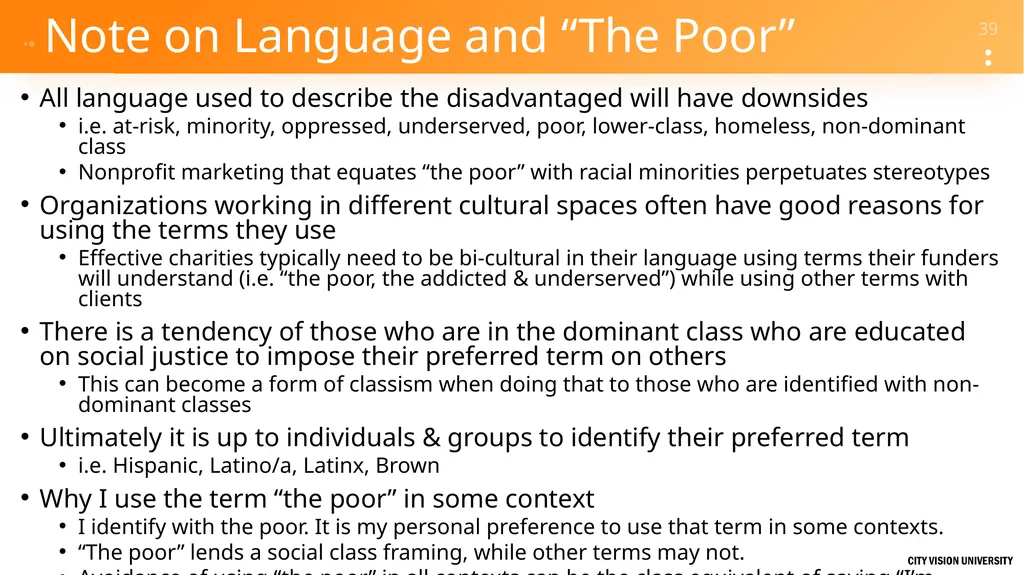
Note on Language and “The Poor” All language used to describe the disadvantaged will have downsides
i.e. at-risk, minority, oppressed, underserved, poor, lower-class, homeless, non-dominant class
Nonprofit marketing that equates “the poor” with racial minorities perpetuates stereotypes
Organizations working in different cultural spaces often have good reasons for using the terms they use
Effective charities typically need to be bi-cultural in their language using terms their funders will understand (i.e. “the poor, the addicted & underserved”) while using other terms with clients
There is a tendency of those who are in the dominant class who are educated on social justice to impose their preferred term on others
This can become a form of classism when doing that to those who are identified with non-dominant classes
Ultimately it is up to individuals & groups to identify their preferred term
i.e. Hispanic, Latino/a, Latinx, Brown
Why I use the term “the poor” in some context
I identify with the poor. It is my personal preference to use that term in some contexts.
“The poor” lends a social class framing, while other terms may not.
Avoidance of using “the poor” in all contexts can be the class equivalent of saying “I’m colorblind”
“The Poor” is used extensively in the Bible and has a very important specific definition<br>
40
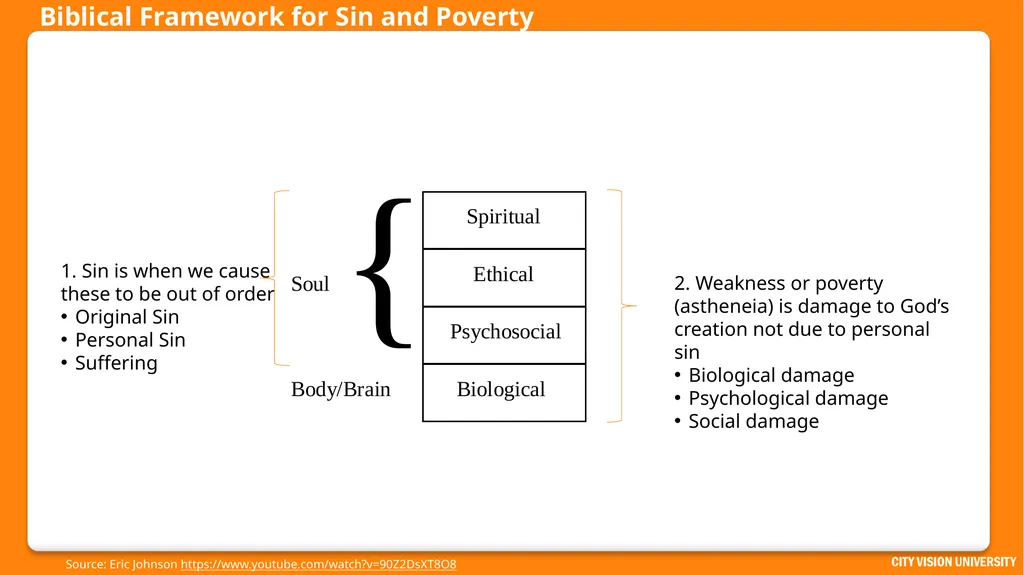
Biblical Framework for Sin and Poverty 1. Sin is when we cause
these to be out of order
Original Sin
Personal Sin
Suffering 2. Weakness or poverty (astheneia) is damage to God’s creation not due to personal sin
Biological damage
Psychological damage
Social damage Source: Eric Johnson https://www.youtube.com/watch?v=90Z2DsXT8O8<br>
Original Sin
Personal Sin
Suffering 2. Weakness or poverty (astheneia) is damage to God’s creation not due to personal sin
Biological damage
Psychological damage
Social damage Source: Eric Johnson https://www.youtube.com/watch?v=90Z2DsXT8O8<br>
41
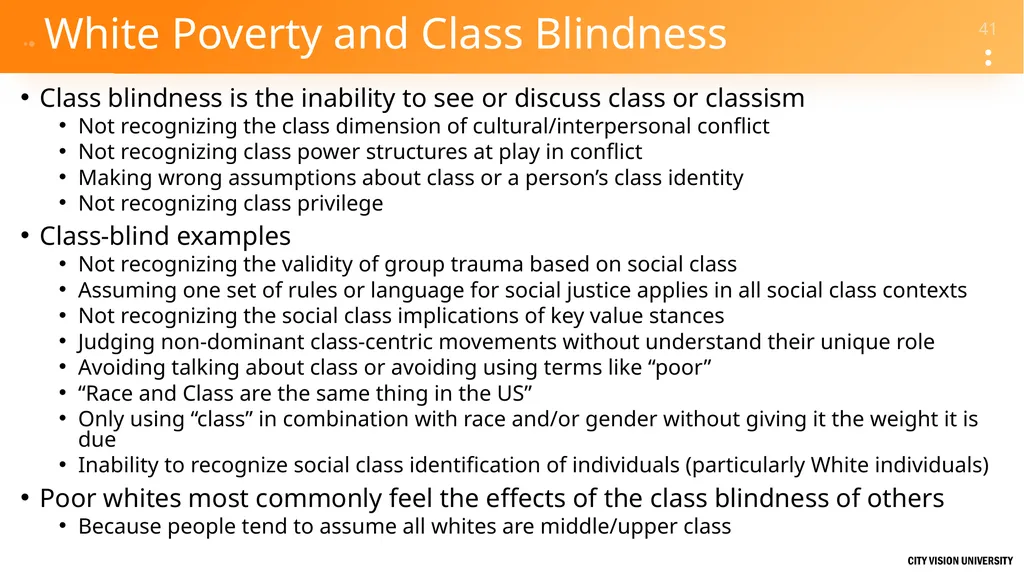
White Poverty and Class Blindness Class blindness is the inability to see or discuss class or classism
Not recognizing the class dimension of cultural/interpersonal conflict
Not recognizing class power structures at play in conflict
Making wrong assumptions about class or a person’s class identity
Not recognizing class privilege
Class-blind examples
Not recognizing the validity of group trauma based on social class
Assuming one set of rules or language for social justice applies in all social class contexts
Not recognizing the social class implications of key value stances
Judging non-dominant class-centric movements without understand their unique role
Avoiding talking about class or avoiding using terms like “poor”
“Race and Class are the same thing in the US”
Only using “class” in combination with race and/or gender without giving it the weight it is due
Inability to recognize social class identification of individuals (particularly White individuals)
Poor whites most commonly feel the effects of the class blindness of others
Because people tend to assume all whites are middle/upper class<br>
42
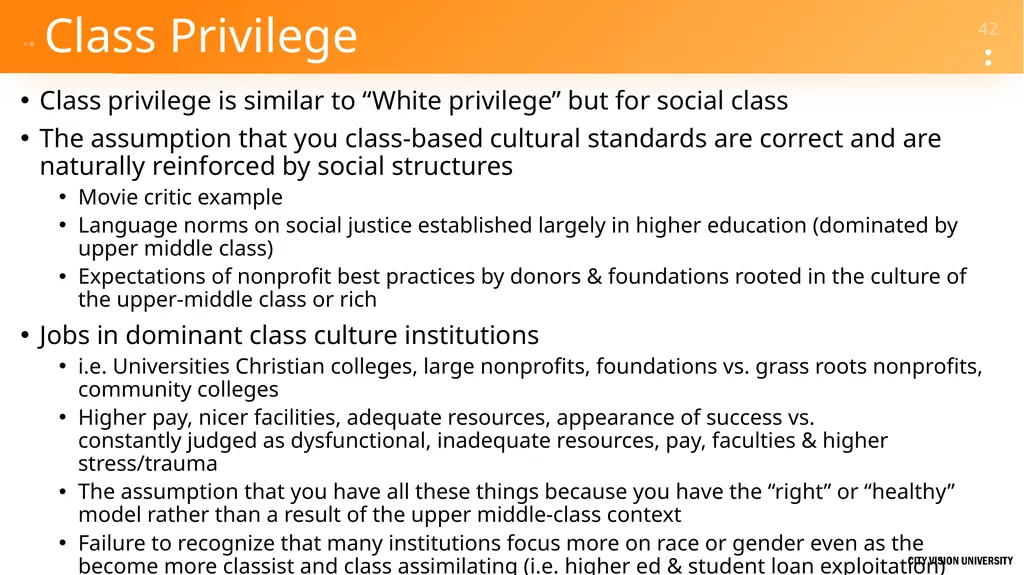
Class Privilege Class privilege is similar to “White privilege” but for social class
The assumption that you class-based cultural standards are correct and are naturally reinforced by social structures
Movie critic example
Language norms on social justice established largely in higher education (dominated by upper middle class)
Expectations of nonprofit best practices by donors & foundations rooted in the culture of the upper-middle class or rich
Jobs in dominant class culture institutions
i.e. Universities Christian colleges, large nonprofits, foundations vs. grass roots nonprofits, community colleges
Higher pay, nicer facilities, adequate resources, appearance of success vs. constantly judged as dysfunctional, inadequate resources, pay, faculties & higher stress/trauma
The assumption that you have all these things because you have the “right” or “healthy” model rather than a result of the upper middle-class context
Failure to recognize that many institutions focus more on race or gender even as the become more classist and class assimilating (i.e. higher ed & student loan exploitation)<br>
43
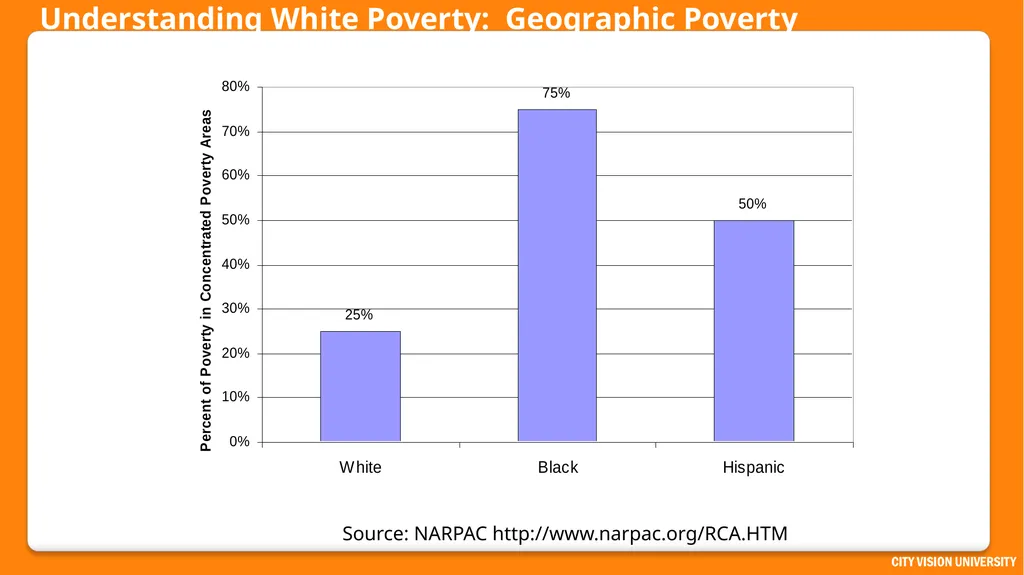
Understanding White Poverty: Geographic Poverty Concentration Source: NARPAC http://www.narpac.org/RCA.HTM<br>
44
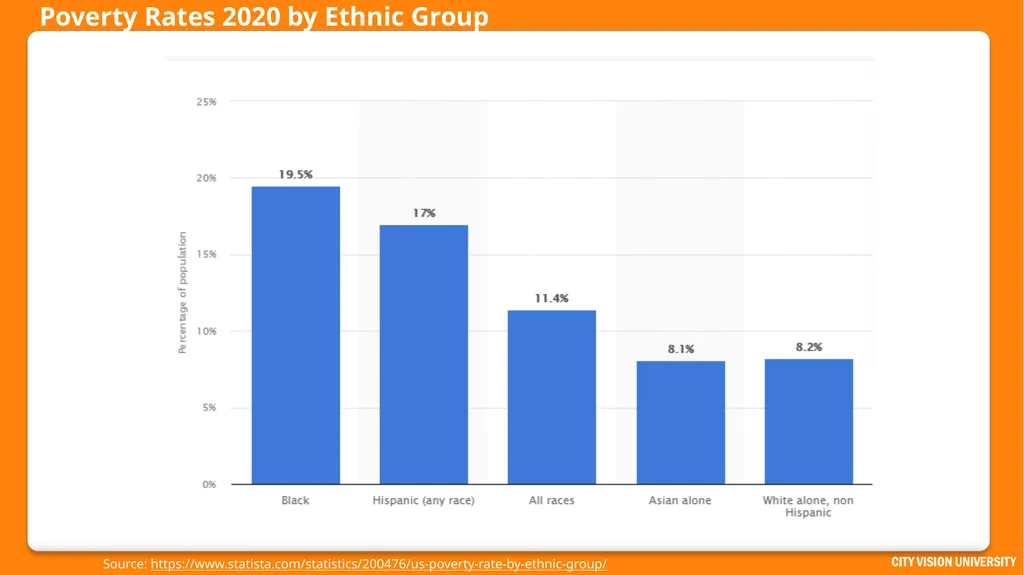
Poverty Rates 2020 by Ethnic Group Source: https://www.statista.com/statistics/200476/us-poverty-rate-by-ethnic-group/<br>
45
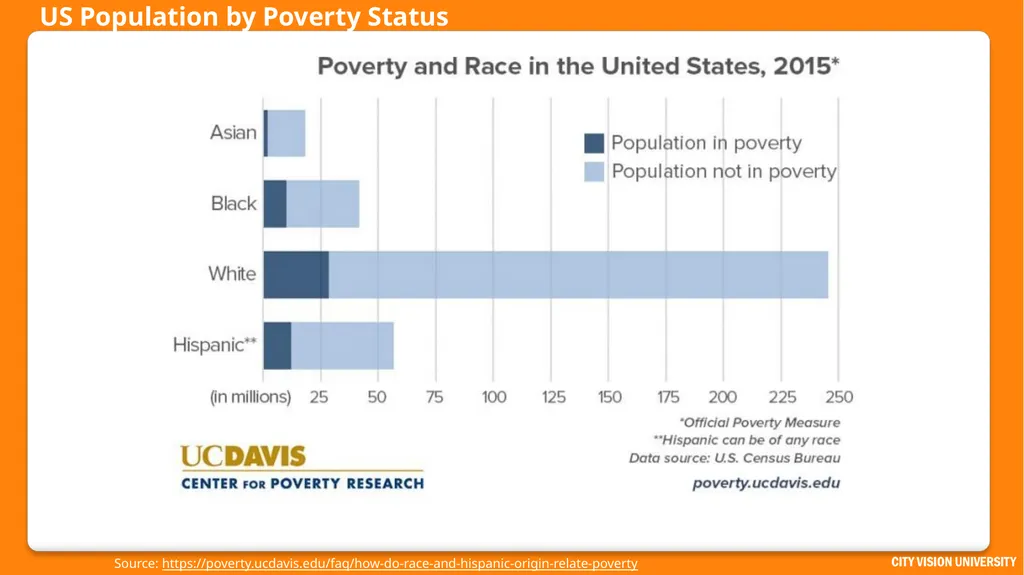
US Population by Poverty Status Source: https://poverty.ucdavis.edu/faq/how-do-race-and-hispanic-origin-relate-poverty<br>
46
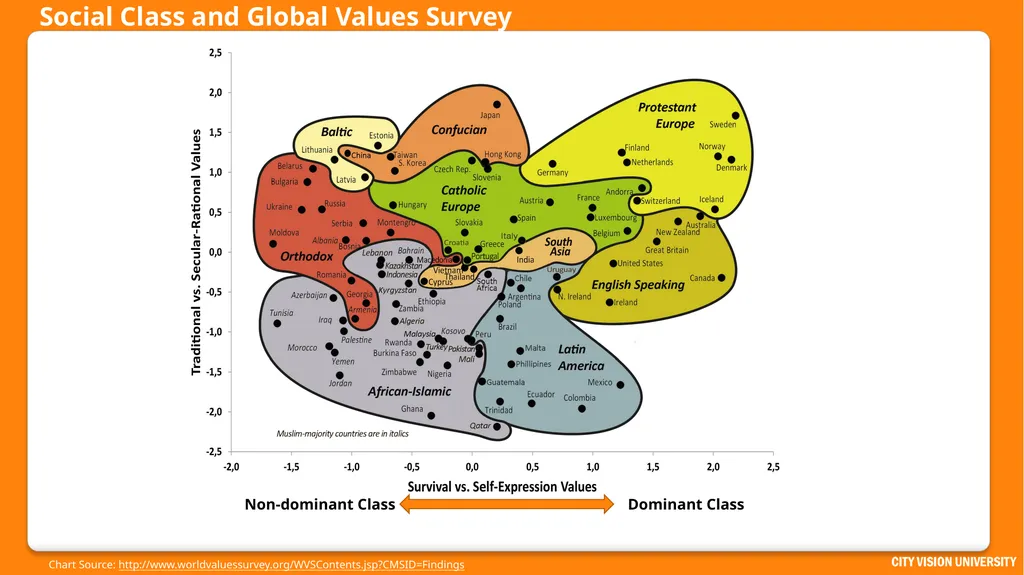
Social Class and Global Values Survey Non-dominant Class Dominant Class Chart Source: http://www.worldvaluessurvey.org/WVSContents.jsp?CMSID=Findings<br>
47
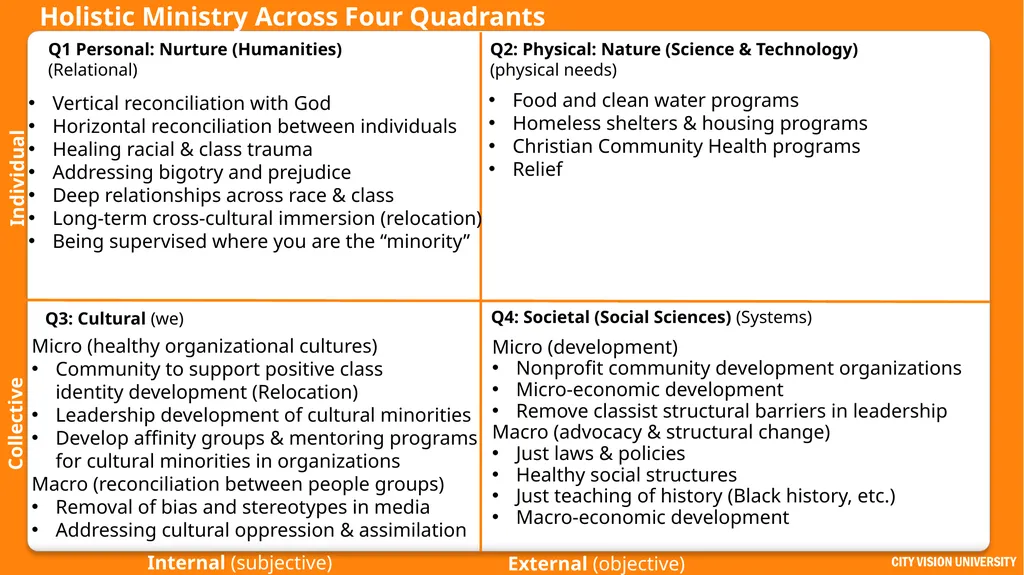
Q1 Personal: Nurture (Humanities)
(Relational) Q2: Physical: Nature (Science & Technology)
(physical needs) Q3: Cultural (we) Q4: Societal (Social Sciences) (Systems) Individual Collective Internal (subjective) External (objective) Micro (healthy organizational cultures)
Community to support positive class identity development (Relocation)
Leadership development of cultural minorities
Develop affinity groups & mentoring programs for cultural minorities in organizations
Macro (reconciliation between people groups)
Removal of bias and stereotypes in media
Addressing cultural oppression & assimilation Micro (development)
Nonprofit community development organizations
Micro-economic development
Remove classist structural barriers in leadership
Macro (advocacy & structural change)
Just laws & policies
Healthy social structures
Just teaching of history (Black history, etc.)
Macro-economic development Vertical reconciliation with God
Horizontal reconciliation between individuals
Healing racial & class trauma
Addressing bigotry and prejudice
Deep relationships across race & class
Long-term cross-cultural immersion (relocation)
Being supervised where you are the “minority” Holistic Ministry Across Four Quadrants Food and clean water programs
Homeless shelters & housing programs
Christian Community Health programs
Relief<br>
48
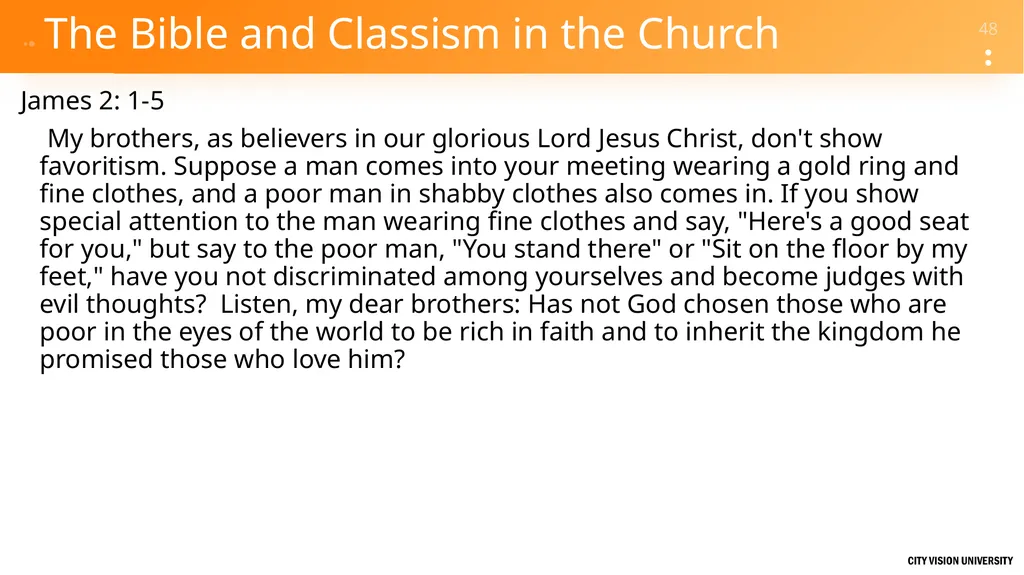
The Bible and Classism in the Church James 2: 1-5
My brothers, as believers in our glorious Lord Jesus Christ, don't show favoritism. Suppose a man comes into your meeting wearing a gold ring and fine clothes, and a poor man in shabby clothes also comes in. If you show special attention to the man wearing fine clothes and say, "Here's a good seat for you," but say to the poor man, "You stand there" or "Sit on the floor by my feet," have you not discriminated among yourselves and become judges with evil thoughts? Listen, my dear brothers: Has not God chosen those who are poor in the eyes of the world to be rich in faith and to inherit the kingdom he promised those who love him?<br>
My brothers, as believers in our glorious Lord Jesus Christ, don't show favoritism. Suppose a man comes into your meeting wearing a gold ring and fine clothes, and a poor man in shabby clothes also comes in. If you show special attention to the man wearing fine clothes and say, "Here's a good seat for you," but say to the poor man, "You stand there" or "Sit on the floor by my feet," have you not discriminated among yourselves and become judges with evil thoughts? Listen, my dear brothers: Has not God chosen those who are poor in the eyes of the world to be rich in faith and to inherit the kingdom he promised those who love him?<br>
49
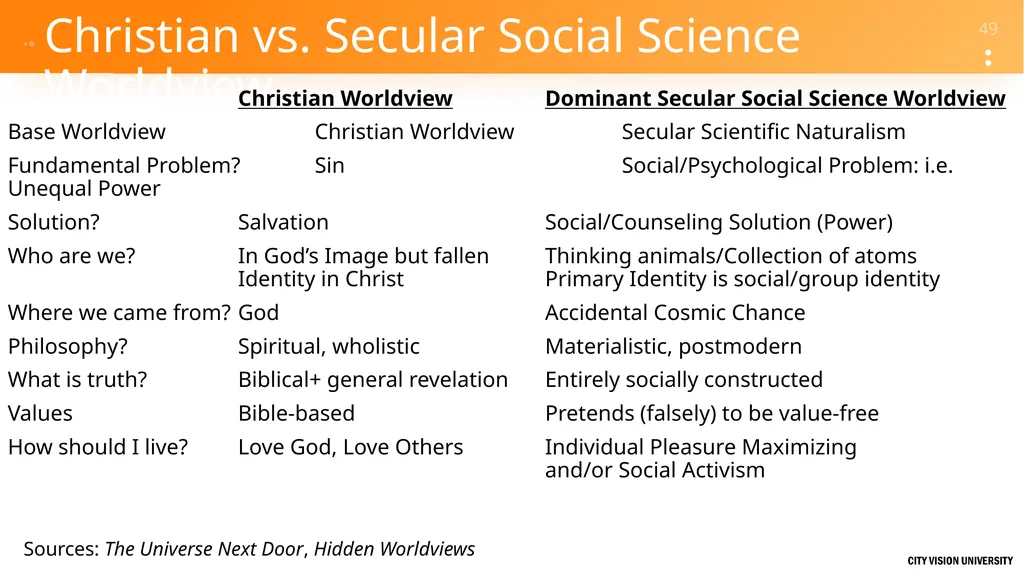
Christian vs. Secular Social Science Worldview Christian Worldview Dominant Secular Social Science Worldview
Base Worldview Christian Worldview Secular Scientific Naturalism
Fundamental Problem? Sin Social/Psychological Problem: i.e. Unequal Power
Solution? Salvation Social/Counseling Solution (Power)
Who are we? In God’s Image but fallen Thinking animals/Collection of atoms Identity in Christ Primary Identity is social/group identity
Where we came from? God Accidental Cosmic Chance
Philosophy? Spiritual, wholistic Materialistic, postmodern
What is truth? Biblical+ general revelation Entirely socially constructed
Values Bible-based Pretends (falsely) to be value-free
How should I live? Love God, Love Others Individual Pleasure Maximizing and/or Social Activism Sources: The Universe Next Door, Hidden Worldviews<br>
50
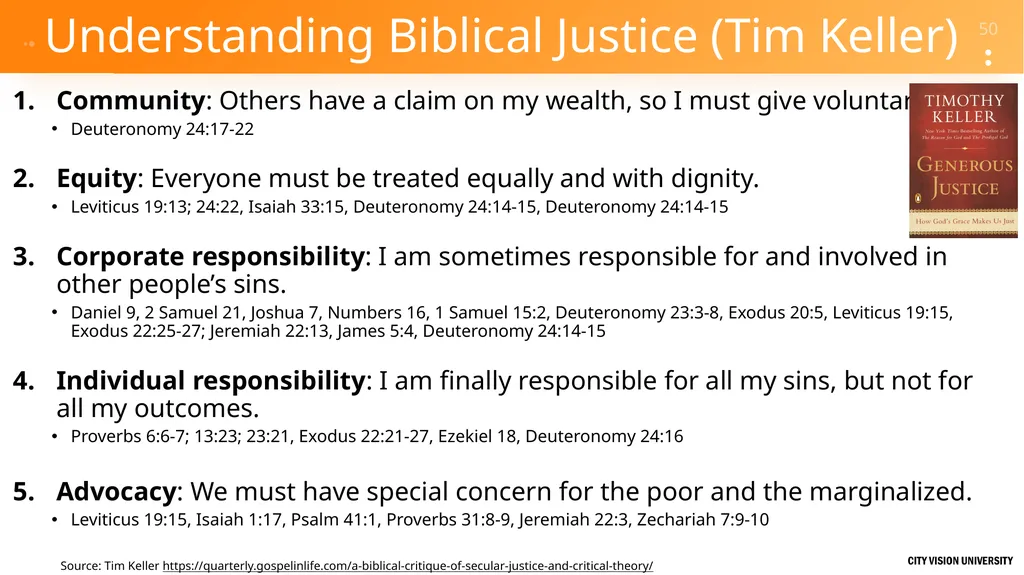
Understanding Biblical Justice (Tim Keller) Community: Others have a claim on my wealth, so I must give voluntarily.
Deuteronomy 24:17-22
Equity: Everyone must be treated equally and with dignity.
Leviticus 19:13; 24:22, Isaiah 33:15, Deuteronomy 24:14-15, Deuteronomy 24:14-15
Corporate responsibility: I am sometimes responsible for and involved in other people’s sins.
Daniel 9, 2 Samuel 21, Joshua 7, Numbers 16, 1 Samuel 15:2, Deuteronomy 23:3-8, Exodus 20:5, Leviticus 19:15, Exodus 22:25-27; Jeremiah 22:13, James 5:4, Deuteronomy 24:14-15
Individual responsibility: I am finally responsible for all my sins, but not for all my outcomes.
Proverbs 6:6-7; 13:23; 23:21, Exodus 22:21-27, Ezekiel 18, Deuteronomy 24:16
Advocacy: We must have special concern for the poor and the marginalized.
Leviticus 19:15, Isaiah 1:17, Psalm 41:1, Proverbs 31:8-9, Jeremiah 22:3, Zechariah 7:9-10 Source: Tim Keller https://quarterly.gospelinlife.com/a-biblical-critique-of-secular-justice-and-critical-theory/<br>
51
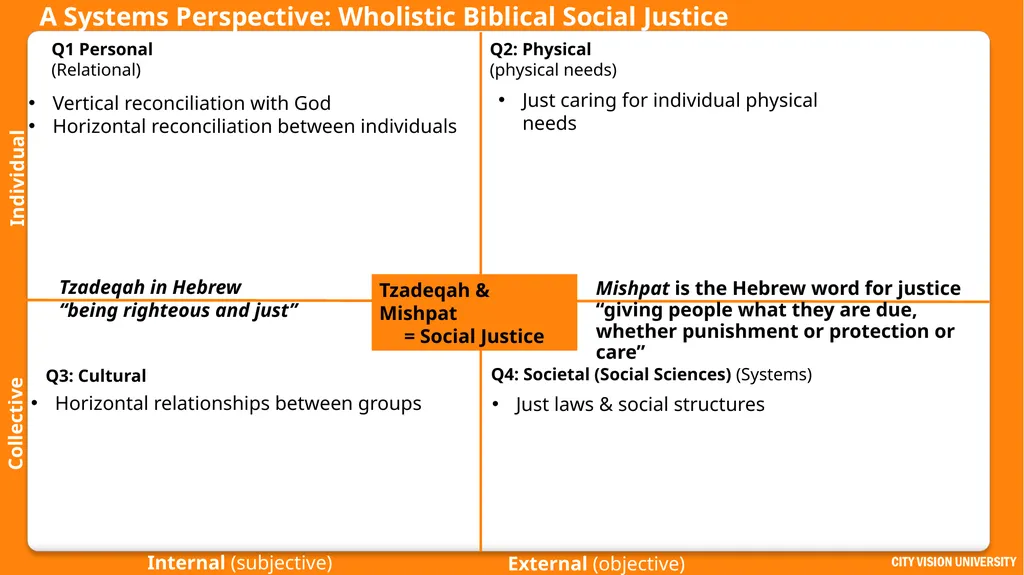
Q1 Personal
(Relational) Q2: Physical (physical needs) Q3: Cultural Q4: Societal (Social Sciences) (Systems) Individual Collective Internal (subjective) External (objective) Horizontal relationships between groups Just laws & social structures Vertical reconciliation with God
Horizontal reconciliation between individuals A Systems Perspective: Wholistic Biblical Social Justice Just caring for individual physical needs Mishpat is the Hebrew word for justice “giving people what they are due, whether punishment or protection or care” Tzadeqah in Hebrew
“being righteous and just” Tzadeqah & Mishpat
= Social Justice<br>