
Recovery Considerations 3 weeks – 3 months 3 Weeks
AM
Published · 20 slides · 0 views

1 / 1



Description
Recovery Considerations 3 weeks 3 months 3 Weeks Post Disaster - Recovery Arrangements have been activated A Natural Disaster Declaration for the LGAs of XXX has been made. A Recovery Committee has been established. The relevant Relief
Related Topics
Share
Embed code
Download this presentation From Below
"Recovery Considerations 3 weeks – 3 months 3 Weeks" is the property of its rightful owner. Permission is granted to download and print the materials on this website for personal, non-commercial use only, and to display it on your personal computer provided you do not modify the materials and that you retain all copyright notices contained in the materials. By downloading content from our website, you accept the terms of this agreement.
Presentation Transcript
01
Recovery Considerations
3 weeks – 3 months<br>
02
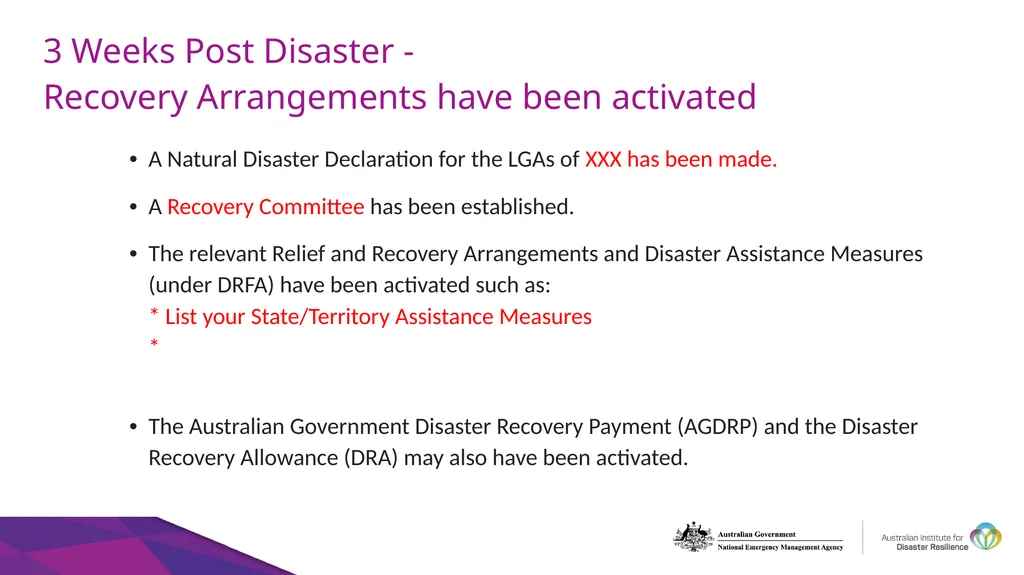
3 Weeks Post Disaster -
Recovery Arrangements have been activated A Natural Disaster Declaration for the LGAs of XXX has been made.
A Recovery Committee has been established.
The relevant Relief and Recovery Arrangements and Disaster Assistance Measures (under DRFA) have been activated such as: * List your State/Territory Assistance Measures *
The Australian Government Disaster Recovery Payment (AGDRP) and the Disaster Recovery Allowance (DRA) may also have been activated.<br>
A Recovery Committee has been established.
The relevant Relief and Recovery Arrangements and Disaster Assistance Measures (under DRFA) have been activated such as: * List your State/Territory Assistance Measures *
The Australian Government Disaster Recovery Payment (AGDRP) and the Disaster Recovery Allowance (DRA) may also have been activated.<br>
03
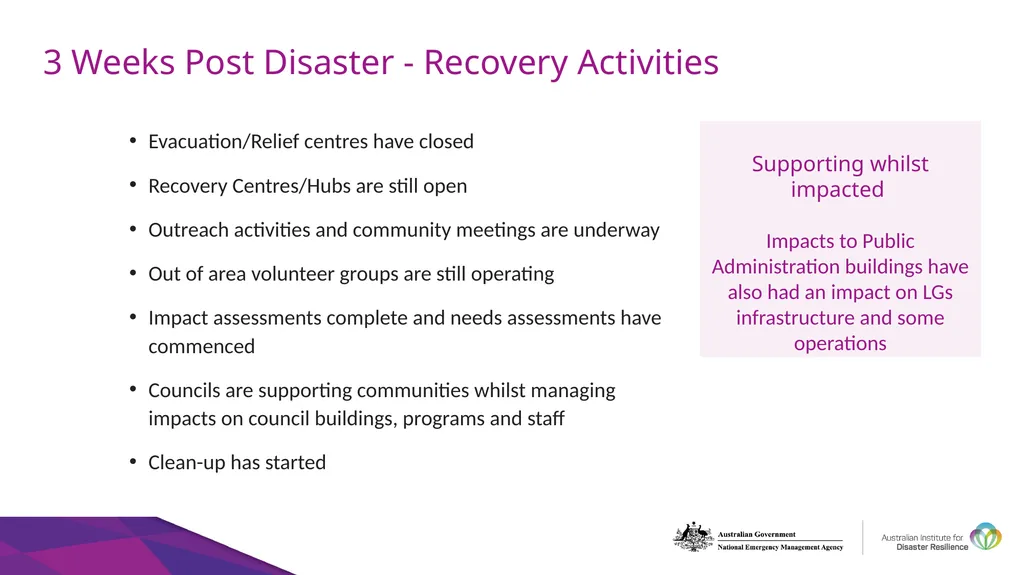
3 Weeks Post Disaster - Recovery Activities Evacuation/Relief centres have closed
Recovery Centres/Hubs are still open
Outreach activities and community meetings are underway
Out of area volunteer groups are still operating
Impact assessments complete and needs assessments have commenced
Councils are supporting communities whilst managing impacts on council buildings, programs and staff
Clean-up has started Supporting whilst impacted
Impacts to Public Administration buildings have also had an impact on LGs infrastructure and some operations<br>
Recovery Centres/Hubs are still open
Outreach activities and community meetings are underway
Out of area volunteer groups are still operating
Impact assessments complete and needs assessments have commenced
Councils are supporting communities whilst managing impacts on council buildings, programs and staff
Clean-up has started Supporting whilst impacted
Impacts to Public Administration buildings have also had an impact on LGs infrastructure and some operations<br>
04
What is happening in the community at 3 weeks Local organisations are likely to be overwhelmed with donated goods
Numbers of volunteers will start to taper off, even though there is still much to do
People are beginning to return to work and schools are reopening
Insurance assessments are underway
Information starting to come through about appeal funds and grants
Media attention is starting to shift away from the disaster<br>
Numbers of volunteers will start to taper off, even though there is still much to do
People are beginning to return to work and schools are reopening
Insurance assessments are underway
Information starting to come through about appeal funds and grants
Media attention is starting to shift away from the disaster<br>
05
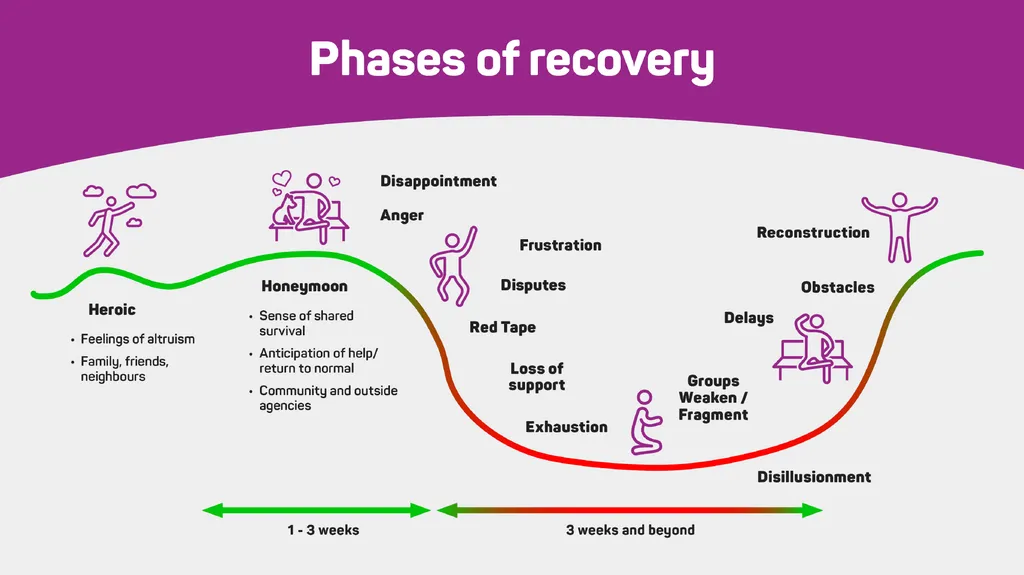
Around 3 weeks is when people begin to recognise the long-term consequences
of what has happened, rather than just the immediate impacts.
Levels of adrenalin will be subsiding and fatigue setting in.
This is true not just for disaster affected community members, but also for recovery workers, volunteers and council staff.<br>
Levels of adrenalin will be subsiding and fatigue setting in.
This is true not just for disaster affected community members, but also for recovery workers, volunteers and council staff.<br>
06
Housing - What is happening now? People staying in informal accommodation arrangements with family and friends
Emergency housing arrangements are coming to an end
Insurance assessments and claims are commencing
High demand for local temporary accommodation, with some forced to move out, or not able return to the area
Some choosing to live in homes deemed uninhabitable
Shortage of tradespeople and building supplies for home repairs.
Housing stress is high and pre-existing homelessness and vulnerability is exacerbated Many homes remain uninhabitable<br>
Emergency housing arrangements are coming to an end
Insurance assessments and claims are commencing
High demand for local temporary accommodation, with some forced to move out, or not able return to the area
Some choosing to live in homes deemed uninhabitable
Shortage of tradespeople and building supplies for home repairs.
Housing stress is high and pre-existing homelessness and vulnerability is exacerbated Many homes remain uninhabitable<br>
07
Community infrastructure - What is happening now? Community groups will be trying to clean up and/or operate from damaged venues and source funding for repairs
Community facilities still being used as recovery centres or donation hubs
Ongoing community service delivery and normal activities may be still be impacted whilst surge effort required
Annual major community events and festivals may have been cancelled. Community Infrastructure<br>
Community facilities still being used as recovery centres or donation hubs
Ongoing community service delivery and normal activities may be still be impacted whilst surge effort required
Annual major community events and festivals may have been cancelled. Community Infrastructure<br>
08
Infrastructure - What is happening now? Utilities have been repaired but not necessarily fully restored
Essential services might be connected at trunk lines, but individual household connections not restored
Critical infrastructure and transport routes are operating with emergency works
Some regional/local roads remain closed
Disruptions to transporting supplies into communities with some roads/bridges impassable or load limited
Planning for full restoration and reconstruction is starting
Clean-up of household, business and environmental debris is underway<br>
Essential services might be connected at trunk lines, but individual household connections not restored
Critical infrastructure and transport routes are operating with emergency works
Some regional/local roads remain closed
Disruptions to transporting supplies into communities with some roads/bridges impassable or load limited
Planning for full restoration and reconstruction is starting
Clean-up of household, business and environmental debris is underway<br>
09
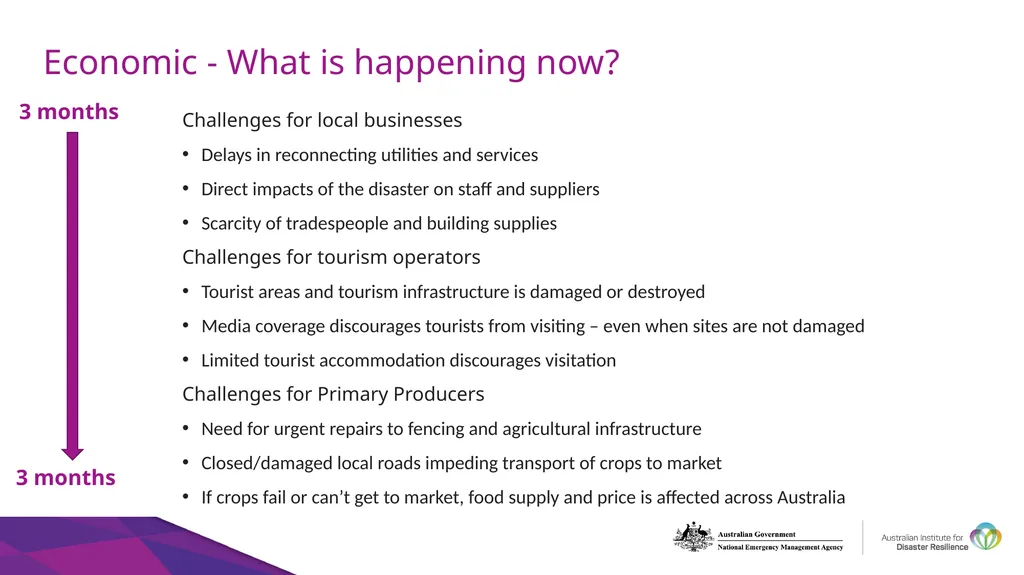
Economic - What is happening now? Challenges for local businesses
Delays in reconnecting utilities and services
Direct impacts of the disaster on staff and suppliers
Scarcity of tradespeople and building supplies
Challenges for tourism operators
Tourist areas and tourism infrastructure is damaged or destroyed
Media coverage discourages tourists from visiting – even when sites are not damaged
Limited tourist accommodation discourages visitation
Challenges for Primary Producers
Need for urgent repairs to fencing and agricultural infrastructure
Closed/damaged local roads impeding transport of crops to market
If crops fail or can’t get to market, food supply and price is affected across Australia<br>
Delays in reconnecting utilities and services
Direct impacts of the disaster on staff and suppliers
Scarcity of tradespeople and building supplies
Challenges for tourism operators
Tourist areas and tourism infrastructure is damaged or destroyed
Media coverage discourages tourists from visiting – even when sites are not damaged
Limited tourist accommodation discourages visitation
Challenges for Primary Producers
Need for urgent repairs to fencing and agricultural infrastructure
Closed/damaged local roads impeding transport of crops to market
If crops fail or can’t get to market, food supply and price is affected across Australia<br>
10
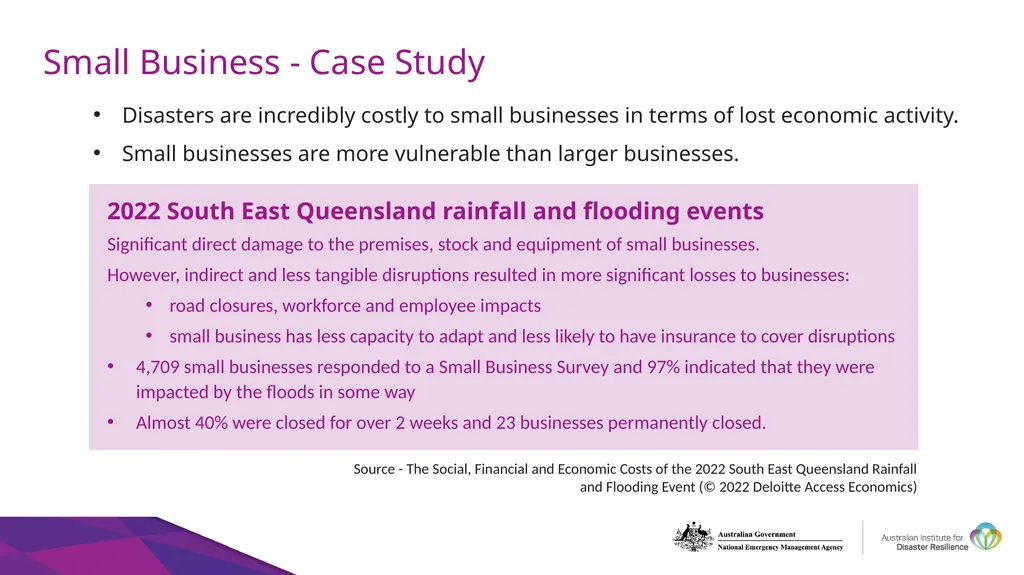
Small Business - Case Study Source - The Social, Financial and Economic Costs of the 2022 South East Queensland Rainfall and Flooding Event (© 2022 Deloitte Access Economics) 2022 South East Queensland rainfall and flooding events
Significant direct damage to the premises, stock and equipment of small businesses.
However, indirect and less tangible disruptions resulted in more significant losses to businesses:
road closures, workforce and employee impacts
small business has less capacity to adapt and less likely to have insurance to cover disruptions
4,709 small businesses responded to a Small Business Survey and 97% indicated that they were impacted by the floods in some way
Almost 40% were closed for over 2 weeks and 23 businesses permanently closed. Disasters are incredibly costly to small businesses in terms of lost economic activity.
Small businesses are more vulnerable than larger businesses.<br>
Significant direct damage to the premises, stock and equipment of small businesses.
However, indirect and less tangible disruptions resulted in more significant losses to businesses:
road closures, workforce and employee impacts
small business has less capacity to adapt and less likely to have insurance to cover disruptions
4,709 small businesses responded to a Small Business Survey and 97% indicated that they were impacted by the floods in some way
Almost 40% were closed for over 2 weeks and 23 businesses permanently closed. Disasters are incredibly costly to small businesses in terms of lost economic activity.
Small businesses are more vulnerable than larger businesses.<br>
11
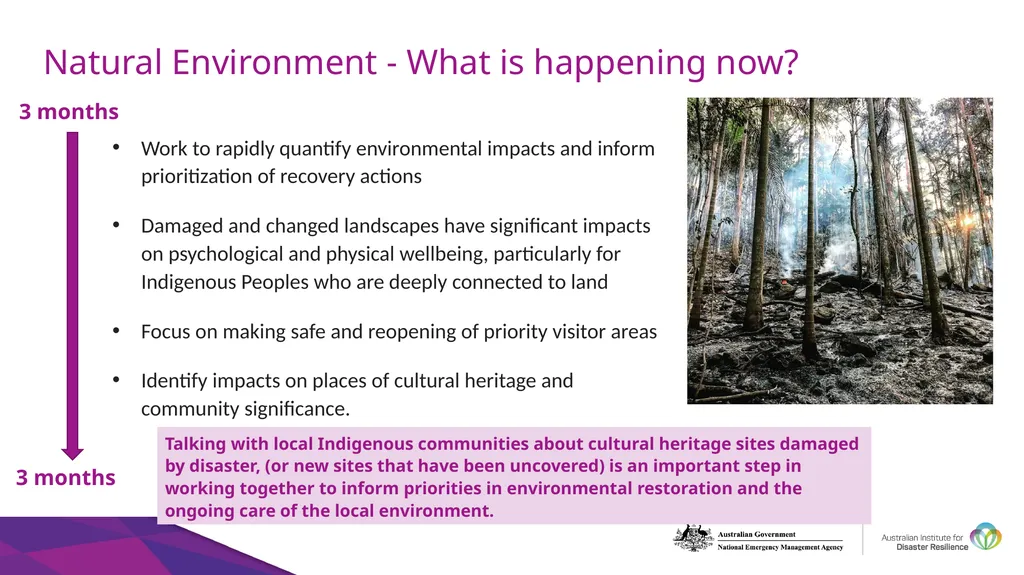
Natural Environment - What is happening now? Work to rapidly quantify environmental impacts and inform prioritization of recovery actions
Damaged and changed landscapes have significant impacts on psychological and physical wellbeing, particularly for Indigenous Peoples who are deeply connected to land
Focus on making safe and reopening of priority visitor areas
Identify impacts on places of cultural heritage and community significance. Talking with local Indigenous communities about cultural heritage sites damaged by disaster, (or new sites that have been uncovered) is an important step in working together to inform priorities in environmental restoration and the ongoing care of the local environment.<br>
Damaged and changed landscapes have significant impacts on psychological and physical wellbeing, particularly for Indigenous Peoples who are deeply connected to land
Focus on making safe and reopening of priority visitor areas
Identify impacts on places of cultural heritage and community significance. Talking with local Indigenous communities about cultural heritage sites damaged by disaster, (or new sites that have been uncovered) is an important step in working together to inform priorities in environmental restoration and the ongoing care of the local environment.<br>
12
What is happening in the community at 3 months? The early recovery support for the community is winding down
The majority of volunteers have left, even though there is still much to do
Media attention has moved on, risk that communities may start to feel ‘forgotten’ by the wider world
Payment of grants and appeal funds has begun, ineligibility can cause distress and create community tensions
Decisions around “remain, relocate or return” are being made
Emergence of mental health, drug and alcohol, domestic violence and relationship breakdown issues<br>
The majority of volunteers have left, even though there is still much to do
Media attention has moved on, risk that communities may start to feel ‘forgotten’ by the wider world
Payment of grants and appeal funds has begun, ineligibility can cause distress and create community tensions
Decisions around “remain, relocate or return” are being made
Emergence of mental health, drug and alcohol, domestic violence and relationship breakdown issues<br>
13
At 3 months the needs of the community can be even greater than when the disaster first hit.
Plan early for an increase in the demand for support and services.<br>
Plan early for an increase in the demand for support and services.<br>
14
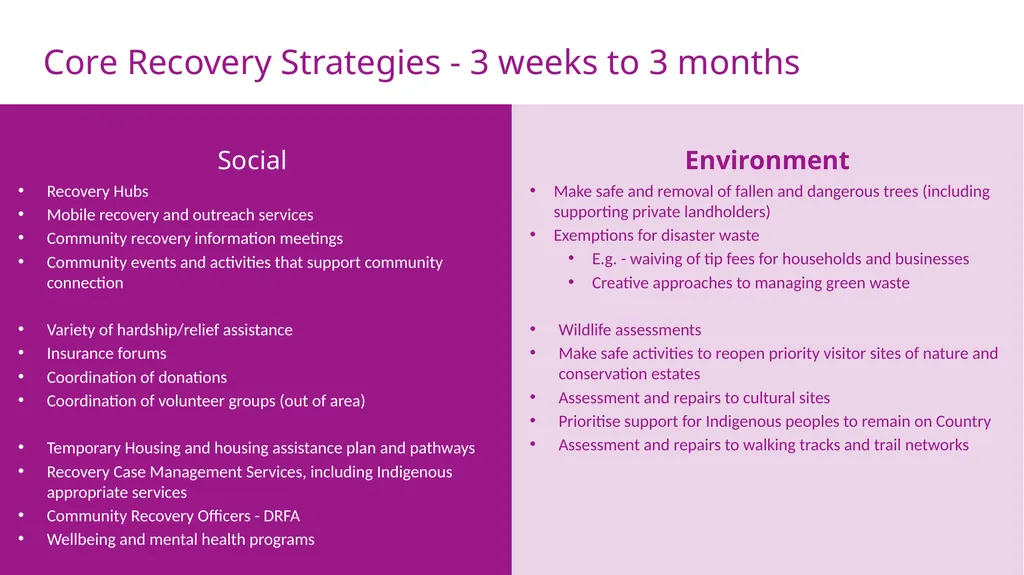
Core Recovery Strategies - 3 weeks to 3 months Social
Recovery Hubs
Mobile recovery and outreach services
Community recovery information meetings
Community events and activities that support community connection
Variety of hardship/relief assistance
Insurance forums
Coordination of donations
Coordination of volunteer groups (out of area)
Temporary Housing and housing assistance plan and pathways
Recovery Case Management Services, including Indigenous appropriate services
Community Recovery Officers - DRFA
Wellbeing and mental health programs Environment
Make safe and removal of fallen and dangerous trees (including supporting private landholders)
Exemptions for disaster waste
E.g. - waiving of tip fees for households and businesses
Creative approaches to managing green waste
Wildlife assessments
Make safe activities to reopen priority visitor sites of nature and conservation estates
Assessment and repairs to cultural sites
Prioritise support for Indigenous peoples to remain on Country
Assessment and repairs to walking tracks and trail networks<br>
Recovery Hubs
Mobile recovery and outreach services
Community recovery information meetings
Community events and activities that support community connection
Variety of hardship/relief assistance
Insurance forums
Coordination of donations
Coordination of volunteer groups (out of area)
Temporary Housing and housing assistance plan and pathways
Recovery Case Management Services, including Indigenous appropriate services
Community Recovery Officers - DRFA
Wellbeing and mental health programs Environment
Make safe and removal of fallen and dangerous trees (including supporting private landholders)
Exemptions for disaster waste
E.g. - waiving of tip fees for households and businesses
Creative approaches to managing green waste
Wildlife assessments
Make safe activities to reopen priority visitor sites of nature and conservation estates
Assessment and repairs to cultural sites
Prioritise support for Indigenous peoples to remain on Country
Assessment and repairs to walking tracks and trail networks<br>
15
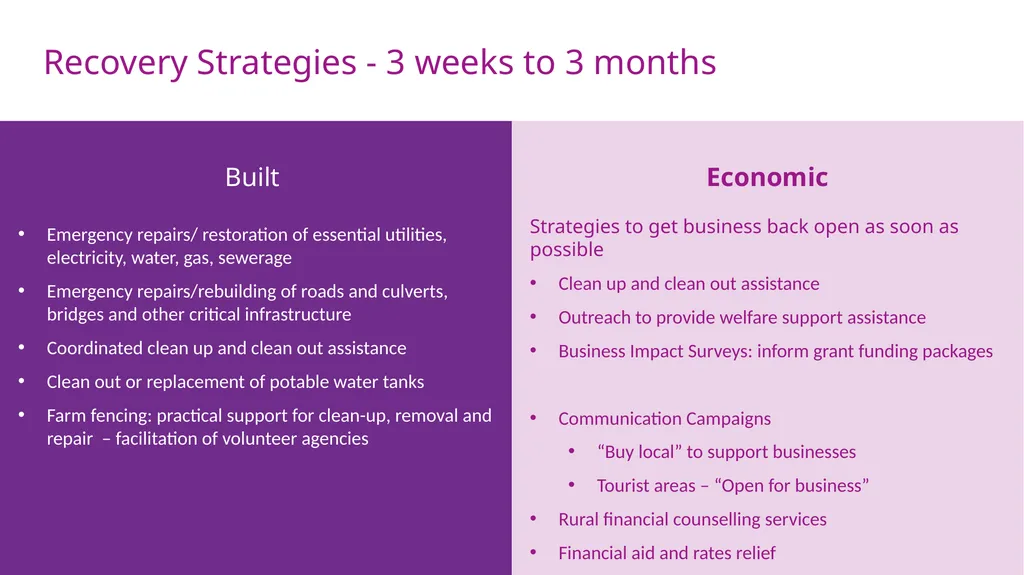
Recovery Strategies - 3 weeks to 3 months Economic
Strategies to get business back open as soon as possible
Clean up and clean out assistance
Outreach to provide welfare support assistance
Business Impact Surveys: inform grant funding packages
Communication Campaigns
“Buy local” to support businesses
Tourist areas – “Open for business”
Rural financial counselling services
Financial aid and rates relief Built
Emergency repairs/ restoration of essential utilities, electricity, water, gas, sewerage
Emergency repairs/rebuilding of roads and culverts, bridges and other critical infrastructure
Coordinated clean up and clean out assistance
Clean out or replacement of potable water tanks
Farm fencing: practical support for clean-up, removal and repair – facilitation of volunteer agencies<br>
Strategies to get business back open as soon as possible
Clean up and clean out assistance
Outreach to provide welfare support assistance
Business Impact Surveys: inform grant funding packages
Communication Campaigns
“Buy local” to support businesses
Tourist areas – “Open for business”
Rural financial counselling services
Financial aid and rates relief Built
Emergency repairs/ restoration of essential utilities, electricity, water, gas, sewerage
Emergency repairs/rebuilding of roads and culverts, bridges and other critical infrastructure
Coordinated clean up and clean out assistance
Clean out or replacement of potable water tanks
Farm fencing: practical support for clean-up, removal and repair – facilitation of volunteer agencies<br>
16
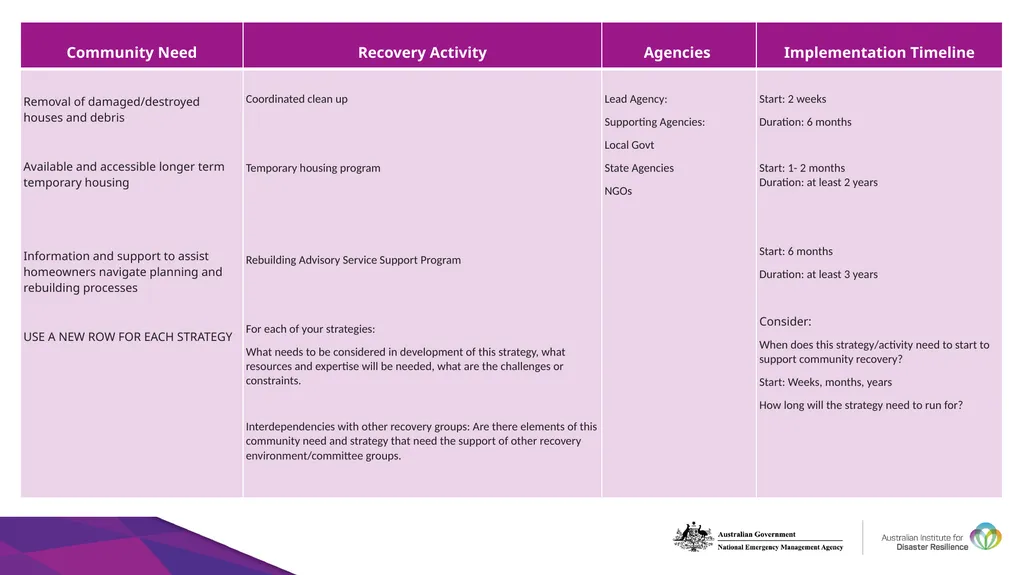
3 weeks – 3 months Considering the community consequences and emerging issues at this stage of recovery:
What are the priority planning actions in response to these issues?
Which organisations/representatives do you need on, or linked to your recovery subcommittee?<br>
What are the priority planning actions in response to these issues?
Which organisations/representatives do you need on, or linked to your recovery subcommittee?<br>