Rectifiers Half wave and Full wave rectifiers Lecturer: Qusay H Ali Electromechanical System Code: ME 219 Semester No: 3 Week No: 1 Alternating current (AC): Alternating current (AC) describes the flow of charge that changes direction
"Rectifiers Half wave and Full wave rectifiers" is the property of its rightful owner. Permission is granted to
download and print the materials on this website for personal, non-commercial use only, and to display it
on your personal computer provided you do not modify the materials and that you retain all copyright
notices contained in the materials. By downloading content from our website, you accept the terms of this
agreement.
Presentation Transcript
01
Rectifiers Half wave and Full wave rectifiers Lecturer: Qusay H Ali
Electromechanical System
Code: ME 219
Semester No: 3
Week No:<br>
02
1 Alternating current (AC):
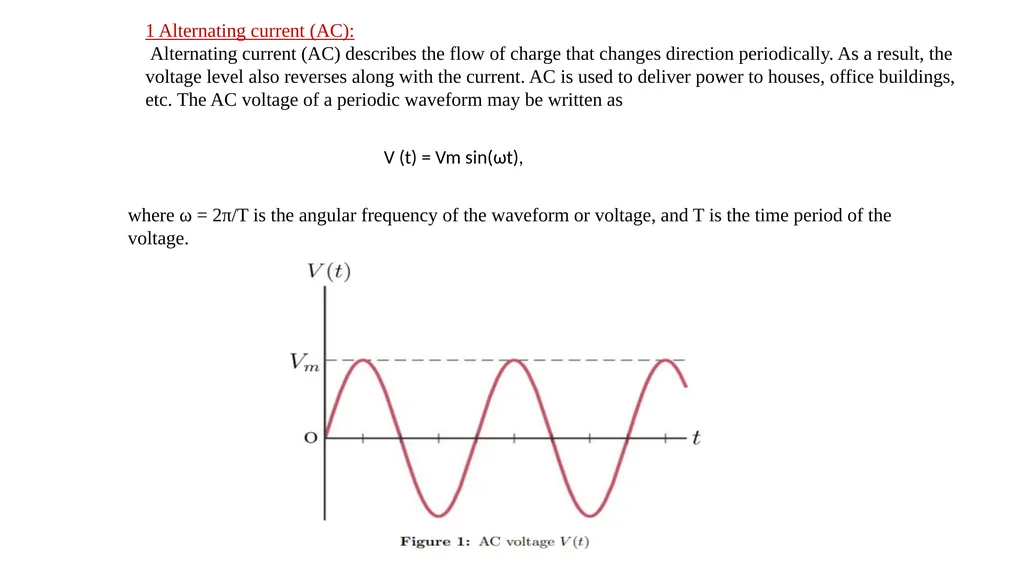
Alternating current (AC) describes the flow of charge that changes direction periodically. As a result, the voltage level also reverses along with the current. AC is used to deliver power to houses, office buildings, etc. The AC voltage of a periodic waveform may be written as V (t) = Vm sin(ωt), where ω = 2π/T is the angular frequency of the waveform or voltage, and T is the time period of the voltage.<br>
03
Average voltage over the time period
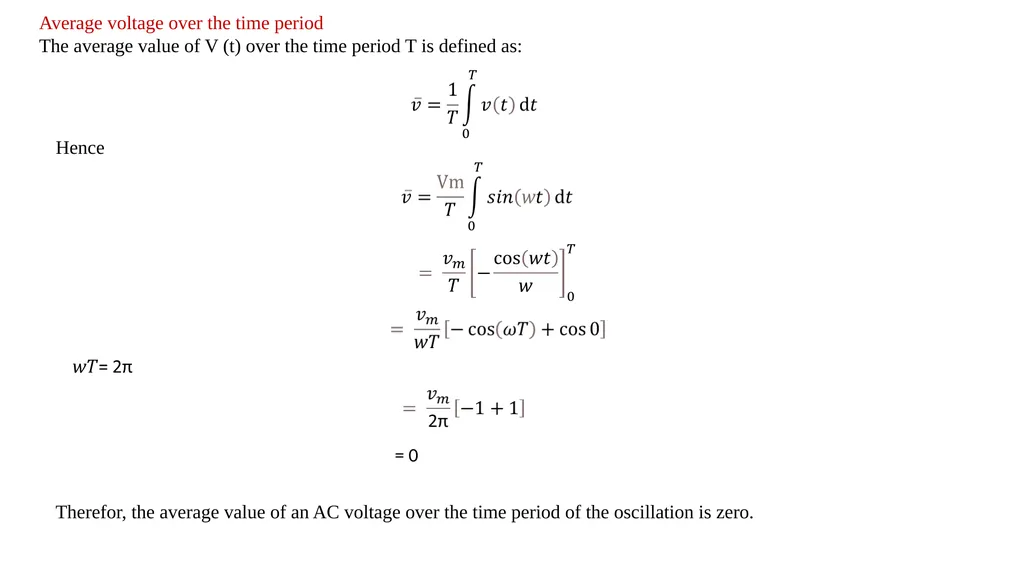
The average value of V (t) over the time period T is defined as: Hence = 0 Therefor, the average value of an AC voltage over the time period of the oscillation is zero.<br>
04
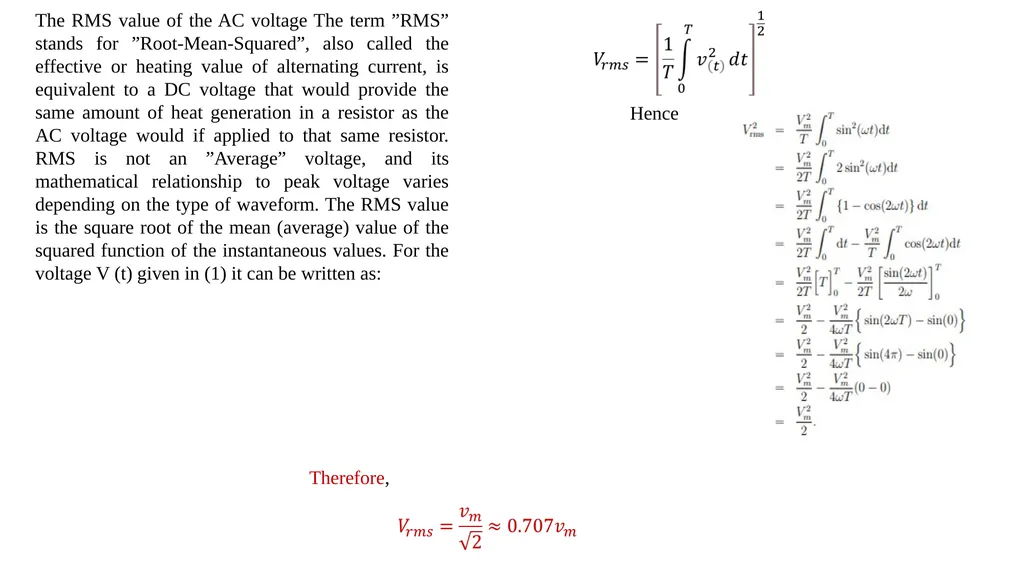
The RMS value of the AC voltage The term ”RMS” stands for ”Root-Mean-Squared”, also called the effective or heating value of alternating current, is equivalent to a DC voltage that would provide the same amount of heat generation in a resistor as the AC voltage would if applied to that same resistor. RMS is not an ”Average” voltage, and its mathematical relationship to peak voltage varies depending on the type of waveform. The RMS value is the square root of the mean (average) value of the squared function of the instantaneous values. For the voltage V (t) given in (1) it can be written as: Hence Therefore,<br>
05
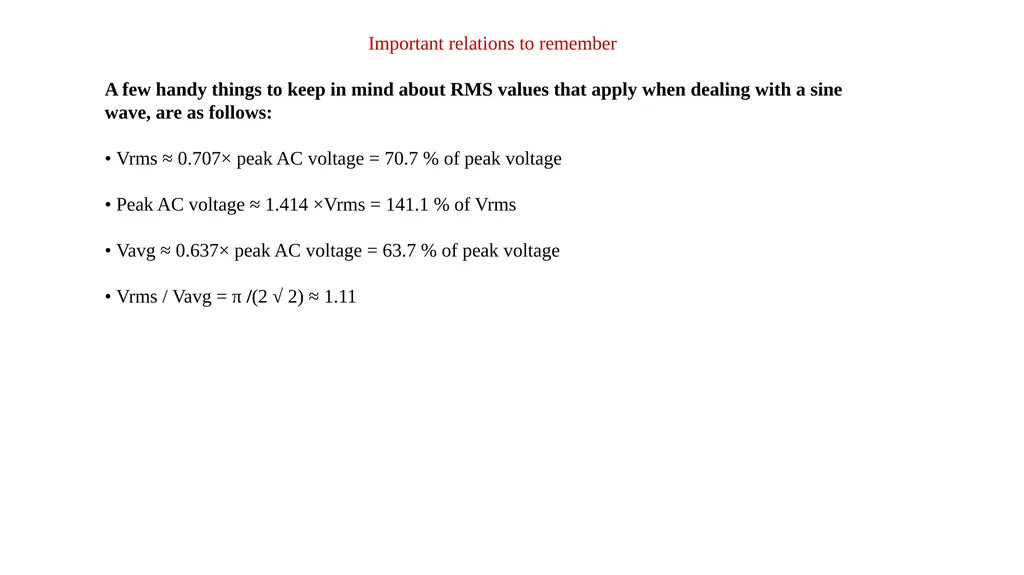
Important relations to remember
A few handy things to keep in mind about RMS values that apply when dealing with a sine wave, are as follows:
• Vrms ≈ 0.707× peak AC voltage = 70.7 % of peak voltage
• Peak AC voltage ≈ 1.414 ×Vrms = 141.1 % of Vrms
• Vavg ≈ 0.637× peak AC voltage = 63.7 % of peak voltage
• Vrms / Vavg = π /(2 √ 2) ≈ 1.11<br>
06
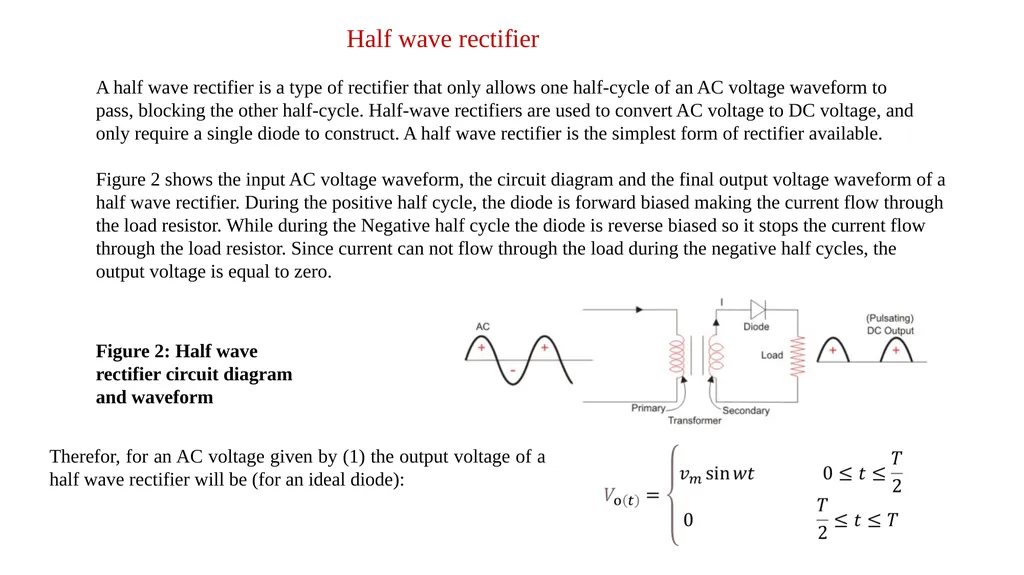
Half wave rectifier A half wave rectifier is a type of rectifier that only allows one half-cycle of an AC voltage waveform to pass, blocking the other half-cycle. Half-wave rectifiers are used to convert AC voltage to DC voltage, and only require a single diode to construct. A half wave rectifier is the simplest form of rectifier available. Figure 2 shows the input AC voltage waveform, the circuit diagram and the final output voltage waveform of a half wave rectifier. During the positive half cycle, the diode is forward biased making the current flow through the load resistor. While during the Negative half cycle the diode is reverse biased so it stops the current flow through the load resistor. Since current can not flow through the load during the negative half cycles, the output voltage is equal to zero. Figure 2: Half wave rectifier circuit diagram and waveform Therefor, for an AC voltage given by (1) the output voltage of a half wave rectifier will be (for an ideal diode):<br>
07
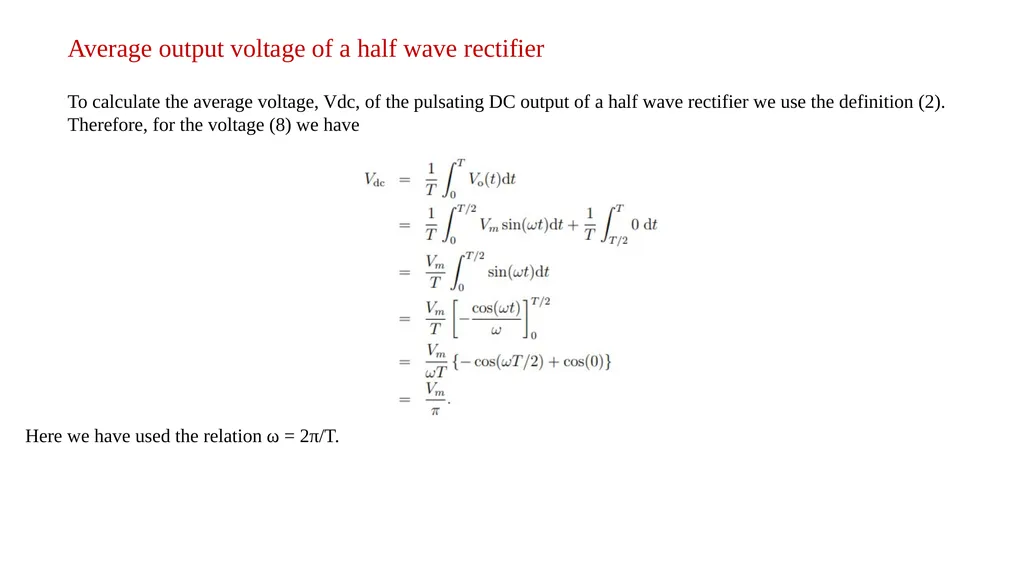
Average output voltage of a half wave rectifier To calculate the average voltage, Vdc, of the pulsating DC output of a half wave rectifier we use the definition (2). Therefore, for the voltage (8) we have Here we have used the relation ω = 2π/T.<br>
08
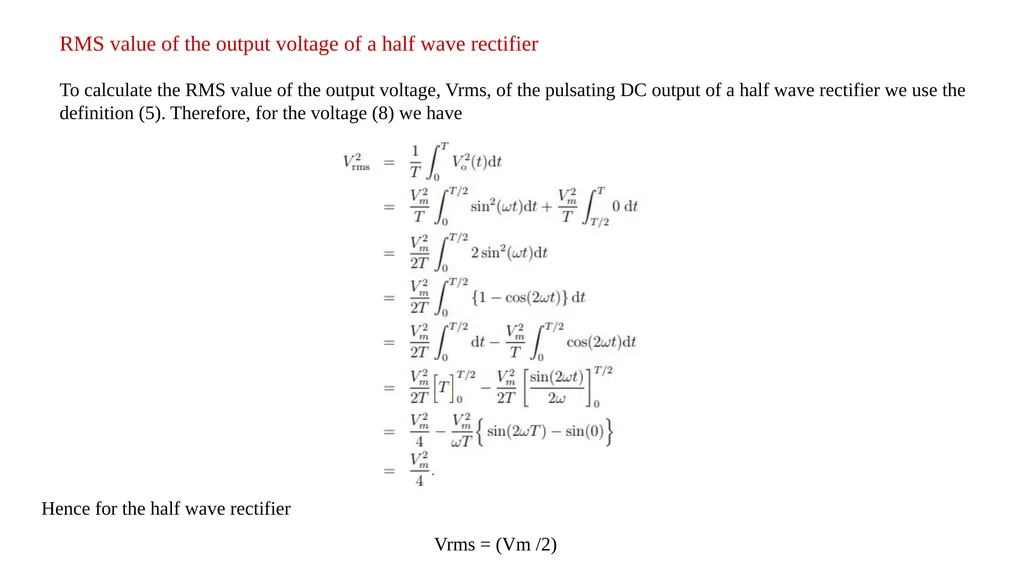
RMS value of the output voltage of a half wave rectifier To calculate the RMS value of the output voltage, Vrms, of the pulsating DC output of a half wave rectifier we use the definition (5). Therefore, for the voltage (8) we have Hence for the half wave rectifier Vrms = (Vm /2)<br>
09
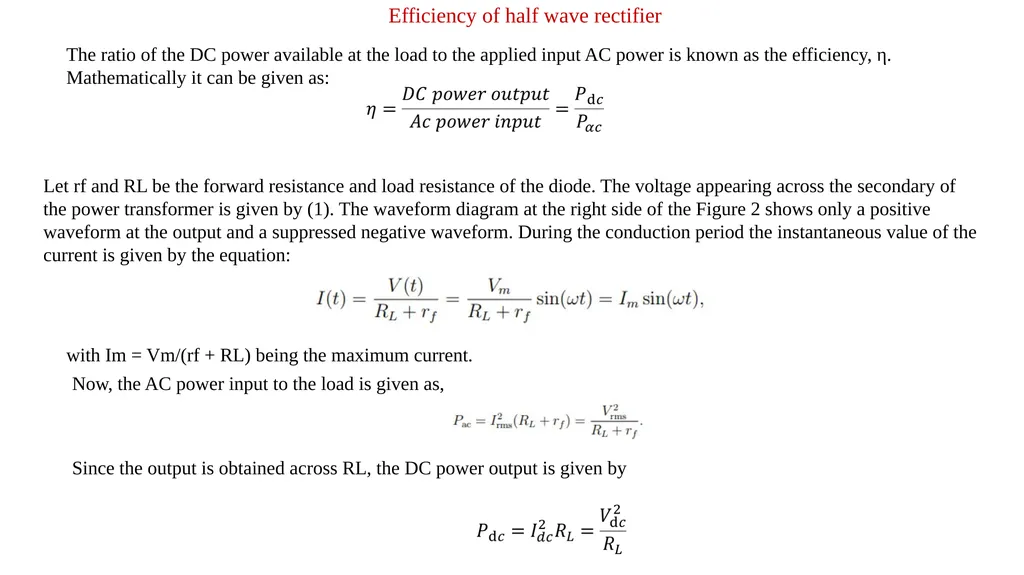
Efficiency of half wave rectifier The ratio of the DC power available at the load to the applied input AC power is known as the efficiency, η. Mathematically it can be given as: Let rf and RL be the forward resistance and load resistance of the diode. The voltage appearing across the secondary of the power transformer is given by (1). The waveform diagram at the right side of the Figure 2 shows only a positive waveform at the output and a suppressed negative waveform. During the conduction period the instantaneous value of the current is given by the equation: with Im = Vm/(rf + RL) being the maximum current. Now, the AC power input to the load is given as, Since the output is obtained across RL, the DC power output is given by<br>
10
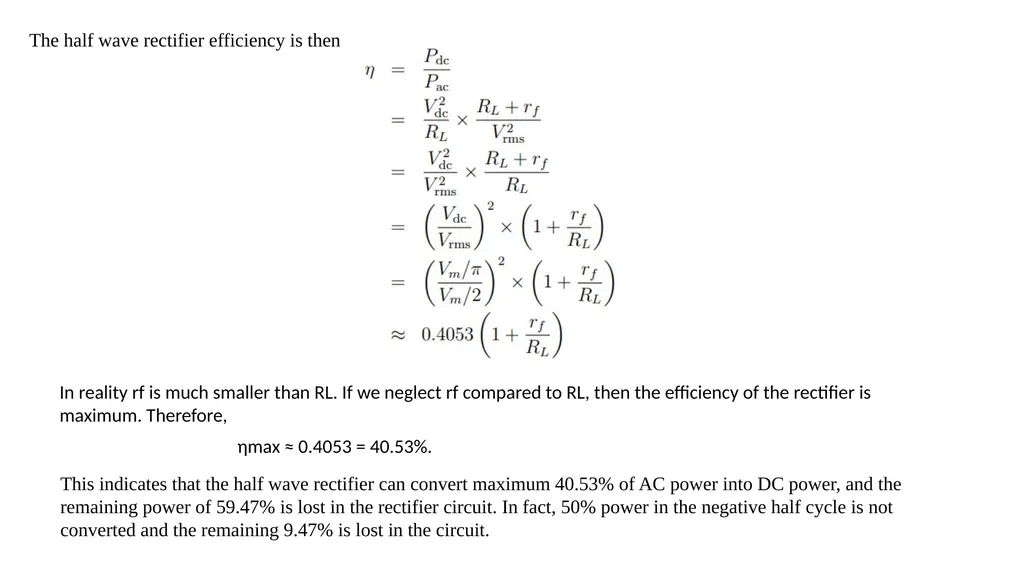
The half wave rectifier efficiency is then In reality rf is much smaller than RL. If we neglect rf compared to RL, then the efficiency of the rectifier is maximum. Therefore, ηmax ≈ 0.4053 = 40.53%. This indicates that the half wave rectifier can convert maximum 40.53% of AC power into DC power, and the remaining power of 59.47% is lost in the rectifier circuit. In fact, 50% power in the negative half cycle is not converted and the remaining 9.47% is lost in the circuit.<br>
11
Applications of half wave rectifier Half wave rectifier is not so good as compared to Full-wave or Bridge rectifier, but sometimes we require this rectifier depending on the requirements. Some of the applications of half-wave rectifier are It is used for the detection of amplitude modulated radio signals.
• For the welding purpose, it supplies polarized voltage.
• It is used in many signal demodulation processes. Advantages of half wave rectifier The main advantage of half-wave rectifiers is in their simplicity. As they do not require as many components, they are simpler and cheaper to setup and construct. As such, the main advantages of half-wave rectifiers are: • Simple (lower number of components)
• Cheaper up front cost (as their is less equipment. Although there is a higher cost over time due to increased power losses) Disadvantages of half wave rectifier The disadvantages of half-wave rectifiers are:
• They only allow a half-cycle through per sinewave, and the other half-cycle is wasted. This leads to power loss.
• They produces a low output voltage.
• The output current we obtain is not purely DC, and it still contains a lot of ripple (i.e. it has a high ripple factor<br>
12
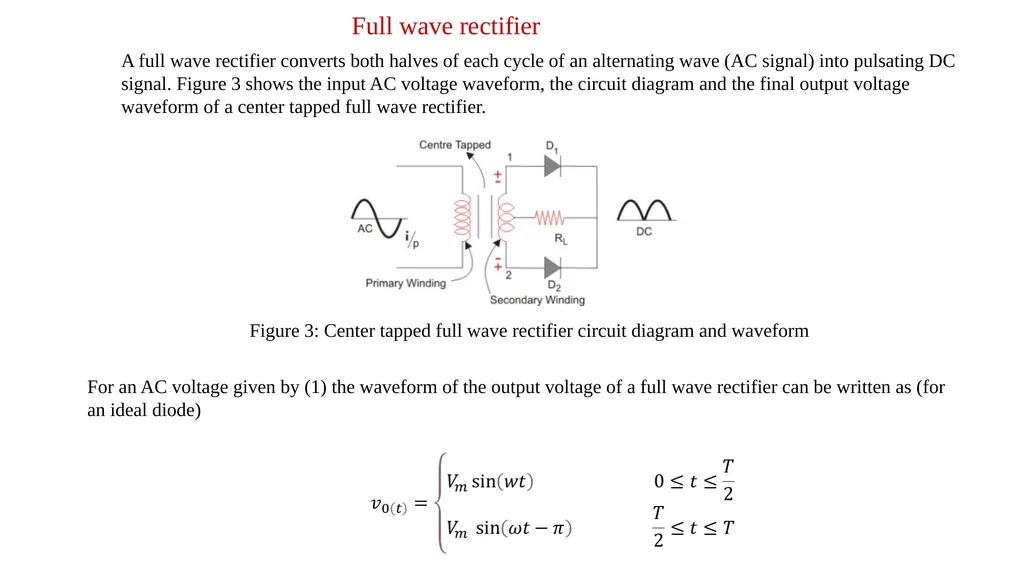
Full wave rectifier A full wave rectifier converts both halves of each cycle of an alternating wave (AC signal) into pulsating DC signal. Figure 3 shows the input AC voltage waveform, the circuit diagram and the final output voltage waveform of a center tapped full wave rectifier. Figure 3: Center tapped full wave rectifier circuit diagram and waveform For an AC voltage given by (1) the waveform of the output voltage of a full wave rectifier can be written as (for an ideal diode)<br>
13
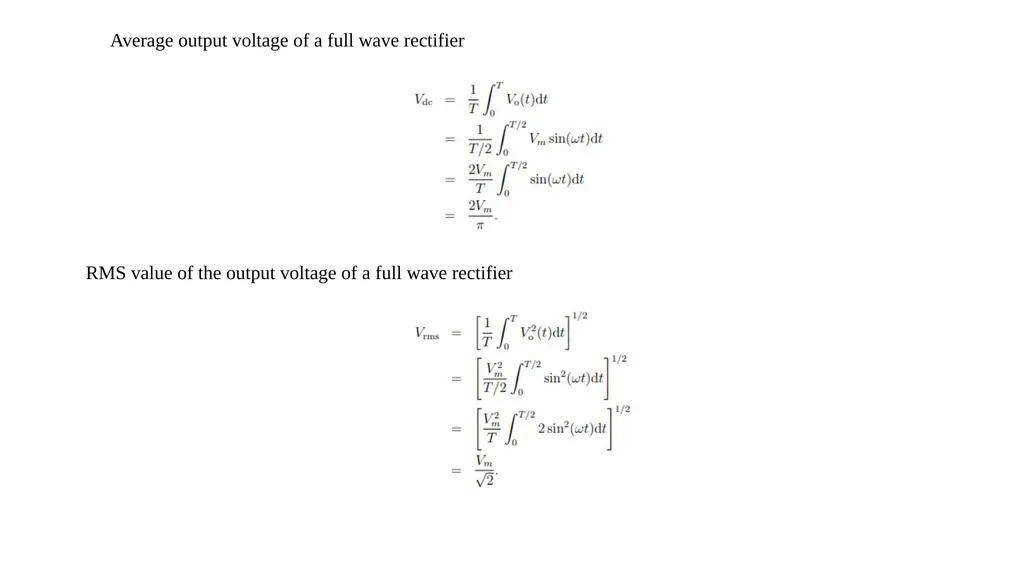
Average output voltage of a full wave rectifier RMS value of the output voltage of a full wave rectifier<br>
14
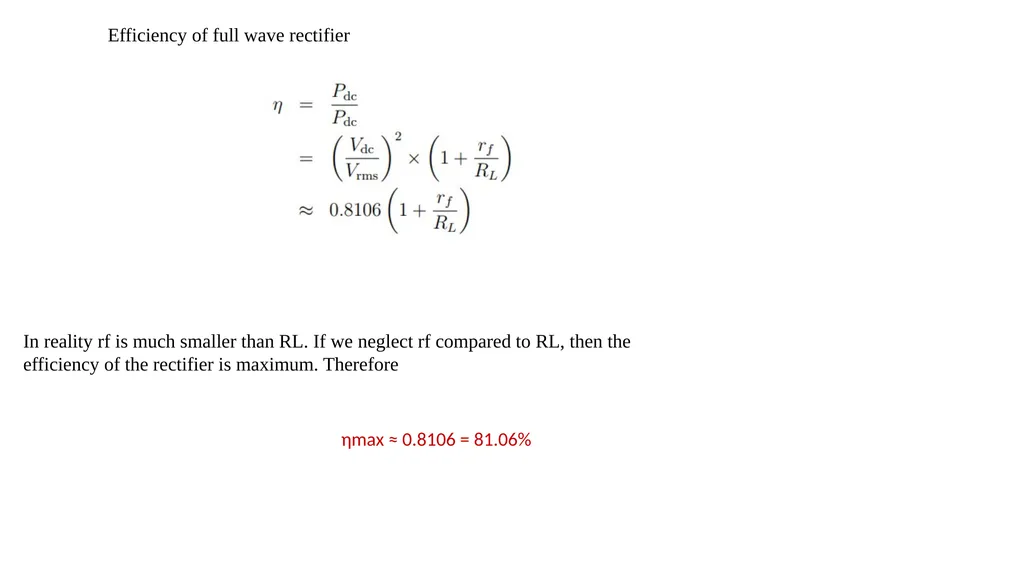
Efficiency of full wave rectifier In reality rf is much smaller than RL. If we neglect rf compared to RL, then the efficiency of the rectifier is maximum. Therefore ηmax ≈ 0.8106 = 81.06%<br>
15
Applications of full wave rectifier Full wave rectifier is of two types; center tapped and bridge rectifier. Both these rectifiers are used for following purposes depends upon the requirement. Following of full wave rectifier applications are: • It can be used to detect the amplitude of modulated radio signal.
• It can be used to supply polarized voltage in welding.
• The Bridge Rectifier circuits are widely used in power supply for various appliances, as they can convert the High AC voltage into Low DC voltage. Advantages of full wave rectifier
• Full wave rectifiers have higher rectifying efficiency than half-wave rectifiers. This means that they convert AC to DC more efficiently.
• They have low power loss because no voltage signal is wasted in the rectification process.
• The output voltage of center tapped full wave rectifier has lower ripples than a half wave rectifiers. Disadvantages of full wave rectifier
• The center tapped rectifier is more expensive than half-wave rectifier and tends to occupy a lot of space.<br>
16
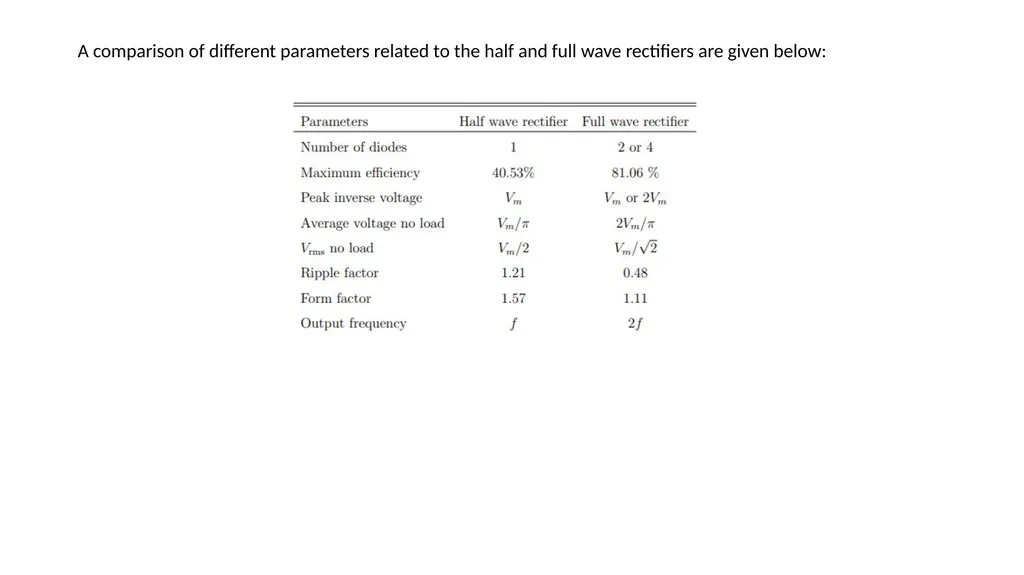
A comparison of different parameters related to the half and full wave rectifiers are given below:<br>