
Recursion CITS1001 2 Scope of this lecture Concept
MS
Published · 40 slides · 0 views
1 / 1

Description
Recursion CITS1001 2 Scope of this lecture Concept of recursion Simple examples of recursion Reading The BlueJ book does not have a chapter on recursion I recommend these notes from Princetons Intro to Programming course:
Related Topics
Share
Embed code
Download this presentation From Below
"Recursion CITS1001 2 Scope of this lecture Concept" is the property of its rightful owner. Permission is granted to download and print the materials on this website for personal, non-commercial use only, and to display it on your personal computer provided you do not modify the materials and that you retain all copyright notices contained in the materials. By downloading content from our website, you accept the terms of this agreement.
Presentation Transcript
01
Recursion CITS1001<br>
02
2 Scope of this lecture Concept of recursion
Simple examples of recursion
Reading
The BlueJ book does not have a chapter on recursion
I recommend these notes from Princeton’s Intro to Programming course:
http://introcs.cs.princeton.edu/java/23recursion/
Some examples in these notes are sourced from here<br>
Simple examples of recursion
Reading
The BlueJ book does not have a chapter on recursion
I recommend these notes from Princeton’s Intro to Programming course:
http://introcs.cs.princeton.edu/java/23recursion/
Some examples in these notes are sourced from here<br>
03
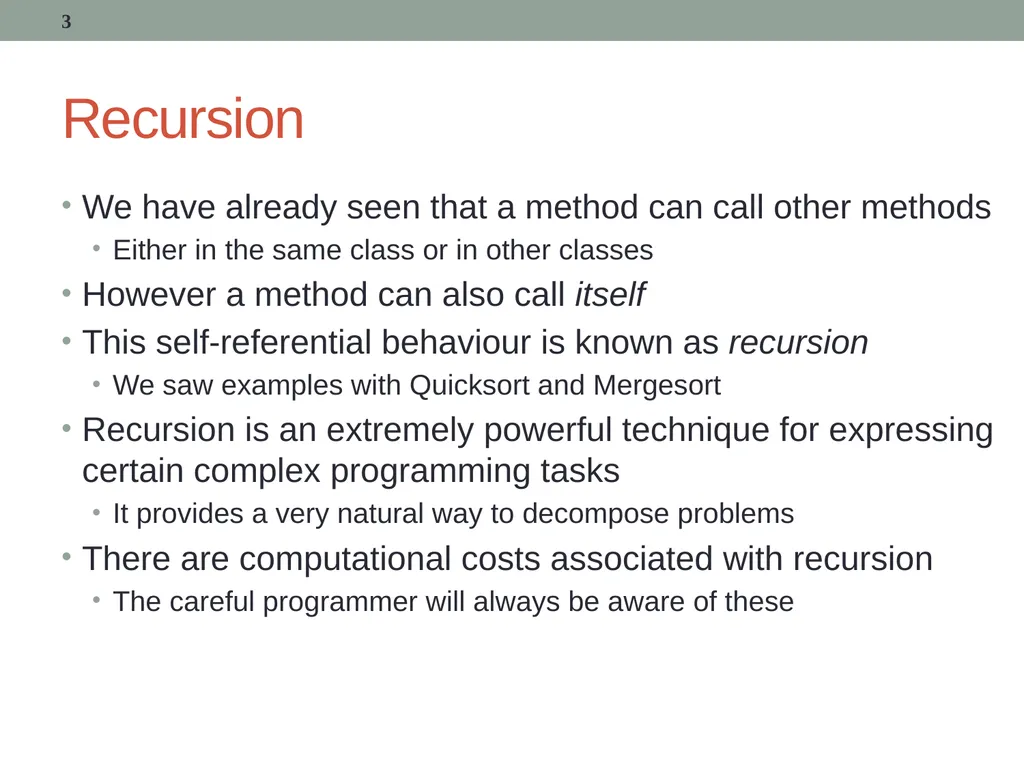
Recursion We have already seen that a method can call other methods
Either in the same class or in other classes
However a method can also call itself
This self-referential behaviour is known as recursion
We saw examples with Quicksort and Mergesort
Recursion is an extremely powerful technique for expressing certain complex programming tasks
It provides a very natural way to decompose problems
There are computational costs associated with recursion
The careful programmer will always be aware of these 3<br>
Either in the same class or in other classes
However a method can also call itself
This self-referential behaviour is known as recursion
We saw examples with Quicksort and Mergesort
Recursion is an extremely powerful technique for expressing certain complex programming tasks
It provides a very natural way to decompose problems
There are computational costs associated with recursion
The careful programmer will always be aware of these 3<br>
04
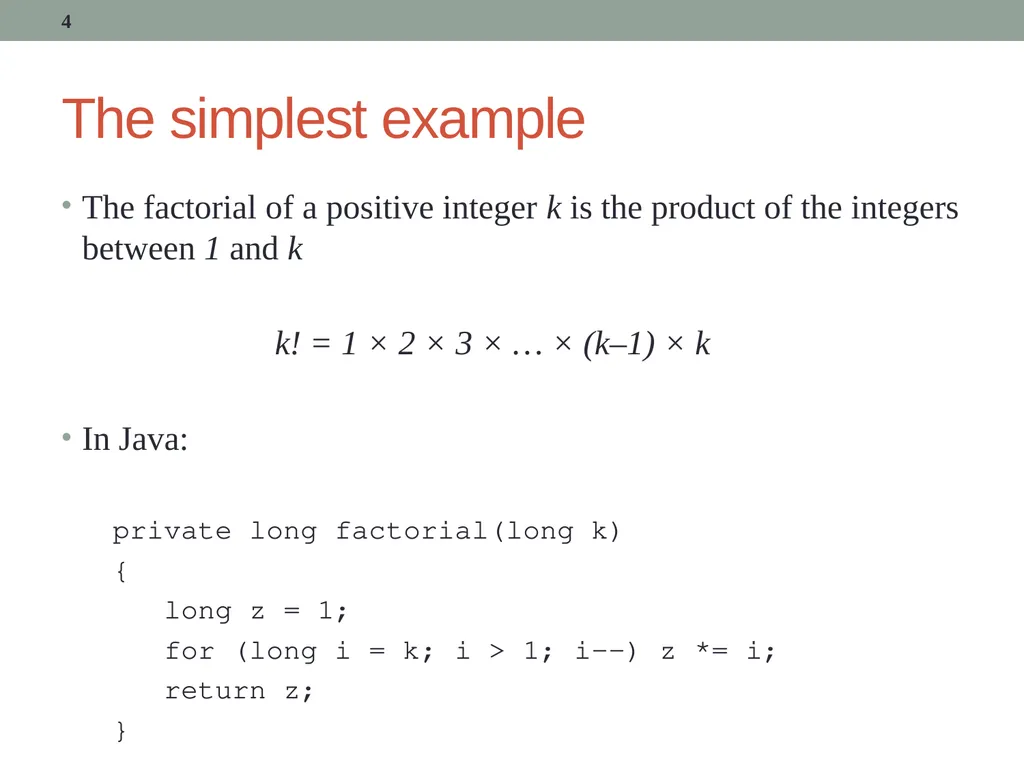
The simplest example The factorial of a positive integer k is the product of the integers between 1 and k
k! = 1 × 2 × 3 × … × (k–1) × k
In Java:
private long factorial(long k)
{
long z = 1;
for (long i = k; i > 1; i––) z *= i;
return z;
} 4<br>
k! = 1 × 2 × 3 × … × (k–1) × k
In Java:
private long factorial(long k)
{
long z = 1;
for (long i = k; i > 1; i––) z *= i;
return z;
} 4<br>
05
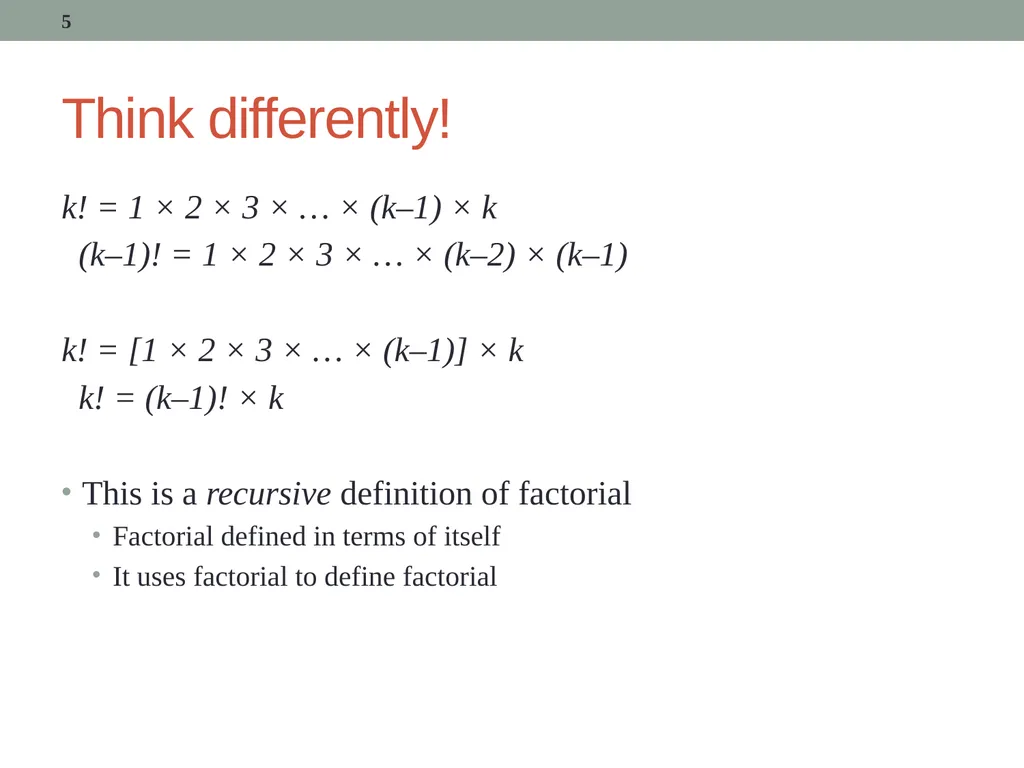
Think differently! k! = 1 × 2 × 3 × … × (k–1) × k
(k–1)! = 1 × 2 × 3 × … × (k–2) × (k–1)
k! = [1 × 2 × 3 × … × (k–1)] × k
k! = (k–1)! × k
This is a recursive definition of factorial
Factorial defined in terms of itself
It uses factorial to define factorial 5<br>
(k–1)! = 1 × 2 × 3 × … × (k–2) × (k–1)
k! = [1 × 2 × 3 × … × (k–1)] × k
k! = (k–1)! × k
This is a recursive definition of factorial
Factorial defined in terms of itself
It uses factorial to define factorial 5<br>
06
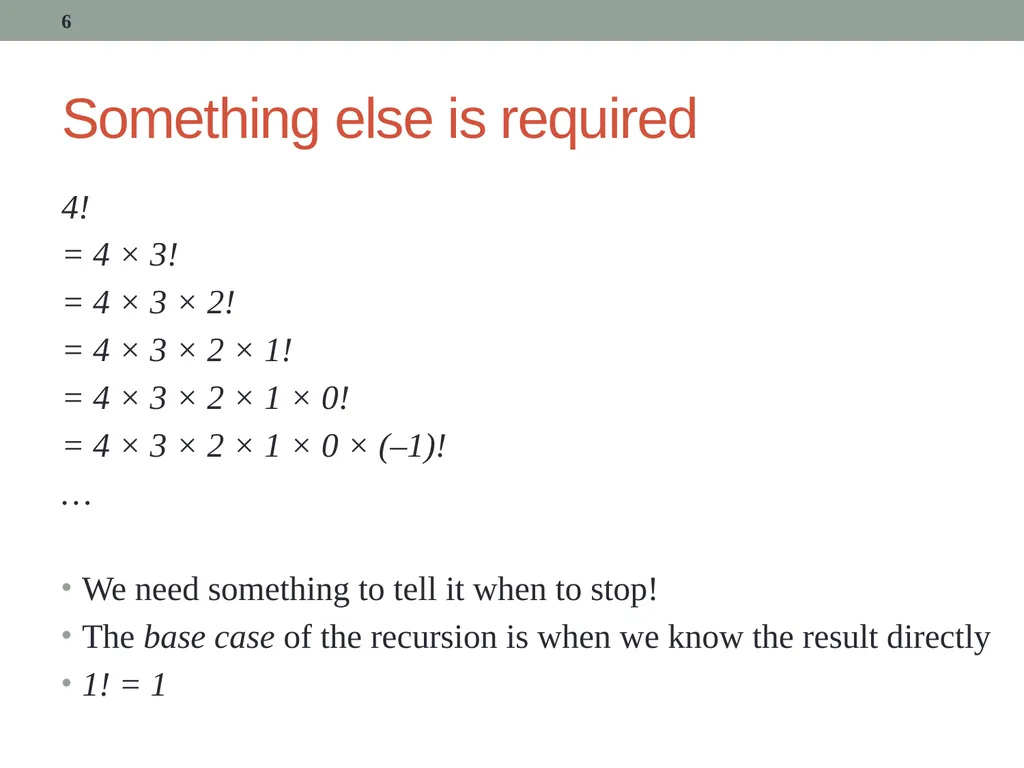
Something else is required 4!
= 4 × 3!
= 4 × 3 × 2!
= 4 × 3 × 2 × 1!
= 4 × 3 × 2 × 1 × 0!
= 4 × 3 × 2 × 1 × 0 × (–1)!
…
We need something to tell it when to stop!
The base case of the recursion is when we know the result directly
1! = 1 6<br>
= 4 × 3!
= 4 × 3 × 2!
= 4 × 3 × 2 × 1!
= 4 × 3 × 2 × 1 × 0!
= 4 × 3 × 2 × 1 × 0 × (–1)!
…
We need something to tell it when to stop!
The base case of the recursion is when we know the result directly
1! = 1 6<br>
07
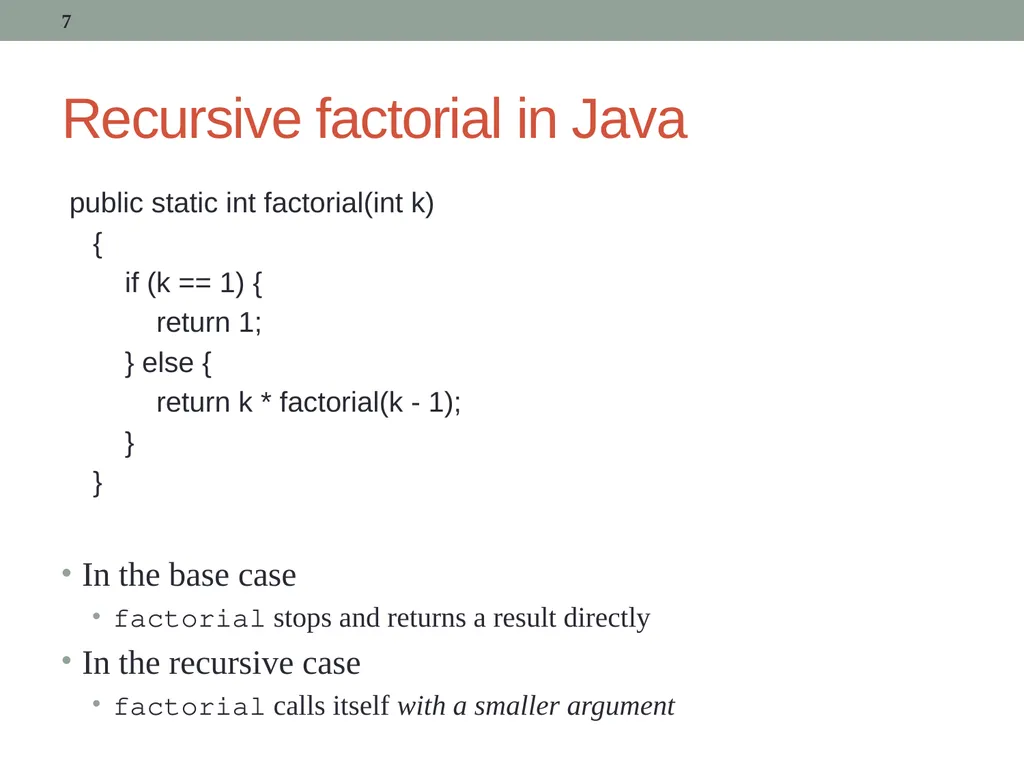
Recursive factorial in Java public static int factorial(int k)
{
if (k == 1) {
return 1;
} else {
return k * factorial(k - 1);
}
}
In the base case
factorial stops and returns a result directly
In the recursive case
factorial calls itself with a smaller argument 7<br>
{
if (k == 1) {
return 1;
} else {
return k * factorial(k - 1);
}
}
In the base case
factorial stops and returns a result directly
In the recursive case
factorial calls itself with a smaller argument 7<br>
08
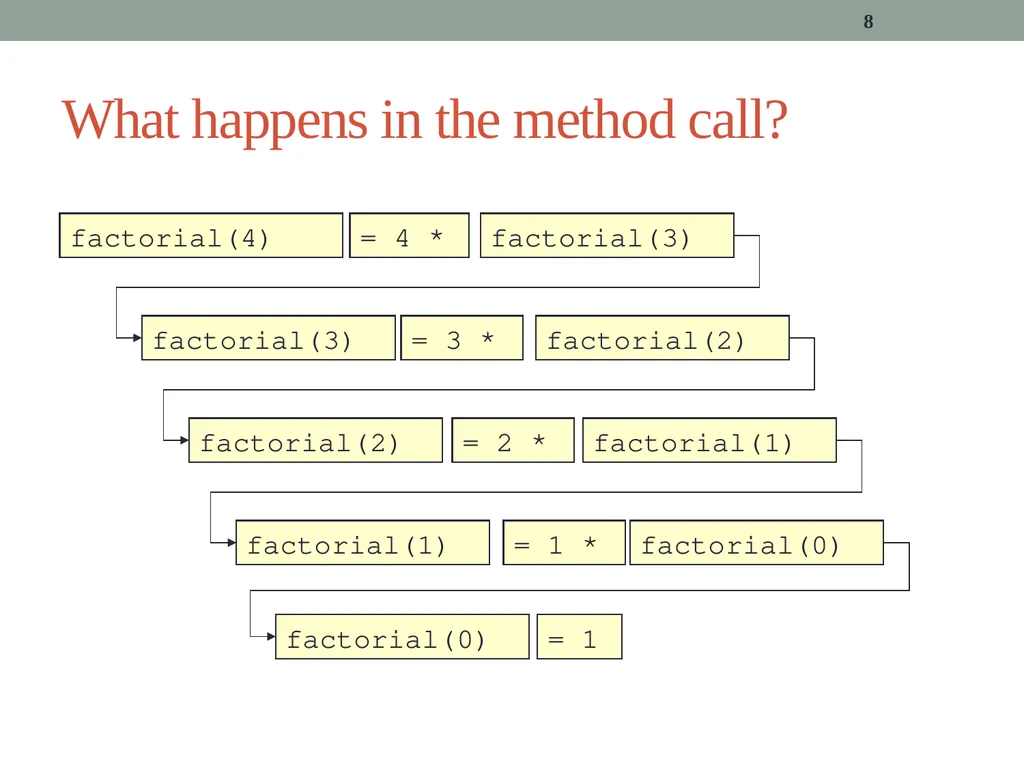
8 What happens in the method call? factorial(4) factorial(3) = 4 * factorial(3) = 3 * factorial(2) factorial(2) = 2 * factorial(1) factorial(1) = 1 * factorial(0) factorial(0) = 1<br>
09
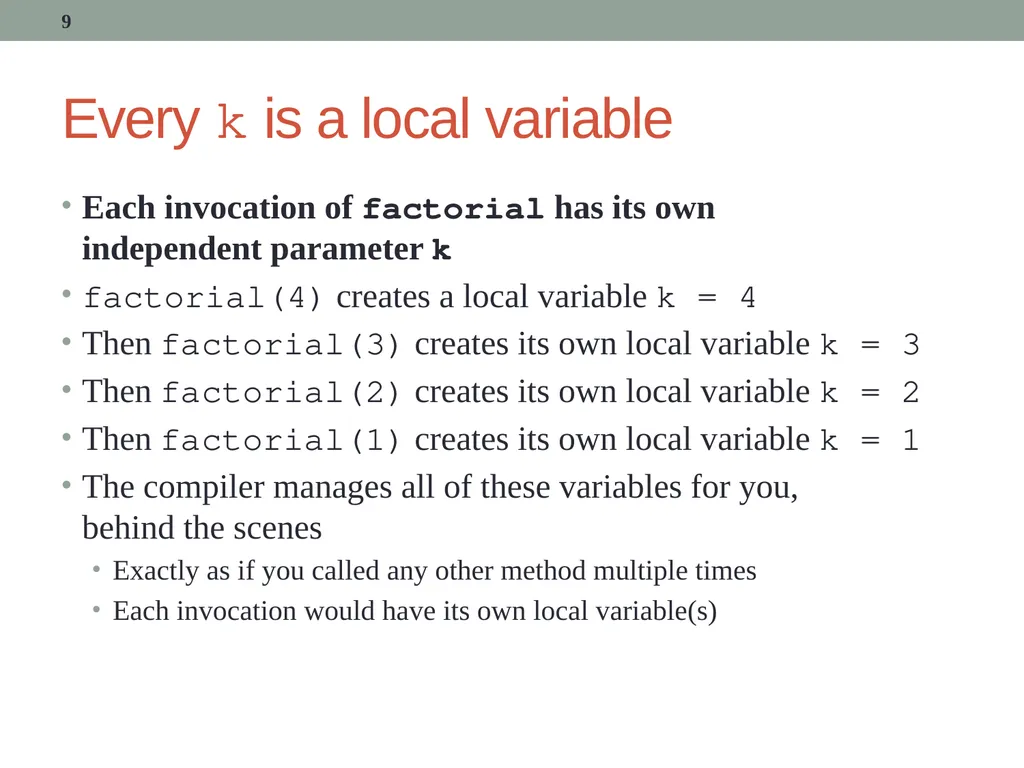
Every k is a local variable Each invocation of factorial has its own
independent parameter k
factorial(4) creates a local variable k = 4
Then factorial(3) creates its own local variable k = 3
Then factorial(2) creates its own local variable k = 2
Then factorial(1) creates its own local variable k = 1
The compiler manages all of these variables for you, behind the scenes
Exactly as if you called any other method multiple times
Each invocation would have its own local variable(s) 9<br>
factorial(4) creates a local variable k = 4
Then factorial(3) creates its own local variable k = 3
Then factorial(2) creates its own local variable k = 2
Then factorial(1) creates its own local variable k = 1
The compiler manages all of these variables for you, behind the scenes
Exactly as if you called any other method multiple times
Each invocation would have its own local variable(s) 9<br>
10
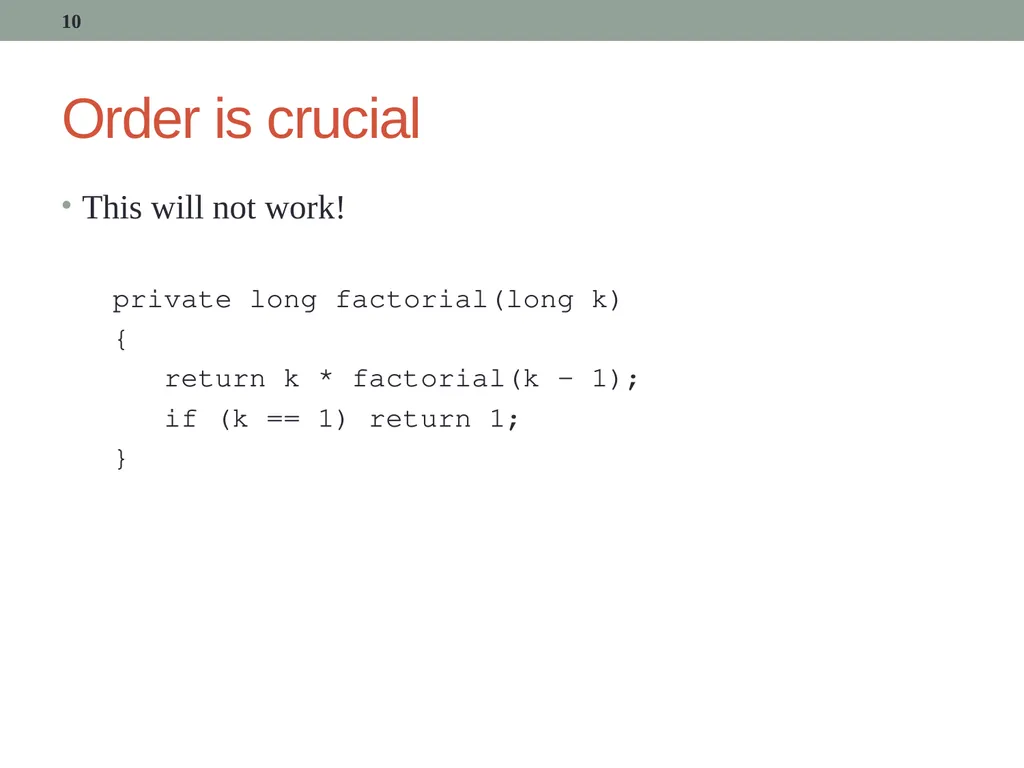
Order is crucial This will not work!
private long factorial(long k)
{
return k * factorial(k – 1);
if (k == 1) return 1;
} 10<br>
private long factorial(long k)
{
return k * factorial(k – 1);
if (k == 1) return 1;
} 10<br>
11
What could possibly
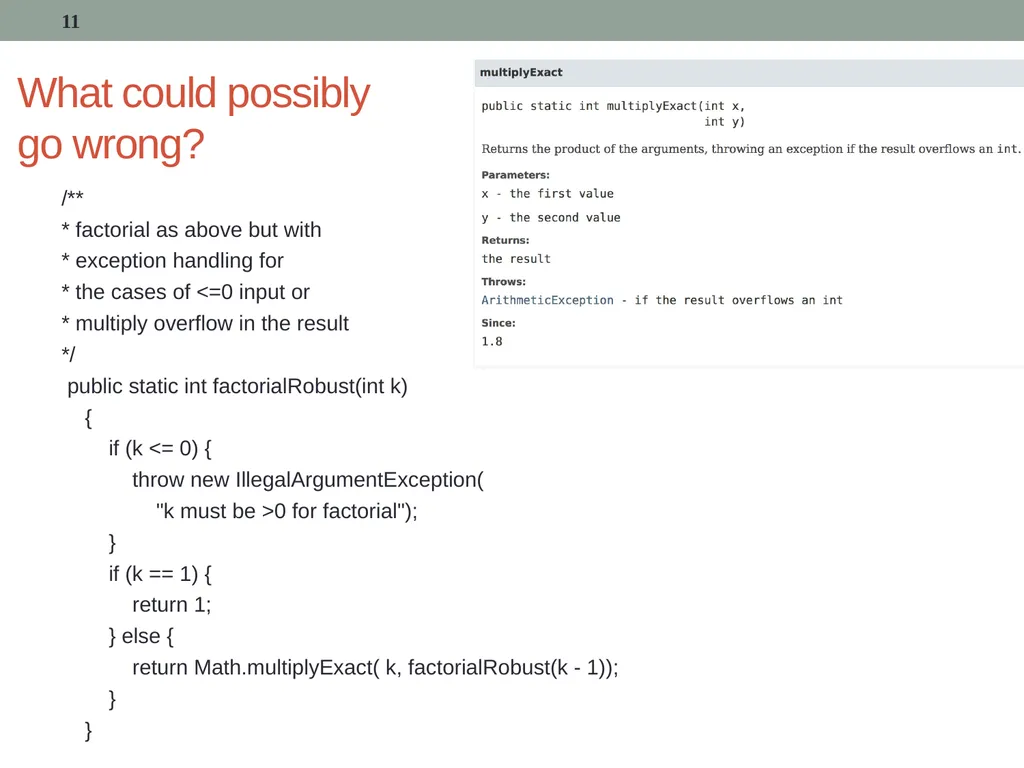
go wrong? /**
* factorial as above but with
* exception handling for
* the cases of <=0 input or
* multiply overflow in the result
*/
public static int factorialRobust(int k)
{
if (k <= 0) {
throw new IllegalArgumentException(
"k must be >0 for factorial");
}
if (k == 1) {
return 1;
} else {
return Math.multiplyExact( k, factorialRobust(k - 1));
}
} 11<br>
* factorial as above but with
* exception handling for
* the cases of <=0 input or
* multiply overflow in the result
*/
public static int factorialRobust(int k)
{
if (k <= 0) {
throw new IllegalArgumentException(
"k must be >0 for factorial");
}
if (k == 1) {
return 1;
} else {
return Math.multiplyExact( k, factorialRobust(k - 1));
}
} 11<br>
12
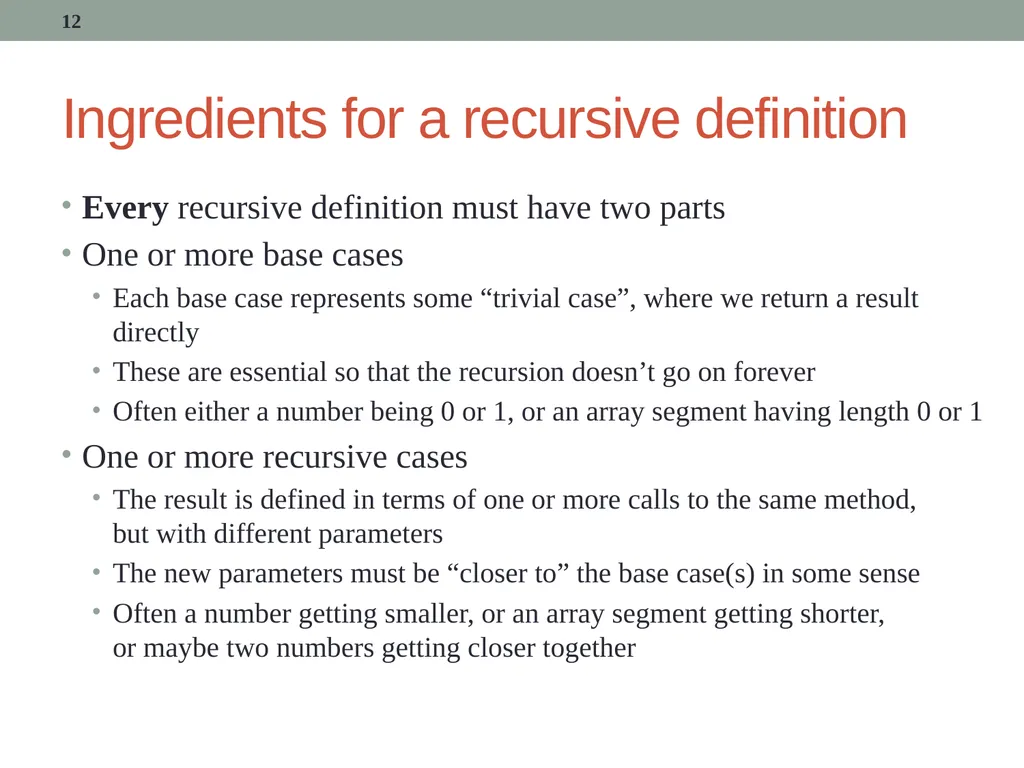
Ingredients for a recursive definition Every recursive definition must have two parts
One or more base cases
Each base case represents some “trivial case”, where we return a result directly
These are essential so that the recursion doesn’t go on forever
Often either a number being 0 or 1, or an array segment having length 0 or 1
One or more recursive cases
The result is defined in terms of one or more calls to the same method, but with different parameters
The new parameters must be “closer to” the base case(s) in some sense
Often a number getting smaller, or an array segment getting shorter, or maybe two numbers getting closer together 12<br>
One or more base cases
Each base case represents some “trivial case”, where we return a result directly
These are essential so that the recursion doesn’t go on forever
Often either a number being 0 or 1, or an array segment having length 0 or 1
One or more recursive cases
The result is defined in terms of one or more calls to the same method, but with different parameters
The new parameters must be “closer to” the base case(s) in some sense
Often a number getting smaller, or an array segment getting shorter, or maybe two numbers getting closer together 12<br>
13
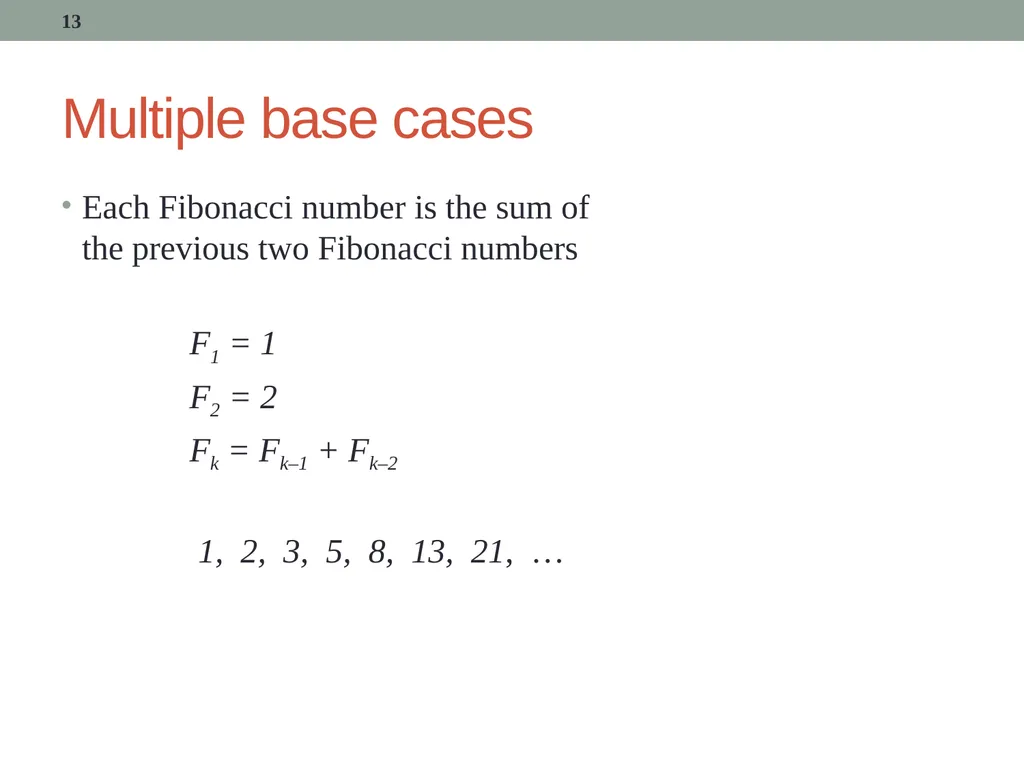
Multiple base cases Each Fibonacci number is the sum of
the previous two Fibonacci numbers
F1 = 1
F2 = 2
Fk = Fk–1 + Fk–2
1, 2, 3, 5, 8, 13, 21, … 13<br>
F1 = 1
F2 = 2
Fk = Fk–1 + Fk–2
1, 2, 3, 5, 8, 13, 21, … 13<br>
14
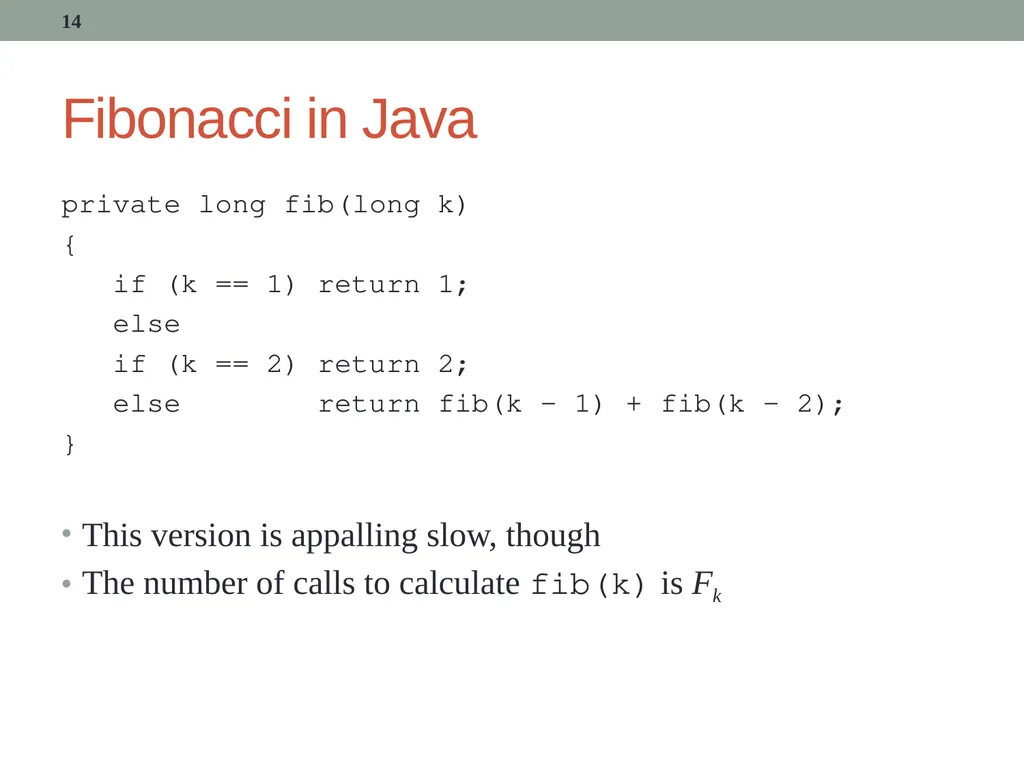
Fibonacci in Java private long fib(long k)
{
if (k == 1) return 1;
else
if (k == 2) return 2;
else return fib(k – 1) + fib(k – 2);
}
This version is appalling slow, though
The number of calls to calculate fib(k) is Fk 14<br>
{
if (k == 1) return 1;
else
if (k == 2) return 2;
else return fib(k – 1) + fib(k – 2);
}
This version is appalling slow, though
The number of calls to calculate fib(k) is Fk 14<br>
15
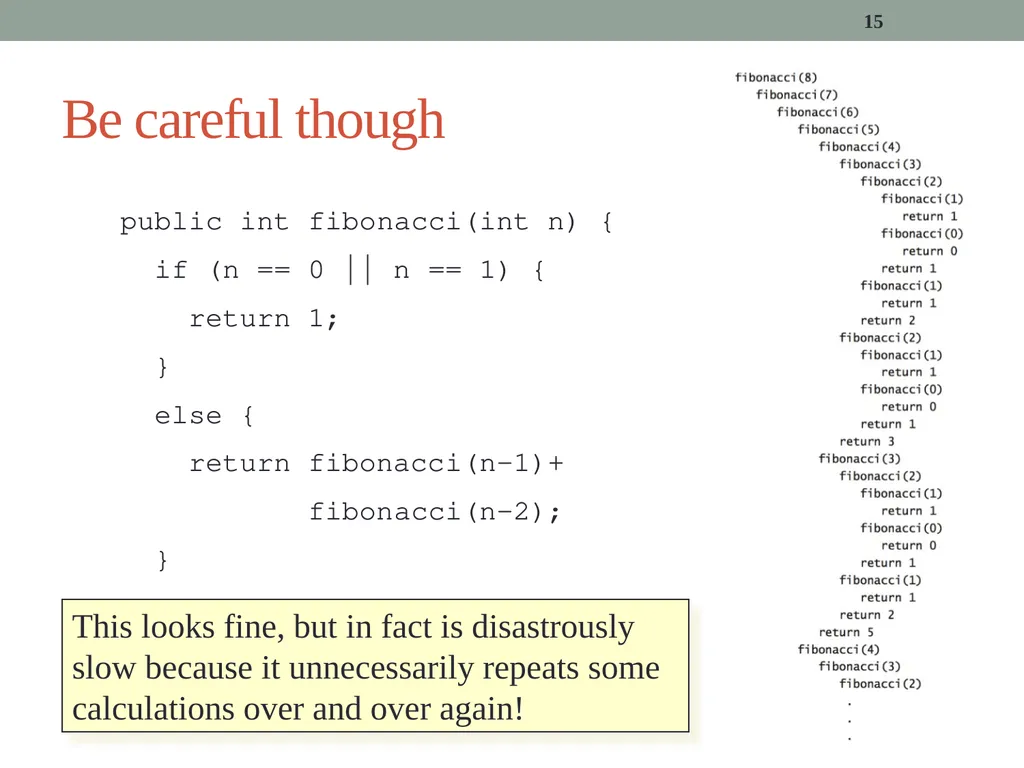
15 Be careful though public int fibonacci(int n) {
if (n == 0 || n == 1) {
return 1;
}
else {
return fibonacci(n-1)+
fibonacci(n-2);
}
} This looks fine, but in fact is disastrously slow because it unnecessarily repeats some calculations over and over again!<br>
if (n == 0 || n == 1) {
return 1;
}
else {
return fibonacci(n-1)+
fibonacci(n-2);
}
} This looks fine, but in fact is disastrously slow because it unnecessarily repeats some calculations over and over again!<br>
16
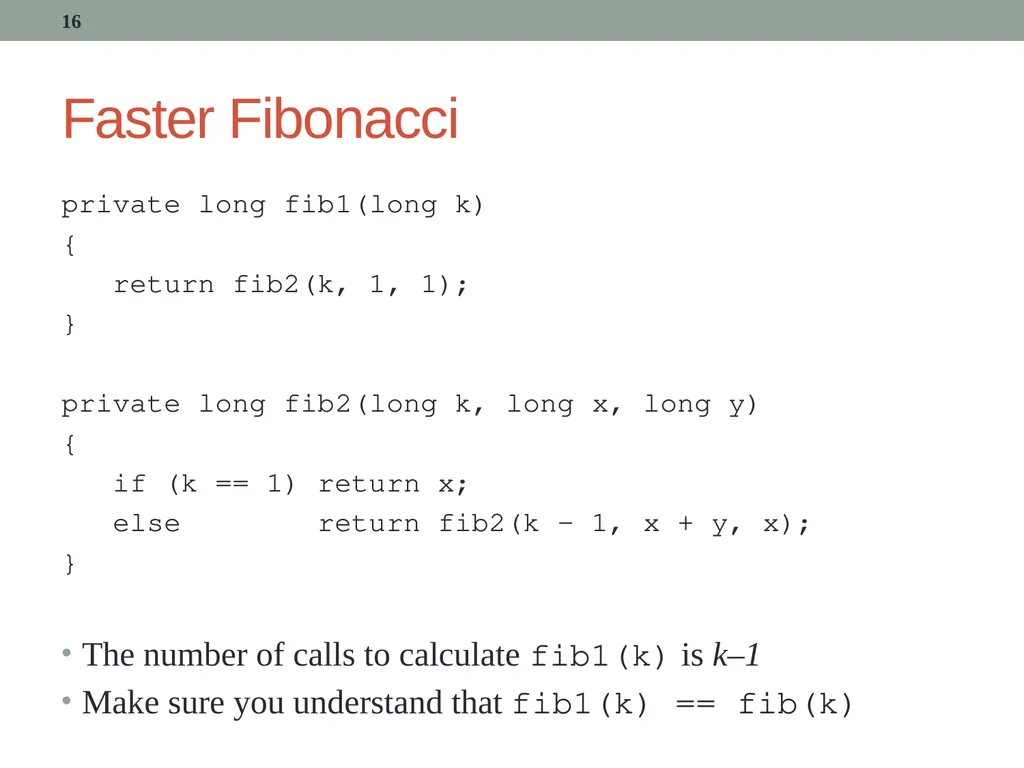
Faster Fibonacci private long fib1(long k)
{
return fib2(k, 1, 1);
}
private long fib2(long k, long x, long y)
{
if (k == 1) return x;
else return fib2(k – 1, x + y, x);
}
The number of calls to calculate fib1(k) is k–1
Make sure you understand that fib1(k) == fib(k) 16<br>
{
return fib2(k, 1, 1);
}
private long fib2(long k, long x, long y)
{
if (k == 1) return x;
else return fib2(k – 1, x + y, x);
}
The number of calls to calculate fib1(k) is k–1
Make sure you understand that fib1(k) == fib(k) 16<br>
17
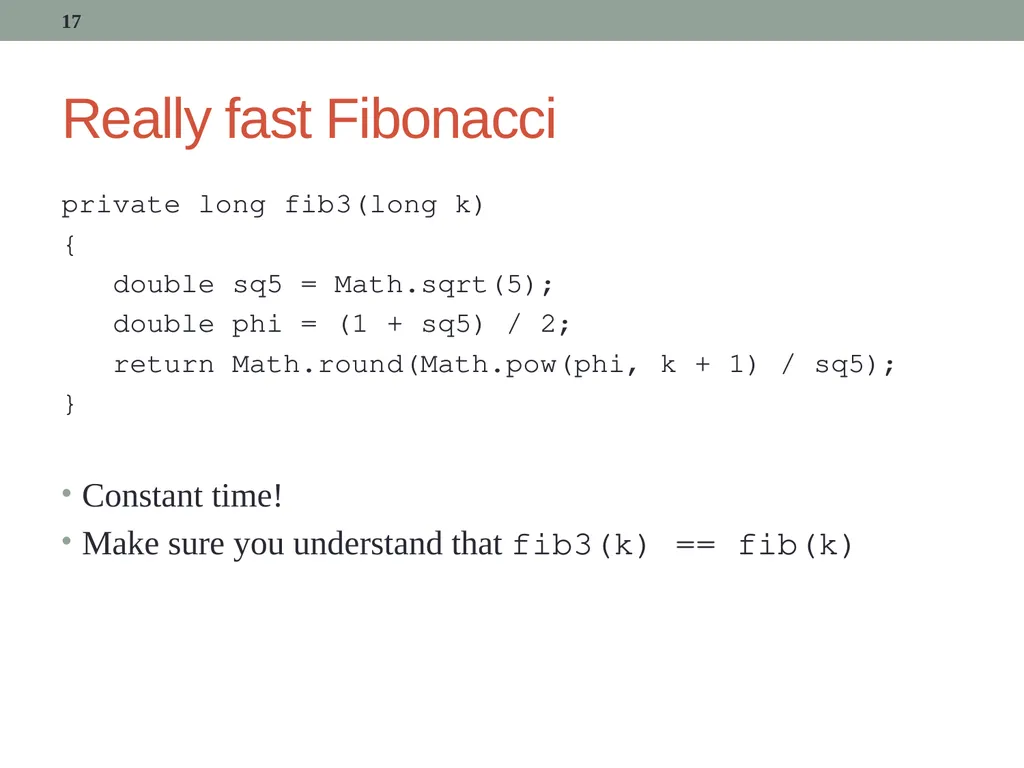
Really fast Fibonacci private long fib3(long k)
{
double sq5 = Math.sqrt(5);
double phi = (1 + sq5) / 2;
return Math.round(Math.pow(phi, k + 1) / sq5);
}
Constant time!
Make sure you understand that fib3(k) == fib(k) 17<br>
{
double sq5 = Math.sqrt(5);
double phi = (1 + sq5) / 2;
return Math.round(Math.pow(phi, k + 1) / sq5);
}
Constant time!
Make sure you understand that fib3(k) == fib(k) 17<br>
18
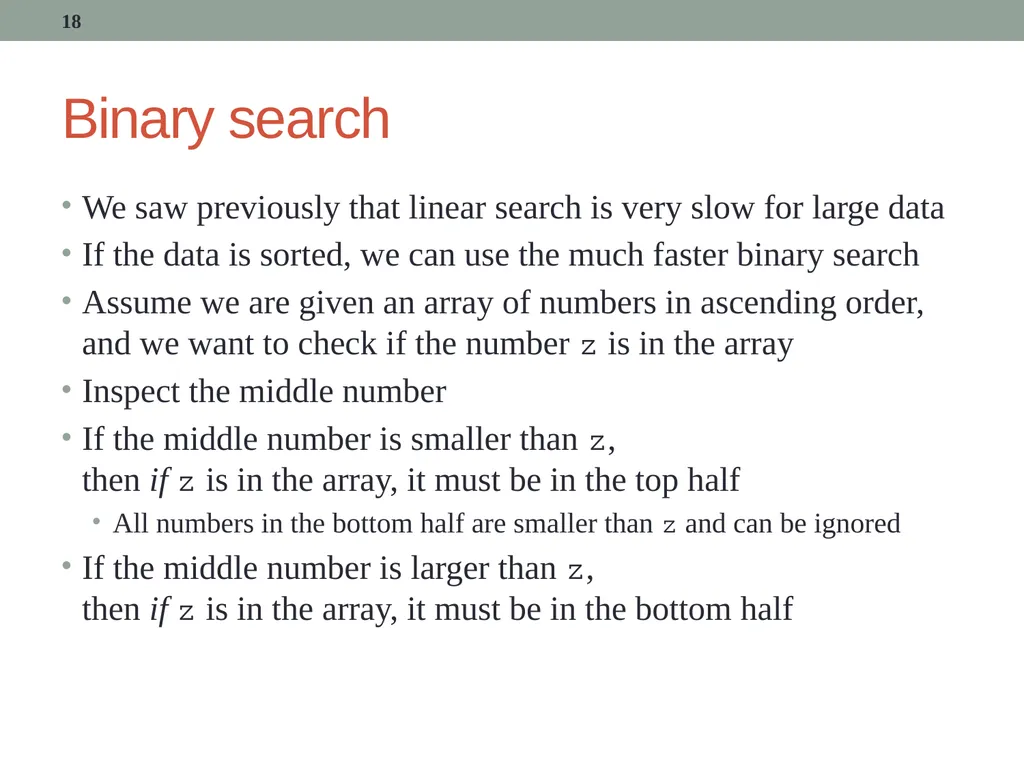
Binary search We saw previously that linear search is very slow for large data
If the data is sorted, we can use the much faster binary search
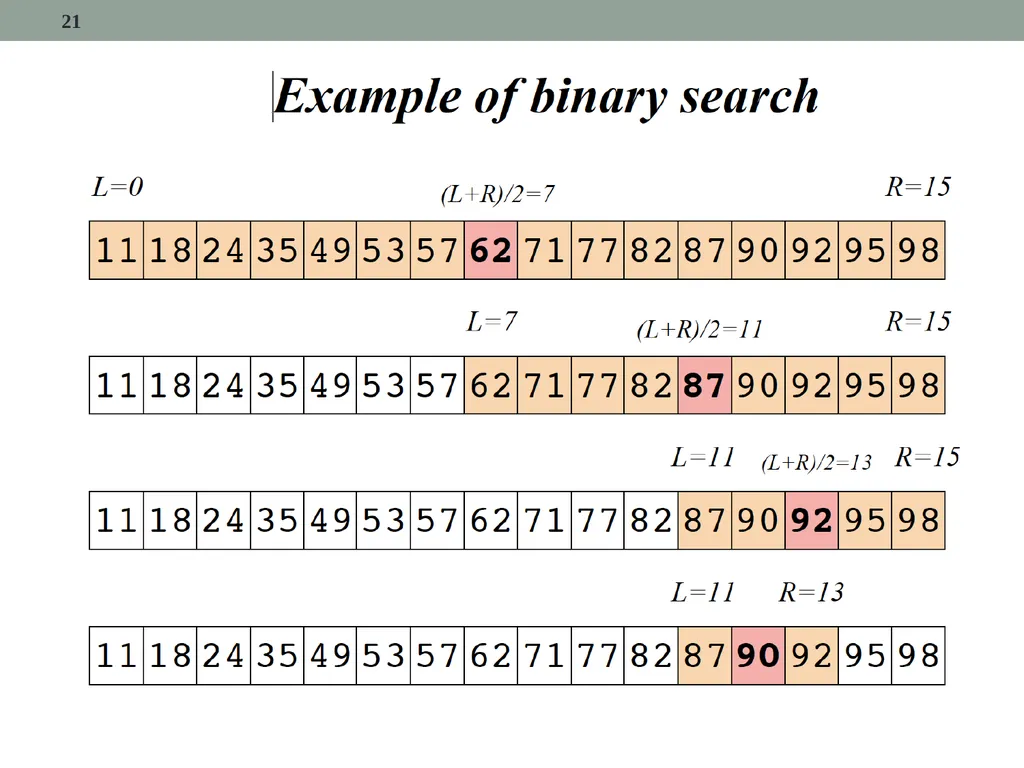
Assume we are given an array of numbers in ascending order, and we want to check if the number z is in the array
Inspect the middle number
If the middle number is smaller than z, then if z is in the array, it must be in the top half
All numbers in the bottom half are smaller than z and can be ignored
If the middle number is larger than z, then if z is in the array, it must be in the bottom half 18<br>
If the data is sorted, we can use the much faster binary search
Assume we are given an array of numbers in ascending order, and we want to check if the number z is in the array
Inspect the middle number
If the middle number is smaller than z, then if z is in the array, it must be in the top half
All numbers in the bottom half are smaller than z and can be ignored
If the middle number is larger than z, then if z is in the array, it must be in the bottom half 18<br>
19
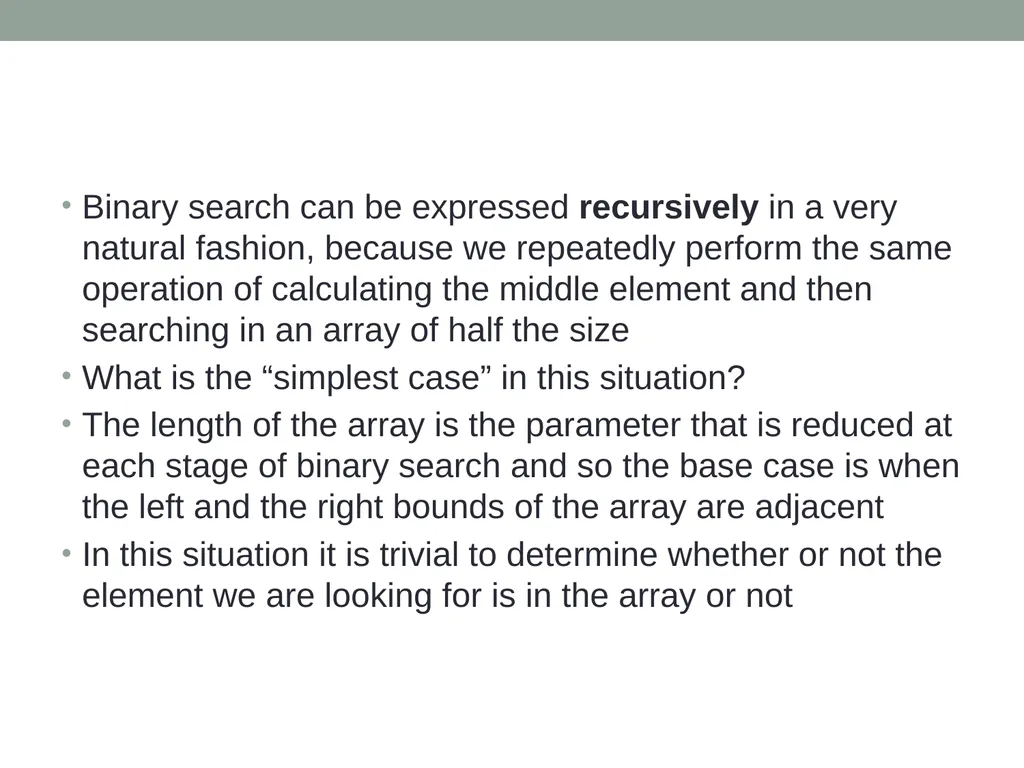
Binary search can be expressed recursively in a very natural fashion, because we repeatedly perform the same operation of calculating the middle element and then searching in an array of half the size
What is the “simplest case” in this situation?
The length of the array is the parameter that is reduced at each stage of binary search and so the base case is when the left and the right bounds of the array are adjacent
In this situation it is trivial to determine whether or not the element we are looking for is in the array or not<br>
What is the “simplest case” in this situation?
The length of the array is the parameter that is reduced at each stage of binary search and so the base case is when the left and the right bounds of the array are adjacent
In this situation it is trivial to determine whether or not the element we are looking for is in the array or not<br>
20
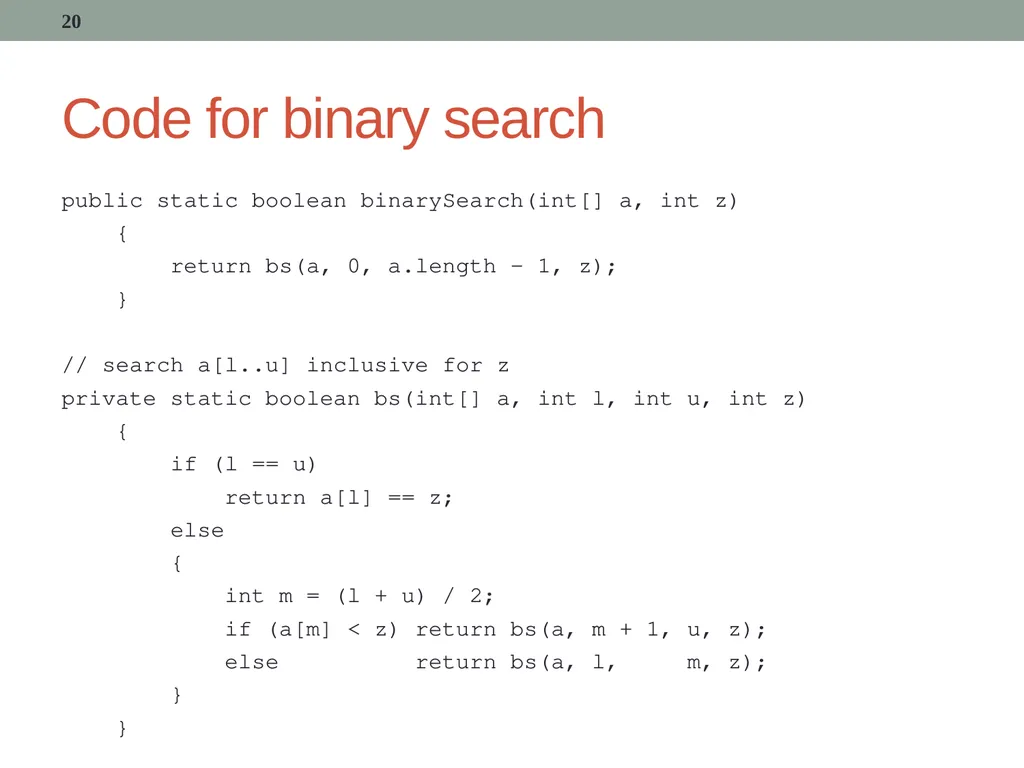
Code for binary search public static boolean binarySearch(int[] a, int z)
{
return bs(a, 0, a.length - 1, z);
}
// search a[l..u] inclusive for z
private static boolean bs(int[] a, int l, int u, int z)
{
if (l == u)
return a[l] == z;
else
{
int m = (l + u) / 2;
if (a[m] < z) return bs(a, m + 1, u, z);
else return bs(a, l, m, z);
}
} 20<br>
{
return bs(a, 0, a.length - 1, z);
}
// search a[l..u] inclusive for z
private static boolean bs(int[] a, int l, int u, int z)
{
if (l == u)
return a[l] == z;
else
{
int m = (l + u) / 2;
if (a[m] < z) return bs(a, m + 1, u, z);
else return bs(a, l, m, z);
}
} 20<br>
21
21<br>
22
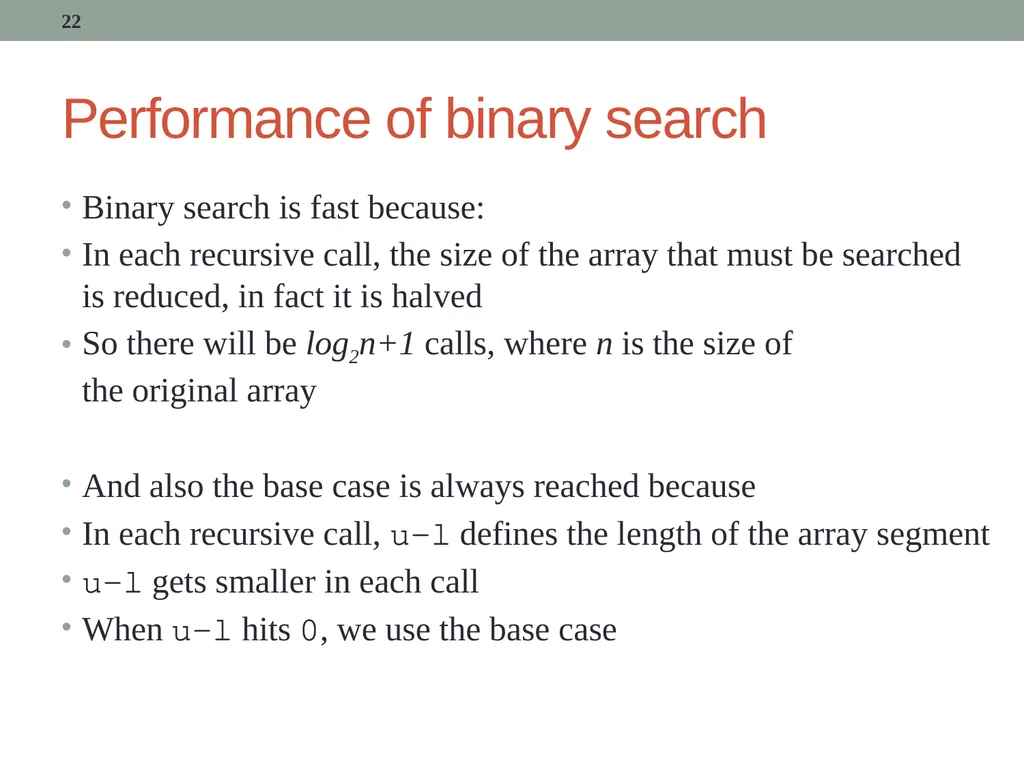
Performance of binary search Binary search is fast because:
In each recursive call, the size of the array that must be searched is reduced, in fact it is halved
So there will be log2n+1 calls, where n is the size of the original array
And also the base case is always reached because
In each recursive call, u–l defines the length of the array segment
u–l gets smaller in each call
When u–l hits 0, we use the base case 22<br>
In each recursive call, the size of the array that must be searched is reduced, in fact it is halved
So there will be log2n+1 calls, where n is the size of the original array
And also the base case is always reached because
In each recursive call, u–l defines the length of the array segment
u–l gets smaller in each call
When u–l hits 0, we use the base case 22<br>
23
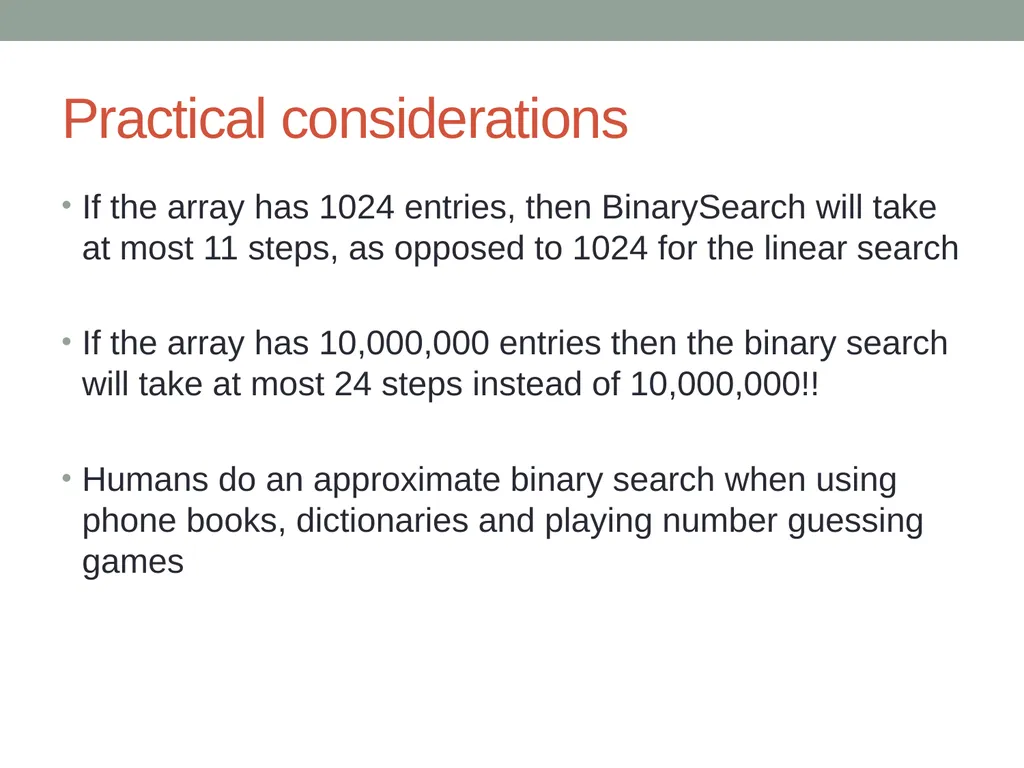
Practical considerations If the array has 1024 entries, then BinarySearch will take at most 11 steps, as opposed to 1024 for the linear search
If the array has 10,000,000 entries then the binary search will take at most 24 steps instead of 10,000,000!!
Humans do an approximate binary search when using phone books, dictionaries and playing number guessing games<br>
If the array has 10,000,000 entries then the binary search will take at most 24 steps instead of 10,000,000!!
Humans do an approximate binary search when using phone books, dictionaries and playing number guessing games<br>
24
Recursive Graphics<br>
25
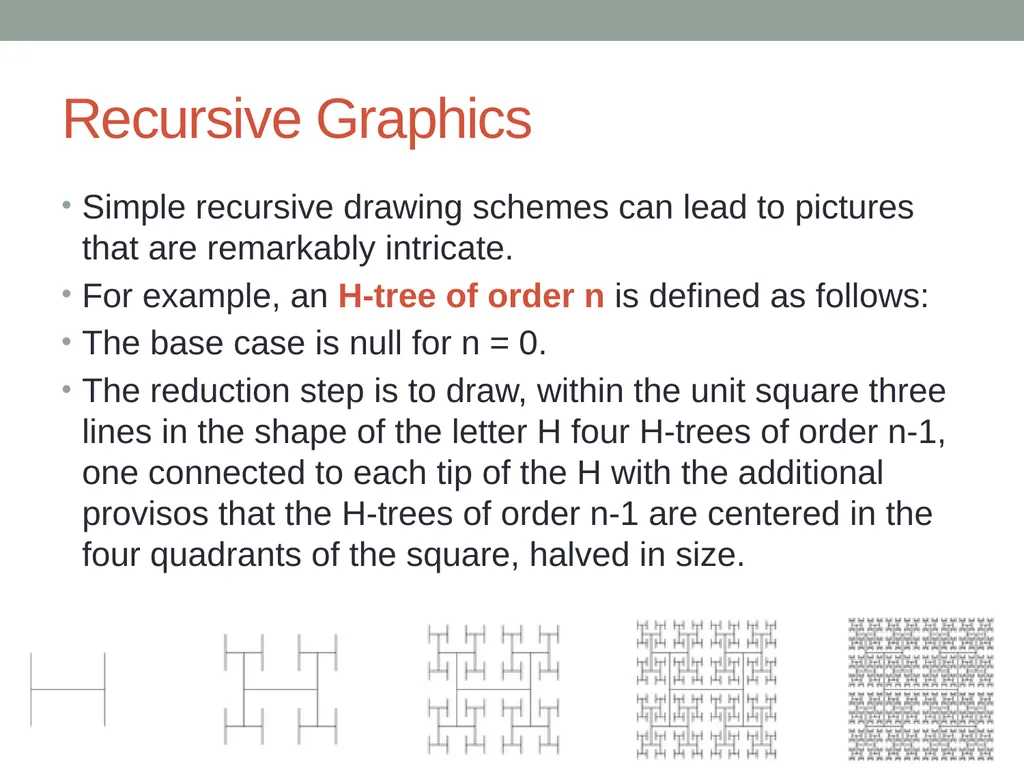
Recursive Graphics Simple recursive drawing schemes can lead to pictures that are remarkably intricate.
For example, an H-tree of order n is defined as follows:
The base case is null for n = 0.
The reduction step is to draw, within the unit square three lines in the shape of the letter H four H-trees of order n-1, one connected to each tip of the H with the additional provisos that the H-trees of order n-1 are centered in the four quadrants of the square, halved in size.<br>
For example, an H-tree of order n is defined as follows:
The base case is null for n = 0.
The reduction step is to draw, within the unit square three lines in the shape of the letter H four H-trees of order n-1, one connected to each tip of the H with the additional provisos that the H-trees of order n-1 are centered in the four quadrants of the square, halved in size.<br>
26
H-tree Htree.java takes a command-line argument n, and plots to standard drawing an H-tree of order n.
An H-tree is a simple example of a fractal: a geometric shape that can be divided into parts, each of which is (approximately) a reduced size copy of the original.<br>
An H-tree is a simple example of a fractal: a geometric shape that can be divided into parts, each of which is (approximately) a reduced size copy of the original.<br>
27
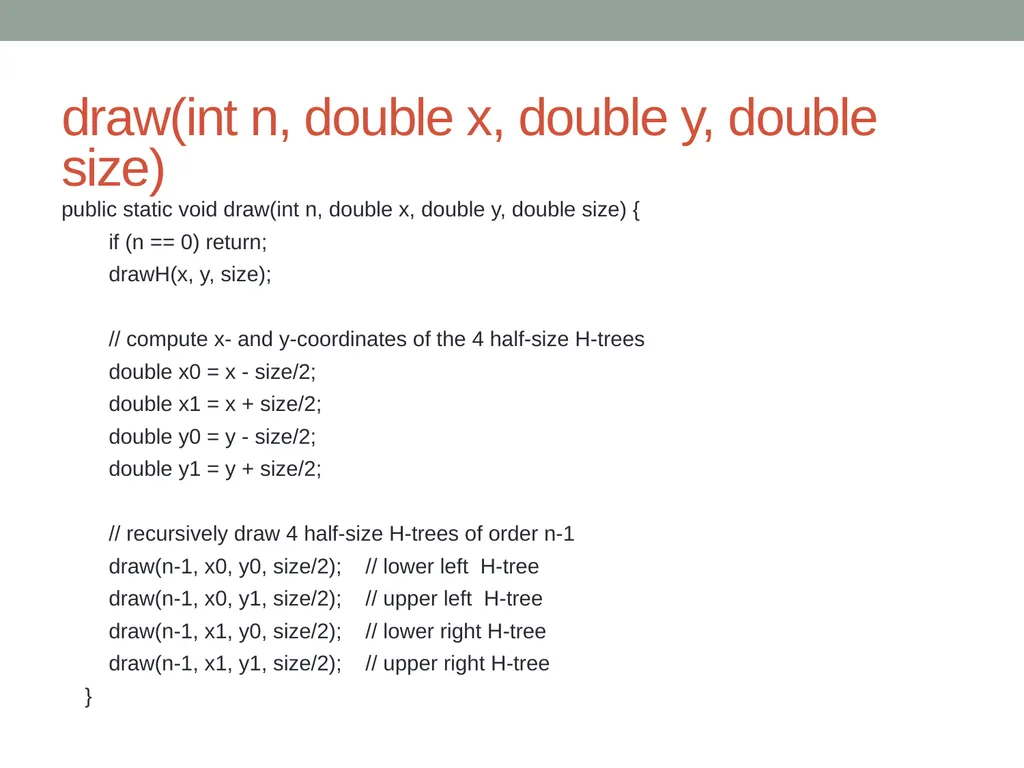
draw(int n, double x, double y, double size) public static void draw(int n, double x, double y, double size) {
if (n == 0) return;
drawH(x, y, size);
// compute x- and y-coordinates of the 4 half-size H-trees
double x0 = x - size/2;
double x1 = x + size/2;
double y0 = y - size/2;
double y1 = y + size/2;
// recursively draw 4 half-size H-trees of order n-1
draw(n-1, x0, y0, size/2); // lower left H-tree
draw(n-1, x0, y1, size/2); // upper left H-tree
draw(n-1, x1, y0, size/2); // lower right H-tree
draw(n-1, x1, y1, size/2); // upper right H-tree
}<br>
if (n == 0) return;
drawH(x, y, size);
// compute x- and y-coordinates of the 4 half-size H-trees
double x0 = x - size/2;
double x1 = x + size/2;
double y0 = y - size/2;
double y1 = y + size/2;
// recursively draw 4 half-size H-trees of order n-1
draw(n-1, x0, y0, size/2); // lower left H-tree
draw(n-1, x0, y1, size/2); // upper left H-tree
draw(n-1, x1, y0, size/2); // lower right H-tree
draw(n-1, x1, y1, size/2); // upper right H-tree
}<br>
28
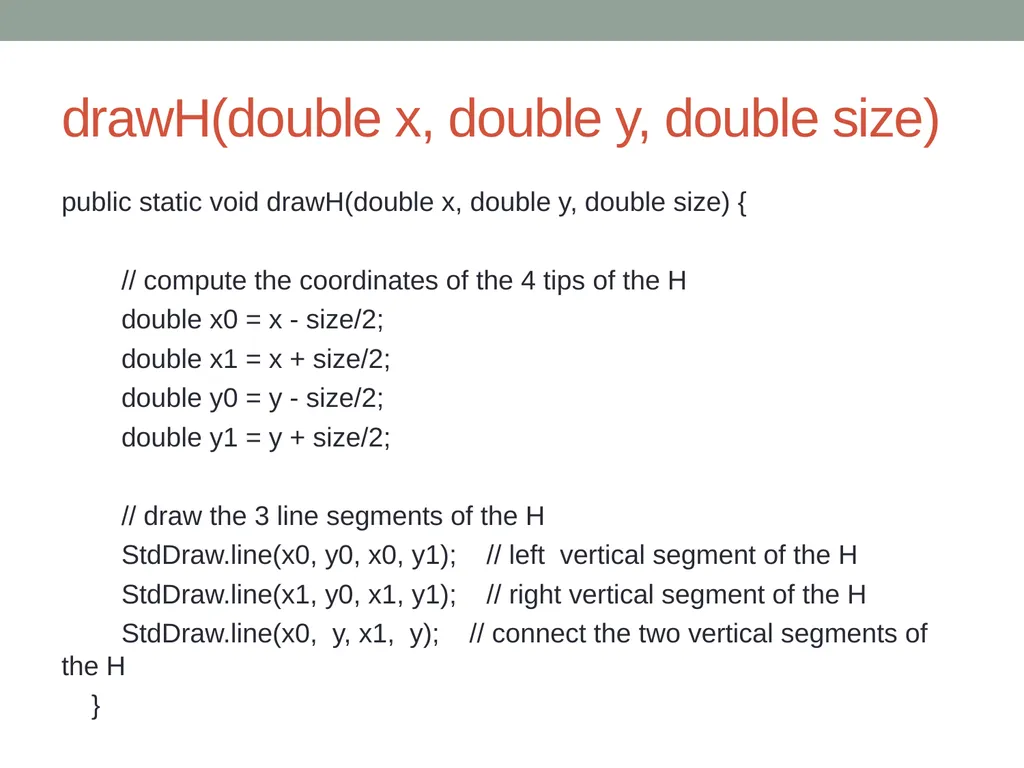
drawH(double x, double y, double size) public static void drawH(double x, double y, double size) {
// compute the coordinates of the 4 tips of the H
double x0 = x - size/2;
double x1 = x + size/2;
double y0 = y - size/2;
double y1 = y + size/2;
// draw the 3 line segments of the H
StdDraw.line(x0, y0, x0, y1); // left vertical segment of the H
StdDraw.line(x1, y0, x1, y1); // right vertical segment of the H
StdDraw.line(x0, y, x1, y); // connect the two vertical segments of the H
}<br>
// compute the coordinates of the 4 tips of the H
double x0 = x - size/2;
double x1 = x + size/2;
double y0 = y - size/2;
double y1 = y + size/2;
// draw the 3 line segments of the H
StdDraw.line(x0, y0, x0, y1); // left vertical segment of the H
StdDraw.line(x1, y0, x1, y1); // right vertical segment of the H
StdDraw.line(x0, y, x1, y); // connect the two vertical segments of the H
}<br>
29
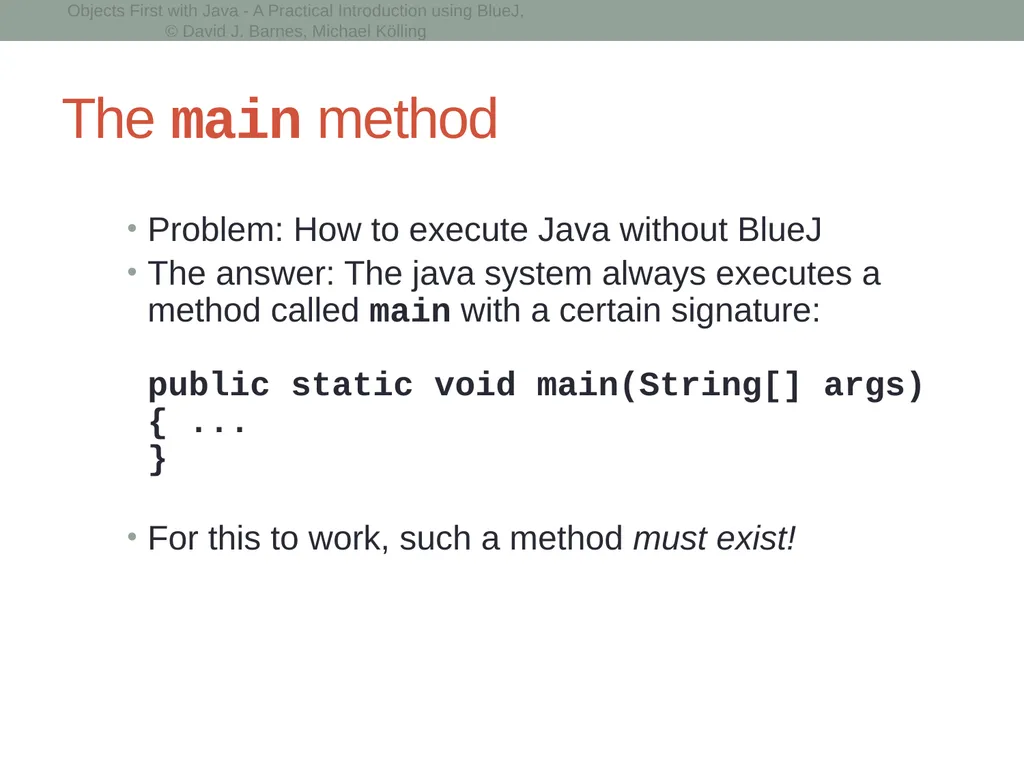
The main method Objects First with Java - A Practical Introduction using BlueJ, © David J. Barnes, Michael Kölling Problem: How to execute Java without BlueJ
The answer: The java system always executes a method called main with a certain signature: public static void main(String[] args) { ... }
For this to work, such a method must exist!<br>
The answer: The java system always executes a method called main with a certain signature: public static void main(String[] args) { ... }
For this to work, such a method must exist!<br>
30
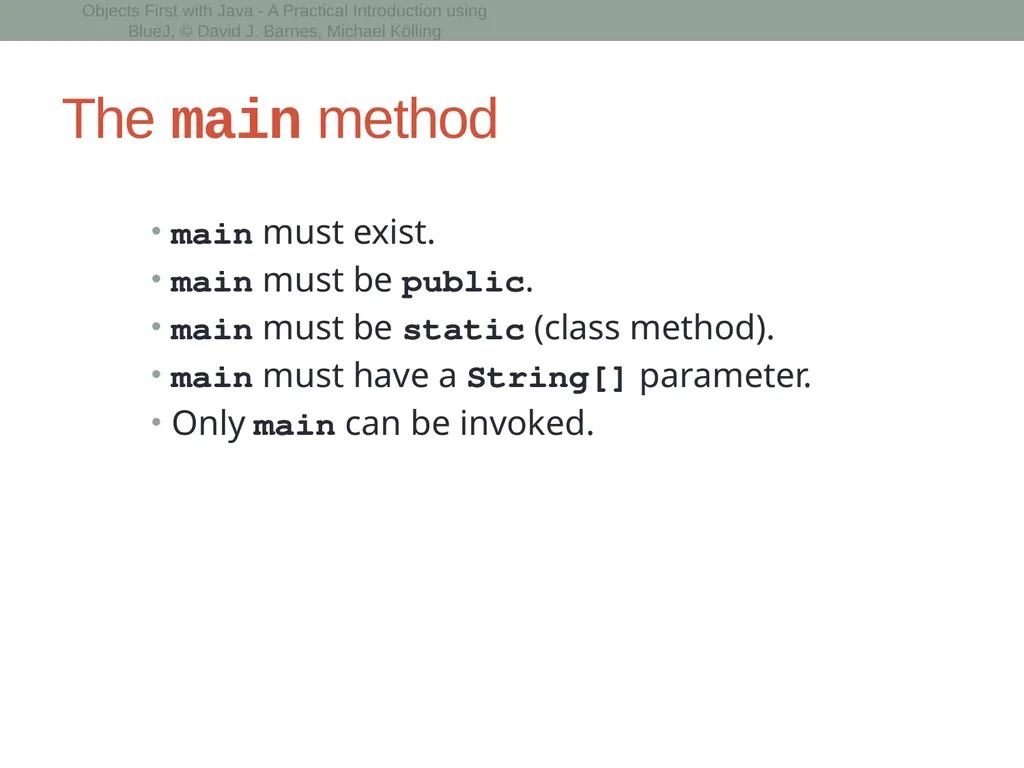
The main method Objects First with Java - A Practical Introduction using BlueJ, © David J. Barnes, Michael Kölling main must exist.
main must be public.
main must be static (class method).
main must have a String[] parameter.
Only main can be invoked.<br>
main must be public.
main must be static (class method).
main must have a String[] parameter.
Only main can be invoked.<br>
31
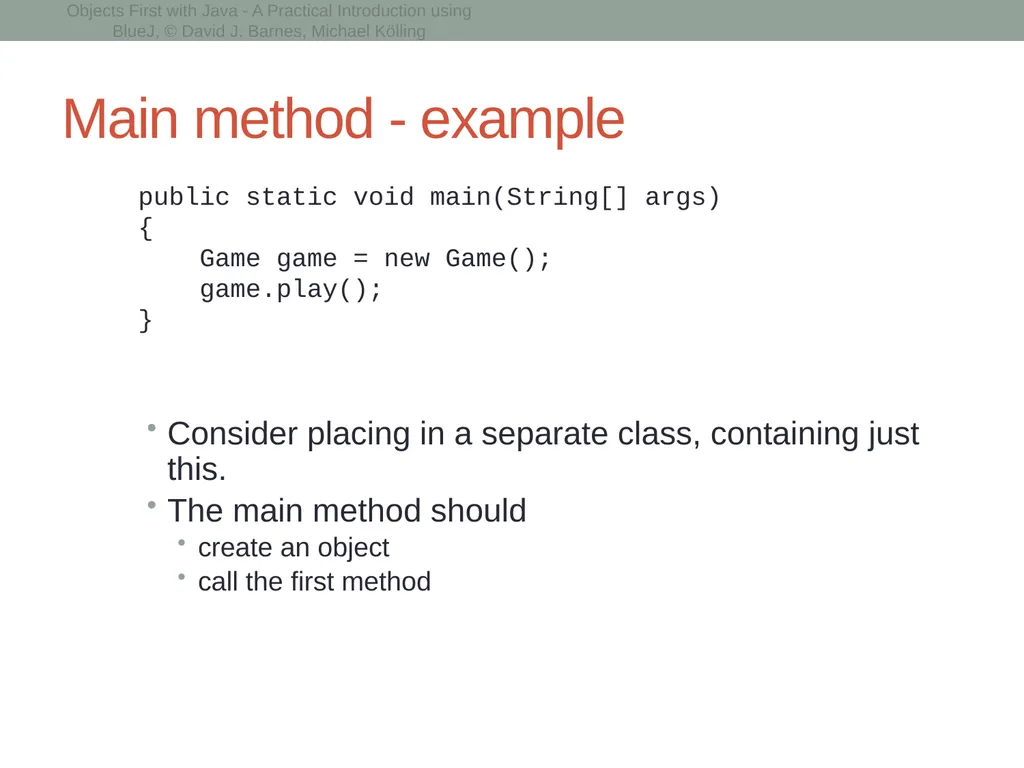
Main method - example Consider placing in a separate class, containing just this.
The main method should
create an object
call the first method Objects First with Java - A Practical Introduction using BlueJ, © David J. Barnes, Michael Kölling public static void main(String[] args)
{
Game game = new Game();
game.play();
}<br>
The main method should
create an object
call the first method Objects First with Java - A Practical Introduction using BlueJ, © David J. Barnes, Michael Kölling public static void main(String[] args)
{
Game game = new Game();
game.play();
}<br>
32
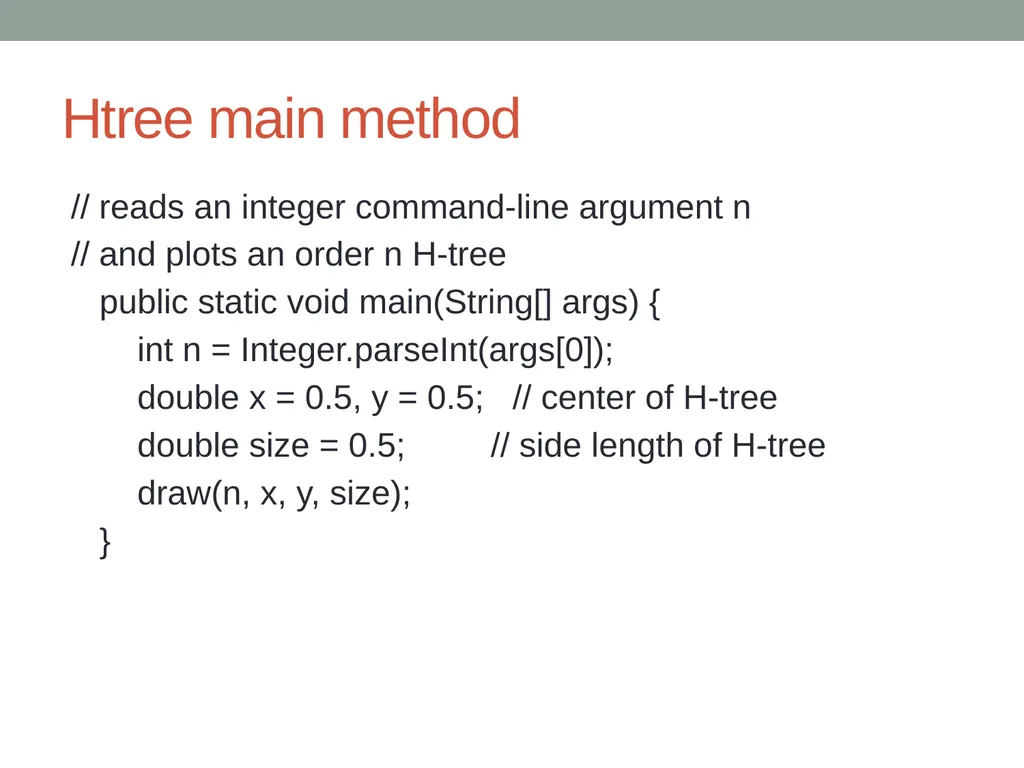
Htree main method // reads an integer command-line argument n
// and plots an order n H-tree
public static void main(String[] args) {
int n = Integer.parseInt(args[0]);
double x = 0.5, y = 0.5; // center of H-tree
double size = 0.5; // side length of H-tree
draw(n, x, y, size);
}<br>
// and plots an order n H-tree
public static void main(String[] args) {
int n = Integer.parseInt(args[0]);
double x = 0.5, y = 0.5; // center of H-tree
double size = 0.5; // side length of H-tree
draw(n, x, y, size);
}<br>
33
Pitfalls of Recursion With recursion, you can write compact and elegant programs that fail spectacularly at runtime.
Study the following examples to help you to avoid the pitfalls.<br>
Study the following examples to help you to avoid the pitfalls.<br>
34
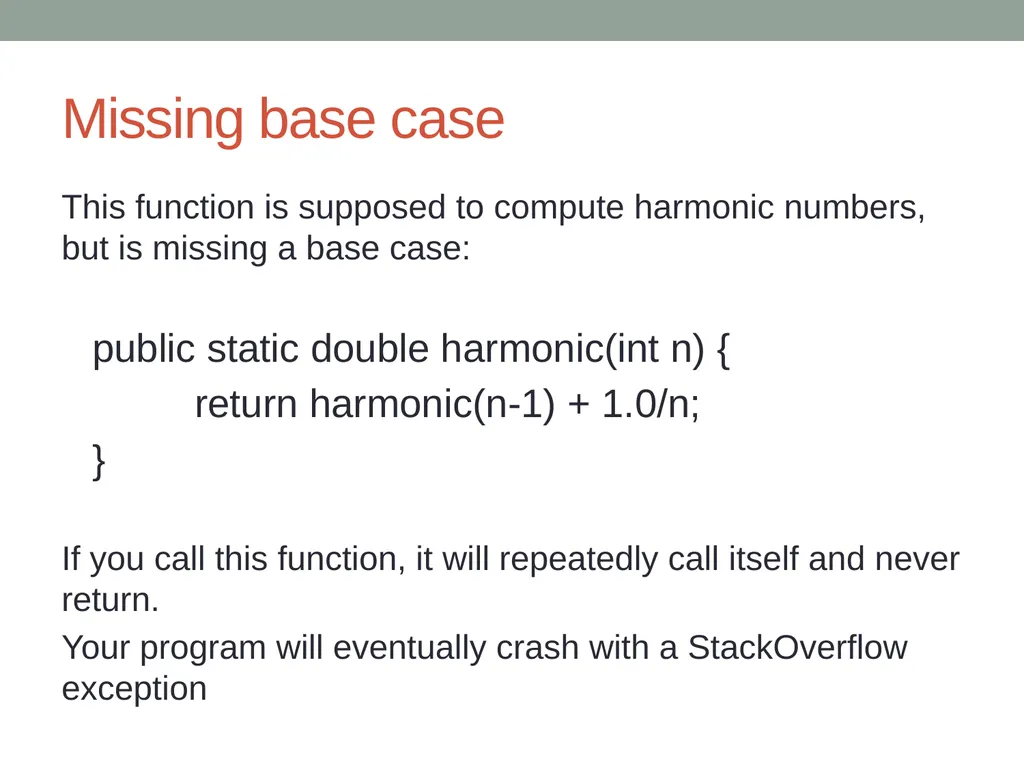
Missing base case This function is supposed to compute harmonic numbers, but is missing a base case:
public static double harmonic(int n) {
return harmonic(n-1) + 1.0/n;
}
If you call this function, it will repeatedly call itself and never return.
Your program will eventually crash with a StackOverflow exception<br>
public static double harmonic(int n) {
return harmonic(n-1) + 1.0/n;
}
If you call this function, it will repeatedly call itself and never return.
Your program will eventually crash with a StackOverflow exception<br>
35
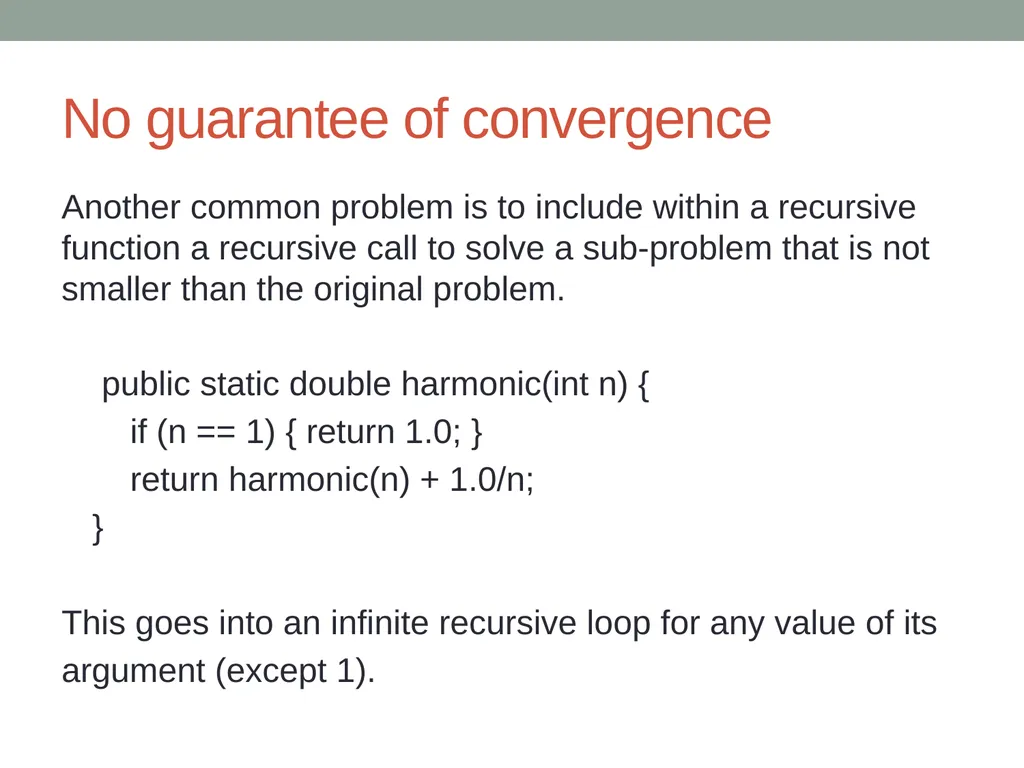
No guarantee of convergence Another common problem is to include within a recursive function a recursive call to solve a sub-problem that is not smaller than the original problem.
public static double harmonic(int n) {
if (n == 1) { return 1.0; }
return harmonic(n) + 1.0/n;
}
This goes into an infinite recursive loop for any value of its
argument (except 1).<br>
public static double harmonic(int n) {
if (n == 1) { return 1.0; }
return harmonic(n) + 1.0/n;
}
This goes into an infinite recursive loop for any value of its
argument (except 1).<br>
36
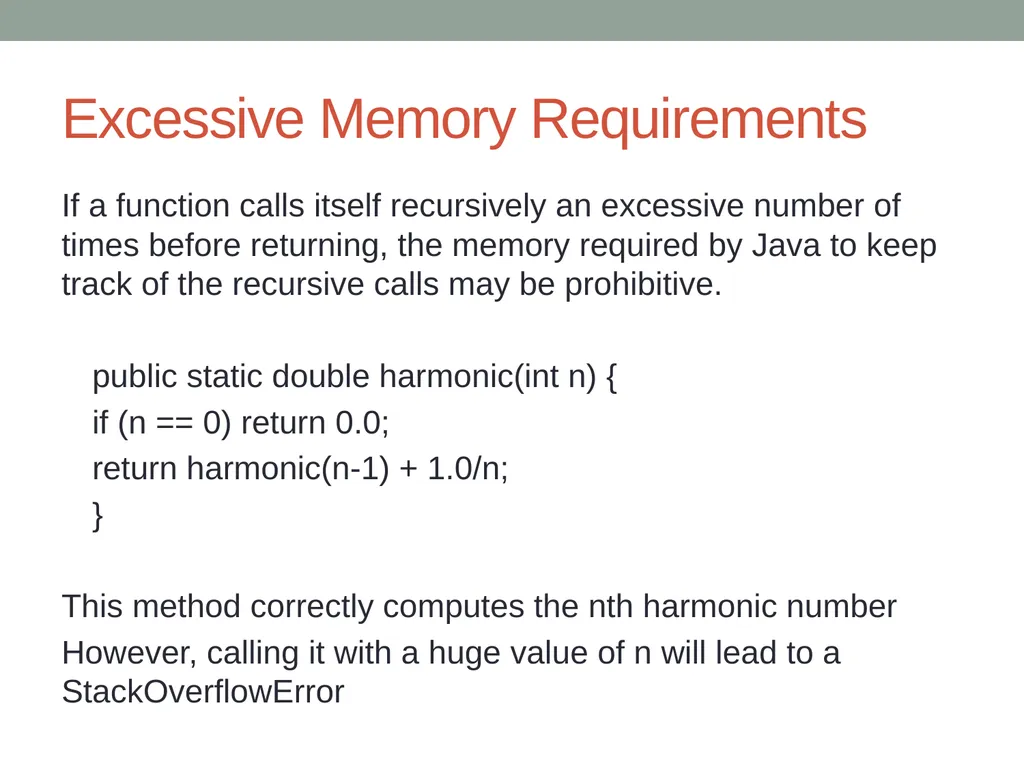
Excessive Memory Requirements If a function calls itself recursively an excessive number of times before returning, the memory required by Java to keep track of the recursive calls may be prohibitive.
public static double harmonic(int n) {
if (n == 0) return 0.0;
return harmonic(n-1) + 1.0/n;
}
This method correctly computes the nth harmonic number
However, calling it with a huge value of n will lead to a StackOverflowError<br>
public static double harmonic(int n) {
if (n == 0) return 0.0;
return harmonic(n-1) + 1.0/n;
}
This method correctly computes the nth harmonic number
However, calling it with a huge value of n will lead to a StackOverflowError<br>
37
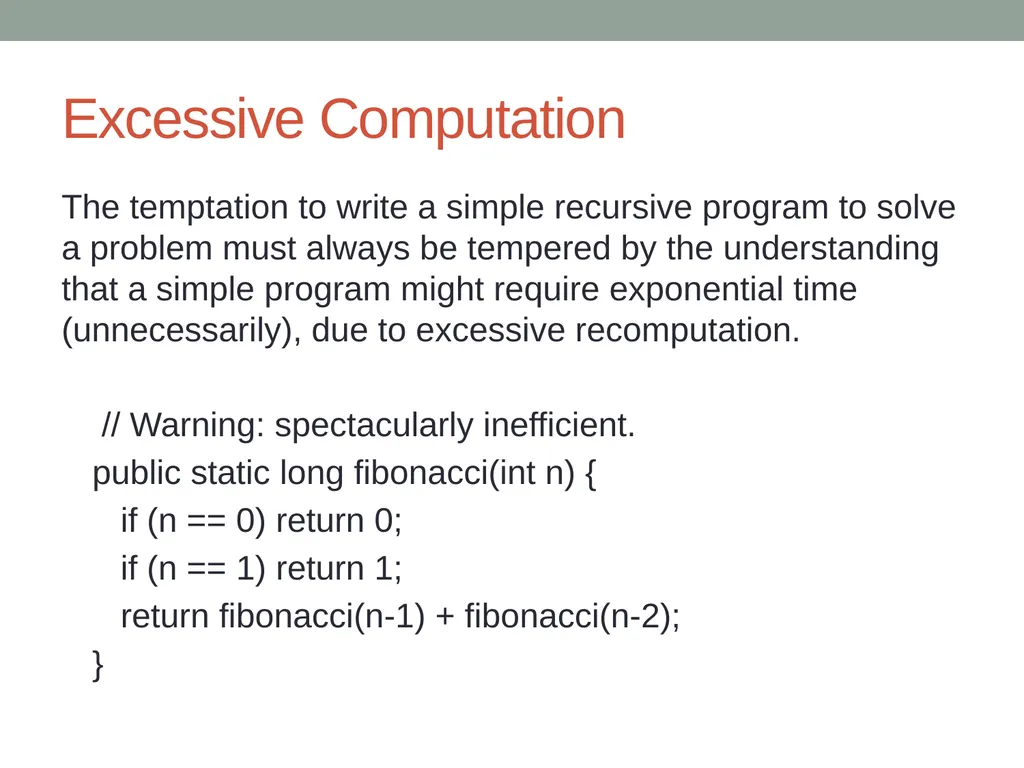
Excessive Computation The temptation to write a simple recursive program to solve a problem must always be tempered by the understanding that a simple program might require exponential time (unnecessarily), due to excessive recomputation.
// Warning: spectacularly inefficient.
public static long fibonacci(int n) {
if (n == 0) return 0;
if (n == 1) return 1;
return fibonacci(n-1) + fibonacci(n-2);
}<br>
// Warning: spectacularly inefficient.
public static long fibonacci(int n) {
if (n == 0) return 0;
if (n == 1) return 1;
return fibonacci(n-1) + fibonacci(n-2);
}<br>
38
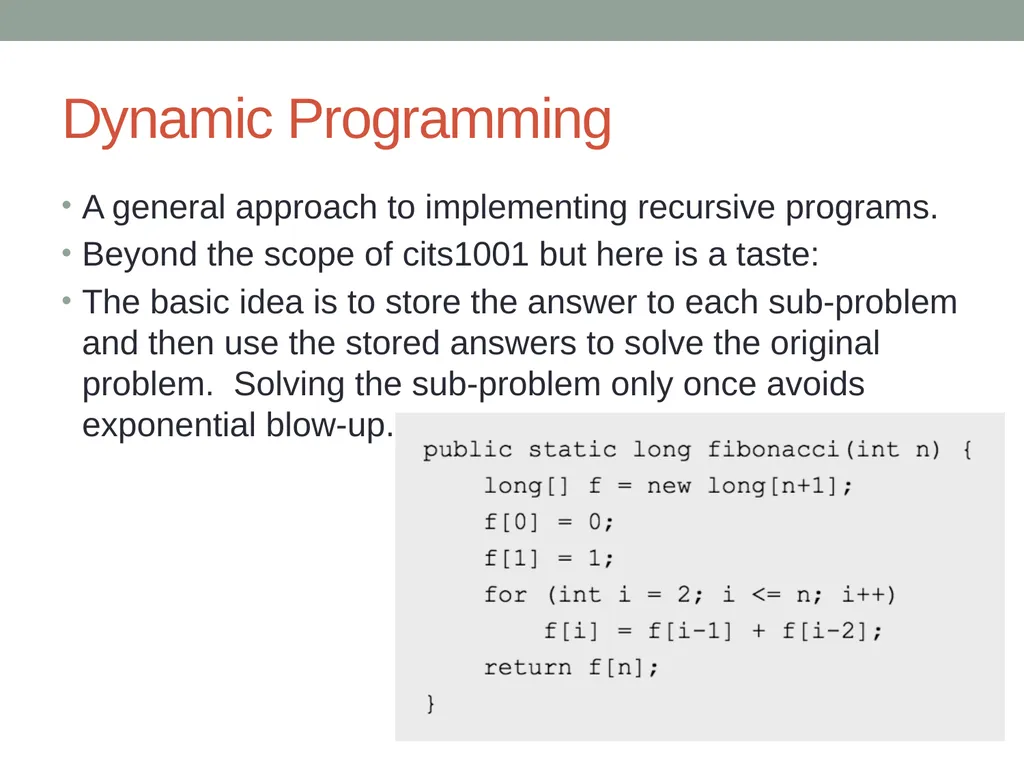
Dynamic Programming A general approach to implementing recursive programs.
Beyond the scope of cits1001 but here is a taste:
The basic idea is to store the answer to each sub-problem and then use the stored answers to solve the original problem. Solving the sub-problem only once avoids exponential blow-up.<br>
Beyond the scope of cits1001 but here is a taste:
The basic idea is to store the answer to each sub-problem and then use the stored answers to solve the original problem. Solving the sub-problem only once avoids exponential blow-up.<br>
39
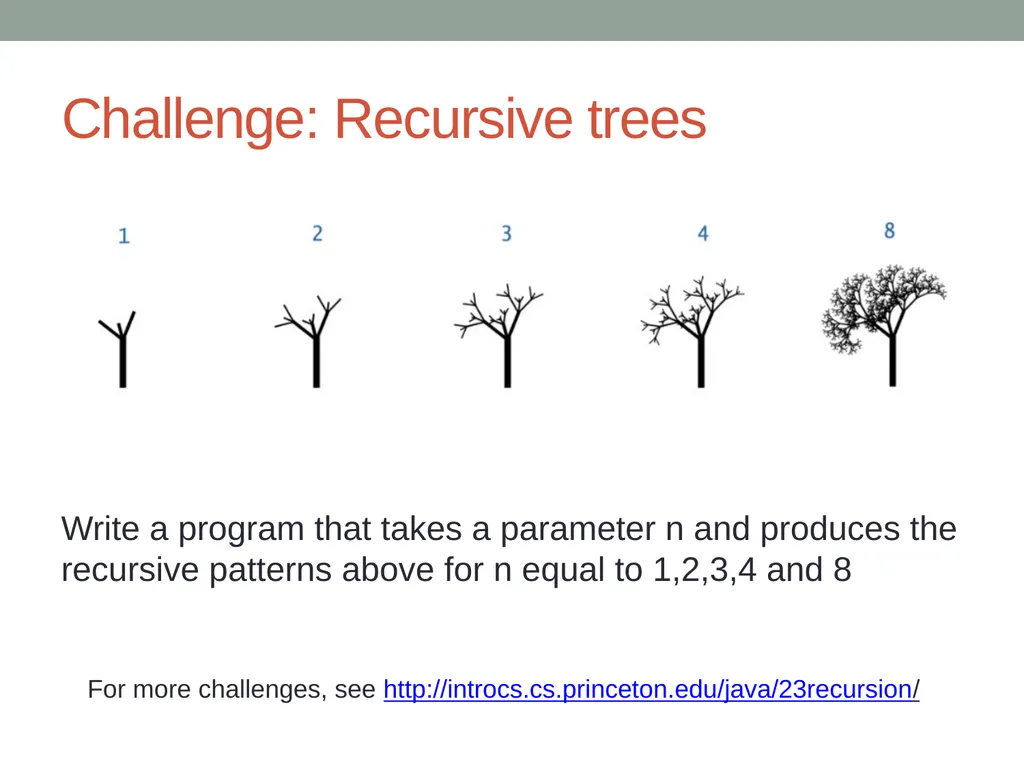
Challenge: Recursive trees Write a program that takes a parameter n and produces the
recursive patterns above for n equal to 1,2,3,4 and 8 For more challenges, see http://introcs.cs.princeton.edu/java/23recursion/<br>
recursive patterns above for n equal to 1,2,3,4 and 8 For more challenges, see http://introcs.cs.princeton.edu/java/23recursion/<br>
40
Summary Recursion can be used to express some complex computations in an elegant way
But there are overheads for using recursion that the programmer needs to be aware of<br>
But there are overheads for using recursion that the programmer needs to be aware of<br>