
Red Flags for Every Teacher Kara Bratton Lutheran
OM
Published · 39 slides · 0 views

1 / 1


Description
Red Flags for Every Teacher Kara Bratton Lutheran Special Education Ministries kbrattonluthsped.org https:luthsped.org20180828lea-webinar-red-flags Autism: Characteristics Speech and Communication Differences Use few or no spoken
Related Topics
Share
Embed code
Download this presentation From Below
"Red Flags for Every Teacher Kara Bratton Lutheran" is the property of its rightful owner. Permission is granted to download and print the materials on this website for personal, non-commercial use only, and to display it on your personal computer provided you do not modify the materials and that you retain all copyright notices contained in the materials. By downloading content from our website, you accept the terms of this agreement.
Presentation Transcript
01
Red Flags for Every Teacher Kara Bratton
Lutheran Special Education Ministries
kbratton@luthsped.org
https://luthsped.org/2018/08/28/lea-webinar-red-flags/<br>
Lutheran Special Education Ministries
kbratton@luthsped.org
https://luthsped.org/2018/08/28/lea-webinar-red-flags/<br>
02
Autism: Characteristics Speech and Communication Differences
Use few or no spoken words by age two, nor do they use gestures, gibberish, or other means to communicate their needs or thoughts.
Use only words they are repeating from television, movies, or other people, especially if they are not using the words to communicate meaning (e.g., repeating a random phrase from a favorite TV show).
Not hard of hearing but don't respond when their name is called.
Lack of eye contact, even when eye contact is requested.
Never initiating interactions or conversations with others.
Do not go through the usual babbling or gibberish stages of speech.
May develop spoken language at the usual time, but use words oddly, have an unusually flat voice, or misunderstand the intended meaning of words.<br>
Use few or no spoken words by age two, nor do they use gestures, gibberish, or other means to communicate their needs or thoughts.
Use only words they are repeating from television, movies, or other people, especially if they are not using the words to communicate meaning (e.g., repeating a random phrase from a favorite TV show).
Not hard of hearing but don't respond when their name is called.
Lack of eye contact, even when eye contact is requested.
Never initiating interactions or conversations with others.
Do not go through the usual babbling or gibberish stages of speech.
May develop spoken language at the usual time, but use words oddly, have an unusually flat voice, or misunderstand the intended meaning of words.<br>
03
Autism: Characteristics Play Skills
Lining up objects or toys rather than using them in pretend or interactive play;
Interacting in the same way with the same objects (toys, doors, containers, etc.) over and over again;
Enacting the same scenes (often from TV) over and over again in exactly the same way;
Engaging in "parallel play" (two children playing near one another but not interacting) long past the point when such play is developmentally typical;
Ignoring or responding angrily to attempts to join them in their play or make changes to their play schemes;
Having difficulty with age-appropriate forms of play such as rule-based games, pretend play, organized sports, or other activities that require social communication.<br>
Lining up objects or toys rather than using them in pretend or interactive play;
Interacting in the same way with the same objects (toys, doors, containers, etc.) over and over again;
Enacting the same scenes (often from TV) over and over again in exactly the same way;
Engaging in "parallel play" (two children playing near one another but not interacting) long past the point when such play is developmentally typical;
Ignoring or responding angrily to attempts to join them in their play or make changes to their play schemes;
Having difficulty with age-appropriate forms of play such as rule-based games, pretend play, organized sports, or other activities that require social communication.<br>
04
Autism: Characteristics Physical Reactions and Behaviors
Rock, flap, or otherwise "stim," often as a way to calm themselves;
Over- or under-respond to sensory input, including pain;
Unusually picky eaters and may refuse foods with particular textures or strong flavors;
Unusual gait that may include toe walking or awkward movements;
Respond in age-inappropriate ways to unexpected changes in routine (angry melt-downs or extreme anxiety as a result of apparently minor changes);
Exhibit age-inappropriate behaviors or interests or have difficulty with developing age-appropriate abilities in toileting, dressing, etc.<br>
Rock, flap, or otherwise "stim," often as a way to calm themselves;
Over- or under-respond to sensory input, including pain;
Unusually picky eaters and may refuse foods with particular textures or strong flavors;
Unusual gait that may include toe walking or awkward movements;
Respond in age-inappropriate ways to unexpected changes in routine (angry melt-downs or extreme anxiety as a result of apparently minor changes);
Exhibit age-inappropriate behaviors or interests or have difficulty with developing age-appropriate abilities in toileting, dressing, etc.<br>
05
Autism: Characteristics Physical Symptoms
Sleep problems are common among people with autism. Many autistic children have trouble falling or staying asleep, and adults on the spectrum often have similar issues.
Many children with autism have mild or more significant delays in gross and fine motor skills; for example, they may have difficulty with manipulating silverware, using scissors, climbing, jumping, etc.
Seizure disorders are more common among children with autism.
Gastrointestinal (GI) problems such as constipation, diarrhea, and/or vomiting are more common among children with autism.<br>
Sleep problems are common among people with autism. Many autistic children have trouble falling or staying asleep, and adults on the spectrum often have similar issues.
Many children with autism have mild or more significant delays in gross and fine motor skills; for example, they may have difficulty with manipulating silverware, using scissors, climbing, jumping, etc.
Seizure disorders are more common among children with autism.
Gastrointestinal (GI) problems such as constipation, diarrhea, and/or vomiting are more common among children with autism.<br>
06
Autism: Characteristics Hyperlexia: a very precocious ability to decode written language without the accompanying ability to understand the meaning of the text;
Synesthesia: unique responses to sound, color, letters, or numbers (for example, some people with synesthesia "see" sounds, "hear" colors, or otherwise experience unique responses to sensory input;
Savant syndrome: small percentage of the autistic population, may have amazing abilities to memorize information, do complex calculations, play piano, and so forth—much like the character of Raymond in the movie "Rain Man.”<br>
Synesthesia: unique responses to sound, color, letters, or numbers (for example, some people with synesthesia "see" sounds, "hear" colors, or otherwise experience unique responses to sensory input;
Savant syndrome: small percentage of the autistic population, may have amazing abilities to memorize information, do complex calculations, play piano, and so forth—much like the character of Raymond in the movie "Rain Man.”<br>
07
Autism: Early Signs The characteristic behaviors of autism spectrum disorder may be apparent in infancy (18 to 24 months), but they usually become clearer during early childhood (24 months to 6 years)
Most obvious signs of autism and symptoms of autism tend to emerge between 2 and 3 years of age
Any of these “red flags” does not mean a child has autism. But because the disorder’s symptoms vary so widely, a child showing these behaviors should be evaluated by a multidisciplinary team
Under the DSM-5 criteria, individuals with ASD must show symptoms from early childhood, even if those symptoms are not recognized until later<br>
Most obvious signs of autism and symptoms of autism tend to emerge between 2 and 3 years of age
Any of these “red flags” does not mean a child has autism. But because the disorder’s symptoms vary so widely, a child showing these behaviors should be evaluated by a multidisciplinary team
Under the DSM-5 criteria, individuals with ASD must show symptoms from early childhood, even if those symptoms are not recognized until later<br>
08
Autism: Early Signs No big smiles or other warm, joyful expressions by six months or thereafter
No back-and-forth sharing of sounds, smiles, or other facial expressions by nine months or thereafter
No babbling by 12 months
No gesturing (pointing, waving bye-bye) by 12 months
No words by 16 months
No two-word meaningful phrases (without imitating or repeating) by 24 months
Any loss of speech or babbling or social skills at any age<br>
No back-and-forth sharing of sounds, smiles, or other facial expressions by nine months or thereafter
No babbling by 12 months
No gesturing (pointing, waving bye-bye) by 12 months
No words by 16 months
No two-word meaningful phrases (without imitating or repeating) by 24 months
Any loss of speech or babbling or social skills at any age<br>
09
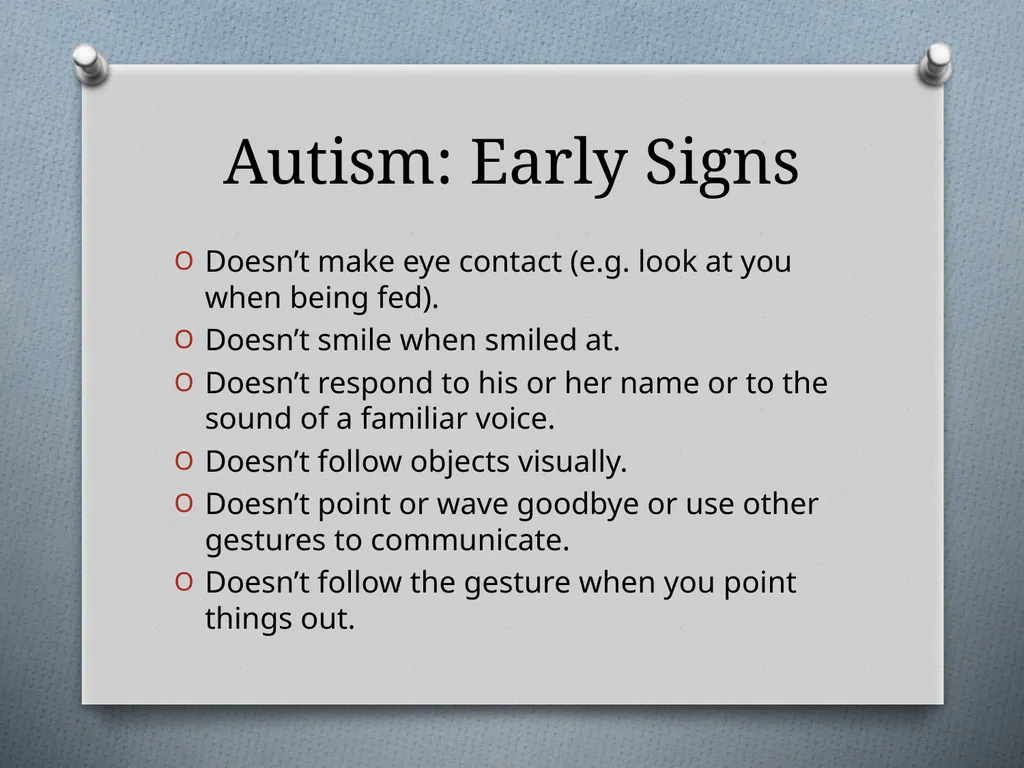
Autism: Early Signs Doesn’t make eye contact (e.g. look at you when being fed).
Doesn’t smile when smiled at.
Doesn’t respond to his or her name or to the sound of a familiar voice.
Doesn’t follow objects visually.
Doesn’t point or wave goodbye or use other gestures to communicate.
Doesn’t follow the gesture when you point things out.<br>
Doesn’t smile when smiled at.
Doesn’t respond to his or her name or to the sound of a familiar voice.
Doesn’t follow objects visually.
Doesn’t point or wave goodbye or use other gestures to communicate.
Doesn’t follow the gesture when you point things out.<br>
10
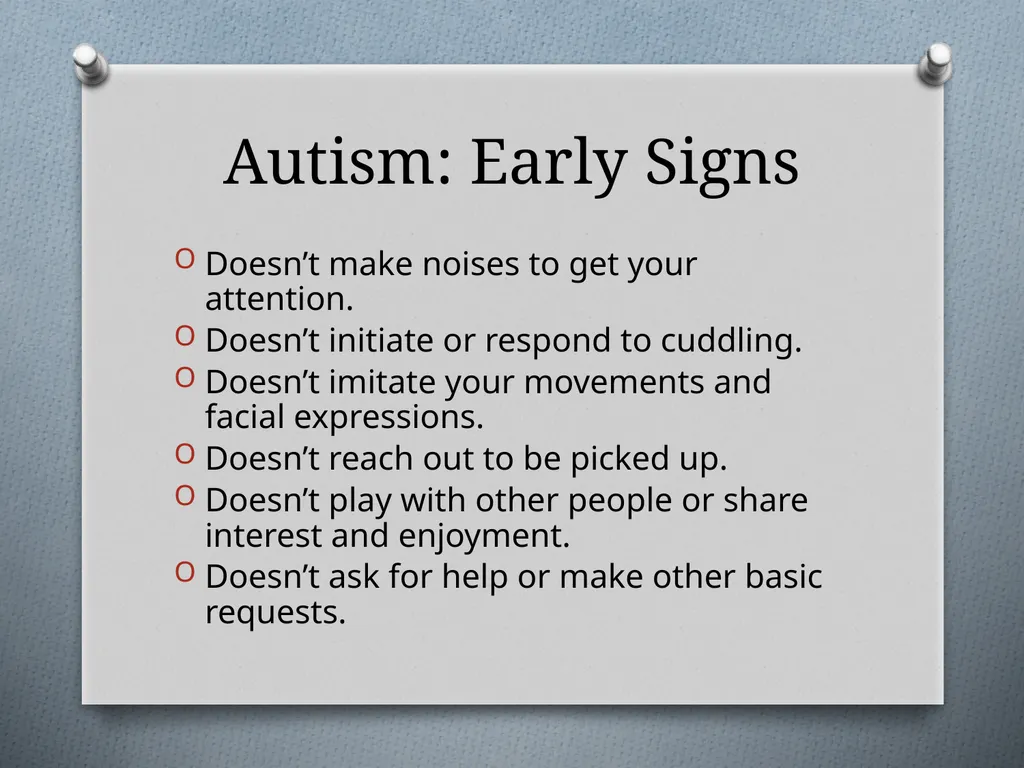
Autism: Early Signs Doesn’t make noises to get your attention.
Doesn’t initiate or respond to cuddling.
Doesn’t imitate your movements and facial expressions.
Doesn’t reach out to be picked up.
Doesn’t play with other people or share interest and enjoyment.
Doesn’t ask for help or make other basic requests.<br>
Doesn’t initiate or respond to cuddling.
Doesn’t imitate your movements and facial expressions.
Doesn’t reach out to be picked up.
Doesn’t play with other people or share interest and enjoyment.
Doesn’t ask for help or make other basic requests.<br>
11
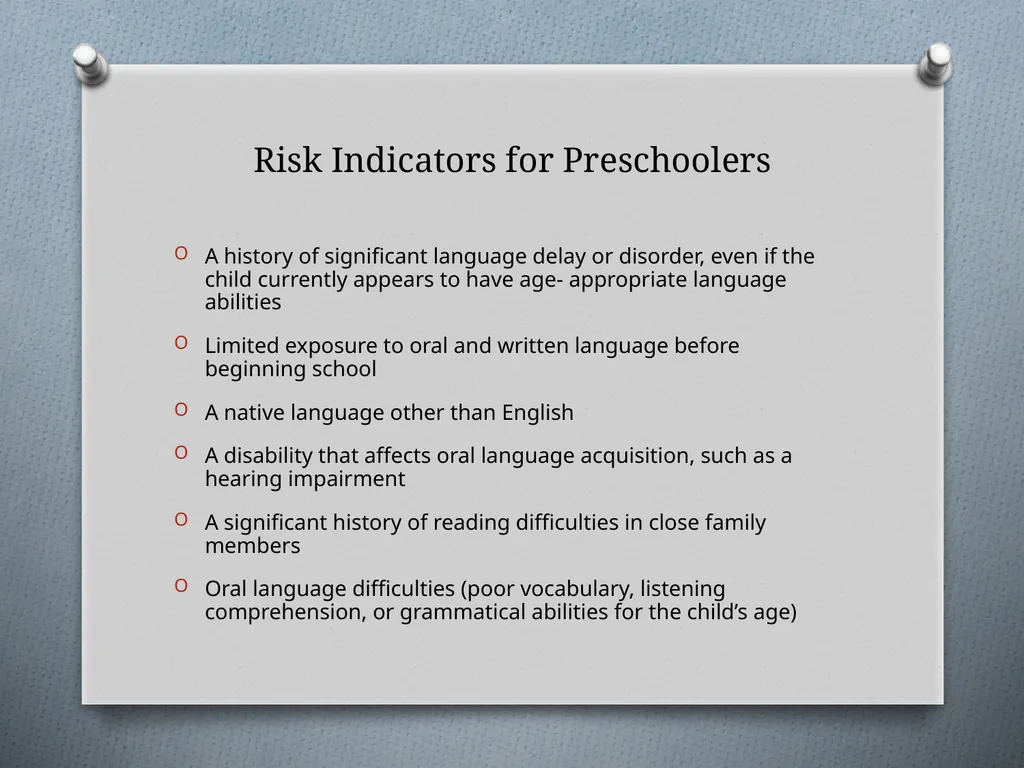
Risk Indicators for Preschoolers A history of significant language delay or disorder, even if the child currently appears to have age- appropriate language abilities
Limited exposure to oral and written language before beginning school
A native language other than English
A disability that affects oral language acquisition, such as a hearing impairment
A significant history of reading difficulties in close family members
Oral language difficulties (poor vocabulary, listening comprehension, or grammatical abilities for the child’s age)<br>
Limited exposure to oral and written language before beginning school
A native language other than English
A disability that affects oral language acquisition, such as a hearing impairment
A significant history of reading difficulties in close family members
Oral language difficulties (poor vocabulary, listening comprehension, or grammatical abilities for the child’s age)<br>
12
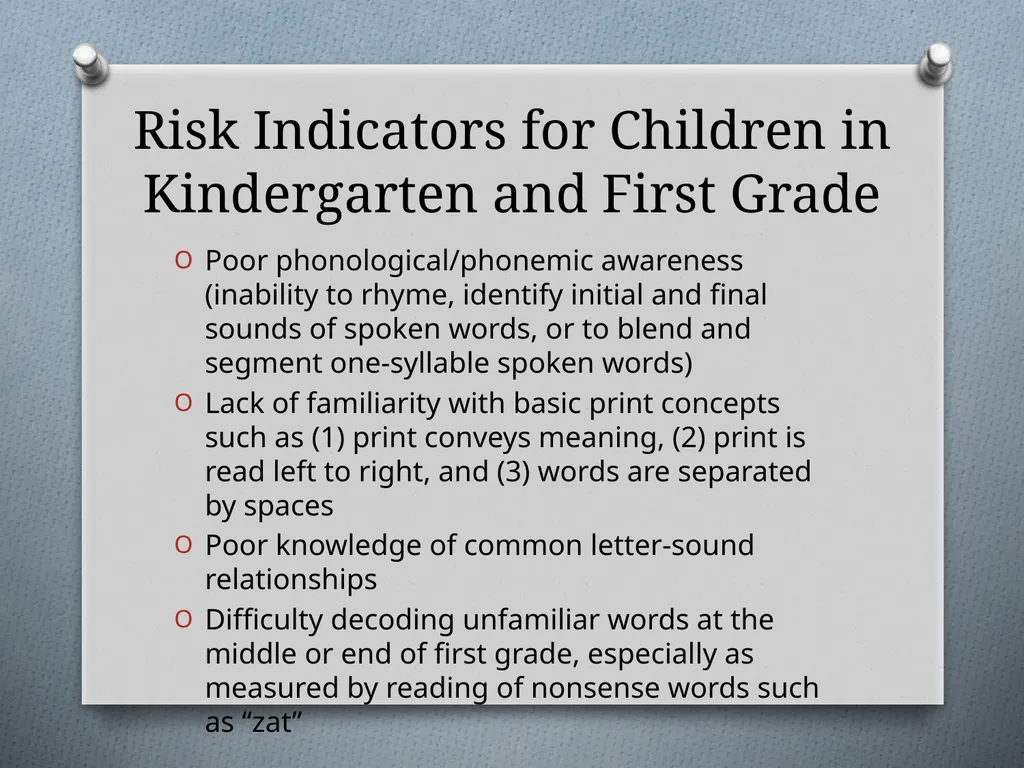
Risk Indicators for Children in Kindergarten and First Grade Poor phonological/phonemic awareness (inability to rhyme, identify initial and final sounds of spoken words, or to blend and segment one-syllable spoken words)
Lack of familiarity with basic print concepts such as (1) print conveys meaning, (2) print is read left to right, and (3) words are separated by spaces
Poor knowledge of common letter-sound relationships
Difficulty decoding unfamiliar words at the middle or end of first grade, especially as measured by reading of nonsense words such as “zat”<br>
Lack of familiarity with basic print concepts such as (1) print conveys meaning, (2) print is read left to right, and (3) words are separated by spaces
Poor knowledge of common letter-sound relationships
Difficulty decoding unfamiliar words at the middle or end of first grade, especially as measured by reading of nonsense words such as “zat”<br>
13
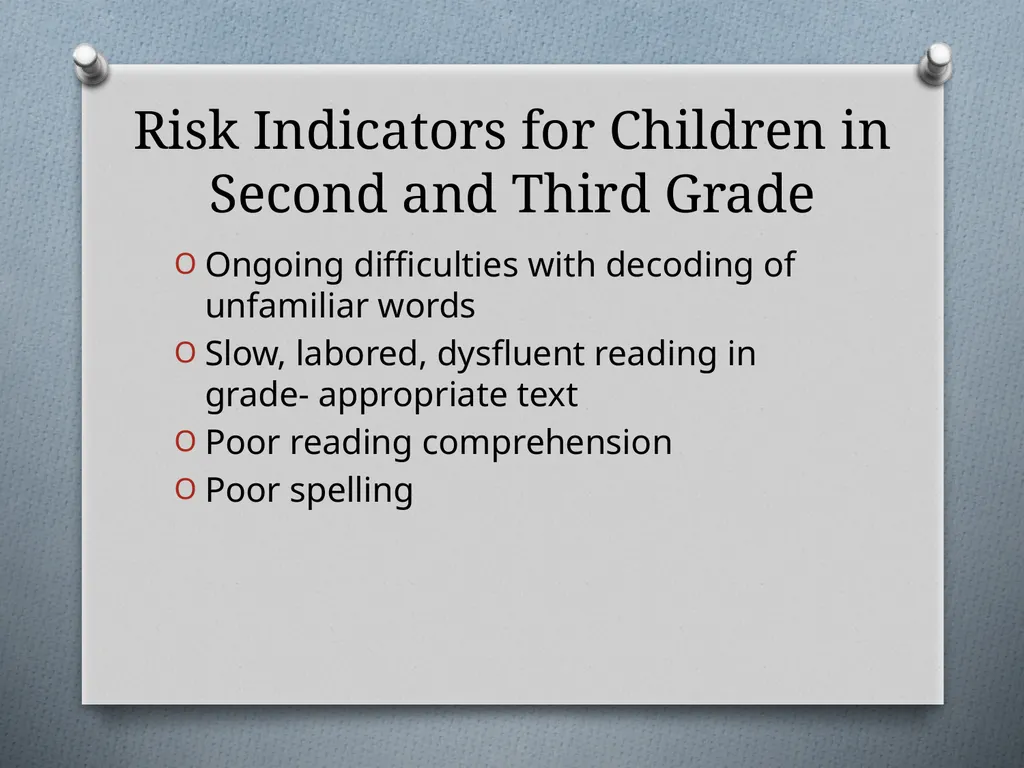
Risk Indicators for Children in Second and Third Grade Ongoing difficulties with decoding of unfamiliar words
Slow, labored, dysfluent reading in grade- appropriate text
Poor reading comprehension
Poor spelling<br>
Slow, labored, dysfluent reading in grade- appropriate text
Poor reading comprehension
Poor spelling<br>
14
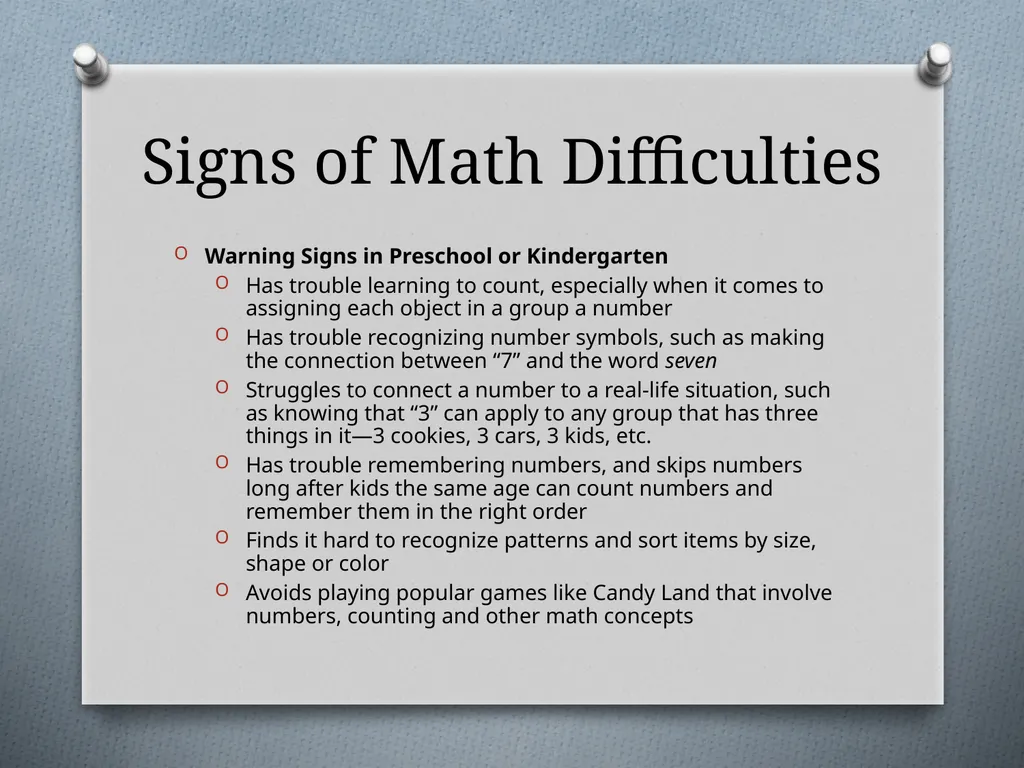
Signs of Math Difficulties Warning Signs in Preschool or Kindergarten
Has trouble learning to count, especially when it comes to assigning each object in a group a number
Has trouble recognizing number symbols, such as making the connection between “7” and the word seven
Struggles to connect a number to a real-life situation, such as knowing that “3” can apply to any group that has three things in it—3 cookies, 3 cars, 3 kids, etc.
Has trouble remembering numbers, and skips numbers long after kids the same age can count numbers and remember them in the right order
Finds it hard to recognize patterns and sort items by size, shape or color
Avoids playing popular games like Candy Land that involve numbers, counting and other math concepts<br>
Has trouble learning to count, especially when it comes to assigning each object in a group a number
Has trouble recognizing number symbols, such as making the connection between “7” and the word seven
Struggles to connect a number to a real-life situation, such as knowing that “3” can apply to any group that has three things in it—3 cookies, 3 cars, 3 kids, etc.
Has trouble remembering numbers, and skips numbers long after kids the same age can count numbers and remember them in the right order
Finds it hard to recognize patterns and sort items by size, shape or color
Avoids playing popular games like Candy Land that involve numbers, counting and other math concepts<br>
15
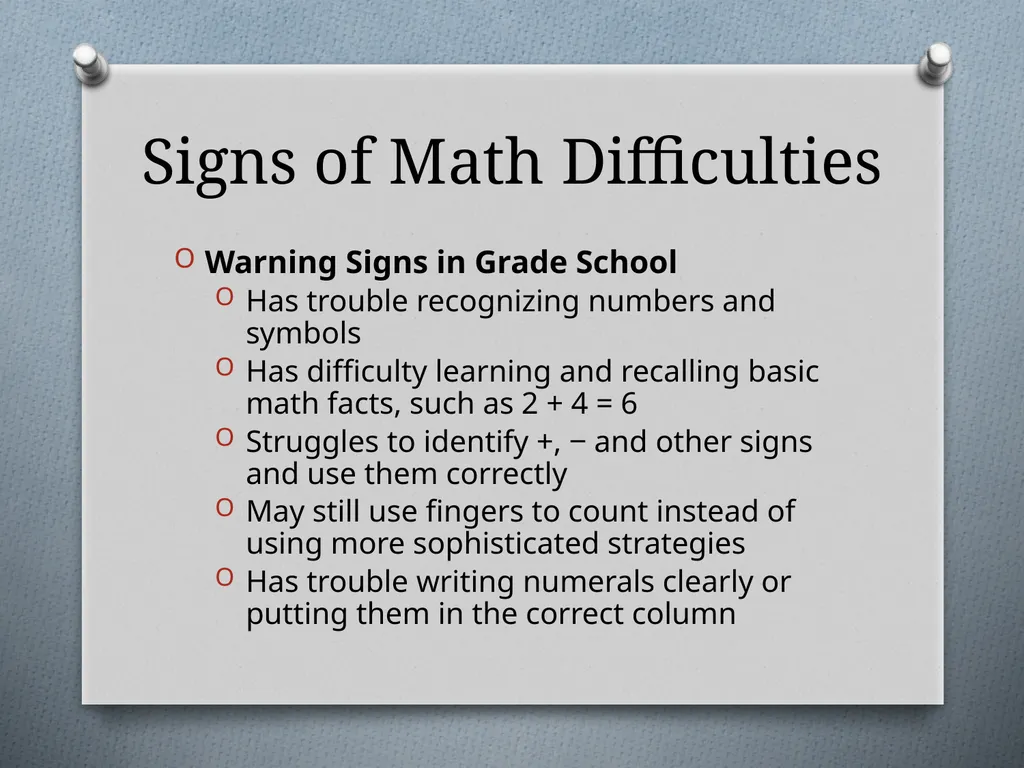
Signs of Math Difficulties Warning Signs in Grade School
Has trouble recognizing numbers and symbols
Has difficulty learning and recalling basic math facts, such as 2 + 4 = 6
Struggles to identify +, ‒ and other signs and use them correctly
May still use fingers to count instead of using more sophisticated strategies
Has trouble writing numerals clearly or putting them in the correct column<br>
Has trouble recognizing numbers and symbols
Has difficulty learning and recalling basic math facts, such as 2 + 4 = 6
Struggles to identify +, ‒ and other signs and use them correctly
May still use fingers to count instead of using more sophisticated strategies
Has trouble writing numerals clearly or putting them in the correct column<br>
16
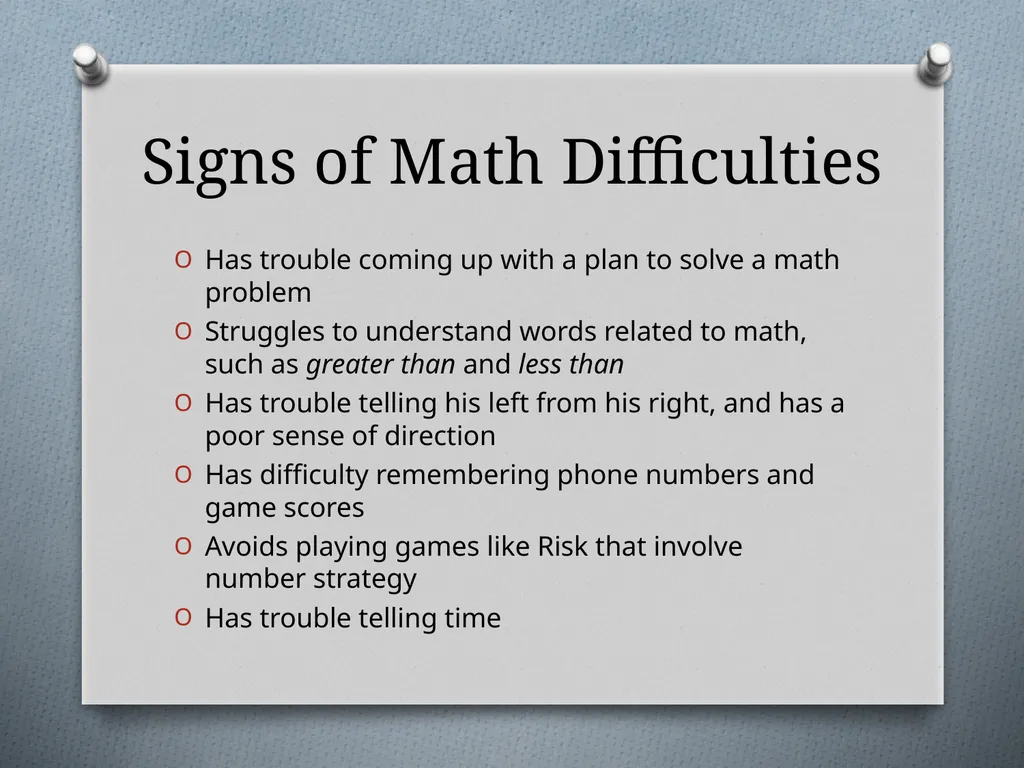
Signs of Math Difficulties Has trouble coming up with a plan to solve a math problem
Struggles to understand words related to math, such as greater than and less than
Has trouble telling his left from his right, and has a poor sense of direction
Has difficulty remembering phone numbers and game scores
Avoids playing games like Risk that involve number strategy
Has trouble telling time<br>
Struggles to understand words related to math, such as greater than and less than
Has trouble telling his left from his right, and has a poor sense of direction
Has difficulty remembering phone numbers and game scores
Avoids playing games like Risk that involve number strategy
Has trouble telling time<br>
17
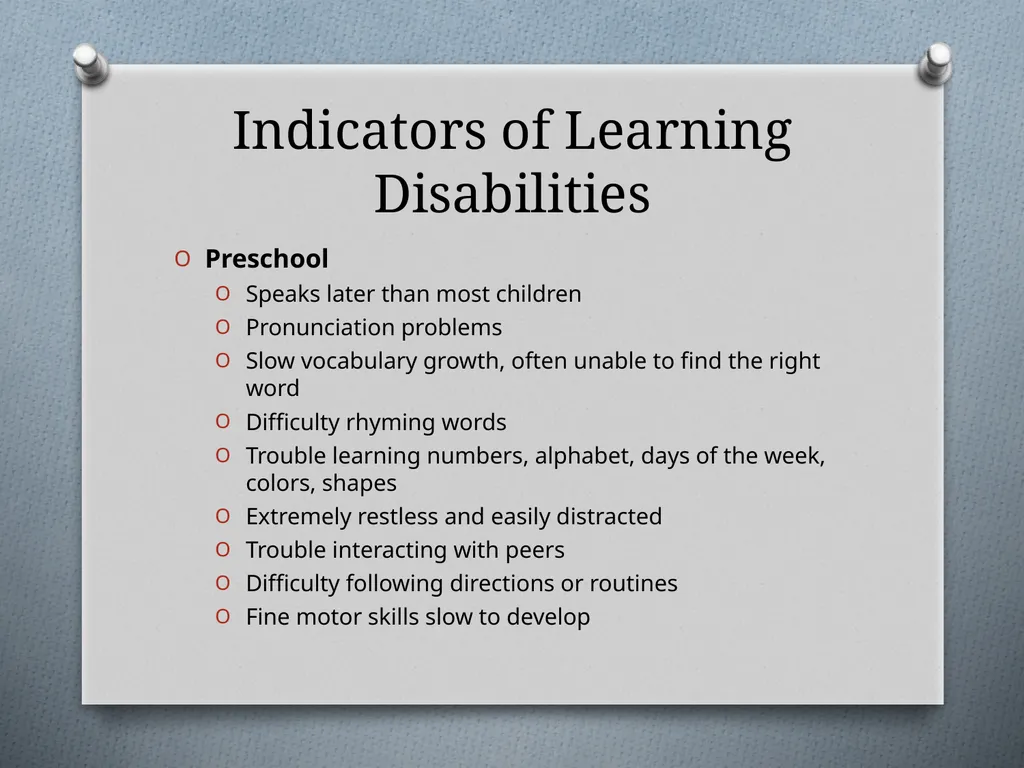
Indicators of Learning Disabilities Preschool
Speaks later than most children
Pronunciation problems
Slow vocabulary growth, often unable to find the right word
Difficulty rhyming words
Trouble learning numbers, alphabet, days of the week, colors, shapes
Extremely restless and easily distracted
Trouble interacting with peers
Difficulty following directions or routines
Fine motor skills slow to develop<br>
Speaks later than most children
Pronunciation problems
Slow vocabulary growth, often unable to find the right word
Difficulty rhyming words
Trouble learning numbers, alphabet, days of the week, colors, shapes
Extremely restless and easily distracted
Trouble interacting with peers
Difficulty following directions or routines
Fine motor skills slow to develop<br>
18
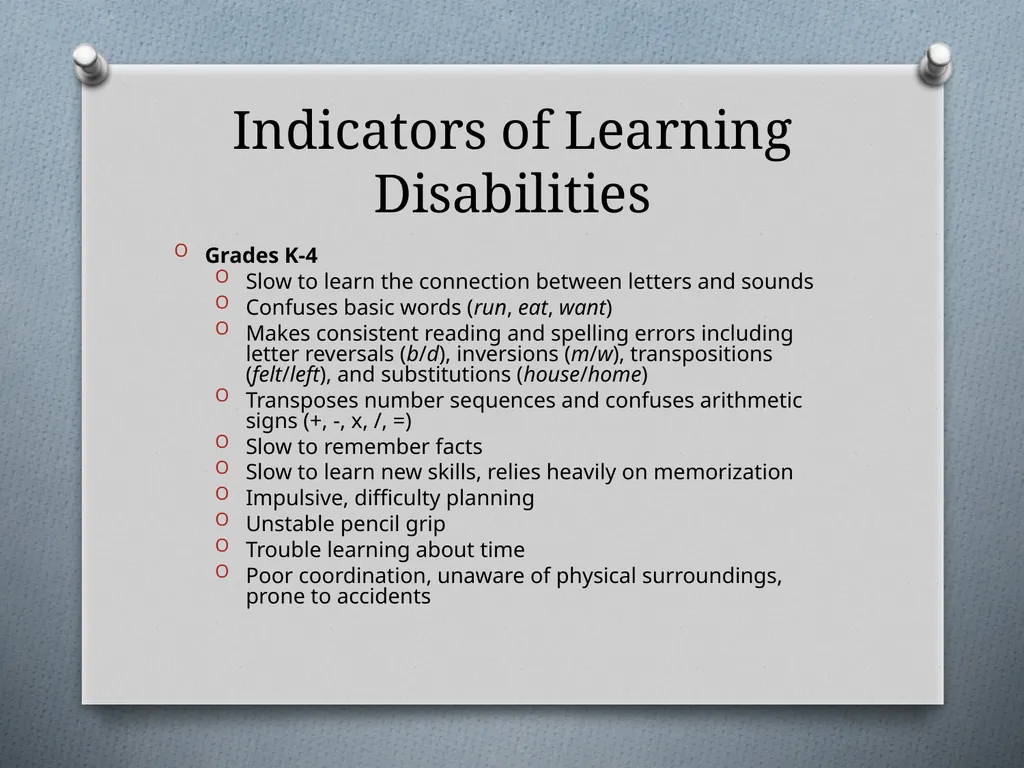
Indicators of Learning Disabilities Grades K-4
Slow to learn the connection between letters and sounds
Confuses basic words (run, eat, want)
Makes consistent reading and spelling errors including letter reversals (b/d), inversions (m/w), transpositions (felt/left), and substitutions (house/home)
Transposes number sequences and confuses arithmetic signs (+, -, x, /, =)
Slow to remember facts
Slow to learn new skills, relies heavily on memorization
Impulsive, difficulty planning
Unstable pencil grip
Trouble learning about time
Poor coordination, unaware of physical surroundings, prone to accidents<br>
Slow to learn the connection between letters and sounds
Confuses basic words (run, eat, want)
Makes consistent reading and spelling errors including letter reversals (b/d), inversions (m/w), transpositions (felt/left), and substitutions (house/home)
Transposes number sequences and confuses arithmetic signs (+, -, x, /, =)
Slow to remember facts
Slow to learn new skills, relies heavily on memorization
Impulsive, difficulty planning
Unstable pencil grip
Trouble learning about time
Poor coordination, unaware of physical surroundings, prone to accidents<br>
19
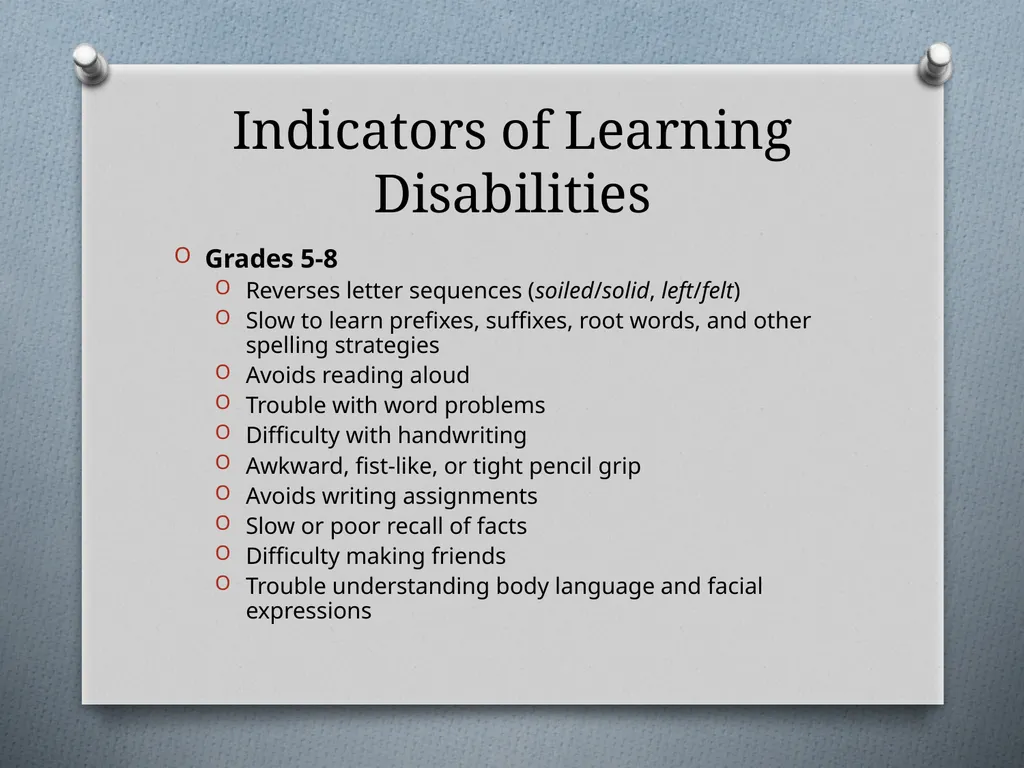
Indicators of Learning Disabilities Grades 5-8
Reverses letter sequences (soiled/solid, left/felt)
Slow to learn prefixes, suffixes, root words, and other spelling strategies
Avoids reading aloud
Trouble with word problems
Difficulty with handwriting
Awkward, fist-like, or tight pencil grip
Avoids writing assignments
Slow or poor recall of facts
Difficulty making friends
Trouble understanding body language and facial expressions<br>
Reverses letter sequences (soiled/solid, left/felt)
Slow to learn prefixes, suffixes, root words, and other spelling strategies
Avoids reading aloud
Trouble with word problems
Difficulty with handwriting
Awkward, fist-like, or tight pencil grip
Avoids writing assignments
Slow or poor recall of facts
Difficulty making friends
Trouble understanding body language and facial expressions<br>
20
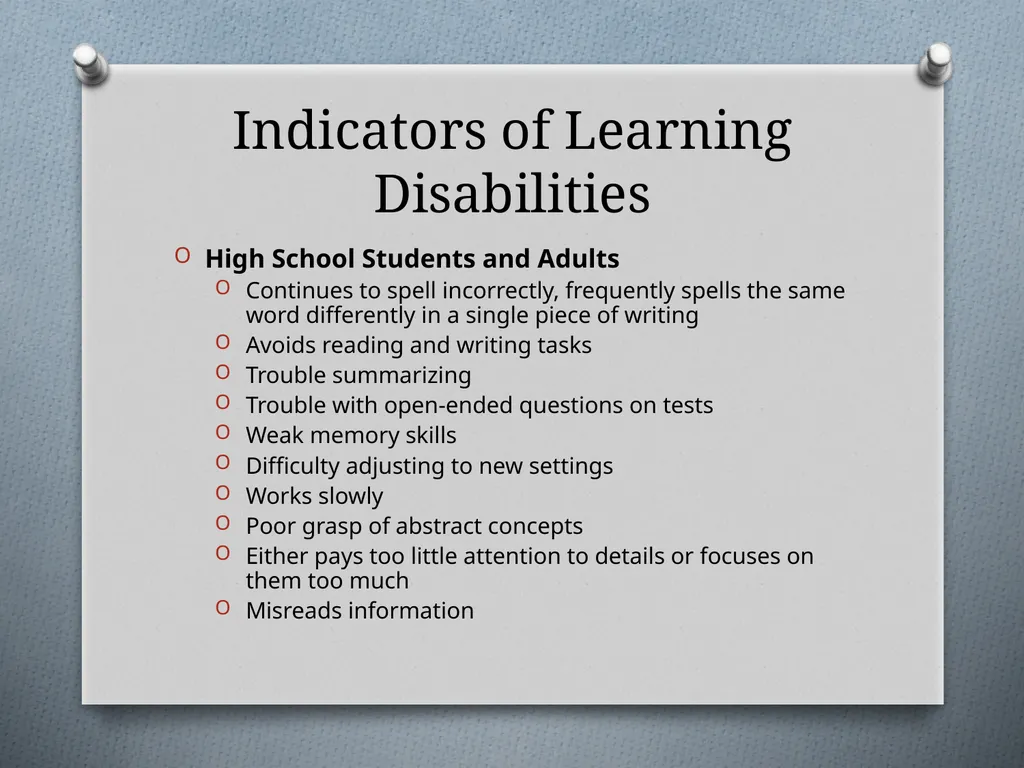
Indicators of Learning Disabilities High School Students and Adults
Continues to spell incorrectly, frequently spells the same word differently in a single piece of writing
Avoids reading and writing tasks
Trouble summarizing
Trouble with open-ended questions on tests
Weak memory skills
Difficulty adjusting to new settings
Works slowly
Poor grasp of abstract concepts
Either pays too little attention to details or focuses on them too much
Misreads information<br>
Continues to spell incorrectly, frequently spells the same word differently in a single piece of writing
Avoids reading and writing tasks
Trouble summarizing
Trouble with open-ended questions on tests
Weak memory skills
Difficulty adjusting to new settings
Works slowly
Poor grasp of abstract concepts
Either pays too little attention to details or focuses on them too much
Misreads information<br>
21
Indicators of ADD/ADHD Some signs of hyperactivity-impulsivity are:
Feeling restless, often fidgeting with hands or feet, or squirming while seated
Running, climbing, or leaving a seat in situations where sitting or quiet behavior is expected
Blurting out answers before hearing the whole question
Having difficulty waiting in line or taking turns.<br>
Feeling restless, often fidgeting with hands or feet, or squirming while seated
Running, climbing, or leaving a seat in situations where sitting or quiet behavior is expected
Blurting out answers before hearing the whole question
Having difficulty waiting in line or taking turns.<br>
22
Indicators of ADD/ADHD Some signs of inattention:
Often becoming easily distracted by irrelevant sights and sounds
Often failing to pay attention to details and making careless mistakes
Rarely following instructions carefully and completely losing or forgetting things like toys, or pencils, books, and tools needed for a task
Often skipping from one uncompleted activity to another.<br>
Often becoming easily distracted by irrelevant sights and sounds
Often failing to pay attention to details and making careless mistakes
Rarely following instructions carefully and completely losing or forgetting things like toys, or pencils, books, and tools needed for a task
Often skipping from one uncompleted activity to another.<br>
23
Indicators of ADD/ADHD “Because everyone shows some of these behaviors at times, the diagnosis requires that such behavior be demonstrated to a degree that is inappropriate for the person's age. The diagnostic guidelines also contain specific requirements for determining when the symptoms indicate ADHD. The behaviors must appear early in life, before age 7, and continue for at least 6 months. Above all, the behaviors must create a real handicap in at least two areas of a person's life such as in the schoolroom, on the playground, at home, in the community, or in social settings. So someone who shows some symptoms but whose schoolwork or friendships are not impaired by these behaviors would not be diagnosed with ADHD. Nor would a child who seems overly active on the playground but functions well elsewhere receive an ADHD diagnosis.
To assess whether a child has ADHD, specialists consider several critical questions: Are these behaviors excessive, long-term, and pervasive? That is, do they occur more often than in other children the same age? Are they a continuous problem, not just a response to a temporary situation? Do the behaviors occur in several settings or only in one specific place like the playground or in the schoolroom? The person's pattern of behavior is compared against a set of criteria and characteristics of the disorder as listed in the Diagnostic and Statistical Manual of Mental Disorders (DSM-IV-TR.)” ldonline.org<br>
To assess whether a child has ADHD, specialists consider several critical questions: Are these behaviors excessive, long-term, and pervasive? That is, do they occur more often than in other children the same age? Are they a continuous problem, not just a response to a temporary situation? Do the behaviors occur in several settings or only in one specific place like the playground or in the schoolroom? The person's pattern of behavior is compared against a set of criteria and characteristics of the disorder as listed in the Diagnostic and Statistical Manual of Mental Disorders (DSM-IV-TR.)” ldonline.org<br>
24
Process for Evaluation Understand the local school district’s procedures
Have documentation ready
Any medical diagnoses
Documentation of parent and/or school concerns
Documentation of interventions (see Intervention Plan)
Documentation of any benchmark assessments/standardized tests
Documentation of any behavioral concerns
Understand that if documentation is limited or does not show interventions attempted by school, or that the student is young and has not had much time to progress academically with interventions, request for evaluation from school district will likely be denied
Private evaluation may be pursued by parent, but this does not automatically qualify student for IEP/ISP<br>
Have documentation ready
Any medical diagnoses
Documentation of parent and/or school concerns
Documentation of interventions (see Intervention Plan)
Documentation of any benchmark assessments/standardized tests
Documentation of any behavioral concerns
Understand that if documentation is limited or does not show interventions attempted by school, or that the student is young and has not had much time to progress academically with interventions, request for evaluation from school district will likely be denied
Private evaluation may be pursued by parent, but this does not automatically qualify student for IEP/ISP<br>
25
Process for Evaluation Think about the purpose of possible evaluation
Young children, while eligible for Child Find, are often difficult to assess or for assessment to show information needed for diagnosis
Assessment results are a major determinant of eligibility so age does need to be considered depending on the potential diagnosis
What information does the teacher/school need in order to help the child? Are interventions and supports currently helping the child succeed? What information could be added from an evaluation that would change instruction?<br>
Young children, while eligible for Child Find, are often difficult to assess or for assessment to show information needed for diagnosis
Assessment results are a major determinant of eligibility so age does need to be considered depending on the potential diagnosis
What information does the teacher/school need in order to help the child? Are interventions and supports currently helping the child succeed? What information could be added from an evaluation that would change instruction?<br>
26
Process for Evaluation Meet with parents when you have concerns
Discuss if the difficulties are new or recurring. Parents can share information from previous years and home observations
Is the difficulty constant or isolated? Teacher can document difficulties that are not isolated with dates
Is the difficulty appropriate for children of this age or is it an atypical difficulty
Develop a plan based on meeting
Keep parents informed about any changes and progress
If determined interventions are not producing improvement, moving on to a referral or pre-referral (depending on district procedures) may be helpful<br>
Discuss if the difficulties are new or recurring. Parents can share information from previous years and home observations
Is the difficulty constant or isolated? Teacher can document difficulties that are not isolated with dates
Is the difficulty appropriate for children of this age or is it an atypical difficulty
Develop a plan based on meeting
Keep parents informed about any changes and progress
If determined interventions are not producing improvement, moving on to a referral or pre-referral (depending on district procedures) may be helpful<br>
27
What To Look For Risk Indicators
Response to Accommodations and Interventions
Behaviors
Parental Input
Observe and document all of these!
Intervention Plan (on website link)
Accommodations Checklists (on website link)<br>
Response to Accommodations and Interventions
Behaviors
Parental Input
Observe and document all of these!
Intervention Plan (on website link)
Accommodations Checklists (on website link)<br>
28
Intervention & Documentation Special education shall not act upon a referral without documented program modifications.
Grab a folder or notebook that you will use to collect documentation about your interventions, accommodations, and modifications for the student. Include dates and details. It is also advisable to keep a record of the phone and email correspondences you have with parents and relevant school personnel.
If you have not yet tried any accommodations or modifications to support the child’s needs in your classroom, consult with others (teachers, the resource specialist, or the school psychologist) about ways to help your student.
Inform the student’s parent about your concerns. Find out what their perspective is on the issue. Let them know what interventions you are considering. Find out if they have effective interventions they use at home.<br>
Grab a folder or notebook that you will use to collect documentation about your interventions, accommodations, and modifications for the student. Include dates and details. It is also advisable to keep a record of the phone and email correspondences you have with parents and relevant school personnel.
If you have not yet tried any accommodations or modifications to support the child’s needs in your classroom, consult with others (teachers, the resource specialist, or the school psychologist) about ways to help your student.
Inform the student’s parent about your concerns. Find out what their perspective is on the issue. Let them know what interventions you are considering. Find out if they have effective interventions they use at home.<br>
29
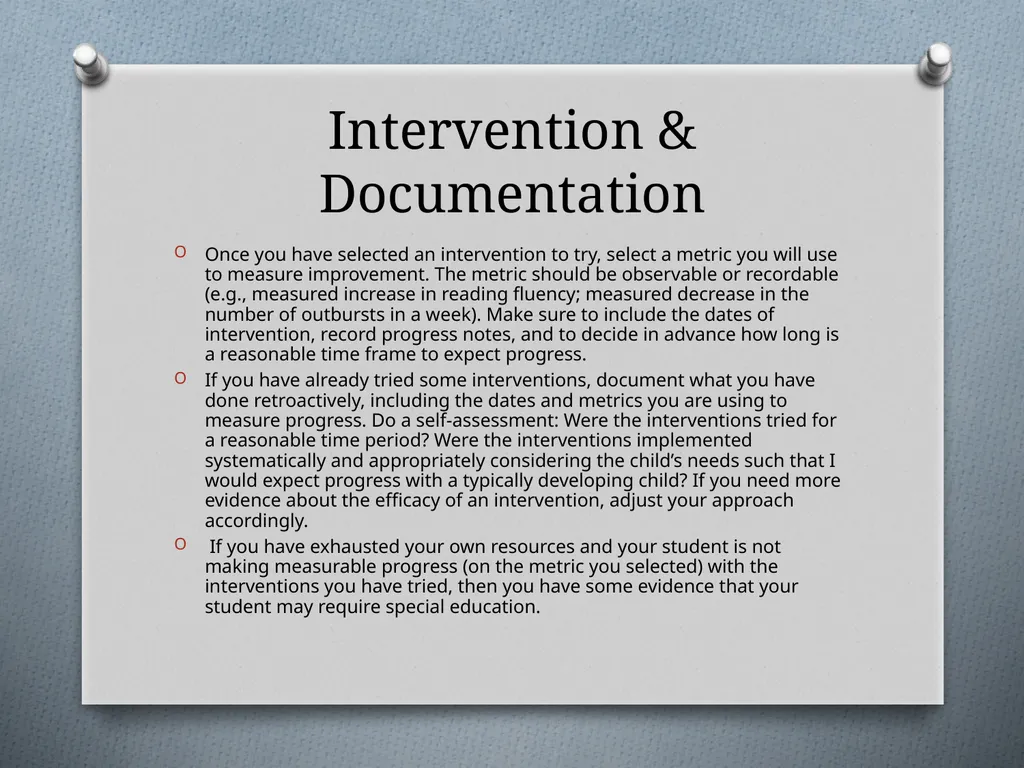
Intervention & Documentation Once you have selected an intervention to try, select a metric you will use to measure improvement. The metric should be observable or recordable (e.g., measured increase in reading fluency; measured decrease in the number of outbursts in a week). Make sure to include the dates of intervention, record progress notes, and to decide in advance how long is a reasonable time frame to expect progress.
If you have already tried some interventions, document what you have done retroactively, including the dates and metrics you are using to measure progress. Do a self-assessment: Were the interventions tried for a reasonable time period? Were the interventions implemented systematically and appropriately considering the child’s needs such that I would expect progress with a typically developing child? If you need more evidence about the efficacy of an intervention, adjust your approach accordingly.
If you have exhausted your own resources and your student is not making measurable progress (on the metric you selected) with the interventions you have tried, then you have some evidence that your student may require special education.<br>
If you have already tried some interventions, document what you have done retroactively, including the dates and metrics you are using to measure progress. Do a self-assessment: Were the interventions tried for a reasonable time period? Were the interventions implemented systematically and appropriately considering the child’s needs such that I would expect progress with a typically developing child? If you need more evidence about the efficacy of an intervention, adjust your approach accordingly.
If you have exhausted your own resources and your student is not making measurable progress (on the metric you selected) with the interventions you have tried, then you have some evidence that your student may require special education.<br>
30
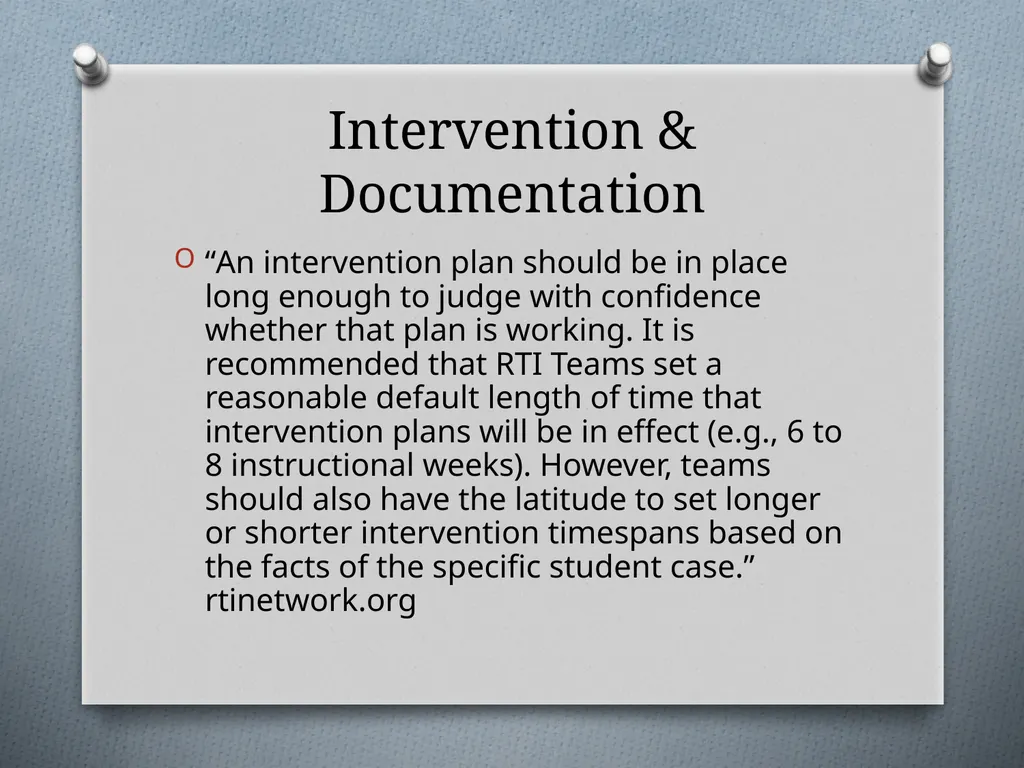
Intervention & Documentation “An intervention plan should be in place long enough to judge with confidence whether that plan is working. It is recommended that RTI Teams set a reasonable default length of time that intervention plans will be in effect (e.g., 6 to 8 instructional weeks). However, teams should also have the latitude to set longer or shorter intervention timespans based on the facts of the specific student case.” rtinetwork.org<br>
31
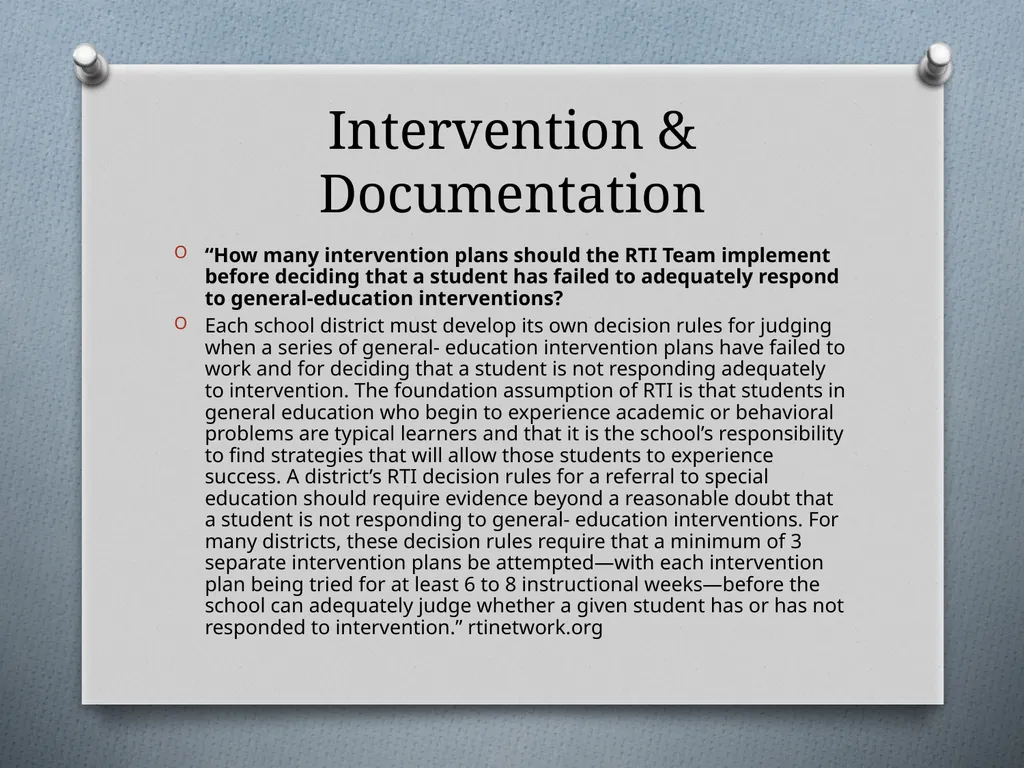
Intervention & Documentation “How many intervention plans should the RTI Team implement before deciding that a student has failed to adequately respond to general-education interventions?
Each school district must develop its own decision rules for judging when a series of general- education intervention plans have failed to work and for deciding that a student is not responding adequately to intervention. The foundation assumption of RTI is that students in general education who begin to experience academic or behavioral problems are typical learners and that it is the school’s responsibility to find strategies that will allow those students to experience success. A district’s RTI decision rules for a referral to special education should require evidence beyond a reasonable doubt that a student is not responding to general- education interventions. For many districts, these decision rules require that a minimum of 3 separate intervention plans be attempted—with each intervention plan being tried for at least 6 to 8 instructional weeks—before the school can adequately judge whether a given student has or has not responded to intervention.” rtinetwork.org<br>
Each school district must develop its own decision rules for judging when a series of general- education intervention plans have failed to work and for deciding that a student is not responding adequately to intervention. The foundation assumption of RTI is that students in general education who begin to experience academic or behavioral problems are typical learners and that it is the school’s responsibility to find strategies that will allow those students to experience success. A district’s RTI decision rules for a referral to special education should require evidence beyond a reasonable doubt that a student is not responding to general- education interventions. For many districts, these decision rules require that a minimum of 3 separate intervention plans be attempted—with each intervention plan being tried for at least 6 to 8 instructional weeks—before the school can adequately judge whether a given student has or has not responded to intervention.” rtinetwork.org<br>
32
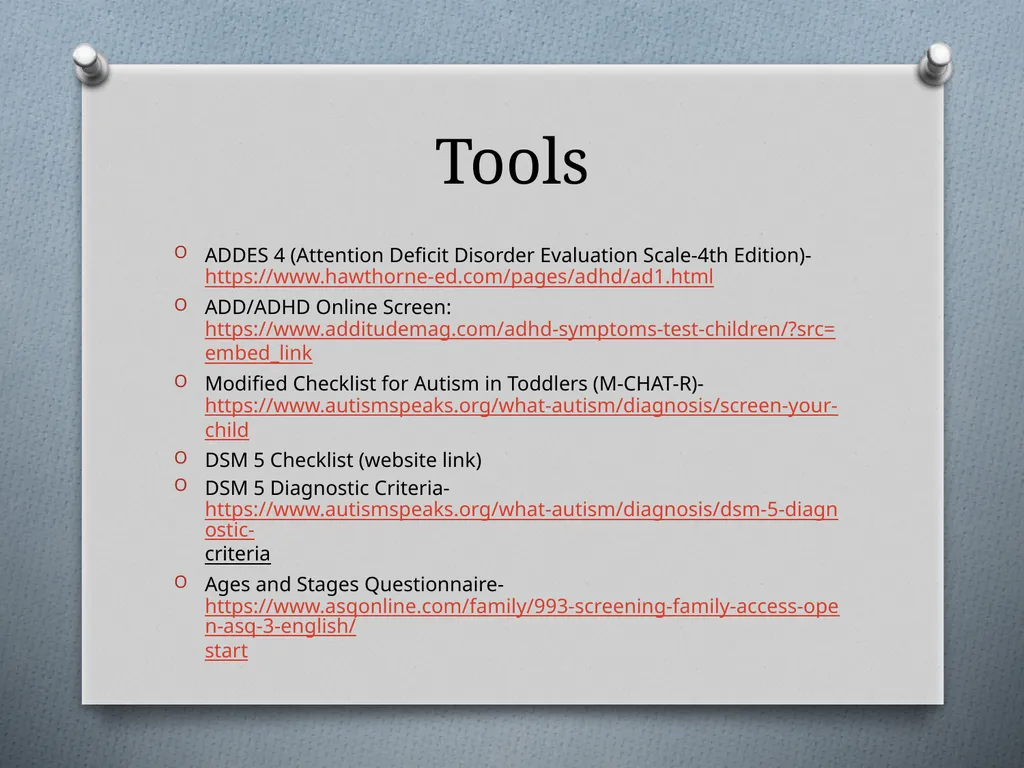
Tools ADDES 4 (Attention Deficit Disorder Evaluation Scale-4th Edition)- https://www.hawthorne-ed.com/pages/adhd/ad1.html
ADD/ADHD Online Screen: https://www.additudemag.com/adhd-symptoms-test-children/?src=embed_link
Modified Checklist for Autism in Toddlers (M-CHAT-R)- https://www.autismspeaks.org/what-autism/diagnosis/screen-your-child
DSM 5 Checklist (website link)
DSM 5 Diagnostic Criteria- https://www.autismspeaks.org/what-autism/diagnosis/dsm-5-diagnostic-criteria
Ages and Stages Questionnaire- https://www.asqonline.com/family/993-screening-family-access-open-asq-3-english/start<br>
ADD/ADHD Online Screen: https://www.additudemag.com/adhd-symptoms-test-children/?src=embed_link
Modified Checklist for Autism in Toddlers (M-CHAT-R)- https://www.autismspeaks.org/what-autism/diagnosis/screen-your-child
DSM 5 Checklist (website link)
DSM 5 Diagnostic Criteria- https://www.autismspeaks.org/what-autism/diagnosis/dsm-5-diagnostic-criteria
Ages and Stages Questionnaire- https://www.asqonline.com/family/993-screening-family-access-open-asq-3-english/start<br>
33
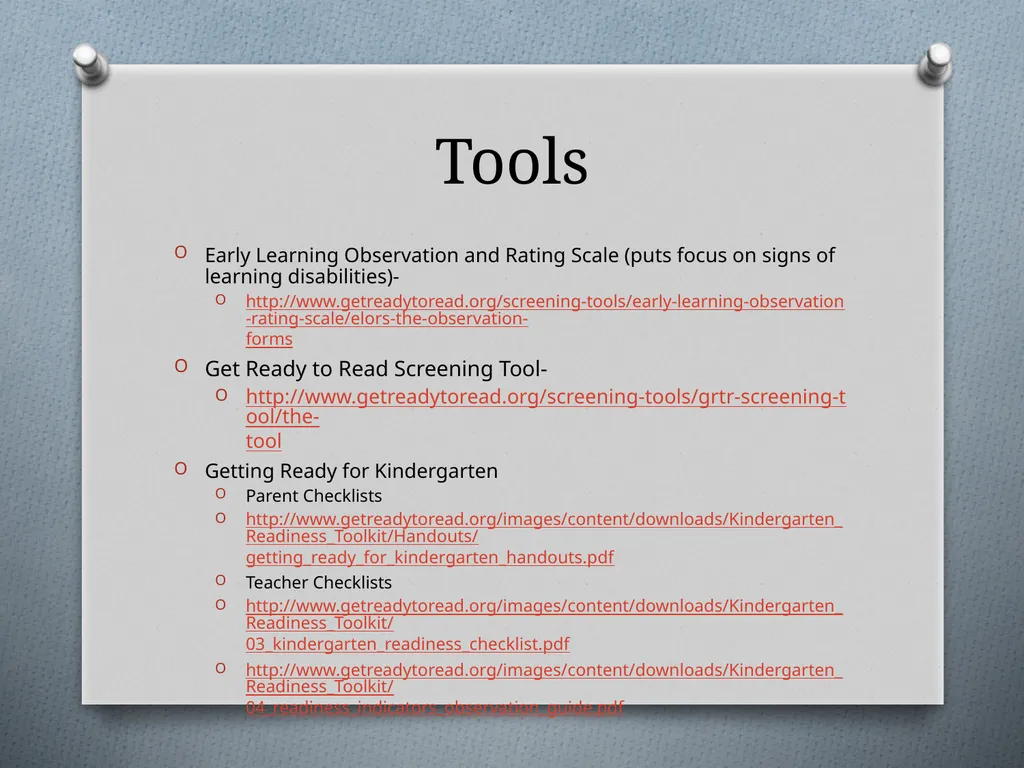
Tools Early Learning Observation and Rating Scale (puts focus on signs of learning disabilities)-
http://www.getreadytoread.org/screening-tools/early-learning-observation-rating-scale/elors-the-observation-forms
Get Ready to Read Screening Tool-
http://www.getreadytoread.org/screening-tools/grtr-screening-tool/the-tool
Getting Ready for Kindergarten
Parent Checklists
http://www.getreadytoread.org/images/content/downloads/Kindergarten_Readiness_Toolkit/Handouts/getting_ready_for_kindergarten_handouts.pdf
Teacher Checklists
http://www.getreadytoread.org/images/content/downloads/Kindergarten_Readiness_Toolkit/03_kindergarten_readiness_checklist.pdf
http://www.getreadytoread.org/images/content/downloads/Kindergarten_Readiness_Toolkit/04_readiness_indicators_observation_guide.pdf<br>
http://www.getreadytoread.org/screening-tools/early-learning-observation-rating-scale/elors-the-observation-forms
Get Ready to Read Screening Tool-
http://www.getreadytoread.org/screening-tools/grtr-screening-tool/the-tool
Getting Ready for Kindergarten
Parent Checklists
http://www.getreadytoread.org/images/content/downloads/Kindergarten_Readiness_Toolkit/Handouts/getting_ready_for_kindergarten_handouts.pdf
Teacher Checklists
http://www.getreadytoread.org/images/content/downloads/Kindergarten_Readiness_Toolkit/03_kindergarten_readiness_checklist.pdf
http://www.getreadytoread.org/images/content/downloads/Kindergarten_Readiness_Toolkit/04_readiness_indicators_observation_guide.pdf<br>
34
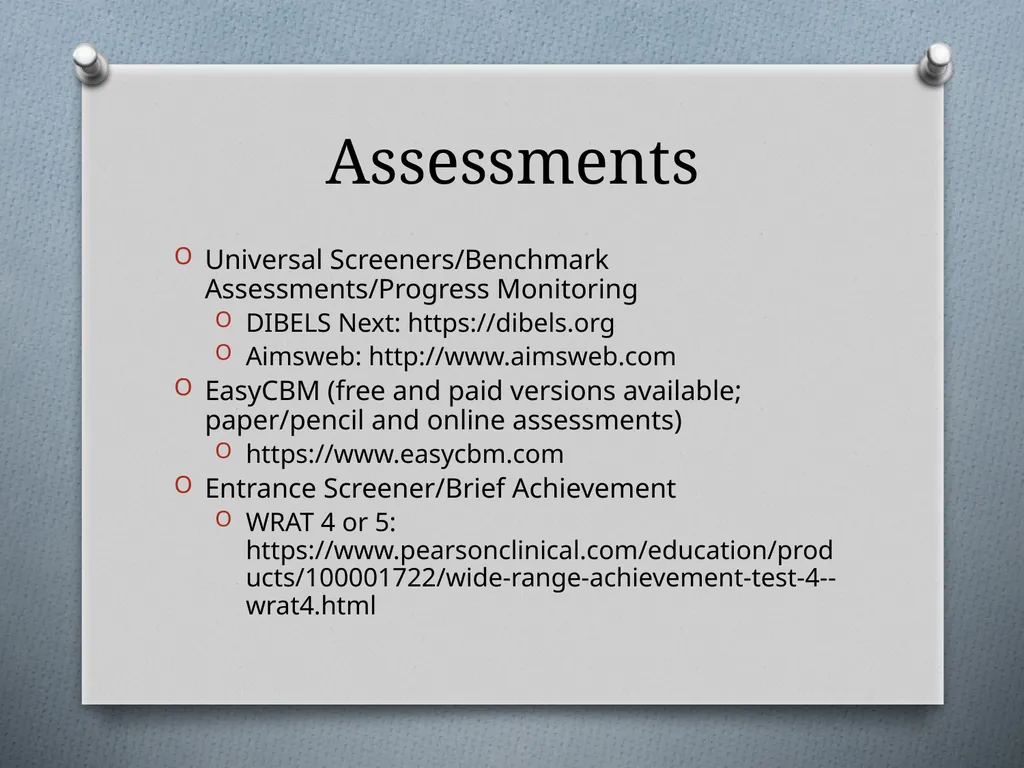
Universal Screeners/Benchmark Assessments/Progress Monitoring
DIBELS Next: https://dibels.org
Aimsweb: http://www.aimsweb.com
EasyCBM (free and paid versions available; paper/pencil and online assessments)
https://www.easycbm.com
Entrance Screener/Brief Achievement
WRAT 4 or 5: https://www.pearsonclinical.com/education/products/100001722/wide-range-achievement-test-4--wrat4.html Assessments<br>
DIBELS Next: https://dibels.org
Aimsweb: http://www.aimsweb.com
EasyCBM (free and paid versions available; paper/pencil and online assessments)
https://www.easycbm.com
Entrance Screener/Brief Achievement
WRAT 4 or 5: https://www.pearsonclinical.com/education/products/100001722/wide-range-achievement-test-4--wrat4.html Assessments<br>
35
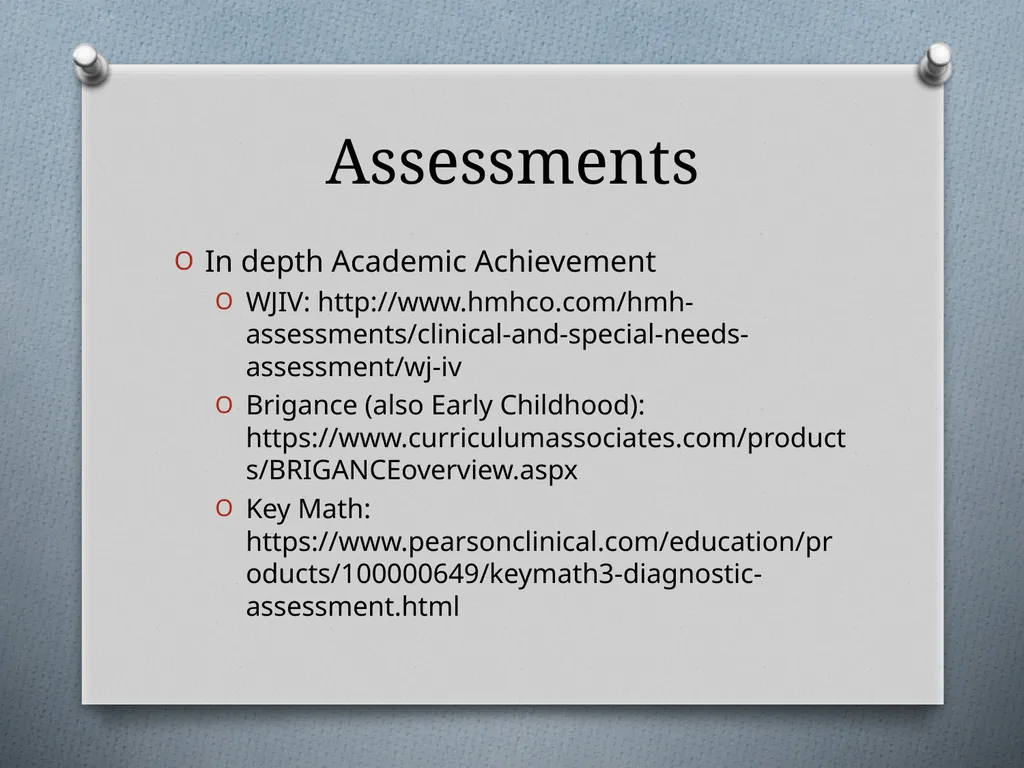
In depth Academic Achievement
WJIV: http://www.hmhco.com/hmh-assessments/clinical-and-special-needs-assessment/wj-iv
Brigance (also Early Childhood): https://www.curriculumassociates.com/products/BRIGANCEoverview.aspx
Key Math: https://www.pearsonclinical.com/education/products/100000649/keymath3-diagnostic-assessment.html Assessments<br>
WJIV: http://www.hmhco.com/hmh-assessments/clinical-and-special-needs-assessment/wj-iv
Brigance (also Early Childhood): https://www.curriculumassociates.com/products/BRIGANCEoverview.aspx
Key Math: https://www.pearsonclinical.com/education/products/100000649/keymath3-diagnostic-assessment.html Assessments<br>
36
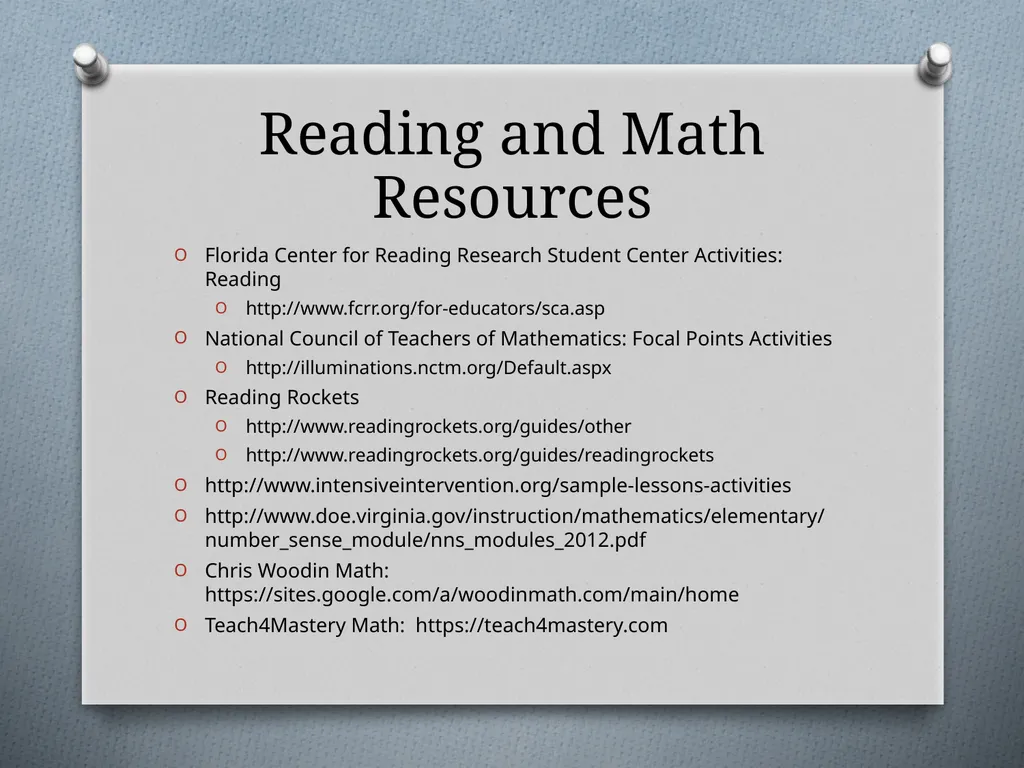
Reading and Math Resources Florida Center for Reading Research Student Center Activities: Reading
http://www.fcrr.org/for-educators/sca.asp
National Council of Teachers of Mathematics: Focal Points Activities
http://illuminations.nctm.org/Default.aspx
Reading Rockets
http://www.readingrockets.org/guides/other
http://www.readingrockets.org/guides/readingrockets
http://www.intensiveintervention.org/sample-lessons-activities
http://www.doe.virginia.gov/instruction/mathematics/elementary/number_sense_module/nns_modules_2012.pdf
Chris Woodin Math: https://sites.google.com/a/woodinmath.com/main/home
Teach4Mastery Math: https://teach4mastery.com<br>
http://www.fcrr.org/for-educators/sca.asp
National Council of Teachers of Mathematics: Focal Points Activities
http://illuminations.nctm.org/Default.aspx
Reading Rockets
http://www.readingrockets.org/guides/other
http://www.readingrockets.org/guides/readingrockets
http://www.intensiveintervention.org/sample-lessons-activities
http://www.doe.virginia.gov/instruction/mathematics/elementary/number_sense_module/nns_modules_2012.pdf
Chris Woodin Math: https://sites.google.com/a/woodinmath.com/main/home
Teach4Mastery Math: https://teach4mastery.com<br>
37
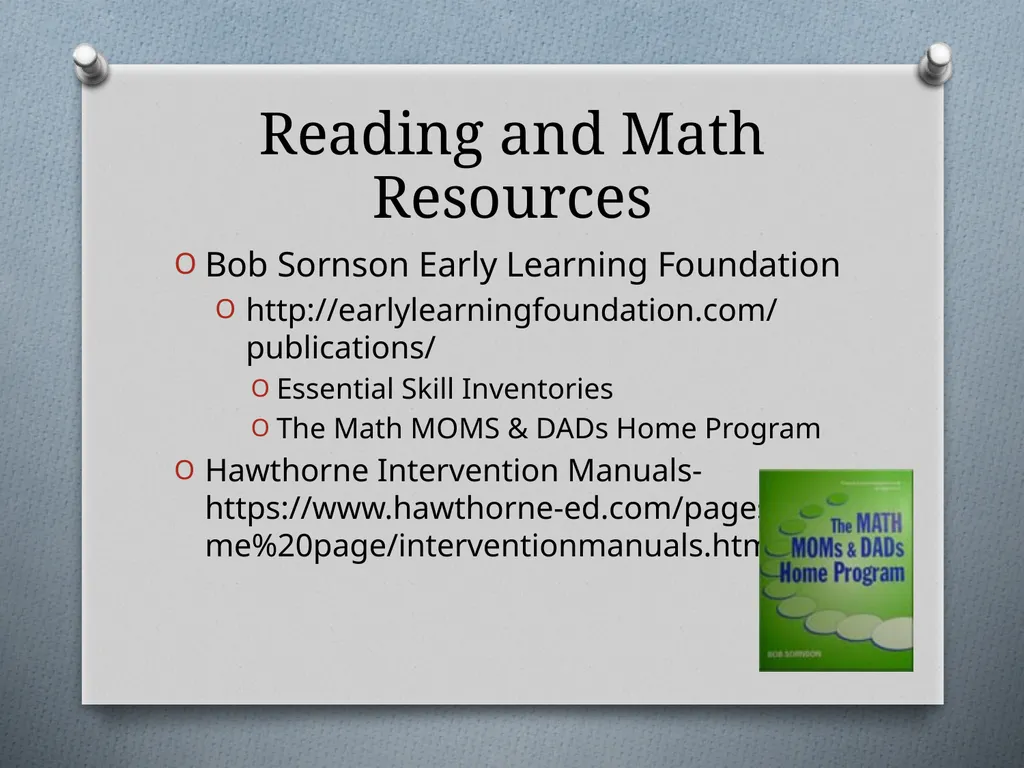
Reading and Math Resources Bob Sornson Early Learning Foundation
http://earlylearningfoundation.com/publications/
Essential Skill Inventories
The Math MOMS & DADs Home Program
Hawthorne Intervention Manuals- https://www.hawthorne-ed.com/pages/home%20page/interventionmanuals.html<br>
http://earlylearningfoundation.com/publications/
Essential Skill Inventories
The Math MOMS & DADs Home Program
Hawthorne Intervention Manuals- https://www.hawthorne-ed.com/pages/home%20page/interventionmanuals.html<br>
38
Stay in Touch! Luthsped.org
Sign up for our free e-newsletters
Always available for FREE consultations
Available for professional development for schools and churches<br>
Sign up for our free e-newsletters
Always available for FREE consultations
Available for professional development for schools and churches<br>