
REDEFINING FINANCE DATE: 03 DECEMBER 2013 CMA as a
PM
Published · 29 slides · 0 views

1 / 1
Description
REDEFINING FINANCE DATE: 03 DECEMBER 2013 CMA as a Viable Business The Finance Team considered the follow issues regarding the establishment of the CMAs The Financial Sustainability of the CMA The Regulatory Compliance with Accounting
Related Topics
Share
Embed code
Download this presentation From Below
"REDEFINING FINANCE DATE: 03 DECEMBER 2013 CMA as a" is the property of its rightful owner. Permission is granted to download and print the materials on this website for personal, non-commercial use only, and to display it on your personal computer provided you do not modify the materials and that you retain all copyright notices contained in the materials. By downloading content from our website, you accept the terms of this agreement.
Presentation Transcript
01
REDEFINING FINANCE DATE: 03 DECEMBER 2013<br>
02
CMA as a Viable Business The Finance Team considered the follow issues regarding the establishment of the CMA’s
The Financial Sustainability of the CMA
The Regulatory Compliance with Accounting Standards
The Internal Control & Segregation of Duties
The capacity required for the management of Revenue Collection & SCM Processes
The need for effective & efficient Budget and Expenditure processes
An integrated approach to Financial Reporting
The importance of reliable ERP Systems<br>
03
OBJECTIVE OF TASK TEAM To provide what financial support and financial arrangement are required for the viability and sustainability for CMAs.
This task team will look into holistic viability of CMAs
To guide the development and implementation of the internal controls and financial management systems<br>
This task team will look into holistic viability of CMAs
To guide the development and implementation of the internal controls and financial management systems<br>
04
CMA viability is dependent upon, but not equivalent to, the charging for water resources management costs.
It is important to distinguish the concept of user charges and total income required to support water resource management
In public finance theory: distinction in tariffs and user charges, both of which relate to
(i) voluntary use,
(ii) benefit received by the user,
(iii) the cost of providing a service. Financial Theory of User Charges<br>
05
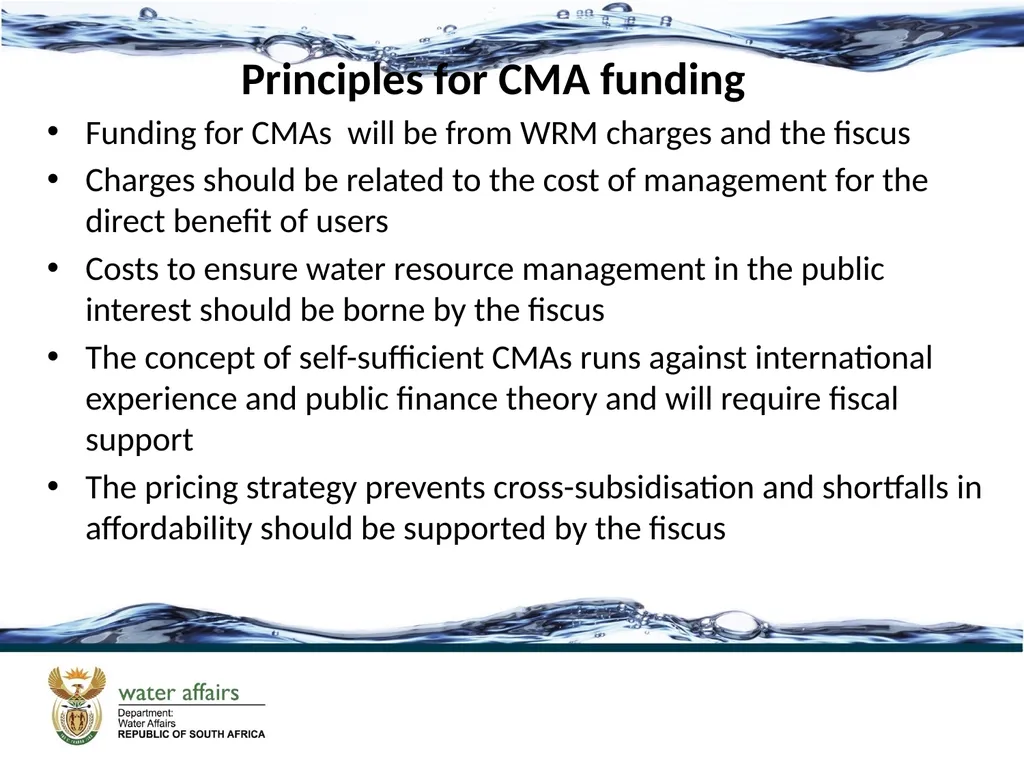
Funding for CMAs will be from WRM charges and the fiscus
Charges should be related to the cost of management for the direct benefit of users
Costs to ensure water resource management in the public interest should be borne by the fiscus
The concept of self-sufficient CMAs runs against international experience and public finance theory and will require fiscal support
The pricing strategy prevents cross-subsidisation and shortfalls in affordability should be supported by the fiscus Principles for CMA funding<br>
06
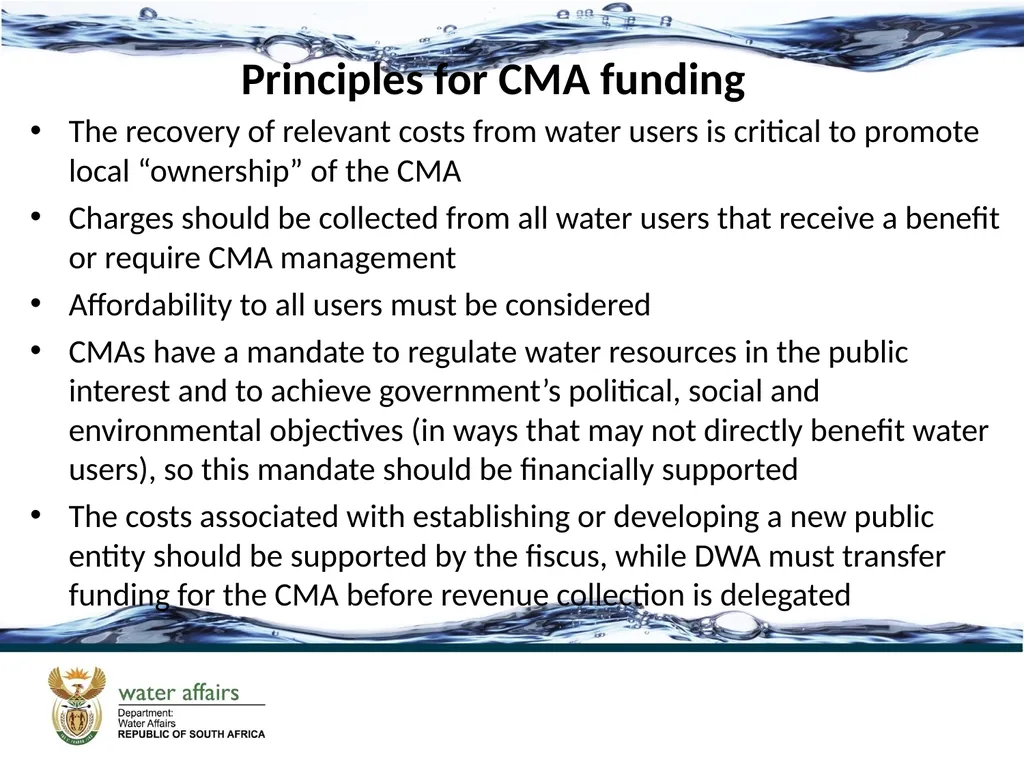
The recovery of relevant costs from water users is critical to promote local “ownership” of the CMA
Charges should be collected from all water users that receive a benefit or require CMA management
Affordability to all users must be considered
CMAs have a mandate to regulate water resources in the public interest and to achieve government’s political, social and environmental objectives (in ways that may not directly benefit water users), so this mandate should be financially supported
The costs associated with establishing or developing a new public entity should be supported by the fiscus, while DWA must transfer funding for the CMA before revenue collection is delegated Principles for CMA funding<br>
07
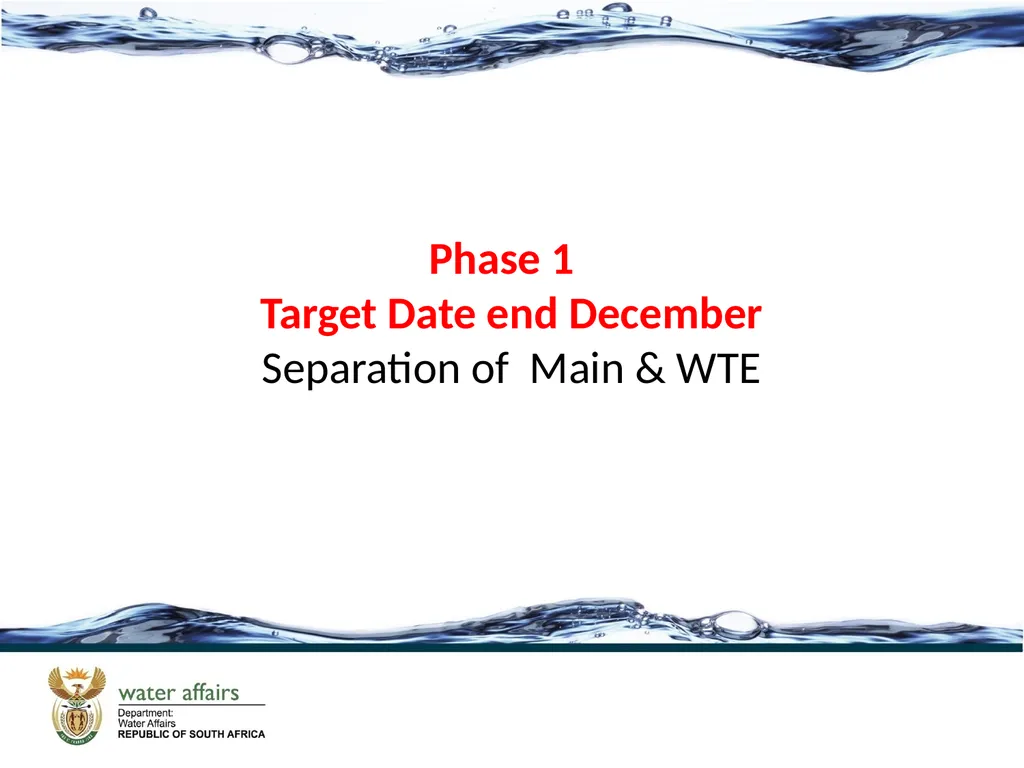
Phase 1
Target Date end December
Separation of Main & WTE<br>
08
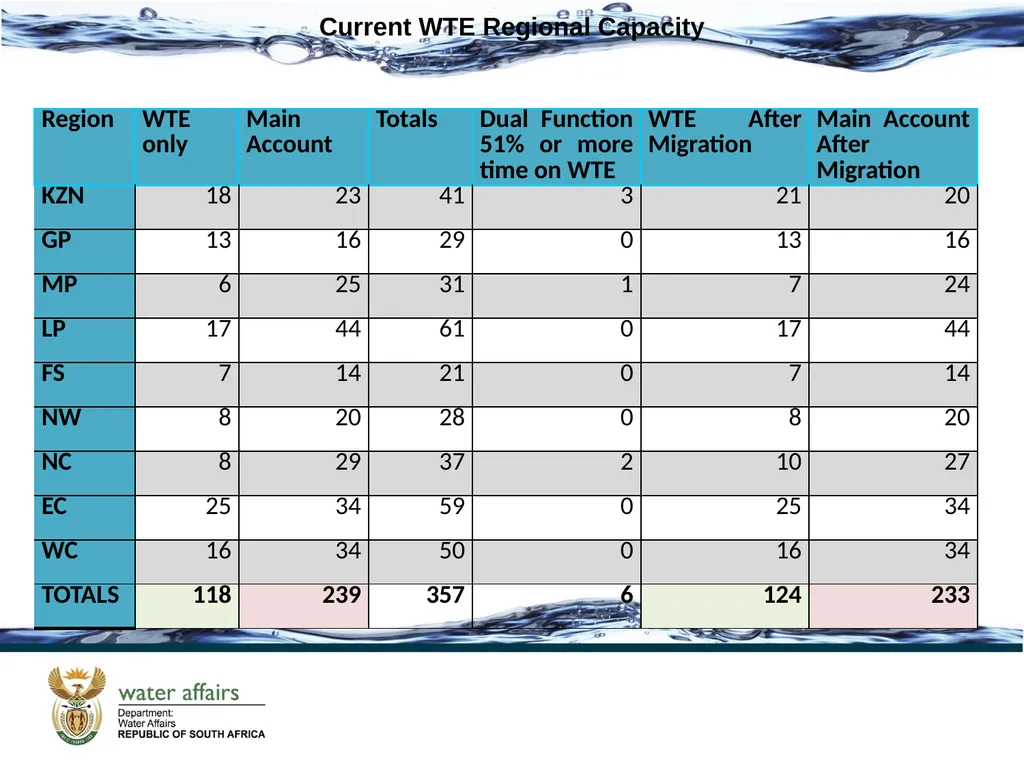
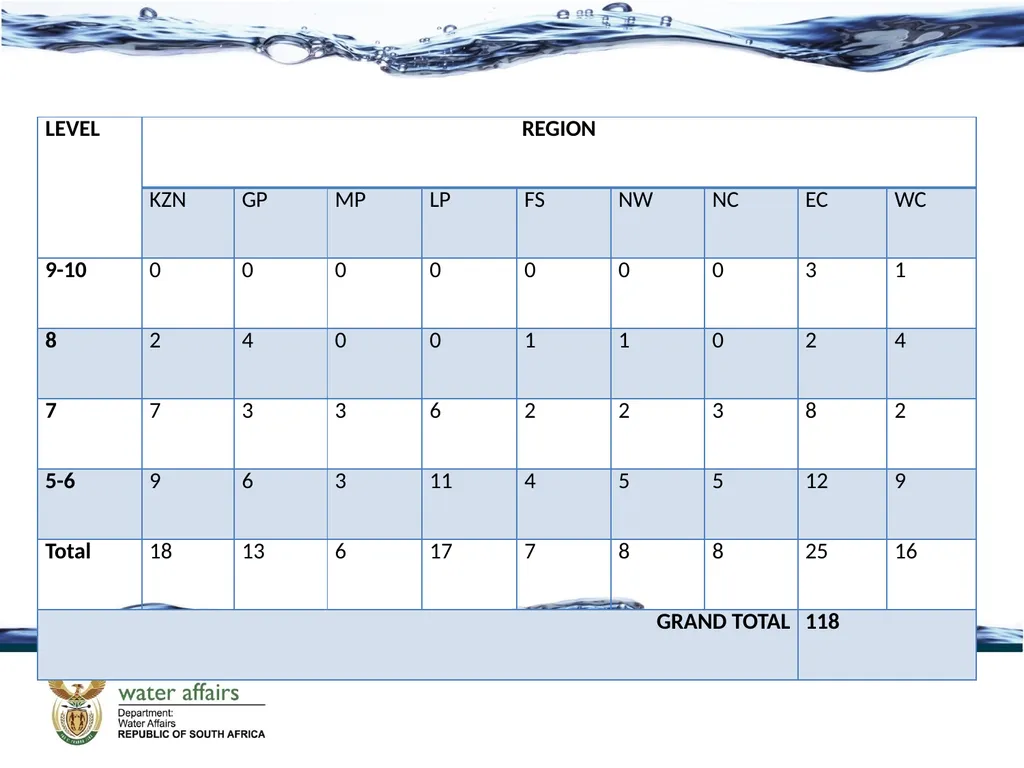
Current WTE Regional Capacity<br>
09
Business Operating Model<br>
10
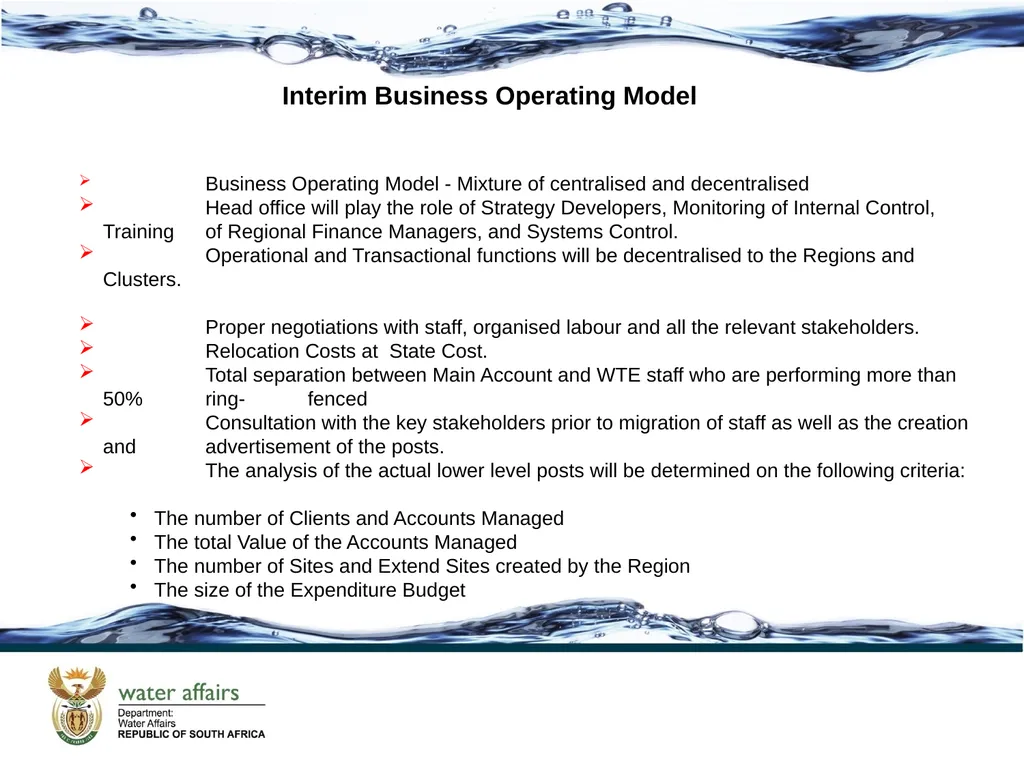
Interim Business Operating Model Business Operating Model - Mixture of centralised and decentralised
Head office will play the role of Strategy Developers, Monitoring of Internal Control, Training of Regional Finance Managers, and Systems Control.
Operational and Transactional functions will be decentralised to the Regions and Clusters.
Proper negotiations with staff, organised labour and all the relevant stakeholders.
Relocation Costs at State Cost.
Total separation between Main Account and WTE staff who are performing more than 50% ring- fenced
Consultation with the key stakeholders prior to migration of staff as well as the creation and advertisement of the posts.
The analysis of the actual lower level posts will be determined on the following criteria:
The number of Clients and Accounts Managed
The total Value of the Accounts Managed
The number of Sites and Extend Sites created by the Region
The size of the Expenditure Budget<br>
11
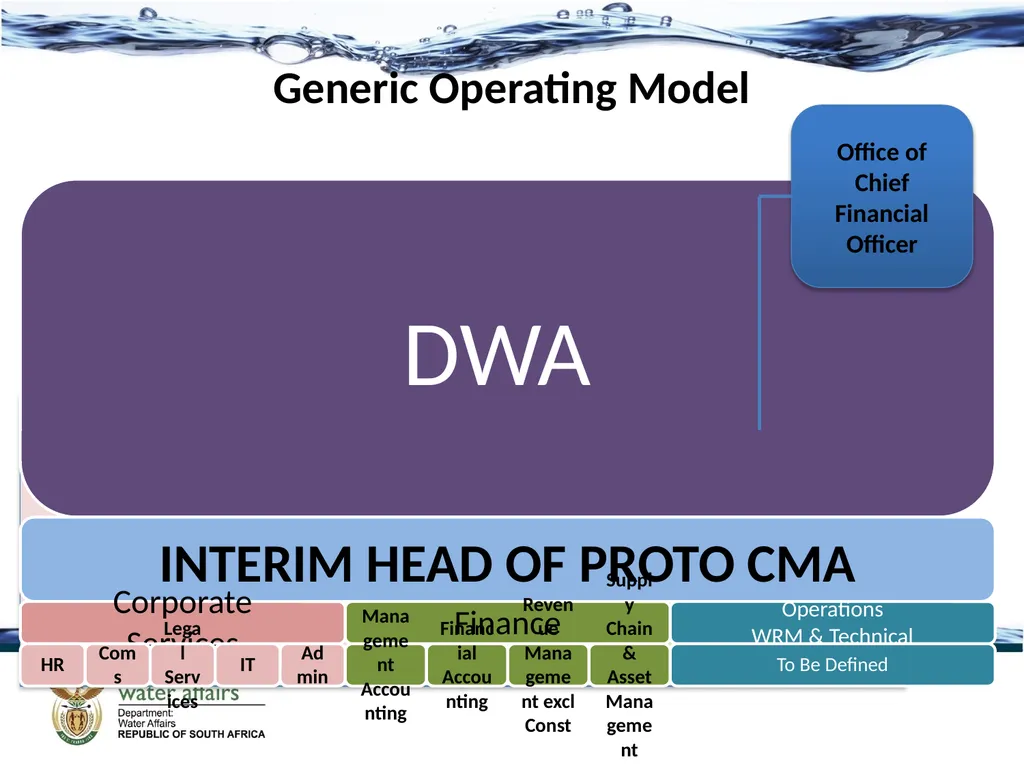
Generic Operating Model Office of Chief Financial Officer<br>
12
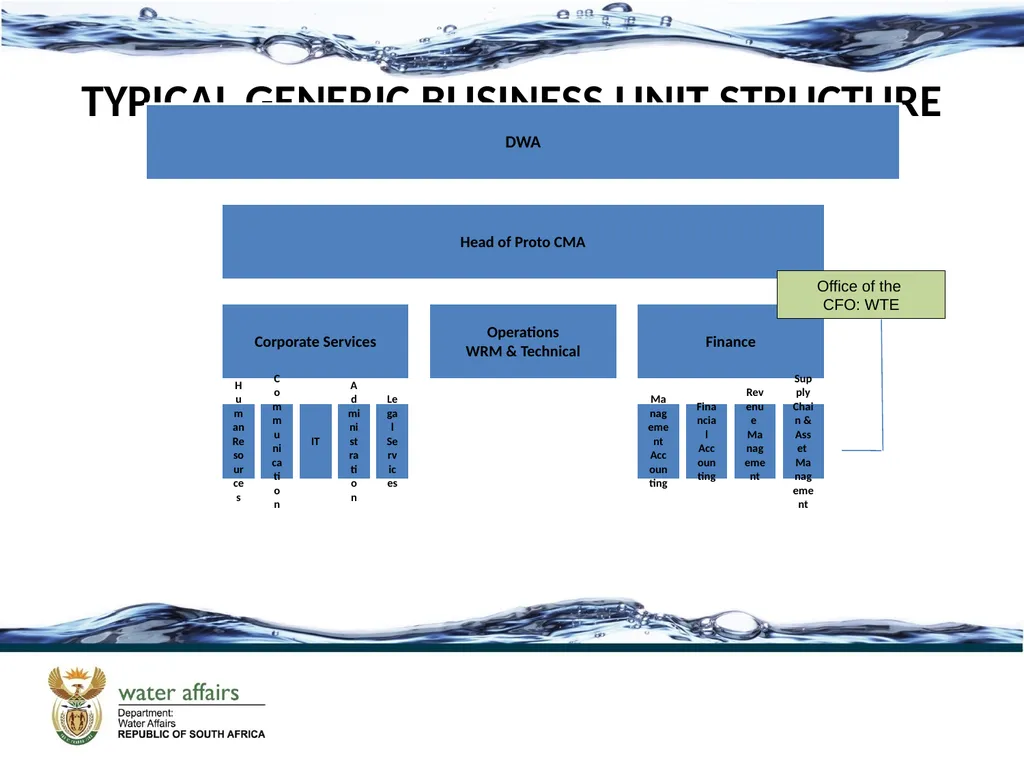
TYPICAL GENERIC BUSINESS UNIT STRUCTURE Office of the
CFO: WTE<br>
CFO: WTE<br>
13
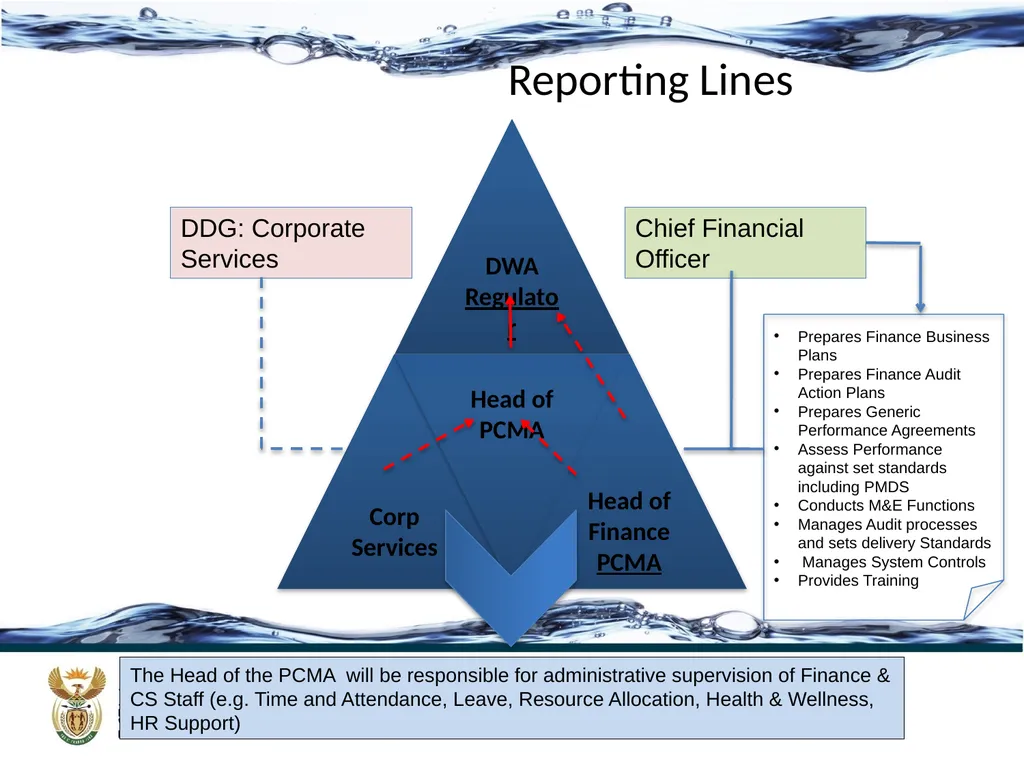
Prepares Finance Business Plans
Prepares Finance Audit Action Plans
Prepares Generic Performance Agreements
Assess Performance against set standards including PMDS
Conducts M&E Functions
Manages Audit processes and sets delivery Standards
Manages System Controls
Provides Training Reporting Lines Chief Financial
Officer DDG: Corporate Services The Head of the PCMA will be responsible for administrative supervision of Finance & CS Staff (e.g. Time and Attendance, Leave, Resource Allocation, Health & Wellness, HR Support)<br>
14
PHASE 2
Generic Structure
Ring-Fencing
Target Date
End January 2014<br>
15
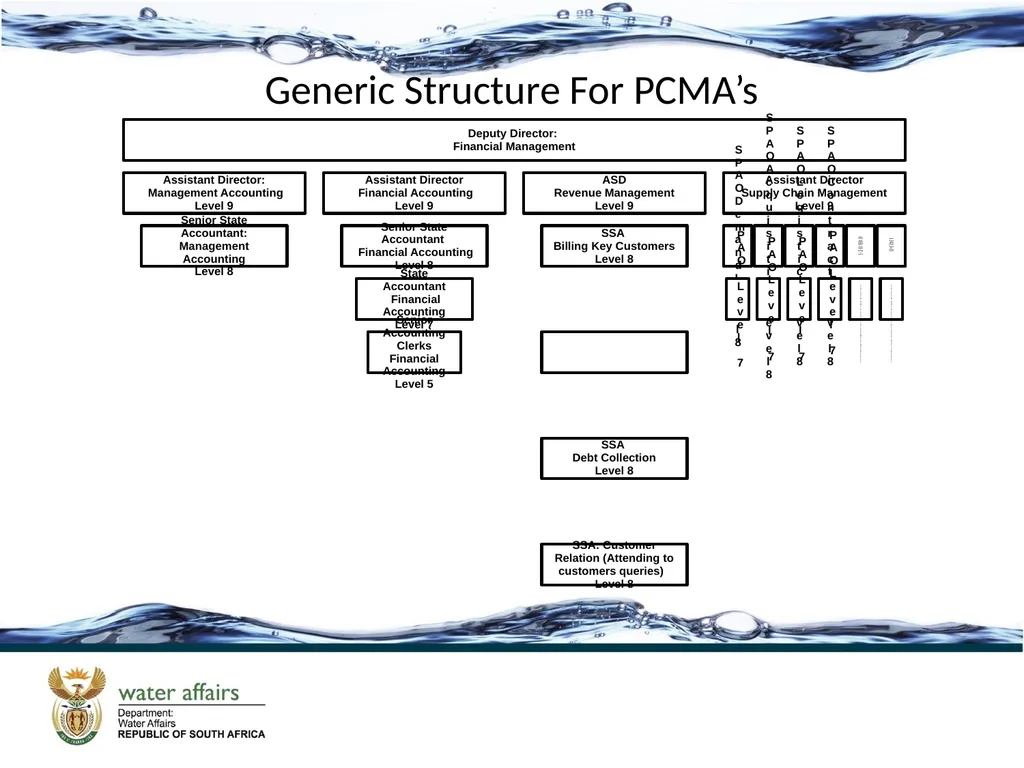
Generic Structure For PCMA’s<br>
16
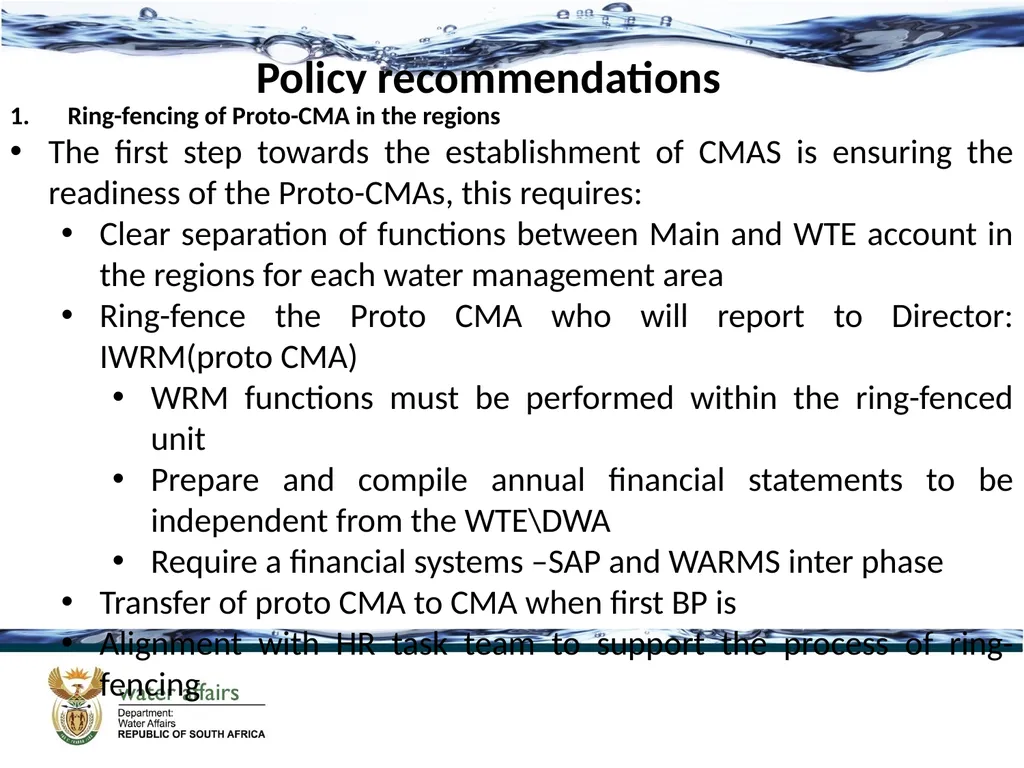
Policy recommendations Ring-fencing of Proto-CMA in the regions
The first step towards the establishment of CMAS is ensuring the readiness of the Proto-CMAs, this requires:
Clear separation of functions between Main and WTE account in the regions for each water management area
Ring-fence the Proto CMA who will report to Director: IWRM(proto CMA)
WRM functions must be performed within the ring-fenced unit
Prepare and compile annual financial statements to be independent from the WTE\DWA
Require a financial systems –SAP and WARMS inter phase
Transfer of proto CMA to CMA when first BP is
Alignment with HR task team to support the process of ring-fencing<br>
17
2 Augmentation for Establishment of CMAS
An augmentation for establishment needs be provided for the CMA set-up and operation for the first three years of its organisational development.
Responsibility for collecting charges should be delegated to the CMA within first 18 months or sooner
Requires resolution for:
the responsibility for billing those water users supplied from schemes, and specifications and requirements of the registration (WARMS) and billing systems that can or must be used by the CMA.<br>
18
Phase 3
Migration and Filling Of Posts
Target Date end March 2014<br>
19
POLICY RECOMMENDATIONS 1. Augmentation grant to the CMAs
An augmentation grant will be given to CMAs to cover the following aspects of operations:
Personnel
IT systems
Governance
Building admin
Public interest/ international functions/regulatory functions
The WRM charges will be utilised for the core functions of the CMAs
DWA will ensure compliance of augmentation grant by the CMAs<br>
20
Policy Recommendations 2.Augmentation for operational support
An operating subsidy should be defined for ongoing CMA support (motivated primarily by CMA public interest mandate and user affordability), to be linked to the CMA business planning process:
requiring final policy clarity on CMA functions and their allocation to user benefit or public interest.
The Pricing Strategy review should clearly address the issues of institutional viability for WRM charges, considering the way in which costs are allocated to users, including:
the issue of capping,
the effective collection of charges from waste dischargers,
a single charge for all user groups and catchments in a CMA jurisdiction, and
definition of function costs to be collected from different users or fiscally supported.<br>
21
Policy Recommendations CMA business planning and reporting requirements should be defined to dictate rules and the accepted approach to:
CMA budgeting, linked to imperatives, functions and revenue,
establishing water use revenue targets for the CMA in line with the Pricing Strategy,
motivating financial support through CMA business planning, and
ensuring responsible financial governance and controls of public funds.<br>
CMA budgeting, linked to imperatives, functions and revenue,
establishing water use revenue targets for the CMA in line with the Pricing Strategy,
motivating financial support through CMA business planning, and
ensuring responsible financial governance and controls of public funds.<br>
22
In addition to the normal operating expenditure, the process of setting up the CMA would incur various once-off costs, to be funded by DWA. Organisational establishment costs include:
cost of appointing the Governing Board’s and initially building their capacity to function properly;
Cost of setting up the CMA business and information management SAP, systems to enable its operation, including the first business plan and human resources strategies;
Cost of setting up the CMA in terms of appointing or transferring its initial staff complement and developing the first business plan; and
initial capital expenditure on communications, computers and obtaining / remodelling premises. Operationalising CMAs<br>
23
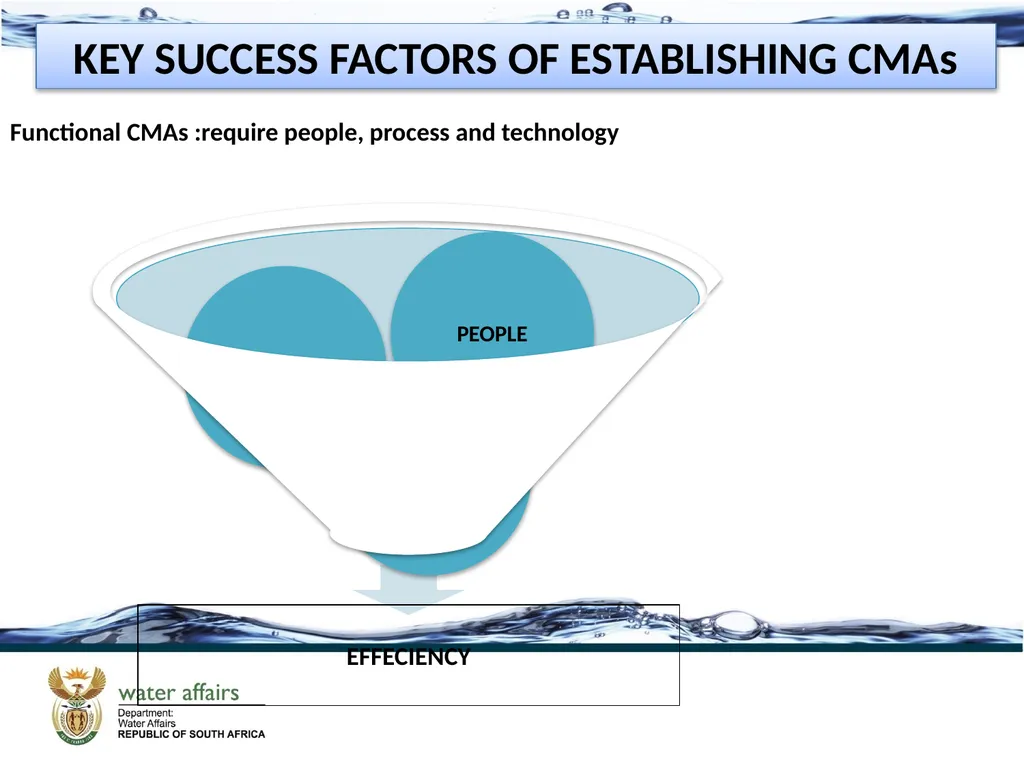
KEY SUCCESS FACTORS OF ESTABLISHING CMAs Functional CMAs :require people, process and technology<br>
24
Challenges and mitigating factors The DWA currently operating within nineteen water management areas in terms of transactional activities while the NWRS2 has proclaimed the nine WMA on 16 August 2013
The nine WMA should be activated in the DWA system (SAP,WARMS...) to prepare for the smooth transitional period for the establishment of CMAs
The two CMAs are not fully functional as some functions are still being performed by DWA
Currently the two CMAs are funded from fiscus - should be funded mostly by water use management charges.
The current proto CMAs have employees which are servicing both main account and WTE as well as two WMA at the same time
The ring-fencing of Proto-CMAs should happen immediately as recommended by the CFO WTE
There should be alignment with all the task teams so that process can move at the same pace<br>
25
People The current proto CMAs have employees already employed by DWA yet, some employees are servicing both main account and WTE at the same time while some are dedicated to WTE only.
Therefore the separation needed between main account and WTE in finance, needs to happen as soon as possible.
The Chief Financial Officer (CFO) WTE proposed that the following structure be implemented at the current proto CMAs per region.
The below structure will aid the proto CMAs in ensuring that they function efficiently.<br>
26
NEXT STEPS Functions that are of national importance should be under Main account
All functions preformed under WTE in the regions should be ring-fenced in the proto CMA
DWA will develop financial framework of augmentation to the CMAs and what augmentation should be used for in the CMAs
DWA will also ensure responsible financial governance and controls of public funds through monitoring and compliance<br>
27
WHAT SHOULD THE NSC DO IN THE PROCESS Approve proposals recommended by the task team
Give directives to relevant structure that support the establishment of CMAs
Support the recommend proposals from the task team to Top Management<br>
Give directives to relevant structure that support the establishment of CMAs
Support the recommend proposals from the task team to Top Management<br>
28
Thank you<br>