
Referee Committee Reorganization Options What are
SN
Published · 17 slides · 0 views

1 / 1


Description
Referee Committee Reorganization Options What are we even talking about? It was suggested at the Referee Committee meeting that the committee and membership consider changing from a regional structure to a topic-based structure, with
Related Topics
Share
Embed code
Download this presentation From Below
"Referee Committee Reorganization Options What are" is the property of its rightful owner. Permission is granted to download and print the materials on this website for personal, non-commercial use only, and to display it on your personal computer provided you do not modify the materials and that you retain all copyright notices contained in the materials. By downloading content from our website, you accept the terms of this agreement.
Presentation Transcript
01
Referee Committee Reorganization Options<br>
02
What are we even talking about? It was suggested at the Referee Committee meeting that the committee and membership consider changing from a regional structure to a topic-based structure, with subject matter or category chairs rather than regional chairs to help coordinate projects.
Analysts and chairs could choose to participate in and receive updates from specific categories of referees, even if they take place outside of their geographic region.<br>
Analysts and chairs could choose to participate in and receive updates from specific categories of referees, even if they take place outside of their geographic region.<br>
03
... but why? Individual labs may be looking at different species common to other parts of their region.
Seed testing is way beyond regional now! Many types of crops are produced in multiple regions.
Technology has changed. Virtual referees and surveys allow for broader reach of referee subjects and more efficient tallying of results.
Analysts may have more support from employers and companies if referees are conducted on crops they see the most.
Canada is listed as a single region but produces and tests a very wide variety of crops.
Emerging technologies, changes to and interpretation of regulations, and new media need a particular focus.<br>
Seed testing is way beyond regional now! Many types of crops are produced in multiple regions.
Technology has changed. Virtual referees and surveys allow for broader reach of referee subjects and more efficient tallying of results.
Analysts may have more support from employers and companies if referees are conducted on crops they see the most.
Canada is listed as a single region but produces and tests a very wide variety of crops.
Emerging technologies, changes to and interpretation of regulations, and new media need a particular focus.<br>
04
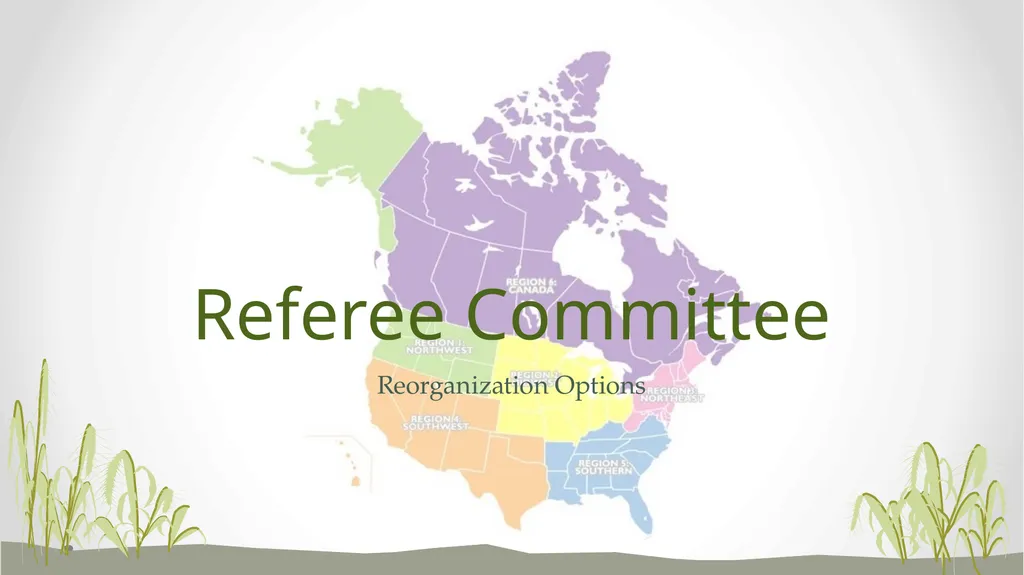
Current Structure 6 Regions, Defined in the AOSA Bylaws, Article XV
Northwest – Region I: Alaska, Idaho, Montana, Oregon, Washington, and Wyoming
Midwest – Region II: Illinois, Indiana, Iowa, Kansas, Michigan, Minnesota, Missouri, Nebraska, North Dakota, Ohio, South Dakota, and Wisconsin
Northeast – Region III: Connecticut, Delaware, Maine, Maryland, Massachusetts, New Hampshire, New Jersey, New York, Pennsylvania, Rhode Island, Vermont, and West Virginia
Southwest – Region IV: Arizona, California, Colorado, Hawaii, Nevada, New Mexico, Oklahoma, Texas and Utah (updated 1995.)
Southern – Region V: Alabama, Arkansas, Florida, Georgia, Kentucky, Louisiana, Mississippi, North Carolina, South Carolina, Tennessee, and Virginia (Updated 1995, 2013)
Canada – Region VI: Provinces of Alberta, British Columbia, Manitoba, Saskatchewan, New Brunswick, Ontario, Quebec, Nova Scotia, Newfoundland, and Prince Edward Island<br>
Northwest – Region I: Alaska, Idaho, Montana, Oregon, Washington, and Wyoming
Midwest – Region II: Illinois, Indiana, Iowa, Kansas, Michigan, Minnesota, Missouri, Nebraska, North Dakota, Ohio, South Dakota, and Wisconsin
Northeast – Region III: Connecticut, Delaware, Maine, Maryland, Massachusetts, New Hampshire, New Jersey, New York, Pennsylvania, Rhode Island, Vermont, and West Virginia
Southwest – Region IV: Arizona, California, Colorado, Hawaii, Nevada, New Mexico, Oklahoma, Texas and Utah (updated 1995.)
Southern – Region V: Alabama, Arkansas, Florida, Georgia, Kentucky, Louisiana, Mississippi, North Carolina, South Carolina, Tennessee, and Virginia (Updated 1995, 2013)
Canada – Region VI: Provinces of Alberta, British Columbia, Manitoba, Saskatchewan, New Brunswick, Ontario, Quebec, Nova Scotia, Newfoundland, and Prince Edward Island<br>
05
Options for New Categories Canadian Seed Analyst Certification Categories
AOSA Uniform Classification Species Class Categories
Custom Referee Categories<br>
AOSA Uniform Classification Species Class Categories
Custom Referee Categories<br>
06
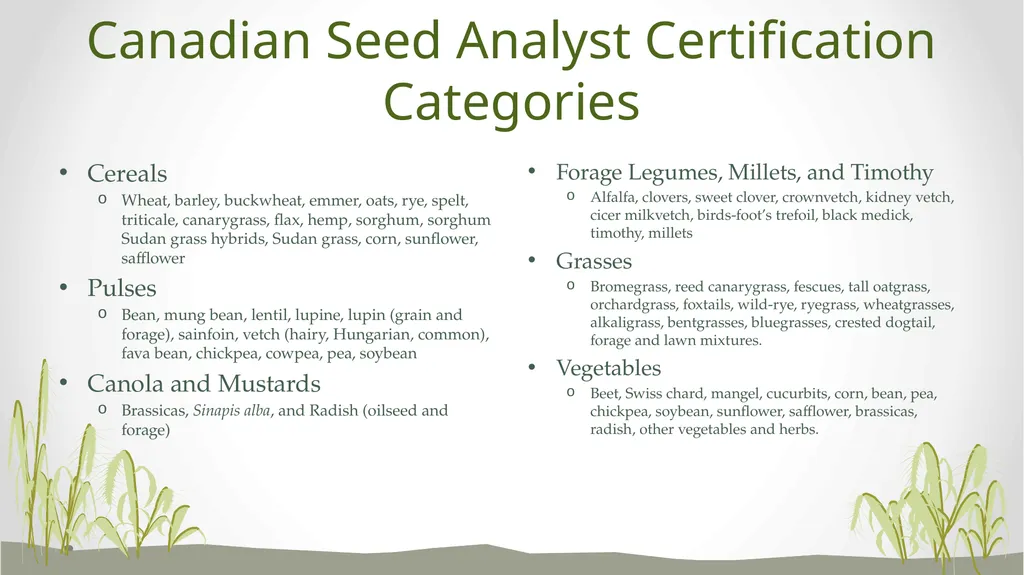
Canadian Seed Analyst Certification Categories Cereals
Wheat, barley, buckwheat, emmer, oats, rye, spelt, triticale, canarygrass, flax, hemp, sorghum, sorghum Sudan grass hybrids, Sudan grass, corn, sunflower, safflower
Pulses
Bean, mung bean, lentil, lupine, lupin (grain and forage), sainfoin, vetch (hairy, Hungarian, common), fava bean, chickpea, cowpea, pea, soybean
Canola and Mustards
Brassicas, Sinapis alba, and Radish (oilseed and forage) Forage Legumes, Millets, and Timothy
Alfalfa, clovers, sweet clover, crownvetch, kidney vetch, cicer milkvetch, birds-foot’s trefoil, black medick, timothy, millets
Grasses
Bromegrass, reed canarygrass, fescues, tall oatgrass, orchardgrass, foxtails, wild-rye, ryegrass, wheatgrasses, alkaligrass, bentgrasses, bluegrasses, crested dogtail, forage and lawn mixtures.
Vegetables
Beet, Swiss chard, mangel, cucurbits, corn, bean, pea, chickpea, soybean, sunflower, safflower, brassicas, radish, other vegetables and herbs.<br>
Wheat, barley, buckwheat, emmer, oats, rye, spelt, triticale, canarygrass, flax, hemp, sorghum, sorghum Sudan grass hybrids, Sudan grass, corn, sunflower, safflower
Pulses
Bean, mung bean, lentil, lupine, lupin (grain and forage), sainfoin, vetch (hairy, Hungarian, common), fava bean, chickpea, cowpea, pea, soybean
Canola and Mustards
Brassicas, Sinapis alba, and Radish (oilseed and forage) Forage Legumes, Millets, and Timothy
Alfalfa, clovers, sweet clover, crownvetch, kidney vetch, cicer milkvetch, birds-foot’s trefoil, black medick, timothy, millets
Grasses
Bromegrass, reed canarygrass, fescues, tall oatgrass, orchardgrass, foxtails, wild-rye, ryegrass, wheatgrasses, alkaligrass, bentgrasses, bluegrasses, crested dogtail, forage and lawn mixtures.
Vegetables
Beet, Swiss chard, mangel, cucurbits, corn, bean, pea, chickpea, soybean, sunflower, safflower, brassicas, radish, other vegetables and herbs.<br>
07
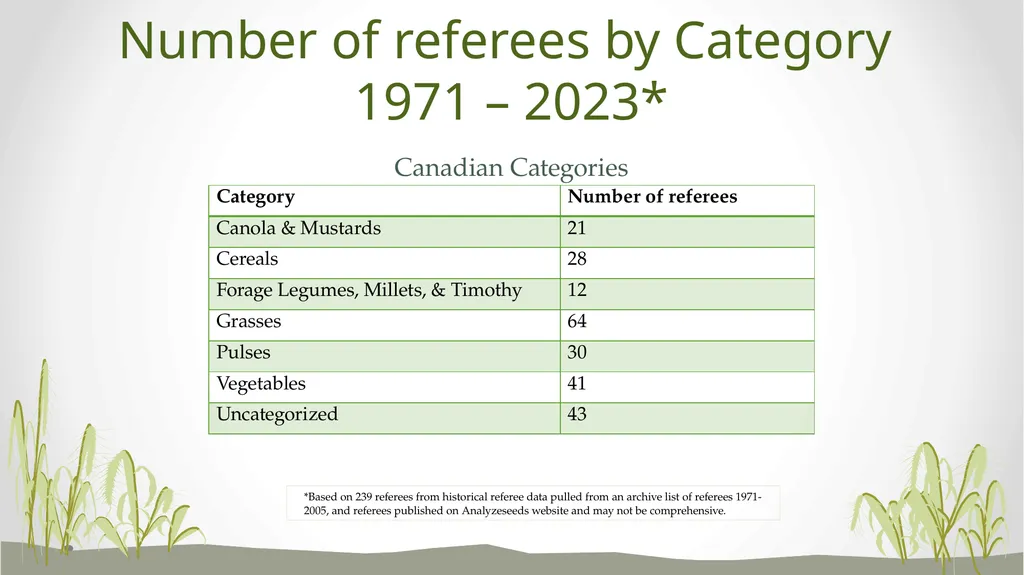
Number of referees by Category
1971 – 2023* Canadian Categories *Based on 239 referees from historical referee data pulled from an archive list of referees 1971-2005, and referees published on Analyzeseeds website and may not be comprehensive.<br>
08
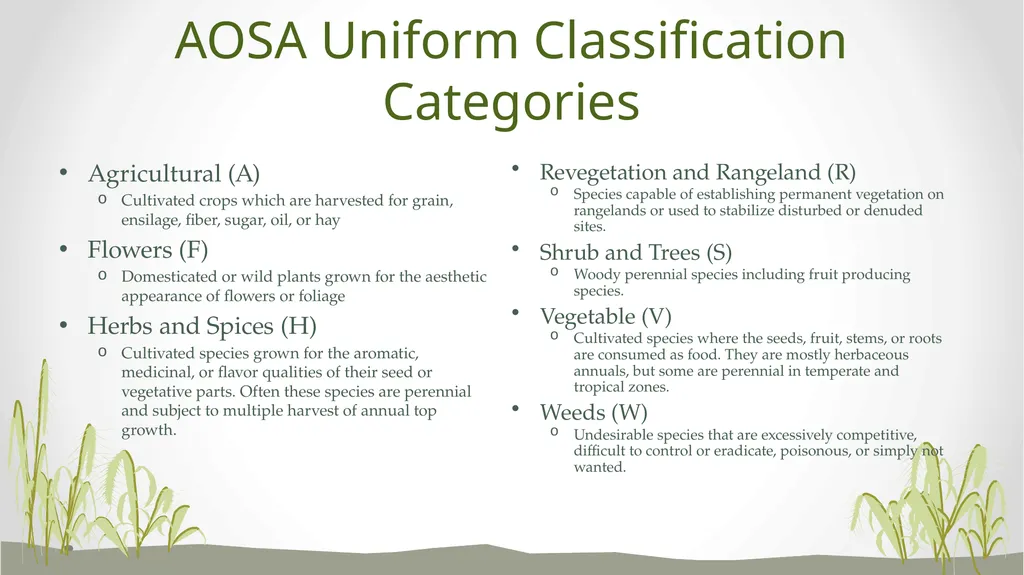
AOSA Uniform Classification Categories Agricultural (A)
Cultivated crops which are harvested for grain, ensilage, fiber, sugar, oil, or hay
Flowers (F)
Domesticated or wild plants grown for the aesthetic appearance of flowers or foliage
Herbs and Spices (H)
Cultivated species grown for the aromatic, medicinal, or flavor qualities of their seed or vegetative parts. Often these species are perennial and subject to multiple harvest of annual top growth. Revegetation and Rangeland (R)
Species capable of establishing permanent vegetation on rangelands or used to stabilize disturbed or denuded sites.
Shrub and Trees (S)
Woody perennial species including fruit producing species.
Vegetable (V)
Cultivated species where the seeds, fruit, stems, or roots are consumed as food. They are mostly herbaceous annuals, but some are perennial in temperate and tropical zones.
Weeds (W)
Undesirable species that are excessively competitive, difficult to control or eradicate, poisonous, or simply not wanted.<br>
Cultivated crops which are harvested for grain, ensilage, fiber, sugar, oil, or hay
Flowers (F)
Domesticated or wild plants grown for the aesthetic appearance of flowers or foliage
Herbs and Spices (H)
Cultivated species grown for the aromatic, medicinal, or flavor qualities of their seed or vegetative parts. Often these species are perennial and subject to multiple harvest of annual top growth. Revegetation and Rangeland (R)
Species capable of establishing permanent vegetation on rangelands or used to stabilize disturbed or denuded sites.
Shrub and Trees (S)
Woody perennial species including fruit producing species.
Vegetable (V)
Cultivated species where the seeds, fruit, stems, or roots are consumed as food. They are mostly herbaceous annuals, but some are perennial in temperate and tropical zones.
Weeds (W)
Undesirable species that are excessively competitive, difficult to control or eradicate, poisonous, or simply not wanted.<br>
09
Number of referees by Category
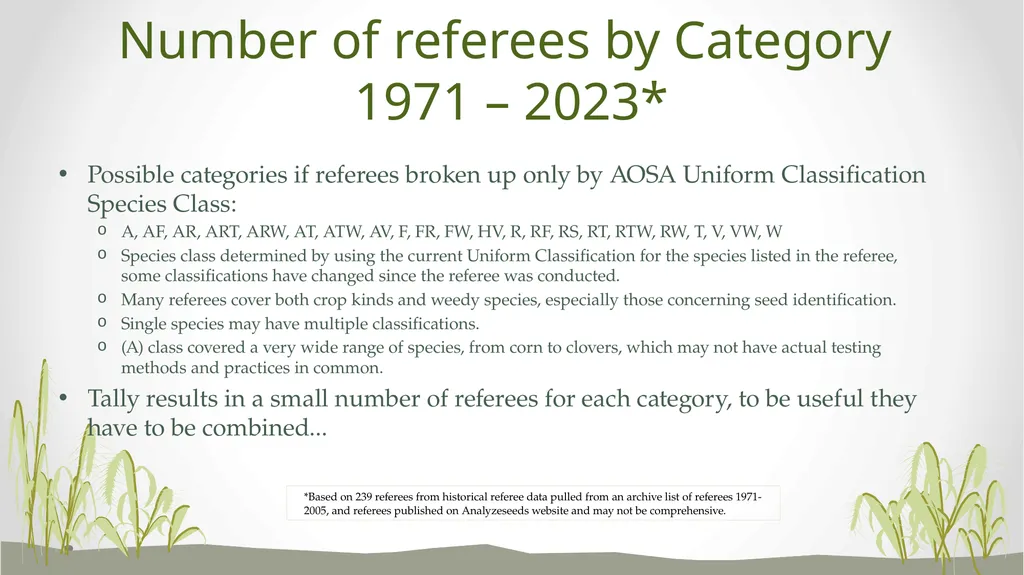
1971 – 2023* Possible categories if referees broken up only by AOSA Uniform Classification Species Class:
A, AF, AR, ART, ARW, AT, ATW, AV, F, FR, FW, HV, R, RF, RS, RT, RTW, RW, T, V, VW, W
Species class determined by using the current Uniform Classification for the species listed in the referee, some classifications have changed since the referee was conducted.
Many referees cover both crop kinds and weedy species, especially those concerning seed identification.
Single species may have multiple classifications.
(A) class covered a very wide range of species, from corn to clovers, which may not have actual testing methods and practices in common.
Tally results in a small number of referees for each category, to be useful they have to be combined... *Based on 239 referees from historical referee data pulled from an archive list of referees 1971-2005, and referees published on Analyzeseeds website and may not be comprehensive.<br>
A, AF, AR, ART, ARW, AT, ATW, AV, F, FR, FW, HV, R, RF, RS, RT, RTW, RW, T, V, VW, W
Species class determined by using the current Uniform Classification for the species listed in the referee, some classifications have changed since the referee was conducted.
Many referees cover both crop kinds and weedy species, especially those concerning seed identification.
Single species may have multiple classifications.
(A) class covered a very wide range of species, from corn to clovers, which may not have actual testing methods and practices in common.
Tally results in a small number of referees for each category, to be useful they have to be combined... *Based on 239 referees from historical referee data pulled from an archive list of referees 1971-2005, and referees published on Analyzeseeds website and may not be comprehensive.<br>
10
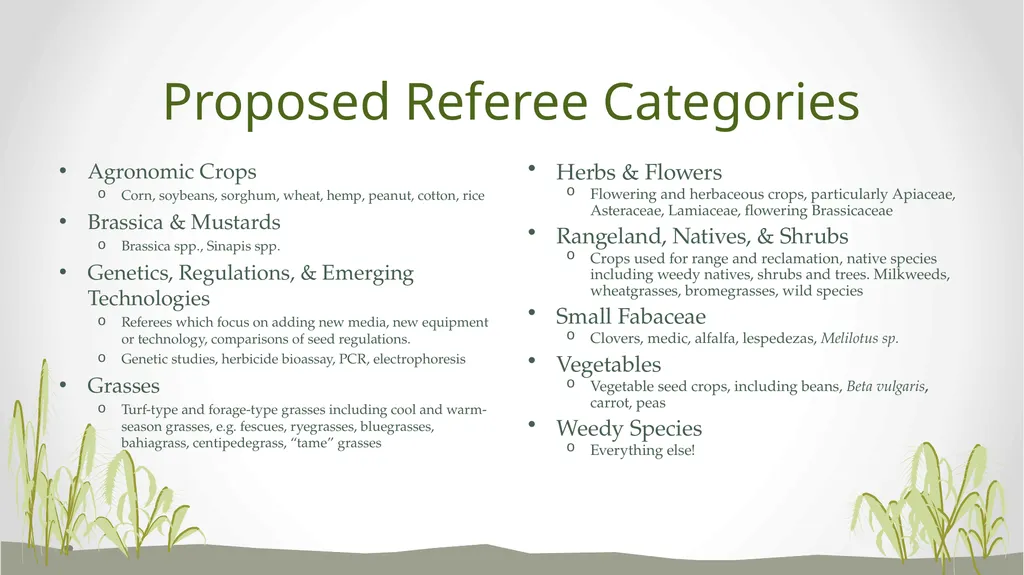
Proposed Referee Categories Agronomic Crops
Corn, soybeans, sorghum, wheat, hemp, peanut, cotton, rice
Brassica & Mustards
Brassica spp., Sinapis spp.
Genetics, Regulations, & Emerging Technologies
Referees which focus on adding new media, new equipment or technology, comparisons of seed regulations.
Genetic studies, herbicide bioassay, PCR, electrophoresis
Grasses
Turf-type and forage-type grasses including cool and warm-season grasses, e.g. fescues, ryegrasses, bluegrasses, bahiagrass, centipedegrass, “tame” grasses Herbs & Flowers
Flowering and herbaceous crops, particularly Apiaceae, Asteraceae, Lamiaceae, flowering Brassicaceae
Rangeland, Natives, & Shrubs
Crops used for range and reclamation, native species including weedy natives, shrubs and trees. Milkweeds, wheatgrasses, bromegrasses, wild species
Small Fabaceae
Clovers, medic, alfalfa, lespedezas, Melilotus sp.
Vegetables
Vegetable seed crops, including beans, Beta vulgaris, carrot, peas
Weedy Species
Everything else!<br>
Corn, soybeans, sorghum, wheat, hemp, peanut, cotton, rice
Brassica & Mustards
Brassica spp., Sinapis spp.
Genetics, Regulations, & Emerging Technologies
Referees which focus on adding new media, new equipment or technology, comparisons of seed regulations.
Genetic studies, herbicide bioassay, PCR, electrophoresis
Grasses
Turf-type and forage-type grasses including cool and warm-season grasses, e.g. fescues, ryegrasses, bluegrasses, bahiagrass, centipedegrass, “tame” grasses Herbs & Flowers
Flowering and herbaceous crops, particularly Apiaceae, Asteraceae, Lamiaceae, flowering Brassicaceae
Rangeland, Natives, & Shrubs
Crops used for range and reclamation, native species including weedy natives, shrubs and trees. Milkweeds, wheatgrasses, bromegrasses, wild species
Small Fabaceae
Clovers, medic, alfalfa, lespedezas, Melilotus sp.
Vegetables
Vegetable seed crops, including beans, Beta vulgaris, carrot, peas
Weedy Species
Everything else!<br>
11
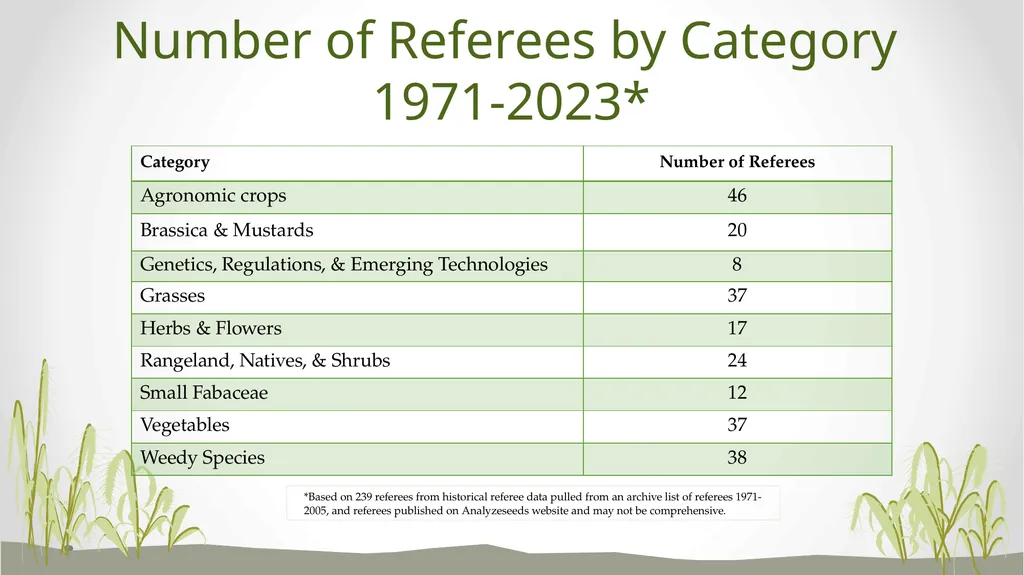
Number of Referees by Category
1971-2023* *Based on 239 referees from historical referee data pulled from an archive list of referees 1971-2005, and referees published on Analyzeseeds website and may not be comprehensive.<br>
12
Futurethink... What would have to happen to make this change?<br>
13
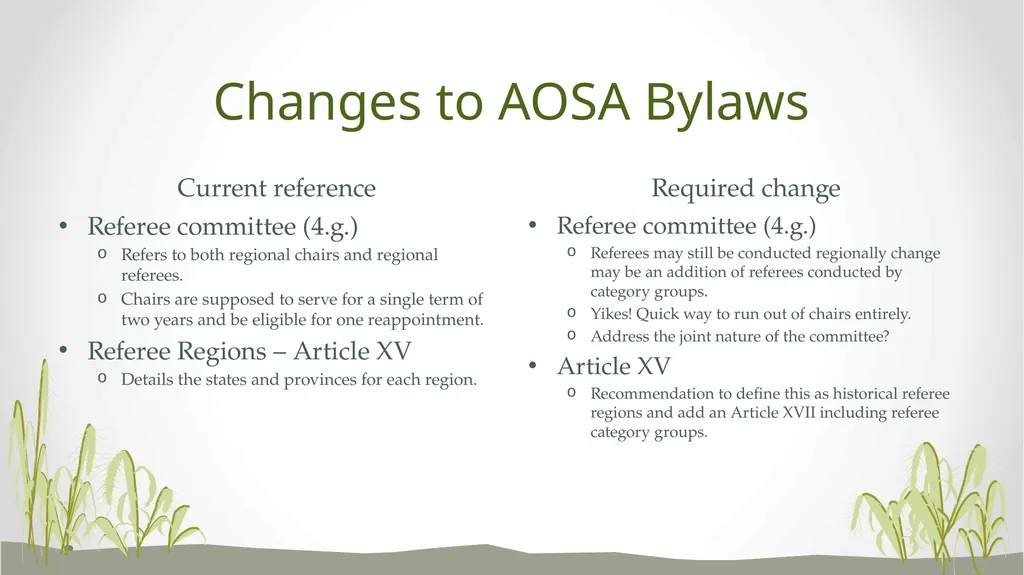
Changes to AOSA Bylaws Current reference Referee committee (4.g.)
Refers to both regional chairs and regional referees.
Chairs are supposed to serve for a single term of two years and be eligible for one reappointment.
Referee Regions – Article XV
Details the states and provinces for each region. Required change Referee committee (4.g.)
Referees may still be conducted regionally change may be an addition of referees conducted by category groups.
Yikes! Quick way to run out of chairs entirely.
Address the joint nature of the committee?
Article XV
Recommendation to define this as historical referee regions and add an Article XVII including referee category groups.<br>
Refers to both regional chairs and regional referees.
Chairs are supposed to serve for a single term of two years and be eligible for one reappointment.
Referee Regions – Article XV
Details the states and provinces for each region. Required change Referee committee (4.g.)
Referees may still be conducted regionally change may be an addition of referees conducted by category groups.
Yikes! Quick way to run out of chairs entirely.
Address the joint nature of the committee?
Article XV
Recommendation to define this as historical referee regions and add an Article XVII including referee category groups.<br>
14
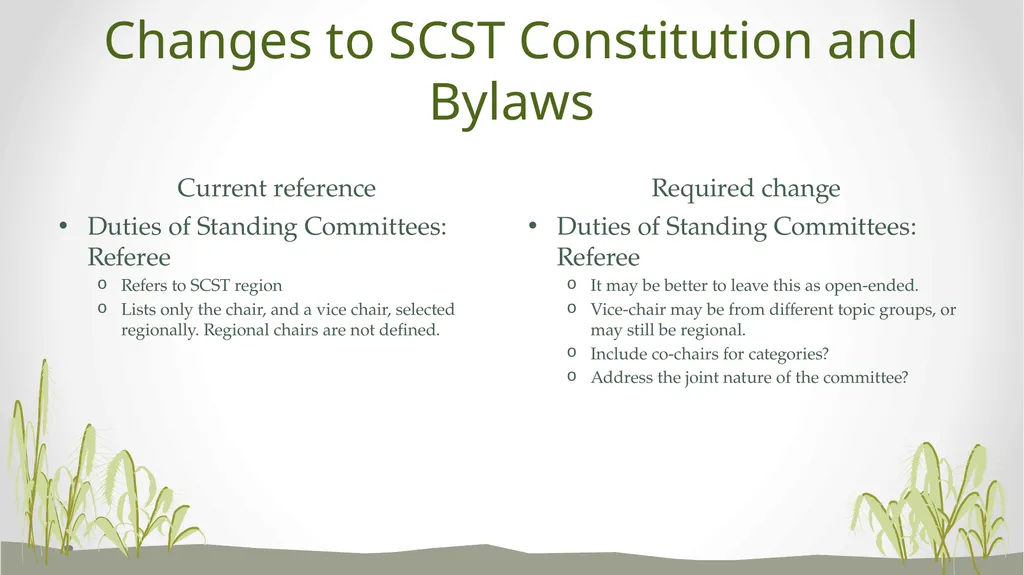
Changes to SCST Constitution and Bylaws Current reference Duties of Standing Committees: Referee
Refers to SCST region
Lists only the chair, and a vice chair, selected regionally. Regional chairs are not defined. Required change Duties of Standing Committees: Referee
It may be better to leave this as open-ended.
Vice-chair may be from different topic groups, or may still be regional.
Include co-chairs for categories?
Address the joint nature of the committee?<br>
Refers to SCST region
Lists only the chair, and a vice chair, selected regionally. Regional chairs are not defined. Required change Duties of Standing Committees: Referee
It may be better to leave this as open-ended.
Vice-chair may be from different topic groups, or may still be regional.
Include co-chairs for categories?
Address the joint nature of the committee?<br>
15
Changes to the organization of the committee Current structure Referee Chairs
1 representative from AOSA, 1 representative from SCST
Regional Chairs
Requires a chair for AOSA and SCST in each region. Required change Referee Chairs
Still representation from AOSA & SCST
Categorical Chairs
May have AOSA & SCST category chair
If a category chair is unavailable, the chair of a corresponding committee may stand in until the position can be filled.
E.g. Flower seed committee, regulatory committee, or advanced technology, Conservation & Reclamation, Tree & Shrub<br>
1 representative from AOSA, 1 representative from SCST
Regional Chairs
Requires a chair for AOSA and SCST in each region. Required change Referee Chairs
Still representation from AOSA & SCST
Categorical Chairs
May have AOSA & SCST category chair
If a category chair is unavailable, the chair of a corresponding committee may stand in until the position can be filled.
E.g. Flower seed committee, regulatory committee, or advanced technology, Conservation & Reclamation, Tree & Shrub<br>
16
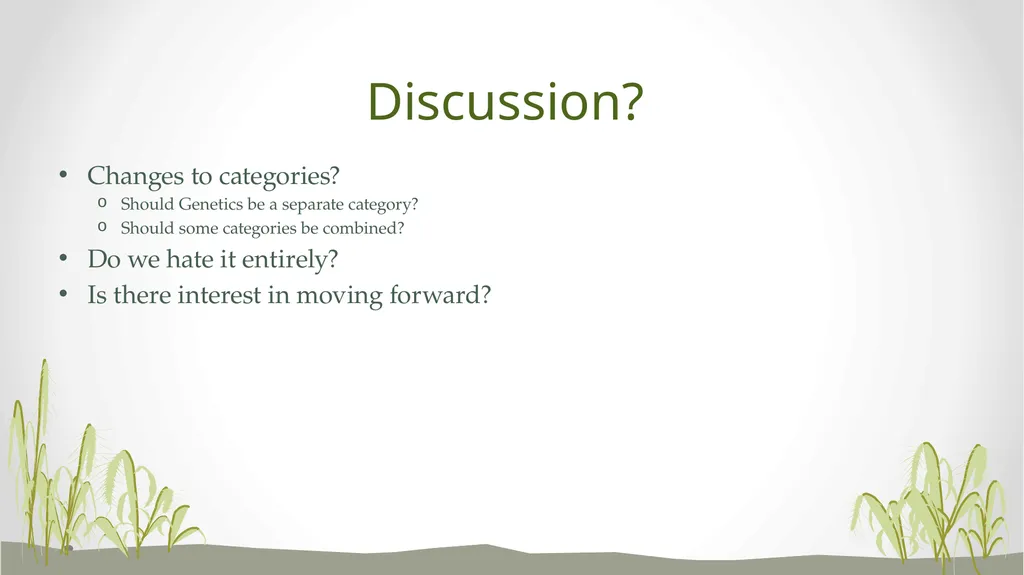
Discussion? Changes to categories?
Should Genetics be a separate category?
Should some categories be combined?
Do we hate it entirely?
Is there interest in moving forward?<br>
Should Genetics be a separate category?
Should some categories be combined?
Do we hate it entirely?
Is there interest in moving forward?<br>
17
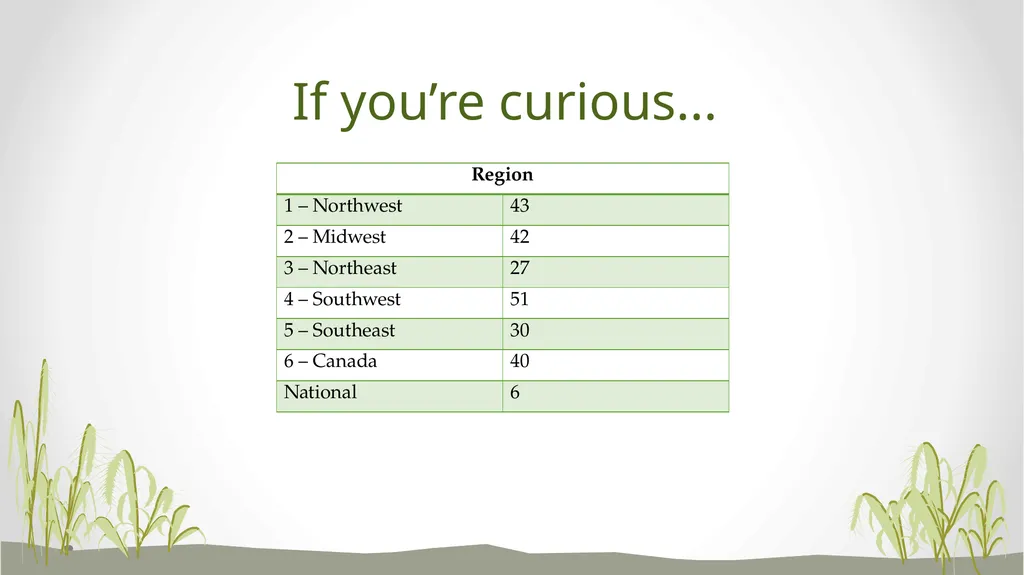
If you’re curious...<br>