
Reference (scan QR code) Global Task Force for

Description: Reference (scan QR code) Global Task Force for Cholera Control (GTFCC) Cholera patient treatment flowchart Case definition suspected cholera: Outside of cholera outbreak: any patient 2 years presenting with acute watery diarrhoea and
Related Topics
Download Presentation
"Reference (scan QR code) Global Task Force for" is the property of its rightful owner. Permission is granted to download and print the materials on this website for personal, non-commercial use only, and to display it on your personal computer provided you do not modify the materials and that you retain all copyright notices contained in the materials. By downloading content from our website, you accept the terms of this agreement.
Presentation Transcript
slide1. Reference (scan QR code)
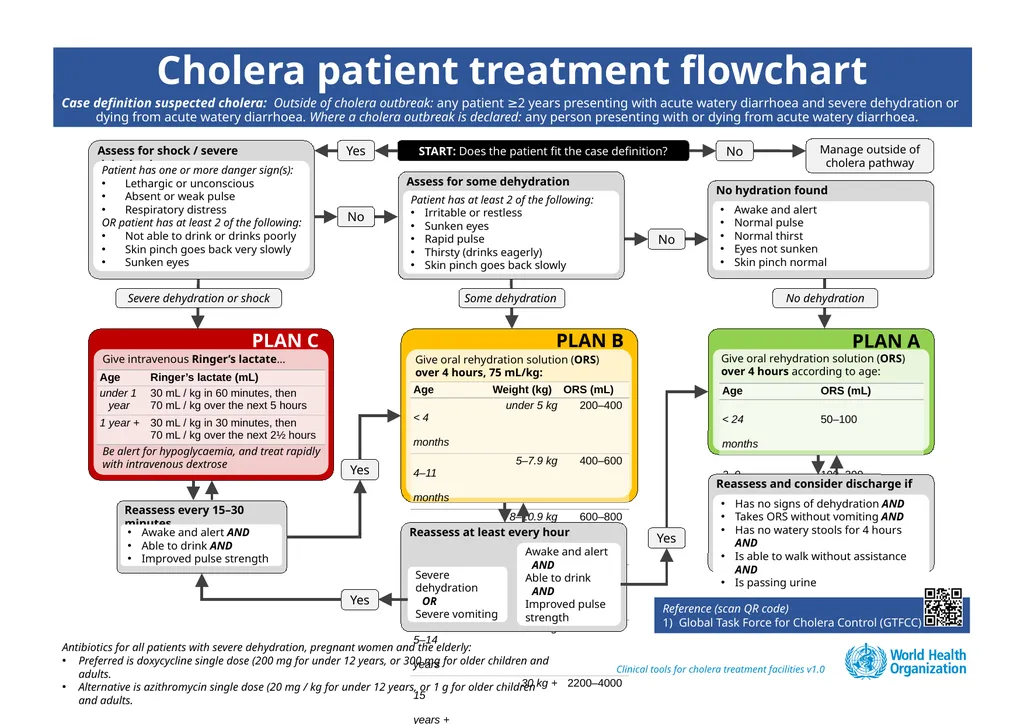
Global Task Force for Cholera Control (GTFCC) Cholera patient treatment flowchart Case definition suspected cholera: Outside of cholera outbreak: any patient ≥2 years presenting with acute watery diarrhoea and severe dehydration or dying from acute watery diarrhoea. Where a cholera outbreak is declared: any person presenting with or dying from acute watery diarrhoea. Yes Yes Yes No Manage outside of cholera pathway START: Does the patient fit the case definition? PLAN A Give intravenous Ringer’s lactate…
Be alert for hypoglycaemia, and treat rapidly with intravenous dextrose PLAN C Reassess every 15–30 minutes Awake and alert AND
Able to drink AND
Improved pulse strength Give oral rehydration solution (ORS)
over 4 hours, 75 mL/kg: PLAN B Some dehydration Severe dehydration or shock No dehydration Antibiotics for all patients with severe dehydration, pregnant women and the elderly:
Preferred is doxycycline single dose (200 mg for under 12 years, or 300 mg for older children and adults.
Alternative is azithromycin single dose (20 mg / kg for under 12 years, or 1 g for older children and adults. Clinical tools for cholera treatment facilities v1.0<br>
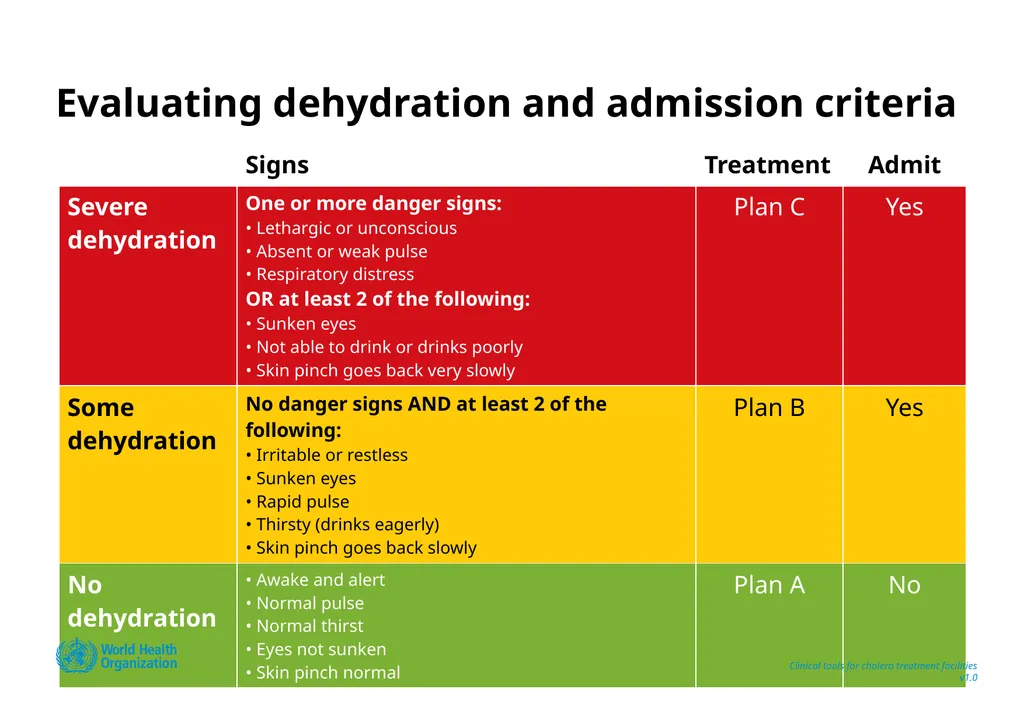
slide2. Evaluating dehydration and admission criteria Clinical tools for cholera treatment facilities
v1.0<br>
slide3. Treatment for
Severe dehydration
Start intravenous fluids immediately Plan C Start intravenous fluid immediately
Ringers lactate is the first choice
Use large cannulas
or put 2 IV lines if large volumes are to be administered rapidly
Write the start time on the IV bag
to help track how quickly fluids are being given Reassess
at least every 15 to 30 minutes
Watch for signs of hypoglycaemia
and treat rapidly
Give ORS to replace ongoing losses
as soon as the patient can drink safely
Zinc - give for 10 days
In patients under 6 months, 10mg once per day
In patients over 6 months, 20mg once per day Clinical tools for cholera treatment facilities
v1.0<br>
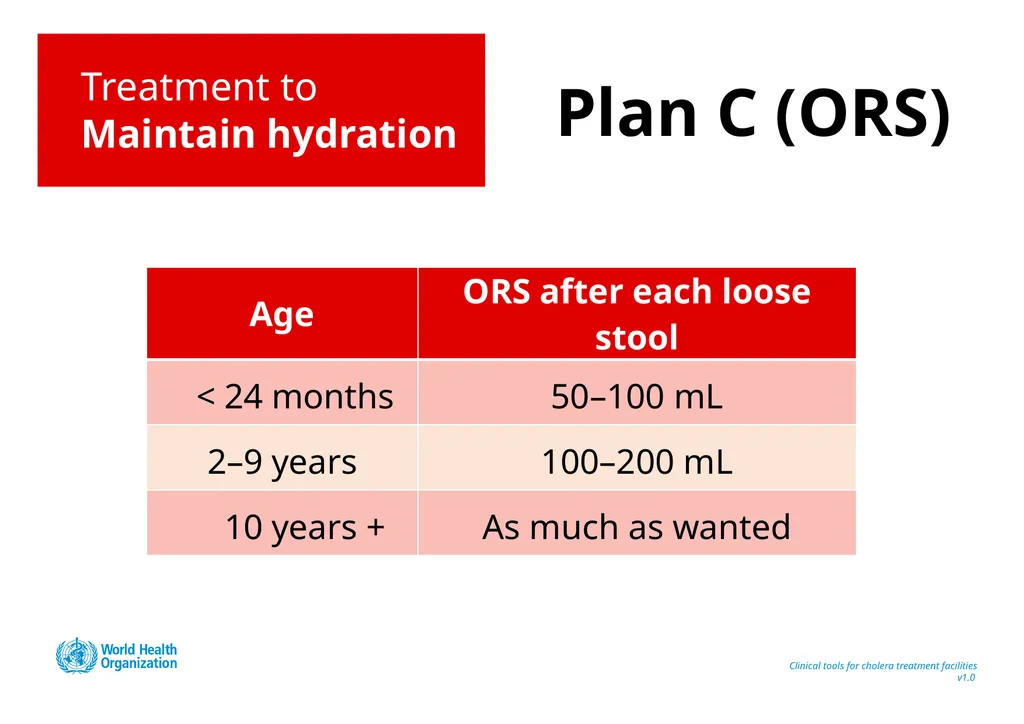
slide4. Treatment to
Maintain hydration Plan C (ORS) Clinical tools for cholera treatment facilities
v1.0<br>
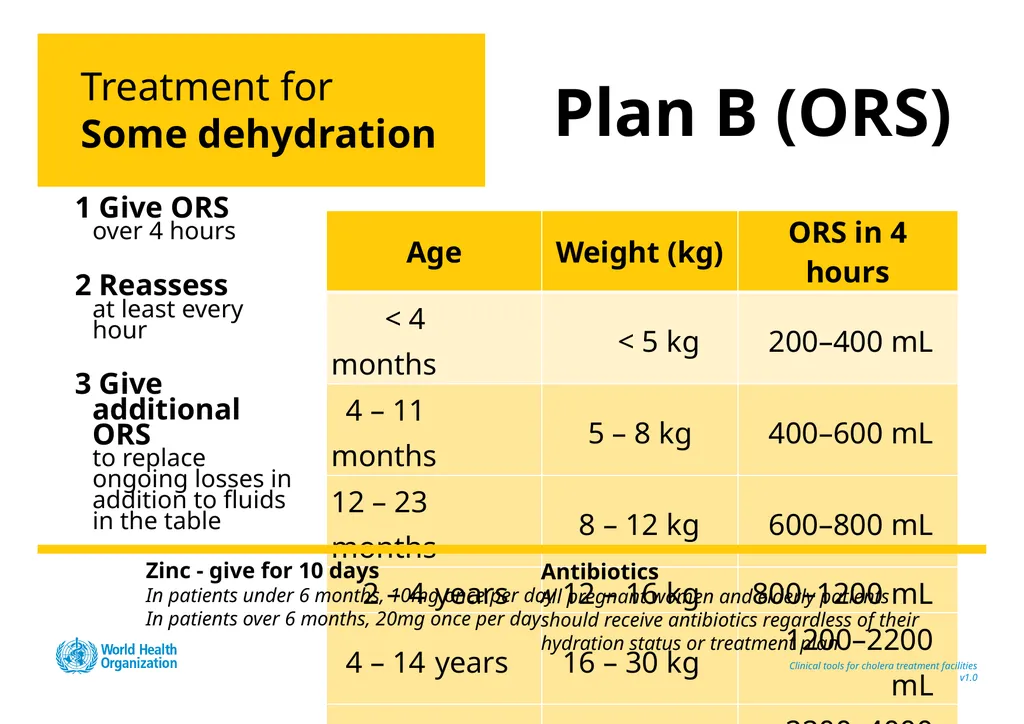
slide5. Treatment for
Some dehydration Plan B (ORS) 1 Give ORS
over 4 hours
2 Reassess
at least every hour
3 Give additional ORS
to replace ongoing losses in addition to fluids in the table Zinc - give for 10 days
In patients under 6 months, 10mg once per day
In patients over 6 months, 20mg once per day Antibiotics
All pregnant women and elderly patients should receive antibiotics regardless of their hydration status or treatment plan Clinical tools for cholera treatment facilities
v1.0<br>
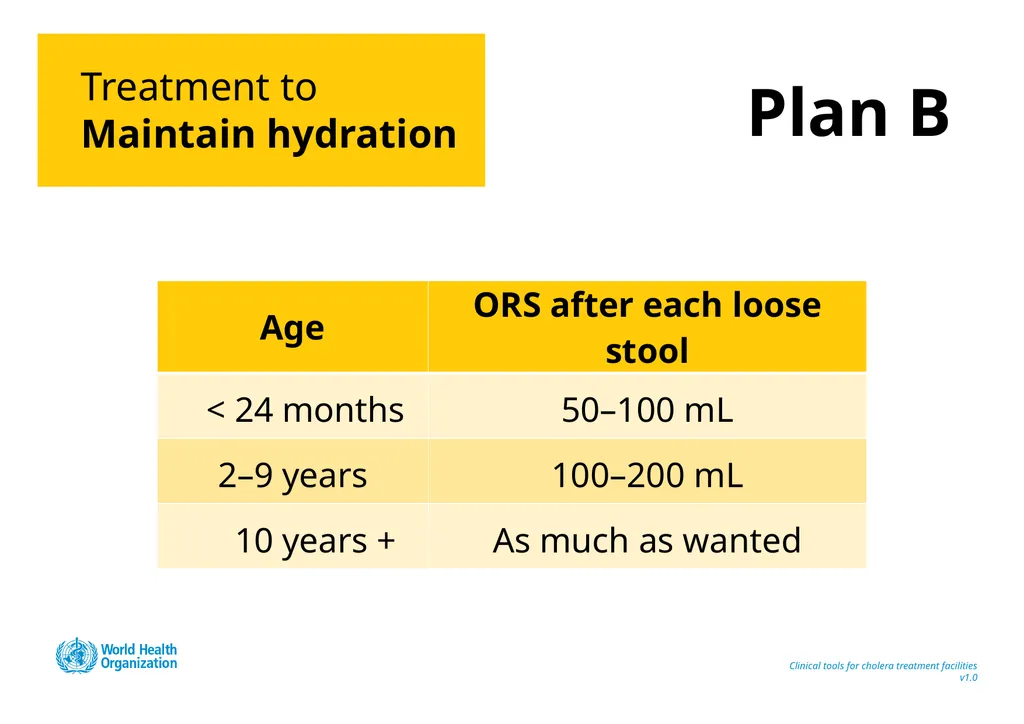
slide6. Treatment to
Maintain hydration Plan B Clinical tools for cholera treatment facilities
v1.0<br>
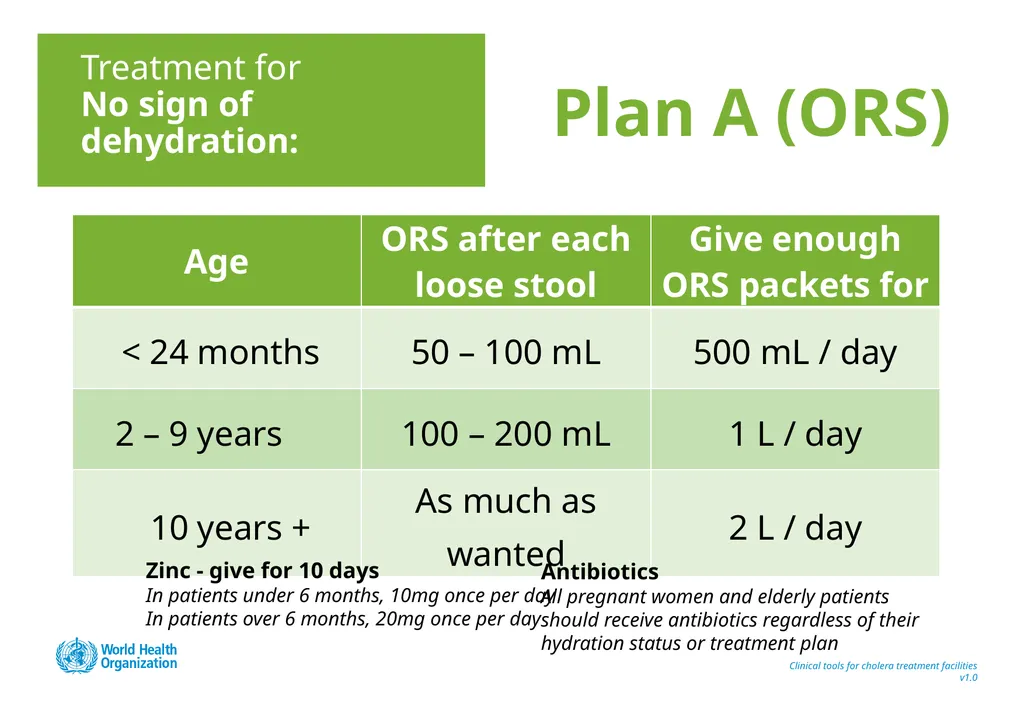
slide7. Zinc - give for 10 days
In patients under 6 months, 10mg once per day
In patients over 6 months, 20mg once per day Treatment for
No sign of dehydration: Plan A (ORS) Antibiotics
All pregnant women and elderly patients should receive antibiotics regardless of their hydration status or treatment plan Clinical tools for cholera treatment facilities
v1.0<br>
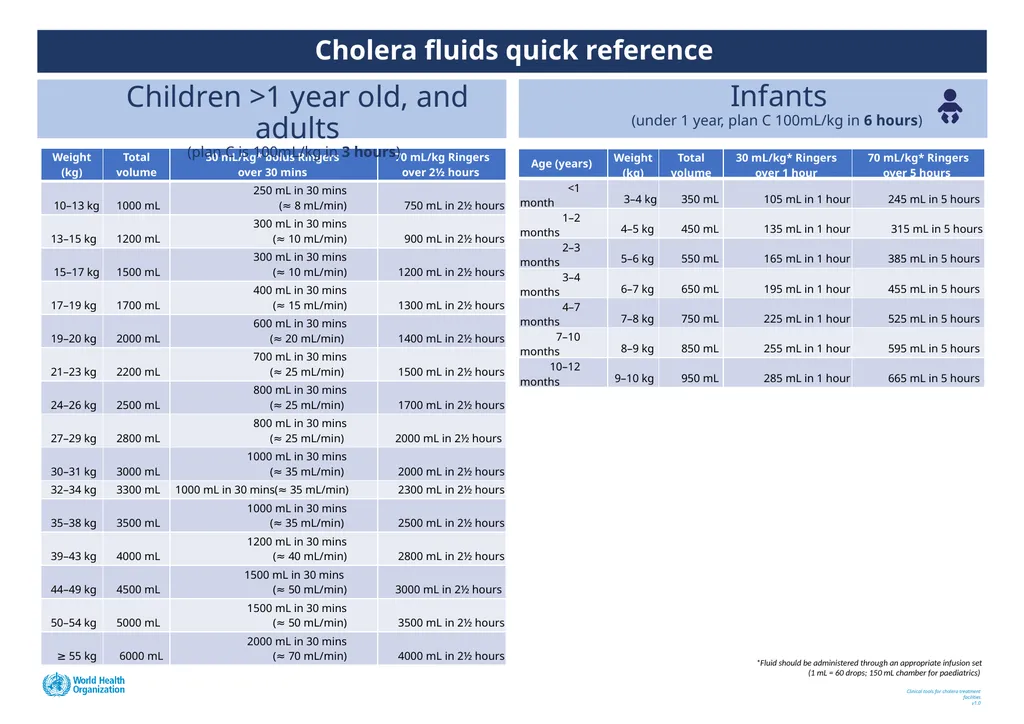
slide8. *Fluid should be administered through an appropriate infusion set
(1 mL = 60 drops; 150 mL chamber for paediatrics) Infants (under 1 year, plan C 100mL/kg in 6 hours) Children >1 year old, and adults
(plan C is 100mL/kg in 3 hours) Cholera fluids quick reference Clinical tools for cholera treatment facilities
v1.0<br>
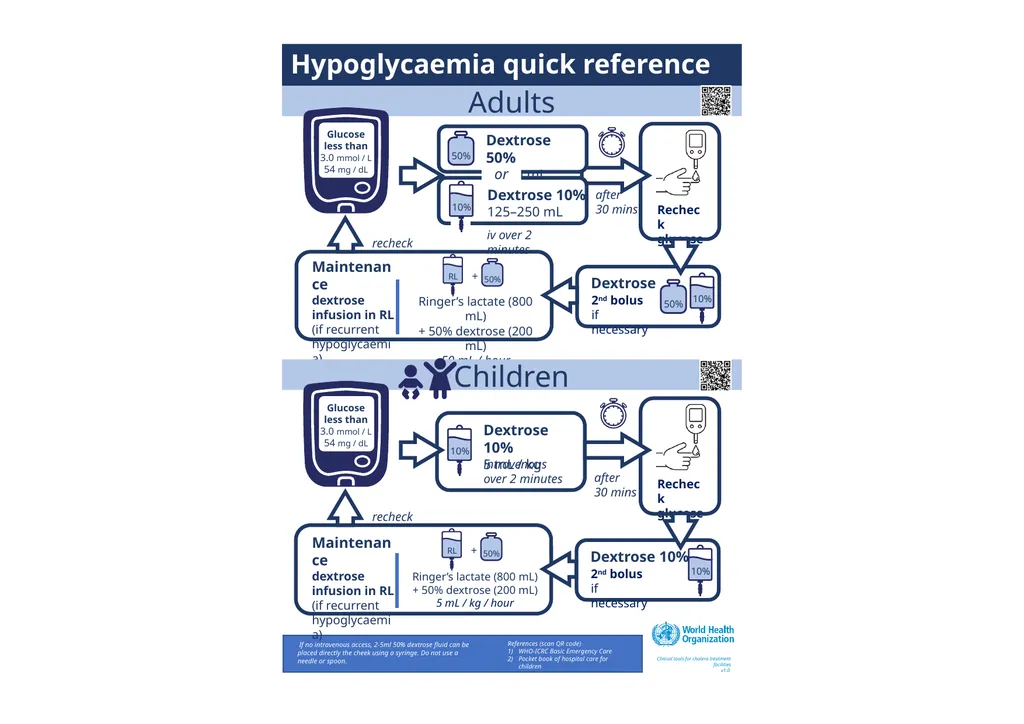
slide9. Recheck
glucose Ringer’s lactate (800 mL)
+ 50% dextrose (200 mL)
5 mL / kg / hour 2nd bolus
if necessary Dextrose 10% Maintenance
dextrose
infusion in RL
(if recurrent
hypoglycaemia) Ringer’s lactate (800 mL)
+ 50% dextrose (200 mL)
50 mL / hour Dextrose 50%
25–50 mL iv over 2 minutes Hypoglycaemia quick reference Adults after
30 mins 2nd bolus
if necessary Dextrose Maintenance
dextrose
infusion in RL
(if recurrent
hypoglycaemia) + Children Recheck
glucose after
30 mins 10% If no intravenous access, 2-5ml 50% dextrose fluid can be placed directly the cheek using a syringe. Do not use a needle or spoon. Dextrose 10%
125–250 mL Dextrose 10%
5 mL / kg intravenous
over 2 minutes + or Glucose less than
3.0 mmol / L
54 mg / dL recheck Glucose less than
3.0 mmol / L
54 mg / dL recheck References (scan QR code)
WHO-ICRC Basic Emergency Care
Pocket book of hospital care for children Clinical tools for cholera treatment facilities
v1.0<br>
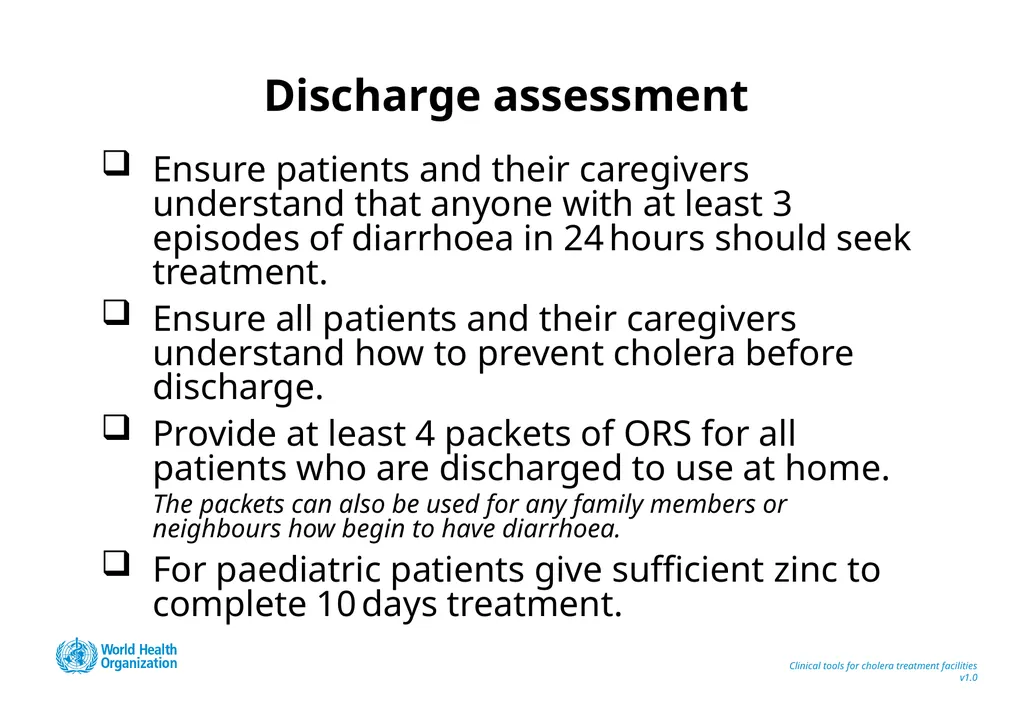
slide10. Discharge assessment Ensure patients and their caregivers understand that anyone with at least 3 episodes of diarrhoea in 24 hours should seek treatment.
Ensure all patients and their caregivers understand how to prevent cholera before discharge.
Provide at least 4 packets of ORS for all patients who are discharged to use at home.
The packets can also be used for any family members or neighbours how begin to have diarrhoea.
For paediatric patients give sufficient zinc to complete 10 days treatment. Clinical tools for cholera treatment facilities
v1.0<br>
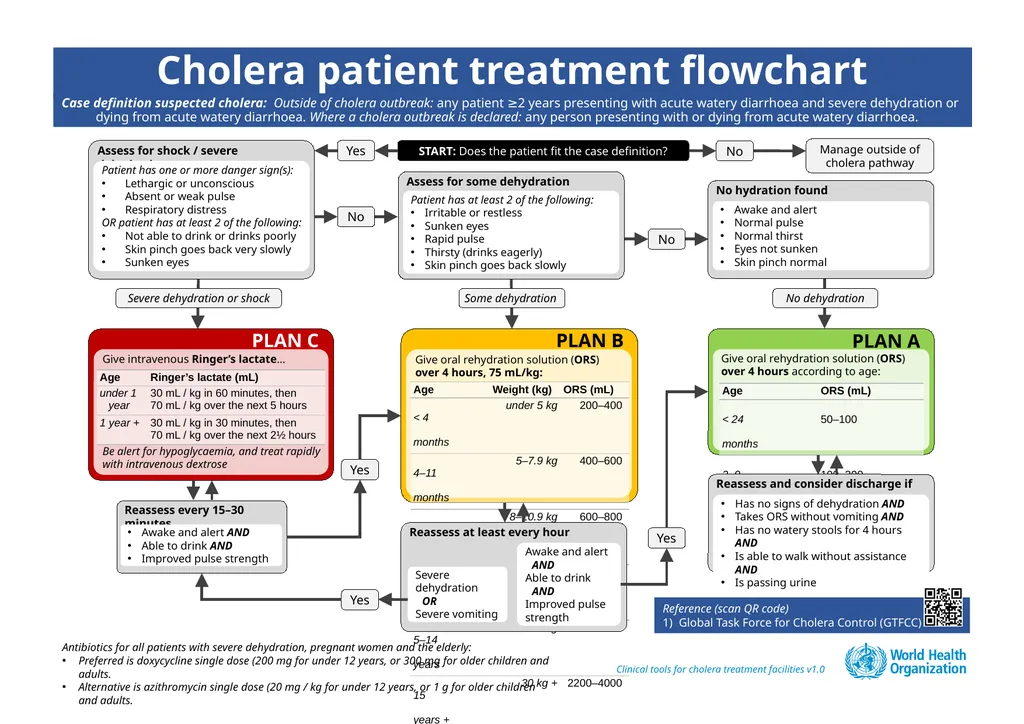
Global Task Force for Cholera Control (GTFCC) Cholera patient treatment flowchart Case definition suspected cholera: Outside of cholera outbreak: any patient ≥2 years presenting with acute watery diarrhoea and severe dehydration or dying from acute watery diarrhoea. Where a cholera outbreak is declared: any person presenting with or dying from acute watery diarrhoea. Yes Yes Yes No Manage outside of cholera pathway START: Does the patient fit the case definition? PLAN A Give intravenous Ringer’s lactate…
Be alert for hypoglycaemia, and treat rapidly with intravenous dextrose PLAN C Reassess every 15–30 minutes Awake and alert AND
Able to drink AND
Improved pulse strength Give oral rehydration solution (ORS)
over 4 hours, 75 mL/kg: PLAN B Some dehydration Severe dehydration or shock No dehydration Antibiotics for all patients with severe dehydration, pregnant women and the elderly:
Preferred is doxycycline single dose (200 mg for under 12 years, or 300 mg for older children and adults.
Alternative is azithromycin single dose (20 mg / kg for under 12 years, or 1 g for older children and adults. Clinical tools for cholera treatment facilities v1.0<br>
slide2. Evaluating dehydration and admission criteria Clinical tools for cholera treatment facilities
v1.0<br>
slide3. Treatment for
Severe dehydration
Start intravenous fluids immediately Plan C Start intravenous fluid immediately
Ringers lactate is the first choice
Use large cannulas
or put 2 IV lines if large volumes are to be administered rapidly
Write the start time on the IV bag
to help track how quickly fluids are being given Reassess
at least every 15 to 30 minutes
Watch for signs of hypoglycaemia
and treat rapidly
Give ORS to replace ongoing losses
as soon as the patient can drink safely
Zinc - give for 10 days
In patients under 6 months, 10mg once per day
In patients over 6 months, 20mg once per day Clinical tools for cholera treatment facilities
v1.0<br>
slide4. Treatment to
Maintain hydration Plan C (ORS) Clinical tools for cholera treatment facilities
v1.0<br>
slide5. Treatment for
Some dehydration Plan B (ORS) 1 Give ORS
over 4 hours
2 Reassess
at least every hour
3 Give additional ORS
to replace ongoing losses in addition to fluids in the table Zinc - give for 10 days
In patients under 6 months, 10mg once per day
In patients over 6 months, 20mg once per day Antibiotics
All pregnant women and elderly patients should receive antibiotics regardless of their hydration status or treatment plan Clinical tools for cholera treatment facilities
v1.0<br>
slide6. Treatment to
Maintain hydration Plan B Clinical tools for cholera treatment facilities
v1.0<br>
slide7. Zinc - give for 10 days
In patients under 6 months, 10mg once per day
In patients over 6 months, 20mg once per day Treatment for
No sign of dehydration: Plan A (ORS) Antibiotics
All pregnant women and elderly patients should receive antibiotics regardless of their hydration status or treatment plan Clinical tools for cholera treatment facilities
v1.0<br>
slide8. *Fluid should be administered through an appropriate infusion set
(1 mL = 60 drops; 150 mL chamber for paediatrics) Infants (under 1 year, plan C 100mL/kg in 6 hours) Children >1 year old, and adults
(plan C is 100mL/kg in 3 hours) Cholera fluids quick reference Clinical tools for cholera treatment facilities
v1.0<br>
slide9. Recheck
glucose Ringer’s lactate (800 mL)
+ 50% dextrose (200 mL)
5 mL / kg / hour 2nd bolus
if necessary Dextrose 10% Maintenance
dextrose
infusion in RL
(if recurrent
hypoglycaemia) Ringer’s lactate (800 mL)
+ 50% dextrose (200 mL)
50 mL / hour Dextrose 50%
25–50 mL iv over 2 minutes Hypoglycaemia quick reference Adults after
30 mins 2nd bolus
if necessary Dextrose Maintenance
dextrose
infusion in RL
(if recurrent
hypoglycaemia) + Children Recheck
glucose after
30 mins 10% If no intravenous access, 2-5ml 50% dextrose fluid can be placed directly the cheek using a syringe. Do not use a needle or spoon. Dextrose 10%
125–250 mL Dextrose 10%
5 mL / kg intravenous
over 2 minutes + or Glucose less than
3.0 mmol / L
54 mg / dL recheck Glucose less than
3.0 mmol / L
54 mg / dL recheck References (scan QR code)
WHO-ICRC Basic Emergency Care
Pocket book of hospital care for children Clinical tools for cholera treatment facilities
v1.0<br>
slide10. Discharge assessment Ensure patients and their caregivers understand that anyone with at least 3 episodes of diarrhoea in 24 hours should seek treatment.
Ensure all patients and their caregivers understand how to prevent cholera before discharge.
Provide at least 4 packets of ORS for all patients who are discharged to use at home.
The packets can also be used for any family members or neighbours how begin to have diarrhoea.
For paediatric patients give sufficient zinc to complete 10 days treatment. Clinical tools for cholera treatment facilities
v1.0<br>