
Regional Consultation Workshop on PM-ABHIM and




Description: Regional Consultation Workshop on PM-ABHIM and XV-FC Health Grants 20th - 21st September 2022 Trivandrum, Kerela Maj Gen (Prof) Atul Kotwal, SM, VSM MBBS, MD (PSM), PDF (Epidemiology), FRCP Edin, FAMS, FIPHA, FIAPSM Executive Director,
Related Topics
Download Presentation
"Regional Consultation Workshop on PM-ABHIM and" is the property of its rightful owner. Permission is granted to download and print the materials on this website for personal, non-commercial use only, and to display it on your personal computer provided you do not modify the materials and that you retain all copyright notices contained in the materials. By downloading content from our website, you accept the terms of this agreement.
Presentation Transcript
slide1. Regional Consultation Workshop on
PM-ABHIM and XV-FC Health Grants
20th - 21st September 2022
Trivandrum, Kerela Maj Gen (Prof) Atul Kotwal, SM, VSM
MBBS, MD (PSM), PDF (Epidemiology), FRCP Edin, FAMS, FIPHA, FIAPSM
Executive Director, NHSRC, MoHFW, Government of India (GoI)<br>
slide2. Pradhan Mantri Ayushman Bharat - Health Infrastructure Mission (PM-ABHIM) PM-ABHIM launched by the Hon’ble Prime Minister on 25th October, 2021 Largest pan-India scheme since 2005 for creation & improvement of long-term Public Healthcare Infrastructure. Total outlay of Rs 64,180 crore from FY 2021-22 till FY 2025-26.<br>
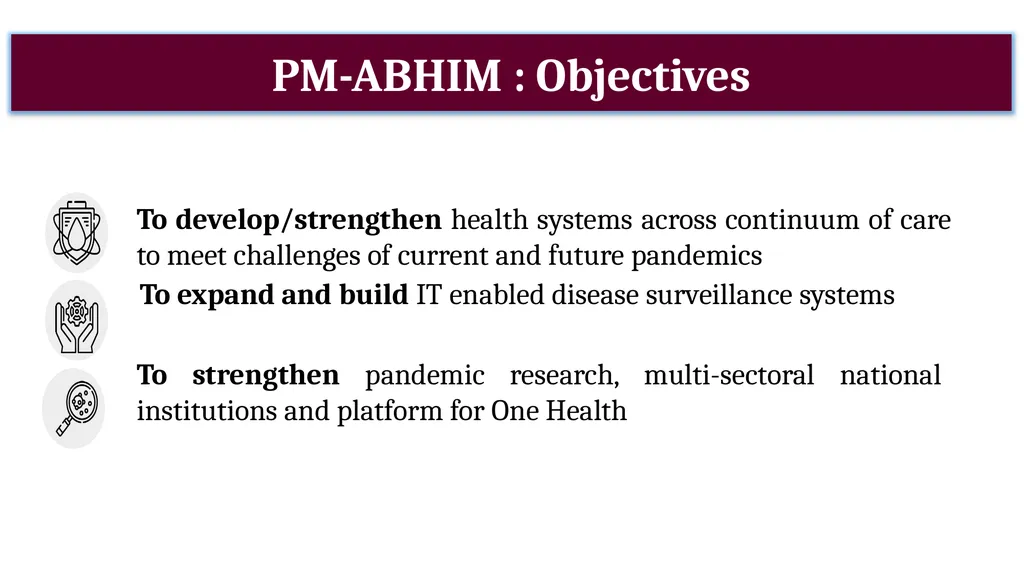
slide3. PM-ABHIM : Objectives<br>
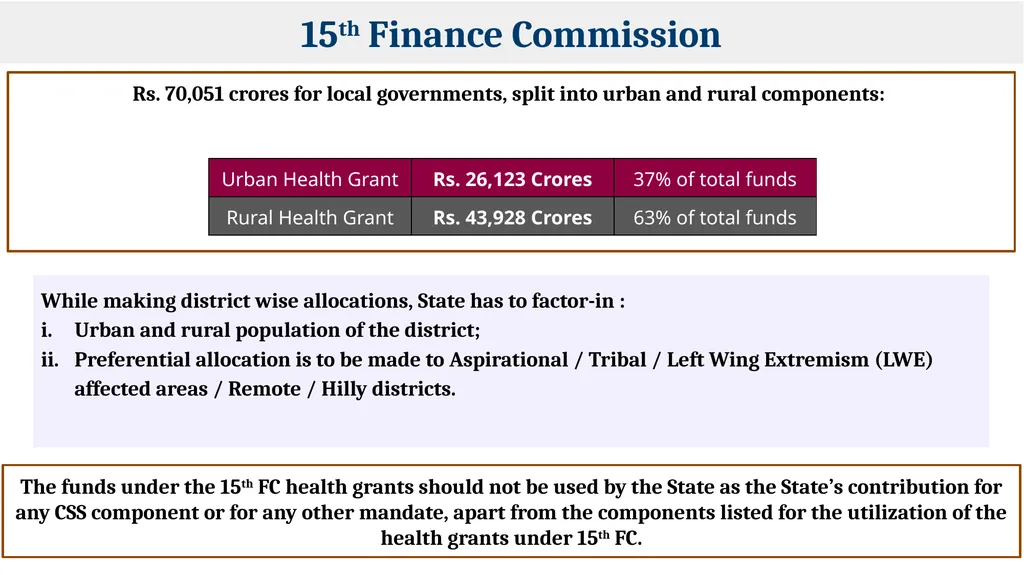
slide4. While making district wise allocations, State has to factor-in :
Urban and rural population of the district;
Preferential allocation is to be made to Aspirational / Tribal / Left Wing Extremism (LWE) affected areas / Remote / Hilly districts. Rs. 70,051 crores for local governments, split into urban and rural components: 15th Finance Commission The funds under the 15th FC health grants should not be used by the State as the State’s contribution for any CSS component or for any other mandate, apart from the components listed for the utilization of the health grants under 15th FC.<br>
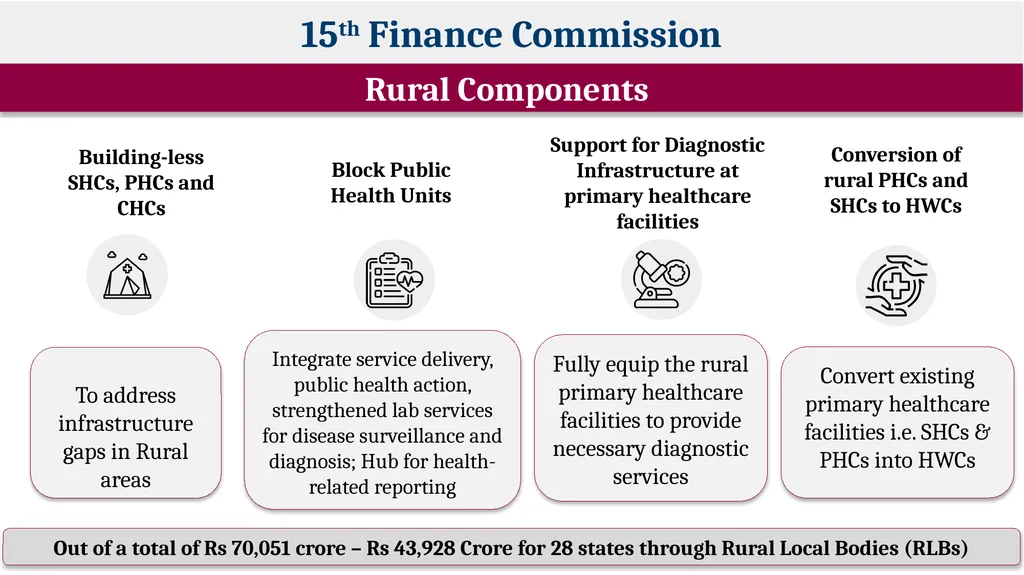
slide5. Rural Components Building-less SHCs, PHCs and CHCs Block Public Health Units Integrate service delivery, public health action, strengthened lab services for disease surveillance and diagnosis; Hub for health-related reporting Support for Diagnostic Infrastructure at primary healthcare facilities Conversion of rural PHCs and SHCs to HWCs To address infrastructure gaps in Rural areas Fully equip the rural primary healthcare facilities to provide necessary diagnostic services Convert existing primary healthcare facilities i.e. SHCs & PHCs into HWCs Out of a total of Rs 70,051 crore – Rs 43,928 Crore for 28 states through Rural Local Bodies (RLBs) 15th Finance Commission<br>
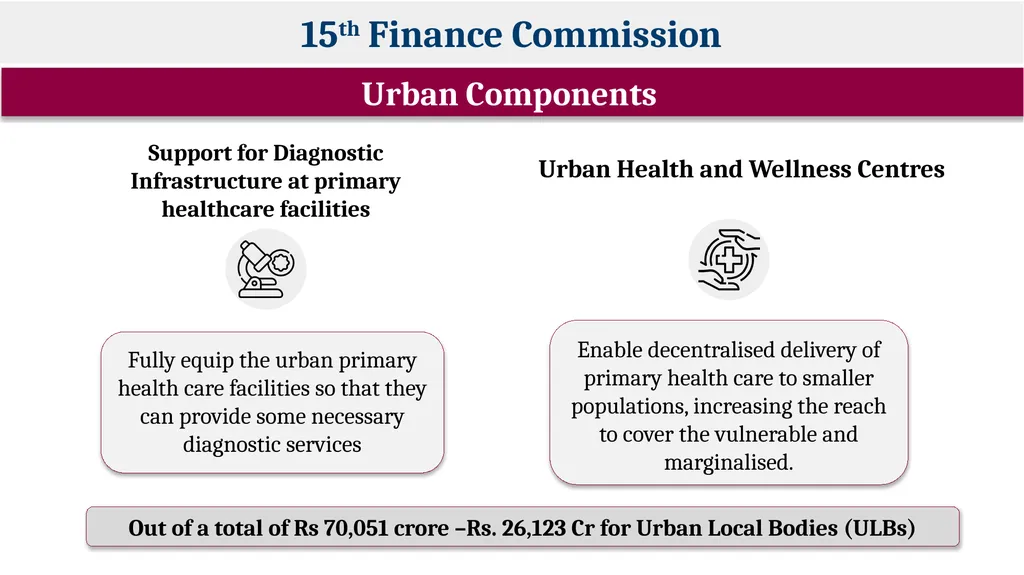
slide6. Urban Components Support for Diagnostic Infrastructure at primary healthcare facilities Urban Health and Wellness Centres Fully equip the urban primary health care facilities so that they can provide some necessary diagnostic services Enable decentralised delivery of primary health care to smaller populations, increasing the reach to cover the vulnerable and marginalised. Out of a total of Rs 70,051 crore –Rs. 26,123 Cr for Urban Local Bodies (ULBs) 15th Finance Commission<br>
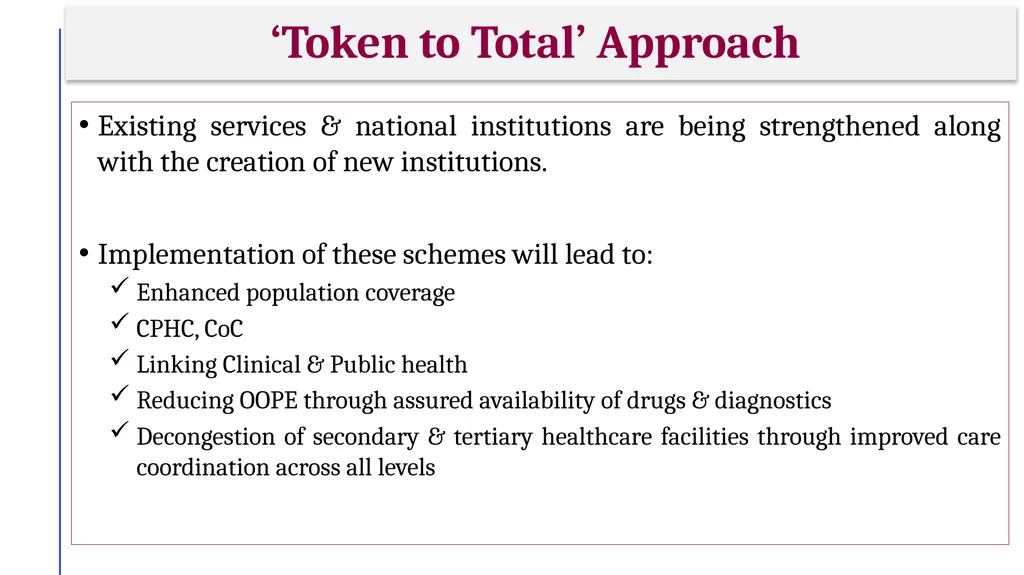
slide7. ‘Token to Total’ Approach Existing services & national institutions are being strengthened along with the creation of new institutions.
Implementation of these schemes will lead to:
Enhanced population coverage
CPHC, CoC
Linking Clinical & Public health
Reducing OOPE through assured availability of drugs & diagnostics
Decongestion of secondary & tertiary healthcare facilities through improved care coordination across all levels<br>
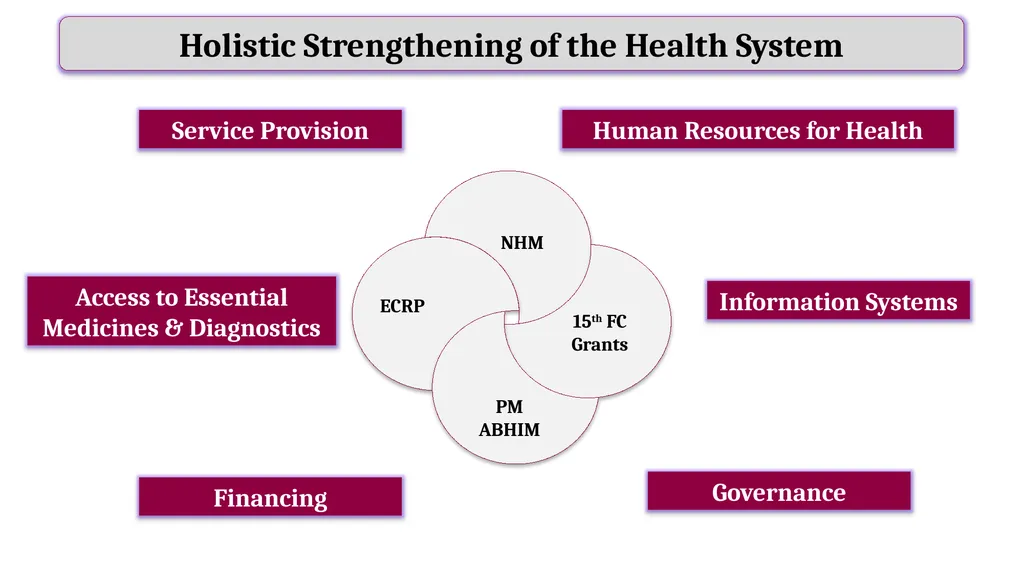
slide8. Financing Service Provision Access to Essential Medicines & Diagnostics Governance Information Systems Human Resources for Health Holistic Strengthening of the Health System ECRP PM ABHIM NHM 15th FC Grants<br>
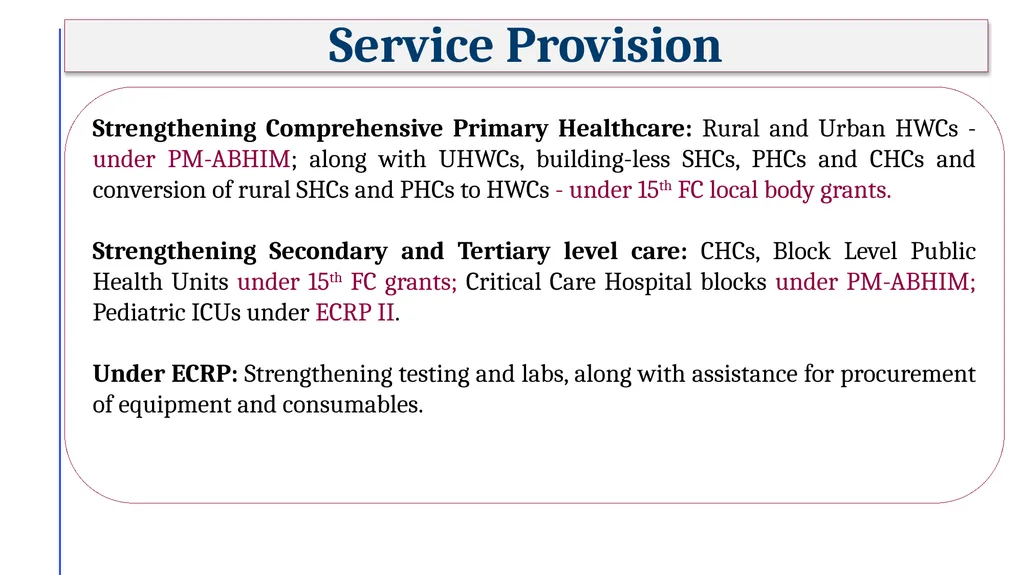
slide9. Service Provision Strengthening Comprehensive Primary Healthcare: Rural and Urban HWCs - under PM-ABHIM; along with UHWCs, building-less SHCs, PHCs and CHCs and conversion of rural SHCs and PHCs to HWCs - under 15th FC local body grants.
Strengthening Secondary and Tertiary level care: CHCs, Block Level Public Health Units under 15th FC grants; Critical Care Hospital blocks under PM-ABHIM; Pediatric ICUs under ECRP II.
Under ECRP: Strengthening testing and labs, along with assistance for procurement of equipment and consumables.<br>
slide10. Service Provision Strengthening Public Health Surveillance, Labs & Linkages:
CS component of PM-ABHIM: 17 new point of entry health units, 15 Health Emergency Operation Centers, 2 Container based mobile hospitals; Regional NCDC, NIV.
Integrated District Public Health Laboratories: Under PM-ABHIM, to serve as the apex of a network to link labs with block, state and regional public health – in all districts.
Block Public Health Units: Under PM-ABHIM and through 15th FC grants, Integrate service delivery, public health action, strengthened lab services for disease surveillance and diagnosis; Hub for health-related reporting<br>
slide11. Governance and Financing PRIs and ULBs will be extensively involved in the implementation of PM-ABHIM and 15th FC health grants.
Strengthening Communitization
To make primary health centers as gatekeepers of the secondary and tertiary level healthcare facilities – Referral Pathways
Continuum of Care<br>
slide12. To understand the unique experiences of each State / UT
To analyze experiences for understanding challenges and roadblocks
To utilize this information towards streamlining the processes (incl timely fund utilization) for envisaged outputs and outcomes
To provide a platform to create continuous, critical engagement of various stakeholders, including state and central government functionaries at all levels, technical institutions, experts, & development partners. OBJECTIVES OF WORKSHOP<br>
slide13. For optimal utilization of funds under PM-ABHIM and 15th FC grants, ensuring extensive involvement of PRIs and ULBs is important – Session on ‘’Communitization by ensuring capacity development of PRIs & ULBs for planning & monitoring’’.
Focus is needed on ‘skills’ and ‘numbers’, while planning for HRH – Session on Comprehensive Planning for HRH: An integrated approach
Context/State specific road blocks and bottle necks during scaling up of initiatives – Session on Scaling of newer initiatives; State priorities, Challenges, Roadmap for implementation. Technical Sessions<br>
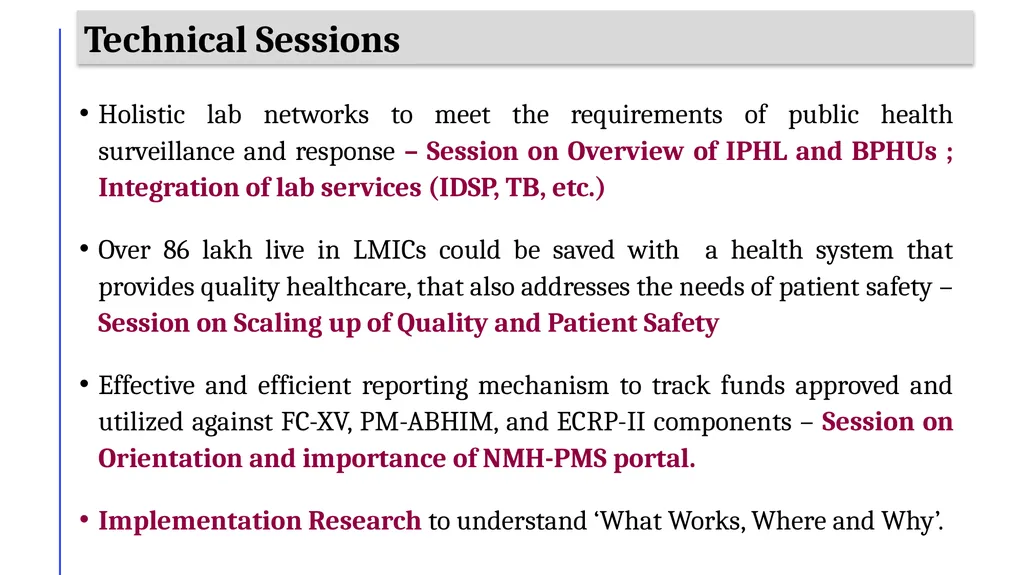
slide14. Holistic lab networks to meet the requirements of public health surveillance and response – Session on Overview of IPHL and BPHUs ; Integration of lab services (IDSP, TB, etc.)
Over 86 lakh live in LMICs could be saved with a health system that provides quality healthcare, that also addresses the needs of patient safety – Session on Scaling up of Quality and Patient Safety
Effective and efficient reporting mechanism to track funds approved and utilized against FC-XV, PM-ABHIM, and ECRP-II components – Session on Orientation and importance of NMH-PMS portal.
Implementation Research to understand ‘What Works, Where and Why’. Technical Sessions<br>
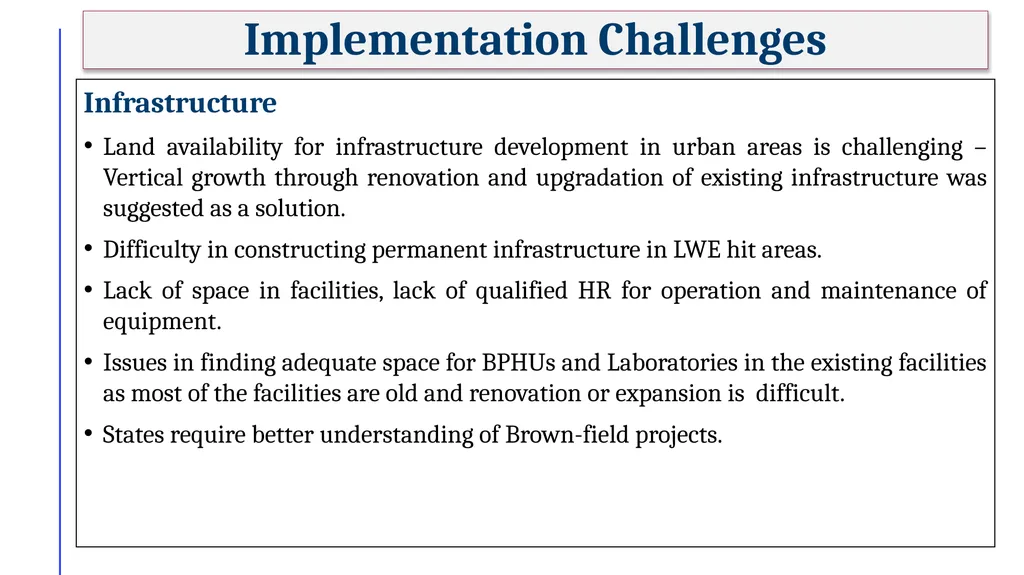
slide15. Implementation Challenges Infrastructure
Land availability for infrastructure development in urban areas is challenging – Vertical growth through renovation and upgradation of existing infrastructure was suggested as a solution.
Difficulty in constructing permanent infrastructure in LWE hit areas.
Lack of space in facilities, lack of qualified HR for operation and maintenance of equipment.
Issues in finding adequate space for BPHUs and Laboratories in the existing facilities as most of the facilities are old and renovation or expansion is difficult.
States require better understanding of Brown-field projects.<br>
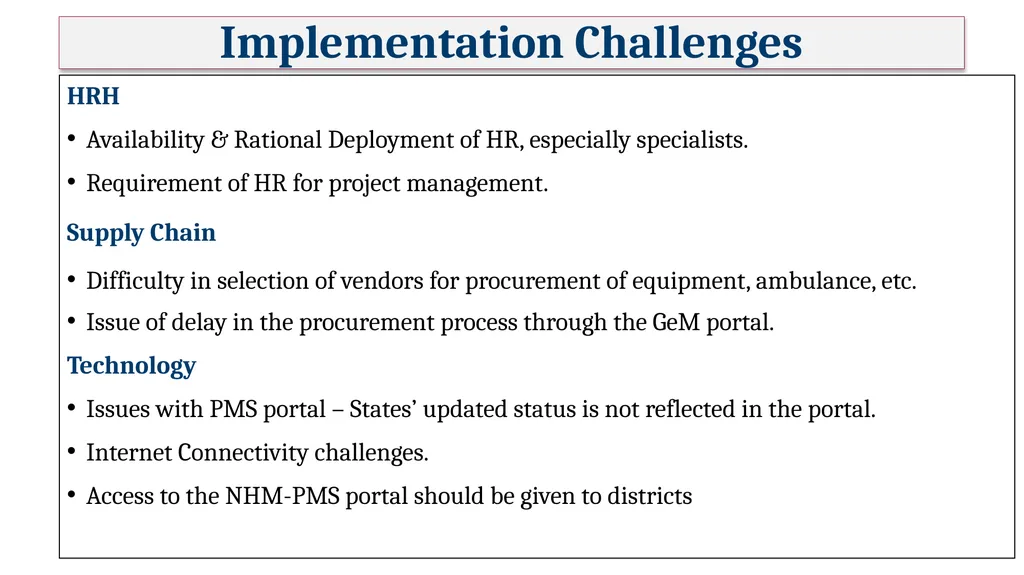
slide16. Implementation Challenges HRH
Availability & Rational Deployment of HR, especially specialists.
Requirement of HR for project management.
Supply Chain
Difficulty in selection of vendors for procurement of equipment, ambulance, etc.
Issue of delay in the procurement process through the GeM portal.
Technology
Issues with PMS portal – States’ updated status is not reflected in the portal.
Internet Connectivity challenges.
Access to the NHM-PMS portal should be given to districts<br>
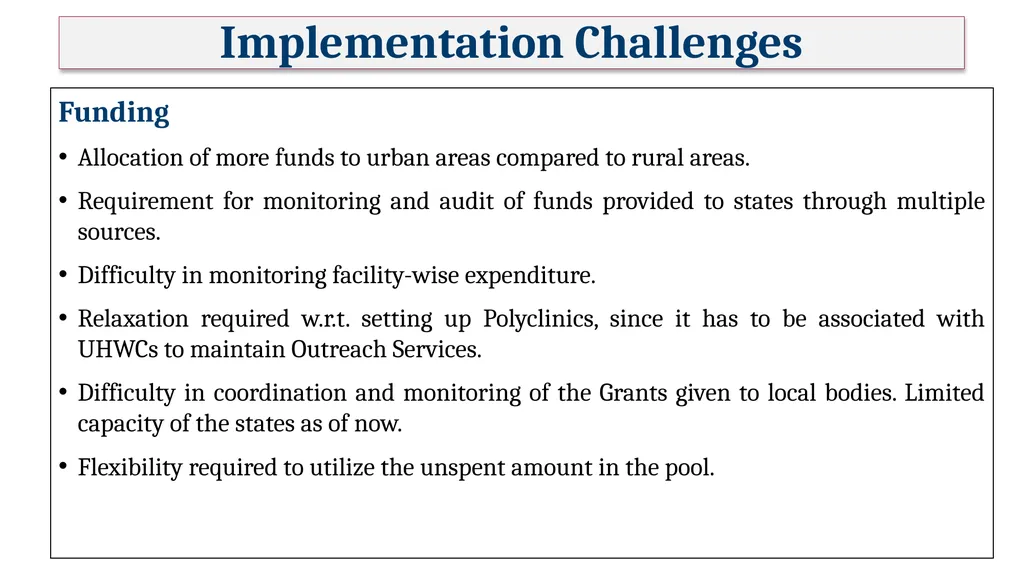
slide17. Implementation Challenges Funding
Allocation of more funds to urban areas compared to rural areas.
Requirement for monitoring and audit of funds provided to states through multiple sources.
Difficulty in monitoring facility-wise expenditure.
Relaxation required w.r.t. setting up Polyclinics, since it has to be associated with UHWCs to maintain Outreach Services.
Difficulty in coordination and monitoring of the Grants given to local bodies. Limited capacity of the states as of now.
Flexibility required to utilize the unspent amount in the pool.<br>
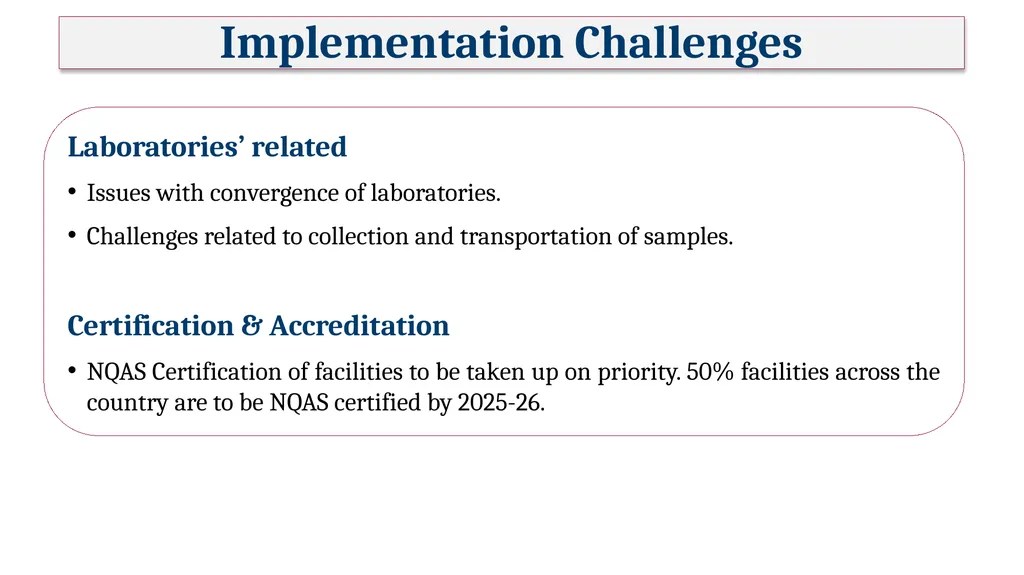
slide18. Implementation Challenges Laboratories’ related
Issues with convergence of laboratories.
Challenges related to collection and transportation of samples.
Certification & Accreditation
NQAS Certification of facilities to be taken up on priority. 50% facilities across the country are to be NQAS certified by 2025-26.<br>
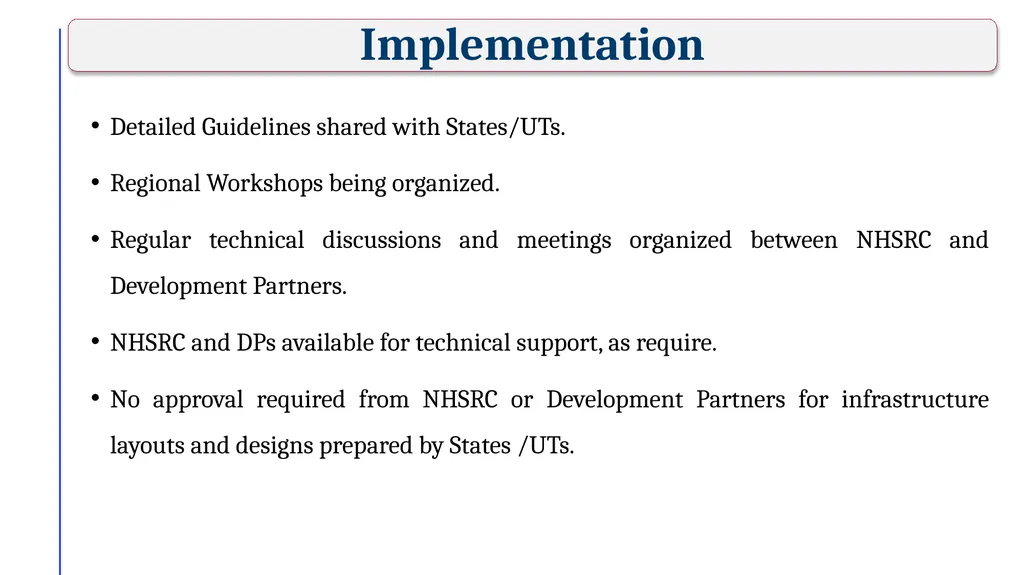
slide19. Detailed Guidelines shared with States/UTs.
Regional Workshops being organized.
Regular technical discussions and meetings organized between NHSRC and Development Partners.
NHSRC and DPs available for technical support, as require.
No approval required from NHSRC or Development Partners for infrastructure layouts and designs prepared by States /UTs. Implementation<br>
slide20. Thank You<br>
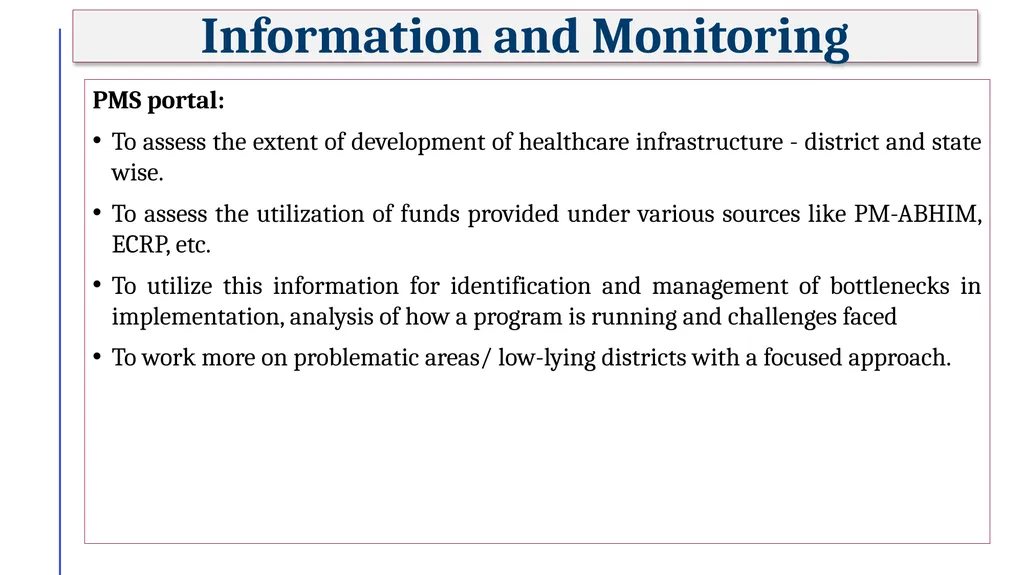
slide22. Information and Monitoring PMS portal:
To assess the extent of development of healthcare infrastructure - district and state wise.
To assess the utilization of funds provided under various sources like PM-ABHIM, ECRP, etc.
To utilize this information for identification and management of bottlenecks in implementation, analysis of how a program is running and challenges faced
To work more on problematic areas/ low-lying districts with a focused approach.<br>
slide23. Suggestions Alternate pathways like ICU nurses and other HR for operationalisation of CCB and IPHL
Mobile HWCs, leveraging existing private clinics in urban area, incentivised volunteers in addition to ASHAs and ANMs due to their limited numbers (Uttar Pradesh)
Creating a common platform to discuss issues and to seek support for newer ideas among the states and/or from the technical units of MoHFW, GoI (Meghalaya)<br>
slide24. Suggestions Flexibility in unit cost norms as the price for raw materials are dynamic. Suggestion was to provide incremental increase in unit cost for each component annually. (Bihar)
Providing administrative and operational costs to states for implementation of 15th FC and PM-ABHIM (Bihar)
Taking technical support from development partners for implementation and monitoring of the scheme (Jharkhand)<br>
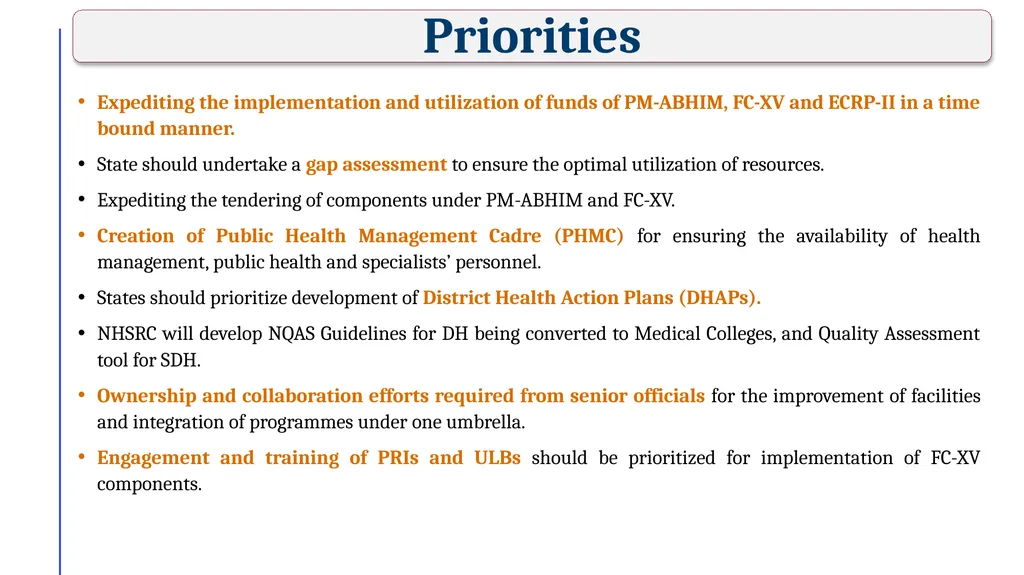
slide25. Expediting the implementation and utilization of funds of PM-ABHIM, FC-XV and ECRP-II in a time bound manner.
State should undertake a gap assessment to ensure the optimal utilization of resources.
Expediting the tendering of components under PM-ABHIM and FC-XV.
Creation of Public Health Management Cadre (PHMC) for ensuring the availability of health management, public health and specialists’ personnel.
States should prioritize development of District Health Action Plans (DHAPs).
NHSRC will develop NQAS Guidelines for DH being converted to Medical Colleges, and Quality Assessment tool for SDH.
Ownership and collaboration efforts required from senior officials for the improvement of facilities and integration of programmes under one umbrella.
Engagement and training of PRIs and ULBs should be prioritized for implementation of FC-XV components. Priorities<br>
MBBS, MD (PSM), PDF (Epidemiology), FRCP Edin, FAMS, FIPHA, FIAPSM
Executive Director, NHSRC, MoHFW, Government of India (GoI)<br>
slide2. Pradhan Mantri Ayushman Bharat - Health Infrastructure Mission (PM-ABHIM) PM-ABHIM launched by the Hon’ble Prime Minister on 25th October, 2021 Largest pan-India scheme since 2005 for creation & improvement of long-term Public Healthcare Infrastructure. Total outlay of Rs 64,180 crore from FY 2021-22 till FY 2025-26.<br>
slide3. PM-ABHIM : Objectives<br>
slide4. While making district wise allocations, State has to factor-in :
Urban and rural population of the district;
Preferential allocation is to be made to Aspirational / Tribal / Left Wing Extremism (LWE) affected areas / Remote / Hilly districts. Rs. 70,051 crores for local governments, split into urban and rural components: 15th Finance Commission The funds under the 15th FC health grants should not be used by the State as the State’s contribution for any CSS component or for any other mandate, apart from the components listed for the utilization of the health grants under 15th FC.<br>
slide5. Rural Components Building-less SHCs, PHCs and CHCs Block Public Health Units Integrate service delivery, public health action, strengthened lab services for disease surveillance and diagnosis; Hub for health-related reporting Support for Diagnostic Infrastructure at primary healthcare facilities Conversion of rural PHCs and SHCs to HWCs To address infrastructure gaps in Rural areas Fully equip the rural primary healthcare facilities to provide necessary diagnostic services Convert existing primary healthcare facilities i.e. SHCs & PHCs into HWCs Out of a total of Rs 70,051 crore – Rs 43,928 Crore for 28 states through Rural Local Bodies (RLBs) 15th Finance Commission<br>
slide6. Urban Components Support for Diagnostic Infrastructure at primary healthcare facilities Urban Health and Wellness Centres Fully equip the urban primary health care facilities so that they can provide some necessary diagnostic services Enable decentralised delivery of primary health care to smaller populations, increasing the reach to cover the vulnerable and marginalised. Out of a total of Rs 70,051 crore –Rs. 26,123 Cr for Urban Local Bodies (ULBs) 15th Finance Commission<br>
slide7. ‘Token to Total’ Approach Existing services & national institutions are being strengthened along with the creation of new institutions.
Implementation of these schemes will lead to:
Enhanced population coverage
CPHC, CoC
Linking Clinical & Public health
Reducing OOPE through assured availability of drugs & diagnostics
Decongestion of secondary & tertiary healthcare facilities through improved care coordination across all levels<br>
slide8. Financing Service Provision Access to Essential Medicines & Diagnostics Governance Information Systems Human Resources for Health Holistic Strengthening of the Health System ECRP PM ABHIM NHM 15th FC Grants<br>
slide9. Service Provision Strengthening Comprehensive Primary Healthcare: Rural and Urban HWCs - under PM-ABHIM; along with UHWCs, building-less SHCs, PHCs and CHCs and conversion of rural SHCs and PHCs to HWCs - under 15th FC local body grants.
Strengthening Secondary and Tertiary level care: CHCs, Block Level Public Health Units under 15th FC grants; Critical Care Hospital blocks under PM-ABHIM; Pediatric ICUs under ECRP II.
Under ECRP: Strengthening testing and labs, along with assistance for procurement of equipment and consumables.<br>
slide10. Service Provision Strengthening Public Health Surveillance, Labs & Linkages:
CS component of PM-ABHIM: 17 new point of entry health units, 15 Health Emergency Operation Centers, 2 Container based mobile hospitals; Regional NCDC, NIV.
Integrated District Public Health Laboratories: Under PM-ABHIM, to serve as the apex of a network to link labs with block, state and regional public health – in all districts.
Block Public Health Units: Under PM-ABHIM and through 15th FC grants, Integrate service delivery, public health action, strengthened lab services for disease surveillance and diagnosis; Hub for health-related reporting<br>
slide11. Governance and Financing PRIs and ULBs will be extensively involved in the implementation of PM-ABHIM and 15th FC health grants.
Strengthening Communitization
To make primary health centers as gatekeepers of the secondary and tertiary level healthcare facilities – Referral Pathways
Continuum of Care<br>
slide12. To understand the unique experiences of each State / UT
To analyze experiences for understanding challenges and roadblocks
To utilize this information towards streamlining the processes (incl timely fund utilization) for envisaged outputs and outcomes
To provide a platform to create continuous, critical engagement of various stakeholders, including state and central government functionaries at all levels, technical institutions, experts, & development partners. OBJECTIVES OF WORKSHOP<br>
slide13. For optimal utilization of funds under PM-ABHIM and 15th FC grants, ensuring extensive involvement of PRIs and ULBs is important – Session on ‘’Communitization by ensuring capacity development of PRIs & ULBs for planning & monitoring’’.
Focus is needed on ‘skills’ and ‘numbers’, while planning for HRH – Session on Comprehensive Planning for HRH: An integrated approach
Context/State specific road blocks and bottle necks during scaling up of initiatives – Session on Scaling of newer initiatives; State priorities, Challenges, Roadmap for implementation. Technical Sessions<br>
slide14. Holistic lab networks to meet the requirements of public health surveillance and response – Session on Overview of IPHL and BPHUs ; Integration of lab services (IDSP, TB, etc.)
Over 86 lakh live in LMICs could be saved with a health system that provides quality healthcare, that also addresses the needs of patient safety – Session on Scaling up of Quality and Patient Safety
Effective and efficient reporting mechanism to track funds approved and utilized against FC-XV, PM-ABHIM, and ECRP-II components – Session on Orientation and importance of NMH-PMS portal.
Implementation Research to understand ‘What Works, Where and Why’. Technical Sessions<br>
slide15. Implementation Challenges Infrastructure
Land availability for infrastructure development in urban areas is challenging – Vertical growth through renovation and upgradation of existing infrastructure was suggested as a solution.
Difficulty in constructing permanent infrastructure in LWE hit areas.
Lack of space in facilities, lack of qualified HR for operation and maintenance of equipment.
Issues in finding adequate space for BPHUs and Laboratories in the existing facilities as most of the facilities are old and renovation or expansion is difficult.
States require better understanding of Brown-field projects.<br>
slide16. Implementation Challenges HRH
Availability & Rational Deployment of HR, especially specialists.
Requirement of HR for project management.
Supply Chain
Difficulty in selection of vendors for procurement of equipment, ambulance, etc.
Issue of delay in the procurement process through the GeM portal.
Technology
Issues with PMS portal – States’ updated status is not reflected in the portal.
Internet Connectivity challenges.
Access to the NHM-PMS portal should be given to districts<br>
slide17. Implementation Challenges Funding
Allocation of more funds to urban areas compared to rural areas.
Requirement for monitoring and audit of funds provided to states through multiple sources.
Difficulty in monitoring facility-wise expenditure.
Relaxation required w.r.t. setting up Polyclinics, since it has to be associated with UHWCs to maintain Outreach Services.
Difficulty in coordination and monitoring of the Grants given to local bodies. Limited capacity of the states as of now.
Flexibility required to utilize the unspent amount in the pool.<br>
slide18. Implementation Challenges Laboratories’ related
Issues with convergence of laboratories.
Challenges related to collection and transportation of samples.
Certification & Accreditation
NQAS Certification of facilities to be taken up on priority. 50% facilities across the country are to be NQAS certified by 2025-26.<br>
slide19. Detailed Guidelines shared with States/UTs.
Regional Workshops being organized.
Regular technical discussions and meetings organized between NHSRC and Development Partners.
NHSRC and DPs available for technical support, as require.
No approval required from NHSRC or Development Partners for infrastructure layouts and designs prepared by States /UTs. Implementation<br>
slide20. Thank You<br>
slide22. Information and Monitoring PMS portal:
To assess the extent of development of healthcare infrastructure - district and state wise.
To assess the utilization of funds provided under various sources like PM-ABHIM, ECRP, etc.
To utilize this information for identification and management of bottlenecks in implementation, analysis of how a program is running and challenges faced
To work more on problematic areas/ low-lying districts with a focused approach.<br>
slide23. Suggestions Alternate pathways like ICU nurses and other HR for operationalisation of CCB and IPHL
Mobile HWCs, leveraging existing private clinics in urban area, incentivised volunteers in addition to ASHAs and ANMs due to their limited numbers (Uttar Pradesh)
Creating a common platform to discuss issues and to seek support for newer ideas among the states and/or from the technical units of MoHFW, GoI (Meghalaya)<br>
slide24. Suggestions Flexibility in unit cost norms as the price for raw materials are dynamic. Suggestion was to provide incremental increase in unit cost for each component annually. (Bihar)
Providing administrative and operational costs to states for implementation of 15th FC and PM-ABHIM (Bihar)
Taking technical support from development partners for implementation and monitoring of the scheme (Jharkhand)<br>
slide25. Expediting the implementation and utilization of funds of PM-ABHIM, FC-XV and ECRP-II in a time bound manner.
State should undertake a gap assessment to ensure the optimal utilization of resources.
Expediting the tendering of components under PM-ABHIM and FC-XV.
Creation of Public Health Management Cadre (PHMC) for ensuring the availability of health management, public health and specialists’ personnel.
States should prioritize development of District Health Action Plans (DHAPs).
NHSRC will develop NQAS Guidelines for DH being converted to Medical Colleges, and Quality Assessment tool for SDH.
Ownership and collaboration efforts required from senior officials for the improvement of facilities and integration of programmes under one umbrella.
Engagement and training of PRIs and ULBs should be prioritized for implementation of FC-XV components. Priorities<br>