
Regional Course on Statistical Business Registers
MY
Published · 22 slides · 0 views

1 / 1



Description
Regional Course on Statistical Business Registers Section 1: Introduction to the UNCEBTS UN Committee of Experts on Business and Trade Statistics (UNCEBTS) In 2017, the UN Statistical Commission requested the creation of a committee of
Related Topics
Share
Embed code
Download this presentation From Below
"Regional Course on Statistical Business Registers" is the property of its rightful owner. Permission is granted to download and print the materials on this website for personal, non-commercial use only, and to display it on your personal computer provided you do not modify the materials and that you retain all copyright notices contained in the materials. By downloading content from our website, you accept the terms of this agreement.
Presentation Transcript
01
Regional Course on
Statistical Business Registers Section 1: Introduction to the UNCEBTS<br>
02
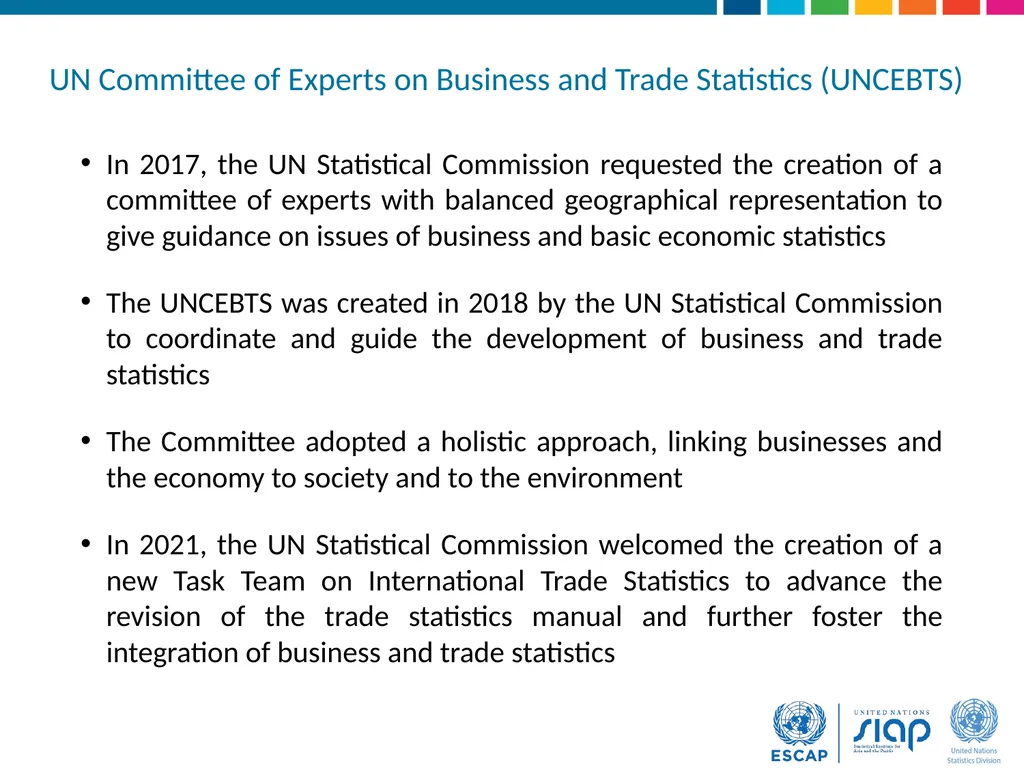
UN Committee of Experts on Business and Trade Statistics (UNCEBTS) In 2017, the UN Statistical Commission requested the creation of a committee of experts with balanced geographical representation to give guidance on issues of business and basic economic statistics
The UNCEBTS was created in 2018 by the UN Statistical Commission to coordinate and guide the development of business and trade statistics
The Committee adopted a holistic approach, linking businesses and the economy to society and to the environment
In 2021, the UN Statistical Commission welcomed the creation of a new Task Team on International Trade Statistics to advance the revision of the trade statistics manual and further foster the integration of business and trade statistics<br>
The UNCEBTS was created in 2018 by the UN Statistical Commission to coordinate and guide the development of business and trade statistics
The Committee adopted a holistic approach, linking businesses and the economy to society and to the environment
In 2021, the UN Statistical Commission welcomed the creation of a new Task Team on International Trade Statistics to advance the revision of the trade statistics manual and further foster the integration of business and trade statistics<br>
03
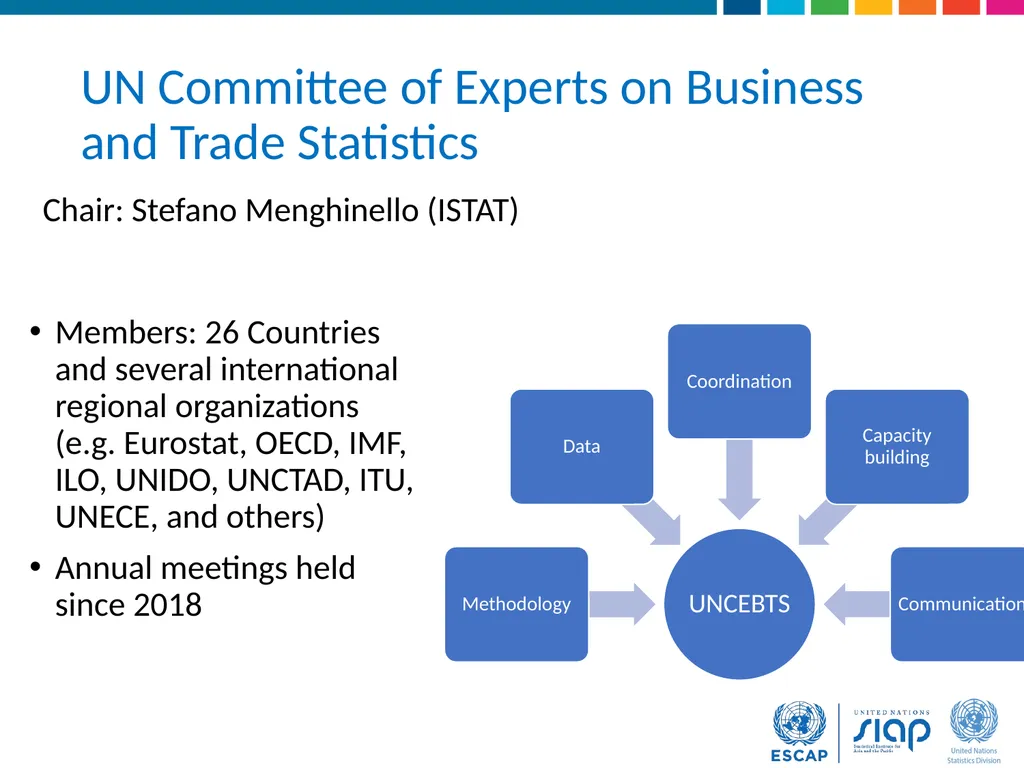
UN Committee of Experts on Business and Trade Statistics Chair: Stefano Menghinello (ISTAT) Members: 26 Countries and several international regional organizations (e.g. Eurostat, OECD, IMF, ILO, UNIDO, UNCTAD, ITU, UNECE, and others)
Annual meetings held since 2018<br>
Annual meetings held since 2018<br>
04
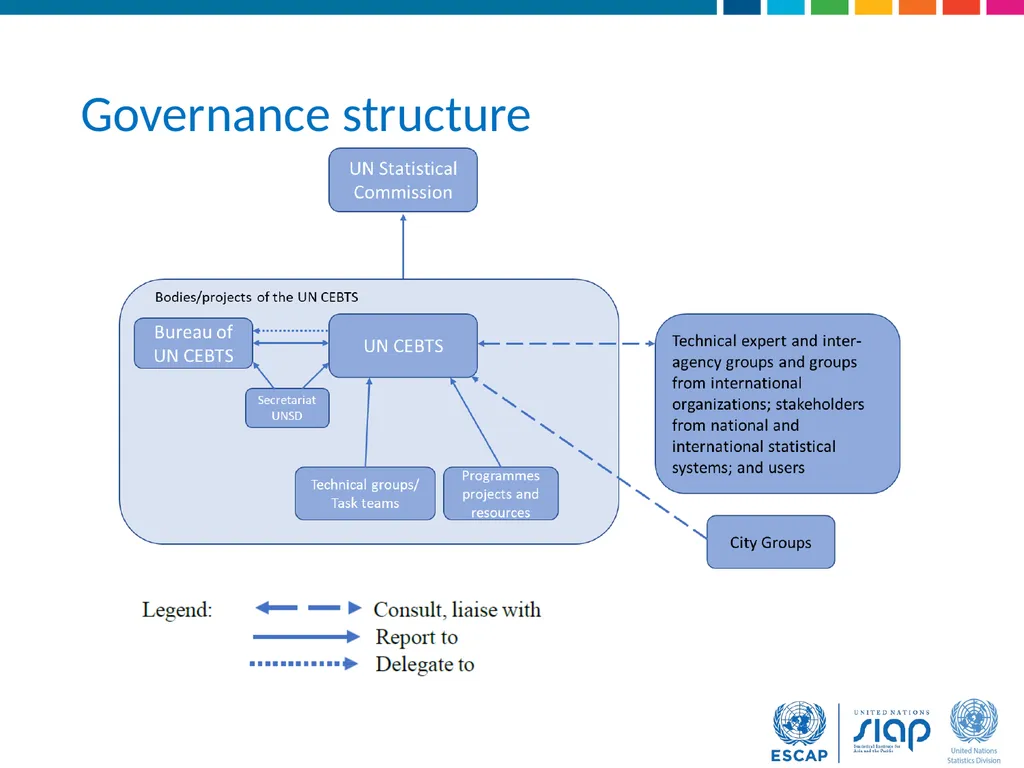
Governance structure<br>
05
Strategic View on Business and Trade Statistics Main elements of the strategic view:
Broadening the scope of official business and trade statistics
Identification of shared priorities to advance with a faster pace
The adoption of an enterprise-centered approach for official business statistics
The SBR as the core of the new data production framework for economic statistics
Promote the integration of business and trade statistics<br>
Broadening the scope of official business and trade statistics
Identification of shared priorities to advance with a faster pace
The adoption of an enterprise-centered approach for official business statistics
The SBR as the core of the new data production framework for economic statistics
Promote the integration of business and trade statistics<br>
06
Output of the Committee in the last few years Oversaw the preparation of the UN Guidelines on Statistical Business Registers (2020)
Developed a strategic view on business statistics (2020)
Prepared the Manual on Principal indicators for business and trade statistics
Prepared the Manual on the Maturity Model for Statistical Business Registers
Oversaw the development of a SIAP-ADB-UNSD e-learning foundational course on SBRs<br>
Developed a strategic view on business statistics (2020)
Prepared the Manual on Principal indicators for business and trade statistics
Prepared the Manual on the Maturity Model for Statistical Business Registers
Oversaw the development of a SIAP-ADB-UNSD e-learning foundational course on SBRs<br>
07
UNCEBTS Task Teams Five task team were created:
Globalization and digitalization
Business dynamics, Business demography and entrepreneurship
Statistical business registers
Exhaustive business registers
Capacity building on statistical business registers
Well-being and sustainability
International trade statistics
They developed annual plan to improve and strengthen business and related trade statistics<br>
Globalization and digitalization
Business dynamics, Business demography and entrepreneurship
Statistical business registers
Exhaustive business registers
Capacity building on statistical business registers
Well-being and sustainability
International trade statistics
They developed annual plan to improve and strengthen business and related trade statistics<br>
08
Develop guidance for business statistics on globalization and digitalization related to the structure, activities and performance of businesses
Identify information gaps based on a review of ongoing statistical initiatives in economic statistics
Identify a set of core indicators on globalization and digitalisation
Conduct joint global assessment on the status of implementation of business statistics on globalization and digitalisation Task Team on globalization and digitalization<br>
Identify information gaps based on a review of ongoing statistical initiatives in economic statistics
Identify a set of core indicators on globalization and digitalisation
Conduct joint global assessment on the status of implementation of business statistics on globalization and digitalisation Task Team on globalization and digitalization<br>
09
HIGHLIGHTS OF THE PROPOSED WORKPLAN Complement and build on current work to record current work to record current best practices from NSOs in terms of data sources and data collection methods and approaches for measuring e-commerce. Action 1 Results Provide practical advice and potential methodological guidance to portray e-commerce and its impacts efficiently and accurately without simply adding more indicators by building off complementary work by UNCTAD and the OECD. Deliverable Provide recommendations on best practices and future areas of study with respect to new data sources and methods for measuring e-commerce to serve as an input and complement to UNCTAD’s Working Group on Measurement of E-commerce<br>
10
HIGHLIGHTS OF THE PROPOSED WORKPLAN (CONT’D) Understanding the structure of large multinational enterprise (MNE) groups and their impact on globalization and digitalization statistics. Action 2 Results A phased approach to identify emerging business models, data gaps created, core challenges for National Statistics Office (NSOs) addressing this issue, and how to link with Statistical Business Registers (SBRS). Deliverable A presentation that outlines the findings of the review and potential next steps
Develop a set of recommendations on the feasibility of a global network of LCUs. This should be done in a coordinated manner with the TT-SBR<br>
Develop a set of recommendations on the feasibility of a global network of LCUs. This should be done in a coordinated manner with the TT-SBR<br>
11
HIGHLIGHTS OF THE PROPOSED WORKPLAN (CONT’D) Measurement of adoption and investment in automation technology such as the use of Artificial Intelligence (AI), robotics and their contribution to firm performance. Action 3 Results Outline the landscape of work to date and identify ongoing work;
Identify measurement practices and data gaps;
Highlight challenges to measurement of adoption and investment in automation technologies. Deliverable A summary document on the current practices in place to measure the automation processes of firms and potential best practices that have been employed
Potential development of new business statistics indicators to better measure artificial intelligence, automation, and its utilisation<br>
Identify measurement practices and data gaps;
Highlight challenges to measurement of adoption and investment in automation technologies. Deliverable A summary document on the current practices in place to measure the automation processes of firms and potential best practices that have been employed
Potential development of new business statistics indicators to better measure artificial intelligence, automation, and its utilisation<br>
12
Task Team on Statistical Business Registers Develop guidance for the Statistical Business Registers to be inclusive and exhaustive in a rapidly changing economy and tailored to statistical production
Provide guidance on business statistics obtained from statistical business registers
Provide advice on development and maintenance of a Global Enterprise Group Register (GGR)<br>
Provide guidance on business statistics obtained from statistical business registers
Provide advice on development and maintenance of a Global Enterprise Group Register (GGR)<br>
13
13 Preparing a report on the Integration of Geospatial Information in the SBR together with the Expert Group on the Integration of Geospatial and Statistical Information
Ongoing development of the toolkit and website to support the Maturity Model for SBRs
Review of the outcome of the global assessment on SBR
Discussion on implementation issues in SBR with ISIC and NACE
Follow up to global initiative on unique identifiers for businesses Current areas of work<br>
Ongoing development of the toolkit and website to support the Maturity Model for SBRs
Review of the outcome of the global assessment on SBR
Discussion on implementation issues in SBR with ISIC and NACE
Follow up to global initiative on unique identifiers for businesses Current areas of work<br>
14
Other areas of work identified by the TT-SBR for a later stage include the following:
Use of statistical units or institutional units
Micro-data linking and SBR
Guidance on protecting confidentiality when sharing MNE data
Explore the use of Big Data and other alternative sources for SBR 14 Other areas of work<br>
Use of statistical units or institutional units
Micro-data linking and SBR
Guidance on protecting confidentiality when sharing MNE data
Explore the use of Big Data and other alternative sources for SBR 14 Other areas of work<br>
15
Capacity Building Develop a maturity model for Statistical Business Registers (SBRs)
Conduct a global assessment on the status of implementation of SBRs in countries
Prepare an inventory of available tools (IT tools, training material, e-learning, etc.) and make them more widely accessible through the UN website and dedicated e-learning platform
Tailor tools to specific levels of maturity of SBRs in countries<br>
Conduct a global assessment on the status of implementation of SBRs in countries
Prepare an inventory of available tools (IT tools, training material, e-learning, etc.) and make them more widely accessible through the UN website and dedicated e-learning platform
Tailor tools to specific levels of maturity of SBRs in countries<br>
16
Task Team on Business dynamics, Demography and entrepreneurships Review statistical guidance and country practices on business dynamics, business demography and entrepreneurship
Develop supplementary guidance on core set of business statistics for business dynamics, business demography and entrepreneurship
Conduct joint global assessment on the status of implementation of business statistics on business dynamics, business demography and entrepreneurship<br>
Develop supplementary guidance on core set of business statistics for business dynamics, business demography and entrepreneurship
Conduct joint global assessment on the status of implementation of business statistics on business dynamics, business demography and entrepreneurship<br>
17
Work on gender (the development of a document on how to integrate gender aspects in relevant business and trade statistics and continuing the discussions with countries and international organizations about business and gender statistics)
Work on entrepreneurship (identifying additional characteristics on entrepreneurship in businesses by a dedicated surveys)
Creating a repository with country experiences to measure entrepreneurship
Identifying the policy questions about the contribution of enterprises to the economy and the required data sources 17 Work programme 2023-24<br>
Work on entrepreneurship (identifying additional characteristics on entrepreneurship in businesses by a dedicated surveys)
Creating a repository with country experiences to measure entrepreneurship
Identifying the policy questions about the contribution of enterprises to the economy and the required data sources 17 Work programme 2023-24<br>
18
Task Team on Well-being and sustainability Develop guidance for business indicators on well-being and sustainability, including social entrepreneurship, “decent work”, environmental impact, and Sustainable Development Goals
Focus on corporate sustainability, quality of jobs and environmental impact
Conduct joint global assessment on the status of implementation of business statistics on well-being and sustainability<br>
Focus on corporate sustainability, quality of jobs and environmental impact
Conduct joint global assessment on the status of implementation of business statistics on well-being and sustainability<br>
19
Activities in 2023 Together with SIAP, UNSD and TT members, three webinars were planned and delivered where WBS indicators cf. CEBTS’ handbook were explained and ‘country practice’ was presented.
The 1st webinar (26 April) introduced the relevance and importance of measuring the impact of businesses on WBS, the rationale and purpose of the suggested indicators, their link to the SDGs indicators and the role of non-financial reporting in producing these indicators.
The 2nd (31 May) focused on the compilation of business statistics indicators related to selected aspects of environmental sustainability (water, energy, emission etc.), cf. the reference list.
The 3rd (13 Sept.) focused on compiling indicators of business performance related to selected social aspects of WBS, e.g. gender, employment, productivity etc.
The webinars were well attended with a majority from developing countries in Asia and the Pacific, but also countries from other parts of the world as well as from international organisations attended.
The webinars were recorded: See SIAP’s website.
Big thanks to all contributors, attendants, UNSD and SIAP!<br>
The 1st webinar (26 April) introduced the relevance and importance of measuring the impact of businesses on WBS, the rationale and purpose of the suggested indicators, their link to the SDGs indicators and the role of non-financial reporting in producing these indicators.
The 2nd (31 May) focused on the compilation of business statistics indicators related to selected aspects of environmental sustainability (water, energy, emission etc.), cf. the reference list.
The 3rd (13 Sept.) focused on compiling indicators of business performance related to selected social aspects of WBS, e.g. gender, employment, productivity etc.
The webinars were well attended with a majority from developing countries in Asia and the Pacific, but also countries from other parts of the world as well as from international organisations attended.
The webinars were recorded: See SIAP’s website.
Big thanks to all contributors, attendants, UNSD and SIAP!<br>
20
Task team on International Trade Statistics Revision of trade statistics manuals (IMTS and MSITS)
Took stock of revisions to SNA and BPM and reviewed their impacts
Drafting various guidance notes based on the list of defined research topics (through global consultation)
Prepared and consulted the outlines
Drafting the handbook on integrating business and trade statistics
Drafting the 2nd volume of Manual on Principal Indicators on Business and Trade Statistics
Contributing to Gender mainstreaming in Business and Trade Statistics with IAEG-GS
Development of the trade data tools<br>
Took stock of revisions to SNA and BPM and reviewed their impacts
Drafting various guidance notes based on the list of defined research topics (through global consultation)
Prepared and consulted the outlines
Drafting the handbook on integrating business and trade statistics
Drafting the 2nd volume of Manual on Principal Indicators on Business and Trade Statistics
Contributing to Gender mainstreaming in Business and Trade Statistics with IAEG-GS
Development of the trade data tools<br>
21
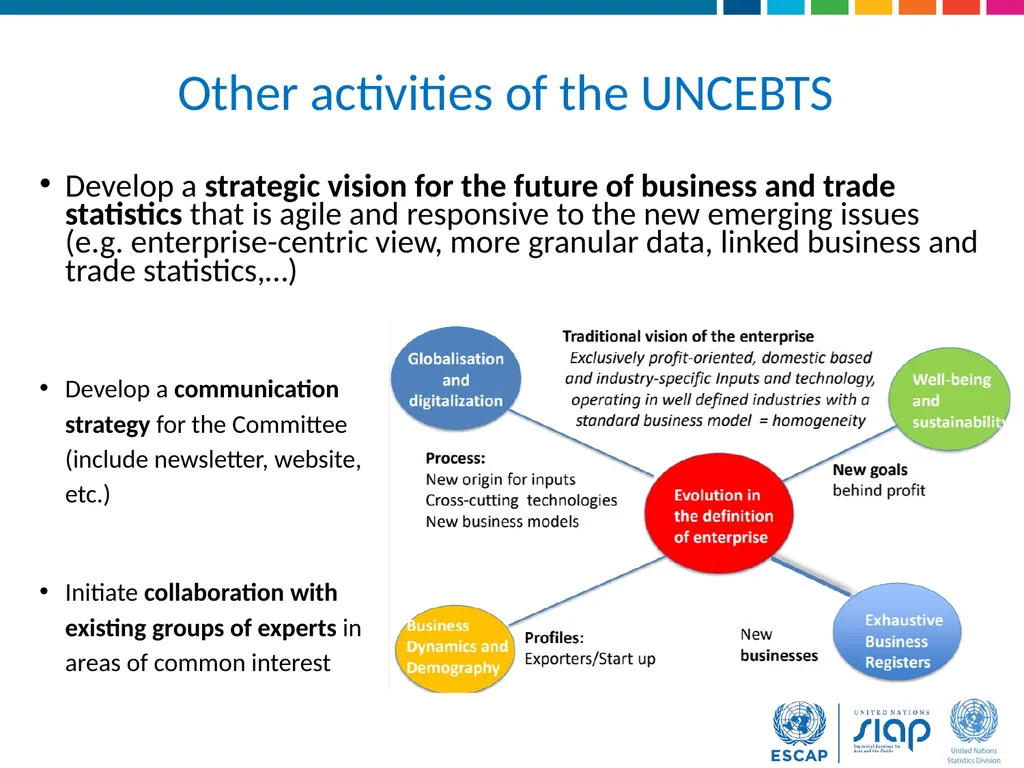
Other activities of the UNCEBTS Develop a communication strategy for the Committee (include newsletter, website, etc.)
Initiate collaboration with existing groups of experts in areas of common interest Develop a strategic vision for the future of business and trade statistics that is agile and responsive to the new emerging issues (e.g. enterprise-centric view, more granular data, linked business and trade statistics,…)<br>
Initiate collaboration with existing groups of experts in areas of common interest Develop a strategic vision for the future of business and trade statistics that is agile and responsive to the new emerging issues (e.g. enterprise-centric view, more granular data, linked business and trade statistics,…)<br>
22
Open discussion What is the relationship between and the other areas of business statistics?
Could you share if your work on the statistical business registers support the following work area in your office?
Globalization and digitalization
Sustainability and well-being
Business dynamics, demographics and entrepreneurship
International trade statistics<br>
Could you share if your work on the statistical business registers support the following work area in your office?
Globalization and digitalization
Sustainability and well-being
Business dynamics, demographics and entrepreneurship
International trade statistics<br>