Regular Expressions CSE 311 Autumn 2025 Lecture 22 Part 3 of the course! Course Outline Symbolic Logic (training wheels) Just make arguments in mechanical ways. Set TheoryNumber Theory (bike in your backyard) Models of computation (biking
"Regular Expressions CSE 311 Autumn 2025 Lecture 22" is the property of its rightful owner. Permission is granted to
download and print the materials on this website for personal, non-commercial use only, and to display it
on your personal computer provided you do not modify the materials and that you retain all copyright
notices contained in the materials. By downloading content from our website, you accept the terms of this
agreement.
Course Outline Symbolic Logic (training wheels)
Just make arguments in mechanical ways.
Set Theory/Number Theory (bike in your backyard)
Models of computation (biking in your neighborhood)
Still make and communicate rigorous arguments
But now with objects you haven’t used before.
A first taste of how we can argue rigorously about computers.
First: regular expressions and context free grammars – understand these “simpler computers”
Soon: what these simple computers can do Then: what simple computers can’t do.
Last week: A problem our computers cannot solve.<br>
04
The next two weeks What are we learning?
Today/Friday: some theory that’s useful for computer scientists
The topics for this weeks are key parts of building compilers, we’ll use that as motivation—no details on compilers, but hopefully enough that you’ll find it interesting.
They ALSO can be thought of as “underpowered computers.”
We’ll use them to build up to proving what computers can and can’t do.
Next week: Tiny computers! (what can they do/what can’t they do?)<br>
05
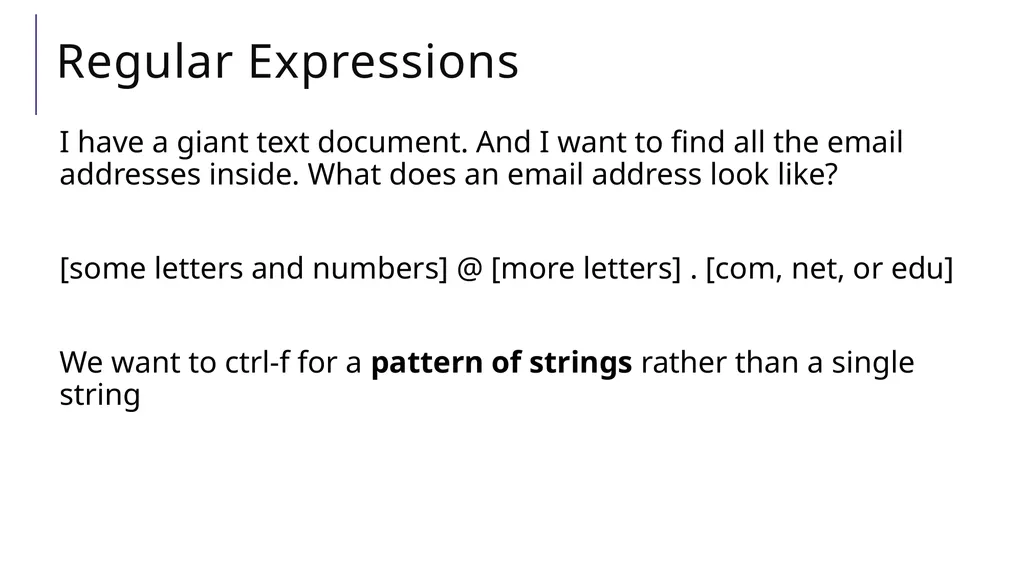
Regular Expressions I have a giant text document. And I want to find all the email addresses inside. What does an email address look like?
[some letters and numbers] @ [more letters] . [com, net, or edu]
We want to ctrl-f for a pattern of strings rather than a single string<br>
06
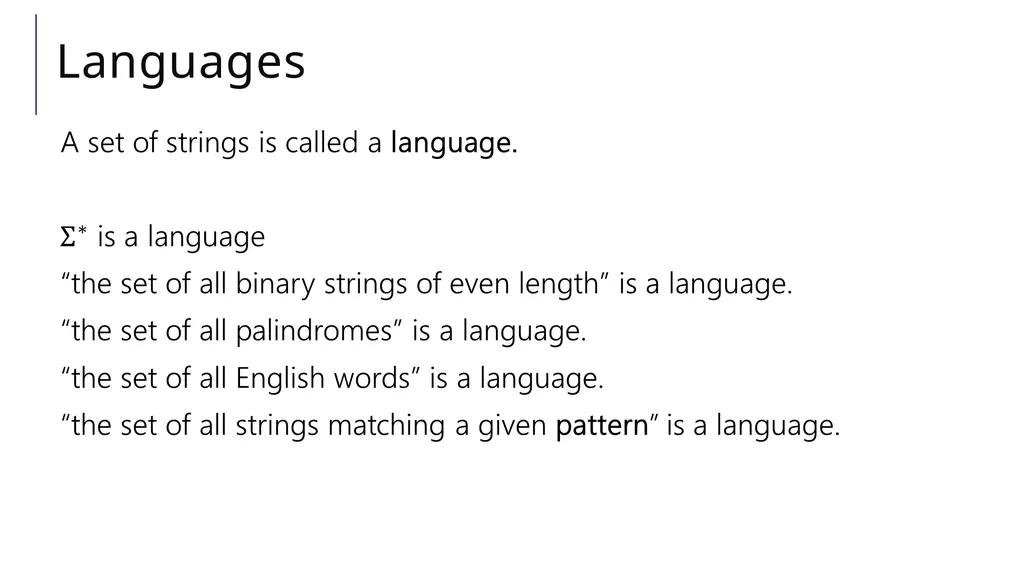
Languages<br>
07
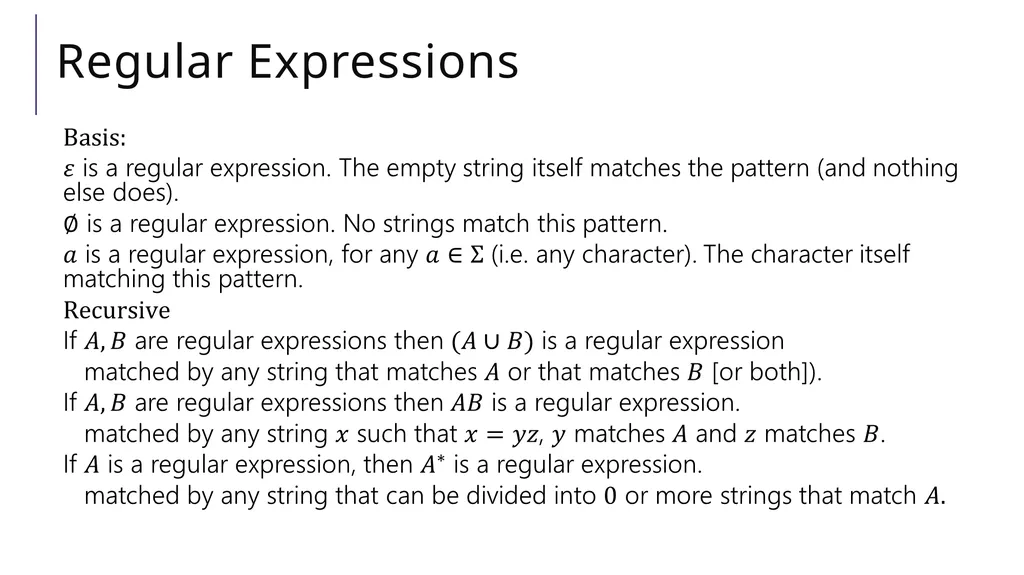
Regular Expressions<br>
08
Regular Expressions<br>
09
Regular Expressions<br>
10
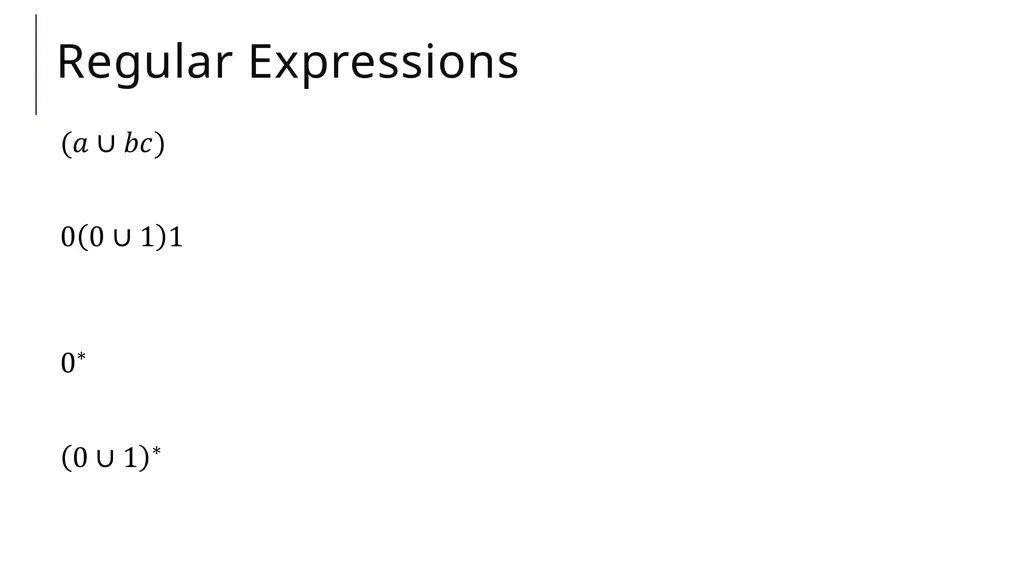
More Examples<br>
11
More Examples<br>
12
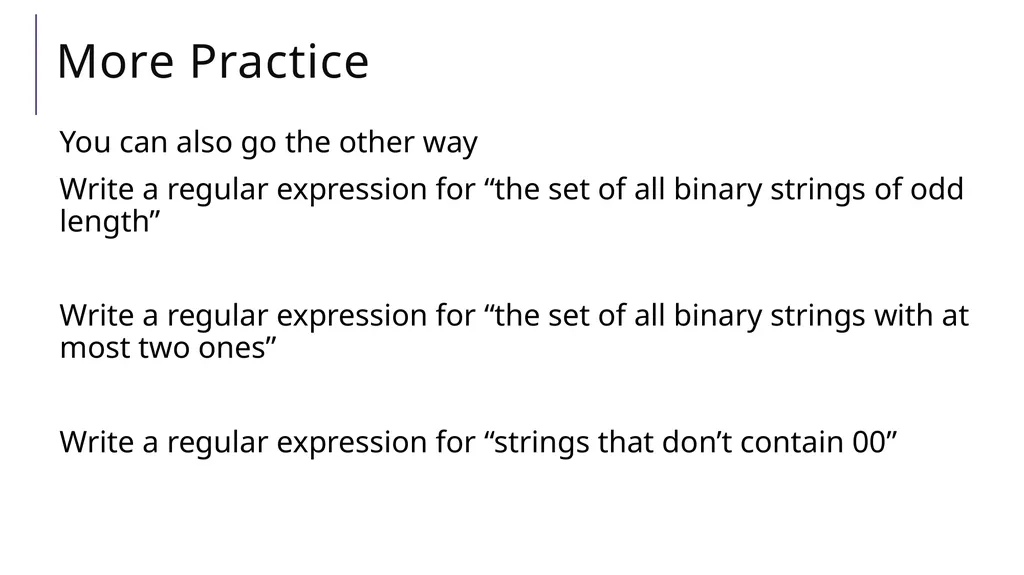
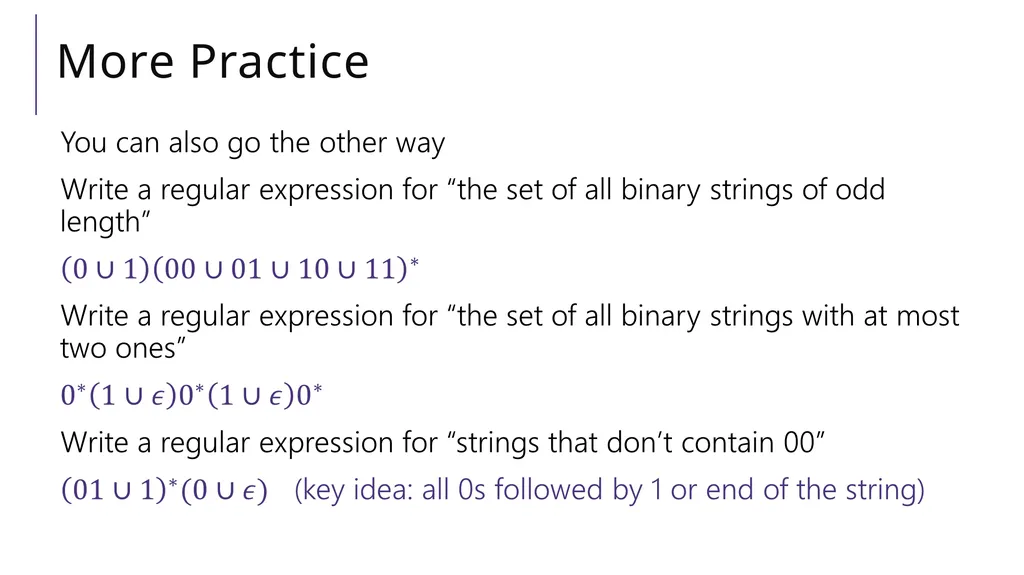
More Practice You can also go the other way
Write a regular expression for “the set of all binary strings of odd length”
Write a regular expression for “the set of all binary strings with at most two ones”
Write a regular expression for “strings that don’t contain 00”<br>
13
More Practice<br>
14
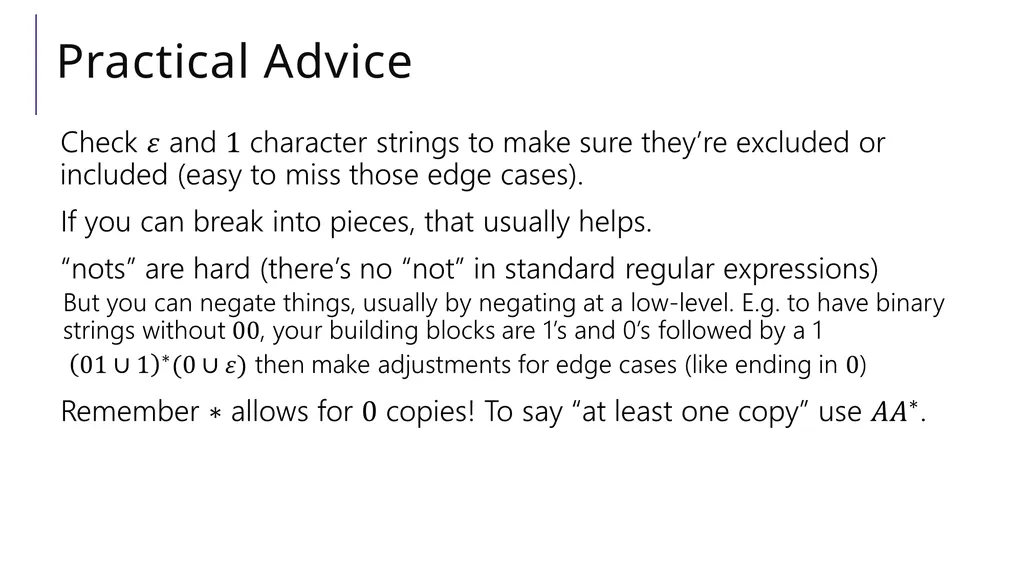
Practical Advice<br>
15
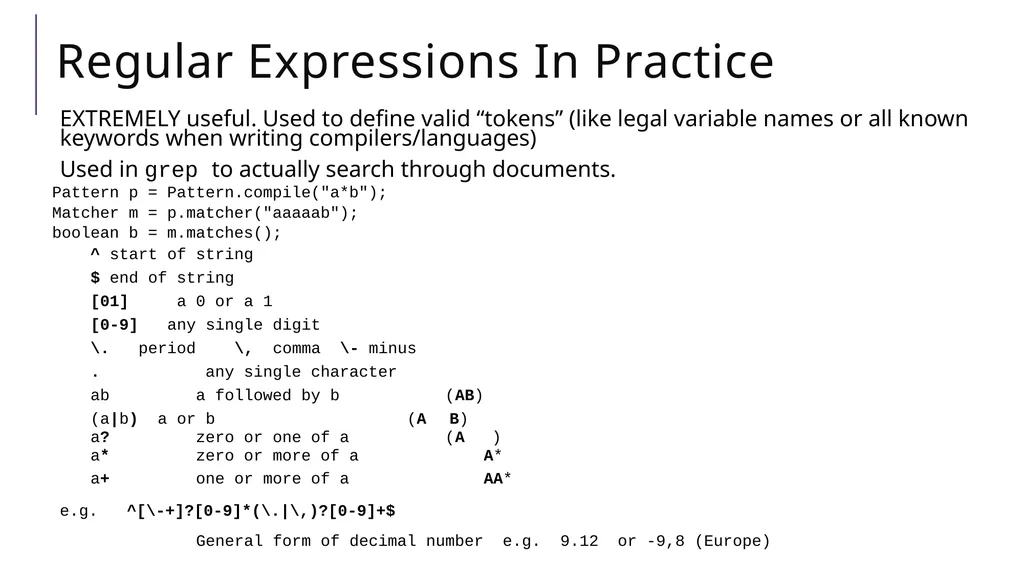
Regular Expressions In Practice EXTREMELY useful. Used to define valid “tokens” (like legal variable names or all known keywords when writing compilers/languages)
Used in grep to actually search through documents.
Pattern p = Pattern.compile("a*b");
Matcher m = p.matcher("aaaaab");
boolean b = m.matches();
^ start of string
$ end of string
[01] a 0 or a 1
[0-9] any single digit
\. period \, comma \- minus
. any single character
ab a followed by b (AB)
(a|b) a or b (A B) a? zero or one of a (A ) a* zero or more of a A*
a+ one or more of a AA*
e.g. ^[\-+]?[0-9]*(\.|\,)?[0-9]+$
General form of decimal number e.g. 9.12 or -9,8 (Europe)<br>
16
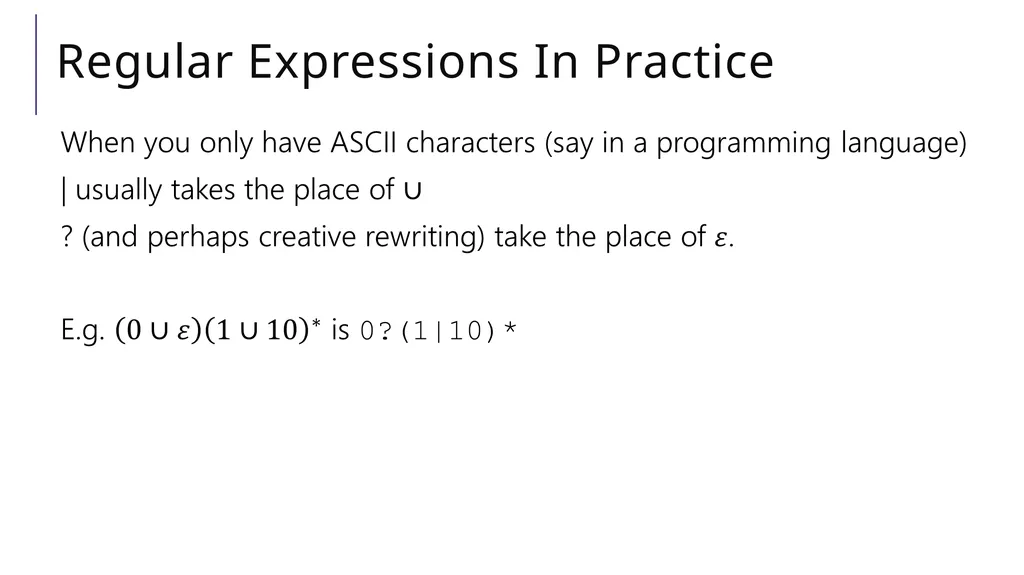
Regular Expressions In Practice<br>
17
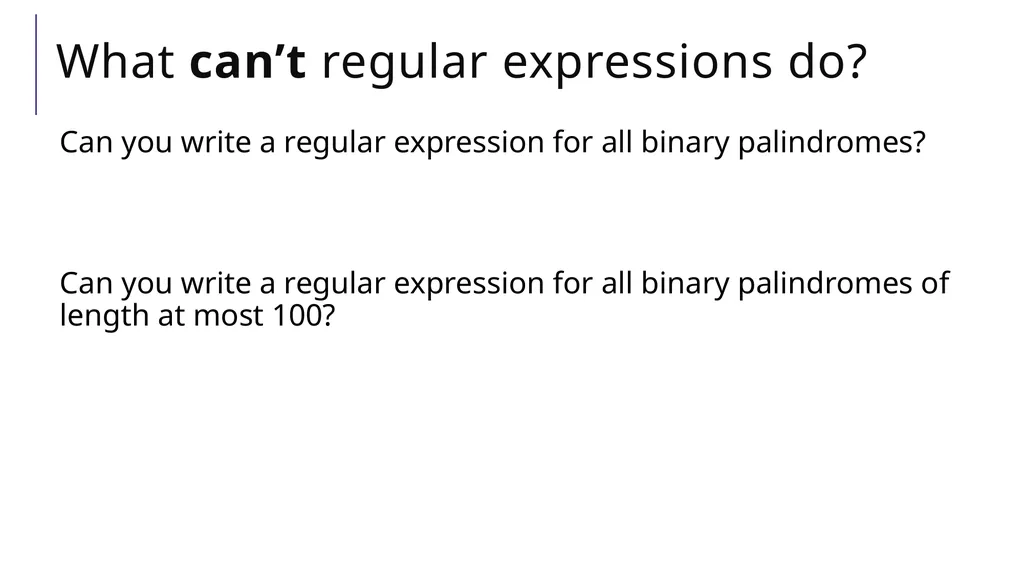
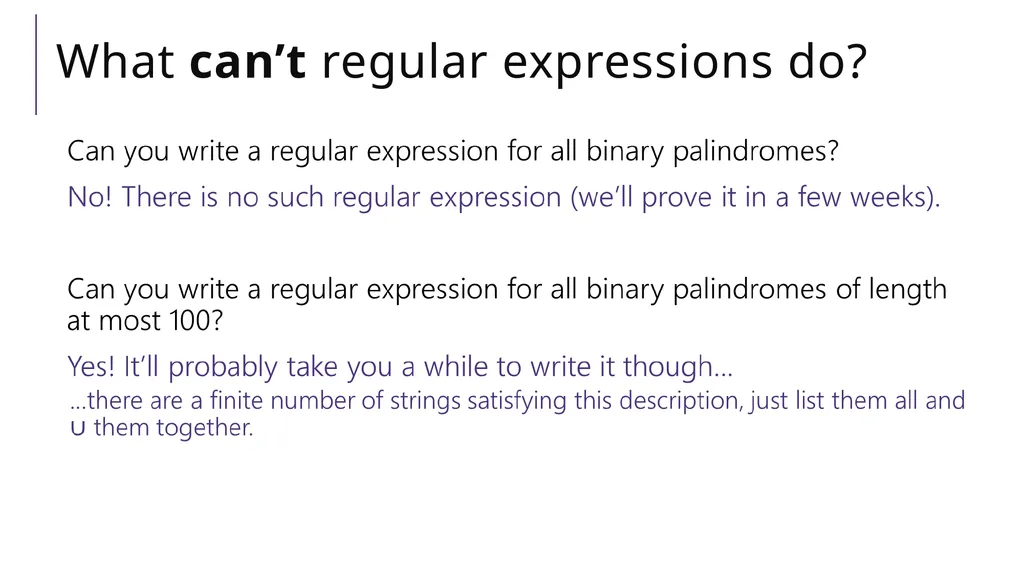
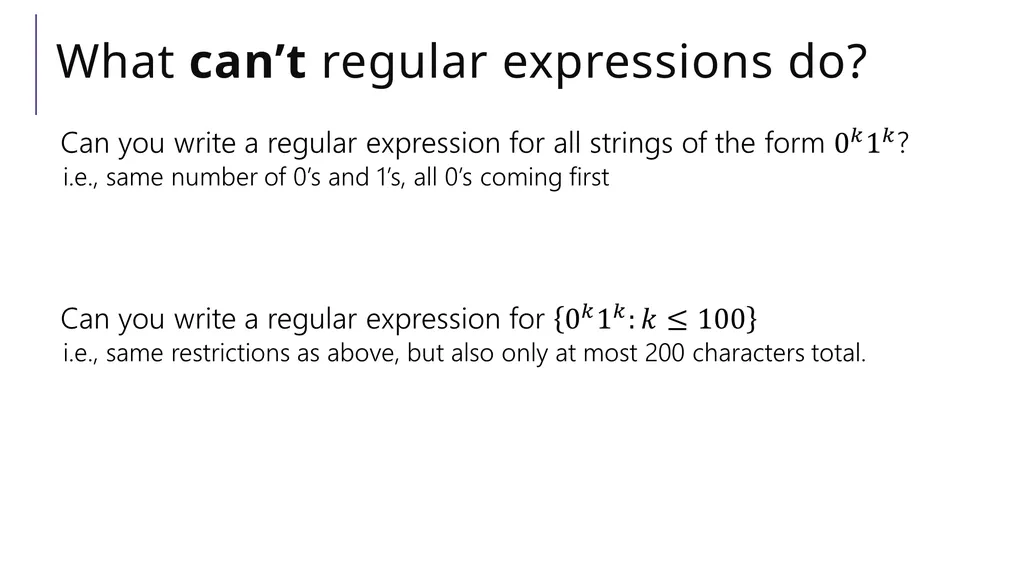
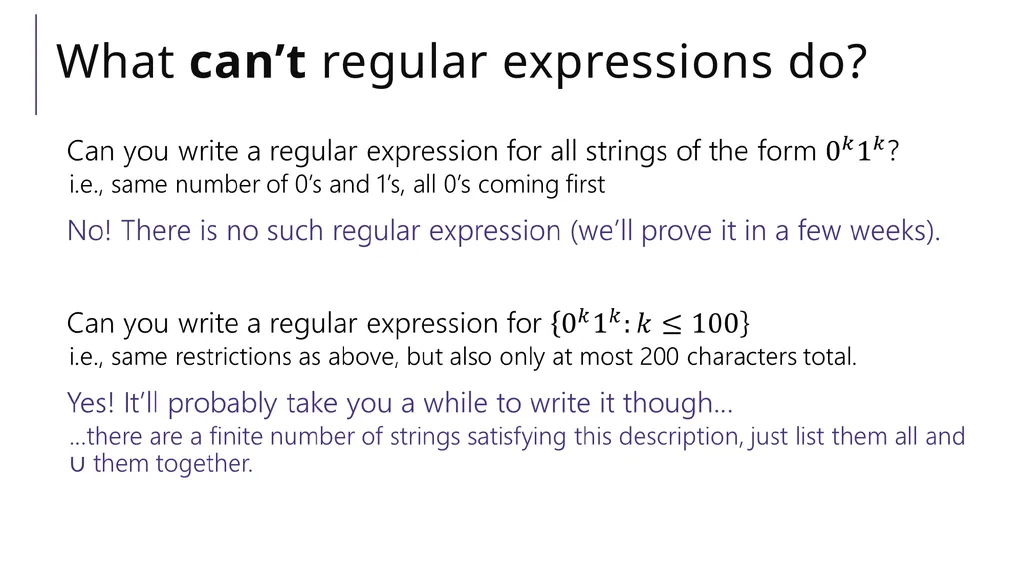
What can’t regular expressions do? Can you write a regular expression for all binary palindromes?
Can you write a regular expression for all binary palindromes of length at most 100?<br>
18
What can’t regular expressions do?<br>
19
What can’t regular expressions do?<br>
20
What can’t regular expressions do?<br>
21
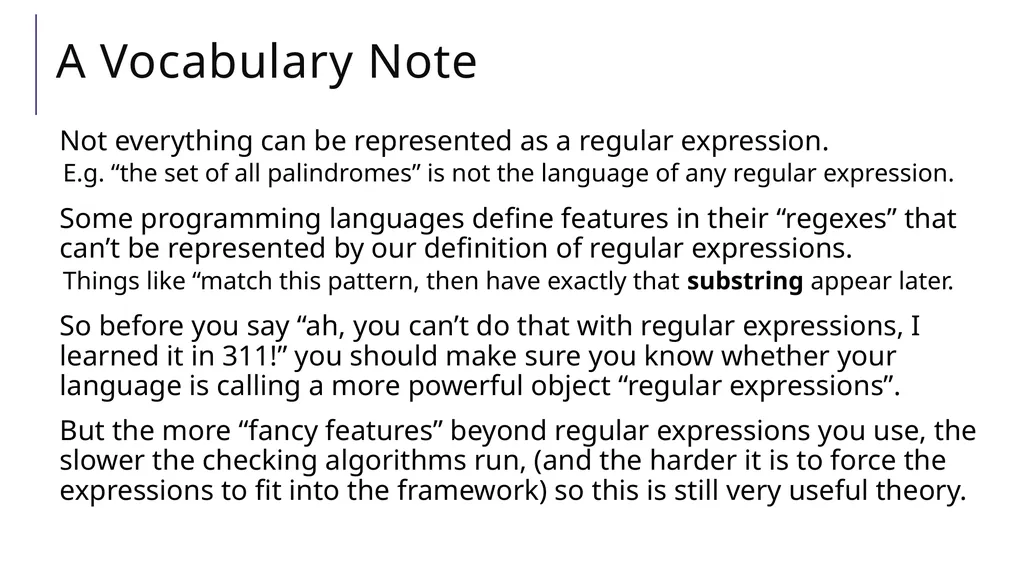
A Vocabulary Note Not everything can be represented as a regular expression.
E.g. “the set of all palindromes” is not the language of any regular expression.
Some programming languages define features in their “regexes” that can’t be represented by our definition of regular expressions.
Things like “match this pattern, then have exactly that substring appear later.
So before you say “ah, you can’t do that with regular expressions, I learned it in 311!” you should make sure you know whether your language is calling a more powerful object “regular expressions”.
But the more “fancy features” beyond regular expressions you use, the slower the checking algorithms run, (and the harder it is to force the expressions to fit into the framework) so this is still very useful theory.<br>
22
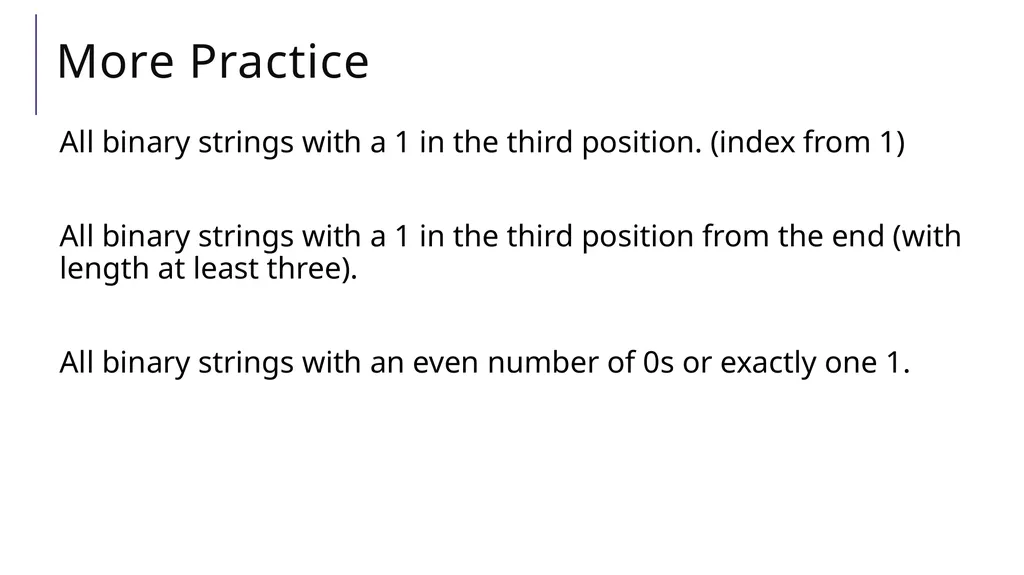
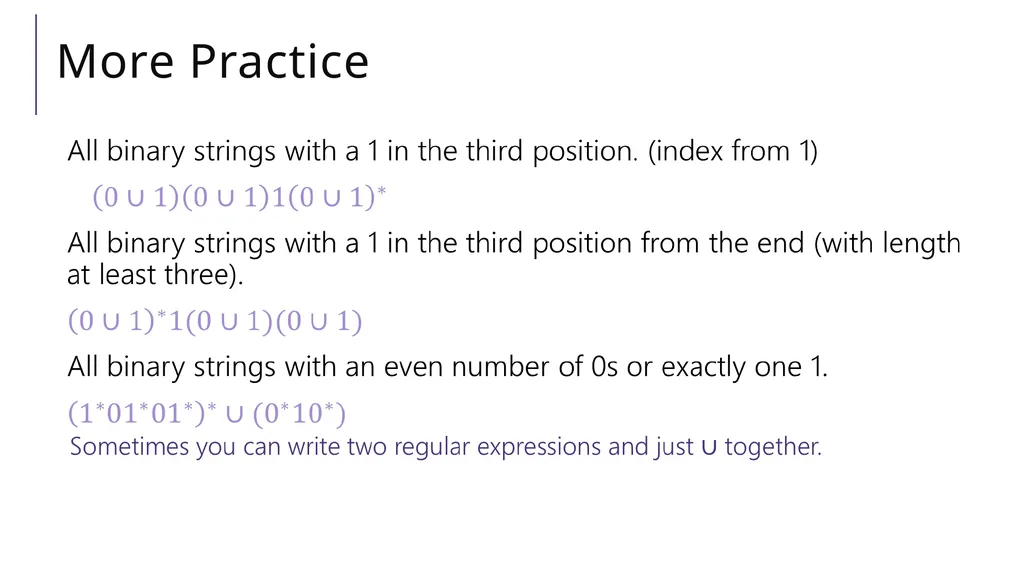
More Practice All binary strings with a 1 in the third position. (index from 1)
All binary strings with a 1 in the third position from the end (with length at least three).
All binary strings with an even number of 0s or exactly one 1.<br>