
Regulation and Supervision Supporting Inclusive











Description: Regulation and Supervision Supporting Inclusive Insurance Markets Lima, Peru June 2015 Michael Hafeman 1 Basis for the training Application Paper on Regulation and Supervision Supporting Inclusive Insurance Markets IAIS October 2012 Core
Related Topics
Download Presentation
"Regulation and Supervision Supporting Inclusive" is the property of its rightful owner. Permission is granted to download and print the materials on this website for personal, non-commercial use only, and to display it on your personal computer provided you do not modify the materials and that you retain all copyright notices contained in the materials. By downloading content from our website, you accept the terms of this agreement.
Presentation Transcript
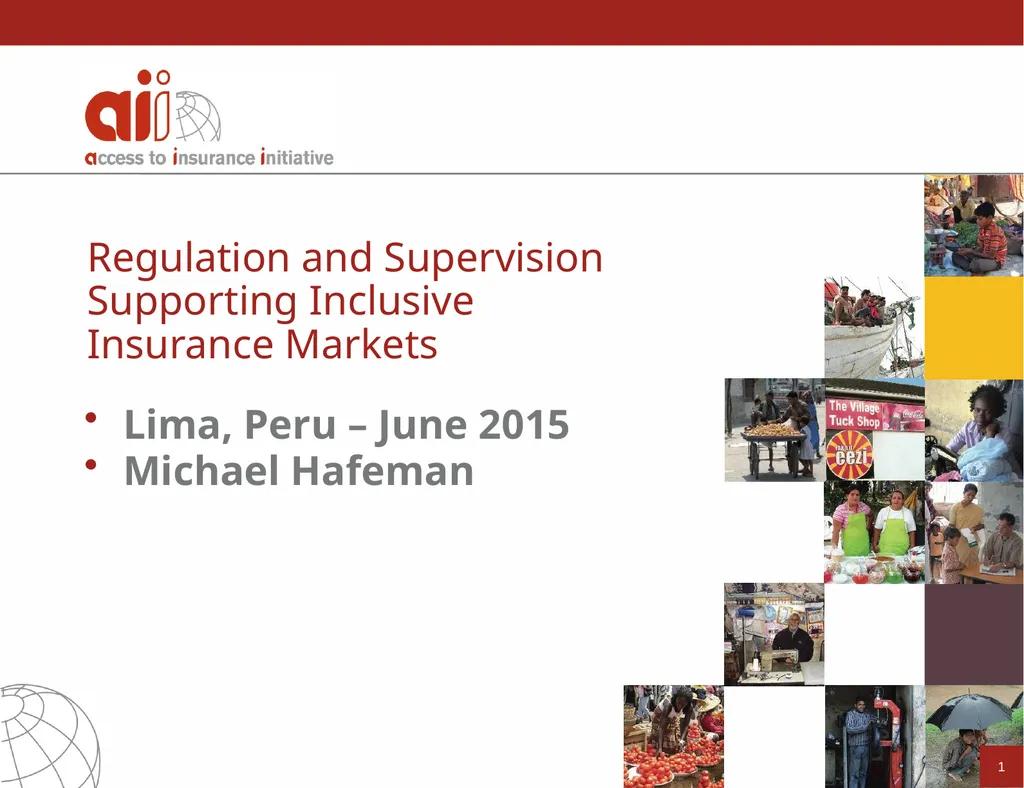
slide1. Regulation and Supervision Supporting Inclusive Insurance Markets Lima, Peru – June 2015
Michael Hafeman 1<br>
slide2. Basis for the training Application Paper on Regulation and Supervision Supporting Inclusive Insurance Markets
IAIS
October 2012
Core Curriculum Module on Regulation and Supervision Supporting Inclusive Insurance Markets
IAIS and Access to Insurance Initiative (A2II)
Available in 2013 2<br>
slide3. Overview Introduction
Market and policy environment
Role of the insurance supervisor
Prudential issues
Market conduct issues 3<br>
slide4. A. Introduction Importance of financial inclusion
Barriers to inclusive insurance markets
Challenges in removing the barriers
How this module can help
Commonly used terms 4<br>
slide5. Inclusive financial markets Enable all consumers to readily access products and services that are appropriate to their needs 5<br>
slide6. Benefits of inclusive financial markets Help reduce poverty
Enhance social welfare
Promote economic development
Contribute to financial stability 6<br>
slide7. G20 Principles for Innovative Financial Inclusion Leadership
Diversity
Innovation
Protection
Empowerment
Cooperation
Knowledge
Proportionality
Framework 7<br>
slide8. Sustainability Reach a large number of customers with useful and affordable products and services
Providers meet financial commitments
Providers treat customers fairly
Customer protection should not be compromised 8<br>
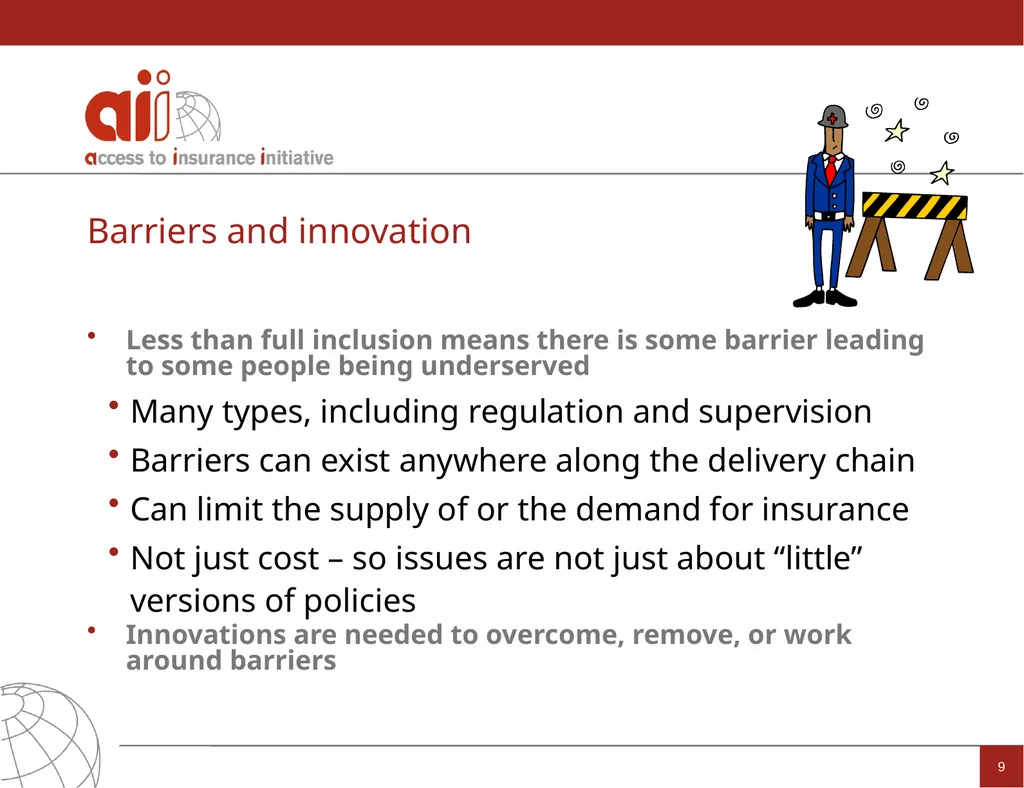
slide9. Barriers and innovation Less than full inclusion means there is some barrier leading to some people being underserved
Many types, including regulation and supervision
Barriers can exist anywhere along the delivery chain
Can limit the supply of or the demand for insurance
Not just cost – so issues are not just about “little” versions of policies
Innovations are needed to overcome, remove, or work around barriers 9<br>
slide10. Supply-side barriers Lack of business incentive
Lack of information
Lack of expertise
Operational factors 10<br>
slide11. Demand-side barriers Low income
Irregular income
Financial illiteracy
Lack of insurance tradition
Religious reasons
Lack of trust 11<br>
slide12. Informal insurance A common response to barriers
Insurance that is exempt from regulation, or
Illegal insurance activities 12<br>
slide13. Ultimately, insurance should be formal Informal insurance is “insurance” (in the mind of the consumer) that is from an issuer that is illegal or exempt
Barriers sometimes mean formal insurers move away from the client group making them “underserved”
needs remain, but without formal cover
find solutions in informal mechanisms and schemes
Reconsider exemptions and exclusions in light of the objectives of insurance supervision 13<br>
slide14. Inappropriate regulation and supervision Barrier to supply
Barrier to demand 14<br>
slide15. Examples of regulatory barriers Restrictions on types of distributors
Restrictions on legal forms of distributors
Education requirements
Training costs
Licensing requirements
Aggregators versus their staff
Commission limits
In light of different ranges of services
Restrictions on services that may be provided
Disclosure requirements 15<br>
slide16. Challenges in removing the barriers Diversity of barriers
Need for innovation
Developing an appropriate, proportionate framework
Diversity of stakeholders 16<br>
slide17. How this module can help Focus on the fundamentals
What roles are played by various parties?
What risks are created by their activities?
Why does a requirement exist? 17<br>
slide18. Commonly used terms Apex organizations
Customer
Effective access
Financial inclusion
Jurisdiction
Microinsurance
Mutuals, cooperatives, and other community-based organizations (MCCOs)
Underserved 18<br>
slide19. Group activity – inclusion Briefly explain how access to insurance in the following situations can help to reduce poverty, enhance social welfare, promote economic development, and contribute to financial stability.
Property insurance for a small merchant
Medical expense insurance for a poor family
Crop insurance for a subsistence farmer
Life insurance for a foreign migrant worker
Third-party liability insurance for a motorcycle taxi driver 19<br>
slide20. Group activity process Discuss within your table group the issues assigned
Develop a response
Select someone to present the results
Timing
15 minutes for discussion
4 minutes for each presentation 20<br>
slide21. B. Market and policy environment Analyzing the environment
Demand for insurance
Products and services
Channels for delivery
Insurers
Policy environment 21<br>
slide22. Analyzing the environment Identify barriers
Develop goals, strategies, and action plans
Resources are available
Toolkit – access to insurance initiative
Examples – published country studies
Technical assistance 22<br>
slide23. Demand for insurance Size of the underserved market
Characteristics of the underserved
Protection needs and preferences
What steps can a supervisor take to remove barriers to demand? 23<br>
slide24. Products and services Products and services currently available
Formal and informal
Do the products exhibit the basic features supportive of enhanced inclusion?
If so, have they been successful?
If not, are there barriers to including such features? 24<br>
slide25. Product features supportive of enhanced inclusion Relatively low premiums
Defined and limited cover
Short policy terms to limit risk
Few, if any, exclusions
Preference for group underwriting
Simple and rapid claims processing while still controlling for fraud 25<br>
slide26. Channels for delivery Channels currently being used
Relative importance in reaching various types of customers
Formal and informal
Do the channels support enhanced inclusion?
Overcome geographic barriers
Cost-effective
Leverage infrastructure
Overcome mistrust
If not, are there barriers to doing so? 26<br>
slide27. Insurers Entities currently underwriting insurance risk
Formal and informal
What do the insurers look like?
Legal form
Ownership
Nature of insurance business
Scale of insurance business
Importance of insurance to overall business
Insurance regulatory status
Are there barriers to entry or formalization? 27<br>
slide28. Discussion – insurers Consider the following questions in the context of your respective jurisdictions
What types of microinsurance providers are operating?
What is their current legal status?
Do any apex organizations exist? If so, what services do they provide? 28<br>
slide29. Policy environment Government policy on financial inclusion
Objectives and responsibilities
Insurance regulation
Insurance supervision 29<br>
slide30. Group activity – environment Consider the following questions in the context of your respective jurisdictions
Has a comprehensive analysis of the market and policy environment been performed?
If so, what were the three most significant findings or recommendations arising from the analysis?
If not, which aspects of the environment do you think would be the most difficult to analyze? 30<br>
slide31. Group activity process Discuss within your table group the issues assigned
Develop a response
Select someone to present the results
Timing
10 minutes for discussion
3 minutes for each presentation 31<br>
slide32. C. Role of the insurance supervisor Supervisory objectives
Importance of having a supervised market
Providing scope for innovation
Proportionality
Definition of microinsurance in regulation
Dealing with diverse market participants
Dealing with diverse authorities
Resource implications 32<br>
slide33. Supervisory objectives Traditional objectives
Fair
Safe
Stable
Inclusiveness objective
Achieving an appropriate balance
Variety of authorities
Objectives
Responsibilities
Are there gaps, overlaps, or potential conflicts? 33<br>
slide34. Importance of having a supervised market All customers deserve protection from undue loss
Failures can affect market confidence and economic growth, even if no systemic risk
Small policies and small insurers do not mean small risk of failure
A loss that might be small to some could be catastrophic to others
Underserved might be less capable of avoiding or dealing with problems 34<br>
slide35. Providing scope for innovation Potential areas of innovation
Entities underwriting insurance
Insurance products
Channels for delivery
Product explanation and documentation
Administration
Does legislation provide scope for innovation?
If not, are there alternative ways to meet supervisory objectives? 35<br>
slide36. Mixed entities Many innovations occur through mixed entities
Large: (for example) telecom companies, commercial entities, other financial institutions
Small: (for example) health care providers, funeral parlors 36<br>
slide37. Proportionality Respond to the nature, scale, and complexity of risks
Particularly important with small policies, small insurers, and the need for innovation
A measure should not go beyond what is necessary to attain supervisory objectives
Similar risks should receive equivalent treatment 37<br>
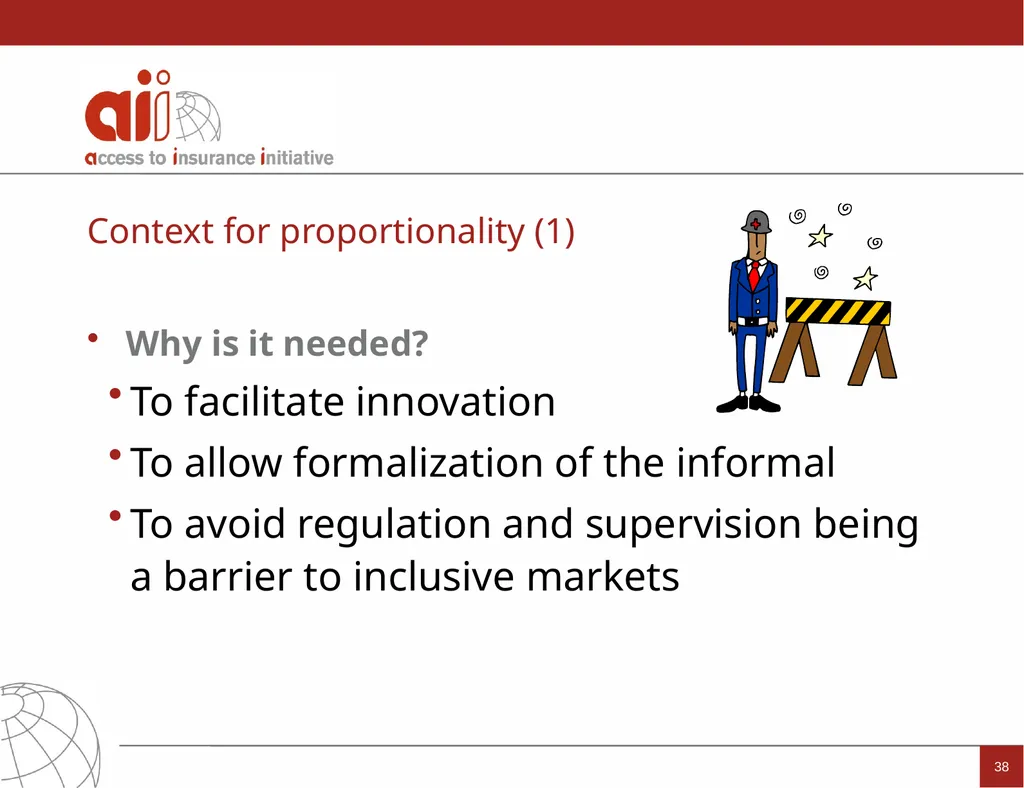
slide38. Context for proportionality (1) Why is it needed?
To facilitate innovation
To allow formalization of the informal
To avoid regulation and supervision being a barrier to inclusive markets 38<br>
slide39. Context for proportionality (2) When is it needed?
Designing requirements
Implementing requirements
Assessing adherence to requirements
Exercising supervisory powers
Who can be affected?
Customers
Insurers
Supervisors 39<br>
slide40. Absolute minimum requirements Registration: for pilots or transitional arrangements
Identify the organization, its form, and require minimum reporting to the supervisor
Minimum reporting
Balance sheet and income statement that identifies the insurance business separately, shows the effect of reinsurance, identifies claim and operating expenses separately, and is at least annual or on request
Note that these are higher standards than a literal reading of ICP 9
Market disclosure
Everyone should be able to determine their market share and benchmark their performance, against the market as a whole 40<br>
slide41. Absolute minimum requirements Conduct of business
Customers should:
Be aware that they have an insurance product
Know the identity of the insurer
Know the manner that the services under the product should be accessed
Know when the insurance service ceases
Know their costs and obligations under the product 41<br>
slide42. Definition of microinsurance in regulation Qualitative definitions
Insurance that is accessed by low-income populations, provided by a variety of different entities, but run in accordance with generally accepted insurance practices (which include the ICPs)
Appropriate for many purposes
Quantitative definitions
Might be needed to allow different treatment
Keep the purpose in mind
Faulty definitions can have unintended consequences 42<br>
slide43. Criteria for definitions Definitions should focus on products, not customers
Definitions that focus on the providers have the potential to create an un-level playing field
Definitions that focus on microinsurers should clearly delineate microinsurance business from others and will require a definition of a risk category or product
Quantitative elements of definitions should be set at the highest possible level to ensure the defined product is as inclusive as possible
Quantitative elements should consider the need to align the resulting business profiles with the expected proportionate regulation and supervision
Would the definition inadvertently exclude target customers, providers, products, or innovations?
Consider a definition that involves supervisory discretion 43<br>
slide44. Discussion – definition (1) The authorities in a jurisdiction are considering adopting the following definition:
“Microinsurance product means an insurance product that is designed to meet the needs of low-income customers, where the amount of premiums, computed on a daily basis, does not exceed 6 percent of the national daily minimum wage rate and the maximum guaranteed benefits do not exceed 600 times the national daily minimum wage rate. In the case of a bundled product, the maximum amounts of premiums and guaranteed benefits apply separately with respect to each component of the product.” 44<br>
slide45. Discussion – definition (2) What are three reasons that this definition might not be supportive of an inclusive insurance market?
What changes would you propose to the definition if its ultimate purpose is to facilitate the licensing of microinsurance-only agents?
What changes would you propose to the definition if its ultimate purpose is to limit the exclusions allowed in microinsurance products? 45<br>
slide46. Dealing with diverse market participants Lack of familiarity – both ways
New roles even for traditional participants
Consider functions, risks, and controls
Consider objectives and how insurance contributes
Communicate actively, including with those in the informal market
Adjust the regulatory framework, if necessary 46<br>
slide47. Dealing with diverse authorities Understand objectives and responsibilities
Seek synergies
Reduce the risk of arbitrage
Document information exchange and confidentiality agreements 47<br>
slide48. A range of other authorities Central Bank
Payment systems
Revenue authorities
Telecommunication regulators
Health authorities
Agriculture department
Social protection department
Others? 48<br>
slide49. Resource implications Policy development
Initial and ongoing
Regulatory and supervisory
Consider the preconditions
Dealing with limitations
Skills and data
Take action and encourage others
Ongoing supervision
Obtaining resources
Cooperate with others
Consider transitional and ongoing needs
Strive for fairness and sustainability 49<br>
slide50. External enablers (1) Capacity builders
Actuaries
Technical assistance (TA) providers
Academics
Operational specialists
Intermediaries
Third-party administrators
Technology suppliers
Extension services and infrastructure 50<br>
slide51. External enablers (2) Funders
Donors
Investors
Promoters
Insurance associations
Conferences and meetings
Microinsurance Network – facilitates information exchange 51<br>
slide52. Group activity – stakeholders (1) Insurance penetration in your jurisdiction is very low compared to others in your region, although various informal insurance mechanisms also exist. You have developed an initial action plan to enhance the inclusiveness of the insurance market, which consists of:
undertaking a comprehensive analysis of the market and policy environment
amending legislation to add “inclusiveness” to the objectives of your authority
formalizing informal insurers. 52<br>
slide53. Group activity – stakeholders (2) You intend to meet with various stakeholders to seek support for your plan. Each group will be assigned one of the following stakeholders to deal with:
The head of your supervisory authority
The Minister of Finance
The Governor of the Central Bank
The President of the Insurance Association
The head of the Microfinance Association (many members offer informal insurance)
The head of a social welfare organization 53<br>
slide54. Group activity – stakeholders (3) Consider the following, from your assigned stakeholder’s point of view:
What is wrong with the current situation?
What are the advantages of your plan?
What are the disadvantages of your plan (and how might you deal with them)?
What good things about the current situation will remain unchanged under your plan?
What do you want from them? 54<br>
slide55. Group activity process Discuss within your table group the questions on the previous slide
Develop responses
Select someone to present the results
Timing
30 minutes for discussion
5 minutes for each presentation 55<br>
slide56. D. Prudential issues Licensing
Operations
Solvency regime
Supervision 56<br>
slide57. Licensing Importance of licensing
Regulated insurance activities
Entities to be licensed
Implementation of licensing 57<br>
slide58. Importance of licensing Define conditions for access to the market
Limit access to those meeting the conditions
Balance is essential
Weak requirements can expose customers to excessive risk
Onerous requirements can reduce their access to insurance 58<br>
slide59. Regulated insurance activities Broad scope is generally better
Avoid exempting insurance from regulation
Avoid restricting desirable insurance activities 59<br>
slide60. Entities to be licensed Types of entities eligible
Mixed entities
Pilot schemes
Small entities 60<br>
slide61. Types of entities eligible Wide range enhances access
Accommodate current or future MCCOs
Avoid exemptions unless appropriate alternative protections
Avoid restrictions unless they support supervisory objectives
Institutional form
Domicile of entity or owners
Nature of owners
Specialization
License should be aligned with capabilities 61<br>
slide62. Types of providers Traditional insurers
Dedicated microinsurers
Mutuals, cooperatives, and community-based organizations – MCCOs
Public-private partnerships
For-profit or not-for-profit
Current legal status
Regulated under insurance law
Regulated under another law
Informal and unregulated 62<br>
slide63. Dedicated licenses Some jurisdictions offer a special license for “dedicated microinsurers” or “specialist microinsurance intermediaries”
More focused scope of licenses
Some additional tasks possible, not only reducing obligations
Proportionate requirements (not concessional compared to risk) with limits 63<br>
slide64. Mixed entities Protect policyholders from risks of noninsurance businesses
Require separate legal entity to underwrite insurance
Transitional arrangements might be needed
Ability to package life and nonlife insurances enhances access
Composite insurers
Products that all insurers can underwrite
Perhaps limited to microinsurance 64<br>
slide65. Pilot schemes Used to test an approach and learn what modifications are needed
If regulated insurance activities are involved, customers should be protected
Licensed insurer might use
Other entities might use 65<br>
slide66. Use of pilots by licensed insurers Sometimes within the scope of their license
Sometimes beyond the scope of their license or legislation 66<br>
slide67. Use of pilots by other entities Can create difficult issues
Customer protection
Ability to supervise
Unfair competition
Accept only on a temporary basis, with transitional arrangements
Registration
Separate identification of assets
Deposit
Notification of customers
Alternative protections 67<br>
slide68. Small entities Some entities are too small to be licensed
Technical – risk pooling
Operational – business processes
How can you determine the minimum size?
Stochastic modeling
Business financial modeling
Benchmark locally and with other jurisdictions
Consult with market participants 68<br>
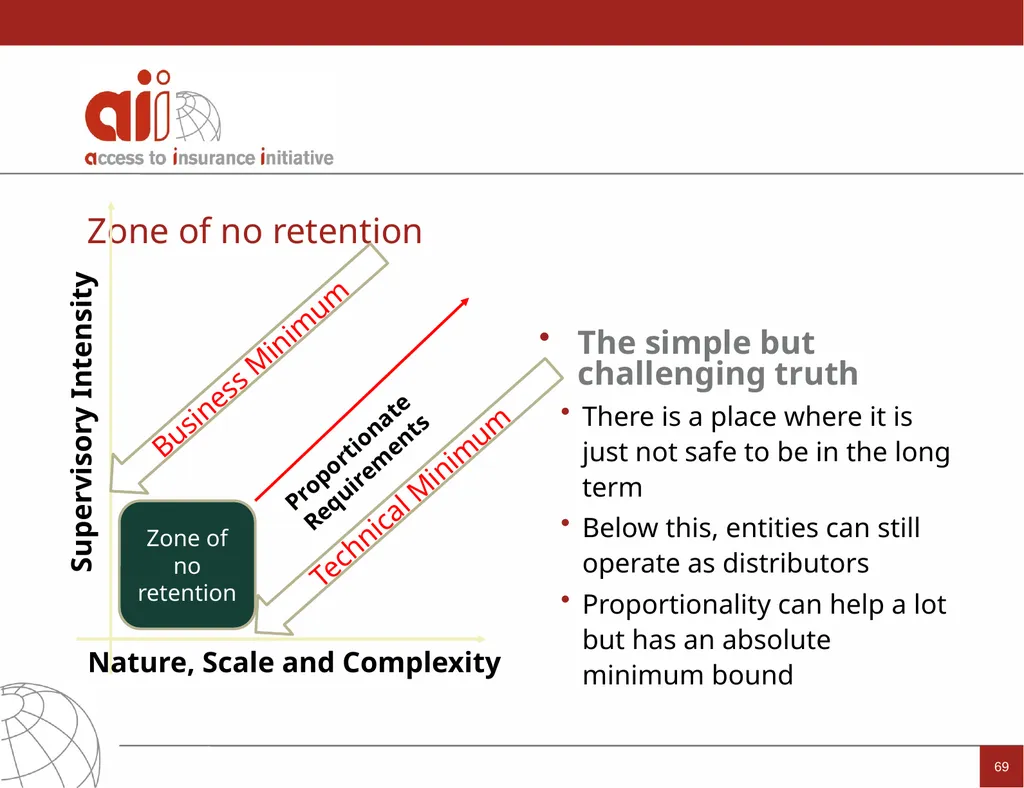
slide69. Zone of no retention The simple but challenging truth
There is a place where it is just not safe to be in the long term
Below this, entities can still operate as distributors
Proportionality can help a lot but has an absolute minimum bound 69 Supervisory Intensity Nature, Scale and Complexity Proportionate Requirements Technical Minimum Business Minimum Zone of no retention<br>
slide70. Implementation of licensing Common implementation challenges
Formalization and transitional arrangements
Changes of control and exit from the market 70<br>
slide71. Common implementation challenges Some entities might not realize their activities require a license
Some entities might not be eligible for a license
Licensing requirements and procedures might need to be adapted
Small entities
Different types of entities
Pilot schemes
Small or informal operators might have difficulty understanding or coping with requirements and procedures
Take steps to remove unnecessary barriers 71<br>
slide72. Formalization and transitional arrangements Formalizing informal insurance is generally better than shutting it down
Start with a clear picture of the current situation and the preferred outcomes
Protections during a transition are incomplete
Transition period should be limited
Activities should be constrained
Processes should be clear and transparent
Contemplate contingencies
Leverage resources
Restrictions should be proportionate
Arrangements should not be unduly attractive 72<br>
slide73. Changes of control and exit from the market Informal insurers that cannot meet formalization requirements
Failed pilot schemes undertaken by unlicensed entities
Mutualization or demutualization 73<br>
slide74. Operations Corporate governance
Suitability of persons
Internal controls and risk management 74<br>
slide75. Corporate governance Requirements exist to protect the interests of stakeholders
For insurers, customers should have high priority
Nature of conflicts can differ by type of entity
MCCOs might not have shareholders
Conflicts can still arise among types or generations of policyholders
MCCOs might have difficulty obtaining a strong, diverse board
Management might end up controlling the board
Unlicensed entities might lack customer-focused governance mechanisms
Supervisors should ensure governance risks are being dealt with 75<br>
slide76. Suitability of persons Small insurers and MCCOs can face particular difficulties
Encourage strengthening of competence
Encourage broadening of boards to include non-members of MCCOs
Ensure that suitability requirements are appropriate 76<br>
slide77. Internal controls and risk management Innovative approaches can create control risks
Involvement of mixed and noninsurance entities can create control risks
If activities are restricted, internal control and risk-management needs may be reduced
Small insurers often face difficulty 77<br>
slide78. Discussion – governance The board of a small community healthcare cooperative is drawn from the membership of the organization.
What are the potential advantages of such a composition from the perspective of the insurance supervisor?
What are the potential disadvantages?
How would your answers differ if the cooperative was large and operated within a broad geographic territory?
What steps might be taken to deal with the disadvantages? 78<br>
slide79. Solvency regime Reinsurance
Valuation and ERM
Capital adequacy 79<br>
slide80. Reinsurance All insurers should have access to the reinsurance they need
Access to reinsurance might be enhanced by:
Formalizing informal insurers
Allowing conventional direct insurers to assume microinsurance risks
Allowing insurers to reinsure microinsurance products that include both life and nonlife coverages with the same reinsurer
Allowing insurers to reinsure new or complex risks with foreign reinsurers
Encouraging MCCOs to cooperate with one another in arranging reinsurance 80<br>
slide81. Valuation and ERM Leverage expertise
Share actuarial services
Develop simplified valuation approaches
Restrict operations commensurate with technical and management capabilities 81<br>
slide82. Capital adequacy Consider the risk characteristics of products and insurers
Methodology should be proportionate
MCCOs can face particular difficulty in raising additional capital 82<br>
slide83. Supervision Risk-based approach
Reporting and off-site analysis
On-site inspection
Prevention, correction, and enforcement 83<br>
slide84. Risk-based approach Large, complex insurers should be subject to sophisticated risk assessment
Small, simple insurers might be subject to a more standardized approach
Synergies with apex organizations and other authorities might be possible
All relevant entities in the insurance delivery chain should be considered 84<br>
slide85. Reporting and off-site analysis Information should be sufficient
Supervisory assessment
Market analysis and policy needs
Requirements should be proportionate
Analysis by class of business for combination products
Benchmarks might differ from conventional insurance 85<br>
slide86. On-site inspection Inspection program might differ for small, geographically remote insurers
Focused inspections of microinsurance activities of conventional insurers might be practical
Obtain access to all entities in the delivery chain 86<br>
slide87. Prevention, correction, and enforcement Basic framework might be unchanged
Additional communication of requirements and expectations
Transitional arrangements should be enforced
Replacing key individuals might be particularly difficult
Financial penalties should be proportionate 87<br>
slide88. Supervisory challenges of MCCOs Insurance may be ancillary to main purpose
Suitability of board
Disclosure of information to members
Access to capital
Fairness and equity in distribution of profits
Demutualization 88<br>
slide89. Discussion – risk profile (1) A large agricultural cooperative has been providing crop insurance to its members on an informal basis.
Five persons are directly involved in the operation of the insurance program. None of them have formal training in insurance.
The cooperative charges premiums sufficient to break even over a five-year period, based on past claims experience. It accumulates a reserve, which is invested in an account at a local bank. 89<br>
slide90. Discussion – risk profile (2) The cooperative plans to set up a subsidiary, for which it will seek an insurance license, as is now required.
The head of your authority has asked you to compare the likely risk profile of this potential applicant with that of a large and well-run conventional nonlife insurer. 90<br>
slide91. Discussion – risk profile (3) What differences are likely within the various risk-assessment categories used by your authority?
Financial: assets, liabilities, capital, earnings, group
Operational: ownership, governance, business activities, controls
Market conduct: business activities, controls 91<br>
slide92. E. Market conduct issues Context for market conduct supervision
SMART Client Protection Principles
Channels for delivery
Conduct of business
Disclosure to the market
Fraud and AML/CFT
Supervision 92<br>
slide93. Context for market conduct supervision Focus on the fairness and propriety of dealings with customers
Innovations in products, distribution, and service delivery
Different entities might be involved
Different functions might be performed, even by traditional participants 93<br>
slide94. SMART Client Protection Principles Appropriate product design and delivery
Prevention of over-indebtedness
Transparency
Responsible pricing
Fair and respectful treatment of clients
Privacy of client data
Mechanisms for complaint resolution 94<br>
slide95. Channels for delivery Innovative channels for delivery
Issues on channels for delivery 95<br>
slide96. Innovative channels for delivery Banks
Microfinance institutions
Nongovernmental organizations
Direct marketing
Direct mail
Alternative sales forces
Technology-based distribution Retailers
Post office outlets
Social and religious associations
Trade unions
Specialized microinsurance agents and brokers
MCCOs 96<br>
slide97. Rationale for using alternatives Quickly achieve scale through the aggregation of consumers
Gain credibility by exploiting existing relationships
Leverage off an infrastructure footprint, either physical or virtual
Obtain access to a transaction platform
Compensation is sufficient to meaningfully supplement other revenues 97<br>
slide98. Issues on channels for delivery Define the activities subject to regulation
Accommodate a wide range of channels
Requirements, commission limits, and restrictions should match the functions performed 98<br>
slide99. Challenges in dealing with distributors They might seek to use control of access to negotiate favorable arrangements for themselves
They will probably have more interest in distributing insurance if helps to support their core activity
Relations can involve multiple parties and be difficult to manage, in part reflecting the variety of roles they might play 99<br>
slide100. Group activity – intermediaries (1) In a particular jurisdiction, the existing requirements on intermediaries include the following:
insurance can be sold by agents, brokers, or directly by insurers
agents must be individuals
brokers must be corporations
agents cannot represent more than one insurer in respect of each type of insurance (life or nonlife)
agents and the principals of brokers must meet suitability requirements, including examinations of their insurance knowledge
agents and brokers must assess the needs of customers and recommend suitable products. 100<br>
slide101. Group activity – intermediaries (2) Work with your group to identify how these requirements might need to change to accommodate the delivery of insurance through:
Microfinance institutions
Retailers
Community healthcare organizations
Sales forces of telecommunications service providers
Agricultural cooperatives
Funeral parlors
Each group will be assigned one of the above. 101<br>
slide102. Group activity process Discuss within your table group the issues assigned
Develop a response
Select someone to present the results
Timing
15 minutes for discussion
3 minutes for each presentation 102<br>
slide103. Conduct of business Context for conduct of business supervision
Product development
Communication with customers
Service to customers 103<br>
slide104. Context for conduct of business supervision Diversity of customer situations and approaches
Universal solutions are impossible
Focus on the basics
Low financial literacy and incomes can make traditional protection measures less useful 104<br>
slide105. Product development (1) Needs and preferences can differ significantly
Product features supportive of enhanced inclusion
Relatively low premiums
Defined and limited cover
Short policy terms to limit risk
Few, if any, exclusions
Preference for group underwriting
Simple and rapid claims processing while still controlling for fraud 105<br>
slide106. Product development (2) Consider the implications of such product features
Profit-sharing approaches might differ
Product approval requirements and criteria might need to be revised 106<br>
slide107. Communication with customers Information should be clear, realistic, and sufficient
Consider requirements where no advice is being provided
Alternatives to written communication 107<br>
slide108. Service to customers Orphan policyholders
Some alternative channels might increase the risk
Others, such as group delivery, might decrease the risk
Claims payment
Process should be simple
Settlement should be timely
Requirements should balance the need for speed against the need to assess validity
Complaints
Processes should be simple and accessible 108<br>
slide109. Disclosure to the market Information should be similar in scope to conventional market
Specific requirements should be proportionate
Needs of MCCO members, as owners, should be considered
Information should support benchmarking by market participants 109<br>
slide110. Fraud and AML/CFT Fraud risks might differ
Customers lack knowledge
Simplified processes
Nature of products and small amounts
Involvement of noninsurance entities
Supervisory disclosure alternatives
AML/CFT risks are low
Nature of products and small amounts
Requirements should be proportionate 110<br>
slide111. Supervision Consider more proactive monitoring
Handbook of Social Performance Indicators for Microinsurance – a useful resource
Seek opportunities to leverage resources 111<br>
slide112. Possibilities for more proactive monitoring Monitoring claims and expense ratios to assess whether microinsurance products are offering reasonable value to customers
Investigating whether low claims ratios or high expense ratios are caused by inappropriate market conduct
Analyzing complaints against insurers and intermediaries to identify inappropriate conduct or inadequate processes for dealing with complaints
Analyzing claims approval rates and claims payment times to help identify slow or unfair claims payment practices 112<br>
slide113. Review and wrap-up Topics covered:
Introduction
Market and policy environment
Role of the insurance supervisor
Prudential issues
Market conduct issues 113<br>
slide114. A. Introduction Importance of financial inclusion
Barriers to inclusive insurance markets
Challenges in removing the barriers
How this module can help
Commonly used terms 114<br>
slide115. B. Market and policy environment Analyzing the environment
Demand for insurance
Products and services
Channels for delivery
Insurers
Policy environment 115<br>
slide116. C. Role of the insurance supervisor Supervisory objectives
Importance of having a supervised market
Providing scope for innovation
Proportionality
Definition of microinsurance in regulation
Dealing with diverse market participants
Dealing with diverse authorities
Resource implications 116<br>
slide117. D. Prudential issues Licensing
Importance of licensing
Regulated insurance activities
Entities to be licensed
Implementation of licensing
Operations
Solvency regime
Supervision 117<br>
slide118. E. Market conduct issues Context for market conduct
SMART Client Protection Principles
Channels for delivery
Conduct of business
Disclosure to the market
Fraud and AML/CFT
Supervision 118<br>
slide119. Wrap-up Questions
Comments
Evaluation
Thank you for participating! 119<br>
Michael Hafeman 1<br>
slide2. Basis for the training Application Paper on Regulation and Supervision Supporting Inclusive Insurance Markets
IAIS
October 2012
Core Curriculum Module on Regulation and Supervision Supporting Inclusive Insurance Markets
IAIS and Access to Insurance Initiative (A2II)
Available in 2013 2<br>
slide3. Overview Introduction
Market and policy environment
Role of the insurance supervisor
Prudential issues
Market conduct issues 3<br>
slide4. A. Introduction Importance of financial inclusion
Barriers to inclusive insurance markets
Challenges in removing the barriers
How this module can help
Commonly used terms 4<br>
slide5. Inclusive financial markets Enable all consumers to readily access products and services that are appropriate to their needs 5<br>
slide6. Benefits of inclusive financial markets Help reduce poverty
Enhance social welfare
Promote economic development
Contribute to financial stability 6<br>
slide7. G20 Principles for Innovative Financial Inclusion Leadership
Diversity
Innovation
Protection
Empowerment
Cooperation
Knowledge
Proportionality
Framework 7<br>
slide8. Sustainability Reach a large number of customers with useful and affordable products and services
Providers meet financial commitments
Providers treat customers fairly
Customer protection should not be compromised 8<br>
slide9. Barriers and innovation Less than full inclusion means there is some barrier leading to some people being underserved
Many types, including regulation and supervision
Barriers can exist anywhere along the delivery chain
Can limit the supply of or the demand for insurance
Not just cost – so issues are not just about “little” versions of policies
Innovations are needed to overcome, remove, or work around barriers 9<br>
slide10. Supply-side barriers Lack of business incentive
Lack of information
Lack of expertise
Operational factors 10<br>
slide11. Demand-side barriers Low income
Irregular income
Financial illiteracy
Lack of insurance tradition
Religious reasons
Lack of trust 11<br>
slide12. Informal insurance A common response to barriers
Insurance that is exempt from regulation, or
Illegal insurance activities 12<br>
slide13. Ultimately, insurance should be formal Informal insurance is “insurance” (in the mind of the consumer) that is from an issuer that is illegal or exempt
Barriers sometimes mean formal insurers move away from the client group making them “underserved”
needs remain, but without formal cover
find solutions in informal mechanisms and schemes
Reconsider exemptions and exclusions in light of the objectives of insurance supervision 13<br>
slide14. Inappropriate regulation and supervision Barrier to supply
Barrier to demand 14<br>
slide15. Examples of regulatory barriers Restrictions on types of distributors
Restrictions on legal forms of distributors
Education requirements
Training costs
Licensing requirements
Aggregators versus their staff
Commission limits
In light of different ranges of services
Restrictions on services that may be provided
Disclosure requirements 15<br>
slide16. Challenges in removing the barriers Diversity of barriers
Need for innovation
Developing an appropriate, proportionate framework
Diversity of stakeholders 16<br>
slide17. How this module can help Focus on the fundamentals
What roles are played by various parties?
What risks are created by their activities?
Why does a requirement exist? 17<br>
slide18. Commonly used terms Apex organizations
Customer
Effective access
Financial inclusion
Jurisdiction
Microinsurance
Mutuals, cooperatives, and other community-based organizations (MCCOs)
Underserved 18<br>
slide19. Group activity – inclusion Briefly explain how access to insurance in the following situations can help to reduce poverty, enhance social welfare, promote economic development, and contribute to financial stability.
Property insurance for a small merchant
Medical expense insurance for a poor family
Crop insurance for a subsistence farmer
Life insurance for a foreign migrant worker
Third-party liability insurance for a motorcycle taxi driver 19<br>
slide20. Group activity process Discuss within your table group the issues assigned
Develop a response
Select someone to present the results
Timing
15 minutes for discussion
4 minutes for each presentation 20<br>
slide21. B. Market and policy environment Analyzing the environment
Demand for insurance
Products and services
Channels for delivery
Insurers
Policy environment 21<br>
slide22. Analyzing the environment Identify barriers
Develop goals, strategies, and action plans
Resources are available
Toolkit – access to insurance initiative
Examples – published country studies
Technical assistance 22<br>
slide23. Demand for insurance Size of the underserved market
Characteristics of the underserved
Protection needs and preferences
What steps can a supervisor take to remove barriers to demand? 23<br>
slide24. Products and services Products and services currently available
Formal and informal
Do the products exhibit the basic features supportive of enhanced inclusion?
If so, have they been successful?
If not, are there barriers to including such features? 24<br>
slide25. Product features supportive of enhanced inclusion Relatively low premiums
Defined and limited cover
Short policy terms to limit risk
Few, if any, exclusions
Preference for group underwriting
Simple and rapid claims processing while still controlling for fraud 25<br>
slide26. Channels for delivery Channels currently being used
Relative importance in reaching various types of customers
Formal and informal
Do the channels support enhanced inclusion?
Overcome geographic barriers
Cost-effective
Leverage infrastructure
Overcome mistrust
If not, are there barriers to doing so? 26<br>
slide27. Insurers Entities currently underwriting insurance risk
Formal and informal
What do the insurers look like?
Legal form
Ownership
Nature of insurance business
Scale of insurance business
Importance of insurance to overall business
Insurance regulatory status
Are there barriers to entry or formalization? 27<br>
slide28. Discussion – insurers Consider the following questions in the context of your respective jurisdictions
What types of microinsurance providers are operating?
What is their current legal status?
Do any apex organizations exist? If so, what services do they provide? 28<br>
slide29. Policy environment Government policy on financial inclusion
Objectives and responsibilities
Insurance regulation
Insurance supervision 29<br>
slide30. Group activity – environment Consider the following questions in the context of your respective jurisdictions
Has a comprehensive analysis of the market and policy environment been performed?
If so, what were the three most significant findings or recommendations arising from the analysis?
If not, which aspects of the environment do you think would be the most difficult to analyze? 30<br>
slide31. Group activity process Discuss within your table group the issues assigned
Develop a response
Select someone to present the results
Timing
10 minutes for discussion
3 minutes for each presentation 31<br>
slide32. C. Role of the insurance supervisor Supervisory objectives
Importance of having a supervised market
Providing scope for innovation
Proportionality
Definition of microinsurance in regulation
Dealing with diverse market participants
Dealing with diverse authorities
Resource implications 32<br>
slide33. Supervisory objectives Traditional objectives
Fair
Safe
Stable
Inclusiveness objective
Achieving an appropriate balance
Variety of authorities
Objectives
Responsibilities
Are there gaps, overlaps, or potential conflicts? 33<br>
slide34. Importance of having a supervised market All customers deserve protection from undue loss
Failures can affect market confidence and economic growth, even if no systemic risk
Small policies and small insurers do not mean small risk of failure
A loss that might be small to some could be catastrophic to others
Underserved might be less capable of avoiding or dealing with problems 34<br>
slide35. Providing scope for innovation Potential areas of innovation
Entities underwriting insurance
Insurance products
Channels for delivery
Product explanation and documentation
Administration
Does legislation provide scope for innovation?
If not, are there alternative ways to meet supervisory objectives? 35<br>
slide36. Mixed entities Many innovations occur through mixed entities
Large: (for example) telecom companies, commercial entities, other financial institutions
Small: (for example) health care providers, funeral parlors 36<br>
slide37. Proportionality Respond to the nature, scale, and complexity of risks
Particularly important with small policies, small insurers, and the need for innovation
A measure should not go beyond what is necessary to attain supervisory objectives
Similar risks should receive equivalent treatment 37<br>
slide38. Context for proportionality (1) Why is it needed?
To facilitate innovation
To allow formalization of the informal
To avoid regulation and supervision being a barrier to inclusive markets 38<br>
slide39. Context for proportionality (2) When is it needed?
Designing requirements
Implementing requirements
Assessing adherence to requirements
Exercising supervisory powers
Who can be affected?
Customers
Insurers
Supervisors 39<br>
slide40. Absolute minimum requirements Registration: for pilots or transitional arrangements
Identify the organization, its form, and require minimum reporting to the supervisor
Minimum reporting
Balance sheet and income statement that identifies the insurance business separately, shows the effect of reinsurance, identifies claim and operating expenses separately, and is at least annual or on request
Note that these are higher standards than a literal reading of ICP 9
Market disclosure
Everyone should be able to determine their market share and benchmark their performance, against the market as a whole 40<br>
slide41. Absolute minimum requirements Conduct of business
Customers should:
Be aware that they have an insurance product
Know the identity of the insurer
Know the manner that the services under the product should be accessed
Know when the insurance service ceases
Know their costs and obligations under the product 41<br>
slide42. Definition of microinsurance in regulation Qualitative definitions
Insurance that is accessed by low-income populations, provided by a variety of different entities, but run in accordance with generally accepted insurance practices (which include the ICPs)
Appropriate for many purposes
Quantitative definitions
Might be needed to allow different treatment
Keep the purpose in mind
Faulty definitions can have unintended consequences 42<br>
slide43. Criteria for definitions Definitions should focus on products, not customers
Definitions that focus on the providers have the potential to create an un-level playing field
Definitions that focus on microinsurers should clearly delineate microinsurance business from others and will require a definition of a risk category or product
Quantitative elements of definitions should be set at the highest possible level to ensure the defined product is as inclusive as possible
Quantitative elements should consider the need to align the resulting business profiles with the expected proportionate regulation and supervision
Would the definition inadvertently exclude target customers, providers, products, or innovations?
Consider a definition that involves supervisory discretion 43<br>
slide44. Discussion – definition (1) The authorities in a jurisdiction are considering adopting the following definition:
“Microinsurance product means an insurance product that is designed to meet the needs of low-income customers, where the amount of premiums, computed on a daily basis, does not exceed 6 percent of the national daily minimum wage rate and the maximum guaranteed benefits do not exceed 600 times the national daily minimum wage rate. In the case of a bundled product, the maximum amounts of premiums and guaranteed benefits apply separately with respect to each component of the product.” 44<br>
slide45. Discussion – definition (2) What are three reasons that this definition might not be supportive of an inclusive insurance market?
What changes would you propose to the definition if its ultimate purpose is to facilitate the licensing of microinsurance-only agents?
What changes would you propose to the definition if its ultimate purpose is to limit the exclusions allowed in microinsurance products? 45<br>
slide46. Dealing with diverse market participants Lack of familiarity – both ways
New roles even for traditional participants
Consider functions, risks, and controls
Consider objectives and how insurance contributes
Communicate actively, including with those in the informal market
Adjust the regulatory framework, if necessary 46<br>
slide47. Dealing with diverse authorities Understand objectives and responsibilities
Seek synergies
Reduce the risk of arbitrage
Document information exchange and confidentiality agreements 47<br>
slide48. A range of other authorities Central Bank
Payment systems
Revenue authorities
Telecommunication regulators
Health authorities
Agriculture department
Social protection department
Others? 48<br>
slide49. Resource implications Policy development
Initial and ongoing
Regulatory and supervisory
Consider the preconditions
Dealing with limitations
Skills and data
Take action and encourage others
Ongoing supervision
Obtaining resources
Cooperate with others
Consider transitional and ongoing needs
Strive for fairness and sustainability 49<br>
slide50. External enablers (1) Capacity builders
Actuaries
Technical assistance (TA) providers
Academics
Operational specialists
Intermediaries
Third-party administrators
Technology suppliers
Extension services and infrastructure 50<br>
slide51. External enablers (2) Funders
Donors
Investors
Promoters
Insurance associations
Conferences and meetings
Microinsurance Network – facilitates information exchange 51<br>
slide52. Group activity – stakeholders (1) Insurance penetration in your jurisdiction is very low compared to others in your region, although various informal insurance mechanisms also exist. You have developed an initial action plan to enhance the inclusiveness of the insurance market, which consists of:
undertaking a comprehensive analysis of the market and policy environment
amending legislation to add “inclusiveness” to the objectives of your authority
formalizing informal insurers. 52<br>
slide53. Group activity – stakeholders (2) You intend to meet with various stakeholders to seek support for your plan. Each group will be assigned one of the following stakeholders to deal with:
The head of your supervisory authority
The Minister of Finance
The Governor of the Central Bank
The President of the Insurance Association
The head of the Microfinance Association (many members offer informal insurance)
The head of a social welfare organization 53<br>
slide54. Group activity – stakeholders (3) Consider the following, from your assigned stakeholder’s point of view:
What is wrong with the current situation?
What are the advantages of your plan?
What are the disadvantages of your plan (and how might you deal with them)?
What good things about the current situation will remain unchanged under your plan?
What do you want from them? 54<br>
slide55. Group activity process Discuss within your table group the questions on the previous slide
Develop responses
Select someone to present the results
Timing
30 minutes for discussion
5 minutes for each presentation 55<br>
slide56. D. Prudential issues Licensing
Operations
Solvency regime
Supervision 56<br>
slide57. Licensing Importance of licensing
Regulated insurance activities
Entities to be licensed
Implementation of licensing 57<br>
slide58. Importance of licensing Define conditions for access to the market
Limit access to those meeting the conditions
Balance is essential
Weak requirements can expose customers to excessive risk
Onerous requirements can reduce their access to insurance 58<br>
slide59. Regulated insurance activities Broad scope is generally better
Avoid exempting insurance from regulation
Avoid restricting desirable insurance activities 59<br>
slide60. Entities to be licensed Types of entities eligible
Mixed entities
Pilot schemes
Small entities 60<br>
slide61. Types of entities eligible Wide range enhances access
Accommodate current or future MCCOs
Avoid exemptions unless appropriate alternative protections
Avoid restrictions unless they support supervisory objectives
Institutional form
Domicile of entity or owners
Nature of owners
Specialization
License should be aligned with capabilities 61<br>
slide62. Types of providers Traditional insurers
Dedicated microinsurers
Mutuals, cooperatives, and community-based organizations – MCCOs
Public-private partnerships
For-profit or not-for-profit
Current legal status
Regulated under insurance law
Regulated under another law
Informal and unregulated 62<br>
slide63. Dedicated licenses Some jurisdictions offer a special license for “dedicated microinsurers” or “specialist microinsurance intermediaries”
More focused scope of licenses
Some additional tasks possible, not only reducing obligations
Proportionate requirements (not concessional compared to risk) with limits 63<br>
slide64. Mixed entities Protect policyholders from risks of noninsurance businesses
Require separate legal entity to underwrite insurance
Transitional arrangements might be needed
Ability to package life and nonlife insurances enhances access
Composite insurers
Products that all insurers can underwrite
Perhaps limited to microinsurance 64<br>
slide65. Pilot schemes Used to test an approach and learn what modifications are needed
If regulated insurance activities are involved, customers should be protected
Licensed insurer might use
Other entities might use 65<br>
slide66. Use of pilots by licensed insurers Sometimes within the scope of their license
Sometimes beyond the scope of their license or legislation 66<br>
slide67. Use of pilots by other entities Can create difficult issues
Customer protection
Ability to supervise
Unfair competition
Accept only on a temporary basis, with transitional arrangements
Registration
Separate identification of assets
Deposit
Notification of customers
Alternative protections 67<br>
slide68. Small entities Some entities are too small to be licensed
Technical – risk pooling
Operational – business processes
How can you determine the minimum size?
Stochastic modeling
Business financial modeling
Benchmark locally and with other jurisdictions
Consult with market participants 68<br>
slide69. Zone of no retention The simple but challenging truth
There is a place where it is just not safe to be in the long term
Below this, entities can still operate as distributors
Proportionality can help a lot but has an absolute minimum bound 69 Supervisory Intensity Nature, Scale and Complexity Proportionate Requirements Technical Minimum Business Minimum Zone of no retention<br>
slide70. Implementation of licensing Common implementation challenges
Formalization and transitional arrangements
Changes of control and exit from the market 70<br>
slide71. Common implementation challenges Some entities might not realize their activities require a license
Some entities might not be eligible for a license
Licensing requirements and procedures might need to be adapted
Small entities
Different types of entities
Pilot schemes
Small or informal operators might have difficulty understanding or coping with requirements and procedures
Take steps to remove unnecessary barriers 71<br>
slide72. Formalization and transitional arrangements Formalizing informal insurance is generally better than shutting it down
Start with a clear picture of the current situation and the preferred outcomes
Protections during a transition are incomplete
Transition period should be limited
Activities should be constrained
Processes should be clear and transparent
Contemplate contingencies
Leverage resources
Restrictions should be proportionate
Arrangements should not be unduly attractive 72<br>
slide73. Changes of control and exit from the market Informal insurers that cannot meet formalization requirements
Failed pilot schemes undertaken by unlicensed entities
Mutualization or demutualization 73<br>
slide74. Operations Corporate governance
Suitability of persons
Internal controls and risk management 74<br>
slide75. Corporate governance Requirements exist to protect the interests of stakeholders
For insurers, customers should have high priority
Nature of conflicts can differ by type of entity
MCCOs might not have shareholders
Conflicts can still arise among types or generations of policyholders
MCCOs might have difficulty obtaining a strong, diverse board
Management might end up controlling the board
Unlicensed entities might lack customer-focused governance mechanisms
Supervisors should ensure governance risks are being dealt with 75<br>
slide76. Suitability of persons Small insurers and MCCOs can face particular difficulties
Encourage strengthening of competence
Encourage broadening of boards to include non-members of MCCOs
Ensure that suitability requirements are appropriate 76<br>
slide77. Internal controls and risk management Innovative approaches can create control risks
Involvement of mixed and noninsurance entities can create control risks
If activities are restricted, internal control and risk-management needs may be reduced
Small insurers often face difficulty 77<br>
slide78. Discussion – governance The board of a small community healthcare cooperative is drawn from the membership of the organization.
What are the potential advantages of such a composition from the perspective of the insurance supervisor?
What are the potential disadvantages?
How would your answers differ if the cooperative was large and operated within a broad geographic territory?
What steps might be taken to deal with the disadvantages? 78<br>
slide79. Solvency regime Reinsurance
Valuation and ERM
Capital adequacy 79<br>
slide80. Reinsurance All insurers should have access to the reinsurance they need
Access to reinsurance might be enhanced by:
Formalizing informal insurers
Allowing conventional direct insurers to assume microinsurance risks
Allowing insurers to reinsure microinsurance products that include both life and nonlife coverages with the same reinsurer
Allowing insurers to reinsure new or complex risks with foreign reinsurers
Encouraging MCCOs to cooperate with one another in arranging reinsurance 80<br>
slide81. Valuation and ERM Leverage expertise
Share actuarial services
Develop simplified valuation approaches
Restrict operations commensurate with technical and management capabilities 81<br>
slide82. Capital adequacy Consider the risk characteristics of products and insurers
Methodology should be proportionate
MCCOs can face particular difficulty in raising additional capital 82<br>
slide83. Supervision Risk-based approach
Reporting and off-site analysis
On-site inspection
Prevention, correction, and enforcement 83<br>
slide84. Risk-based approach Large, complex insurers should be subject to sophisticated risk assessment
Small, simple insurers might be subject to a more standardized approach
Synergies with apex organizations and other authorities might be possible
All relevant entities in the insurance delivery chain should be considered 84<br>
slide85. Reporting and off-site analysis Information should be sufficient
Supervisory assessment
Market analysis and policy needs
Requirements should be proportionate
Analysis by class of business for combination products
Benchmarks might differ from conventional insurance 85<br>
slide86. On-site inspection Inspection program might differ for small, geographically remote insurers
Focused inspections of microinsurance activities of conventional insurers might be practical
Obtain access to all entities in the delivery chain 86<br>
slide87. Prevention, correction, and enforcement Basic framework might be unchanged
Additional communication of requirements and expectations
Transitional arrangements should be enforced
Replacing key individuals might be particularly difficult
Financial penalties should be proportionate 87<br>
slide88. Supervisory challenges of MCCOs Insurance may be ancillary to main purpose
Suitability of board
Disclosure of information to members
Access to capital
Fairness and equity in distribution of profits
Demutualization 88<br>
slide89. Discussion – risk profile (1) A large agricultural cooperative has been providing crop insurance to its members on an informal basis.
Five persons are directly involved in the operation of the insurance program. None of them have formal training in insurance.
The cooperative charges premiums sufficient to break even over a five-year period, based on past claims experience. It accumulates a reserve, which is invested in an account at a local bank. 89<br>
slide90. Discussion – risk profile (2) The cooperative plans to set up a subsidiary, for which it will seek an insurance license, as is now required.
The head of your authority has asked you to compare the likely risk profile of this potential applicant with that of a large and well-run conventional nonlife insurer. 90<br>
slide91. Discussion – risk profile (3) What differences are likely within the various risk-assessment categories used by your authority?
Financial: assets, liabilities, capital, earnings, group
Operational: ownership, governance, business activities, controls
Market conduct: business activities, controls 91<br>
slide92. E. Market conduct issues Context for market conduct supervision
SMART Client Protection Principles
Channels for delivery
Conduct of business
Disclosure to the market
Fraud and AML/CFT
Supervision 92<br>
slide93. Context for market conduct supervision Focus on the fairness and propriety of dealings with customers
Innovations in products, distribution, and service delivery
Different entities might be involved
Different functions might be performed, even by traditional participants 93<br>
slide94. SMART Client Protection Principles Appropriate product design and delivery
Prevention of over-indebtedness
Transparency
Responsible pricing
Fair and respectful treatment of clients
Privacy of client data
Mechanisms for complaint resolution 94<br>
slide95. Channels for delivery Innovative channels for delivery
Issues on channels for delivery 95<br>
slide96. Innovative channels for delivery Banks
Microfinance institutions
Nongovernmental organizations
Direct marketing
Direct mail
Alternative sales forces
Technology-based distribution Retailers
Post office outlets
Social and religious associations
Trade unions
Specialized microinsurance agents and brokers
MCCOs 96<br>
slide97. Rationale for using alternatives Quickly achieve scale through the aggregation of consumers
Gain credibility by exploiting existing relationships
Leverage off an infrastructure footprint, either physical or virtual
Obtain access to a transaction platform
Compensation is sufficient to meaningfully supplement other revenues 97<br>
slide98. Issues on channels for delivery Define the activities subject to regulation
Accommodate a wide range of channels
Requirements, commission limits, and restrictions should match the functions performed 98<br>
slide99. Challenges in dealing with distributors They might seek to use control of access to negotiate favorable arrangements for themselves
They will probably have more interest in distributing insurance if helps to support their core activity
Relations can involve multiple parties and be difficult to manage, in part reflecting the variety of roles they might play 99<br>
slide100. Group activity – intermediaries (1) In a particular jurisdiction, the existing requirements on intermediaries include the following:
insurance can be sold by agents, brokers, or directly by insurers
agents must be individuals
brokers must be corporations
agents cannot represent more than one insurer in respect of each type of insurance (life or nonlife)
agents and the principals of brokers must meet suitability requirements, including examinations of their insurance knowledge
agents and brokers must assess the needs of customers and recommend suitable products. 100<br>
slide101. Group activity – intermediaries (2) Work with your group to identify how these requirements might need to change to accommodate the delivery of insurance through:
Microfinance institutions
Retailers
Community healthcare organizations
Sales forces of telecommunications service providers
Agricultural cooperatives
Funeral parlors
Each group will be assigned one of the above. 101<br>
slide102. Group activity process Discuss within your table group the issues assigned
Develop a response
Select someone to present the results
Timing
15 minutes for discussion
3 minutes for each presentation 102<br>
slide103. Conduct of business Context for conduct of business supervision
Product development
Communication with customers
Service to customers 103<br>
slide104. Context for conduct of business supervision Diversity of customer situations and approaches
Universal solutions are impossible
Focus on the basics
Low financial literacy and incomes can make traditional protection measures less useful 104<br>
slide105. Product development (1) Needs and preferences can differ significantly
Product features supportive of enhanced inclusion
Relatively low premiums
Defined and limited cover
Short policy terms to limit risk
Few, if any, exclusions
Preference for group underwriting
Simple and rapid claims processing while still controlling for fraud 105<br>
slide106. Product development (2) Consider the implications of such product features
Profit-sharing approaches might differ
Product approval requirements and criteria might need to be revised 106<br>
slide107. Communication with customers Information should be clear, realistic, and sufficient
Consider requirements where no advice is being provided
Alternatives to written communication 107<br>
slide108. Service to customers Orphan policyholders
Some alternative channels might increase the risk
Others, such as group delivery, might decrease the risk
Claims payment
Process should be simple
Settlement should be timely
Requirements should balance the need for speed against the need to assess validity
Complaints
Processes should be simple and accessible 108<br>
slide109. Disclosure to the market Information should be similar in scope to conventional market
Specific requirements should be proportionate
Needs of MCCO members, as owners, should be considered
Information should support benchmarking by market participants 109<br>
slide110. Fraud and AML/CFT Fraud risks might differ
Customers lack knowledge
Simplified processes
Nature of products and small amounts
Involvement of noninsurance entities
Supervisory disclosure alternatives
AML/CFT risks are low
Nature of products and small amounts
Requirements should be proportionate 110<br>
slide111. Supervision Consider more proactive monitoring
Handbook of Social Performance Indicators for Microinsurance – a useful resource
Seek opportunities to leverage resources 111<br>
slide112. Possibilities for more proactive monitoring Monitoring claims and expense ratios to assess whether microinsurance products are offering reasonable value to customers
Investigating whether low claims ratios or high expense ratios are caused by inappropriate market conduct
Analyzing complaints against insurers and intermediaries to identify inappropriate conduct or inadequate processes for dealing with complaints
Analyzing claims approval rates and claims payment times to help identify slow or unfair claims payment practices 112<br>
slide113. Review and wrap-up Topics covered:
Introduction
Market and policy environment
Role of the insurance supervisor
Prudential issues
Market conduct issues 113<br>
slide114. A. Introduction Importance of financial inclusion
Barriers to inclusive insurance markets
Challenges in removing the barriers
How this module can help
Commonly used terms 114<br>
slide115. B. Market and policy environment Analyzing the environment
Demand for insurance
Products and services
Channels for delivery
Insurers
Policy environment 115<br>
slide116. C. Role of the insurance supervisor Supervisory objectives
Importance of having a supervised market
Providing scope for innovation
Proportionality
Definition of microinsurance in regulation
Dealing with diverse market participants
Dealing with diverse authorities
Resource implications 116<br>
slide117. D. Prudential issues Licensing
Importance of licensing
Regulated insurance activities
Entities to be licensed
Implementation of licensing
Operations
Solvency regime
Supervision 117<br>
slide118. E. Market conduct issues Context for market conduct
SMART Client Protection Principles
Channels for delivery
Conduct of business
Disclosure to the market
Fraud and AML/CFT
Supervision 118<br>
slide119. Wrap-up Questions
Comments
Evaluation
Thank you for participating! 119<br>