
Regulatory Priorities and Information Needs Linked
Description: Regulatory Priorities and Information Needs Linked to Exposure to Nanomaterials Second Quantifying Exposure to Engineered Nanomaterials from Manufactured Products (QEEN II) workshop 9-10 October 2018 Department of Labor Overview Background
Related Topics
Download Presentation
"Regulatory Priorities and Information Needs Linked" is the property of its rightful owner. Permission is granted to download and print the materials on this website for personal, non-commercial use only, and to display it on your personal computer provided you do not modify the materials and that you retain all copyright notices contained in the materials. By downloading content from our website, you accept the terms of this agreement.
Presentation Transcript
slide1. Regulatory Priorities and Information Needs Linked to Exposure to Nanomaterials
Second Quantifying Exposure to Engineered Nanomaterials from Manufactured Products (QEEN II) workshop
9-10 October 2018
Department of Labor<br>
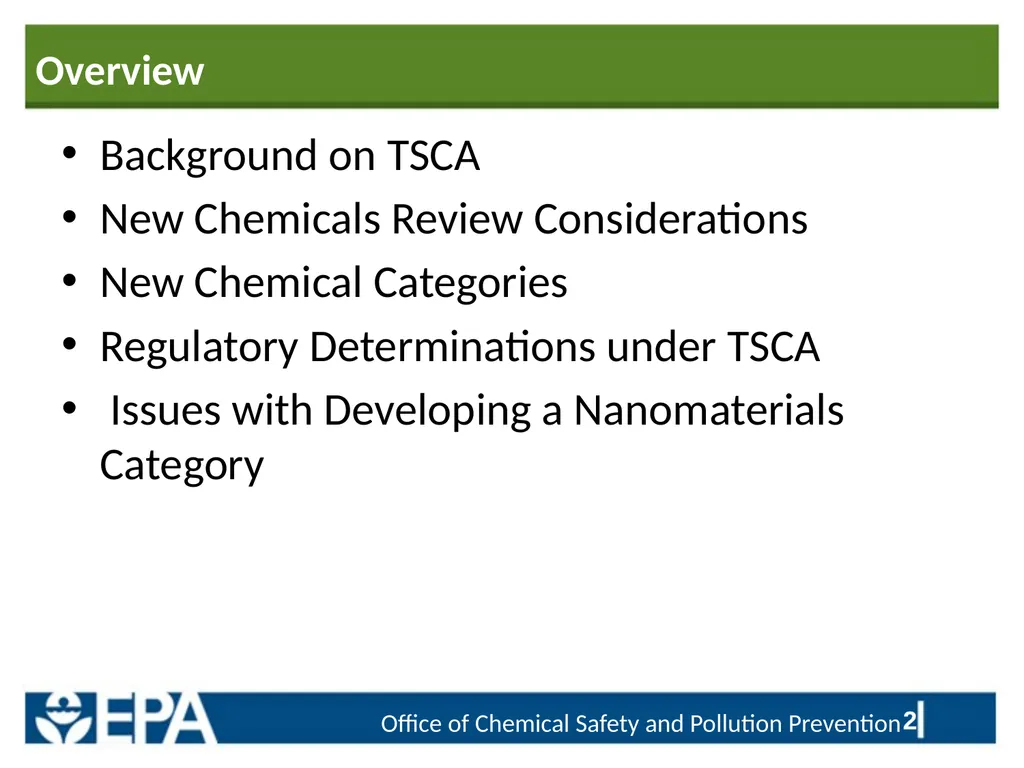
slide2. Overview Background on TSCA
New Chemicals Review Considerations
New Chemical Categories
Regulatory Determinations under TSCA
Issues with Developing a Nanomaterials Category<br>
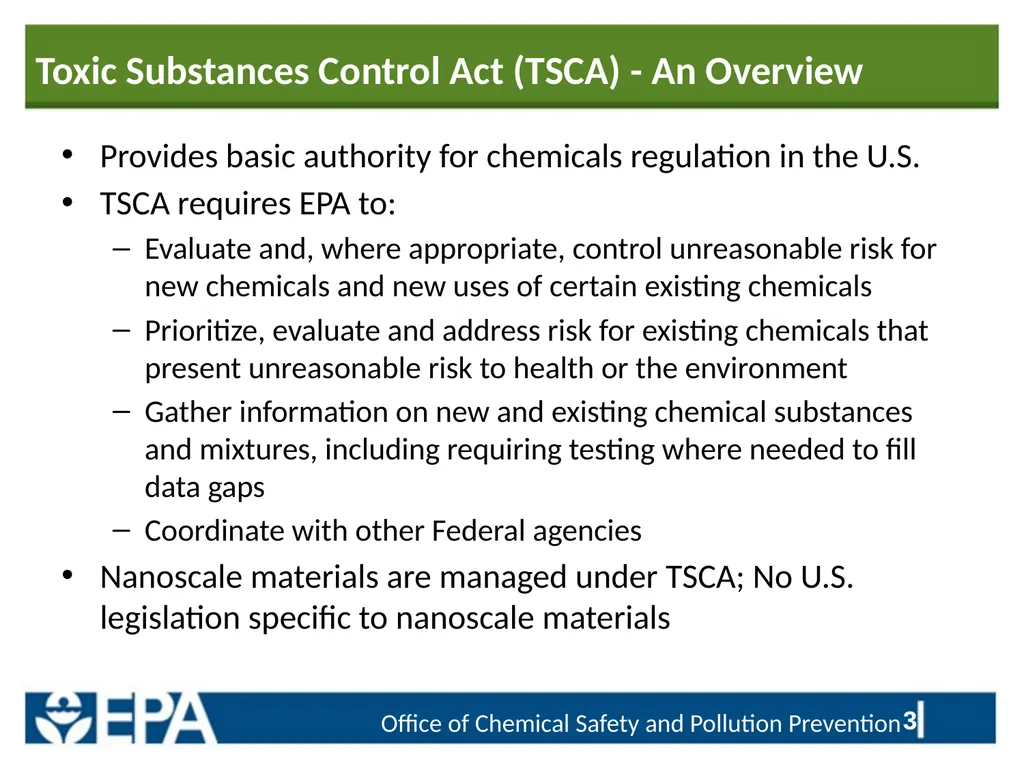
slide3. Toxic Substances Control Act (TSCA) - An Overview Provides basic authority for chemicals regulation in the U.S.
TSCA requires EPA to:
Evaluate and, where appropriate, control unreasonable risk for new chemicals and new uses of certain existing chemicals
Prioritize, evaluate and address risk for existing chemicals that present unreasonable risk to health or the environment
Gather information on new and existing chemical substances and mixtures, including requiring testing where needed to fill data gaps
Coordinate with other Federal agencies
Nanoscale materials are managed under TSCA; No U.S. legislation specific to nanoscale materials<br>
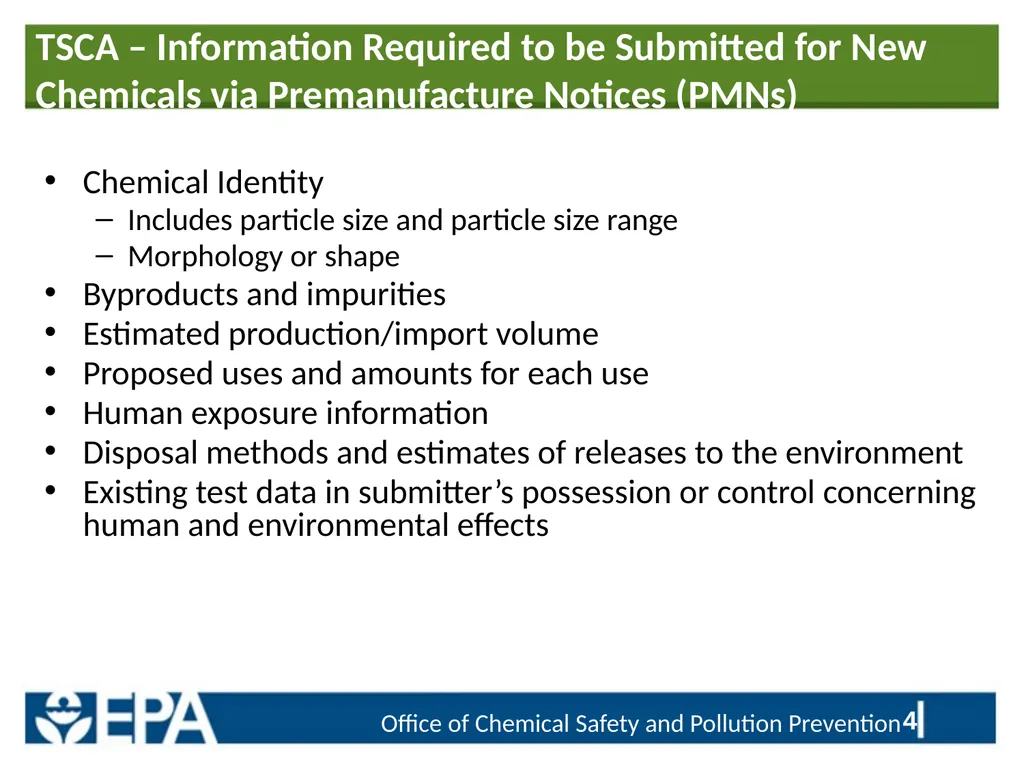
slide4. TSCA – Information Required to be Submitted for New Chemicals via Premanufacture Notices (PMNs) Chemical Identity
Includes particle size and particle size range
Morphology or shape
Byproducts and impurities
Estimated production/import volume
Proposed uses and amounts for each use
Human exposure information
Disposal methods and estimates of releases to the environment
Existing test data in submitter’s possession or control concerning human and environmental effects<br>
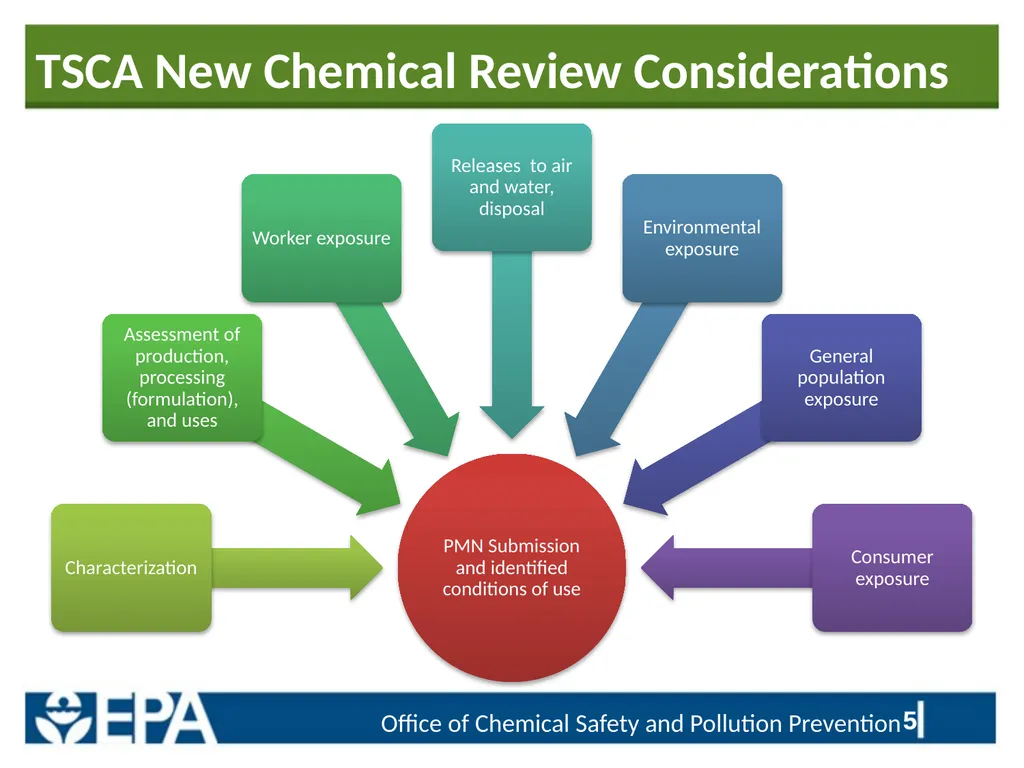
slide5. TSCA New Chemical Review Considerations<br>
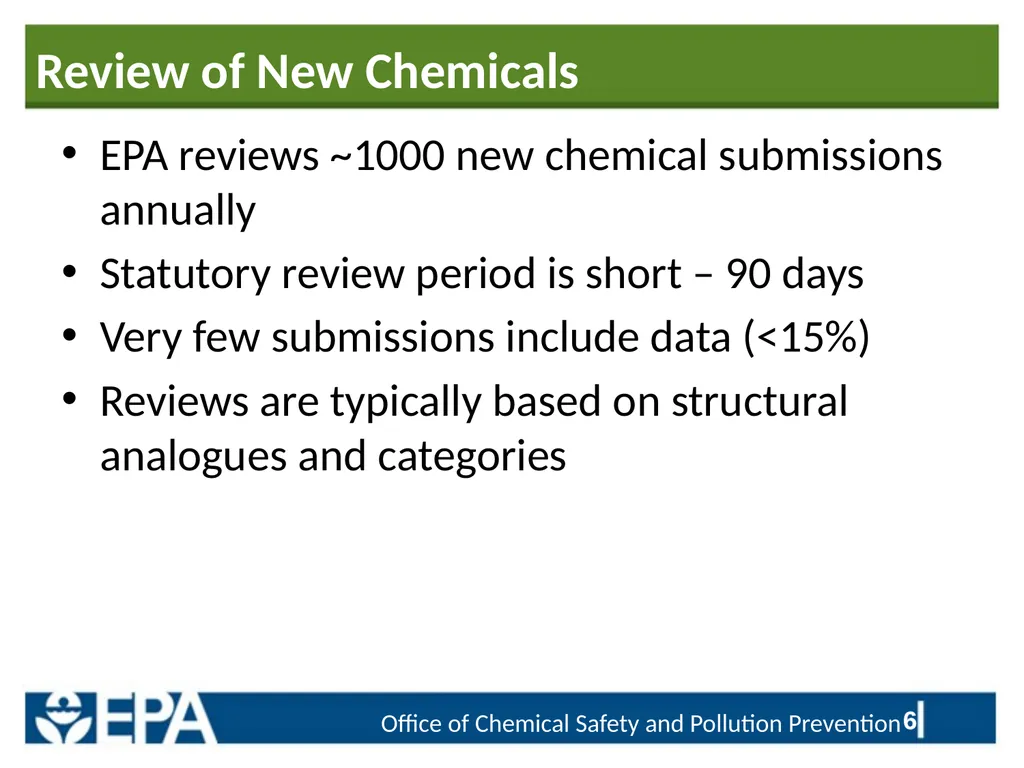
slide6. Review of New Chemicals EPA reviews ~1000 new chemical submissions annually
Statutory review period is short – 90 days
Very few submissions include data (<15%)
Reviews are typically based on structural analogues and categories<br>
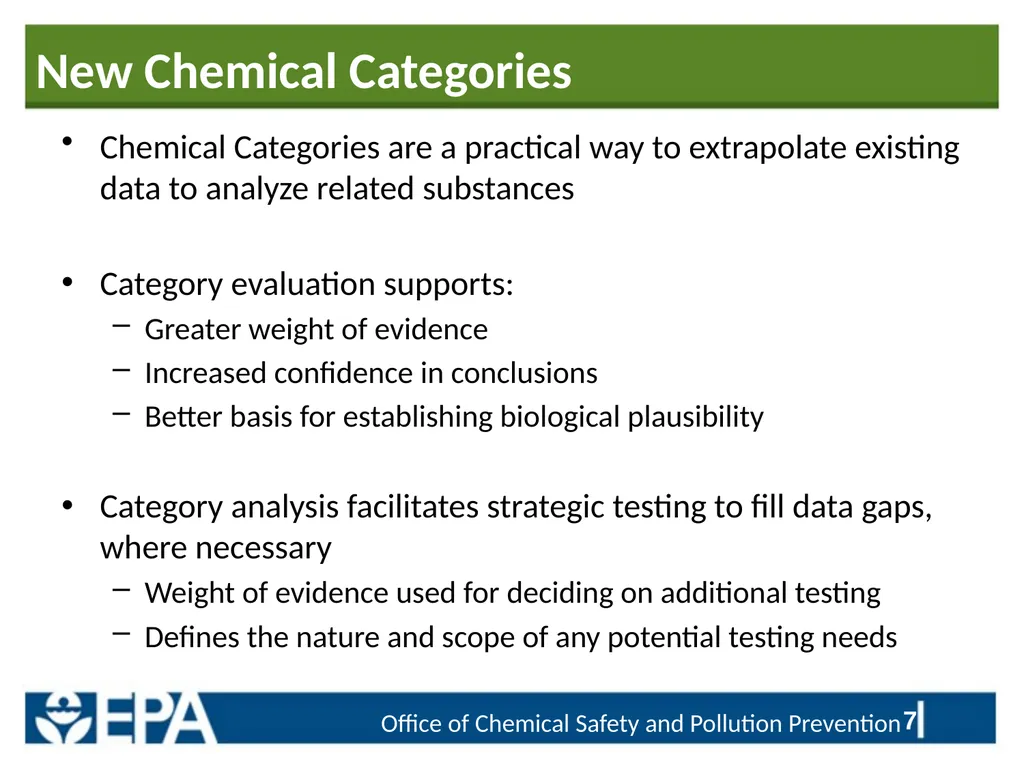
slide7. New Chemical Categories Chemical Categories are a practical way to extrapolate existing data to analyze related substances
Category evaluation supports:
Greater weight of evidence
Increased confidence in conclusions
Better basis for establishing biological plausibility
Category analysis facilitates strategic testing to fill data gaps, where necessary
Weight of evidence used for deciding on additional testing
Defines the nature and scope of any potential testing needs<br>
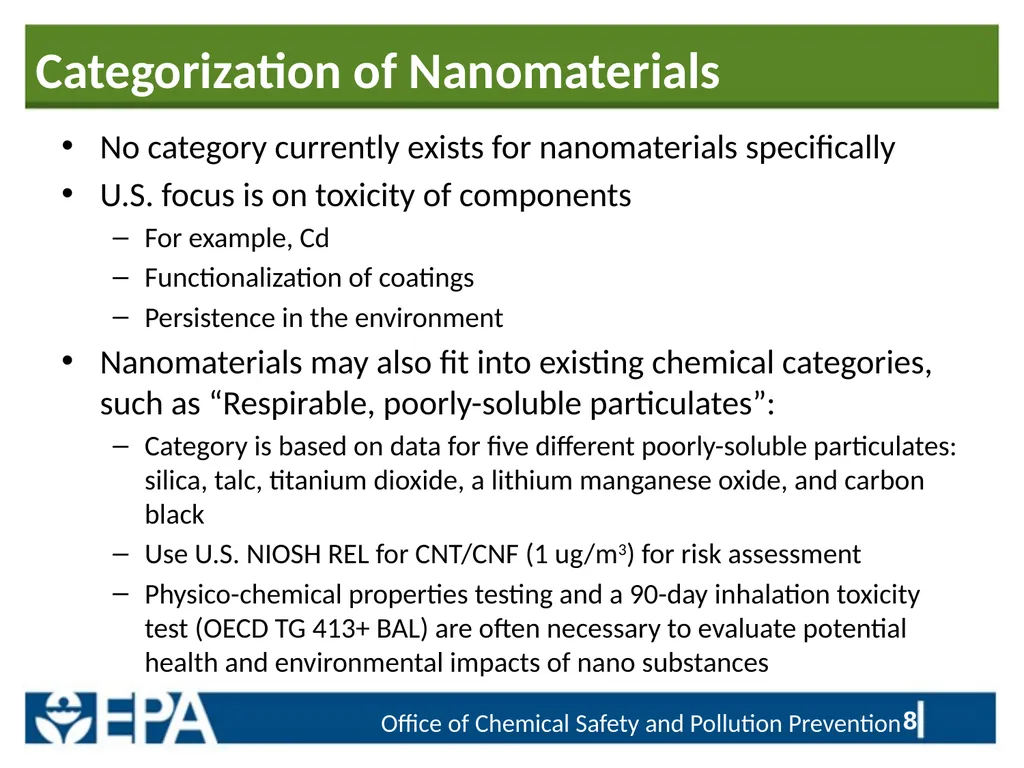
slide8. Categorization of Nanomaterials No category currently exists for nanomaterials specifically
U.S. focus is on toxicity of components
For example, Cd
Functionalization of coatings
Persistence in the environment
Nanomaterials may also fit into existing chemical categories, such as “Respirable, poorly-soluble particulates”:
Category is based on data for five different poorly-soluble particulates: silica, talc, titanium dioxide, a lithium manganese oxide, and carbon black
Use U.S. NIOSH REL for CNT/CNF (1 ug/m3) for risk assessment
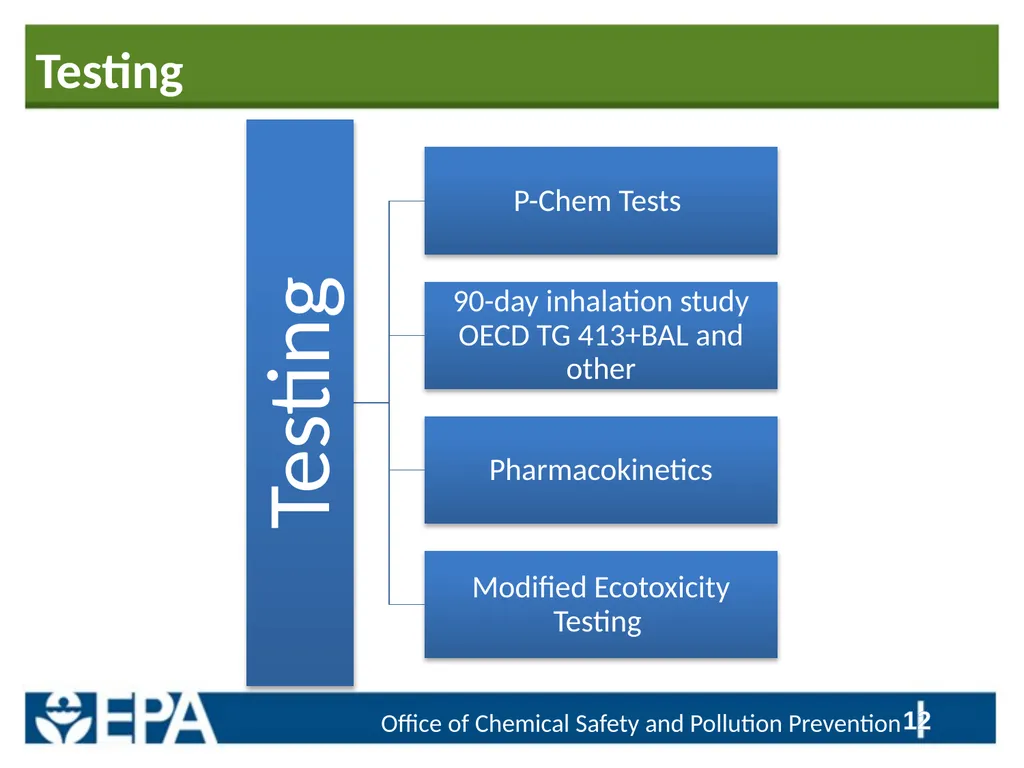
Physico-chemical properties testing and a 90-day inhalation toxicity test (OECD TG 413+ BAL) are often necessary to evaluate potential health and environmental impacts of nano substances<br>
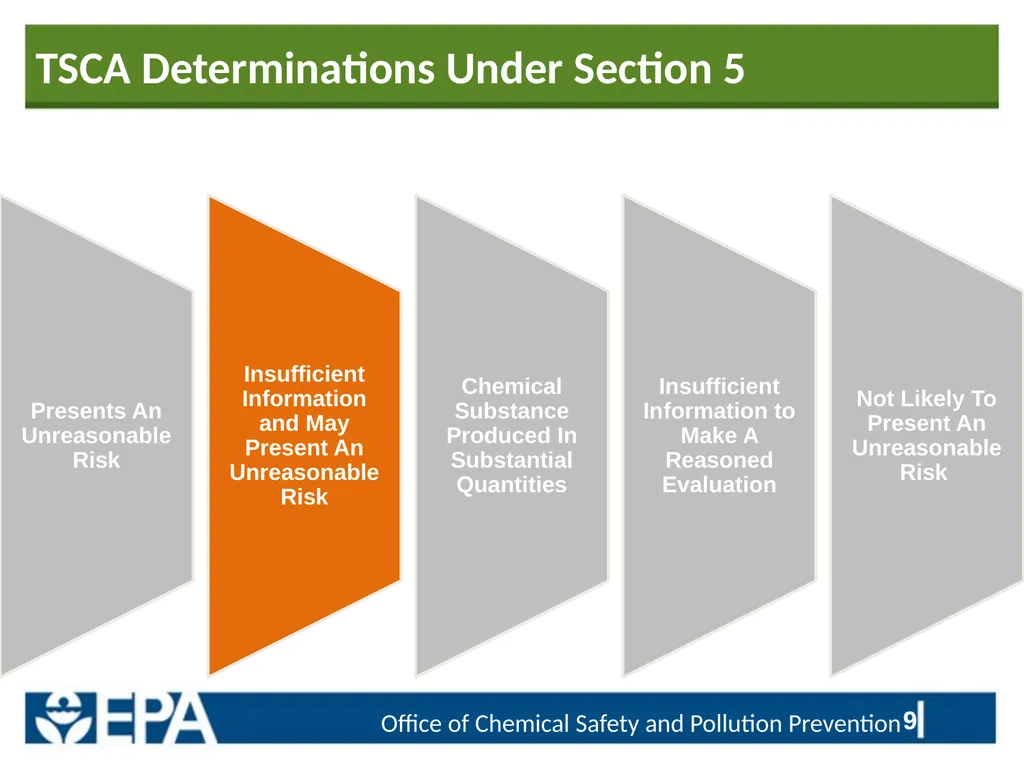
slide9. TSCA Determinations Under Section 5<br>
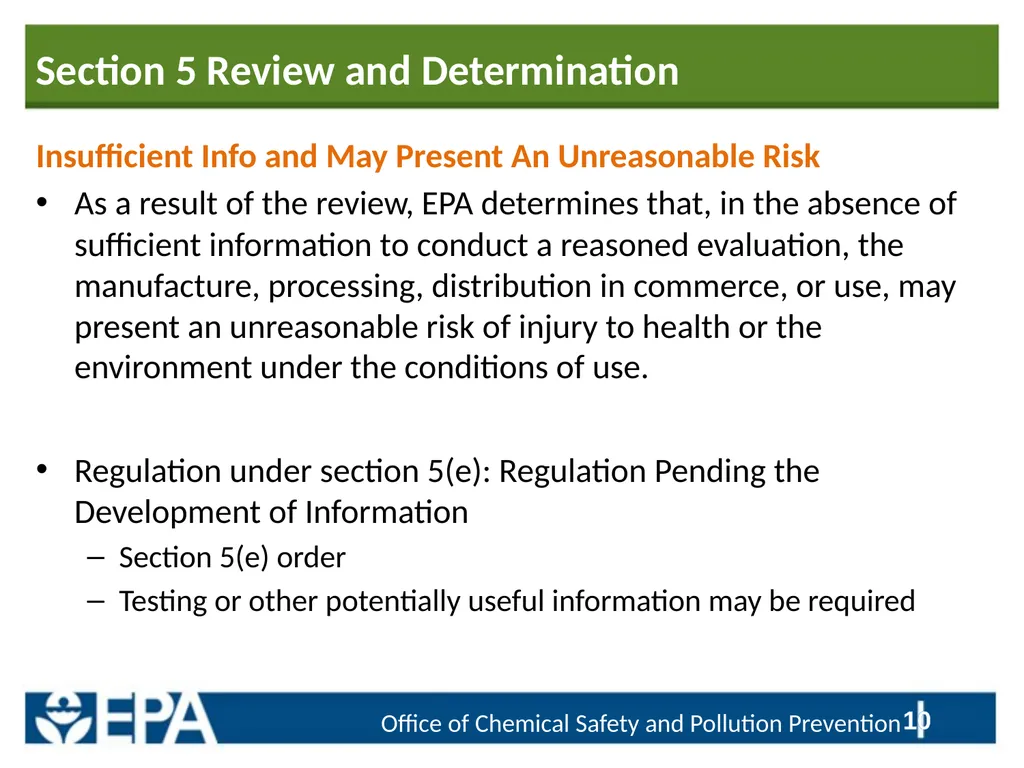
slide10. Insufficient Info and May Present An Unreasonable Risk
As a result of the review, EPA determines that, in the absence of sufficient information to conduct a reasoned evaluation, the manufacture, processing, distribution in commerce, or use, may present an unreasonable risk of injury to health or the environment under the conditions of use.
Regulation under section 5(e): Regulation Pending the Development of Information
Section 5(e) order
Testing or other potentially useful information may be required Section 5 Review and Determination<br>
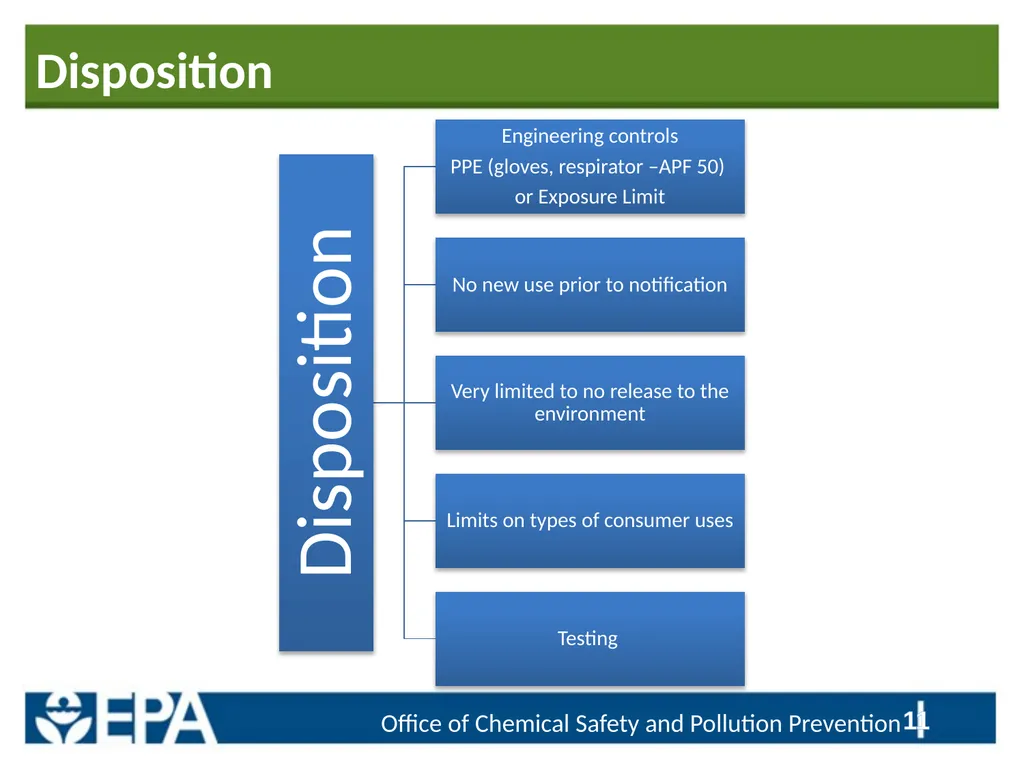
slide11. Disposition<br>
slide12. Testing<br>
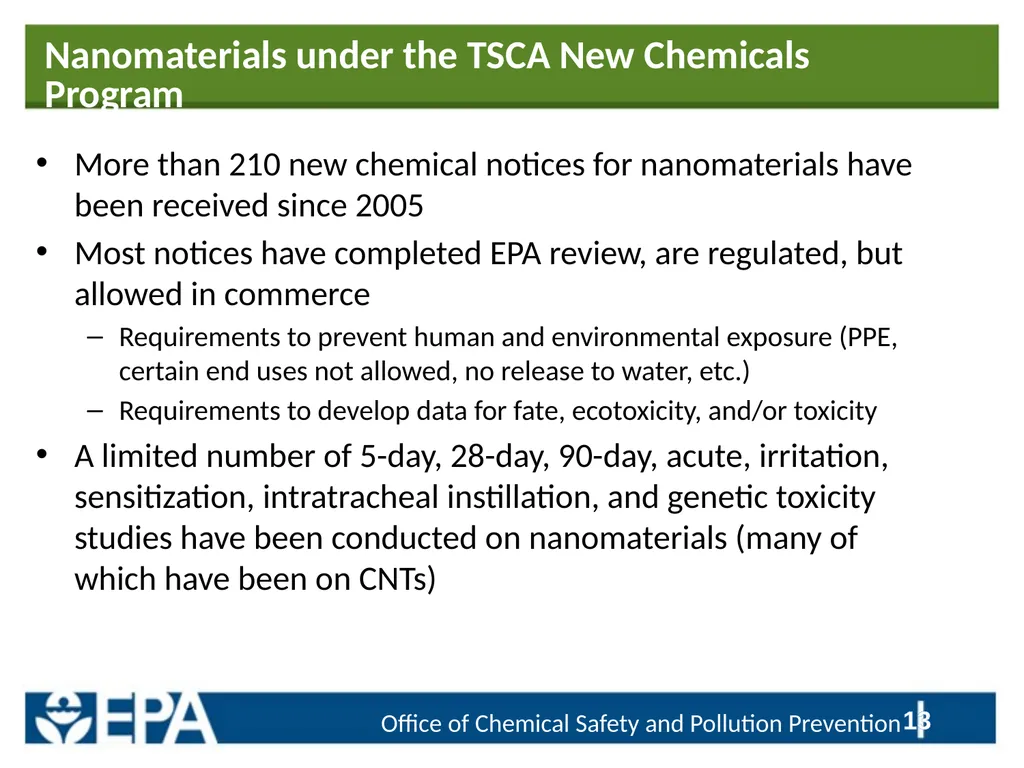
slide13. Nanomaterials under the TSCA New Chemicals Program More than 210 new chemical notices for nanomaterials have been received since 2005
Most notices have completed EPA review, are regulated, but allowed in commerce
Requirements to prevent human and environmental exposure (PPE, certain end uses not allowed, no release to water, etc.)
Requirements to develop data for fate, ecotoxicity, and/or toxicity
A limited number of 5-day, 28-day, 90-day, acute, irritation, sensitization, intratracheal instillation, and genetic toxicity studies have been conducted on nanomaterials (many of which have been on CNTs)<br>
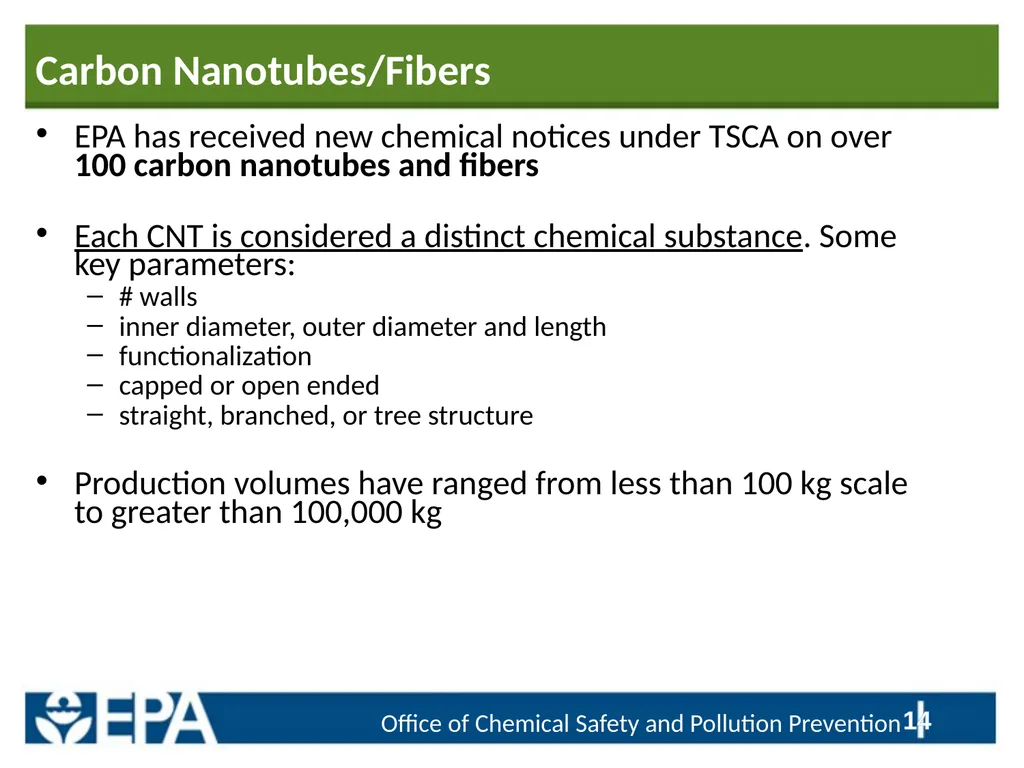
slide14. Carbon Nanotubes/Fibers EPA has received new chemical notices under TSCA on over 100 carbon nanotubes and fibers
Each CNT is considered a distinct chemical substance. Some key parameters:
# walls
inner diameter, outer diameter and length
functionalization
capped or open ended
straight, branched, or tree structure
Production volumes have ranged from less than 100 kg scale to greater than 100,000 kg<br>
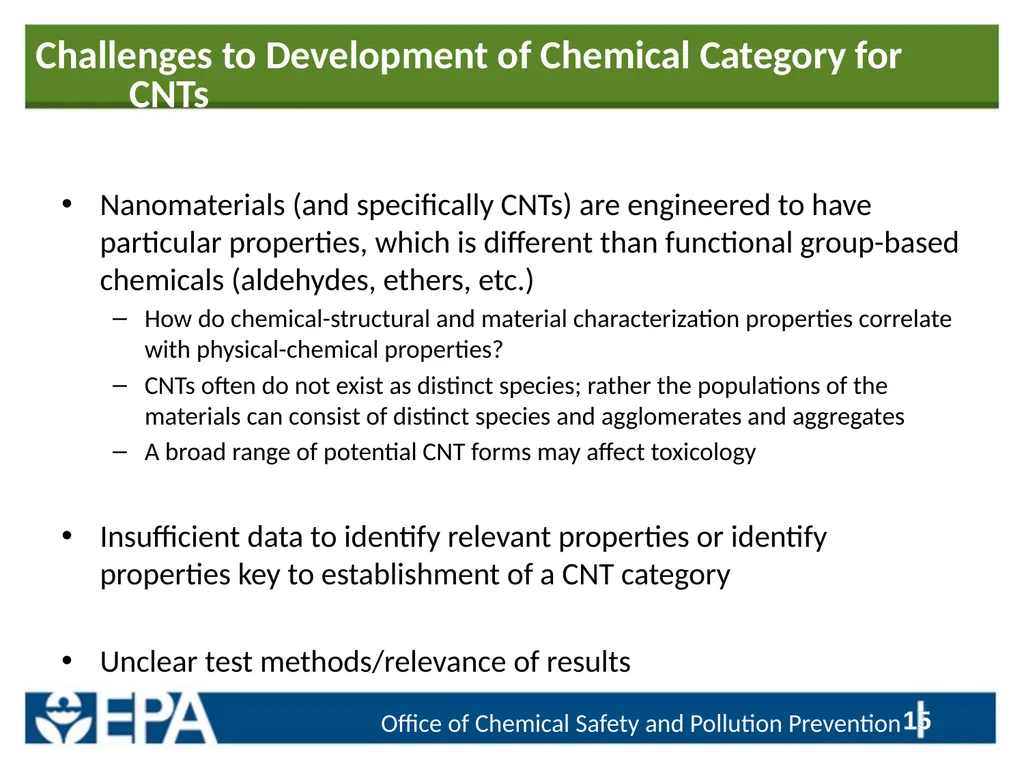
slide15. Challenges to Development of Chemical Category for CNTs Nanomaterials (and specifically CNTs) are engineered to have particular properties, which is different than functional group-based chemicals (aldehydes, ethers, etc.)
How do chemical-structural and material characterization properties correlate with physical-chemical properties?
CNTs often do not exist as distinct species; rather the populations of the materials can consist of distinct species and agglomerates and aggregates
A broad range of potential CNT forms may affect toxicology
Insufficient data to identify relevant properties or identify properties key to establishment of a CNT category
Unclear test methods/relevance of results<br>
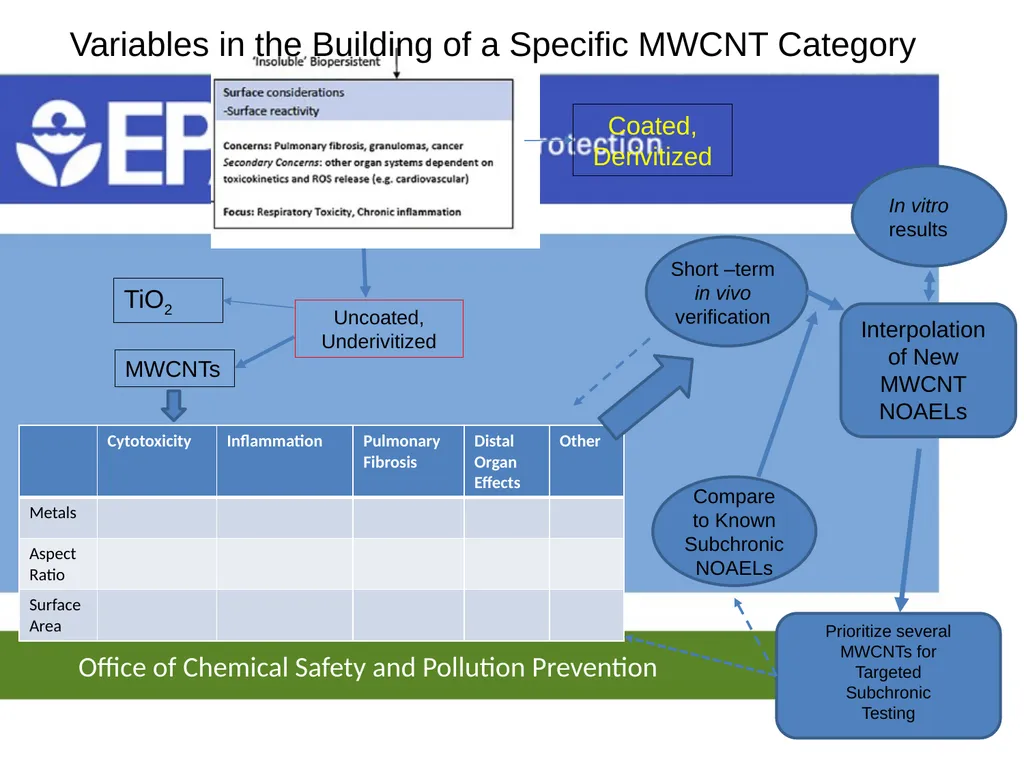
slide16. Variables in the Building of a Specific MWCNT Category Uncoated, Underivitized Coated, Derivitized TiO2 MWCNTs Short –term in vivo verification Compare to Known Subchronic NOAELs Interpolation of New MWCNT NOAELs Prioritize several MWCNTs for Targeted Subchronic Testing In vitro results<br>
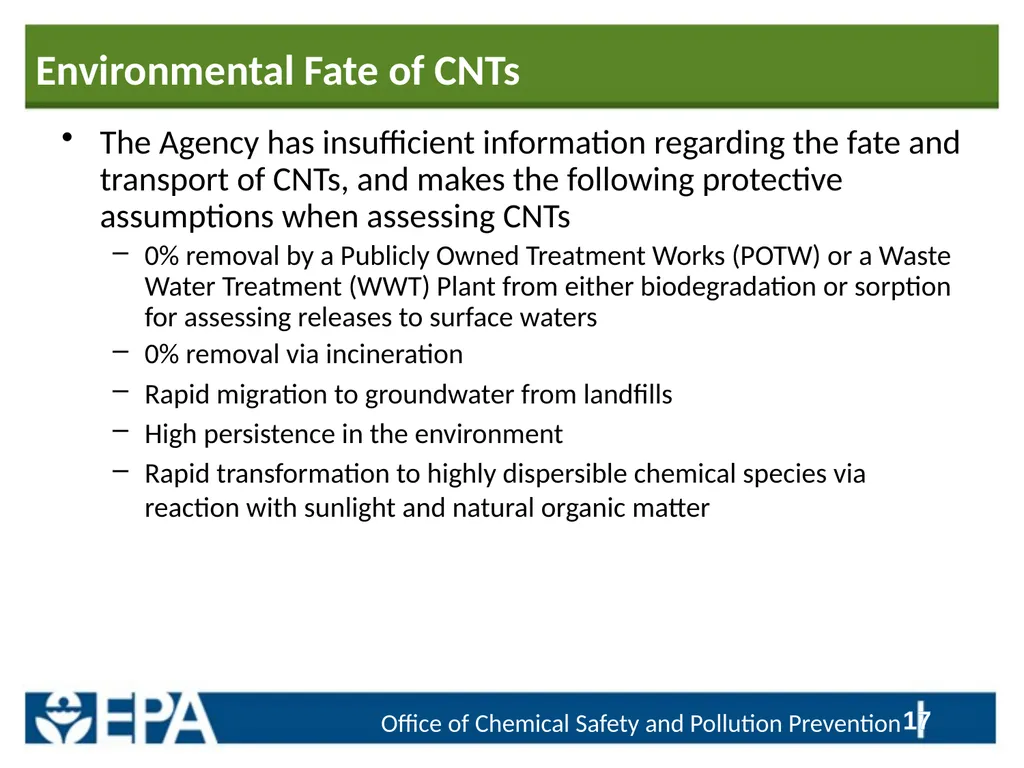
slide17. Environmental Fate of CNTs The Agency has insufficient information regarding the fate and transport of CNTs, and makes the following protective assumptions when assessing CNTs
0% removal by a Publicly Owned Treatment Works (POTW) or a Waste Water Treatment (WWT) Plant from either biodegradation or sorption for assessing releases to surface waters
0% removal via incineration
Rapid migration to groundwater from landfills
High persistence in the environment
Rapid transformation to highly dispersible chemical species via reaction with sunlight and natural organic matter<br>
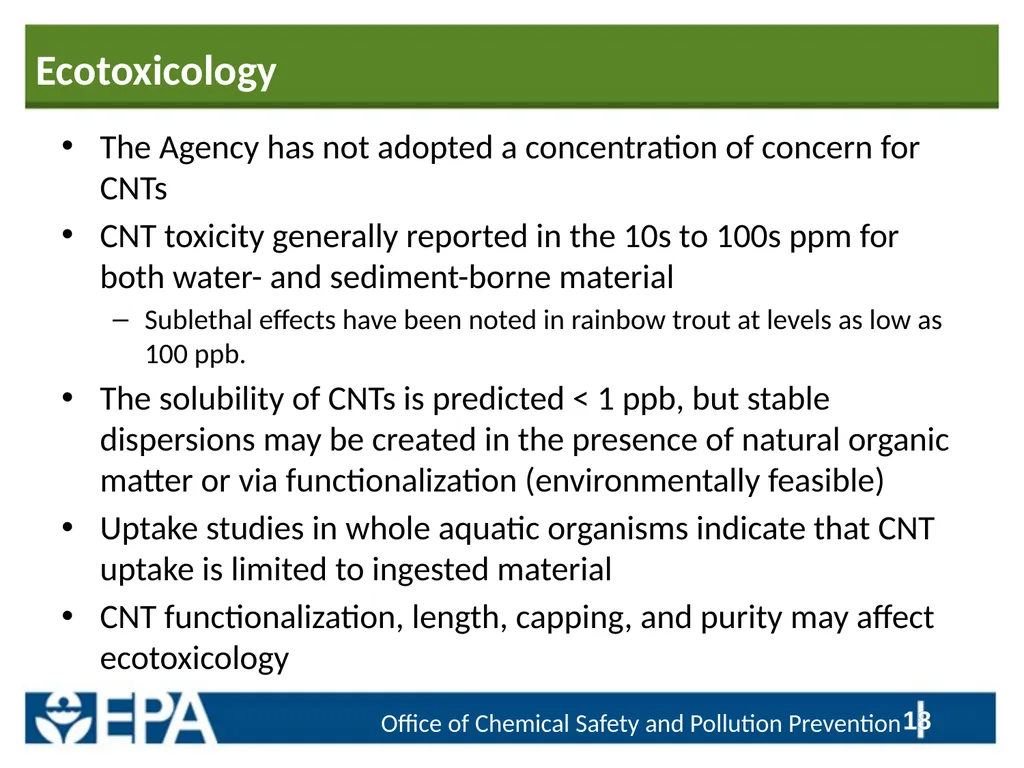
slide18. Ecotoxicology The Agency has not adopted a concentration of concern for CNTs
CNT toxicity generally reported in the 10s to 100s ppm for both water- and sediment-borne material
Sublethal effects have been noted in rainbow trout at levels as low as 100 ppb.
The solubility of CNTs is predicted < 1 ppb, but stable dispersions may be created in the presence of natural organic matter or via functionalization (environmentally feasible)
Uptake studies in whole aquatic organisms indicate that CNT uptake is limited to ingested material
CNT functionalization, length, capping, and purity may affect ecotoxicology<br>
slide19. Environmental Risk Assessment Development of nanomaterial-specific test guidelines are needed for more appropriate environmental hazard assessment
Furthermore, due to the transformation potential of CNTs, the Agency would likely require generation of additional data if a company wanted to release CNTs to the environment<br>
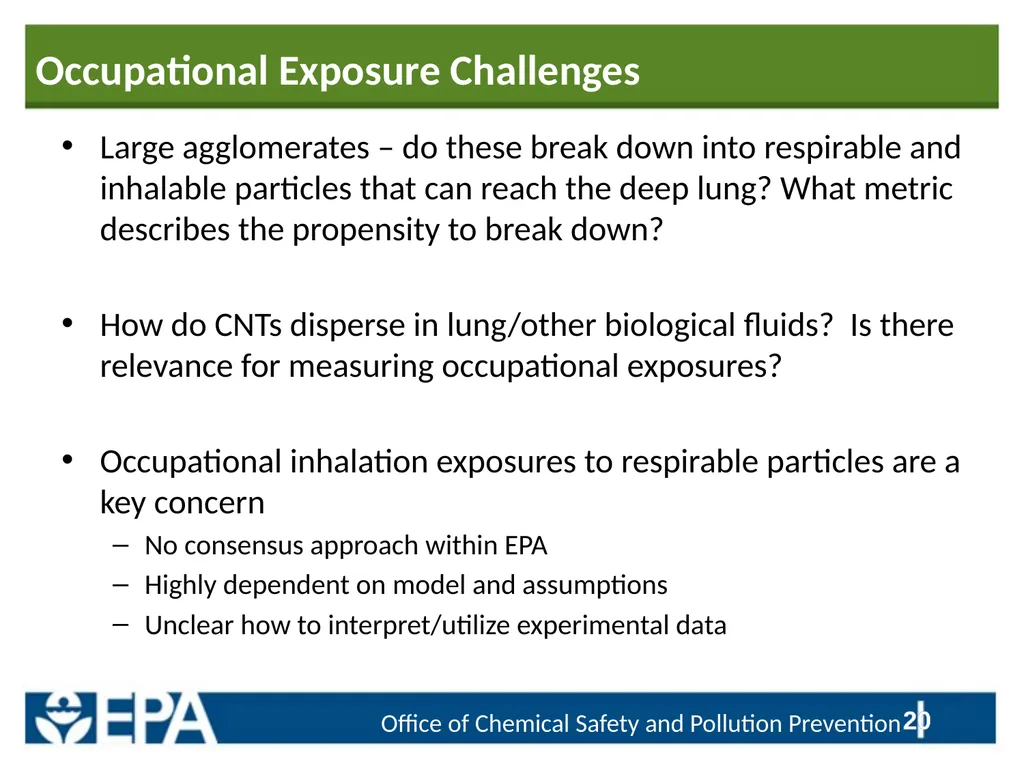
slide20. Occupational Exposure Challenges Large agglomerates – do these break down into respirable and inhalable particles that can reach the deep lung? What metric describes the propensity to break down?
How do CNTs disperse in lung/other biological fluids? Is there relevance for measuring occupational exposures?
Occupational inhalation exposures to respirable particles are a key concern
No consensus approach within EPA
Highly dependent on model and assumptions
Unclear how to interpret/utilize experimental data<br>
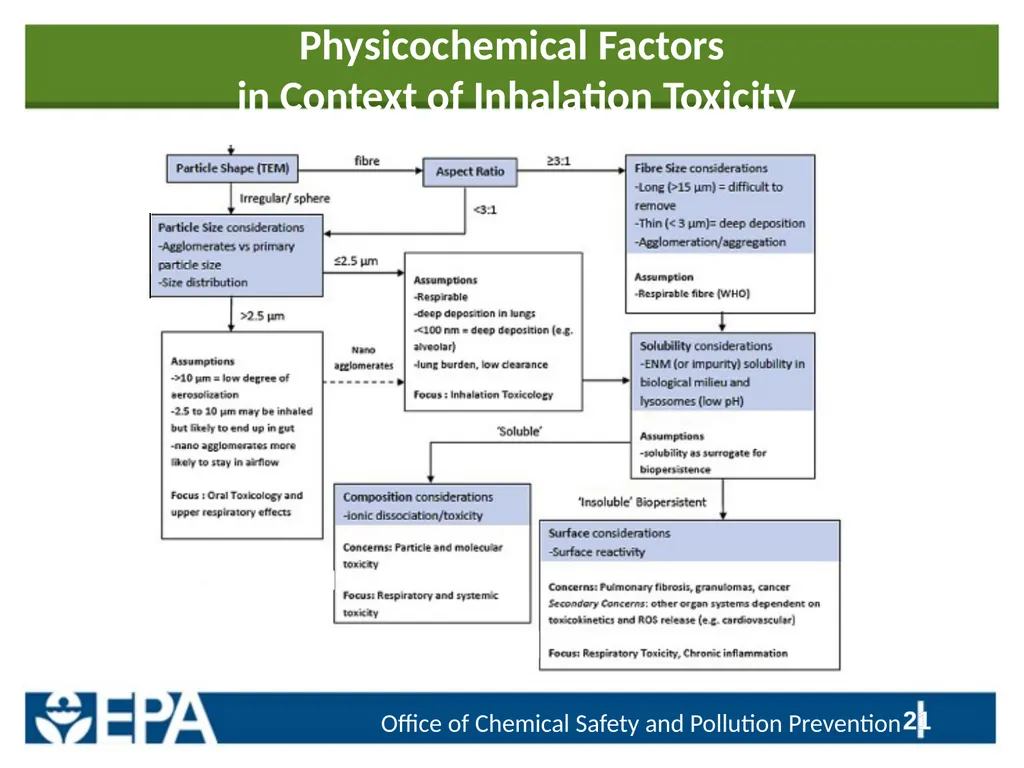
slide21. Physicochemical Factors in Context of Inhalation Toxicity<br>
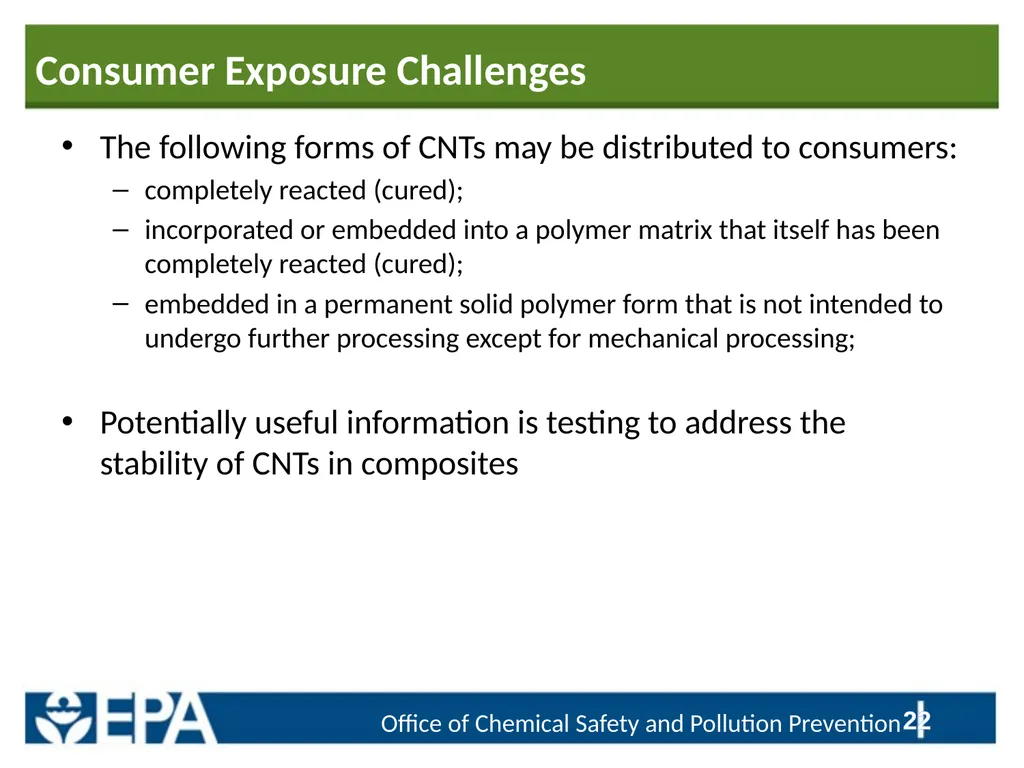
slide22. Consumer Exposure Challenges The following forms of CNTs may be distributed to consumers:
completely reacted (cured);
incorporated or embedded into a polymer matrix that itself has been completely reacted (cured);
embedded in a permanent solid polymer form that is not intended to undergo further processing except for mechanical processing;
Potentially useful information is testing to address the stability of CNTs in composites<br>
slide23. For More Information Reviewing New Chemicals Under TSCA:
https://www.epa.gov/reviewing-new-chemicals-under-toxic-substances-control-act-tsca
Control of Nanoscale Materials Under TSCA:
https://www.epa.gov/reviewing-new-chemicals-under-toxic-substances-control-act-tsca/control-nanoscale-materials-under
Predictive Models and Tools for Assessing Chemicals Under TSCA
https://www.epa.gov/tsca-screening-tools<br>
slide24. Thank you! Kenneth Moss, US EPA
moss.kenneth@epa.gov<br>
slide2. Overview Background on TSCA
New Chemicals Review Considerations
New Chemical Categories
Regulatory Determinations under TSCA
Issues with Developing a Nanomaterials Category<br>
slide3. Toxic Substances Control Act (TSCA) - An Overview Provides basic authority for chemicals regulation in the U.S.
TSCA requires EPA to:
Evaluate and, where appropriate, control unreasonable risk for new chemicals and new uses of certain existing chemicals
Prioritize, evaluate and address risk for existing chemicals that present unreasonable risk to health or the environment
Gather information on new and existing chemical substances and mixtures, including requiring testing where needed to fill data gaps
Coordinate with other Federal agencies
Nanoscale materials are managed under TSCA; No U.S. legislation specific to nanoscale materials<br>
slide4. TSCA – Information Required to be Submitted for New Chemicals via Premanufacture Notices (PMNs) Chemical Identity
Includes particle size and particle size range
Morphology or shape
Byproducts and impurities
Estimated production/import volume
Proposed uses and amounts for each use
Human exposure information
Disposal methods and estimates of releases to the environment
Existing test data in submitter’s possession or control concerning human and environmental effects<br>
slide5. TSCA New Chemical Review Considerations<br>
slide6. Review of New Chemicals EPA reviews ~1000 new chemical submissions annually
Statutory review period is short – 90 days
Very few submissions include data (<15%)
Reviews are typically based on structural analogues and categories<br>
slide7. New Chemical Categories Chemical Categories are a practical way to extrapolate existing data to analyze related substances
Category evaluation supports:
Greater weight of evidence
Increased confidence in conclusions
Better basis for establishing biological plausibility
Category analysis facilitates strategic testing to fill data gaps, where necessary
Weight of evidence used for deciding on additional testing
Defines the nature and scope of any potential testing needs<br>
slide8. Categorization of Nanomaterials No category currently exists for nanomaterials specifically
U.S. focus is on toxicity of components
For example, Cd
Functionalization of coatings
Persistence in the environment
Nanomaterials may also fit into existing chemical categories, such as “Respirable, poorly-soluble particulates”:
Category is based on data for five different poorly-soluble particulates: silica, talc, titanium dioxide, a lithium manganese oxide, and carbon black
Use U.S. NIOSH REL for CNT/CNF (1 ug/m3) for risk assessment
Physico-chemical properties testing and a 90-day inhalation toxicity test (OECD TG 413+ BAL) are often necessary to evaluate potential health and environmental impacts of nano substances<br>
slide9. TSCA Determinations Under Section 5<br>
slide10. Insufficient Info and May Present An Unreasonable Risk
As a result of the review, EPA determines that, in the absence of sufficient information to conduct a reasoned evaluation, the manufacture, processing, distribution in commerce, or use, may present an unreasonable risk of injury to health or the environment under the conditions of use.
Regulation under section 5(e): Regulation Pending the Development of Information
Section 5(e) order
Testing or other potentially useful information may be required Section 5 Review and Determination<br>
slide11. Disposition<br>
slide12. Testing<br>
slide13. Nanomaterials under the TSCA New Chemicals Program More than 210 new chemical notices for nanomaterials have been received since 2005
Most notices have completed EPA review, are regulated, but allowed in commerce
Requirements to prevent human and environmental exposure (PPE, certain end uses not allowed, no release to water, etc.)
Requirements to develop data for fate, ecotoxicity, and/or toxicity
A limited number of 5-day, 28-day, 90-day, acute, irritation, sensitization, intratracheal instillation, and genetic toxicity studies have been conducted on nanomaterials (many of which have been on CNTs)<br>
slide14. Carbon Nanotubes/Fibers EPA has received new chemical notices under TSCA on over 100 carbon nanotubes and fibers
Each CNT is considered a distinct chemical substance. Some key parameters:
# walls
inner diameter, outer diameter and length
functionalization
capped or open ended
straight, branched, or tree structure
Production volumes have ranged from less than 100 kg scale to greater than 100,000 kg<br>
slide15. Challenges to Development of Chemical Category for CNTs Nanomaterials (and specifically CNTs) are engineered to have particular properties, which is different than functional group-based chemicals (aldehydes, ethers, etc.)
How do chemical-structural and material characterization properties correlate with physical-chemical properties?
CNTs often do not exist as distinct species; rather the populations of the materials can consist of distinct species and agglomerates and aggregates
A broad range of potential CNT forms may affect toxicology
Insufficient data to identify relevant properties or identify properties key to establishment of a CNT category
Unclear test methods/relevance of results<br>
slide16. Variables in the Building of a Specific MWCNT Category Uncoated, Underivitized Coated, Derivitized TiO2 MWCNTs Short –term in vivo verification Compare to Known Subchronic NOAELs Interpolation of New MWCNT NOAELs Prioritize several MWCNTs for Targeted Subchronic Testing In vitro results<br>
slide17. Environmental Fate of CNTs The Agency has insufficient information regarding the fate and transport of CNTs, and makes the following protective assumptions when assessing CNTs
0% removal by a Publicly Owned Treatment Works (POTW) or a Waste Water Treatment (WWT) Plant from either biodegradation or sorption for assessing releases to surface waters
0% removal via incineration
Rapid migration to groundwater from landfills
High persistence in the environment
Rapid transformation to highly dispersible chemical species via reaction with sunlight and natural organic matter<br>
slide18. Ecotoxicology The Agency has not adopted a concentration of concern for CNTs
CNT toxicity generally reported in the 10s to 100s ppm for both water- and sediment-borne material
Sublethal effects have been noted in rainbow trout at levels as low as 100 ppb.
The solubility of CNTs is predicted < 1 ppb, but stable dispersions may be created in the presence of natural organic matter or via functionalization (environmentally feasible)
Uptake studies in whole aquatic organisms indicate that CNT uptake is limited to ingested material
CNT functionalization, length, capping, and purity may affect ecotoxicology<br>
slide19. Environmental Risk Assessment Development of nanomaterial-specific test guidelines are needed for more appropriate environmental hazard assessment
Furthermore, due to the transformation potential of CNTs, the Agency would likely require generation of additional data if a company wanted to release CNTs to the environment<br>
slide20. Occupational Exposure Challenges Large agglomerates – do these break down into respirable and inhalable particles that can reach the deep lung? What metric describes the propensity to break down?
How do CNTs disperse in lung/other biological fluids? Is there relevance for measuring occupational exposures?
Occupational inhalation exposures to respirable particles are a key concern
No consensus approach within EPA
Highly dependent on model and assumptions
Unclear how to interpret/utilize experimental data<br>
slide21. Physicochemical Factors in Context of Inhalation Toxicity<br>
slide22. Consumer Exposure Challenges The following forms of CNTs may be distributed to consumers:
completely reacted (cured);
incorporated or embedded into a polymer matrix that itself has been completely reacted (cured);
embedded in a permanent solid polymer form that is not intended to undergo further processing except for mechanical processing;
Potentially useful information is testing to address the stability of CNTs in composites<br>
slide23. For More Information Reviewing New Chemicals Under TSCA:
https://www.epa.gov/reviewing-new-chemicals-under-toxic-substances-control-act-tsca
Control of Nanoscale Materials Under TSCA:
https://www.epa.gov/reviewing-new-chemicals-under-toxic-substances-control-act-tsca/control-nanoscale-materials-under
Predictive Models and Tools for Assessing Chemicals Under TSCA
https://www.epa.gov/tsca-screening-tools<br>
slide24. Thank you! Kenneth Moss, US EPA
moss.kenneth@epa.gov<br>