Rehabilitation considerations during the COVID-19 outbreak 16th July 2020 Pauline Kleinitz, Rehabilitation Programme, WHO Headquarters Why we need to consider rehabilitation? Impact of COVID-19 on rehabilitation services Survey Results of
"Rehabilitation considerations during the COVID-19" is the property of its rightful owner. Permission is granted to
download and print the materials on this website for personal, non-commercial use only, and to display it
on your personal computer provided you do not modify the materials and that you retain all copyright
notices contained in the materials. By downloading content from our website, you accept the terms of this
agreement.
Presentation Transcript
01
Rehabilitation considerations during the COVID-19 outbreak 16th July 2020 Pauline Kleinitz, Rehabilitation Programme, WHO Headquarters<br>
02
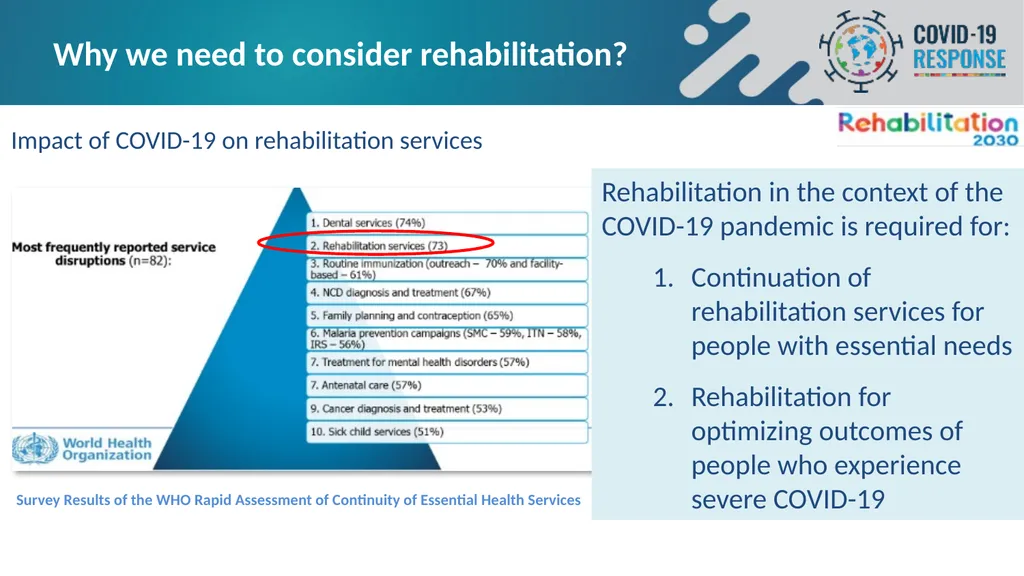
Why we need to consider rehabilitation? Impact of COVID-19 on rehabilitation services Survey Results of the WHO Rapid Assessment of Continuity of Essential Health Services Rehabilitation in the context of the COVID-19 pandemic is required for:
Continuation of rehabilitation services for people with essential needs
Rehabilitation for optimizing outcomes of people who experience severe COVID-19<br>
03
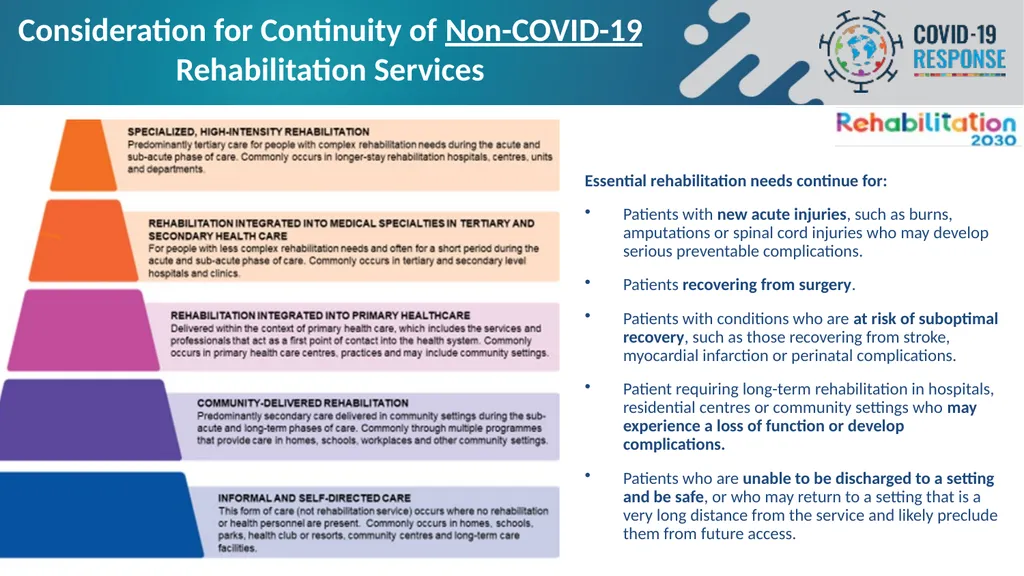
Consideration for Continuity of Non-COVID-19 Rehabilitation Services Essential rehabilitation needs continue for:
Patients with new acute injuries, such as burns, amputations or spinal cord injuries who may develop serious preventable complications.
Patients recovering from surgery.
Patients with conditions who are at risk of suboptimal recovery, such as those recovering from stroke, myocardial infarction or perinatal complications.
Patient requiring long-term rehabilitation in hospitals, residential centres or community settings who may experience a loss of function or develop complications.
Patients who are unable to be discharged to a setting and be safe, or who may return to a setting that is a very long distance from the service and likely preclude them from future access.<br>
04
Rehabilitation for Severe COVID-19 Severe COVID-19 patients
The illness may be complicated by respiratory failure and other forms of multi organ failure, resulting in ICU admission with likely invasive mechanical ventilation.
Rehabilitation needs are typically related to the consequences of ventilatory support, and prolonged immobilization<br>
05
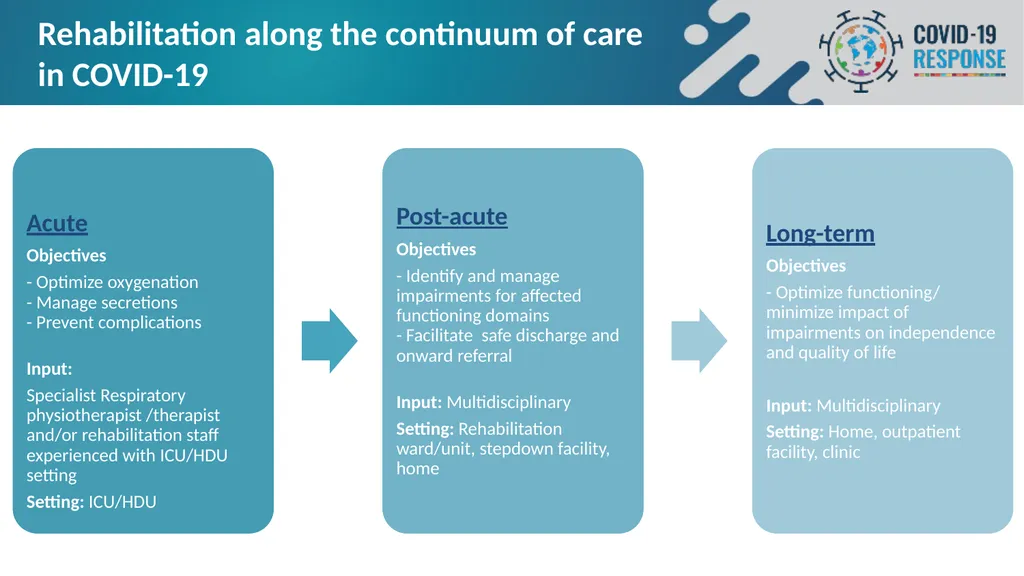
Rehabilitation along the continuum of care in COVID-19<br>
06
Rehabilitation for severe COVID-19 Impairments most likely to encounter:
Physical deconditioning and muscle weakness, fatigue
Impaired lung function
Delirium and other cognitive impairments
Impaired swallow and communication
Mental health disorders and psychosocial support needs.
Multi-disciplinary team approach is key
Still many unknowns related to the pathophysiology of COVID-19 and the long-term complications, many organs can be affected<br>
07
Common country experiences Rehabilitation services significantly reduced and often without full consideration of the consequences. Decisions made locally regarding continuation of rehabilitation services, limited national direction. Inadequate consideration of all four factors regarding service continuation :
Risks associated with cessation or reduction of services for different patient groups
Feasibility and appropriateness of alternative modes of service delivery e.g. telehealth, home outreach
Access to PPE and robustness of IPC measures in different settings
Capacity of the rehabilitation workforce, e.g. available for redistribution
COVID-19 related rehabilitation needs increased in tertiary settings and major urban areas, but less ‘new’ need in rural areas. Generally, reduced demand in line with reductions in elective surgery, transportation, lockdowns etc
Where face to face rehabilitation has not been an option a re-purposing workforce towards alternatives like tele-health, advice/help lines and developing self management plans has occurred, as has re-purposing for triage and other urgent needs<br>
08
Common country experiences PPE for rehabilitation personnel is essential but concerns repeatedly raised about limited access. Unmet rehabilitation needs & lack of resources reported to ministries of health, advocacy by professionals essential, value of involving rehabilitation workforce in service decisions highlighted
Telehealth (primarily phone calls) being utilised for service delivery for patients - important way forward
Online videos for patient rehabilitation and pre-developed pamphlets used for COVID-19 clients
Supply chains for assistive products interrupted
Greater task-sharing, upskilling and transdisciplinary teamwork occurring – but must be within scope of practice.
Rehabilitation professionals undertaking online training
Inadequate social support services for people with disabilities repeatedly highlighted as a concern<br>
09
Rehabilitation sector reflections No perfect response
Context vary, teams vary - need to adopt, adapt and evaluate approaches
Opportunity to highlight the value of rehabilitation
Opportunity to strengthen teams and efficiencies
Opportunity to harness telehealth for the long term
Importance of social sector support services for people with disabilities, and continuation of health and social sector collaboration
Opportunity to learn and link with international groups/ resources / training<br>
10
THANK YOU<br>
11
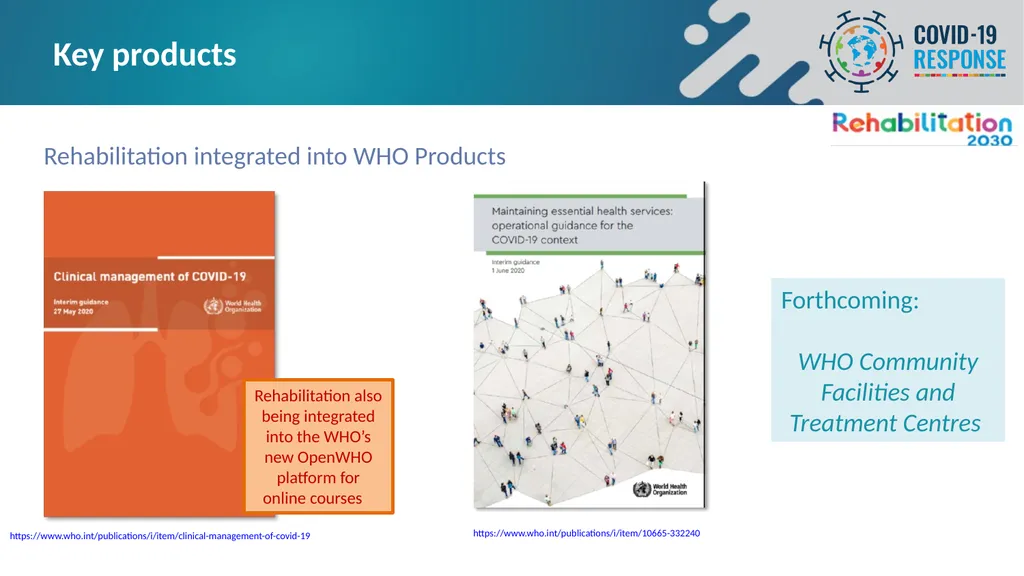
Key products Rehabilitation integrated into WHO Products Rehabilitation also being integrated into the WHO’s new OpenWHO platform for online courses https://www.who.int/publications/i/item/clinical-management-of-covid-19 https://www.who.int/publications/i/item/10665-332240 Forthcoming:
WHO Community Facilities and Treatment Centres<br>
12
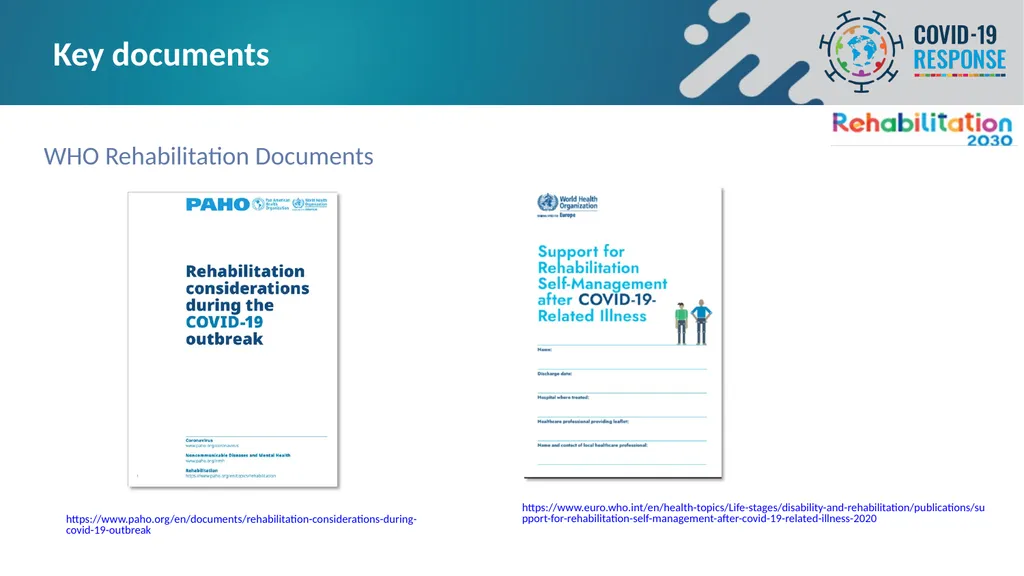
Key documents WHO Rehabilitation Documents https://www.paho.org/en/documents/rehabilitation-considerations-during-covid-19-outbreak https://www.euro.who.int/en/health-topics/Life-stages/disability-and-rehabilitation/publications/support-for-rehabilitation-self-management-after-covid-19-related-illness-2020<br>
13
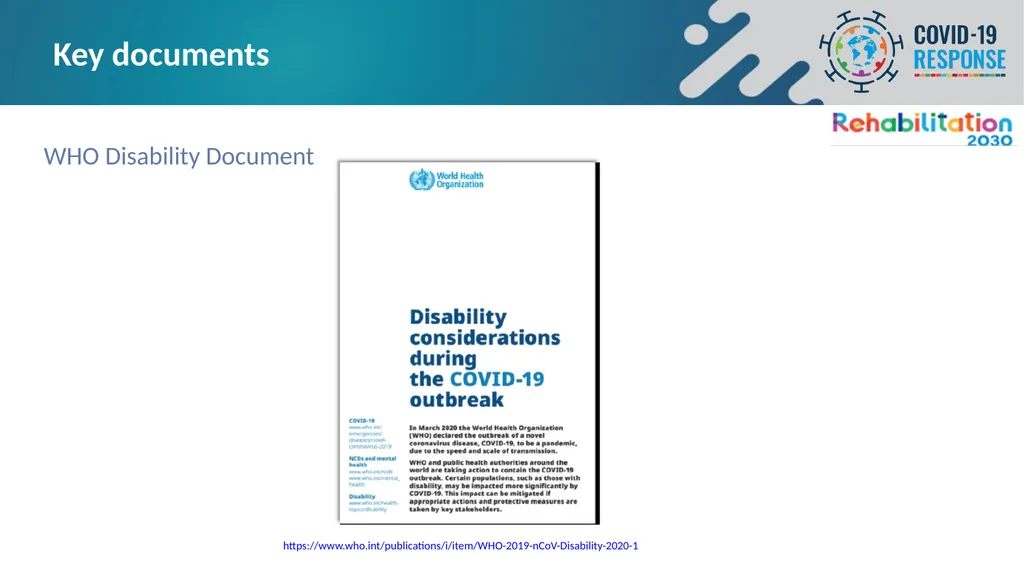
Key documents WHO Disability Document https://www.who.int/publications/i/item/WHO-2019-nCoV-Disability-2020-1<br>