
Relational Aggression: Sugar and Spice But Not
CS
Published · 22 slides · 0 views

1 / 1


Description
Relational Aggression: Sugar and Spice But Not Always Nice! Ann D. Collier, Ph.D. Psychology Department Northern Arizona University Bullying typically refers to direct aggression, or an overt physical act or assault Relational Aggression
Related Topics
Share
Embed code
Download this presentation From Below
"Relational Aggression: Sugar and Spice But Not" is the property of its rightful owner. Permission is granted to download and print the materials on this website for personal, non-commercial use only, and to display it on your personal computer provided you do not modify the materials and that you retain all copyright notices contained in the materials. By downloading content from our website, you accept the terms of this agreement.
Presentation Transcript
01
Relational Aggression: Sugar and Spice But Not Always Nice! Ann D. Collier, Ph.D.
Psychology Department
Northern Arizona University<br>
Psychology Department
Northern Arizona University<br>
02
Bullying typically refers to direct aggression, or an overt physical act or assault
Relational Aggression (social aggression) is indirect and is aimed at damaging another’s self-esteem, social status, or both. It can include:
verbal threats,
social exclusion
ostracism
malicious gossip
scapegoating
secret telling
threats of friendship withdrawal
Non-verbal communication Mean Girls<br>
Relational Aggression (social aggression) is indirect and is aimed at damaging another’s self-esteem, social status, or both. It can include:
verbal threats,
social exclusion
ostracism
malicious gossip
scapegoating
secret telling
threats of friendship withdrawal
Non-verbal communication Mean Girls<br>
03
Look at the frequency and intensity of behaviors; ask child, mother, teacher. Believe the child!
Exclusion to upset the child
Pressure to do things s/he doesn’t want to do
Lies or nasty things said about others
Games spoiled
Tricked in a nasty way
Called nasty names How to assess relational aggression<br>
Exclusion to upset the child
Pressure to do things s/he doesn’t want to do
Lies or nasty things said about others
Games spoiled
Tricked in a nasty way
Called nasty names How to assess relational aggression<br>
04
Every Saturday night a girl in your class has a party. She invites all your friends but never invites you.
One Friday you wear a new dress to school and your best friend tells you on the way to class that it makes you look fat.
A girl in your class regularly starts rumors about people at school that are not true.
A group of girls is passing notes in class and when certain people raise their hands, all of the girls giggle.
Raskauskas & Stoltz (2004) Which of these are Normal?<br>
One Friday you wear a new dress to school and your best friend tells you on the way to class that it makes you look fat.
A girl in your class regularly starts rumors about people at school that are not true.
A group of girls is passing notes in class and when certain people raise their hands, all of the girls giggle.
Raskauskas & Stoltz (2004) Which of these are Normal?<br>
05
Childhood typically spent practicing caretaking and nurturing, e.g., with dolls
Best friends discover joys of intimacy and connection
Belonging to a peer group bolsters confidence and reinforces identity; protects the child from isolation and victimization Girls are Supposed to be Friends!<br>
Best friends discover joys of intimacy and connection
Belonging to a peer group bolsters confidence and reinforces identity; protects the child from isolation and victimization Girls are Supposed to be Friends!<br>
06
Girls are deeply intertwined and threatened when faced with conflict or disagreement
Girls are socialized away from aggression; unprepared to negotiate conflict.
Minor disagreement can call an entire relationship into question
Anger can’t be voiced; they are not taught skills to handle conflict. In fact, they are more often taught to manage their anger and disappointment covertly
Passivity is reinforced by same-sex peer group
Adults minimize it as just “being girls” When there is conflict amongst friends….<br>
Girls are socialized away from aggression; unprepared to negotiate conflict.
Minor disagreement can call an entire relationship into question
Anger can’t be voiced; they are not taught skills to handle conflict. In fact, they are more often taught to manage their anger and disappointment covertly
Passivity is reinforced by same-sex peer group
Adults minimize it as just “being girls” When there is conflict amongst friends….<br>
07
Girls often turn to romantic relationships to meet their unmet social-emotional needs (again, without the skills)
Associated with more stress or relationship violence in later heterosexual romantic relationships
Need to learn to work it out with same-sex peers first!
Pressure for romantic heterosexual relationships at a very young age
Puts girls at risk for victimization because they lack the social skills to negotiate the increased dependency or intimacy with older males Romantic relationships in girls<br>
Associated with more stress or relationship violence in later heterosexual romantic relationships
Need to learn to work it out with same-sex peers first!
Pressure for romantic heterosexual relationships at a very young age
Puts girls at risk for victimization because they lack the social skills to negotiate the increased dependency or intimacy with older males Romantic relationships in girls<br>
08
Girls put more emphasis on establishing close and intimate connections
Girls are taught that aggression is unacceptable
With few outlets to be assertive (or aggressive), girls are socialized to hurt each other through damaging peer relationships
When girls are taught empathy and how to handle conflict appropriately, it lowers the chances of relational aggression In summary……. “So Why Are They so Mean?”<br>
Girls are taught that aggression is unacceptable
With few outlets to be assertive (or aggressive), girls are socialized to hurt each other through damaging peer relationships
When girls are taught empathy and how to handle conflict appropriately, it lowers the chances of relational aggression In summary……. “So Why Are They so Mean?”<br>
09
Pro-social relationship develop with
Warmth
Attentiveness
Consistent and clear limits
Compliance rewarded
Careful monitoring of activities.
Teach child he/she is valued and provide safety; promote the development of skills as grow up The role of healthy parenting<br>
Warmth
Attentiveness
Consistent and clear limits
Compliance rewarded
Careful monitoring of activities.
Teach child he/she is valued and provide safety; promote the development of skills as grow up The role of healthy parenting<br>
10
Failure to model pro-social skills and nurturance; failure to reward non-aggressive interactions
Consistent use of harsh and coercive punishment
Lack of supervision
Greater risk of victimization of girls (e.g., 1 in 4 sexually abused) When families are maladaptive…<br>
Consistent use of harsh and coercive punishment
Lack of supervision
Greater risk of victimization of girls (e.g., 1 in 4 sexually abused) When families are maladaptive…<br>
11
Peaks in the middle school years
Starts much younger, as early as 3rd grade
Shy or socially withdrawn children with depressive affect identified as future victims
When it occurs, intensifies negative, depressed affect which increases isolation and vulnerability
Female are more likely to fight with those with whom they have close relationships (family members, friends) When does it happen?<br>
Starts much younger, as early as 3rd grade
Shy or socially withdrawn children with depressive affect identified as future victims
When it occurs, intensifies negative, depressed affect which increases isolation and vulnerability
Female are more likely to fight with those with whom they have close relationships (family members, friends) When does it happen?<br>
12
Changes from protected elementary school with smaller student-to-teacher ratio
Fewer decision making opportunities, greater ability groupings (that segregate students), limited time to connect with teachers
Bombarded with images of “ideal” physical attractiveness, minimally recognized for achievements, and pressured for heterosexual relationships before psychologically ready
PRESSURE TO CONFORM Why is middle school so rough?<br>
Fewer decision making opportunities, greater ability groupings (that segregate students), limited time to connect with teachers
Bombarded with images of “ideal” physical attractiveness, minimally recognized for achievements, and pressured for heterosexual relationships before psychologically ready
PRESSURE TO CONFORM Why is middle school so rough?<br>
13
Characteristically more submissive, shy, socially awkward, feel isolated.
Fewer close friendships to begin with
Higher depressive symptoms and social anxiety; “signals” students they are insecure and will not fight back
Higher fear of negative evaluation
Over time, with prolonged victimization, they experience PTSD (trauma from social manipulation), lower self-esteem, sense of less control in lives Who is at risk? Victims of Relational Aggression<br>
Fewer close friendships to begin with
Higher depressive symptoms and social anxiety; “signals” students they are insecure and will not fight back
Higher fear of negative evaluation
Over time, with prolonged victimization, they experience PTSD (trauma from social manipulation), lower self-esteem, sense of less control in lives Who is at risk? Victims of Relational Aggression<br>
14
Victimization results in self-harm (intentionally hurt own body with any physical means) in multiple studies! Longer the bullying, greater self-injury
Earlier the age (7-10 years of age) it starts, greater the behavior seen, even when controlling for domestic violence and maladaptive parenting, pre-existing psychopathology, low IQ
Increases the risk for depression, loneliness and social isolation
Exacerbates the impact of adverse family environment
Associated with school failure, dropout, violent romantic relationships, teen pregnancy, becoming an abusive parent Long-term Impact of Bullying<br>
Earlier the age (7-10 years of age) it starts, greater the behavior seen, even when controlling for domestic violence and maladaptive parenting, pre-existing psychopathology, low IQ
Increases the risk for depression, loneliness and social isolation
Exacerbates the impact of adverse family environment
Associated with school failure, dropout, violent romantic relationships, teen pregnancy, becoming an abusive parent Long-term Impact of Bullying<br>
15
deliberate, direct, and self-inflicted destruction of body tissue resulting in immediate tissue damage, for purposes not socially sanctioned and without suicidal intent
That said, it is important to note that individuals with a history of self-injury are at higher risk for suicide thoughts, gestures, and attempts
****nine times more likely to report having made a suicide attempt at some point in their life. What is self-injury?<br>
That said, it is important to note that individuals with a history of self-injury are at higher risk for suicide thoughts, gestures, and attempts
****nine times more likely to report having made a suicide attempt at some point in their life. What is self-injury?<br>
16
Higher social status and positioned more centrally to their peers
Have more power and influence over others and a “need” to dominate
Perceived as more confident and popular, even if they don’t feel that internally
Believe that antisocial behaviors are acceptable: “it is okay to do this.”
Greater hyperactivity (in boys) The Mean Girl “Offenders”<br>
Have more power and influence over others and a “need” to dominate
Perceived as more confident and popular, even if they don’t feel that internally
Believe that antisocial behaviors are acceptable: “it is okay to do this.”
Greater hyperactivity (in boys) The Mean Girl “Offenders”<br>
17
Have characteristics of both
More problems than non-victimized females with social anxiety and peer relationships; feel lonely
Have been bullied
Perpetrate socially aggressive behavior
Hold accepting attitude toward antisocial behaviors (allows them to participate without remorse) Provocative Victim: Bully/Victim<br>
More problems than non-victimized females with social anxiety and peer relationships; feel lonely
Have been bullied
Perpetrate socially aggressive behavior
Hold accepting attitude toward antisocial behaviors (allows them to participate without remorse) Provocative Victim: Bully/Victim<br>
18
Children with friends are less likely to be victimized
The group retaliates to protect their friends and scare away aggressor
Less frequently alone and less likely identified as a target
Friends provide advice on how to deal with aggressor
The “more” best friends the better
However, friendships that are fraught with conflict and betrayal leave children more vulnerable What can you do? Help create friendship groups<br>
The group retaliates to protect their friends and scare away aggressor
Less frequently alone and less likely identified as a target
Friends provide advice on how to deal with aggressor
The “more” best friends the better
However, friendships that are fraught with conflict and betrayal leave children more vulnerable What can you do? Help create friendship groups<br>
19
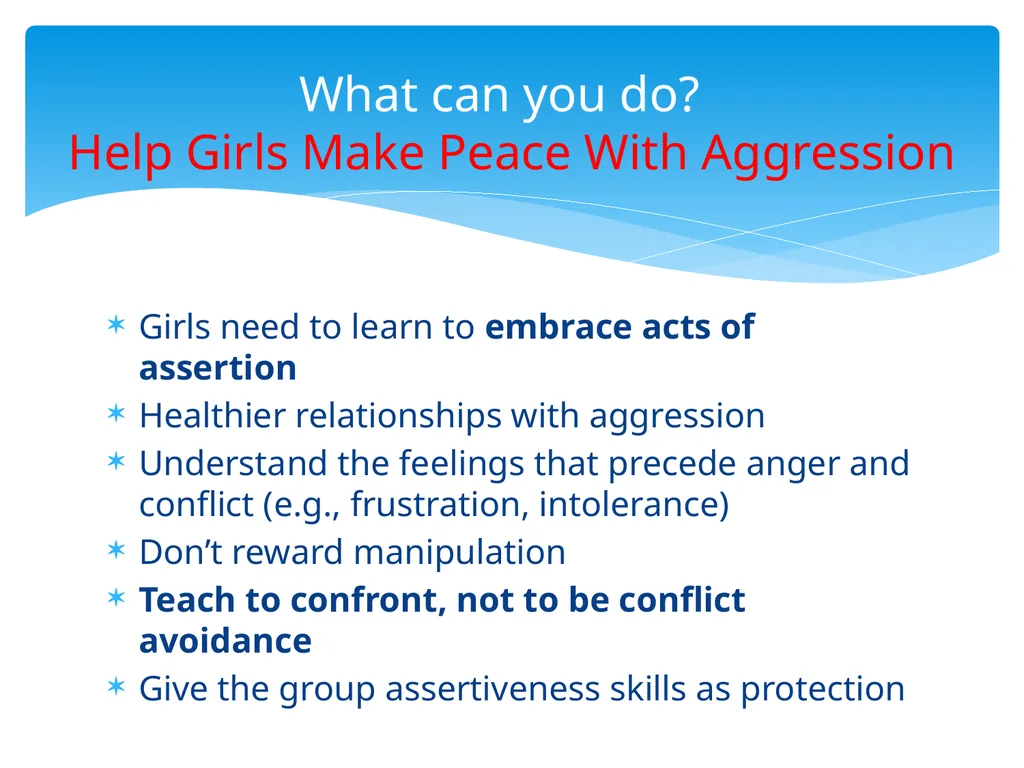
Girls need to learn to embrace acts of assertion
Healthier relationships with aggression
Understand the feelings that precede anger and conflict (e.g., frustration, intolerance)
Don’t reward manipulation
Teach to confront, not to be conflict avoidance
Give the group assertiveness skills as protection What can you do? Help Girls Make Peace With Aggression<br>
Healthier relationships with aggression
Understand the feelings that precede anger and conflict (e.g., frustration, intolerance)
Don’t reward manipulation
Teach to confront, not to be conflict avoidance
Give the group assertiveness skills as protection What can you do? Help Girls Make Peace With Aggression<br>
20
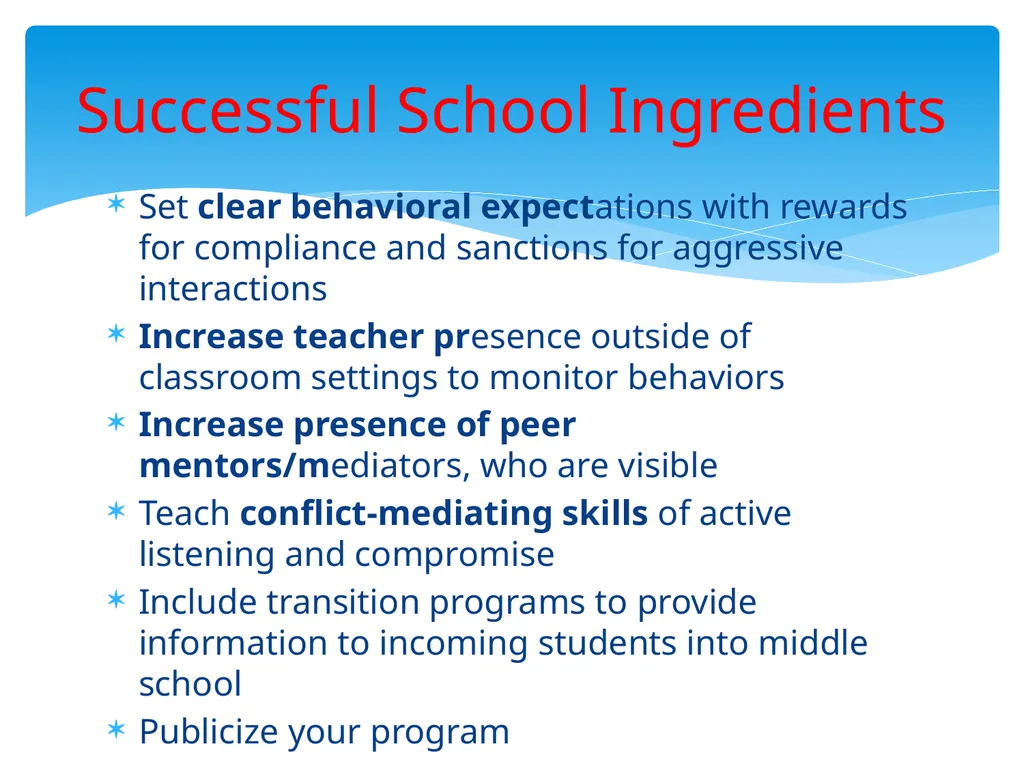
Set clear behavioral expectations with rewards for compliance and sanctions for aggressive interactions
Increase teacher presence outside of classroom settings to monitor behaviors
Increase presence of peer mentors/mediators, who are visible
Teach conflict-mediating skills of active listening and compromise
Include transition programs to provide information to incoming students into middle school
Publicize your program Successful School Ingredients<br>
Increase teacher presence outside of classroom settings to monitor behaviors
Increase presence of peer mentors/mediators, who are visible
Teach conflict-mediating skills of active listening and compromise
Include transition programs to provide information to incoming students into middle school
Publicize your program Successful School Ingredients<br>
21
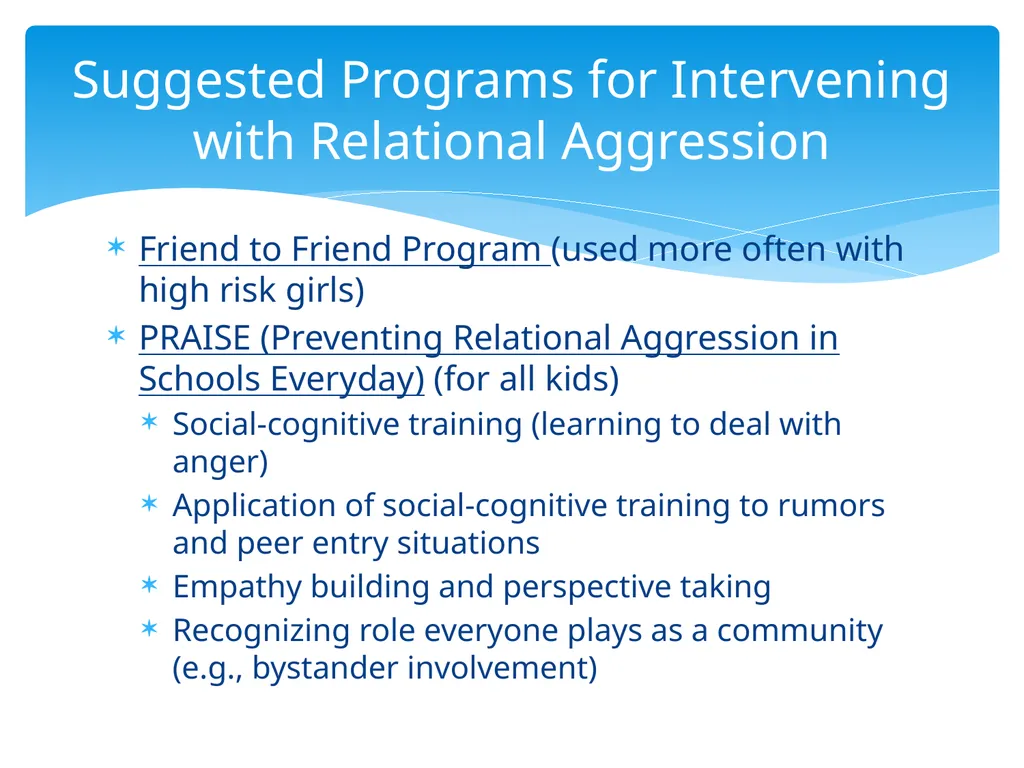
Friend to Friend Program (used more often with high risk girls)
PRAISE (Preventing Relational Aggression in Schools Everyday) (for all kids)
Social-cognitive training (learning to deal with anger)
Application of social-cognitive training to rumors and peer entry situations
Empathy building and perspective taking
Recognizing role everyone plays as a community (e.g., bystander involvement) Suggested Programs for Intervening with Relational Aggression<br>
PRAISE (Preventing Relational Aggression in Schools Everyday) (for all kids)
Social-cognitive training (learning to deal with anger)
Application of social-cognitive training to rumors and peer entry situations
Empathy building and perspective taking
Recognizing role everyone plays as a community (e.g., bystander involvement) Suggested Programs for Intervening with Relational Aggression<br>
22
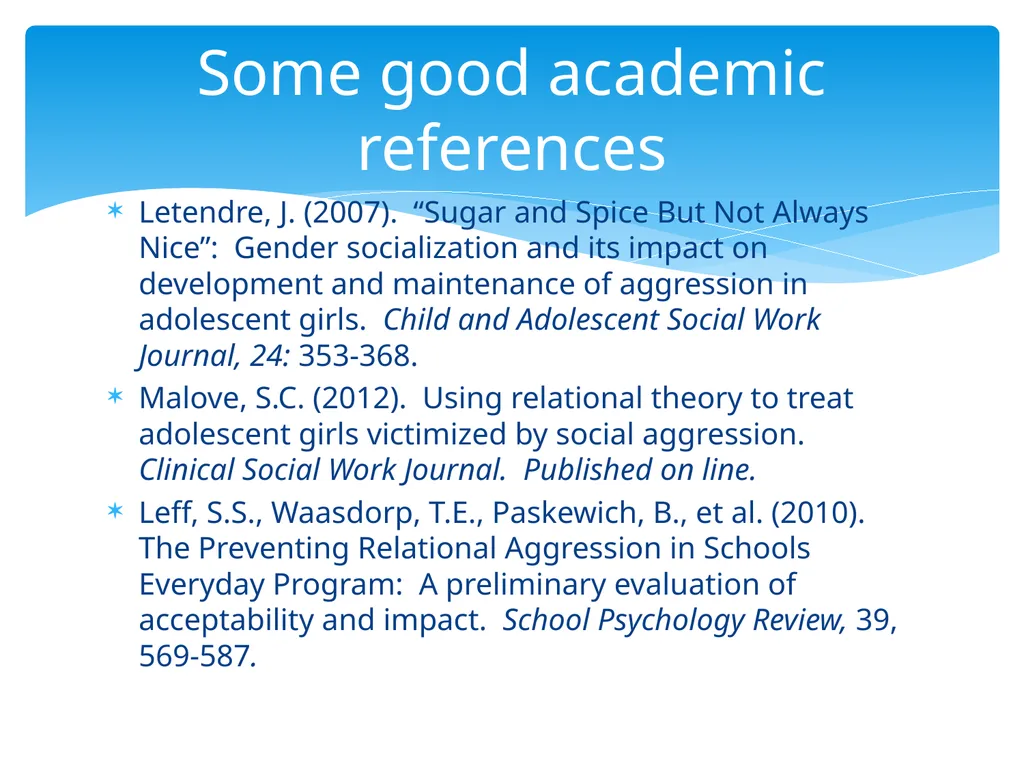
Letendre, J. (2007). “Sugar and Spice But Not Always Nice”: Gender socialization and its impact on development and maintenance of aggression in adolescent girls. Child and Adolescent Social Work Journal, 24: 353-368.
Malove, S.C. (2012). Using relational theory to treat adolescent girls victimized by social aggression. Clinical Social Work Journal. Published on line.
Leff, S.S., Waasdorp, T.E., Paskewich, B., et al. (2010). The Preventing Relational Aggression in Schools Everyday Program: A preliminary evaluation of acceptability and impact. School Psychology Review, 39, 569-587. Some good academic references<br>
Malove, S.C. (2012). Using relational theory to treat adolescent girls victimized by social aggression. Clinical Social Work Journal. Published on line.
Leff, S.S., Waasdorp, T.E., Paskewich, B., et al. (2010). The Preventing Relational Aggression in Schools Everyday Program: A preliminary evaluation of acceptability and impact. School Psychology Review, 39, 569-587. Some good academic references<br>