Remembering MILLA those times Early years late 1950s J.Schneps, Neutrino Telescopes 2013 1 I arrived in Padova with an NSF Fellowship September 1, 1958. Why would a young U.S. physicist (2 years from the Ph.D.) come to Padova? For this
"Remembering MILLA & those times Early years – late" is the property of its rightful owner. Permission is granted to
download and print the materials on this website for personal, non-commercial use only, and to display it
on your personal computer provided you do not modify the materials and that you retain all copyright
notices contained in the materials. By downloading content from our website, you accept the terms of this
agreement.
Presentation Transcript
01
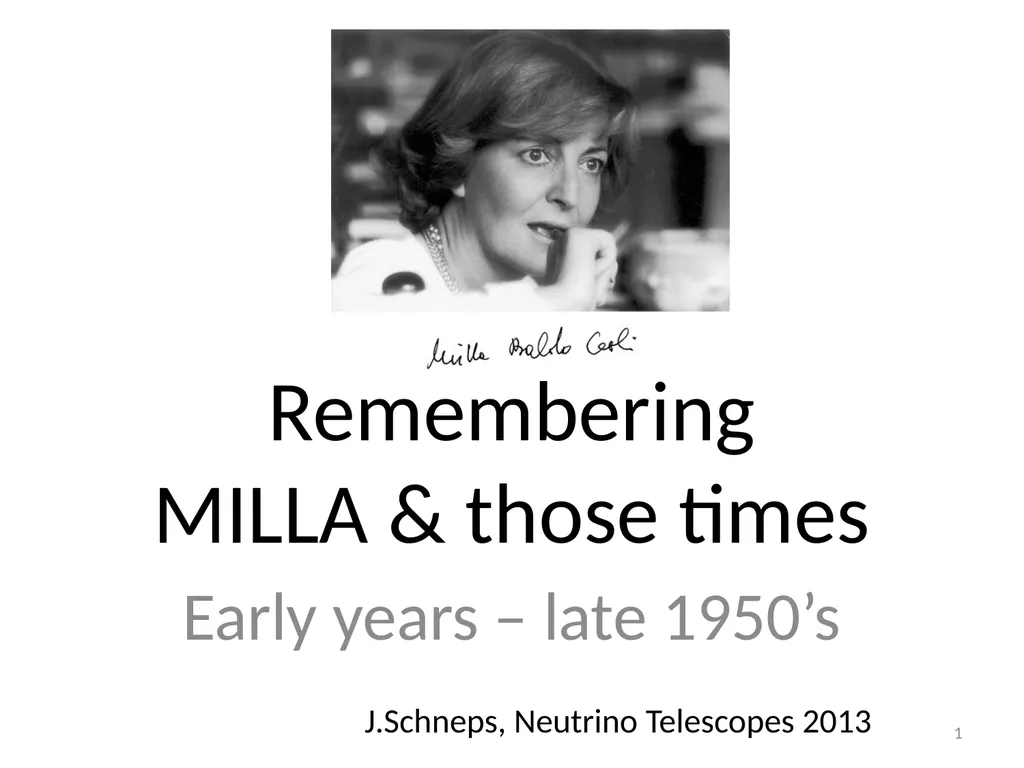
Remembering MILLA & those times Early years – late 1950’s J.Schneps, Neutrino Telescopes 2013 1<br>
02
I arrived in Padova with an NSF Fellowship September 1, 1958. Why would a young U.S.
physicist (2 years from the Ph.D.) come to Padova?
For this we have to travel 7500 km and a few years back from Padova to Madison, Wisconsin.
1952 – W.F. (Jack) Fry arrives at Univ of Wisconsin to start an experimental program in particle physics using nuclear emulsions.
1953 – He receives a grant from the Atomic Energy Commission and I become his first student, shortly after joined by M.S. Swami from India and a year later by postdoc George Snow. 2<br>
03
The exciting thing at the time was “strange” particles. K-mesons, the θ-τ puzzle, Λ, Σ, Ξ hyperons, associated production, and Gell Mann’s new strangeness quantum number.
We flew emulsion stacks in balloons to get high energy cosmic ray events, and exposed stacks
to kaon beams at the new proton accelerators, the 2-3 GeV Cosmotron and the 6.3 GeV Bevatron. The K– beams from the Bevatron were prolific producers of strange particles. We produced about 5 papers/year – a paper had 3-4 authors and 1 – 1001 events. Here are a couple I especially remember. 3<br>
04
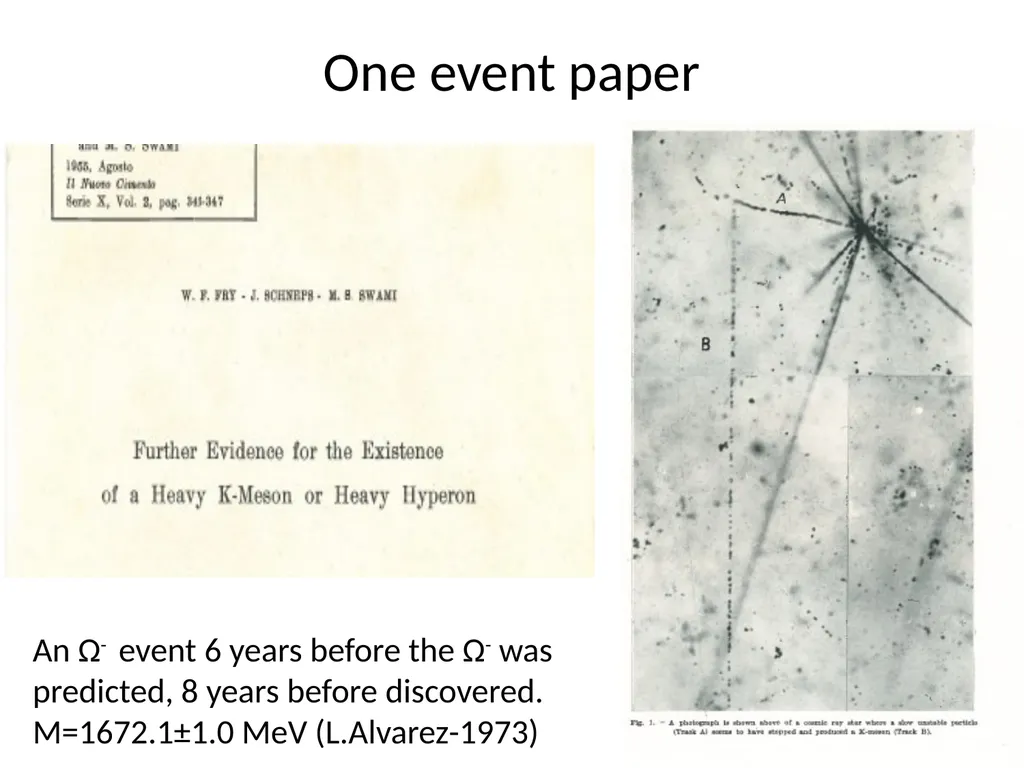
One event paper An Ω- event 6 years before the Ω- was
predicted, 8 years before discovered.
M=1672.1±1.0 MeV (L.Alvarez-1973) 4<br>
05
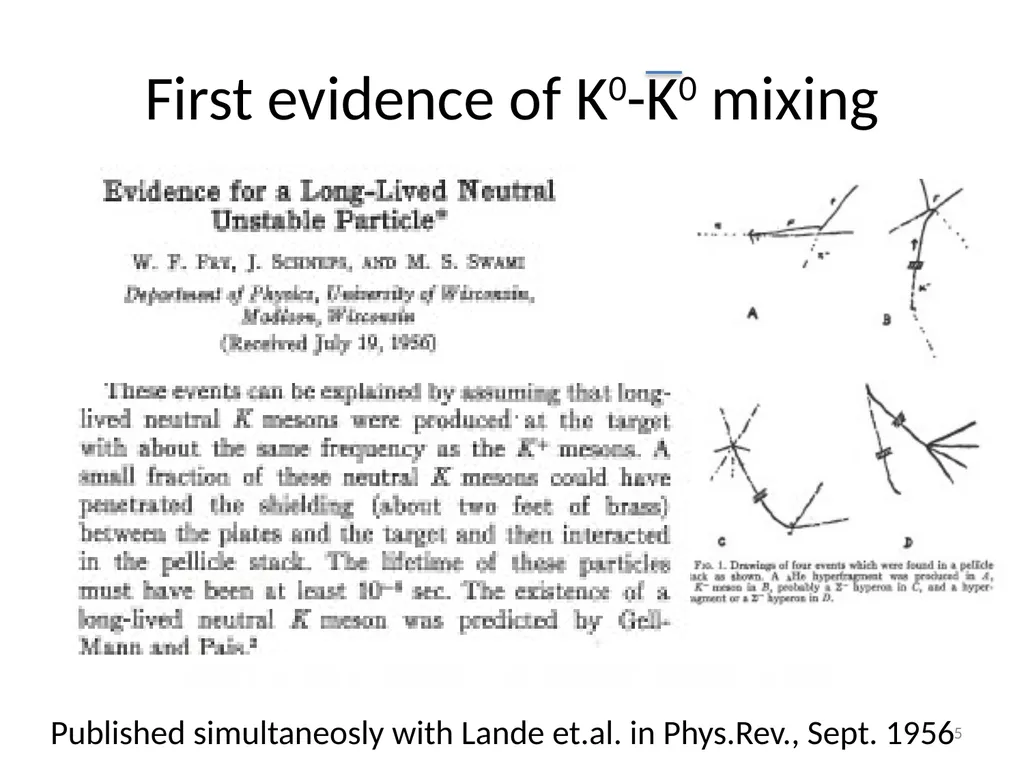
First evidence of K0-K0 mixing Published simultaneosly with Lande et.al. in Phys.Rev., Sept. 1956 5<br>
06
1956 Fry takes me aside – he has good news to tell me
He’s been promoted - Assoc.Prof. with tenure.
He has a Guggenheim Fellowship and will go to Padova in September for a year.
I can stay in Wisconsin as a postdoc or find another job. I choose to go to Tufts Univ. in Boston as Ass’t. Prof. It’s my job to finish up the papers we’ve been working on. Jack is excited about long-lived K0. Before leaving he exposes a stack of emulsion to a K– beam at the Bevatron and takes it with him to Padova. 6<br>
07
1956-57
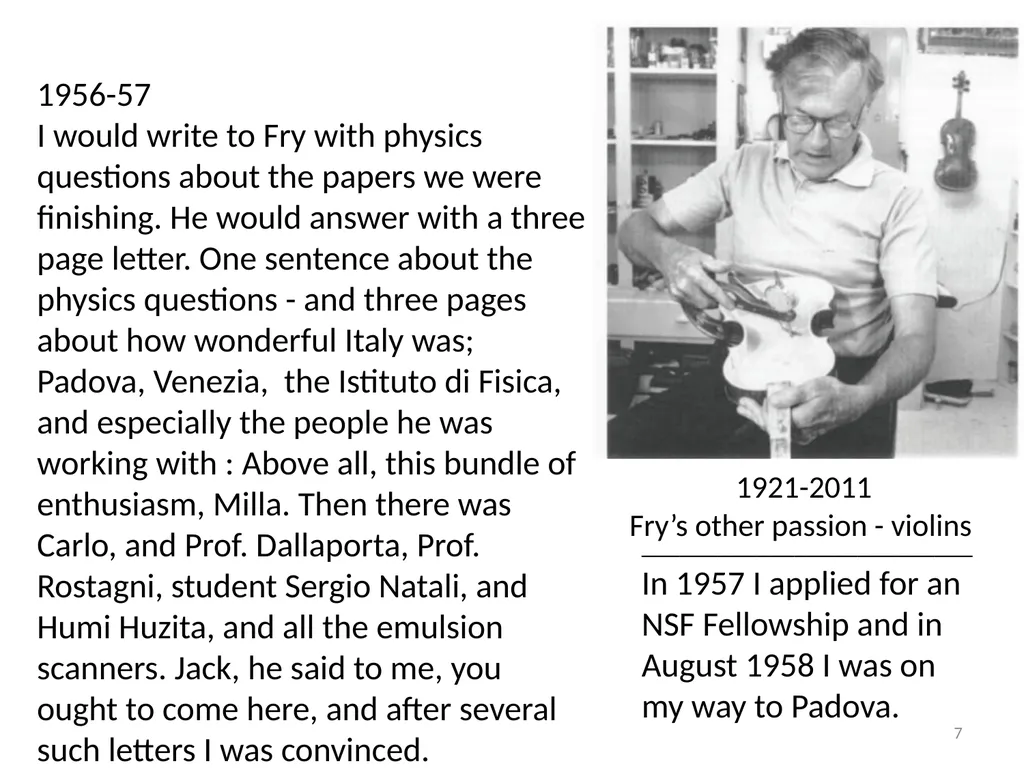
I would write to Fry with physics questions about the papers we were finishing. He would answer with a three page letter. One sentence about the physics questions - and three pages about how wonderful Italy was; Padova, Venezia, the Istituto di Fisica, and especially the people he was working with : Above all, this bundle of enthusiasm, Milla. Then there was Carlo, and Prof. Dallaporta, Prof. Rostagni, student Sergio Natali, and Humi Huzita, and all the emulsion scanners. Jack, he said to me, you ought to come here, and after several such letters I was convinced. __________________________ In 1957 I applied for an NSF Fellowship and in August 1958 I was on my way to Padova. 1921-2011
Fry’s other passion - violins 7<br>
08
Milla enrolled in the University of Padova shortly after the end of World War II. In 1952 she completed her thesis with Prof. Dallaporta and joined the newly forming emulsion group (at no salary). The only way to study the new strange particles in Europe was with high energy cosmic ray events – cloud chambers on mountain tops; emulsion stacks flying to high altitudes in balloons. In the U.S. accelerators were arriving. The 3 GeV Cosmotron at Brookhaven, followed by the 6.3 GeV Bevatron at Berkeley. In 1956 we were so excited by finding the long-lived K0 that Jack Fry quickly arranged a new exposure of an emulsion stack to a kaon beam at the Bevatron, and when he arrived in Padova he was carrying it with him. This began the change from cosmic rays to accelerator based research in Padova (CERN was on the way). In 1956-57 Fry and Milla concentrated on Kaon mixing and even obtained a first crude measurement of the K2-K1 mass dfference.
See Milla’s article, 2002: http://www.annualreviews.org/doi/pdf/10.1146/annurev.nucl.52.050102.090730 8<br>
09
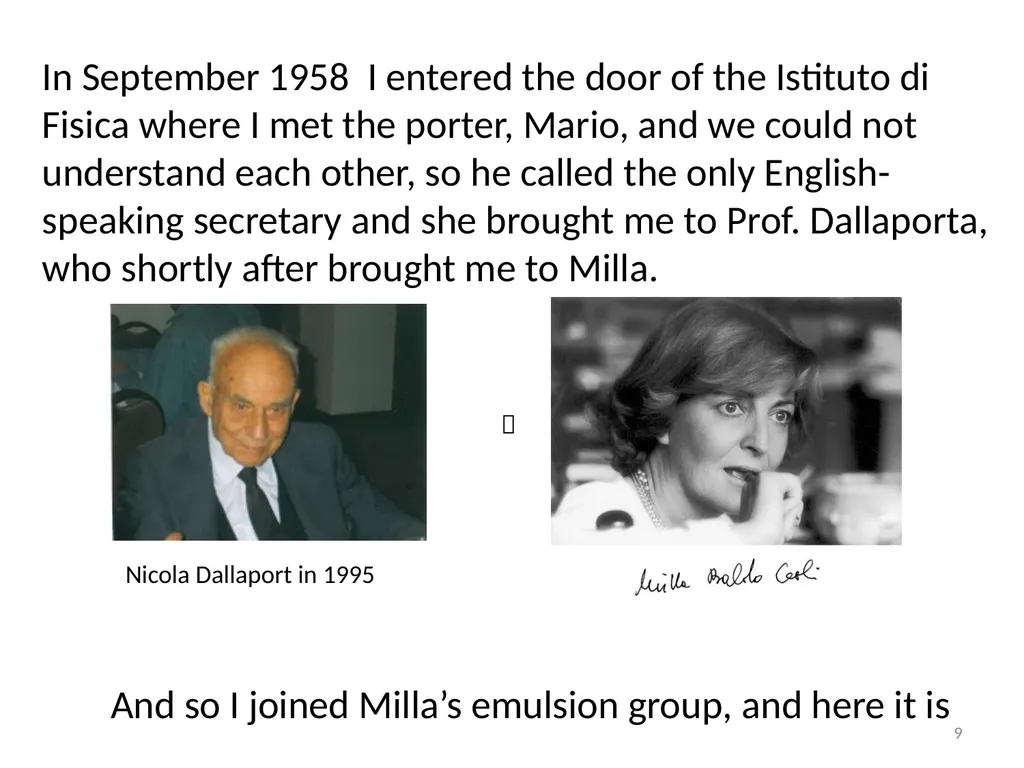
In September 1958 I entered the door of the Istituto di
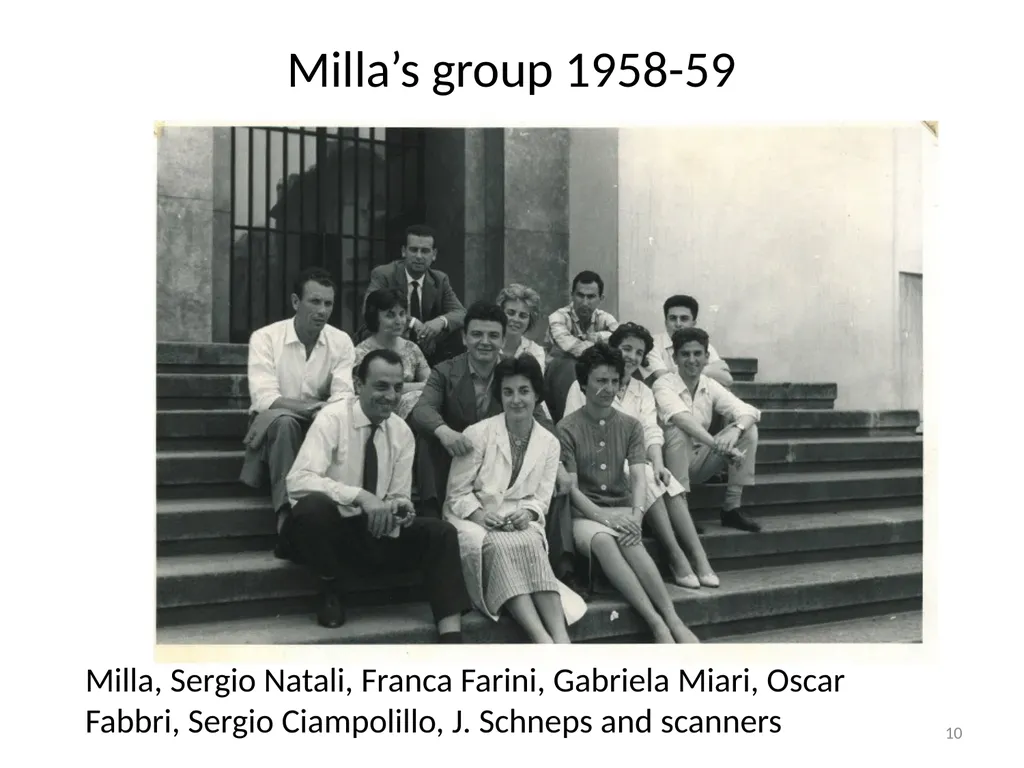
Fisica where I met the porter, Mario, and we could not understand each other, so he called the only English-speaking secretary and she brought me to Prof. Dallaporta, who shortly after brought me to Milla. Nicola Dallaport in 1995 And so I joined Milla’s emulsion group, and here it is 9<br>
10
Milla’s group 1958-59 Milla, Sergio Natali, Franca Farini, Gabriela Miari, Oscar Fabbri, Sergio Ciampolillo, J. Schneps and scanners 10<br>
11
Soon I met everyone in the particle physics section. Marcello Cresti and Silvia Limentani had just returned from the U.S. to set up a bubble chamber facility, and of course there was Carlo, who insisted on only speaking Italian to me. Eventually, I learned.
In Milla’s group we worked on studying the properties of “cascade” Ξ hyperons, produced by high energy K– beams at Berkeley. (Remember, quarks, standard model, charm, etc. did not yet exist).But with Milla, everybody absorbed her enthusiasm , and we talked about everything, including physics. When Jack Fry arrived for a few weeks he and I played mandolin duets for the Italians! 11<br>
12
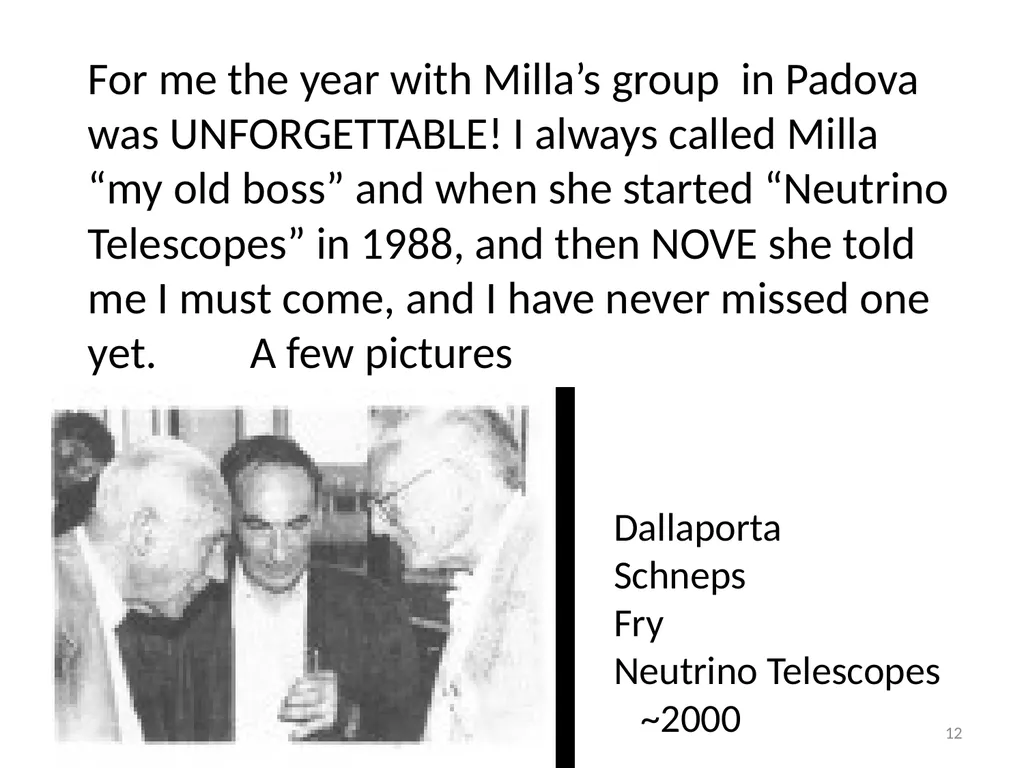
For me the year with Milla’s group in Padova was UNFORGETTABLE! I always called Milla “my old boss” and when she started “Neutrino Telescopes” in 1988, and then NOVE she told me I must come, and I have never missed one yet. A few pictures Dallaporta
Schneps
Fry
Neutrino Telescopes
~2000 12<br>
13
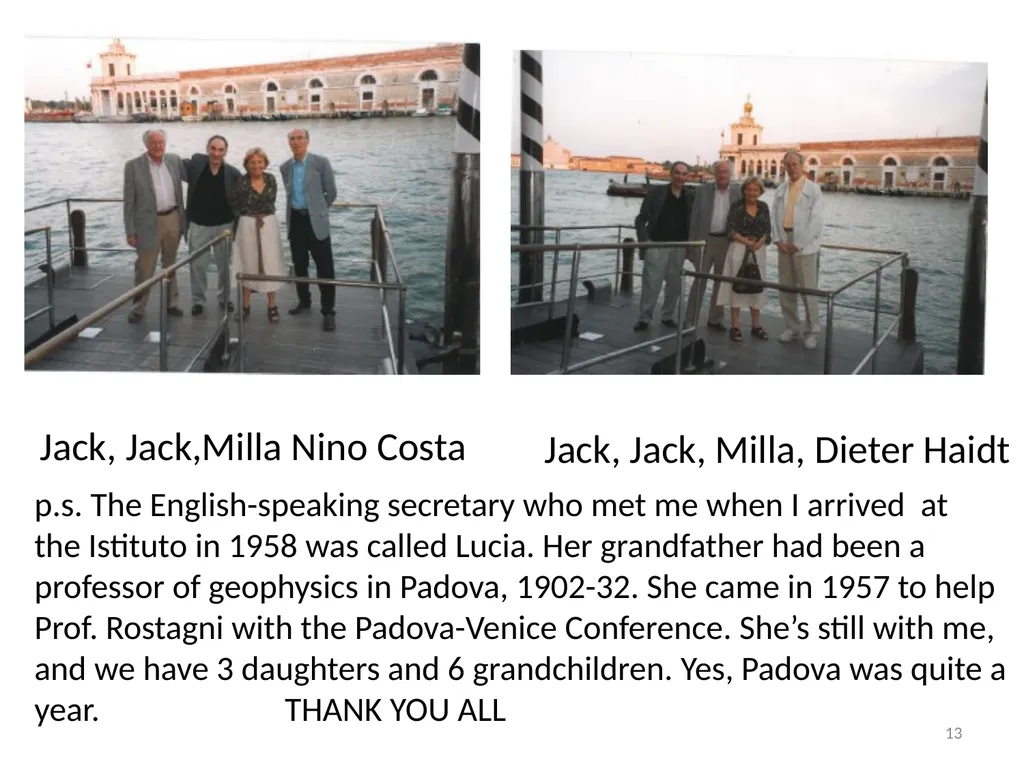
Jack, Jack,Milla Nino Costa Jack, Jack, Milla, Dieter Haidt p.s. The English-speaking secretary who met me when I arrived at
the Istituto in 1958 was called Lucia. Her grandfather had been a professor of geophysics in Padova, 1902-32. She came in 1957 to help Prof. Rostagni with the Padova-Venice Conference. She’s still with me, and we have 3 daughters and 6 grandchildren. Yes, Padova was quite a year. THANK YOU ALL 13<br>