RENEWAL PROCESSES IN CONTINUOUS TIME PAGES 249 –
Description: RENEWAL PROCESSES IN CONTINUOUS TIME PAGES 249 255 Khaoula Chnina INTRODUCTION Renewal theory is the branch of probability theory that generalizes Poisson processes for arbitrary inter-arrival (holding) times. In the classical Poisson
Related Topics
Download Presentation
"RENEWAL PROCESSES IN CONTINUOUS TIME PAGES 249 –" is the property of its rightful owner. Permission is granted to download and print the materials on this website for personal, non-commercial use only, and to display it on your personal computer provided you do not modify the materials and that you retain all copyright notices contained in the materials. By downloading content from our website, you accept the terms of this agreement.
Presentation Transcript
slide1. RENEWAL PROCESSES IN CONTINUOUS TIME PAGES 249 – 255
Khaoula Chnina<br>
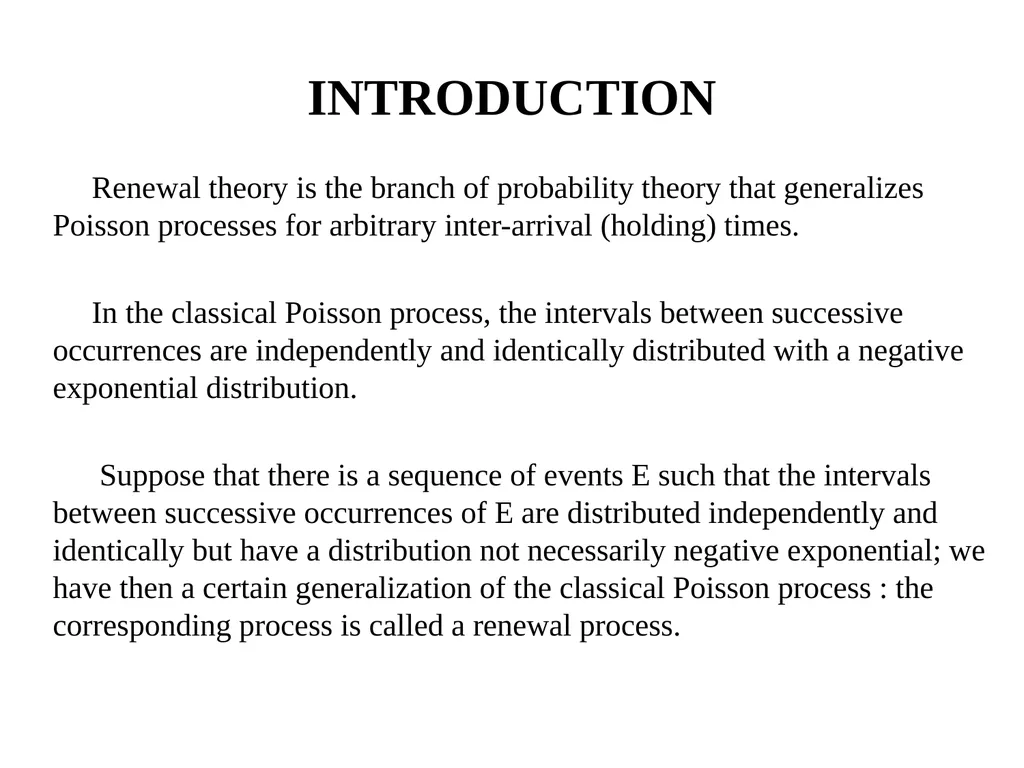
slide2. INTRODUCTION Renewal theory is the branch of probability theory that generalizes Poisson processes for arbitrary inter-arrival (holding) times.
In the classical Poisson process, the intervals between successive occurrences are independently and identically distributed with a negative exponential distribution.
Suppose that there is a sequence of events E such that the intervals between successive occurrences of E are distributed independently and identically but have a distribution not necessarily negative exponential; we have then a certain generalization of the classical Poisson process : the corresponding process is called a renewal process.<br>
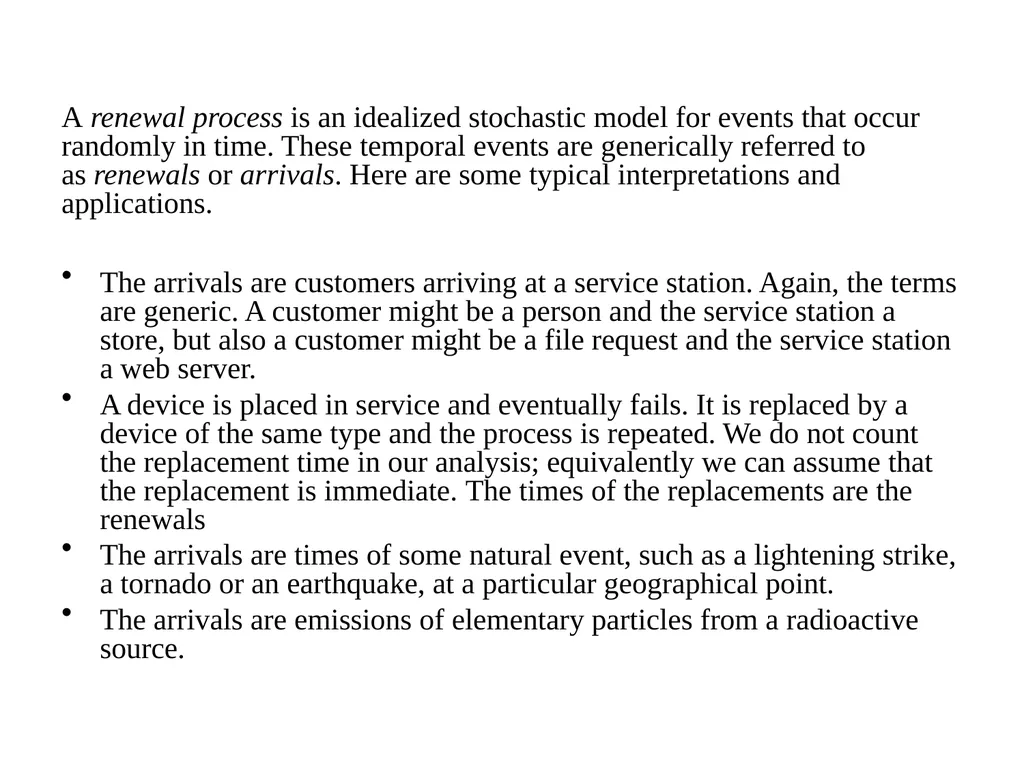
slide3. A renewal process is an idealized stochastic model for events that occur randomly in time. These temporal events are generically referred to as renewals or arrivals. Here are some typical interpretations and applications.
The arrivals are customers arriving at a service station. Again, the terms are generic. A customer might be a person and the service station a store, but also a customer might be a file request and the service station a web server.
A device is placed in service and eventually fails. It is replaced by a device of the same type and the process is repeated. We do not count the replacement time in our analysis; equivalently we can assume that the replacement is immediate. The times of the replacements are the renewals
The arrivals are times of some natural event, such as a lightening strike, a tornado or an earthquake, at a particular geographical point.
The arrivals are emissions of elementary particles from a radioactive source.<br>
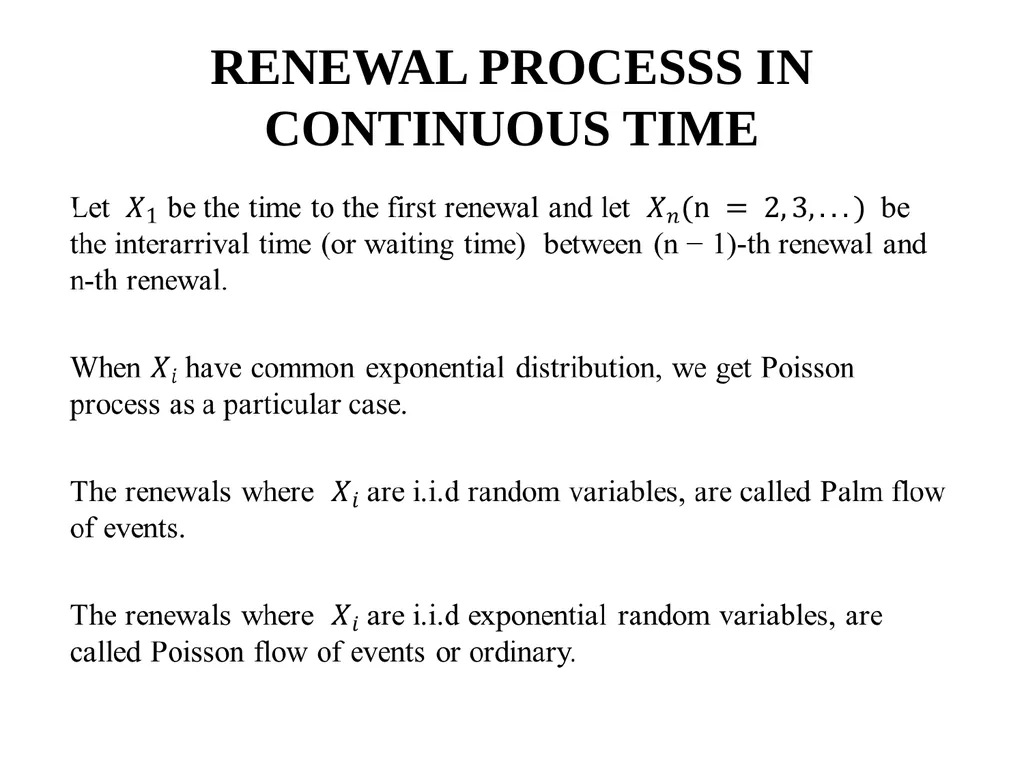
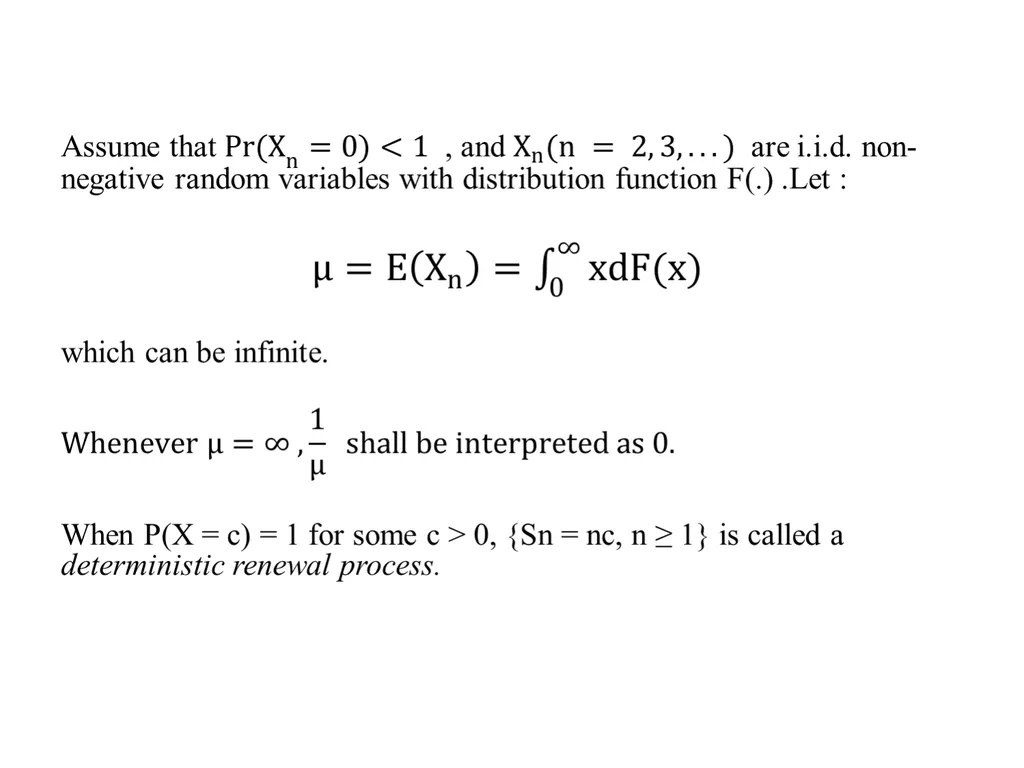
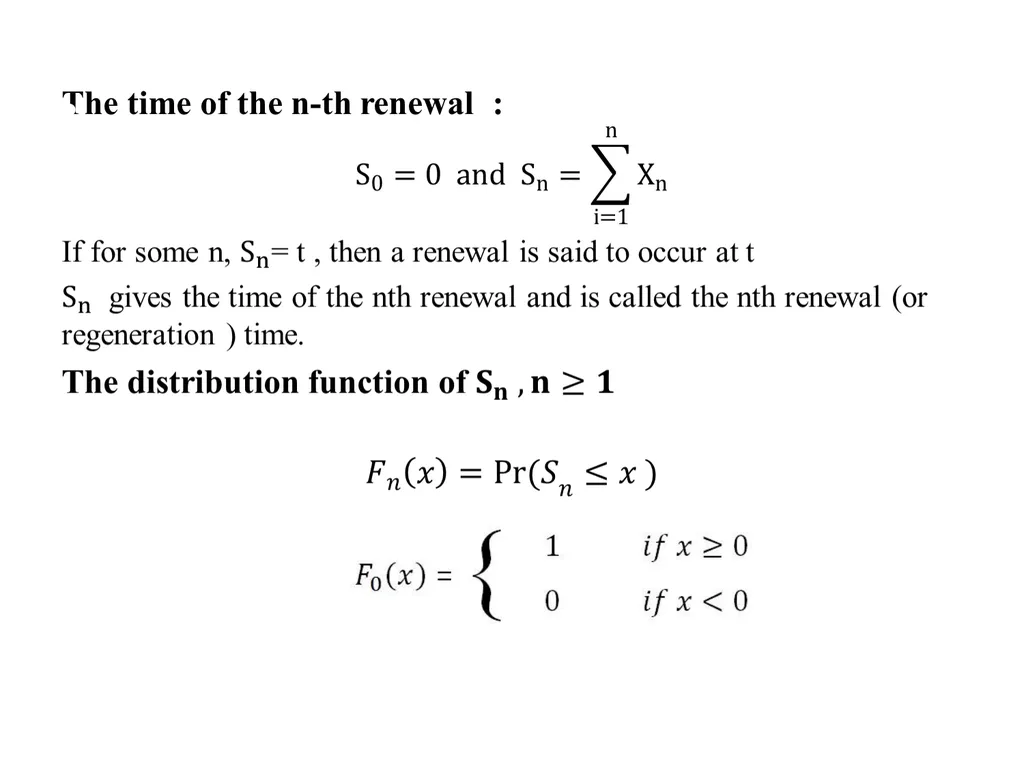
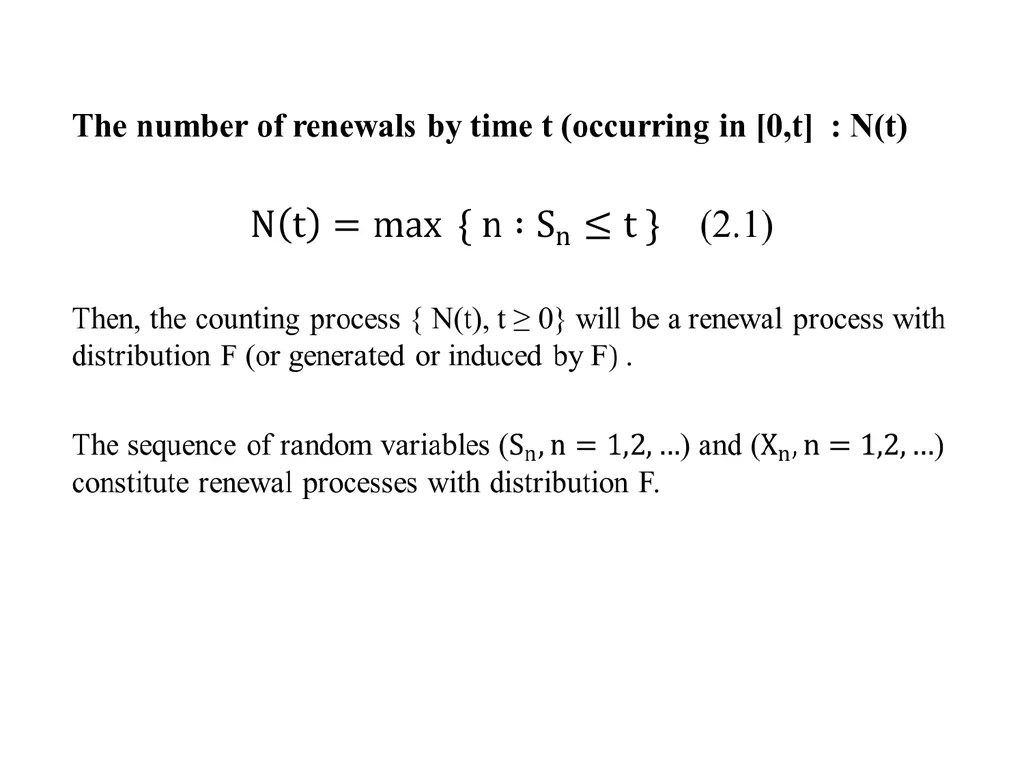
slide4. RENEWAL PROCESSS IN CONTINUOUS TIME<br>
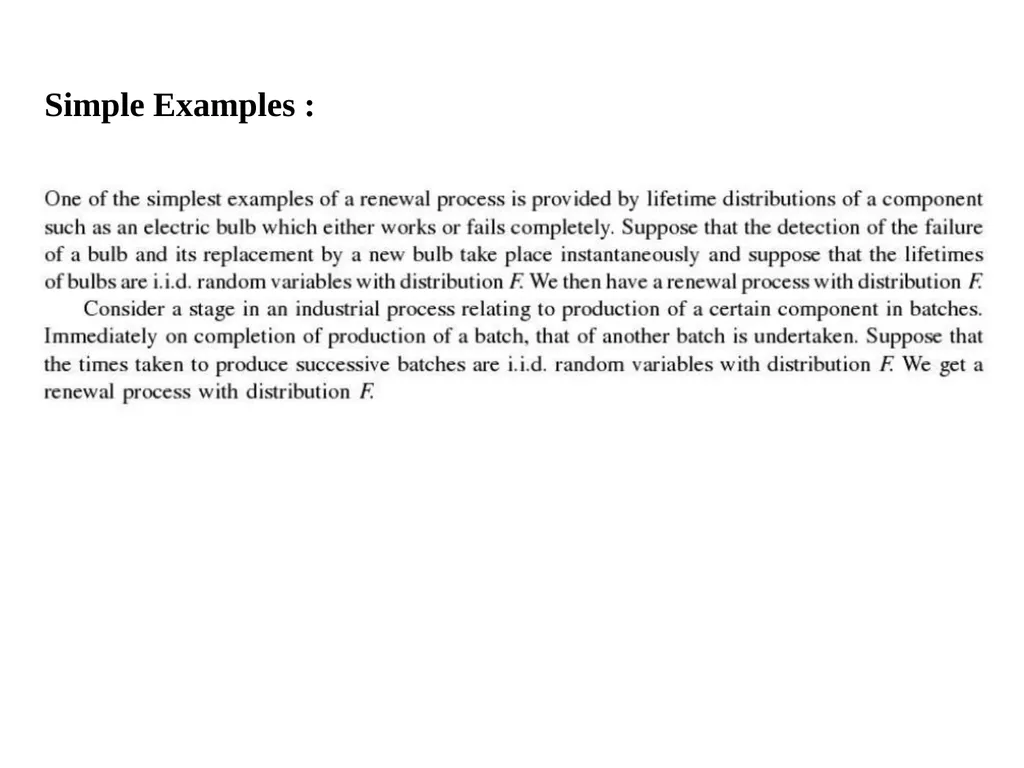
slide8. Simple Examples :<br>
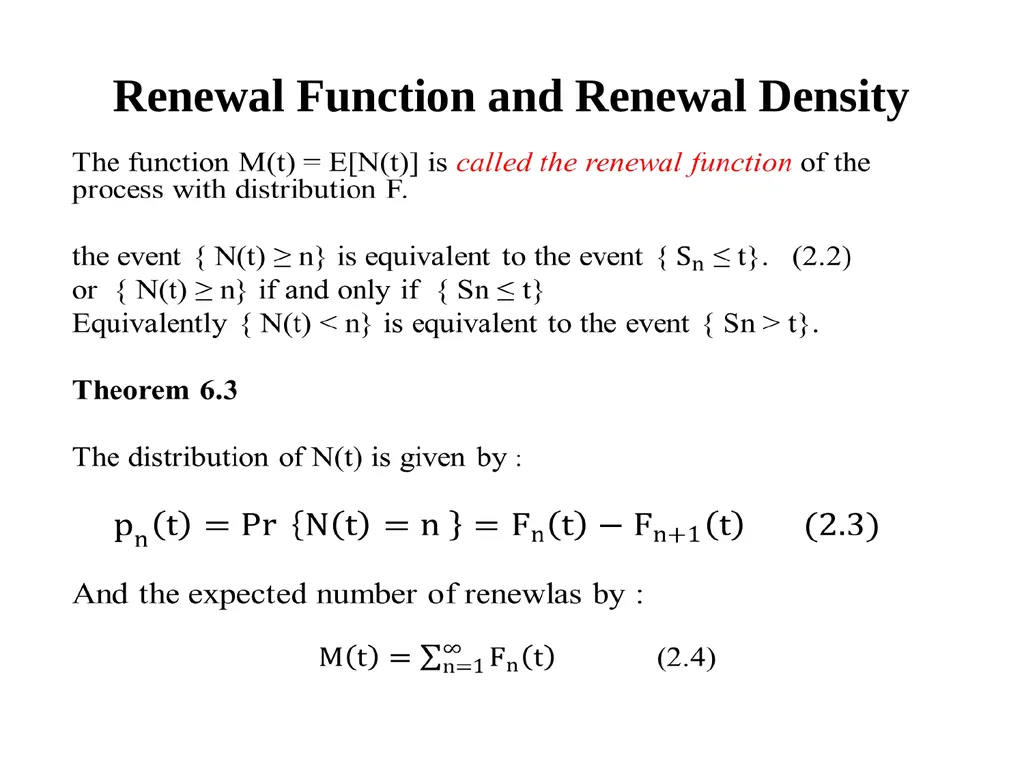
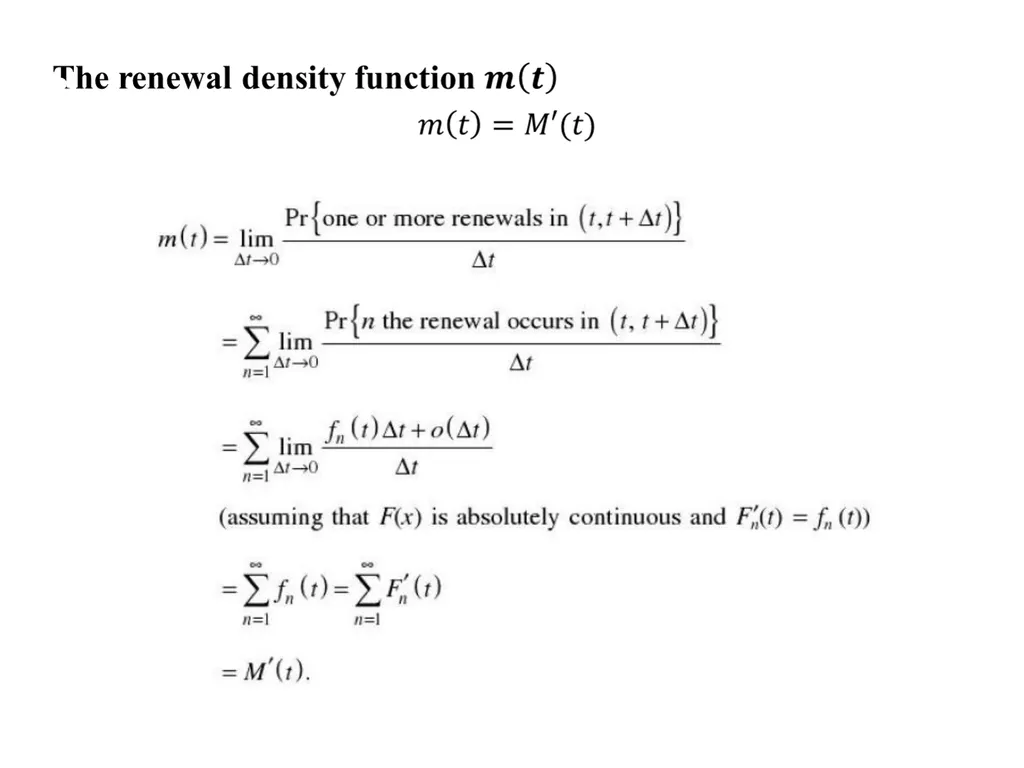
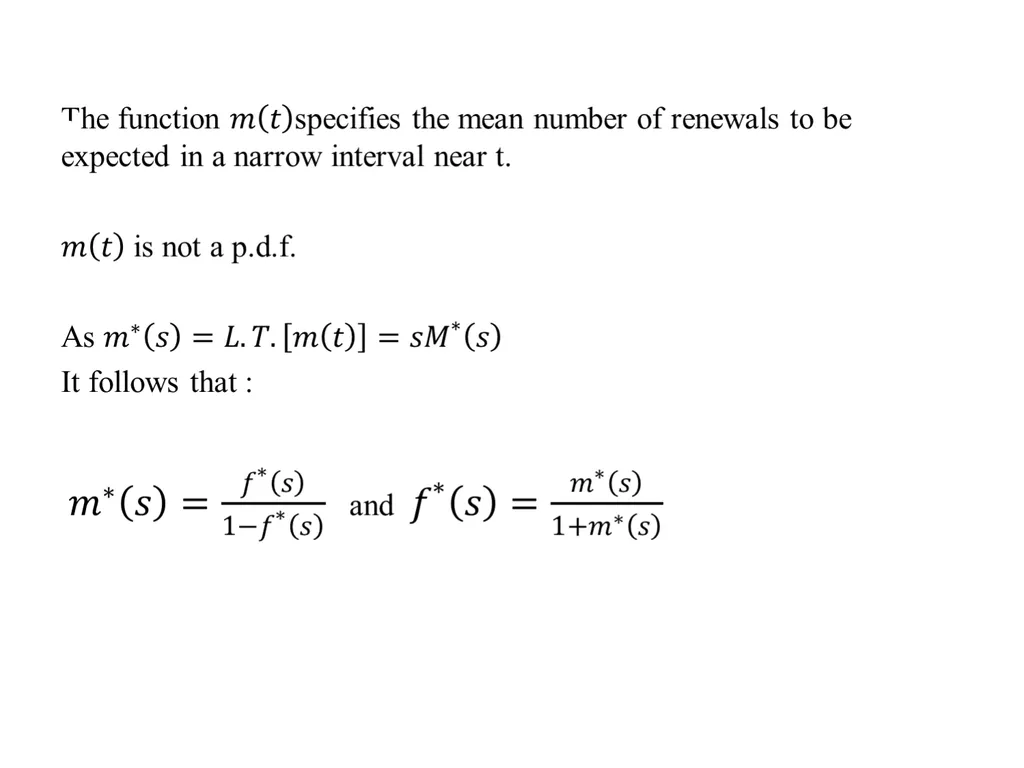
slide9. Renewal Function and Renewal Density<br>
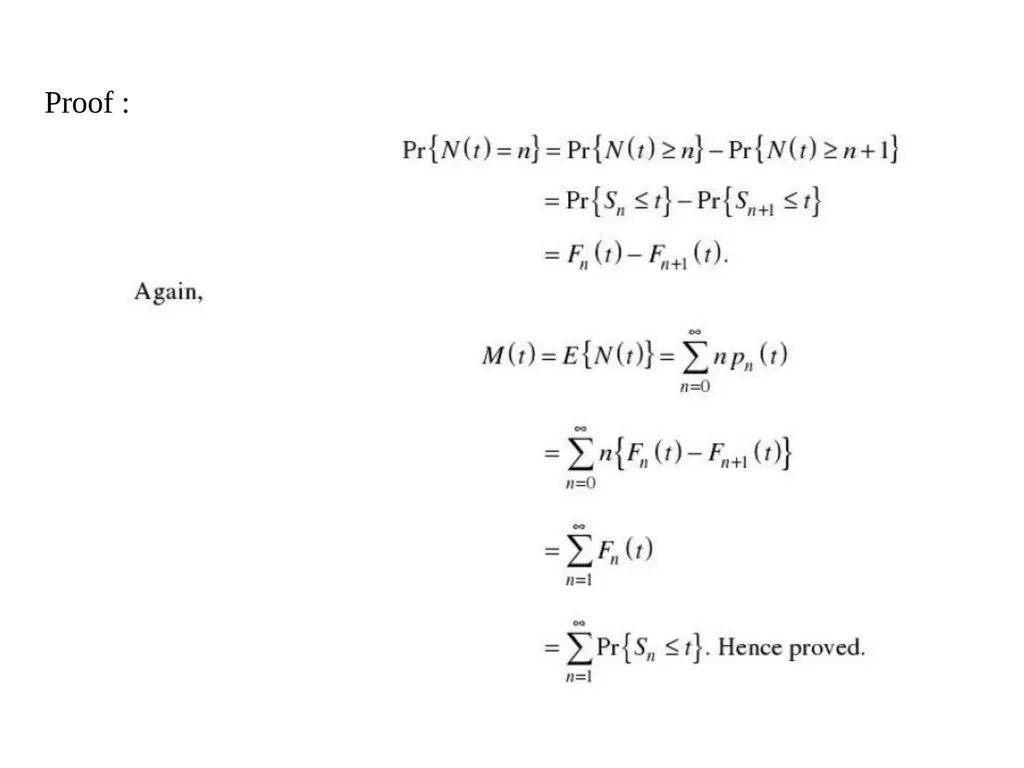
slide10. Proof :<br>
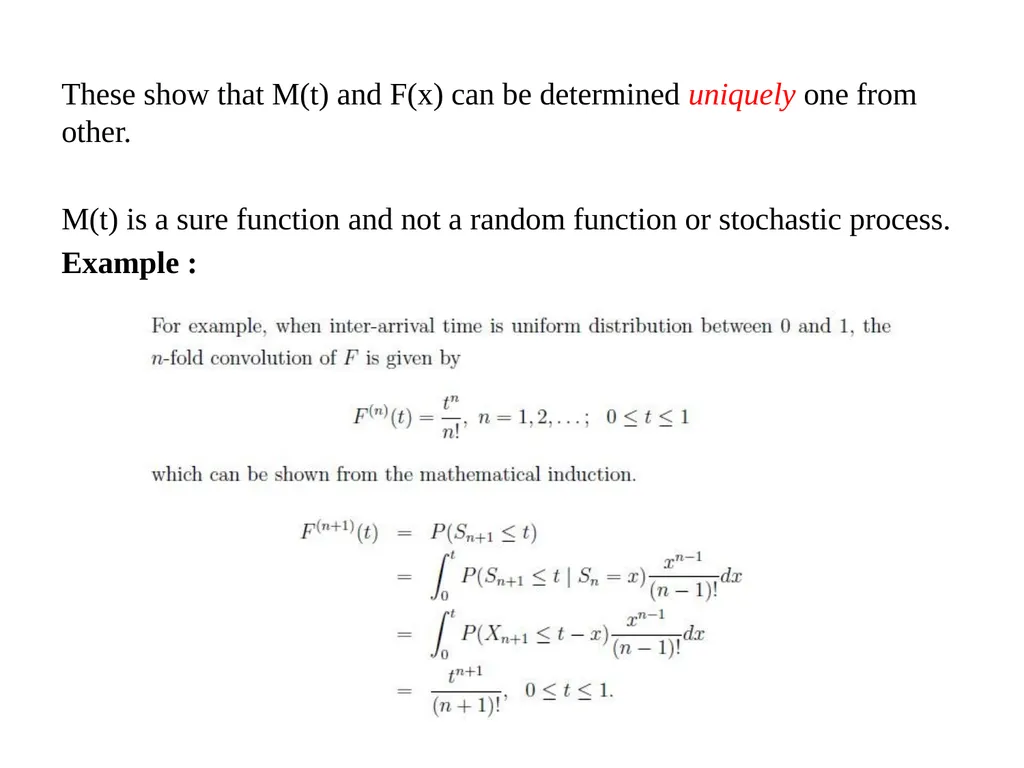
slide12. These show that M(t) and F(x) can be determined uniquely one from other.
M(t) is a sure function and not a random function or stochastic process.
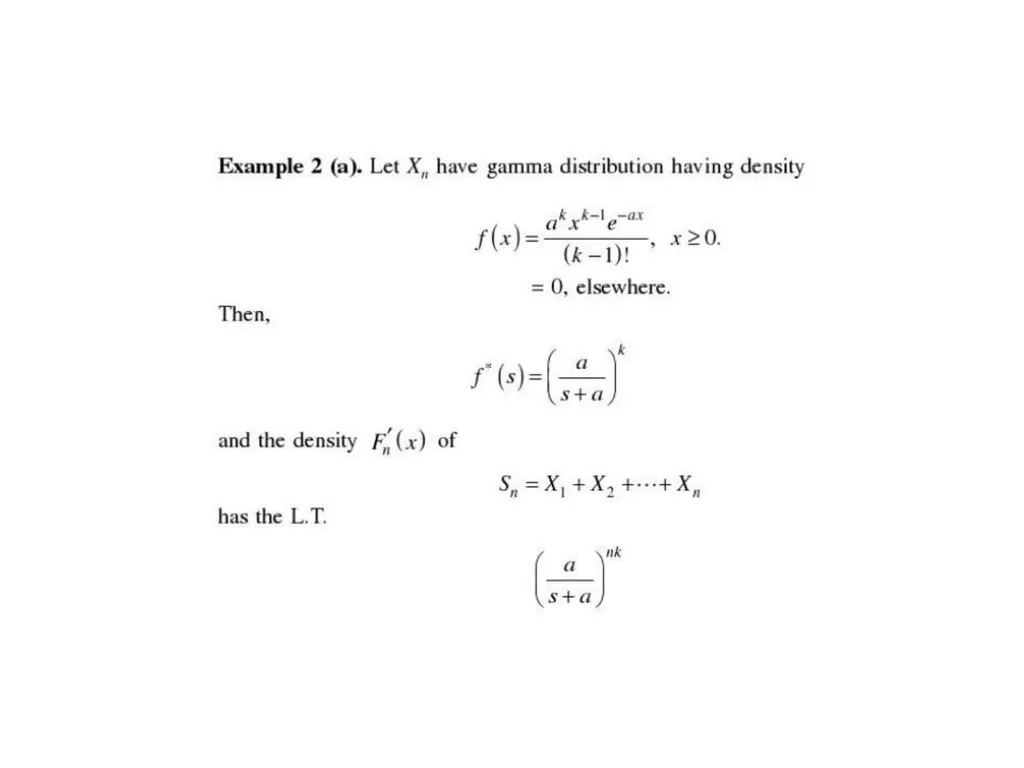
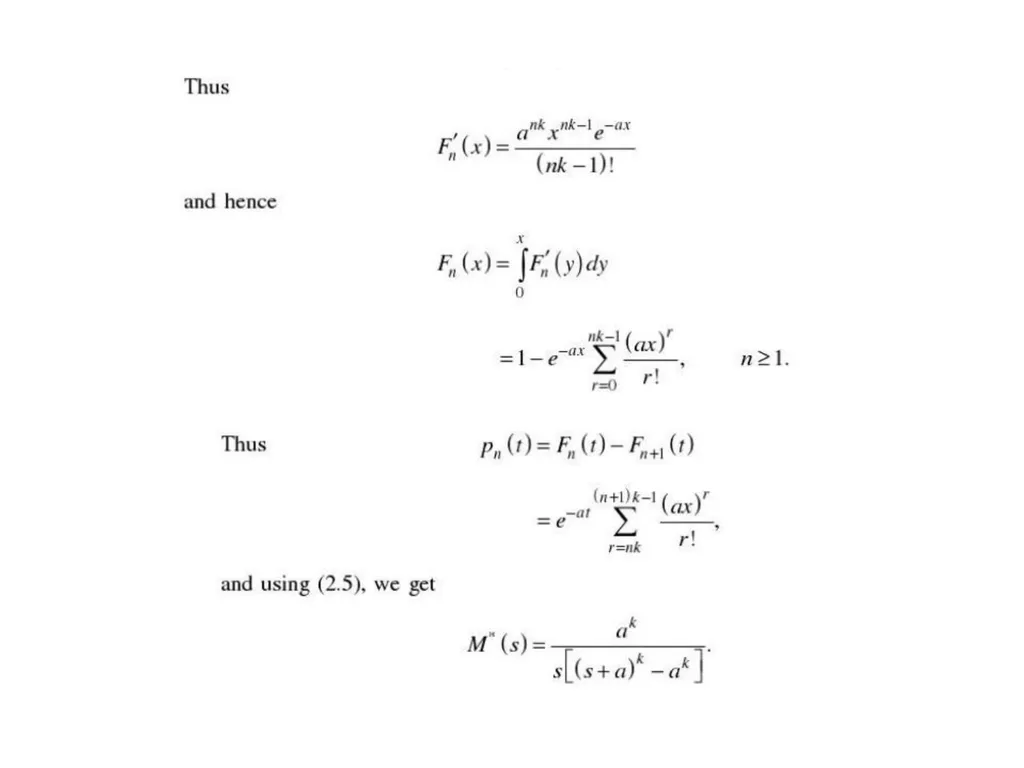
Example :<br>
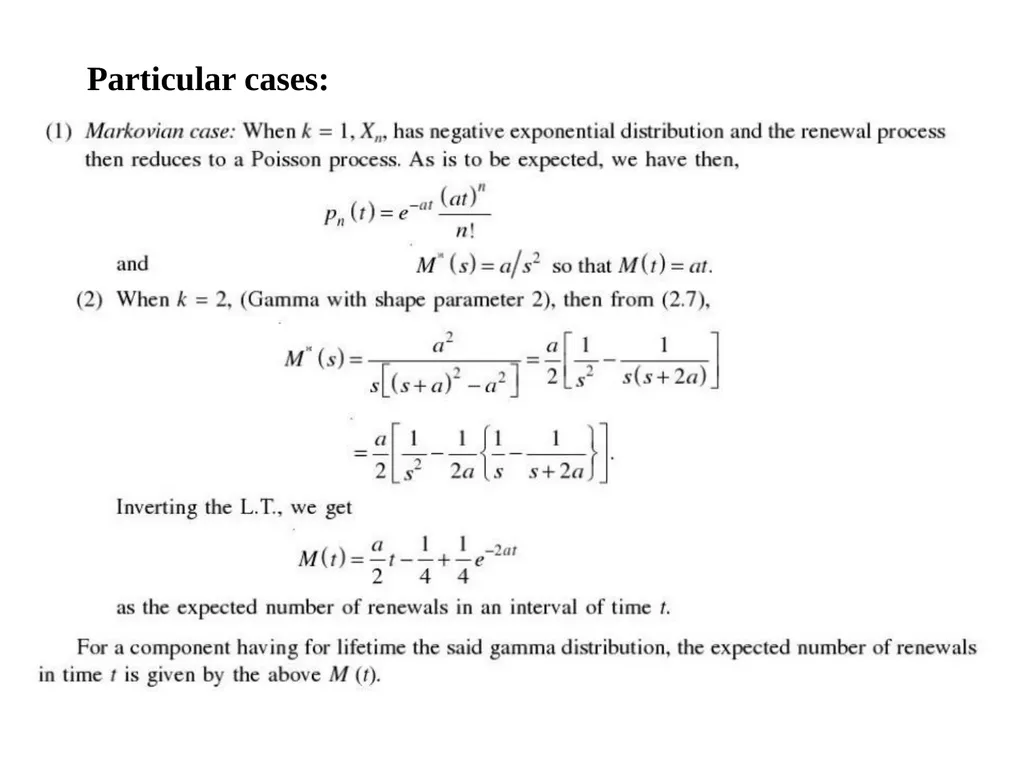
slide17. Particular cases:<br>
Khaoula Chnina<br>
slide2. INTRODUCTION Renewal theory is the branch of probability theory that generalizes Poisson processes for arbitrary inter-arrival (holding) times.
In the classical Poisson process, the intervals between successive occurrences are independently and identically distributed with a negative exponential distribution.
Suppose that there is a sequence of events E such that the intervals between successive occurrences of E are distributed independently and identically but have a distribution not necessarily negative exponential; we have then a certain generalization of the classical Poisson process : the corresponding process is called a renewal process.<br>
slide3. A renewal process is an idealized stochastic model for events that occur randomly in time. These temporal events are generically referred to as renewals or arrivals. Here are some typical interpretations and applications.
The arrivals are customers arriving at a service station. Again, the terms are generic. A customer might be a person and the service station a store, but also a customer might be a file request and the service station a web server.
A device is placed in service and eventually fails. It is replaced by a device of the same type and the process is repeated. We do not count the replacement time in our analysis; equivalently we can assume that the replacement is immediate. The times of the replacements are the renewals
The arrivals are times of some natural event, such as a lightening strike, a tornado or an earthquake, at a particular geographical point.
The arrivals are emissions of elementary particles from a radioactive source.<br>
slide4. RENEWAL PROCESSS IN CONTINUOUS TIME<br>
slide8. Simple Examples :<br>
slide9. Renewal Function and Renewal Density<br>
slide10. Proof :<br>
slide12. These show that M(t) and F(x) can be determined uniquely one from other.
M(t) is a sure function and not a random function or stochastic process.
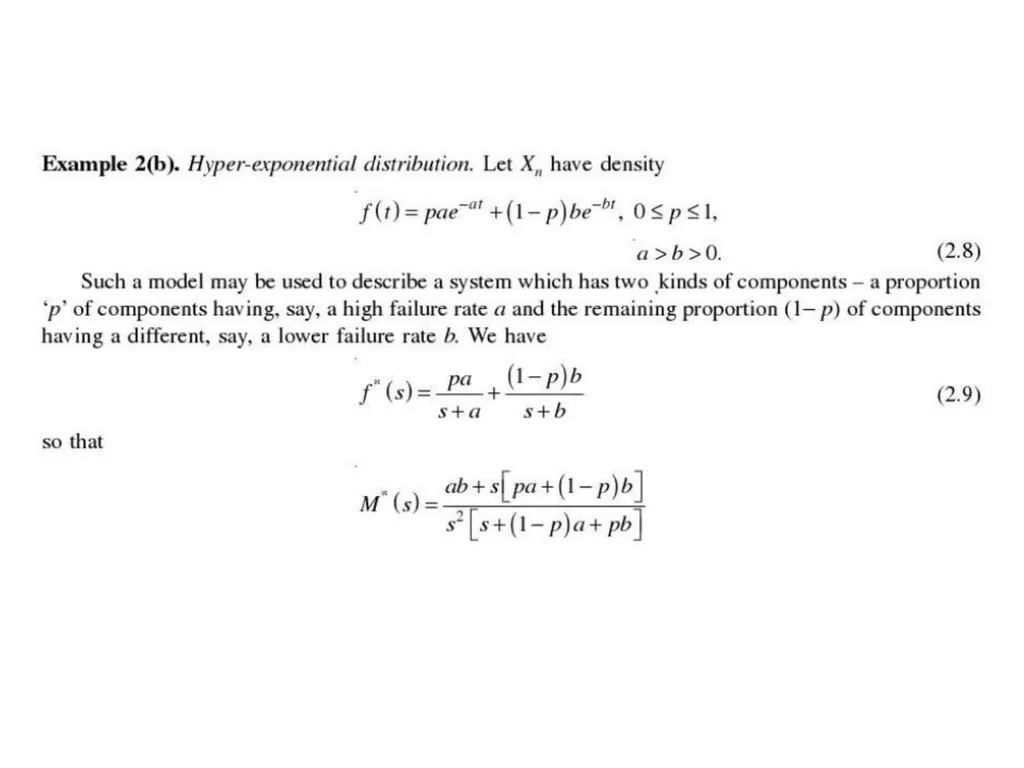
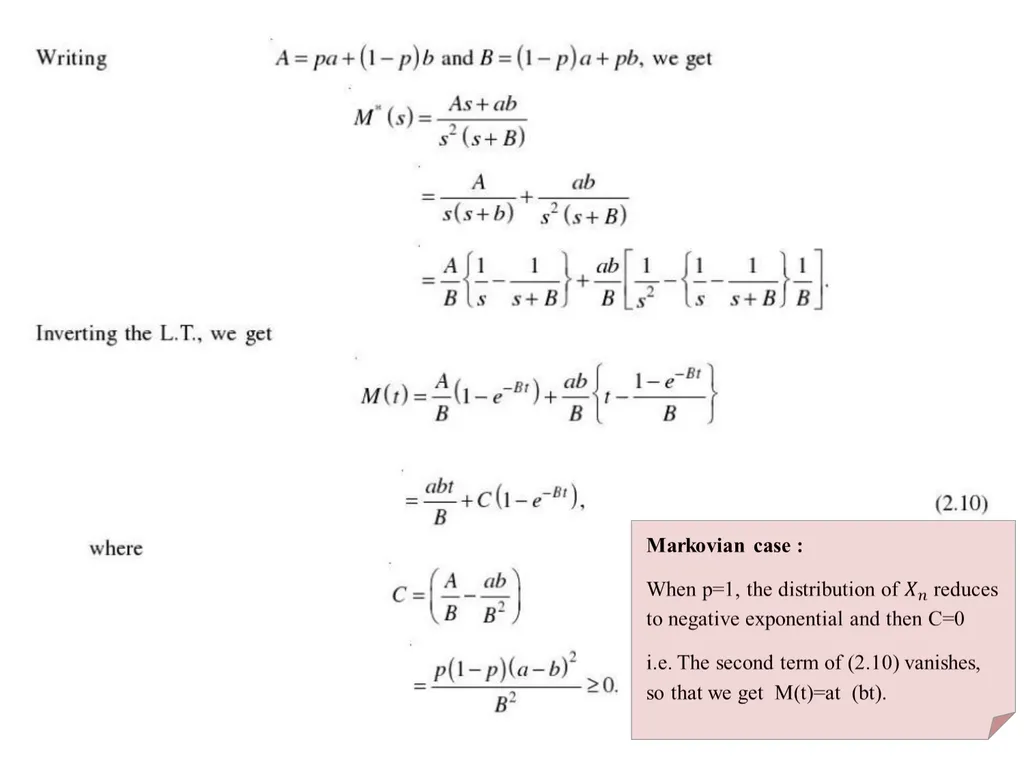
Example :<br>
slide17. Particular cases:<br>