Replicated Latin Squares Three types of replication in traditional (1 treatment, 2 blocks) latin squares Case study (ssquare, n of trt levels) Crossover designs Subject is one block, Period is another Yandell introduces crossovers as a
"Replicated Latin Squares Three types of" is the property of its rightful owner. Permission is granted to
download and print the materials on this website for personal, non-commercial use only, and to display it
on your personal computer provided you do not modify the materials and that you retain all copyright
notices contained in the materials. By downloading content from our website, you accept the terms of this
agreement.
Presentation Transcript
01
Replicated Latin Squares Three types of replication in traditional (1 treatment, 2 blocks) latin squares
Case study (s=square, n=# of trt levels)
Crossover designs
Subject is one block, Period is another
Yandell introduces crossovers as a special case of the split plot design<br>
02
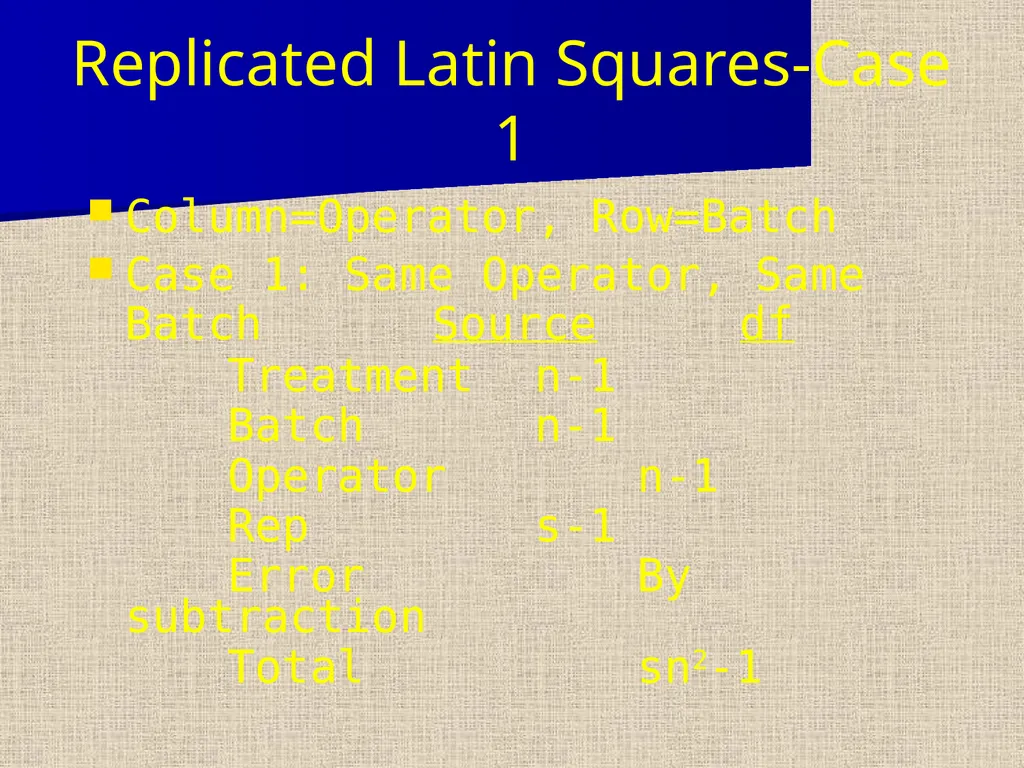
Replicated Latin Squares-Case 1 Column=Operator, Row=Batch
Case 1: Same Operator, Same Batch Source df
Treatment n-1
Batch n-1
Operator n-1
Rep s-1
Error By subtraction
Total sn2-1<br>
03
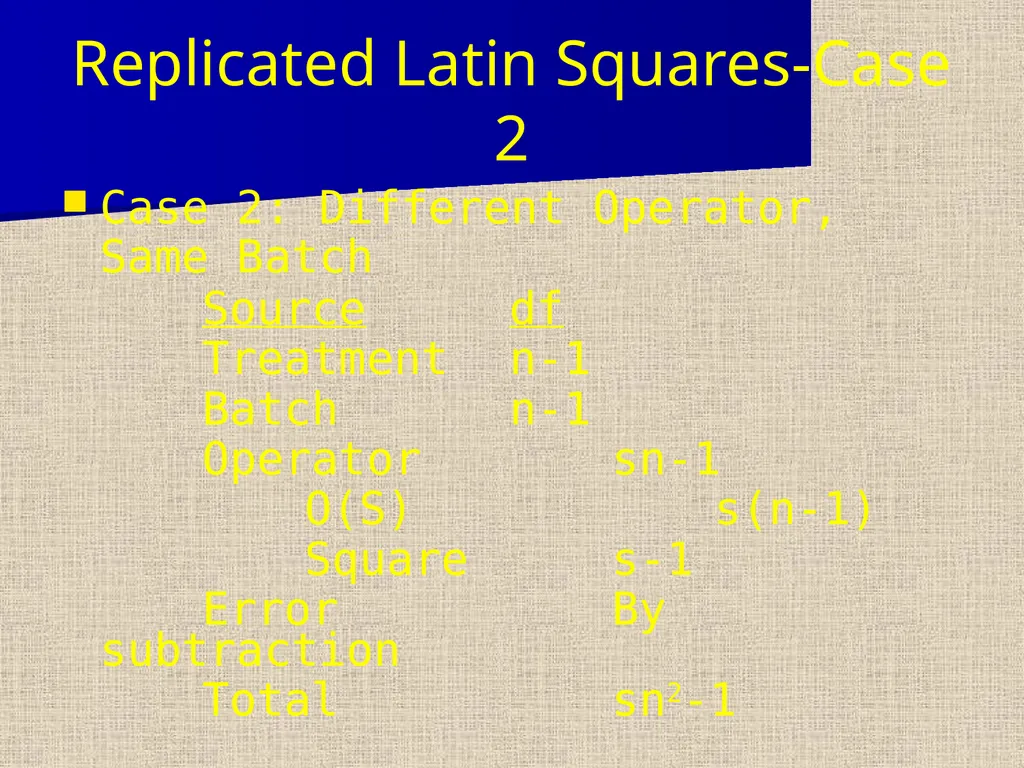
Replicated Latin Squares-Case 2 Case 2: Different Operator, Same Batch
Source df
Treatment n-1
Batch n-1
Operator sn-1
O(S) s(n-1)
Square s-1
Error By subtraction
Total sn2-1<br>
04
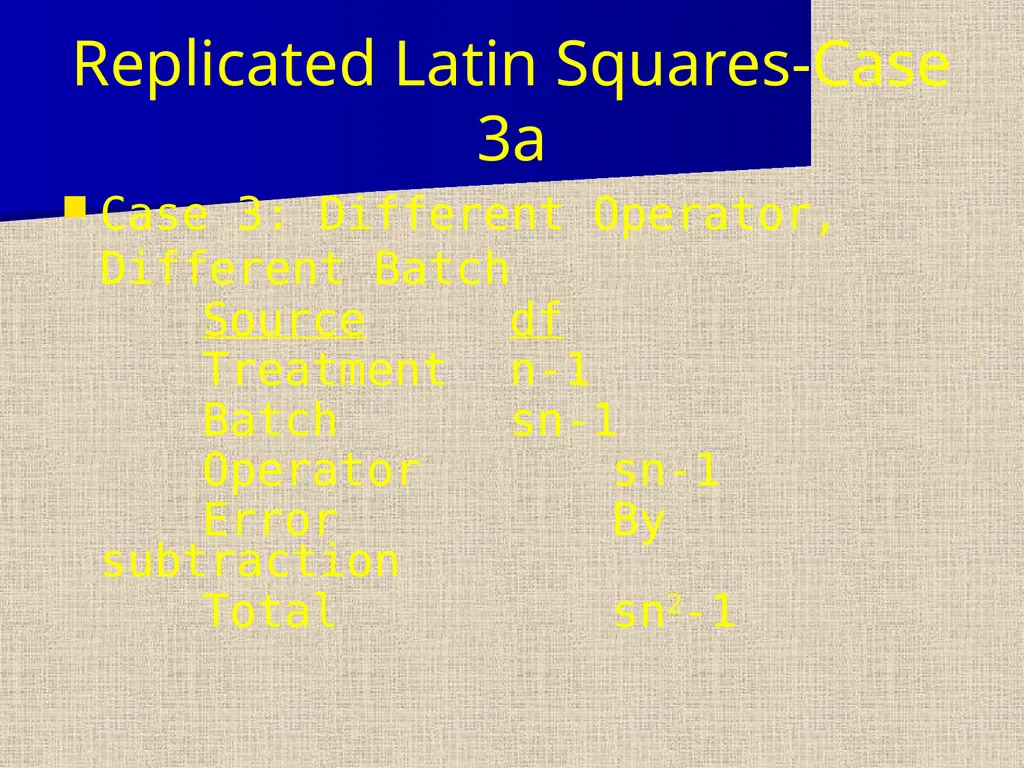
Replicated Latin Squares-Case 3a Case 3: Different Operator, Different Batch
Source df
Treatment n-1
Batch sn-1
Operator sn-1
Error By subtraction
Total sn2-1<br>
05
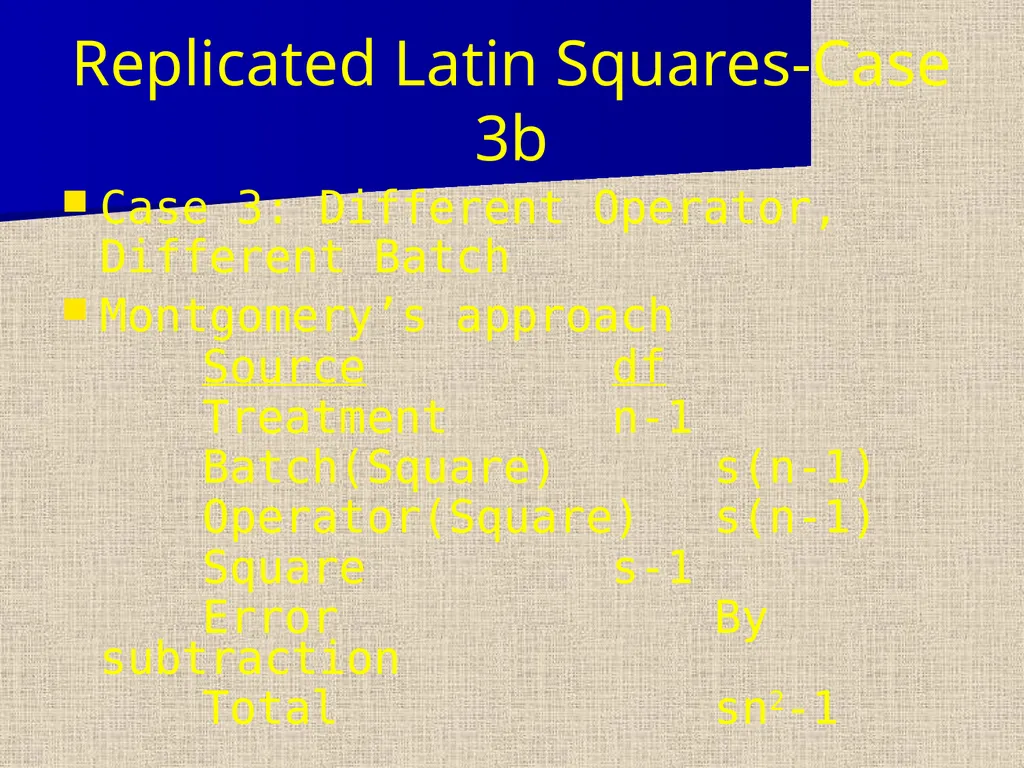
Replicated Latin Squares-Case 3b Case 3: Different Operator, Different Batch
Montgomery’s approach
Source df
Treatment n-1
Batch(Square) s(n-1)
Operator(Square) s(n-1)
Square s-1
Error By subtraction
Total sn2-1<br>
06
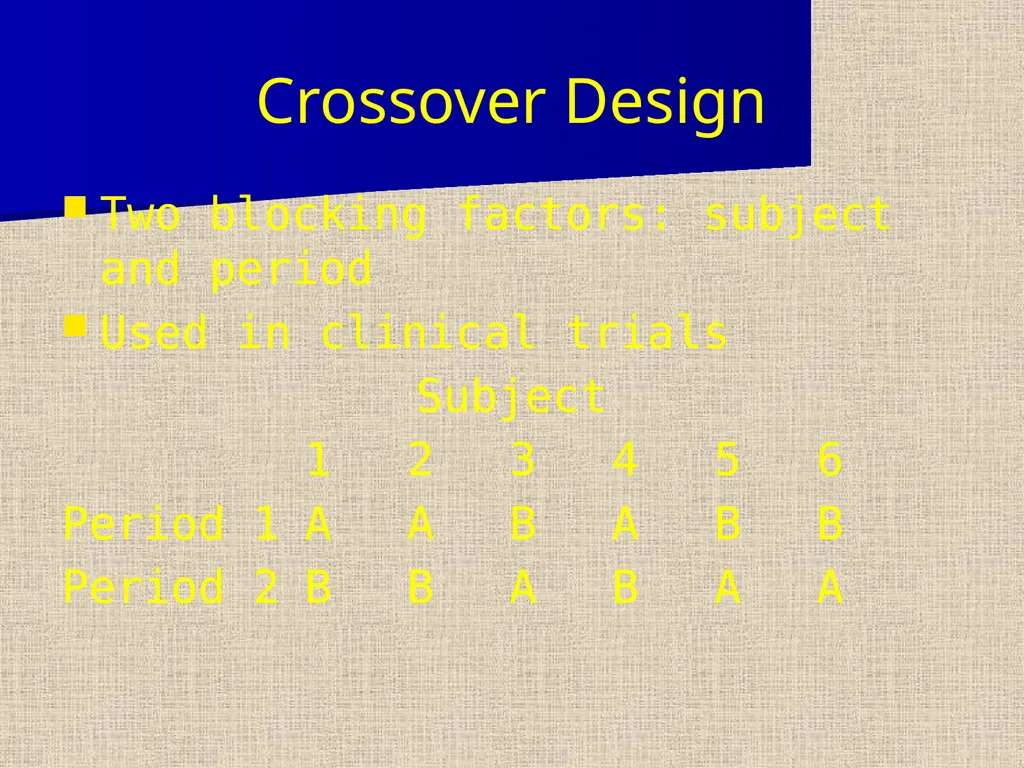
Crossover Design Two blocking factors: subject and period
Used in clinical trials
Subject
1 2 3 4 5 6
Period 1 A A B A B B
Period 2 B B A B A A<br>
07
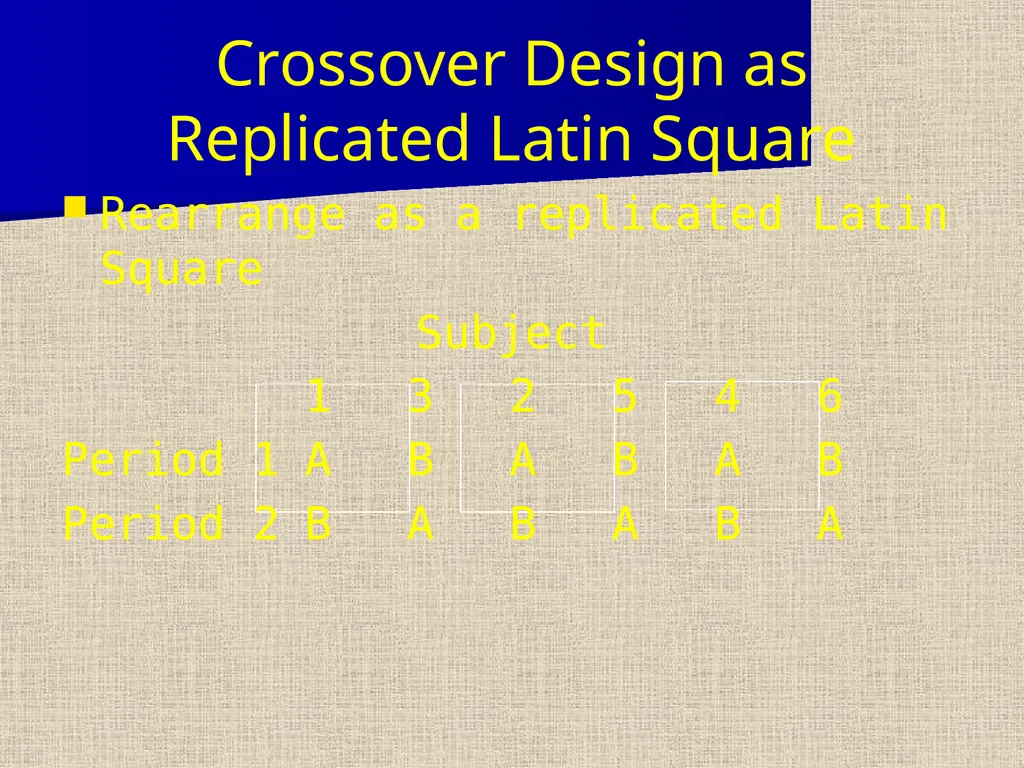
Rearrange as a replicated Latin Square
Subject
1 3 2 5 4 6
Period 1 A B A B A B
Period 2 B A B A B A Crossover Design as Replicated Latin Square<br>
08
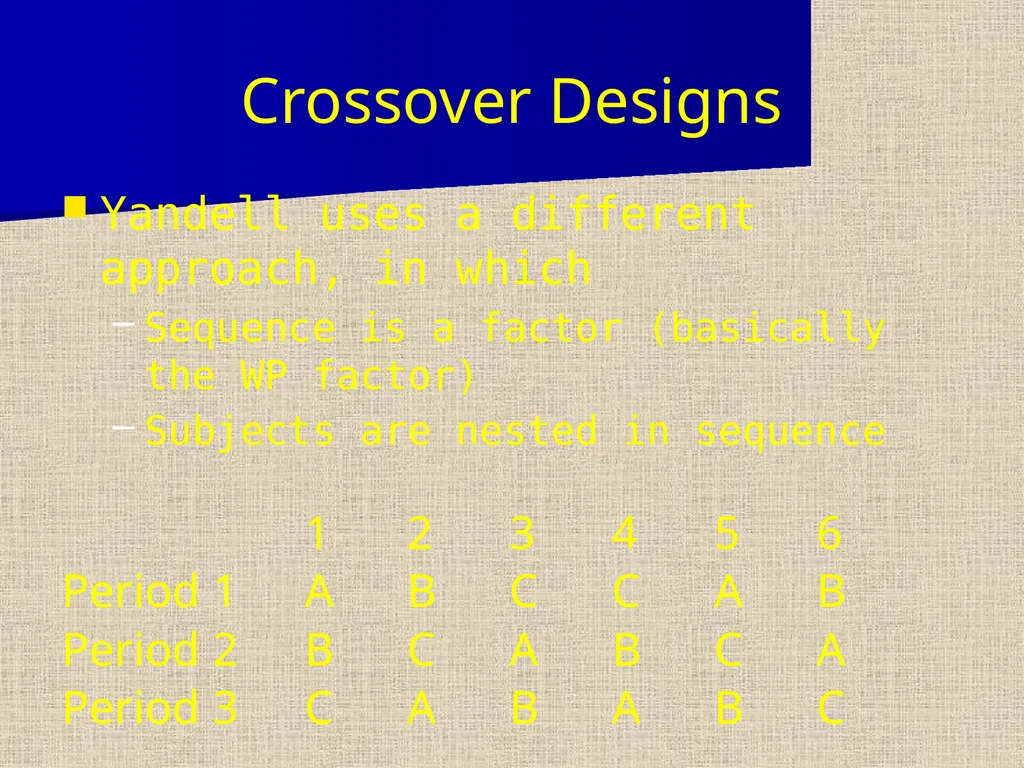
Crossover Designs Yandell uses a different approach, in which
Sequence is a factor (basically the WP factor)
Subjects are nested in sequence
1 2 3 4 5 6
Period 1 A B C C A B
Period 2 B C A B C A
Period 3 C A B A B C<br>
09
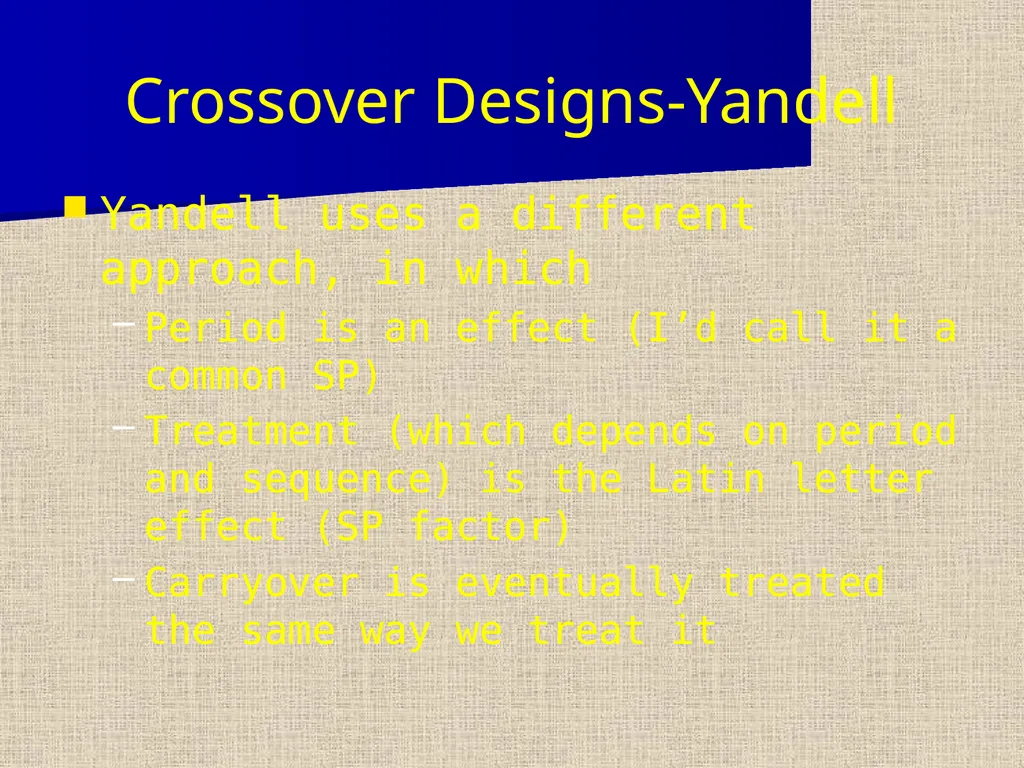
Crossover Designs-Yandell Yandell uses a different approach, in which
Period is an effect (I’d call it a common SP)
Treatment (which depends on period and sequence) is the Latin letter effect (SP factor)
Carryover is eventually treated the same way we treat it<br>
10
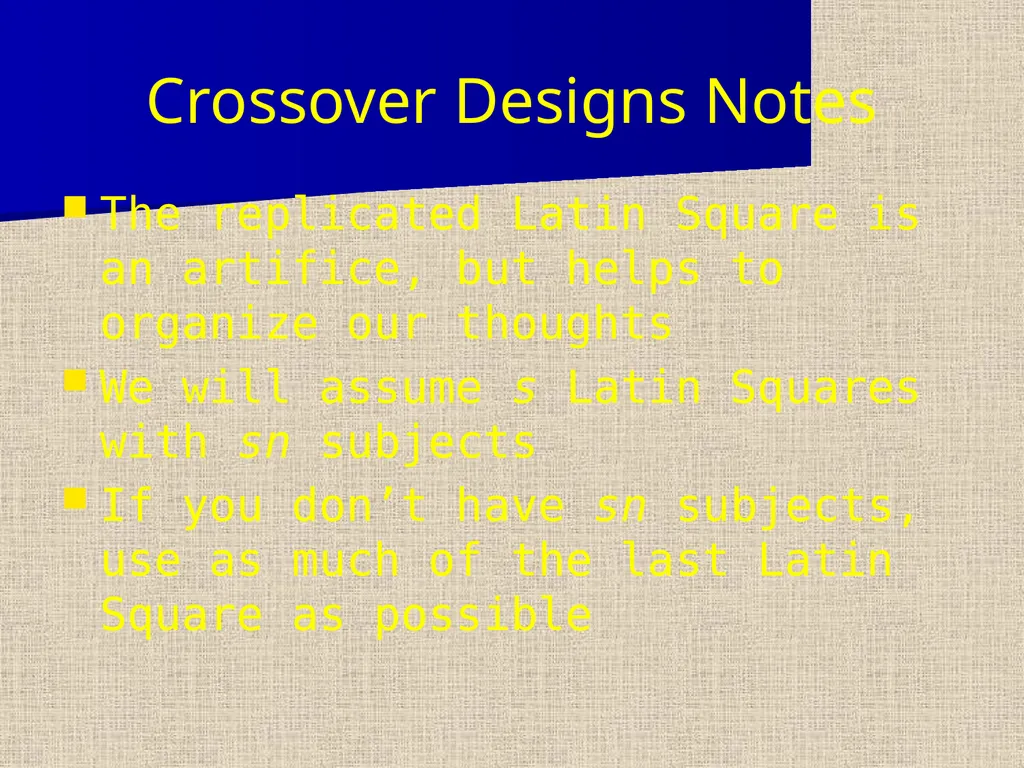
Crossover Designs Notes The replicated Latin Square is an artifice, but helps to organize our thoughts
We will assume s Latin Squares with sn subjects
If you don’t have sn subjects, use as much of the last Latin Square as possible<br>
11
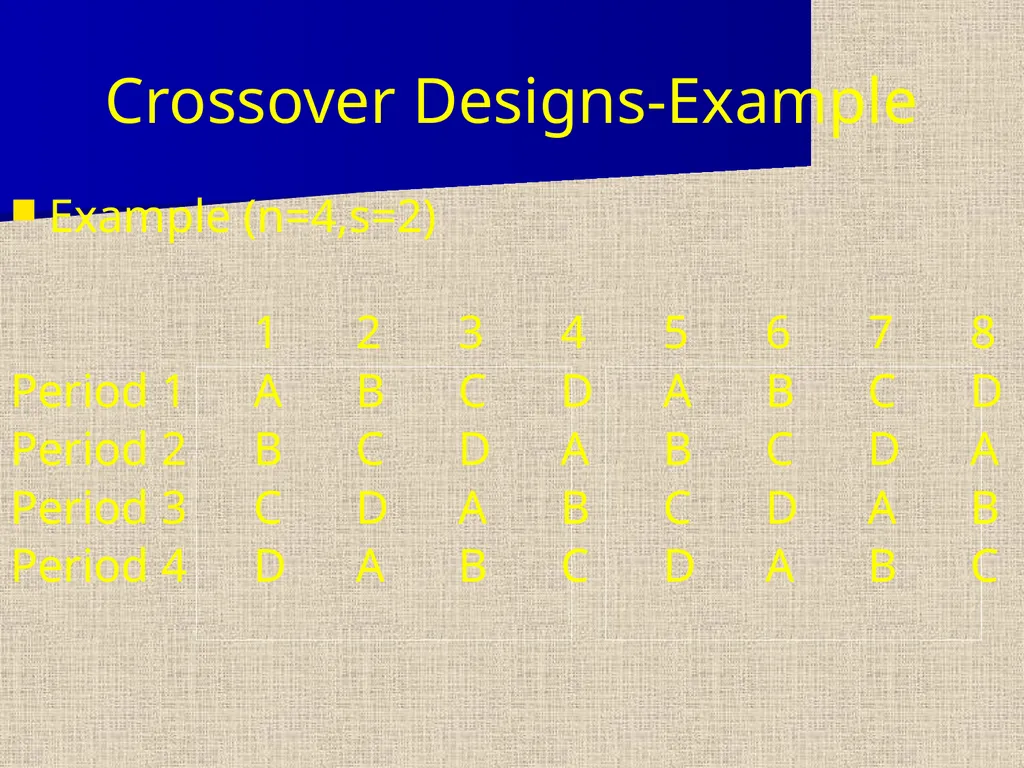
Example (n=4,s=2)
1 2 3 4 5 6 7 8
Period 1 A B C D A B C D
Period 2 B C D A B C D A
Period 3 C D A B C D A B
Period 4 D A B C D A B C Crossover Designs-Example<br>
12
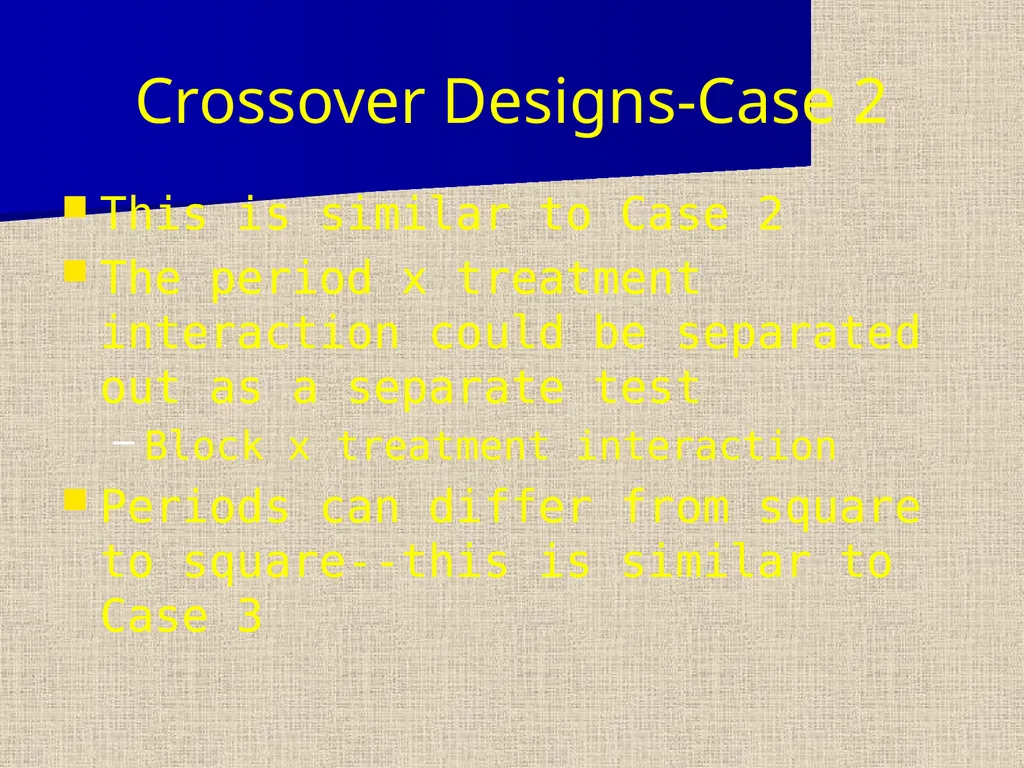
Crossover Designs-Case 2 This is similar to Case 2
The period x treatment interaction could be separated out as a separate test
Block x treatment interaction
Periods can differ from square to square--this is similar to Case 3<br>
13
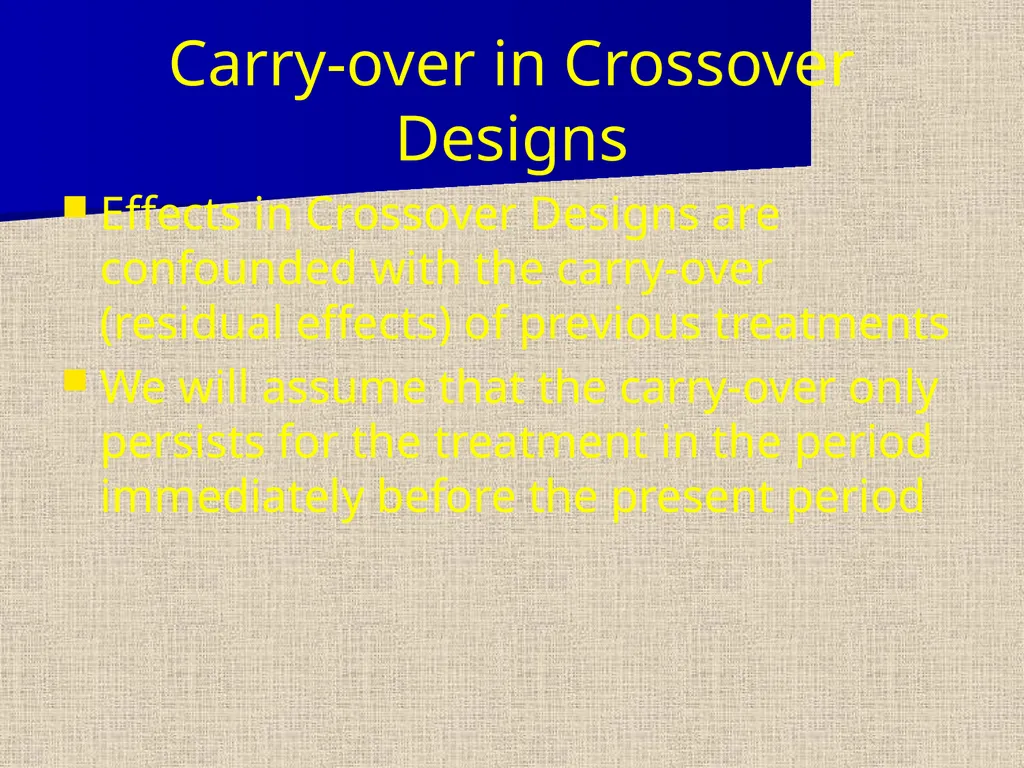
Carry-over in Crossover Designs Effects in Crossover Designs are confounded with the carry-over (residual effects) of previous treatments
We will assume that the carry-over only persists for the treatment in the period immediately before the present period<br>
14
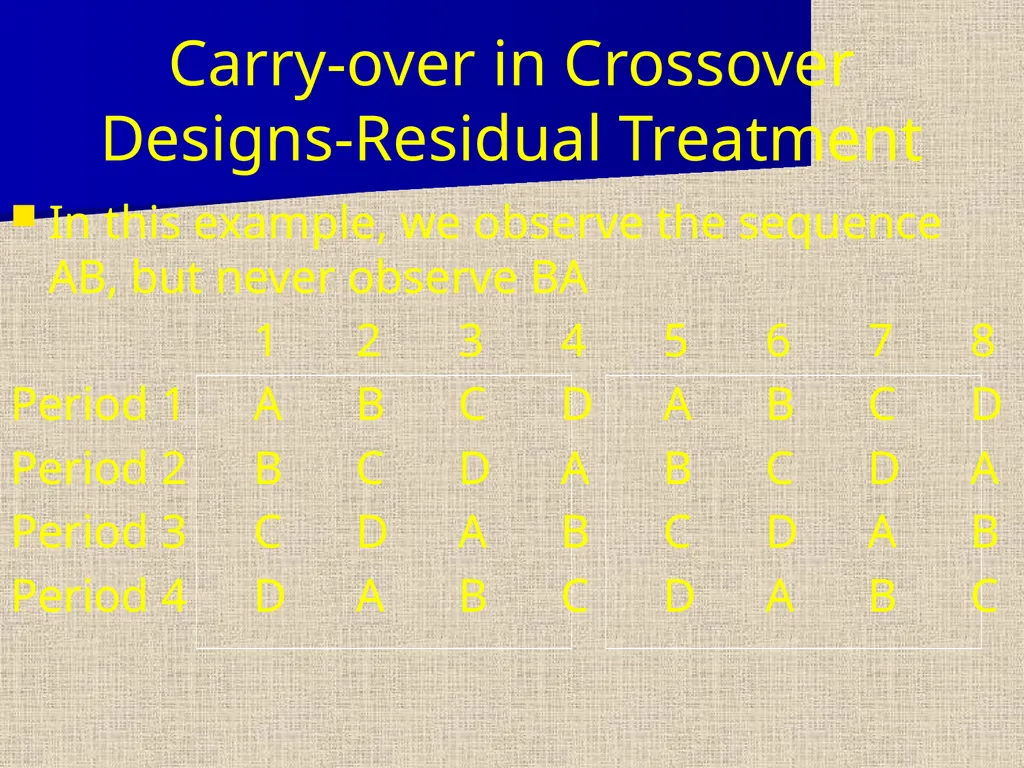
In this example, we observe the sequence AB, but never observe BA
1 2 3 4 5 6 7 8
Period 1 A B C D A B C D
Period 2 B C D A B C D A
Period 3 C D A B C D A B
Period 4 D A B C D A B C Carry-over in Crossover Designs-Residual Treatment<br>
15
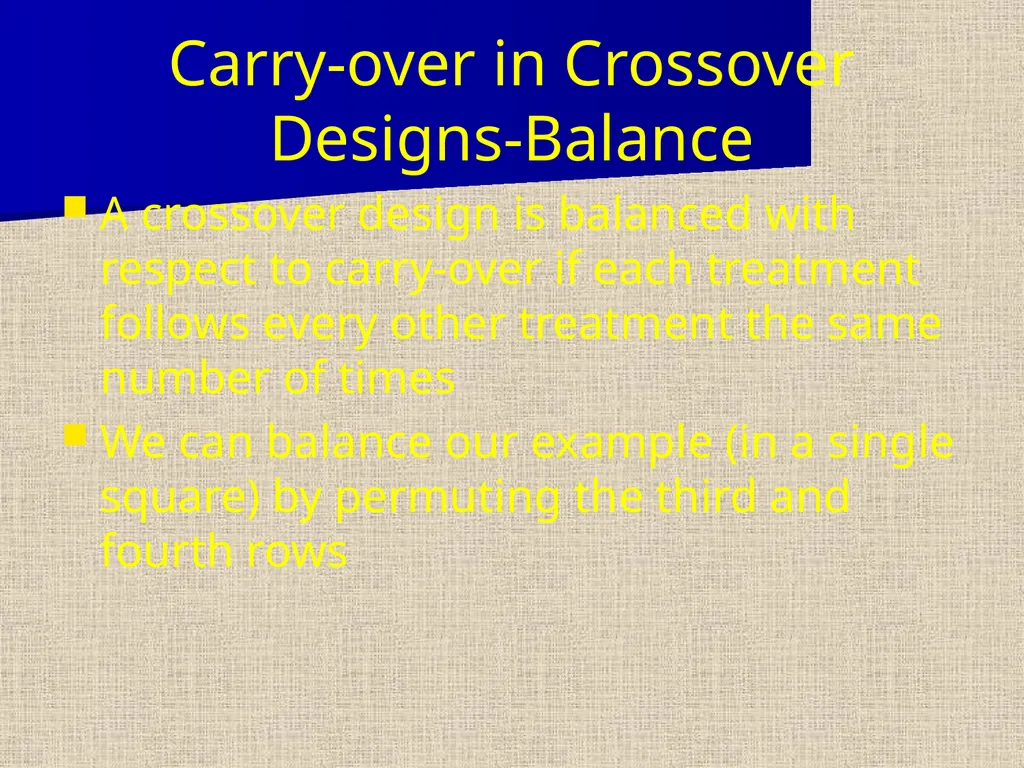
Carry-over in Crossover Designs-Balance A crossover design is balanced with respect to carry-over if each treatment follows every other treatment the same number of times
We can balance our example (in a single square) by permuting the third and fourth rows<br>
16
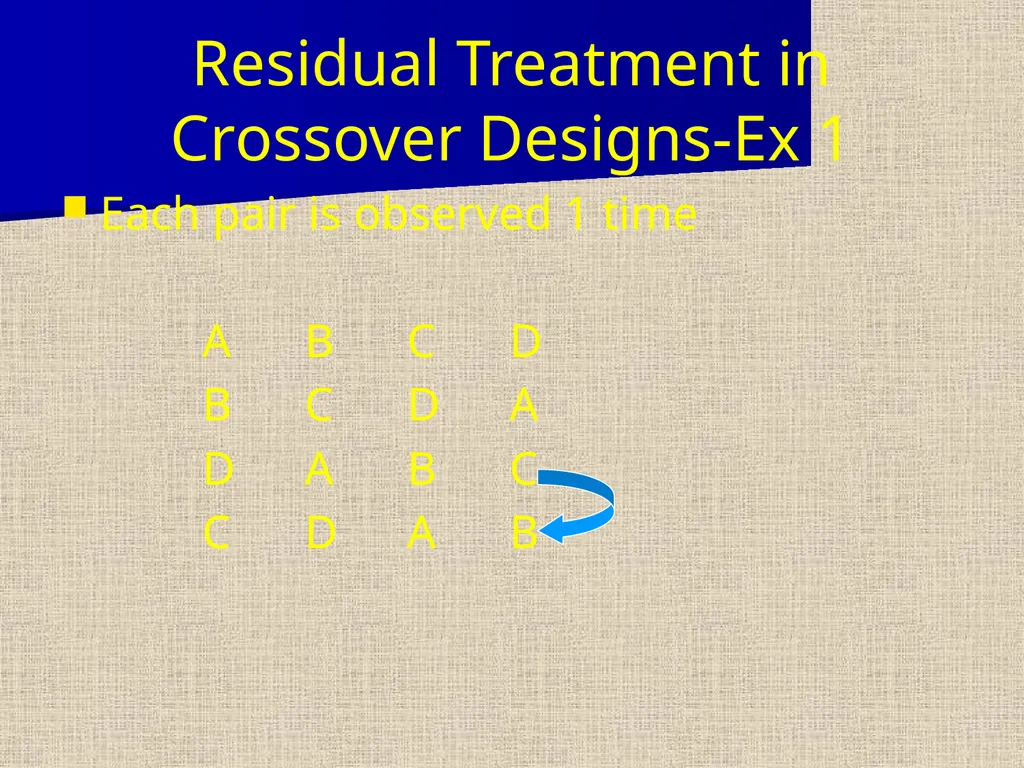
Each pair is observed 1 time
A B C D
B C D A
D A B C
C D A B Residual Treatment in Crossover Designs-Ex 1<br>
17
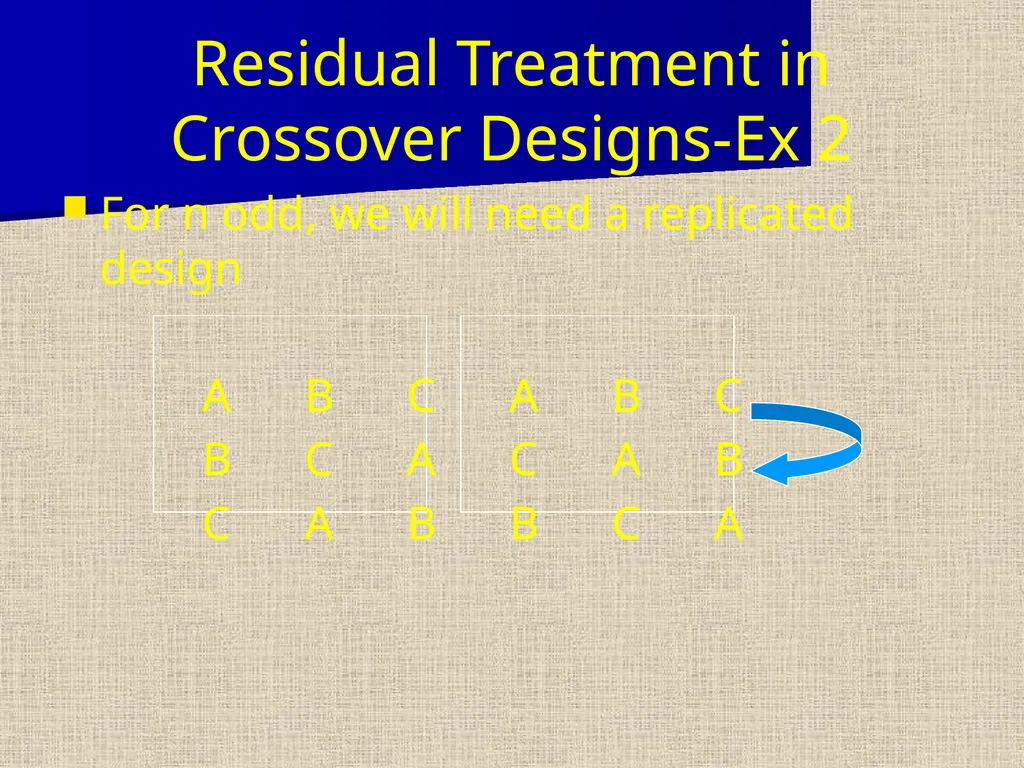
For n odd, we will need a replicated design
A B C A B C
B C A C A B
C A B B C A Residual Treatment in Crossover Designs-Ex 2<br>
18
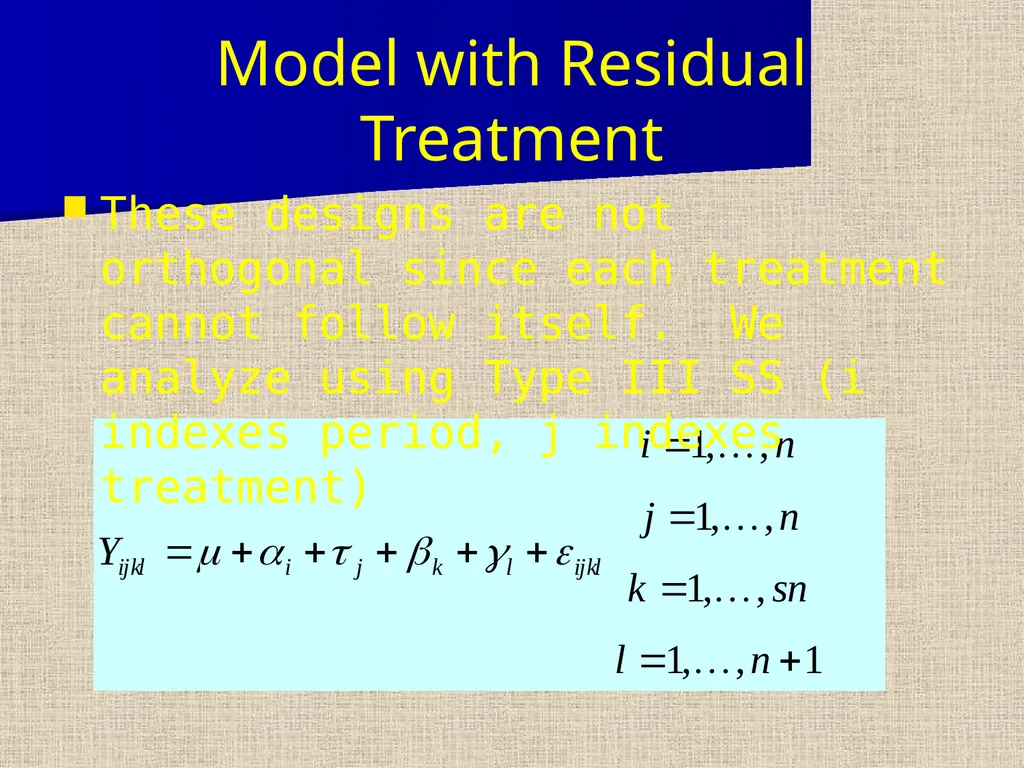
These designs are not orthogonal since each treatment cannot follow itself. We analyze using Type III SS (i indexes period, j indexes treatment) Model with Residual Treatment<br>
19
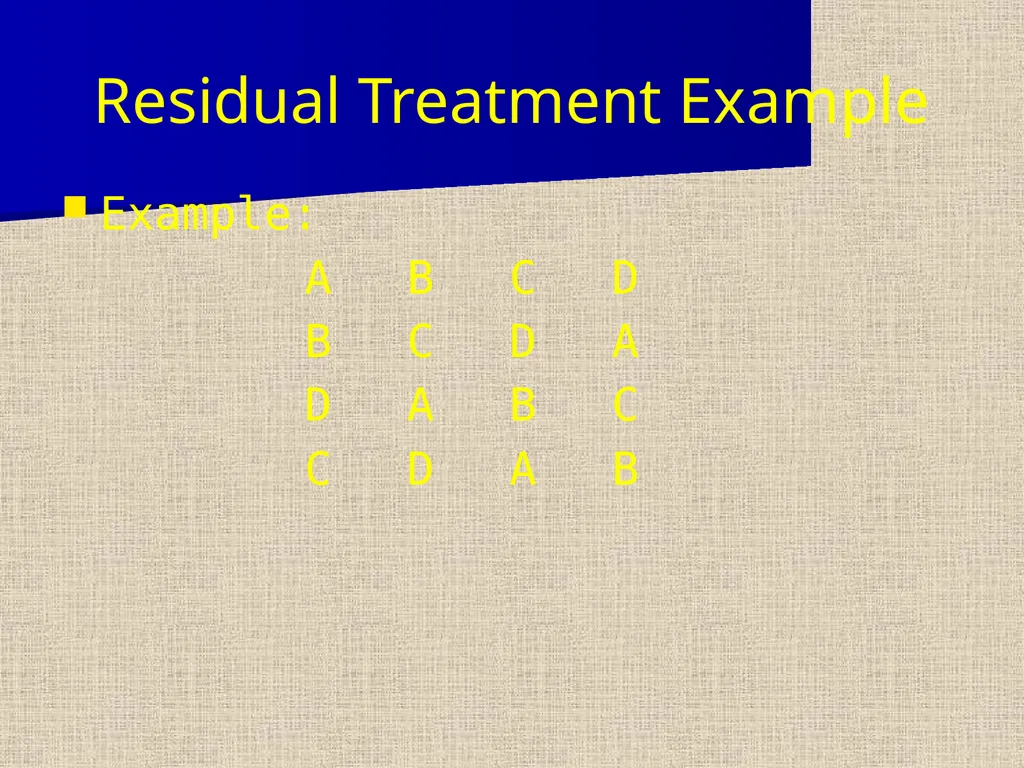
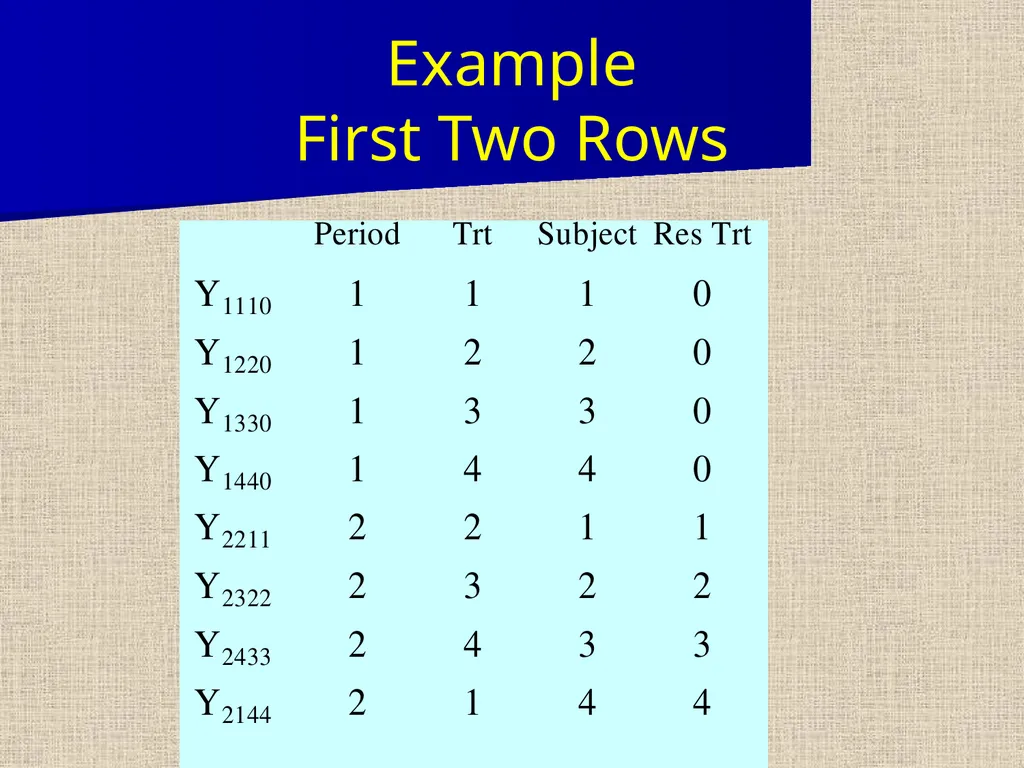
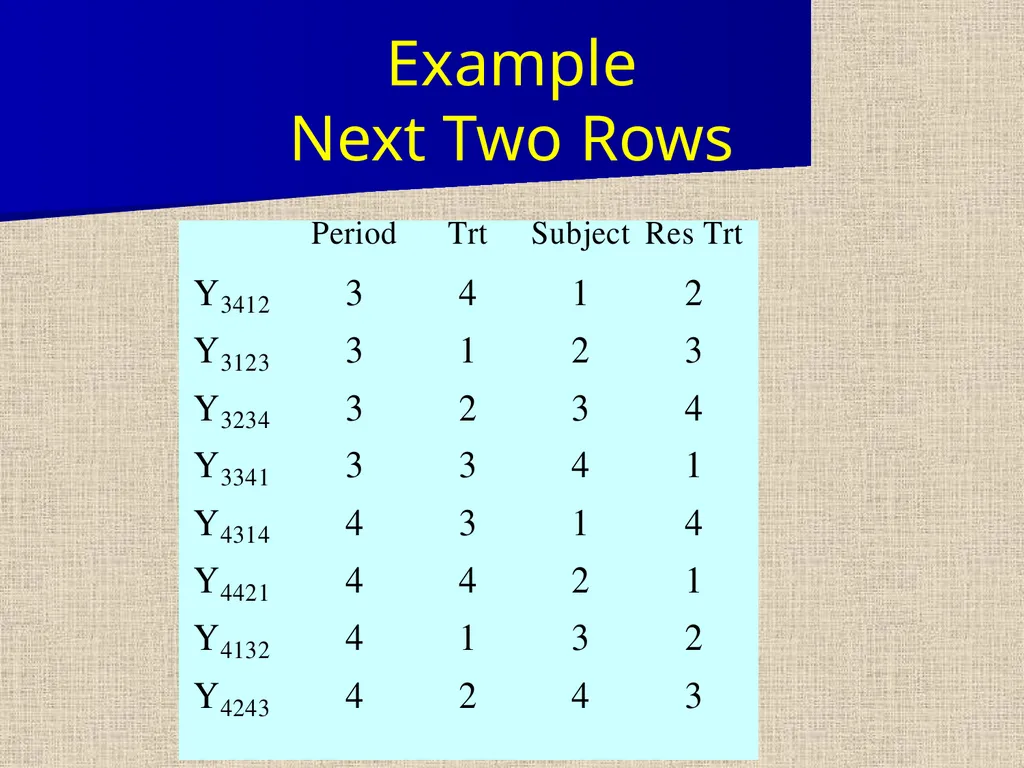
Residual Treatment Example Example:
A B C D
B C D A
D A B C
C D A B<br>
20
Example First Two Rows<br>
21
Example Next Two Rows<br>
22
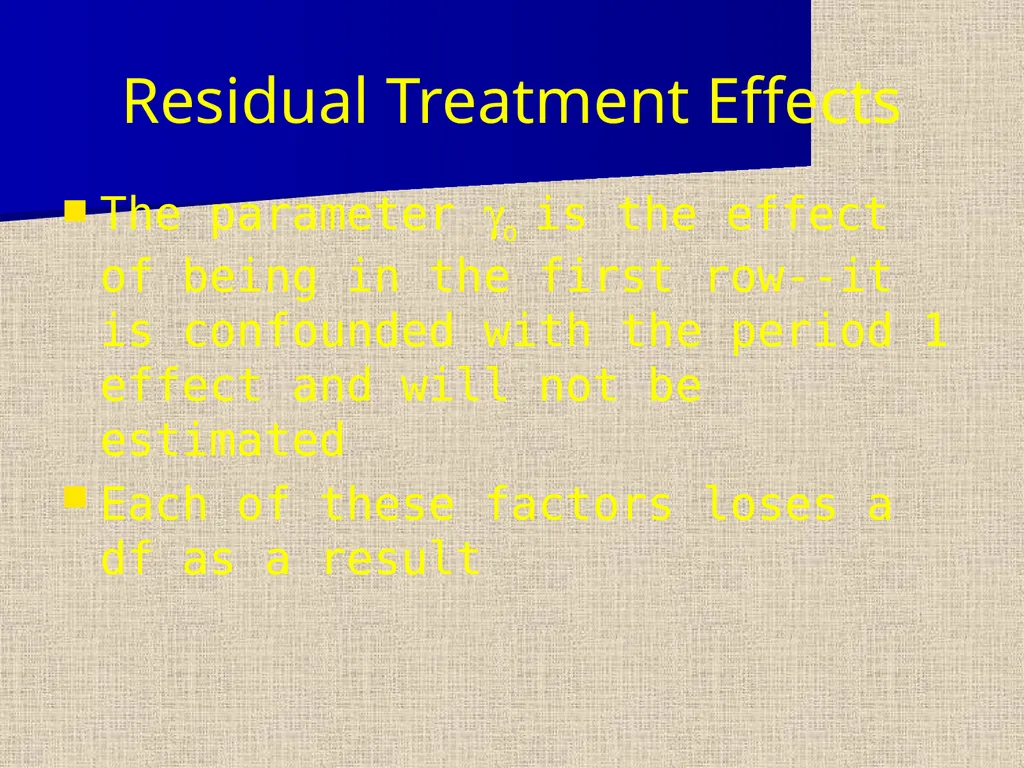
Residual Treatment Effects The parameter go is the effect of being in the first row--it is confounded with the period 1 effect and will not be estimated
Each of these factors loses a df as a result<br>
23
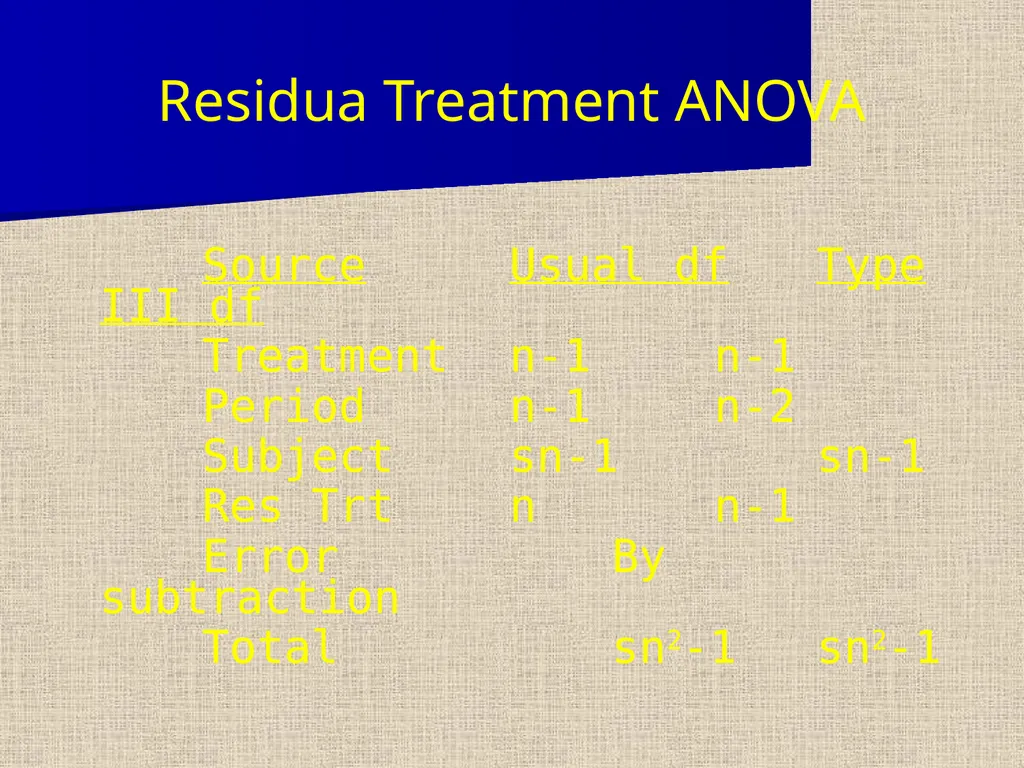
Residua Treatment ANOVA Source Usual df Type III df
Treatment n-1 n-1
Period n-1 n-2
Subject sn-1 sn-1
Res Trt n n-1
Error By subtraction
Total sn2-1 sn2-1<br>