04
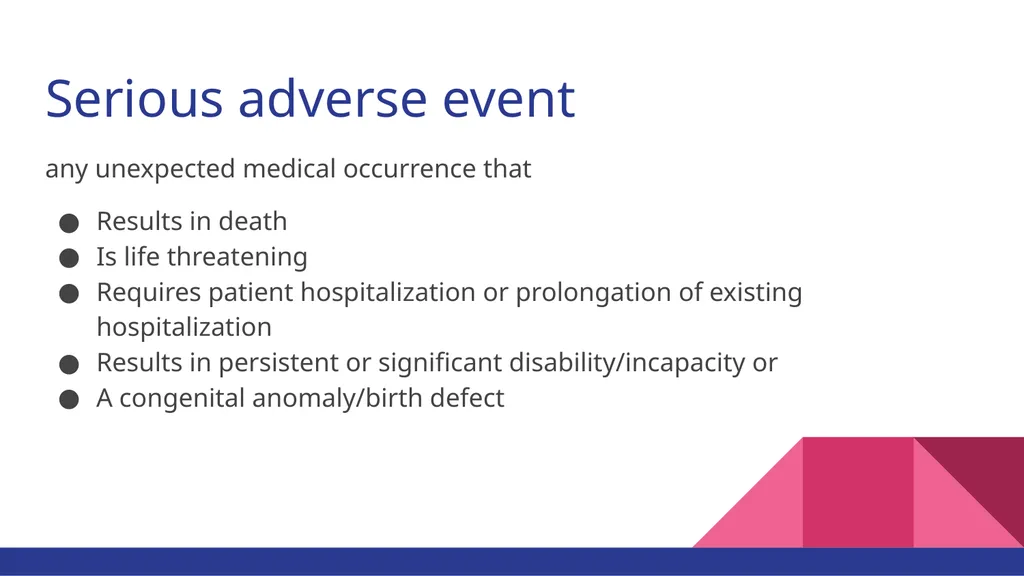
Serious adverse event any unexpected medical occurrence that
Results in death
Is life threatening
Requires patient hospitalization or prolongation of existing hospitalization
Results in persistent or significant disability/incapacity or
A congenital anomaly/birth defect<br>
05
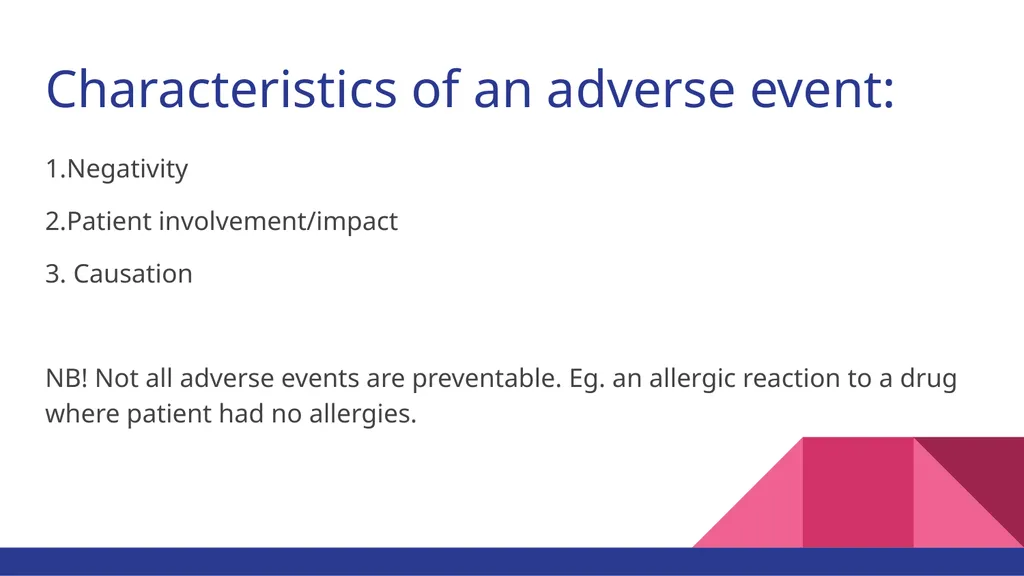
Characteristics of an adverse event: 1.Negativity
2.Patient involvement/impact
3. Causation
NB! Not all adverse events are preventable. Eg. an allergic reaction to a drug where patient had no allergies.<br>
06
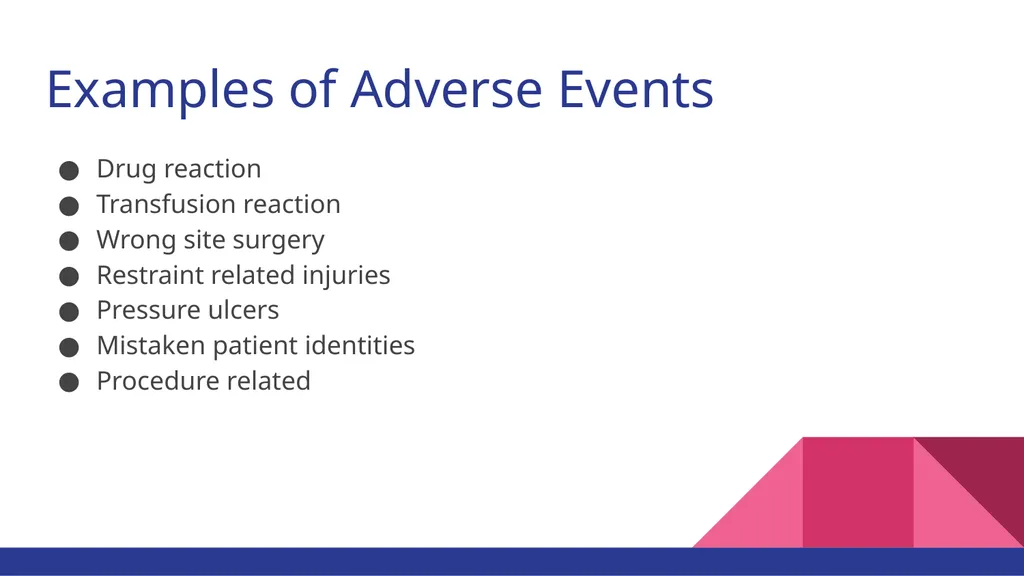
Examples of Adverse Events Drug reaction
Transfusion reaction
Wrong site surgery
Restraint related injuries
Pressure ulcers
Mistaken patient identities
Procedure related<br>
07
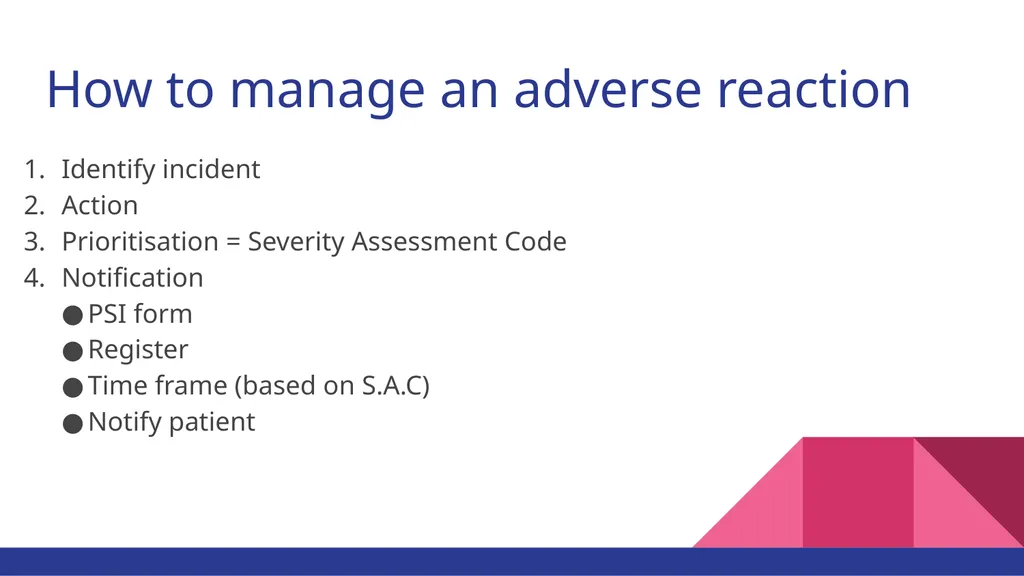
How to manage an adverse reaction Identify incident
Action
Prioritisation = Severity Assessment Code
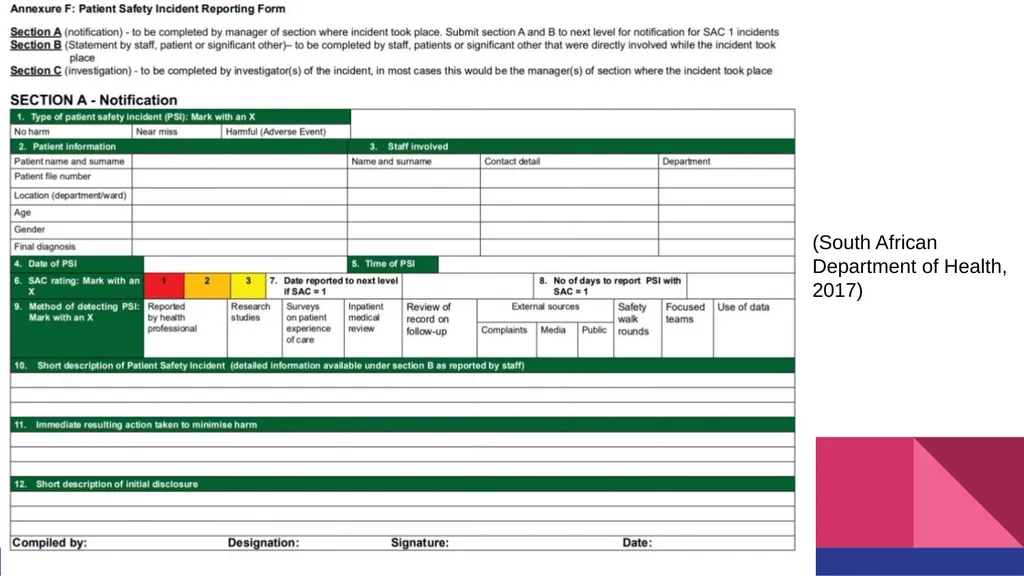
Notification
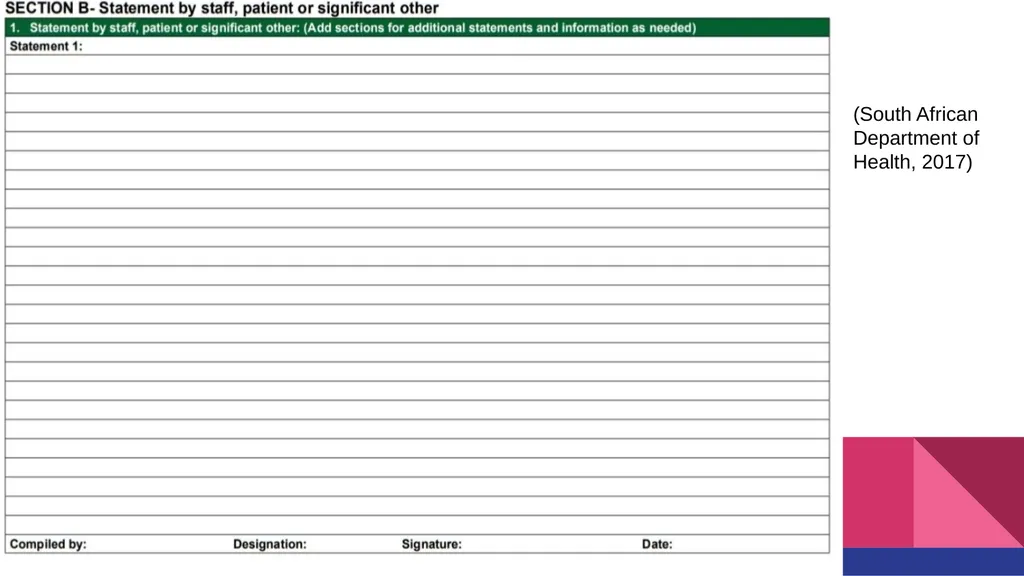
PSI form
Register
Time frame (based on S.A.C)
Notify patient<br>
08
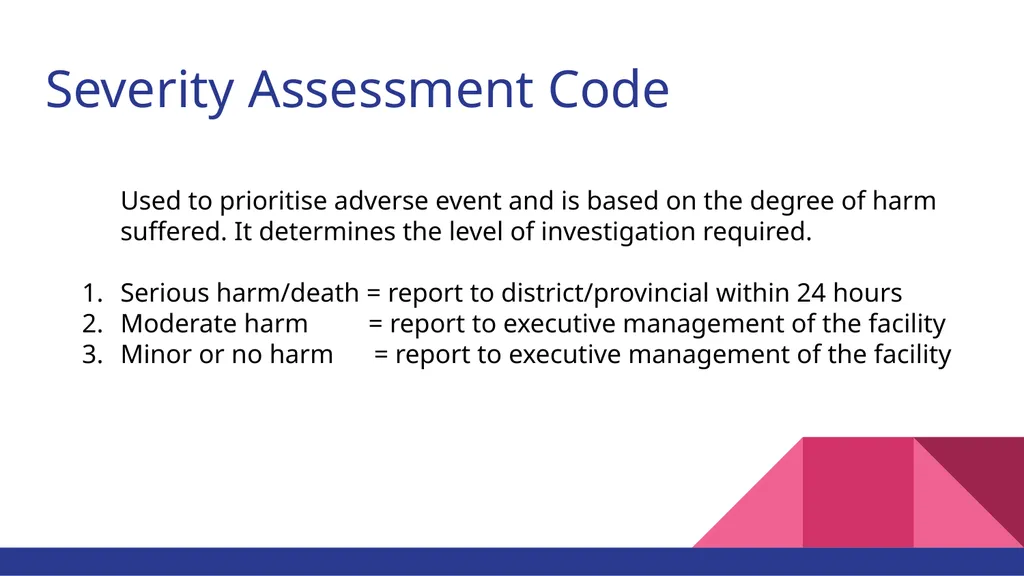
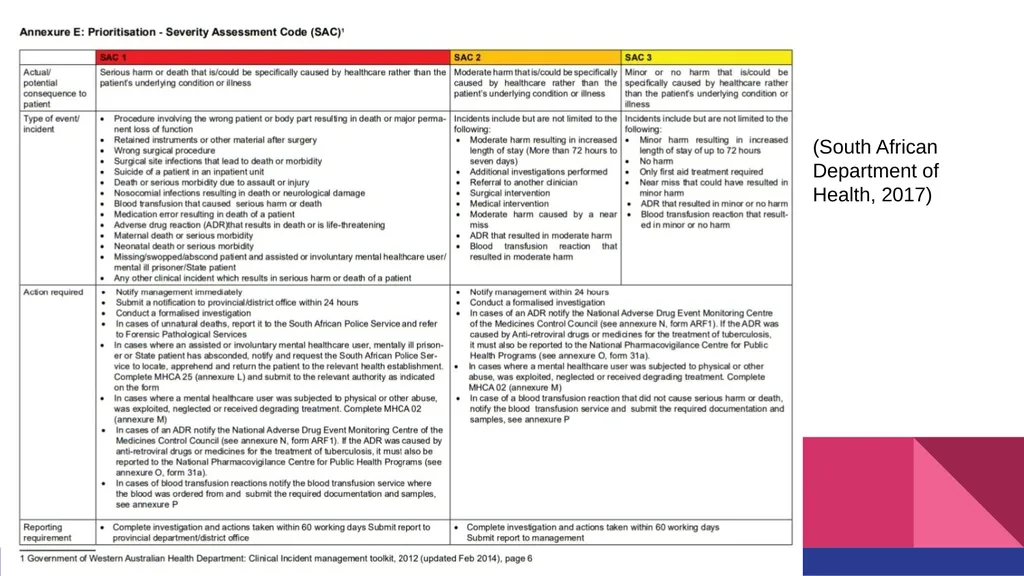
Severity Assessment Code Used to prioritise adverse event and is based on the degree of harm suffered. It determines the level of investigation required.
Serious harm/death = report to district/provincial within 24 hours
Moderate harm = report to executive management of the facility
Minor or no harm = report to executive management of the facility<br>
09
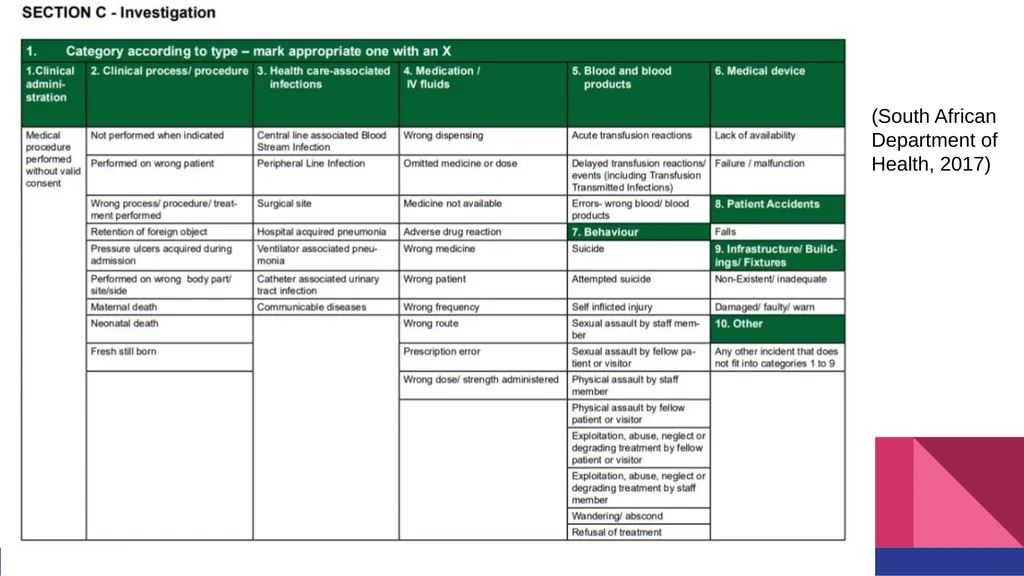
(South African Department of Health, 2017)<br>
10
How to manage an adverse reaction cont 5. Investigation and report of investigation
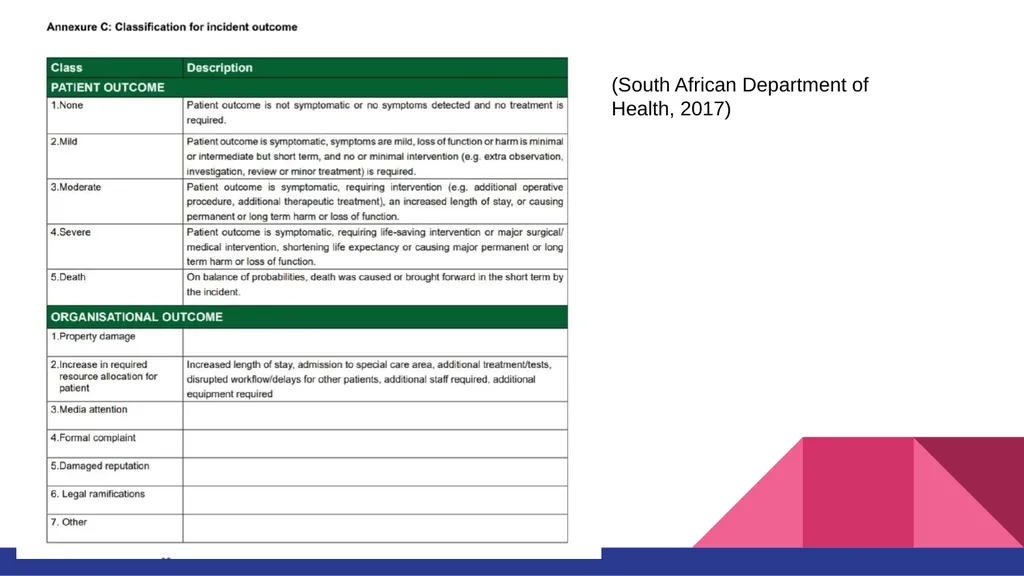
6. Classification
7. Analysis
8. Implementation of recommendations
9. Learning<br>
11
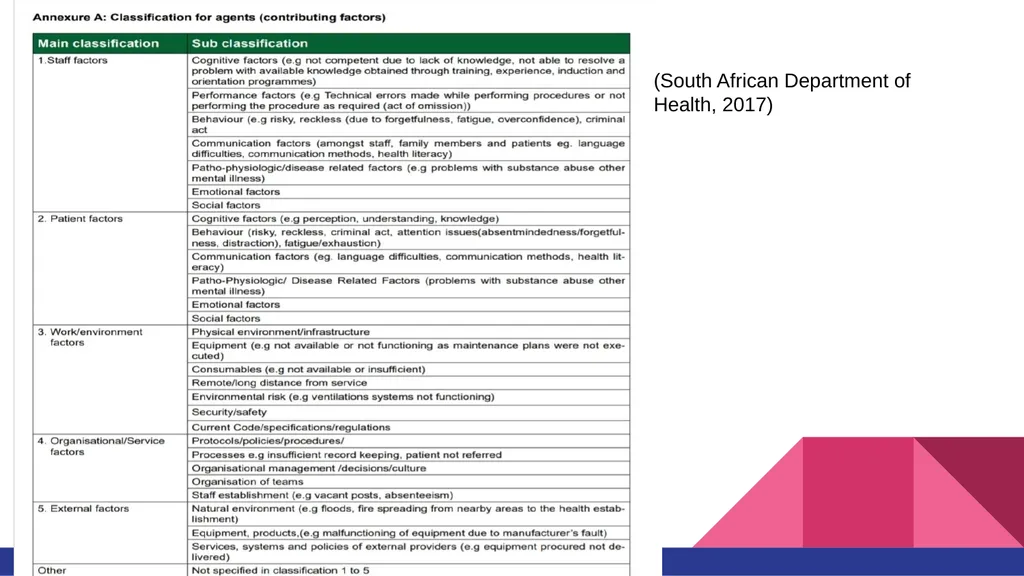
(South African Department of Health, 2017)<br>
12
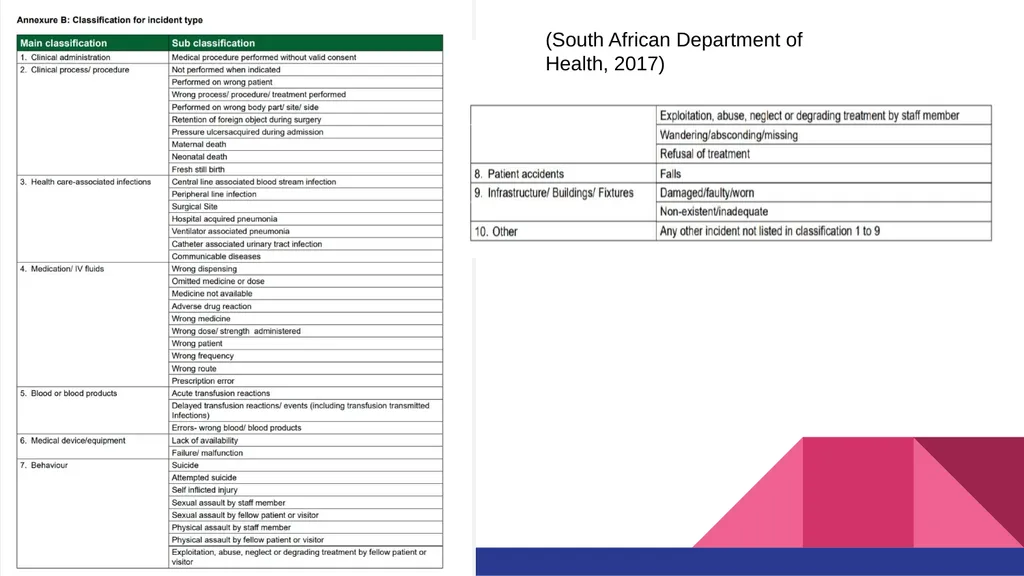
(South African Department of Health, 2017)<br>
13
(South African Department of Health, 2017)<br>
14
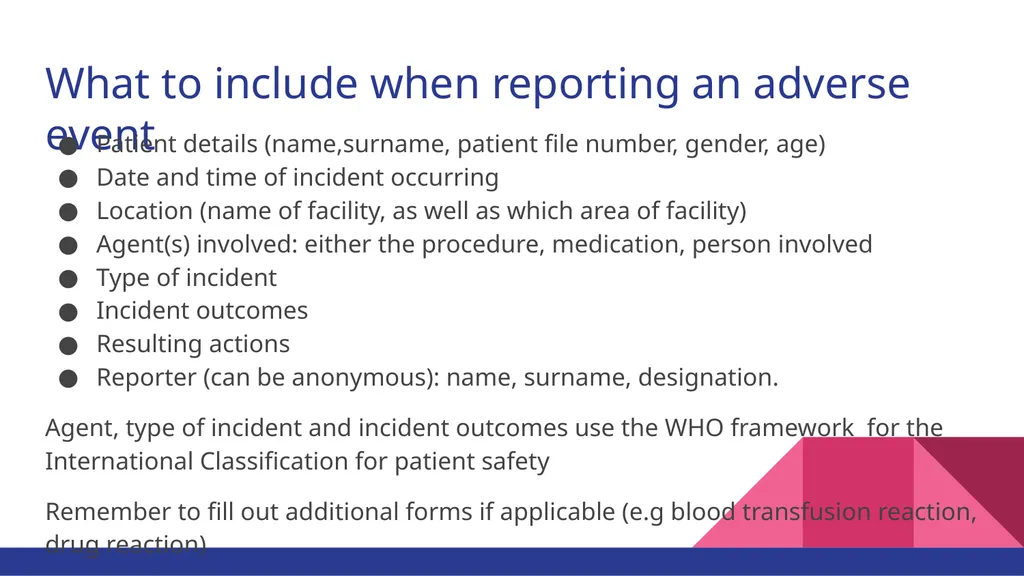
What to include when reporting an adverse event Patient details (name,surname, patient file number, gender, age)
Date and time of incident occurring
Location (name of facility, as well as which area of facility)
Agent(s) involved: either the procedure, medication, person involved
Type of incident
Incident outcomes
Resulting actions
Reporter (can be anonymous): name, surname, designation.
Agent, type of incident and incident outcomes use the WHO framework for the International Classification for patient safety
Remember to fill out additional forms if applicable (e.g blood transfusion reaction, drug reaction)<br>
15
(South African Department of Health, 2017)<br>
16
(South African Department of Health, 2017)<br>
17
(South African Department of Health, 2017)<br>
18
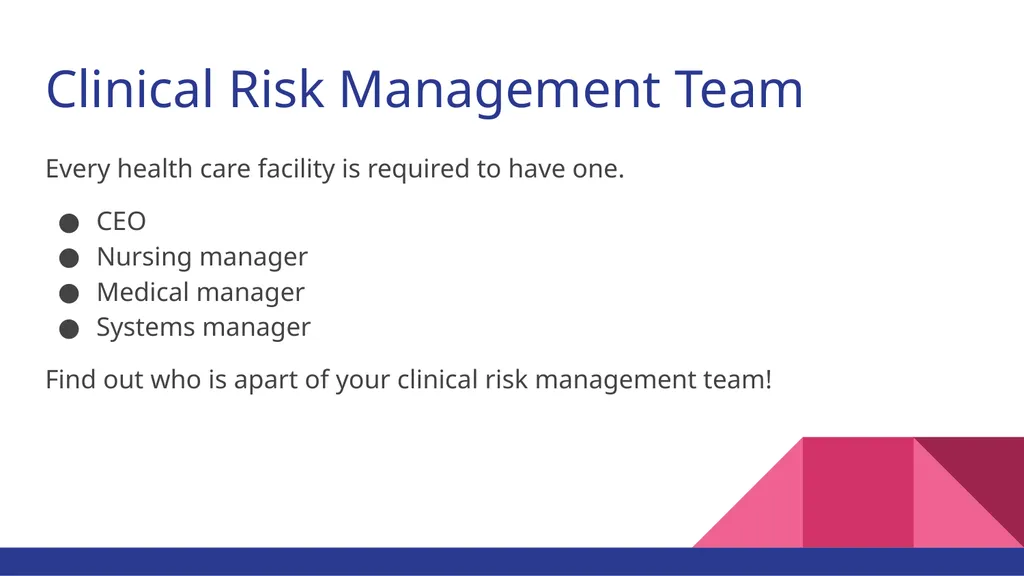
Clinical Risk Management Team Every health care facility is required to have one.
CEO
Nursing manager
Medical manager
Systems manager
Find out who is apart of your clinical risk management team!<br>
19
Conclusion: It is a passive monitoring system
Identify clinical risk management team
It is your responsibility to report adverse events
WHO PSI DATA<br>
20
References South African Department of Health, 2017. National Guideline for Patient Safety Incident Reporting and Learning in the Public Health Sector of South Africa. Pretoria: NDoh, pp.8-62.
University of Kwazulu-natal, n.d. Adverse Events Monitoring and Reporting Guidelines. Durban: Nelson Mandela School of Medicine, pp.3-9.
Semete, B., 2020. Guidelines for Adverse Drug Reactions Reporting for Healthcare Professionals. [ebook] Pretoria: South African Health Products regulatory authority, pp.5-9. Available at: <http://www.sahpra.org.za> [Accessed 19 February 2021].<br>
21
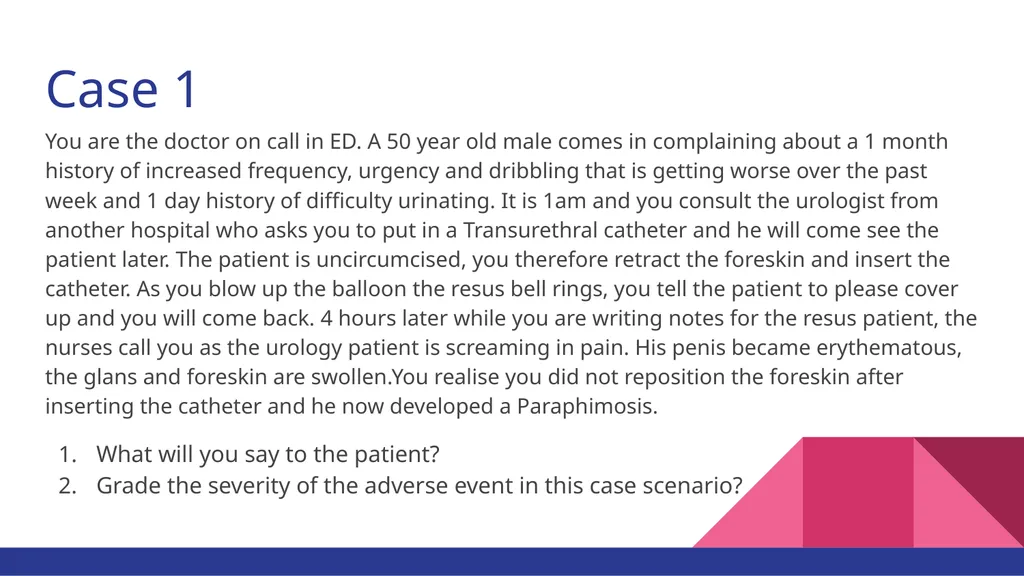
Case 1 You are the doctor on call in ED. A 50 year old male comes in complaining about a 1 month history of increased frequency, urgency and dribbling that is getting worse over the past week and 1 day history of difficulty urinating. It is 1am and you consult the urologist from another hospital who asks you to put in a Transurethral catheter and he will come see the patient later. The patient is uncircumcised, you therefore retract the foreskin and insert the catheter. As you blow up the balloon the resus bell rings, you tell the patient to please cover up and you will come back. 4 hours later while you are writing notes for the resus patient, the nurses call you as the urology patient is screaming in pain. His penis became erythematous, the glans and foreskin are swollen.You realise you did not reposition the foreskin after inserting the catheter and he now developed a Paraphimosis.
What will you say to the patient?
Grade the severity of the adverse event in this case scenario?<br>
22
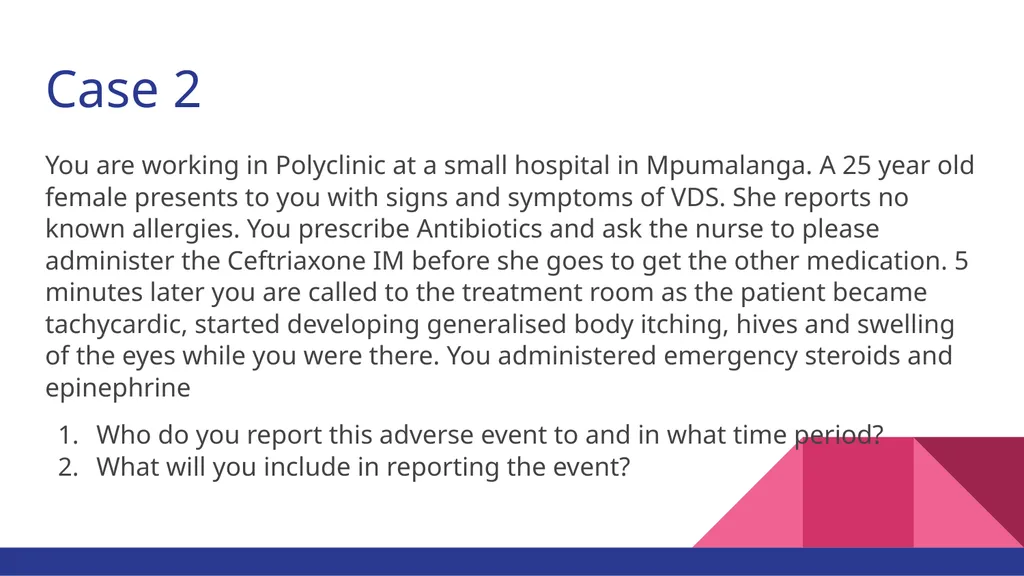
Case 2 You are working in Polyclinic at a small hospital in Mpumalanga. A 25 year old female presents to you with signs and symptoms of VDS. She reports no known allergies. You prescribe Antibiotics and ask the nurse to please administer the Ceftriaxone IM before she goes to get the other medication. 5 minutes later you are called to the treatment room as the patient became tachycardic, started developing generalised body itching, hives and swelling of the eyes while you were there. You administered emergency steroids and epinephrine
Who do you report this adverse event to and in what time period?
What will you include in reporting the event?<br>
23
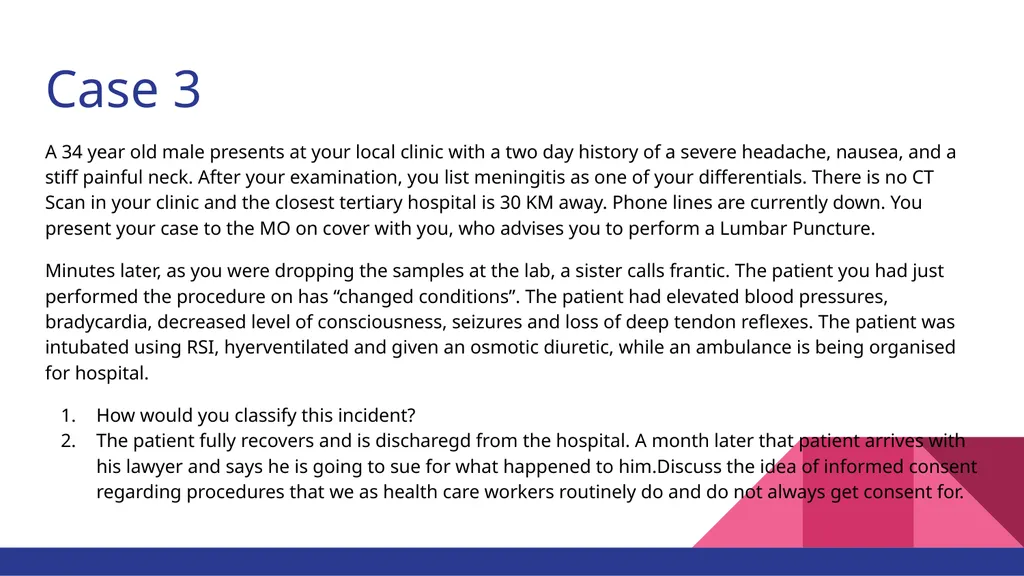
Case 3 A 34 year old male presents at your local clinic with a two day history of a severe headache, nausea, and a stiff painful neck. After your examination, you list meningitis as one of your differentials. There is no CT Scan in your clinic and the closest tertiary hospital is 30 KM away. Phone lines are currently down. You present your case to the MO on cover with you, who advises you to perform a Lumbar Puncture.
Minutes later, as you were dropping the samples at the lab, a sister calls frantic. The patient you had just performed the procedure on has “changed conditions”. The patient had elevated blood pressures, bradycardia, decreased level of consciousness, seizures and loss of deep tendon reflexes. The patient was intubated using RSI, hyerventilated and given an osmotic diuretic, while an ambulance is being organised for hospital.
How would you classify this incident?
The patient fully recovers and is discharegd from the hospital. A month later that patient arrives with his lawyer and says he is going to sue for what happened to him.Discuss the idea of informed consent regarding procedures that we as health care workers routinely do and do not always get consent for.<br>