
Reporting Source Reduction to the Toxics Release
Description: Reporting Source Reduction to the Toxics Release Inventory Charlie Snyder US EPA June 14, 2023 1 Overview What is source reduction? Why report source reduction? How do I report source reduction activities on the Form R? Section 8.10 Section
Related Topics
Download Presentation
"Reporting Source Reduction to the Toxics Release" is the property of its rightful owner. Permission is granted to download and print the materials on this website for personal, non-commercial use only, and to display it on your personal computer provided you do not modify the materials and that you retain all copyright notices contained in the materials. By downloading content from our website, you accept the terms of this agreement.
Presentation Transcript
slide1. Reporting Source Reduction
to the
Toxics Release Inventory Charlie Snyder
US EPA
June 14, 2023 1<br>
slide2. Overview What is source reduction?
Why report source reduction?
How do I report source reduction activities on the Form R?
Section 8.10
Section 8.11
How does TRI categorize source reduction?
Source reduction examples
Writing optional comments
How is source reduction information used? 2<br>
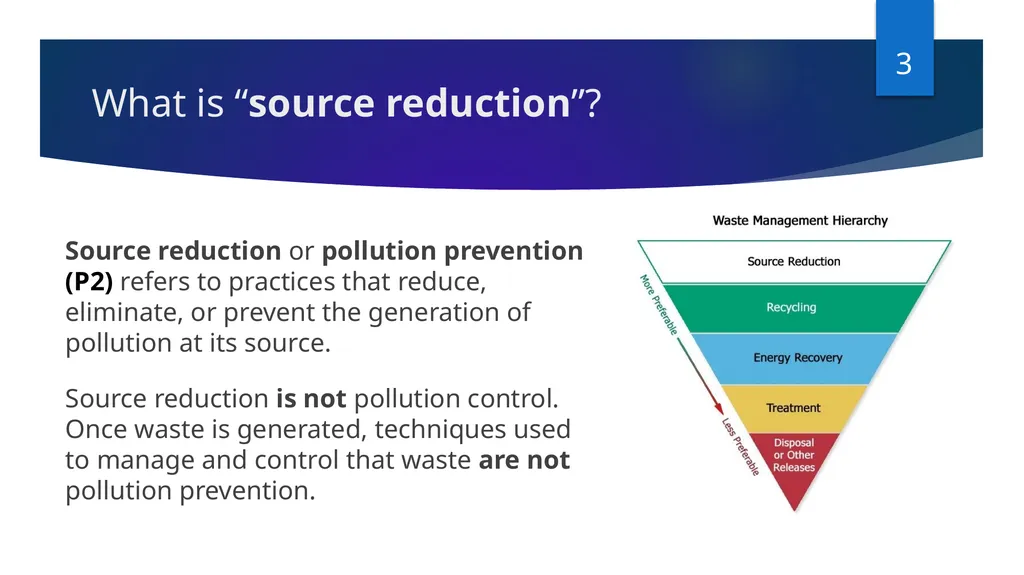
slide3. What is “source reduction”? 3 Source reduction or pollution prevention (P2) refers to practices that reduce, eliminate, or prevent the generation of pollution at its source.
Source reduction is not pollution control. Once waste is generated, techniques used to manage and control that waste are not pollution prevention.<br>
slide4. Why must facilities report their source reduction activities to TRI? The Pollution Prevention Act of 1990
Established source reduction as a national priority
Expanded the TRI reporting requirements to collect information on source reduction activities at facilities that report to TRI
Facilities are required by law to report their newly implemented source reduction activities to the Toxics Release Inventory on their Form R. 4<br>
slide5. How do facilities report source reduction to TRI? Facilities use the Form R to report their releases, waste management, and new source reduction activities to TRI
Source reduction information is collected in Sections 8.10 and 8.11 of the Form R 5<br>
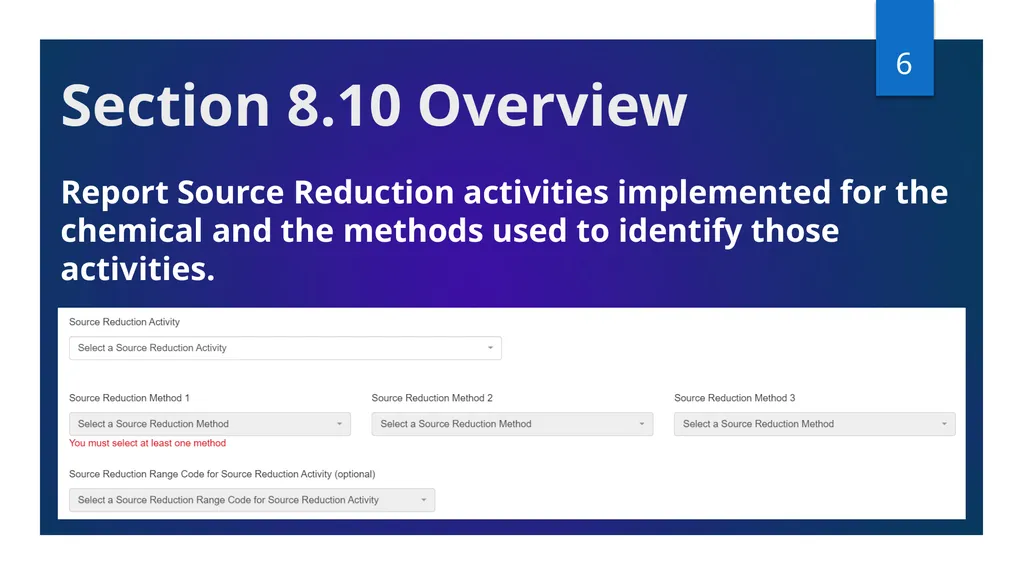
slide6. Section 8.10 Overview Report Source Reduction activities implemented for the chemical and the methods used to identify those activities. 6<br>
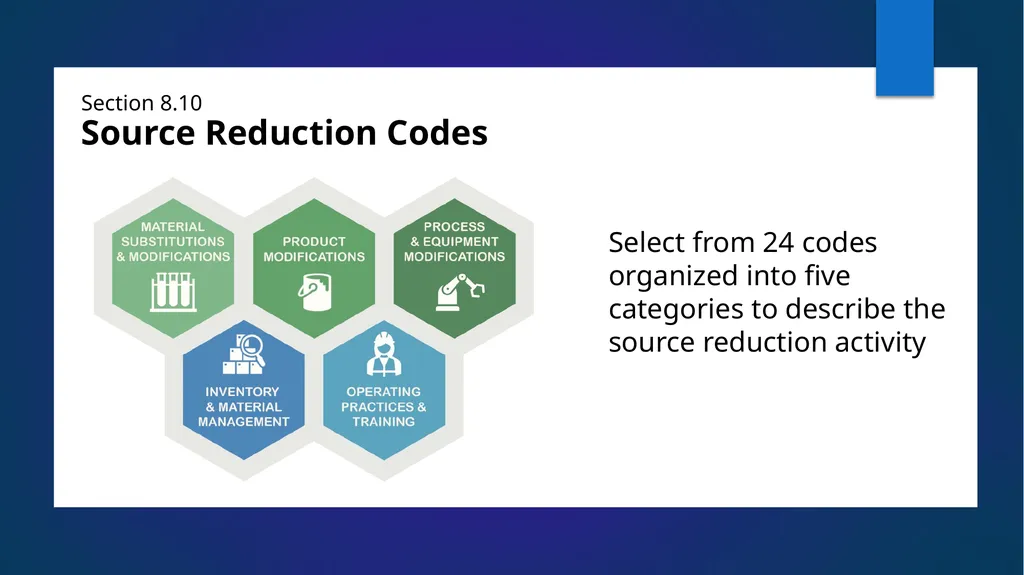
slide7. Section 8.10 Source Reduction Codes Select from 24 codes organized into five categories to describe the source reduction activity 7<br>
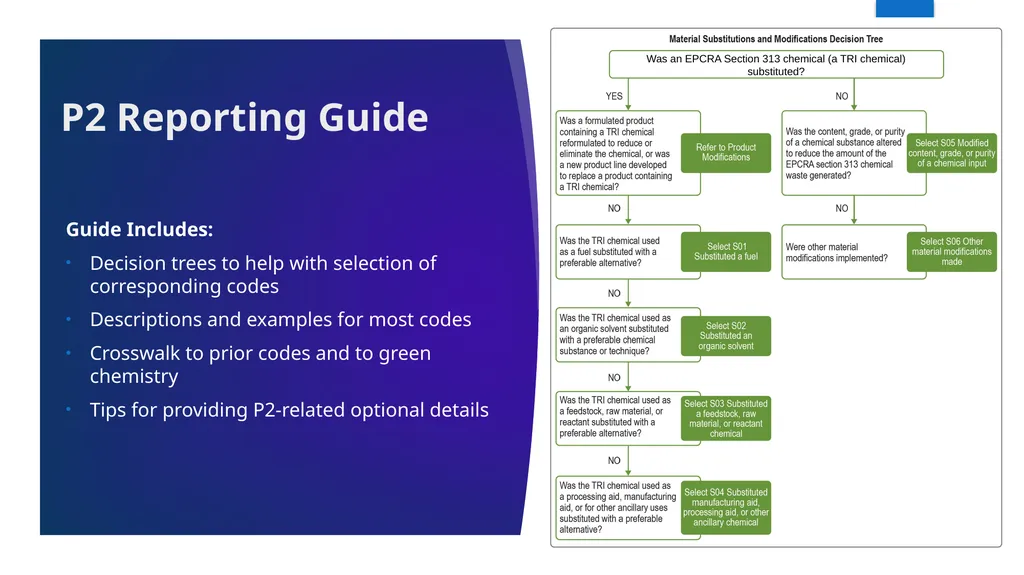
slide8. P2 Reporting Guide Guide Includes:
Decision trees to help with selection of corresponding codes
Descriptions and examples for most codes
Crosswalk to prior codes and to green chemistry
Tips for providing P2-related optional details Was an EPCRA Section 313 chemical (a TRI chemical) substituted?<br>
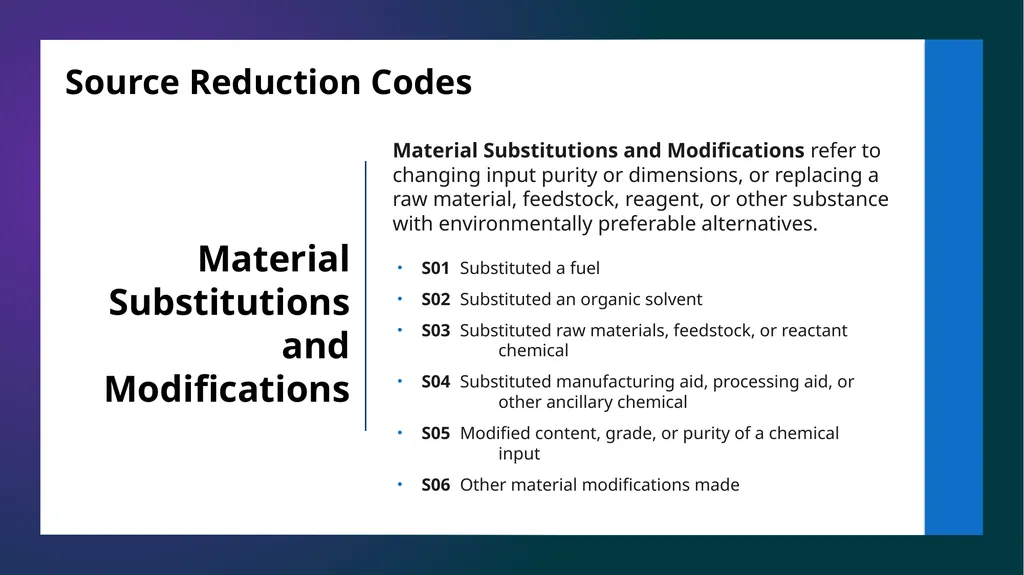
slide9. Source Reduction Codes Material Substitutions and Modifications Material Substitutions and Modifications refer to changing input purity or dimensions, or replacing a raw material, feedstock, reagent, or other substance with environmentally preferable alternatives.
S01 Substituted a fuel
S02 Substituted an organic solvent
S03 Substituted raw materials, feedstock, or reactant chemical
S04 Substituted manufacturing aid, processing aid, or other ancillary chemical
S05 Modified content, grade, or purity of a chemical input
S06 Other material modifications made 9<br>
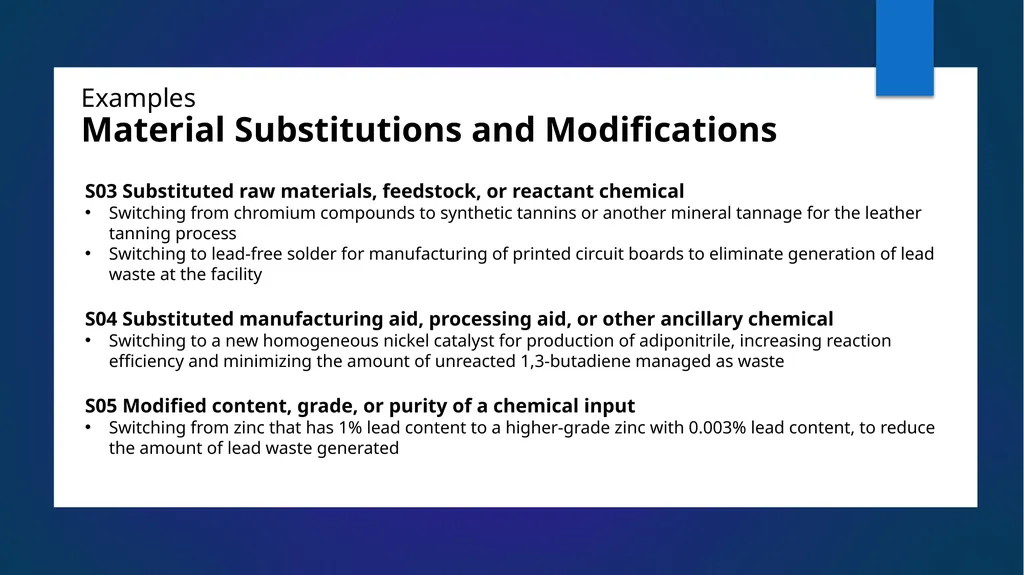
slide10. Examples Material Substitutions and Modifications S03 Substituted raw materials, feedstock, or reactant chemical
Switching from chromium compounds to synthetic tannins or another mineral tannage for the leather tanning process
Switching to lead-free solder for manufacturing of printed circuit boards to eliminate generation of lead waste at the facility
S04 Substituted manufacturing aid, processing aid, or other ancillary chemical
Switching to a new homogeneous nickel catalyst for production of adiponitrile, increasing reaction efficiency and minimizing the amount of unreacted 1,3-butadiene managed as waste
S05 Modified content, grade, or purity of a chemical input
Switching from zinc that has 1% lead content to a higher-grade zinc with 0.003% lead content, to reduce the amount of lead waste generated 10<br>
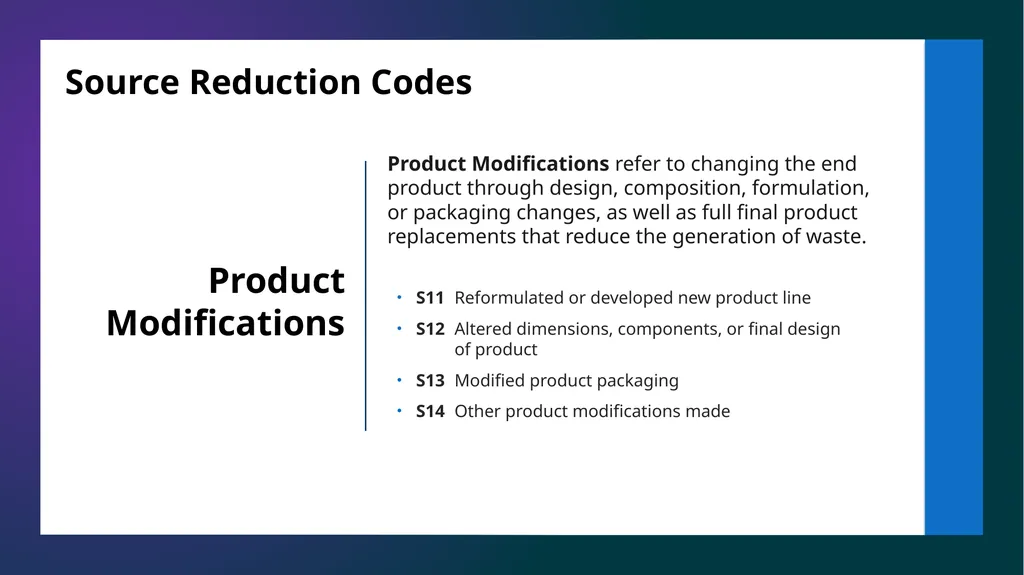
slide11. Source Reduction Codes Product Modifications Product Modifications refer to changing the end product through design, composition, formulation, or packaging changes, as well as full final product replacements that reduce the generation of waste.
S11 Reformulated or developed new product line
S12 Altered dimensions, components, or final design of product
S13 Modified product packaging
S14 Other product modifications made 11<br>
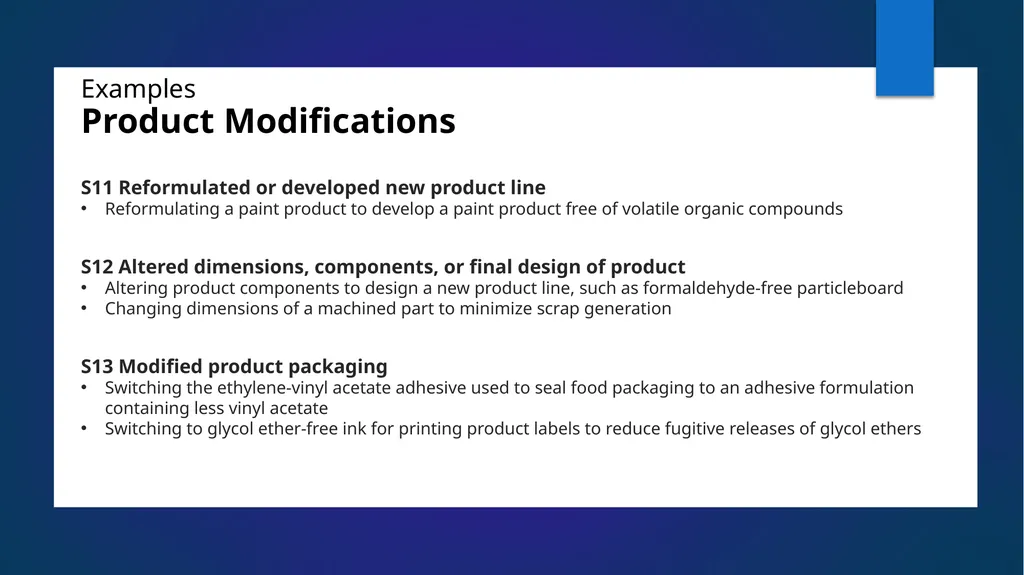
slide12. Examples Product Modifications S11 Reformulated or developed new product line
Reformulating a paint product to develop a paint product free of volatile organic compounds
S12 Altered dimensions, components, or final design of product
Altering product components to design a new product line, such as formaldehyde-free particleboard
Changing dimensions of a machined part to minimize scrap generation
S13 Modified product packaging
Switching the ethylene-vinyl acetate adhesive used to seal food packaging to an adhesive formulation containing less vinyl acetate
Switching to glycol ether-free ink for printing product labels to reduce fugitive releases of glycol ethers 12<br>
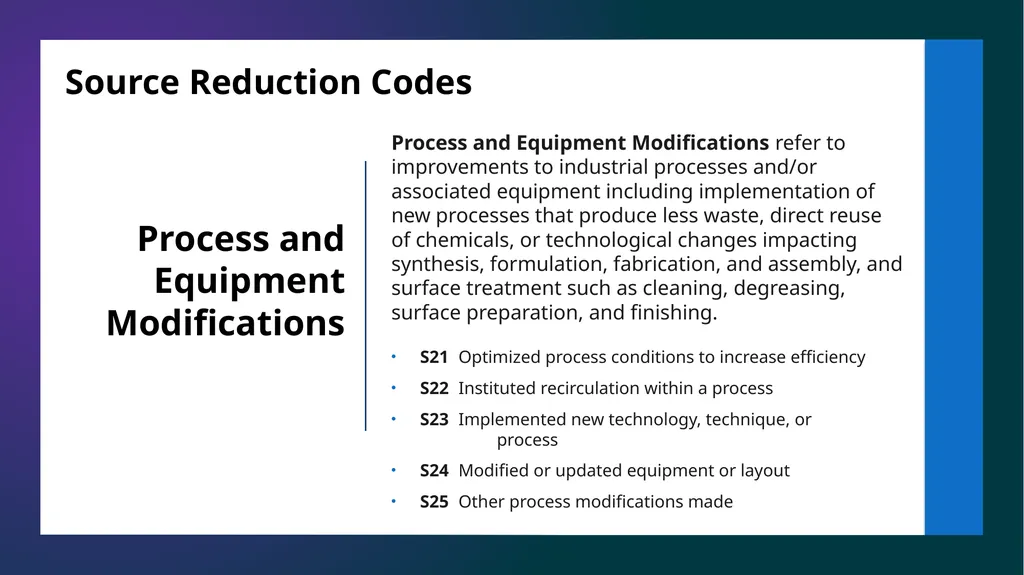
slide13. Source Reduction Codes Process and Equipment Modifications Process and Equipment Modifications refer to improvements to industrial processes and/or associated equipment including implementation of new processes that produce less waste, direct reuse of chemicals, or technological changes impacting synthesis, formulation, fabrication, and assembly, and surface treatment such as cleaning, degreasing, surface preparation, and finishing.
S21 Optimized process conditions to increase efficiency
S22 Instituted recirculation within a process
S23 Implemented new technology, technique, or process
S24 Modified or updated equipment or layout
S25 Other process modifications made 13<br>
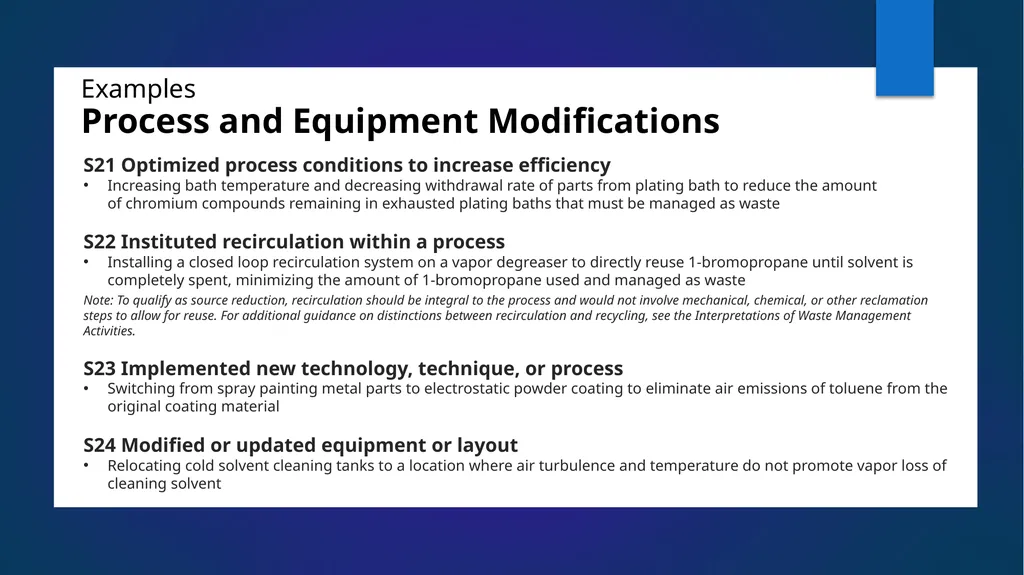
slide14. Examples Process and Equipment Modifications S21 Optimized process conditions to increase efficiency
Increasing bath temperature and decreasing withdrawal rate of parts from plating bath to reduce the amount of chromium compounds remaining in exhausted plating baths that must be managed as waste
S22 Instituted recirculation within a process
Installing a closed loop recirculation system on a vapor degreaser to directly reuse 1‑bromopropane until solvent is completely spent, minimizing the amount of 1‑bromopropane used and managed as waste
Note: To qualify as source reduction, recirculation should be integral to the process and would not involve mechanical, chemical, or other reclamation steps to allow for reuse. For additional guidance on distinctions between recirculation and recycling, see the Interpretations of Waste Management Activities.
S23 Implemented new technology, technique, or process
Switching from spray painting metal parts to electrostatic powder coating to eliminate air emissions of toluene from the original coating material
S24 Modified or updated equipment or layout
Relocating cold solvent cleaning tanks to a location where air turbulence and temperature do not promote vapor loss of cleaning solvent 14<br>
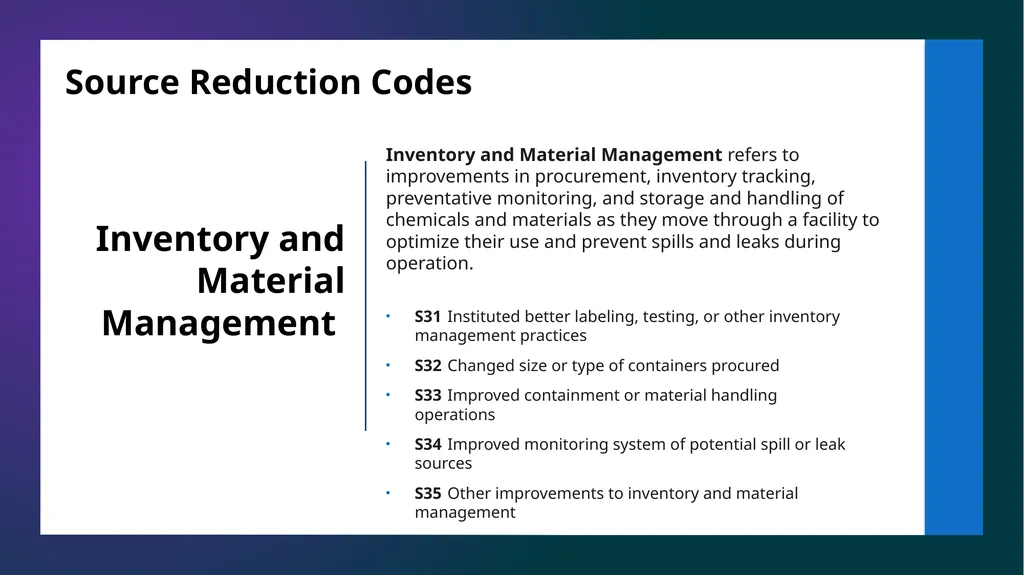
slide15. Source Reduction Codes Inventory and Material Management Inventory and Material Management refers to improvements in procurement, inventory tracking, preventative monitoring, and storage and handling of chemicals and materials as they move through a facility to optimize their use and prevent spills and leaks during operation.
S31 Instituted better labeling, testing, or other inventory management practices
S32 Changed size or type of containers procured
S33 Improved containment or material handling operations
S34 Improved monitoring system of potential spill or leak sources
S35 Other improvements to inventory and material management 15<br>
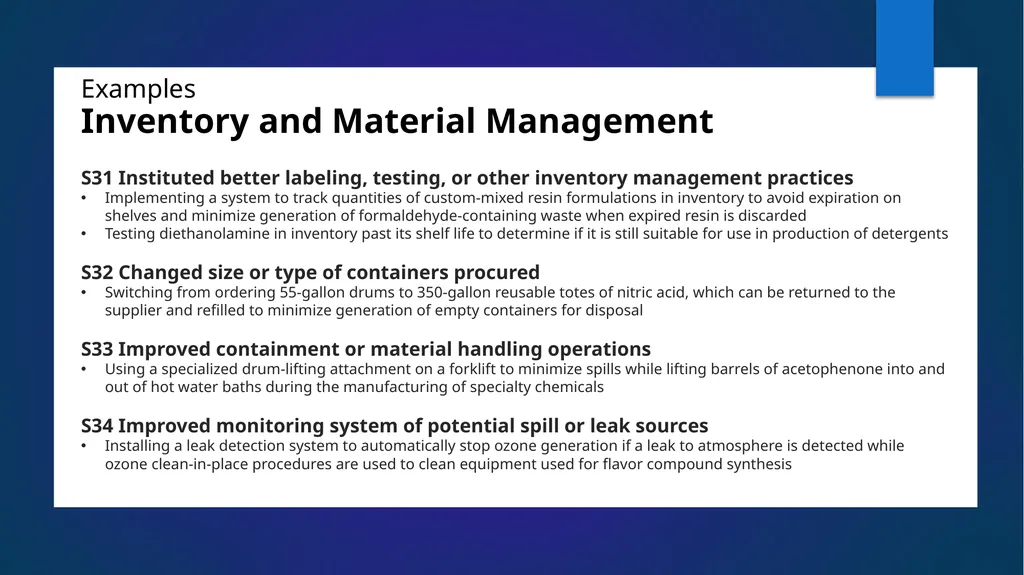
slide16. Examples Inventory and Material Management S31 Instituted better labeling, testing, or other inventory management practices
Implementing a system to track quantities of custom-mixed resin formulations in inventory to avoid expiration on shelves and minimize generation of formaldehyde-containing waste when expired resin is discarded
Testing diethanolamine in inventory past its shelf life to determine if it is still suitable for use in production of detergents
S32 Changed size or type of containers procured
Switching from ordering 55-gallon drums to 350-gallon reusable totes of nitric acid, which can be returned to the supplier and refilled to minimize generation of empty containers for disposal
S33 Improved containment or material handling operations
Using a specialized drum-lifting attachment on a forklift to minimize spills while lifting barrels of acetophenone into and out of hot water baths during the manufacturing of specialty chemicals
S34 Improved monitoring system of potential spill or leak sources
Installing a leak detection system to automatically stop ozone generation if a leak to atmosphere is detected while ozone clean-in-place procedures are used to clean equipment used for flavor compound synthesis 16<br>
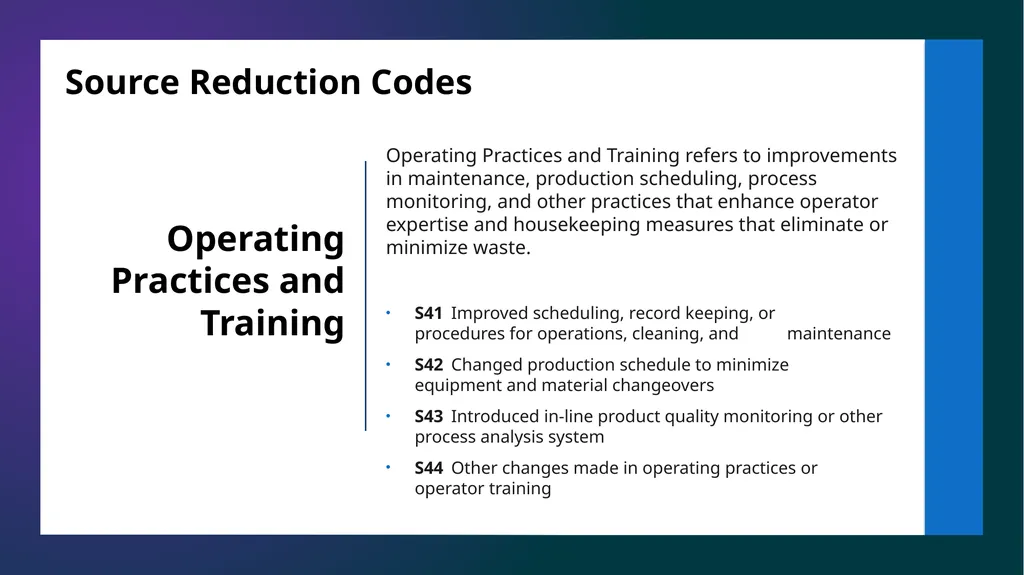
slide17. Source Reduction Codes Operating Practices and Training Operating Practices and Training refers to improvements in maintenance, production scheduling, process monitoring, and other practices that enhance operator expertise and housekeeping measures that eliminate or minimize waste.
S41 Improved scheduling, record keeping, or procedures for operations, cleaning, and maintenance
S42 Changed production schedule to minimize equipment and material changeovers
S43 Introduced in-line product quality monitoring or other process analysis system
S44 Other changes made in operating practices or operator training 17<br>
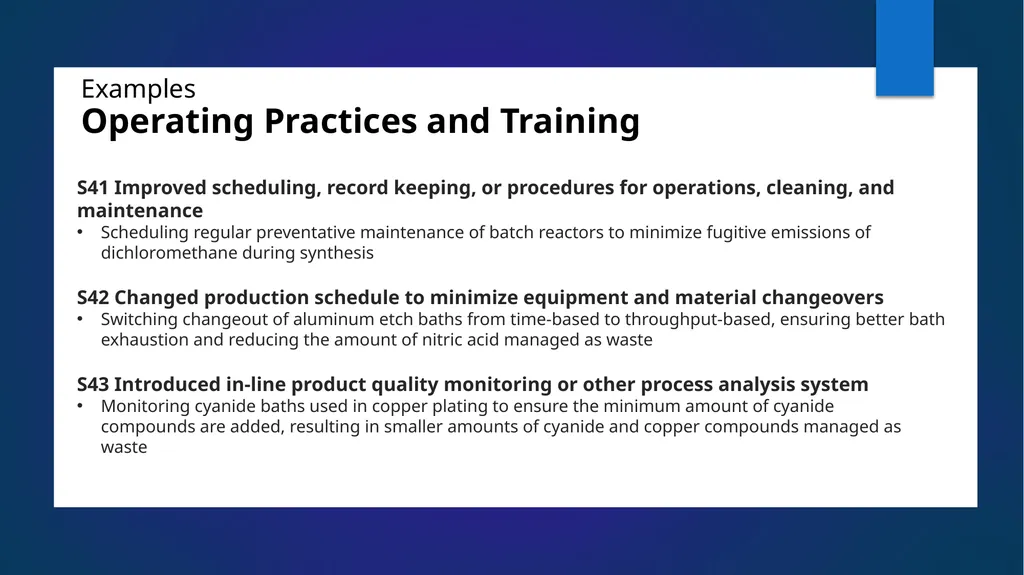
slide18. Examples Operating Practices and Training S41 Improved scheduling, record keeping, or procedures for operations, cleaning, and maintenance
Scheduling regular preventative maintenance of batch reactors to minimize fugitive emissions of dichloromethane during synthesis
S42 Changed production schedule to minimize equipment and material changeovers
Switching changeout of aluminum etch baths from time-based to throughput-based, ensuring better bath exhaustion and reducing the amount of nitric acid managed as waste
S43 Introduced in-line product quality monitoring or other process analysis system
Monitoring cyanide baths used in copper plating to ensure the minimum amount of cyanide compounds are added, resulting in smaller amounts of cyanide and copper compounds managed as waste 18<br>
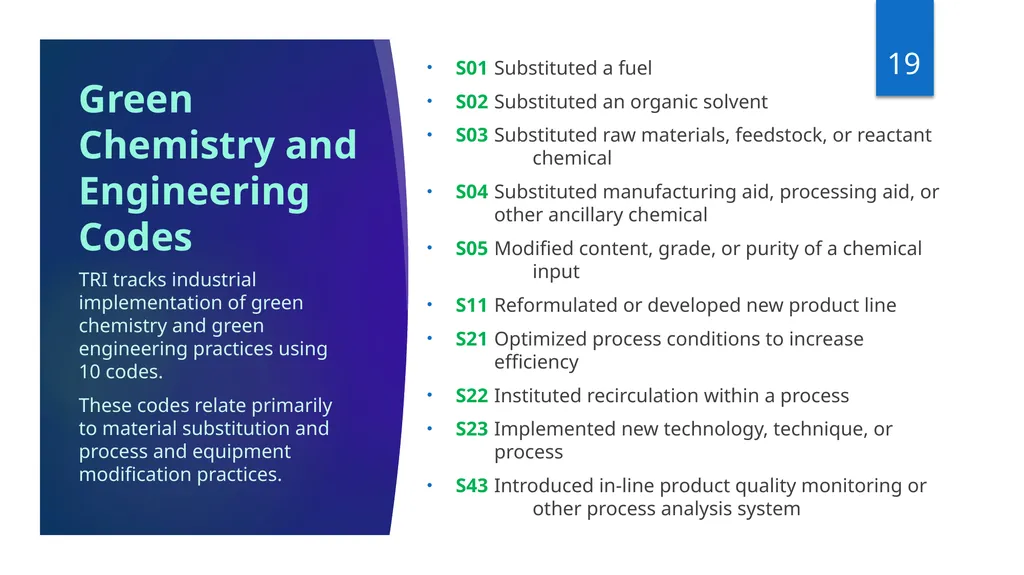
slide19. Green Chemistry and Engineering Codes TRI tracks industrial implementation of green chemistry and green engineering practices using 10 codes.
These codes relate primarily to material substitution and process and equipment modification practices. S01 Substituted a fuel
S02 Substituted an organic solvent
S03 Substituted raw materials, feedstock, or reactant chemical
S04 Substituted manufacturing aid, processing aid, or other ancillary chemical
S05 Modified content, grade, or purity of a chemical input
S11 Reformulated or developed new product line
S21 Optimized process conditions to increase efficiency
S22 Instituted recirculation within a process
S23 Implemented new technology, technique, or process
S43 Introduced in-line product quality monitoring or other process analysis system 19<br>
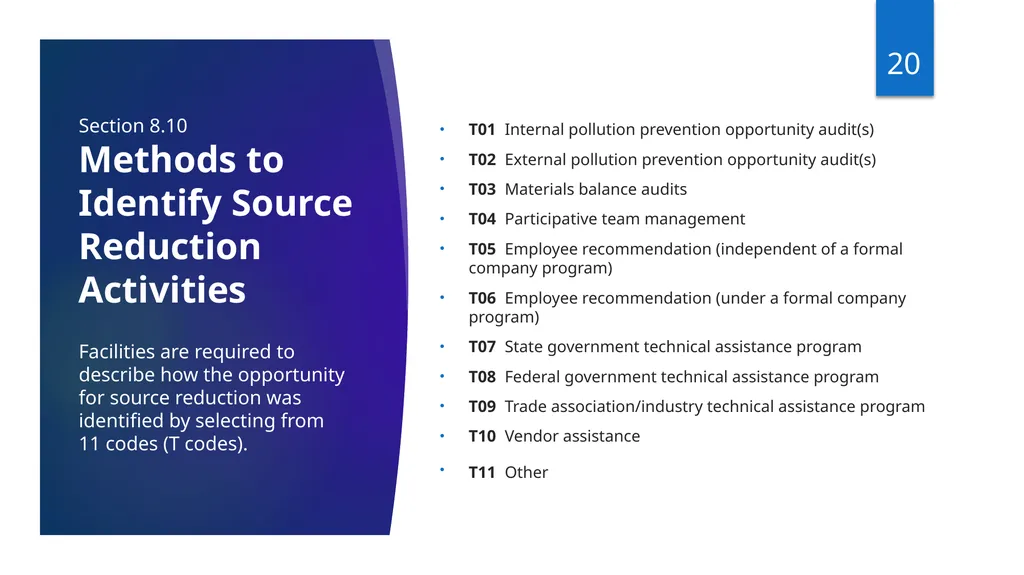
slide20. Section 8.10 Methods to Identify Source Reduction Activities Facilities are required to describe how the opportunity for source reduction was identified by selecting from 11 codes (T codes). T01 Internal pollution prevention opportunity audit(s)
T02 External pollution prevention opportunity audit(s)
T03 Materials balance audits
T04 Participative team management
T05 Employee recommendation (independent of a formal company program)
T06 Employee recommendation (under a formal company program)
T07 State government technical assistance program
T08 Federal government technical assistance program
T09 Trade association/industry technical assistance program
T10 Vendor assistance
T11 Other 20<br>
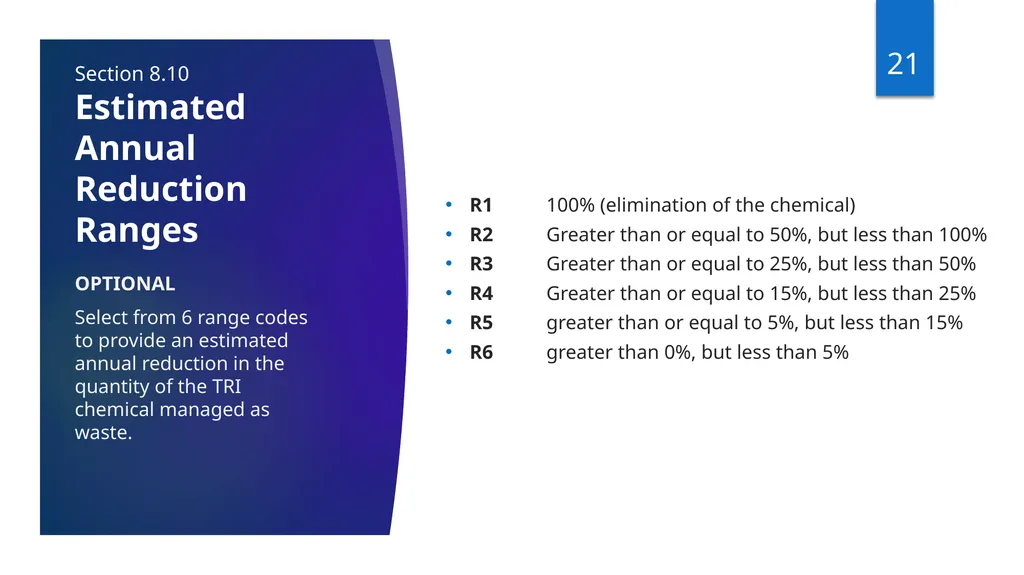
slide21. Section 8.10 Estimated Annual Reduction Ranges OPTIONAL
Select from 6 range codes to provide an estimated annual reduction in the quantity of the TRI chemical managed as waste. R1 100% (elimination of the chemical)
R2 Greater than or equal to 50%, but less than 100%
R3 Greater than or equal to 25%, but less than 50%
R4 Greater than or equal to 15%, but less than 25%
R5 greater than or equal to 5%, but less than 15%
R6 greater than 0%, but less than 5% 21<br>
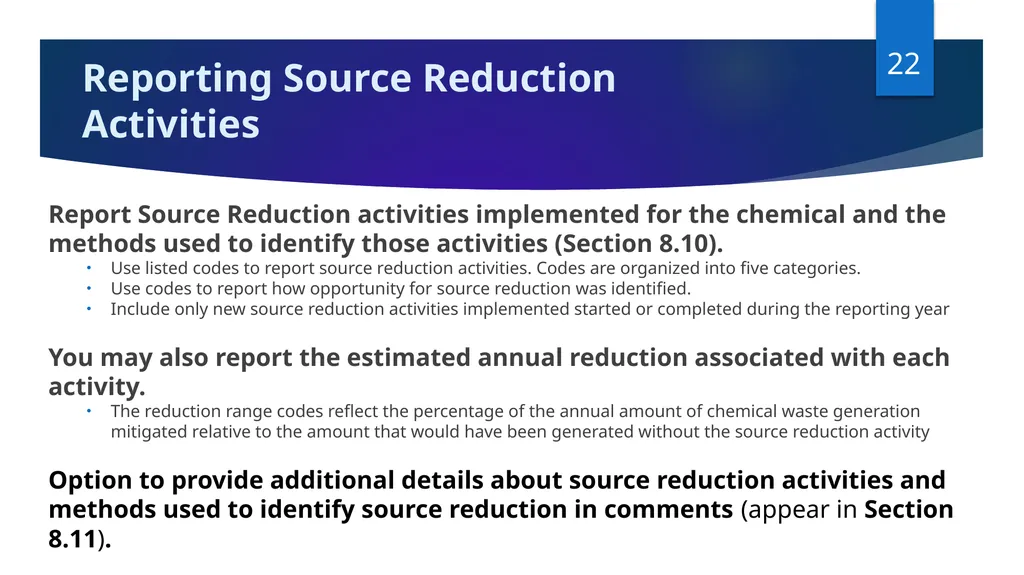
slide22. Reporting Source Reduction Activities Report Source Reduction activities implemented for the chemical and the methods used to identify those activities (Section 8.10).
Use listed codes to report source reduction activities. Codes are organized into five categories.
Use codes to report how opportunity for source reduction was identified.
Include only new source reduction activities implemented started or completed during the reporting year
You may also report the estimated annual reduction associated with each activity.
The reduction range codes reflect the percentage of the annual amount of chemical waste generation mitigated relative to the amount that would have been generated without the source reduction activity
Option to provide additional details about source reduction activities and methods used to identify source reduction in comments (appear in Section 8.11). 22<br>
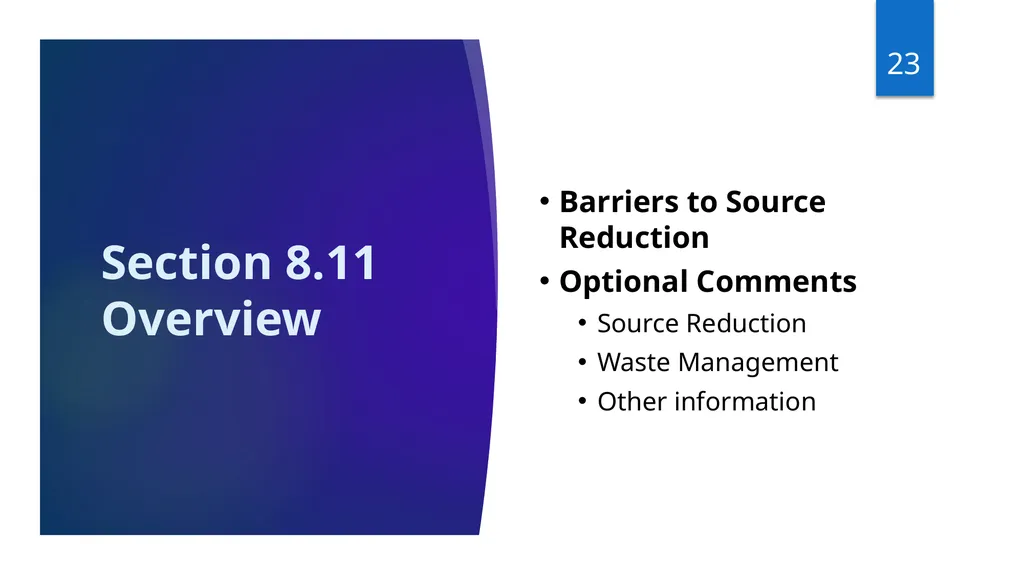
slide23. Section 8.11 Overview Barriers to Source Reduction
Optional Comments
Source Reduction
Waste Management
Other information 23<br>
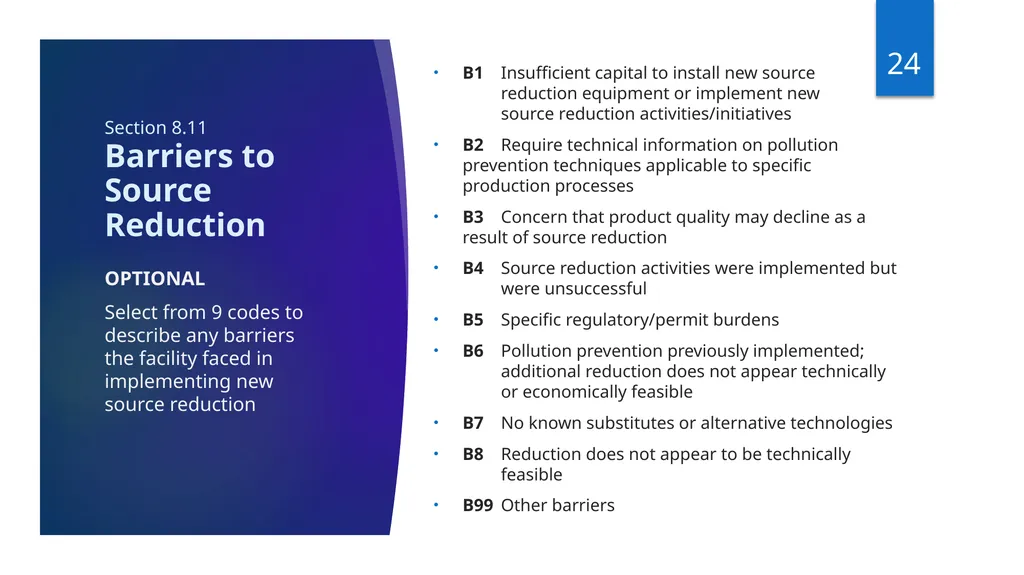
slide24. Section 8.11 Barriers to Source Reduction OPTIONAL
Select from 9 codes to describe any barriers the facility faced in implementing new source reduction B1 Insufficient capital to install new source reduction equipment or implement new source reduction activities/initiatives
B2 Require technical information on pollution prevention techniques applicable to specific production processes
B3 Concern that product quality may decline as a result of source reduction
B4 Source reduction activities were implemented but were unsuccessful
B5 Specific regulatory/permit burdens
B6 Pollution prevention previously implemented; additional reduction does not appear technically or economically feasible
B7 No known substitutes or alternative technologies
B8 Reduction does not appear to be technically feasible
B99 Other barriers 24<br>
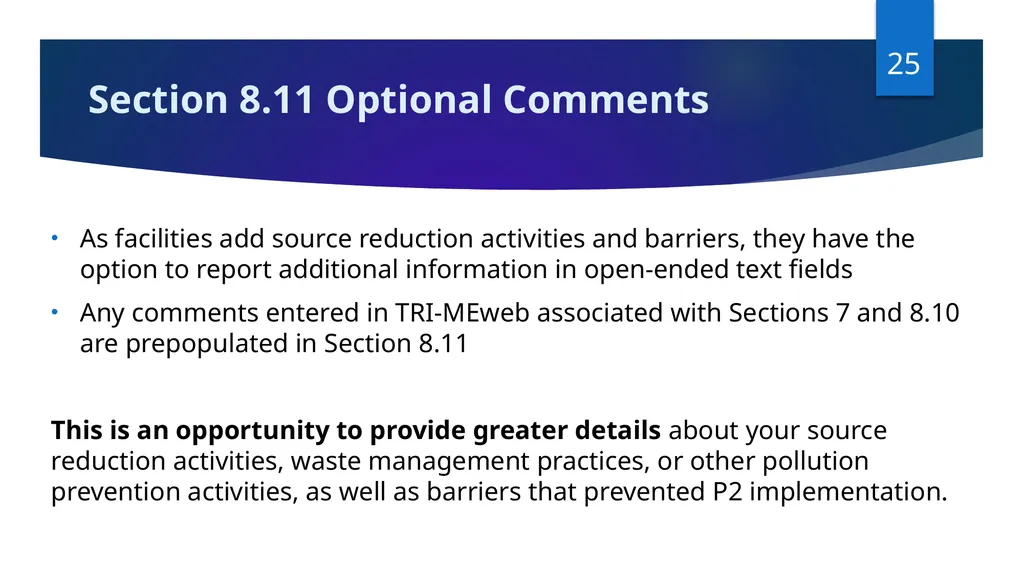
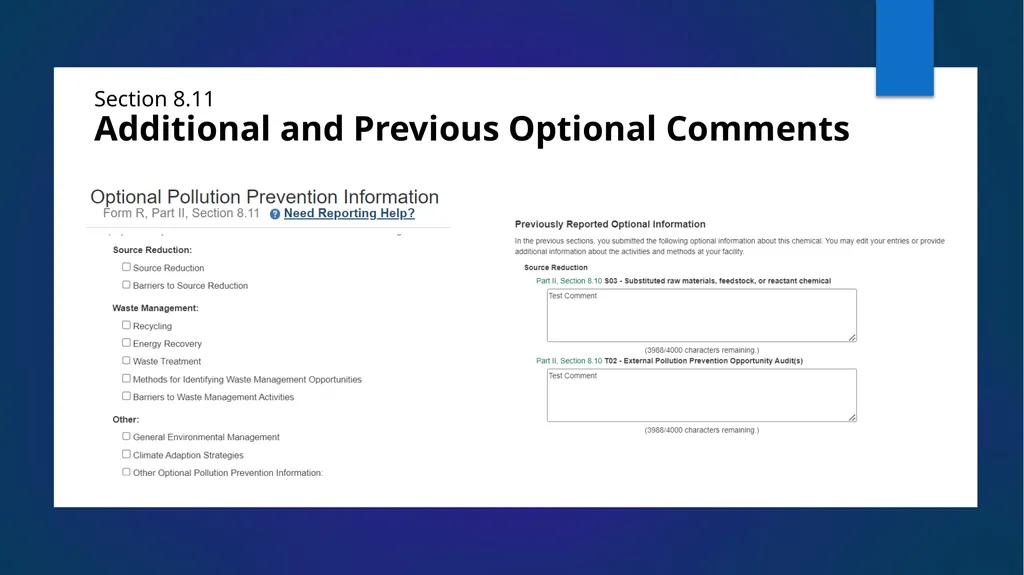
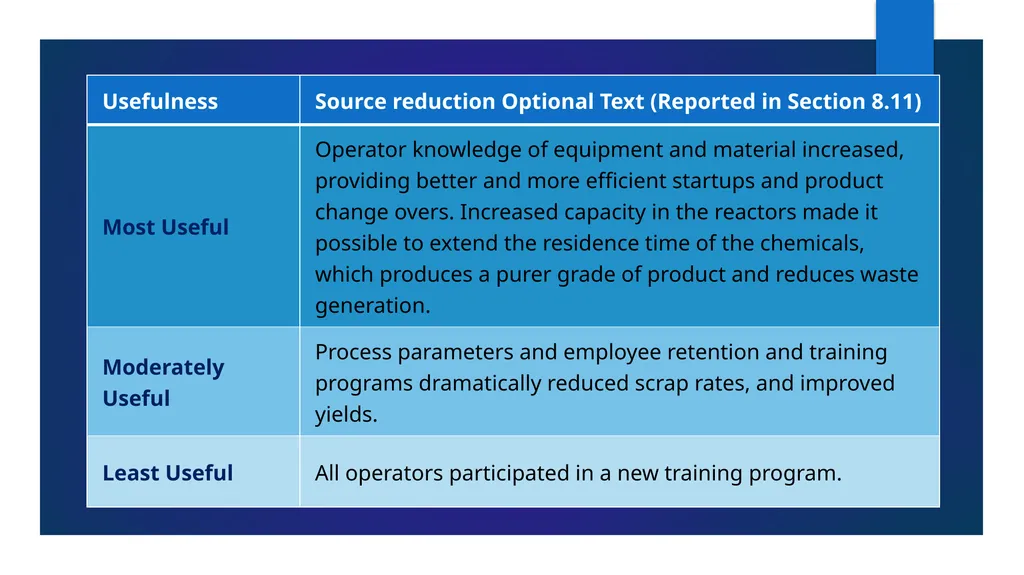
slide25. Section 8.11 Optional Comments As facilities add source reduction activities and barriers, they have the option to report additional information in open-ended text fields
Any comments entered in TRI-MEweb associated with Sections 7 and 8.10 are prepopulated in Section 8.11
This is an opportunity to provide greater details about your source reduction activities, waste management practices, or other pollution prevention activities, as well as barriers that prevented P2 implementation. 25<br>
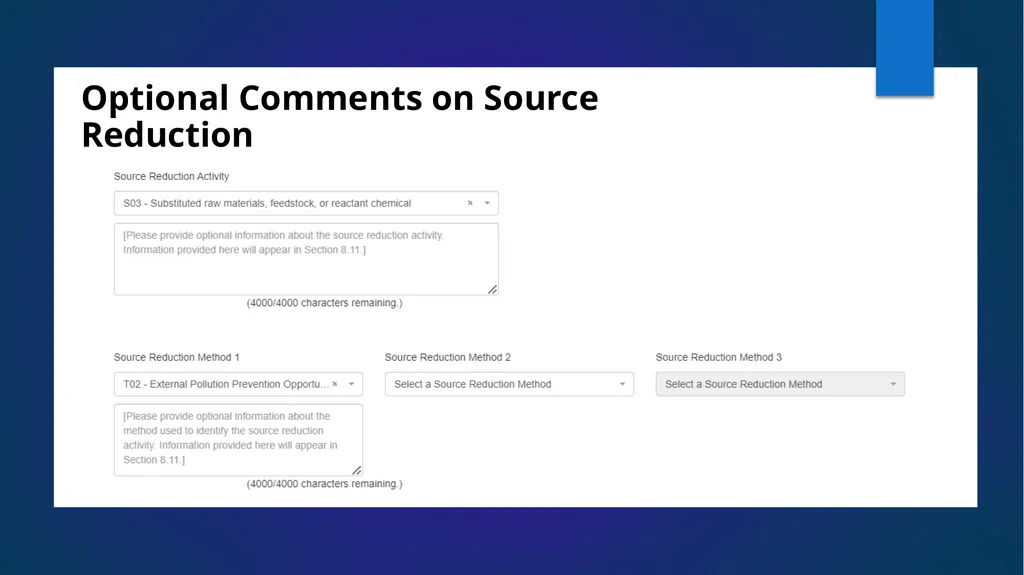
slide26. Optional Comments on Source Reduction 26<br>
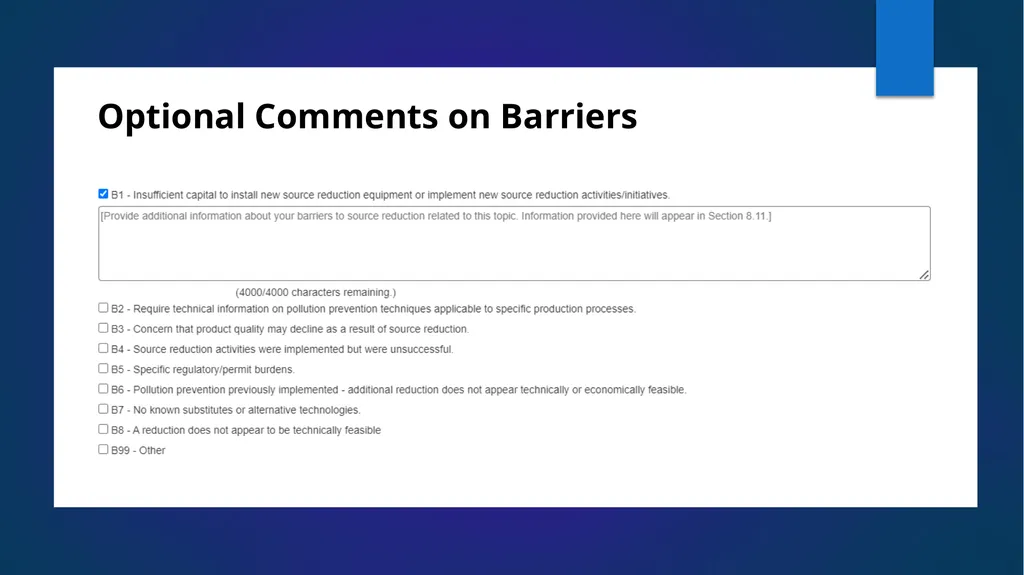
slide27. Optional Comments on Barriers 27<br>
slide28. Section 8.11 Additional and Previous Optional Comments 28<br>
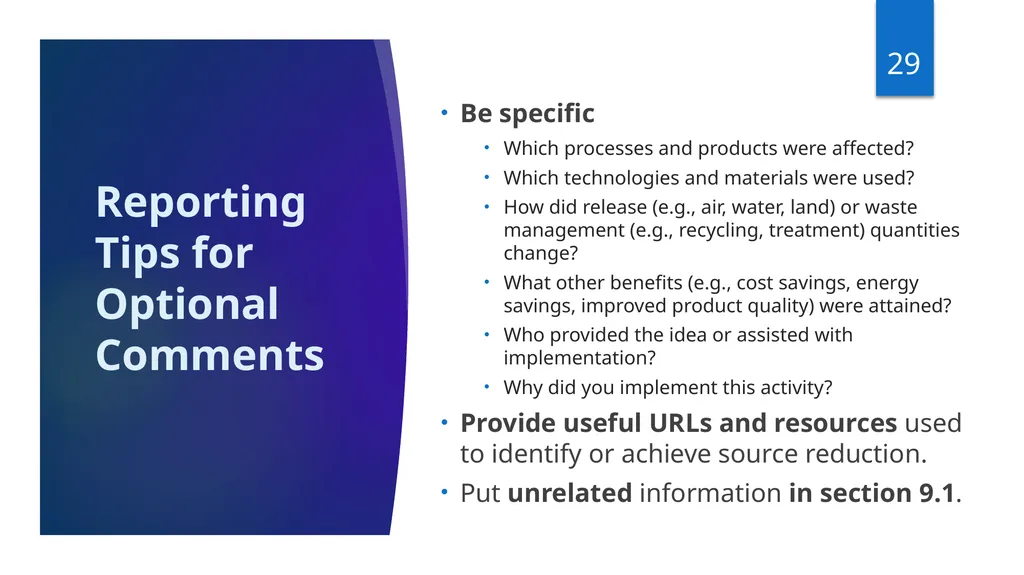
slide29. Reporting Tips for Optional Comments Be specific
Which processes and products were affected?
Which technologies and materials were used?
How did release (e.g., air, water, land) or waste management (e.g., recycling, treatment) quantities change?
What other benefits (e.g., cost savings, energy savings, improved product quality) were attained?
Who provided the idea or assisted with implementation?
Why did you implement this activity?
Provide useful URLs and resources used to identify or achieve source reduction.
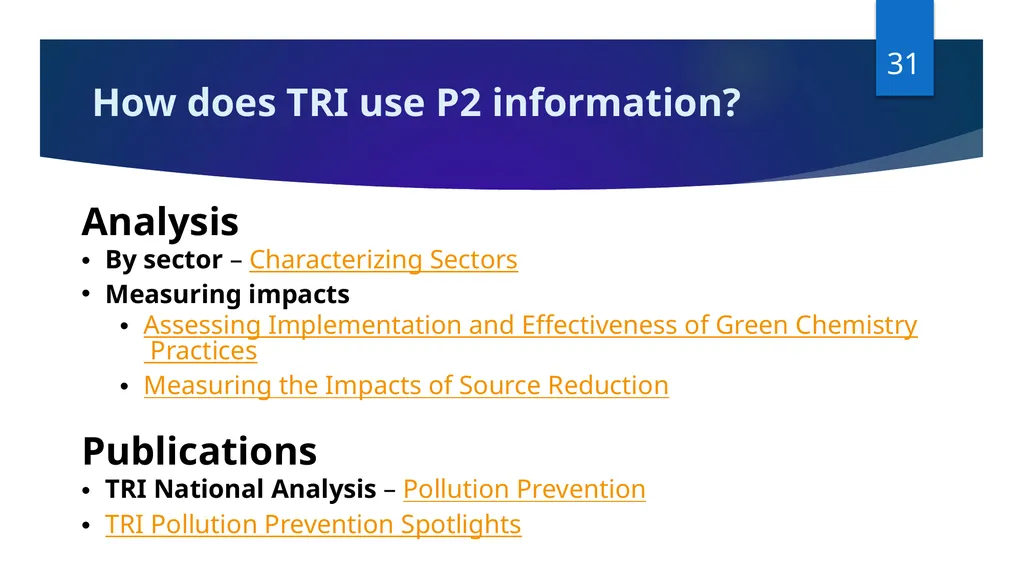
Put unrelated information in section 9.1. 29<br>
slide31. How does TRI use P2 information? 31 Analysis
By sector – Characterizing Sectors
Measuring impacts
Assessing Implementation and Effectiveness of Green Chemistry Practices
Measuring the Impacts of Source Reduction
Publications
TRI National Analysis – Pollution Prevention
TRI Pollution Prevention Spotlights<br>
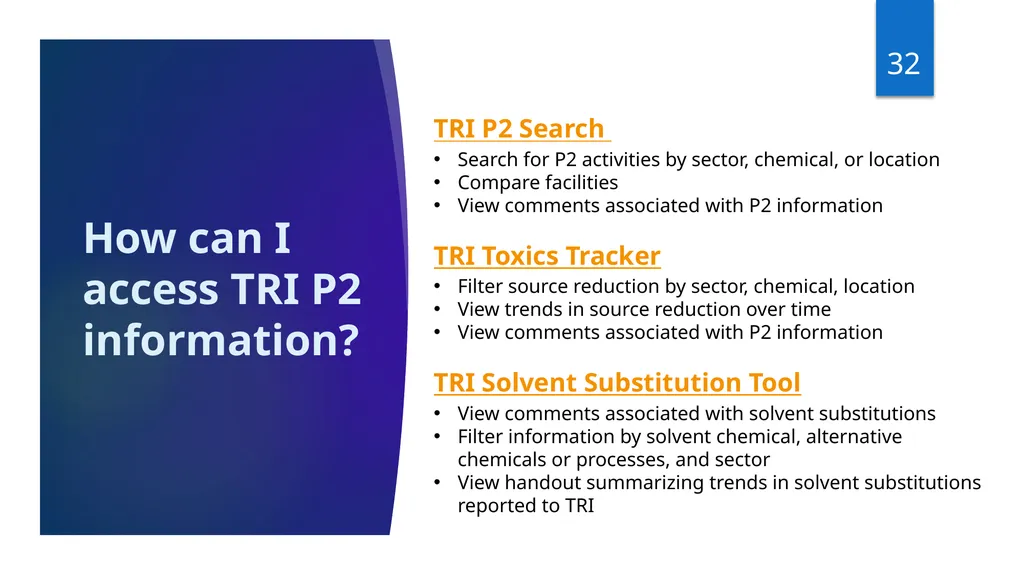
slide32. How can I access TRI P2 information? 32 TRI P2 Search
Search for P2 activities by sector, chemical, or location
Compare facilities
View comments associated with P2 information
TRI Toxics Tracker
Filter source reduction by sector, chemical, location
View trends in source reduction over time
View comments associated with P2 information
TRI Solvent Substitution Tool
View comments associated with solvent substitutions
Filter information by solvent chemical, alternative chemicals or processes, and sector
View handout summarizing trends in solvent substitutions reported to TRI<br>
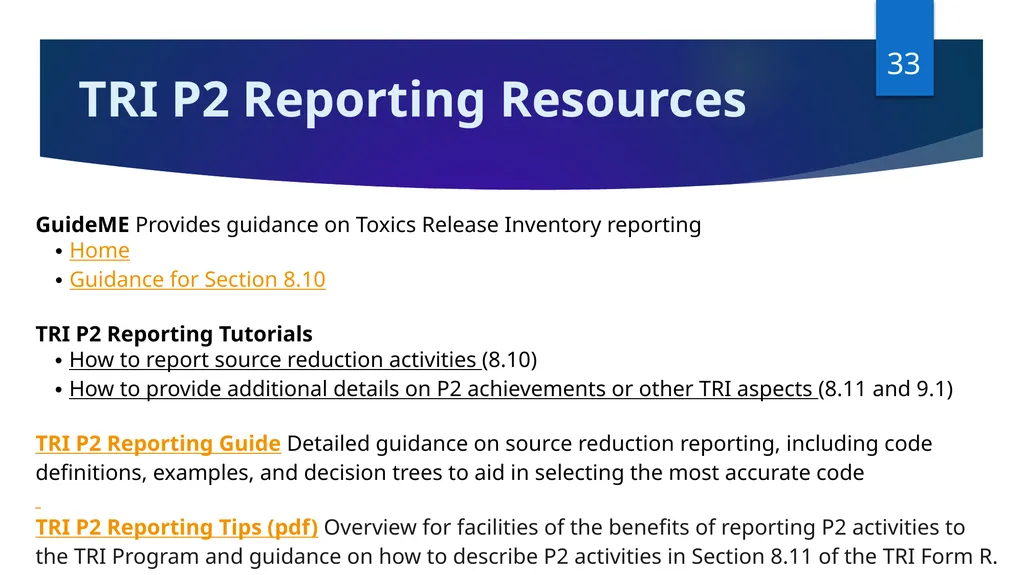
slide33. TRI P2 Reporting Resources 33 GuideME Provides guidance on Toxics Release Inventory reporting
Home
Guidance for Section 8.10
TRI P2 Reporting Tutorials
How to report source reduction activities (8.10)
How to provide additional details on P2 achievements or other TRI aspects (8.11 and 9.1)
TRI P2 Reporting Guide Detailed guidance on source reduction reporting, including code definitions, examples, and decision trees to aid in selecting the most accurate code
TRI P2 Reporting Tips (pdf) Overview for facilities of the benefits of reporting P2 activities to the TRI Program and guidance on how to describe P2 activities in Section 8.11 of the TRI Form R.<br>
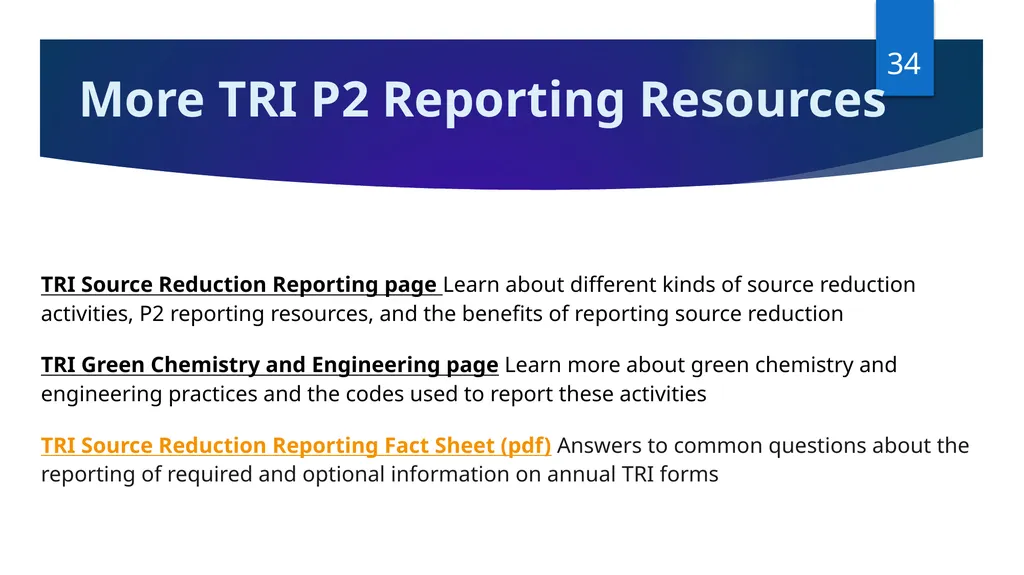
slide34. More TRI P2 Reporting Resources 34 TRI Source Reduction Reporting page Learn about different kinds of source reduction activities, P2 reporting resources, and the benefits of reporting source reduction
TRI Green Chemistry and Engineering page Learn more about green chemistry and engineering practices and the codes used to report these activities
TRI Source Reduction Reporting Fact Sheet (pdf) Answers to common questions about the reporting of required and optional information on annual TRI forms<br>
slide35. 35 TRI Program Home
https://www.epa.gov/toxics-release-inventory-tri-program
TRI P2 Home
https://www.epa.gov/toxics-release-inventory-tri-program/pollution-prevention-p2-and-tri
Additional questions and follow-up
TRI.Help@epa.gov
snyder.charlotte@epa.gov Questions?<br>
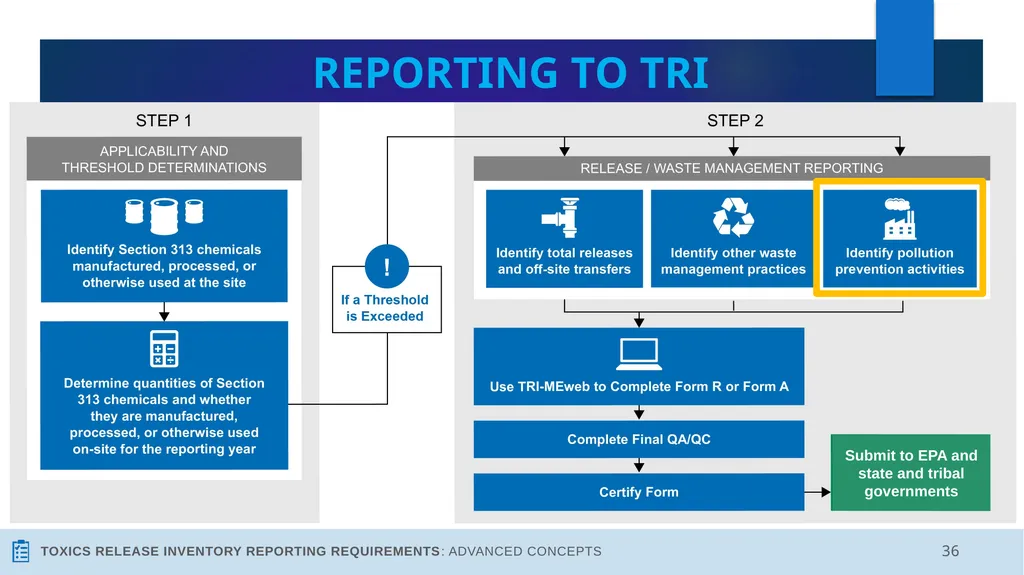
slide36. REPORTING TO TRI Submit to EPA and state and tribal governments<br>
US EPA
June 14, 2023 1<br>
slide2. Overview What is source reduction?
Why report source reduction?
How do I report source reduction activities on the Form R?
Section 8.10
Section 8.11
How does TRI categorize source reduction?
Source reduction examples
Writing optional comments
How is source reduction information used? 2<br>
slide3. What is “source reduction”? 3 Source reduction or pollution prevention (P2) refers to practices that reduce, eliminate, or prevent the generation of pollution at its source.
Source reduction is not pollution control. Once waste is generated, techniques used to manage and control that waste are not pollution prevention.<br>
slide4. Why must facilities report their source reduction activities to TRI? The Pollution Prevention Act of 1990
Established source reduction as a national priority
Expanded the TRI reporting requirements to collect information on source reduction activities at facilities that report to TRI
Facilities are required by law to report their newly implemented source reduction activities to the Toxics Release Inventory on their Form R. 4<br>
slide5. How do facilities report source reduction to TRI? Facilities use the Form R to report their releases, waste management, and new source reduction activities to TRI
Source reduction information is collected in Sections 8.10 and 8.11 of the Form R 5<br>
slide6. Section 8.10 Overview Report Source Reduction activities implemented for the chemical and the methods used to identify those activities. 6<br>
slide7. Section 8.10 Source Reduction Codes Select from 24 codes organized into five categories to describe the source reduction activity 7<br>
slide8. P2 Reporting Guide Guide Includes:
Decision trees to help with selection of corresponding codes
Descriptions and examples for most codes
Crosswalk to prior codes and to green chemistry
Tips for providing P2-related optional details Was an EPCRA Section 313 chemical (a TRI chemical) substituted?<br>
slide9. Source Reduction Codes Material Substitutions and Modifications Material Substitutions and Modifications refer to changing input purity or dimensions, or replacing a raw material, feedstock, reagent, or other substance with environmentally preferable alternatives.
S01 Substituted a fuel
S02 Substituted an organic solvent
S03 Substituted raw materials, feedstock, or reactant chemical
S04 Substituted manufacturing aid, processing aid, or other ancillary chemical
S05 Modified content, grade, or purity of a chemical input
S06 Other material modifications made 9<br>
slide10. Examples Material Substitutions and Modifications S03 Substituted raw materials, feedstock, or reactant chemical
Switching from chromium compounds to synthetic tannins or another mineral tannage for the leather tanning process
Switching to lead-free solder for manufacturing of printed circuit boards to eliminate generation of lead waste at the facility
S04 Substituted manufacturing aid, processing aid, or other ancillary chemical
Switching to a new homogeneous nickel catalyst for production of adiponitrile, increasing reaction efficiency and minimizing the amount of unreacted 1,3-butadiene managed as waste
S05 Modified content, grade, or purity of a chemical input
Switching from zinc that has 1% lead content to a higher-grade zinc with 0.003% lead content, to reduce the amount of lead waste generated 10<br>
slide11. Source Reduction Codes Product Modifications Product Modifications refer to changing the end product through design, composition, formulation, or packaging changes, as well as full final product replacements that reduce the generation of waste.
S11 Reformulated or developed new product line
S12 Altered dimensions, components, or final design of product
S13 Modified product packaging
S14 Other product modifications made 11<br>
slide12. Examples Product Modifications S11 Reformulated or developed new product line
Reformulating a paint product to develop a paint product free of volatile organic compounds
S12 Altered dimensions, components, or final design of product
Altering product components to design a new product line, such as formaldehyde-free particleboard
Changing dimensions of a machined part to minimize scrap generation
S13 Modified product packaging
Switching the ethylene-vinyl acetate adhesive used to seal food packaging to an adhesive formulation containing less vinyl acetate
Switching to glycol ether-free ink for printing product labels to reduce fugitive releases of glycol ethers 12<br>
slide13. Source Reduction Codes Process and Equipment Modifications Process and Equipment Modifications refer to improvements to industrial processes and/or associated equipment including implementation of new processes that produce less waste, direct reuse of chemicals, or technological changes impacting synthesis, formulation, fabrication, and assembly, and surface treatment such as cleaning, degreasing, surface preparation, and finishing.
S21 Optimized process conditions to increase efficiency
S22 Instituted recirculation within a process
S23 Implemented new technology, technique, or process
S24 Modified or updated equipment or layout
S25 Other process modifications made 13<br>
slide14. Examples Process and Equipment Modifications S21 Optimized process conditions to increase efficiency
Increasing bath temperature and decreasing withdrawal rate of parts from plating bath to reduce the amount of chromium compounds remaining in exhausted plating baths that must be managed as waste
S22 Instituted recirculation within a process
Installing a closed loop recirculation system on a vapor degreaser to directly reuse 1‑bromopropane until solvent is completely spent, minimizing the amount of 1‑bromopropane used and managed as waste
Note: To qualify as source reduction, recirculation should be integral to the process and would not involve mechanical, chemical, or other reclamation steps to allow for reuse. For additional guidance on distinctions between recirculation and recycling, see the Interpretations of Waste Management Activities.
S23 Implemented new technology, technique, or process
Switching from spray painting metal parts to electrostatic powder coating to eliminate air emissions of toluene from the original coating material
S24 Modified or updated equipment or layout
Relocating cold solvent cleaning tanks to a location where air turbulence and temperature do not promote vapor loss of cleaning solvent 14<br>
slide15. Source Reduction Codes Inventory and Material Management Inventory and Material Management refers to improvements in procurement, inventory tracking, preventative monitoring, and storage and handling of chemicals and materials as they move through a facility to optimize their use and prevent spills and leaks during operation.
S31 Instituted better labeling, testing, or other inventory management practices
S32 Changed size or type of containers procured
S33 Improved containment or material handling operations
S34 Improved monitoring system of potential spill or leak sources
S35 Other improvements to inventory and material management 15<br>
slide16. Examples Inventory and Material Management S31 Instituted better labeling, testing, or other inventory management practices
Implementing a system to track quantities of custom-mixed resin formulations in inventory to avoid expiration on shelves and minimize generation of formaldehyde-containing waste when expired resin is discarded
Testing diethanolamine in inventory past its shelf life to determine if it is still suitable for use in production of detergents
S32 Changed size or type of containers procured
Switching from ordering 55-gallon drums to 350-gallon reusable totes of nitric acid, which can be returned to the supplier and refilled to minimize generation of empty containers for disposal
S33 Improved containment or material handling operations
Using a specialized drum-lifting attachment on a forklift to minimize spills while lifting barrels of acetophenone into and out of hot water baths during the manufacturing of specialty chemicals
S34 Improved monitoring system of potential spill or leak sources
Installing a leak detection system to automatically stop ozone generation if a leak to atmosphere is detected while ozone clean-in-place procedures are used to clean equipment used for flavor compound synthesis 16<br>
slide17. Source Reduction Codes Operating Practices and Training Operating Practices and Training refers to improvements in maintenance, production scheduling, process monitoring, and other practices that enhance operator expertise and housekeeping measures that eliminate or minimize waste.
S41 Improved scheduling, record keeping, or procedures for operations, cleaning, and maintenance
S42 Changed production schedule to minimize equipment and material changeovers
S43 Introduced in-line product quality monitoring or other process analysis system
S44 Other changes made in operating practices or operator training 17<br>
slide18. Examples Operating Practices and Training S41 Improved scheduling, record keeping, or procedures for operations, cleaning, and maintenance
Scheduling regular preventative maintenance of batch reactors to minimize fugitive emissions of dichloromethane during synthesis
S42 Changed production schedule to minimize equipment and material changeovers
Switching changeout of aluminum etch baths from time-based to throughput-based, ensuring better bath exhaustion and reducing the amount of nitric acid managed as waste
S43 Introduced in-line product quality monitoring or other process analysis system
Monitoring cyanide baths used in copper plating to ensure the minimum amount of cyanide compounds are added, resulting in smaller amounts of cyanide and copper compounds managed as waste 18<br>
slide19. Green Chemistry and Engineering Codes TRI tracks industrial implementation of green chemistry and green engineering practices using 10 codes.
These codes relate primarily to material substitution and process and equipment modification practices. S01 Substituted a fuel
S02 Substituted an organic solvent
S03 Substituted raw materials, feedstock, or reactant chemical
S04 Substituted manufacturing aid, processing aid, or other ancillary chemical
S05 Modified content, grade, or purity of a chemical input
S11 Reformulated or developed new product line
S21 Optimized process conditions to increase efficiency
S22 Instituted recirculation within a process
S23 Implemented new technology, technique, or process
S43 Introduced in-line product quality monitoring or other process analysis system 19<br>
slide20. Section 8.10 Methods to Identify Source Reduction Activities Facilities are required to describe how the opportunity for source reduction was identified by selecting from 11 codes (T codes). T01 Internal pollution prevention opportunity audit(s)
T02 External pollution prevention opportunity audit(s)
T03 Materials balance audits
T04 Participative team management
T05 Employee recommendation (independent of a formal company program)
T06 Employee recommendation (under a formal company program)
T07 State government technical assistance program
T08 Federal government technical assistance program
T09 Trade association/industry technical assistance program
T10 Vendor assistance
T11 Other 20<br>
slide21. Section 8.10 Estimated Annual Reduction Ranges OPTIONAL
Select from 6 range codes to provide an estimated annual reduction in the quantity of the TRI chemical managed as waste. R1 100% (elimination of the chemical)
R2 Greater than or equal to 50%, but less than 100%
R3 Greater than or equal to 25%, but less than 50%
R4 Greater than or equal to 15%, but less than 25%
R5 greater than or equal to 5%, but less than 15%
R6 greater than 0%, but less than 5% 21<br>
slide22. Reporting Source Reduction Activities Report Source Reduction activities implemented for the chemical and the methods used to identify those activities (Section 8.10).
Use listed codes to report source reduction activities. Codes are organized into five categories.
Use codes to report how opportunity for source reduction was identified.
Include only new source reduction activities implemented started or completed during the reporting year
You may also report the estimated annual reduction associated with each activity.
The reduction range codes reflect the percentage of the annual amount of chemical waste generation mitigated relative to the amount that would have been generated without the source reduction activity
Option to provide additional details about source reduction activities and methods used to identify source reduction in comments (appear in Section 8.11). 22<br>
slide23. Section 8.11 Overview Barriers to Source Reduction
Optional Comments
Source Reduction
Waste Management
Other information 23<br>
slide24. Section 8.11 Barriers to Source Reduction OPTIONAL
Select from 9 codes to describe any barriers the facility faced in implementing new source reduction B1 Insufficient capital to install new source reduction equipment or implement new source reduction activities/initiatives
B2 Require technical information on pollution prevention techniques applicable to specific production processes
B3 Concern that product quality may decline as a result of source reduction
B4 Source reduction activities were implemented but were unsuccessful
B5 Specific regulatory/permit burdens
B6 Pollution prevention previously implemented; additional reduction does not appear technically or economically feasible
B7 No known substitutes or alternative technologies
B8 Reduction does not appear to be technically feasible
B99 Other barriers 24<br>
slide25. Section 8.11 Optional Comments As facilities add source reduction activities and barriers, they have the option to report additional information in open-ended text fields
Any comments entered in TRI-MEweb associated with Sections 7 and 8.10 are prepopulated in Section 8.11
This is an opportunity to provide greater details about your source reduction activities, waste management practices, or other pollution prevention activities, as well as barriers that prevented P2 implementation. 25<br>
slide26. Optional Comments on Source Reduction 26<br>
slide27. Optional Comments on Barriers 27<br>
slide28. Section 8.11 Additional and Previous Optional Comments 28<br>
slide29. Reporting Tips for Optional Comments Be specific
Which processes and products were affected?
Which technologies and materials were used?
How did release (e.g., air, water, land) or waste management (e.g., recycling, treatment) quantities change?
What other benefits (e.g., cost savings, energy savings, improved product quality) were attained?
Who provided the idea or assisted with implementation?
Why did you implement this activity?
Provide useful URLs and resources used to identify or achieve source reduction.
Put unrelated information in section 9.1. 29<br>
slide31. How does TRI use P2 information? 31 Analysis
By sector – Characterizing Sectors
Measuring impacts
Assessing Implementation and Effectiveness of Green Chemistry Practices
Measuring the Impacts of Source Reduction
Publications
TRI National Analysis – Pollution Prevention
TRI Pollution Prevention Spotlights<br>
slide32. How can I access TRI P2 information? 32 TRI P2 Search
Search for P2 activities by sector, chemical, or location
Compare facilities
View comments associated with P2 information
TRI Toxics Tracker
Filter source reduction by sector, chemical, location
View trends in source reduction over time
View comments associated with P2 information
TRI Solvent Substitution Tool
View comments associated with solvent substitutions
Filter information by solvent chemical, alternative chemicals or processes, and sector
View handout summarizing trends in solvent substitutions reported to TRI<br>
slide33. TRI P2 Reporting Resources 33 GuideME Provides guidance on Toxics Release Inventory reporting
Home
Guidance for Section 8.10
TRI P2 Reporting Tutorials
How to report source reduction activities (8.10)
How to provide additional details on P2 achievements or other TRI aspects (8.11 and 9.1)
TRI P2 Reporting Guide Detailed guidance on source reduction reporting, including code definitions, examples, and decision trees to aid in selecting the most accurate code
TRI P2 Reporting Tips (pdf) Overview for facilities of the benefits of reporting P2 activities to the TRI Program and guidance on how to describe P2 activities in Section 8.11 of the TRI Form R.<br>
slide34. More TRI P2 Reporting Resources 34 TRI Source Reduction Reporting page Learn about different kinds of source reduction activities, P2 reporting resources, and the benefits of reporting source reduction
TRI Green Chemistry and Engineering page Learn more about green chemistry and engineering practices and the codes used to report these activities
TRI Source Reduction Reporting Fact Sheet (pdf) Answers to common questions about the reporting of required and optional information on annual TRI forms<br>
slide35. 35 TRI Program Home
https://www.epa.gov/toxics-release-inventory-tri-program
TRI P2 Home
https://www.epa.gov/toxics-release-inventory-tri-program/pollution-prevention-p2-and-tri
Additional questions and follow-up
TRI.Help@epa.gov
snyder.charlotte@epa.gov Questions?<br>
slide36. REPORTING TO TRI Submit to EPA and state and tribal governments<br>