
Research and Development Contracts: Finding
T
Published · 29 slides · 0 views
1 / 1

Description
Research and Development Contracts: Finding Opportunities Writing Proposals Presented by: George Kennedy Chief, Acquisition Management and Policy Branch National Institute of Allergy and Infectious Diseases National Institutes of Health
Related Topics
Share
Embed code
Download this presentation From Below
"Research and Development Contracts: Finding" is the property of its rightful owner. Permission is granted to download and print the materials on this website for personal, non-commercial use only, and to display it on your personal computer provided you do not modify the materials and that you retain all copyright notices contained in the materials. By downloading content from our website, you accept the terms of this agreement.
Presentation Transcript
01
Research and Development Contracts:
Finding Opportunities & Writing Proposals Presented by: George Kennedy
Chief, Acquisition Management and Policy Branch
National Institute of Allergy and Infectious Diseases
National Institutes of Health
Brian O’Laughlin
Deputy Director and Chief, Green Contracts Management Branch
Office of Acquisition
National Institute on Drug Abuse<br>
Chief, Acquisition Management and Policy Branch
National Institute of Allergy and Infectious Diseases
National Institutes of Health
Brian O’Laughlin
Deputy Director and Chief, Green Contracts Management Branch
Office of Acquisition
National Institute on Drug Abuse<br>
02
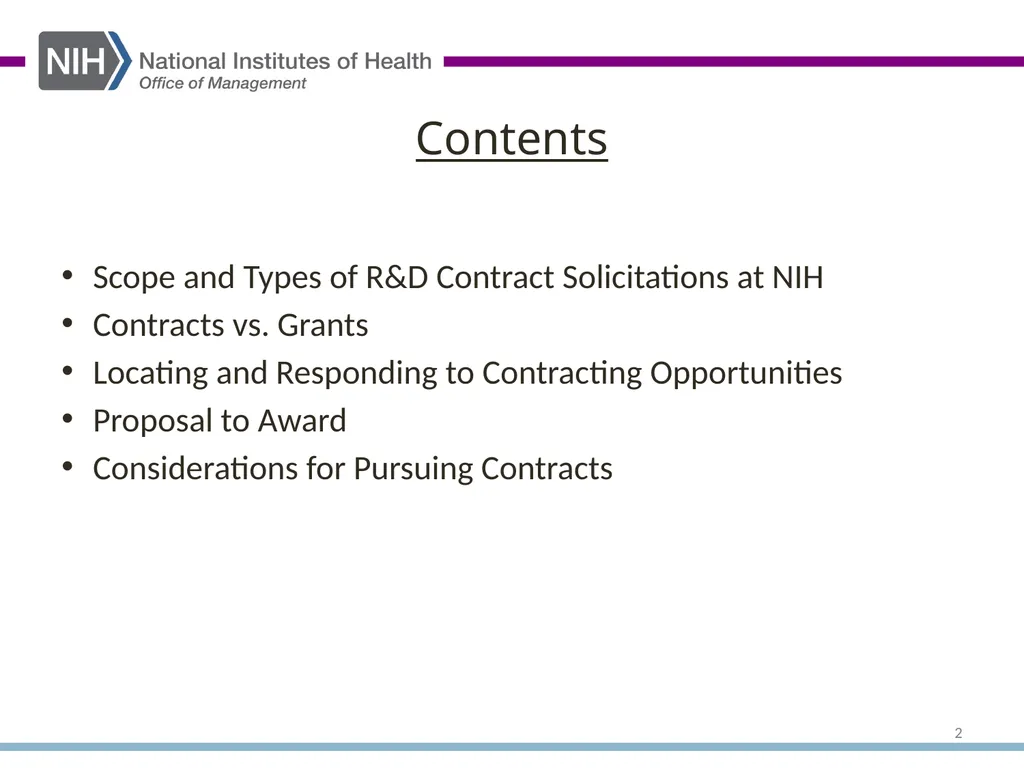
Scope and Types of R&D Contract Solicitations at NIH
Contracts vs. Grants
Locating and Responding to Contracting Opportunities
Proposal to Award
Considerations for Pursuing Contracts Contents 2<br>
Contracts vs. Grants
Locating and Responding to Contracting Opportunities
Proposal to Award
Considerations for Pursuing Contracts Contents 2<br>
03
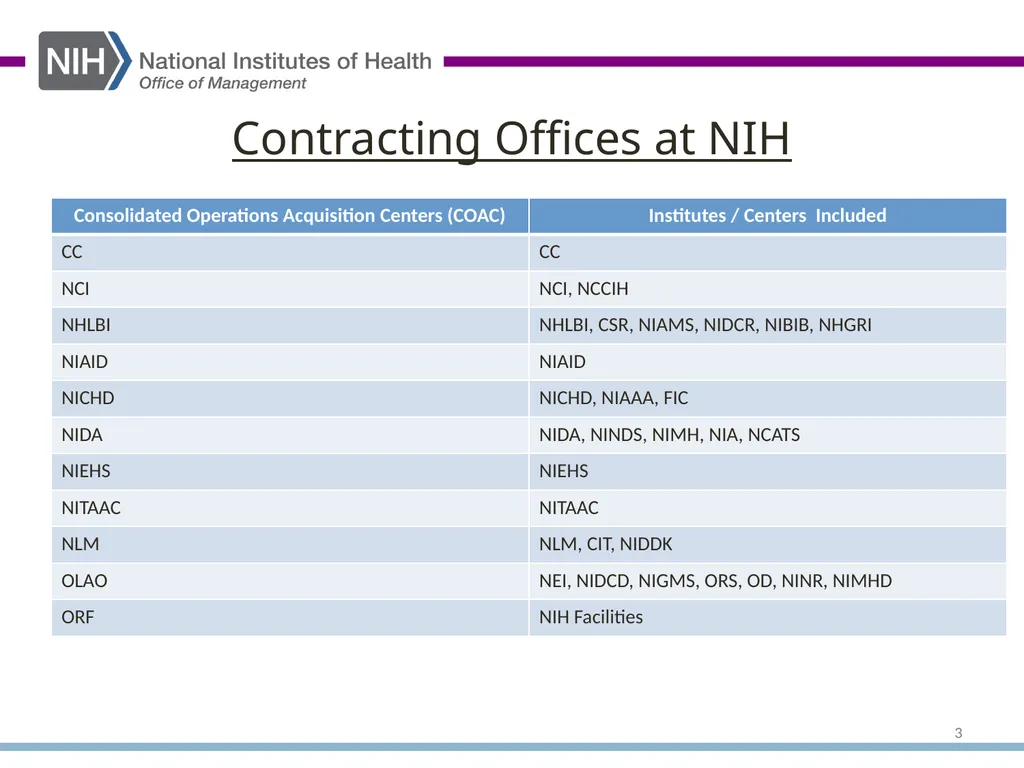
Contracting Offices at NIH 3<br>
04
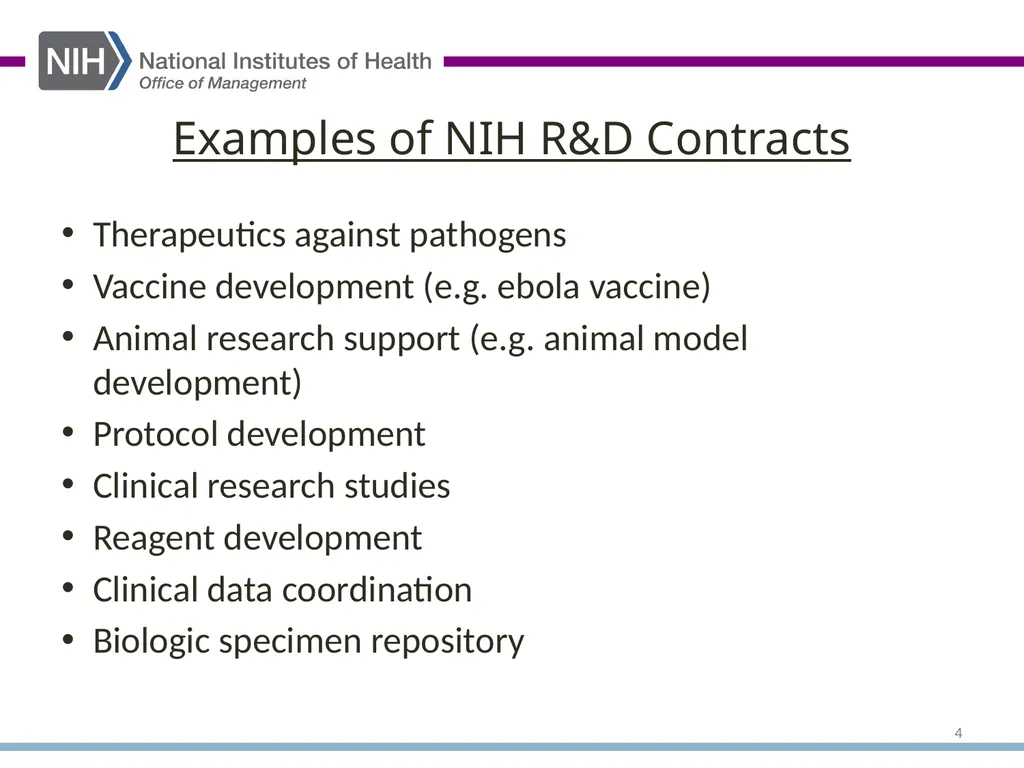
Therapeutics against pathogens
Vaccine development (e.g. ebola vaccine)
Animal research support (e.g. animal model development)
Protocol development
Clinical research studies
Reagent development
Clinical data coordination
Biologic specimen repository Examples of NIH R&D Contracts 4<br>
Vaccine development (e.g. ebola vaccine)
Animal research support (e.g. animal model development)
Protocol development
Clinical research studies
Reagent development
Clinical data coordination
Biologic specimen repository Examples of NIH R&D Contracts 4<br>
05
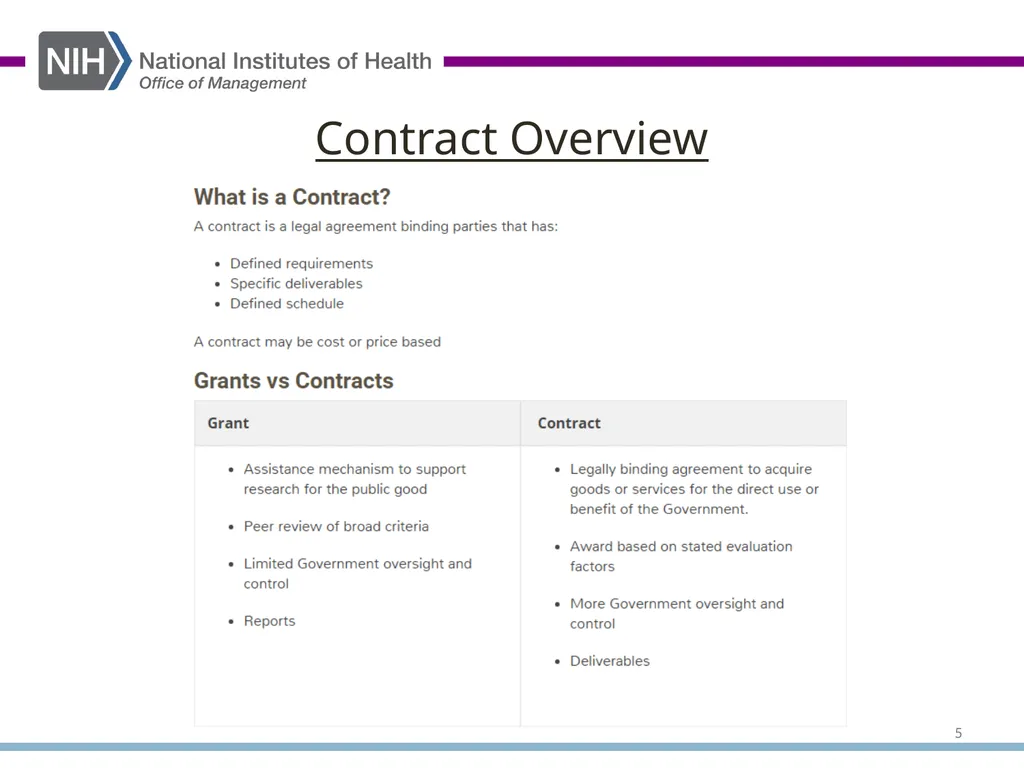
Contract Overview 5<br>
06
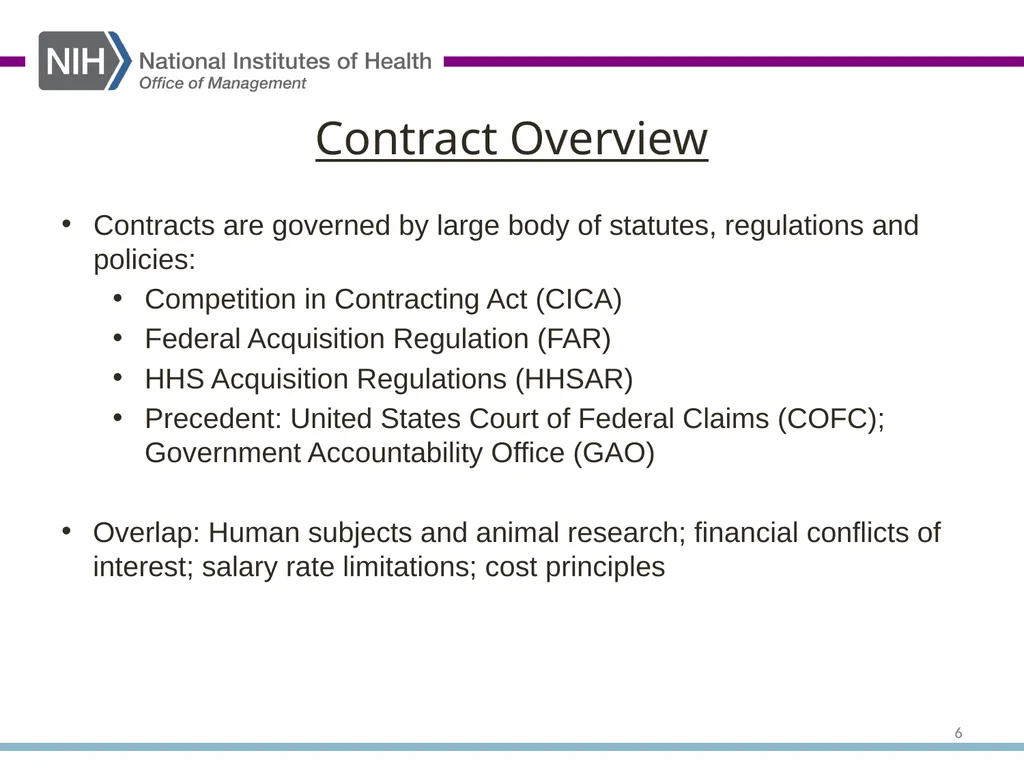
Contracts are governed by large body of statutes, regulations and policies:
Competition in Contracting Act (CICA)
Federal Acquisition Regulation (FAR)
HHS Acquisition Regulations (HHSAR)
Precedent: United States Court of Federal Claims (COFC); Government Accountability Office (GAO)
Overlap: Human subjects and animal research; financial conflicts of interest; salary rate limitations; cost principles Contract Overview 6<br>
Competition in Contracting Act (CICA)
Federal Acquisition Regulation (FAR)
HHS Acquisition Regulations (HHSAR)
Precedent: United States Court of Federal Claims (COFC); Government Accountability Office (GAO)
Overlap: Human subjects and animal research; financial conflicts of interest; salary rate limitations; cost principles Contract Overview 6<br>
07
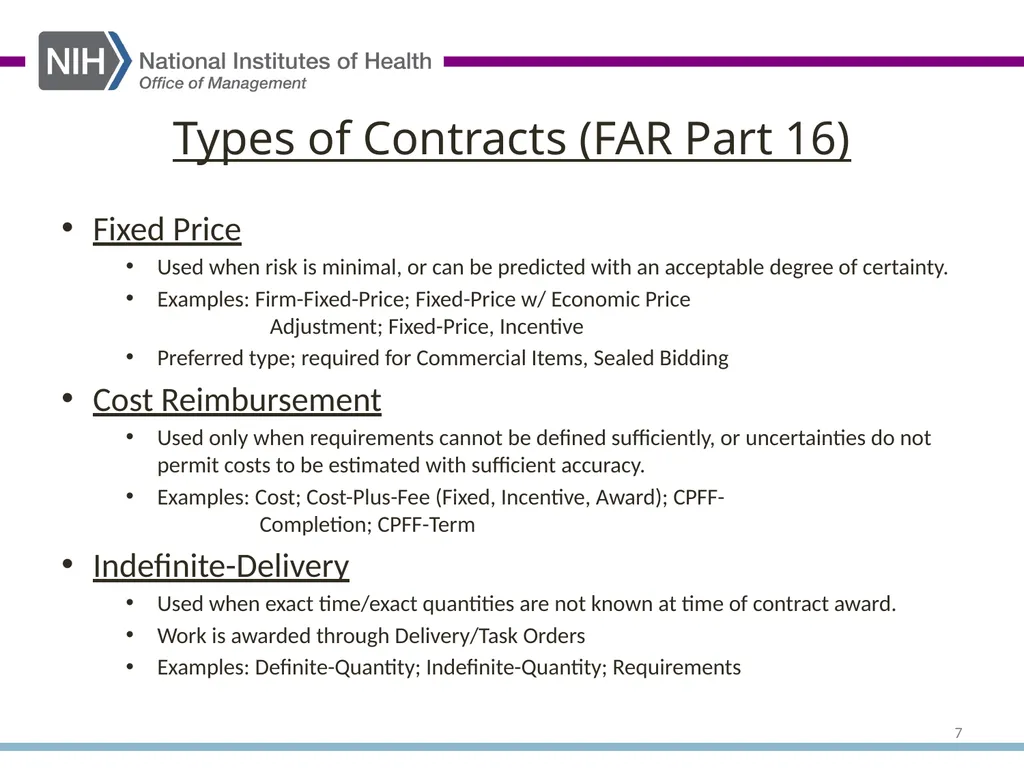
Fixed Price
Used when risk is minimal, or can be predicted with an acceptable degree of certainty.
Examples: Firm-Fixed-Price; Fixed-Price w/ Economic Price Adjustment; Fixed-Price, Incentive
Preferred type; required for Commercial Items, Sealed Bidding
Cost Reimbursement
Used only when requirements cannot be defined sufficiently, or uncertainties do not permit costs to be estimated with sufficient accuracy.
Examples: Cost; Cost-Plus-Fee (Fixed, Incentive, Award); CPFF- Completion; CPFF-Term
Indefinite-Delivery
Used when exact time/exact quantities are not known at time of contract award.
Work is awarded through Delivery/Task Orders
Examples: Definite-Quantity; Indefinite-Quantity; Requirements Types of Contracts (FAR Part 16) 7<br>
Used when risk is minimal, or can be predicted with an acceptable degree of certainty.
Examples: Firm-Fixed-Price; Fixed-Price w/ Economic Price Adjustment; Fixed-Price, Incentive
Preferred type; required for Commercial Items, Sealed Bidding
Cost Reimbursement
Used only when requirements cannot be defined sufficiently, or uncertainties do not permit costs to be estimated with sufficient accuracy.
Examples: Cost; Cost-Plus-Fee (Fixed, Incentive, Award); CPFF- Completion; CPFF-Term
Indefinite-Delivery
Used when exact time/exact quantities are not known at time of contract award.
Work is awarded through Delivery/Task Orders
Examples: Definite-Quantity; Indefinite-Quantity; Requirements Types of Contracts (FAR Part 16) 7<br>
08
FAR 2.101:
“Solicitation” means any request to submit offers or quotations to the Government. Solicitations under sealed bid procedures are called “invitations for bids.” Solicitations under negotiated procedures are called “requests for proposals.” Solicitations under simplified acquisition procedures may require submission of either a quotation or an offer. Solicitations 8<br>
“Solicitation” means any request to submit offers or quotations to the Government. Solicitations under sealed bid procedures are called “invitations for bids.” Solicitations under negotiated procedures are called “requests for proposals.” Solicitations under simplified acquisition procedures may require submission of either a quotation or an offer. Solicitations 8<br>
09
Communicates Government requirements to prospective contractors and solicits proposals.
Also describes the—
Anticipated terms and conditions that will apply to the contract;
Information required to be in the offeror’s proposal; and
Factors and significant subfactors that will be used to evaluate the proposal and their relative importance. Requests for Proposals (RFP) 9<br>
Also describes the—
Anticipated terms and conditions that will apply to the contract;
Information required to be in the offeror’s proposal; and
Factors and significant subfactors that will be used to evaluate the proposal and their relative importance. Requests for Proposals (RFP) 9<br>
10
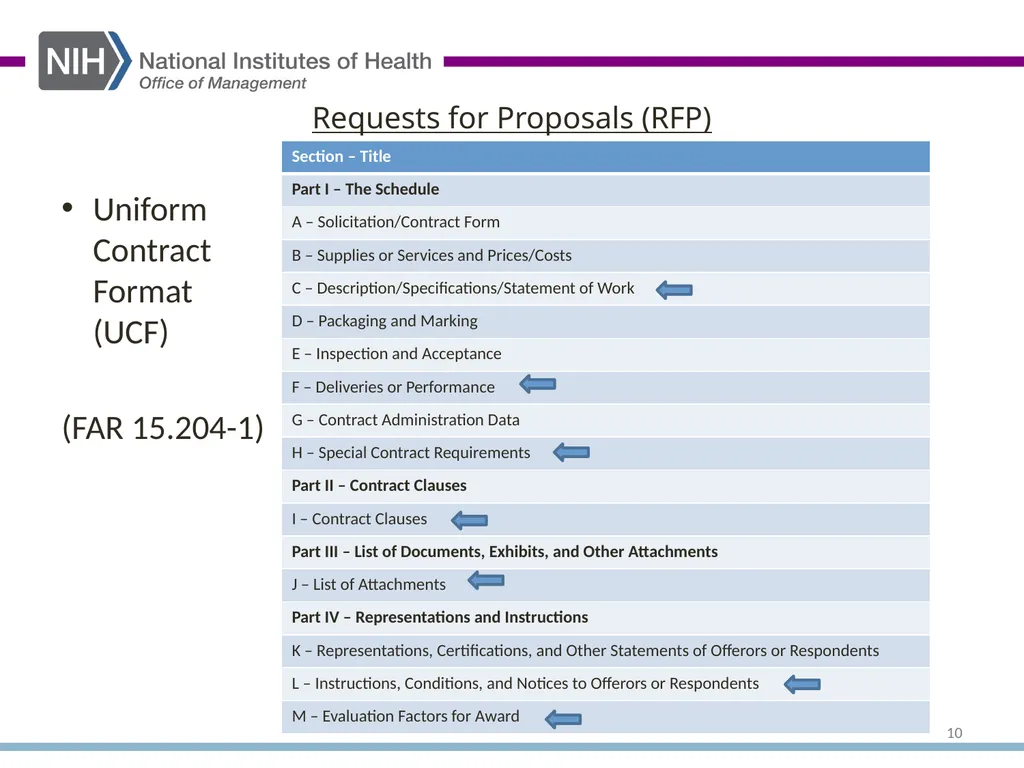
Uniform Contract Format (UCF)
(FAR 15.204-1) Requests for Proposals (RFP) 10<br>
(FAR 15.204-1) Requests for Proposals (RFP) 10<br>
11
FAR 2.101: A general announcement of an agency’s research interest including criteria for selecting proposals and soliciting the participation of all offerors capable of satisfying the Government’s needs.
FAR 35.016(a): For the acquisition of basic and applied research and that part of development not related to the development of a specific system or hardware procurement…directed toward advancing the state-of-the-art or increasing knowledge or understanding rather than focusing on a specific system or hardware solution. Broad Agency Announcement (BAA) 11<br>
FAR 35.016(a): For the acquisition of basic and applied research and that part of development not related to the development of a specific system or hardware procurement…directed toward advancing the state-of-the-art or increasing knowledge or understanding rather than focusing on a specific system or hardware solution. Broad Agency Announcement (BAA) 11<br>
12
Statutory program aimed at strengthening the role of innovative small business concerns in Federally-funded research or research and development.
Administered through grants and contracts.
Contract solicitation released annually
HHS Components: NIH, CDC
https://sbir.nih.gov/ Small Business Innovative Research (SBIR) 12<br>
Administered through grants and contracts.
Contract solicitation released annually
HHS Components: NIH, CDC
https://sbir.nih.gov/ Small Business Innovative Research (SBIR) 12<br>
13
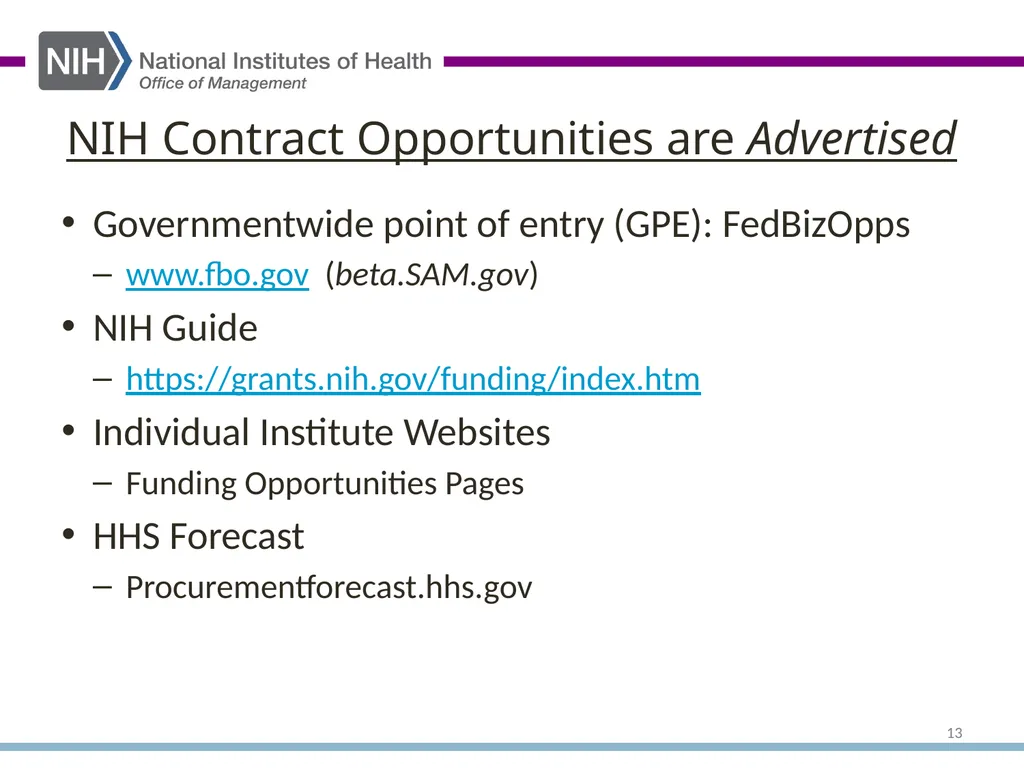
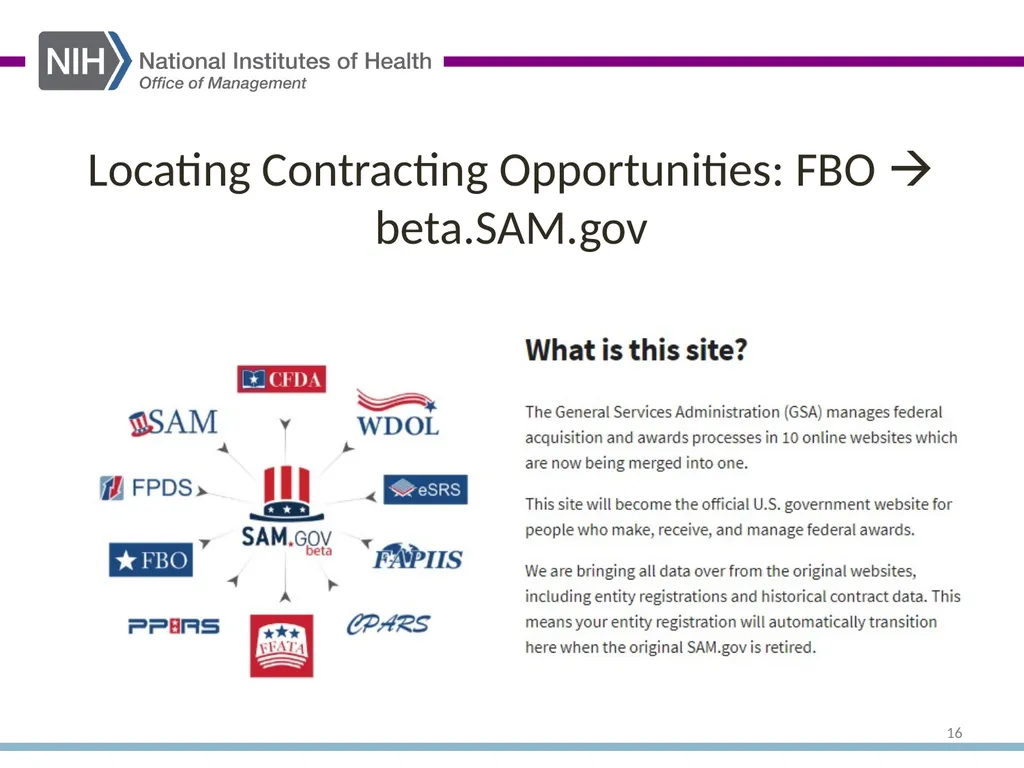
Governmentwide point of entry (GPE): FedBizOpps
www.fbo.gov (beta.SAM.gov)
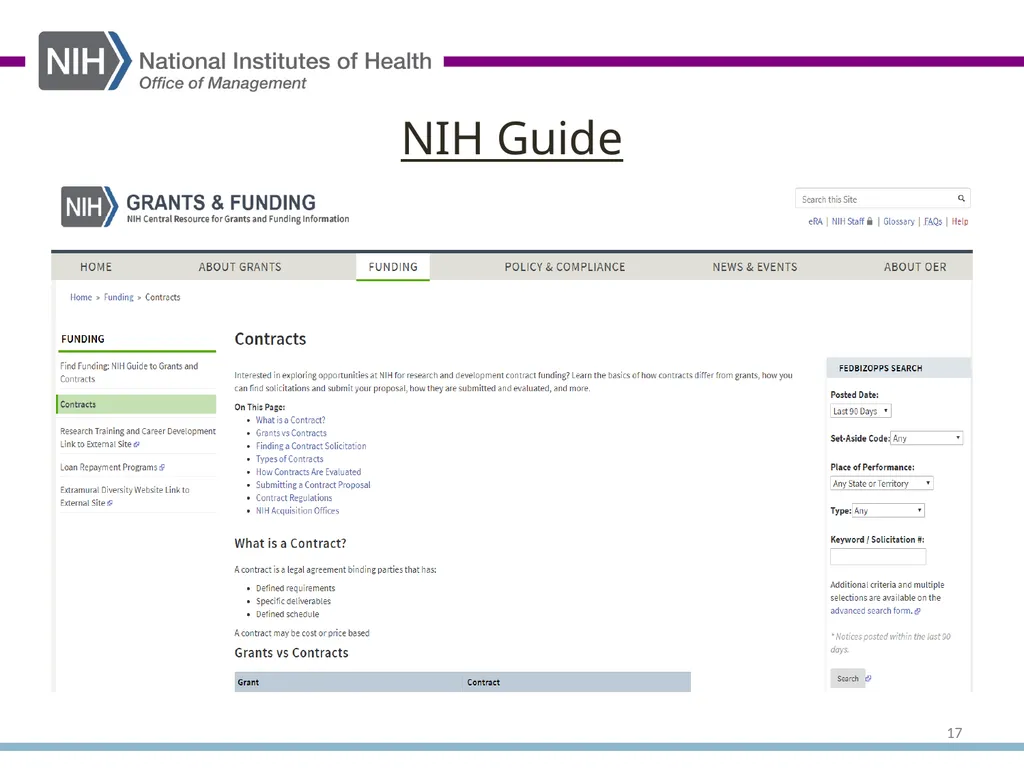
NIH Guide
https://grants.nih.gov/funding/index.htm
Individual Institute Websites
Funding Opportunities Pages
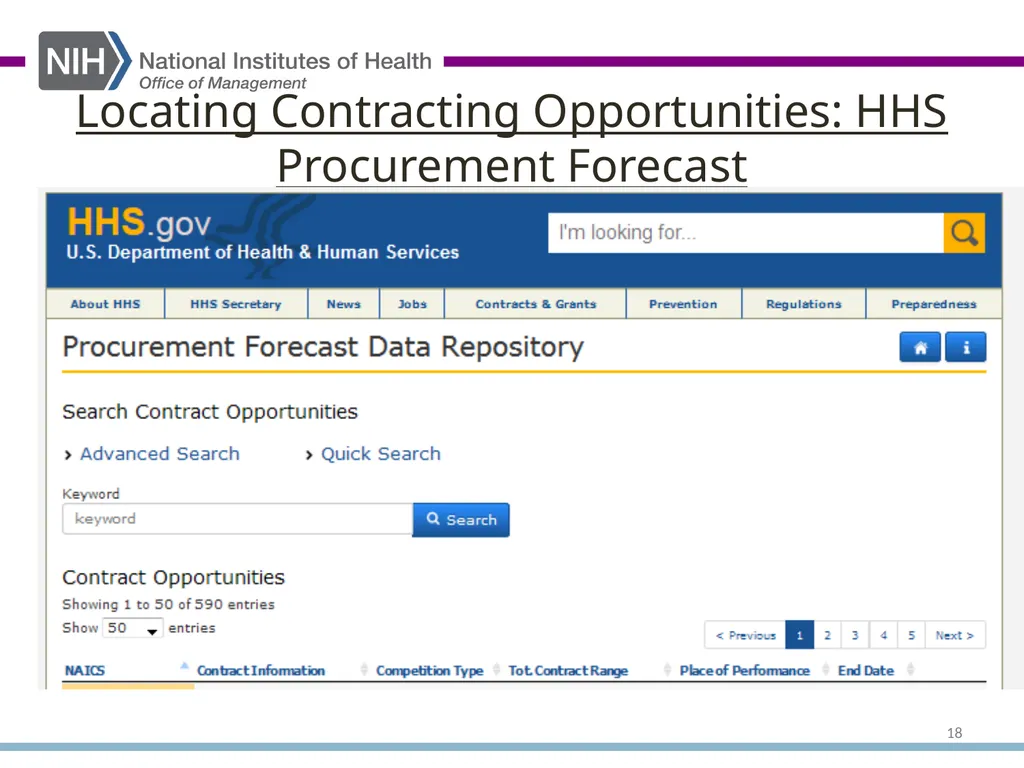
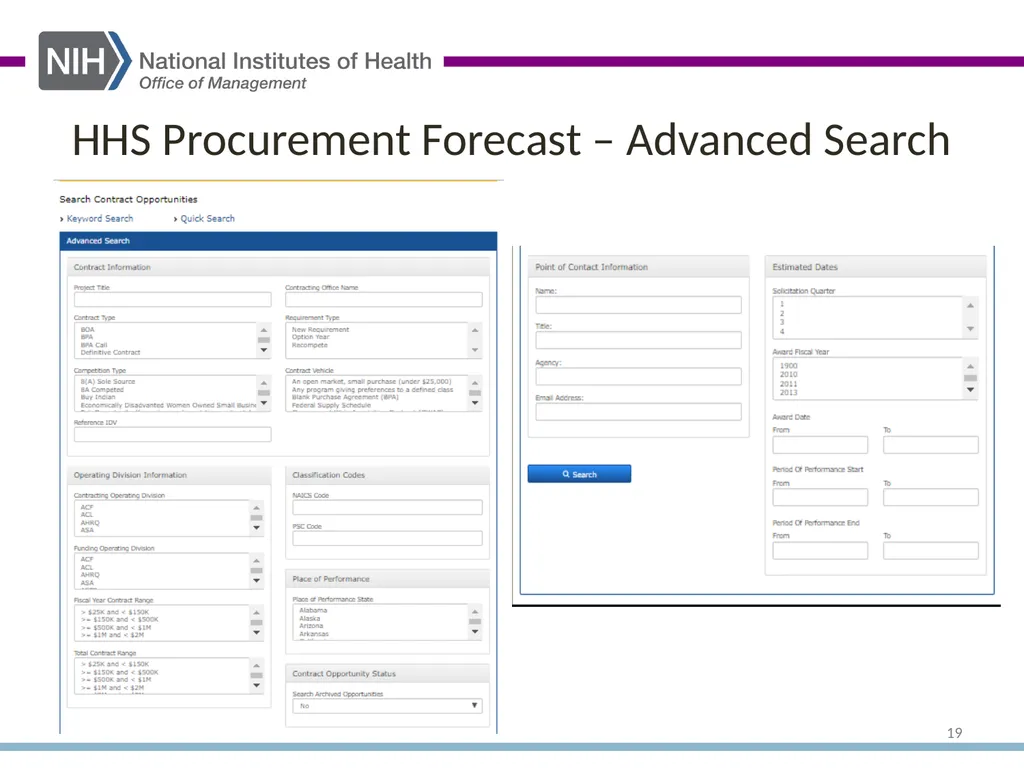
HHS Forecast
Procurementforecast.hhs.gov NIH Contract Opportunities are Advertised 13<br>
www.fbo.gov (beta.SAM.gov)
NIH Guide
https://grants.nih.gov/funding/index.htm
Individual Institute Websites
Funding Opportunities Pages
HHS Forecast
Procurementforecast.hhs.gov NIH Contract Opportunities are Advertised 13<br>
14
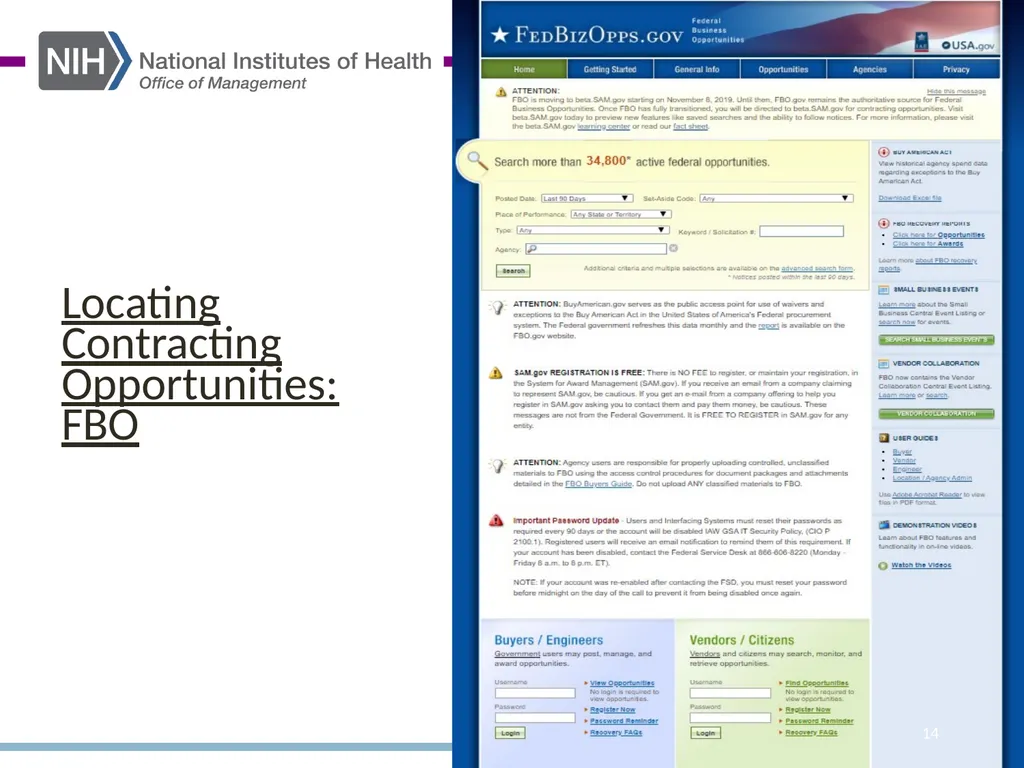
Locating Contracting Opportunities: FBO 14<br>
15
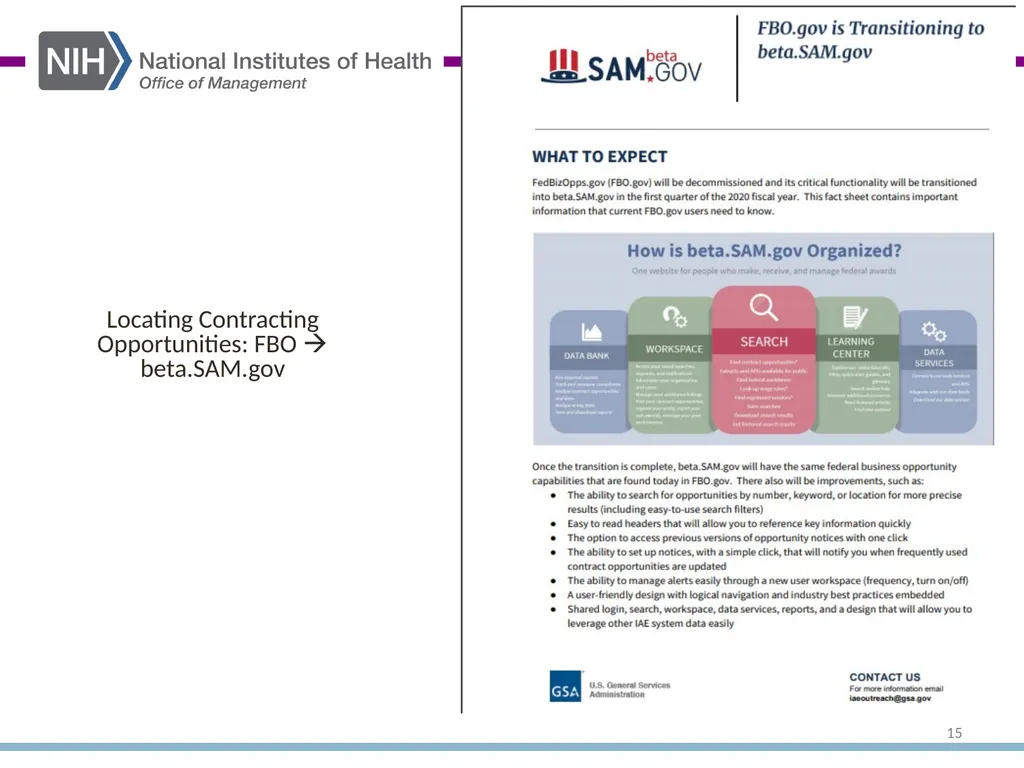
Locating Contracting Opportunities: FBO beta.SAM.gov 15<br>
16
Locating Contracting Opportunities: FBO beta.SAM.gov 16<br>
17
NIH Guide 17<br>
18
Locating Contracting Opportunities: HHS Procurement Forecast 18<br>
19
HHS Procurement Forecast – Advanced Search 19<br>
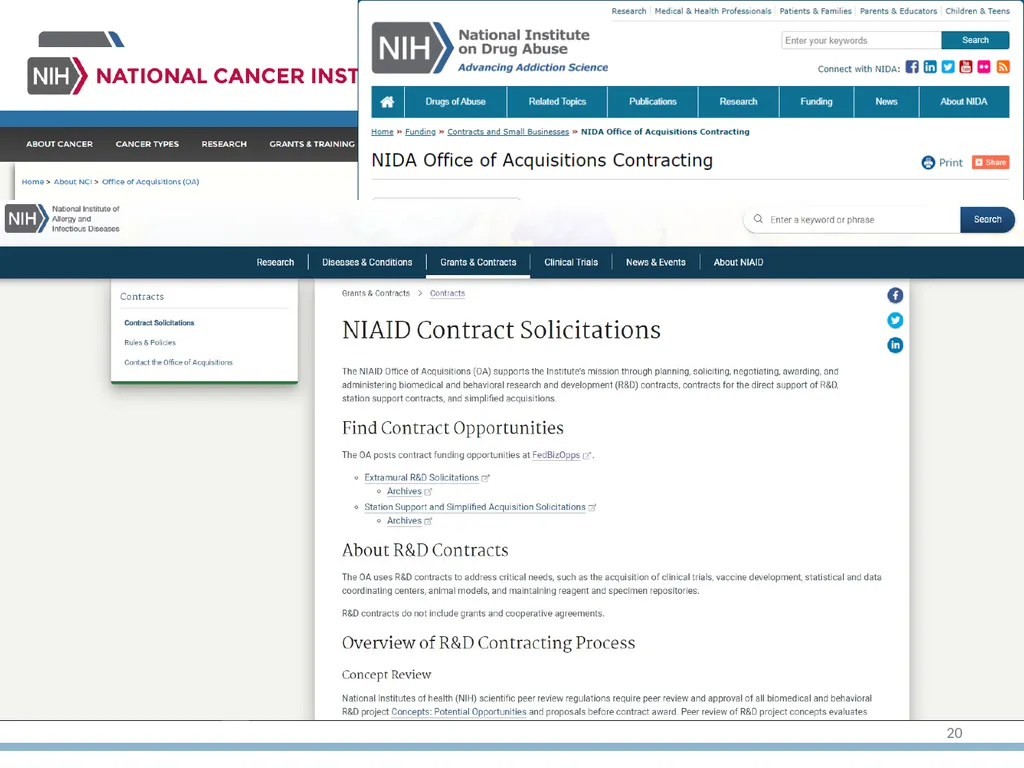
20
Locating Contracting Opportunities: IC Websites 20<br>
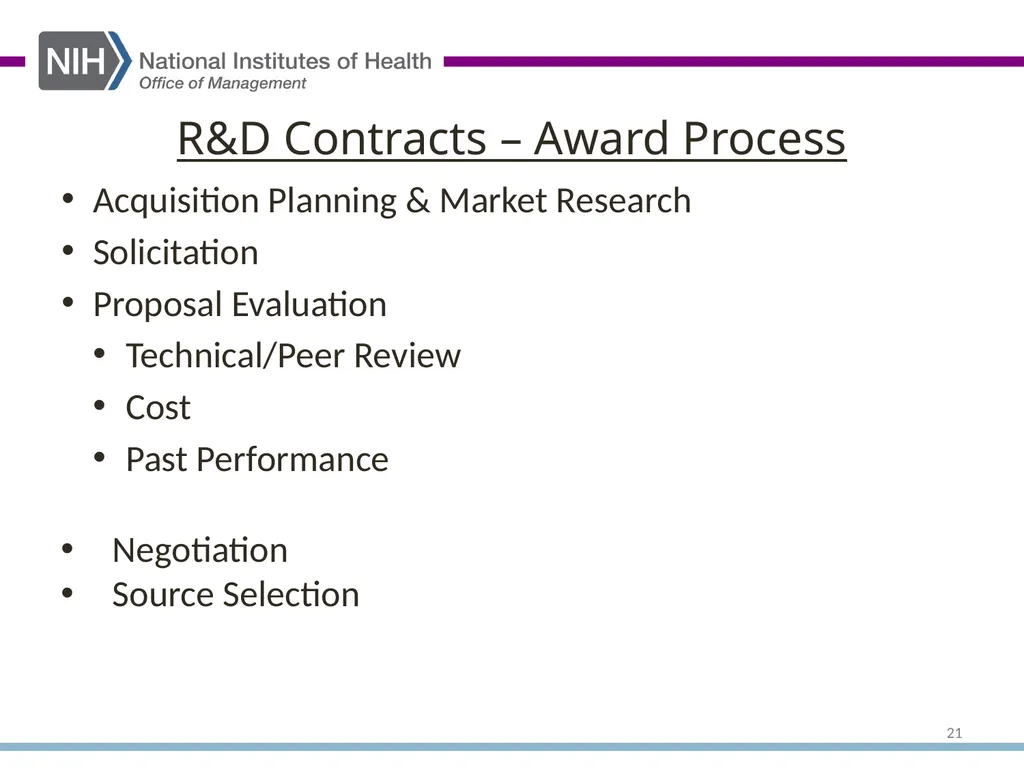
21
Acquisition Planning & Market Research
Solicitation
Proposal Evaluation
Technical/Peer Review
Cost
Past Performance R&D Contracts – Award Process 21 Negotiation
Source Selection<br>
Solicitation
Proposal Evaluation
Technical/Peer Review
Cost
Past Performance R&D Contracts – Award Process 21 Negotiation
Source Selection<br>
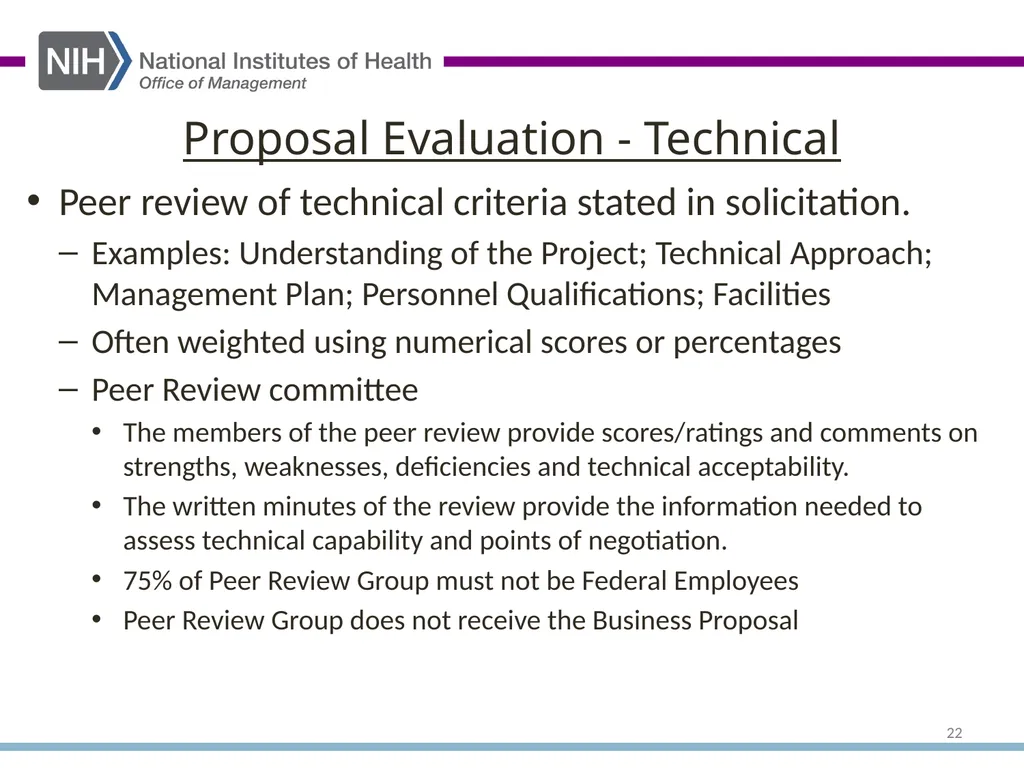
22
Peer review of technical criteria stated in solicitation.
Examples: Understanding of the Project; Technical Approach; Management Plan; Personnel Qualifications; Facilities
Often weighted using numerical scores or percentages
Peer Review committee
The members of the peer review provide scores/ratings and comments on strengths, weaknesses, deficiencies and technical acceptability.
The written minutes of the review provide the information needed to assess technical capability and points of negotiation.
75% of Peer Review Group must not be Federal Employees
Peer Review Group does not receive the Business Proposal Proposal Evaluation - Technical 22<br>
Examples: Understanding of the Project; Technical Approach; Management Plan; Personnel Qualifications; Facilities
Often weighted using numerical scores or percentages
Peer Review committee
The members of the peer review provide scores/ratings and comments on strengths, weaknesses, deficiencies and technical acceptability.
The written minutes of the review provide the information needed to assess technical capability and points of negotiation.
75% of Peer Review Group must not be Federal Employees
Peer Review Group does not receive the Business Proposal Proposal Evaluation - Technical 22<br>
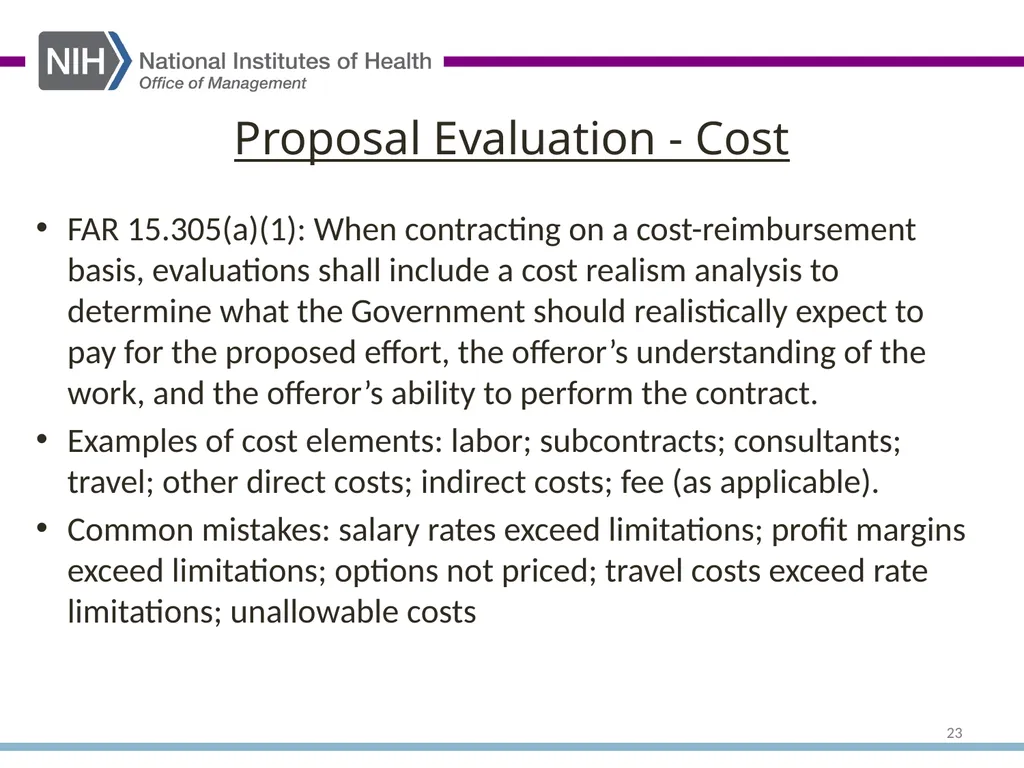
23
FAR 15.305(a)(1): When contracting on a cost-reimbursement basis, evaluations shall include a cost realism analysis to determine what the Government should realistically expect to pay for the proposed effort, the offeror’s understanding of the work, and the offeror’s ability to perform the contract.
Examples of cost elements: labor; subcontracts; consultants; travel; other direct costs; indirect costs; fee (as applicable).
Common mistakes: salary rates exceed limitations; profit margins exceed limitations; options not priced; travel costs exceed rate limitations; unallowable costs Proposal Evaluation - Cost 23<br>
Examples of cost elements: labor; subcontracts; consultants; travel; other direct costs; indirect costs; fee (as applicable).
Common mistakes: salary rates exceed limitations; profit margins exceed limitations; options not priced; travel costs exceed rate limitations; unallowable costs Proposal Evaluation - Cost 23<br>
24
The currency and relevance of the information, source of the information, context of the data, and general trends in contractor’s performance shall be considered. (FAR 15.305(a)(2))
Offerors are given the opportunity to identify past or current contracts for similar work; Government may also obtain information from other sources (PPIRS; past performance questionnaires).
If no relevant past performance is available, the offeror may not be evaluated favorably or unfavorably on past performance. Past Performance Evaluation 24<br>
Offerors are given the opportunity to identify past or current contracts for similar work; Government may also obtain information from other sources (PPIRS; past performance questionnaires).
If no relevant past performance is available, the offeror may not be evaluated favorably or unfavorably on past performance. Past Performance Evaluation 24<br>
25
Based on the ratings of each proposal against all evaluation criteria, the contracting officer shall establish a competitive range comprised of all of the most highly rated proposals. FAR 15.306(c)
Can be reduced for purposes of efficiency.
Negotiations
Government must tell offerors all deficiencies and significant weaknesses in the proposal and adverse past performance information.
Government can also negotiate price.
Offeror has opportunity to revise its proposal. Competitive Range and Negotiations 25<br>
Can be reduced for purposes of efficiency.
Negotiations
Government must tell offerors all deficiencies and significant weaknesses in the proposal and adverse past performance information.
Government can also negotiate price.
Offeror has opportunity to revise its proposal. Competitive Range and Negotiations 25<br>
26
The Contracting Officer selects awardees based on the Evaluation Factors for Award stated in the solicitation.
Example:
Selection of an offeror for contract award will be based on an evaluation of proposals against three factors. The factors in order of importance are: technical, cost, and past performance. Although technical factors are of paramount consideration in the award of the contract, past performance and cost/price are also important to the overall contract award decision. All evaluation factors other than cost or price, when combined, are significantly more important than cost/price. The Government intends to make an award(s) to that offeror whose proposal provides the best overall value to the Government. Source Selection 26<br>
Example:
Selection of an offeror for contract award will be based on an evaluation of proposals against three factors. The factors in order of importance are: technical, cost, and past performance. Although technical factors are of paramount consideration in the award of the contract, past performance and cost/price are also important to the overall contract award decision. All evaluation factors other than cost or price, when combined, are significantly more important than cost/price. The Government intends to make an award(s) to that offeror whose proposal provides the best overall value to the Government. Source Selection 26<br>
27
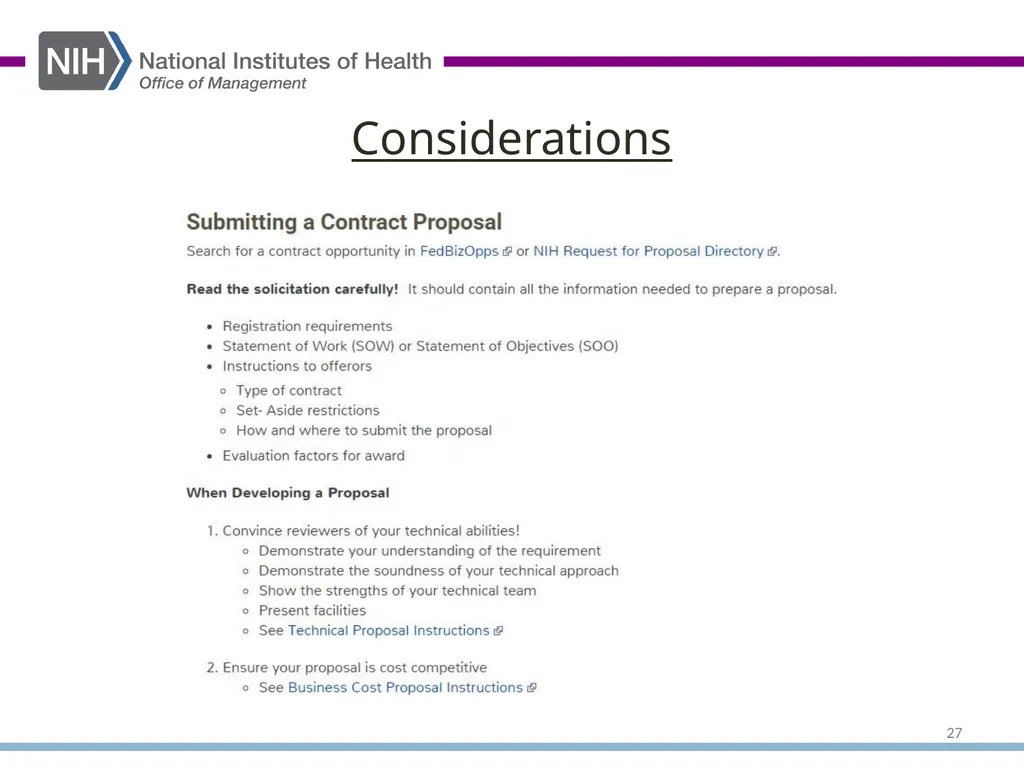
Considerations 27<br>
28
Scope and Types of R&D Contract Solicitations at NIH
Contracts vs. Grants
Locating and Responding to Contracting Opportunities
Proposal to Award
Considerations for Pursuing Contracts
Good Luck! Closing Remarks 28<br>
Contracts vs. Grants
Locating and Responding to Contracting Opportunities
Proposal to Award
Considerations for Pursuing Contracts
Good Luck! Closing Remarks 28<br>
29
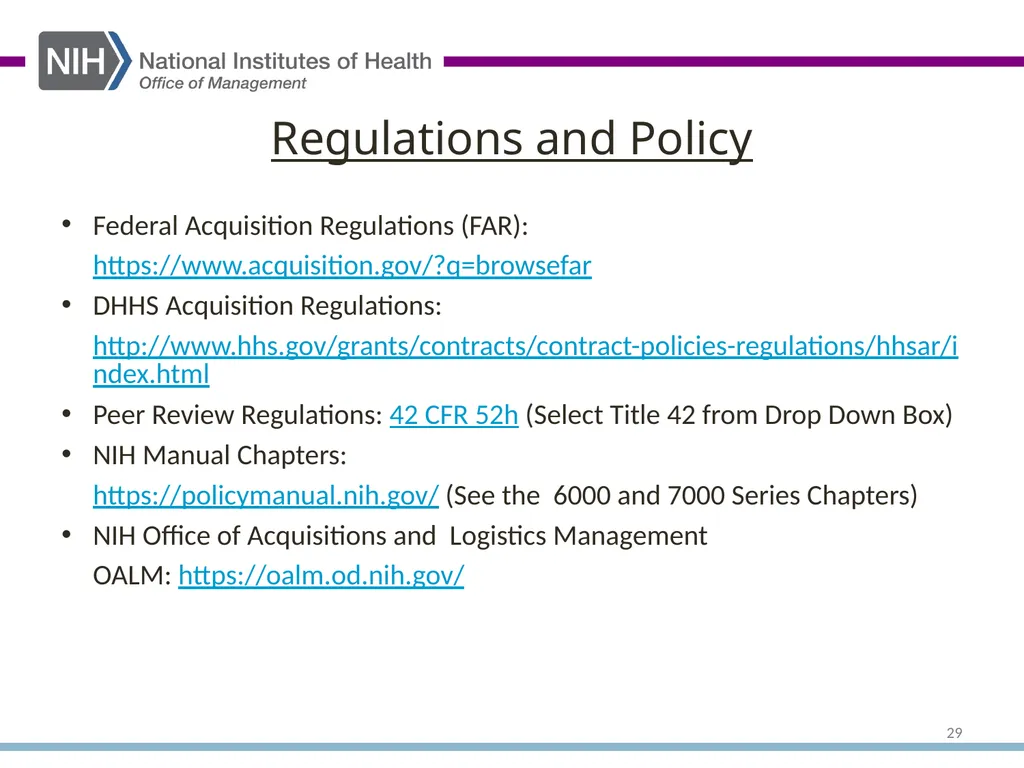
Federal Acquisition Regulations (FAR):
https://www.acquisition.gov/?q=browsefar
DHHS Acquisition Regulations:
http://www.hhs.gov/grants/contracts/contract-policies-regulations/hhsar/index.html
Peer Review Regulations: 42 CFR 52h (Select Title 42 from Drop Down Box)
NIH Manual Chapters:
https://policymanual.nih.gov/ (See the 6000 and 7000 Series Chapters)
NIH Office of Acquisitions and Logistics Management
OALM: https://oalm.od.nih.gov/ Regulations and Policy 29<br>
https://www.acquisition.gov/?q=browsefar
DHHS Acquisition Regulations:
http://www.hhs.gov/grants/contracts/contract-policies-regulations/hhsar/index.html
Peer Review Regulations: 42 CFR 52h (Select Title 42 from Drop Down Box)
NIH Manual Chapters:
https://policymanual.nih.gov/ (See the 6000 and 7000 Series Chapters)
NIH Office of Acquisitions and Logistics Management
OALM: https://oalm.od.nih.gov/ Regulations and Policy 29<br>