
Research and Development Contracts Richard




Description: Research and Development Contracts Richard Hartmann Chief, DMID Research Contracts Branch A National Institute of Allergy and Infectious Diseases George Kennedy Lead Contracting Officer, DMID Research Contracts Branch A National Institute
Related Topics
Download Presentation
"Research and Development Contracts Richard" is the property of its rightful owner. Permission is granted to download and print the materials on this website for personal, non-commercial use only, and to display it on your personal computer provided you do not modify the materials and that you retain all copyright notices contained in the materials. By downloading content from our website, you accept the terms of this agreement.
Presentation Transcript
slide1. Research and Development Contracts Richard Hartmann
Chief, DMID Research Contracts Branch A
National Institute of Allergy and Infectious Diseases
George Kennedy
Lead Contracting Officer, DMID Research Contracts Branch A
National Institute of Allergy and Infectious Diseases<br>
slide2. Contracts at NIH
The Basics of R&D Contracts
The Award Process for Contracts
Where to look for Opportunities
What does the Contract Mean to You? Contents 2<br>
slide3. On the Forefront of Science 3<br>
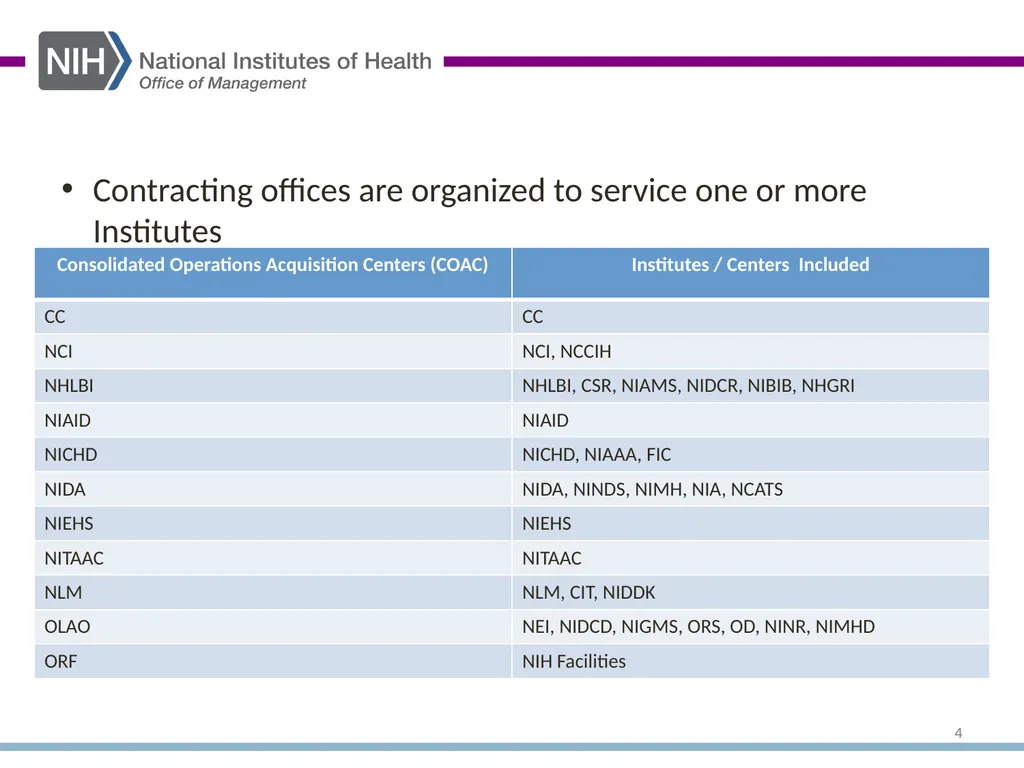
slide4. Contracting offices are organized to service one or more Institutes 4<br>
slide5. NIH FY 2015 COAC and Delegated Obligations by Procurement Mechanism $4.77B Shows COAC and Delegated obligations by procurement mechanism in total dollars and in percentage of total dollars. BPA Calls include micro-purchases as does P-Card and Simplified Acquisitions (BPA calls, Purchase Orders, and DO/TOs). Data also includes modifications. Dollars are in Millions. 5 Chart 1<br>
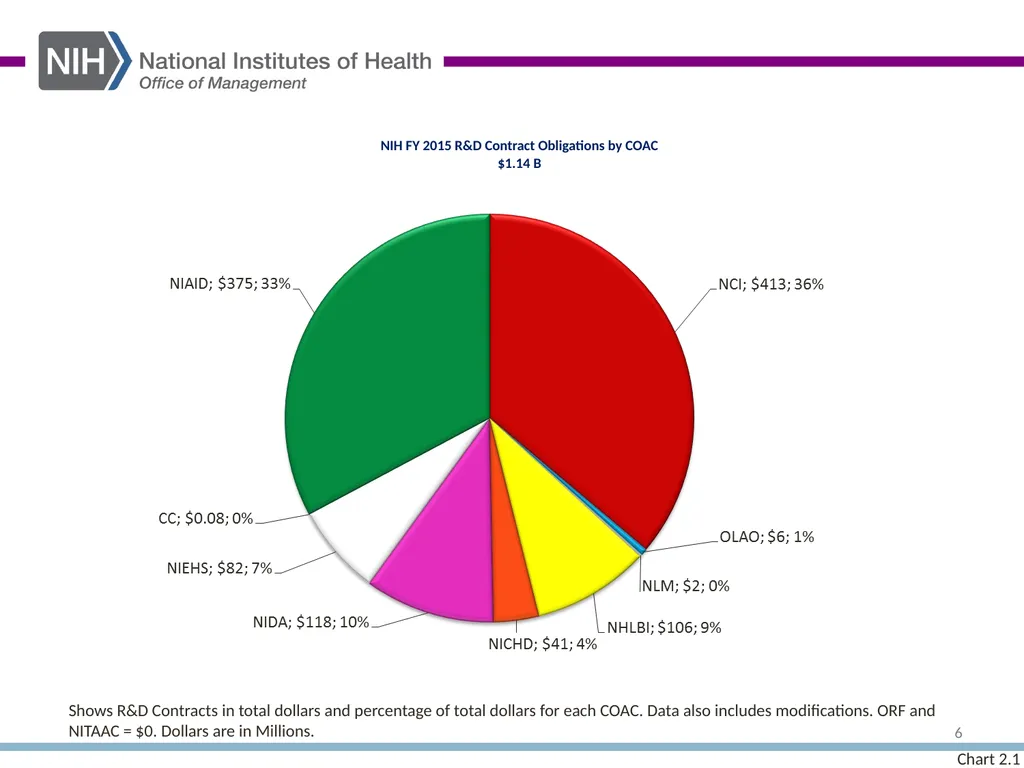
slide6. NIH FY 2015 R&D Contract Obligations by COAC $1.14 B Shows R&D Contracts in total dollars and percentage of total dollars for each COAC. Data also includes modifications. ORF and NITAAC = $0. Dollars are in Millions. 6 Chart 2.1<br>
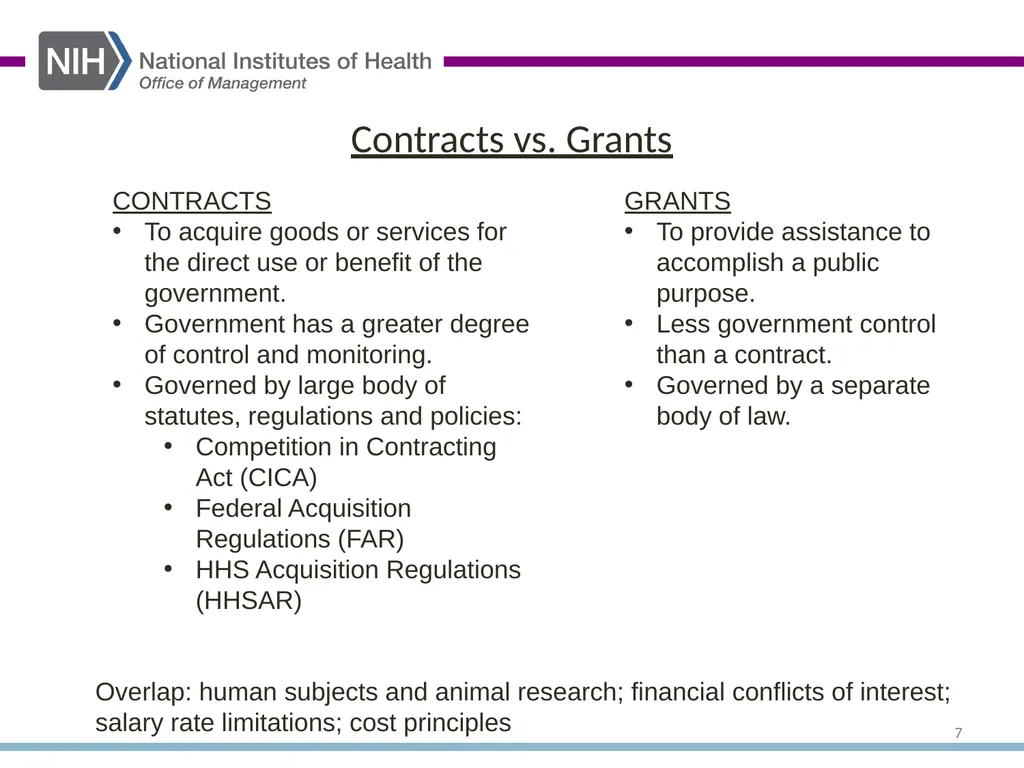
slide7. Contracts vs. Grants 7 CONTRACTS
To acquire goods or services for the direct use or benefit of the government.
Government has a greater degree of control and monitoring.
Governed by large body of statutes, regulations and policies:
Competition in Contracting Act (CICA)
Federal Acquisition Regulations (FAR)
HHS Acquisition Regulations (HHSAR) GRANTS
To provide assistance to accomplish a public purpose.
Less government control than a contract.
Governed by a separate body of law. Overlap: human subjects and animal research; financial conflicts of interest; salary rate limitations; cost principles<br>
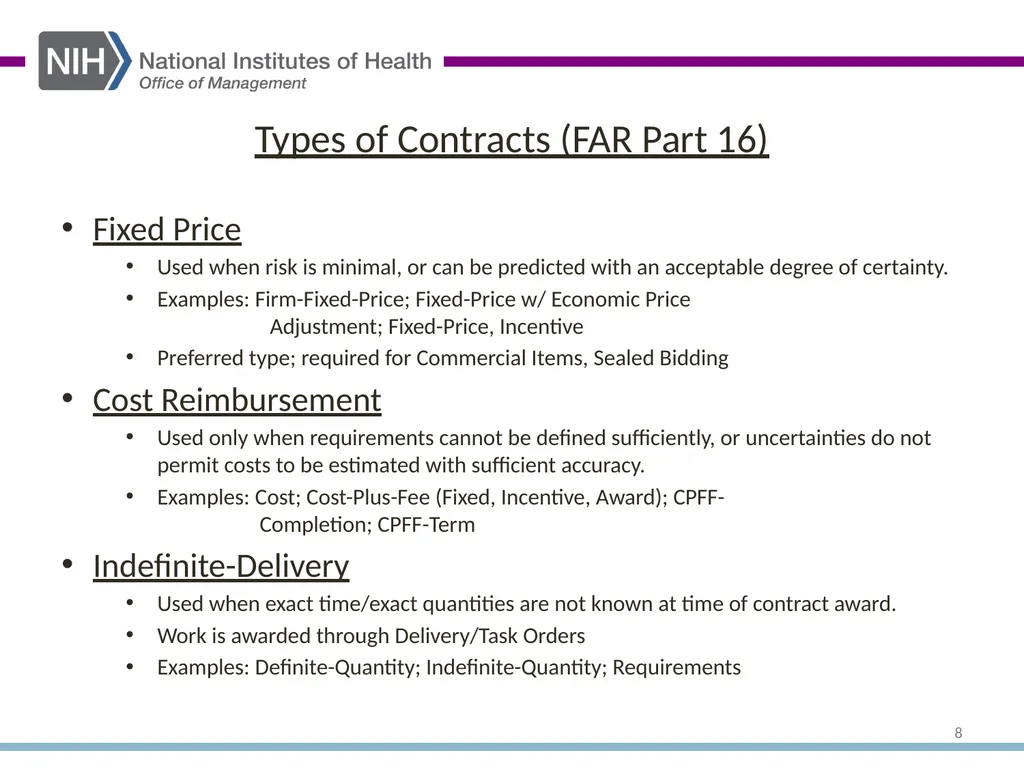
slide8. Fixed Price
Used when risk is minimal, or can be predicted with an acceptable degree of certainty.
Examples: Firm-Fixed-Price; Fixed-Price w/ Economic Price Adjustment; Fixed-Price, Incentive
Preferred type; required for Commercial Items, Sealed Bidding
Cost Reimbursement
Used only when requirements cannot be defined sufficiently, or uncertainties do not permit costs to be estimated with sufficient accuracy.
Examples: Cost; Cost-Plus-Fee (Fixed, Incentive, Award); CPFF- Completion; CPFF-Term
Indefinite-Delivery
Used when exact time/exact quantities are not known at time of contract award.
Work is awarded through Delivery/Task Orders
Examples: Definite-Quantity; Indefinite-Quantity; Requirements Types of Contracts (FAR Part 16) 8<br>
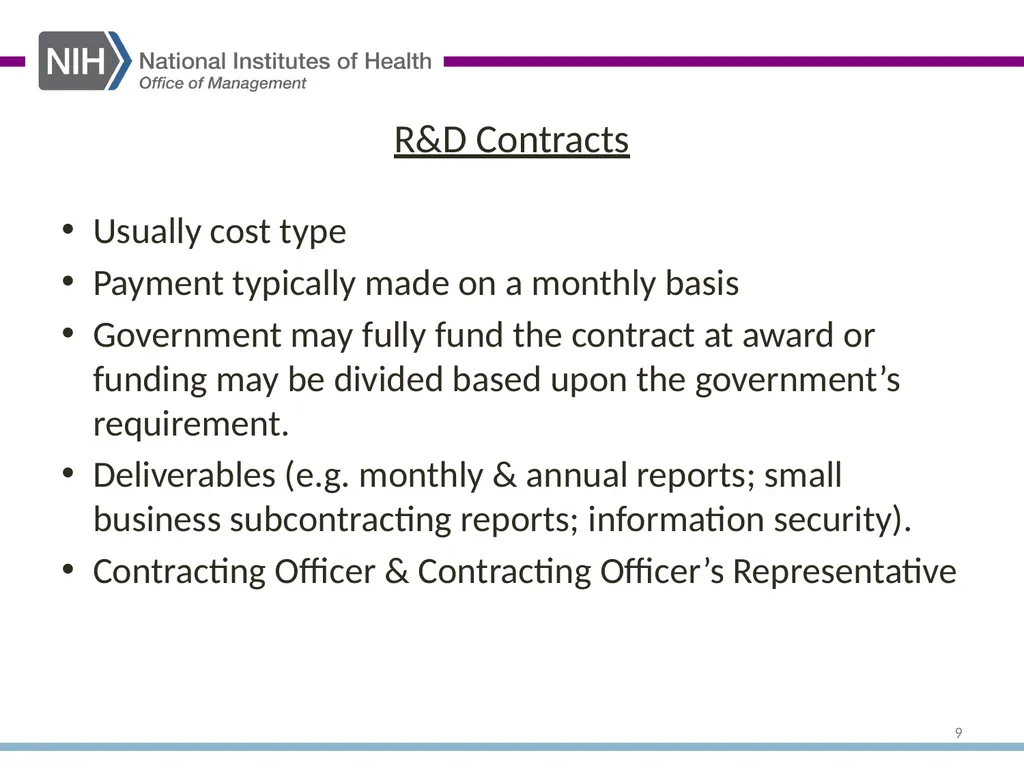
slide9. Usually cost type
Payment typically made on a monthly basis
Government may fully fund the contract at award or funding may be divided based upon the government’s requirement.
Deliverables (e.g. monthly & annual reports; small business subcontracting reports; information security).
Contracting Officer & Contracting Officer’s Representative R&D Contracts 9<br>
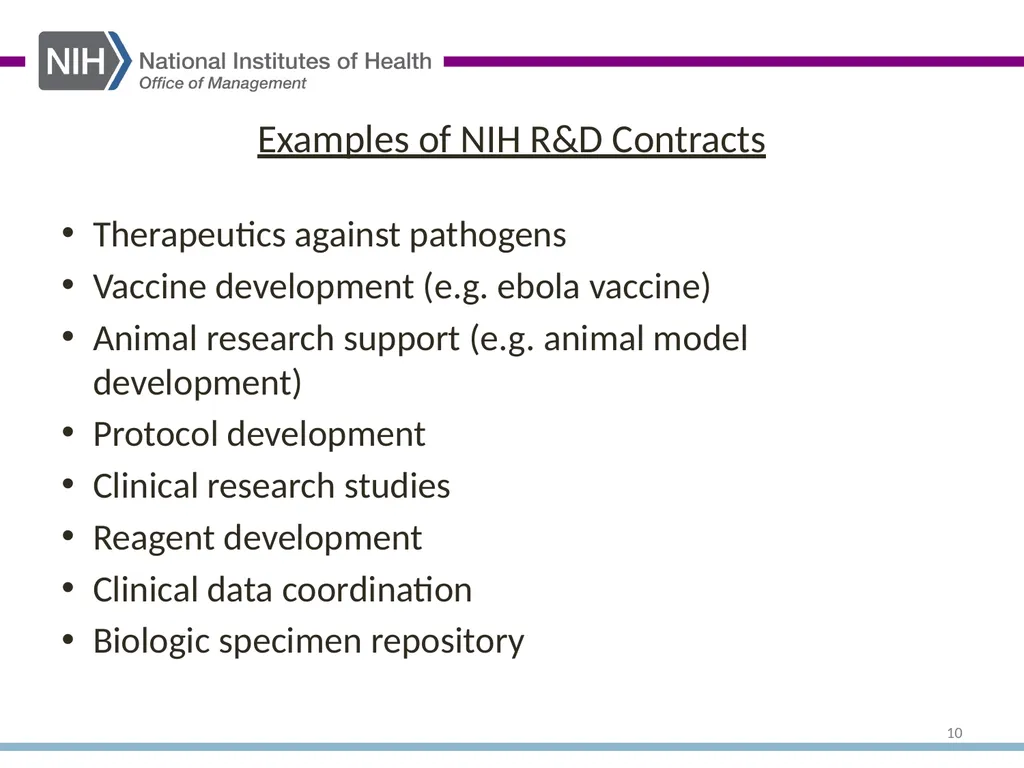
slide10. Therapeutics against pathogens
Vaccine development (e.g. ebola vaccine)
Animal research support (e.g. animal model development)
Protocol development
Clinical research studies
Reagent development
Clinical data coordination
Biologic specimen repository Examples of NIH R&D Contracts 10<br>
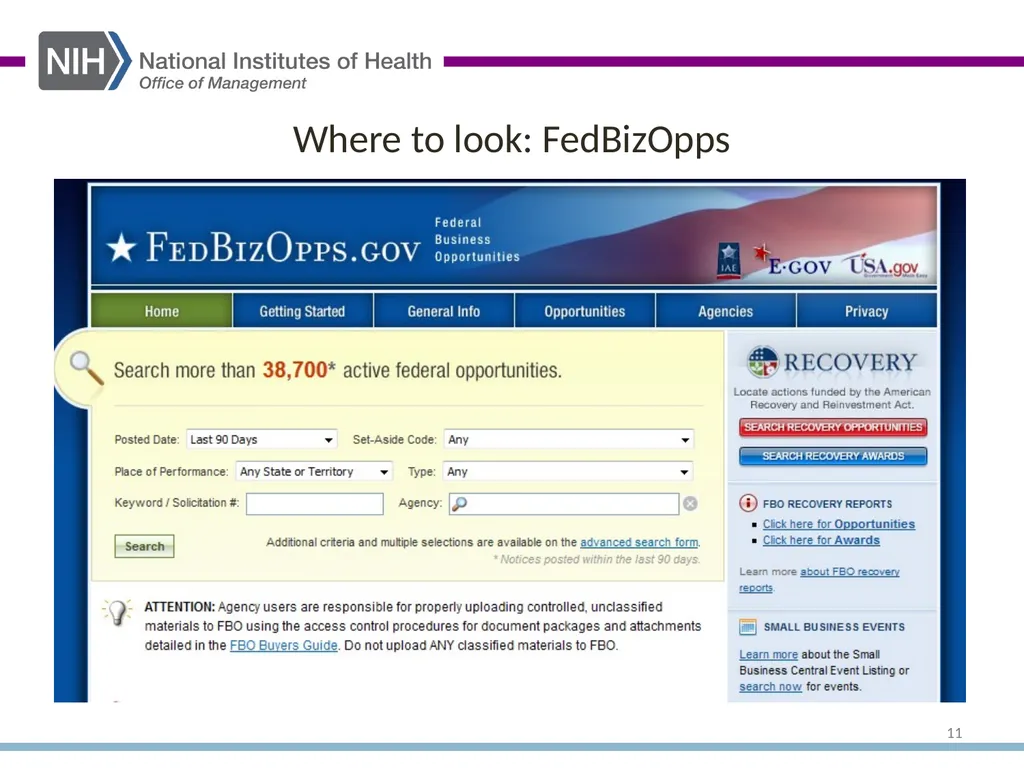
slide11. Where to look: FedBizOpps 11<br>
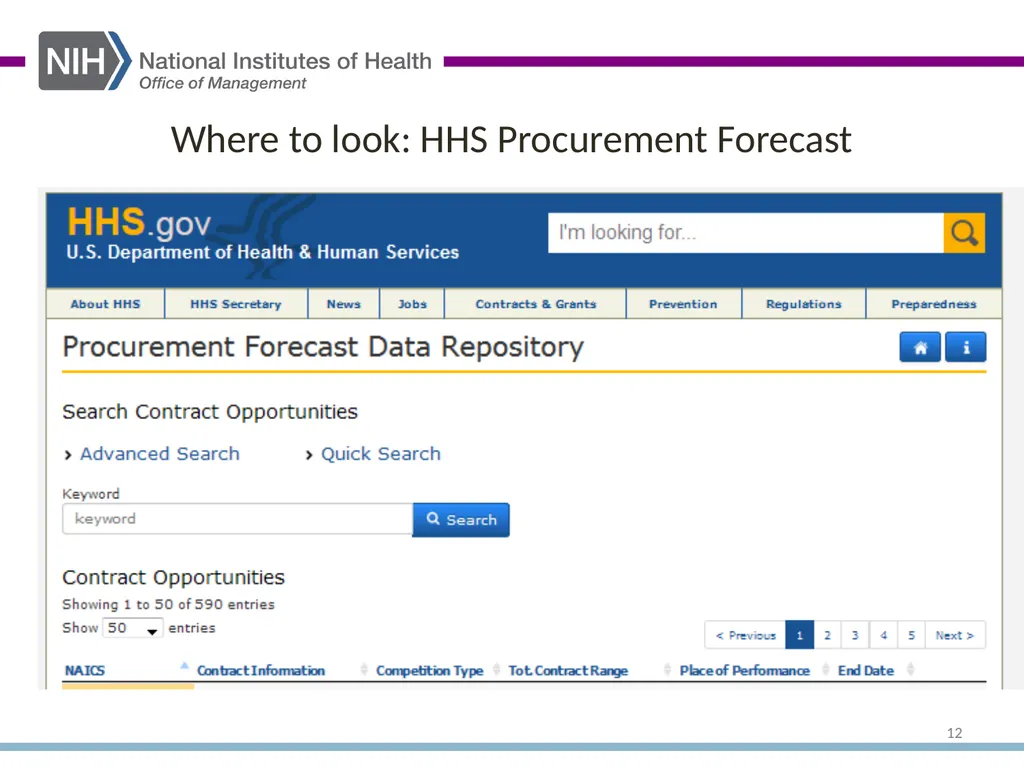
slide12. Where to look: HHS Procurement Forecast 12<br>
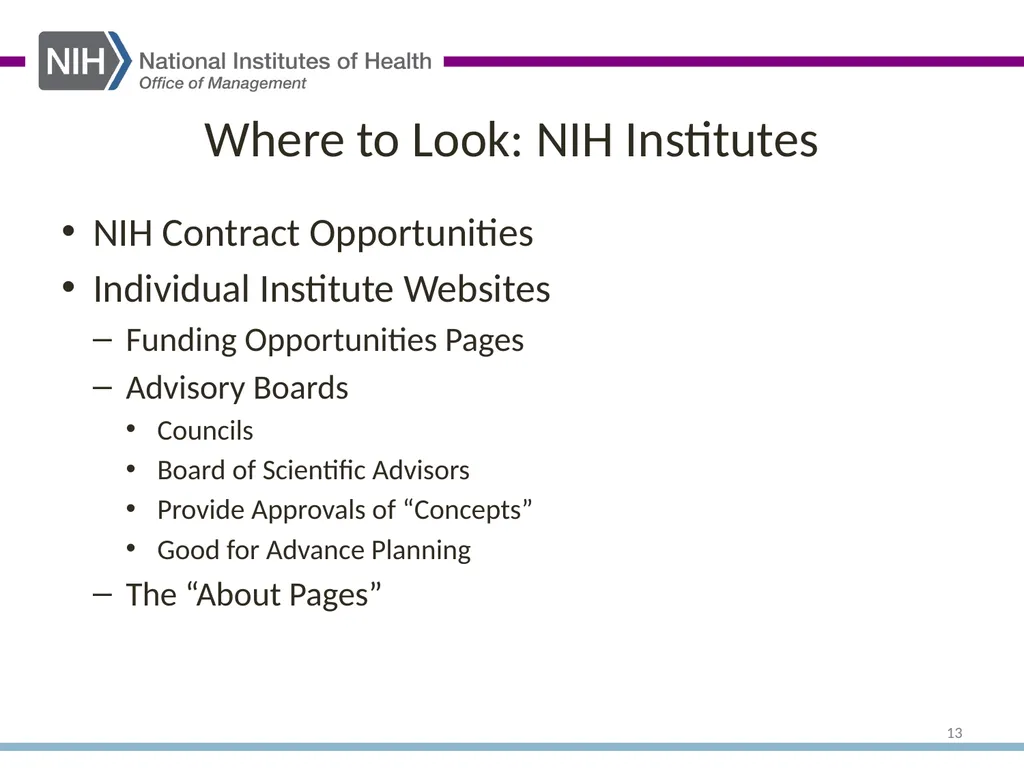
slide13. NIH Contract Opportunities
Individual Institute Websites
Funding Opportunities Pages
Advisory Boards
Councils
Board of Scientific Advisors
Provide Approvals of “Concepts”
Good for Advance Planning
The “About Pages” Where to Look: NIH Institutes 13<br>
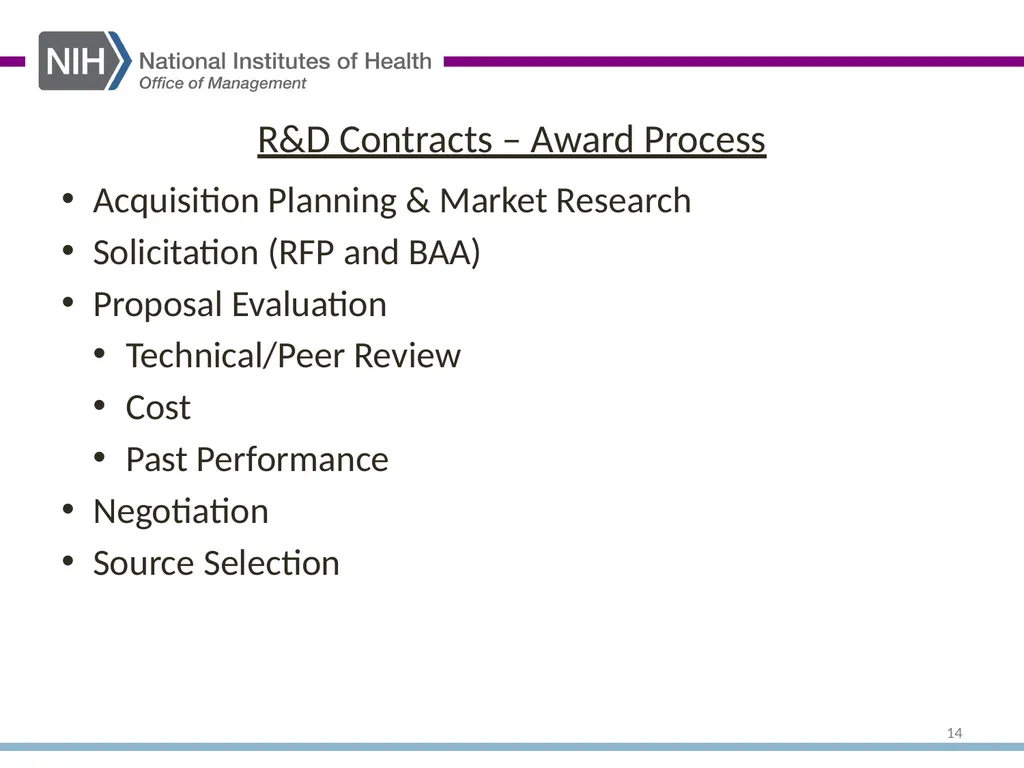
slide14. Acquisition Planning & Market Research
Solicitation (RFP and BAA)
Proposal Evaluation
Technical/Peer Review
Cost
Past Performance
Negotiation
Source Selection R&D Contracts – Award Process 14<br>
slide15. Technical proposals reviewed by NIH staff prior to release to peer review committee.
Effect of page limitations (check the solicitation)
75% of peer review group members must not be government employees.
Peer review group does not see business proposal. Proposal Evaluation - Technical 15<br>
slide16. Proposal evaluated based on the technical criteria stated in solicitation.
Examples: Understanding of the Project; Technical Approach; Management Plan; Personnel Qualifications; Facilities
Numerical scores
Peer Review committee
The members of the peer review provide scores/ratings and comments on strengths, weaknesses, deficiencies and technical acceptability.
The written minutes of the review provide the information needed to assess technical capability and points of negotiation. Proposal Evaluation - Technical 16<br>
slide17. For R&D contracts, offerors usually need to provide details on: labor; subcontracts; consultants; travel and other direct costs; fringe benefits; overhead or other indirect costs and profit (where applicable).
COR & CO review the proposed costs and compare it with the IGCE and with other proposals.
Costs must be realistic and reasonable.
Common mistakes: salary rates exceed limitations; profit margins exceed limitations; options not priced; travel costs exceed rate limitations; unallowable costs Proposal Evaluation - Cost 17<br>
slide18. Offerors provide references for similar work.
Government may obtain information from any source (PPIRS; past performance questionnaires).
If there is no relevant past performance available, the offeror may not be evaluated favorably or unfavorably. Past Performance Evaluation 18<br>
slide19. Competitive Range Determination
Negotiations
Government must tell offerors all deficiencies and significant weaknesses in the proposal and adverse past performance information.
Government can also negotiate price.
Offeror has opportunity to revise its proposal. Competitive Range and Negotiations 19<br>
slide20. The Contracting Officer selects awardees based on the Evaluation Factors for Award
Example:
Selection of an offeror for contract award will be based on an evaluation of proposals against three factors. The factors in order of importance are: technical, cost, and past performance. Although technical factors are of paramount consideration in the award of the contract, past performance and cost/price are also important to the overall contract award decision. All evaluation factors other than cost or price, when combined, are significantly more important than cost/price. The Government intends to make an award(s) to that offeror whose proposal provides the best overall value to the Government. Source Selection 20<br>
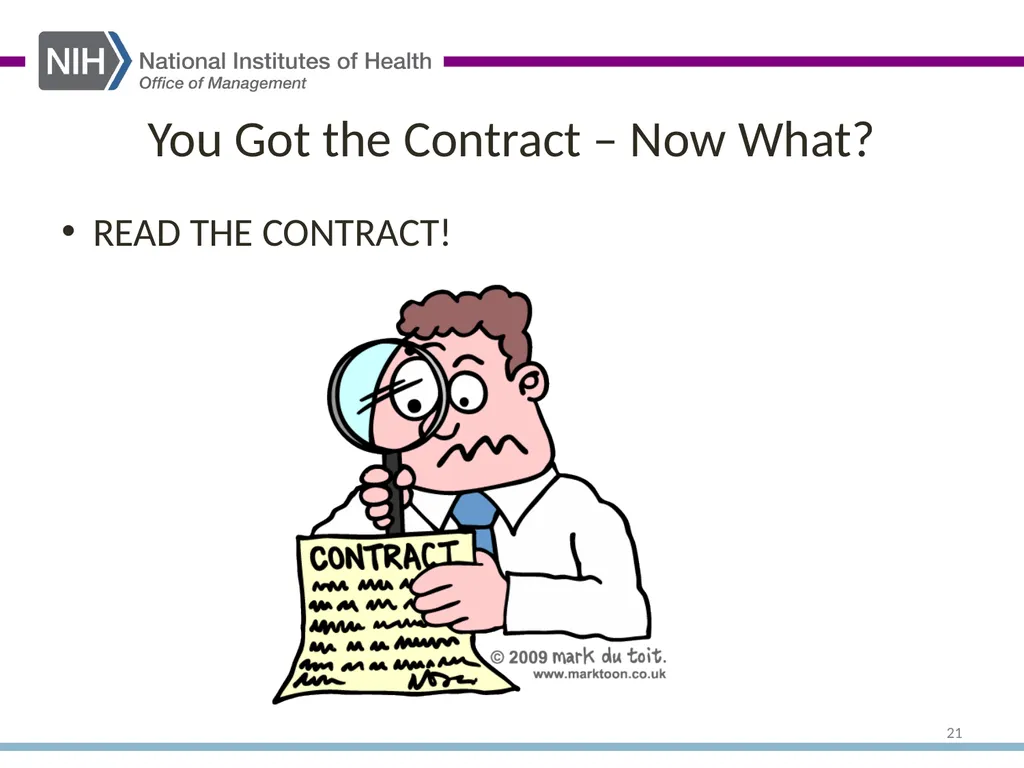
slide21. READ THE CONTRACT! You Got the Contract – Now What? 21<br>
slide22. The mutual obligations of the Government and the Contractor are established by, and limited to, the written stipulations in the contract document.
Unless specifically authorized by the Contracting Officer, the Contractor shall not assume any obligations or take any action not specifically required or authorized by the contract. Obligations and Limitations 22<br>
slide23. Face Page and 4 Parts
Part I The Schedule
Part II Contract Clauses
Part III Attachments
Part IV Representations and Certifications The Contract 23<br>
slide24. Face Page
Contract Number
Funding
The Schedule
Cost/Price
Advance Understandings
The STATEMENT OF WORK
Deliverables
Reports
Clauses As the PI - What is Important to You 24<br>
slide25. The Statement of Work defines the work to be performed under the contract and acts as a framework for what costs are covered under the contract.
The Contractor should be intimately familiar with all details of the Statement of Work
Any changes to the Statement of Work must be approved in writing by the Contracting Officer The Heart of the Contract 25<br>
slide26. For the Government
Contracting Officer
Contract Specialist
Contracting Officer’s Representative
For the Contractor
Official Binding the Organization
Administrator
Principal Investigator The Players 26<br>
slide27. Contracting Officer
The Final Authority
Contract Specialist
The Administrator
The COR
The Technical Expert For the Government 27<br>
slide28. The Binding Official
CEO, Dean, Head of Business Relations
The Administrator
The Day to Day
The PI
The Guru For the Contractor 28<br>
slide29. Technical Reports
Deliverables (Other than Reports)
Program Development Plan
Assay Results
Chemical Products, Drugs, etc.
Meetings and Site Visits
Teleconferences
Audits (Technical and Cost)
Past Performance (CPARS) Contract Performance 29<br>
slide30. Contracts are paid from Invoices
Billing
Fixed Price - Payment upon Completion
Fixed Price – Payments for Deliverables
Fixed Price Progress Payments
Cost Reimbursement – Monthly Invoices
Only Contracting Officer Approves Payment Getting Your Money 30<br>
slide31. All costs that are directly attributed to the performance of work may be billed to the contract. All costs are subject to review by the Government to determine:
Allowability
Allocability
Reasonableness Invoice Review by the Government 31<br>
slide32. The costs must be given consistent treatment through application of those generally accepted accounting principles appropriate to the circumstances.
FAR Part 30 Cost Accounting Standards
FAR Part 31 Cost Principles
Commercial Organizations
Educational, Governments, and Nonprofits - 2 CFR 200 Uniform Guidance
The costs must conform to any limitations or exclusions set forth in the contract.
Advance Understanding
Provisions Applicable to Direct Costs Allowability 32<br>
slide33. The Uniform Guidance provides the uniform cost principles for all Federal grants and cooperative agreements.
Federal Acquisition Regulations (FAR) refer to the uniform guidance to establish appropriate cost principles.
FAR and Appropriations Law restrict certain aspects of the uniform guidance under contracts. Uniform Guidance and Contracts 33<br>
slide34. Costs resulting from performance of the work.
Direct Costs incurred solely in performance of the contract.
Indirect costs that are properly allocated to the contract according to a negotiated agreement. Allocable Costs 34<br>
slide35. A cost that, in its amount and nature, is consistent with what a reasonable person would incur in the conduct of the same business in the same or similar circumstances.
A contractor's actual costs are presumed to be reasonable. Bruce Constr. Corp. v. United States, 163 Ct. C1. 97, 401 (1963); South Georgia Cleaning Svcs., Inc., ASBCA No. 38546, 93-2 BCA 525,800 (1992). Reasonableness of Costs 35<br>
slide36. There are three common reasons why the Government doesn’t pay (or partially pays) an invoice. They are:
Deliverable not Received
Improper Invoice
Questioned costs
When an invoice is only partially paid, the amount not paid is considered “Suspended.” You Didn’t Pay My Invoice 36<br>
slide37. Math Errors
Hours Billed
Billing of Unallowable Costs
Billing of Costs not Allocable
Equipment, particularly Computers and File Cabinets
General Office Supplies
Travel and Conference Costs
Publications Most Common Suspensions 37<br>
slide38. Travel costs under a contract are only allowable when the travel is in direct performance of the contract. 31 USC 1345 states that “except as specifically provided by law, an appropriation may not be used for [non-Federal employee] travel, transportation, and subsistence expenses for a meeting.” What this means is that unless a Contract has to travel in order to accomplish the contract, we cannot pay for that travel. Travel Costs 38<br>
slide39. Communicate, Communicate, Communicate
Keep the Contracting Office in the loop
Plan Ahead
Do Good Work and Succeed Final Thoughts 39<br>
slide40. FedBizOpps: www.fbo.gov
HHS Procurement Forecast: procurementforecast.hhs.gov
NIH Contract Opportunities
https://oamp.od.nih.gov/Contract-Opportunity#ProposalInstructionsForOfferors
Also look at Funding pages for Individual Institutes Opportunities 40<br>
slide41. Federal Acquisition Regulations (FAR):
https://www.acquisition.gov/?q=browsefar
DHHS Acquisition Regulations:
http://www.hhs.gov/grants/contracts/contract-policies-regulations/hhsar/index.html
Peer Review Regulations: 42 CFR 52h
Select Title 42 from Drop Down Box Regulations and Policy 41<br>
slide42. NIH Manual Chapters:
https://oma1.od.nih.gov/manualchapters/scripts/mcs/browse.asp See the 6000 and 7000 Series Chapters
NIH Office of Acquisitions and Logistics Management
OALM: https://oalm.od.nih.gov/ NIH Information 42<br>
Chief, DMID Research Contracts Branch A
National Institute of Allergy and Infectious Diseases
George Kennedy
Lead Contracting Officer, DMID Research Contracts Branch A
National Institute of Allergy and Infectious Diseases<br>
slide2. Contracts at NIH
The Basics of R&D Contracts
The Award Process for Contracts
Where to look for Opportunities
What does the Contract Mean to You? Contents 2<br>
slide3. On the Forefront of Science 3<br>
slide4. Contracting offices are organized to service one or more Institutes 4<br>
slide5. NIH FY 2015 COAC and Delegated Obligations by Procurement Mechanism $4.77B Shows COAC and Delegated obligations by procurement mechanism in total dollars and in percentage of total dollars. BPA Calls include micro-purchases as does P-Card and Simplified Acquisitions (BPA calls, Purchase Orders, and DO/TOs). Data also includes modifications. Dollars are in Millions. 5 Chart 1<br>
slide6. NIH FY 2015 R&D Contract Obligations by COAC $1.14 B Shows R&D Contracts in total dollars and percentage of total dollars for each COAC. Data also includes modifications. ORF and NITAAC = $0. Dollars are in Millions. 6 Chart 2.1<br>
slide7. Contracts vs. Grants 7 CONTRACTS
To acquire goods or services for the direct use or benefit of the government.
Government has a greater degree of control and monitoring.
Governed by large body of statutes, regulations and policies:
Competition in Contracting Act (CICA)
Federal Acquisition Regulations (FAR)
HHS Acquisition Regulations (HHSAR) GRANTS
To provide assistance to accomplish a public purpose.
Less government control than a contract.
Governed by a separate body of law. Overlap: human subjects and animal research; financial conflicts of interest; salary rate limitations; cost principles<br>
slide8. Fixed Price
Used when risk is minimal, or can be predicted with an acceptable degree of certainty.
Examples: Firm-Fixed-Price; Fixed-Price w/ Economic Price Adjustment; Fixed-Price, Incentive
Preferred type; required for Commercial Items, Sealed Bidding
Cost Reimbursement
Used only when requirements cannot be defined sufficiently, or uncertainties do not permit costs to be estimated with sufficient accuracy.
Examples: Cost; Cost-Plus-Fee (Fixed, Incentive, Award); CPFF- Completion; CPFF-Term
Indefinite-Delivery
Used when exact time/exact quantities are not known at time of contract award.
Work is awarded through Delivery/Task Orders
Examples: Definite-Quantity; Indefinite-Quantity; Requirements Types of Contracts (FAR Part 16) 8<br>
slide9. Usually cost type
Payment typically made on a monthly basis
Government may fully fund the contract at award or funding may be divided based upon the government’s requirement.
Deliverables (e.g. monthly & annual reports; small business subcontracting reports; information security).
Contracting Officer & Contracting Officer’s Representative R&D Contracts 9<br>
slide10. Therapeutics against pathogens
Vaccine development (e.g. ebola vaccine)
Animal research support (e.g. animal model development)
Protocol development
Clinical research studies
Reagent development
Clinical data coordination
Biologic specimen repository Examples of NIH R&D Contracts 10<br>
slide11. Where to look: FedBizOpps 11<br>
slide12. Where to look: HHS Procurement Forecast 12<br>
slide13. NIH Contract Opportunities
Individual Institute Websites
Funding Opportunities Pages
Advisory Boards
Councils
Board of Scientific Advisors
Provide Approvals of “Concepts”
Good for Advance Planning
The “About Pages” Where to Look: NIH Institutes 13<br>
slide14. Acquisition Planning & Market Research
Solicitation (RFP and BAA)
Proposal Evaluation
Technical/Peer Review
Cost
Past Performance
Negotiation
Source Selection R&D Contracts – Award Process 14<br>
slide15. Technical proposals reviewed by NIH staff prior to release to peer review committee.
Effect of page limitations (check the solicitation)
75% of peer review group members must not be government employees.
Peer review group does not see business proposal. Proposal Evaluation - Technical 15<br>
slide16. Proposal evaluated based on the technical criteria stated in solicitation.
Examples: Understanding of the Project; Technical Approach; Management Plan; Personnel Qualifications; Facilities
Numerical scores
Peer Review committee
The members of the peer review provide scores/ratings and comments on strengths, weaknesses, deficiencies and technical acceptability.
The written minutes of the review provide the information needed to assess technical capability and points of negotiation. Proposal Evaluation - Technical 16<br>
slide17. For R&D contracts, offerors usually need to provide details on: labor; subcontracts; consultants; travel and other direct costs; fringe benefits; overhead or other indirect costs and profit (where applicable).
COR & CO review the proposed costs and compare it with the IGCE and with other proposals.
Costs must be realistic and reasonable.
Common mistakes: salary rates exceed limitations; profit margins exceed limitations; options not priced; travel costs exceed rate limitations; unallowable costs Proposal Evaluation - Cost 17<br>
slide18. Offerors provide references for similar work.
Government may obtain information from any source (PPIRS; past performance questionnaires).
If there is no relevant past performance available, the offeror may not be evaluated favorably or unfavorably. Past Performance Evaluation 18<br>
slide19. Competitive Range Determination
Negotiations
Government must tell offerors all deficiencies and significant weaknesses in the proposal and adverse past performance information.
Government can also negotiate price.
Offeror has opportunity to revise its proposal. Competitive Range and Negotiations 19<br>
slide20. The Contracting Officer selects awardees based on the Evaluation Factors for Award
Example:
Selection of an offeror for contract award will be based on an evaluation of proposals against three factors. The factors in order of importance are: technical, cost, and past performance. Although technical factors are of paramount consideration in the award of the contract, past performance and cost/price are also important to the overall contract award decision. All evaluation factors other than cost or price, when combined, are significantly more important than cost/price. The Government intends to make an award(s) to that offeror whose proposal provides the best overall value to the Government. Source Selection 20<br>
slide21. READ THE CONTRACT! You Got the Contract – Now What? 21<br>
slide22. The mutual obligations of the Government and the Contractor are established by, and limited to, the written stipulations in the contract document.
Unless specifically authorized by the Contracting Officer, the Contractor shall not assume any obligations or take any action not specifically required or authorized by the contract. Obligations and Limitations 22<br>
slide23. Face Page and 4 Parts
Part I The Schedule
Part II Contract Clauses
Part III Attachments
Part IV Representations and Certifications The Contract 23<br>
slide24. Face Page
Contract Number
Funding
The Schedule
Cost/Price
Advance Understandings
The STATEMENT OF WORK
Deliverables
Reports
Clauses As the PI - What is Important to You 24<br>
slide25. The Statement of Work defines the work to be performed under the contract and acts as a framework for what costs are covered under the contract.
The Contractor should be intimately familiar with all details of the Statement of Work
Any changes to the Statement of Work must be approved in writing by the Contracting Officer The Heart of the Contract 25<br>
slide26. For the Government
Contracting Officer
Contract Specialist
Contracting Officer’s Representative
For the Contractor
Official Binding the Organization
Administrator
Principal Investigator The Players 26<br>
slide27. Contracting Officer
The Final Authority
Contract Specialist
The Administrator
The COR
The Technical Expert For the Government 27<br>
slide28. The Binding Official
CEO, Dean, Head of Business Relations
The Administrator
The Day to Day
The PI
The Guru For the Contractor 28<br>
slide29. Technical Reports
Deliverables (Other than Reports)
Program Development Plan
Assay Results
Chemical Products, Drugs, etc.
Meetings and Site Visits
Teleconferences
Audits (Technical and Cost)
Past Performance (CPARS) Contract Performance 29<br>
slide30. Contracts are paid from Invoices
Billing
Fixed Price - Payment upon Completion
Fixed Price – Payments for Deliverables
Fixed Price Progress Payments
Cost Reimbursement – Monthly Invoices
Only Contracting Officer Approves Payment Getting Your Money 30<br>
slide31. All costs that are directly attributed to the performance of work may be billed to the contract. All costs are subject to review by the Government to determine:
Allowability
Allocability
Reasonableness Invoice Review by the Government 31<br>
slide32. The costs must be given consistent treatment through application of those generally accepted accounting principles appropriate to the circumstances.
FAR Part 30 Cost Accounting Standards
FAR Part 31 Cost Principles
Commercial Organizations
Educational, Governments, and Nonprofits - 2 CFR 200 Uniform Guidance
The costs must conform to any limitations or exclusions set forth in the contract.
Advance Understanding
Provisions Applicable to Direct Costs Allowability 32<br>
slide33. The Uniform Guidance provides the uniform cost principles for all Federal grants and cooperative agreements.
Federal Acquisition Regulations (FAR) refer to the uniform guidance to establish appropriate cost principles.
FAR and Appropriations Law restrict certain aspects of the uniform guidance under contracts. Uniform Guidance and Contracts 33<br>
slide34. Costs resulting from performance of the work.
Direct Costs incurred solely in performance of the contract.
Indirect costs that are properly allocated to the contract according to a negotiated agreement. Allocable Costs 34<br>
slide35. A cost that, in its amount and nature, is consistent with what a reasonable person would incur in the conduct of the same business in the same or similar circumstances.
A contractor's actual costs are presumed to be reasonable. Bruce Constr. Corp. v. United States, 163 Ct. C1. 97, 401 (1963); South Georgia Cleaning Svcs., Inc., ASBCA No. 38546, 93-2 BCA 525,800 (1992). Reasonableness of Costs 35<br>
slide36. There are three common reasons why the Government doesn’t pay (or partially pays) an invoice. They are:
Deliverable not Received
Improper Invoice
Questioned costs
When an invoice is only partially paid, the amount not paid is considered “Suspended.” You Didn’t Pay My Invoice 36<br>
slide37. Math Errors
Hours Billed
Billing of Unallowable Costs
Billing of Costs not Allocable
Equipment, particularly Computers and File Cabinets
General Office Supplies
Travel and Conference Costs
Publications Most Common Suspensions 37<br>
slide38. Travel costs under a contract are only allowable when the travel is in direct performance of the contract. 31 USC 1345 states that “except as specifically provided by law, an appropriation may not be used for [non-Federal employee] travel, transportation, and subsistence expenses for a meeting.” What this means is that unless a Contract has to travel in order to accomplish the contract, we cannot pay for that travel. Travel Costs 38<br>
slide39. Communicate, Communicate, Communicate
Keep the Contracting Office in the loop
Plan Ahead
Do Good Work and Succeed Final Thoughts 39<br>
slide40. FedBizOpps: www.fbo.gov
HHS Procurement Forecast: procurementforecast.hhs.gov
NIH Contract Opportunities
https://oamp.od.nih.gov/Contract-Opportunity#ProposalInstructionsForOfferors
Also look at Funding pages for Individual Institutes Opportunities 40<br>
slide41. Federal Acquisition Regulations (FAR):
https://www.acquisition.gov/?q=browsefar
DHHS Acquisition Regulations:
http://www.hhs.gov/grants/contracts/contract-policies-regulations/hhsar/index.html
Peer Review Regulations: 42 CFR 52h
Select Title 42 from Drop Down Box Regulations and Policy 41<br>
slide42. NIH Manual Chapters:
https://oma1.od.nih.gov/manualchapters/scripts/mcs/browse.asp See the 6000 and 7000 Series Chapters
NIH Office of Acquisitions and Logistics Management
OALM: https://oalm.od.nih.gov/ NIH Information 42<br>