
Research Budget Training Series Team Members:
A
Published · 43 slides · 0 views

1 / 1

Description
Research Budget Training Series Team Members: Allen Dunlow, Director of Finance Renee Chartrand, Milwaukee VAMC Antonio Laracuente, Atlanta VAHCS Erin Olson, St. Louis VAHCS Jamece Petteway, Durham VAHCS Kari Points, Iowa City VAHCS Diana
Related Topics
Share
Embed code
Download this presentation From Below
"Research Budget Training Series Team Members:" is the property of its rightful owner. Permission is granted to download and print the materials on this website for personal, non-commercial use only, and to display it on your personal computer provided you do not modify the materials and that you retain all copyright notices contained in the materials. By downloading content from our website, you accept the terms of this agreement.
Presentation Transcript
01
Research Budget Training Series Team Members:
Allen Dunlow, Director of Finance
Renee Chartrand, Milwaukee VAMC
Antonio Laracuente, Atlanta VAHCS
Erin Olson, St. Louis VAHCS
Jamece Petteway, Durham VAHCS
Kari Points, Iowa City VAHCS
Diana Powers, Charleston VAMC
Tabitha Randall, Salt Lake City VAHCS Feb 18, 2021 – Part 1
A General Overview
February 25, 2021 – Part 2
Allocations and Expenditures Dial in (Main): (404) 397-1596: (496
Attendee Access Code: 199-433-2439
Slides available on SharePoint:
See link in Q&A<br>
Allen Dunlow, Director of Finance
Renee Chartrand, Milwaukee VAMC
Antonio Laracuente, Atlanta VAHCS
Erin Olson, St. Louis VAHCS
Jamece Petteway, Durham VAHCS
Kari Points, Iowa City VAHCS
Diana Powers, Charleston VAMC
Tabitha Randall, Salt Lake City VAHCS Feb 18, 2021 – Part 1
A General Overview
February 25, 2021 – Part 2
Allocations and Expenditures Dial in (Main): (404) 397-1596: (496
Attendee Access Code: 199-433-2439
Slides available on SharePoint:
See link in Q&A<br>
02
Research Budget Training – Session 1 Feb 18, 2021
Allen Dunlow
Antonio Laracuente
Kari Points A General Overview<br>
Allen Dunlow
Antonio Laracuente
Kari Points A General Overview<br>
03
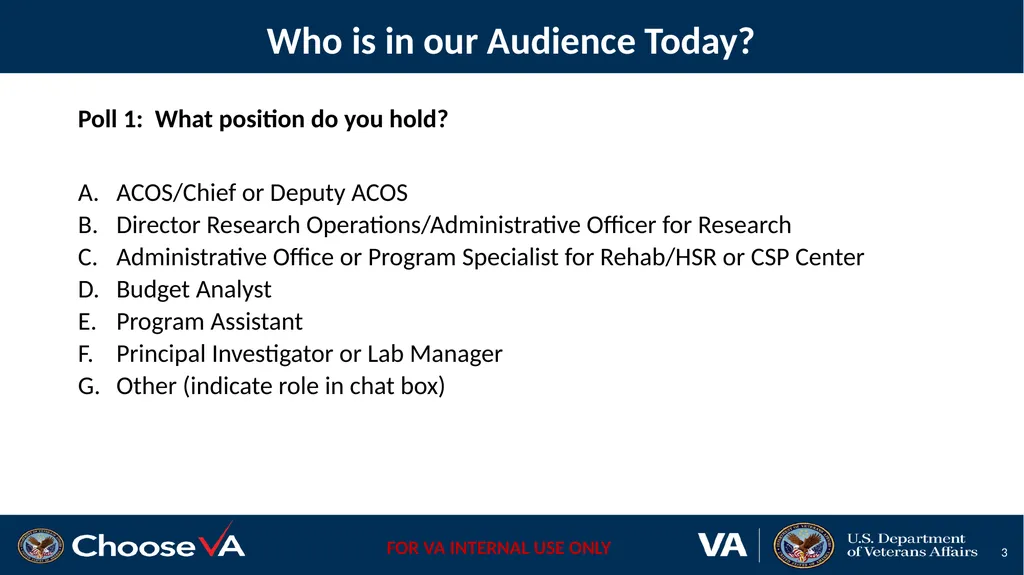
Who is in our Audience Today? Poll 1: What position do you hold?
ACOS/Chief or Deputy ACOS
Director Research Operations/Administrative Officer for Research
Administrative Office or Program Specialist for Rehab/HSR or CSP Center
Budget Analyst
Program Assistant
Principal Investigator or Lab Manager
Other (indicate role in chat box) 3<br>
ACOS/Chief or Deputy ACOS
Director Research Operations/Administrative Officer for Research
Administrative Office or Program Specialist for Rehab/HSR or CSP Center
Budget Analyst
Program Assistant
Principal Investigator or Lab Manager
Other (indicate role in chat box) 3<br>
04
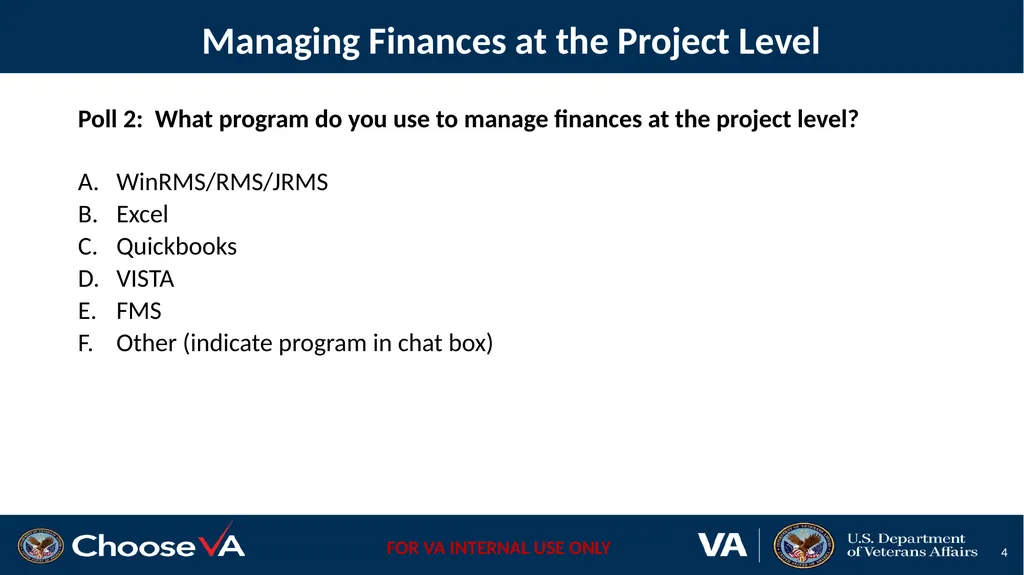
Managing Finances at the Project Level Poll 2: What program do you use to manage finances at the project level?
WinRMS/RMS/JRMS
Excel
Quickbooks
VISTA
FMS
Other (indicate program in chat box) 4<br>
WinRMS/RMS/JRMS
Excel
Quickbooks
VISTA
FMS
Other (indicate program in chat box) 4<br>
05
Commitment to the Enterprise Over the years, ORD has allowed each station to independently manage the budgets allocated to facilities. Recent rescissions in appropriations have made ORD relook at how things operate. One major factor to consider is how effective management of funding at the local facility impacts the overall appropriation.
We need a culture change: “SPEND the MONEY you GET in the Year you get it!”<br>
We need a culture change: “SPEND the MONEY you GET in the Year you get it!”<br>
06
How do we go about this Notify investigators that Carryover is no longer acceptable – money is expended in the year allocated (think 1 year money)
Work closely with investigators and if spending execution is not occurring, then contact the ORD/Service project officer to determine solutions (PMO)
Plan ahead and send money back before the end of Q3
Utilize existing financial software and tools to manage budgets
Understand the money cycle and who is responsible
Accountability – Research Offices will be held to a higher standard effective FY 21
Read the Dunlow notifications carefully<br>
Work closely with investigators and if spending execution is not occurring, then contact the ORD/Service project officer to determine solutions (PMO)
Plan ahead and send money back before the end of Q3
Utilize existing financial software and tools to manage budgets
Understand the money cycle and who is responsible
Accountability – Research Offices will be held to a higher standard effective FY 21
Read the Dunlow notifications carefully<br>
07
The Money Cycle Responsibilities ORD will hold the Research Offices accountable for execution.
Research Offices should work closely with the investigators and Center administrative staff to ensure execution.
Centers need to notify Research Office staff when additional funding is requested or offered by ORD Services prior to accepting funds.
Research Office needs to determine how additional funding impacts carryover.
Review project start dates to ensure that execution can occur.
Do not accept funding until investigator is on board or has on-board date<br>
Research Offices should work closely with the investigators and Center administrative staff to ensure execution.
Centers need to notify Research Office staff when additional funding is requested or offered by ORD Services prior to accepting funds.
Research Office needs to determine how additional funding impacts carryover.
Review project start dates to ensure that execution can occur.
Do not accept funding until investigator is on board or has on-board date<br>
08
Additional Reporting Starting Soon RAFT has been utilized by the field as an informational tool
Effective this year, expenditure execution field will be incorporated into RAFT
Each quarter cumulative FY expenditures will be reported into RAFT
This will be on lump sum per project – only CY funds reported
ORD will review to determine if projects are under executing and may request additional information
Research Offices will be the POC for these discussions.<br>
Effective this year, expenditure execution field will be incorporated into RAFT
Each quarter cumulative FY expenditures will be reported into RAFT
This will be on lump sum per project – only CY funds reported
ORD will review to determine if projects are under executing and may request additional information
Research Offices will be the POC for these discussions.<br>
09
ORD “Dunlow Notifications” Cannot stress enough that these need to be read and shared
PY management
CY management
Preparing for end of year
Contracting
Interagency Agreements
These are all critical and will become much more so as VA moves to a new financial management system.
ORD Budget Mailgroup – Have budget analyst or techs added
Ask Questions<br>
PY management
CY management
Preparing for end of year
Contracting
Interagency Agreements
These are all critical and will become much more so as VA moves to a new financial management system.
ORD Budget Mailgroup – Have budget analyst or techs added
Ask Questions<br>
10
Today and Next Week’s presentation General information regarding the Research Appropriation
Focus on 3 major areas
Allocation
Expenditures
Reimbursables
Each section will provide tools to use in management and where to get these tools
We will touch on WINRMS but will look at more in-depth training into how to use it at a later date<br>
Focus on 3 major areas
Allocation
Expenditures
Reimbursables
Each section will provide tools to use in management and where to get these tools
We will touch on WINRMS but will look at more in-depth training into how to use it at a later date<br>
11
General information Dunlow slides Allen Dunlow
Director Finance
Office of Research and Development (ORD)(14RD)<br>
Director Finance
Office of Research and Development (ORD)(14RD)<br>
12
Expectations of the field Honesty and Integrity: Once you lose that relationship, it is very hard to re-establish
I expect you to know the basics of fiscal law and act accordingly. Know Purpose, Time, and Amount (PTA); You have dollars given to you for a specific purpose to be obligated during a particular time not to exceed a certain amount.
Return money in a timely manner
I try to have open communications with the field. I will attempt to answer your questions as quickly as I can. When I ask for information, I expect a response.
I have tried to foster a closer relationship with your VISN CFOs. I understand the dynamics of working with over 100 different fiscal offices and officers. I will try to give you information and guidance to help you in this relationship. Bottom line however is that your local CFO will dictate various interpretations of policy and regulation. I encourage you to build a trusting and supportive relationship with this individual.
No matter what I say today, I try to never forget you folks must implement – you are where the rubber meets the road<br>
I expect you to know the basics of fiscal law and act accordingly. Know Purpose, Time, and Amount (PTA); You have dollars given to you for a specific purpose to be obligated during a particular time not to exceed a certain amount.
Return money in a timely manner
I try to have open communications with the field. I will attempt to answer your questions as quickly as I can. When I ask for information, I expect a response.
I have tried to foster a closer relationship with your VISN CFOs. I understand the dynamics of working with over 100 different fiscal offices and officers. I will try to give you information and guidance to help you in this relationship. Bottom line however is that your local CFO will dictate various interpretations of policy and regulation. I encourage you to build a trusting and supportive relationship with this individual.
No matter what I say today, I try to never forget you folks must implement – you are where the rubber meets the road<br>
13
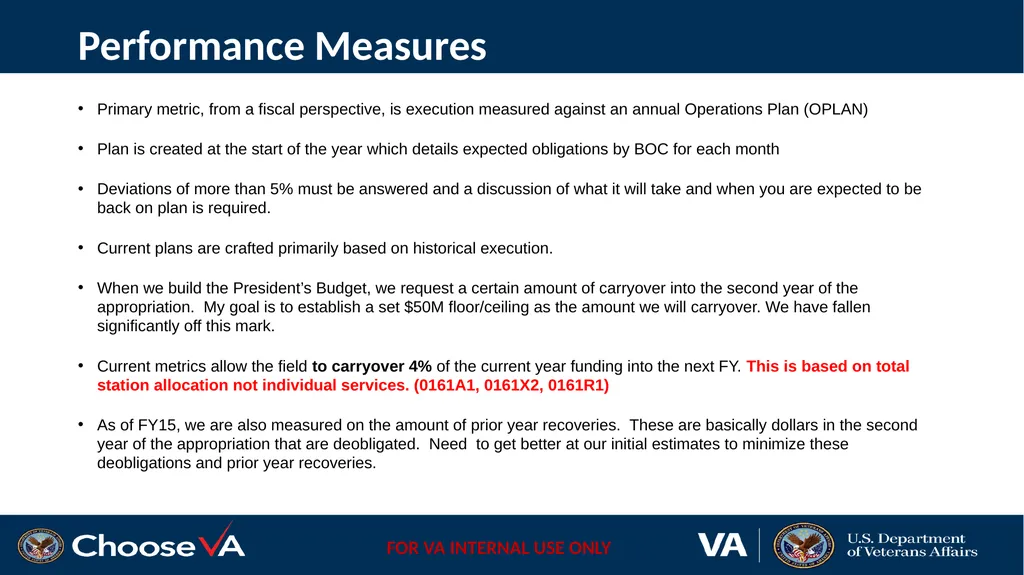
Performance Measures Primary metric, from a fiscal perspective, is execution measured against an annual Operations Plan (OPLAN)
Plan is created at the start of the year which details expected obligations by BOC for each month
Deviations of more than 5% must be answered and a discussion of what it will take and when you are expected to be back on plan is required.
Current plans are crafted primarily based on historical execution.
When we build the President’s Budget, we request a certain amount of carryover into the second year of the appropriation. My goal is to establish a set $50M floor/ceiling as the amount we will carryover. We have fallen significantly off this mark.
Current metrics allow the field to carryover 4% of the current year funding into the next FY. This is based on total station allocation not individual services. (0161A1, 0161X2, 0161R1)
As of FY15, we are also measured on the amount of prior year recoveries. These are basically dollars in the second year of the appropriation that are deobligated. Need to get better at our initial estimates to minimize these deobligations and prior year recoveries.<br>
Plan is created at the start of the year which details expected obligations by BOC for each month
Deviations of more than 5% must be answered and a discussion of what it will take and when you are expected to be back on plan is required.
Current plans are crafted primarily based on historical execution.
When we build the President’s Budget, we request a certain amount of carryover into the second year of the appropriation. My goal is to establish a set $50M floor/ceiling as the amount we will carryover. We have fallen significantly off this mark.
Current metrics allow the field to carryover 4% of the current year funding into the next FY. This is based on total station allocation not individual services. (0161A1, 0161X2, 0161R1)
As of FY15, we are also measured on the amount of prior year recoveries. These are basically dollars in the second year of the appropriation that are deobligated. Need to get better at our initial estimates to minimize these deobligations and prior year recoveries.<br>
14
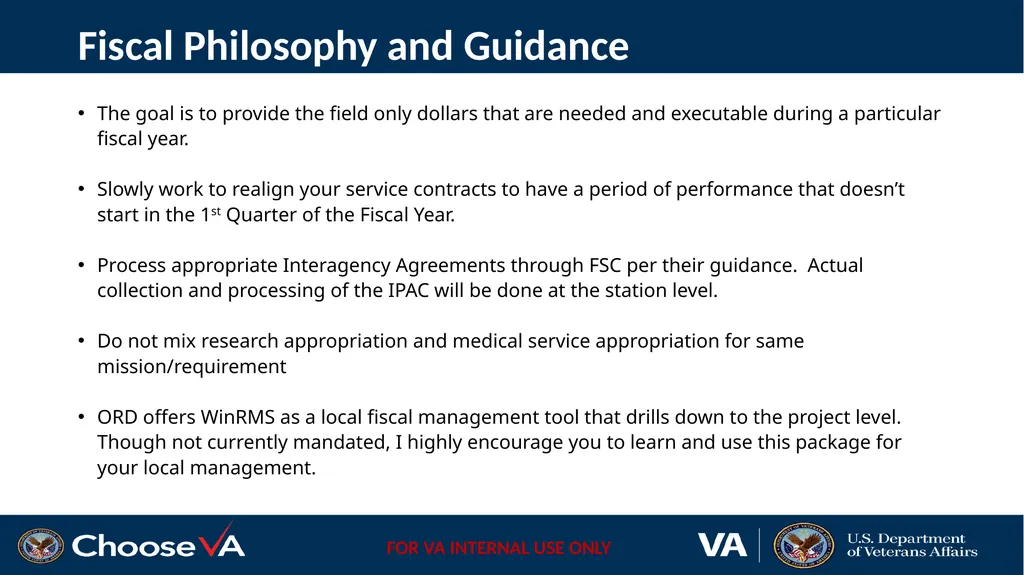
Fiscal Philosophy and Guidance The goal is to provide the field only dollars that are needed and executable during a particular fiscal year.
Slowly work to realign your service contracts to have a period of performance that doesn’t start in the 1st Quarter of the Fiscal Year.
Process appropriate Interagency Agreements through FSC per their guidance. Actual collection and processing of the IPAC will be done at the station level.
Do not mix research appropriation and medical service appropriation for same mission/requirement
ORD offers WinRMS as a local fiscal management tool that drills down to the project level. Though not currently mandated, I highly encourage you to learn and use this package for your local management.<br>
Slowly work to realign your service contracts to have a period of performance that doesn’t start in the 1st Quarter of the Fiscal Year.
Process appropriate Interagency Agreements through FSC per their guidance. Actual collection and processing of the IPAC will be done at the station level.
Do not mix research appropriation and medical service appropriation for same mission/requirement
ORD offers WinRMS as a local fiscal management tool that drills down to the project level. Though not currently mandated, I highly encourage you to learn and use this package for your local management.<br>
15
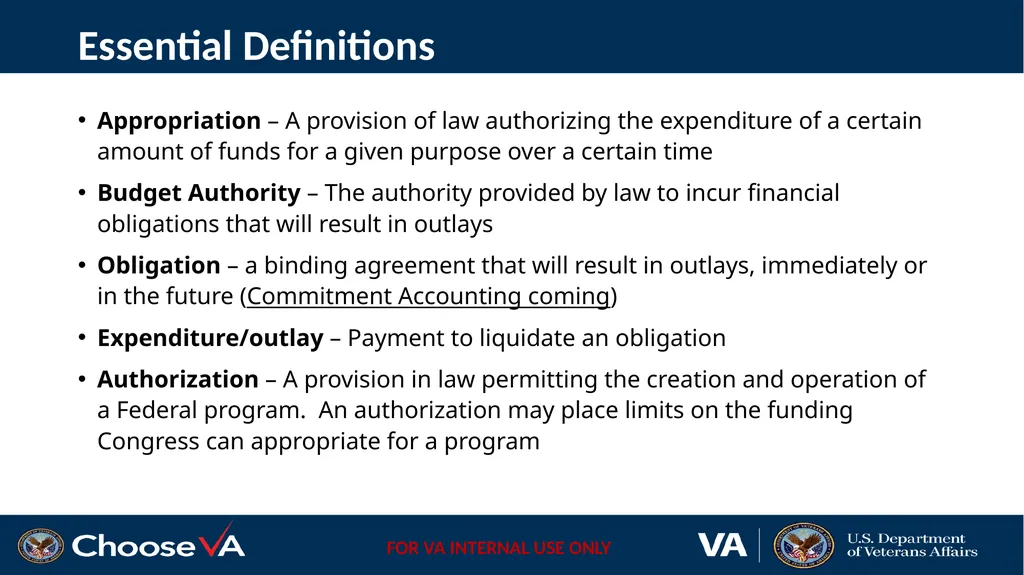
Essential Definitions Appropriation – A provision of law authorizing the expenditure of a certain amount of funds for a given purpose over a certain time
Budget Authority – The authority provided by law to incur financial obligations that will result in outlays
Obligation – a binding agreement that will result in outlays, immediately or in the future (Commitment Accounting coming)
Expenditure/outlay – Payment to liquidate an obligation
Authorization – A provision in law permitting the creation and operation of a Federal program. An authorization may place limits on the funding Congress can appropriate for a program<br>
Budget Authority – The authority provided by law to incur financial obligations that will result in outlays
Obligation – a binding agreement that will result in outlays, immediately or in the future (Commitment Accounting coming)
Expenditure/outlay – Payment to liquidate an obligation
Authorization – A provision in law permitting the creation and operation of a Federal program. An authorization may place limits on the funding Congress can appropriate for a program<br>
16
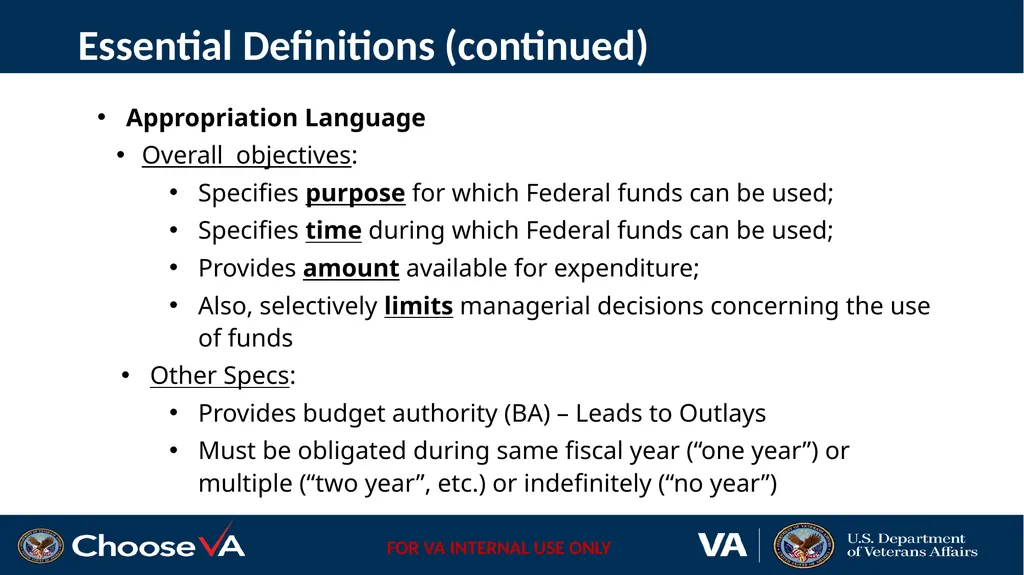
Essential Definitions (continued) Appropriation Language
Overall objectives:
Specifies purpose for which Federal funds can be used;
Specifies time during which Federal funds can be used;
Provides amount available for expenditure;
Also, selectively limits managerial decisions concerning the use of funds
Other Specs:
Provides budget authority (BA) – Leads to Outlays
Must be obligated during same fiscal year (“one year”) or multiple (“two year”, etc.) or indefinitely (“no year”)<br>
Overall objectives:
Specifies purpose for which Federal funds can be used;
Specifies time during which Federal funds can be used;
Provides amount available for expenditure;
Also, selectively limits managerial decisions concerning the use of funds
Other Specs:
Provides budget authority (BA) – Leads to Outlays
Must be obligated during same fiscal year (“one year”) or multiple (“two year”, etc.) or indefinitely (“no year”)<br>
17
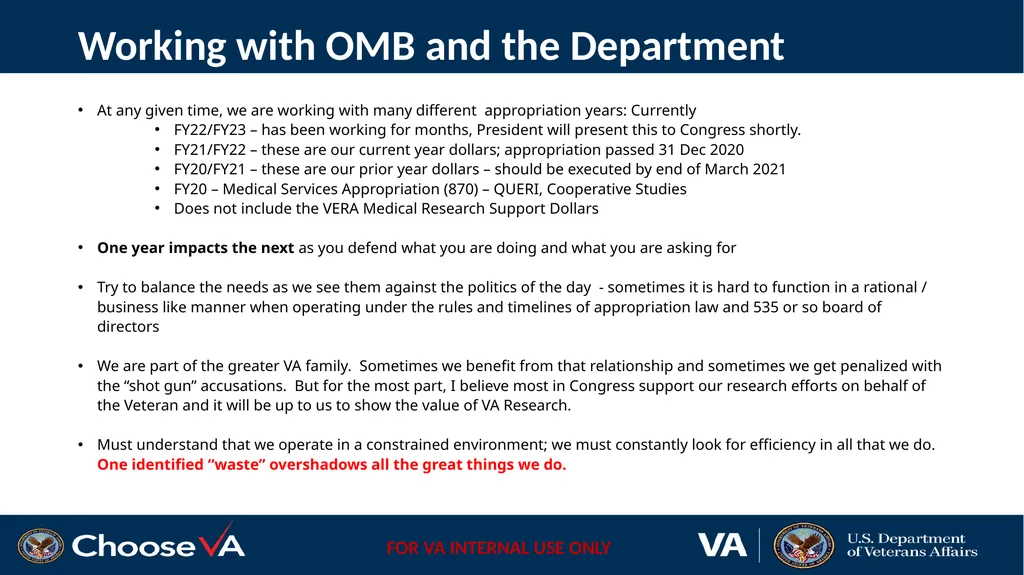
Working with OMB and the Department At any given time, we are working with many different appropriation years: Currently
FY22/FY23 – has been working for months, President will present this to Congress shortly.
FY21/FY22 – these are our current year dollars; appropriation passed 31 Dec 2020
FY20/FY21 – these are our prior year dollars – should be executed by end of March 2021
FY20 – Medical Services Appropriation (870) – QUERI, Cooperative Studies
Does not include the VERA Medical Research Support Dollars
One year impacts the next as you defend what you are doing and what you are asking for
Try to balance the needs as we see them against the politics of the day - sometimes it is hard to function in a rational / business like manner when operating under the rules and timelines of appropriation law and 535 or so board of directors
We are part of the greater VA family. Sometimes we benefit from that relationship and sometimes we get penalized with the “shot gun” accusations. But for the most part, I believe most in Congress support our research efforts on behalf of the Veteran and it will be up to us to show the value of VA Research.
Must understand that we operate in a constrained environment; we must constantly look for efficiency in all that we do. One identified “waste” overshadows all the great things we do.<br>
FY22/FY23 – has been working for months, President will present this to Congress shortly.
FY21/FY22 – these are our current year dollars; appropriation passed 31 Dec 2020
FY20/FY21 – these are our prior year dollars – should be executed by end of March 2021
FY20 – Medical Services Appropriation (870) – QUERI, Cooperative Studies
Does not include the VERA Medical Research Support Dollars
One year impacts the next as you defend what you are doing and what you are asking for
Try to balance the needs as we see them against the politics of the day - sometimes it is hard to function in a rational / business like manner when operating under the rules and timelines of appropriation law and 535 or so board of directors
We are part of the greater VA family. Sometimes we benefit from that relationship and sometimes we get penalized with the “shot gun” accusations. But for the most part, I believe most in Congress support our research efforts on behalf of the Veteran and it will be up to us to show the value of VA Research.
Must understand that we operate in a constrained environment; we must constantly look for efficiency in all that we do. One identified “waste” overshadows all the great things we do.<br>
18
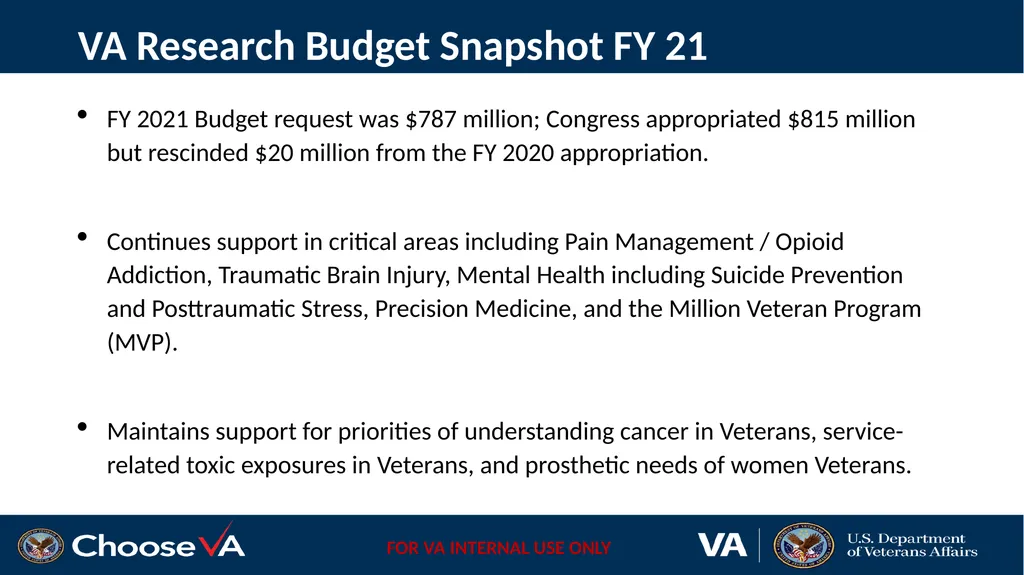
VA Research Budget Snapshot FY 21 FY 2021 Budget request was $787 million; Congress appropriated $815 million but rescinded $20 million from the FY 2020 appropriation.
Continues support in critical areas including Pain Management / Opioid Addiction, Traumatic Brain Injury, Mental Health including Suicide Prevention and Posttraumatic Stress, Precision Medicine, and the Million Veteran Program (MVP).
Maintains support for priorities of understanding cancer in Veterans, service-related toxic exposures in Veterans, and prosthetic needs of women Veterans.<br>
Continues support in critical areas including Pain Management / Opioid Addiction, Traumatic Brain Injury, Mental Health including Suicide Prevention and Posttraumatic Stress, Precision Medicine, and the Million Veteran Program (MVP).
Maintains support for priorities of understanding cancer in Veterans, service-related toxic exposures in Veterans, and prosthetic needs of women Veterans.<br>
19
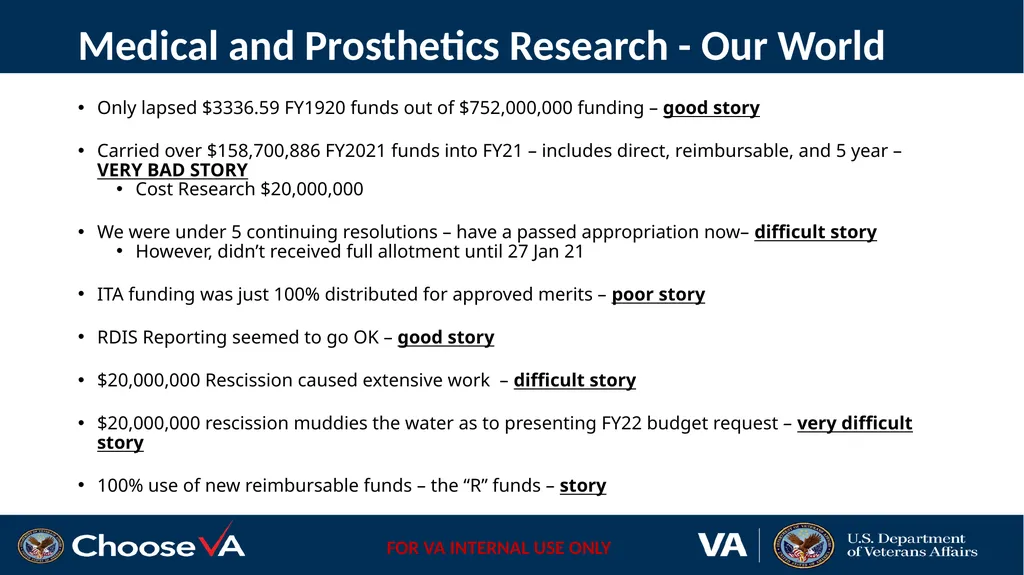
Medical and Prosthetics Research - Our World Only lapsed $3336.59 FY1920 funds out of $752,000,000 funding – good story
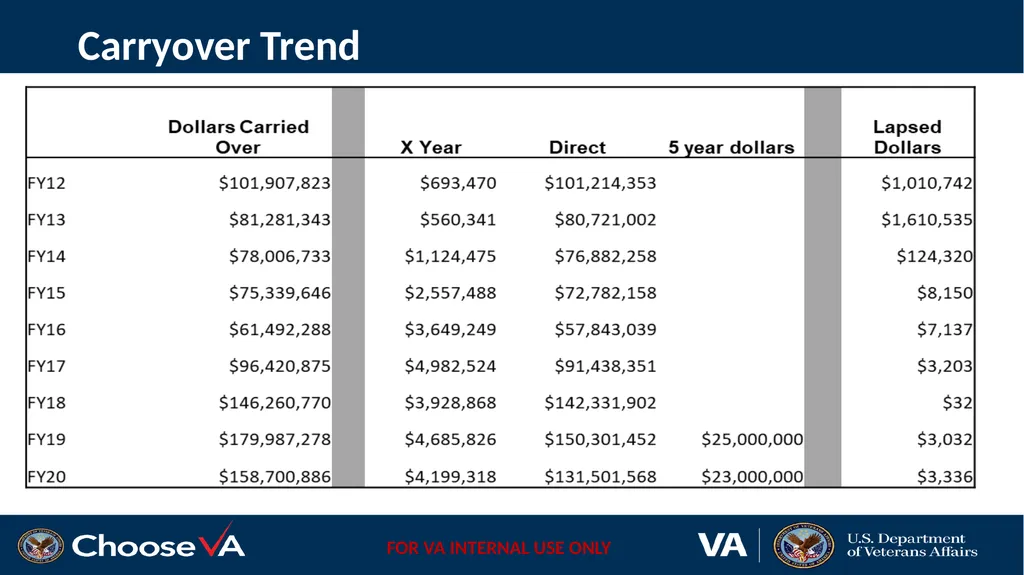
Carried over $158,700,886 FY2021 funds into FY21 – includes direct, reimbursable, and 5 year – VERY BAD STORY
Cost Research $20,000,000
We were under 5 continuing resolutions – have a passed appropriation now– difficult story
However, didn’t received full allotment until 27 Jan 21
ITA funding was just 100% distributed for approved merits – poor story
RDIS Reporting seemed to go OK – good story
$20,000,000 Rescission caused extensive work – difficult story
$20,000,000 rescission muddies the water as to presenting FY22 budget request – very difficult story
100% use of new reimbursable funds – the “R” funds – story<br>
Carried over $158,700,886 FY2021 funds into FY21 – includes direct, reimbursable, and 5 year – VERY BAD STORY
Cost Research $20,000,000
We were under 5 continuing resolutions – have a passed appropriation now– difficult story
However, didn’t received full allotment until 27 Jan 21
ITA funding was just 100% distributed for approved merits – poor story
RDIS Reporting seemed to go OK – good story
$20,000,000 Rescission caused extensive work – difficult story
$20,000,000 rescission muddies the water as to presenting FY22 budget request – very difficult story
100% use of new reimbursable funds – the “R” funds – story<br>
20
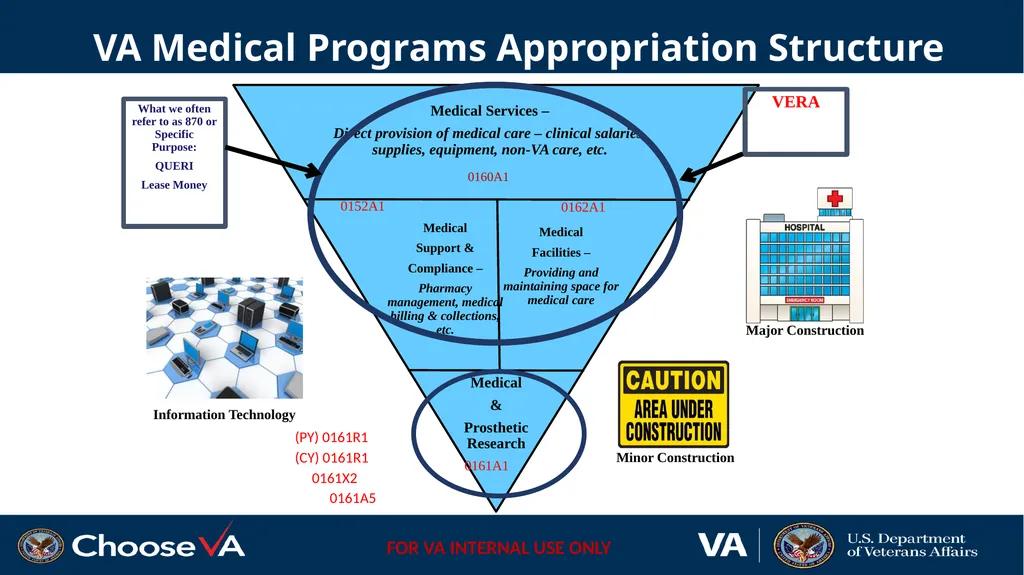
VA Medical Programs Appropriation Structure<br>
21
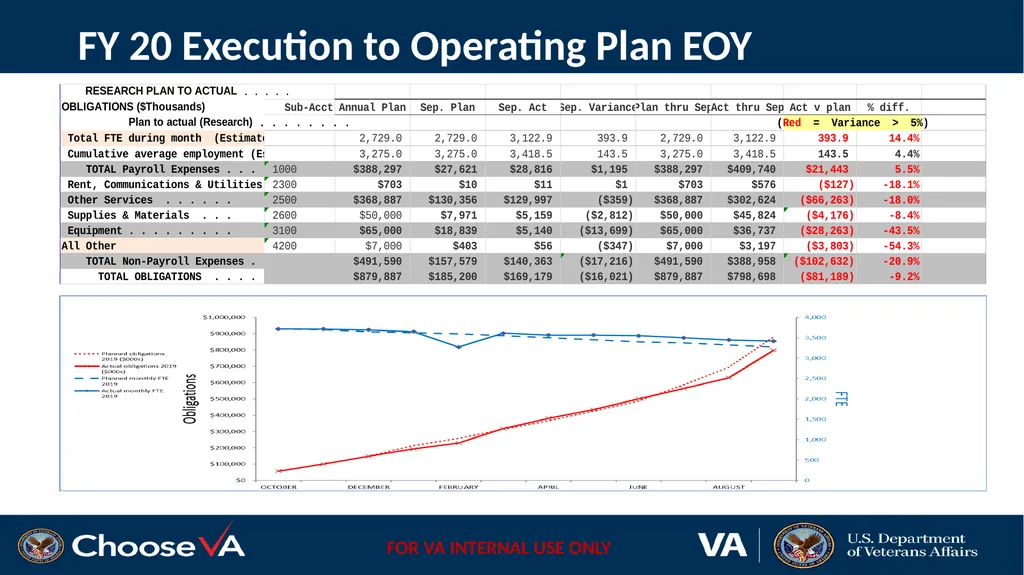
FY 20 Execution to Operating Plan EOY<br>
22
Carryover Trend<br>
23
What is the impact of the rescission? A rescission is basically a Congressional action to take back dollars that have been previously appropriated
Congress is always looking for bill payers – if they determine you aren’t spending dollars you are prime to be a bill payer
Between the two rescissions - a loss of $70,000,000 buying power to invest in VA Research
Significant disruption to our operations
Central Office requiring current year dollars to pay many mandated enterprise-wide bills<br>
Congress is always looking for bill payers – if they determine you aren’t spending dollars you are prime to be a bill payer
Between the two rescissions - a loss of $70,000,000 buying power to invest in VA Research
Significant disruption to our operations
Central Office requiring current year dollars to pay many mandated enterprise-wide bills<br>
24
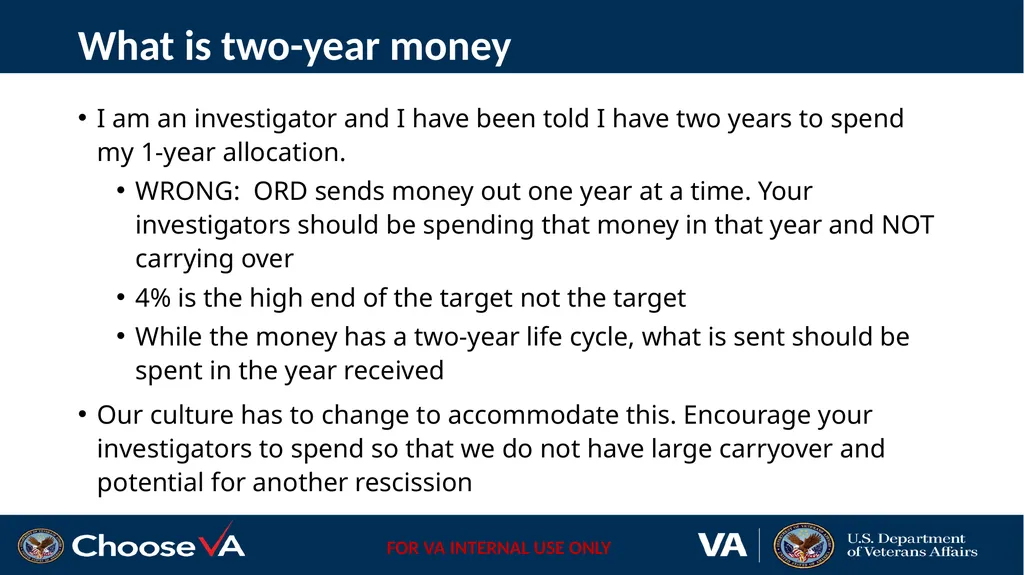
What is two-year money I am an investigator and I have been told I have two years to spend my 1-year allocation.
WRONG: ORD sends money out one year at a time. Your investigators should be spending that money in that year and NOT carrying over
4% is the high end of the target not the target
While the money has a two-year life cycle, what is sent should be spent in the year received
Our culture has to change to accommodate this. Encourage your investigators to spend so that we do not have large carryover and potential for another rescission<br>
WRONG: ORD sends money out one year at a time. Your investigators should be spending that money in that year and NOT carrying over
4% is the high end of the target not the target
While the money has a two-year life cycle, what is sent should be spent in the year received
Our culture has to change to accommodate this. Encourage your investigators to spend so that we do not have large carryover and potential for another rescission<br>
25
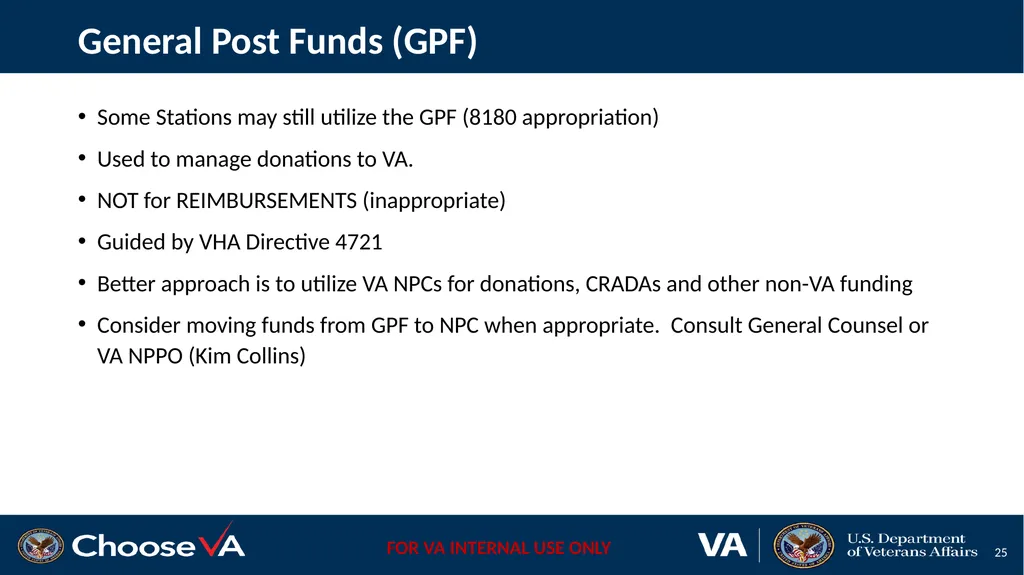
General Post Funds (GPF) Some Stations may still utilize the GPF (8180 appropriation)
Used to manage donations to VA.
NOT for REIMBURSEMENTS (inappropriate)
Guided by VHA Directive 4721
Better approach is to utilize VA NPCs for donations, CRADAs and other non-VA funding
Consider moving funds from GPF to NPC when appropriate. Consult General Counsel or VA NPPO (Kim Collins) 25<br>
Used to manage donations to VA.
NOT for REIMBURSEMENTS (inappropriate)
Guided by VHA Directive 4721
Better approach is to utilize VA NPCs for donations, CRADAs and other non-VA funding
Consider moving funds from GPF to NPC when appropriate. Consult General Counsel or VA NPPO (Kim Collins) 25<br>
26
The Research Office Dunlow slides Kari Points, MHA, MBA
Director Research Operations
Iowa City VAHCS<br>
Director Research Operations
Iowa City VAHCS<br>
27
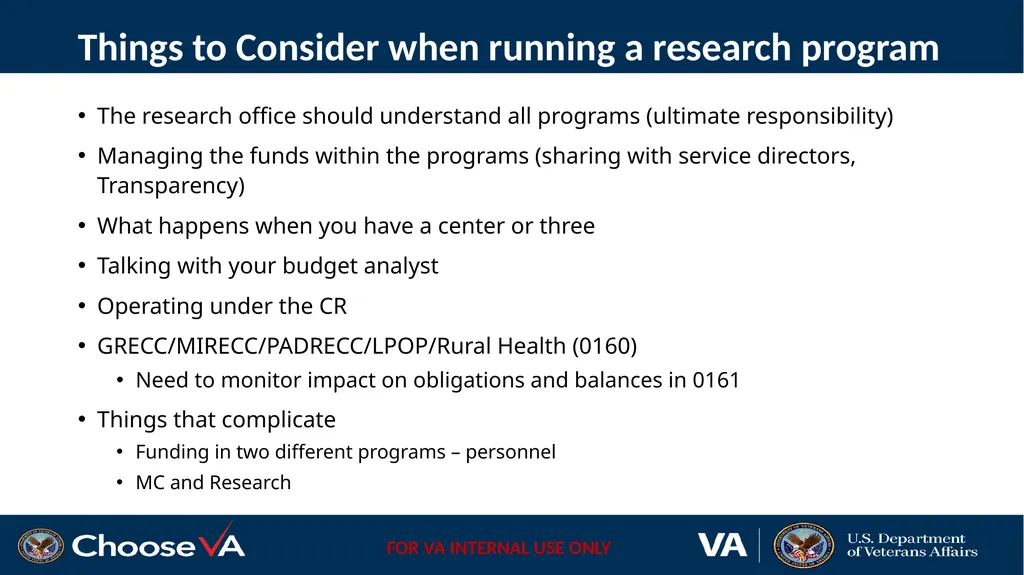
Things to Consider when running a research program The research office should understand all programs (ultimate responsibility)
Managing the funds within the programs (sharing with service directors, Transparency)
What happens when you have a center or three
Talking with your budget analyst
Operating under the CR
GRECC/MIRECC/PADRECC/LPOP/Rural Health (0160)
Need to monitor impact on obligations and balances in 0161
Things that complicate
Funding in two different programs – personnel
MC and Research<br>
Managing the funds within the programs (sharing with service directors, Transparency)
What happens when you have a center or three
Talking with your budget analyst
Operating under the CR
GRECC/MIRECC/PADRECC/LPOP/Rural Health (0160)
Need to monitor impact on obligations and balances in 0161
Things that complicate
Funding in two different programs – personnel
MC and Research<br>
28
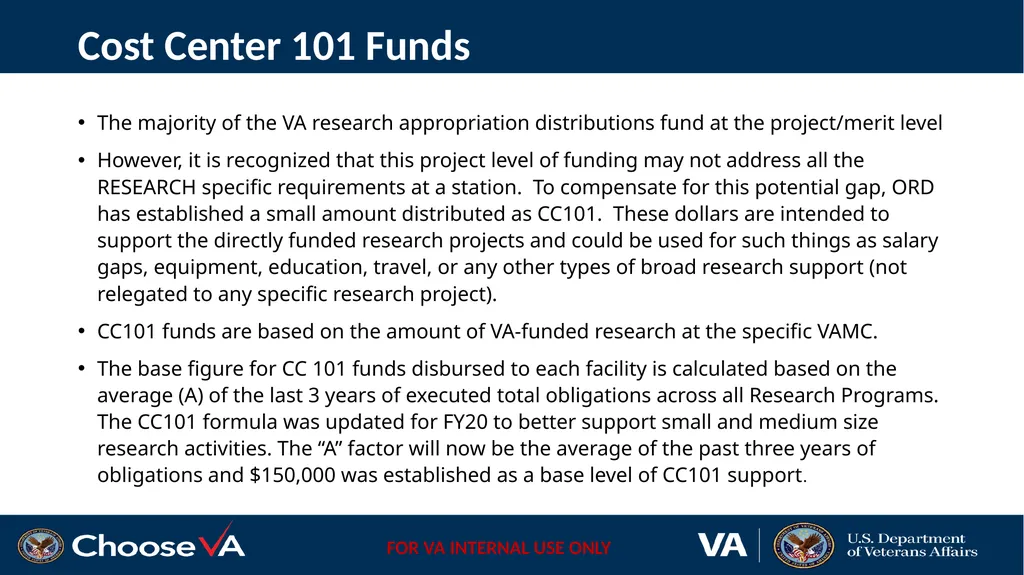
Cost Center 101 Funds The majority of the VA research appropriation distributions fund at the project/merit level
However, it is recognized that this project level of funding may not address all the RESEARCH specific requirements at a station. To compensate for this potential gap, ORD has established a small amount distributed as CC101. These dollars are intended to support the directly funded research projects and could be used for such things as salary gaps, equipment, education, travel, or any other types of broad research support (not relegated to any specific research project).
CC101 funds are based on the amount of VA-funded research at the specific VAMC.
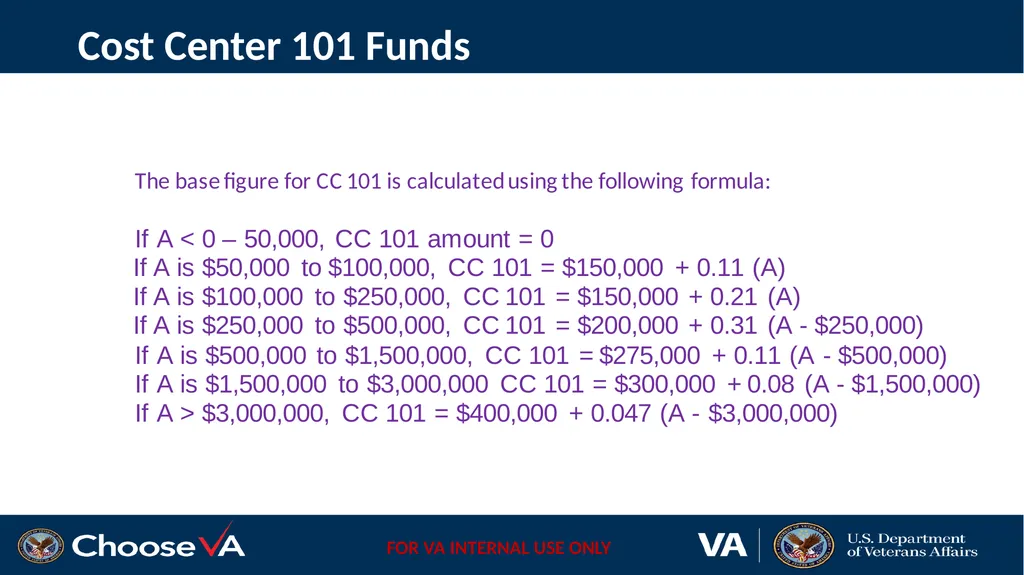
The base figure for CC 101 funds disbursed to each facility is calculated based on the average (A) of the last 3 years of executed total obligations across all Research Programs. The CC101 formula was updated for FY20 to better support small and medium size research activities. The “A” factor will now be the average of the past three years of obligations and $150,000 was established as a base level of CC101 support.<br>
However, it is recognized that this project level of funding may not address all the RESEARCH specific requirements at a station. To compensate for this potential gap, ORD has established a small amount distributed as CC101. These dollars are intended to support the directly funded research projects and could be used for such things as salary gaps, equipment, education, travel, or any other types of broad research support (not relegated to any specific research project).
CC101 funds are based on the amount of VA-funded research at the specific VAMC.
The base figure for CC 101 funds disbursed to each facility is calculated based on the average (A) of the last 3 years of executed total obligations across all Research Programs. The CC101 formula was updated for FY20 to better support small and medium size research activities. The “A” factor will now be the average of the past three years of obligations and $150,000 was established as a base level of CC101 support.<br>
29
Cost Center 101 Funds<br>
30
RDIS and VERA Funds As part of the Research & Development Information System (RDIS) annual report, each VA facility with Research & Development activity is required to report to ORD funding that supported each Research & Development Committee (R&DC) approved research at their facility.
VA Funded - confirm Allocations
Non-VA funded – provide expenditures or Allocation (NOA)
The RDIS Annual Report is submitted through the ePromise system. ePROMISe manages data for VA-funded, non-VA funded and non-funded research projects that are reviewed and approved by the R&DC.
Throughout the year, you should be updating your R&D Committee approved projects in ePromise to ensure accurate expenditure reporting of all funded awards deemed VA research. By entering the projects throughout the year, you will avoid end of year panic to have them entered by Sept 30th.<br>
VA Funded - confirm Allocations
Non-VA funded – provide expenditures or Allocation (NOA)
The RDIS Annual Report is submitted through the ePromise system. ePROMISe manages data for VA-funded, non-VA funded and non-funded research projects that are reviewed and approved by the R&DC.
Throughout the year, you should be updating your R&D Committee approved projects in ePromise to ensure accurate expenditure reporting of all funded awards deemed VA research. By entering the projects throughout the year, you will avoid end of year panic to have them entered by Sept 30th.<br>
31
RDIS and VERA Funds (cont). Accurate RDIS reporting by the facility Research Office for each project in ePROMISe is essential to ensuring an appropriate VERA research support allocation.
VERA dollars are allocated annually to VA medical centers and hospitals to support their operations, including medical and personnel expenditures. This is 0160 Funds. This is NOT 0161A1 Research funds.
The total amount of Research VERA dollars available for distribution each year is fixed in the President’s Budget. To determine each VAMC’s share, the quantity of their research allocations (VA) and expenditures (non-VA) is tabulated through the RDIS report.<br>
VERA dollars are allocated annually to VA medical centers and hospitals to support their operations, including medical and personnel expenditures. This is 0160 Funds. This is NOT 0161A1 Research funds.
The total amount of Research VERA dollars available for distribution each year is fixed in the President’s Budget. To determine each VAMC’s share, the quantity of their research allocations (VA) and expenditures (non-VA) is tabulated through the RDIS report.<br>
32
Deadlines Pay attention to deadlines that are sent out throughout the fiscal year. These may be sent by Allen Dunlow and/or your Fiscal or Contracting Office.
Credit Card Transactions
1358 and 2237 transactions
Contract Deadlines
Reimbursements
Prior Year Funds Expended
Cost Transfers
Inter Agency Agreements (IAA)<br>
Credit Card Transactions
1358 and 2237 transactions
Contract Deadlines
Reimbursements
Prior Year Funds Expended
Cost Transfers
Inter Agency Agreements (IAA)<br>
33
Cost Transfers It is important to do cost transfers throughout the fiscal year. Some facilities have gotten into a habit of doing them all at the end of the year.
ORD is unable to do expenditure projections throughout the year if you wait and do a large one-time transfer at end of year. It impacts the execution of the appropriation.
Prior Year funds should be expended by March 31st each year. Do not wait until end of September to do one cost transfer to close out prior year funds.
Cost transfers may not be just between prior year and current year funds. They may include transferring costs between the Medical Center and Research appropriations, 0161R1 and 0161X2 funds, 870 funds, or across programs within the 0161A1 fund. These all should be completed throughout the year.<br>
ORD is unable to do expenditure projections throughout the year if you wait and do a large one-time transfer at end of year. It impacts the execution of the appropriation.
Prior Year funds should be expended by March 31st each year. Do not wait until end of September to do one cost transfer to close out prior year funds.
Cost transfers may not be just between prior year and current year funds. They may include transferring costs between the Medical Center and Research appropriations, 0161R1 and 0161X2 funds, 870 funds, or across programs within the 0161A1 fund. These all should be completed throughout the year.<br>
34
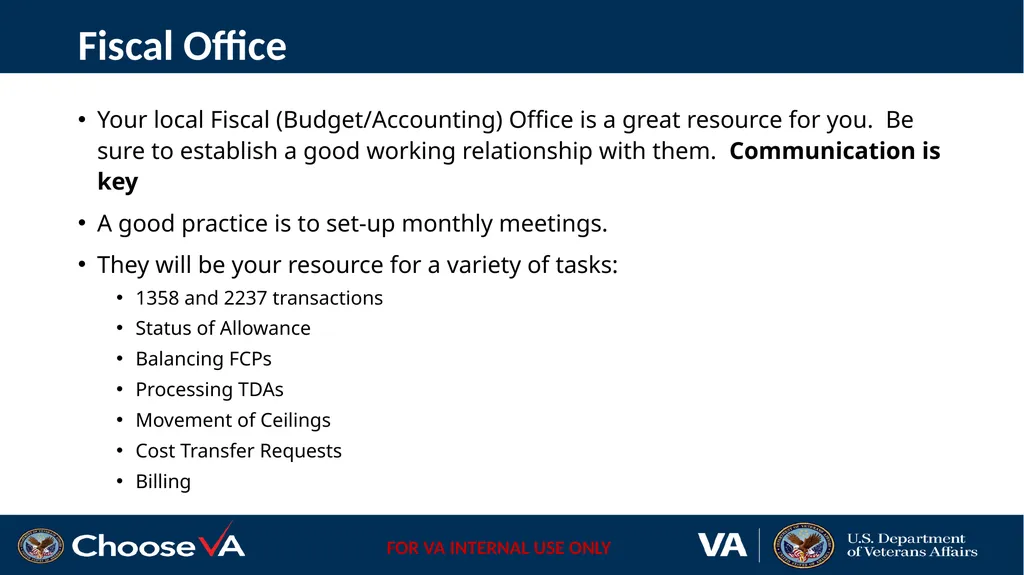
Fiscal Office Your local Fiscal (Budget/Accounting) Office is a great resource for you. Be sure to establish a good working relationship with them. Communication is key
A good practice is to set-up monthly meetings.
They will be your resource for a variety of tasks:
1358 and 2237 transactions
Status of Allowance
Balancing FCPs
Processing TDAs
Movement of Ceilings
Cost Transfer Requests
Billing<br>
A good practice is to set-up monthly meetings.
They will be your resource for a variety of tasks:
1358 and 2237 transactions
Status of Allowance
Balancing FCPs
Processing TDAs
Movement of Ceilings
Cost Transfer Requests
Billing<br>
35
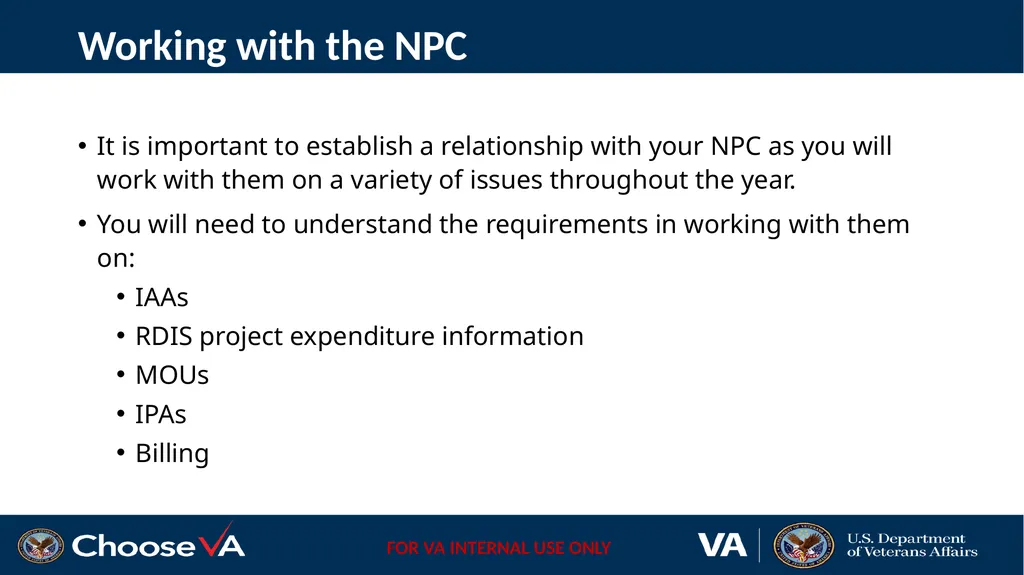
Working with the NPC It is important to establish a relationship with your NPC as you will work with them on a variety of issues throughout the year.
You will need to understand the requirements in working with them on:
IAAs
RDIS project expenditure information
MOUs
IPAs
Billing<br>
You will need to understand the requirements in working with them on:
IAAs
RDIS project expenditure information
MOUs
IPAs
Billing<br>
36
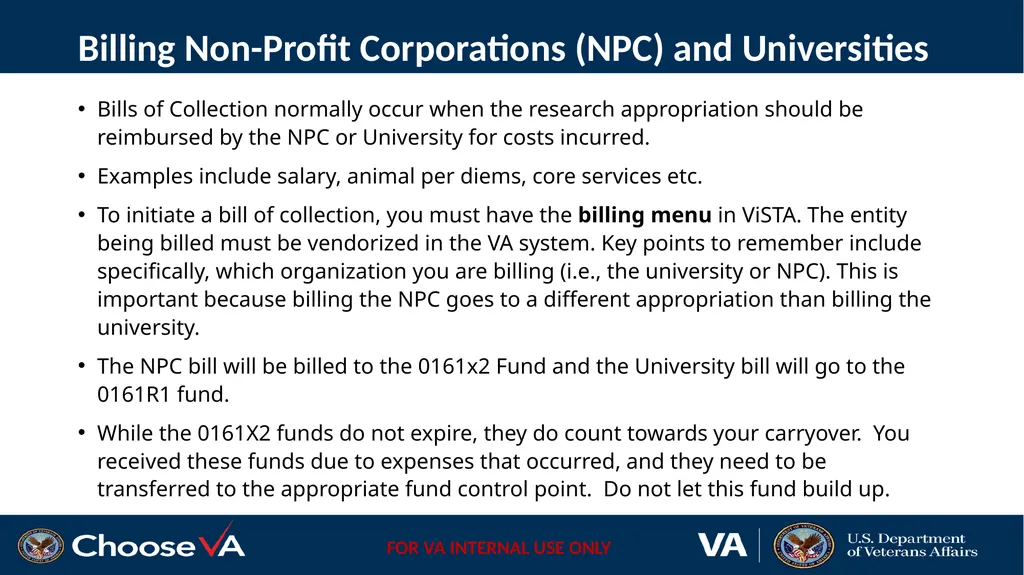
Billing Non-Profit Corporations (NPC) and Universities Bills of Collection normally occur when the research appropriation should be reimbursed by the NPC or University for costs incurred.
Examples include salary, animal per diems, core services etc.
To initiate a bill of collection, you must have the billing menu in ViSTA. The entity being billed must be vendorized in the VA system. Key points to remember include specifically, which organization you are billing (i.e., the university or NPC). This is important because billing the NPC goes to a different appropriation than billing the university.
The NPC bill will be billed to the 0161x2 Fund and the University bill will go to the 0161R1 fund.
While the 0161X2 funds do not expire, they do count towards your carryover. You received these funds due to expenses that occurred, and they need to be transferred to the appropriate fund control point. Do not let this fund build up.<br>
Examples include salary, animal per diems, core services etc.
To initiate a bill of collection, you must have the billing menu in ViSTA. The entity being billed must be vendorized in the VA system. Key points to remember include specifically, which organization you are billing (i.e., the university or NPC). This is important because billing the NPC goes to a different appropriation than billing the university.
The NPC bill will be billed to the 0161x2 Fund and the University bill will go to the 0161R1 fund.
While the 0161X2 funds do not expire, they do count towards your carryover. You received these funds due to expenses that occurred, and they need to be transferred to the appropriate fund control point. Do not let this fund build up.<br>
37
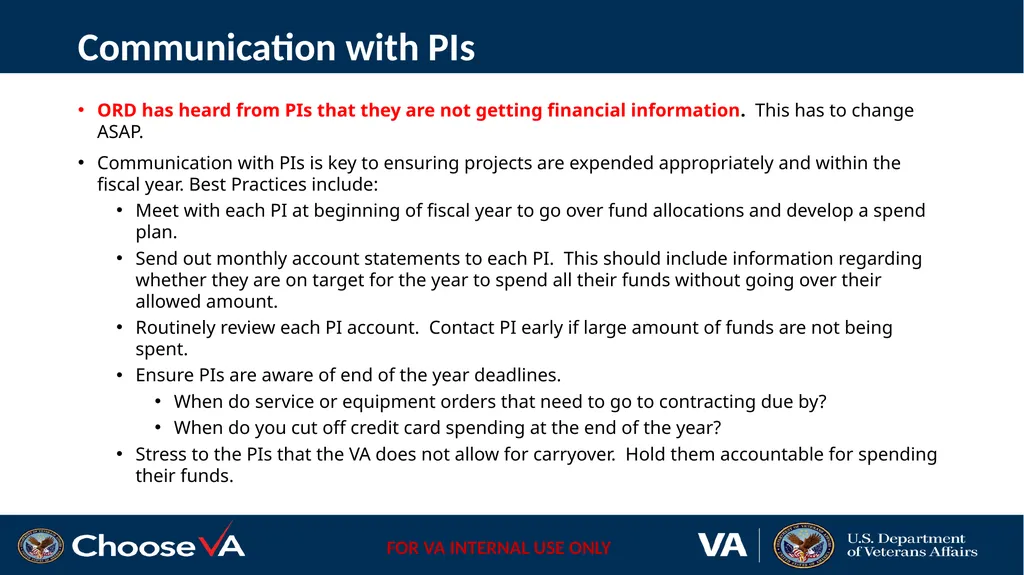
Communication with PIs ORD has heard from PIs that they are not getting financial information. This has to change ASAP.
Communication with PIs is key to ensuring projects are expended appropriately and within the fiscal year. Best Practices include:
Meet with each PI at beginning of fiscal year to go over fund allocations and develop a spend plan.
Send out monthly account statements to each PI. This should include information regarding whether they are on target for the year to spend all their funds without going over their allowed amount.
Routinely review each PI account. Contact PI early if large amount of funds are not being spent.
Ensure PIs are aware of end of the year deadlines.
When do service or equipment orders that need to go to contracting due by?
When do you cut off credit card spending at the end of the year?
Stress to the PIs that the VA does not allow for carryover. Hold them accountable for spending their funds.<br>
Communication with PIs is key to ensuring projects are expended appropriately and within the fiscal year. Best Practices include:
Meet with each PI at beginning of fiscal year to go over fund allocations and develop a spend plan.
Send out monthly account statements to each PI. This should include information regarding whether they are on target for the year to spend all their funds without going over their allowed amount.
Routinely review each PI account. Contact PI early if large amount of funds are not being spent.
Ensure PIs are aware of end of the year deadlines.
When do service or equipment orders that need to go to contracting due by?
When do you cut off credit card spending at the end of the year?
Stress to the PIs that the VA does not allow for carryover. Hold them accountable for spending their funds.<br>
38
Returning Funds to ORD You need to work closely with your Investigator and Program Officers to ensure proper execution of the funding provided for the project.
If funding is going to have potential large carry-over amounts, you will want to return funds and possibly redistribute to another fiscal year or the end of the project.
ORD will be looking at the rate of execution starting FY 21 Q3.
Prior to returning funds to ORD be sure that all expenditures have been received for the Investigator’s project. If the Investigator is retiring or leaving the VA, annual leave will be paid out.<br>
If funding is going to have potential large carry-over amounts, you will want to return funds and possibly redistribute to another fiscal year or the end of the project.
ORD will be looking at the rate of execution starting FY 21 Q3.
Prior to returning funds to ORD be sure that all expenditures have been received for the Investigator’s project. If the Investigator is retiring or leaving the VA, annual leave will be paid out.<br>
39
Tools of the Trade WinRMS (JRMS) – ORD Provided
VSSC – Fiscal report
http://vssc.med.va.gov/
Status of Allowance – Can also obtain from Fiscal Office. Balance FCPs to FMS.
F20 – Daily Activity Reports
Open Obligation Reports
AACS – TDAs, VERA
https://vhaarcweb401n1.arc.va.gov/AACSHome/
VISTA – Running Balances and expenditures
Must get appropriate menus and keys
Eg. Billing – PRCA Billing
RAFT – Investigator Pink Sheets, Funding Reports
https://raft.research.va.gov/RAFT/<br>
VSSC – Fiscal report
http://vssc.med.va.gov/
Status of Allowance – Can also obtain from Fiscal Office. Balance FCPs to FMS.
F20 – Daily Activity Reports
Open Obligation Reports
AACS – TDAs, VERA
https://vhaarcweb401n1.arc.va.gov/AACSHome/
VISTA – Running Balances and expenditures
Must get appropriate menus and keys
Eg. Billing – PRCA Billing
RAFT – Investigator Pink Sheets, Funding Reports
https://raft.research.va.gov/RAFT/<br>
40
WinRMS WinRMS is a web-based computer software designed to assist VA Research Field Offices in administering VA research funds. It is available to all VA Research Field Offices at no charge; many, but not all VA research programs use WinRMS.
WinRMS interfaces with VistA to extract accounting information related to personnel salaries, purchase orders (including inter-agency personnel agreements), cost transfers, and other transactions recorded within VistA.
WinRMS is also an excellent resource for identifying accounting errors in research project budgets (e.g., when an employee is not paid correctly, purchase orders are erroneously charged to your cost centers/FCPs). WinRMS is incredibly cumbersome to set up, but once all the data are entered, it can be an asset for your accounting staff and can run expense reports for your investigators by grant.
If you are interested in learning more about the WinRMS system, please contact Antonio Laracuente. We would be happy to assist you in installing the program at your facility.<br>
WinRMS interfaces with VistA to extract accounting information related to personnel salaries, purchase orders (including inter-agency personnel agreements), cost transfers, and other transactions recorded within VistA.
WinRMS is also an excellent resource for identifying accounting errors in research project budgets (e.g., when an employee is not paid correctly, purchase orders are erroneously charged to your cost centers/FCPs). WinRMS is incredibly cumbersome to set up, but once all the data are entered, it can be an asset for your accounting staff and can run expense reports for your investigators by grant.
If you are interested in learning more about the WinRMS system, please contact Antonio Laracuente. We would be happy to assist you in installing the program at your facility.<br>
41
Summary Utilize Tools
Communicate with Centers and PIs
Communicate with ORD
Build Relationships with Budget and Accounting
Stay on top of the budget as it can easily get away from you
Ask Questions
Listen to the next session that focuses on actual implementation of allocations, expenditures and reimbursables<br>
Communicate with Centers and PIs
Communicate with ORD
Build Relationships with Budget and Accounting
Stay on top of the budget as it can easily get away from you
Ask Questions
Listen to the next session that focuses on actual implementation of allocations, expenditures and reimbursables<br>
42
Questions ????????<br>
43
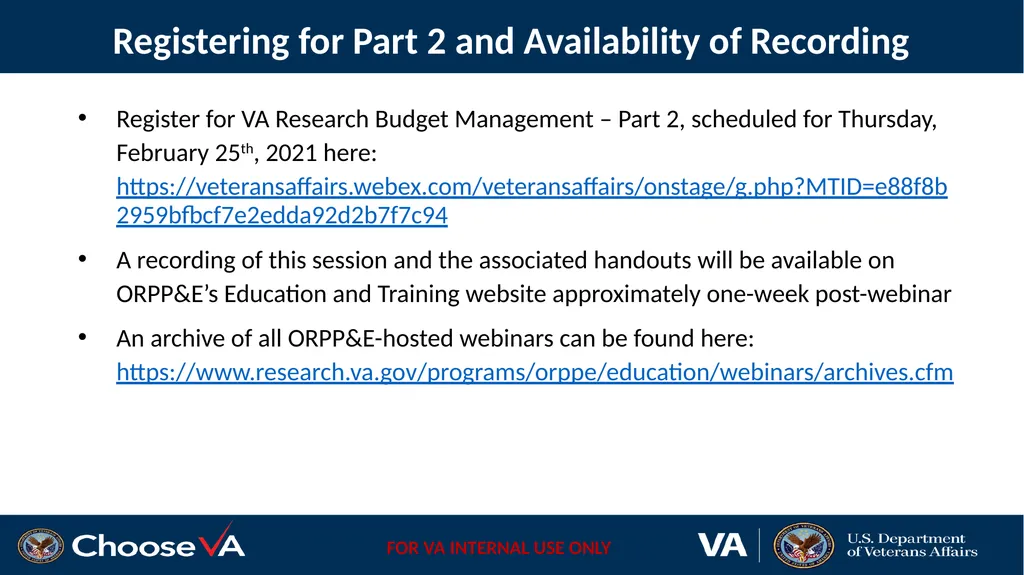
Registering for Part 2 and Availability of Recording Register for VA Research Budget Management – Part 2, scheduled for Thursday, February 25th, 2021 here: https://veteransaffairs.webex.com/veteransaffairs/onstage/g.php?MTID=e88f8b2959bfbcf7e2edda92d2b7f7c94
A recording of this session and the associated handouts will be available on ORPP&E’s Education and Training website approximately one-week post-webinar
An archive of all ORPP&E-hosted webinars can be found here: https://www.research.va.gov/programs/orppe/education/webinars/archives.cfm<br>
A recording of this session and the associated handouts will be available on ORPP&E’s Education and Training website approximately one-week post-webinar
An archive of all ORPP&E-hosted webinars can be found here: https://www.research.va.gov/programs/orppe/education/webinars/archives.cfm<br>