Research method choice, citation impact and gender in academic publishing Mike Thelwall, University of Wolverhampton Based on: Gender differences in academic interests: An analysis of publications from 2017 in 285 fields Mike Thelwall,
"Research method choice, citation impact and gender" is the property of its rightful owner. Permission is granted to
download and print the materials on this website for personal, non-commercial use only, and to display it
on your personal computer provided you do not modify the materials and that you retain all copyright
notices contained in the materials. By downloading content from our website, you accept the terms of this
agreement.
Presentation Transcript
01
Research method choice, citation impact and gender in academic publishing Mike Thelwall, University of Wolverhampton
Based on:
Gender differences in academic interests: An analysis of publications from 2017 in 285 fields
Mike Thelwall, Carol Bailey, Catherine Tobin, Noel-Ann Bradshaw<br>
02
Background: Gender differences in education and occupation A history of bias against women in academia – including bans (lifted in 1974 in 5 Oxford colleges; 1988 in one Cambridge college)
Males still dominate most STEM subjects in terms of degrees and occupations
Females dominate health care, elementary education and domestic sphere (HEED) degrees and occupations
Some careers are highly gendered, from carpenters (1.8% female) to secretaries/administrators (94.5% female)
A hypothesised underlying trend is for females to prefer people-oriented careers/subjects and males to prefer thing-oriented careers/subjects
but this is partly based on 1973 general occupational inventories<br>
03
Background: Gender differences in abilities Males and females have similar or identical cognitive abilities for most tasks except:
Females have greater verbal fluency
Males outperform females in some mental spatial rotation tasks
More males achieve the very highest and lowest level of mathematical performance
This has varied over time and varies between countries<br>
04
Background: Gender differences in interests Some sex differences in childhood toy preferences occur before gender awareness develops and are mimicked in some monkeys (e.g., males more interested in things that move in space?)
Socialisation instils gendered interests – so it is difficult to be sure whether other gender interests are biological or socialised
People/socialising/dolls/my little pony are female?
Things/competitive sports/computer games are male?<br>
05
“Convincing evidence indicates that prenatal exposure to [] testosterone influences the development of children’s sex-typical toy and activity interests.”
Boys: toy vehicles; rough and tumble; other boys
Girls: dolls; other girls
Hines, M. (2011). Gender development and the human brain. Annual Review of Neuroscience, 34, 69-88.<br>
06
Research questions Identify fine-grained gender differences in research topics in researchers from the USA, India, UK
Which broad and narrow academic fields currently (2017) have gendered differences in participation rates?
Are there gendered differences in research topics or methods employed by researchers across academia?
Are there gendered differences in research topics or methods employed by researchers within narrow academic fields?<br>
07
Methods: Gender identification First author gender was estimated based on their first name
Matched against the most common 10,000 first names in the USA 1990 census used at least 90% by one gender, or by Gender-API.com
Proportions were corrected by checking a random sample of 1000 authors for gender based on web searches for their home pages Mike -> Male; Kate, Carol -> Female; Noel-Ann -> Unknown<br>
08
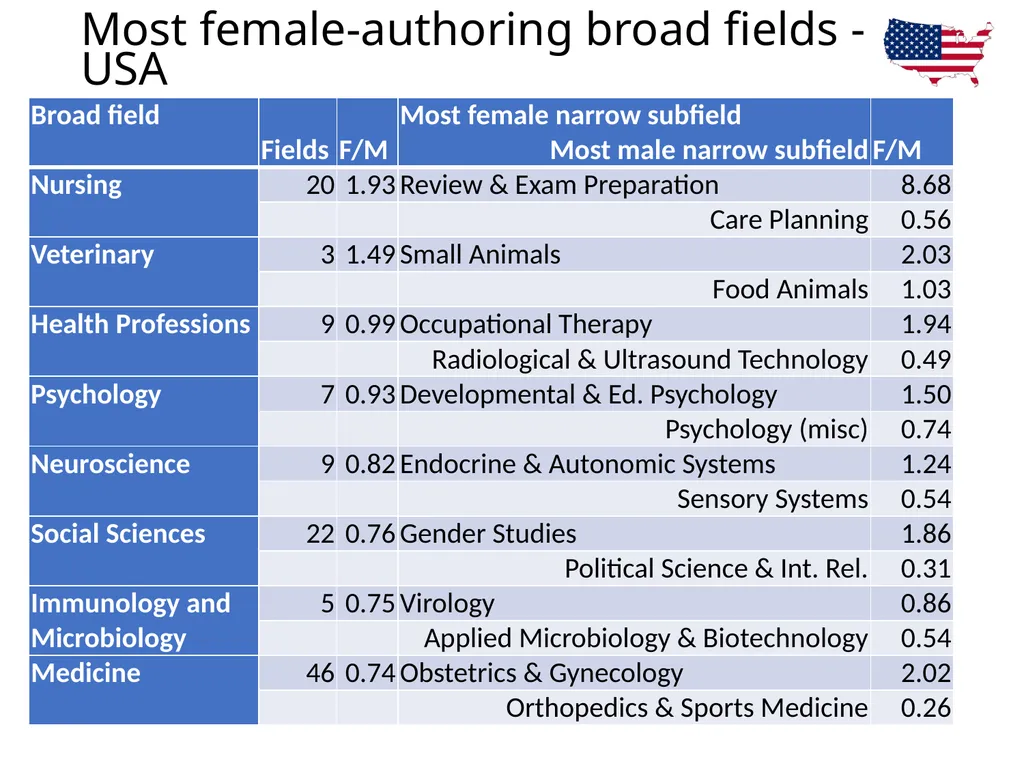
Most female-authoring broad fields - USA<br>
09
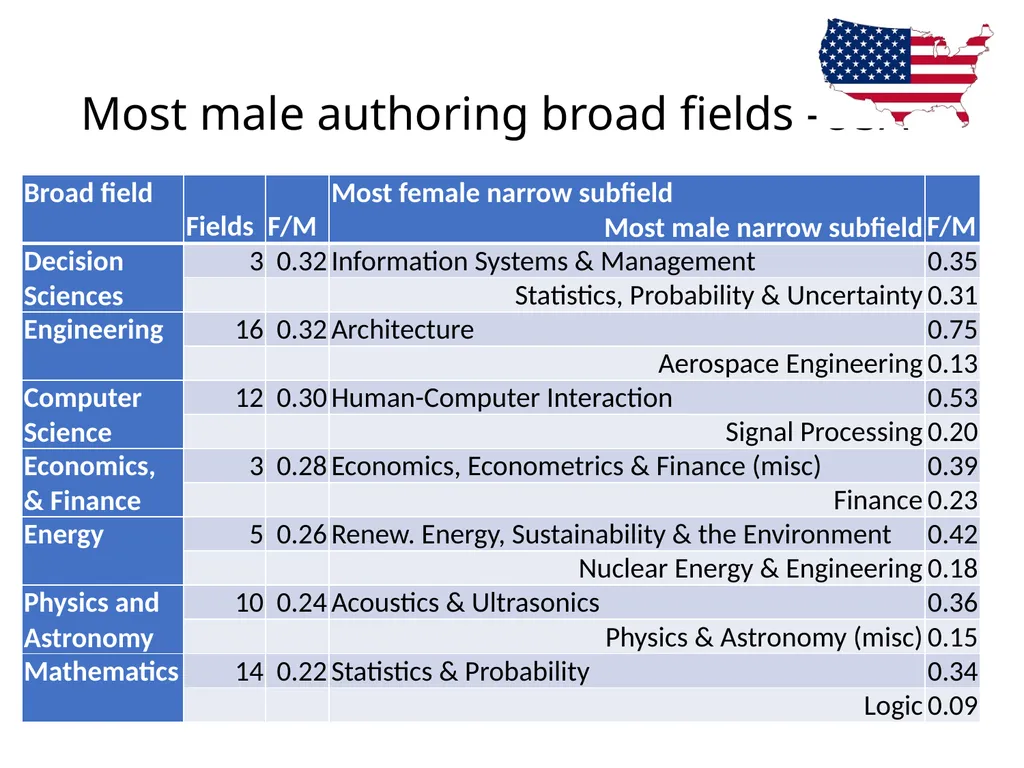
Most male authoring broad fields -USA Selected results<br>
10
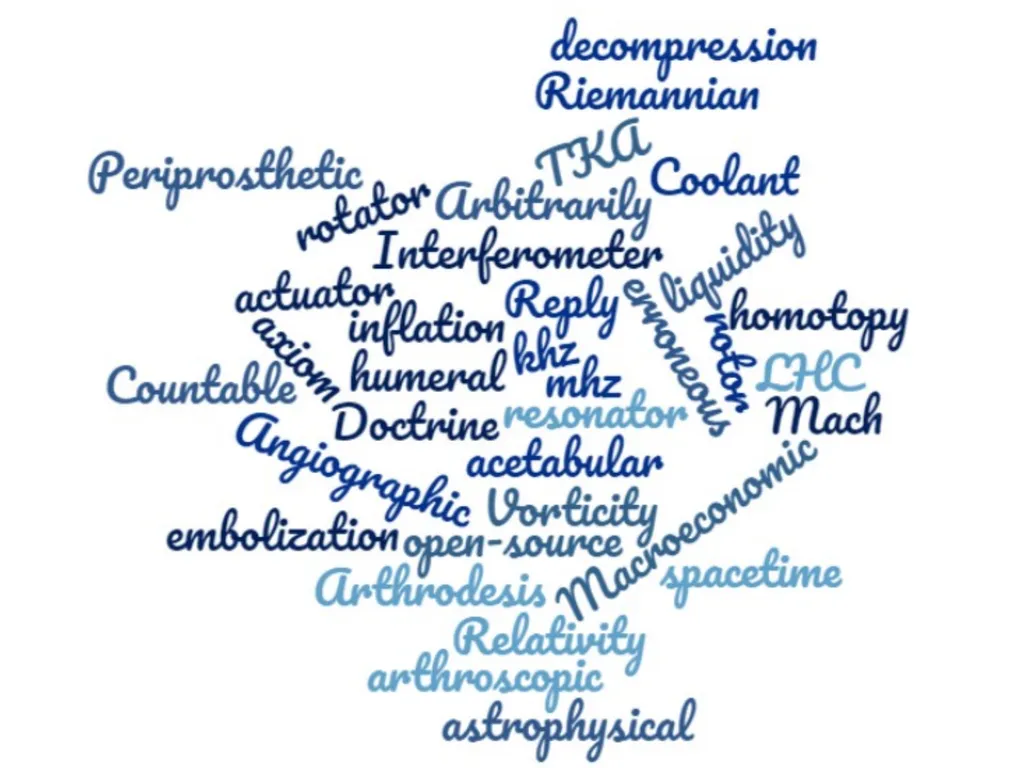
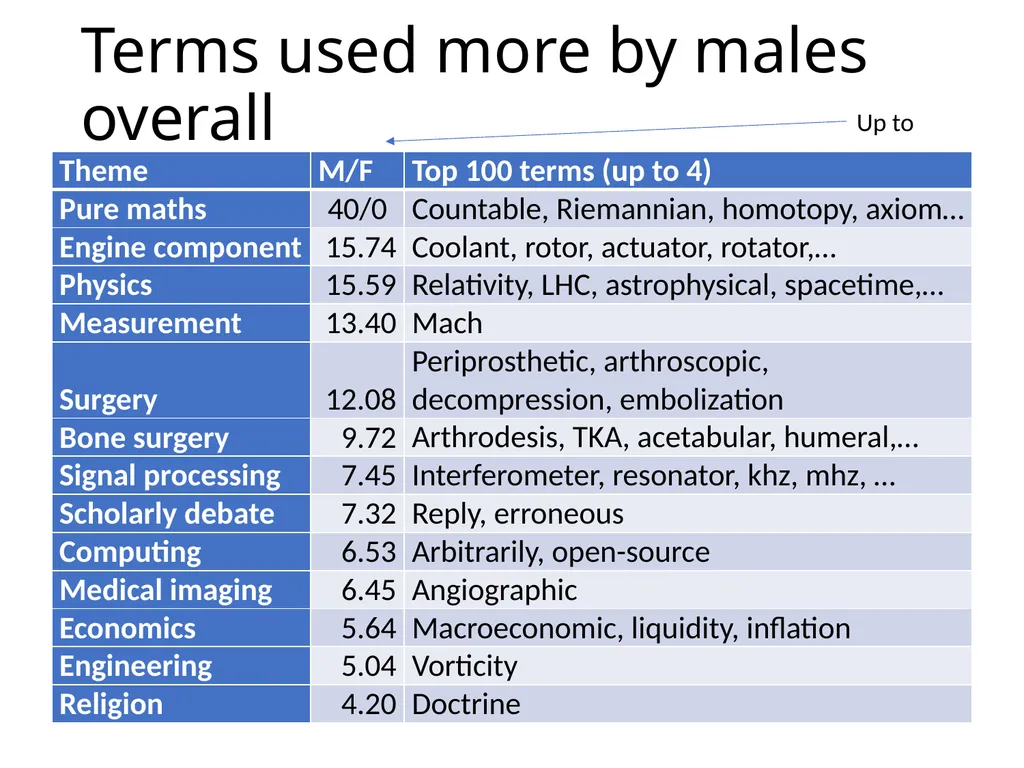
Terms used more by males overall Up to<br>
11
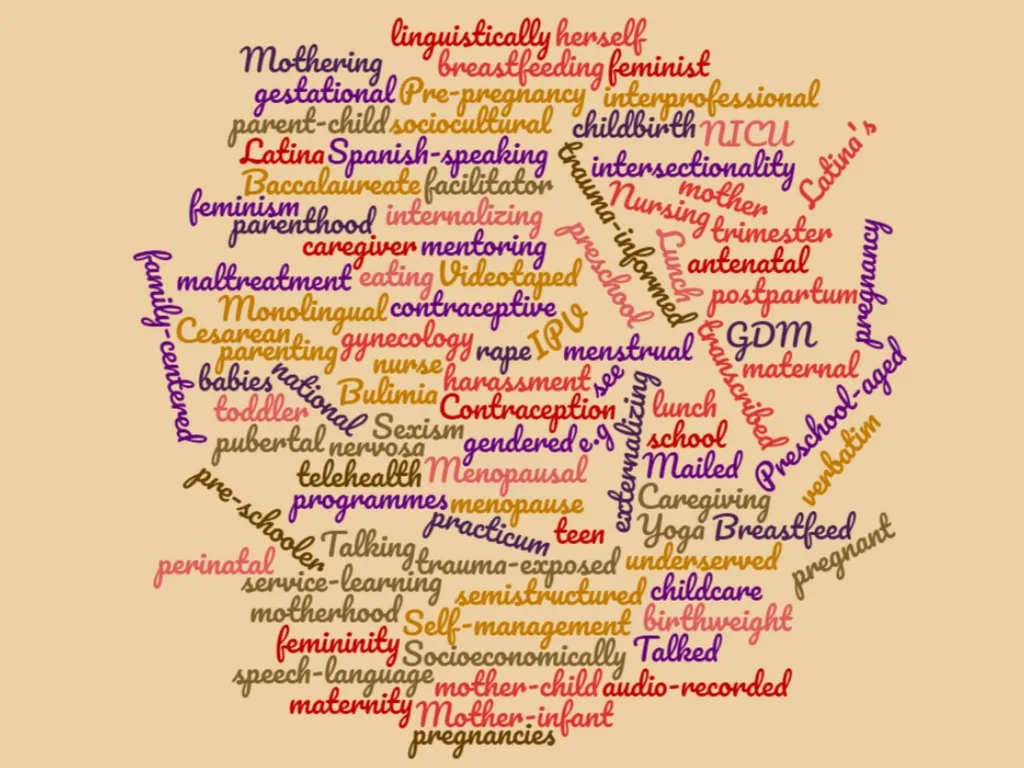
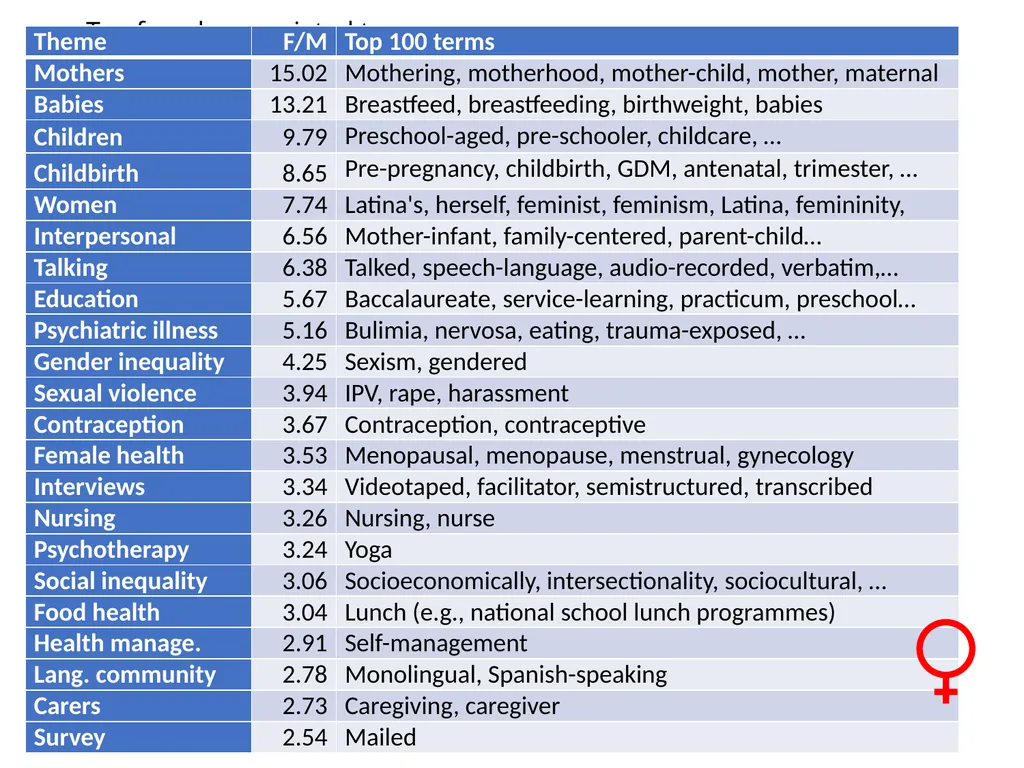
Top female-associated terms<br>
12
Female topics - are people enough? Not all people attract female research to the same extent
Veterinary is not human-related and is an exception
Cell biology is an exception<br>
13
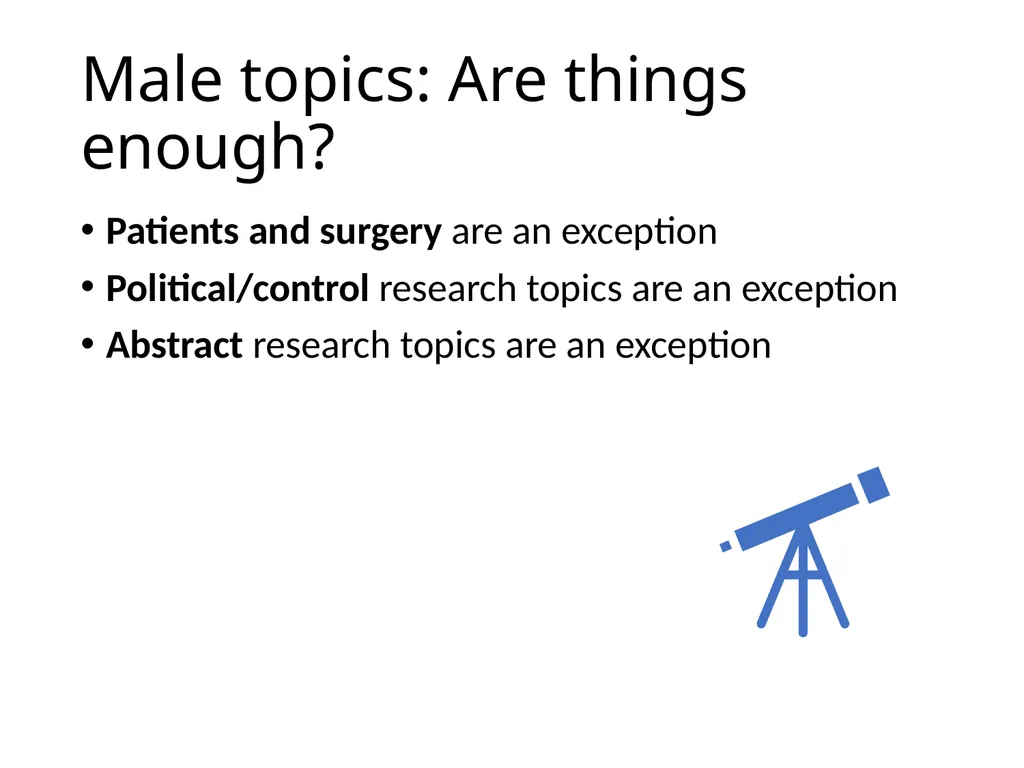
Male topics: Are things enough? Patients and surgery are an exception
Political/control research topics are an exception
Abstract research topics are an exception<br>
14
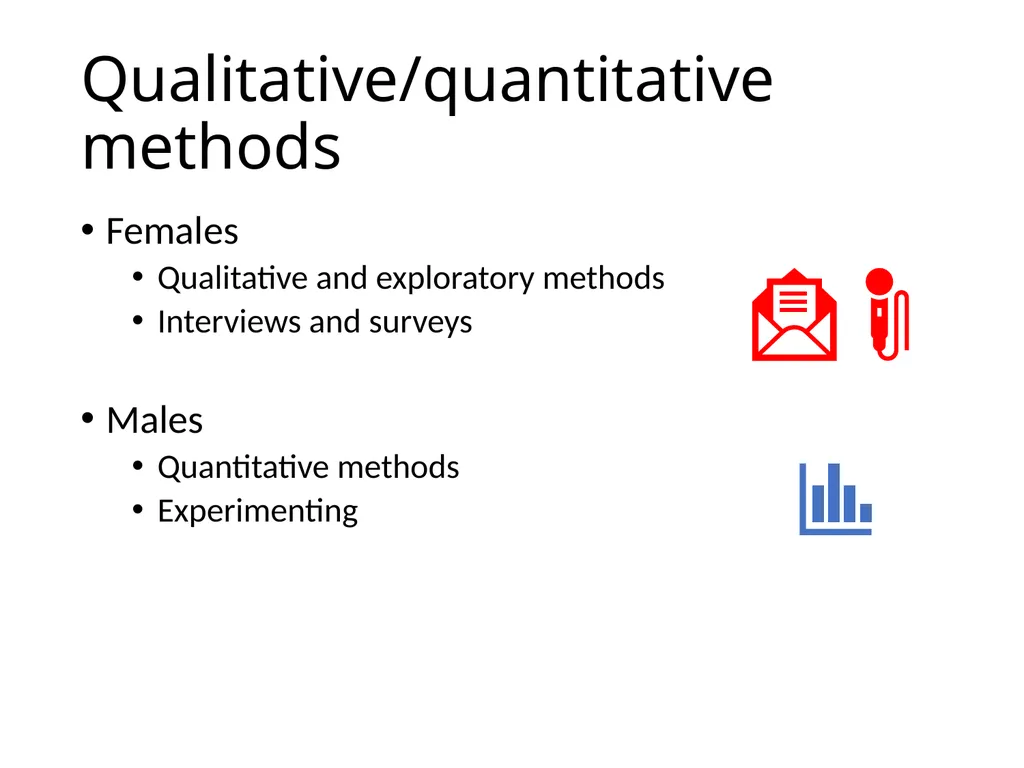
Qualitative/quantitative methods Females
Qualitative and exploratory methods
Interviews and surveys
Males
Quantitative methods
Experimenting<br>
15
How is the UK different? Not much
More female in the UK: Veterinary; Dentistry; Biochemistry, Genetics and Molecular Biology; Decision Sciences; Energy
More male in the UK: Health Professions; Chemical Engineering<br>
16
How is India different? All broad fields male gendered – fewer females overall
Narrower gap between fields in gender splits – few fields highly male
Veterinary Science is highly male, instead of highly female<br>
17
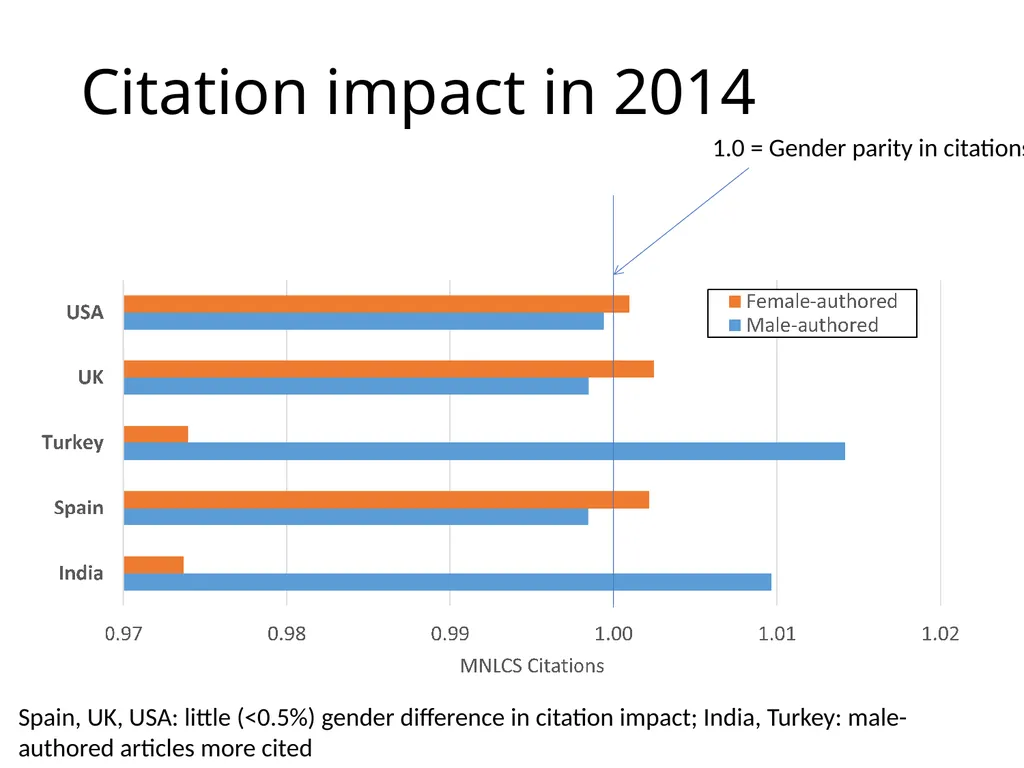
Citation impact in 2014 1.0 = Gender parity in citations Spain, UK, USA: little (<0.5%) gender difference in citation impact; India, Turkey: male-authored articles more cited<br>
18
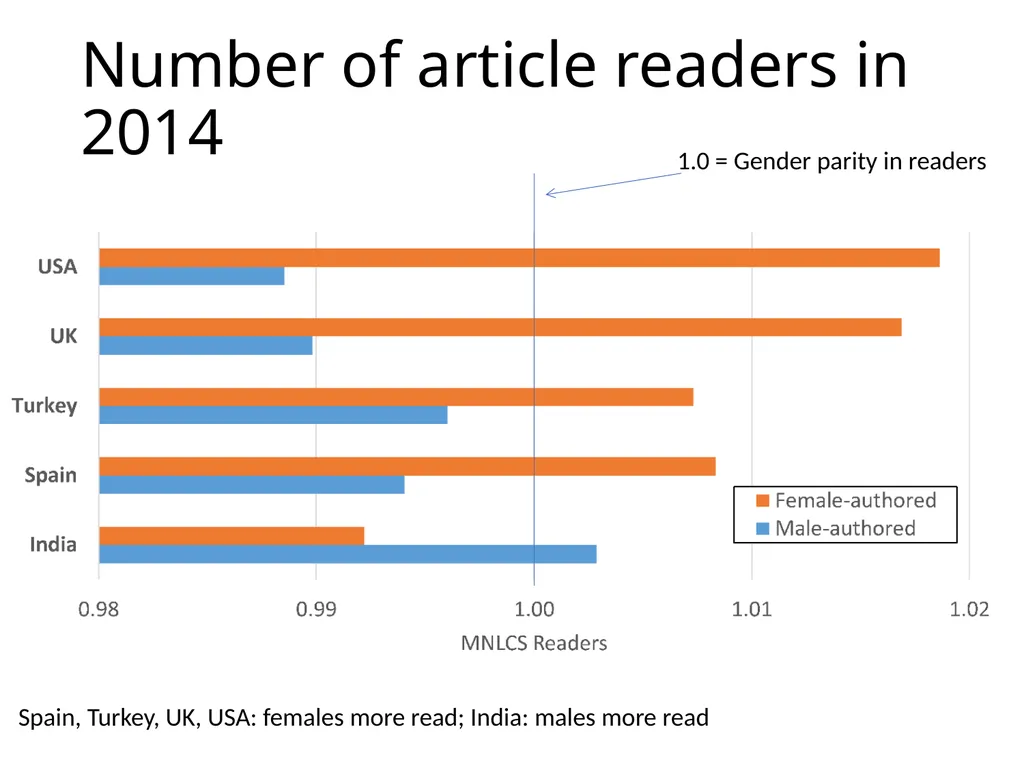
Number of article readers in 2014 1.0 = Gender parity in readers Spain, Turkey, UK, USA: females more read; India: males more read<br>
19
Conclusion Some hypothesised gender-based patterns modified (e.g., people/things)
New gender-based patterns discovered (e.g., people methods, abstraction, power/control)
Causes unknown: other methods needed to get more insights into these
Do research managers/journal editors need to be more aware of gender differences so that they can be more receptive to female research styles and topics? More ideas: Thelwall, M. & Mas-Bleda, A. (2018). YouTube science channel video presenters and comments: Female friendly or vestiges of sexism? Aslib Journal of Information Management, 70(1), 28-46.<br>