
Research Question formulation Literature searching
Description: Research Question formulation Literature searching NarrowingBroadening a Topic Often a challenge Need to do some background reading Overview of the topic Terminology used Concept mapping can help identify subtopics narrow your focus
Related Topics
Download Presentation
"Research Question formulation Literature searching" is the property of its rightful owner. Permission is granted to download and print the materials on this website for personal, non-commercial use only, and to display it on your personal computer provided you do not modify the materials and that you retain all copyright notices contained in the materials. By downloading content from our website, you accept the terms of this agreement.
Presentation Transcript
slide1. Research
Question formulation
Literature searching<br>
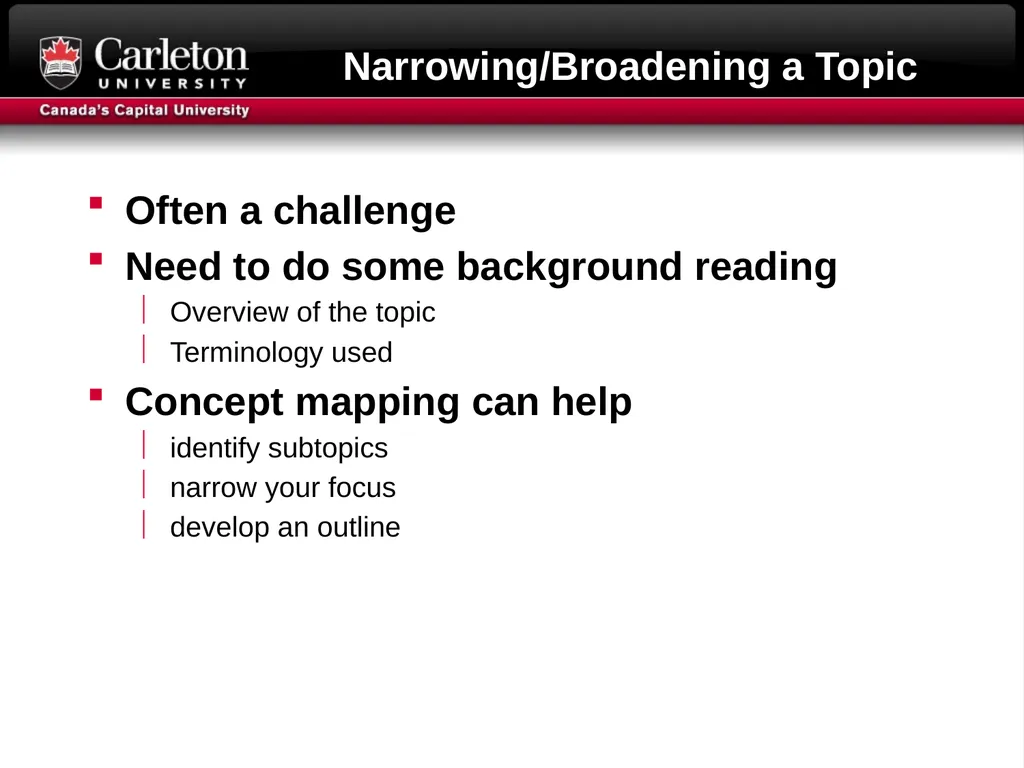
slide2. Narrowing/Broadening a Topic Often a challenge
Need to do some background reading
Overview of the topic
Terminology used
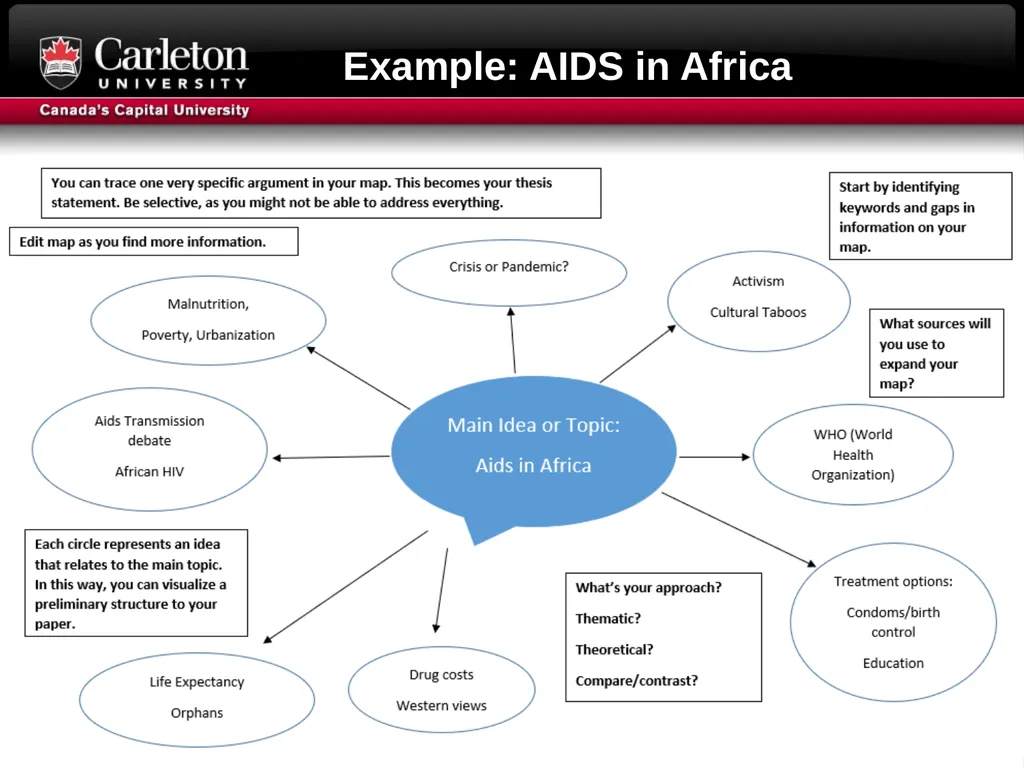
Concept mapping can help
identify subtopics
narrow your focus
develop an outline<br>
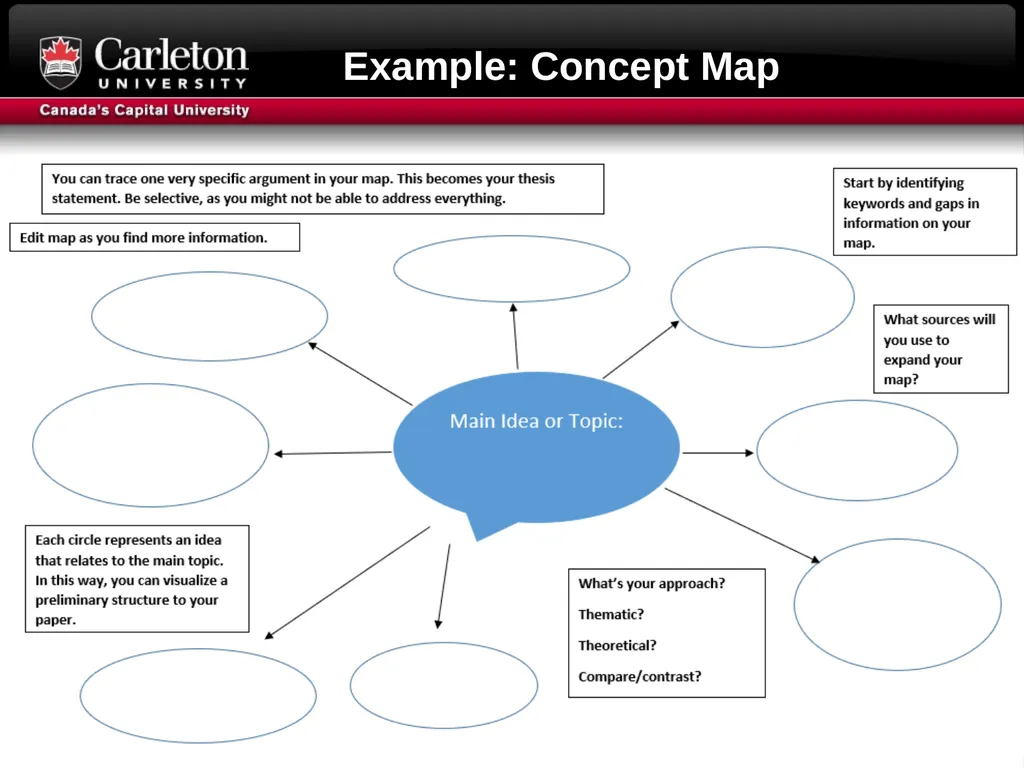
slide3. Example: Concept Map<br>
slide4. Example: AIDS in Africa<br>
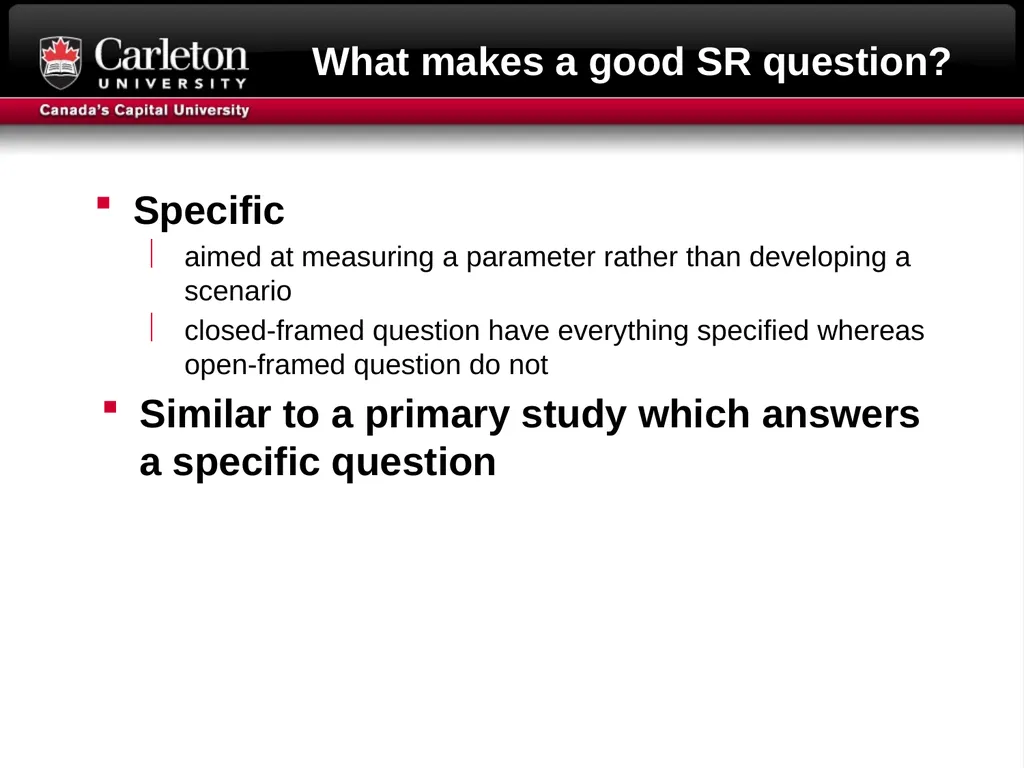
slide5. What makes a good SR question? Specific
aimed at measuring a parameter rather than developing a scenario
closed-framed question have everything specified whereas open-framed question do not
Similar to a primary study which answers a specific question<br>
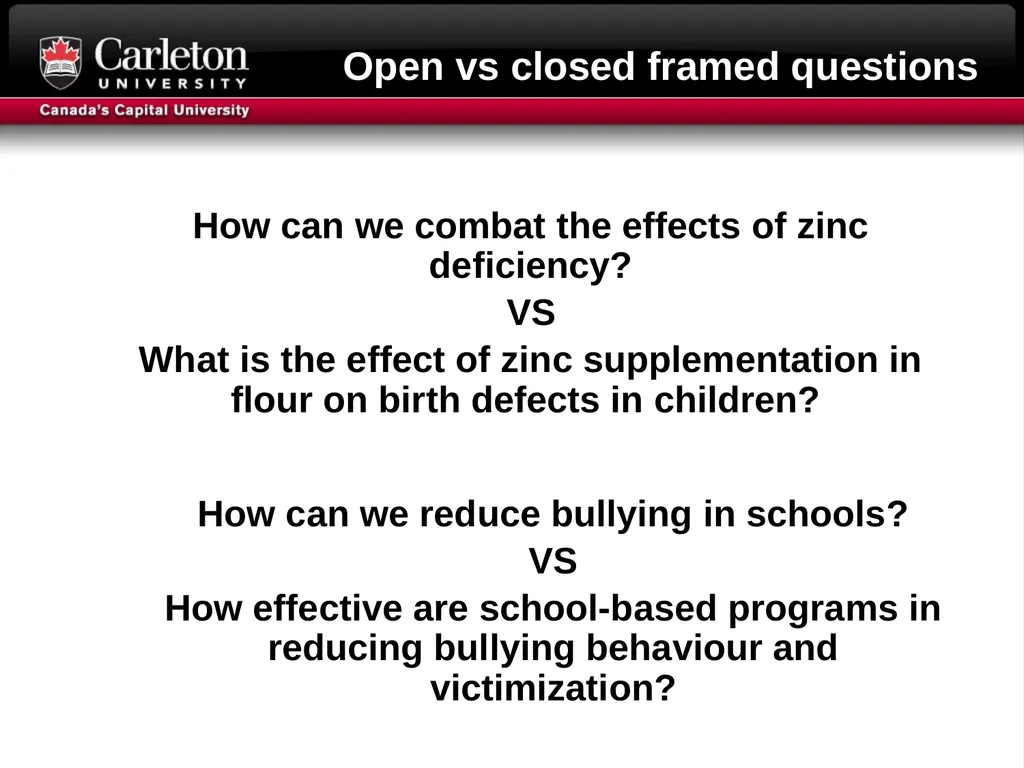
slide6. Open vs closed framed questions How can we combat the effects of zinc deficiency?
VS
What is the effect of zinc supplementation in flour on birth defects in children?
How can we reduce bullying in schools?
VS
How effective are school-based programs in reducing bullying behaviour and victimization?<br>
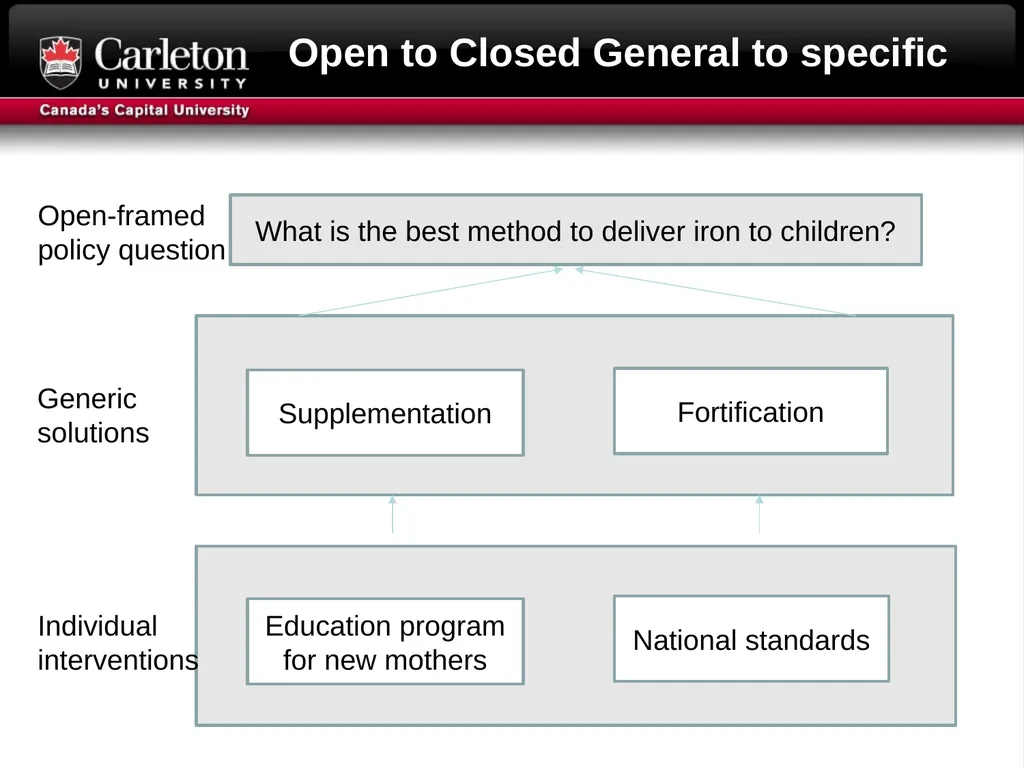
slide7. Open to Closed General to specific What is the best method to deliver iron to children? Supplementation Fortification Education program for new mothers National standards Open-framed
policy question Generic
solutions Individual
interventions<br>
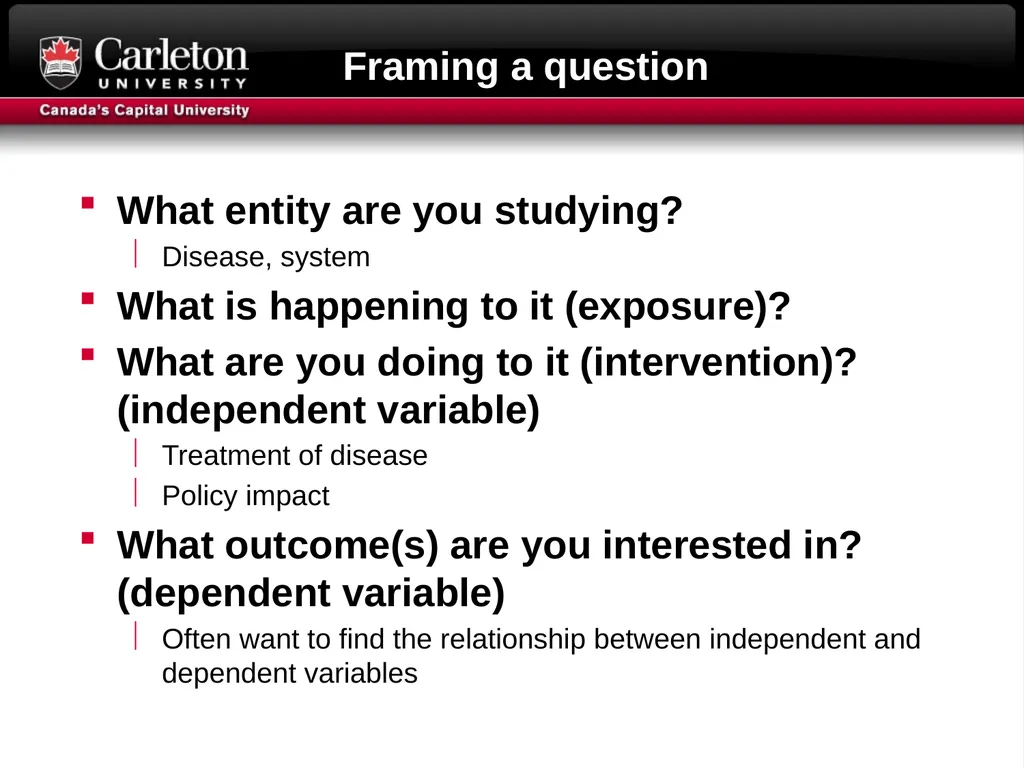
slide8. Framing a question What entity are you studying?
Disease, system
What is happening to it (exposure)?
What are you doing to it (intervention)? (independent variable)
Treatment of disease
Policy impact
What outcome(s) are you interested in? (dependent variable)
Often want to find the relationship between independent and dependent variables<br>
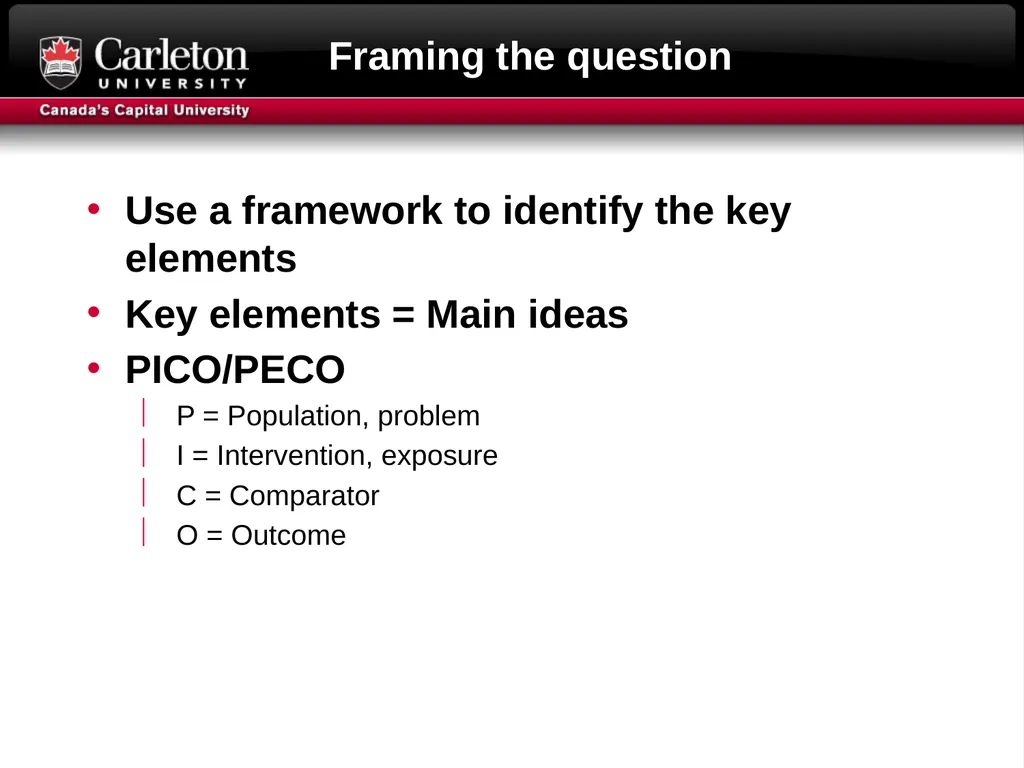
slide9. Framing the question Use a framework to identify the key elements
Key elements = Main ideas
PICO/PECO
P = Population, problem
I = Intervention, exposure
C = Comparator
O = Outcome<br>
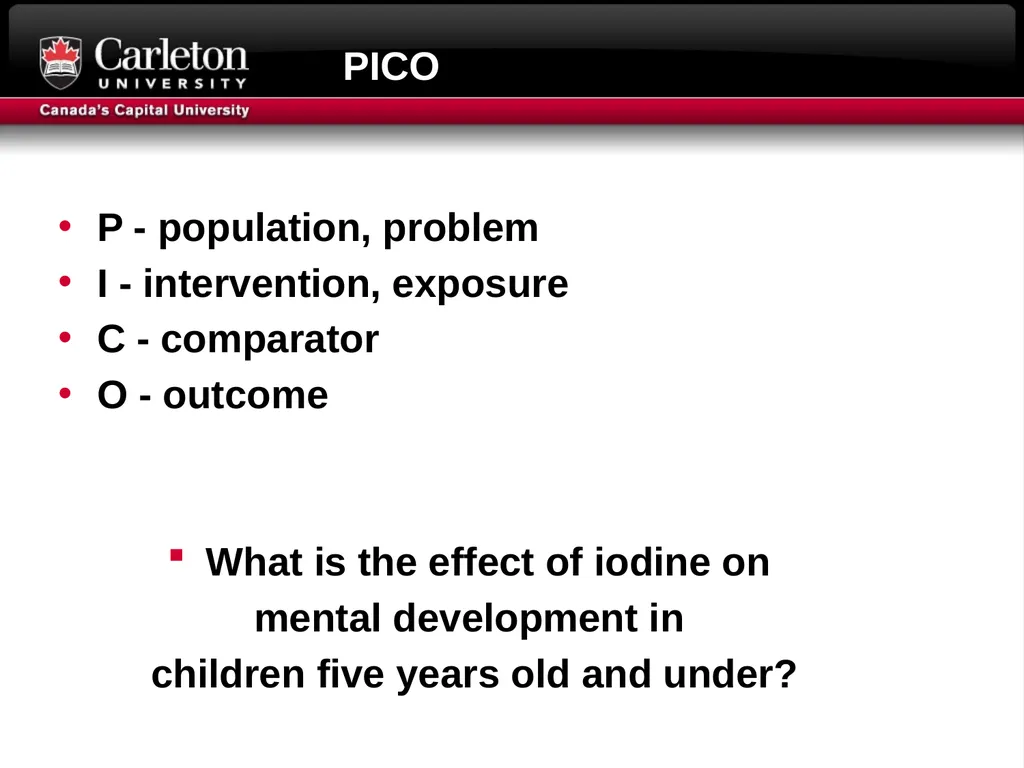
slide10. PICO P - population, problem
I - intervention, exposure
C - comparator
O - outcome
What is the effect of iodine on
mental development in
children five years old and under?<br>
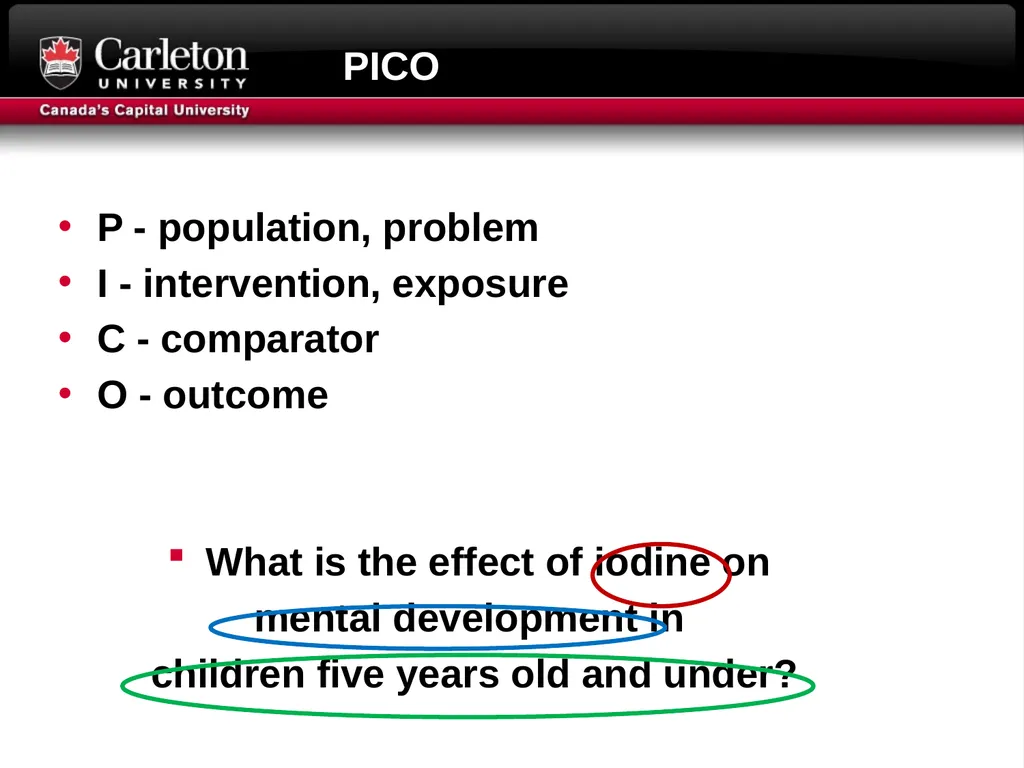
slide11. PICO P - population, problem
I - intervention, exposure
C - comparator
O - outcome
What is the effect of iodine on
mental development in
children five years old and under?<br>
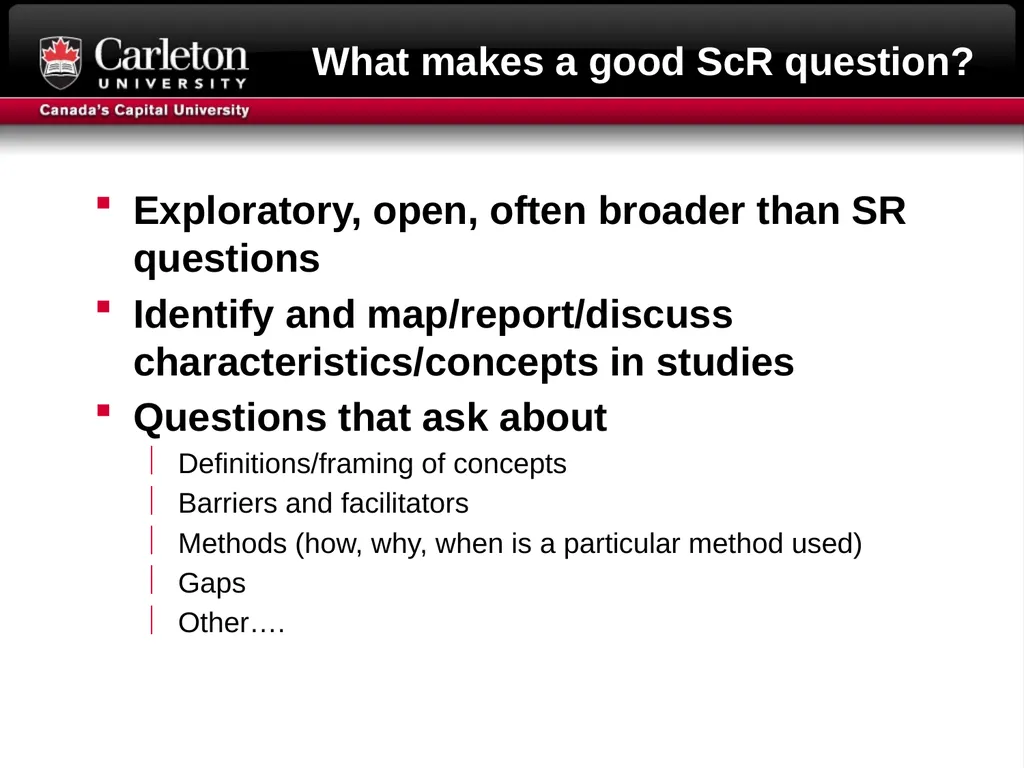
slide12. What makes a good ScR question? Exploratory, open, often broader than SR questions
Identify and map/report/discuss characteristics/concepts in studies
Questions that ask about
Definitions/framing of concepts
Barriers and facilitators
Methods (how, why, when is a particular method used)
Gaps
Other….<br>
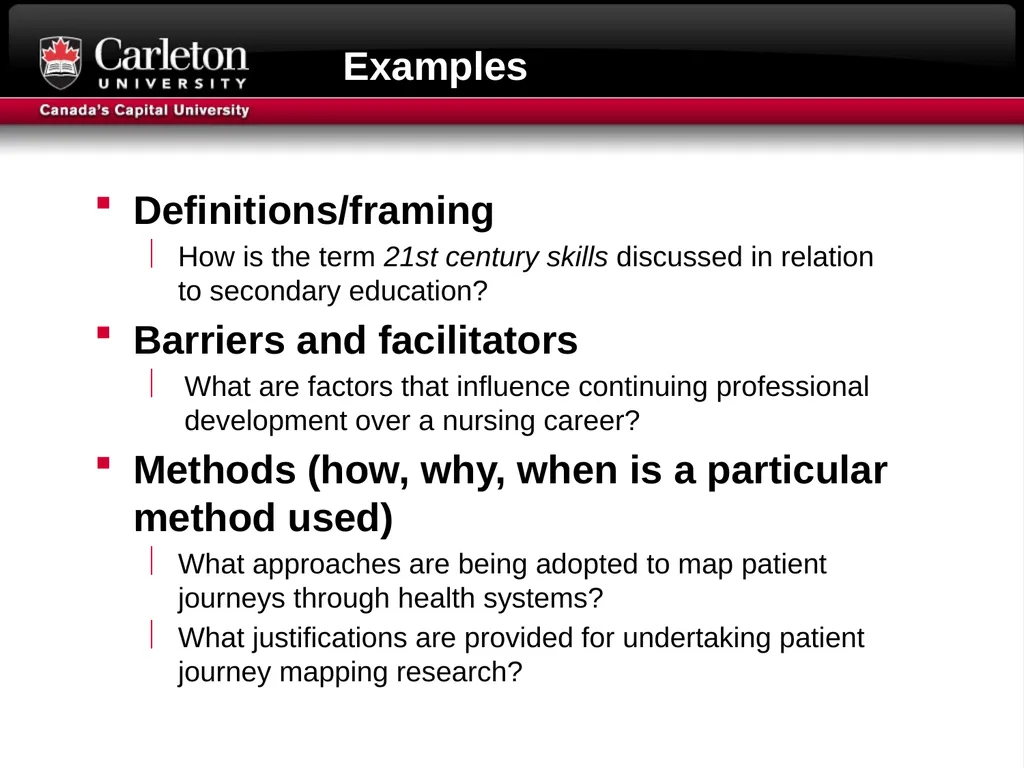
slide13. Examples Definitions/framing
How is the term 21st century skills discussed in relation to secondary education?
Barriers and facilitators
What are factors that influence continuing professional development over a nursing career?
Methods (how, why, when is a particular method used)
What approaches are being adopted to map patient journeys through health systems?
What justifications are provided for undertaking patient journey mapping research?<br>
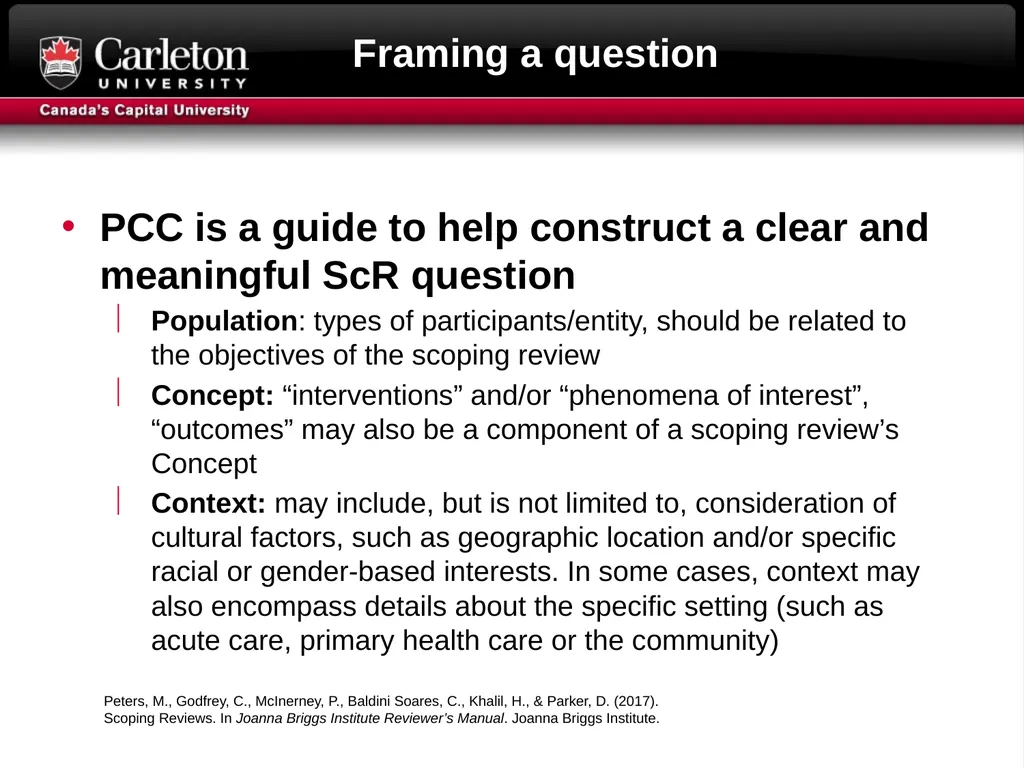
slide14. PCC is a guide to help construct a clear and meaningful ScR question
Population: types of participants/entity, should be related to the objectives of the scoping review
Concept: “interventions” and/or “phenomena of interest”, “outcomes” may also be a component of a scoping review’s Concept
Context: may include, but is not limited to, consideration of cultural factors, such as geographic location and/or specific racial or gender-based interests. In some cases, context may also encompass details about the specific setting (such as acute care, primary health care or the community) Peters, M., Godfrey, C., McInerney, P., Baldini Soares, C., Khalil, H., & Parker, D. (2017). Scoping Reviews. In Joanna Briggs Institute Reviewer’s Manual. Joanna Briggs Institute. Framing a question<br>
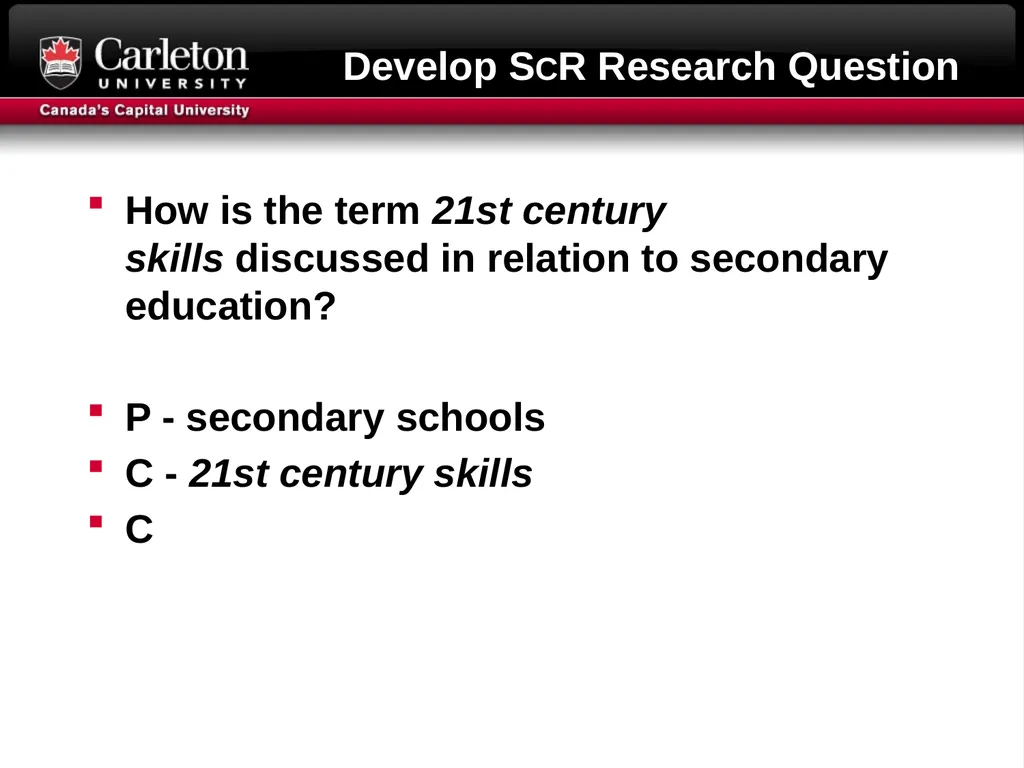
slide15. Develop ScR Research Question How is the term 21st century skills discussed in relation to secondary education?
P - secondary schools
C - 21st century skills
C<br>
slide16. Pause here Know your objective/goal for conducting a review (the why)
Develop your question from this objective
Your research question is the most important part of this process
Everything flows from your question
It is worthwhile to spend time on developing a good research question<br>
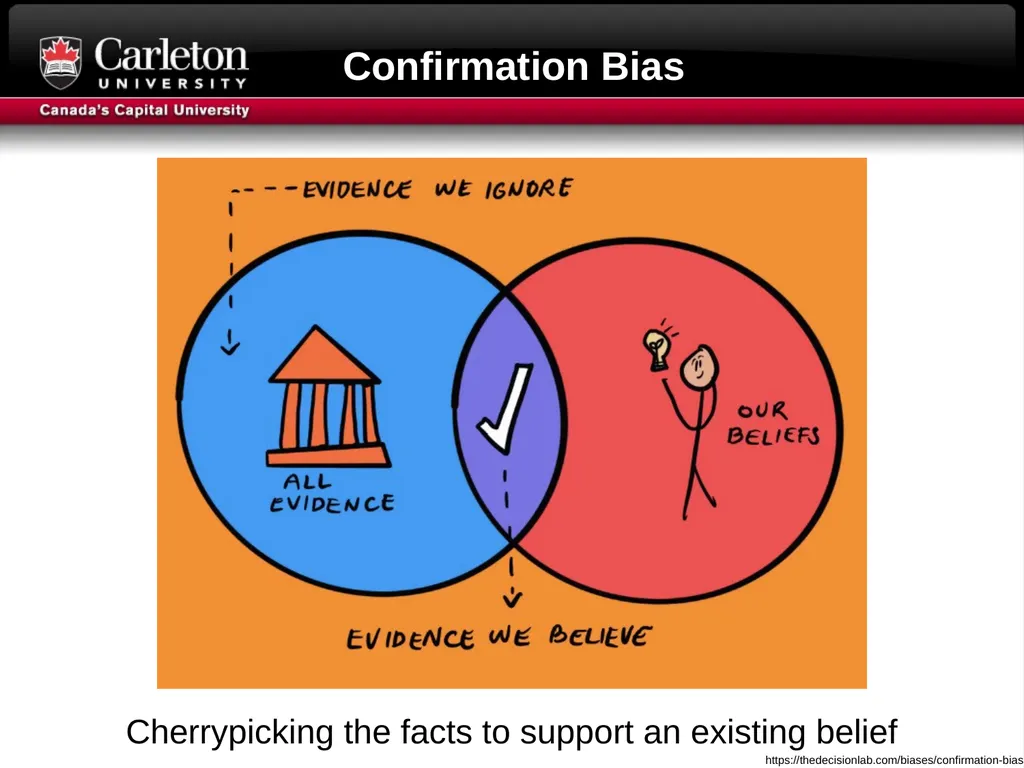
slide17. Confirmation Bias Cherrypicking the facts to support an existing belief https://thedecisionlab.com/biases/confirmation-bias<br>
slide18. Searching Background searching
Gathering information on your topic to ensure there is sufficient/not too much literature
Narrowing or broadening your topic
Helps focus for the next step
Searching for your research topic
Not just one search
Different aspects of your search may require different searches
Be deliberate in your searching<br>
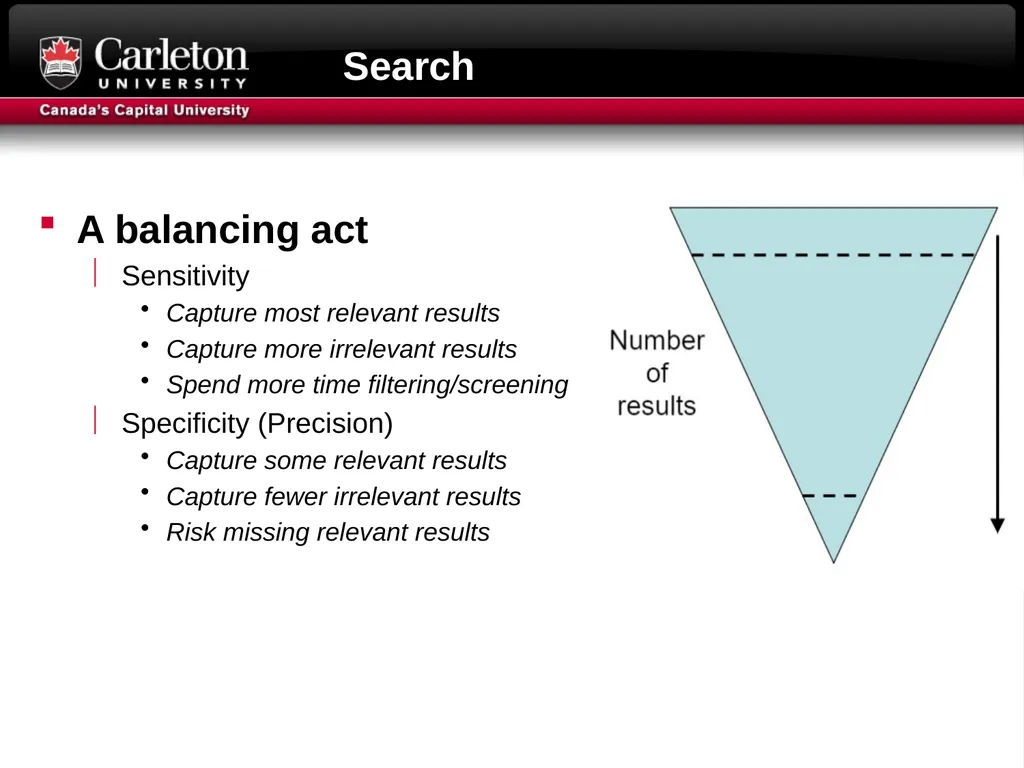
slide19. Search A balancing act
Sensitivity
Capture most relevant results
Capture more irrelevant results
Spend more time filtering/screening
Specificity (Precision)
Capture some relevant results
Capture fewer irrelevant results
Risk missing relevant results<br>
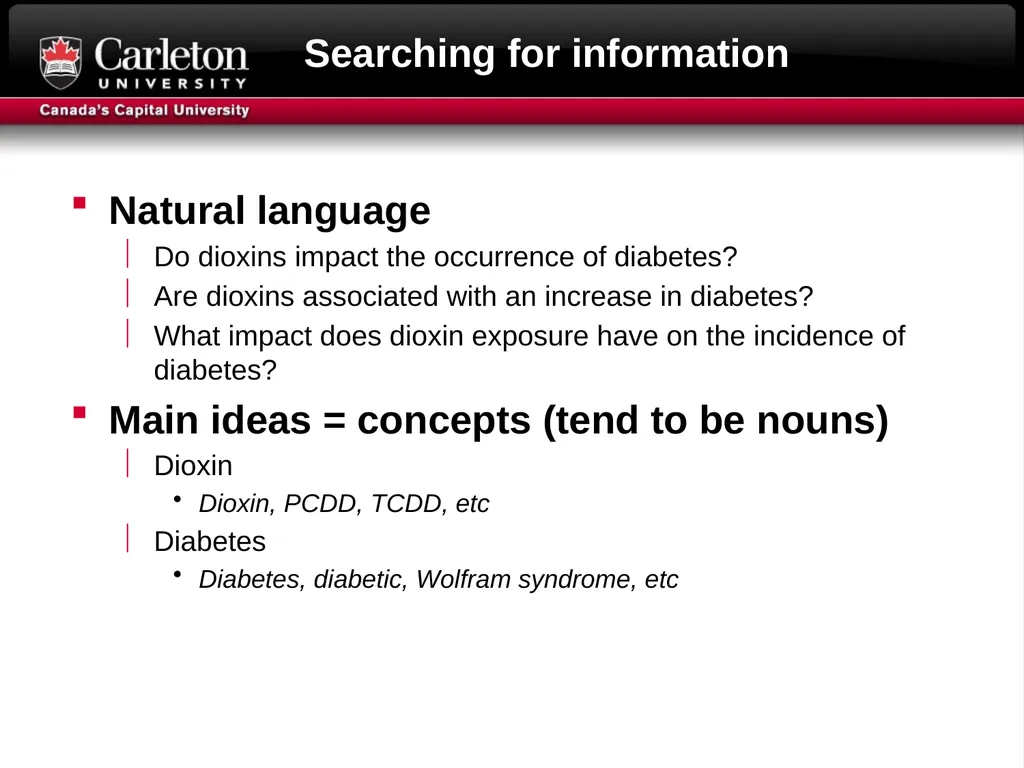
slide20. Searching for information Natural language
Do dioxins impact the occurrence of diabetes?
Are dioxins associated with an increase in diabetes?
What impact does dioxin exposure have on the incidence of diabetes?
Main ideas = concepts (tend to be nouns)
Dioxin
Dioxin, PCDD, TCDD, etc
Diabetes
Diabetes, diabetic, Wolfram syndrome, etc<br>
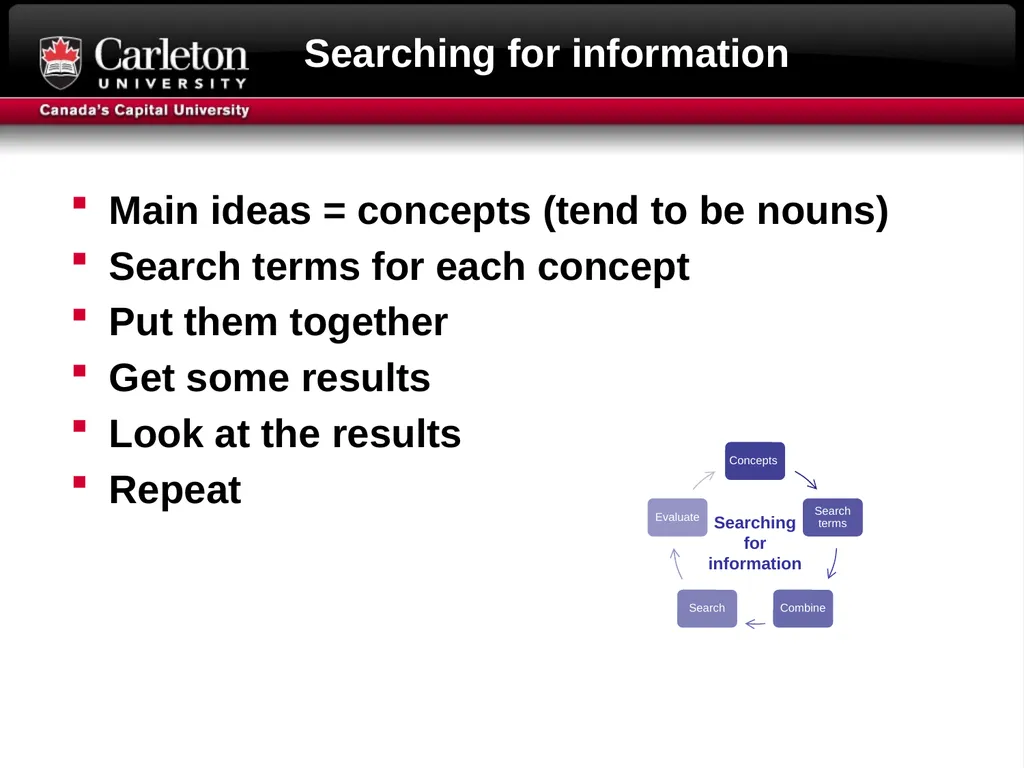
slide21. Searching for information Main ideas = concepts (tend to be nouns)
Search terms for each concept
Put them together
Get some results
Look at the results
Repeat<br>
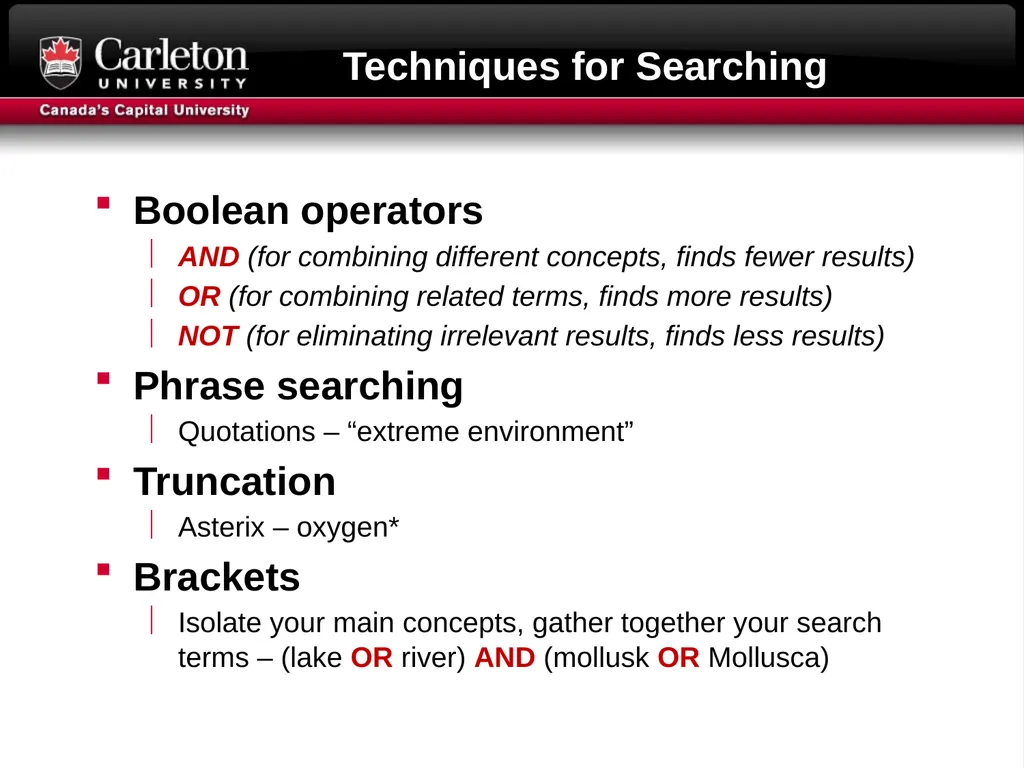
slide22. Techniques for Searching Boolean operators
AND (for combining different concepts, finds fewer results)
OR (for combining related terms, finds more results)
NOT (for eliminating irrelevant results, finds less results)
Phrase searching
Quotations – “extreme environment”
Truncation
Asterix – oxygen*
Brackets
Isolate your main concepts, gather together your search terms – (lake OR river) AND (mollusk OR Mollusca)<br>
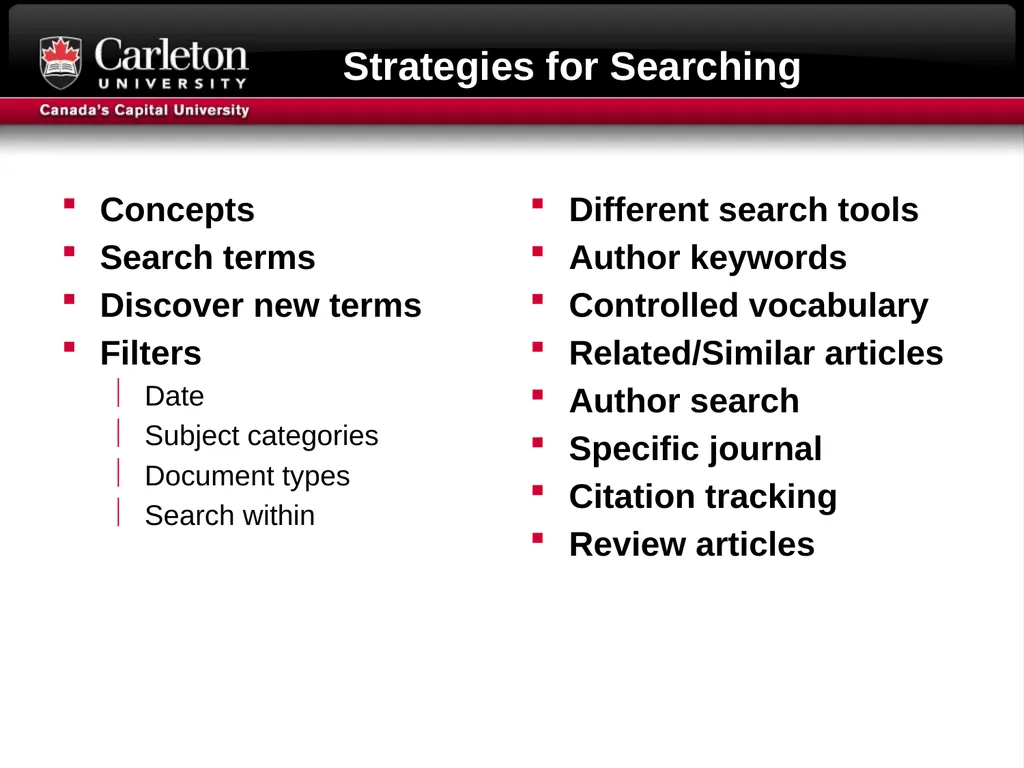
slide23. Different search tools
Author keywords
Controlled vocabulary
Related/Similar articles
Author search
Specific journal
Citation tracking
Review articles Strategies for Searching Concepts
Search terms
Discover new terms
Filters
Date
Subject categories
Document types
Search within<br>
slide24. Interlibrary loan Can take a day or two, sometimes just hours, to receive an electronic copy of an article
If you do a search using a library database, the ILL form auto-populates
Free service<br>
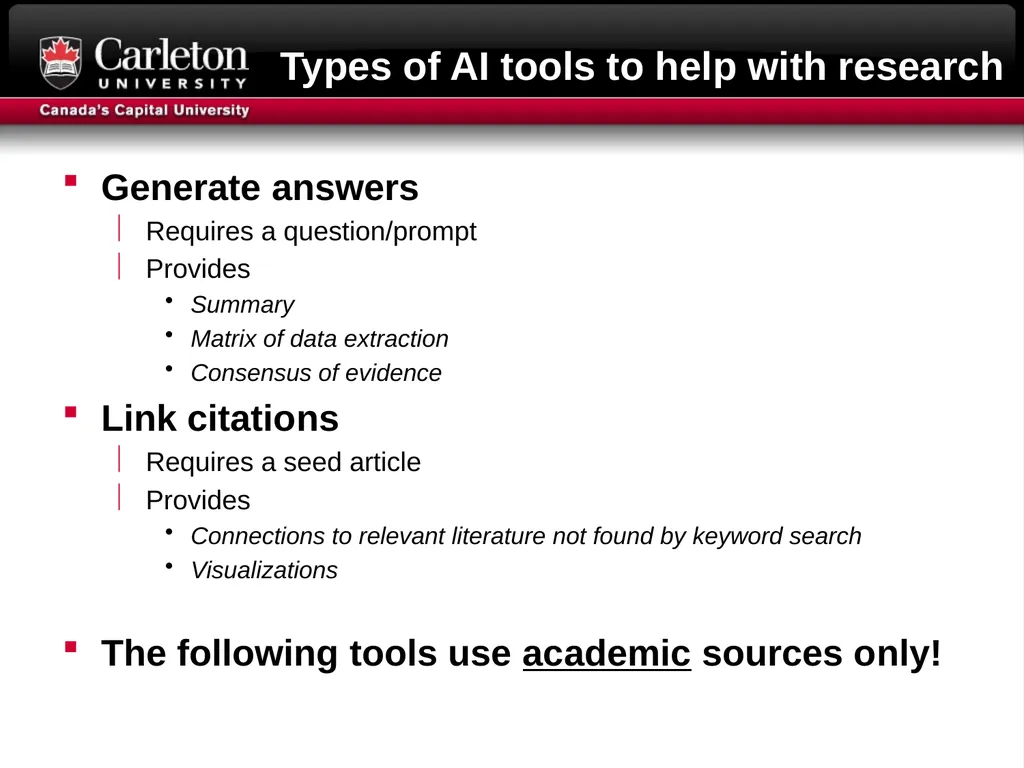
slide25. Types of AI tools to help with research Generate answers
Requires a question/prompt
Provides
Summary
Matrix of data extraction
Consensus of evidence
Link citations
Requires a seed article
Provides
Connections to relevant literature not found by keyword search
Visualizations
The following tools use academic sources only!<br>
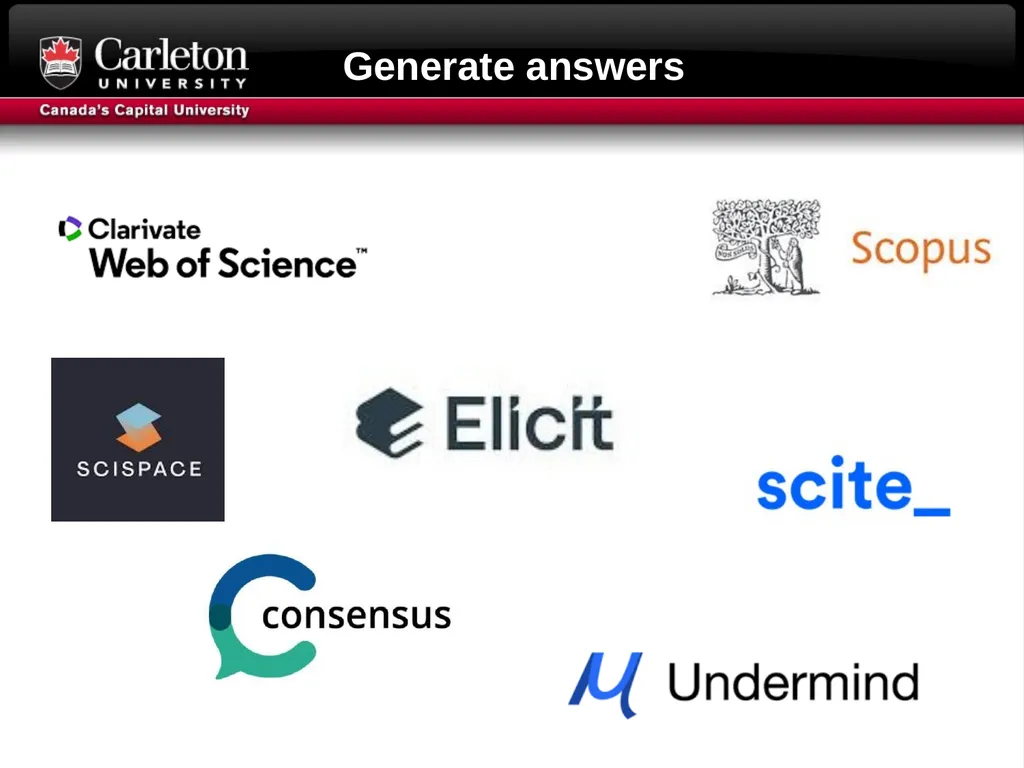
slide26. Generate answers<br>
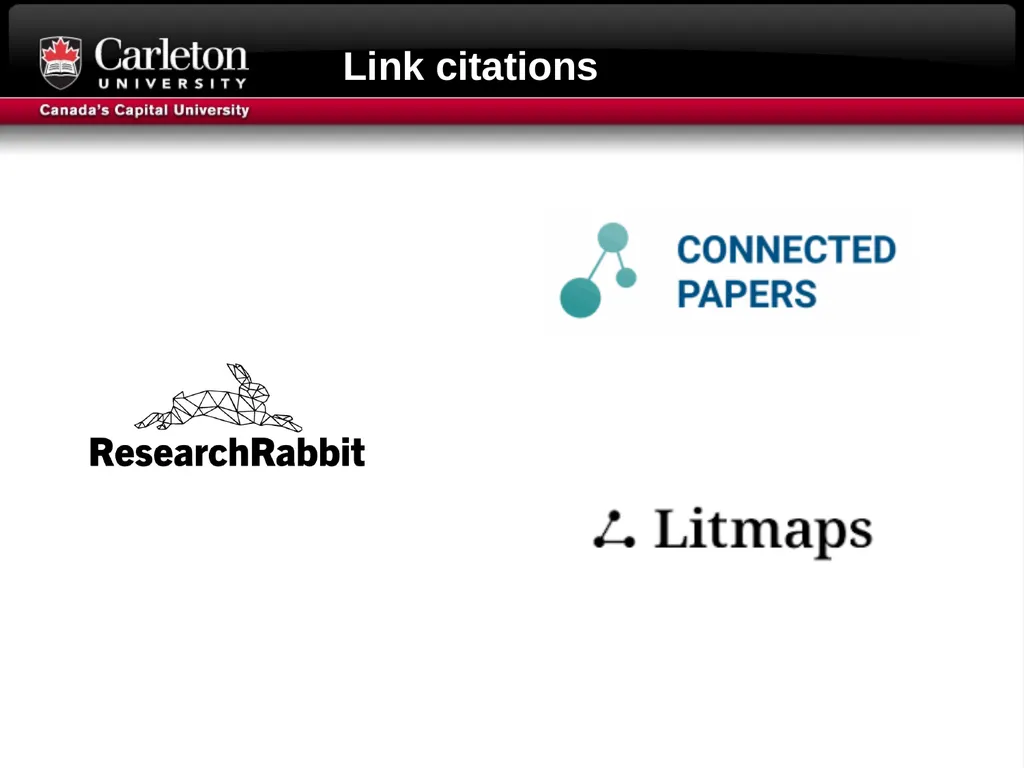
slide27. Link citations<br>
slide28. GenAI tools – non-academic<br>
slide29. Search Tool Demonstration Research Rabbit
PubMed
Web of Science
Scopus
Google Scholar<br>
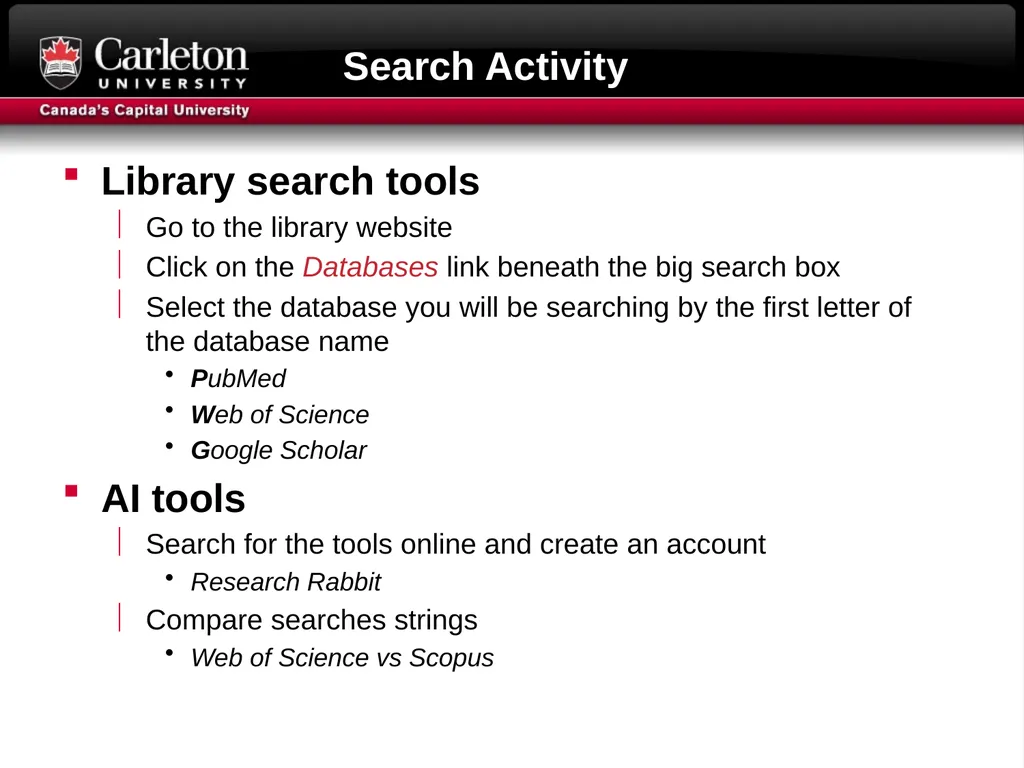
slide30. Search Activity Library search tools
Go to the library website
Click on the Databases link beneath the big search box
Select the database you will be searching by the first letter of the database name
PubMed
Web of Science
Google Scholar
AI tools
Search for the tools online and create an account
Research Rabbit
Compare searches strings
Web of Science vs Scopus<br>
slide31. Citation Management Citation Management
Zotero Demonstration<br>
slide2. Narrowing/Broadening a Topic Often a challenge
Need to do some background reading
Overview of the topic
Terminology used
Concept mapping can help
identify subtopics
narrow your focus
develop an outline<br>
slide3. Example: Concept Map<br>
slide4. Example: AIDS in Africa<br>
slide5. What makes a good SR question? Specific
aimed at measuring a parameter rather than developing a scenario
closed-framed question have everything specified whereas open-framed question do not
Similar to a primary study which answers a specific question<br>
slide6. Open vs closed framed questions How can we combat the effects of zinc deficiency?
VS
What is the effect of zinc supplementation in flour on birth defects in children?
How can we reduce bullying in schools?
VS
How effective are school-based programs in reducing bullying behaviour and victimization?<br>
slide7. Open to Closed General to specific What is the best method to deliver iron to children? Supplementation Fortification Education program for new mothers National standards Open-framed
policy question Generic
solutions Individual
interventions<br>
slide8. Framing a question What entity are you studying?
Disease, system
What is happening to it (exposure)?
What are you doing to it (intervention)? (independent variable)
Treatment of disease
Policy impact
What outcome(s) are you interested in? (dependent variable)
Often want to find the relationship between independent and dependent variables<br>
slide9. Framing the question Use a framework to identify the key elements
Key elements = Main ideas
PICO/PECO
P = Population, problem
I = Intervention, exposure
C = Comparator
O = Outcome<br>
slide10. PICO P - population, problem
I - intervention, exposure
C - comparator
O - outcome
What is the effect of iodine on
mental development in
children five years old and under?<br>
slide11. PICO P - population, problem
I - intervention, exposure
C - comparator
O - outcome
What is the effect of iodine on
mental development in
children five years old and under?<br>
slide12. What makes a good ScR question? Exploratory, open, often broader than SR questions
Identify and map/report/discuss characteristics/concepts in studies
Questions that ask about
Definitions/framing of concepts
Barriers and facilitators
Methods (how, why, when is a particular method used)
Gaps
Other….<br>
slide13. Examples Definitions/framing
How is the term 21st century skills discussed in relation to secondary education?
Barriers and facilitators
What are factors that influence continuing professional development over a nursing career?
Methods (how, why, when is a particular method used)
What approaches are being adopted to map patient journeys through health systems?
What justifications are provided for undertaking patient journey mapping research?<br>
slide14. PCC is a guide to help construct a clear and meaningful ScR question
Population: types of participants/entity, should be related to the objectives of the scoping review
Concept: “interventions” and/or “phenomena of interest”, “outcomes” may also be a component of a scoping review’s Concept
Context: may include, but is not limited to, consideration of cultural factors, such as geographic location and/or specific racial or gender-based interests. In some cases, context may also encompass details about the specific setting (such as acute care, primary health care or the community) Peters, M., Godfrey, C., McInerney, P., Baldini Soares, C., Khalil, H., & Parker, D. (2017). Scoping Reviews. In Joanna Briggs Institute Reviewer’s Manual. Joanna Briggs Institute. Framing a question<br>
slide15. Develop ScR Research Question How is the term 21st century skills discussed in relation to secondary education?
P - secondary schools
C - 21st century skills
C<br>
slide16. Pause here Know your objective/goal for conducting a review (the why)
Develop your question from this objective
Your research question is the most important part of this process
Everything flows from your question
It is worthwhile to spend time on developing a good research question<br>
slide17. Confirmation Bias Cherrypicking the facts to support an existing belief https://thedecisionlab.com/biases/confirmation-bias<br>
slide18. Searching Background searching
Gathering information on your topic to ensure there is sufficient/not too much literature
Narrowing or broadening your topic
Helps focus for the next step
Searching for your research topic
Not just one search
Different aspects of your search may require different searches
Be deliberate in your searching<br>
slide19. Search A balancing act
Sensitivity
Capture most relevant results
Capture more irrelevant results
Spend more time filtering/screening
Specificity (Precision)
Capture some relevant results
Capture fewer irrelevant results
Risk missing relevant results<br>
slide20. Searching for information Natural language
Do dioxins impact the occurrence of diabetes?
Are dioxins associated with an increase in diabetes?
What impact does dioxin exposure have on the incidence of diabetes?
Main ideas = concepts (tend to be nouns)
Dioxin
Dioxin, PCDD, TCDD, etc
Diabetes
Diabetes, diabetic, Wolfram syndrome, etc<br>
slide21. Searching for information Main ideas = concepts (tend to be nouns)
Search terms for each concept
Put them together
Get some results
Look at the results
Repeat<br>
slide22. Techniques for Searching Boolean operators
AND (for combining different concepts, finds fewer results)
OR (for combining related terms, finds more results)
NOT (for eliminating irrelevant results, finds less results)
Phrase searching
Quotations – “extreme environment”
Truncation
Asterix – oxygen*
Brackets
Isolate your main concepts, gather together your search terms – (lake OR river) AND (mollusk OR Mollusca)<br>
slide23. Different search tools
Author keywords
Controlled vocabulary
Related/Similar articles
Author search
Specific journal
Citation tracking
Review articles Strategies for Searching Concepts
Search terms
Discover new terms
Filters
Date
Subject categories
Document types
Search within<br>
slide24. Interlibrary loan Can take a day or two, sometimes just hours, to receive an electronic copy of an article
If you do a search using a library database, the ILL form auto-populates
Free service<br>
slide25. Types of AI tools to help with research Generate answers
Requires a question/prompt
Provides
Summary
Matrix of data extraction
Consensus of evidence
Link citations
Requires a seed article
Provides
Connections to relevant literature not found by keyword search
Visualizations
The following tools use academic sources only!<br>
slide26. Generate answers<br>
slide27. Link citations<br>
slide28. GenAI tools – non-academic<br>
slide29. Search Tool Demonstration Research Rabbit
PubMed
Web of Science
Scopus
Google Scholar<br>
slide30. Search Activity Library search tools
Go to the library website
Click on the Databases link beneath the big search box
Select the database you will be searching by the first letter of the database name
PubMed
Web of Science
Google Scholar
AI tools
Search for the tools online and create an account
Research Rabbit
Compare searches strings
Web of Science vs Scopus<br>
slide31. Citation Management Citation Management
Zotero Demonstration<br>