
Respiration Syllabus Definition and role of



Description: Respiration Syllabus Definition and role of aerobic respiration. Representation by a balanced equation of the overall sequence of reactions for glucose. A simple treatment of aerobic respiration of glucose by reference to a two-stage
Related Topics
Download Presentation
"Respiration Syllabus Definition and role of" is the property of its rightful owner. Permission is granted to download and print the materials on this website for personal, non-commercial use only, and to display it on your personal computer provided you do not modify the materials and that you retain all copyright notices contained in the materials. By downloading content from our website, you accept the terms of this agreement.
Presentation Transcript
slide1. Respiration<br>
slide2. Syllabus Definition and role of "aerobic respiration".
Representation by a balanced equation of the overall sequence of reactions for glucose.
A simple treatment of aerobic respiration of glucose by reference to a two-stage process.
Stage 1 does not require oxygen and releases a small amount of energy.
First-stage process: Glycolysis – the conversion of a six-carbon carbohydrate to pyruvate with the generation of ATP. Fermentation option – ethanol or lactic acid production.
Stage 2 does require oxygen and releases a large amount of energy.
Cellular location of the first and second stage process
Second-stage process: Production of Acetyl Co.A and one molecule of carbon dioxide. Krebs Cycle and the electron transport system, which produce more carbon dioxide, water, and ATP molecules.
Definition of "anaerobic respiration". Reference to fermentation.
Examine the role of microorganisms in industrial fermentation, including bioprocessing with immobilised cells: procedure, advantages, and use in bioreactors.
Prepare and show the production of alcohol by yeast.<br>
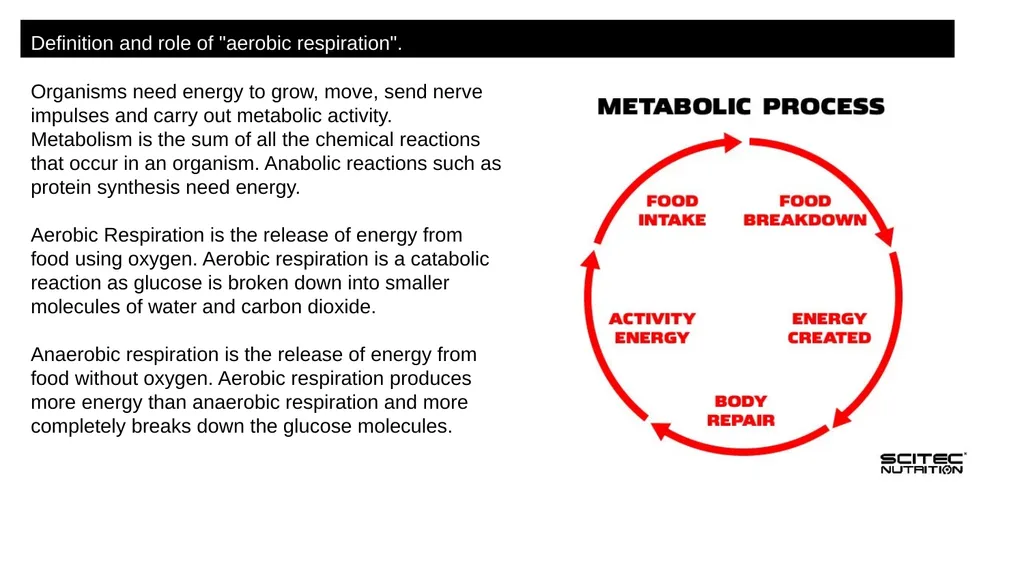
slide3. Definition and role of "aerobic respiration". Organisms need energy to grow, move, send nerve impulses and carry out metabolic activity.
Metabolism is the sum of all the chemical reactions that occur in an organism. Anabolic reactions such as protein synthesis need energy.
Aerobic Respiration is the release of energy from food using oxygen. Aerobic respiration is a catabolic reaction as glucose is broken down into smaller molecules of water and carbon dioxide.
Anaerobic respiration is the release of energy from food without oxygen. Aerobic respiration produces more energy than anaerobic respiration and more completely breaks down the glucose molecules.<br>
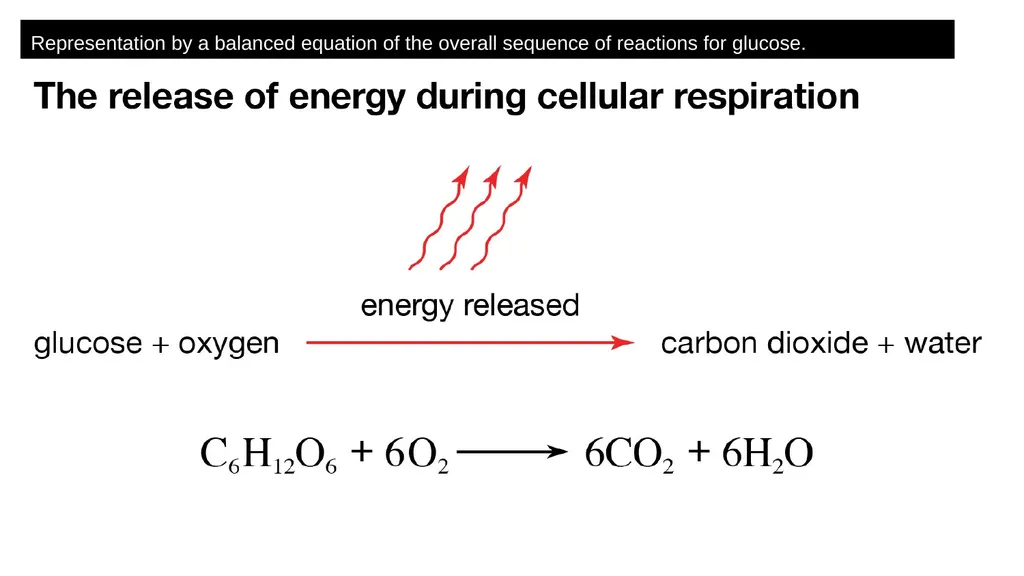
slide4. Representation by a balanced equation of the overall sequence of reactions for glucose.<br>
slide5. A simple treatment of aerobic respiration of glucose by reference to a two-stage process. Stage 1 does not require oxygen and releases a small amount of energy. Stage 2 does require oxygen and releases a large amount of energy.
Cellular location of the first and second stage process Respiration occurs in 2 stages.
Stage 1 does not require oxygen and releases a small amount of energy.
Stage 1 of respiration occurs in the cytosol (cytoplasm without organelles)
Stage 2 does require oxygen and releases a large amount of energy.
Stage 2 occurs in the mitochondria and needs oxygen to occur.<br>
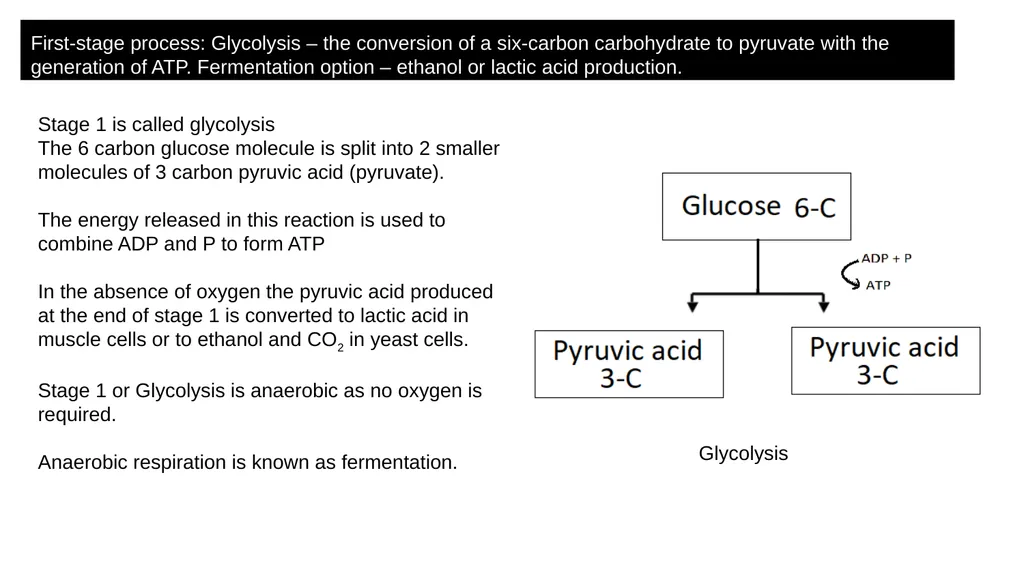
slide6. First-stage process: Glycolysis – the conversion of a six-carbon carbohydrate to pyruvate with the generation of ATP. Fermentation option – ethanol or lactic acid production. Stage 1 is called glycolysis
The 6 carbon glucose molecule is split into 2 smaller molecules of 3 carbon pyruvic acid (pyruvate).
The energy released in this reaction is used to combine ADP and P to form ATP
In the absence of oxygen the pyruvic acid produced at the end of stage 1 is converted to lactic acid in muscle cells or to ethanol and CO2 in yeast cells.
Stage 1 or Glycolysis is anaerobic as no oxygen is required.
Anaerobic respiration is known as fermentation. Glycolysis<br>
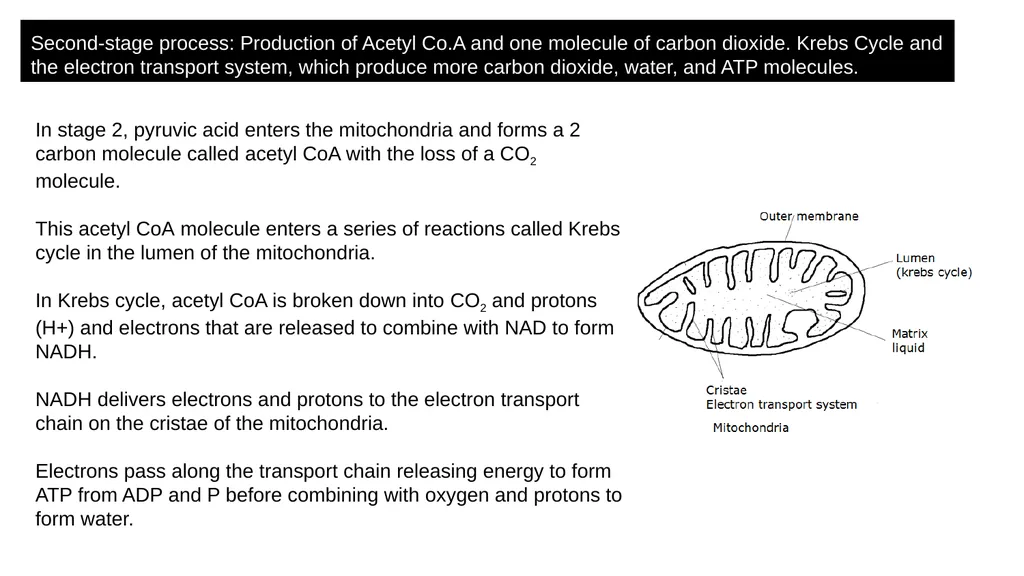
slide7. Second-stage process: Production of Acetyl Co.A and one molecule of carbon dioxide. Krebs Cycle and the electron transport system, which produce more carbon dioxide, water, and ATP molecules. In stage 2, pyruvic acid enters the mitochondria and forms a 2 carbon molecule called acetyl CoA with the loss of a CO2 molecule.
This acetyl CoA molecule enters a series of reactions called Krebs cycle in the lumen of the mitochondria.
In Krebs cycle, acetyl CoA is broken down into CO2 and protons (H+) and electrons that are released to combine with NAD to form NADH.
NADH delivers electrons and protons to the electron transport chain on the cristae of the mitochondria.
Electrons pass along the transport chain releasing energy to form ATP from ADP and P before combining with oxygen and protons to form water.<br>
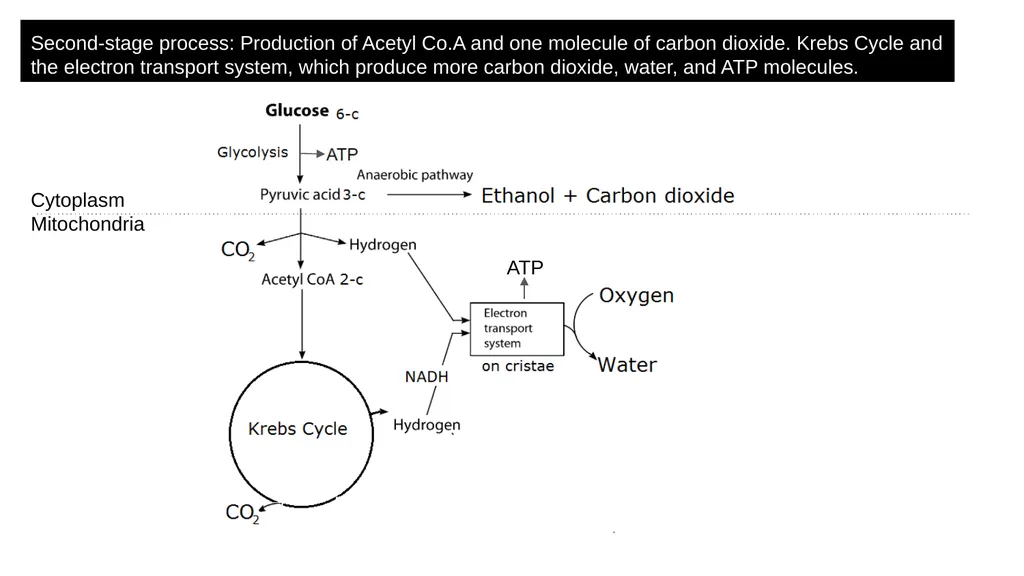
slide8. Second-stage process: Production of Acetyl Co.A and one molecule of carbon dioxide. Krebs Cycle and the electron transport system, which produce more carbon dioxide, water, and ATP molecules. Cytoplasm
Mitochondria ATP<br>
slide9. Definition of "anaerobic respiration". Reference to fermentation. Anaerobic Respiration is the release of energy from food without oxygen. Anaerobic respiration occurs entirely in the cytosol and produces less energy than aerobic respiration. If only stage 1 of respiration occurs it is called anaerobic respiration.
Glucose → Alcohol + Carbon dioxide + energy (in yeast)
Glucose → Lactic Acid + energy (in muscle cells)
Alcohol and carbon dioxide are products of respiration by yeast cells (used in brewing and baking). Lactic acid is a product of anaerobic respiration in muscles.
During heavy exercise the muscles may not receive enough oxygen so stage 2 of respiration is not possible. When muscles break down glucose in the absence of oxygen lactic acid is formed. Lactic acid builds up in the blood and forms painful cramps and must be broken down by the liver.<br>
slide10. Examine the role of microorganisms in industrial fermentation, including bioprocessing with immobilised cells: procedure, advantages, and use in bioreactors. Anaerobic respiration is called fermentation.
Bioprocessing is any process that uses complete living cells or their components (e.g., bacteria, fungi, enzymes, chloroplasts) to obtain desired products such as vitamins, food additives and medicines.
Yeast is an organism capable of anaerobic respiration that is used in the fermentation of beer. Ethanol and CO2 are made when yeast ferments glucose. Immobilised cells such as yeast can be trapped in sodium alginate. The yeast cells continue to ferment glucose but are easy to separate from the product. Immobilised cells and enzymes can easily be reused.
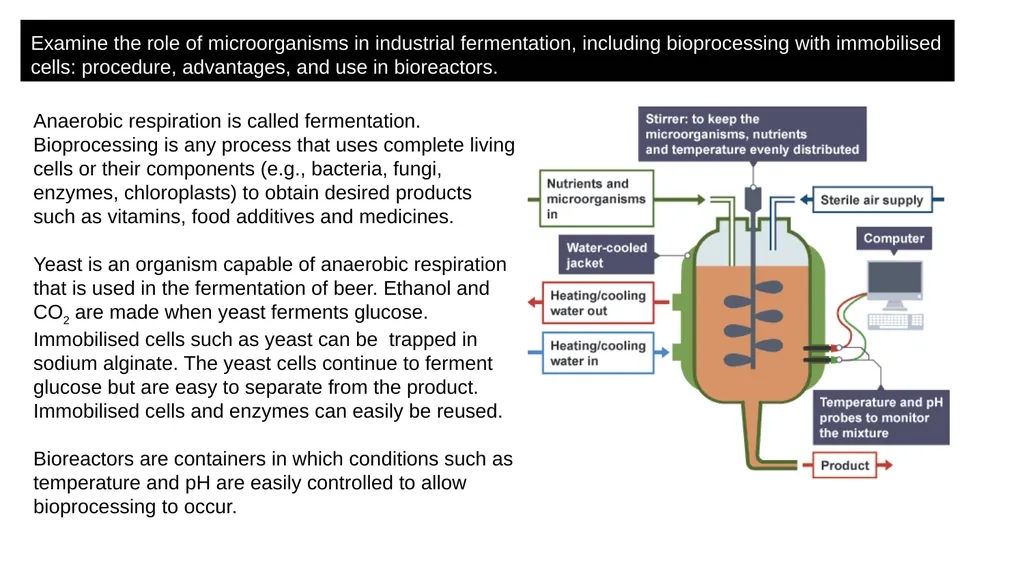
Bioreactors are containers in which conditions such as temperature and pH are easily controlled to allow bioprocessing to occur.<br>
slide11. Prepare and show the production of alcohol by yeast. Place yeast cells in a solution of water and glucose in a conical flask. Use boiled cooled water to remove the oxygen. Place the flask in a water bath at 30oC. A second flask with water and glucose but no yeast can be used as a control.
A fermentation lock (air lock) is used to keep out oxygen. (an oil layer would also keep out oxygen)
Carbon dioxide is produced during the experiment and can be seen as bubbles.
Fermentation is finished when the bubbles stop. Filter the mixture into a test tube.
The alcohol produced is detected with the Iodoform test. Add potassium iodide, Add sodium hypochlorite, Heat, The colour changes from orange to yellow (crystals) showing alcohol present.<br>
slide2. Syllabus Definition and role of "aerobic respiration".
Representation by a balanced equation of the overall sequence of reactions for glucose.
A simple treatment of aerobic respiration of glucose by reference to a two-stage process.
Stage 1 does not require oxygen and releases a small amount of energy.
First-stage process: Glycolysis – the conversion of a six-carbon carbohydrate to pyruvate with the generation of ATP. Fermentation option – ethanol or lactic acid production.
Stage 2 does require oxygen and releases a large amount of energy.
Cellular location of the first and second stage process
Second-stage process: Production of Acetyl Co.A and one molecule of carbon dioxide. Krebs Cycle and the electron transport system, which produce more carbon dioxide, water, and ATP molecules.
Definition of "anaerobic respiration". Reference to fermentation.
Examine the role of microorganisms in industrial fermentation, including bioprocessing with immobilised cells: procedure, advantages, and use in bioreactors.
Prepare and show the production of alcohol by yeast.<br>
slide3. Definition and role of "aerobic respiration". Organisms need energy to grow, move, send nerve impulses and carry out metabolic activity.
Metabolism is the sum of all the chemical reactions that occur in an organism. Anabolic reactions such as protein synthesis need energy.
Aerobic Respiration is the release of energy from food using oxygen. Aerobic respiration is a catabolic reaction as glucose is broken down into smaller molecules of water and carbon dioxide.
Anaerobic respiration is the release of energy from food without oxygen. Aerobic respiration produces more energy than anaerobic respiration and more completely breaks down the glucose molecules.<br>
slide4. Representation by a balanced equation of the overall sequence of reactions for glucose.<br>
slide5. A simple treatment of aerobic respiration of glucose by reference to a two-stage process. Stage 1 does not require oxygen and releases a small amount of energy. Stage 2 does require oxygen and releases a large amount of energy.
Cellular location of the first and second stage process Respiration occurs in 2 stages.
Stage 1 does not require oxygen and releases a small amount of energy.
Stage 1 of respiration occurs in the cytosol (cytoplasm without organelles)
Stage 2 does require oxygen and releases a large amount of energy.
Stage 2 occurs in the mitochondria and needs oxygen to occur.<br>
slide6. First-stage process: Glycolysis – the conversion of a six-carbon carbohydrate to pyruvate with the generation of ATP. Fermentation option – ethanol or lactic acid production. Stage 1 is called glycolysis
The 6 carbon glucose molecule is split into 2 smaller molecules of 3 carbon pyruvic acid (pyruvate).
The energy released in this reaction is used to combine ADP and P to form ATP
In the absence of oxygen the pyruvic acid produced at the end of stage 1 is converted to lactic acid in muscle cells or to ethanol and CO2 in yeast cells.
Stage 1 or Glycolysis is anaerobic as no oxygen is required.
Anaerobic respiration is known as fermentation. Glycolysis<br>
slide7. Second-stage process: Production of Acetyl Co.A and one molecule of carbon dioxide. Krebs Cycle and the electron transport system, which produce more carbon dioxide, water, and ATP molecules. In stage 2, pyruvic acid enters the mitochondria and forms a 2 carbon molecule called acetyl CoA with the loss of a CO2 molecule.
This acetyl CoA molecule enters a series of reactions called Krebs cycle in the lumen of the mitochondria.
In Krebs cycle, acetyl CoA is broken down into CO2 and protons (H+) and electrons that are released to combine with NAD to form NADH.
NADH delivers electrons and protons to the electron transport chain on the cristae of the mitochondria.
Electrons pass along the transport chain releasing energy to form ATP from ADP and P before combining with oxygen and protons to form water.<br>
slide8. Second-stage process: Production of Acetyl Co.A and one molecule of carbon dioxide. Krebs Cycle and the electron transport system, which produce more carbon dioxide, water, and ATP molecules. Cytoplasm
Mitochondria ATP<br>
slide9. Definition of "anaerobic respiration". Reference to fermentation. Anaerobic Respiration is the release of energy from food without oxygen. Anaerobic respiration occurs entirely in the cytosol and produces less energy than aerobic respiration. If only stage 1 of respiration occurs it is called anaerobic respiration.
Glucose → Alcohol + Carbon dioxide + energy (in yeast)
Glucose → Lactic Acid + energy (in muscle cells)
Alcohol and carbon dioxide are products of respiration by yeast cells (used in brewing and baking). Lactic acid is a product of anaerobic respiration in muscles.
During heavy exercise the muscles may not receive enough oxygen so stage 2 of respiration is not possible. When muscles break down glucose in the absence of oxygen lactic acid is formed. Lactic acid builds up in the blood and forms painful cramps and must be broken down by the liver.<br>
slide10. Examine the role of microorganisms in industrial fermentation, including bioprocessing with immobilised cells: procedure, advantages, and use in bioreactors. Anaerobic respiration is called fermentation.
Bioprocessing is any process that uses complete living cells or their components (e.g., bacteria, fungi, enzymes, chloroplasts) to obtain desired products such as vitamins, food additives and medicines.
Yeast is an organism capable of anaerobic respiration that is used in the fermentation of beer. Ethanol and CO2 are made when yeast ferments glucose. Immobilised cells such as yeast can be trapped in sodium alginate. The yeast cells continue to ferment glucose but are easy to separate from the product. Immobilised cells and enzymes can easily be reused.
Bioreactors are containers in which conditions such as temperature and pH are easily controlled to allow bioprocessing to occur.<br>
slide11. Prepare and show the production of alcohol by yeast. Place yeast cells in a solution of water and glucose in a conical flask. Use boiled cooled water to remove the oxygen. Place the flask in a water bath at 30oC. A second flask with water and glucose but no yeast can be used as a control.
A fermentation lock (air lock) is used to keep out oxygen. (an oil layer would also keep out oxygen)
Carbon dioxide is produced during the experiment and can be seen as bubbles.
Fermentation is finished when the bubbles stop. Filter the mixture into a test tube.
The alcohol produced is detected with the Iodoform test. Add potassium iodide, Add sodium hypochlorite, Heat, The colour changes from orange to yellow (crystals) showing alcohol present.<br>