
Respiratory Fit Testing Train the Trainer One part
CS
Published · 73 slides · 0 views
1 / 1
Description
Respiratory Fit Testing Train the Trainer One part of an employers comprehensive safety program with a focus on respiratory protection. June 2022 Housekeeping Details Welcome Introduction Welcome to Respiratory Fit Testing TTT Successful
Related Topics
Share
Embed code
Download this presentation From Below
"Respiratory Fit Testing Train the Trainer One part" is the property of its rightful owner. Permission is granted to download and print the materials on this website for personal, non-commercial use only, and to display it on your personal computer provided you do not modify the materials and that you retain all copyright notices contained in the materials. By downloading content from our website, you accept the terms of this agreement.
Presentation Transcript
01
Respiratory Fit Testing
Train the Trainer
One part of an employer’s comprehensive safety program
with a focus on respiratory protection.
June 2022<br>
Train the Trainer
One part of an employer’s comprehensive safety program
with a focus on respiratory protection.
June 2022<br>
02
Housekeeping Details<br>
03
Welcome & Introduction Welcome to Respiratory Fit Testing TTT
Successful completion of this program includes:
active involvement in discussion
return demonstration
Evaluation – pre session
Please follow along in the Fit Tester Protocols and Resources Binder<br>
Successful completion of this program includes:
active involvement in discussion
return demonstration
Evaluation – pre session
Please follow along in the Fit Tester Protocols and Resources Binder<br>
04
Introductions Your name
Where you work
Previous experience with fit testing<br>
Where you work
Previous experience with fit testing<br>
05
What You Will Learn Understanding Saskatchewan’s Occupational Health and Safety legislation and CSA standards pertaining to Fit testing
Overview of roles and responsibilities in a respiratory protection program
Hazard assessment
Selection of appropriate respirator
Respirator fit testing (qualitative and quantitative)
Orientation (self directed and facilitated)
Health Surveillance
Training
Program evaluation
Recordkeeping
Cleaning, inspection, maintenance and storage of respirators
Principles of Qualitative Fit Testing
Principles of Quantitative Fit Testing Page 1<br>
Overview of roles and responsibilities in a respiratory protection program
Hazard assessment
Selection of appropriate respirator
Respirator fit testing (qualitative and quantitative)
Orientation (self directed and facilitated)
Health Surveillance
Training
Program evaluation
Recordkeeping
Cleaning, inspection, maintenance and storage of respirators
Principles of Qualitative Fit Testing
Principles of Quantitative Fit Testing Page 1<br>
06
SASWH Approved Fit Testers Fit test trainers approved by SASWH have access to resources such as a PowerPoint for orientation and forms referenced in this material.
Visit www.saswh.ca and login/register with the following username and password (case sensitive)
Username: RPP1
Password: RPP2 Page 1<br>
Visit www.saswh.ca and login/register with the following username and password (case sensitive)
Username: RPP1
Password: RPP2 Page 1<br>
07
Re-Approval Fit testers require re-approval every 2 years by attending SASWH’s fit tester re-evaluation session.
A fit tester will be eligible for re-approval so long as they have fit tested/taught a minimum of 5 workers in the previous 2 years. Page 1<br>
A fit tester will be eligible for re-approval so long as they have fit tested/taught a minimum of 5 workers in the previous 2 years. Page 1<br>
08
Legislation Definition of “train”
Means to give information and explanation to a worker with respect to a particular subject matter and require a practical demonstration that the worker has acquired the knowledge or skill related to the subject-matter Page 2<br>
Means to give information and explanation to a worker with respect to a particular subject matter and require a practical demonstration that the worker has acquired the knowledge or skill related to the subject-matter Page 2<br>
09
Supplies for Fit Testing Orientation (either the presentation or worker’s can read the document)
Respirator user screening form
Respirator user tracking form
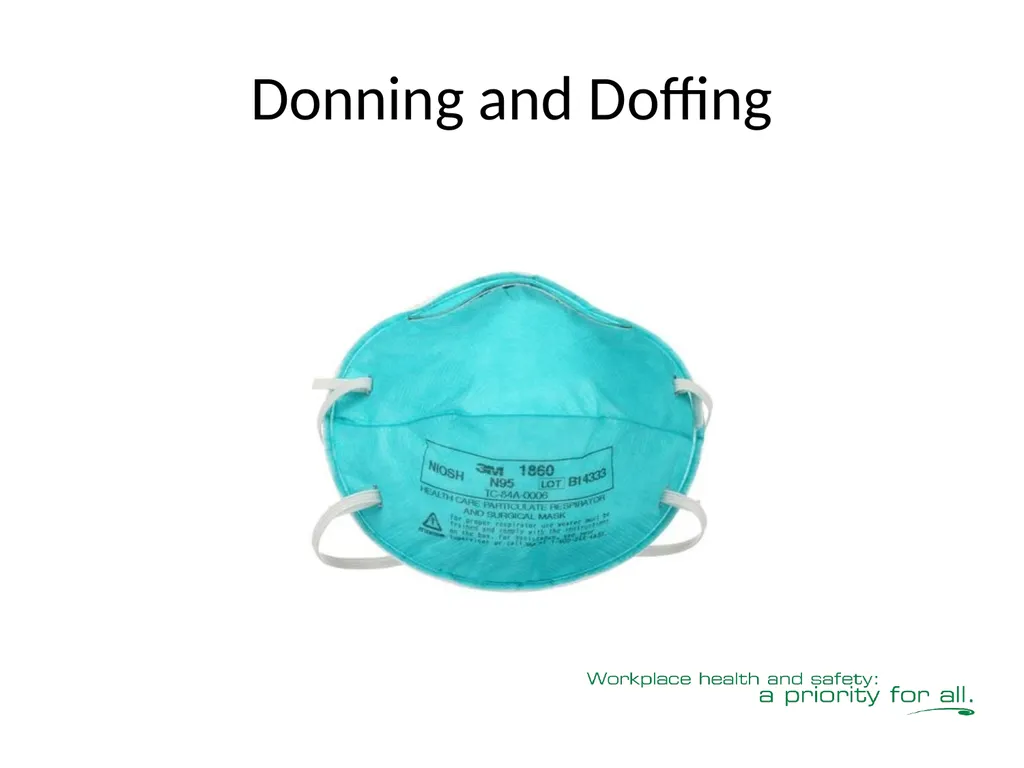
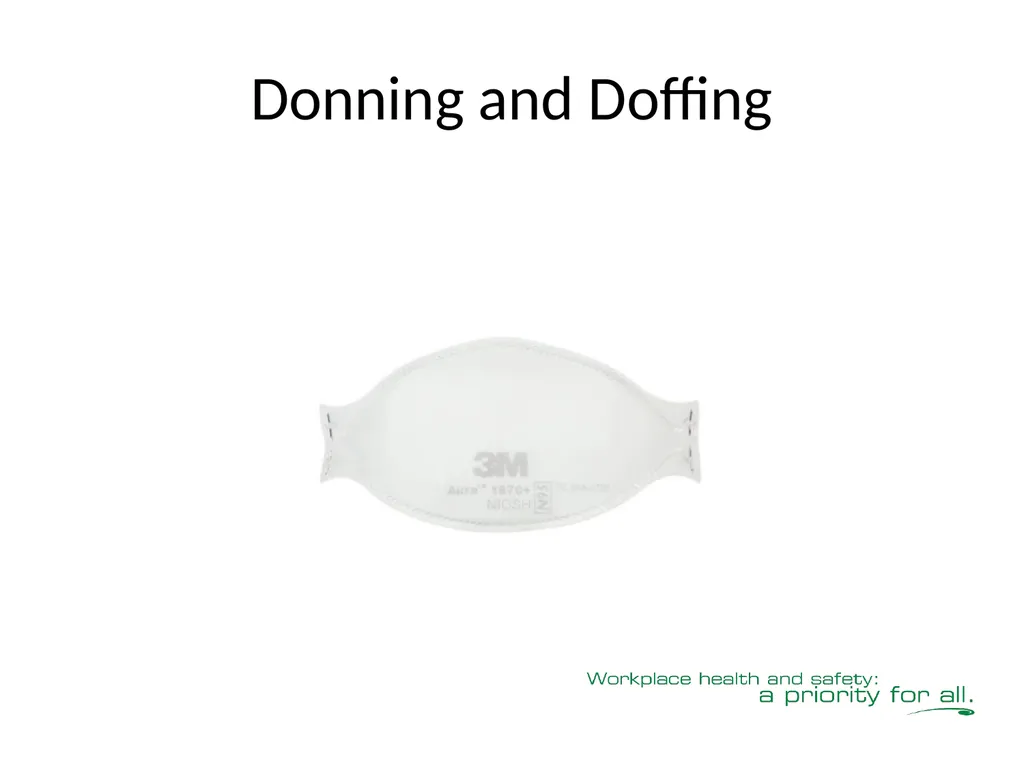
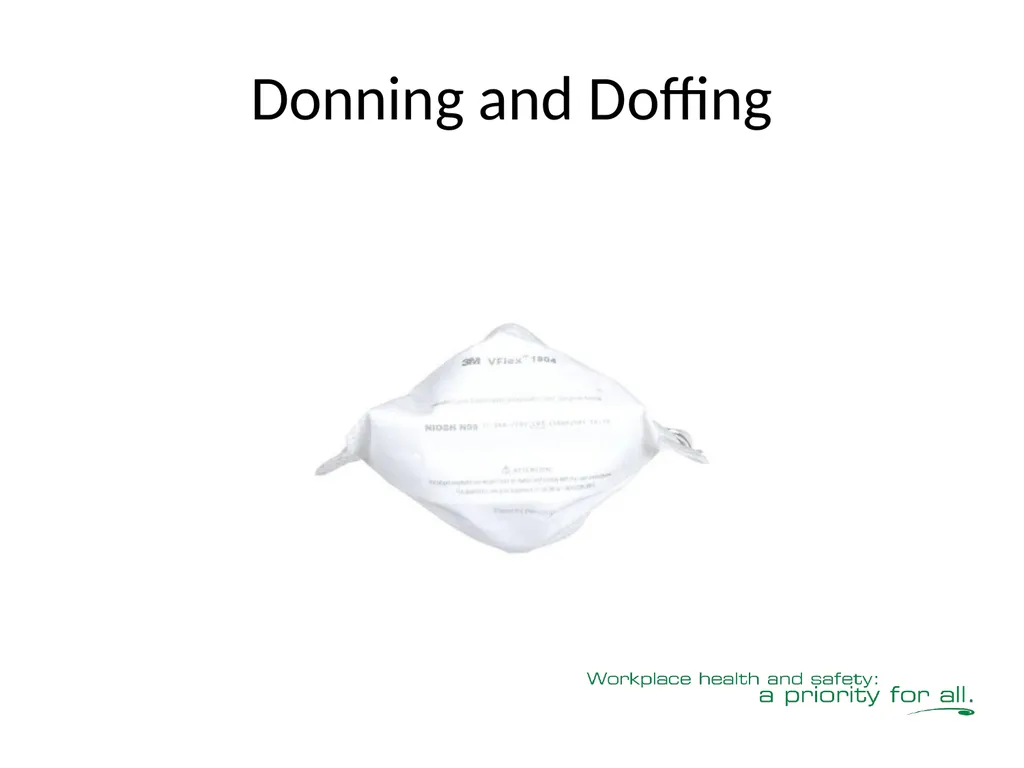
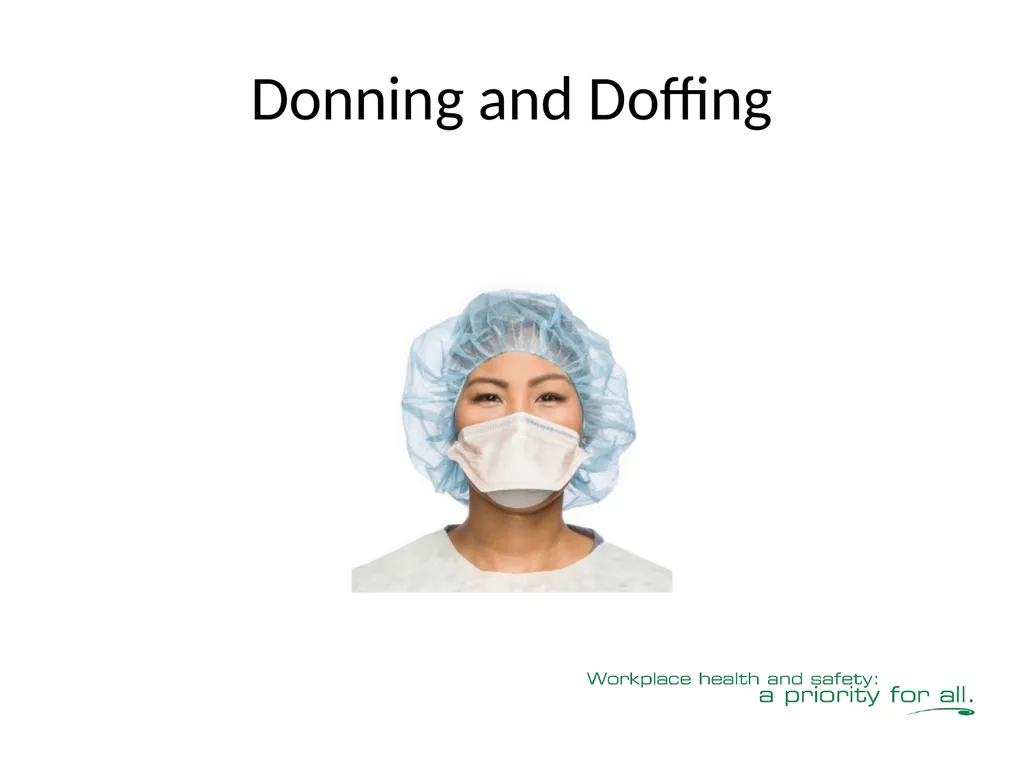
NIOSH approved respirators (elastomeric and/or disposable)
Mirror
Equipment/Supplies for the method of fit testing you are conducting (qualitative, or quantitative)
Safety data sheet for the sensitivity solution, and fit test solution (qualitative)
Safety data sheet for the alcohol solution (quantitative)
Water for participants of qualitative fit testing
Stickers/Wallet cards
Additional PPE that may be required based on the current situation Page 2<br>
Respirator user screening form
Respirator user tracking form
NIOSH approved respirators (elastomeric and/or disposable)
Mirror
Equipment/Supplies for the method of fit testing you are conducting (qualitative, or quantitative)
Safety data sheet for the sensitivity solution, and fit test solution (qualitative)
Safety data sheet for the alcohol solution (quantitative)
Water for participants of qualitative fit testing
Stickers/Wallet cards
Additional PPE that may be required based on the current situation Page 2<br>
10
Risk Assessments Self Risk Assessment
Consider if the fit tester is not able to perform the fit testing process on the day of training, or if a second fit tester is needed to assist
Assess communication skills to ensure participants understand the information fit testers are providing
Consider your own sensitivity to bitrex (when using qualitative method)
Is the fit tester equipped to handle an adverse reaction, who would the fit tester connect with if an adverse reaction happens, what is the emergency protocol Page 3<br>
Consider if the fit tester is not able to perform the fit testing process on the day of training, or if a second fit tester is needed to assist
Assess communication skills to ensure participants understand the information fit testers are providing
Consider your own sensitivity to bitrex (when using qualitative method)
Is the fit tester equipped to handle an adverse reaction, who would the fit tester connect with if an adverse reaction happens, what is the emergency protocol Page 3<br>
11
Risk Assessments Equipment Risk Assessment
Ensure equipment has been maintained according to manufacturer guidelines (calibration, cleaning of nebulizers, humidifier for quantitative)
Check for loose classroom chair legs, table legs, frayed extension cords to ensure these items do no pose a risk of injury Page 3<br>
Ensure equipment has been maintained according to manufacturer guidelines (calibration, cleaning of nebulizers, humidifier for quantitative)
Check for loose classroom chair legs, table legs, frayed extension cords to ensure these items do no pose a risk of injury Page 3<br>
12
Risk Assessments Environment Risk Assessment
Consider loose tile/carpet, burnt out lightbulbs are repaired
Consider proximity to hazards/violence/excessive noise/odours/access/exits
For qualitative: rooms are to be well ventilated
For quantitative: a smaller room may be better for the count of air particulates Page 3<br>
Consider loose tile/carpet, burnt out lightbulbs are repaired
Consider proximity to hazards/violence/excessive noise/odours/access/exits
For qualitative: rooms are to be well ventilated
For quantitative: a smaller room may be better for the count of air particulates Page 3<br>
13
Reporting, Documenting, Communicating Identified Risks Any defective/non-functioning equipment and/or items are not to be used during training
Report these risks, including how they were eliminated or managed according to the process for the site/area fit testing is being done Page 3<br>
Report these risks, including how they were eliminated or managed according to the process for the site/area fit testing is being done Page 3<br>
14
Three Rights of Workers The Right to Know
Every worker has a right to be informed about the hazards at work, trained to recognize those hazards, and trained to protected themselves from those hazards
The Right to Participate
The occupational health committee (OHC) is the principal vehicle for worker participation in the workplace
The Right to Refuse
A worker has the right to refuse unusually dangerous work Page 5<br>
Every worker has a right to be informed about the hazards at work, trained to recognize those hazards, and trained to protected themselves from those hazards
The Right to Participate
The occupational health committee (OHC) is the principal vehicle for worker participation in the workplace
The Right to Refuse
A worker has the right to refuse unusually dangerous work Page 5<br>
15
CSA Standard CAN/CSA-Z94.4-18 Selection, use and care of respirators is the national standard of Canada. It provides guidelines for workplace respiratory fit testing programs Page 6<br>
16
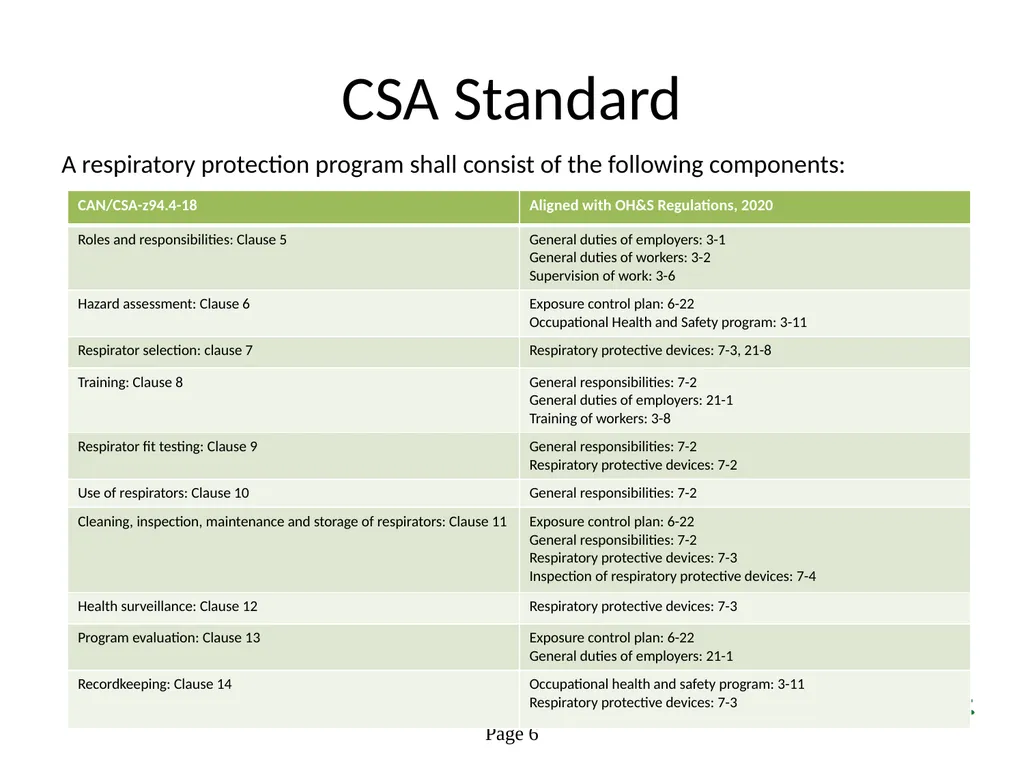
CSA Standard A respiratory protection program shall consist of the following components: Page 6<br>
17
Roles and Responsibilities Employer (Clause 4.2.1): is responsible for preparing and implementing, in consultation with users, a written respiratory protection program including written procedures
Program Administrator (Clause 5.1): is responsible for the administration of the respiratory protection program
Respirator Users (Clause 5.2): once they have received their training, must ensure that they use and care for respirators in accordance with the written instructions and training received Page 6<br>
Program Administrator (Clause 5.1): is responsible for the administration of the respiratory protection program
Respirator Users (Clause 5.2): once they have received their training, must ensure that they use and care for respirators in accordance with the written instructions and training received Page 6<br>
18
Roles and Responsibilities Supervisor (Clause 5.3): shall monitor respirator user to ensure that respiratory protection program requirements are being met, including user screening, training, fit testing and any medical assessment required are completed prior to assigning a user any task that requires the use of a respirator
Respirator Fit Tester (Clause 5.5) is the individual responsible for the hands on fit testing and training of respirator users. A fit tester MUST follow the protocols identified in the respiratory protection program. Page 7<br>
Respirator Fit Tester (Clause 5.5) is the individual responsible for the hands on fit testing and training of respirator users. A fit tester MUST follow the protocols identified in the respiratory protection program. Page 7<br>
19
Hazard Assessment There are 2 main types of respiratory hazards in the workplace:
Oxygen deficient – Oxygen concentration is confirmed to be below 19.5%
Airborne Contaminants – the work area has levels of contamination which exceed workplace guidelines
Airborne contaminants include:
Biological hazards
Dusts
Mists
Vapours
Fumes
Gases
Fibers Page 8<br>
Oxygen deficient – Oxygen concentration is confirmed to be below 19.5%
Airborne Contaminants – the work area has levels of contamination which exceed workplace guidelines
Airborne contaminants include:
Biological hazards
Dusts
Mists
Vapours
Fumes
Gases
Fibers Page 8<br>
20
NOTE None of the respirators covered in SASWH’s fit testing session provide protection in oxygen depleted atmospheres
Air-supplying units are not part of this training and employees need specialized training to use air-supplying respirators
Employees should never be allowed to enter suspect or confirmed oxygen depleted environments
Always check with your supervisor regarding entering an oxygen deficient area Page 8<br>
Air-supplying units are not part of this training and employees need specialized training to use air-supplying respirators
Employees should never be allowed to enter suspect or confirmed oxygen depleted environments
Always check with your supervisor regarding entering an oxygen deficient area Page 8<br>
21
How to assess the hazards CSA Z94.4-18, Section 6
6.1 General: a hazard and risk assessment shall be performed by a qualified person (or persons) to determine the respiratory hazards present and to assist in the selection of an appropriate respirator where required Page 8/9<br>
6.1 General: a hazard and risk assessment shall be performed by a qualified person (or persons) to determine the respiratory hazards present and to assist in the selection of an appropriate respirator where required Page 8/9<br>
22
Selection of Appropriate Respirator Regardless of the respirator chosen, ensure it is NIOSH approved. For healthcare, the respirator must be healthcare specific (e.g. fluid resistant)
Types of respirators:
Atmosphere-supplying respirators (SCBA, airline, multifunctional)
Air purifying respirators, non-powered (APR) and powered (PAPR)
Combined respirator (a configuration incorporating both atmosphere-supplying and air purifying
Escape-only respirators (atmosphere supplying or air purifying Page 9<br>
Types of respirators:
Atmosphere-supplying respirators (SCBA, airline, multifunctional)
Air purifying respirators, non-powered (APR) and powered (PAPR)
Combined respirator (a configuration incorporating both atmosphere-supplying and air purifying
Escape-only respirators (atmosphere supplying or air purifying Page 9<br>
23
Styles of APRs There are several styles of air purifying respirators:
Non-powered air purifying
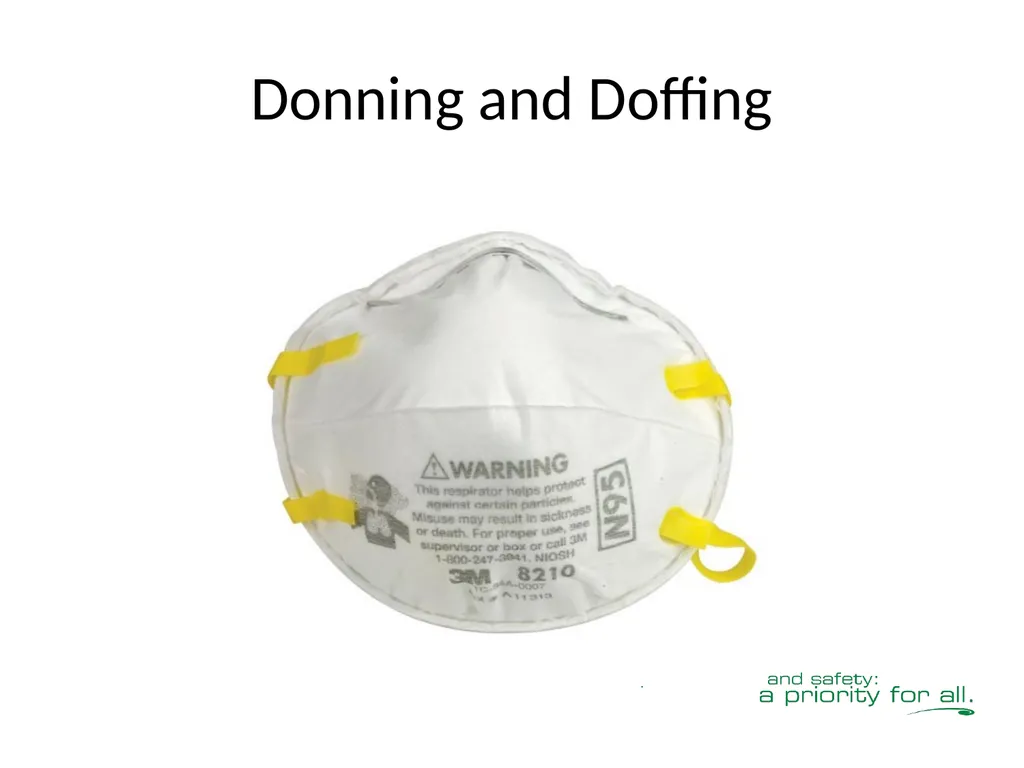
Disposable respirators
Fairly inexpensive
Marked single use
Made of cloth-like fibers and cannot be washed and reused
N95 and N100 fall in this category
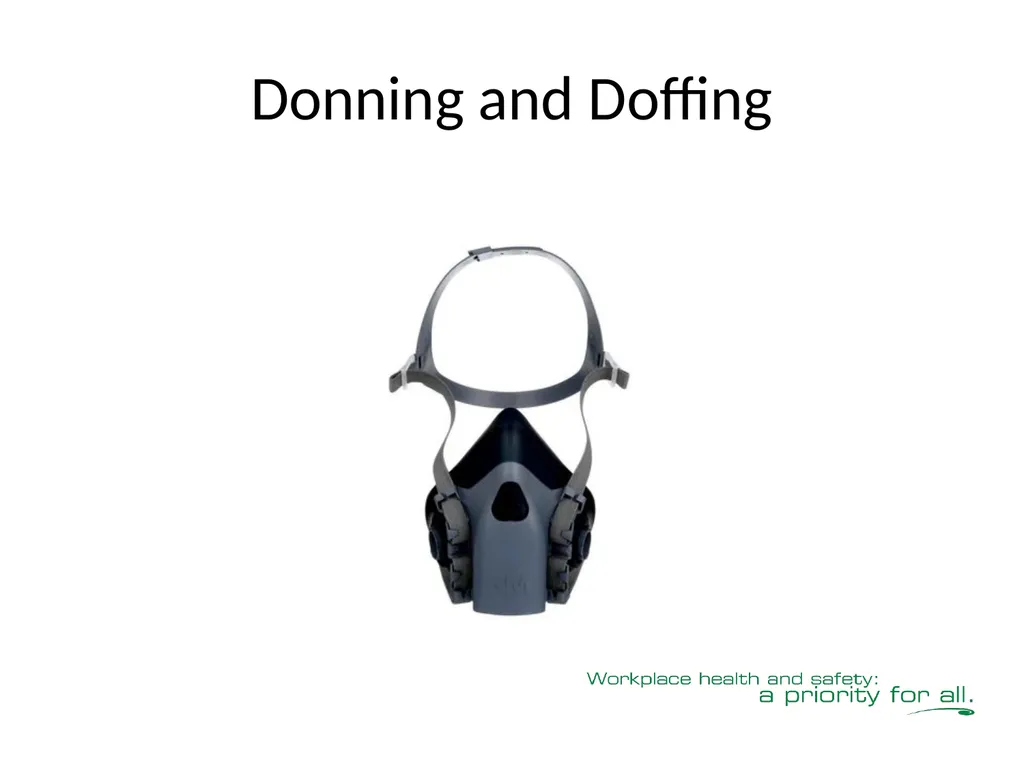
Half-face elastomeric respirator
Full face elastomeric respirator
Powered air purifying
Tight seal which requires fit testing
Loose hood does not require fit testing Page 10<br>
Non-powered air purifying
Disposable respirators
Fairly inexpensive
Marked single use
Made of cloth-like fibers and cannot be washed and reused
N95 and N100 fall in this category
Half-face elastomeric respirator
Full face elastomeric respirator
Powered air purifying
Tight seal which requires fit testing
Loose hood does not require fit testing Page 10<br>
24
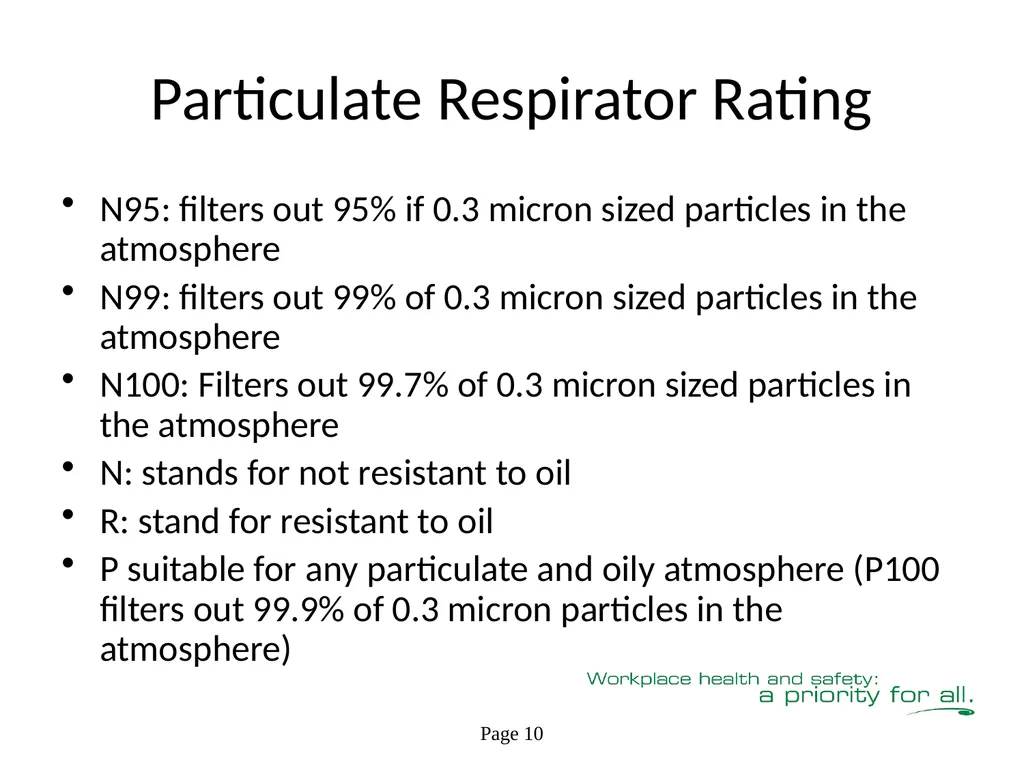
Particulate Respirator Rating N95: filters out 95% if 0.3 micron sized particles in the atmosphere
N99: filters out 99% of 0.3 micron sized particles in the atmosphere
N100: Filters out 99.7% of 0.3 micron sized particles in the atmosphere
N: stands for not resistant to oil
R: stand for resistant to oil
P suitable for any particulate and oily atmosphere (P100 filters out 99.9% of 0.3 micron particles in the atmosphere) Page 10<br>
N99: filters out 99% of 0.3 micron sized particles in the atmosphere
N100: Filters out 99.7% of 0.3 micron sized particles in the atmosphere
N: stands for not resistant to oil
R: stand for resistant to oil
P suitable for any particulate and oily atmosphere (P100 filters out 99.9% of 0.3 micron particles in the atmosphere) Page 10<br>
25
Respirator Fit Testing Once the hazard assessment has been completed, hazards have been recognized, and equipment has been chosen, now we conduct the fit testing Page 11<br>
26
Respirator Fit Testing In order to be competent, fit testers must be qualified through training and experience to conduct the appropriate tests that will ensure users are protected from hazards during respirator use.
Fit testers will be responsible to maintain and create, if necessary, records of fit testing done. Page 11<br>
Fit testers will be responsible to maintain and create, if necessary, records of fit testing done. Page 11<br>
27
Fit Testing The fit testers shall be competent in the applicable fit test methods and be able to verify a user’s ability to obtain an effective respirator seal, comfort, and a fit for a tight-fitting respirator.
The fit tester shall also be able to manage the overall fit testing process, including the transition between sensitivity screening and fit testing where applicable, interpret test results, and document user, respirator and instrument performance. Page 11<br>
The fit tester shall also be able to manage the overall fit testing process, including the transition between sensitivity screening and fit testing where applicable, interpret test results, and document user, respirator and instrument performance. Page 11<br>
28
Limitations Training on the use of a respirator shall include the limitations of the respiratory protection device.
Limitations are the restrictions, cautions, warning and prohibitions, imposed by manufacturers, testing and certification agencies, authorities having jurisdiction, and employers on the use, care, and maintenance of the respirator.
*The packaging on the respirator box or an informational insert from the manufacturer would indicate the cautions/limitations of that specific respirator Page 12<br>
Limitations are the restrictions, cautions, warning and prohibitions, imposed by manufacturers, testing and certification agencies, authorities having jurisdiction, and employers on the use, care, and maintenance of the respirator.
*The packaging on the respirator box or an informational insert from the manufacturer would indicate the cautions/limitations of that specific respirator Page 12<br>
29
Provision of training Training shall be provided by a qualified person or persons with a practical understanding of the respiratory protection program roles, responsibilities, and requirements and the ability to coordinate the multiple training requirements of the program.
Trainers shall themselves be capable of demonstrating the care and practical use elements prescribed in Clause 8.1.6. Page 13<br>
Trainers shall themselves be capable of demonstrating the care and practical use elements prescribed in Clause 8.1.6. Page 13<br>
30
Respirator Fit Testing The purpose of a qualitative or quantitative fit test is to verify a user’s ability to obtain an effective seal and an acceptably comfortable fit for a selected tight-fitting respirator.
The fit test process also verifies that a user is able to demonstrate the required level of competency in donning and doffing the respirator, as well as inspecting it and performing a user seal check. Page 14<br>
The fit test process also verifies that a user is able to demonstrate the required level of competency in donning and doffing the respirator, as well as inspecting it and performing a user seal check. Page 14<br>
31
Respirator Fit Testing No person shall use or be assigned to use a tight-fitting respirator until a satisfactory fit has been verified by a qualitative or quantitative fit test. Page 14<br>
32
Respirator Fit Testing The fit test shall be used to verify the selection of the specific make, model, and size of a tight-fitting respirator for individual users.
A sufficient variety of respirators shall be provided to ensure that each user has an opportunity to obtain a satisfactory fit because no single make, model, or size can be expected to fit all persons.
The fit tester shall not force fit a respirator being fit tested.
Note: Force fitting is the practice of repeating a failed fit test with the same respirator by redonning or otherwise adjusting it (e.g., overtightening the straps) until a fit test pass is finally obtained. The user may adjust the respirator, but comfort should be maintained. Offering a reasonable array of respirator types and sizes should eliminate the inclination to force fit. Page 14<br>
A sufficient variety of respirators shall be provided to ensure that each user has an opportunity to obtain a satisfactory fit because no single make, model, or size can be expected to fit all persons.
The fit tester shall not force fit a respirator being fit tested.
Note: Force fitting is the practice of repeating a failed fit test with the same respirator by redonning or otherwise adjusting it (e.g., overtightening the straps) until a fit test pass is finally obtained. The user may adjust the respirator, but comfort should be maintained. Offering a reasonable array of respirator types and sizes should eliminate the inclination to force fit. Page 14<br>
33
Respirator Fit Testing Individuals who are unwilling or otherwise unable to comply with the interference-free requirement, or who are unable to obtain an acceptable fit, shall be prohibited from using a tightfitting respirator.
Fit testers shall follow the requirements of the program and shall not perform a fit test if they observe that the person is not free from interference where the respirator seals to the skin of the face or neck. In such cases, the fit tester shall notify the program administrator. Page 15<br>
Fit testers shall follow the requirements of the program and shall not perform a fit test if they observe that the person is not free from interference where the respirator seals to the skin of the face or neck. In such cases, the fit tester shall notify the program administrator. Page 15<br>
34
Respirator Interference Concerns Facial hair: Individuals shall present themselves for fit testing free from interference of hair where the respirator seals to the skin of the face or neck.
Although the rate of hair growth varies among individuals, for many, this requires being clean-shaven within the previous 24 or preferably 12 h to ensure that hair neither infringes on the sealing surface of the respirator nor interferes with valve or respirator function. Page 15<br>
Although the rate of hair growth varies among individuals, for many, this requires being clean-shaven within the previous 24 or preferably 12 h to ensure that hair neither infringes on the sealing surface of the respirator nor interferes with valve or respirator function. Page 15<br>
35
Respirator Interference Concerns Personal conditions: Individuals shall present themselves for fit testing in the same personal condition they would expect to be in when using the respirator.
This includes hair styles (e.g., hair buns) and wearing or not wearing dentures, eyeglasses, or contact lenses. Page 15<br>
This includes hair styles (e.g., hair buns) and wearing or not wearing dentures, eyeglasses, or contact lenses. Page 15<br>
36
Respirator Interference Concerns Personal effects or accessories: Individuals shall present themselves for fit testing in such a way that personal accessories such as head coverings, garments, facial jewelry, or other items shall not come between the skin and the sealing surface of the respirator.
Note: Such accessories can impair respirator effectiveness by interfering with valve function, respirator adjustability, and proper secure positioning.
Makeup, creams, or lotions can also interfere with effective respirator function. Page 15<br>
Note: Such accessories can impair respirator effectiveness by interfering with valve function, respirator adjustability, and proper secure positioning.
Makeup, creams, or lotions can also interfere with effective respirator function. Page 15<br>
37
Respirator Interference Concerns Personal protective equipment (PPE) integration: When PPE such as eye, face, head, or hearing protectors or protective garments are required to be worn during respirator use, they shall be worn during respirator fit testing to ensure that the respirator seal is not compromised. Page 15<br>
38
Qualitative Fit Testing (QLFT) Qualitative fit testing shall be conducted in accordance with one of the procedures described in Annex B.
Only QLFT methods that are appropriate for the respirator as referenced in Table 3 of the CSA standard shall be used.
QLFT shall not be used for SCBA and multi-functional SCBA airline applications. Page 16<br>
Only QLFT methods that are appropriate for the respirator as referenced in Table 3 of the CSA standard shall be used.
QLFT shall not be used for SCBA and multi-functional SCBA airline applications. Page 16<br>
39
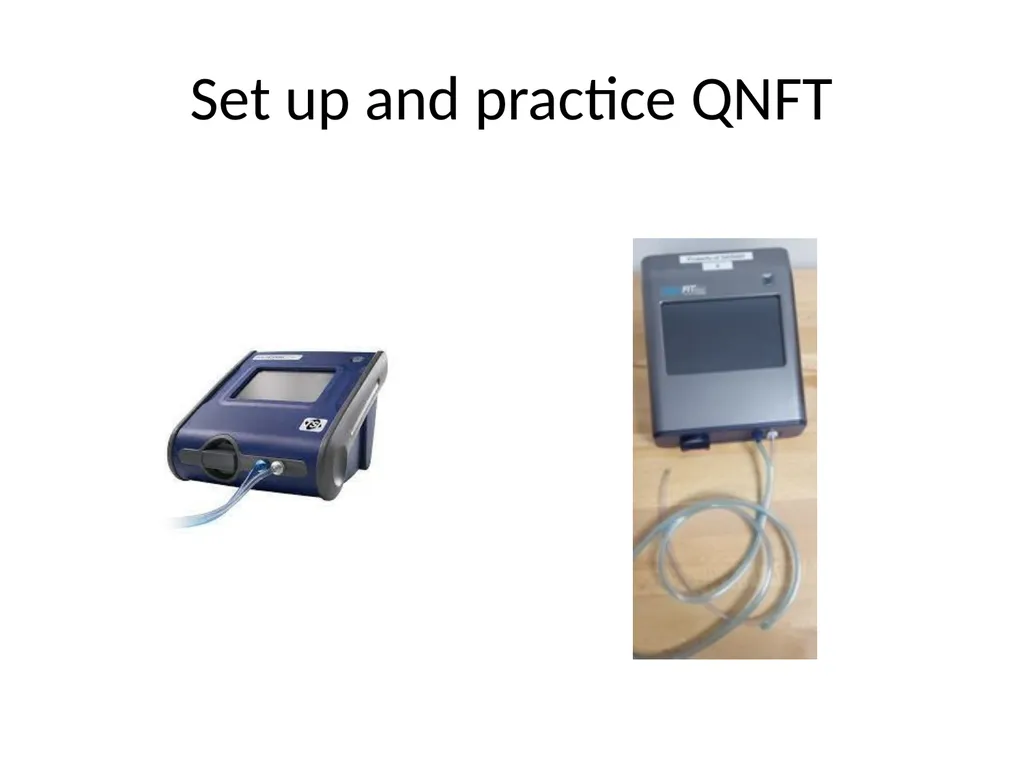
Quantitative Fit Testing (QNFT) Quantitative fit testing shall be conducted in accordance with one of the procedures described in Annex C.
Only QNFT methods that are appropriate for the respirator as referenced in Table 4 of the CSA standard shall be used. Page 16<br>
Only QNFT methods that are appropriate for the respirator as referenced in Table 4 of the CSA standard shall be used. Page 16<br>
40
Health Surveillance Prior to fit testing and respirator use, the program administrator shall ensure that documentation is completed that confirms that individuals are free from any physiological or psychological condition that could preclude them from being fit tested on or using the selected respirator.
All health information shall be treated as medically confidential. Page 16<br>
All health information shall be treated as medically confidential. Page 16<br>
41
Recordkeeping General: The program administrator shall ensure that appropriate records are kept of all respiratory protection program activities as required by applicable legislation, employer policy, or as outlined in this Standard.
Recordkeeping should include documentation on:
the individuals fulfilling the roles and responsibilities of the program, including corresponding with users, qualified persons, and regulators
hazard assessment, including periodic monitoring of the workplace atmosphere
selection of the appropriate respirator
training
respirator facial fit
cleaning, maintenance, and storage of respirators
health surveillance of respirator users; and
program evaluation (see Clause 13).
Note: Records should be maintained for the duration of employment of the person trained or for a minimum of 10 years Page 18<br>
Recordkeeping should include documentation on:
the individuals fulfilling the roles and responsibilities of the program, including corresponding with users, qualified persons, and regulators
hazard assessment, including periodic monitoring of the workplace atmosphere
selection of the appropriate respirator
training
respirator facial fit
cleaning, maintenance, and storage of respirators
health surveillance of respirator users; and
program evaluation (see Clause 13).
Note: Records should be maintained for the duration of employment of the person trained or for a minimum of 10 years Page 18<br>
42
Records of Respirator Fit Testing Fit test records shall be retained for respirator users and shall meet all the following requirements:
the name of the person tested;
the date of the tests;
the specific make, model, and size of respirator;
the type of fit test method and test agent used;
pass/fail criteria for the fit test;
a list of additional PPE worn during the fit test;
notes on restrictions related to facial hair, use of dentures and corrective eyewear, or any particular fitting difficulties such as unusual facial features or use of facial jewelry or cosmetics;
the name of the person conducting the fit test;
result of comfort assessment steps criteria, through movements, observation, and scoring (e.g., 0,1,2,3);
further comfort assessment through the validation questions (see comfort assessment steps in Clauses B.2.3 and C.2.3 and in the example fit testing record form in Annex R);
documentation of the individual user’s competency, including pre-use inspection of the facepiece, donning and doffing and user seal checks, and corresponding fit test results;
documentation of any unsuccessful fit test and nature/cause(s) for the failure; and
documentation of the maintenance, calibration, and repair of fit test equipment Page 19<br>
the name of the person tested;
the date of the tests;
the specific make, model, and size of respirator;
the type of fit test method and test agent used;
pass/fail criteria for the fit test;
a list of additional PPE worn during the fit test;
notes on restrictions related to facial hair, use of dentures and corrective eyewear, or any particular fitting difficulties such as unusual facial features or use of facial jewelry or cosmetics;
the name of the person conducting the fit test;
result of comfort assessment steps criteria, through movements, observation, and scoring (e.g., 0,1,2,3);
further comfort assessment through the validation questions (see comfort assessment steps in Clauses B.2.3 and C.2.3 and in the example fit testing record form in Annex R);
documentation of the individual user’s competency, including pre-use inspection of the facepiece, donning and doffing and user seal checks, and corresponding fit test results;
documentation of any unsuccessful fit test and nature/cause(s) for the failure; and
documentation of the maintenance, calibration, and repair of fit test equipment Page 19<br>
43
Negative and Positive User Seal Checks Several styles of respirators should be available for the test procedure.
Candidates will be given time to select a respirator that gives them a good positive and negative user seal check prior to the test. Page 20/21<br>
Candidates will be given time to select a respirator that gives them a good positive and negative user seal check prior to the test. Page 20/21<br>
44
Negative Pressure User Seal Check (elastomeric) A negative-pressure user seal check can be conducted on air-purifying respirators and
atmosphere- supplying respirators equipped with tight-fitting facepieces.
This check can be difficult or impossible to conduct on respirators incorporating air-purifying elements that do not allow the inhalation inlets to be temporarily sealed. Page 20/21<br>
atmosphere- supplying respirators equipped with tight-fitting facepieces.
This check can be difficult or impossible to conduct on respirators incorporating air-purifying elements that do not allow the inhalation inlets to be temporarily sealed. Page 20/21<br>
45
Negative Pressure User Seal Check (elastomeric) The procedure for conducting the negative-pressure user seal check shall be as follows:
The user seal check consists of closing off the inlet opening(s) of the respirator air-purifying elements so that upon inhalation, passage of air into the facepiece will not occur. In the case of atmosphere-supplying respirators, the user seal check consists of closing off the air supply hose.
To avoid possible disruption of the facial seal, a non-permeable, flexible plastic wrap may be used to seal the air inlets instead of attempting to maintain a seal with the hands.
The user shall inhale gently and hold a breath for at least 5 s. The facepiece will collapse slightly on the face and shall remain collapsed while the breath is held.
During this period, the facepiece shall not be disturbed by the user attempting to maintain a seal on the inlet opening of the air-purifying elements.
If the facepiece remains collapsed while a breath is being held, the user seal check is successful.
If the facepiece does not remain collapsed while a breath is being held, the user shall verify that nothing obstructs the sealing surface, adjust the facepiece and harness, and repeat the user seal check.
If the facepiece still does not remain collapsed while a breath is being held, then the user shall remove the respirator, inspect the components for the cause of the leakage, correct any problems discovered, or obtain a replacement respirator and repeat the user seal check.
Users shall not use a respirator for which a user seal check cannot be completed successfully. Page 20/21<br>
The user seal check consists of closing off the inlet opening(s) of the respirator air-purifying elements so that upon inhalation, passage of air into the facepiece will not occur. In the case of atmosphere-supplying respirators, the user seal check consists of closing off the air supply hose.
To avoid possible disruption of the facial seal, a non-permeable, flexible plastic wrap may be used to seal the air inlets instead of attempting to maintain a seal with the hands.
The user shall inhale gently and hold a breath for at least 5 s. The facepiece will collapse slightly on the face and shall remain collapsed while the breath is held.
During this period, the facepiece shall not be disturbed by the user attempting to maintain a seal on the inlet opening of the air-purifying elements.
If the facepiece remains collapsed while a breath is being held, the user seal check is successful.
If the facepiece does not remain collapsed while a breath is being held, the user shall verify that nothing obstructs the sealing surface, adjust the facepiece and harness, and repeat the user seal check.
If the facepiece still does not remain collapsed while a breath is being held, then the user shall remove the respirator, inspect the components for the cause of the leakage, correct any problems discovered, or obtain a replacement respirator and repeat the user seal check.
Users shall not use a respirator for which a user seal check cannot be completed successfully. Page 20/21<br>
46
Positive Pressure User Seal Check (elastomeric) A positive-pressure user seal check can be conducted on respirators equipped with tightfitting facepieces that contain both inhalation and exhalation valve Page 20/21<br>
47
Positive Pressure User Seal Check (elastomeric) The procedure for conducting the positive-pressure user seal check shall be as follows:
Don the respirator facepiece, closing off the exhalation valve or breathing tube, or both, and exhaling gently. Note: For some respirators, the positive-pressure user seal check requires that the exhalation valve cover be removed, then replaced following completion of the user seal check.
During this period, the facepiece shall not be disturbed by the user attempting to maintain a seal on the exhalation valve.
If a slight positive pressure can be maintained inside the facepiece without detection of any outward leakage of air, the user seal check is successful.
If a slight positive pressure cannot be maintained inside the facepiece for 5 s, the user shall verify that nothing obstructs the sealing surface, adjust the facepiece and harness, and repeat the user seal check.
If a slight positive pressure still cannot be maintained inside the facepiece, the user shall remove the respirator, inspect the components for the cause of the leakage, correct any problems discovered, or obtain a replacement respirator and repeat the user seal check.
Users shall not use a respirator for which a user seal check cannot be completed successfully. Page 20/21<br>
Don the respirator facepiece, closing off the exhalation valve or breathing tube, or both, and exhaling gently. Note: For some respirators, the positive-pressure user seal check requires that the exhalation valve cover be removed, then replaced following completion of the user seal check.
During this period, the facepiece shall not be disturbed by the user attempting to maintain a seal on the exhalation valve.
If a slight positive pressure can be maintained inside the facepiece without detection of any outward leakage of air, the user seal check is successful.
If a slight positive pressure cannot be maintained inside the facepiece for 5 s, the user shall verify that nothing obstructs the sealing surface, adjust the facepiece and harness, and repeat the user seal check.
If a slight positive pressure still cannot be maintained inside the facepiece, the user shall remove the respirator, inspect the components for the cause of the leakage, correct any problems discovered, or obtain a replacement respirator and repeat the user seal check.
Users shall not use a respirator for which a user seal check cannot be completed successfully. Page 20/21<br>
48
Negative and Positive Pressure User Seal Checks for Disposable Respirators The following procedures are provided as examples once the respirator is properly donned. Page 20/21<br>
49
Negative Pressure User Seal Check for Disposable Respirators During a negative pressure user seal check, the respirator user inhales sharply while blocking the paths for air to enter the facepiece.
A successful check is when the facepiece collapses slightly under the negative pressure that is created with this procedure.
To conduct a negative pressure user seal check, the respirator user covers the filter surface with their hands as much as possible and then inhales. The facepiece should collapse on the users face and they should not feel air passing between their face and the facepiece. Page 20/21<br>
A successful check is when the facepiece collapses slightly under the negative pressure that is created with this procedure.
To conduct a negative pressure user seal check, the respirator user covers the filter surface with their hands as much as possible and then inhales. The facepiece should collapse on the users face and they should not feel air passing between their face and the facepiece. Page 20/21<br>
50
Positive Pressure User Seal Check for Disposable Respirators During a positive pressure user seal check, the respirator user exhales gently while blocking the paths for air to exit the facepiece.
A successful check is when the facepiece is slightly pressurized before increased pressure causes outward leakage.
To conduct a positive pressure user seal check, the respirator user exhales gently into the facepiece. The face fit is considered satisfactory if a slight positive pressure is being built up inside the facepiece without any evidence of outward leakage of air at the seal. Examples of such evidence would be the feeling of air movement on their face along the seal of the facepiece, fogging of their glasses, or a lack of pressure being built up inside the facepiece. Page 20/21<br>
A successful check is when the facepiece is slightly pressurized before increased pressure causes outward leakage.
To conduct a positive pressure user seal check, the respirator user exhales gently into the facepiece. The face fit is considered satisfactory if a slight positive pressure is being built up inside the facepiece without any evidence of outward leakage of air at the seal. Examples of such evidence would be the feeling of air movement on their face along the seal of the facepiece, fogging of their glasses, or a lack of pressure being built up inside the facepiece. Page 20/21<br>
51
Negative and Positive Pressure User Seal Checks for Disposable Respirators In either seal check, if air leaks around the nose, the respirator user uses both hands to readjust
the nosepiece by placing fingertips at the top of the metal nose clip. Slide fingertips down both sides of the metal strip to more efficiently mold the nose area to the shape of your nose. Readjust the straps along the sides of head until a proper seal is achieved. Repeat the seal checks. Page 20/21<br>
the nosepiece by placing fingertips at the top of the metal nose clip. Slide fingertips down both sides of the metal strip to more efficiently mold the nose area to the shape of your nose. Readjust the straps along the sides of head until a proper seal is achieved. Repeat the seal checks. Page 20/21<br>
52
Qualitative Respirator Fit Tests (QLFT) Acceptable QLFT methods: The following QLFT methods shall be acceptable:
QLFT using isoamyl acetate (banana oil) as a challenge agent in a test chamber following threshold screening, with non-detection of its odour by a test subject wearing a respirator serving as an indication of acceptable fit;
QLFT using saccharin solution aerosol as a challenge agent in a test chamber following threshold screening, with non-detection of its sweet taste by a test subject wearing a respirator serving as an indication of acceptable fit;
QLFT using bitter aerosol (denatonium benzoate) as a challenge agent in a test chamber following threshold screening, with non-detection of its bitter taste by a test subject wearing a respirator serving as an indication of acceptable fit; and
QLFT using irritant smoke (stannic chloride) as a challenge agent following threshold screening, with non-detection of it by a test subject wearing a respirator serving as an indication of acceptable fit. Page 22<br>
QLFT using isoamyl acetate (banana oil) as a challenge agent in a test chamber following threshold screening, with non-detection of its odour by a test subject wearing a respirator serving as an indication of acceptable fit;
QLFT using saccharin solution aerosol as a challenge agent in a test chamber following threshold screening, with non-detection of its sweet taste by a test subject wearing a respirator serving as an indication of acceptable fit;
QLFT using bitter aerosol (denatonium benzoate) as a challenge agent in a test chamber following threshold screening, with non-detection of its bitter taste by a test subject wearing a respirator serving as an indication of acceptable fit; and
QLFT using irritant smoke (stannic chloride) as a challenge agent following threshold screening, with non-detection of it by a test subject wearing a respirator serving as an indication of acceptable fit. Page 22<br>
53
Qualitative Respirator Fit Tests (QLFT) Introduction of QLFT to respirator users: The person conducting the QLFT shall provide the test subject with an introduction to QLFT. In this introduction, the fit tester shall
explain what the QLFT procedure is, why it is required, and the importance of using a respirator that provides an effective, reproducible face-to-facepiece seal;
explain why the test is important, in order to convince the test subject to co-operate fully in the QLFT;
describe the challenge agent used in the QLFT and how to identify it;
describe how the test subject selects a properly fitting and comfortable respirator from those that are appropriate to the application;
explain that the respirator is equipped with the appropriate filters or chemical cartridges for the challenge agent being used;
explain that the test subject is required to successfully complete the positive- or negative-pressure user seal check with the selected respirator without physical or verbal assistance prior to proceeding with the QLF
explain that the test subject is required to don the respirator properly, without physical or verbal assistance, in accordance with the manufacturer’s instructions;
explain that the test subject is required, during the QLFT, to wear other PPE that he/she could be required to use in the workplace and that could affect the face-to-facepiece seal;
describe the QLFT exercises and how to perform them during the QLFT;
explain why it is important to use, in the workplace, the specific brand, model, and size of facepiece that is used to pass the QLFT; and
emphasize that the user must always inspect a respirator before using it to ensure that it is in proper working condition. Page 22<br>
explain what the QLFT procedure is, why it is required, and the importance of using a respirator that provides an effective, reproducible face-to-facepiece seal;
explain why the test is important, in order to convince the test subject to co-operate fully in the QLFT;
describe the challenge agent used in the QLFT and how to identify it;
describe how the test subject selects a properly fitting and comfortable respirator from those that are appropriate to the application;
explain that the respirator is equipped with the appropriate filters or chemical cartridges for the challenge agent being used;
explain that the test subject is required to successfully complete the positive- or negative-pressure user seal check with the selected respirator without physical or verbal assistance prior to proceeding with the QLF
explain that the test subject is required to don the respirator properly, without physical or verbal assistance, in accordance with the manufacturer’s instructions;
explain that the test subject is required, during the QLFT, to wear other PPE that he/she could be required to use in the workplace and that could affect the face-to-facepiece seal;
describe the QLFT exercises and how to perform them during the QLFT;
explain why it is important to use, in the workplace, the specific brand, model, and size of facepiece that is used to pass the QLFT; and
emphasize that the user must always inspect a respirator before using it to ensure that it is in proper working condition. Page 22<br>
54
Qualitative Respirator Fit Tests (QLFT) Comfort assessment conditions and criteria: Assessment of comfort and appropriateness of fit shall include the fit tester confirming through observation that the following conditions and criteria are met:
proper placement of the chin in its resting space;
proper fit and position of the facepiece on the nose (if a half-facepiece) or nose cup on the nose (if a full-facepiece);
position of the eyes within the facepiece lens to allow the best peripheral vision (if a fullfacepiece)
optimal strap tension (not too loose or too tight) and positioning;
accommodation of spectacles (lens inserts in a full facepiece) or eye protection (with a half- facepiece), without adversely affecting face-to-facepiece seal;
intelligible speech without an obvious break in the face-to-facepiece seal;
stability, against tendency for a facepiece to slip, create excessive pressure or break the seal, for example in the presence of movement or contact with other integrating PPE or accessories;
full contact of the sealing surface of the facepiece to the face;
proper positioning of additional integrating equipment (i.e., PPE) for function;
successful seal check, followed by
sufficient time allowed (at least 5 min) for assessment of comfort in relation to the face-to- facepiece seal, strap tension, or other pressure points resulting from integrating PPE if worn, including corrective lens inserts, safety glasses, hoods, helmets etc.; and subsequently
the wearer’s verbal confirmation of adequate comfort (see Clause B.2.3.5); and
repeated successful user seal check. Page 23<br>
proper placement of the chin in its resting space;
proper fit and position of the facepiece on the nose (if a half-facepiece) or nose cup on the nose (if a full-facepiece);
position of the eyes within the facepiece lens to allow the best peripheral vision (if a fullfacepiece)
optimal strap tension (not too loose or too tight) and positioning;
accommodation of spectacles (lens inserts in a full facepiece) or eye protection (with a half- facepiece), without adversely affecting face-to-facepiece seal;
intelligible speech without an obvious break in the face-to-facepiece seal;
stability, against tendency for a facepiece to slip, create excessive pressure or break the seal, for example in the presence of movement or contact with other integrating PPE or accessories;
full contact of the sealing surface of the facepiece to the face;
proper positioning of additional integrating equipment (i.e., PPE) for function;
successful seal check, followed by
sufficient time allowed (at least 5 min) for assessment of comfort in relation to the face-to- facepiece seal, strap tension, or other pressure points resulting from integrating PPE if worn, including corrective lens inserts, safety glasses, hoods, helmets etc.; and subsequently
the wearer’s verbal confirmation of adequate comfort (see Clause B.2.3.5); and
repeated successful user seal check. Page 23<br>
55
Qualitative Respirator Fit Tests (QLFT) Comfort assessment movements: Throughout the process of assessing comfort that meets the criteria above, and after the waiting period, the wearer should perform the following movements for 3 to 5 s:
Nod head up and down.
Tilt head with left ear touching left shoulder and then right ear touching right shoulder.
Turn head from one side to the other.
Shake head twice vigorously.
Perform facial expressions: open and close mouth as if speaking, move the jaw left to right, up and down, smile, frown. Page 24<br>
Nod head up and down.
Tilt head with left ear touching left shoulder and then right ear touching right shoulder.
Turn head from one side to the other.
Shake head twice vigorously.
Perform facial expressions: open and close mouth as if speaking, move the jaw left to right, up and down, smile, frown. Page 24<br>
56
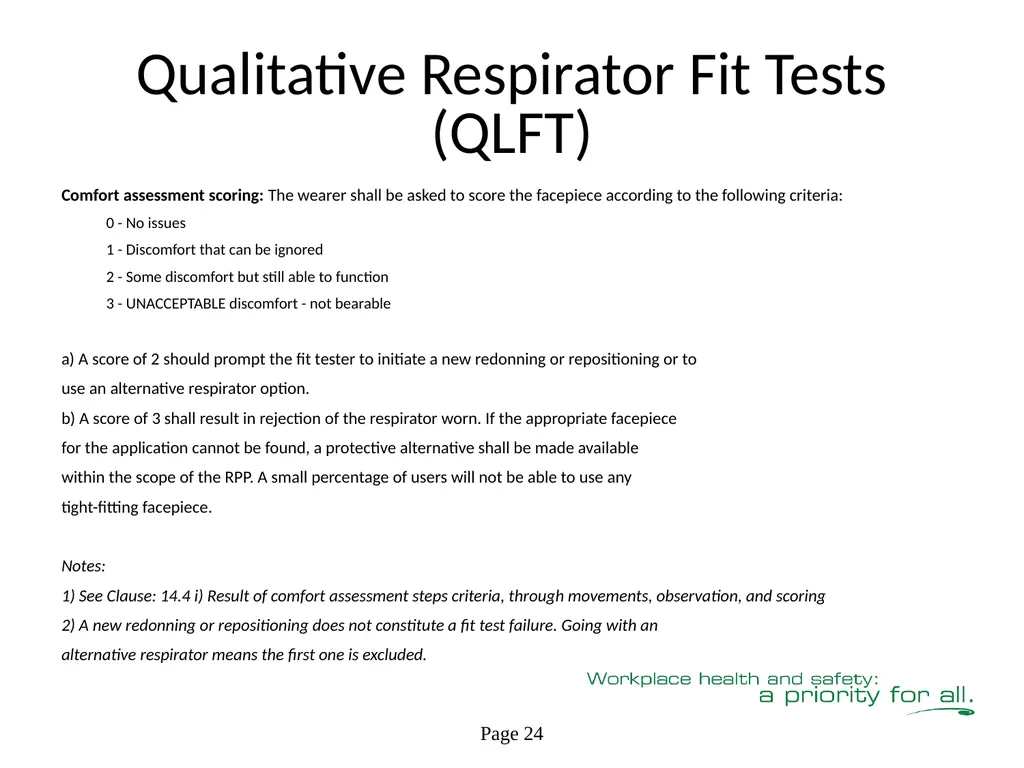
Qualitative Respirator Fit Tests (QLFT) Comfort assessment scoring: The wearer shall be asked to score the facepiece according to the following criteria:
0 - No issues
1 - Discomfort that can be ignored
2 - Some discomfort but still able to function
3 - UNACCEPTABLE discomfort - not bearable
a) A score of 2 should prompt the fit tester to initiate a new redonning or repositioning or to
use an alternative respirator option.
b) A score of 3 shall result in rejection of the respirator worn. If the appropriate facepiece
for the application cannot be found, a protective alternative shall be made available
within the scope of the RPP. A small percentage of users will not be able to use any
tight-fitting facepiece.
Notes:
1) See Clause: 14.4 i) Result of comfort assessment steps criteria, through movements, observation, and scoring
2) A new redonning or repositioning does not constitute a fit test failure. Going with an
alternative respirator means the first one is excluded. Page 24<br>
0 - No issues
1 - Discomfort that can be ignored
2 - Some discomfort but still able to function
3 - UNACCEPTABLE discomfort - not bearable
a) A score of 2 should prompt the fit tester to initiate a new redonning or repositioning or to
use an alternative respirator option.
b) A score of 3 shall result in rejection of the respirator worn. If the appropriate facepiece
for the application cannot be found, a protective alternative shall be made available
within the scope of the RPP. A small percentage of users will not be able to use any
tight-fitting facepiece.
Notes:
1) See Clause: 14.4 i) Result of comfort assessment steps criteria, through movements, observation, and scoring
2) A new redonning or repositioning does not constitute a fit test failure. Going with an
alternative respirator means the first one is excluded. Page 24<br>
57
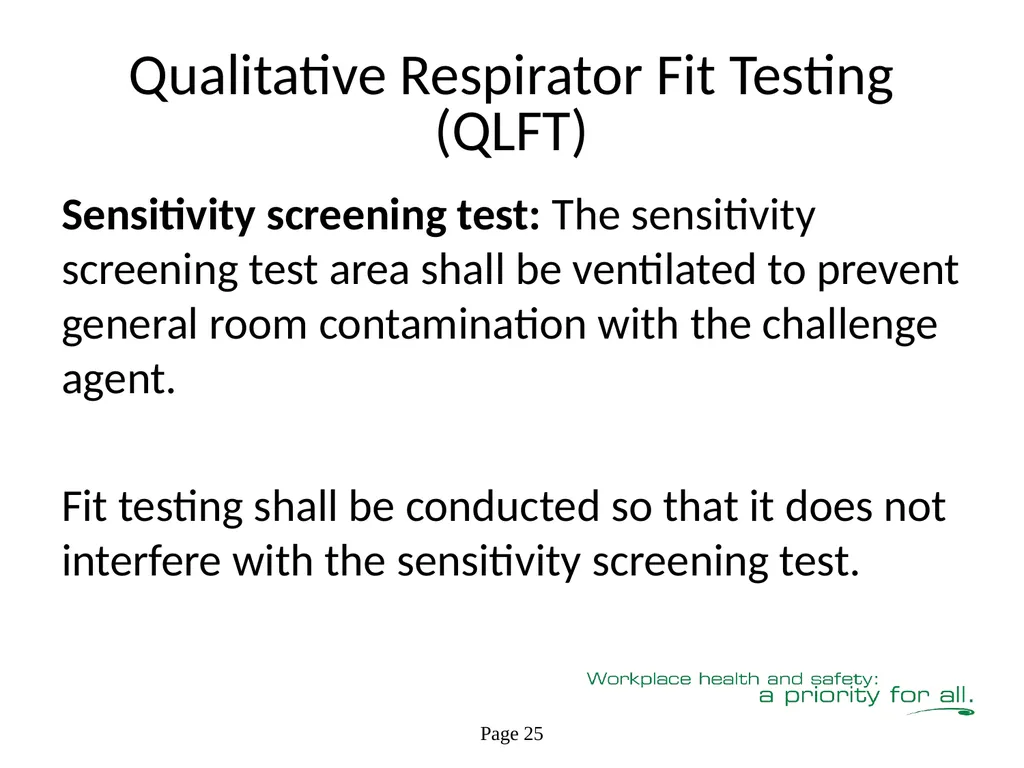
Qualitative Respirator Fit Testing (QLFT) Sensitivity screening test: The sensitivity screening test area shall be ventilated to prevent general room contamination with the challenge agent.
Fit testing shall be conducted so that it does not interfere with the sensitivity screening test. Page 25<br>
Fit testing shall be conducted so that it does not interfere with the sensitivity screening test. Page 25<br>
58
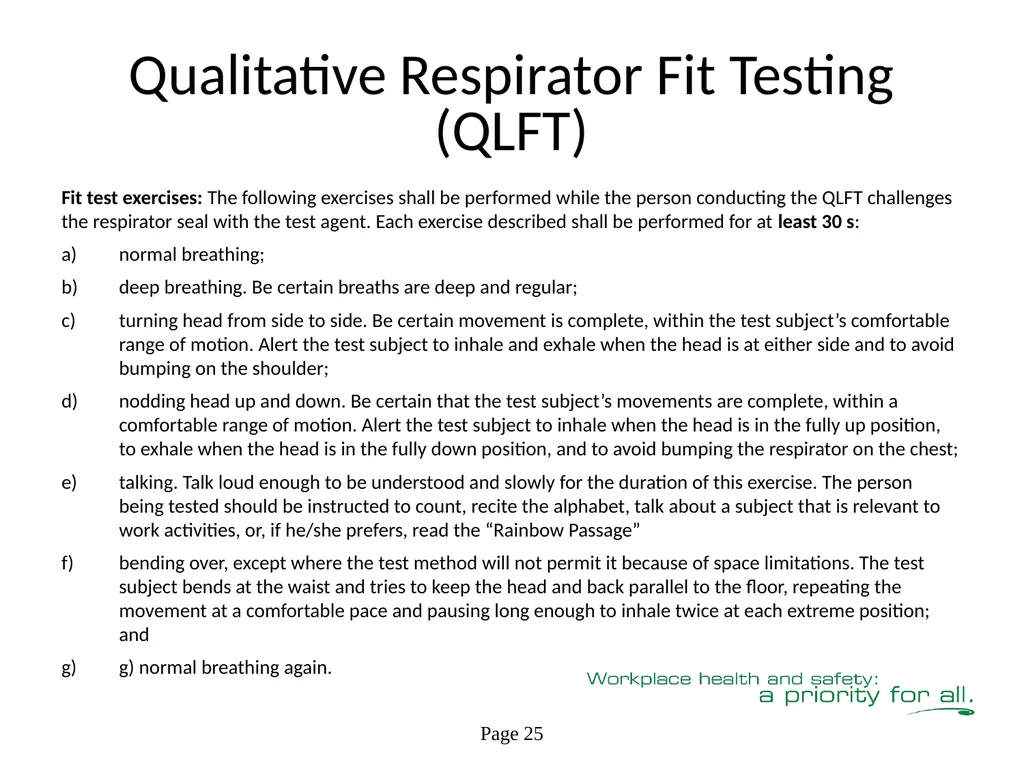
Qualitative Respirator Fit Testing (QLFT) Fit test exercises: The following exercises shall be performed while the person conducting the QLFT challenges the respirator seal with the test agent. Each exercise described shall be performed for at least 30 s:
normal breathing;
deep breathing. Be certain breaths are deep and regular;
turning head from side to side. Be certain movement is complete, within the test subject’s comfortable range of motion. Alert the test subject to inhale and exhale when the head is at either side and to avoid bumping on the shoulder;
nodding head up and down. Be certain that the test subject’s movements are complete, within a comfortable range of motion. Alert the test subject to inhale when the head is in the fully up position, to exhale when the head is in the fully down position, and to avoid bumping the respirator on the chest;
talking. Talk loud enough to be understood and slowly for the duration of this exercise. The person being tested should be instructed to count, recite the alphabet, talk about a subject that is relevant to work activities, or, if he/she prefers, read the “Rainbow Passage”
bending over, except where the test method will not permit it because of space limitations. The test subject bends at the waist and tries to keep the head and back parallel to the floor, repeating the movement at a comfortable pace and pausing long enough to inhale twice at each extreme position; and
g) normal breathing again. Page 25<br>
normal breathing;
deep breathing. Be certain breaths are deep and regular;
turning head from side to side. Be certain movement is complete, within the test subject’s comfortable range of motion. Alert the test subject to inhale and exhale when the head is at either side and to avoid bumping on the shoulder;
nodding head up and down. Be certain that the test subject’s movements are complete, within a comfortable range of motion. Alert the test subject to inhale when the head is in the fully up position, to exhale when the head is in the fully down position, and to avoid bumping the respirator on the chest;
talking. Talk loud enough to be understood and slowly for the duration of this exercise. The person being tested should be instructed to count, recite the alphabet, talk about a subject that is relevant to work activities, or, if he/she prefers, read the “Rainbow Passage”
bending over, except where the test method will not permit it because of space limitations. The test subject bends at the waist and tries to keep the head and back parallel to the floor, repeating the movement at a comfortable pace and pausing long enough to inhale twice at each extreme position; and
g) normal breathing again. Page 25<br>
59
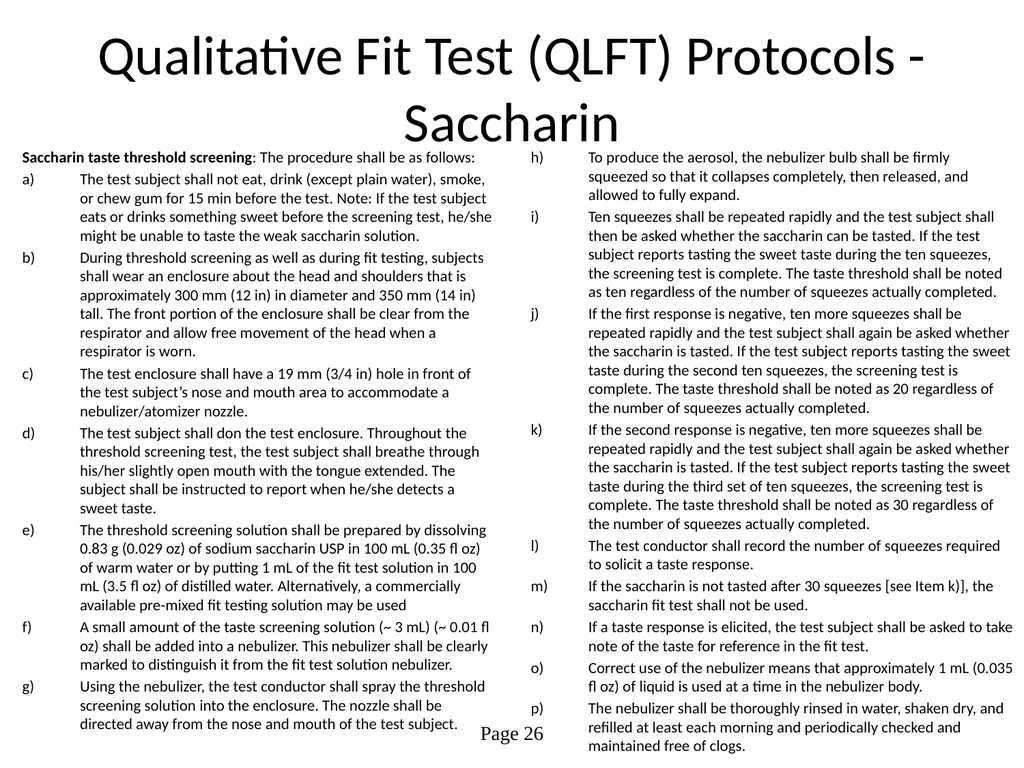
Qualitative Fit Test (QLFT) Protocols - Saccharin Saccharin taste threshold screening: The procedure shall be as follows:
The test subject shall not eat, drink (except plain water), smoke, or chew gum for 15 min before the test. Note: If the test subject eats or drinks something sweet before the screening test, he/she might be unable to taste the weak saccharin solution.
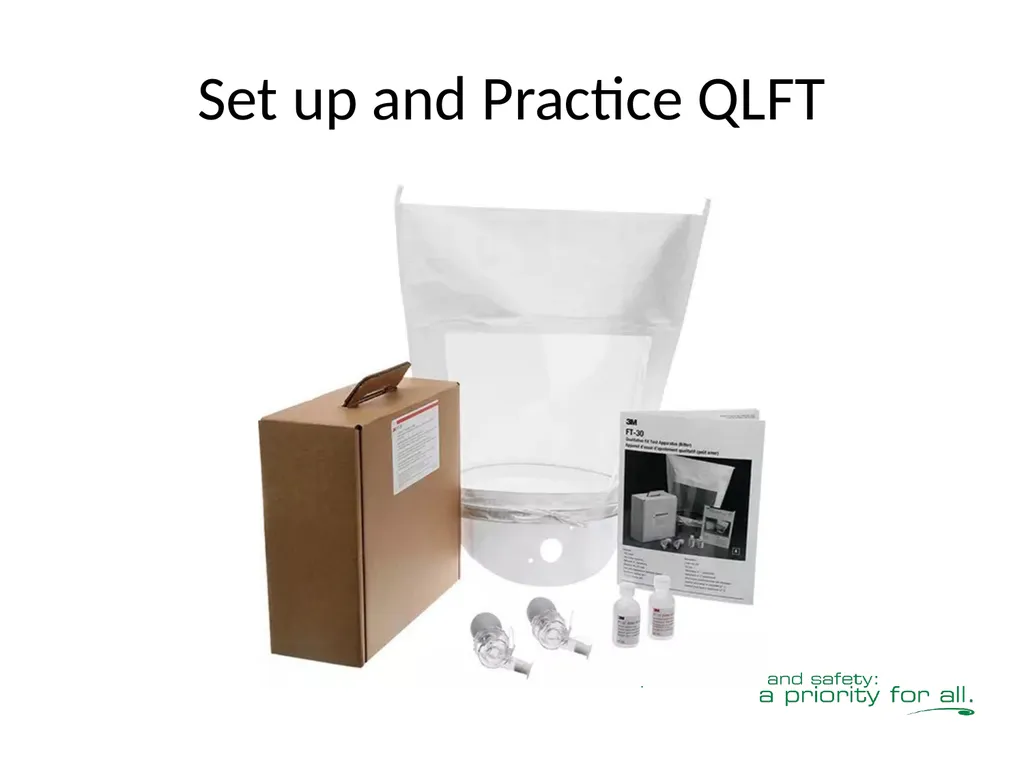
During threshold screening as well as during fit testing, subjects shall wear an enclosure about the head and shoulders that is approximately 300 mm (12 in) in diameter and 350 mm (14 in) tall. The front portion of the enclosure shall be clear from the respirator and allow free movement of the head when a respirator is worn.
The test enclosure shall have a 19 mm (3/4 in) hole in front of the test subject’s nose and mouth area to accommodate a nebulizer/atomizer nozzle.
The test subject shall don the test enclosure. Throughout the threshold screening test, the test subject shall breathe through his/her slightly open mouth with the tongue extended. The subject shall be instructed to report when he/she detects a sweet taste.
The threshold screening solution shall be prepared by dissolving 0.83 g (0.029 oz) of sodium saccharin USP in 100 mL (0.35 fl oz) of warm water or by putting 1 mL of the fit test solution in 100 mL (3.5 fl oz) of distilled water. Alternatively, a commercially available pre-mixed fit testing solution may be used
A small amount of the taste screening solution (~ 3 mL) (~ 0.01 fl oz) shall be added into a nebulizer. This nebulizer shall be clearly marked to distinguish it from the fit test solution nebulizer.
Using the nebulizer, the test conductor shall spray the threshold screening solution into the enclosure. The nozzle shall be directed away from the nose and mouth of the test subject. To produce the aerosol, the nebulizer bulb shall be firmly squeezed so that it collapses completely, then released, and allowed to fully expand.
Ten squeezes shall be repeated rapidly and the test subject shall then be asked whether the saccharin can be tasted. If the test subject reports tasting the sweet taste during the ten squeezes, the screening test is complete. The taste threshold shall be noted as ten regardless of the number of squeezes actually completed.
If the first response is negative, ten more squeezes shall be repeated rapidly and the test subject shall again be asked whether the saccharin is tasted. If the test subject reports tasting the sweet taste during the second ten squeezes, the screening test is complete. The taste threshold shall be noted as 20 regardless of the number of squeezes actually completed.
If the second response is negative, ten more squeezes shall be repeated rapidly and the test subject shall again be asked whether the saccharin is tasted. If the test subject reports tasting the sweet taste during the third set of ten squeezes, the screening test is complete. The taste threshold shall be noted as 30 regardless of the number of squeezes actually completed.
The test conductor shall record the number of squeezes required to solicit a taste response.
If the saccharin is not tasted after 30 squeezes [see Item k)], the saccharin fit test shall not be used.
If a taste response is elicited, the test subject shall be asked to take note of the taste for reference in the fit test.
Correct use of the nebulizer means that approximately 1 mL (0.035 fl oz) of liquid is used at a time in the nebulizer body.
The nebulizer shall be thoroughly rinsed in water, shaken dry, and refilled at least each morning and periodically checked and maintained free of clogs. Page 26<br>
The test subject shall not eat, drink (except plain water), smoke, or chew gum for 15 min before the test. Note: If the test subject eats or drinks something sweet before the screening test, he/she might be unable to taste the weak saccharin solution.
During threshold screening as well as during fit testing, subjects shall wear an enclosure about the head and shoulders that is approximately 300 mm (12 in) in diameter and 350 mm (14 in) tall. The front portion of the enclosure shall be clear from the respirator and allow free movement of the head when a respirator is worn.
The test enclosure shall have a 19 mm (3/4 in) hole in front of the test subject’s nose and mouth area to accommodate a nebulizer/atomizer nozzle.
The test subject shall don the test enclosure. Throughout the threshold screening test, the test subject shall breathe through his/her slightly open mouth with the tongue extended. The subject shall be instructed to report when he/she detects a sweet taste.
The threshold screening solution shall be prepared by dissolving 0.83 g (0.029 oz) of sodium saccharin USP in 100 mL (0.35 fl oz) of warm water or by putting 1 mL of the fit test solution in 100 mL (3.5 fl oz) of distilled water. Alternatively, a commercially available pre-mixed fit testing solution may be used
A small amount of the taste screening solution (~ 3 mL) (~ 0.01 fl oz) shall be added into a nebulizer. This nebulizer shall be clearly marked to distinguish it from the fit test solution nebulizer.
Using the nebulizer, the test conductor shall spray the threshold screening solution into the enclosure. The nozzle shall be directed away from the nose and mouth of the test subject. To produce the aerosol, the nebulizer bulb shall be firmly squeezed so that it collapses completely, then released, and allowed to fully expand.
Ten squeezes shall be repeated rapidly and the test subject shall then be asked whether the saccharin can be tasted. If the test subject reports tasting the sweet taste during the ten squeezes, the screening test is complete. The taste threshold shall be noted as ten regardless of the number of squeezes actually completed.
If the first response is negative, ten more squeezes shall be repeated rapidly and the test subject shall again be asked whether the saccharin is tasted. If the test subject reports tasting the sweet taste during the second ten squeezes, the screening test is complete. The taste threshold shall be noted as 20 regardless of the number of squeezes actually completed.
If the second response is negative, ten more squeezes shall be repeated rapidly and the test subject shall again be asked whether the saccharin is tasted. If the test subject reports tasting the sweet taste during the third set of ten squeezes, the screening test is complete. The taste threshold shall be noted as 30 regardless of the number of squeezes actually completed.
The test conductor shall record the number of squeezes required to solicit a taste response.
If the saccharin is not tasted after 30 squeezes [see Item k)], the saccharin fit test shall not be used.
If a taste response is elicited, the test subject shall be asked to take note of the taste for reference in the fit test.
Correct use of the nebulizer means that approximately 1 mL (0.035 fl oz) of liquid is used at a time in the nebulizer body.
The nebulizer shall be thoroughly rinsed in water, shaken dry, and refilled at least each morning and periodically checked and maintained free of clogs. Page 26<br>
60
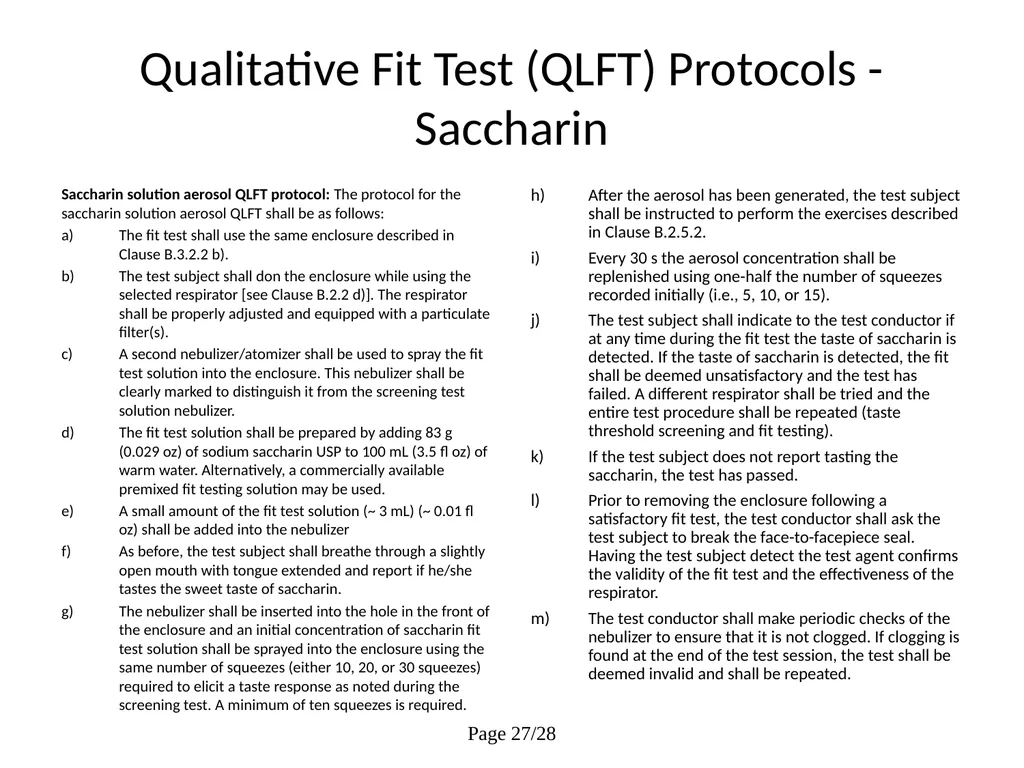
Qualitative Fit Test (QLFT) Protocols - Saccharin Saccharin solution aerosol QLFT protocol: The protocol for the saccharin solution aerosol QLFT shall be as follows:
The fit test shall use the same enclosure described in Clause B.3.2.2 b).
The test subject shall don the enclosure while using the selected respirator [see Clause B.2.2 d)]. The respirator shall be properly adjusted and equipped with a particulate filter(s).
A second nebulizer/atomizer shall be used to spray the fit test solution into the enclosure. This nebulizer shall be clearly marked to distinguish it from the screening test solution nebulizer.
The fit test solution shall be prepared by adding 83 g (0.029 oz) of sodium saccharin USP to 100 mL (3.5 fl oz) of warm water. Alternatively, a commercially available premixed fit testing solution may be used.
A small amount of the fit test solution (~ 3 mL) (~ 0.01 fl oz) shall be added into the nebulizer
As before, the test subject shall breathe through a slightly open mouth with tongue extended and report if he/she tastes the sweet taste of saccharin.
The nebulizer shall be inserted into the hole in the front of the enclosure and an initial concentration of saccharin fit test solution shall be sprayed into the enclosure using the same number of squeezes (either 10, 20, or 30 squeezes) required to elicit a taste response as noted during the screening test. A minimum of ten squeezes is required. After the aerosol has been generated, the test subject shall be instructed to perform the exercises described in Clause B.2.5.2.
Every 30 s the aerosol concentration shall be replenished using one-half the number of squeezes recorded initially (i.e., 5, 10, or 15).
The test subject shall indicate to the test conductor if at any time during the fit test the taste of saccharin is detected. If the taste of saccharin is detected, the fit shall be deemed unsatisfactory and the test has failed. A different respirator shall be tried and the entire test procedure shall be repeated (taste threshold screening and fit testing).
If the test subject does not report tasting the saccharin, the test has passed.
Prior to removing the enclosure following a satisfactory fit test, the test conductor shall ask the test subject to break the face-to-facepiece seal. Having the test subject detect the test agent confirms the validity of the fit test and the effectiveness of the respirator.
The test conductor shall make periodic checks of the nebulizer to ensure that it is not clogged. If clogging is found at the end of the test session, the test shall be deemed invalid and shall be repeated. Page 27/28<br>
The fit test shall use the same enclosure described in Clause B.3.2.2 b).
The test subject shall don the enclosure while using the selected respirator [see Clause B.2.2 d)]. The respirator shall be properly adjusted and equipped with a particulate filter(s).
A second nebulizer/atomizer shall be used to spray the fit test solution into the enclosure. This nebulizer shall be clearly marked to distinguish it from the screening test solution nebulizer.
The fit test solution shall be prepared by adding 83 g (0.029 oz) of sodium saccharin USP to 100 mL (3.5 fl oz) of warm water. Alternatively, a commercially available premixed fit testing solution may be used.
A small amount of the fit test solution (~ 3 mL) (~ 0.01 fl oz) shall be added into the nebulizer
As before, the test subject shall breathe through a slightly open mouth with tongue extended and report if he/she tastes the sweet taste of saccharin.
The nebulizer shall be inserted into the hole in the front of the enclosure and an initial concentration of saccharin fit test solution shall be sprayed into the enclosure using the same number of squeezes (either 10, 20, or 30 squeezes) required to elicit a taste response as noted during the screening test. A minimum of ten squeezes is required. After the aerosol has been generated, the test subject shall be instructed to perform the exercises described in Clause B.2.5.2.
Every 30 s the aerosol concentration shall be replenished using one-half the number of squeezes recorded initially (i.e., 5, 10, or 15).
The test subject shall indicate to the test conductor if at any time during the fit test the taste of saccharin is detected. If the taste of saccharin is detected, the fit shall be deemed unsatisfactory and the test has failed. A different respirator shall be tried and the entire test procedure shall be repeated (taste threshold screening and fit testing).
If the test subject does not report tasting the saccharin, the test has passed.
Prior to removing the enclosure following a satisfactory fit test, the test conductor shall ask the test subject to break the face-to-facepiece seal. Having the test subject detect the test agent confirms the validity of the fit test and the effectiveness of the respirator.
The test conductor shall make periodic checks of the nebulizer to ensure that it is not clogged. If clogging is found at the end of the test session, the test shall be deemed invalid and shall be repeated. Page 27/28<br>
61
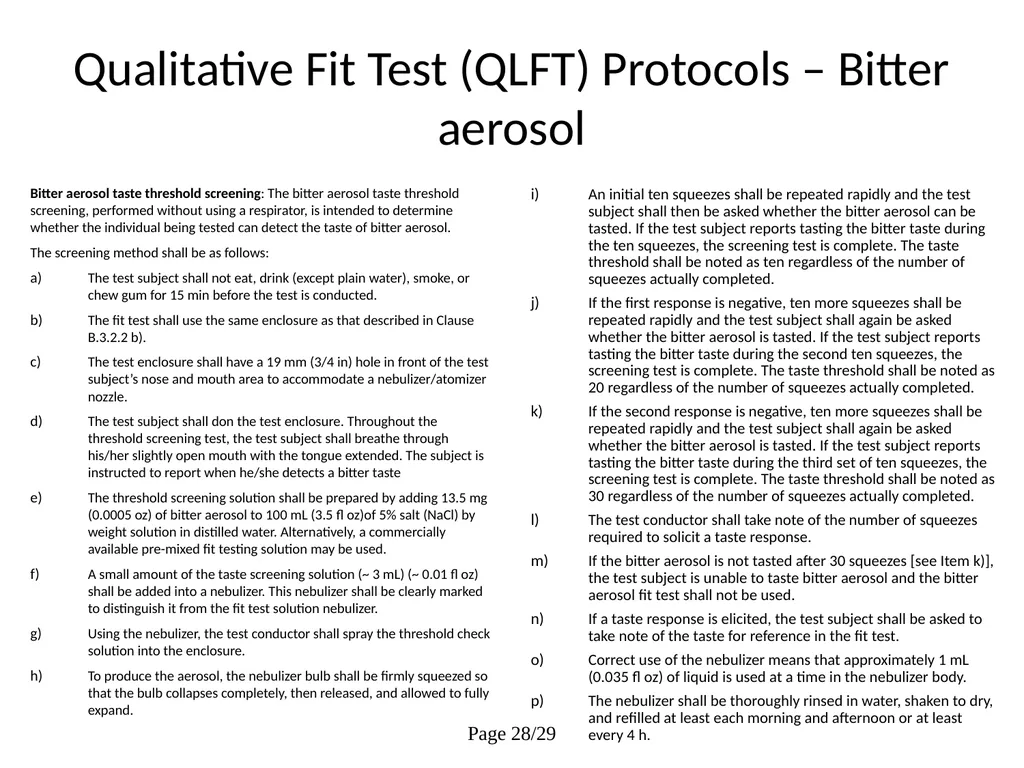
Qualitative Fit Test (QLFT) Protocols – Bitter aerosol Bitter aerosol taste threshold screening: The bitter aerosol taste threshold screening, performed without using a respirator, is intended to determine whether the individual being tested can detect the taste of bitter aerosol.
The screening method shall be as follows:
The test subject shall not eat, drink (except plain water), smoke, or chew gum for 15 min before the test is conducted.
The fit test shall use the same enclosure as that described in Clause B.3.2.2 b).
The test enclosure shall have a 19 mm (3/4 in) hole in front of the test subject’s nose and mouth area to accommodate a nebulizer/atomizer nozzle.
The test subject shall don the test enclosure. Throughout the threshold screening test, the test subject shall breathe through his/her slightly open mouth with the tongue extended. The subject is instructed to report when he/she detects a bitter taste
The threshold screening solution shall be prepared by adding 13.5 mg (0.0005 oz) of bitter aerosol to 100 mL (3.5 fl oz)of 5% salt (NaCl) by weight solution in distilled water. Alternatively, a commercially available pre-mixed fit testing solution may be used.
A small amount of the taste screening solution (~ 3 mL) (~ 0.01 fl oz) shall be added into a nebulizer. This nebulizer shall be clearly marked to distinguish it from the fit test solution nebulizer.
Using the nebulizer, the test conductor shall spray the threshold check solution into the enclosure.
To produce the aerosol, the nebulizer bulb shall be firmly squeezed so that the bulb collapses completely, then released, and allowed to fully expand. An initial ten squeezes shall be repeated rapidly and the test subject shall then be asked whether the bitter aerosol can be tasted. If the test subject reports tasting the bitter taste during the ten squeezes, the screening test is complete. The taste threshold shall be noted as ten regardless of the number of squeezes actually completed.
If the first response is negative, ten more squeezes shall be repeated rapidly and the test subject shall again be asked whether the bitter aerosol is tasted. If the test subject reports tasting the bitter taste during the second ten squeezes, the screening test is complete. The taste threshold shall be noted as 20 regardless of the number of squeezes actually completed.
If the second response is negative, ten more squeezes shall be repeated rapidly and the test subject shall again be asked whether the bitter aerosol is tasted. If the test subject reports tasting the bitter taste during the third set of ten squeezes, the screening test is complete. The taste threshold shall be noted as 30 regardless of the number of squeezes actually completed.
The test conductor shall take note of the number of squeezes required to solicit a taste response.
If the bitter aerosol is not tasted after 30 squeezes [see Item k)], the test subject is unable to taste bitter aerosol and the bitter aerosol fit test shall not be used.
If a taste response is elicited, the test subject shall be asked to take note of the taste for reference in the fit test.
Correct use of the nebulizer means that approximately 1 mL (0.035 fl oz) of liquid is used at a time in the nebulizer body.
The nebulizer shall be thoroughly rinsed in water, shaken to dry, and refilled at least each morning and afternoon or at least every 4 h. Page 28/29<br>
The screening method shall be as follows:
The test subject shall not eat, drink (except plain water), smoke, or chew gum for 15 min before the test is conducted.
The fit test shall use the same enclosure as that described in Clause B.3.2.2 b).
The test enclosure shall have a 19 mm (3/4 in) hole in front of the test subject’s nose and mouth area to accommodate a nebulizer/atomizer nozzle.
The test subject shall don the test enclosure. Throughout the threshold screening test, the test subject shall breathe through his/her slightly open mouth with the tongue extended. The subject is instructed to report when he/she detects a bitter taste
The threshold screening solution shall be prepared by adding 13.5 mg (0.0005 oz) of bitter aerosol to 100 mL (3.5 fl oz)of 5% salt (NaCl) by weight solution in distilled water. Alternatively, a commercially available pre-mixed fit testing solution may be used.
A small amount of the taste screening solution (~ 3 mL) (~ 0.01 fl oz) shall be added into a nebulizer. This nebulizer shall be clearly marked to distinguish it from the fit test solution nebulizer.
Using the nebulizer, the test conductor shall spray the threshold check solution into the enclosure.
To produce the aerosol, the nebulizer bulb shall be firmly squeezed so that the bulb collapses completely, then released, and allowed to fully expand. An initial ten squeezes shall be repeated rapidly and the test subject shall then be asked whether the bitter aerosol can be tasted. If the test subject reports tasting the bitter taste during the ten squeezes, the screening test is complete. The taste threshold shall be noted as ten regardless of the number of squeezes actually completed.
If the first response is negative, ten more squeezes shall be repeated rapidly and the test subject shall again be asked whether the bitter aerosol is tasted. If the test subject reports tasting the bitter taste during the second ten squeezes, the screening test is complete. The taste threshold shall be noted as 20 regardless of the number of squeezes actually completed.
If the second response is negative, ten more squeezes shall be repeated rapidly and the test subject shall again be asked whether the bitter aerosol is tasted. If the test subject reports tasting the bitter taste during the third set of ten squeezes, the screening test is complete. The taste threshold shall be noted as 30 regardless of the number of squeezes actually completed.
The test conductor shall take note of the number of squeezes required to solicit a taste response.
If the bitter aerosol is not tasted after 30 squeezes [see Item k)], the test subject is unable to taste bitter aerosol and the bitter aerosol fit test shall not be used.
If a taste response is elicited, the test subject shall be asked to take note of the taste for reference in the fit test.
Correct use of the nebulizer means that approximately 1 mL (0.035 fl oz) of liquid is used at a time in the nebulizer body.
The nebulizer shall be thoroughly rinsed in water, shaken to dry, and refilled at least each morning and afternoon or at least every 4 h. Page 28/29<br>
62
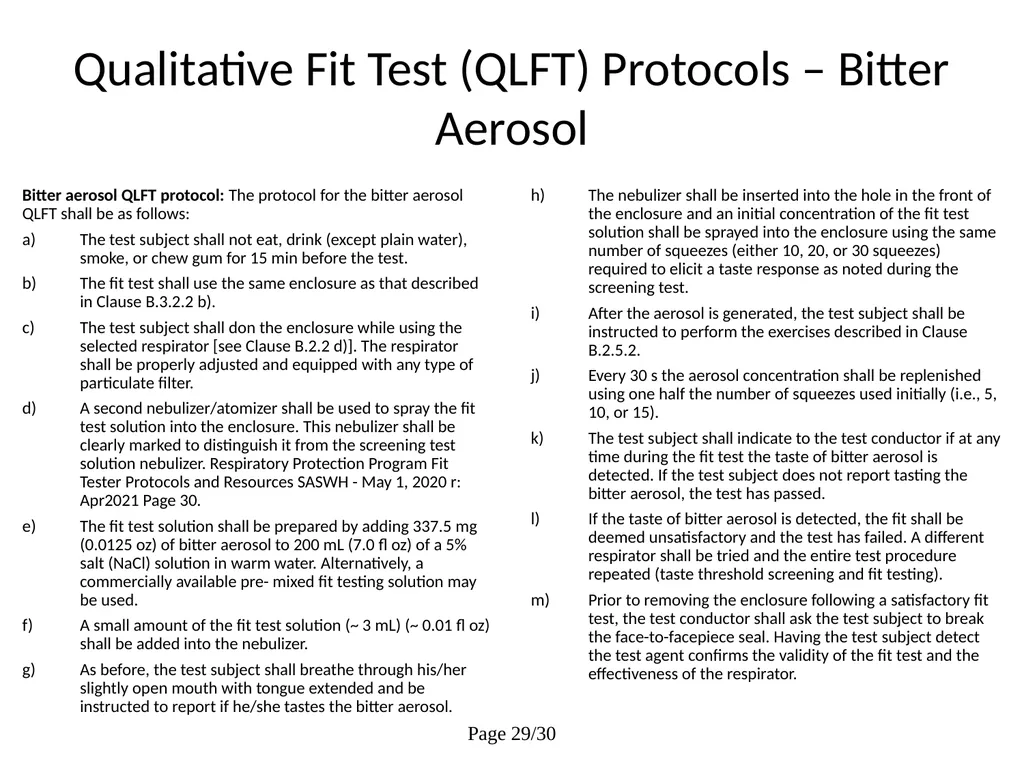
Qualitative Fit Test (QLFT) Protocols – Bitter Aerosol Bitter aerosol QLFT protocol: The protocol for the bitter aerosol QLFT shall be as follows:
The test subject shall not eat, drink (except plain water), smoke, or chew gum for 15 min before the test.
The fit test shall use the same enclosure as that described in Clause B.3.2.2 b).
The test subject shall don the enclosure while using the selected respirator [see Clause B.2.2 d)]. The respirator shall be properly adjusted and equipped with any type of particulate filter.
A second nebulizer/atomizer shall be used to spray the fit test solution into the enclosure. This nebulizer shall be clearly marked to distinguish it from the screening test solution nebulizer. Respiratory Protection Program Fit Tester Protocols and Resources SASWH - May 1, 2020 r: Apr2021 Page 30.
The fit test solution shall be prepared by adding 337.5 mg (0.0125 oz) of bitter aerosol to 200 mL (7.0 fl oz) of a 5% salt (NaCl) solution in warm water. Alternatively, a commercially available pre- mixed fit testing solution may be used.
A small amount of the fit test solution (~ 3 mL) (~ 0.01 fl oz) shall be added into the nebulizer.
As before, the test subject shall breathe through his/her slightly open mouth with tongue extended and be instructed to report if he/she tastes the bitter aerosol. The nebulizer shall be inserted into the hole in the front of the enclosure and an initial concentration of the fit test solution shall be sprayed into the enclosure using the same number of squeezes (either 10, 20, or 30 squeezes) required to elicit a taste response as noted during the screening test.
After the aerosol is generated, the test subject shall be instructed to perform the exercises described in Clause B.2.5.2.
Every 30 s the aerosol concentration shall be replenished using one half the number of squeezes used initially (i.e., 5, 10, or 15).
The test subject shall indicate to the test conductor if at any time during the fit test the taste of bitter aerosol is detected. If the test subject does not report tasting the bitter aerosol, the test has passed.
If the taste of bitter aerosol is detected, the fit shall be deemed unsatisfactory and the test has failed. A different respirator shall be tried and the entire test procedure repeated (taste threshold screening and fit testing).
Prior to removing the enclosure following a satisfactory fit test, the test conductor shall ask the test subject to break the face-to-facepiece seal. Having the test subject detect the test agent confirms the validity of the fit test and the effectiveness of the respirator. Page 29/30<br>
The test subject shall not eat, drink (except plain water), smoke, or chew gum for 15 min before the test.
The fit test shall use the same enclosure as that described in Clause B.3.2.2 b).
The test subject shall don the enclosure while using the selected respirator [see Clause B.2.2 d)]. The respirator shall be properly adjusted and equipped with any type of particulate filter.
A second nebulizer/atomizer shall be used to spray the fit test solution into the enclosure. This nebulizer shall be clearly marked to distinguish it from the screening test solution nebulizer. Respiratory Protection Program Fit Tester Protocols and Resources SASWH - May 1, 2020 r: Apr2021 Page 30.
The fit test solution shall be prepared by adding 337.5 mg (0.0125 oz) of bitter aerosol to 200 mL (7.0 fl oz) of a 5% salt (NaCl) solution in warm water. Alternatively, a commercially available pre- mixed fit testing solution may be used.
A small amount of the fit test solution (~ 3 mL) (~ 0.01 fl oz) shall be added into the nebulizer.
As before, the test subject shall breathe through his/her slightly open mouth with tongue extended and be instructed to report if he/she tastes the bitter aerosol. The nebulizer shall be inserted into the hole in the front of the enclosure and an initial concentration of the fit test solution shall be sprayed into the enclosure using the same number of squeezes (either 10, 20, or 30 squeezes) required to elicit a taste response as noted during the screening test.
After the aerosol is generated, the test subject shall be instructed to perform the exercises described in Clause B.2.5.2.
Every 30 s the aerosol concentration shall be replenished using one half the number of squeezes used initially (i.e., 5, 10, or 15).
The test subject shall indicate to the test conductor if at any time during the fit test the taste of bitter aerosol is detected. If the test subject does not report tasting the bitter aerosol, the test has passed.
If the taste of bitter aerosol is detected, the fit shall be deemed unsatisfactory and the test has failed. A different respirator shall be tried and the entire test procedure repeated (taste threshold screening and fit testing).
Prior to removing the enclosure following a satisfactory fit test, the test conductor shall ask the test subject to break the face-to-facepiece seal. Having the test subject detect the test agent confirms the validity of the fit test and the effectiveness of the respirator. Page 29/30<br>
63
Quantitative respirator fit tests (QNFT) Introduction of QNFT to respirator users: The person conducting the QNFT shall provide the test subject with an introduction to QNFT. In this introduction, the fit tester shall
explain what the QNFT procedure is, why it is required, and the importance of using a respirator that provides an effective, reproducible face-to-facepiece seal;
explain why the test is important, in order to convince the test subject to co-operate fully in the QNFT;
describe the challenge agent (e.g., ambient dust, generated aerosol, negative pressure) used in the QNFT;
describe how the test subject selects a properly fitting and comfortable respirator from those that are appropriate to the application;
explain that the respirator is equipped with the appropriate adapters or filters for the QNFT being used;
explain that the test subject is required to successfully complete the positive- or negative-pressure user seal check with the selected respirator without physical or verbal assistance prior to proceeding with the QNFT;
explain that the test subject is required to don the respirator properly, without physical or verbal assistance, in accordance with the manufacturer’s instructions;
explain that the test subject is required, during the QNFT, to wear other PPE that he/she could be required to use in the workplace and that could affect the face-to-facepiece seal;
describe the QNFT exercises and how to perform them during the QNFT;
explain why it is important to use, in the workplace, the specific brand, model, and size of facepiece that is used to pass the QNFT; and
emphasize that the user must always inspect a respirator before using it to ensure that it is in proper working condition Page 31<br>
explain what the QNFT procedure is, why it is required, and the importance of using a respirator that provides an effective, reproducible face-to-facepiece seal;
explain why the test is important, in order to convince the test subject to co-operate fully in the QNFT;
describe the challenge agent (e.g., ambient dust, generated aerosol, negative pressure) used in the QNFT;
describe how the test subject selects a properly fitting and comfortable respirator from those that are appropriate to the application;
explain that the respirator is equipped with the appropriate adapters or filters for the QNFT being used;
explain that the test subject is required to successfully complete the positive- or negative-pressure user seal check with the selected respirator without physical or verbal assistance prior to proceeding with the QNFT;
explain that the test subject is required to don the respirator properly, without physical or verbal assistance, in accordance with the manufacturer’s instructions;
explain that the test subject is required, during the QNFT, to wear other PPE that he/she could be required to use in the workplace and that could affect the face-to-facepiece seal;
describe the QNFT exercises and how to perform them during the QNFT;
explain why it is important to use, in the workplace, the specific brand, model, and size of facepiece that is used to pass the QNFT; and
emphasize that the user must always inspect a respirator before using it to ensure that it is in proper working condition Page 31<br>
64
Donning and Doffing<br>
65
Donning and Doffing<br>
66
Donning and Doffing<br>
67
Donning and Doffing<br>
68
Donning and Doffing<br>
69
Donning and Doffing<br>
70
Forms<br>
71
Set up and Practice QLFT<br>
72
Set up and practice QNFT<br>
73
Congratulations You are now a qualified fit tester!!!
You will receive a wallet card, and will be required to recertify in two years<br>
You will receive a wallet card, and will be required to recertify in two years<br>