
Respiratory Protection Session Objectives You will









Description: Respiratory Protection Session Objectives You will be able to: Identify the hazards of airborne contaminants Identify and use appropriate respiratory protection Recognize the limitations and capabilities of respirators in our workplace
Related Topics
Download Presentation
"Respiratory Protection Session Objectives You will" is the property of its rightful owner. Permission is granted to download and print the materials on this website for personal, non-commercial use only, and to display it on your personal computer provided you do not modify the materials and that you retain all copyright notices contained in the materials. By downloading content from our website, you accept the terms of this agreement.
Presentation Transcript
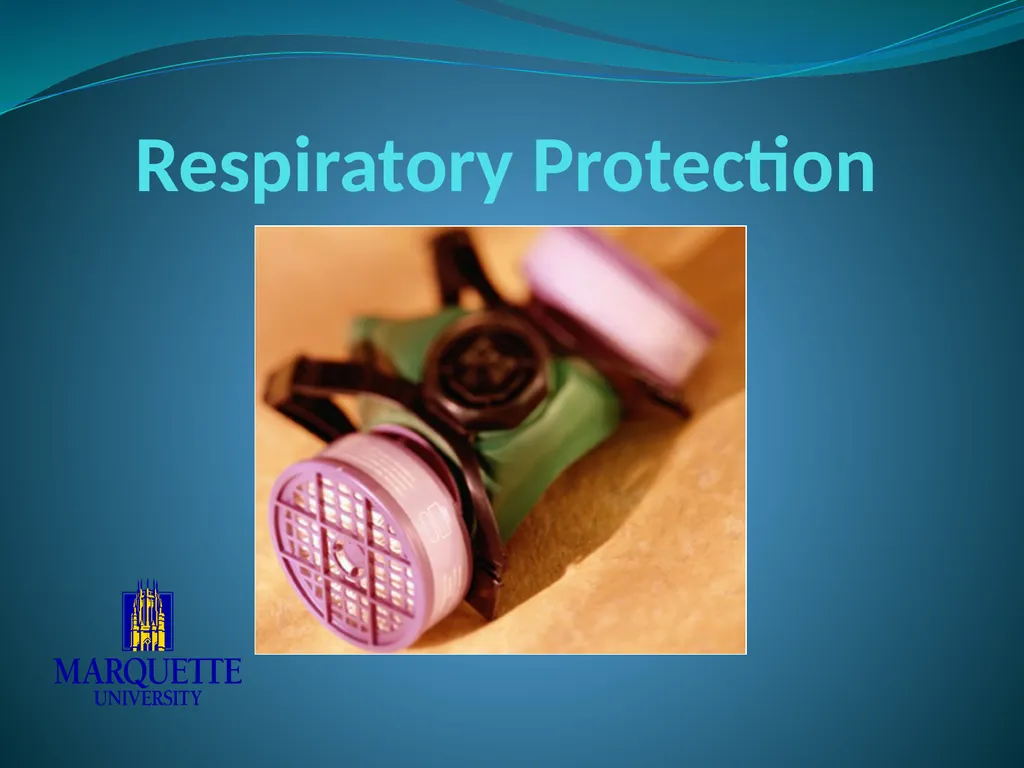
slide1. Respiratory Protection<br>
slide2. Session Objectives You will be able to:
Identify the hazards of airborne contaminants
Identify and use appropriate respiratory protection
Recognize the limitations and capabilities of respirators in our workplace
Inspect, maintain, and store respirators
Understand procedures for medical evaluations and recognize the medical signs and symptoms that may prevent effective respirator use<br>
slide3. Employee Exposure Exposure to a concentration of an airborne contaminant that would occur if the employee were not using respiratory protection.<br>
slide4. Required Vs Voluntary use Respirators Respirators are required under the following circumstances:
There is the potential for an overexposure to a contaminant:
The exposure is difficult to measure and control due to variability in the process
Oxygen deficient atmosphere exists.
Voluntary use of a respirator is permitted by employees upon request although there is neither a potential for overexposure to a contaminant nor an oxygen deficient atmosphere.<br>
slide5. Inhalation Hazards Airborne particles
Dust, fog, smoke, fume, mist, aerosol
Chemical vapor or gas
Biological organisms
Bacteria, mold, spores, fungi, or viruses<br>
slide6. Immediately Dangerous to Life or Health (IDLH) An atmosphere that poses an immediate threat to life, would cause irreversible adverse health effects, or would impair an individual’s ability to escape from a dangerous atmosphere.
IDLH conditions occur most often in confined spaces, large chemical spills, or chemical fires.<br>
slide7. How Respirators Work Prevent inhalation of airborne contaminants
Generate negative pressure in facepiece
Generate positive pressure in facepiece
Air is passed through a filter, sorbent, or catalyst that traps contaminants<br>
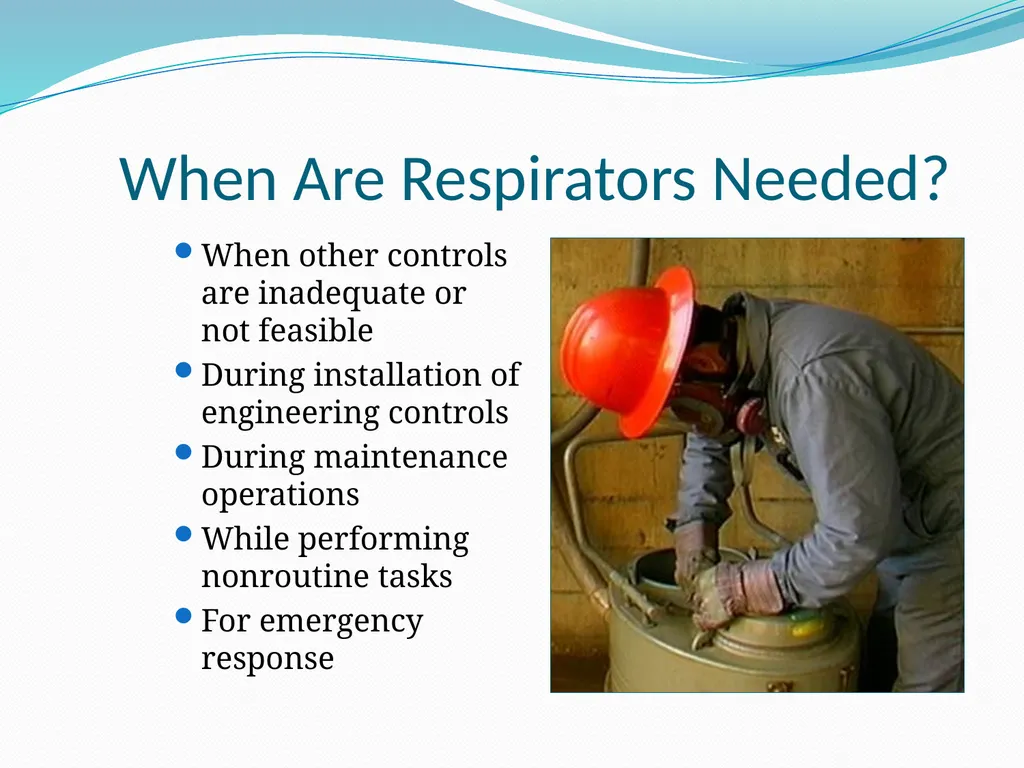
slide8. When Are Respirators Needed? When other controls are inadequate or not feasible
During installation of engineering controls
During maintenance operations
While performing nonroutine tasks
For emergency response<br>
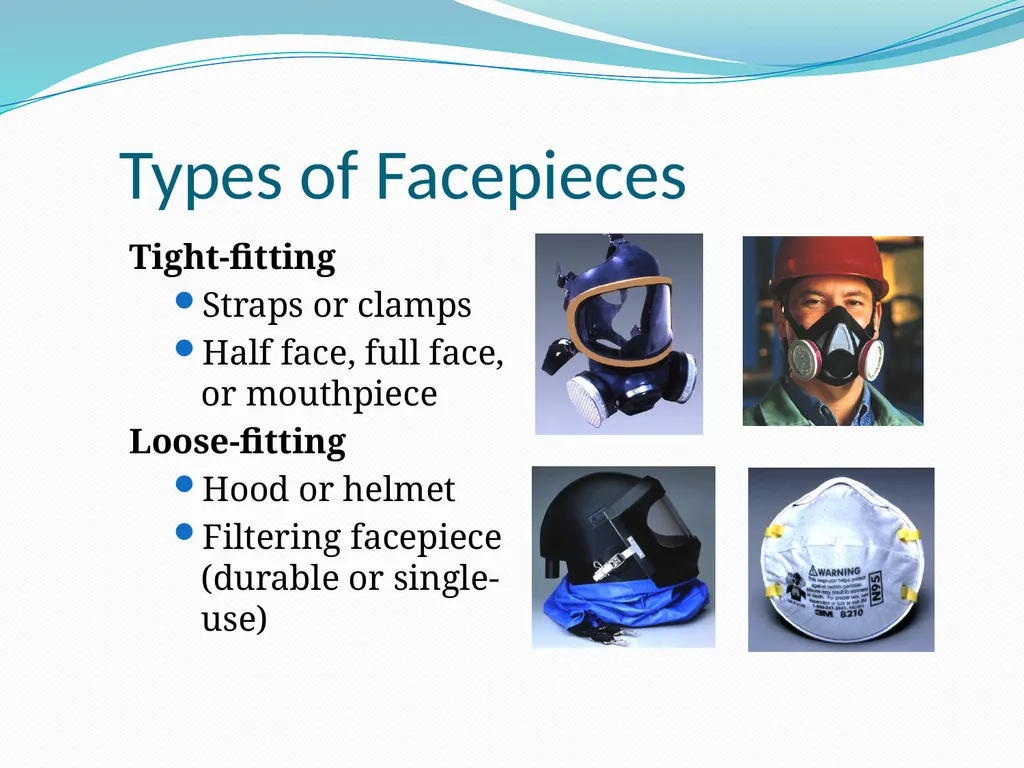
slide9. Types of Facepieces Tight-fitting
Straps or clamps
Half face, full face, or mouthpiece
Loose-fitting
Hood or helmet
Filtering facepiece (durable or single-use)<br>
slide10. Assigned Protection Factor (APF) Concentration Outside Respirator
PF = ---------------------------------------------
Concentration Inside Respirator
10 = Air Purifying Half Mask
50 = Air Purifying Full Face Mask
25-50 = Powered Air Purifying
1000 =Type C Supplied Air
10,000 = Self Contained<br>
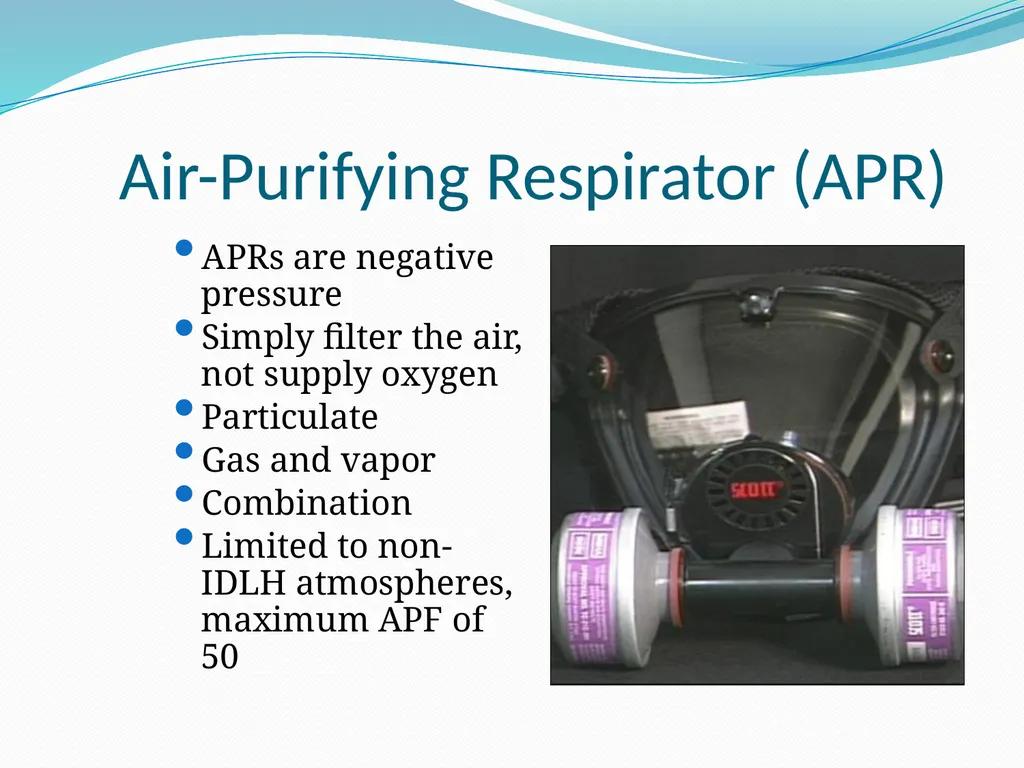
slide11. Air-Purifying Respirator (APR) APRs are negative pressure
Simply filter the air, not supply oxygen
Particulate
Gas and vapor
Combination
Limited to non-IDLH atmospheres, maximum APF of 50<br>
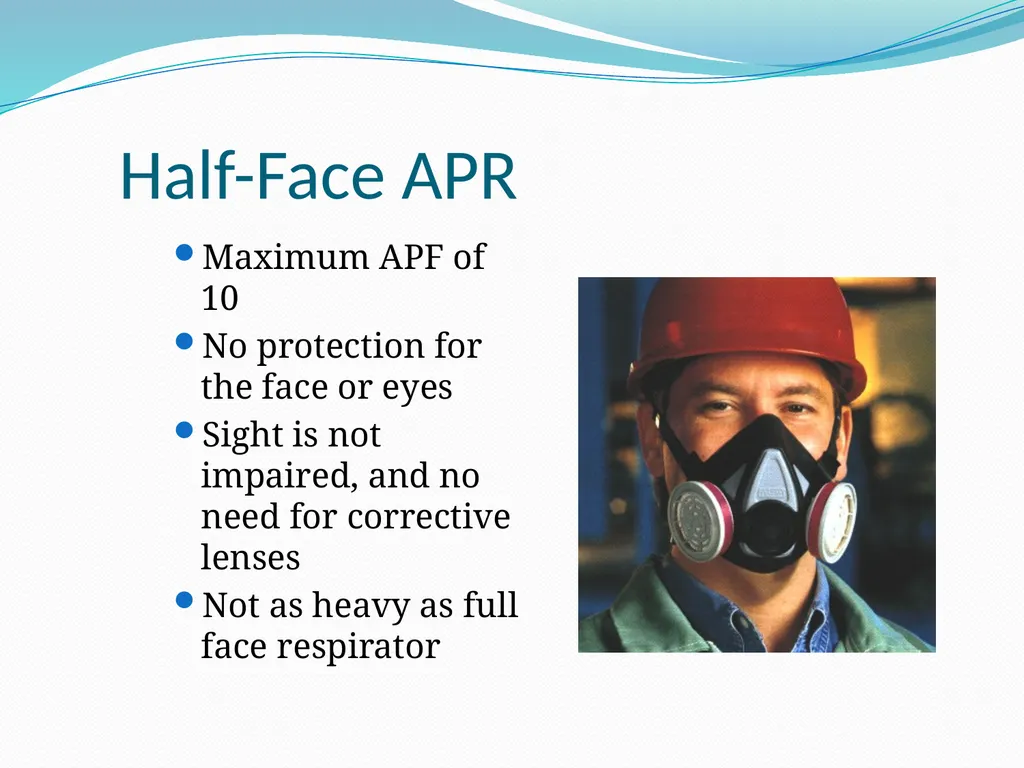
slide12. Half-Face APR Maximum APF of 10
No protection for the face or eyes
Sight is not impaired, and no need for corrective lenses
Not as heavy as full face respirator<br>
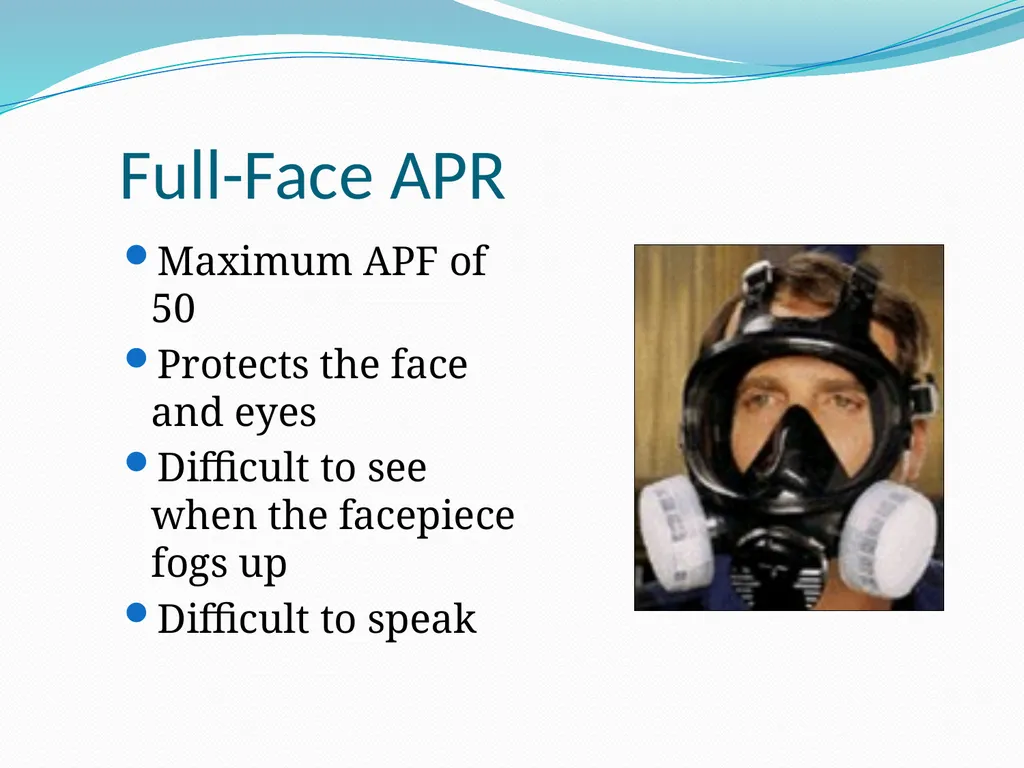
slide13. Full-Face APR Maximum APF of 50
Protects the face and eyes
Difficult to see when the facepiece fogs up
Difficult to speak<br>
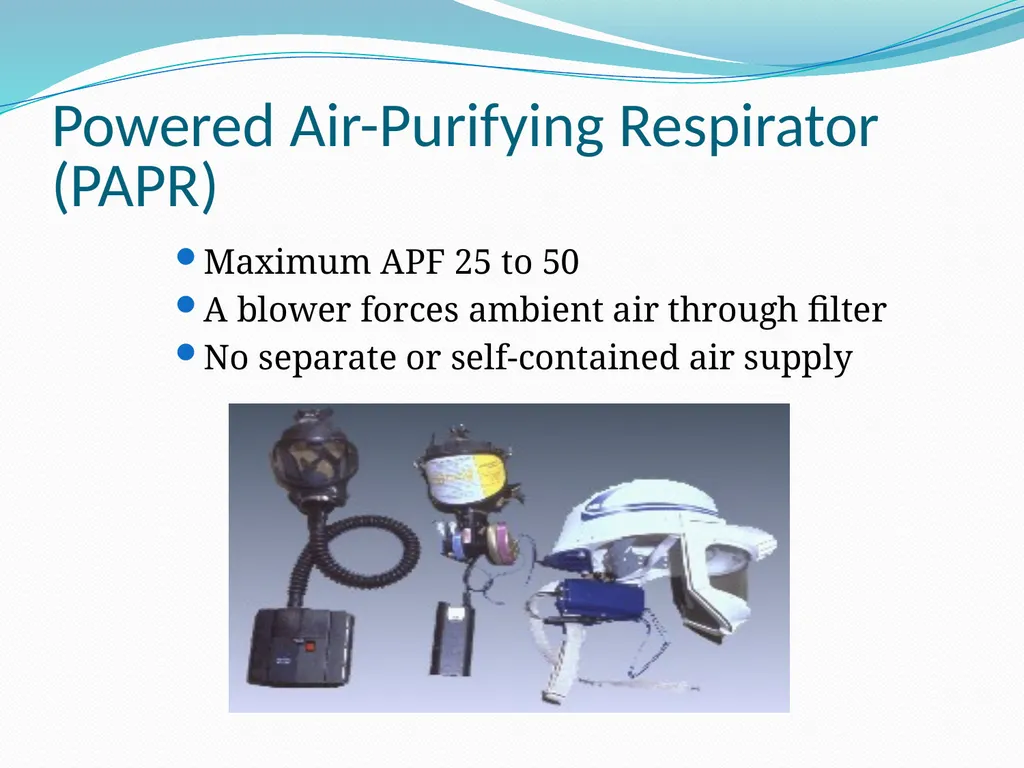
slide14. Powered Air-Purifying Respirator (PAPR) Maximum APF 25 to 50
A blower forces ambient air through filter
No separate or self-contained air supply<br>
slide15. Prohibited Uses of APR and PAPR IDLH atmosphere, including oxygen-deficient
Unknown airborne contaminants
Contaminants with poorly understood exposure limits or other warnings
Contaminant concentrations exceed maximum use concentration (MUC) limits
MUC=The OSHA Permissible Exposure Limit (PEL) x APF<br>
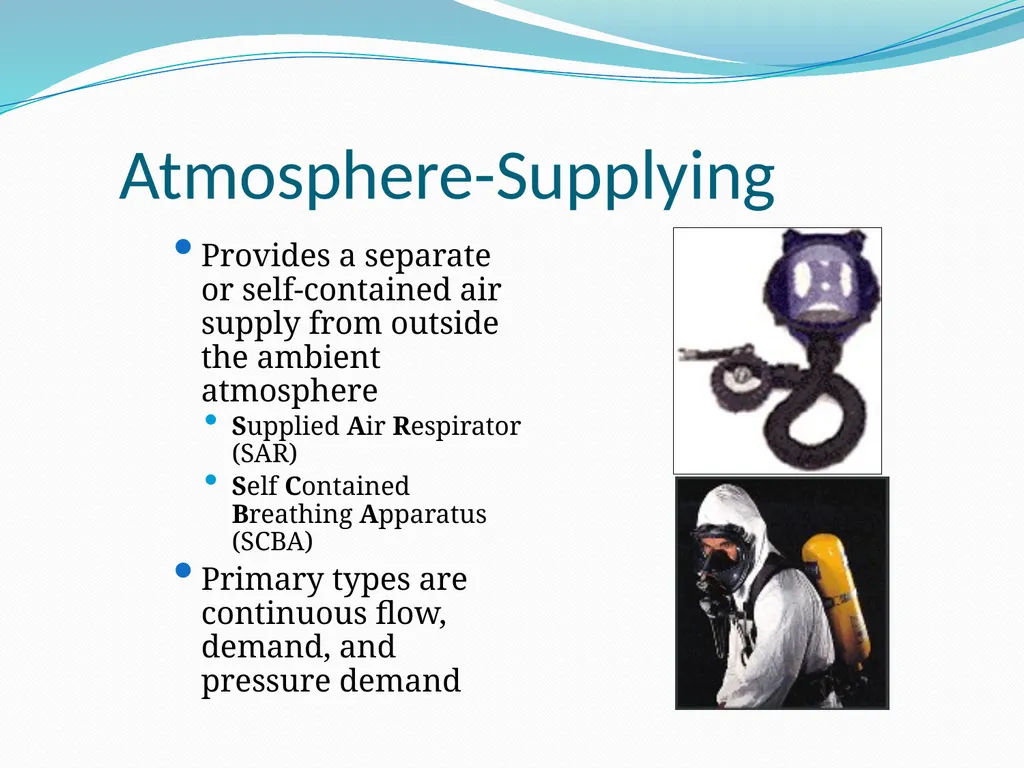
slide16. Atmosphere-Supplying Provides a separate or self-contained air supply from outside the ambient atmosphere
Supplied Air Respirator (SAR)
Self Contained Breathing Apparatus (SCBA)
Primary types are continuous flow, demand, and pressure demand<br>
slide17. Image Credit: OSHA Filtering Facepiece Negative pressure
Filter removes particulates
The filter is an integral part of the mask
The entire mask is composed of the filter material
Hazard protection is very limited<br>
slide18. Inhalation Hazards and Respirators—Questions? Any questions about the hazards of airborne contaminants at our facility?
The types of respirators used at the facility?<br>
slide19. Respirator Selection The physical state of the contaminants
Contaminant concentration
Oxygen deficiency
Warning properties of the contaminant(s)
Potential for an IDLH atmosphere
Length of time of respirator use<br>
slide20. Respirator Selection (cont.) The workload of the wearer
The working environment (e.g., temperature)
The proper filter media for the given contaminant
Potential hazard of skin contact with contaminants
Potential hazard of eye contact with contaminants<br>
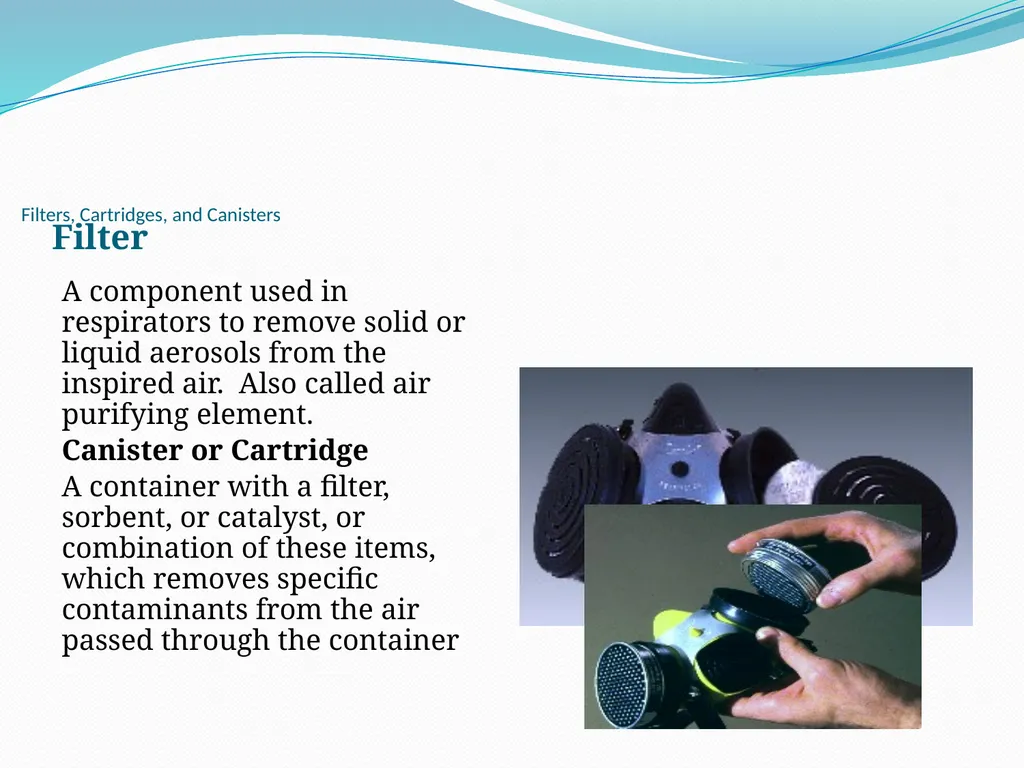
slide21. Filters, Cartridges, and Canisters Filter A component used in respirators to remove solid or liquid aerosols from the inspired air. Also called air purifying element.
Canister or Cartridge
A container with a filter, sorbent, or catalyst, or combination of these items, which removes specific contaminants from the air passed through the container<br>
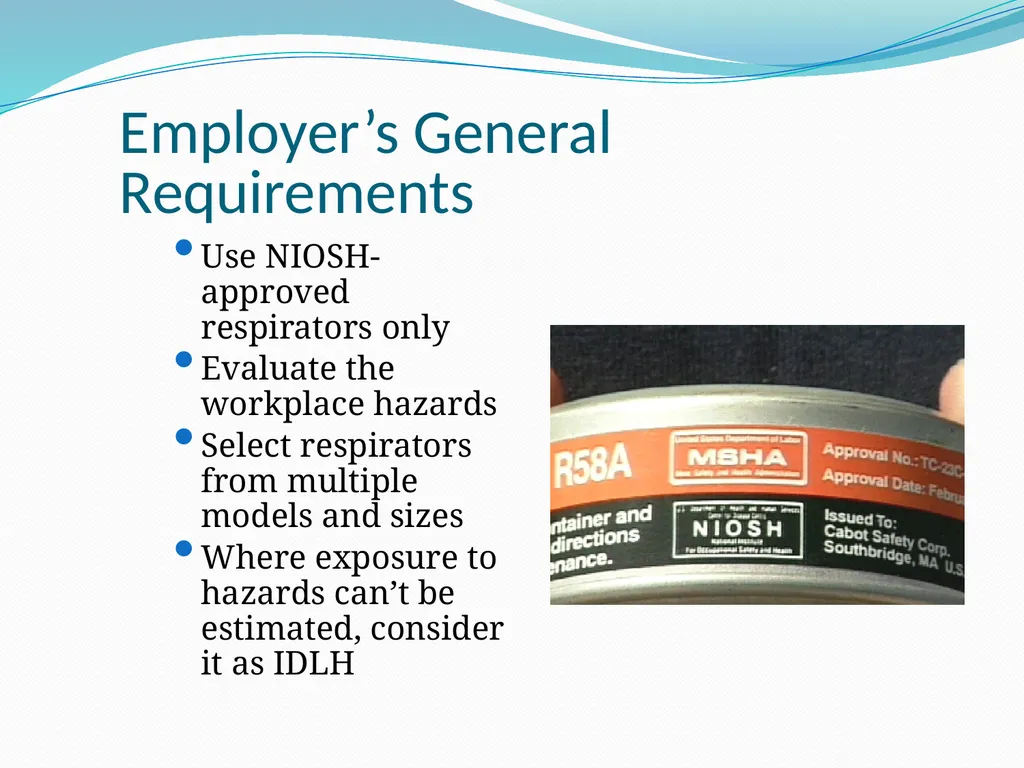
slide22. Filters, Cartridges, and Canisters All must be labeled and color-coded with the NIOSH approval label
The label must not be removed and must remain legible
Marked with “NIOSH,” manufacturer’s name and part number, and cartridge or filter type
End-of-service-life indicator (ESLI) must be NIOSH-certified for APRs<br>
slide23. Medical Evaluation An initial medical evaluation—a questionnaire—is required before fit testing and respirator use
All medical evaluations must be confidential
Employees must be allowed to discuss the questionnaire with the physician
Follow-up evaluations must be conducted if conditions of use or user health change<br>
slide24. Fit Testing Before an employee uses any respirator with a negative or positive pressure tight-fitting face piece, the employee must be fit tested with the same make, model, style, and size of respirator that will be used.<br>
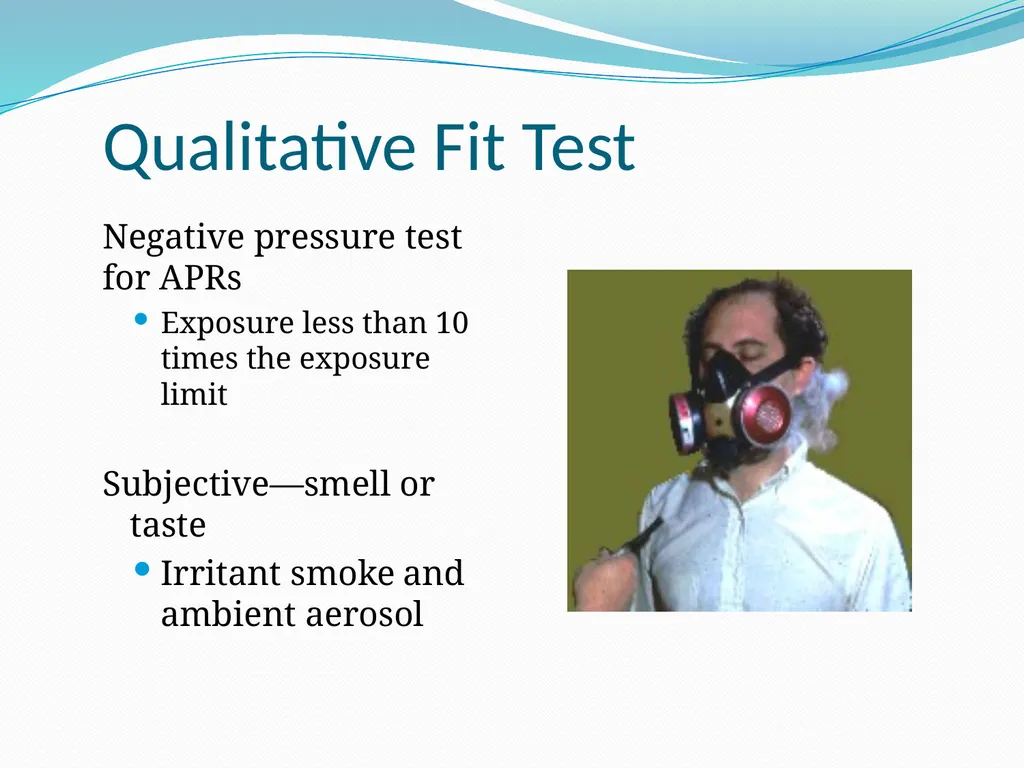
slide25. Qualitative Fit Test Negative pressure test for APRs
Exposure less than 10 times the exposure limit
Subjective—smell or taste
Irritant smoke and ambient aerosol<br>
slide26. Quantitative Fit Test Numeric measurement—fit factor—of leakage into the respirator
Controlled negative pressure
Portacount™
For negative-pressure APRs, exposure levels greater than 10 times the occupational exposure limit<br>
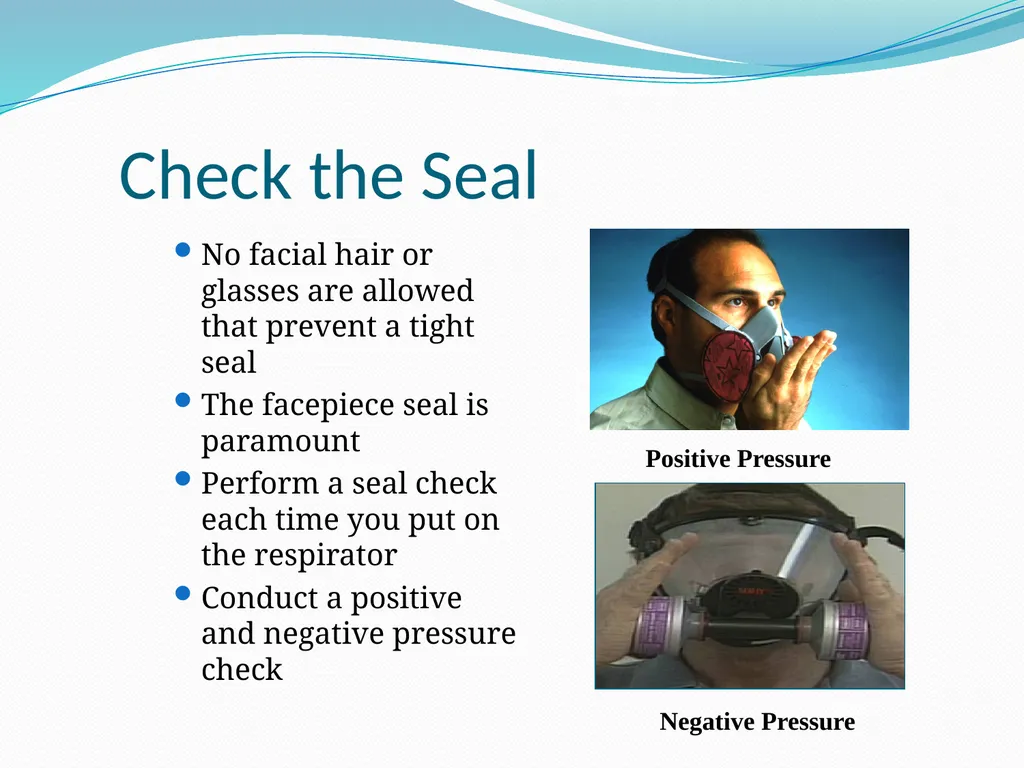
slide27. Check the Seal No facial hair or glasses are allowed that prevent a tight seal
The facepiece seal is paramount
Perform a seal check each time you put on the respirator
Conduct a positive and negative pressure check Positive Pressure Negative Pressure<br>
slide28. Inspect Respirator Carefully Inspect the respirator before each use and during cleaning, following manufacturer’s instructions
Emergency respirators
Check at least monthly when not in use
Check before and after each use
Check elastic parts for pliability and deterioration
Report any problems or defects<br>
slide29. Store Properly Protect equipment from damage, sunlight, or contamination
Store dry respirator and cartridges in a clean container or bag
Do not allow the facepiece to be distorted<br>
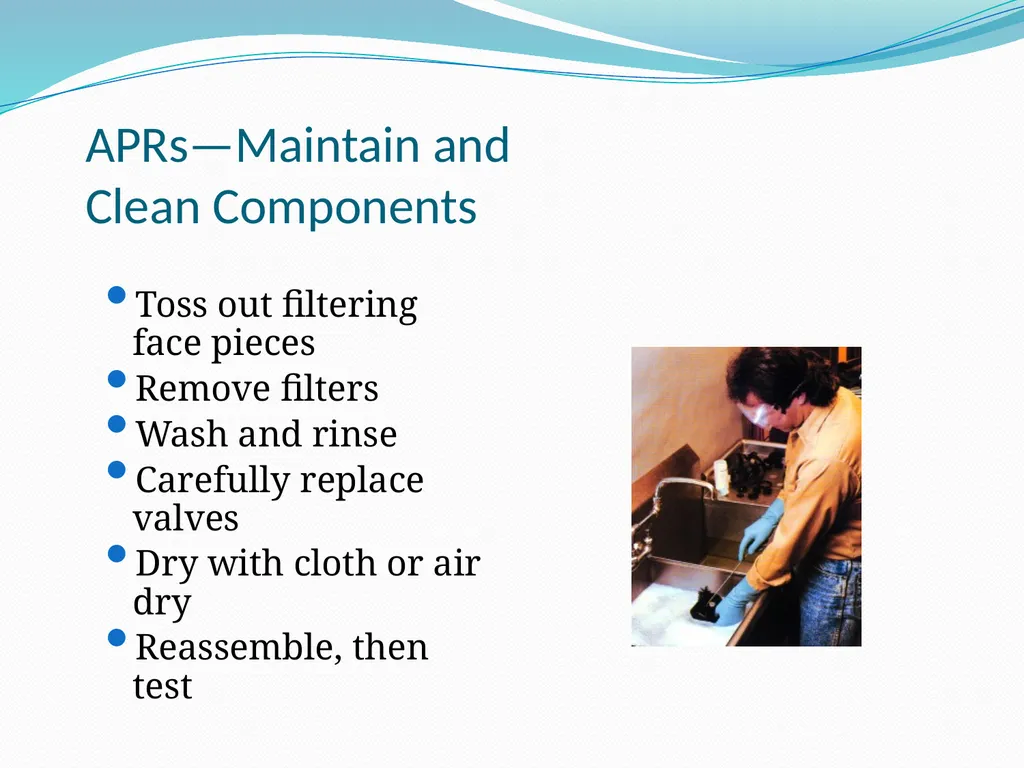
slide30. APRs—Maintain and Clean Components Toss out filtering face pieces
Remove filters
Wash and rinse
Carefully replace valves
Dry with cloth or air dry
Reassemble, then test<br>
slide31. Respirator Care and Use— Questions? Any questions about your responsibilities for the care and use of respirators and their components?
Any questions about the respiratory protection plan or dangerous atmospheres?<br>
slide32. Regulatory Requirements 29 CFR 1910.134
Requires a written respiratory protection plan
Employee training
Medical evaluation
Fit testing
Provide respirators at no cost to employee<br>
slide33. Employer’s General Requirements Use NIOSH-approved respirators only
Evaluate the workplace hazards
Select respirators from multiple models and sizes
Where exposure to hazards can’t be estimated, consider it as IDLH<br>
slide34. Key Points to Remember Understand the physical and health hazards of dangerous airborne substances in your work area (review SDS)
Make sure appropriate engineering controls are implemented before using a respirator
Know how to properly don, fit, use, inspect, clean, and store respirators
Inspect respirators and cartridges before each use
Always make sure the right respirator and cartridge are matched to the appropriate working conditions and contaminants<br>
slide35. Questions
?
Dennis Daye CIH, CSP, CHMM
dennis.daye@mu.edu
Ext. 288-8411<br>
slide36. DVD Respiratory Protection A Breath of Fresh Air<br>
slide2. Session Objectives You will be able to:
Identify the hazards of airborne contaminants
Identify and use appropriate respiratory protection
Recognize the limitations and capabilities of respirators in our workplace
Inspect, maintain, and store respirators
Understand procedures for medical evaluations and recognize the medical signs and symptoms that may prevent effective respirator use<br>
slide3. Employee Exposure Exposure to a concentration of an airborne contaminant that would occur if the employee were not using respiratory protection.<br>
slide4. Required Vs Voluntary use Respirators Respirators are required under the following circumstances:
There is the potential for an overexposure to a contaminant:
The exposure is difficult to measure and control due to variability in the process
Oxygen deficient atmosphere exists.
Voluntary use of a respirator is permitted by employees upon request although there is neither a potential for overexposure to a contaminant nor an oxygen deficient atmosphere.<br>
slide5. Inhalation Hazards Airborne particles
Dust, fog, smoke, fume, mist, aerosol
Chemical vapor or gas
Biological organisms
Bacteria, mold, spores, fungi, or viruses<br>
slide6. Immediately Dangerous to Life or Health (IDLH) An atmosphere that poses an immediate threat to life, would cause irreversible adverse health effects, or would impair an individual’s ability to escape from a dangerous atmosphere.
IDLH conditions occur most often in confined spaces, large chemical spills, or chemical fires.<br>
slide7. How Respirators Work Prevent inhalation of airborne contaminants
Generate negative pressure in facepiece
Generate positive pressure in facepiece
Air is passed through a filter, sorbent, or catalyst that traps contaminants<br>
slide8. When Are Respirators Needed? When other controls are inadequate or not feasible
During installation of engineering controls
During maintenance operations
While performing nonroutine tasks
For emergency response<br>
slide9. Types of Facepieces Tight-fitting
Straps or clamps
Half face, full face, or mouthpiece
Loose-fitting
Hood or helmet
Filtering facepiece (durable or single-use)<br>
slide10. Assigned Protection Factor (APF) Concentration Outside Respirator
PF = ---------------------------------------------
Concentration Inside Respirator
10 = Air Purifying Half Mask
50 = Air Purifying Full Face Mask
25-50 = Powered Air Purifying
1000 =Type C Supplied Air
10,000 = Self Contained<br>
slide11. Air-Purifying Respirator (APR) APRs are negative pressure
Simply filter the air, not supply oxygen
Particulate
Gas and vapor
Combination
Limited to non-IDLH atmospheres, maximum APF of 50<br>
slide12. Half-Face APR Maximum APF of 10
No protection for the face or eyes
Sight is not impaired, and no need for corrective lenses
Not as heavy as full face respirator<br>
slide13. Full-Face APR Maximum APF of 50
Protects the face and eyes
Difficult to see when the facepiece fogs up
Difficult to speak<br>
slide14. Powered Air-Purifying Respirator (PAPR) Maximum APF 25 to 50
A blower forces ambient air through filter
No separate or self-contained air supply<br>
slide15. Prohibited Uses of APR and PAPR IDLH atmosphere, including oxygen-deficient
Unknown airborne contaminants
Contaminants with poorly understood exposure limits or other warnings
Contaminant concentrations exceed maximum use concentration (MUC) limits
MUC=The OSHA Permissible Exposure Limit (PEL) x APF<br>
slide16. Atmosphere-Supplying Provides a separate or self-contained air supply from outside the ambient atmosphere
Supplied Air Respirator (SAR)
Self Contained Breathing Apparatus (SCBA)
Primary types are continuous flow, demand, and pressure demand<br>
slide17. Image Credit: OSHA Filtering Facepiece Negative pressure
Filter removes particulates
The filter is an integral part of the mask
The entire mask is composed of the filter material
Hazard protection is very limited<br>
slide18. Inhalation Hazards and Respirators—Questions? Any questions about the hazards of airborne contaminants at our facility?
The types of respirators used at the facility?<br>
slide19. Respirator Selection The physical state of the contaminants
Contaminant concentration
Oxygen deficiency
Warning properties of the contaminant(s)
Potential for an IDLH atmosphere
Length of time of respirator use<br>
slide20. Respirator Selection (cont.) The workload of the wearer
The working environment (e.g., temperature)
The proper filter media for the given contaminant
Potential hazard of skin contact with contaminants
Potential hazard of eye contact with contaminants<br>
slide21. Filters, Cartridges, and Canisters Filter A component used in respirators to remove solid or liquid aerosols from the inspired air. Also called air purifying element.
Canister or Cartridge
A container with a filter, sorbent, or catalyst, or combination of these items, which removes specific contaminants from the air passed through the container<br>
slide22. Filters, Cartridges, and Canisters All must be labeled and color-coded with the NIOSH approval label
The label must not be removed and must remain legible
Marked with “NIOSH,” manufacturer’s name and part number, and cartridge or filter type
End-of-service-life indicator (ESLI) must be NIOSH-certified for APRs<br>
slide23. Medical Evaluation An initial medical evaluation—a questionnaire—is required before fit testing and respirator use
All medical evaluations must be confidential
Employees must be allowed to discuss the questionnaire with the physician
Follow-up evaluations must be conducted if conditions of use or user health change<br>
slide24. Fit Testing Before an employee uses any respirator with a negative or positive pressure tight-fitting face piece, the employee must be fit tested with the same make, model, style, and size of respirator that will be used.<br>
slide25. Qualitative Fit Test Negative pressure test for APRs
Exposure less than 10 times the exposure limit
Subjective—smell or taste
Irritant smoke and ambient aerosol<br>
slide26. Quantitative Fit Test Numeric measurement—fit factor—of leakage into the respirator
Controlled negative pressure
Portacount™
For negative-pressure APRs, exposure levels greater than 10 times the occupational exposure limit<br>
slide27. Check the Seal No facial hair or glasses are allowed that prevent a tight seal
The facepiece seal is paramount
Perform a seal check each time you put on the respirator
Conduct a positive and negative pressure check Positive Pressure Negative Pressure<br>
slide28. Inspect Respirator Carefully Inspect the respirator before each use and during cleaning, following manufacturer’s instructions
Emergency respirators
Check at least monthly when not in use
Check before and after each use
Check elastic parts for pliability and deterioration
Report any problems or defects<br>
slide29. Store Properly Protect equipment from damage, sunlight, or contamination
Store dry respirator and cartridges in a clean container or bag
Do not allow the facepiece to be distorted<br>
slide30. APRs—Maintain and Clean Components Toss out filtering face pieces
Remove filters
Wash and rinse
Carefully replace valves
Dry with cloth or air dry
Reassemble, then test<br>
slide31. Respirator Care and Use— Questions? Any questions about your responsibilities for the care and use of respirators and their components?
Any questions about the respiratory protection plan or dangerous atmospheres?<br>
slide32. Regulatory Requirements 29 CFR 1910.134
Requires a written respiratory protection plan
Employee training
Medical evaluation
Fit testing
Provide respirators at no cost to employee<br>
slide33. Employer’s General Requirements Use NIOSH-approved respirators only
Evaluate the workplace hazards
Select respirators from multiple models and sizes
Where exposure to hazards can’t be estimated, consider it as IDLH<br>
slide34. Key Points to Remember Understand the physical and health hazards of dangerous airborne substances in your work area (review SDS)
Make sure appropriate engineering controls are implemented before using a respirator
Know how to properly don, fit, use, inspect, clean, and store respirators
Inspect respirators and cartridges before each use
Always make sure the right respirator and cartridge are matched to the appropriate working conditions and contaminants<br>
slide35. Questions
?
Dennis Daye CIH, CSP, CHMM
dennis.daye@mu.edu
Ext. 288-8411<br>
slide36. DVD Respiratory Protection A Breath of Fresh Air<br>