
Rethinking our EAP Teaching: Some Emerging
TF
Published · 41 slides · 0 views
1 / 1






Description
Rethinking our EAP Teaching: Some Emerging Challenges Christine B. Feak John M. Swales Selected topics The vanishing center? Getting to grips with humanities texts Rethinking the targets of instruction The vanishing center? Episodes in
Related Topics
Share
Embed code
Download this presentation From Below
"Rethinking our EAP Teaching: Some Emerging" is the property of its rightful owner. Permission is granted to download and print the materials on this website for personal, non-commercial use only, and to display it on your personal computer provided you do not modify the materials and that you retain all copyright notices contained in the materials. By downloading content from our website, you accept the terms of this agreement.
Presentation Transcript
01
Rethinking our EAP Teaching: Some Emerging Challenges Christine B. Feak & John M. Swales<br>
02
Selected topics The vanishing center?
Getting to grips with humanities texts
Rethinking the targets of instruction<br>
Getting to grips with humanities texts
Rethinking the targets of instruction<br>
03
The vanishing center? Episodes in ESP : A source and reference book on the development of English for science and technology (1985)
15 Episodes
4 textbook extracts
4 descriptions of EST discourse
2 theoretical discussions (Widdowson; Hutchinson & Waters)
5 dealing with methodology and materials)
29 authors or co-authors (28 native speakers of English, 10 from the U.S. and the from Great Britain—though often working overseas)<br>
04
30 years later The Semiperiphery of Academic Writing: Discourses, Communities and Practices. (Karen Bennett, ed.) 2014
15 authors and co-authors, all non-native speakers of English, except for the editor (British) and one other contributor (from Australia)
All the papers (bar one) are scholarly descriptions of the state of play in various countries (mostly E. Europe), such as “The changing face of Czech academic discourse”.
The one exception: “Teaching academic writing for the global world in Poland: The ELF perspective”<br>
05
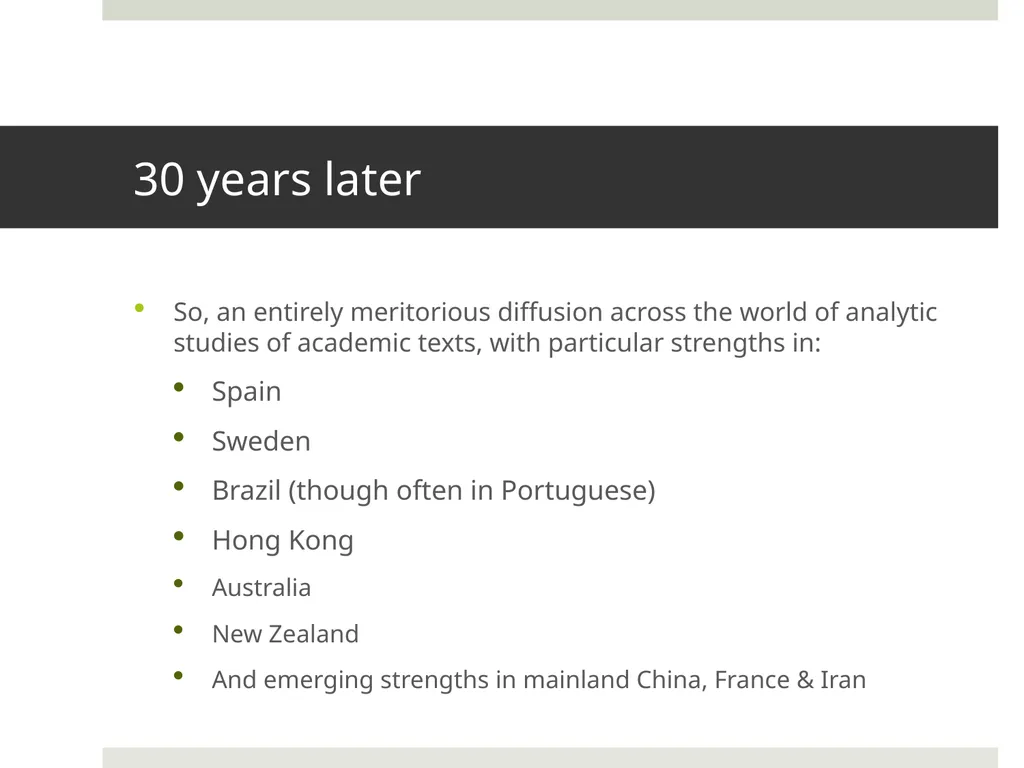
30 years later So, an entirely meritorious diffusion across the world of analytic studies of academic texts, with particular strengths in:
Spain
Sweden
Brazil (though often in Portuguese)
Hong Kong
Australia
New Zealand
And emerging strengths in mainland China, France & Iran<br>
Spain
Sweden
Brazil (though often in Portuguese)
Hong Kong
Australia
New Zealand
And emerging strengths in mainland China, France & Iran<br>
06
The old center A worrying implosion in the “old center” (USA, UK)
Fewer doctoral opportunities in these countries
Fewer professorial appointments
A hard-working “lecturer class”
Many conference presentations (as in BALEAP), but few with the will and the skill to attempt international publication<br>
Fewer doctoral opportunities in these countries
Fewer professorial appointments
A hard-working “lecturer class”
Many conference presentations (as in BALEAP), but few with the will and the skill to attempt international publication<br>
07
Getting to grips with humanities texts A double whammy: Only limited demand at the graduate level and the difficulty in establishing clear lines of textual development
The case of the genre of describing/discussing/evaluating a creative work (a painting, poem, piece of music, film, etc.)<br>
The case of the genre of describing/discussing/evaluating a creative work (a painting, poem, piece of music, film, etc.)<br>
08
Three options General-specific (as in empirical introductions)
Let me tell you about the context (creator, historical background, social context) Now let’s examine the artistic object.
Specific-general (as in empirical discussions)
Let’s have a look at the creative product, and let me walk you through its main features Now let me tell you about its creator, her ambience and the influences and effects of her work.<br>
09
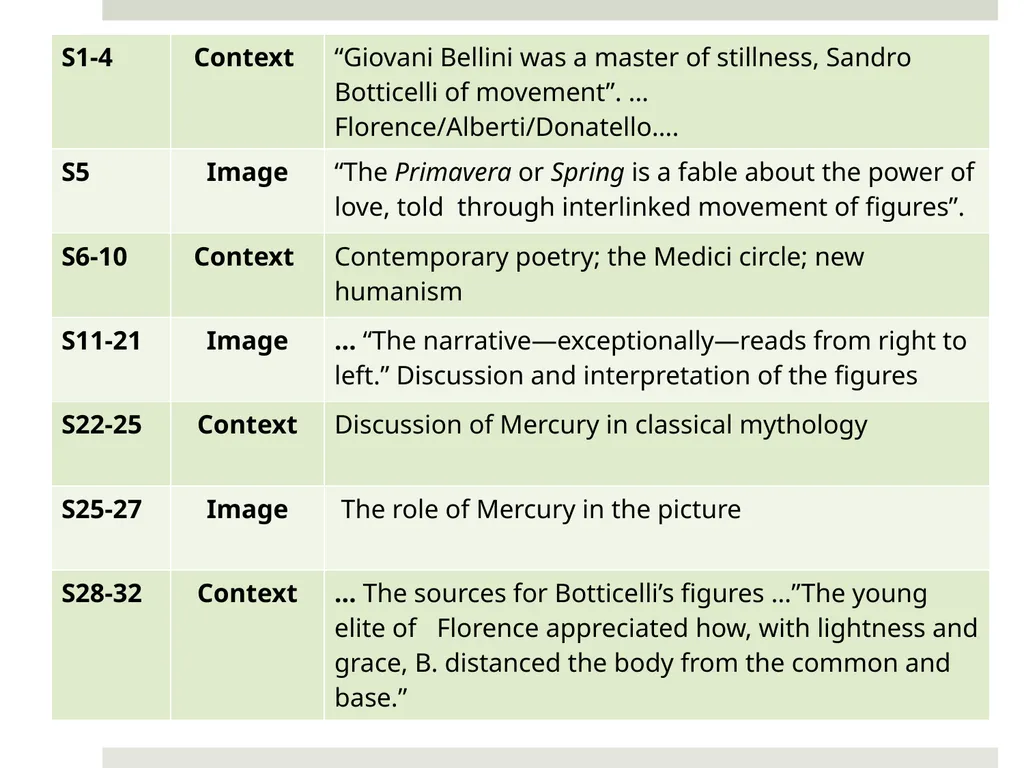
Three options 3. As far as I can see, at least for art objects, the preferred trajectory is a continuous switching between context and image
Art-The Critics Choice
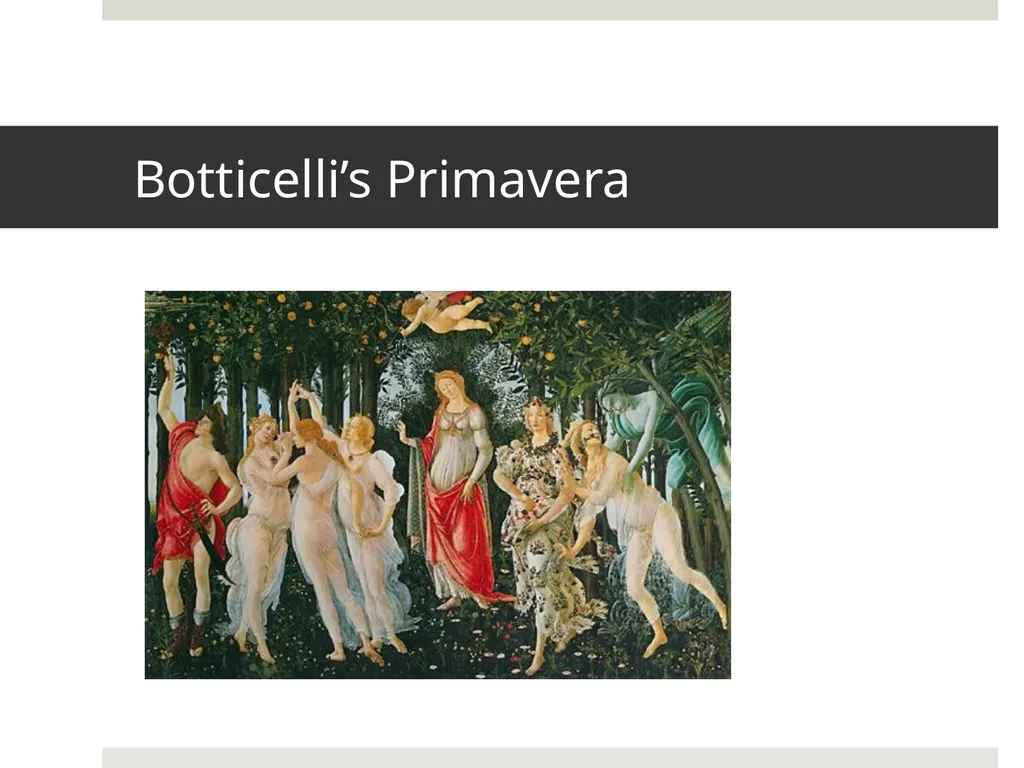
Professor Paul Hills (of London University) with a large page (750 words) to talk about Botticelli’s Primavera.<br>
Art-The Critics Choice
Professor Paul Hills (of London University) with a large page (750 words) to talk about Botticelli’s Primavera.<br>
10
Botticelli’s Primavera<br>
11
Structure of Hill’s text<br>
12
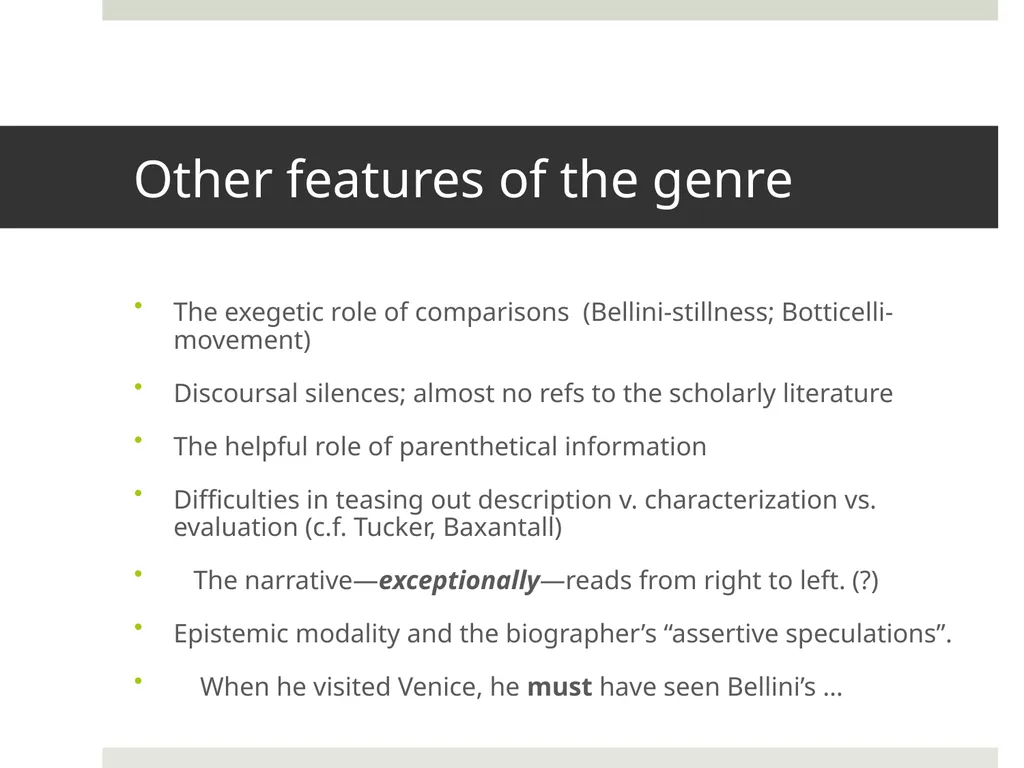
Other features of the genre The exegetic role of comparisons (Bellini-stillness; Botticelli-movement)
Discoursal silences; almost no refs to the scholarly literature
The helpful role of parenthetical information
Difficulties in teasing out description v. characterization vs. evaluation (c.f. Tucker, Baxantall)
The narrative—exceptionally—reads from right to left. (?)
Epistemic modality and the biographer’s “assertive speculations”.
When he visited Venice, he must have seen Bellini’s …<br>
13
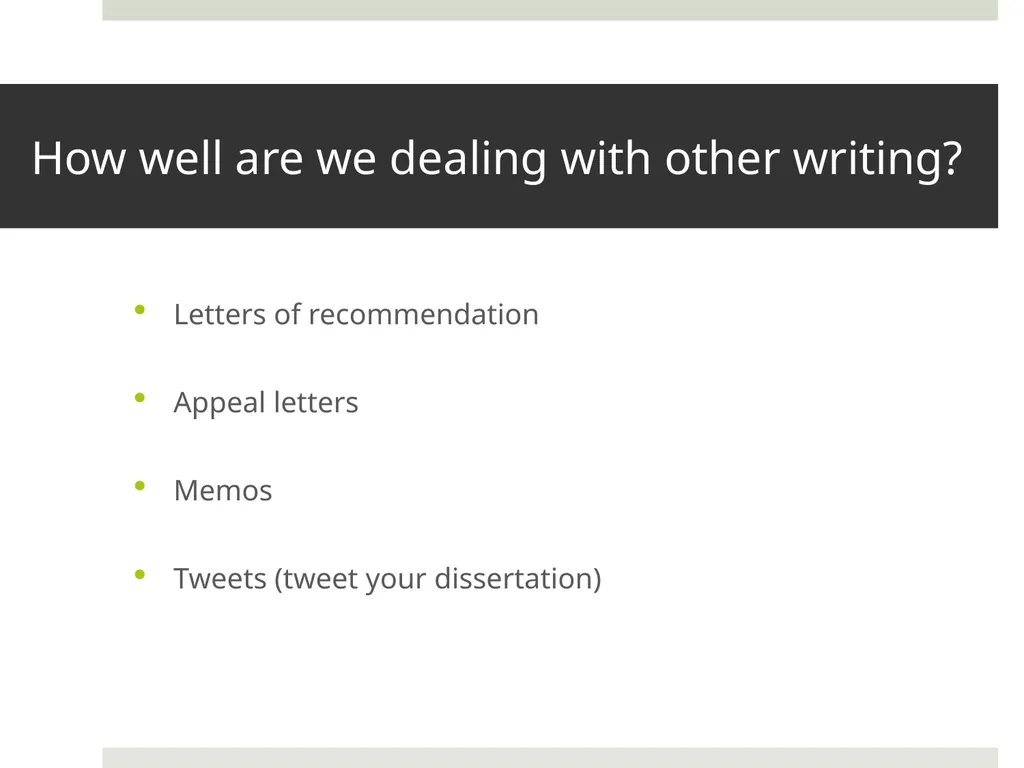
How well are we dealing with other writing? Letters of recommendation
Appeal letters
Memos
Tweets (tweet your dissertation)<br>
Appeal letters
Memos
Tweets (tweet your dissertation)<br>
14
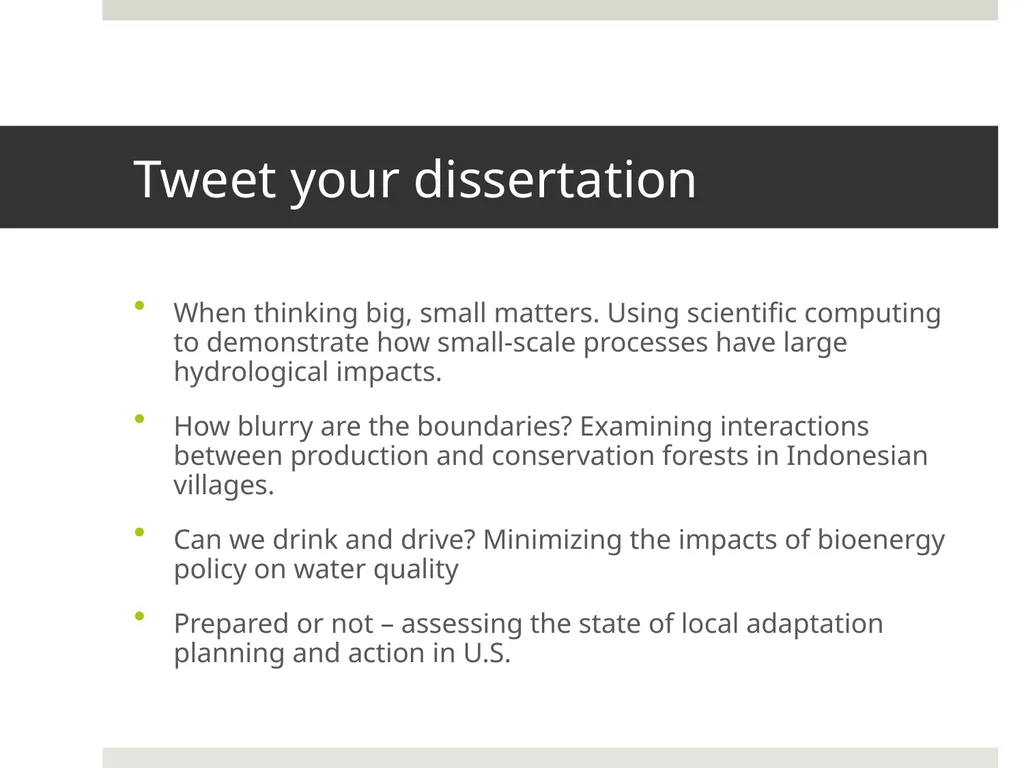
Tweet your dissertation When thinking big, small matters. Using scientific computing to demonstrate how small-scale processes have large hydrological impacts.
How blurry are the boundaries? Examining interactions between production and conservation forests in Indonesian villages.
Can we drink and drive? Minimizing the impacts of bioenergy policy on water quality
Prepared or not – assessing the state of local adaptation planning and action in U.S.<br>
How blurry are the boundaries? Examining interactions between production and conservation forests in Indonesian villages.
Can we drink and drive? Minimizing the impacts of bioenergy policy on water quality
Prepared or not – assessing the state of local adaptation planning and action in U.S.<br>
15
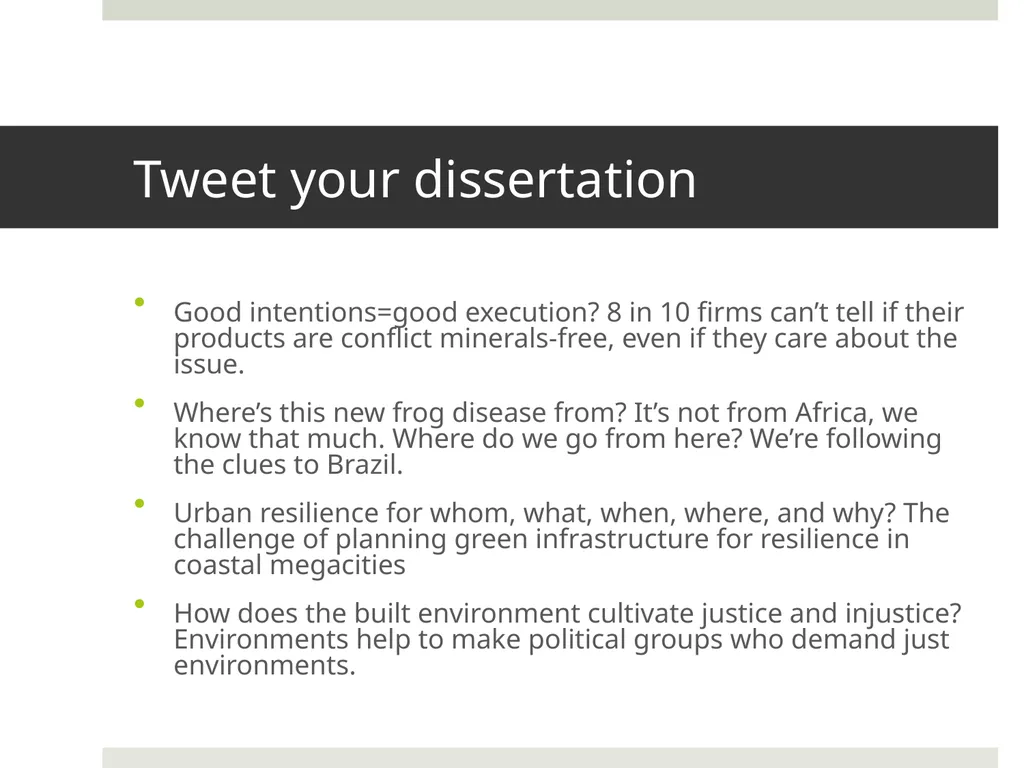
Tweet your dissertation Good intentions=good execution? 8 in 10 firms can’t tell if their products are conflict minerals-free, even if they care about the issue.
Where’s this new frog disease from? It’s not from Africa, we know that much. Where do we go from here? We’re following the clues to Brazil.
Urban resilience for whom, what, when, where, and why? The challenge of planning green infrastructure for resilience in coastal megacities
How does the built environment cultivate justice and injustice? Environments help to make political groups who demand just environments.<br>
16
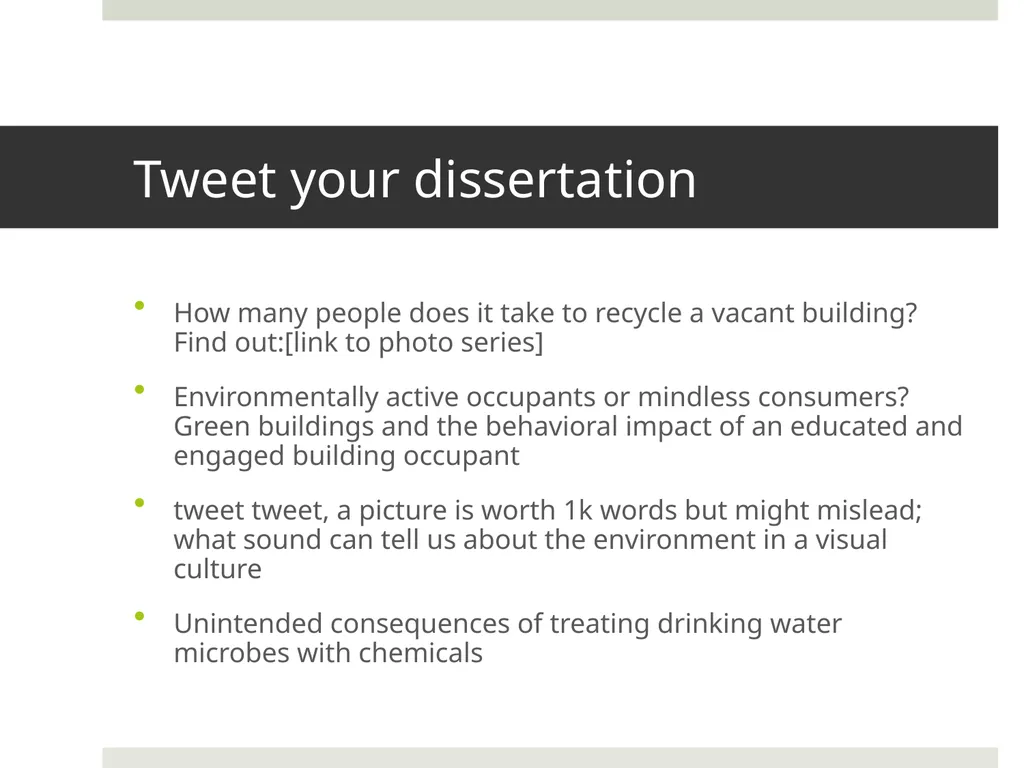
Tweet your dissertation How many people does it take to recycle a vacant building? Find out:[link to photo series]
Environmentally active occupants or mindless consumers? Green buildings and the behavioral impact of an educated and engaged building occupant
tweet tweet, a picture is worth 1k words but might mislead; what sound can tell us about the environment in a visual culture
Unintended consequences of treating drinking water microbes with chemicals<br>
17
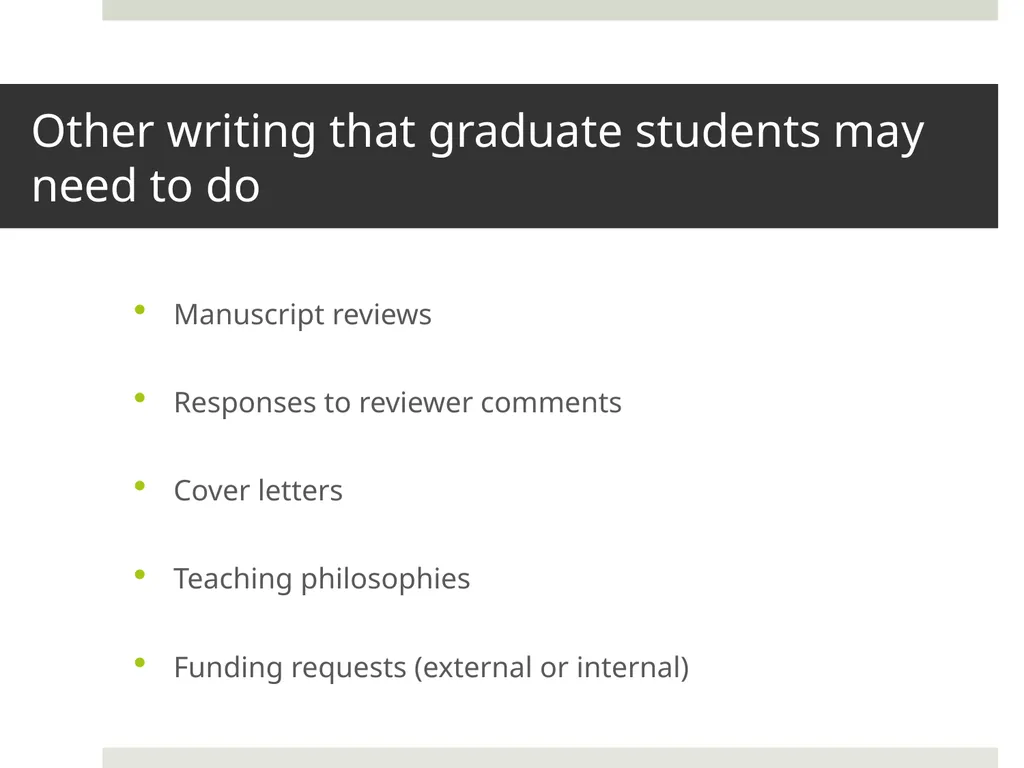
Other writing that graduate students may need to do Manuscript reviews
Responses to reviewer comments
Cover letters
Teaching philosophies
Funding requests (external or internal)<br>
Responses to reviewer comments
Cover letters
Teaching philosophies
Funding requests (external or internal)<br>
18
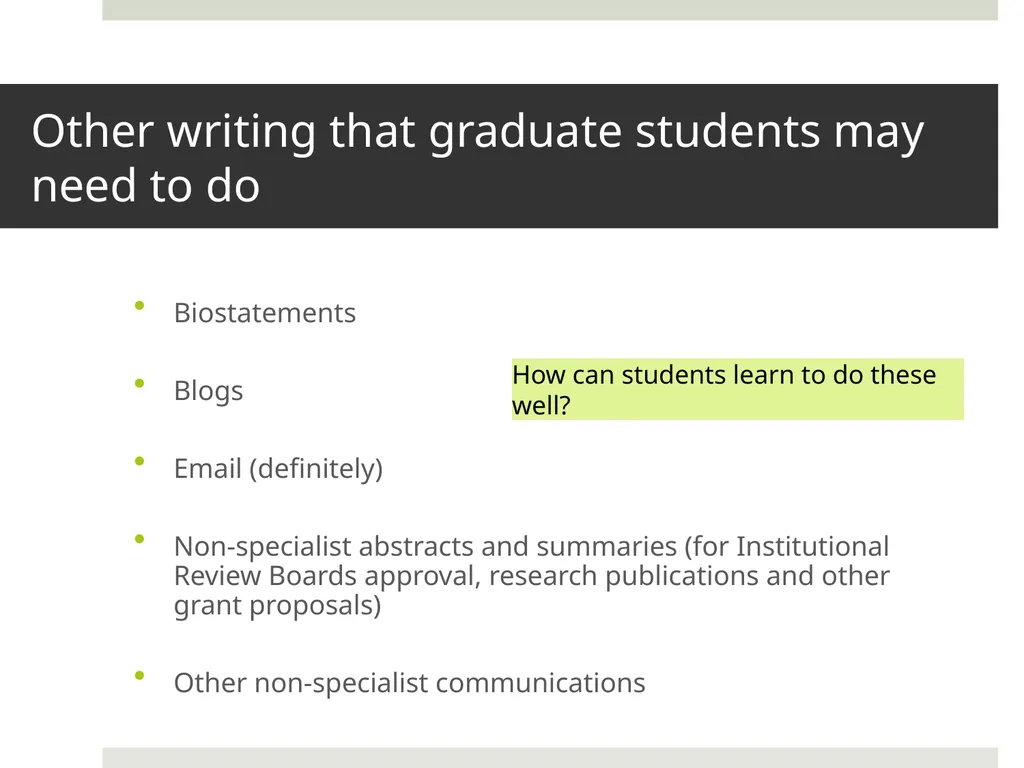
Other writing that graduate students may need to do Biostatements
Blogs
Email (definitely)
Non-specialist abstracts and summaries (for Institutional Review Boards approval, research publications and other grant proposals)
Other non-specialist communications How can students learn to do these well?<br>
Blogs
Email (definitely)
Non-specialist abstracts and summaries (for Institutional Review Boards approval, research publications and other grant proposals)
Other non-specialist communications How can students learn to do these well?<br>
19
Why do students need to develop skills to communicate with non-specialists? Not all students pursuing a Ph.D. are interested in academic careers.
Professional Ph.D.s are becoming increasingly attractive to those interested in the public and private sectors.
Doctor of Economic Development (DED)
Doctor of Public Administration (DPA)
Doctor of Business Administration (DBA)
Doctor of Audiology (D. Aud.)<br>
Professional Ph.D.s are becoming increasingly attractive to those interested in the public and private sectors.
Doctor of Economic Development (DED)
Doctor of Public Administration (DPA)
Doctor of Business Administration (DBA)
Doctor of Audiology (D. Aud.)<br>
20
Why do students need to develop skills to communicate with non-specialists? Academics are increasingly being expected to be able to communicate with non-specialists.
Project summaries of a National Science Foundation grant proposal
Sponsored research from non-government sources
Communications with policy makers
(or more likely their staff)
Interdisciplinary research
Research articles in journals that require a non-specialist abstract<br>
Project summaries of a National Science Foundation grant proposal
Sponsored research from non-government sources
Communications with policy makers
(or more likely their staff)
Interdisciplinary research
Research articles in journals that require a non-specialist abstract<br>
21
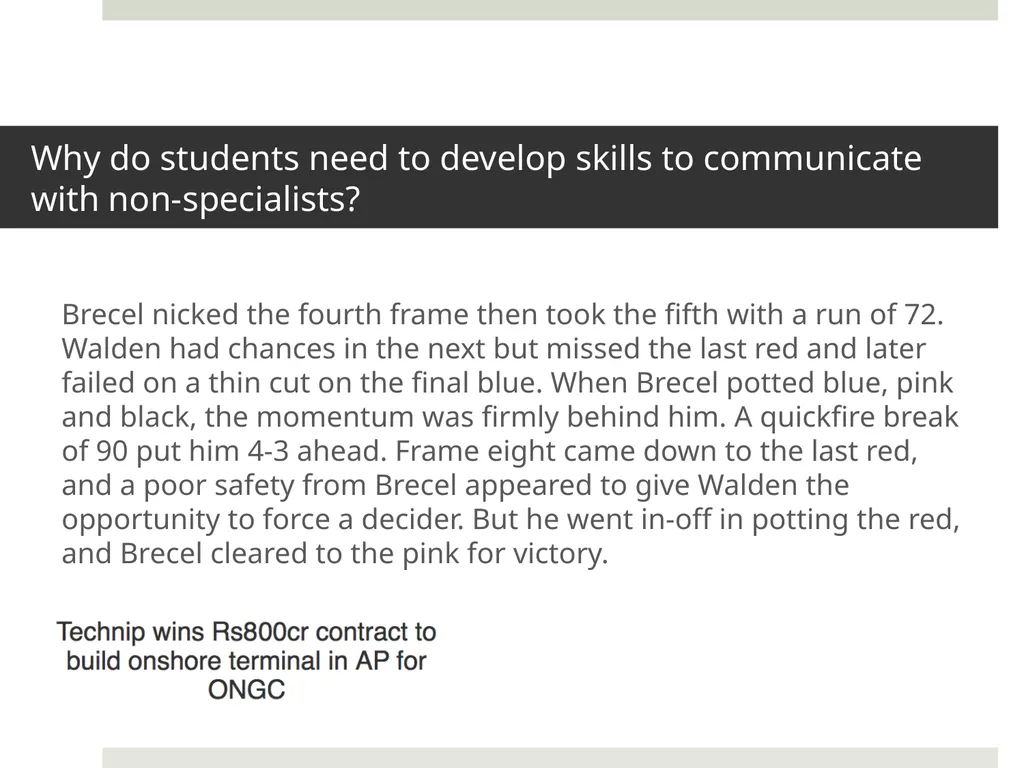
Why do students need to develop skills to communicate with non-specialists? Brecel nicked the fourth frame then took the fifth with a run of 72. Walden had chances in the next but missed the last red and later failed on a thin cut on the final blue. When Brecel potted blue, pink and black, the momentum was firmly behind him. A quickfire break of 90 put him 4-3 ahead. Frame eight came down to the last red, and a poor safety from Brecel appeared to give Walden the opportunity to force a decider. But he went in-off in potting the red, and Brecel cleared to the pink for victory.<br>
22
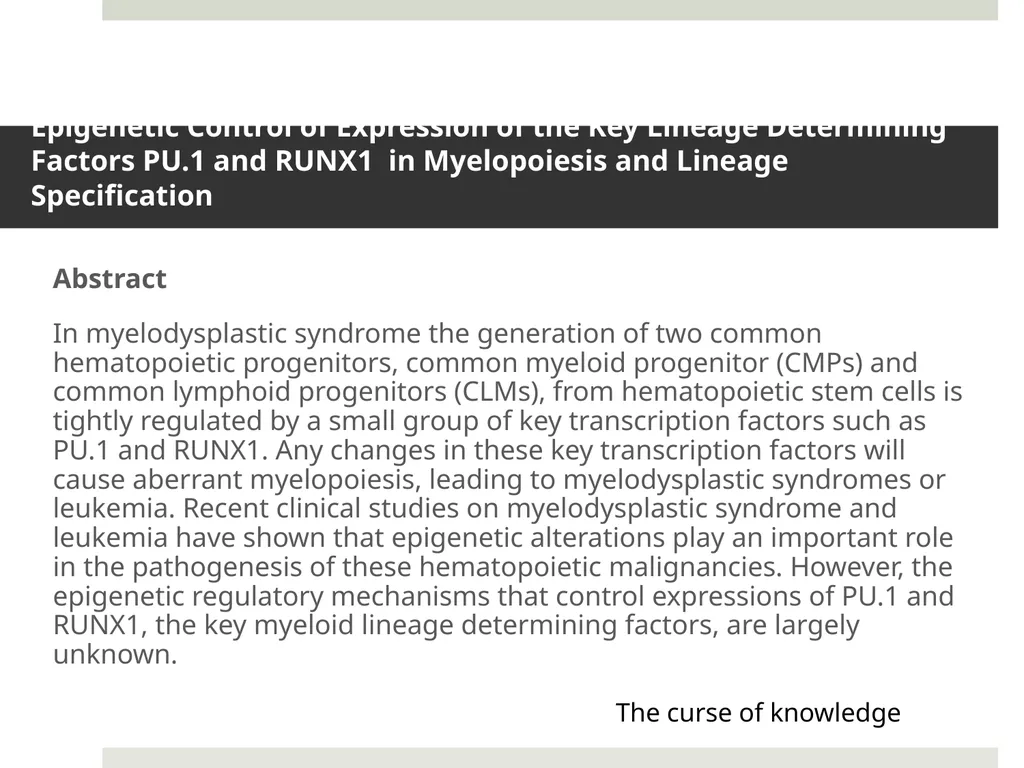
Epigenetic Control of Expression of the Key Lineage Determining Factors PU.1 and RUNX1 in Myelopoiesis and Lineage Specification Abstract
In myelodysplastic syndrome the generation of two common hematopoietic progenitors, common myeloid progenitor (CMPs) and common lymphoid progenitors (CLMs), from hematopoietic stem cells is tightly regulated by a small group of key transcription factors such as PU.1 and RUNX1. Any changes in these key transcription factors will cause aberrant myelopoiesis, leading to myelodysplastic syndromes or leukemia. Recent clinical studies on myelodysplastic syndrome and leukemia have shown that epigenetic alterations play an important role in the pathogenesis of these hematopoietic malignancies. However, the epigenetic regulatory mechanisms that control expressions of PU.1 and RUNX1, the key myeloid lineage determining factors, are largely unknown. The curse of knowledge<br>
In myelodysplastic syndrome the generation of two common hematopoietic progenitors, common myeloid progenitor (CMPs) and common lymphoid progenitors (CLMs), from hematopoietic stem cells is tightly regulated by a small group of key transcription factors such as PU.1 and RUNX1. Any changes in these key transcription factors will cause aberrant myelopoiesis, leading to myelodysplastic syndromes or leukemia. Recent clinical studies on myelodysplastic syndrome and leukemia have shown that epigenetic alterations play an important role in the pathogenesis of these hematopoietic malignancies. However, the epigenetic regulatory mechanisms that control expressions of PU.1 and RUNX1, the key myeloid lineage determining factors, are largely unknown. The curse of knowledge<br>
23
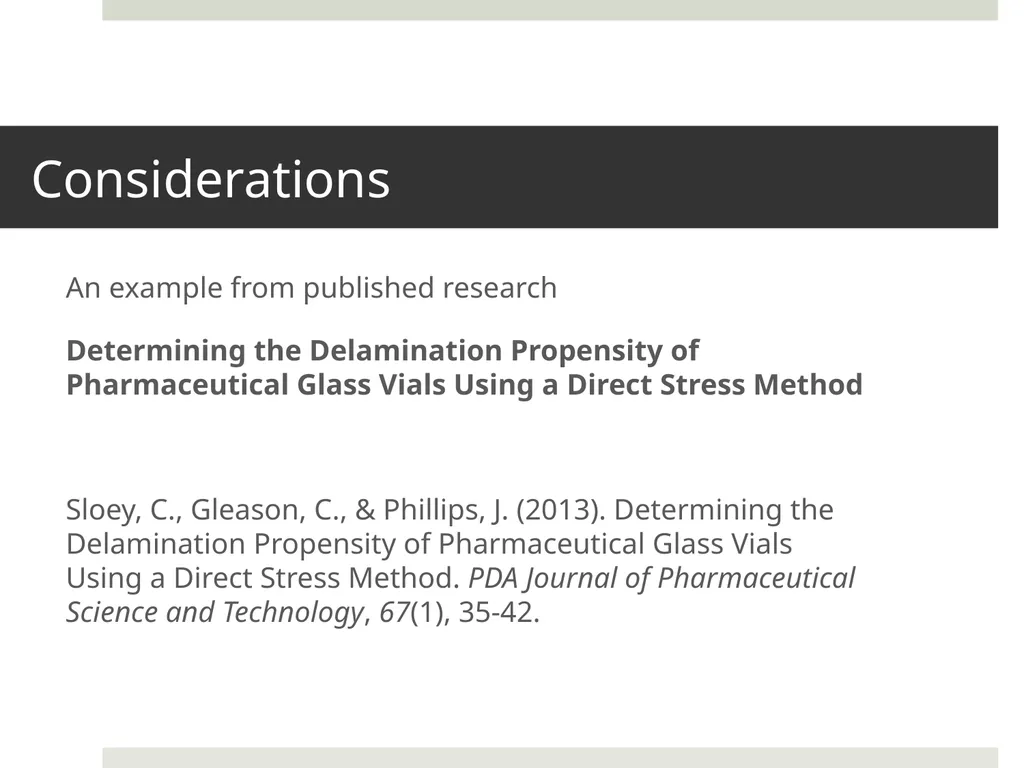
Considerations An example from published research
Determining the Delamination Propensity of Pharmaceutical Glass Vials Using a Direct Stress Method
Sloey, C., Gleason, C., & Phillips, J. (2013). Determining the Delamination Propensity of Pharmaceutical Glass Vials Using a Direct Stress Method. PDA Journal of Pharmaceutical Science and Technology, 67(1), 35-42.<br>
24
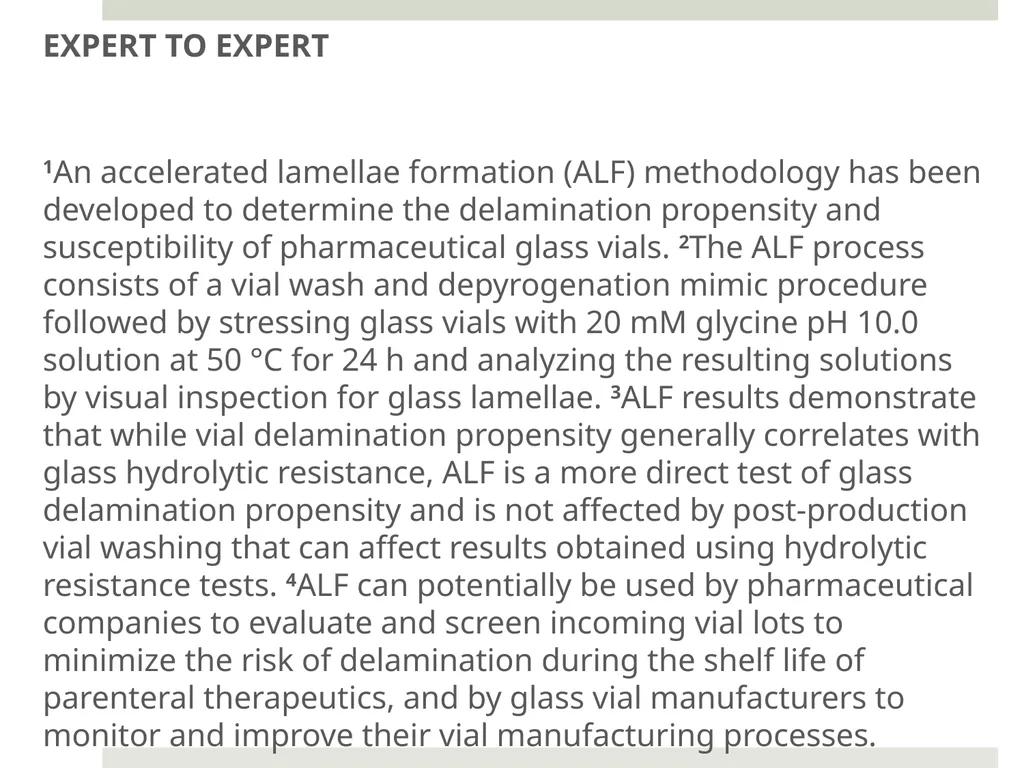
EXPERT TO EXPERT
1An accelerated lamellae formation (ALF) methodology has been developed to determine the delamination propensity and susceptibility of pharmaceutical glass vials. 2The ALF process consists of a vial wash and depyrogenation mimic procedure followed by stressing glass vials with 20 mM glycine pH 10.0 solution at 50 °C for 24 h and analyzing the resulting solutions by visual inspection for glass lamellae. 3ALF results demonstrate that while vial delamination propensity generally correlates with glass hydrolytic resistance, ALF is a more direct test of glass delamination propensity and is not affected by post-production vial washing that can affect results obtained using hydrolytic resistance tests. 4ALF can potentially be used by pharmaceutical companies to evaluate and screen incoming vial lots to minimize the risk of delamination during the shelf life of parenteral therapeutics, and by glass vial manufacturers to monitor and improve their vial manufacturing processes.<br>
1An accelerated lamellae formation (ALF) methodology has been developed to determine the delamination propensity and susceptibility of pharmaceutical glass vials. 2The ALF process consists of a vial wash and depyrogenation mimic procedure followed by stressing glass vials with 20 mM glycine pH 10.0 solution at 50 °C for 24 h and analyzing the resulting solutions by visual inspection for glass lamellae. 3ALF results demonstrate that while vial delamination propensity generally correlates with glass hydrolytic resistance, ALF is a more direct test of glass delamination propensity and is not affected by post-production vial washing that can affect results obtained using hydrolytic resistance tests. 4ALF can potentially be used by pharmaceutical companies to evaluate and screen incoming vial lots to minimize the risk of delamination during the shelf life of parenteral therapeutics, and by glass vial manufacturers to monitor and improve their vial manufacturing processes.<br>
25
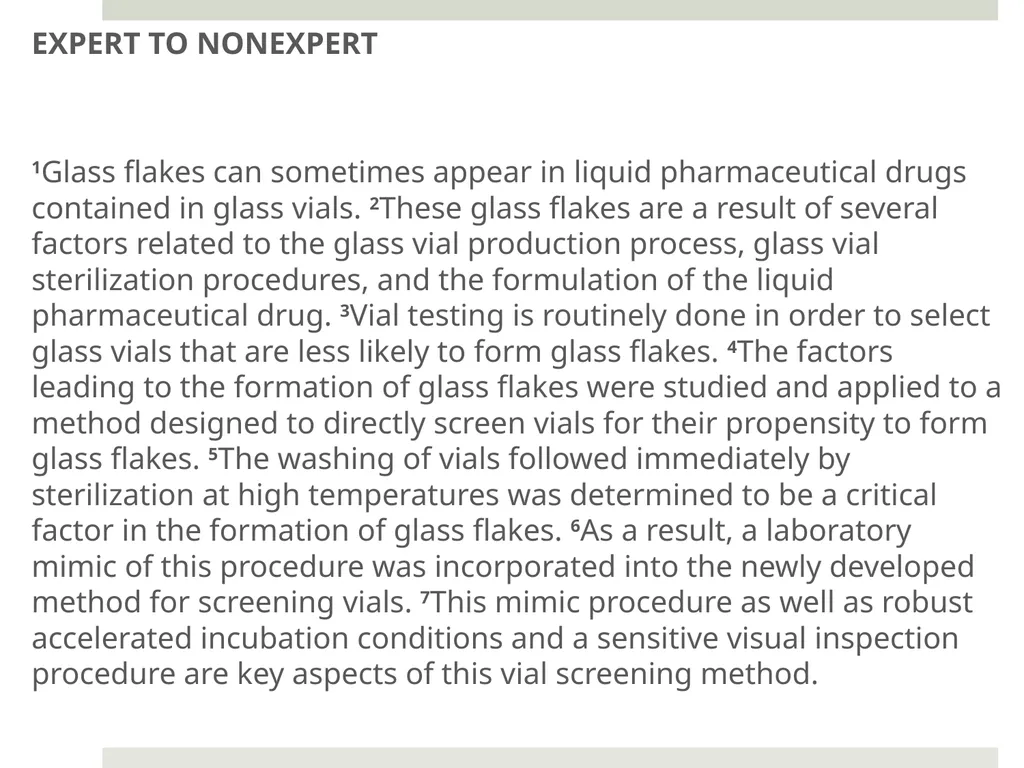
EXPERT TO NONEXPERT
1Glass flakes can sometimes appear in liquid pharmaceutical drugs contained in glass vials. 2These glass flakes are a result of several factors related to the glass vial production process, glass vial sterilization procedures, and the formulation of the liquid pharmaceutical drug. 3Vial testing is routinely done in order to select glass vials that are less likely to form glass flakes. 4The factors leading to the formation of glass flakes were studied and applied to a method designed to directly screen vials for their propensity to form glass flakes. 5The washing of vials followed immediately by sterilization at high temperatures was determined to be a critical factor in the formation of glass flakes. 6As a result, a laboratory mimic of this procedure was incorporated into the newly developed method for screening vials. 7This mimic procedure as well as robust accelerated incubation conditions and a sensitive visual inspection procedure are key aspects of this vial screening method.<br>
1Glass flakes can sometimes appear in liquid pharmaceutical drugs contained in glass vials. 2These glass flakes are a result of several factors related to the glass vial production process, glass vial sterilization procedures, and the formulation of the liquid pharmaceutical drug. 3Vial testing is routinely done in order to select glass vials that are less likely to form glass flakes. 4The factors leading to the formation of glass flakes were studied and applied to a method designed to directly screen vials for their propensity to form glass flakes. 5The washing of vials followed immediately by sterilization at high temperatures was determined to be a critical factor in the formation of glass flakes. 6As a result, a laboratory mimic of this procedure was incorporated into the newly developed method for screening vials. 7This mimic procedure as well as robust accelerated incubation conditions and a sensitive visual inspection procedure are key aspects of this vial screening method.<br>
26
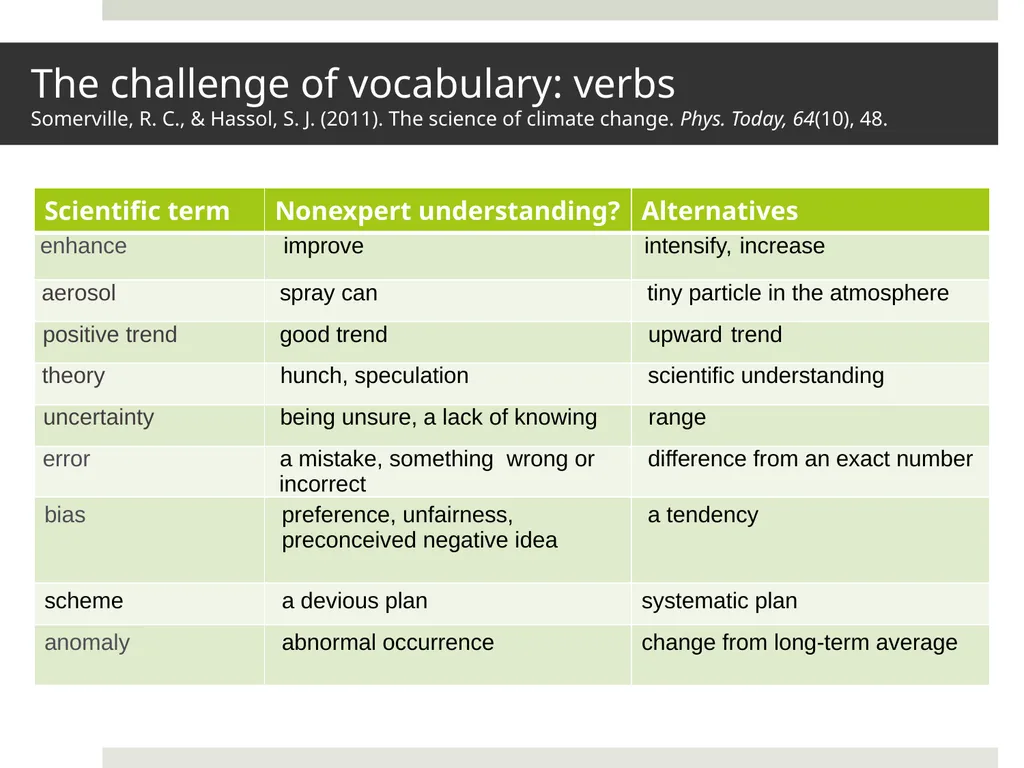
The challenge of vocabulary: verbs
Somerville, R. C., & Hassol, S. J. (2011). The science of climate change. Phys. Today, 64(10), 48.<br>
27
Challenges Catton, K. B., Webster, D. R., & Yen, J. (2012). The effect of fluid viscosity, habitat temperature, and body size on the flow disturbance of Euchaeta. Limnology & Oceanography: Fluids & Environments, 2, 80-92.<br>
28
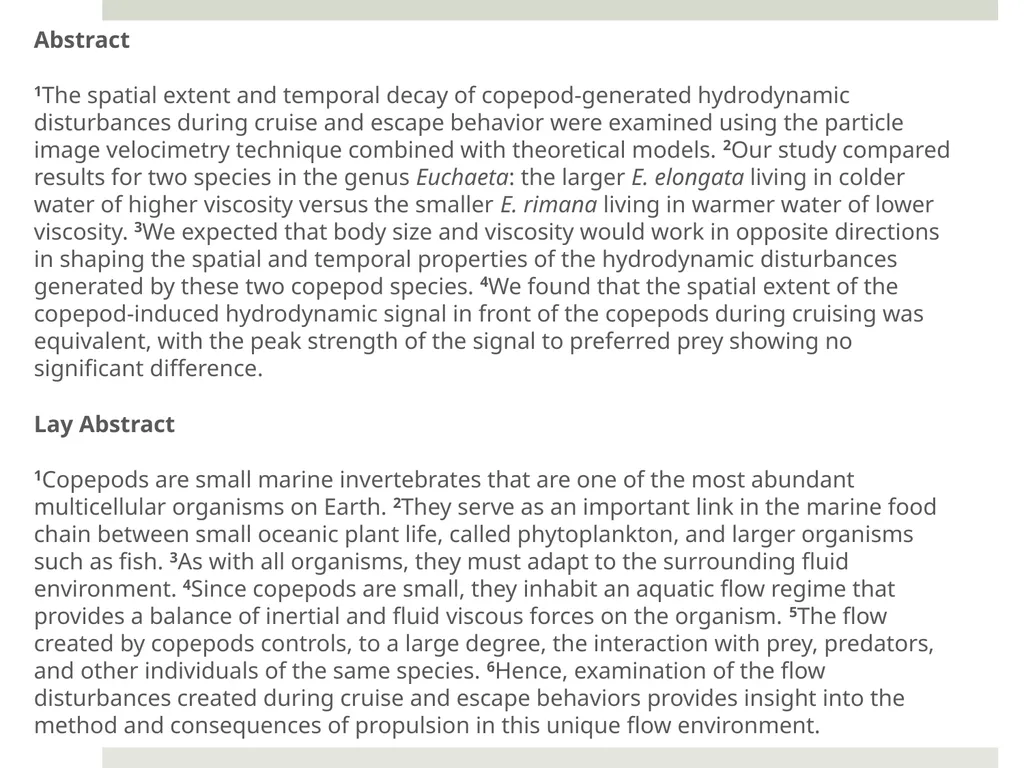
Abstract
1The spatial extent and temporal decay of copepod-generated hydrodynamic disturbances during cruise and escape behavior were examined using the particle image velocimetry technique combined with theoretical models. 2Our study compared results for two species in the genus Euchaeta: the larger E. elongata living in colder water of higher viscosity versus the smaller E. rimana living in warmer water of lower viscosity. 3We expected that body size and viscosity would work in opposite directions in shaping the spatial and temporal properties of the hydrodynamic disturbances generated by these two copepod species. 4We found that the spatial extent of the copepod-induced hydrodynamic signal in front of the copepods during cruising was equivalent, with the peak strength of the signal to preferred prey showing no significant difference.
Lay Abstract
1Copepods are small marine invertebrates that are one of the most abundant multicellular organisms on Earth. 2They serve as an important link in the marine food chain between small oceanic plant life, called phytoplankton, and larger organisms such as fish. 3As with all organisms, they must adapt to the surrounding fluid environment. 4Since copepods are small, they inhabit an aquatic flow regime that provides a balance of inertial and fluid viscous forces on the organism. 5The flow created by copepods controls, to a large degree, the interaction with prey, predators, and other individuals of the same species. 6Hence, examination of the flow disturbances created during cruise and escape behaviors provides insight into the method and consequences of propulsion in this unique flow environment.<br>
29
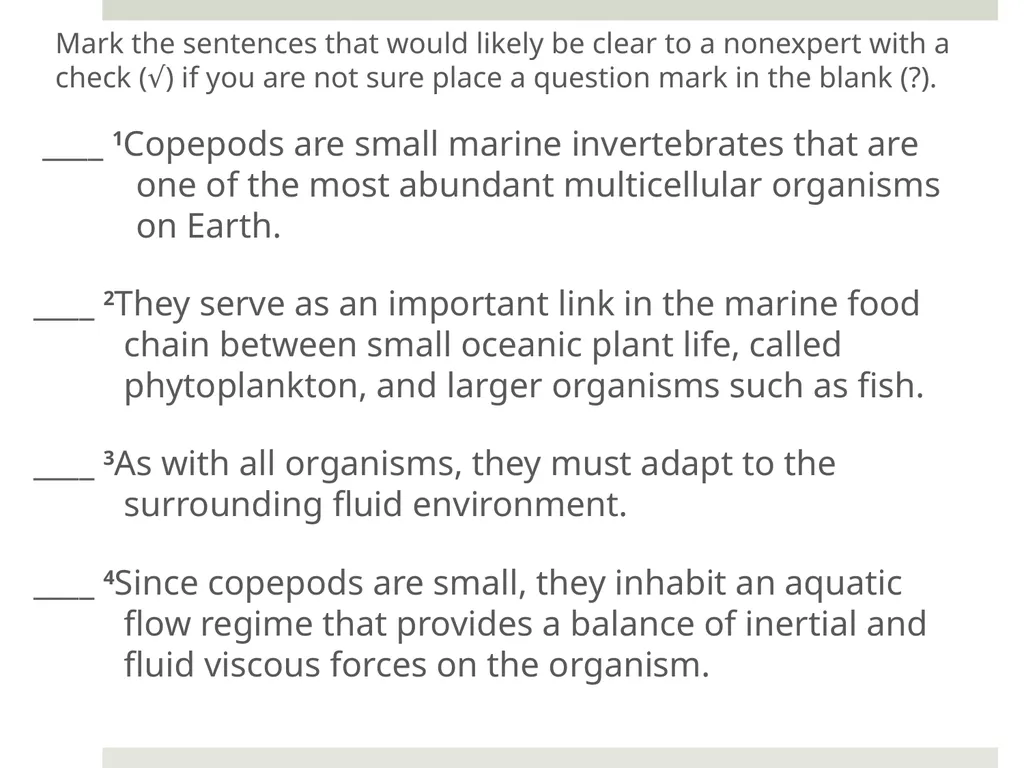
Mark the sentences that would likely be clear to a nonexpert with a check (√) if you are not sure place a question mark in the blank (?).
____ 1Copepods are small marine invertebrates that are one of the most abundant multicellular organisms on Earth.
____ 2They serve as an important link in the marine food chain between small oceanic plant life, called phytoplankton, and larger organisms such as fish.
____ 3As with all organisms, they must adapt to the surrounding fluid environment.
____ 4Since copepods are small, they inhabit an aquatic flow regime that provides a balance of inertial and fluid viscous forces on the organism.<br>
30
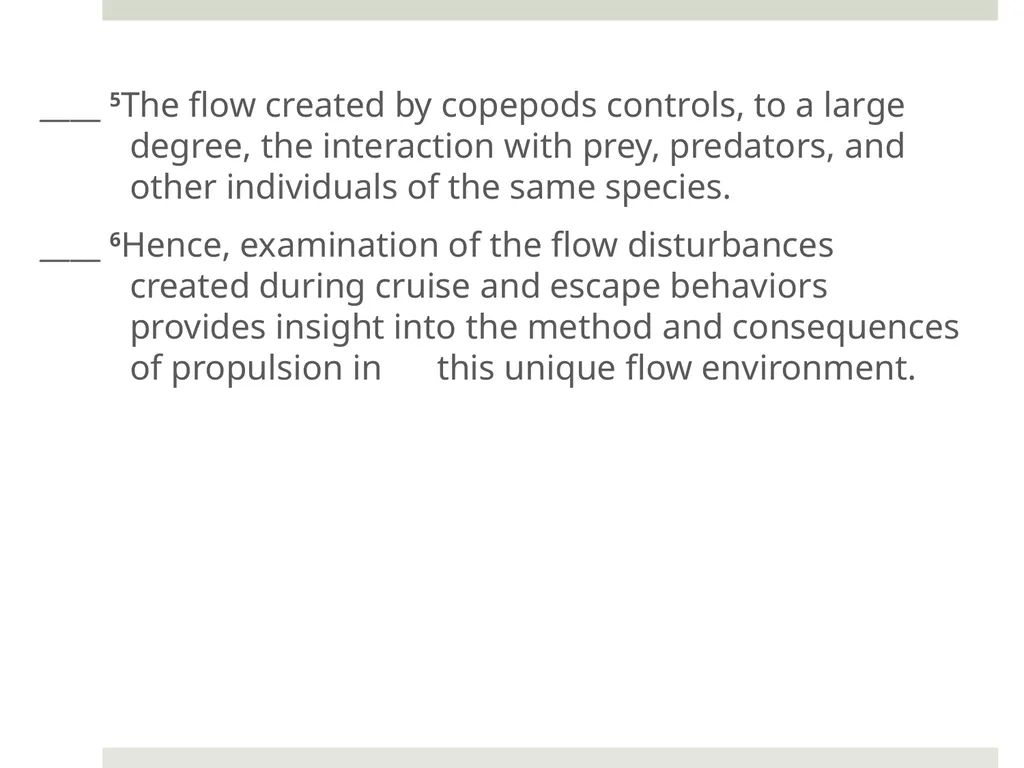
____ 5The flow created by copepods controls, to a large degree, the interaction with prey, predators, and other individuals of the same species.
____ 6Hence, examination of the flow disturbances created during cruise and escape behaviors provides insight into the method and consequences of propulsion in this unique flow environment.<br>
____ 6Hence, examination of the flow disturbances created during cruise and escape behaviors provides insight into the method and consequences of propulsion in this unique flow environment.<br>
31
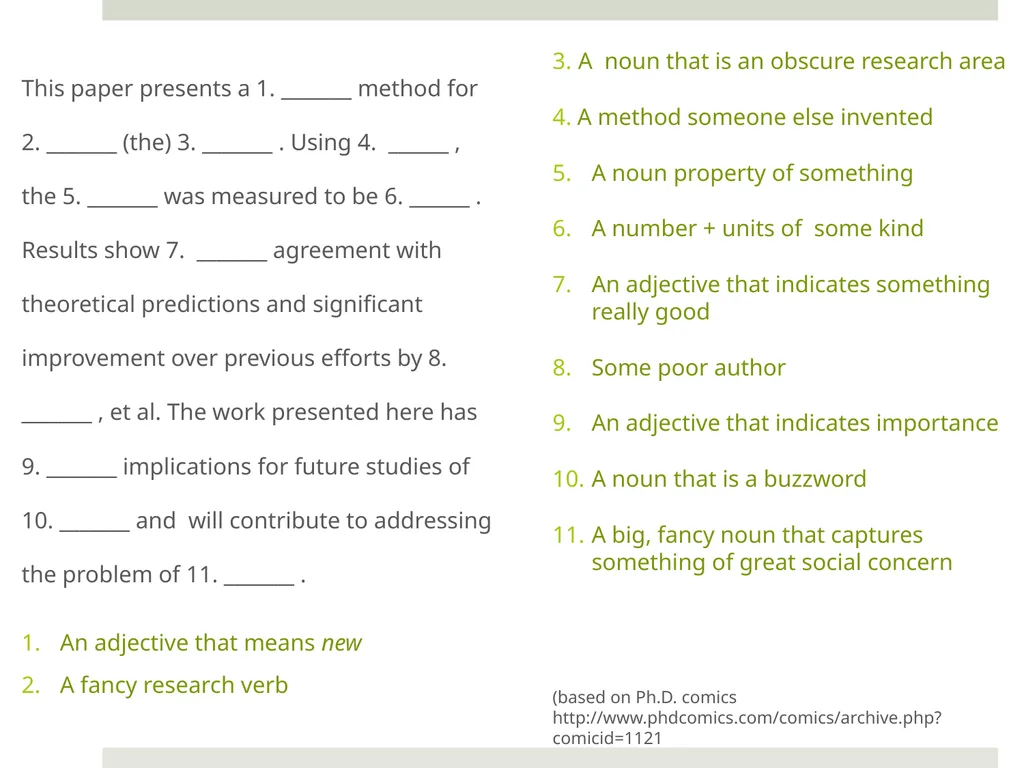
The Real Challenge? Mad libs There is no quick fix to writing.<br>
32
This paper presents a 1. _______ method for 2. _______ (the) 3. _______ . Using 4. ______ , the 5. _______ was measured to be 6. ______ . Results show 7. _______ agreement with theoretical predictions and significant improvement over previous efforts by 8. _______ , et al. The work presented here has 9. _______ implications for future studies of 10. _______ and will contribute to addressing the problem of 11. _______ .
An adjective that means new
A fancy research verb A noun that is an obscure research area
A method someone else invented
A noun property of something
A number + units of some kind
An adjective that indicates something really good
Some poor author
An adjective that indicates importance
A noun that is a buzzword
A big, fancy noun that captures something of great social concern
(based on Ph.D. comics
http://www.phdcomics.com/comics/archive.php?comicid=1121<br>
33
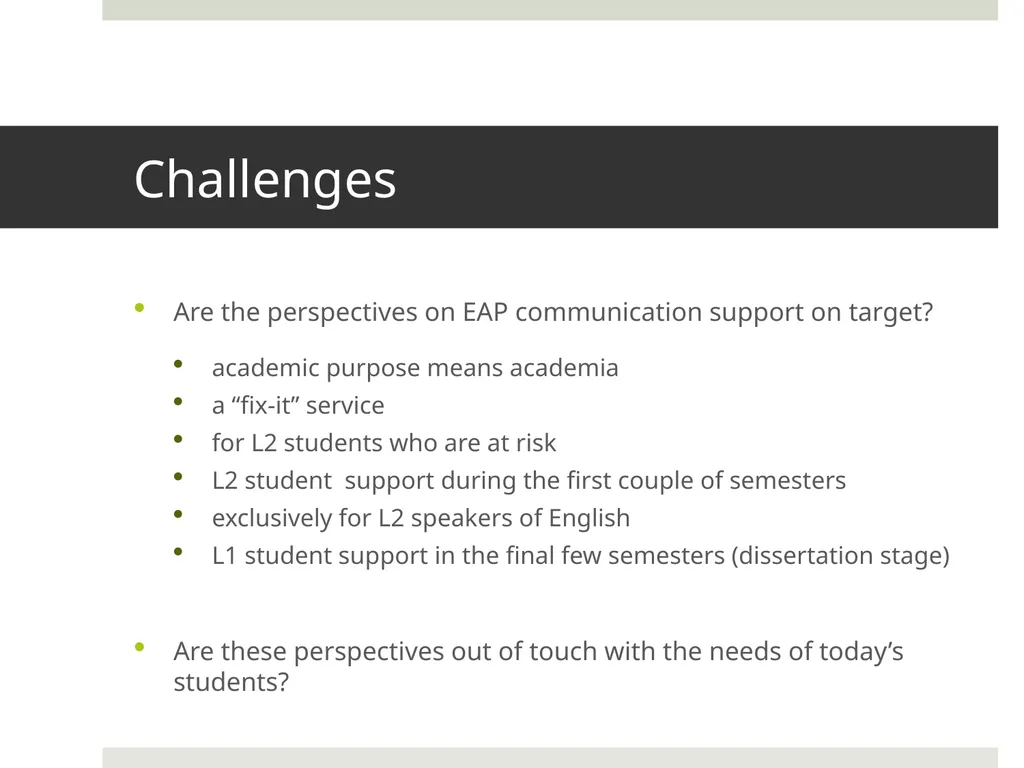
Challenges Are the perspectives on EAP communication support on target?
academic purpose means academia
a “fix-it” service
for L2 students who are at risk
L2 student support during the first couple of semesters
exclusively for L2 speakers of English
L1 student support in the final few semesters (dissertation stage)
Are these perspectives out of touch with the needs of today’s students?<br>
34
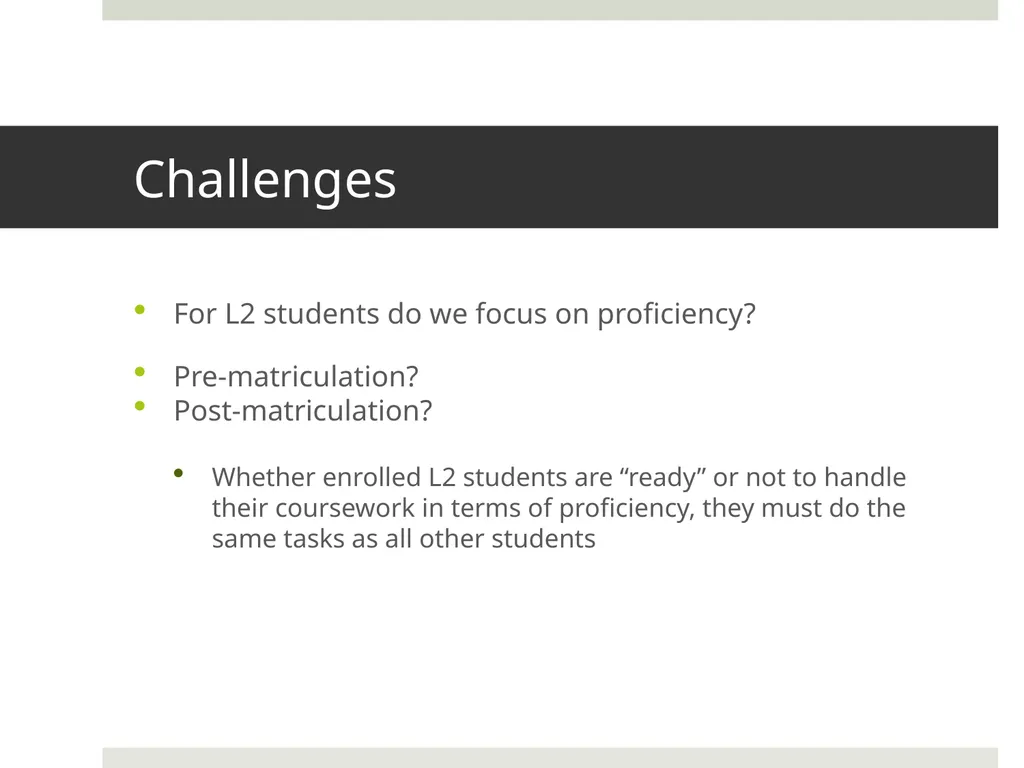
Challenges For L2 students do we focus on proficiency?
Pre-matriculation?
Post-matriculation?
Whether enrolled L2 students are “ready” or not to handle their coursework in terms of proficiency, they must do the same tasks as all other students<br>
Pre-matriculation?
Post-matriculation?
Whether enrolled L2 students are “ready” or not to handle their coursework in terms of proficiency, they must do the same tasks as all other students<br>
35
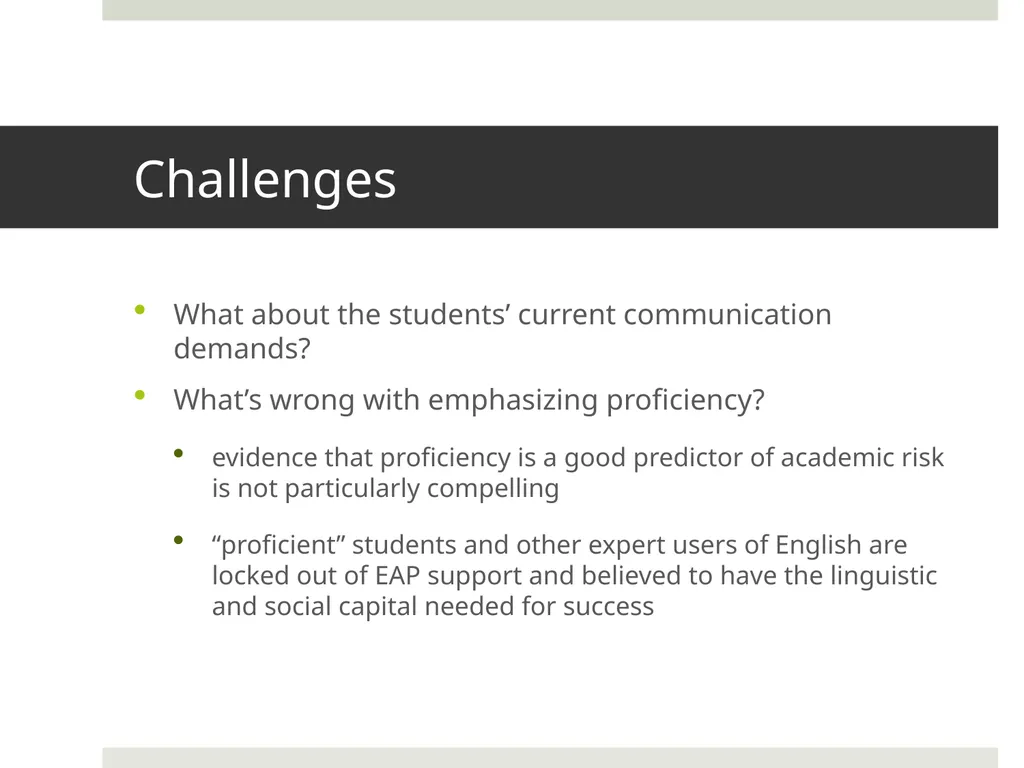
Challenges What about the students’ current communication demands?
What’s wrong with emphasizing proficiency?
evidence that proficiency is a good predictor of academic risk is not particularly compelling
“proficient” students and other expert users of English are locked out of EAP support and believed to have the linguistic and social capital needed for success<br>
36
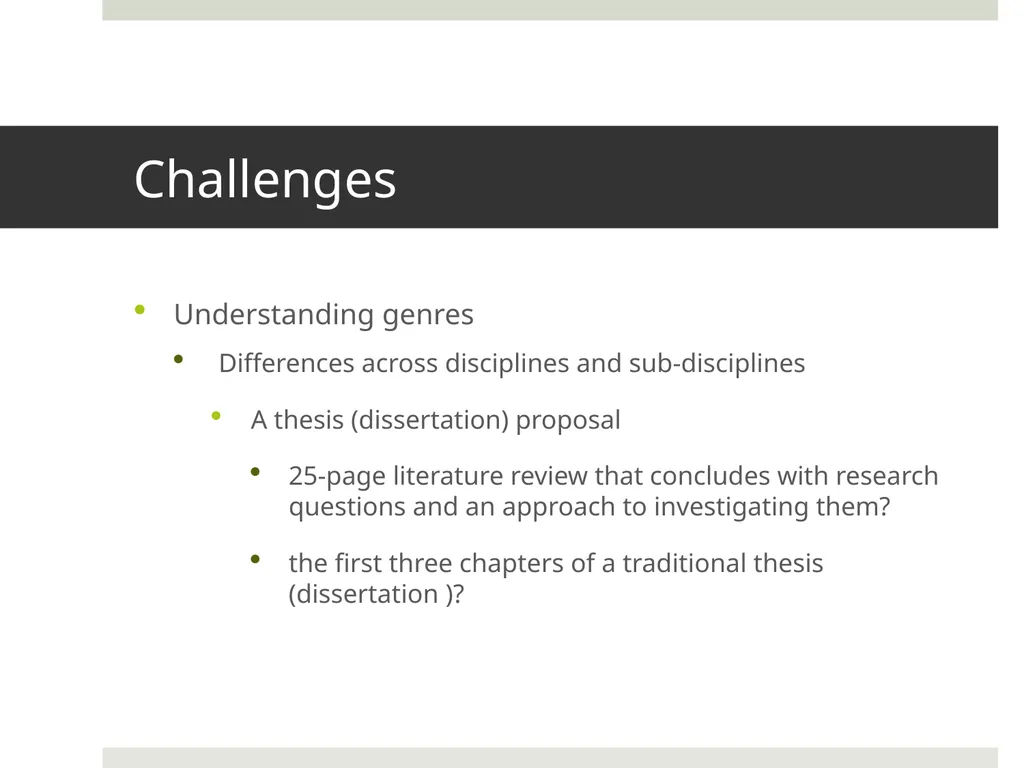
Challenges Understanding genres
Differences across disciplines and sub-disciplines
A thesis (dissertation) proposal
25-page literature review that concludes with research questions and an approach to investigating them?
the first three chapters of a traditional thesis (dissertation )?<br>
Differences across disciplines and sub-disciplines
A thesis (dissertation) proposal
25-page literature review that concludes with research questions and an approach to investigating them?
the first three chapters of a traditional thesis (dissertation )?<br>
37
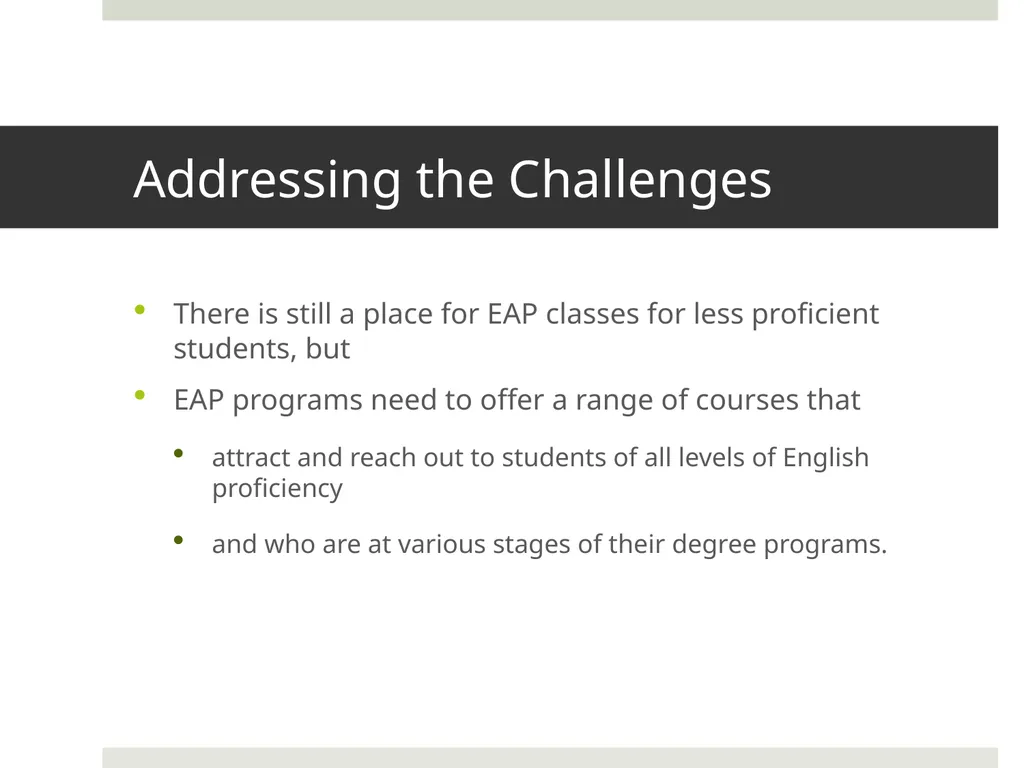
Addressing the Challenges There is still a place for EAP classes for less proficient students, but
EAP programs need to offer a range of courses that
attract and reach out to students of all levels of English proficiency
and who are at various stages of their degree programs.<br>
EAP programs need to offer a range of courses that
attract and reach out to students of all levels of English proficiency
and who are at various stages of their degree programs.<br>
38
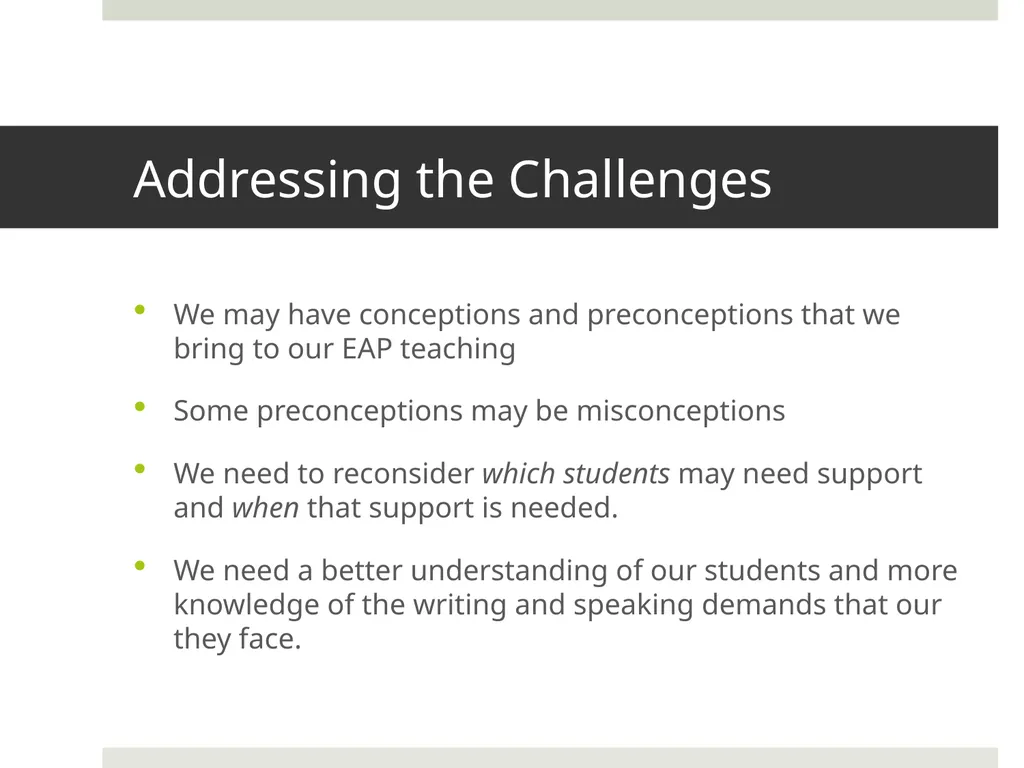
Addressing the Challenges We may have conceptions and preconceptions that we bring to our EAP teaching
Some preconceptions may be misconceptions
We need to reconsider which students may need support and when that support is needed.
We need a better understanding of our students and more knowledge of the writing and speaking demands that our they face.<br>
Some preconceptions may be misconceptions
We need to reconsider which students may need support and when that support is needed.
We need a better understanding of our students and more knowledge of the writing and speaking demands that our they face.<br>
39
Addressing the Challenges And . . . . ?<br>
40
Thank you! cfeak@umich.edu
jmswales@umich.edu<br>
jmswales@umich.edu<br>