
Retirement Planning & NPS Guide : Vichitra





Description: Retirement Planning NPS Guide : Vichitra Malhotra Presented By : 1. Shryans Jain 2. Gaurav Nautiyal 3. Deepesh Gada 4. Neelesh Tripathi 35th India Fellowship Webinar Date: 16th July 2021 Introduction of Guide Vichitra Malhotra
Related Topics
Download Presentation
"Retirement Planning & NPS Guide : Vichitra" is the property of its rightful owner. Permission is granted to download and print the materials on this website for personal, non-commercial use only, and to display it on your personal computer provided you do not modify the materials and that you retain all copyright notices contained in the materials. By downloading content from our website, you accept the terms of this agreement.
Presentation Transcript
slide1. Retirement Planning & NPS Guide : Vichitra Malhotra
Presented By :
1. Shryans Jain
2. Gaurav Nautiyal
3. Deepesh Gada
4. Neelesh Tripathi 35th India Fellowship Webinar
Date: 16th July 2021<br>
slide2. Introduction of Guide
Vichitra Malhotra www.actuariesindia.org Vichitra Malhotra is Founder and Consulting Actuary for Veritas Actuaries and Consultants
Vichitra Malhotra is a Consulting Actuary with about 10 years of work experience, providing consultancy in various actuarial practice areas.
She is qualified from both Institute of Actuaries of India as well as Institute and Faculty of Actuaries, UK.
In her past role, she has worked with large multinationals in India including PricewaterhouseCoopers (PwC), Max Life Insurance and Canara HSBC OBC Life Insurance.<br>
slide3. Introduction to Case Study A Company would like to conduct a series of awareness sessions for its employees to highlight the key retirement benefits available in the corporate sector and to emphasize on the importance of retirement savings.
The schemes offered by the Company are Gratuity benefit, Provident Fund and National Pension System (NPS). The contribution to NPS is optional. www.actuariesindia.org<br>
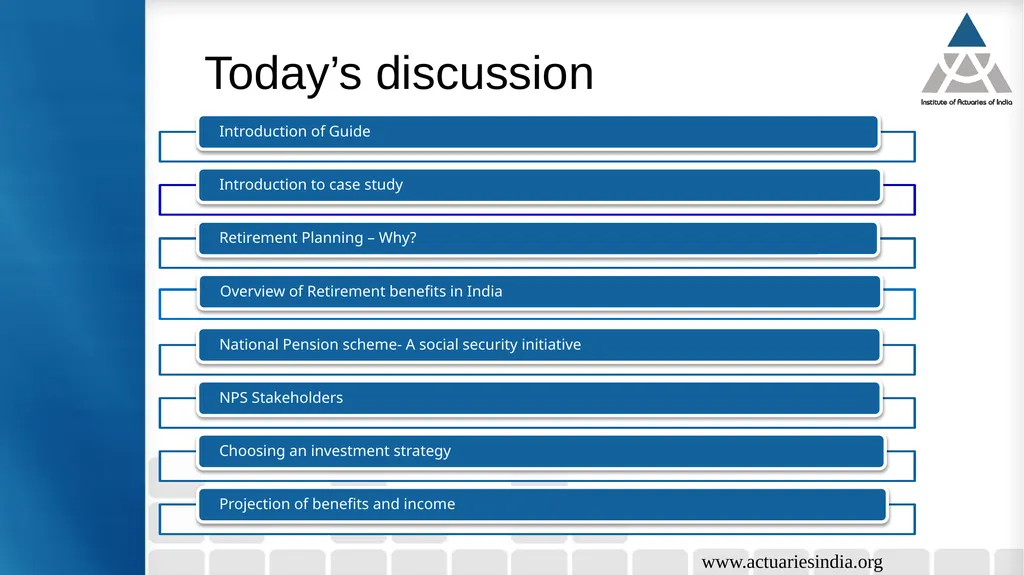
slide4. Today’s discussion www.actuariesindia.org<br>
slide5. Retirement Planning – Why? Medical Inflation
Pattern of spending changes post retirement
Nuclear families
No state sponsored pension
Plan your Retirement so you can manage your Lifestyle from Pre to Post Retirement.
Prepare for more free time and less stress! www.actuariesindia.org<br>
slide6. Mandatory Schemes
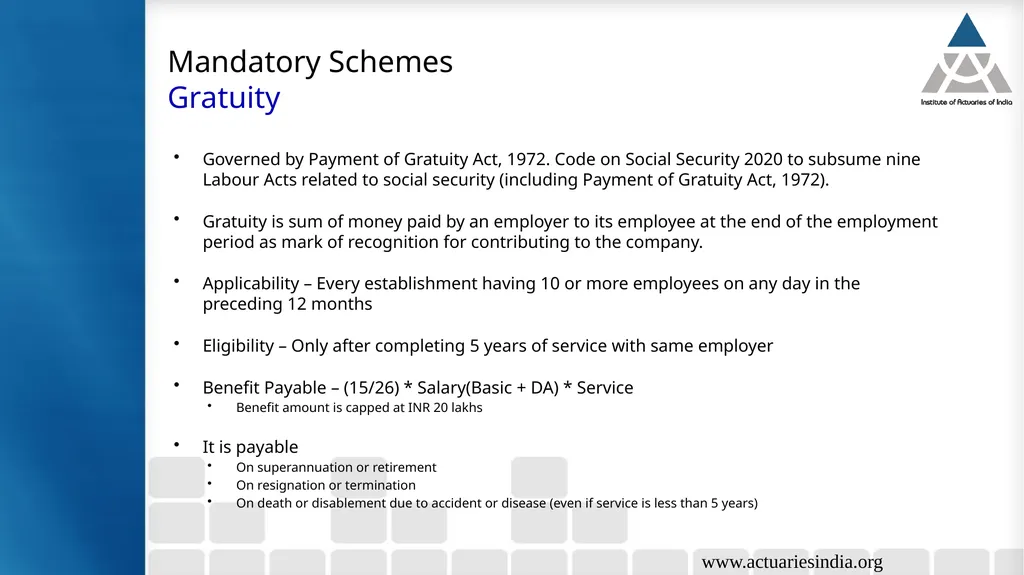
Gratuity Governed by Payment of Gratuity Act, 1972. Code on Social Security 2020 to subsume nine Labour Acts related to social security (including Payment of Gratuity Act, 1972).
Gratuity is sum of money paid by an employer to its employee at the end of the employment period as mark of recognition for contributing to the company.
Applicability – Every establishment having 10 or more employees on any day in the preceding 12 months
Eligibility – Only after completing 5 years of service with same employer
Benefit Payable – (15/26) * Salary(Basic + DA) * Service
Benefit amount is capped at INR 20 lakhs
It is payable
On superannuation or retirement
On resignation or termination
On death or disablement due to accident or disease (even if service is less than 5 years) www.actuariesindia.org<br>
slide7. Mandatory Schemes
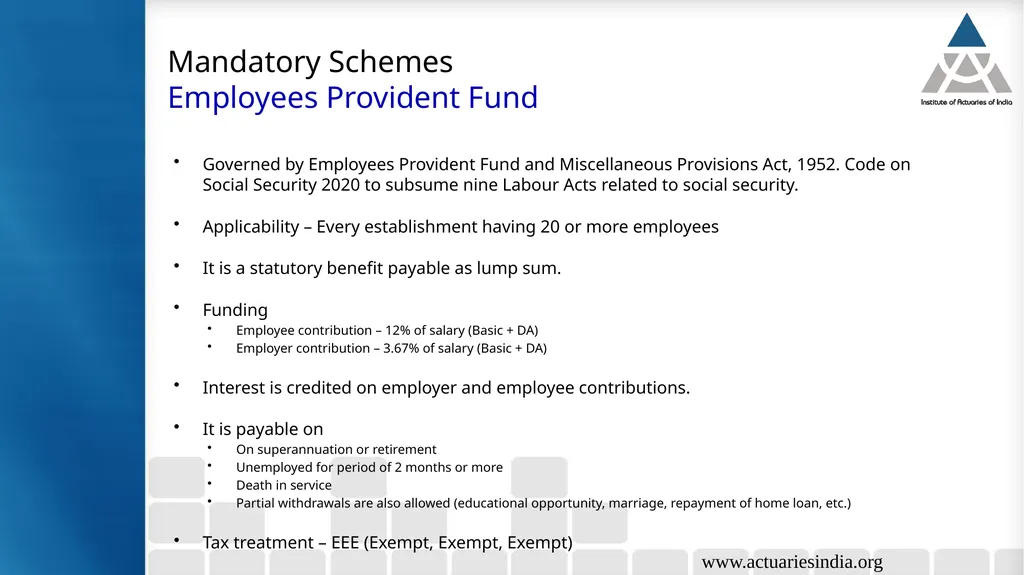
Employees Provident Fund Governed by Employees Provident Fund and Miscellaneous Provisions Act, 1952. Code on Social Security 2020 to subsume nine Labour Acts related to social security.
Applicability – Every establishment having 20 or more employees
It is a statutory benefit payable as lump sum.
Funding
Employee contribution – 12% of salary (Basic + DA)
Employer contribution – 3.67% of salary (Basic + DA)
Interest is credited on employer and employee contributions.
It is payable on
On superannuation or retirement
Unemployed for period of 2 months or more
Death in service
Partial withdrawals are also allowed (educational opportunity, marriage, repayment of home loan, etc.)
Tax treatment – EEE (Exempt, Exempt, Exempt) www.actuariesindia.org<br>
slide8. Mandatory Schemes
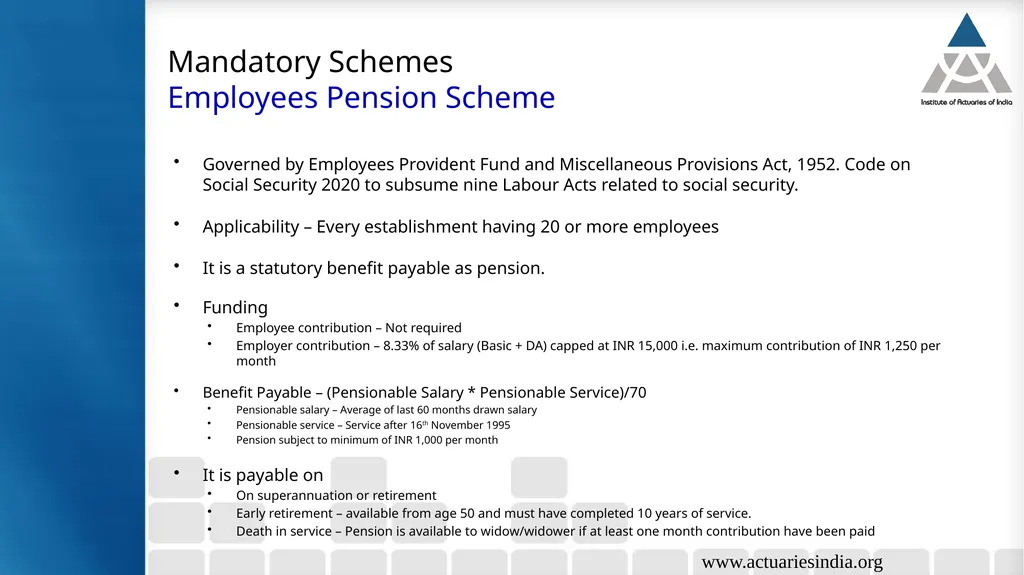
Employees Pension Scheme www.actuariesindia.org Governed by Employees Provident Fund and Miscellaneous Provisions Act, 1952. Code on Social Security 2020 to subsume nine Labour Acts related to social security.
Applicability – Every establishment having 20 or more employees
It is a statutory benefit payable as pension.
Funding
Employee contribution – Not required
Employer contribution – 8.33% of salary (Basic + DA) capped at INR 15,000 i.e. maximum contribution of INR 1,250 per month
Benefit Payable – (Pensionable Salary * Pensionable Service)/70
Pensionable salary – Average of last 60 months drawn salary
Pensionable service – Service after 16th November 1995
Pension subject to minimum of INR 1,000 per month
It is payable on
On superannuation or retirement
Early retirement – available from age 50 and must have completed 10 years of service.
Death in service – Pension is available to widow/widower if at least one month contribution have been paid<br>
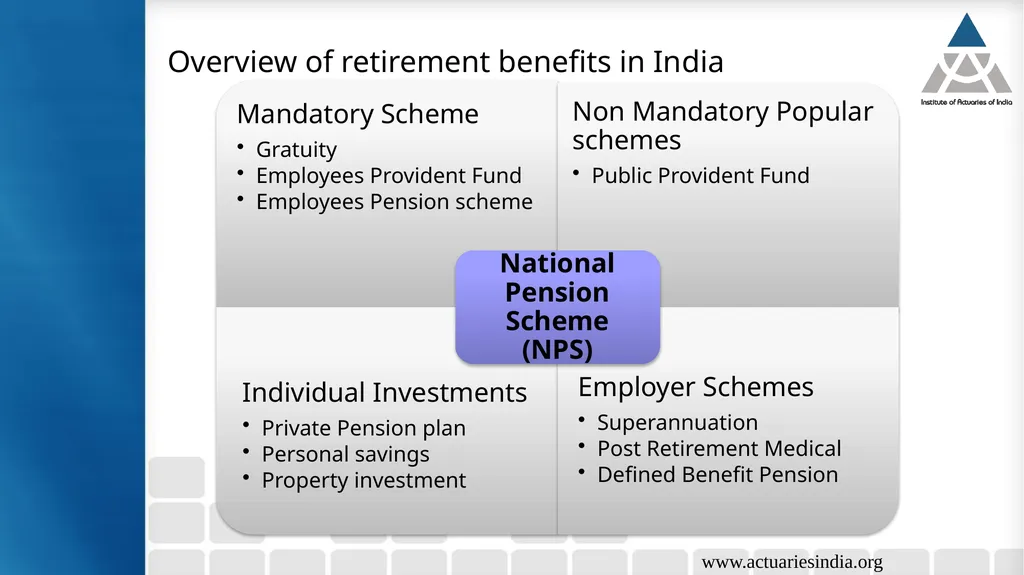
slide9. Overview of retirement benefits in India www.actuariesindia.org<br>
slide10. National Pension scheme- A social security initiative Initiative by Government of India in 2004
Falls under the purview of the Pension Fund Regulatory and Development Authority (PFRDA) and Central Government
Voluntary and long-term investment mechanism for retirement income
Open to employees from the public, private and even the unorganised sectors
Encourages investment in a pension account at regular intervals during the period of employment
After retirement, the subscribers can take out a certain percentage of the corpus
Remaining amount is received as a monthly pension www.actuariesindia.org<br>
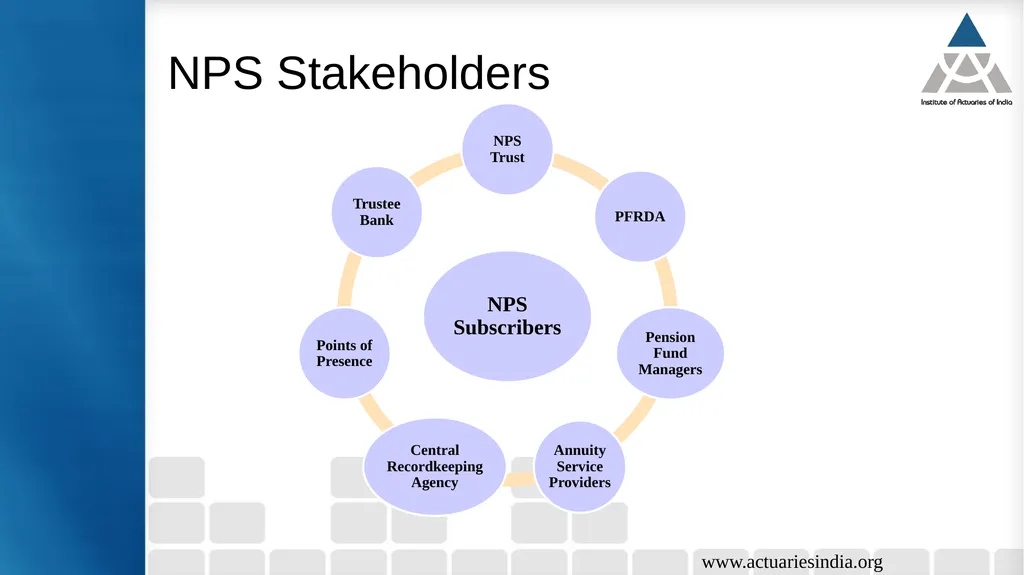
slide11. NPS Stakeholders www.actuariesindia.org<br>
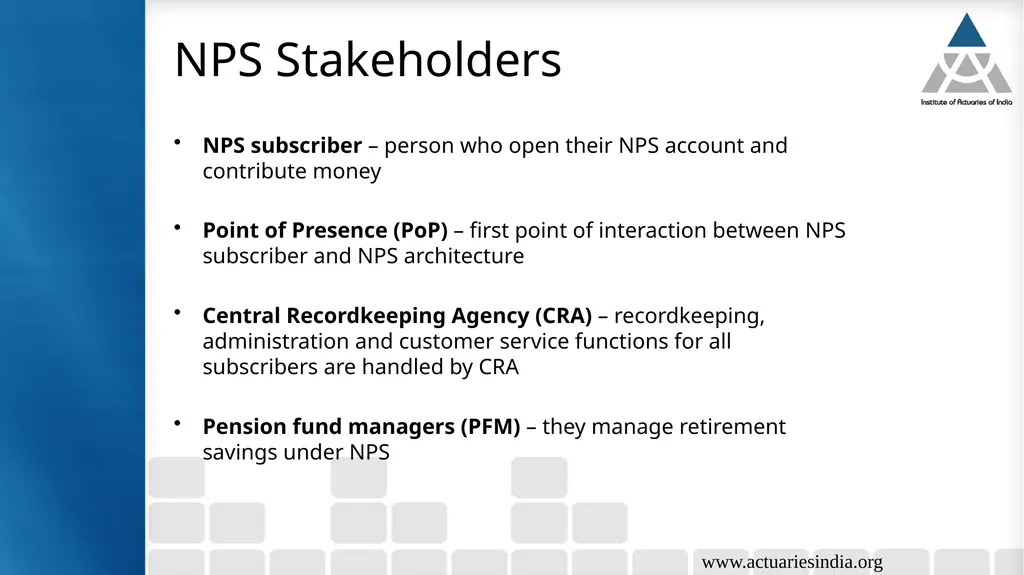
slide12. NPS Stakeholders NPS subscriber – person who open their NPS account and contribute money
Point of Presence (PoP) – first point of interaction between NPS subscriber and NPS architecture
Central Recordkeeping Agency (CRA) – recordkeeping, administration and customer service functions for all subscribers are handled by CRA
Pension fund managers (PFM) – they manage retirement savings under NPS www.actuariesindia.org<br>
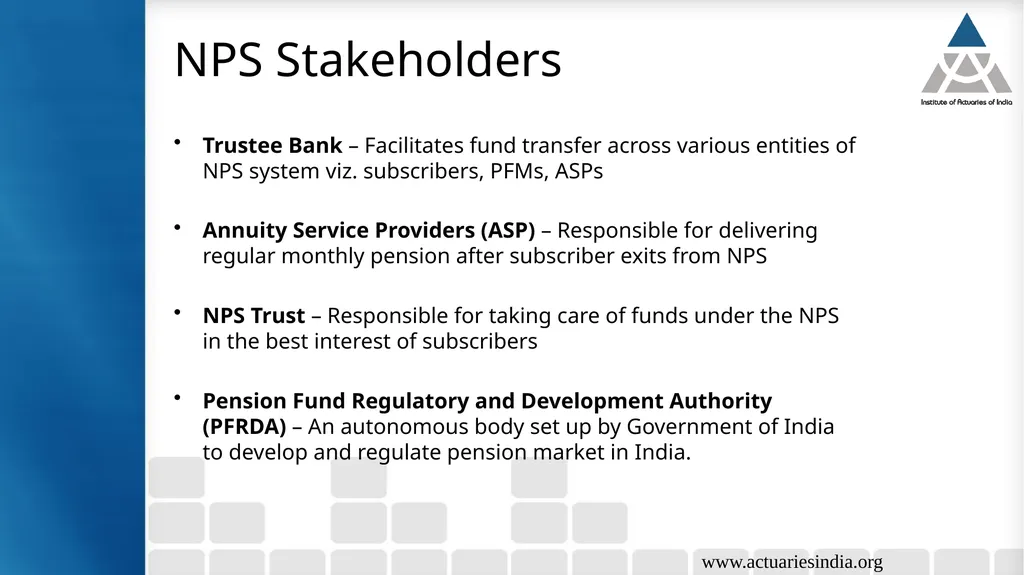
slide13. NPS Stakeholders Trustee Bank – Facilitates fund transfer across various entities of NPS system viz. subscribers, PFMs, ASPs
Annuity Service Providers (ASP) – Responsible for delivering regular monthly pension after subscriber exits from NPS
NPS Trust – Responsible for taking care of funds under the NPS in the best interest of subscribers
Pension Fund Regulatory and Development Authority (PFRDA) – An autonomous body set up by Government of India to develop and regulate pension market in India. www.actuariesindia.org<br>
slide14. Features and Benefits NPS is an excellent retirement product in terms of transparency, access, cost and tax benefits.
Genuine security Net post retirement - Restrictions on withdrawal from tier-I account and stipulation that at maturity part of the tier-I corpus be used to buy annuity
Higher expected returns compared to other traditional tax-saving investments like the PPF
Market linked investments in debt and equity instruments
Portability across jobs and locations, with tax benefits under Section 80C and Section 80CCD
Benefits are less certain compared to the Earlier Pensions Schemes -the Defined pension related benefits for Government Employees www.actuariesindia.org<br>
slide15. Eligibility Norms and procedures A citizen of India, whether resident or non-resident or an OCI /PIO can join NPS
The subscriber should be between 18 and 65 years old on the date of submission of application
The subscribers should comply with the Know Your Customer (KYC) norms as detailed in the subscriber registration form.
Should not be Un-discharged insolvent and individuals of unsound mind.
Both an online as well as an offline route to open the NPS account and generate a Permanent Retirement Account Number(PRAN)
PRAN is a unique 12-digit number assigned to the registered subscribers. Using PRAN the NPS Login can be made through different channels www.actuariesindia.org<br>
slide16. Two types of NPS accounts - TIER 1 and TIER 2 Tier I :
The primary account, a pension account
Has restrictions on withdrawals and utilization of accumulated corpus.
The tax breaks that NPS offers are applicable only to Tier I accounts.
Tier II:
An investment account, similar to a mutual fund in characteristics, but offers no Exit load, no commissions, good returns
Helps bring liquidity to the scheme, subscribers with pre-existing Tier I accounts can deposit and withdraw monies as and when they want
The Tier 2 NPS account offers tax benefits to government employees under certain conditions. www.actuariesindia.org<br>
slide17. Taxation benefits Any person who is a subscriber of NPS can avail tax deduction up to 10 percent of gross income within the overall ceiling of Rs 1.5 lakh, under Section 80C of the Income Tax (I-T) Act
Any additional self contribution (up to Rs 50,000) under section 80CCD(1B) as NPS tax benefit.
The scheme, therefore, allows a tax deduction of up to Rs 2 lakh in total.
Similar to PPF/ EPF , the NPS is an EEE (Exempt-Exempt-Exempt) instrument where the entire corpus escapes tax at maturity and entire pension withdrawal amount is tax-free. www.actuariesindia.org<br>
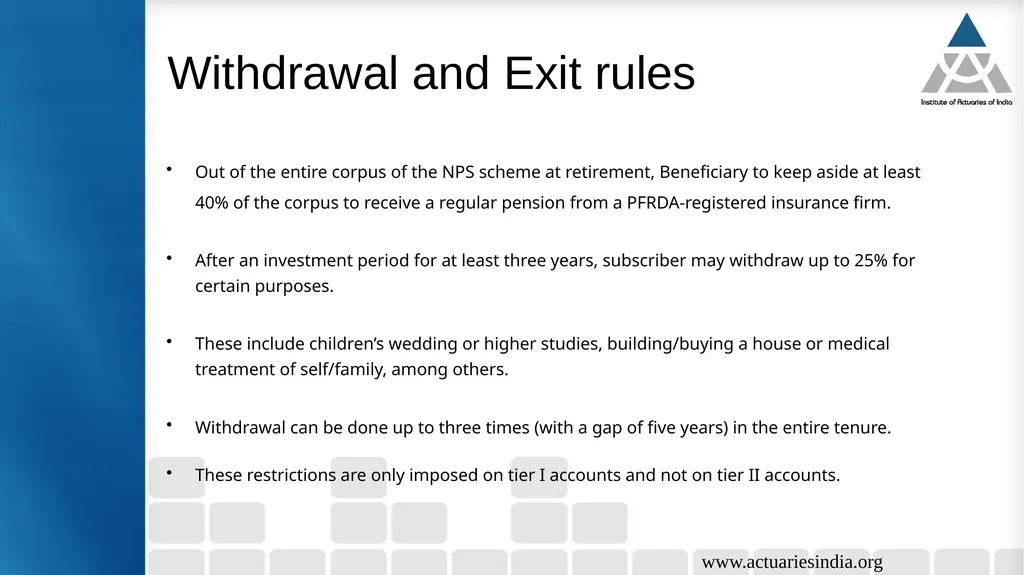
slide18. Withdrawal and Exit rules www.actuariesindia.org Out of the entire corpus of the NPS scheme at retirement, Beneficiary to keep aside at least 40% of the corpus to receive a regular pension from a PFRDA-registered insurance firm.
After an investment period for at least three years, subscriber may withdraw up to 25% for certain purposes.
These include children’s wedding or higher studies, building/buying a house or medical treatment of self/family, among others.
Withdrawal can be done up to three times (with a gap of five years) in the entire tenure.
These restrictions are only imposed on tier I accounts and not on tier II accounts.<br>
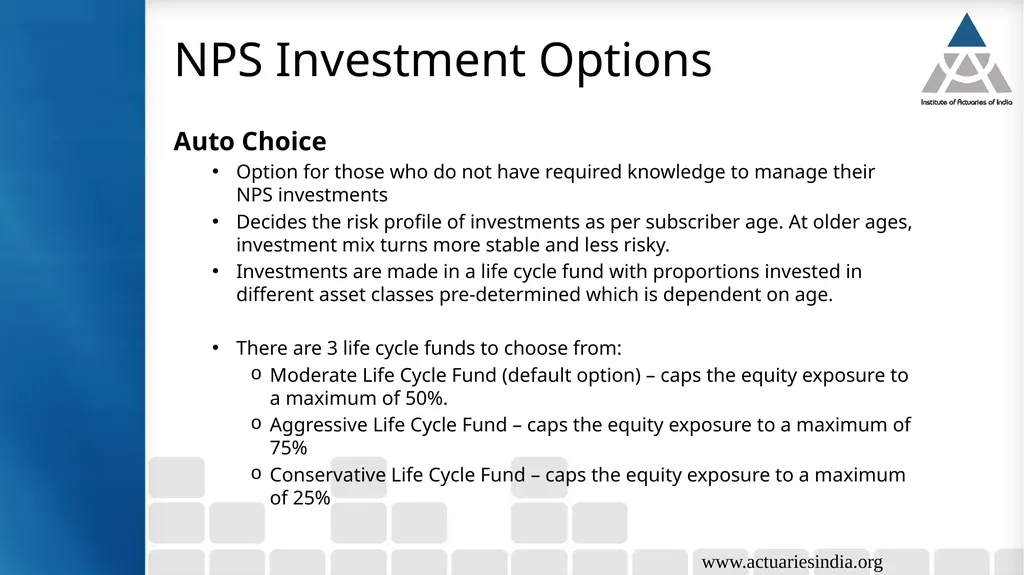
slide19. NPS Investment Options Auto Choice
Option for those who do not have required knowledge to manage their NPS investments
Decides the risk profile of investments as per subscriber age. At older ages, investment mix turns more stable and less risky.
Investments are made in a life cycle fund with proportions invested in different asset classes pre-determined which is dependent on age.
There are 3 life cycle funds to choose from:
Moderate Life Cycle Fund (default option) – caps the equity exposure to a maximum of 50%.
Aggressive Life Cycle Fund – caps the equity exposure to a maximum of 75%
Conservative Life Cycle Fund – caps the equity exposure to a maximum of 25% www.actuariesindia.org<br>
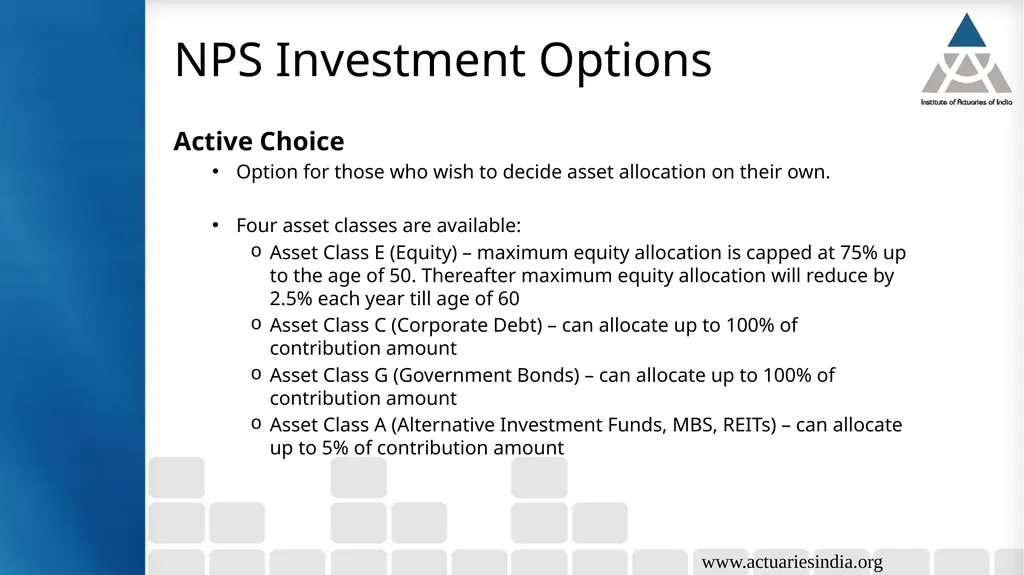
slide20. NPS Investment Options Active Choice
Option for those who wish to decide asset allocation on their own.
Four asset classes are available:
Asset Class E (Equity) – maximum equity allocation is capped at 75% up to the age of 50. Thereafter maximum equity allocation will reduce by 2.5% each year till age of 60
Asset Class C (Corporate Debt) – can allocate up to 100% of contribution amount
Asset Class G (Government Bonds) – can allocate up to 100% of contribution amount
Asset Class A (Alternative Investment Funds, MBS, REITs) – can allocate up to 5% of contribution amount www.actuariesindia.org<br>
slide21. Considerations to be borne in mind while choosing investment strategy Need to balance conflicting objectives of safety of capital and achieving reasonably high long term returns
Need for returns to be at least as much as inflation
Age – a younger person can take on more investment risk
Diversification – helps to reduce specific risk related to a particular asset class www.actuariesindia.org<br>
slide22. Considerations to be borne in mind while choosing investment strategy Risk Appetite
Expertise
NPS investment should be done keeping in mind overall retirement portfolio. www.actuariesindia.org<br>
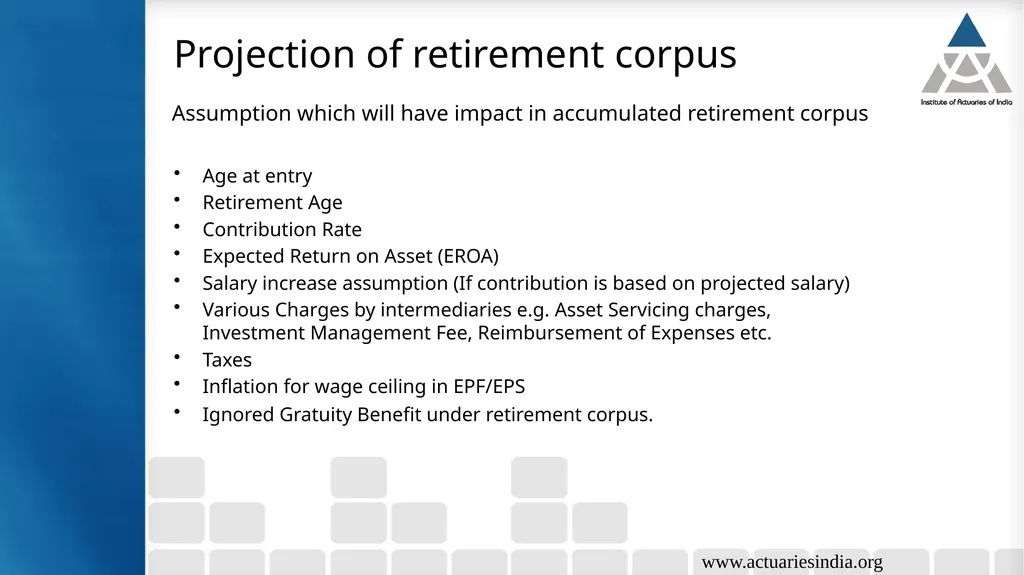
slide23. Projection of retirement corpus Age at entry
Retirement Age
Contribution Rate
Expected Return on Asset (EROA)
Salary increase assumption (If contribution is based on projected salary)
Various Charges by intermediaries e.g. Asset Servicing charges, Investment Management Fee, Reimbursement of Expenses etc.
Taxes
Inflation for wage ceiling in EPF/EPS
Ignored Gratuity Benefit under retirement corpus. www.actuariesindia.org Assumption which will have impact in accumulated retirement corpus<br>
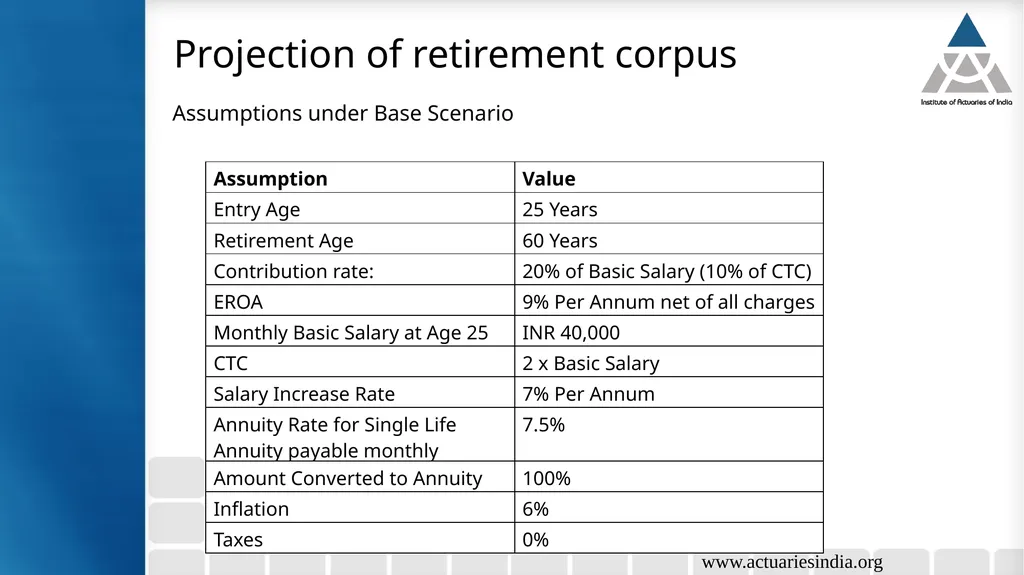
slide24. Projection of retirement corpus www.actuariesindia.org Assumptions under Base Scenario<br>
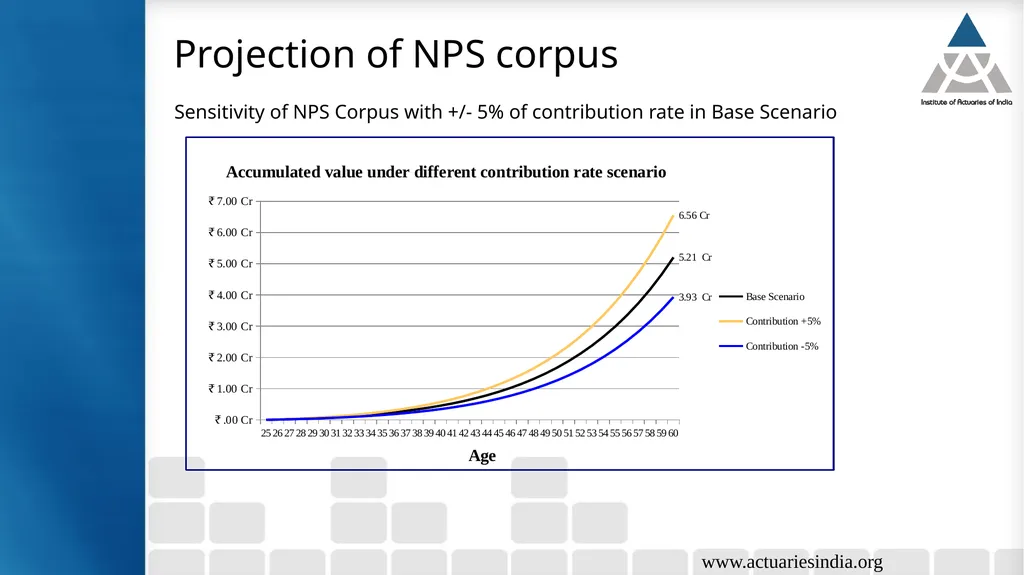
slide25. Projection of NPS corpus www.actuariesindia.org Sensitivity of NPS Corpus with +/- 5% of contribution rate in Base Scenario<br>
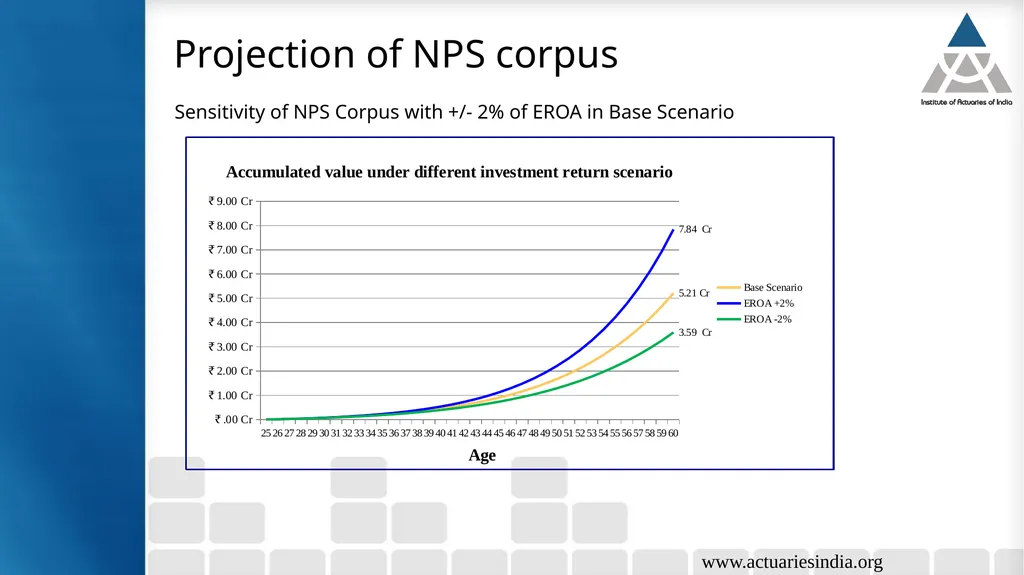
slide26. Projection of NPS corpus www.actuariesindia.org Sensitivity of NPS Corpus with +/- 2% of EROA in Base Scenario<br>
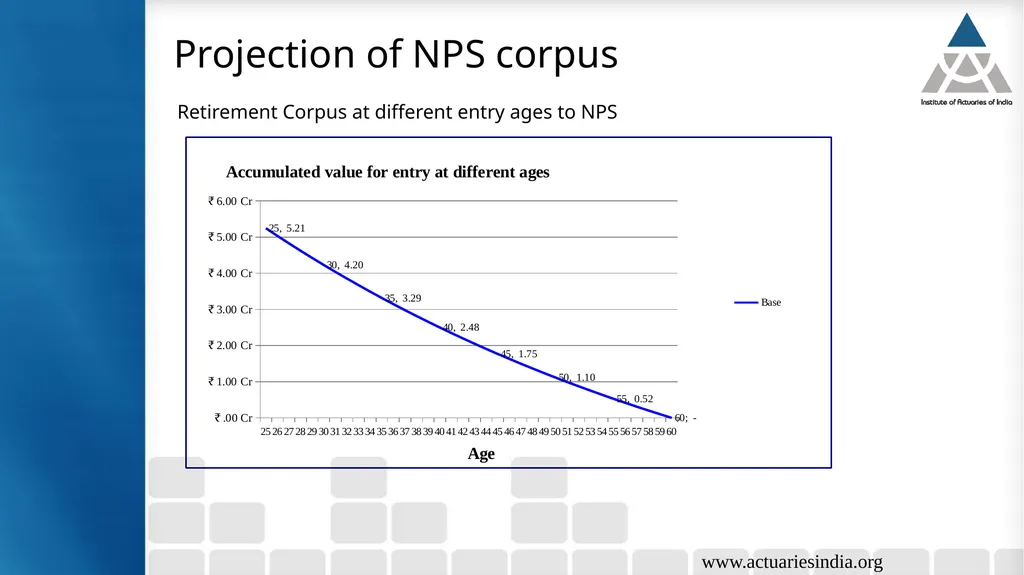
slide27. Projection of NPS corpus www.actuariesindia.org Retirement Corpus at different entry ages to NPS<br>
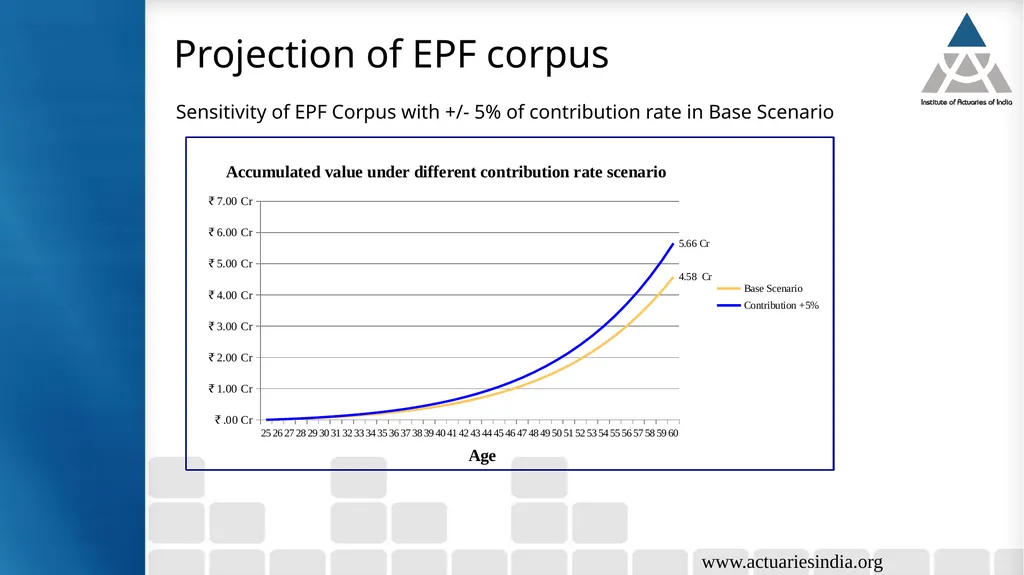
slide28. Projection of EPF corpus www.actuariesindia.org Sensitivity of EPF Corpus with +/- 5% of contribution rate in Base Scenario<br>
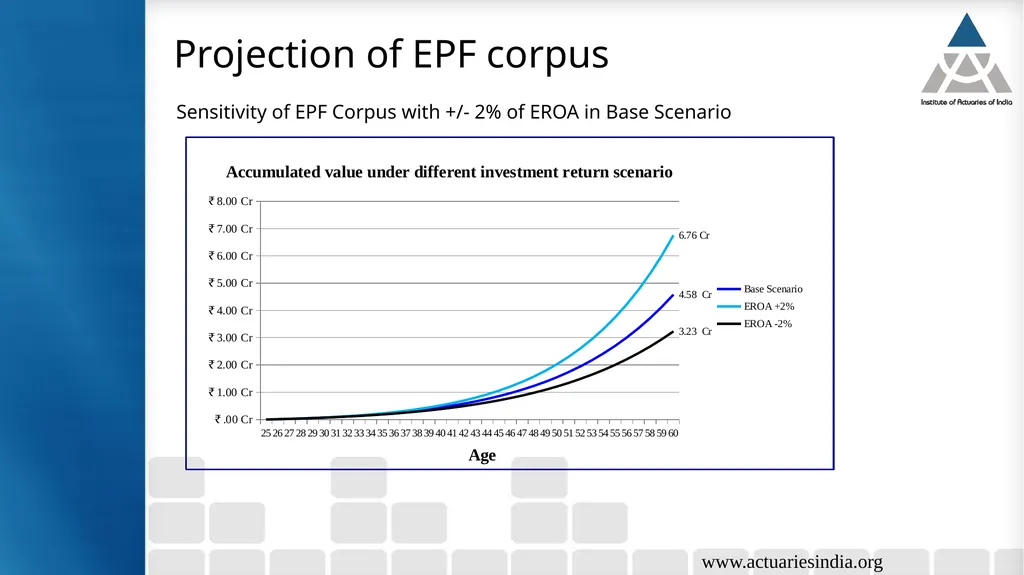
slide29. Projection of EPF corpus www.actuariesindia.org Sensitivity of EPF Corpus with +/- 2% of EROA in Base Scenario<br>
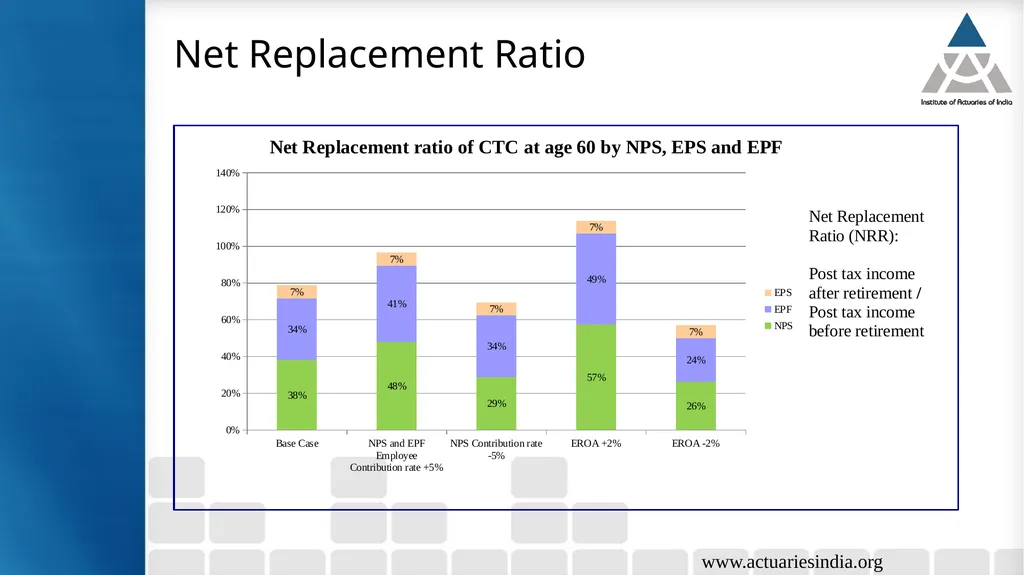
slide30. Net Replacement Ratio www.actuariesindia.org<br>
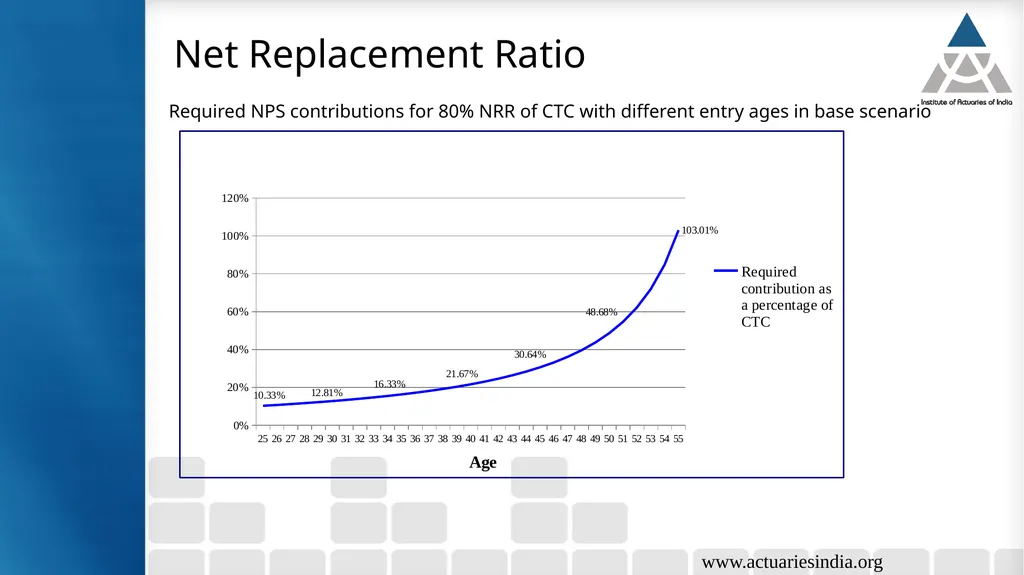
slide31. Net Replacement Ratio www.actuariesindia.org Required NPS contributions for 80% NRR of CTC with different entry ages in base scenario<br>
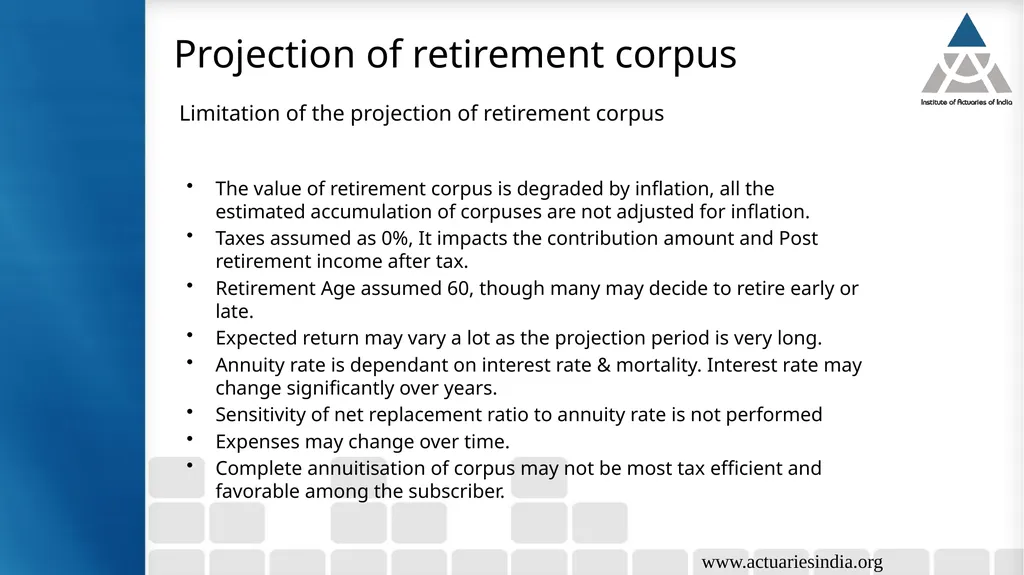
slide32. Projection of retirement corpus www.actuariesindia.org Limitation of the projection of retirement corpus The value of retirement corpus is degraded by inflation, all the estimated accumulation of corpuses are not adjusted for inflation.
Taxes assumed as 0%, It impacts the contribution amount and Post retirement income after tax.
Retirement Age assumed 60, though many may decide to retire early or late.
Expected return may vary a lot as the projection period is very long.
Annuity rate is dependant on interest rate & mortality. Interest rate may change significantly over years.
Sensitivity of net replacement ratio to annuity rate is not performed
Expenses may change over time.
Complete annuitisation of corpus may not be most tax efficient and favorable among the subscriber.<br>
slide33. www.actuariesindia.org<br>
Presented By :
1. Shryans Jain
2. Gaurav Nautiyal
3. Deepesh Gada
4. Neelesh Tripathi 35th India Fellowship Webinar
Date: 16th July 2021<br>
slide2. Introduction of Guide
Vichitra Malhotra www.actuariesindia.org Vichitra Malhotra is Founder and Consulting Actuary for Veritas Actuaries and Consultants
Vichitra Malhotra is a Consulting Actuary with about 10 years of work experience, providing consultancy in various actuarial practice areas.
She is qualified from both Institute of Actuaries of India as well as Institute and Faculty of Actuaries, UK.
In her past role, she has worked with large multinationals in India including PricewaterhouseCoopers (PwC), Max Life Insurance and Canara HSBC OBC Life Insurance.<br>
slide3. Introduction to Case Study A Company would like to conduct a series of awareness sessions for its employees to highlight the key retirement benefits available in the corporate sector and to emphasize on the importance of retirement savings.
The schemes offered by the Company are Gratuity benefit, Provident Fund and National Pension System (NPS). The contribution to NPS is optional. www.actuariesindia.org<br>
slide4. Today’s discussion www.actuariesindia.org<br>
slide5. Retirement Planning – Why? Medical Inflation
Pattern of spending changes post retirement
Nuclear families
No state sponsored pension
Plan your Retirement so you can manage your Lifestyle from Pre to Post Retirement.
Prepare for more free time and less stress! www.actuariesindia.org<br>
slide6. Mandatory Schemes
Gratuity Governed by Payment of Gratuity Act, 1972. Code on Social Security 2020 to subsume nine Labour Acts related to social security (including Payment of Gratuity Act, 1972).
Gratuity is sum of money paid by an employer to its employee at the end of the employment period as mark of recognition for contributing to the company.
Applicability – Every establishment having 10 or more employees on any day in the preceding 12 months
Eligibility – Only after completing 5 years of service with same employer
Benefit Payable – (15/26) * Salary(Basic + DA) * Service
Benefit amount is capped at INR 20 lakhs
It is payable
On superannuation or retirement
On resignation or termination
On death or disablement due to accident or disease (even if service is less than 5 years) www.actuariesindia.org<br>
slide7. Mandatory Schemes
Employees Provident Fund Governed by Employees Provident Fund and Miscellaneous Provisions Act, 1952. Code on Social Security 2020 to subsume nine Labour Acts related to social security.
Applicability – Every establishment having 20 or more employees
It is a statutory benefit payable as lump sum.
Funding
Employee contribution – 12% of salary (Basic + DA)
Employer contribution – 3.67% of salary (Basic + DA)
Interest is credited on employer and employee contributions.
It is payable on
On superannuation or retirement
Unemployed for period of 2 months or more
Death in service
Partial withdrawals are also allowed (educational opportunity, marriage, repayment of home loan, etc.)
Tax treatment – EEE (Exempt, Exempt, Exempt) www.actuariesindia.org<br>
slide8. Mandatory Schemes
Employees Pension Scheme www.actuariesindia.org Governed by Employees Provident Fund and Miscellaneous Provisions Act, 1952. Code on Social Security 2020 to subsume nine Labour Acts related to social security.
Applicability – Every establishment having 20 or more employees
It is a statutory benefit payable as pension.
Funding
Employee contribution – Not required
Employer contribution – 8.33% of salary (Basic + DA) capped at INR 15,000 i.e. maximum contribution of INR 1,250 per month
Benefit Payable – (Pensionable Salary * Pensionable Service)/70
Pensionable salary – Average of last 60 months drawn salary
Pensionable service – Service after 16th November 1995
Pension subject to minimum of INR 1,000 per month
It is payable on
On superannuation or retirement
Early retirement – available from age 50 and must have completed 10 years of service.
Death in service – Pension is available to widow/widower if at least one month contribution have been paid<br>
slide9. Overview of retirement benefits in India www.actuariesindia.org<br>
slide10. National Pension scheme- A social security initiative Initiative by Government of India in 2004
Falls under the purview of the Pension Fund Regulatory and Development Authority (PFRDA) and Central Government
Voluntary and long-term investment mechanism for retirement income
Open to employees from the public, private and even the unorganised sectors
Encourages investment in a pension account at regular intervals during the period of employment
After retirement, the subscribers can take out a certain percentage of the corpus
Remaining amount is received as a monthly pension www.actuariesindia.org<br>
slide11. NPS Stakeholders www.actuariesindia.org<br>
slide12. NPS Stakeholders NPS subscriber – person who open their NPS account and contribute money
Point of Presence (PoP) – first point of interaction between NPS subscriber and NPS architecture
Central Recordkeeping Agency (CRA) – recordkeeping, administration and customer service functions for all subscribers are handled by CRA
Pension fund managers (PFM) – they manage retirement savings under NPS www.actuariesindia.org<br>
slide13. NPS Stakeholders Trustee Bank – Facilitates fund transfer across various entities of NPS system viz. subscribers, PFMs, ASPs
Annuity Service Providers (ASP) – Responsible for delivering regular monthly pension after subscriber exits from NPS
NPS Trust – Responsible for taking care of funds under the NPS in the best interest of subscribers
Pension Fund Regulatory and Development Authority (PFRDA) – An autonomous body set up by Government of India to develop and regulate pension market in India. www.actuariesindia.org<br>
slide14. Features and Benefits NPS is an excellent retirement product in terms of transparency, access, cost and tax benefits.
Genuine security Net post retirement - Restrictions on withdrawal from tier-I account and stipulation that at maturity part of the tier-I corpus be used to buy annuity
Higher expected returns compared to other traditional tax-saving investments like the PPF
Market linked investments in debt and equity instruments
Portability across jobs and locations, with tax benefits under Section 80C and Section 80CCD
Benefits are less certain compared to the Earlier Pensions Schemes -the Defined pension related benefits for Government Employees www.actuariesindia.org<br>
slide15. Eligibility Norms and procedures A citizen of India, whether resident or non-resident or an OCI /PIO can join NPS
The subscriber should be between 18 and 65 years old on the date of submission of application
The subscribers should comply with the Know Your Customer (KYC) norms as detailed in the subscriber registration form.
Should not be Un-discharged insolvent and individuals of unsound mind.
Both an online as well as an offline route to open the NPS account and generate a Permanent Retirement Account Number(PRAN)
PRAN is a unique 12-digit number assigned to the registered subscribers. Using PRAN the NPS Login can be made through different channels www.actuariesindia.org<br>
slide16. Two types of NPS accounts - TIER 1 and TIER 2 Tier I :
The primary account, a pension account
Has restrictions on withdrawals and utilization of accumulated corpus.
The tax breaks that NPS offers are applicable only to Tier I accounts.
Tier II:
An investment account, similar to a mutual fund in characteristics, but offers no Exit load, no commissions, good returns
Helps bring liquidity to the scheme, subscribers with pre-existing Tier I accounts can deposit and withdraw monies as and when they want
The Tier 2 NPS account offers tax benefits to government employees under certain conditions. www.actuariesindia.org<br>
slide17. Taxation benefits Any person who is a subscriber of NPS can avail tax deduction up to 10 percent of gross income within the overall ceiling of Rs 1.5 lakh, under Section 80C of the Income Tax (I-T) Act
Any additional self contribution (up to Rs 50,000) under section 80CCD(1B) as NPS tax benefit.
The scheme, therefore, allows a tax deduction of up to Rs 2 lakh in total.
Similar to PPF/ EPF , the NPS is an EEE (Exempt-Exempt-Exempt) instrument where the entire corpus escapes tax at maturity and entire pension withdrawal amount is tax-free. www.actuariesindia.org<br>
slide18. Withdrawal and Exit rules www.actuariesindia.org Out of the entire corpus of the NPS scheme at retirement, Beneficiary to keep aside at least 40% of the corpus to receive a regular pension from a PFRDA-registered insurance firm.
After an investment period for at least three years, subscriber may withdraw up to 25% for certain purposes.
These include children’s wedding or higher studies, building/buying a house or medical treatment of self/family, among others.
Withdrawal can be done up to three times (with a gap of five years) in the entire tenure.
These restrictions are only imposed on tier I accounts and not on tier II accounts.<br>
slide19. NPS Investment Options Auto Choice
Option for those who do not have required knowledge to manage their NPS investments
Decides the risk profile of investments as per subscriber age. At older ages, investment mix turns more stable and less risky.
Investments are made in a life cycle fund with proportions invested in different asset classes pre-determined which is dependent on age.
There are 3 life cycle funds to choose from:
Moderate Life Cycle Fund (default option) – caps the equity exposure to a maximum of 50%.
Aggressive Life Cycle Fund – caps the equity exposure to a maximum of 75%
Conservative Life Cycle Fund – caps the equity exposure to a maximum of 25% www.actuariesindia.org<br>
slide20. NPS Investment Options Active Choice
Option for those who wish to decide asset allocation on their own.
Four asset classes are available:
Asset Class E (Equity) – maximum equity allocation is capped at 75% up to the age of 50. Thereafter maximum equity allocation will reduce by 2.5% each year till age of 60
Asset Class C (Corporate Debt) – can allocate up to 100% of contribution amount
Asset Class G (Government Bonds) – can allocate up to 100% of contribution amount
Asset Class A (Alternative Investment Funds, MBS, REITs) – can allocate up to 5% of contribution amount www.actuariesindia.org<br>
slide21. Considerations to be borne in mind while choosing investment strategy Need to balance conflicting objectives of safety of capital and achieving reasonably high long term returns
Need for returns to be at least as much as inflation
Age – a younger person can take on more investment risk
Diversification – helps to reduce specific risk related to a particular asset class www.actuariesindia.org<br>
slide22. Considerations to be borne in mind while choosing investment strategy Risk Appetite
Expertise
NPS investment should be done keeping in mind overall retirement portfolio. www.actuariesindia.org<br>
slide23. Projection of retirement corpus Age at entry
Retirement Age
Contribution Rate
Expected Return on Asset (EROA)
Salary increase assumption (If contribution is based on projected salary)
Various Charges by intermediaries e.g. Asset Servicing charges, Investment Management Fee, Reimbursement of Expenses etc.
Taxes
Inflation for wage ceiling in EPF/EPS
Ignored Gratuity Benefit under retirement corpus. www.actuariesindia.org Assumption which will have impact in accumulated retirement corpus<br>
slide24. Projection of retirement corpus www.actuariesindia.org Assumptions under Base Scenario<br>
slide25. Projection of NPS corpus www.actuariesindia.org Sensitivity of NPS Corpus with +/- 5% of contribution rate in Base Scenario<br>
slide26. Projection of NPS corpus www.actuariesindia.org Sensitivity of NPS Corpus with +/- 2% of EROA in Base Scenario<br>
slide27. Projection of NPS corpus www.actuariesindia.org Retirement Corpus at different entry ages to NPS<br>
slide28. Projection of EPF corpus www.actuariesindia.org Sensitivity of EPF Corpus with +/- 5% of contribution rate in Base Scenario<br>
slide29. Projection of EPF corpus www.actuariesindia.org Sensitivity of EPF Corpus with +/- 2% of EROA in Base Scenario<br>
slide30. Net Replacement Ratio www.actuariesindia.org<br>
slide31. Net Replacement Ratio www.actuariesindia.org Required NPS contributions for 80% NRR of CTC with different entry ages in base scenario<br>
slide32. Projection of retirement corpus www.actuariesindia.org Limitation of the projection of retirement corpus The value of retirement corpus is degraded by inflation, all the estimated accumulation of corpuses are not adjusted for inflation.
Taxes assumed as 0%, It impacts the contribution amount and Post retirement income after tax.
Retirement Age assumed 60, though many may decide to retire early or late.
Expected return may vary a lot as the projection period is very long.
Annuity rate is dependant on interest rate & mortality. Interest rate may change significantly over years.
Sensitivity of net replacement ratio to annuity rate is not performed
Expenses may change over time.
Complete annuitisation of corpus may not be most tax efficient and favorable among the subscriber.<br>
slide33. www.actuariesindia.org<br>