
Returning to School and Making Use of



Description: Returning to School and Making Use of Trauma-Informed Approaches: The transformative power of feeling safe and what about when it goes wrong? Ian Hunkin Sigma Teaching School Delta Education Trust 23.6.20 Aims To provide a brief overview of
Related Topics
Download Presentation
"Returning to School and Making Use of" is the property of its rightful owner. Permission is granted to download and print the materials on this website for personal, non-commercial use only, and to display it on your personal computer provided you do not modify the materials and that you retain all copyright notices contained in the materials. By downloading content from our website, you accept the terms of this agreement.
Presentation Transcript
slide1. Returning to School and Making Use of Trauma-Informed Approaches: The transformative power of feeling safe and what about when it goes wrong? Ian Hunkin
Sigma Teaching School
Delta Education Trust
23.6.20<br>
slide2. Aims To provide a brief overview of the key messages from research regarding what works for children and young people who have experienced trauma.
Provide an opportunity to reflect on your own practice with regard to these key messages (reassurance and ideally identifying actions to further develop your practice).
Signposting to other information (including a free online staff CPD course through Sigma Teaching School). Evidence-based:
The approaches and interventions referenced will be evidence-based; mostly from the fields of psychology and neuroscience. Some of the evidence-based approaches and interventions informed by the research are deceptively simple. They are, however, also enormously powerful in their impact.
These approaches and interventions are essential for children and young people who have experienced trauma and, additionally, are good practice for all children and young people.<br>
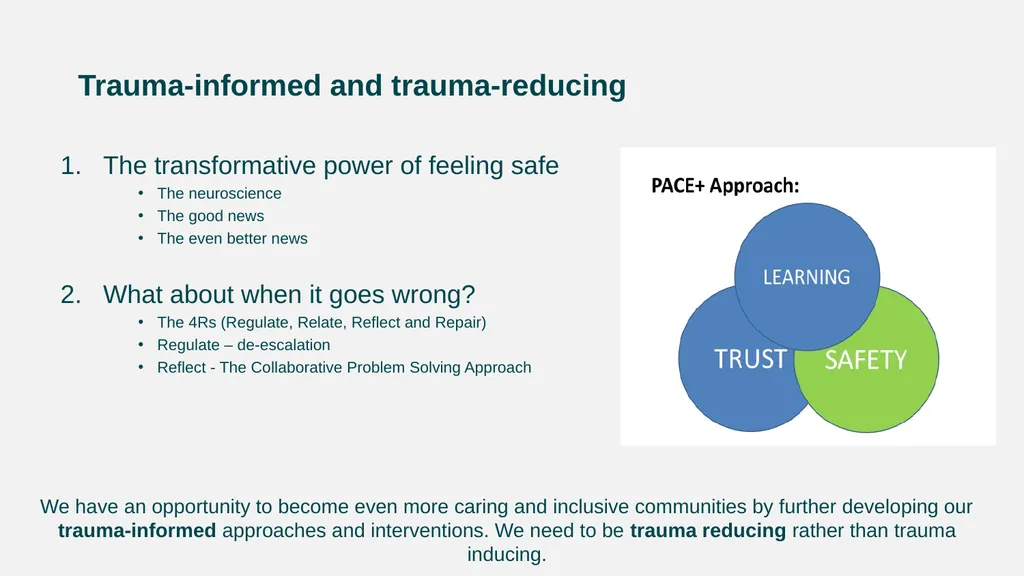
slide3. Trauma-informed and trauma-reducing The transformative power of feeling safe
The neuroscience
The good news
The even better news
What about when it goes wrong?
The 4Rs (Regulate, Relate, Reflect and Repair)
Regulate – de-escalation
Reflect - The Collaborative Problem Solving Approach We have an opportunity to become even more caring and inclusive communities by further developing our trauma-informed approaches and interventions. We need to be trauma reducing rather than trauma inducing.<br>
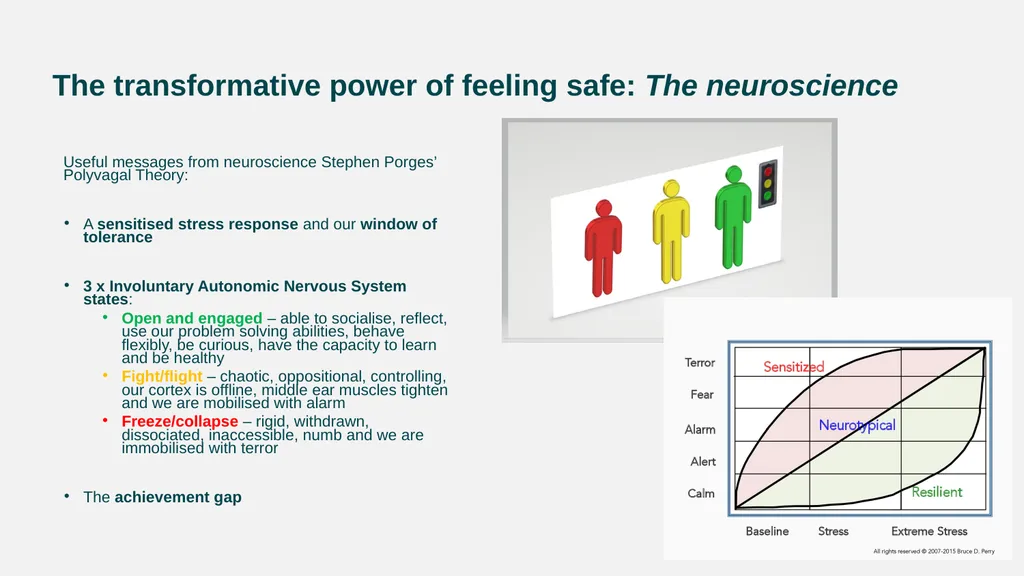
slide4. The transformative power of feeling safe: The neuroscience Useful messages from neuroscience Stephen Porges’ Polyvagal Theory:
A sensitised stress response and our window of tolerance
3 x Involuntary Autonomic Nervous System states:
Open and engaged – able to socialise, reflect, use our problem solving abilities, behave flexibly, be curious, have the capacity to learn and be healthy
Fight/flight – chaotic, oppositional, controlling, our cortex is offline, middle ear muscles tighten and we are mobilised with alarm
Freeze/collapse – rigid, withdrawn, dissociated, inaccessible, numb and we are immobilised with terror
The achievement gap<br>
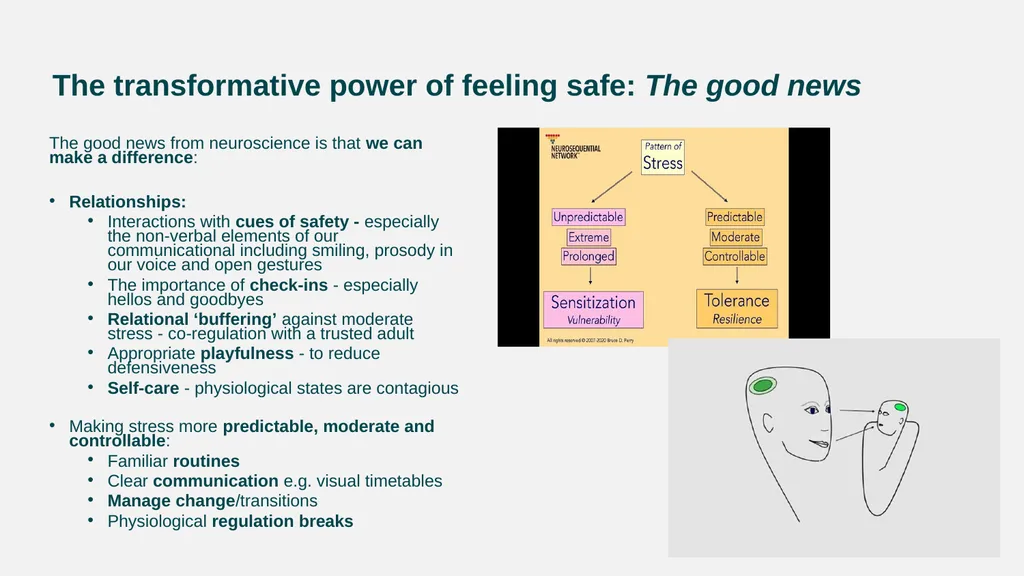
slide5. The transformative power of feeling safe: The good news The good news from neuroscience is that we can make a difference:
Relationships:
Interactions with cues of safety - especially the non-verbal elements of our communicational including smiling, prosody in our voice and open gestures
The importance of check-ins - especially hellos and goodbyes
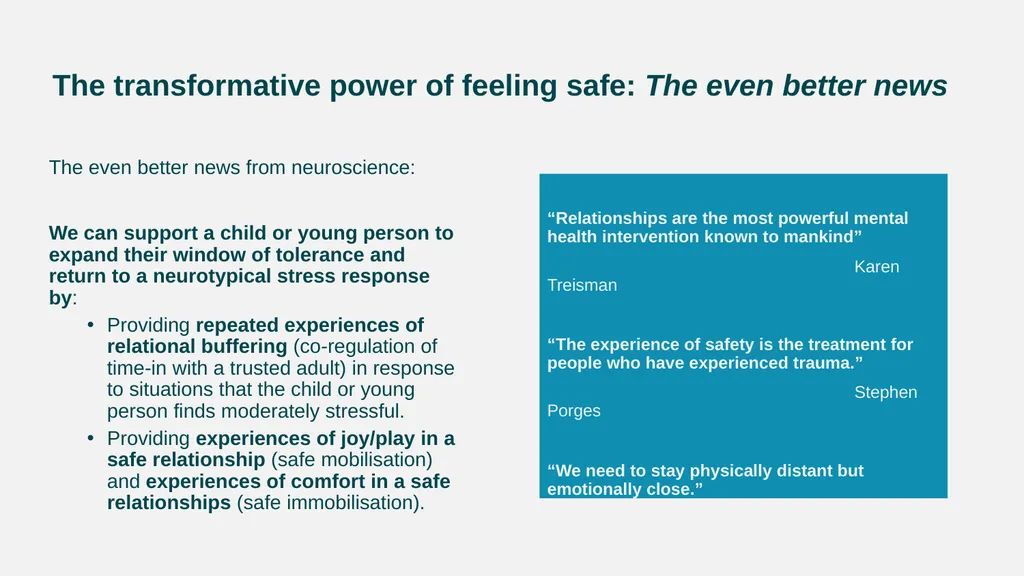
Relational ‘buffering’ against moderate stress - co-regulation with a trusted adult
Appropriate playfulness - to reduce defensiveness
Self-care - physiological states are contagious
Making stress more predictable, moderate and controllable:
Familiar routines
Clear communication e.g. visual timetables
Manage change/transitions
Physiological regulation breaks<br>
slide6. The transformative power of feeling safe: The even better news The even better news from neuroscience:
We can support a child or young person to expand their window of tolerance and return to a neurotypical stress response by:
Providing repeated experiences of relational buffering (co-regulation of time-in with a trusted adult) in response to situations that the child or young person finds moderately stressful.
Providing experiences of joy/play in a safe relationship (safe mobilisation) and experiences of comfort in a safe relationships (safe immobilisation). “Relationships are the most powerful mental health intervention known to mankind”
Karen Treisman
“The experience of safety is the treatment for people who have experienced trauma.”
Stephen Porges
“We need to stay physically distant but emotionally close.”
Bruce Perry<br>
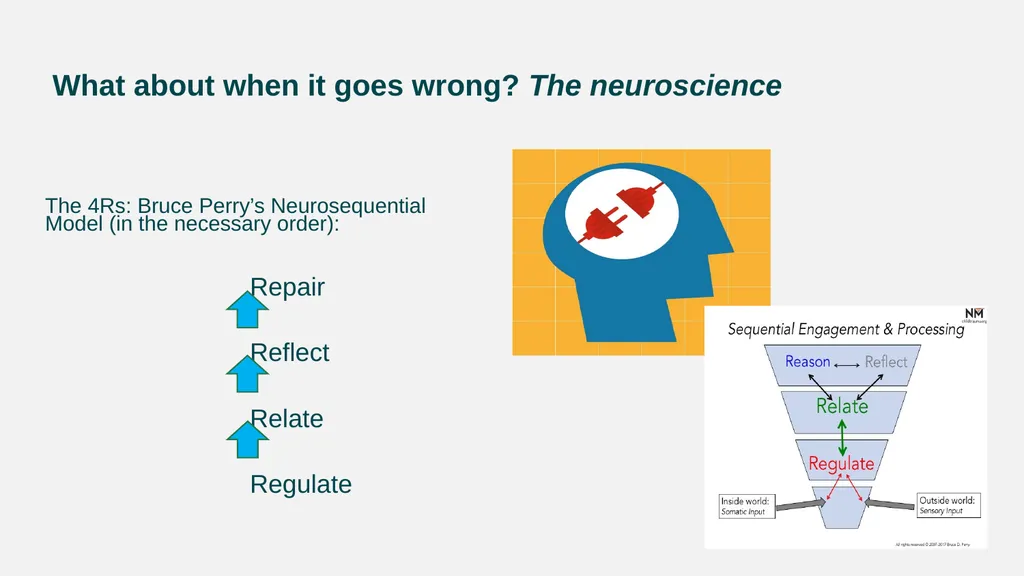
slide7. What about when it goes wrong? The neuroscience The 4Rs: Bruce Perry’s Neurosequential Model (in the necessary order):
Repair
Reflect
Relate
Regulate<br>
slide8. Regulate: De-escalation techniques (a plan of what and how) Risk assess the situation – safety, keep everyone safe
Clear instruction
Positive feedback if instruction is followed
Increased personal space, side stance, open palm gestures
Attuned nonverbal communication (matching the energy but not the emotion)
Listen to the learner and use pACE (playfulness, Acceptance, Curiosity and Empathy) especially A&E e.g. “I can see that something really stressful has happened. Help me to understand?”
LIFE (Listen, I statements, opportunities for Forking and for Everyone to win)
Calm, firm voice
Common language, one voice same instruction
Encourage the learner to make safe choices and to regulate his/her physiological arousal with staff
Take up time for learner
Continue to risk assess situation
Change of face if required
Time-in with a key adult (co-regulation)
Physiological regulation actions with a key adult e.g. 7:11 breathing or rhythmic grounding and soothing activities 8<br>
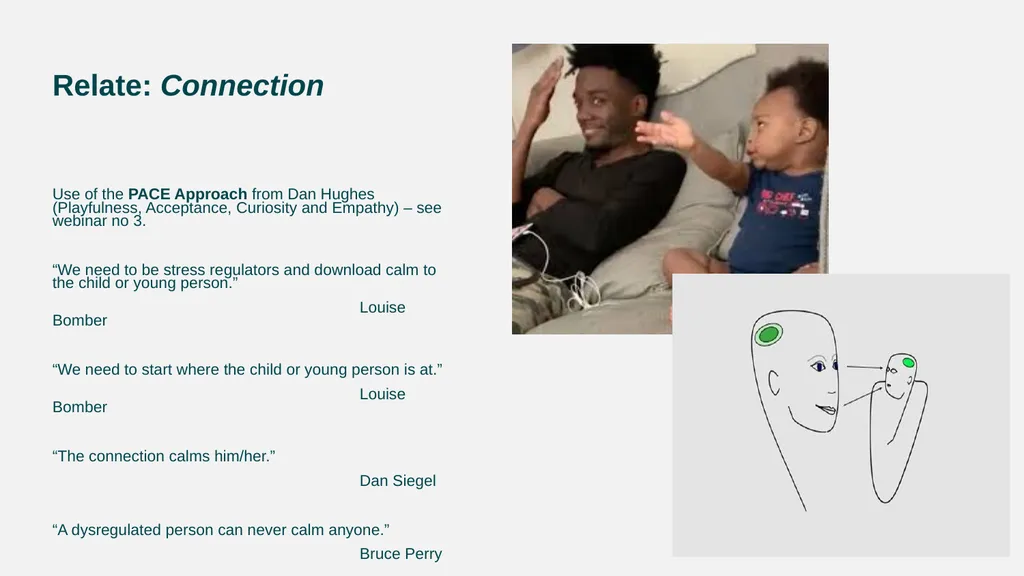
slide9. Relate: Connection Use of the PACE Approach from Dan Hughes (Playfulness, Acceptance, Curiosity and Empathy) – see webinar no 3.
“We need to be stress regulators and download calm to the child or young person.”
Louise Bomber
“We need to start where the child or young person is at.”
Louise Bomber
“The connection calms him/her.”
Dan Siegel
“A dysregulated person can never calm anyone.”
Bruce Perry<br>
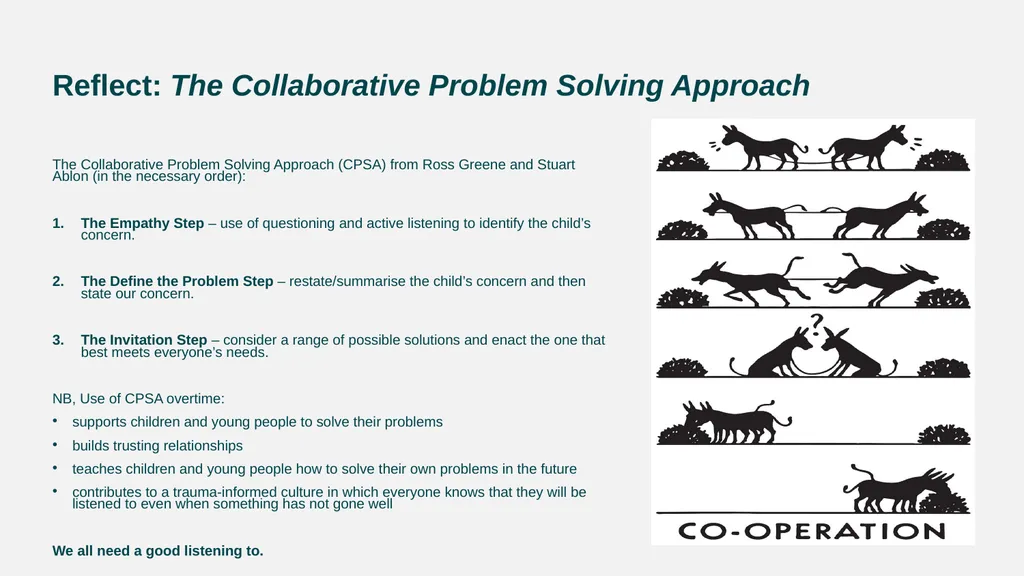
slide10. Reflect: The Collaborative Problem Solving Approach The Collaborative Problem Solving Approach (CPSA) from Ross Greene and Stuart Ablon (in the necessary order):
The Empathy Step – use of questioning and active listening to identify the child’s concern.
The Define the Problem Step – restate/summarise the child’s concern and then state our concern.
The Invitation Step – consider a range of possible solutions and enact the one that best meets everyone’s needs.
NB, Use of CPSA overtime:
supports children and young people to solve their problems
builds trusting relationships
teaches children and young people how to solve their own problems in the future
contributes to a trauma-informed culture in which everyone knows that they will be listened to even when something has not gone well
We all need a good listening to.<br>
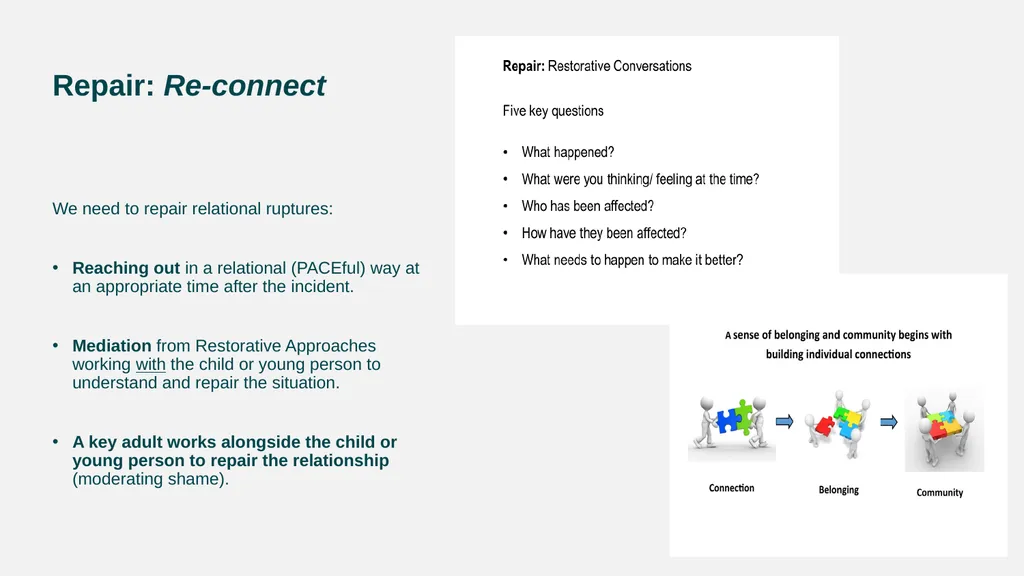
slide11. Repair: Re-connect We need to repair relational ruptures:
Reaching out in a relational (PACEful) way at an appropriate time after the incident.
Mediation from Restorative Approaches working with the child or young person to understand and repair the situation.
A key adult works alongside the child or young person to repair the relationship (moderating shame).<br>
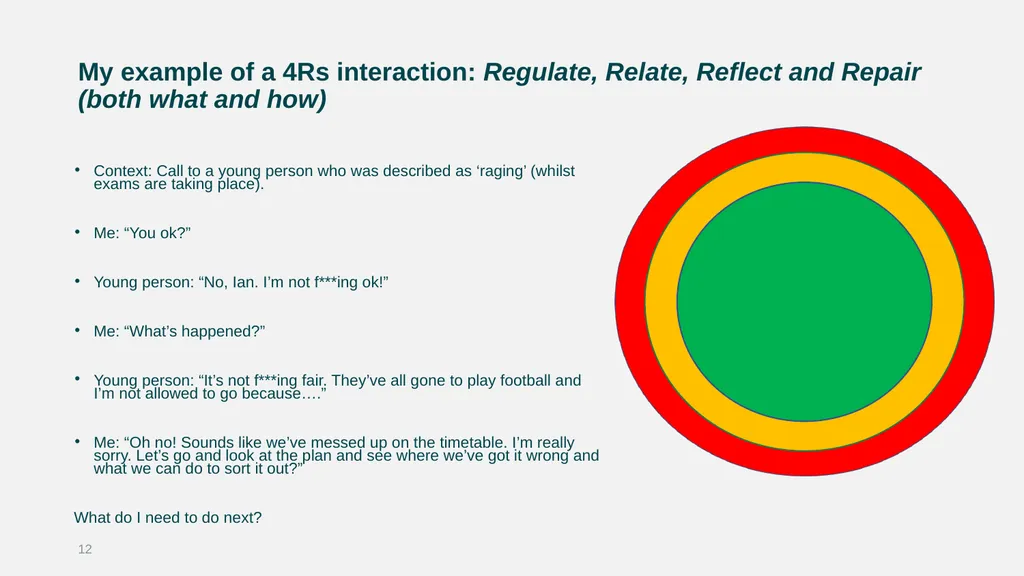
slide12. My example of a 4Rs interaction: Regulate, Relate, Reflect and Repair (both what and how) Context: Call to a young person who was described as ‘raging’ (whilst exams are taking place).
Me: “You ok?”
Young person: “No, Ian. I’m not f***ing ok!”
Me: “What’s happened?”
Young person: “It’s not f***ing fair. They’ve all gone to play football and I’m not allowed to go because….”
Me: “Oh no! Sounds like we’ve messed up on the timetable. I’m really sorry. Let’s go and look at the plan and see where we’ve got it wrong and what we can do to sort it out?”
What do I need to do next? 12<br>
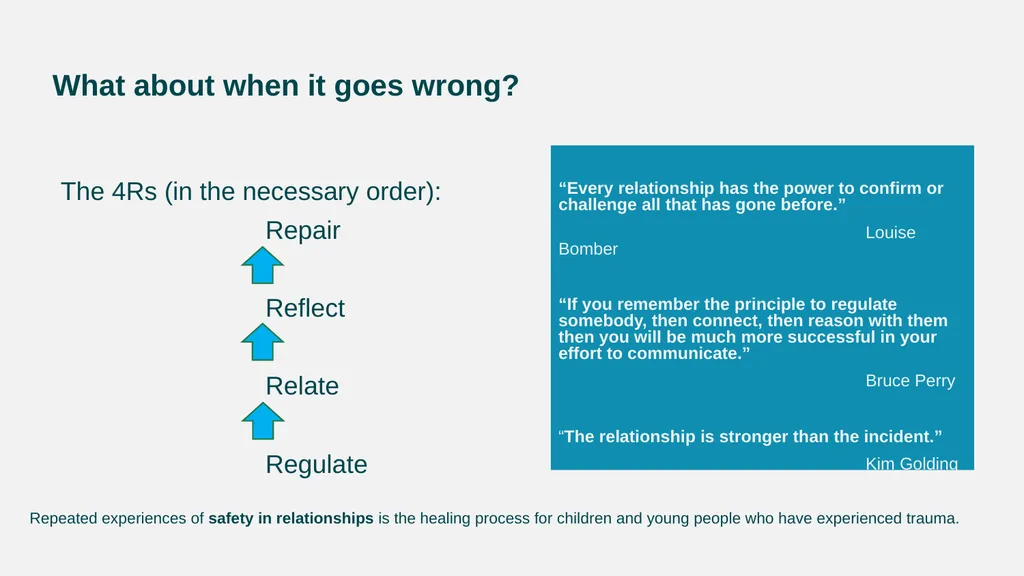
slide13. What about when it goes wrong? “Every relationship has the power to confirm or challenge all that has gone before.”
Louise Bomber
“If you remember the principle to regulate somebody, then connect, then reason with them then you will be much more successful in your effort to communicate.”
Bruce Perry
“The relationship is stronger than the incident.”
Kim Golding The 4Rs (in the necessary order):
Repair
Reflect
Relate
Regulate Repeated experiences of safety in relationships is the healing process for children and young people who have experienced trauma.<br>
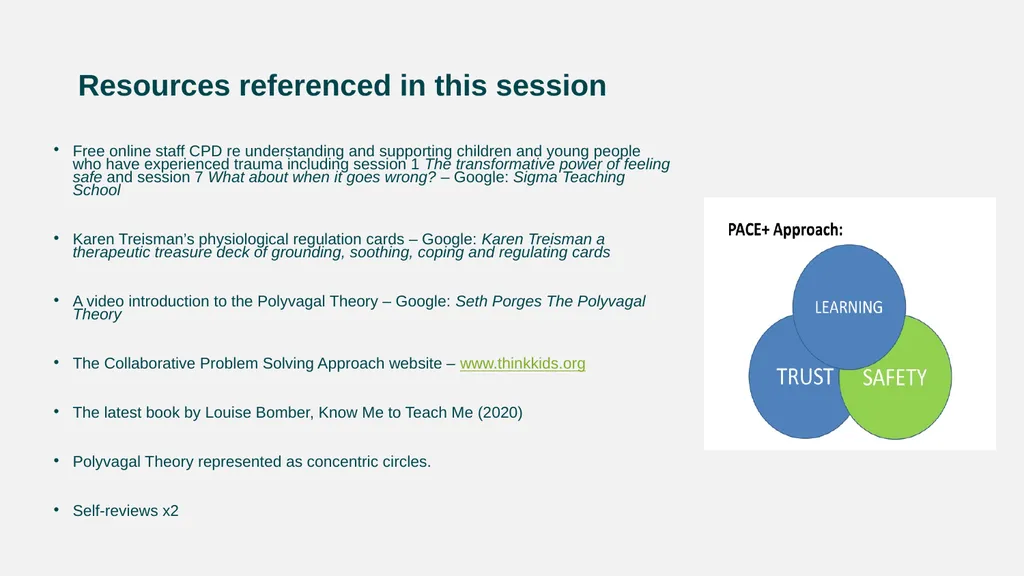
slide14. Resources referenced in this session Free online staff CPD re understanding and supporting children and young people who have experienced trauma including session 1 The transformative power of feeling safe and session 7 What about when it goes wrong? – Google: Sigma Teaching School
Karen Treisman’s physiological regulation cards – Google: Karen Treisman a therapeutic treasure deck of grounding, soothing, coping and regulating cards
A video introduction to the Polyvagal Theory – Google: Seth Porges The Polyvagal Theory
The Collaborative Problem Solving Approach website – www.thinkkids.org
The latest book by Louise Bomber, Know Me to Teach Me (2020)
Polyvagal Theory represented as concentric circles.
Self-reviews x2<br>
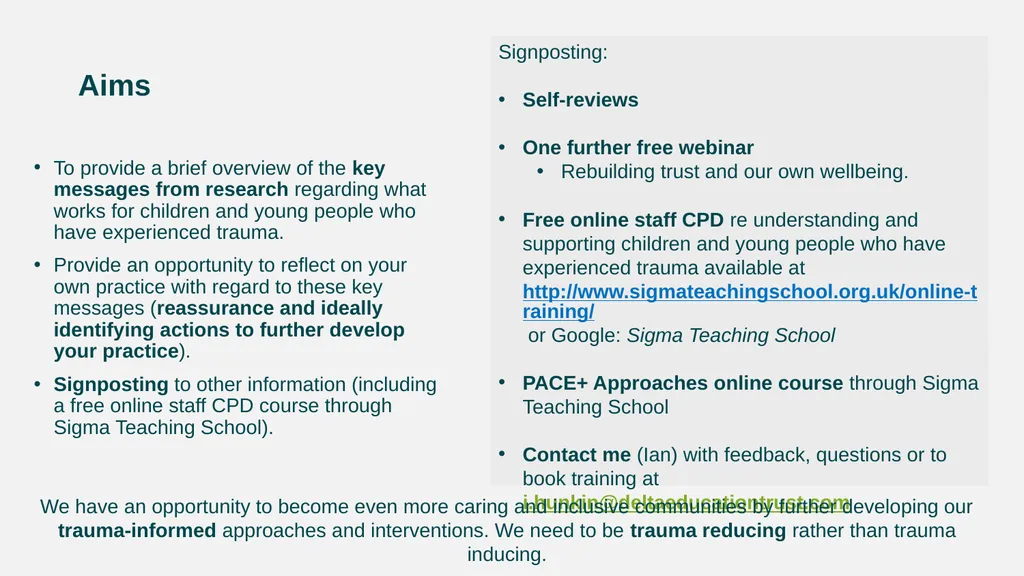
slide15. Aims To provide a brief overview of the key messages from research regarding what works for children and young people who have experienced trauma.
Provide an opportunity to reflect on your own practice with regard to these key messages (reassurance and ideally identifying actions to further develop your practice).
Signposting to other information (including a free online staff CPD course through Sigma Teaching School). Signposting:
Self-reviews
One further free webinar
Rebuilding trust and our own wellbeing.
Free online staff CPD re understanding and supporting children and young people who have experienced trauma available at http://www.sigmateachingschool.org.uk/online-training/ or Google: Sigma Teaching School
PACE+ Approaches online course through Sigma Teaching School
Contact me (Ian) with feedback, questions or to book training at i.hunkin@deltaeducationtrust.com We have an opportunity to become even more caring and inclusive communities by further developing our trauma-informed approaches and interventions. We need to be trauma reducing rather than trauma inducing.<br>
slide16. Self-Review Documents<br>
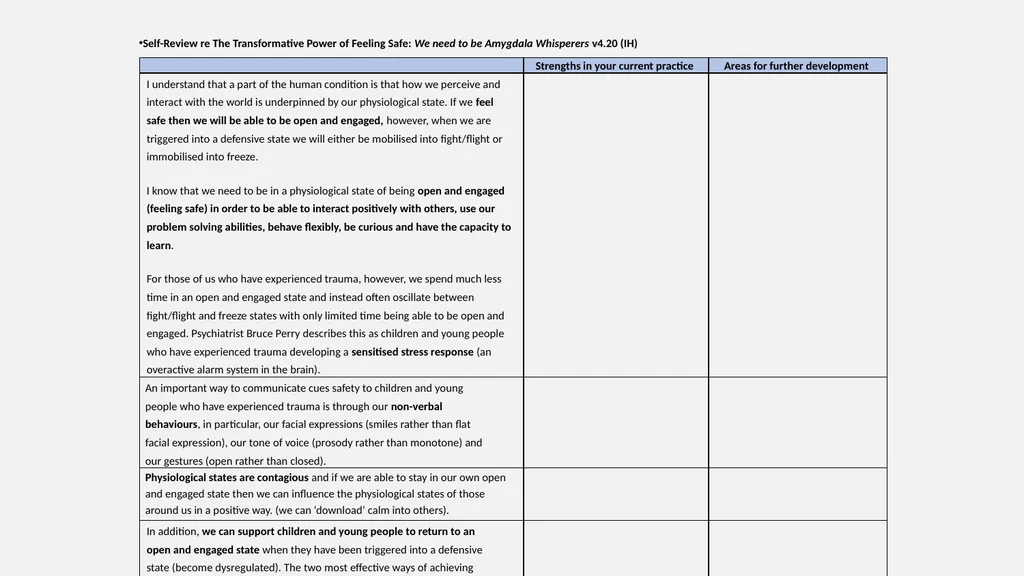
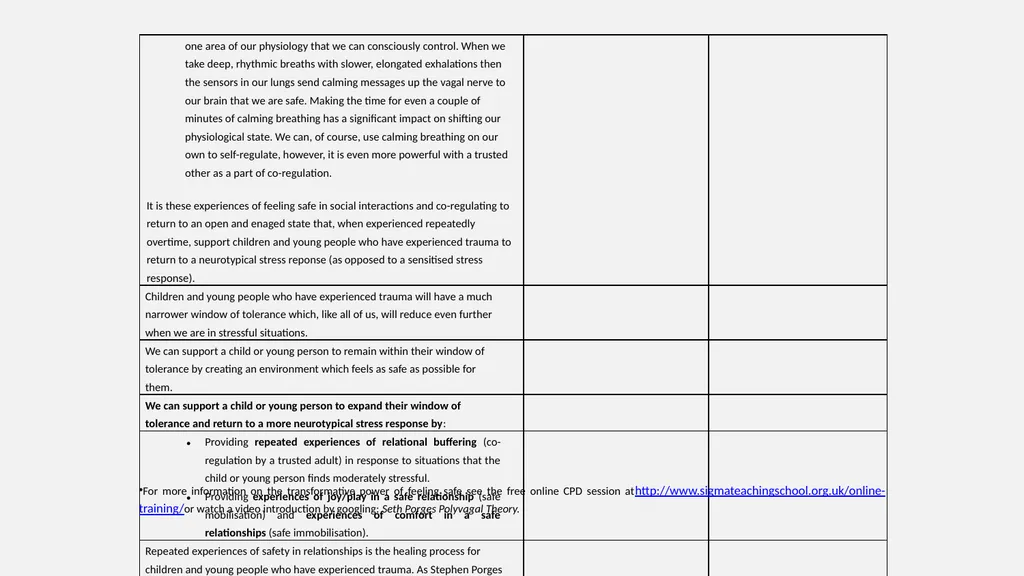
slide17. Self-Review re The Transformative Power of Feeling Safe: We need to be Amygdala Whisperers v4.20 (IH)<br>
slide18. For more information on the transformative power of feeling safe see the free online CPD session athttp://www.sigmateachingschool.org.uk/online-training/or watch a video introduction by googling: Seth Porges Polyvagal Theory.<br>
slide19. Self-review re applying the 4Rs to provide correction with connection for children and young people who have experienced trauma: Respecting our biology.
v7.19 (IH) NB. Regulate Relate Reflect Repair<br>
slide20. Q&A Answers from Ian Hunkin<br>
slide21. Can the cards (resource by Karen Treisman) be used with all age groups? The Karen Treisman Therapeutic Treasure deck of grounding, soothing, coping and regulating cards can absolutely be used with all ages of children and young people with only a little differentiation. They can also be used with adults too. Ideally they are used to experiment which physiological regulation activities work best to calm each individual and then to make use of these activities both reactively (co-regulation as time-in with a trusted adult when needing to regulate) and proactively in brief activities interspersed throughout the day to keep us regulated. We can build these into whole class transitions. I’ve found these a really useful resource (and I’m not on a commission).
Please see below a link to a short video from Karen Treisman introducing her resource.
https://www.youtube.com/watch?v=Mfw_bGIcMcM<br>
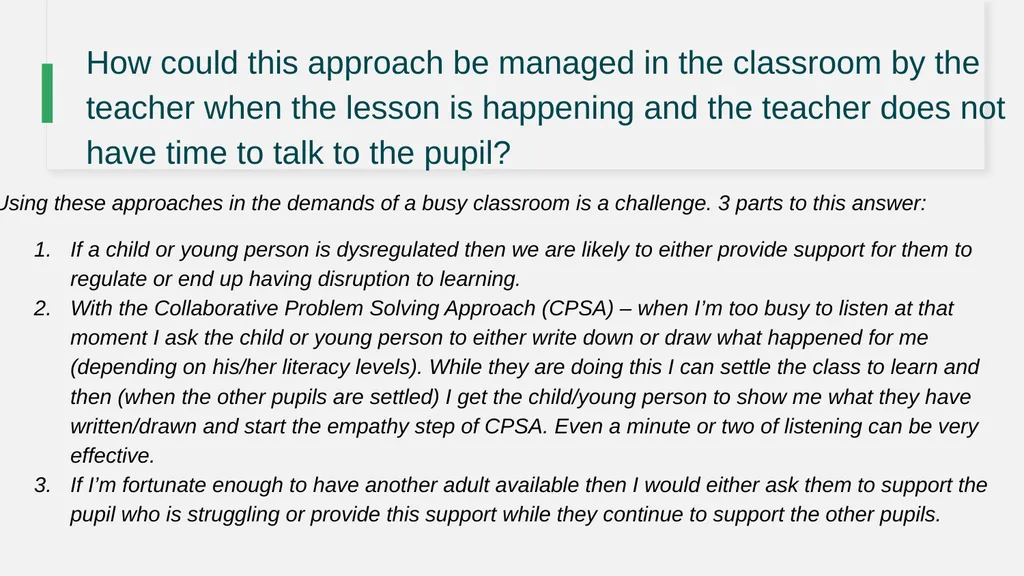
slide22. How could this approach be managed in the classroom by the teacher when the lesson is happening and the teacher does not have time to talk to the pupil? Using these approaches in the demands of a busy classroom is a challenge. 3 parts to this answer:
If a child or young person is dysregulated then we are likely to either provide support for them to regulate or end up having disruption to learning.
With the Collaborative Problem Solving Approach (CPSA) – when I’m too busy to listen at that moment I ask the child or young person to either write down or draw what happened for me (depending on his/her literacy levels). While they are doing this I can settle the class to learn and then (when the other pupils are settled) I get the child/young person to show me what they have written/drawn and start the empathy step of CPSA. Even a minute or two of listening can be very effective.
If I’m fortunate enough to have another adult available then I would either ask them to support the pupil who is struggling or provide this support while they continue to support the other pupils.<br>
slide23. Would you go straight into the de-escalation strategies if the child is really cross or is it best to wait until they are at least talking, like you example and then start these strategies? I would match my de-escalation strategies to where I think the child or young person is - i.e. I would use the 4Rs approach (Regulate, Relate, Reflect and Repair in that order). If the child or young person appears regulated (in open and engaged physiological state) then I would move onto relating and reflecting using the Collaborative Problem Solving Approach. However, if he/she is not yet regulated then I would co-regulate first with the time-in with a trusted adult and potentially the addition of physiological regulation activities with the trusted adult (e.g. 7-11 breathing, rhythmic physical activity or distraction/grounding actions).<br>
slide24. Thank you for attending! Join the Community of Practice: https://www.sendgateway.org.uk/whole-school-send/join-our-community-of-practice.html
Sendgateway.org.uk
Nasen.org.uk
@wholeschoolSEND
@nasen<br>
Sigma Teaching School
Delta Education Trust
23.6.20<br>
slide2. Aims To provide a brief overview of the key messages from research regarding what works for children and young people who have experienced trauma.
Provide an opportunity to reflect on your own practice with regard to these key messages (reassurance and ideally identifying actions to further develop your practice).
Signposting to other information (including a free online staff CPD course through Sigma Teaching School). Evidence-based:
The approaches and interventions referenced will be evidence-based; mostly from the fields of psychology and neuroscience. Some of the evidence-based approaches and interventions informed by the research are deceptively simple. They are, however, also enormously powerful in their impact.
These approaches and interventions are essential for children and young people who have experienced trauma and, additionally, are good practice for all children and young people.<br>
slide3. Trauma-informed and trauma-reducing The transformative power of feeling safe
The neuroscience
The good news
The even better news
What about when it goes wrong?
The 4Rs (Regulate, Relate, Reflect and Repair)
Regulate – de-escalation
Reflect - The Collaborative Problem Solving Approach We have an opportunity to become even more caring and inclusive communities by further developing our trauma-informed approaches and interventions. We need to be trauma reducing rather than trauma inducing.<br>
slide4. The transformative power of feeling safe: The neuroscience Useful messages from neuroscience Stephen Porges’ Polyvagal Theory:
A sensitised stress response and our window of tolerance
3 x Involuntary Autonomic Nervous System states:
Open and engaged – able to socialise, reflect, use our problem solving abilities, behave flexibly, be curious, have the capacity to learn and be healthy
Fight/flight – chaotic, oppositional, controlling, our cortex is offline, middle ear muscles tighten and we are mobilised with alarm
Freeze/collapse – rigid, withdrawn, dissociated, inaccessible, numb and we are immobilised with terror
The achievement gap<br>
slide5. The transformative power of feeling safe: The good news The good news from neuroscience is that we can make a difference:
Relationships:
Interactions with cues of safety - especially the non-verbal elements of our communicational including smiling, prosody in our voice and open gestures
The importance of check-ins - especially hellos and goodbyes
Relational ‘buffering’ against moderate stress - co-regulation with a trusted adult
Appropriate playfulness - to reduce defensiveness
Self-care - physiological states are contagious
Making stress more predictable, moderate and controllable:
Familiar routines
Clear communication e.g. visual timetables
Manage change/transitions
Physiological regulation breaks<br>
slide6. The transformative power of feeling safe: The even better news The even better news from neuroscience:
We can support a child or young person to expand their window of tolerance and return to a neurotypical stress response by:
Providing repeated experiences of relational buffering (co-regulation of time-in with a trusted adult) in response to situations that the child or young person finds moderately stressful.
Providing experiences of joy/play in a safe relationship (safe mobilisation) and experiences of comfort in a safe relationships (safe immobilisation). “Relationships are the most powerful mental health intervention known to mankind”
Karen Treisman
“The experience of safety is the treatment for people who have experienced trauma.”
Stephen Porges
“We need to stay physically distant but emotionally close.”
Bruce Perry<br>
slide7. What about when it goes wrong? The neuroscience The 4Rs: Bruce Perry’s Neurosequential Model (in the necessary order):
Repair
Reflect
Relate
Regulate<br>
slide8. Regulate: De-escalation techniques (a plan of what and how) Risk assess the situation – safety, keep everyone safe
Clear instruction
Positive feedback if instruction is followed
Increased personal space, side stance, open palm gestures
Attuned nonverbal communication (matching the energy but not the emotion)
Listen to the learner and use pACE (playfulness, Acceptance, Curiosity and Empathy) especially A&E e.g. “I can see that something really stressful has happened. Help me to understand?”
LIFE (Listen, I statements, opportunities for Forking and for Everyone to win)
Calm, firm voice
Common language, one voice same instruction
Encourage the learner to make safe choices and to regulate his/her physiological arousal with staff
Take up time for learner
Continue to risk assess situation
Change of face if required
Time-in with a key adult (co-regulation)
Physiological regulation actions with a key adult e.g. 7:11 breathing or rhythmic grounding and soothing activities 8<br>
slide9. Relate: Connection Use of the PACE Approach from Dan Hughes (Playfulness, Acceptance, Curiosity and Empathy) – see webinar no 3.
“We need to be stress regulators and download calm to the child or young person.”
Louise Bomber
“We need to start where the child or young person is at.”
Louise Bomber
“The connection calms him/her.”
Dan Siegel
“A dysregulated person can never calm anyone.”
Bruce Perry<br>
slide10. Reflect: The Collaborative Problem Solving Approach The Collaborative Problem Solving Approach (CPSA) from Ross Greene and Stuart Ablon (in the necessary order):
The Empathy Step – use of questioning and active listening to identify the child’s concern.
The Define the Problem Step – restate/summarise the child’s concern and then state our concern.
The Invitation Step – consider a range of possible solutions and enact the one that best meets everyone’s needs.
NB, Use of CPSA overtime:
supports children and young people to solve their problems
builds trusting relationships
teaches children and young people how to solve their own problems in the future
contributes to a trauma-informed culture in which everyone knows that they will be listened to even when something has not gone well
We all need a good listening to.<br>
slide11. Repair: Re-connect We need to repair relational ruptures:
Reaching out in a relational (PACEful) way at an appropriate time after the incident.
Mediation from Restorative Approaches working with the child or young person to understand and repair the situation.
A key adult works alongside the child or young person to repair the relationship (moderating shame).<br>
slide12. My example of a 4Rs interaction: Regulate, Relate, Reflect and Repair (both what and how) Context: Call to a young person who was described as ‘raging’ (whilst exams are taking place).
Me: “You ok?”
Young person: “No, Ian. I’m not f***ing ok!”
Me: “What’s happened?”
Young person: “It’s not f***ing fair. They’ve all gone to play football and I’m not allowed to go because….”
Me: “Oh no! Sounds like we’ve messed up on the timetable. I’m really sorry. Let’s go and look at the plan and see where we’ve got it wrong and what we can do to sort it out?”
What do I need to do next? 12<br>
slide13. What about when it goes wrong? “Every relationship has the power to confirm or challenge all that has gone before.”
Louise Bomber
“If you remember the principle to regulate somebody, then connect, then reason with them then you will be much more successful in your effort to communicate.”
Bruce Perry
“The relationship is stronger than the incident.”
Kim Golding The 4Rs (in the necessary order):
Repair
Reflect
Relate
Regulate Repeated experiences of safety in relationships is the healing process for children and young people who have experienced trauma.<br>
slide14. Resources referenced in this session Free online staff CPD re understanding and supporting children and young people who have experienced trauma including session 1 The transformative power of feeling safe and session 7 What about when it goes wrong? – Google: Sigma Teaching School
Karen Treisman’s physiological regulation cards – Google: Karen Treisman a therapeutic treasure deck of grounding, soothing, coping and regulating cards
A video introduction to the Polyvagal Theory – Google: Seth Porges The Polyvagal Theory
The Collaborative Problem Solving Approach website – www.thinkkids.org
The latest book by Louise Bomber, Know Me to Teach Me (2020)
Polyvagal Theory represented as concentric circles.
Self-reviews x2<br>
slide15. Aims To provide a brief overview of the key messages from research regarding what works for children and young people who have experienced trauma.
Provide an opportunity to reflect on your own practice with regard to these key messages (reassurance and ideally identifying actions to further develop your practice).
Signposting to other information (including a free online staff CPD course through Sigma Teaching School). Signposting:
Self-reviews
One further free webinar
Rebuilding trust and our own wellbeing.
Free online staff CPD re understanding and supporting children and young people who have experienced trauma available at http://www.sigmateachingschool.org.uk/online-training/ or Google: Sigma Teaching School
PACE+ Approaches online course through Sigma Teaching School
Contact me (Ian) with feedback, questions or to book training at i.hunkin@deltaeducationtrust.com We have an opportunity to become even more caring and inclusive communities by further developing our trauma-informed approaches and interventions. We need to be trauma reducing rather than trauma inducing.<br>
slide16. Self-Review Documents<br>
slide17. Self-Review re The Transformative Power of Feeling Safe: We need to be Amygdala Whisperers v4.20 (IH)<br>
slide18. For more information on the transformative power of feeling safe see the free online CPD session athttp://www.sigmateachingschool.org.uk/online-training/or watch a video introduction by googling: Seth Porges Polyvagal Theory.<br>
slide19. Self-review re applying the 4Rs to provide correction with connection for children and young people who have experienced trauma: Respecting our biology.
v7.19 (IH) NB. Regulate Relate Reflect Repair<br>
slide20. Q&A Answers from Ian Hunkin<br>
slide21. Can the cards (resource by Karen Treisman) be used with all age groups? The Karen Treisman Therapeutic Treasure deck of grounding, soothing, coping and regulating cards can absolutely be used with all ages of children and young people with only a little differentiation. They can also be used with adults too. Ideally they are used to experiment which physiological regulation activities work best to calm each individual and then to make use of these activities both reactively (co-regulation as time-in with a trusted adult when needing to regulate) and proactively in brief activities interspersed throughout the day to keep us regulated. We can build these into whole class transitions. I’ve found these a really useful resource (and I’m not on a commission).
Please see below a link to a short video from Karen Treisman introducing her resource.
https://www.youtube.com/watch?v=Mfw_bGIcMcM<br>
slide22. How could this approach be managed in the classroom by the teacher when the lesson is happening and the teacher does not have time to talk to the pupil? Using these approaches in the demands of a busy classroom is a challenge. 3 parts to this answer:
If a child or young person is dysregulated then we are likely to either provide support for them to regulate or end up having disruption to learning.
With the Collaborative Problem Solving Approach (CPSA) – when I’m too busy to listen at that moment I ask the child or young person to either write down or draw what happened for me (depending on his/her literacy levels). While they are doing this I can settle the class to learn and then (when the other pupils are settled) I get the child/young person to show me what they have written/drawn and start the empathy step of CPSA. Even a minute or two of listening can be very effective.
If I’m fortunate enough to have another adult available then I would either ask them to support the pupil who is struggling or provide this support while they continue to support the other pupils.<br>
slide23. Would you go straight into the de-escalation strategies if the child is really cross or is it best to wait until they are at least talking, like you example and then start these strategies? I would match my de-escalation strategies to where I think the child or young person is - i.e. I would use the 4Rs approach (Regulate, Relate, Reflect and Repair in that order). If the child or young person appears regulated (in open and engaged physiological state) then I would move onto relating and reflecting using the Collaborative Problem Solving Approach. However, if he/she is not yet regulated then I would co-regulate first with the time-in with a trusted adult and potentially the addition of physiological regulation activities with the trusted adult (e.g. 7-11 breathing, rhythmic physical activity or distraction/grounding actions).<br>
slide24. Thank you for attending! Join the Community of Practice: https://www.sendgateway.org.uk/whole-school-send/join-our-community-of-practice.html
Sendgateway.org.uk
Nasen.org.uk
@wholeschoolSEND
@nasen<br>