Review of Tasks for SPC3 Yoichi Sato (KEK/J-PARC),
Description: Review of Tasks for SPC3 Yoichi Sato (KEKJ-PARC), IPAC 25 SPC Chair IPAC25 SPC3 2025-JAN-06,07, Tokyo, Japan 1 https:indico.jacow.orgevent91 IPAC2025 SPC3 Yoichi Sato SPC composition Proposals from: Yoichi Sato, Ming-Chyuan Lin
Related Topics
Download Presentation
"Review of Tasks for SPC3 Yoichi Sato (KEK/J-PARC)," is the property of its rightful owner. Permission is granted to download and print the materials on this website for personal, non-commercial use only, and to display it on your personal computer provided you do not modify the materials and that you retain all copyright notices contained in the materials. By downloading content from our website, you accept the terms of this agreement.
Presentation Transcript
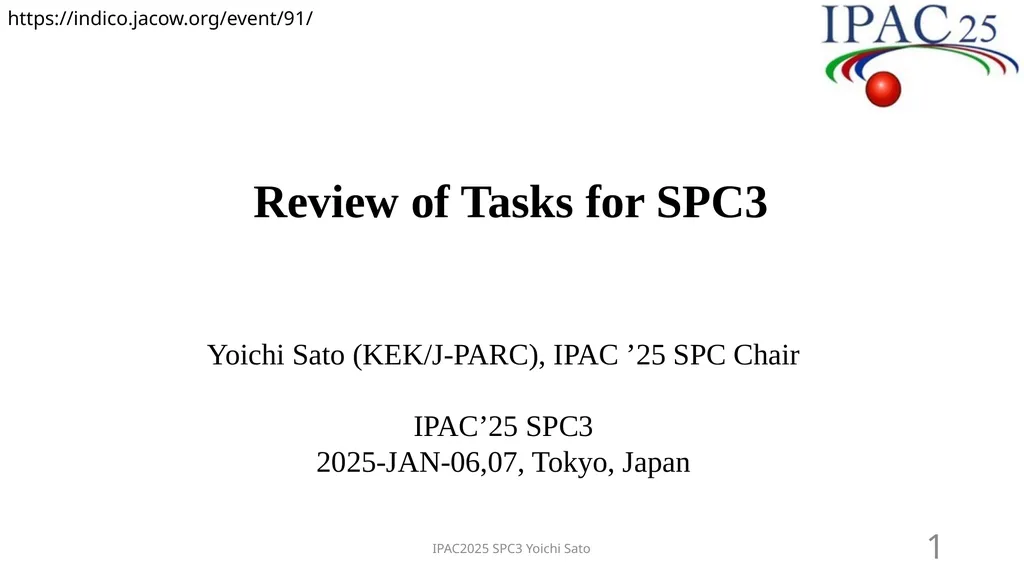
slide1. Review of Tasks for SPC3 Yoichi Sato (KEK/J-PARC), IPAC ’25 SPC Chair
IPAC’25 SPC3
2025-JAN-06,07, Tokyo, Japan 1 https://indico.jacow.org/event/91/ IPAC2025 SPC3 Yoichi Sato<br>
slide2. SPC composition Proposals from:
Yoichi Sato, Ming-Chyuan Lin (Asia),
Peter McIntosh, Rogelio Tomas (Europe),
Fulvia Pilat, Wolfram Fischer (Americas)<br>
slide3. Expected SPC tasks SPC1: 2023-DEC-4,5 Taipei, Taiwan
Review and finalize Main Classifications (MCs) and Sub classifications
Allocate oral sessions amongst the MCs
Establish the program structure and draft synoptic table
Agree on constitution of the Scientific Advisory Board (SAB) – can trigger submission
SPC2: 2024-MAY-24,25, Nashville, USA
Select invited orals from proposals by SPC/SAB/OC – balance topics, labs, countries etc.
Select Opening and Closing plenary topics and speakers
SPC3: 2025-JAN-6,7, Tokyo, Japan
Select contributed orals from submitted abstracts.
Select session chairs from OC/SPC.
Select Industry (Special) topics and speakers – LOC to determine.
Finalize any outstanding program issues.
During Conference:
Evaluate posters during Student Poster session.
Identify papers with potential for PRAB publication.
Provide feedback on conference organization –post event. 3 ✔ ✔<br>
slide4. Keys from SPC1, SPC2 and after IPAC’24 4 IPAC’24, May 2024, Nashville, US
Adopt Synoptic Table close to IPAC’22, ’23 format “2 parallel session”
No LPR (due to America’s PAC OC bylaws)
No Student tutoring for IPAC’24 (done for NA-PACs in Americas), but Student poster session was held
Future IPAC conferences
IPAC’26, Deauville, France (near GANIL)
IPAC’27, Detroit, US (near FRIB/MSU)
IPAC’28, Tokyo, Japan (near KEK, RIKEN-Nishina)
Light Peer Review
Do again for IPAC’25, but limited for early-career-people
Equal Opportunity Session
1st EqO session in Asian-IPAC
Student poster session
On Sunday.<br>
slide5. 5<br>
slide6. Opening (Strategic, broad impact)
The Operational Challenges:
Achieving 500 mA High Beam Current at Taiwan Photon Source Ping-Jung Chou, NSRRC
High Beam Power Operations at Heavy Ion Facilities:
Technical Developments, Challenges and Resolutions Osamu Kamigaito, RIKEN Nishina
Review of nonlinear resonances in accelerators and storage rings;
including a discussion of chaos, particle diffusion and dynamic aperture Shyh-Yuan Lee, IU
Liquid lithium charge stripping technology: achievement and lessons learned Takuji Kanemura, FRIB/MSU
RF Acceleration with Short Pulses: Breaking the High-Gradient Barrier Xueying Lu, ANL
Closing (Impactful, applications, future-looking, outreach)
Future circular Higgs factories: Status and prospective Yuhui Li, IHEP
Latest Achievements in Femtosecond Synchronization of Large Scale Facilities Sebastian Schulz, DESY
BeamPIE - a suborbital test of an accelerator for space applications Quinn Marksteiner, LANL Opening/closing plenary talks 6 IPAC2025 SPC3 Yoichi Sato<br>
slide7. Invited talks 7 SPC3 allows for further balancing of topics, regions, labs, speakers, …
NOTE: No Invited Talks from Korea MC1: Colliders and Related Accelerators
EIC accelerator status
ILC accelerator status
Design Initiatives for a 10 TeV pCM Wakefield Collider
Status of the Baseline Design for a 10 TeV Muon Collider MC2: Photon Sources and Electron Accelerators
Toward realization of few-cycle free electron lasers: basic concept and its experimental demonstration
Cascaded hard X-ray self-seeded free-electron laser at megahertz repetition rate
SPS-II Project: Status update
LCLS-II commissioning and operation with high-repetition-rate CW FELs MC3: Novel Particle Sources and Acceleration Techniques
Enhanced proton and neutron production using the ultra-short (24 fs) and high-power (2 PW) Apollon laser facility
Record beam intensity productions of Highly charged heavy ions by 28-45 GHz superconducting ECR ion sources at IMP
Guiding of charged particle beams in curved plasma-discharge capillaries MC4: Hadron Accelerators
Beam commissioning of K=500 Superconducting Cyclotron at VECC
Personnel and machine protection for high power accelerator commissioning, operations, and power ramp up
Deceleration of Ion Beams - Related Callenges and Opportunities MC5: Beam Dynamics and EM Fields
Review of Linear and Nonlinear Optics Measurements in the CERN-LHC
Review of impedance effects for acclerators
Review of beam based correction and optimisation for accelerators
Elevating Beam Quality and Stability in Linear Accelerators through High Order Mode Analysis
Ultrafast visualization of an electric field under the Lorentz transformation MC6: Beam Instrumentation and Controls, Feedback and Operational Aspects
Upgrade of KEK electron/positron Injector Linac by using pulse magnets and machine learning
Reinforcement Learning in Particle Accelerators MC7: Accelerator Technology and Sustainability
Experimental demonstration of particle acceleration with normal conducting accelerating structure at cryogenic temperature
Overview of permanent magnet implementations for advanced light sources
Assessing and Increasing the sustainability of future accelerator based facilities
Development for Various Applications at Compact ERL as a high-power CW SRF linac in KEK
Neutron target for high-intensity operation at J-PARC MLF MC8: Applications of Accelerators, and Engagement for Industry and Society
Carbon ion therapy facility at Taipei Veterans General Hospital
Compact hadron sources and linacs for societal applications<br>
slide8. IPAC’25 Proposed Synoptic Table 8 Industry
Session Welcome
Receptions Conference
Banquet Equal
Opportunity
Session
(all welcome) Chair’s reception
(invitation only) Laboratory
tours IPAC’25
OC2 Industrial Session
was compressed from
2 to 1 hours,
to increase contribution orals
EqO Session just
in Tuesday evening<br>
slide9. IPAC'25 MC allocations 9 Contributed talks to be selected at SPC3. The number of contributed talks to be selected during SPC3:
MC1: 7 (was originally 6)
MC2: 8 (was originally 6)
MC3: 5 (was originally 6)
MC4: 6 (was originally 6)
MC5: 9 (was originally 6)
MC6: 7 (was originally 9)
MC7: 9
MC8: 3 (was originally 3)
54 in Total for Contributed Orals
(was originally 51) Allocation balances are modified,
based on number / scientific impacts
of submitted contributions.<br>
slide10. MC Coordinators should try to:
Select major, significant, timely topics demonstrated results better than promise to create a result
Provide a balance over MC research fields
Avoid duplication with invited talks presented in IPAC’23, ’24,or invited talk at IPAC’25 - either speaker or topic
Ensure a suitable regional and institutional balance
Regional balance basically AS:EMEA:AM ~= 2:1:1 for Asian-IPAC
Ensure strong gender balance
Not select OC or SPC members as speakers SAB members can give talks.
Provide candidates for allocated slots, and reserve talks SPC criteria for contribution talk priorities 10 IPAC2025 SPC3 Yoichi Sato<br>
slide11. Invited speakers MUST present their talk in person, no option for remote presentations to be made available
If speaker cannot, then it will be replaced with an alternative speaker or alternative talk
need to discuss if remote talk allowed
if selected speaker cannot obtain visa Proposed contribution talk policy 11 IPAC2025 SPC3 Yoichi Sato<br>
slide12. Contributed oral allocations for each MC are (total = 54) , SPC3 DAY1
Select contributed orals 1st Round
mainly focusing on scientific impact,
but considering regional balance
AS:EMEA:AM ~= 2:1:1
for Asian-IPAC.
SPC3 DAY2
Select contributed orals 2nd Round considering
country/facility/gender balances also.
Select Session Chairs
22 chairs are needed.
Final Discussion 12<br>
slide13. References IPAC2025 SPC3 Yoichi Sato 13<br>
slide14. BASIC CONCEPTto finalize Invited/Plenary Talks in SPC2Create a very strong scientific program Make Conceptual Messages of IPAC’25
Impacts on Accelerator Community,
Safety, Long lasting, Sustainability, Target, …
Showcase new and upgraded facilities, technologies and application developments
Attract potential delegates to IPAC’25
Need to consider the balance as total
Country, Institute, Diversity, …
Provide an excellent regional, gender and organizational balance
Answer a Homework from IPAC’24
IPAC’24 SPC requested to make some review of kickers
Modernized kicker Impedance Review? 14<br>
slide15. Priority distribution in each MC,
Avoiding duplication of talks presented in IPAC'23 and IPAC'24 (see also the list of talks presented previously),
Good balance over 3 regions, countries in the region, fields/component systems, and gender, since this is an Asian-organized IPAC, so we are targeting 50% for Asia, 25% for the Americas, and 25% for Europe.
Voting results are guidance, which should be respected as much as possible, as long as other criteria is also respected. If needed, selection can deviate from the ranking by votes in order to define a fair, inclusive and excellent scientific program,
Speaker must not be member of OC and SPC (but can be a member of the SAB),
For the MC session chairs, the MC coordinators should each chair a session. In case of more than 2 sessions for a MC, either a MC coordinator can chair two sessions or we take another member of the OC. If no adequate person for this in OC, we can also take from SAB somebody suited who we know will attend. As a last resort: any other person deemed appropriate. Nomination Policy of Invited Orals<br>
IPAC’25 SPC3
2025-JAN-06,07, Tokyo, Japan 1 https://indico.jacow.org/event/91/ IPAC2025 SPC3 Yoichi Sato<br>
slide2. SPC composition Proposals from:
Yoichi Sato, Ming-Chyuan Lin (Asia),
Peter McIntosh, Rogelio Tomas (Europe),
Fulvia Pilat, Wolfram Fischer (Americas)<br>
slide3. Expected SPC tasks SPC1: 2023-DEC-4,5 Taipei, Taiwan
Review and finalize Main Classifications (MCs) and Sub classifications
Allocate oral sessions amongst the MCs
Establish the program structure and draft synoptic table
Agree on constitution of the Scientific Advisory Board (SAB) – can trigger submission
SPC2: 2024-MAY-24,25, Nashville, USA
Select invited orals from proposals by SPC/SAB/OC – balance topics, labs, countries etc.
Select Opening and Closing plenary topics and speakers
SPC3: 2025-JAN-6,7, Tokyo, Japan
Select contributed orals from submitted abstracts.
Select session chairs from OC/SPC.
Select Industry (Special) topics and speakers – LOC to determine.
Finalize any outstanding program issues.
During Conference:
Evaluate posters during Student Poster session.
Identify papers with potential for PRAB publication.
Provide feedback on conference organization –post event. 3 ✔ ✔<br>
slide4. Keys from SPC1, SPC2 and after IPAC’24 4 IPAC’24, May 2024, Nashville, US
Adopt Synoptic Table close to IPAC’22, ’23 format “2 parallel session”
No LPR (due to America’s PAC OC bylaws)
No Student tutoring for IPAC’24 (done for NA-PACs in Americas), but Student poster session was held
Future IPAC conferences
IPAC’26, Deauville, France (near GANIL)
IPAC’27, Detroit, US (near FRIB/MSU)
IPAC’28, Tokyo, Japan (near KEK, RIKEN-Nishina)
Light Peer Review
Do again for IPAC’25, but limited for early-career-people
Equal Opportunity Session
1st EqO session in Asian-IPAC
Student poster session
On Sunday.<br>
slide5. 5<br>
slide6. Opening (Strategic, broad impact)
The Operational Challenges:
Achieving 500 mA High Beam Current at Taiwan Photon Source Ping-Jung Chou, NSRRC
High Beam Power Operations at Heavy Ion Facilities:
Technical Developments, Challenges and Resolutions Osamu Kamigaito, RIKEN Nishina
Review of nonlinear resonances in accelerators and storage rings;
including a discussion of chaos, particle diffusion and dynamic aperture Shyh-Yuan Lee, IU
Liquid lithium charge stripping technology: achievement and lessons learned Takuji Kanemura, FRIB/MSU
RF Acceleration with Short Pulses: Breaking the High-Gradient Barrier Xueying Lu, ANL
Closing (Impactful, applications, future-looking, outreach)
Future circular Higgs factories: Status and prospective Yuhui Li, IHEP
Latest Achievements in Femtosecond Synchronization of Large Scale Facilities Sebastian Schulz, DESY
BeamPIE - a suborbital test of an accelerator for space applications Quinn Marksteiner, LANL Opening/closing plenary talks 6 IPAC2025 SPC3 Yoichi Sato<br>
slide7. Invited talks 7 SPC3 allows for further balancing of topics, regions, labs, speakers, …
NOTE: No Invited Talks from Korea MC1: Colliders and Related Accelerators
EIC accelerator status
ILC accelerator status
Design Initiatives for a 10 TeV pCM Wakefield Collider
Status of the Baseline Design for a 10 TeV Muon Collider MC2: Photon Sources and Electron Accelerators
Toward realization of few-cycle free electron lasers: basic concept and its experimental demonstration
Cascaded hard X-ray self-seeded free-electron laser at megahertz repetition rate
SPS-II Project: Status update
LCLS-II commissioning and operation with high-repetition-rate CW FELs MC3: Novel Particle Sources and Acceleration Techniques
Enhanced proton and neutron production using the ultra-short (24 fs) and high-power (2 PW) Apollon laser facility
Record beam intensity productions of Highly charged heavy ions by 28-45 GHz superconducting ECR ion sources at IMP
Guiding of charged particle beams in curved plasma-discharge capillaries MC4: Hadron Accelerators
Beam commissioning of K=500 Superconducting Cyclotron at VECC
Personnel and machine protection for high power accelerator commissioning, operations, and power ramp up
Deceleration of Ion Beams - Related Callenges and Opportunities MC5: Beam Dynamics and EM Fields
Review of Linear and Nonlinear Optics Measurements in the CERN-LHC
Review of impedance effects for acclerators
Review of beam based correction and optimisation for accelerators
Elevating Beam Quality and Stability in Linear Accelerators through High Order Mode Analysis
Ultrafast visualization of an electric field under the Lorentz transformation MC6: Beam Instrumentation and Controls, Feedback and Operational Aspects
Upgrade of KEK electron/positron Injector Linac by using pulse magnets and machine learning
Reinforcement Learning in Particle Accelerators MC7: Accelerator Technology and Sustainability
Experimental demonstration of particle acceleration with normal conducting accelerating structure at cryogenic temperature
Overview of permanent magnet implementations for advanced light sources
Assessing and Increasing the sustainability of future accelerator based facilities
Development for Various Applications at Compact ERL as a high-power CW SRF linac in KEK
Neutron target for high-intensity operation at J-PARC MLF MC8: Applications of Accelerators, and Engagement for Industry and Society
Carbon ion therapy facility at Taipei Veterans General Hospital
Compact hadron sources and linacs for societal applications<br>
slide8. IPAC’25 Proposed Synoptic Table 8 Industry
Session Welcome
Receptions Conference
Banquet Equal
Opportunity
Session
(all welcome) Chair’s reception
(invitation only) Laboratory
tours IPAC’25
OC2 Industrial Session
was compressed from
2 to 1 hours,
to increase contribution orals
EqO Session just
in Tuesday evening<br>
slide9. IPAC'25 MC allocations 9 Contributed talks to be selected at SPC3. The number of contributed talks to be selected during SPC3:
MC1: 7 (was originally 6)
MC2: 8 (was originally 6)
MC3: 5 (was originally 6)
MC4: 6 (was originally 6)
MC5: 9 (was originally 6)
MC6: 7 (was originally 9)
MC7: 9
MC8: 3 (was originally 3)
54 in Total for Contributed Orals
(was originally 51) Allocation balances are modified,
based on number / scientific impacts
of submitted contributions.<br>
slide10. MC Coordinators should try to:
Select major, significant, timely topics demonstrated results better than promise to create a result
Provide a balance over MC research fields
Avoid duplication with invited talks presented in IPAC’23, ’24,or invited talk at IPAC’25 - either speaker or topic
Ensure a suitable regional and institutional balance
Regional balance basically AS:EMEA:AM ~= 2:1:1 for Asian-IPAC
Ensure strong gender balance
Not select OC or SPC members as speakers SAB members can give talks.
Provide candidates for allocated slots, and reserve talks SPC criteria for contribution talk priorities 10 IPAC2025 SPC3 Yoichi Sato<br>
slide11. Invited speakers MUST present their talk in person, no option for remote presentations to be made available
If speaker cannot, then it will be replaced with an alternative speaker or alternative talk
need to discuss if remote talk allowed
if selected speaker cannot obtain visa Proposed contribution talk policy 11 IPAC2025 SPC3 Yoichi Sato<br>
slide12. Contributed oral allocations for each MC are (total = 54) , SPC3 DAY1
Select contributed orals 1st Round
mainly focusing on scientific impact,
but considering regional balance
AS:EMEA:AM ~= 2:1:1
for Asian-IPAC.
SPC3 DAY2
Select contributed orals 2nd Round considering
country/facility/gender balances also.
Select Session Chairs
22 chairs are needed.
Final Discussion 12<br>
slide13. References IPAC2025 SPC3 Yoichi Sato 13<br>
slide14. BASIC CONCEPTto finalize Invited/Plenary Talks in SPC2Create a very strong scientific program Make Conceptual Messages of IPAC’25
Impacts on Accelerator Community,
Safety, Long lasting, Sustainability, Target, …
Showcase new and upgraded facilities, technologies and application developments
Attract potential delegates to IPAC’25
Need to consider the balance as total
Country, Institute, Diversity, …
Provide an excellent regional, gender and organizational balance
Answer a Homework from IPAC’24
IPAC’24 SPC requested to make some review of kickers
Modernized kicker Impedance Review? 14<br>
slide15. Priority distribution in each MC,
Avoiding duplication of talks presented in IPAC'23 and IPAC'24 (see also the list of talks presented previously),
Good balance over 3 regions, countries in the region, fields/component systems, and gender, since this is an Asian-organized IPAC, so we are targeting 50% for Asia, 25% for the Americas, and 25% for Europe.
Voting results are guidance, which should be respected as much as possible, as long as other criteria is also respected. If needed, selection can deviate from the ranking by votes in order to define a fair, inclusive and excellent scientific program,
Speaker must not be member of OC and SPC (but can be a member of the SAB),
For the MC session chairs, the MC coordinators should each chair a session. In case of more than 2 sessions for a MC, either a MC coordinator can chair two sessions or we take another member of the OC. If no adequate person for this in OC, we can also take from SAB somebody suited who we know will attend. As a last resort: any other person deemed appropriate. Nomination Policy of Invited Orals<br>