
Review: Pressure Drop in PBRs A → B -rA =
DP
Published · 32 slides · 0 views

1 / 1
Description
Review: Pressure Drop in PBRs A B -rA kCA dXAdW for an isothermal ideal gas phase reaction with DP 1st order reaction rate Mole balance Rate law Stoichiometry (put CA in terms of X) Combine Pressure drop (put PP0 in terms of X) Only
Related Topics
Share
Embed code
Download this presentation From Below
"Review: Pressure Drop in PBRs A → B -rA =" is the property of its rightful owner. Permission is granted to download and print the materials on this website for personal, non-commercial use only, and to display it on your personal computer provided you do not modify the materials and that you retain all copyright notices contained in the materials. By downloading content from our website, you accept the terms of this agreement.
Presentation Transcript
01
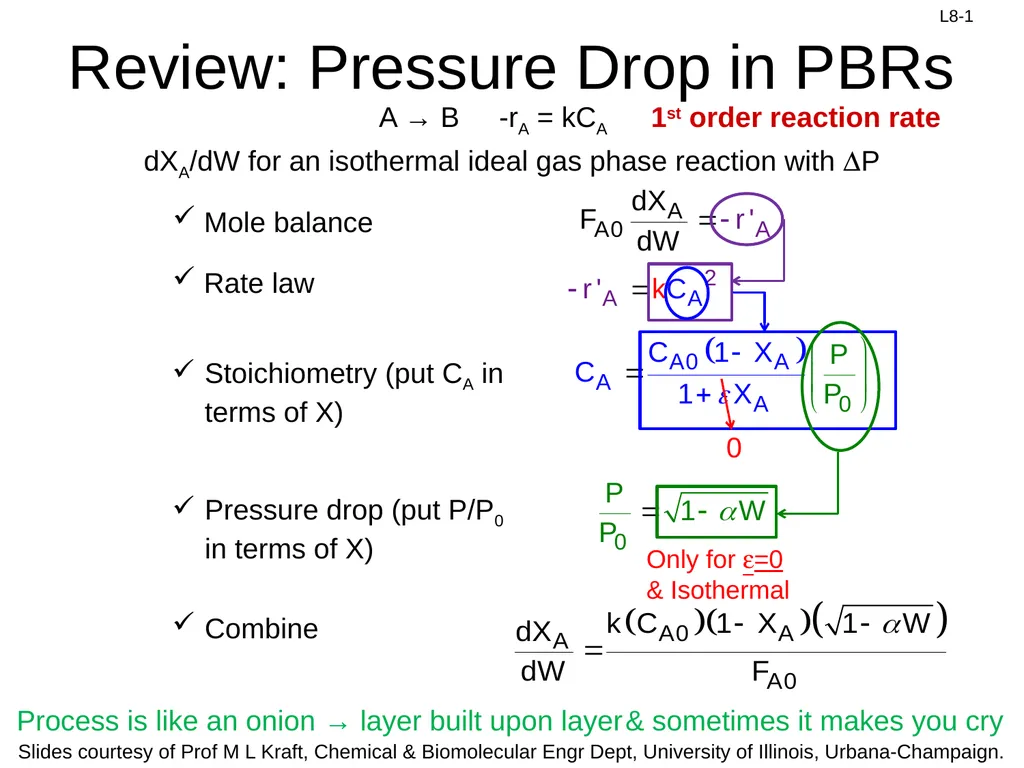
Review: Pressure Drop in PBRs A → B -rA = kCA dXA/dW for an isothermal ideal gas phase reaction with DP 1st order reaction rate Mole balance Rate law Stoichiometry (put CA in terms of X) Combine Pressure drop (put P/P0 in terms of X) Only for e=0
& Isothermal 0 Process is like an onion → layer built upon layer & sometimes it makes you cry<br>
& Isothermal 0 Process is like an onion → layer built upon layer & sometimes it makes you cry<br>
02
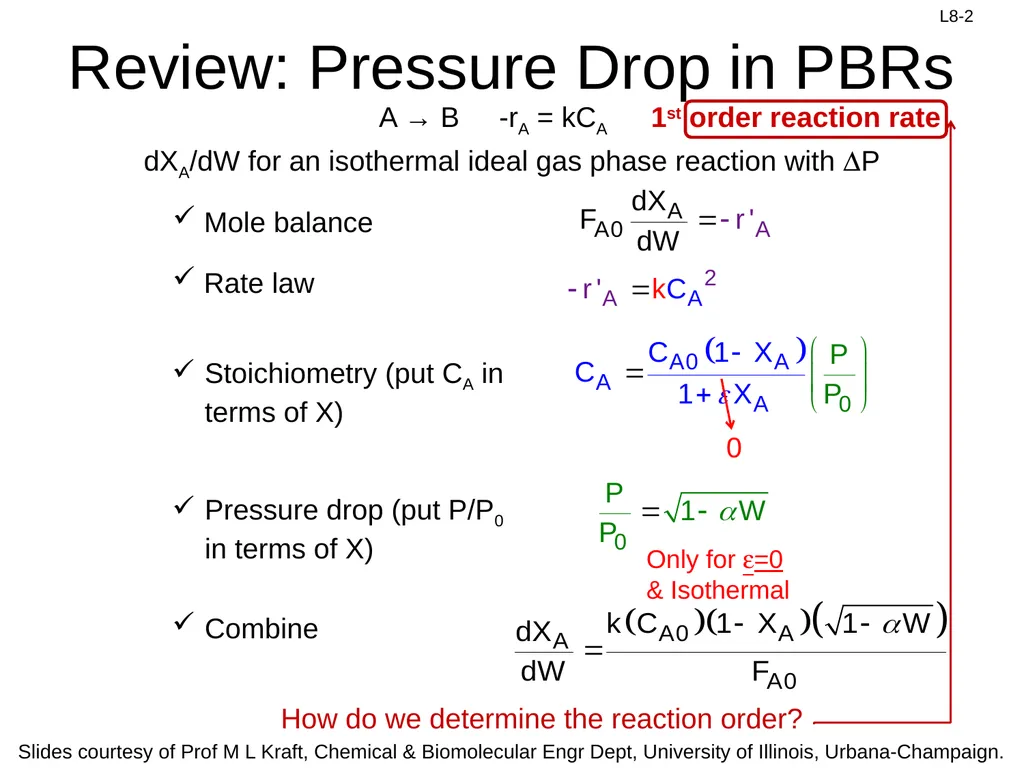
Review: Pressure Drop in PBRs A → B -rA = kCA dXA/dW for an isothermal ideal gas phase reaction with DP 1st order reaction rate Mole balance Rate law Stoichiometry (put CA in terms of X) Combine Pressure drop (put P/P0 in terms of X) Only for e=0
& Isothermal 0 How do we determine the reaction order?<br>
& Isothermal 0 How do we determine the reaction order?<br>
03
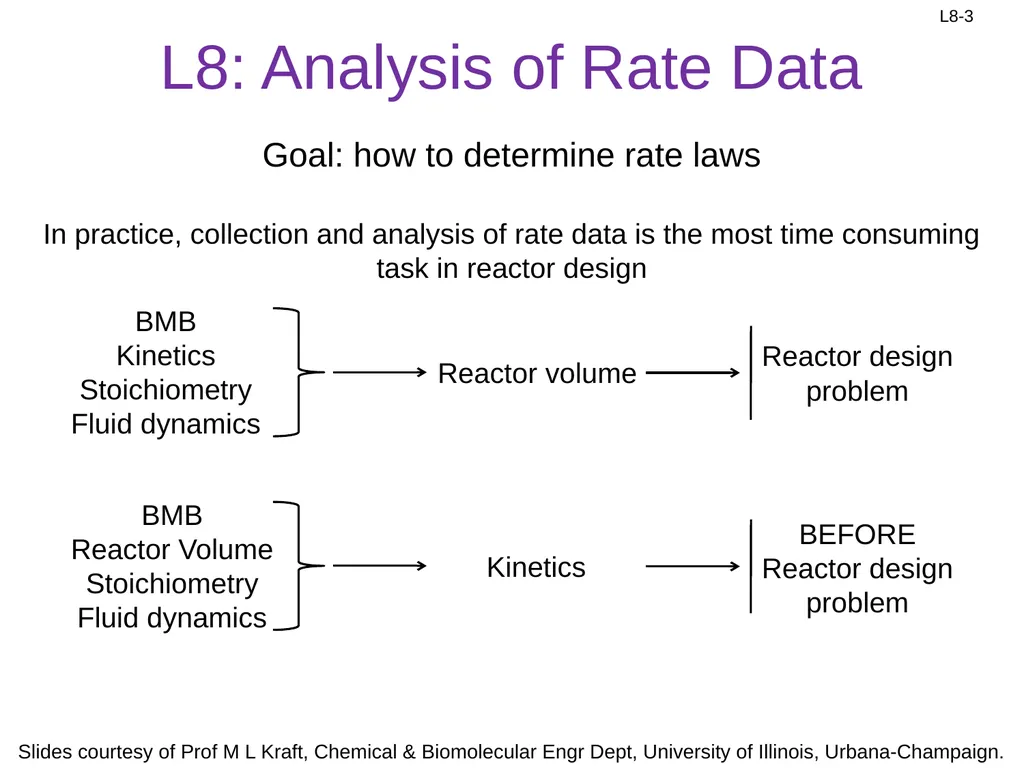
L8: Analysis of Rate Data Goal: how to determine rate laws In practice, collection and analysis of rate data is the most time consuming task in reactor design BMB
Kinetics
Stoichiometry
Fluid dynamics Reactor volume Reactor design problem BMB
Reactor Volume
Stoichiometry
Fluid dynamics Kinetics BEFORE
Reactor design problem<br>
Kinetics
Stoichiometry
Fluid dynamics Reactor volume Reactor design problem BMB
Reactor Volume
Stoichiometry
Fluid dynamics Kinetics BEFORE
Reactor design problem<br>
04
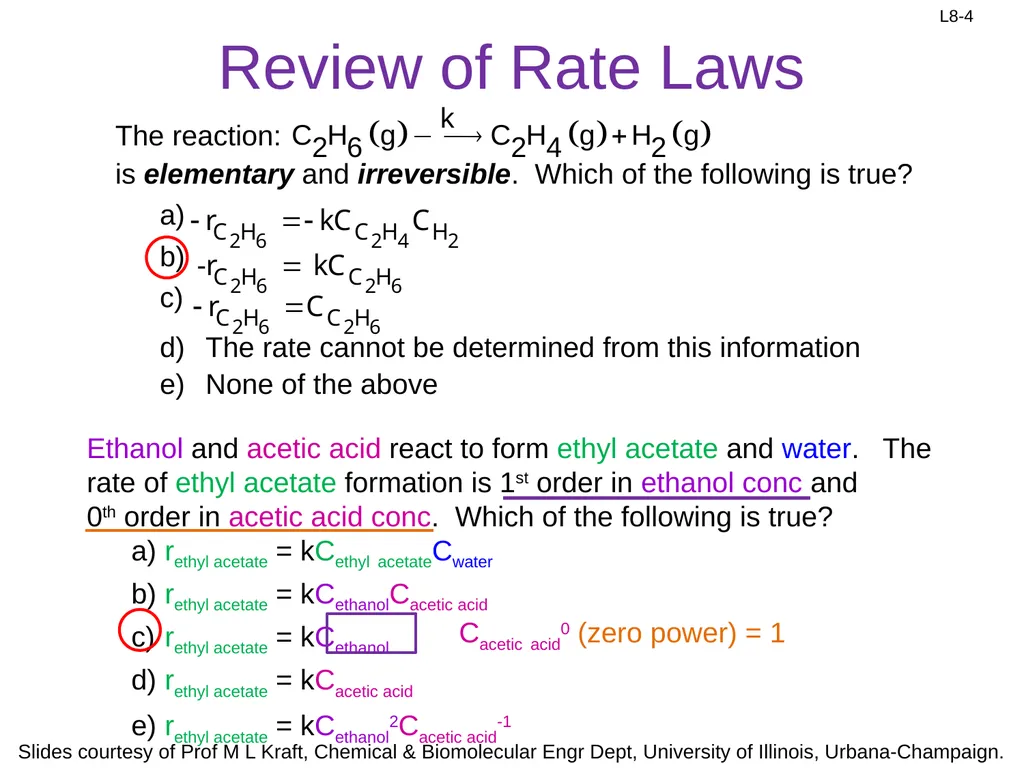
Review of Rate Laws The reaction:
is elementary and irreversible. Which of the following is true?
The rate cannot be determined from this information
None of the above Ethanol and acetic acid react to form ethyl acetate and water. The rate of ethyl acetate formation is 1st order in ethanol conc and
0th order in acetic acid conc. Which of the following is true?
rethyl acetate = kCethyl acetateCwater
rethyl acetate = kCethanolCacetic acid
rethyl acetate = kCethanol
rethyl acetate = kCacetic acid
rethyl acetate = kCethanol2Cacetic acid-1 Cacetic acid0 (zero power) = 1<br>
05
Collection & Analysis of Rate Data Constant-volume batch reactor
For homogenous reactions
Concentration vs. time measurements
Measurement during the unsteady-state operation
Differential reactor
For solid-fluid reactions
Measurement during steady state operation
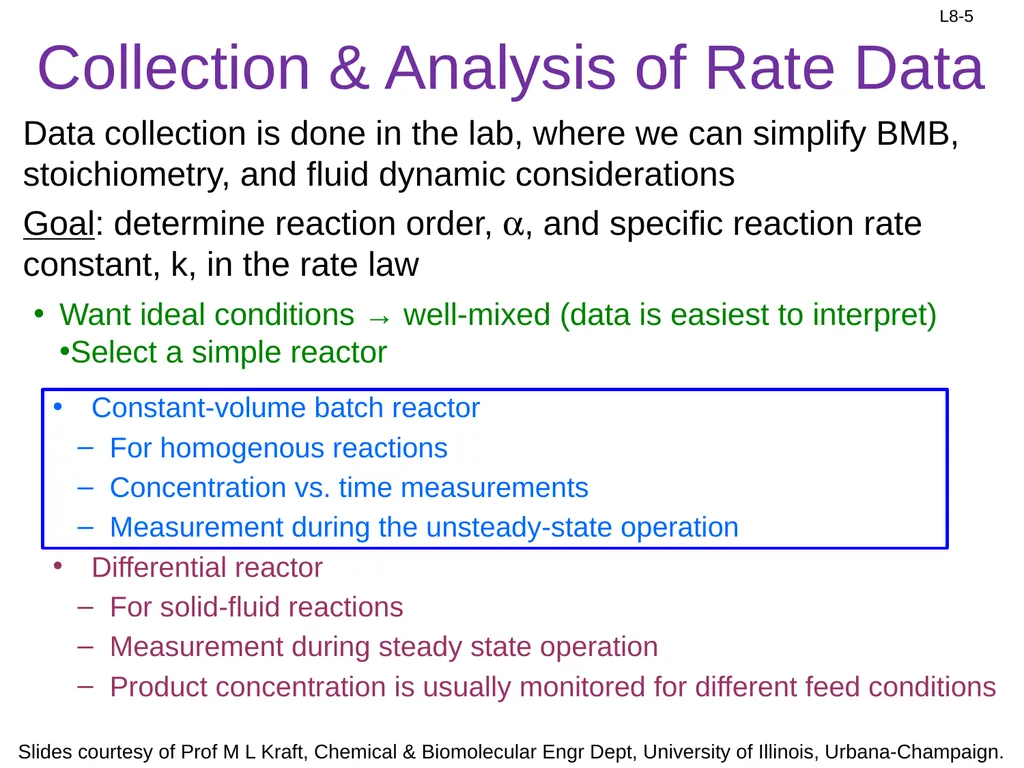
Product concentration is usually monitored for different feed conditions Data collection is done in the lab, where we can simplify BMB, stoichiometry, and fluid dynamic considerations
Goal: determine reaction order, a, and specific reaction rate constant, k, in the rate law Want ideal conditions → well-mixed (data is easiest to interpret)
Select a simple reactor<br>
06
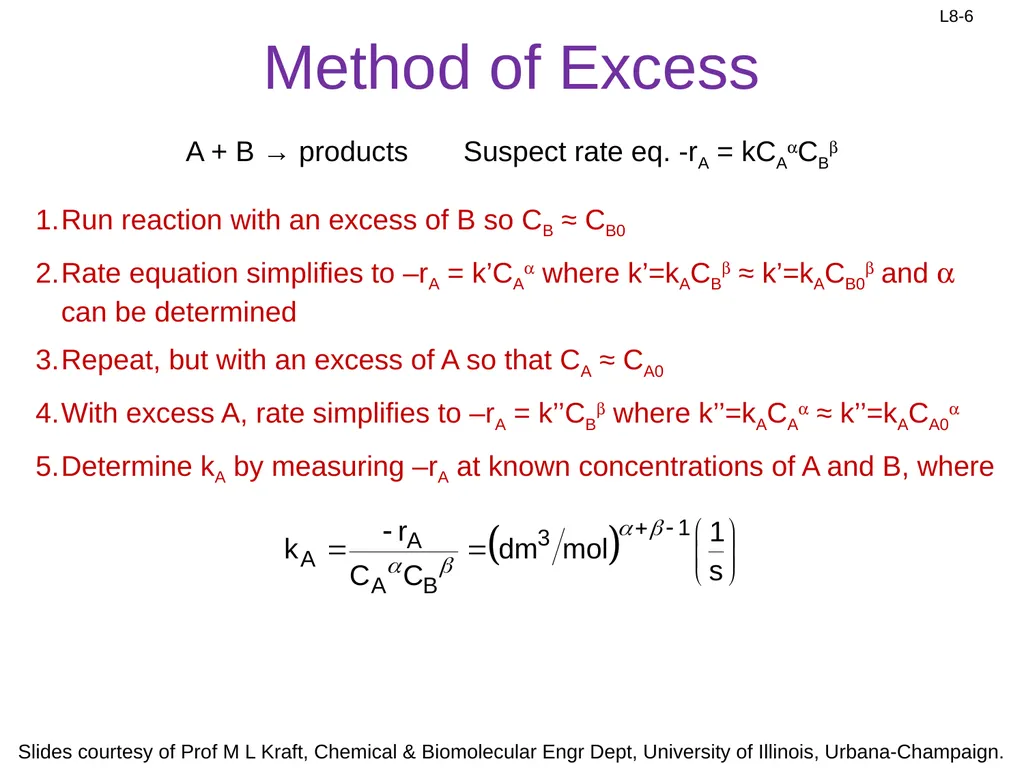
Method of Excess A + B → products Suspect rate eq. -rA = kCAaCBb Run reaction with an excess of B so CB ≈ CB0
Rate equation simplifies to –rA = k’CAa where k’=kACBb ≈ k’=kACB0b and a can be determined
Repeat, but with an excess of A so that CA ≈ CA0
With excess A, rate simplifies to –rA = k’’CBb where k’’=kACAa ≈ k’’=kACA0a
Determine kA by measuring –rA at known concentrations of A and B, where<br>
Rate equation simplifies to –rA = k’CAa where k’=kACBb ≈ k’=kACB0b and a can be determined
Repeat, but with an excess of A so that CA ≈ CA0
With excess A, rate simplifies to –rA = k’’CBb where k’’=kACAa ≈ k’’=kACA0a
Determine kA by measuring –rA at known concentrations of A and B, where<br>
07
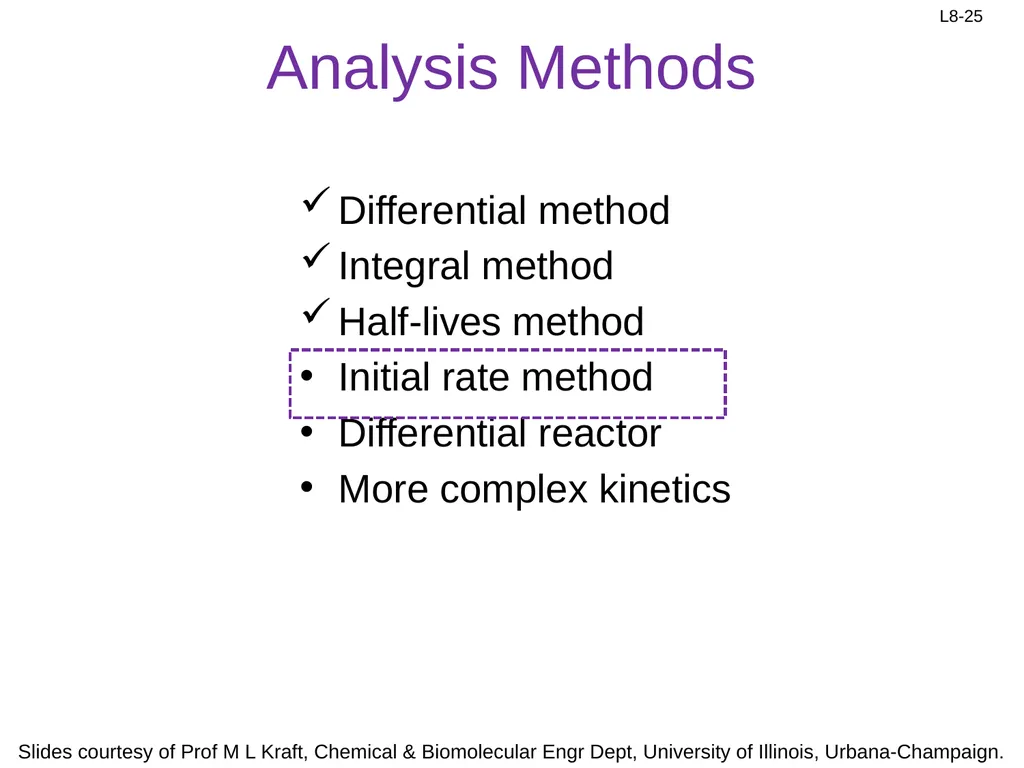
Analysis Methods Differential method
Integral method
Half-lives method
Initial rate method
Differential reactor
More complex kinetics<br>
Integral method
Half-lives method
Initial rate method
Differential reactor
More complex kinetics<br>
08
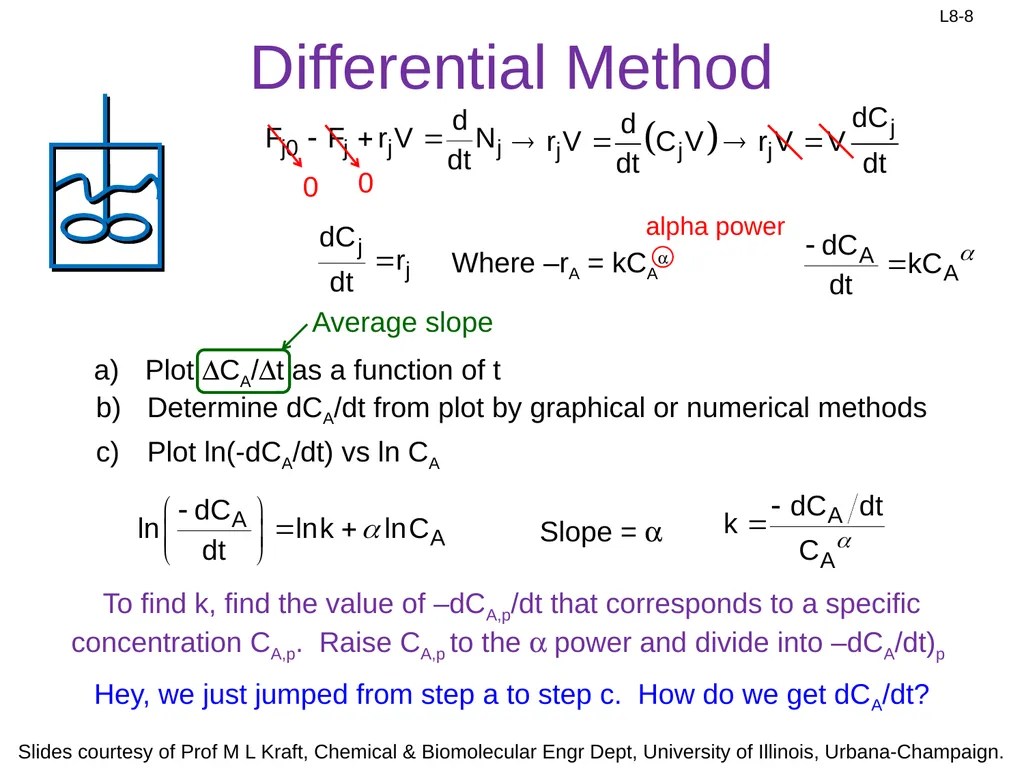
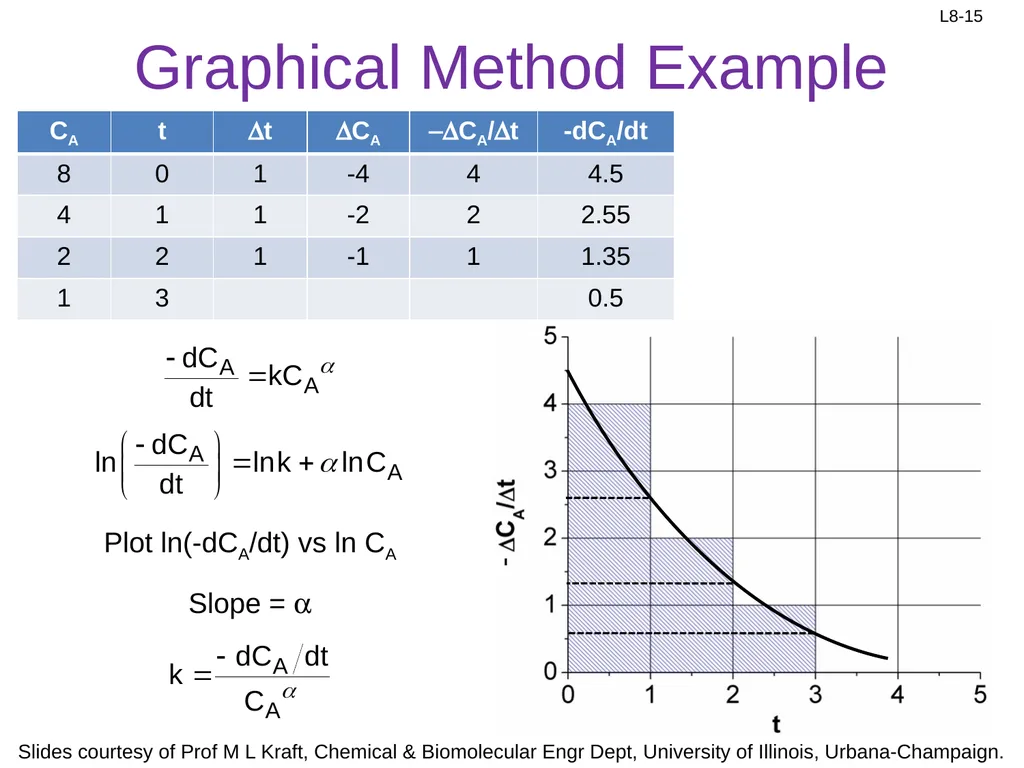
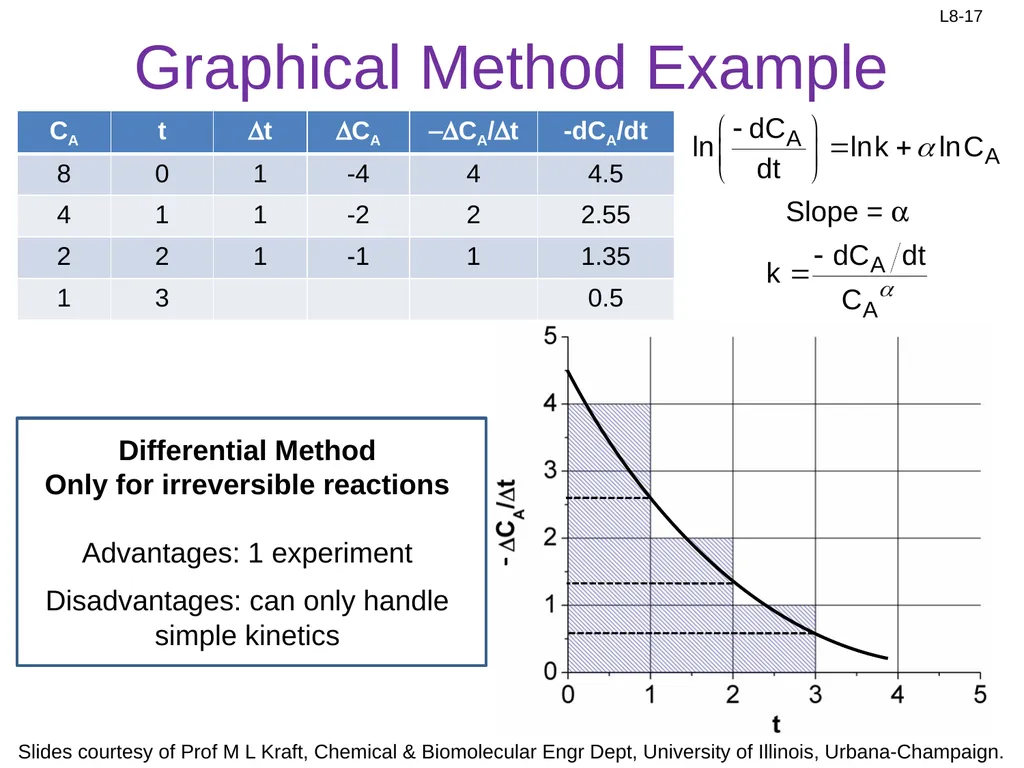
Differential Method 0 0 Where –rA = kCAa alpha power Determine dCA/dt from plot by graphical or numerical methods
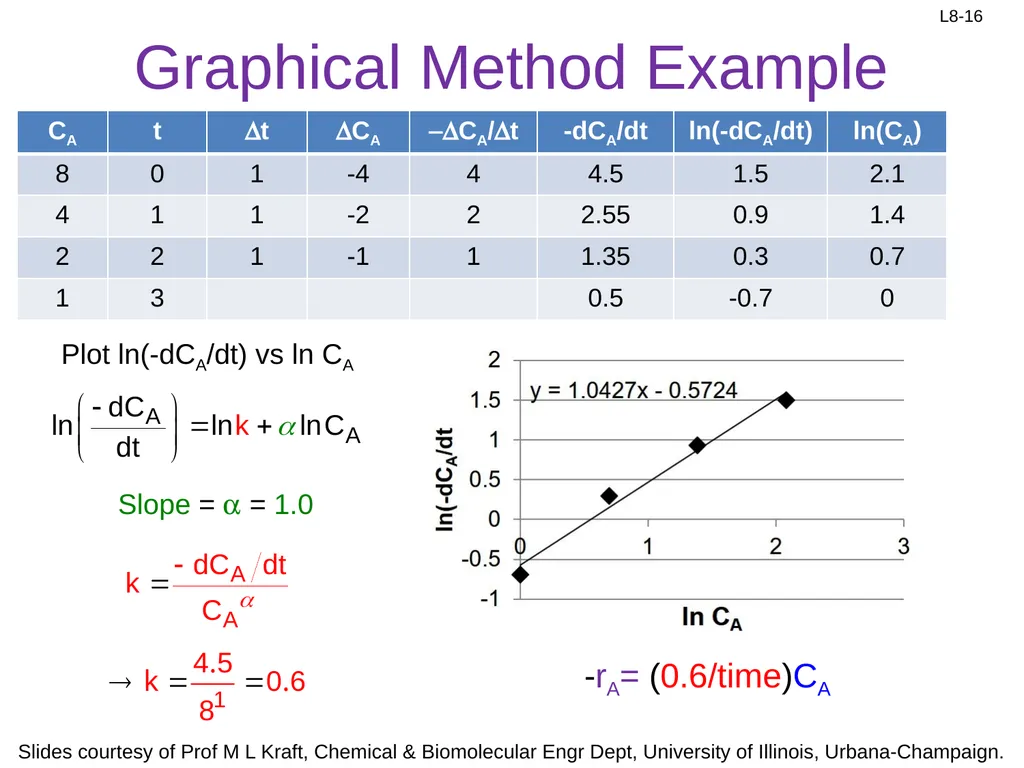
Plot ln(-dCA/dt) vs ln CA Average slope Slope = a To find k, find the value of –dCA,p/dt that corresponds to a specific concentration CA,p. Raise CA,p to the a power and divide into –dCA/dt)p Hey, we just jumped from step a to step c. How do we get dCA/dt? Plot DCA/Dt as a function of t<br>
Plot ln(-dCA/dt) vs ln CA Average slope Slope = a To find k, find the value of –dCA,p/dt that corresponds to a specific concentration CA,p. Raise CA,p to the a power and divide into –dCA/dt)p Hey, we just jumped from step a to step c. How do we get dCA/dt? Plot DCA/Dt as a function of t<br>
09
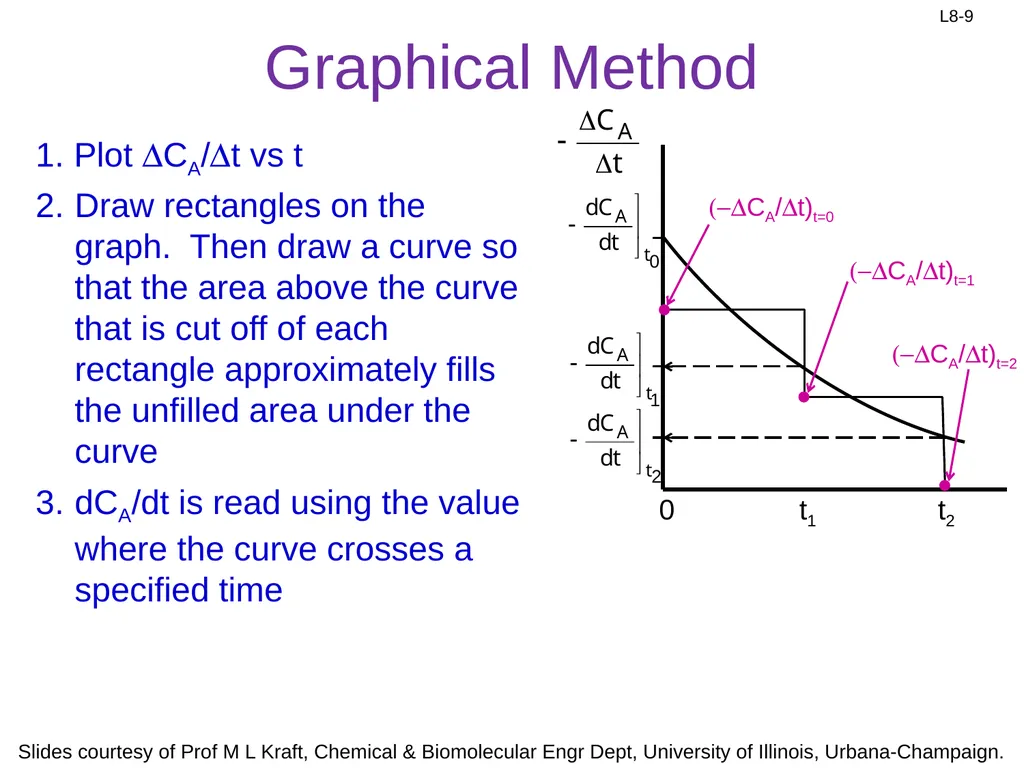
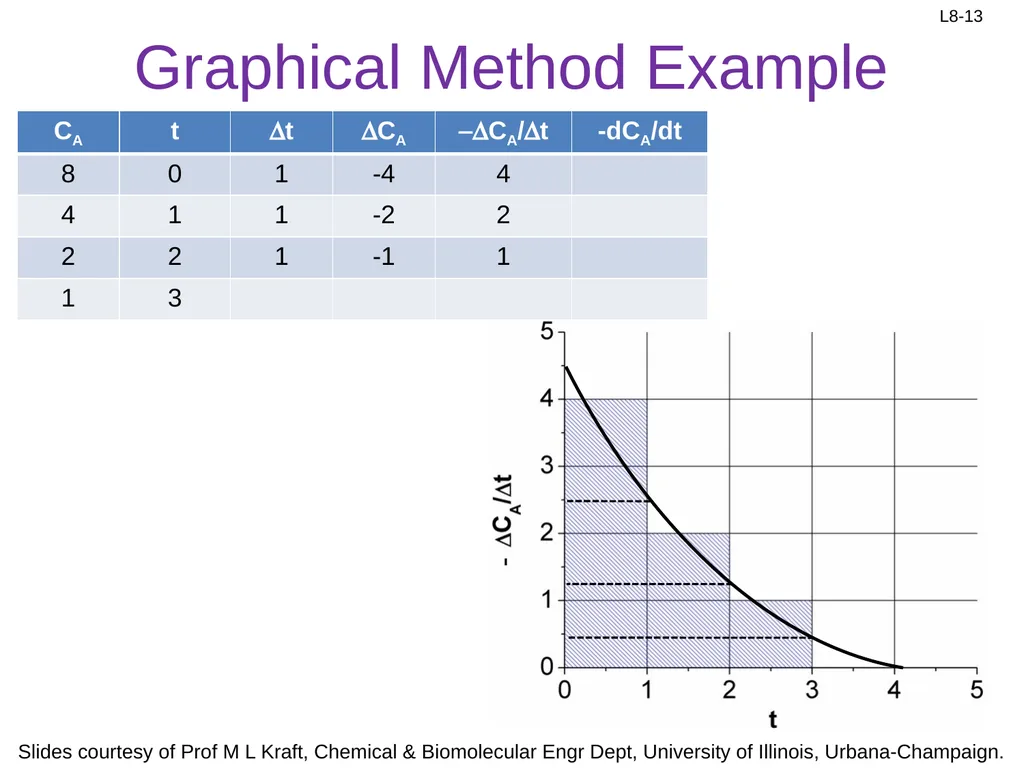
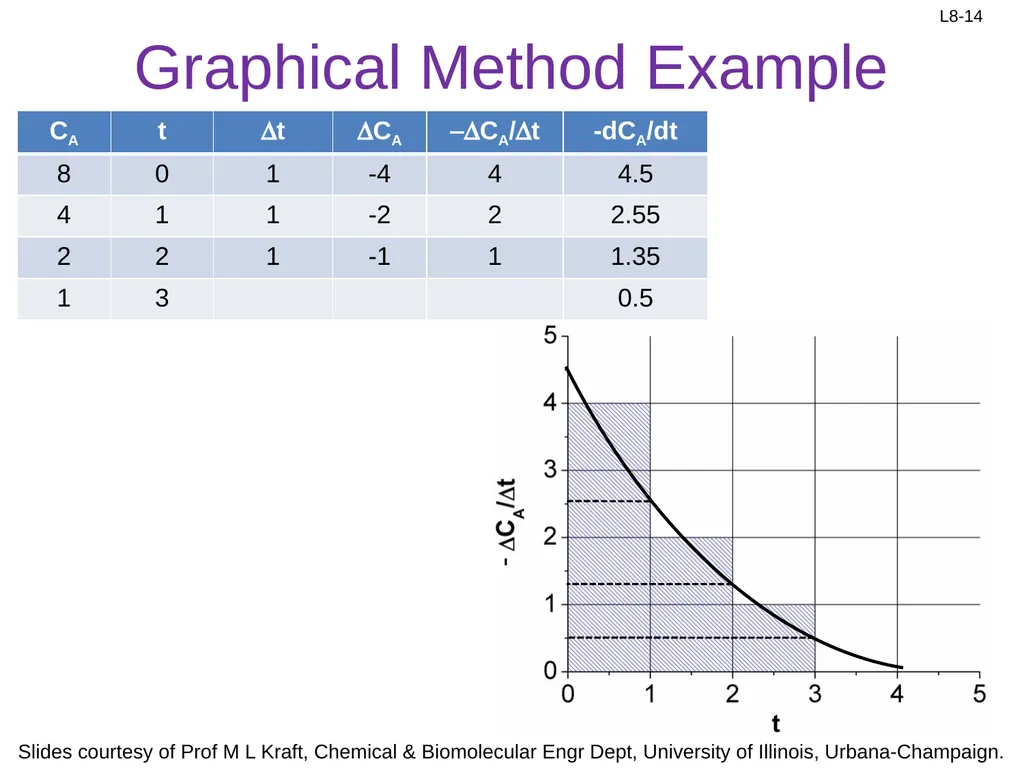
dCA/dt is read using the value where the curve crosses a specified time Graphical Method Plot DCA/Dt vs t Draw rectangles on the graph. Then draw a curve so that the area above the curve that is cut off of each rectangle approximately fills the unfilled area under the curve (-DCA/Dt)t=0 (-DCA/Dt)t=1 (-DCA/Dt)t=2<br>
10
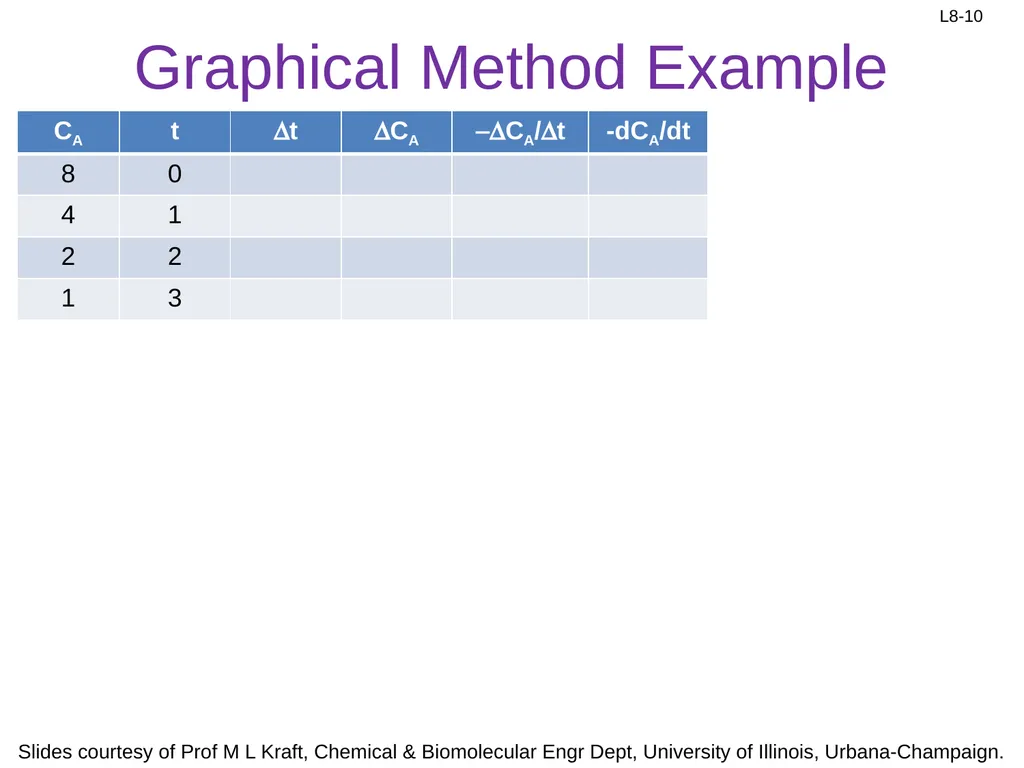
Graphical Method Example<br>
11
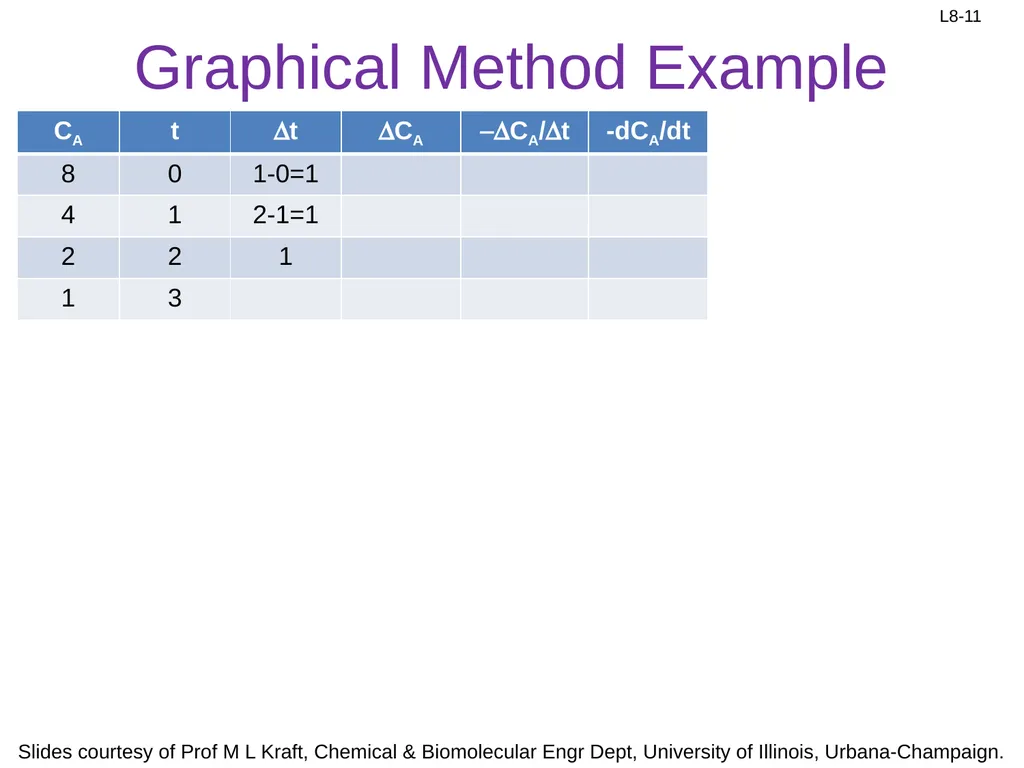
Graphical Method Example<br>
12
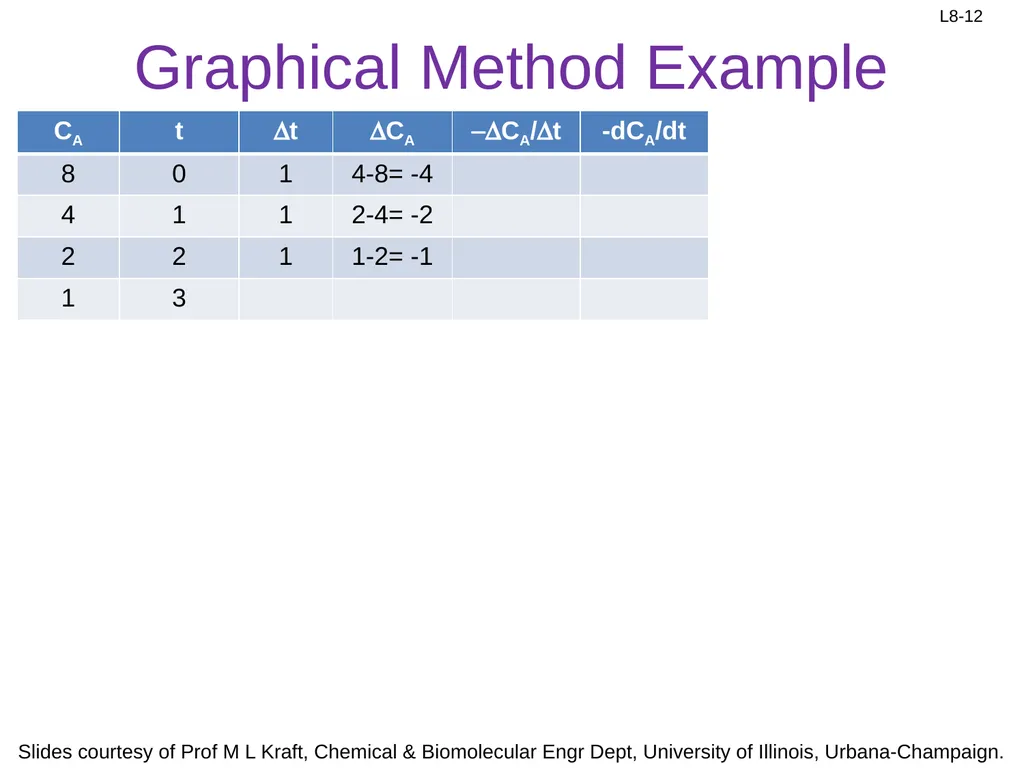
Graphical Method Example<br>
13
Graphical Method Example -<br>
14
Graphical Method Example -<br>
15
Graphical Method Example Slope = a - Plot ln(-dCA/dt) vs ln CA<br>
16
Graphical Method Example Slope = a = 1.0 Plot ln(-dCA/dt) vs ln CA -rA= (0.6/time)CA<br>
17
Graphical Method Example Slope = a Differential Method
Only for irreversible reactions
Advantages: 1 experiment
Disadvantages: can only handle simple kinetics - -<br>
Only for irreversible reactions
Advantages: 1 experiment
Disadvantages: can only handle simple kinetics - -<br>
18
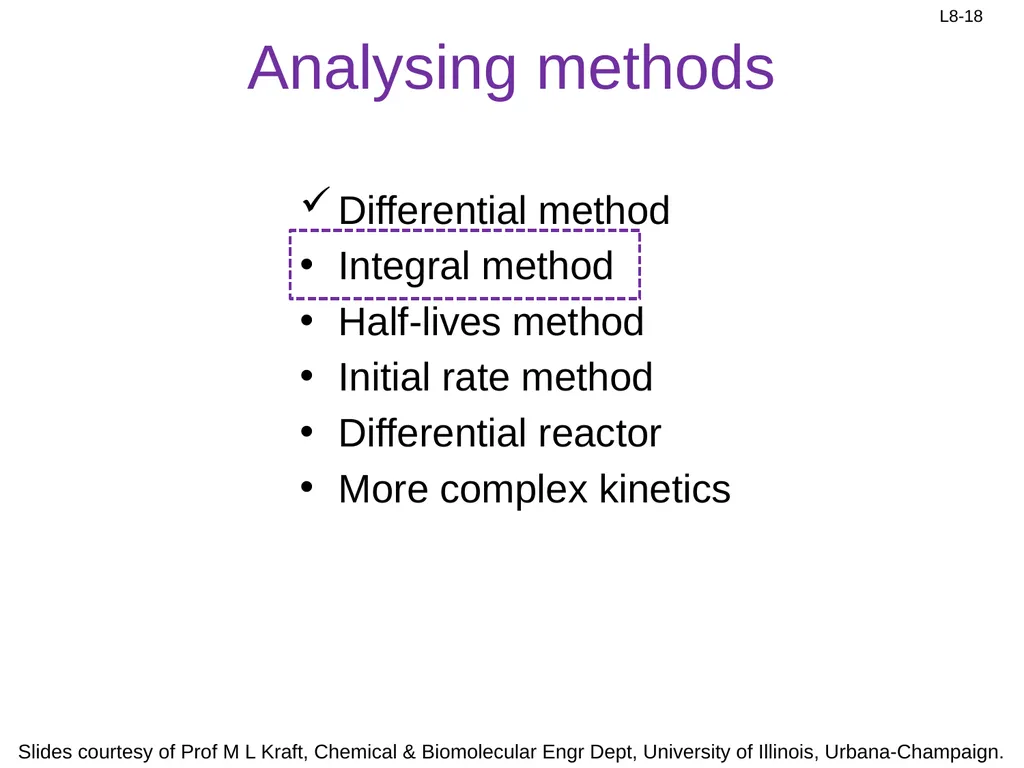
Analysing methods Differential method
Integral method
Half-lives method
Initial rate method
Differential reactor
More complex kinetics<br>
Integral method
Half-lives method
Initial rate method
Differential reactor
More complex kinetics<br>
19
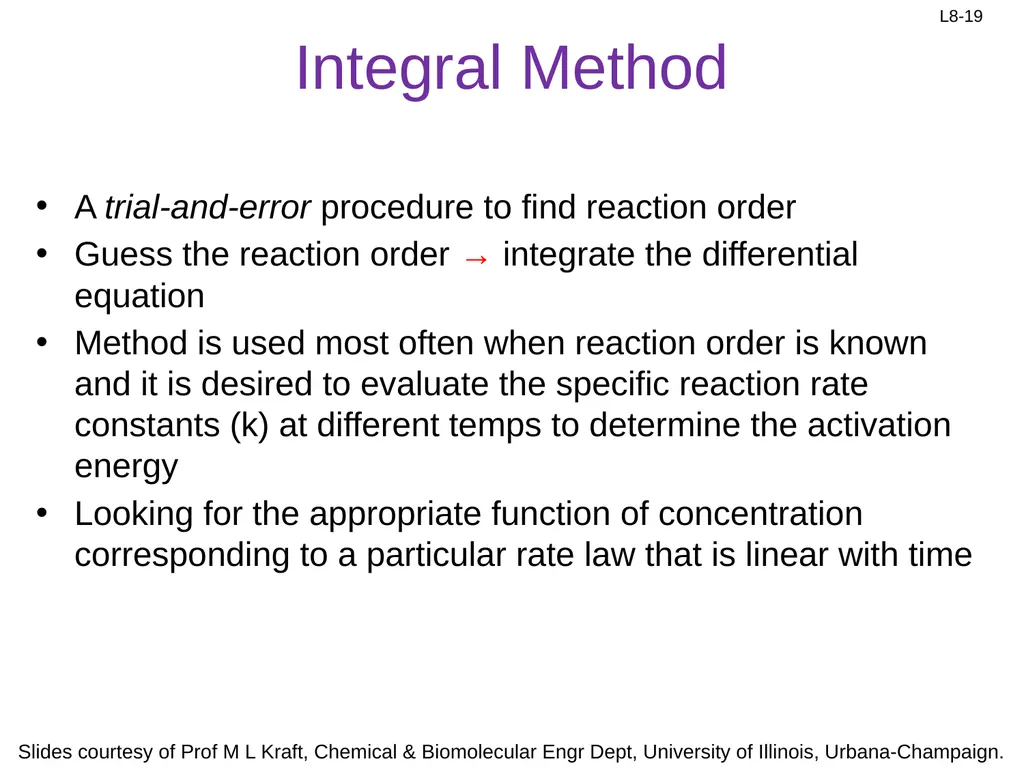
Integral Method A trial-and-error procedure to find reaction order
Guess the reaction order → integrate the differential equation
Method is used most often when reaction order is known and it is desired to evaluate the specific reaction rate constants (k) at different temps to determine the activation energy
Looking for the appropriate function of concentration corresponding to a particular rate law that is linear with time<br>
20
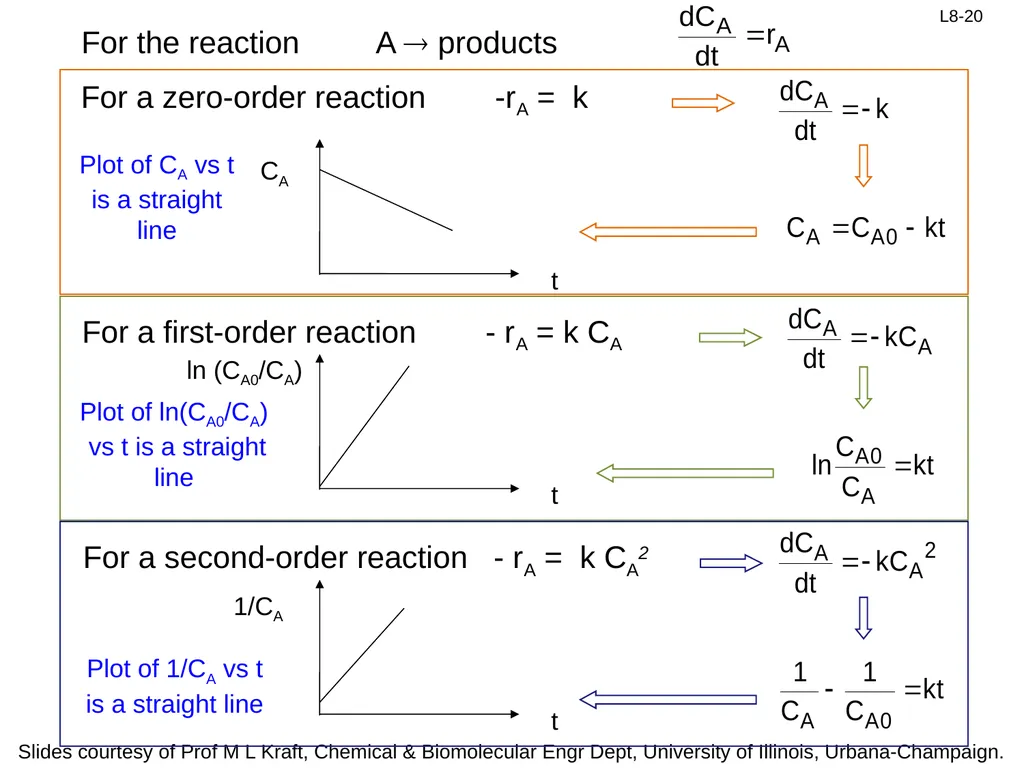
For the reaction A products For a first-order reaction - rA = k CA For a second-order reaction - rA = k CA2 For a zero-order reaction -rA = k Plot of CA vs t is a straight line Plot of ln(CA0/CA) vs t is a straight line Plot of 1/CA vs t is a straight line<br>
21
Analysis Methods Differential method
Integral method
Half-lives method
Initial rate method
Differential reactor
More complex kinetics<br>
Integral method
Half-lives method
Initial rate method
Differential reactor
More complex kinetics<br>
22
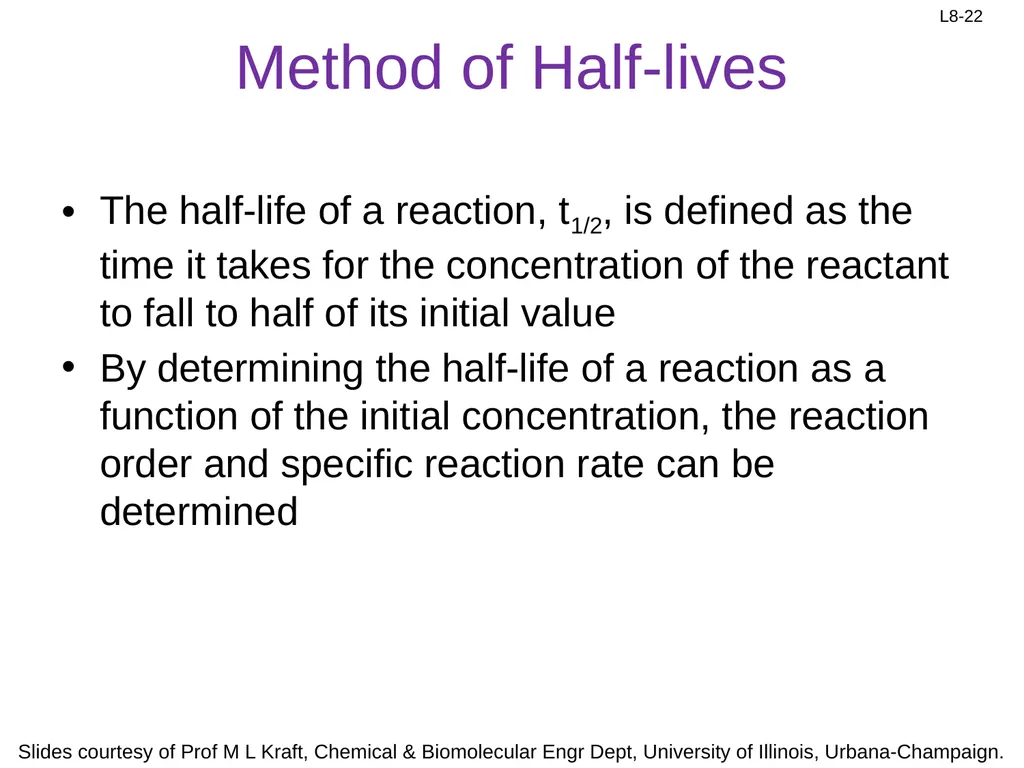
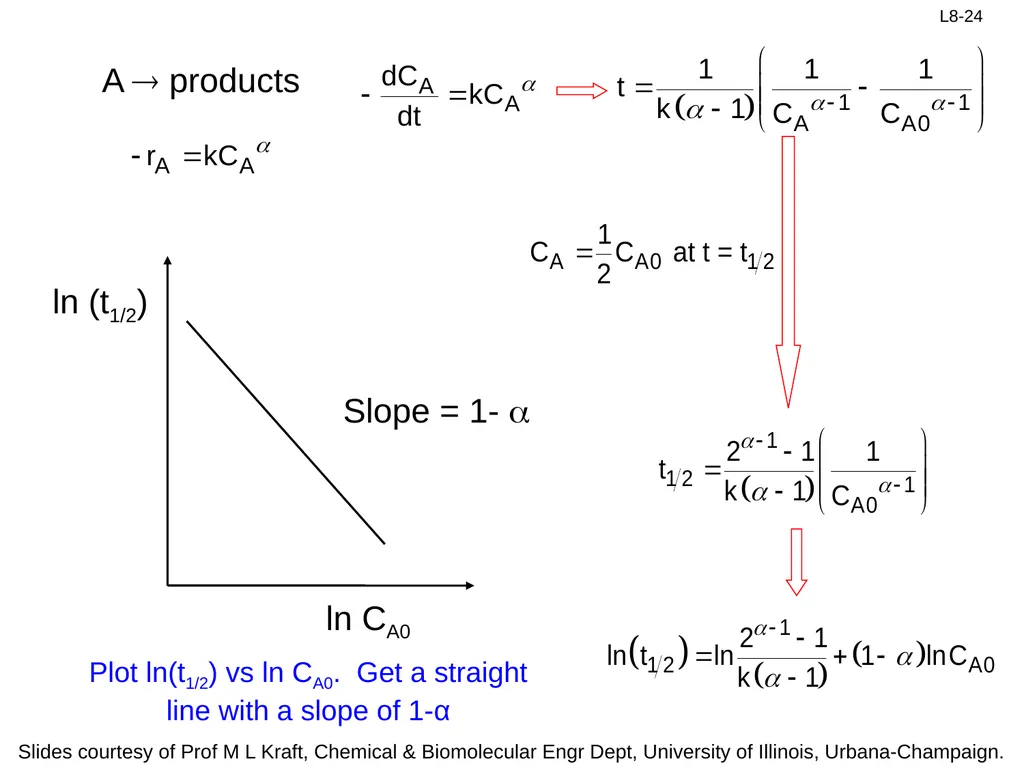
Method of Half-lives The half-life of a reaction, t1/2, is defined as the time it takes for the concentration of the reactant to fall to half of its initial value
By determining the half-life of a reaction as a function of the initial concentration, the reaction order and specific reaction rate can be determined<br>
By determining the half-life of a reaction as a function of the initial concentration, the reaction order and specific reaction rate can be determined<br>
23
Method of Half-lives The half-life of a reaction, t1/2, is defined as the time it takes for the concentration of the reactant to fall to half of its initial value
By determining the half-life of a reaction as a function of the initial concentration, the reaction order and specific reaction rate can be determined<br>
By determining the half-life of a reaction as a function of the initial concentration, the reaction order and specific reaction rate can be determined<br>
24
A products Plot ln(t1/2) vs ln CA0. Get a straight line with a slope of 1-α<br>
25
Analysis Methods Differential method
Integral method
Half-lives method
Initial rate method
Differential reactor
More complex kinetics<br>
Integral method
Half-lives method
Initial rate method
Differential reactor
More complex kinetics<br>
26
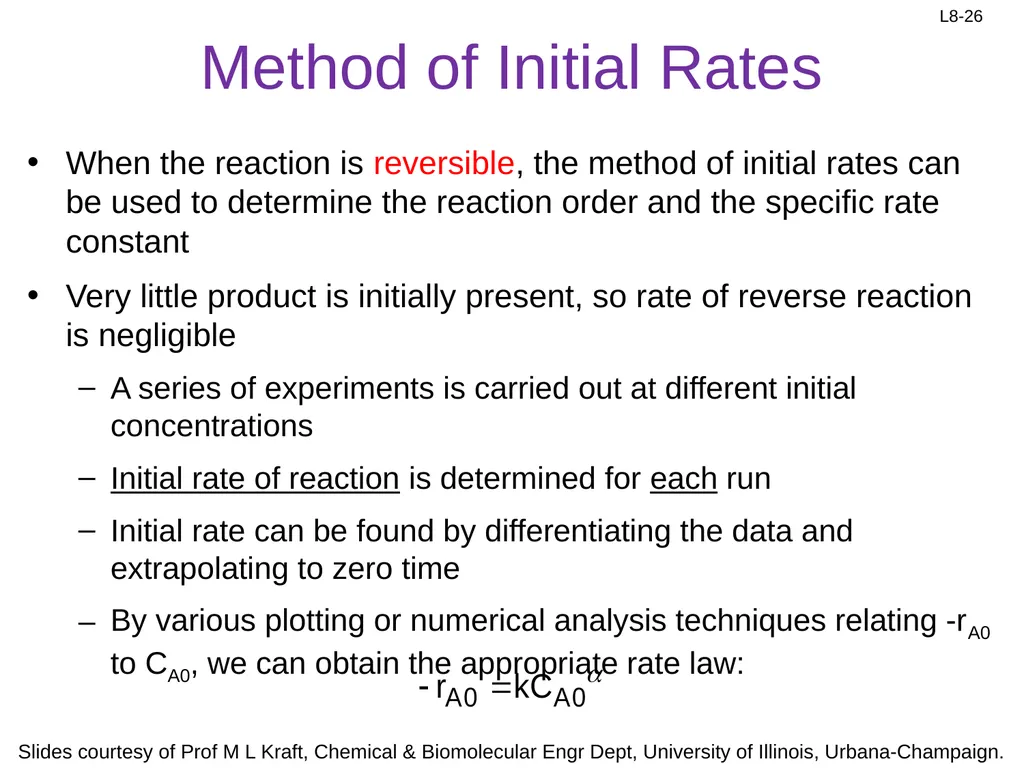
Method of Initial Rates When the reaction is reversible, the method of initial rates can be used to determine the reaction order and the specific rate constant
Very little product is initially present, so rate of reverse reaction is negligible
A series of experiments is carried out at different initial concentrations
Initial rate of reaction is determined for each run
Initial rate can be found by differentiating the data and extrapolating to zero time
By various plotting or numerical analysis techniques relating -rA0 to CA0, we can obtain the appropriate rate law:<br>
27
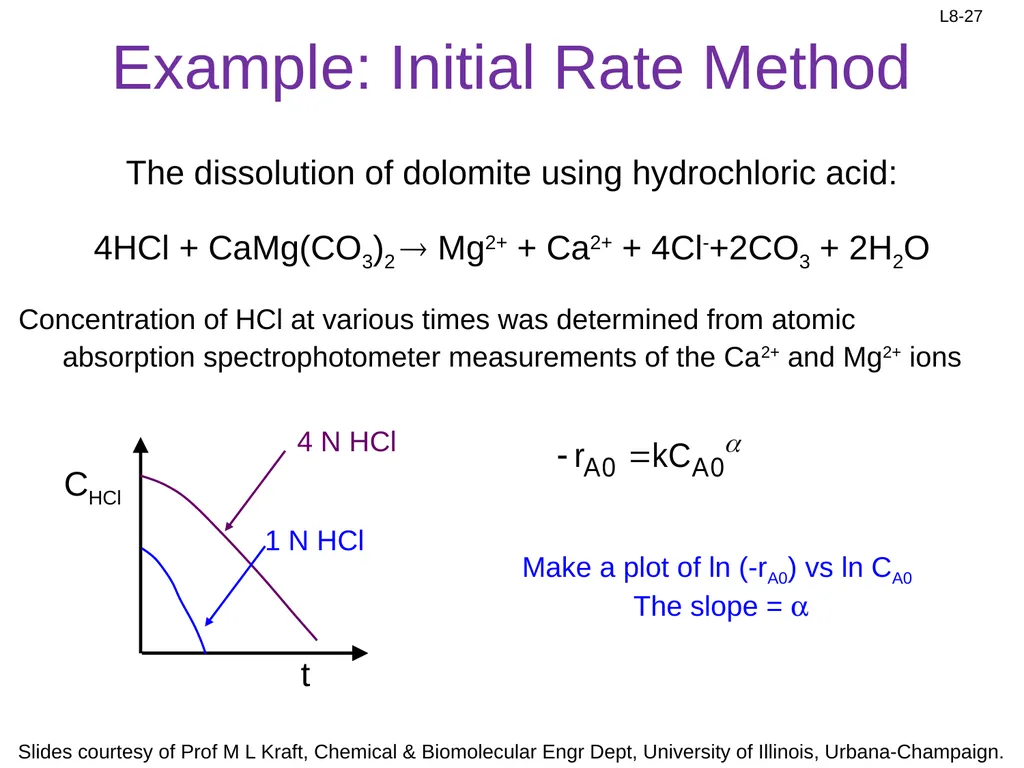
Example: Initial Rate Method 4HCl + CaMg(CO3)2 Mg2+ + Ca2+ + 4Cl-+2CO3 + 2H2O The dissolution of dolomite using hydrochloric acid: Concentration of HCl at various times was determined from atomic
absorption spectrophotometer measurements of the Ca2+ and Mg2+ ions CHCl t 4 N HCl 1 N HCl Make a plot of ln (-rA0) vs ln CA0
The slope = a<br>
absorption spectrophotometer measurements of the Ca2+ and Mg2+ ions CHCl t 4 N HCl 1 N HCl Make a plot of ln (-rA0) vs ln CA0
The slope = a<br>
28
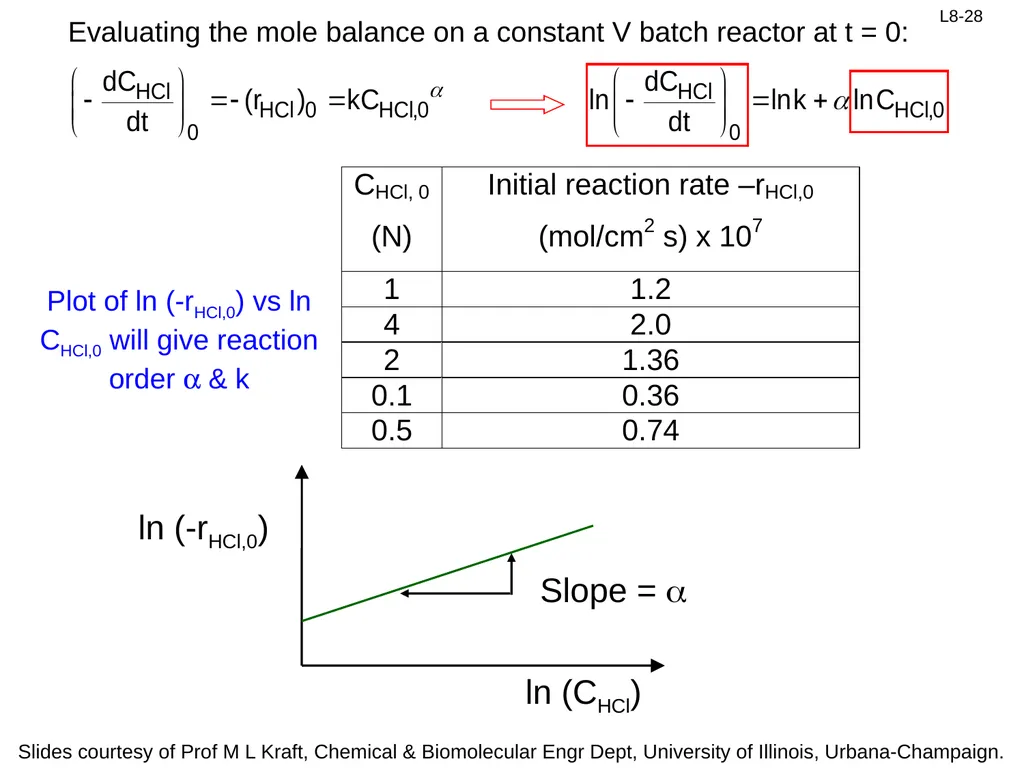
Evaluating the mole balance on a constant V batch reactor at t = 0: Plot of ln (-rHCl,0) vs ln CHCl,0 will give reaction order a & k<br>
29
Analysis Methods Differential method
Integral method
Half-lives method
Initial rate method
Differential reactor
More Complex Kinetics<br>
Integral method
Half-lives method
Initial rate method
Differential reactor
More Complex Kinetics<br>
30
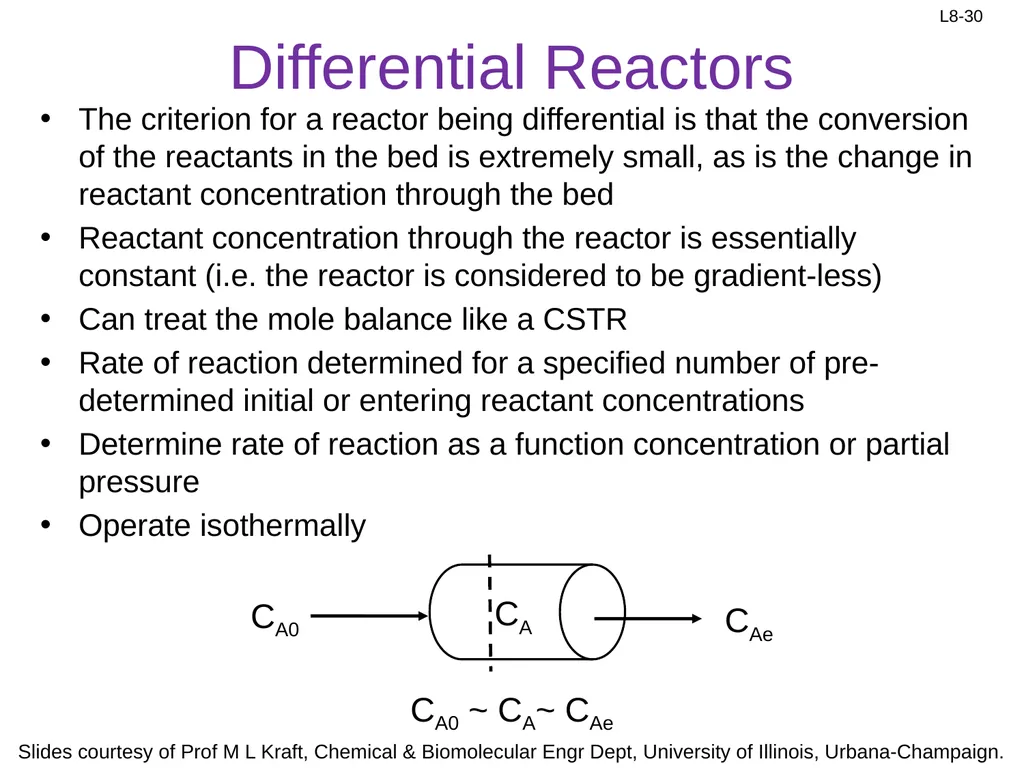
Differential Reactors The criterion for a reactor being differential is that the conversion of the reactants in the bed is extremely small, as is the change in reactant concentration through the bed
Reactant concentration through the reactor is essentially constant (i.e. the reactor is considered to be gradient-less)
Can treat the mole balance like a CSTR
Rate of reaction determined for a specified number of pre-determined initial or entering reactant concentrations
Determine rate of reaction as a function concentration or partial pressure
Operate isothermally CA0 ~ CA~ CAe<br>
31
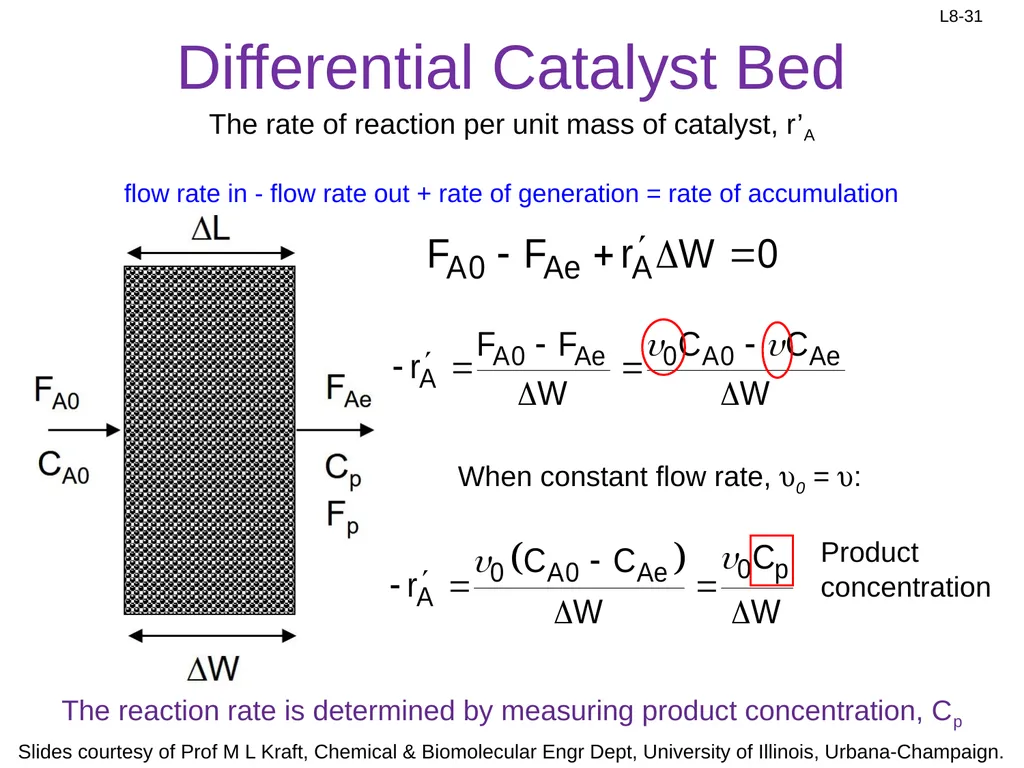
Differential Catalyst Bed The rate of reaction per unit mass of catalyst, r’A flow rate in - flow rate out + rate of generation = rate of accumulation When constant flow rate, u0 = u: Product concentration The reaction rate is determined by measuring product concentration, Cp<br>
32
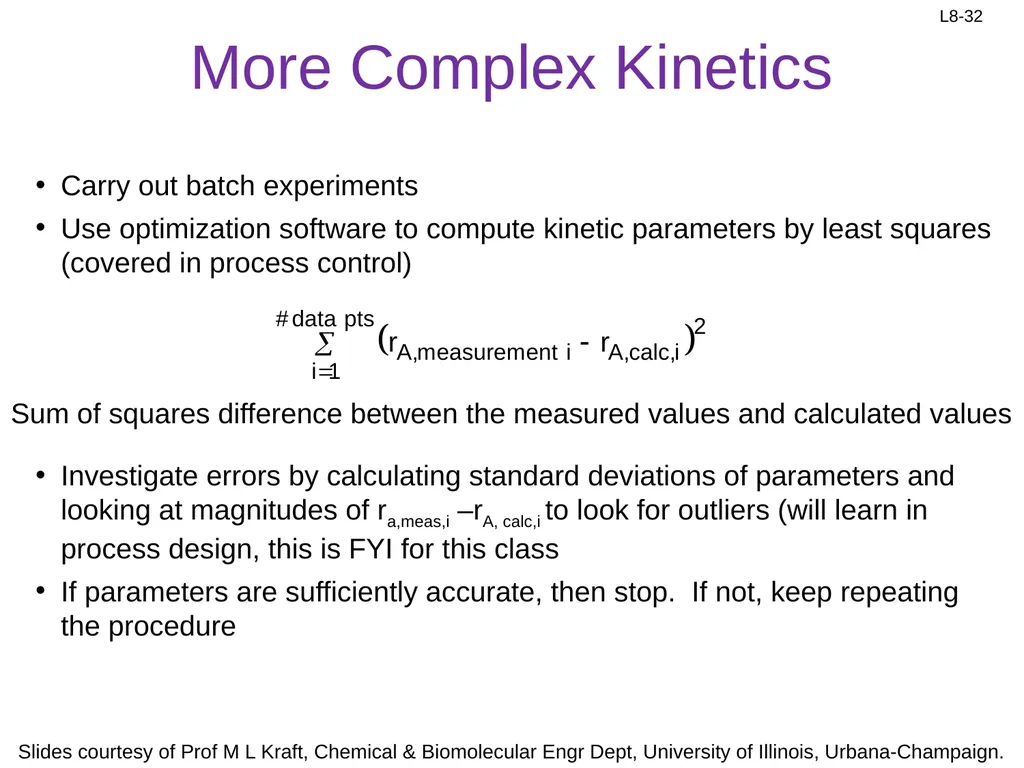
More Complex Kinetics Carry out batch experiments
Use optimization software to compute kinetic parameters by least squares (covered in process control)
Investigate errors by calculating standard deviations of parameters and looking at magnitudes of ra,meas,i –rA, calc,i to look for outliers (will learn in process design, this is FYI for this class
If parameters are sufficiently accurate, then stop. If not, keep repeating the procedure Sum of squares difference between the measured values and calculated values<br>