
RIGHT-SIDED VS. LEFT-SIDED LEFT BUNDLE AREA LEAD
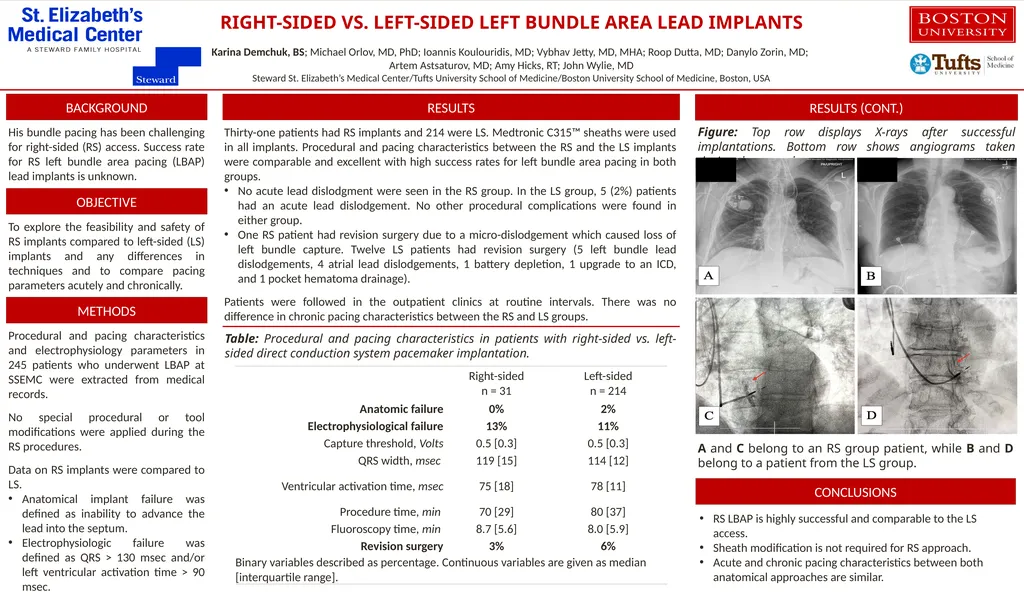
Description: RIGHT-SIDED VS. LEFT-SIDED LEFT BUNDLE AREA LEAD IMPLANTS Karina Demchuk, BS; Michael Orlov, MD, PhD; Ioannis Koulouridis, MD; Vybhav Jetty, MD, MHA; Roop Dutta, MD; Danylo Zorin, MD; Artem Astsaturov, MD; Amy Hicks, RT; John Wylie, MD
Related Topics
Download Presentation
"RIGHT-SIDED VS. LEFT-SIDED LEFT BUNDLE AREA LEAD" is the property of its rightful owner. Permission is granted to download and print the materials on this website for personal, non-commercial use only, and to display it on your personal computer provided you do not modify the materials and that you retain all copyright notices contained in the materials. By downloading content from our website, you accept the terms of this agreement.
Presentation Transcript
slide1. RIGHT-SIDED VS. LEFT-SIDED LEFT BUNDLE AREA LEAD IMPLANTS
Karina Demchuk, BS; Michael Orlov, MD, PhD; Ioannis Koulouridis, MD; Vybhav Jetty, MD, MHA; Roop Dutta, MD; Danylo Zorin, MD;
Artem Astsaturov, MD; Amy Hicks, RT; John Wylie, MD
Steward St. Elizabeth’s Medical Center/Tufts University School of Medicine/Boston University School of Medicine, Boston, USA His bundle pacing has been challenging for right-sided (RS) access. Success rate for RS left bundle area pacing (LBAP) lead implants is unknown. RS LBAP is highly successful and comparable to the LS access.
Sheath modification is not required for RS approach.
Acute and chronic pacing characteristics between both anatomical approaches are similar. Procedural and pacing characteristics and electrophysiology parameters in 245 patients who underwent LBAP at SSEMC were extracted from medical records.
No special procedural or tool modifications were applied during the RS procedures.
Data on RS implants were compared to LS.
Anatomical implant failure was defined as inability to advance the lead into the septum.
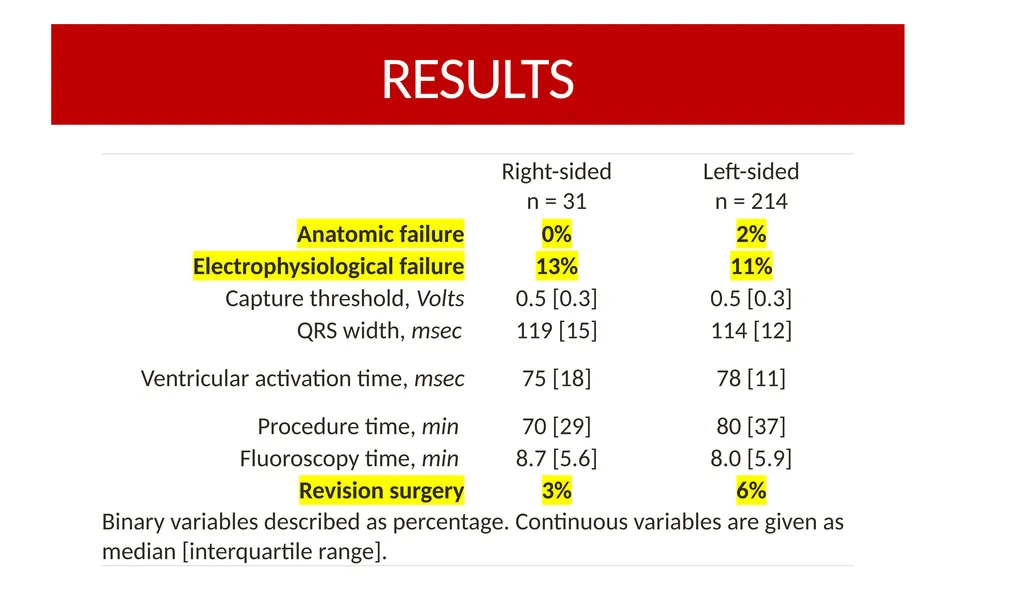
Electrophysiologic failure was defined as QRS > 130 msec and/or left ventricular activation time > 90 msec. Thirty-one patients had RS implants and 214 were LS. Medtronic C315™ sheaths were used in all implants. Procedural and pacing characteristics between the RS and the LS implants were comparable and excellent with high success rates for left bundle area pacing in both groups.
No acute lead dislodgment were seen in the RS group. In the LS group, 5 (2%) patients had an acute lead dislodgement. No other procedural complications were found in either group.
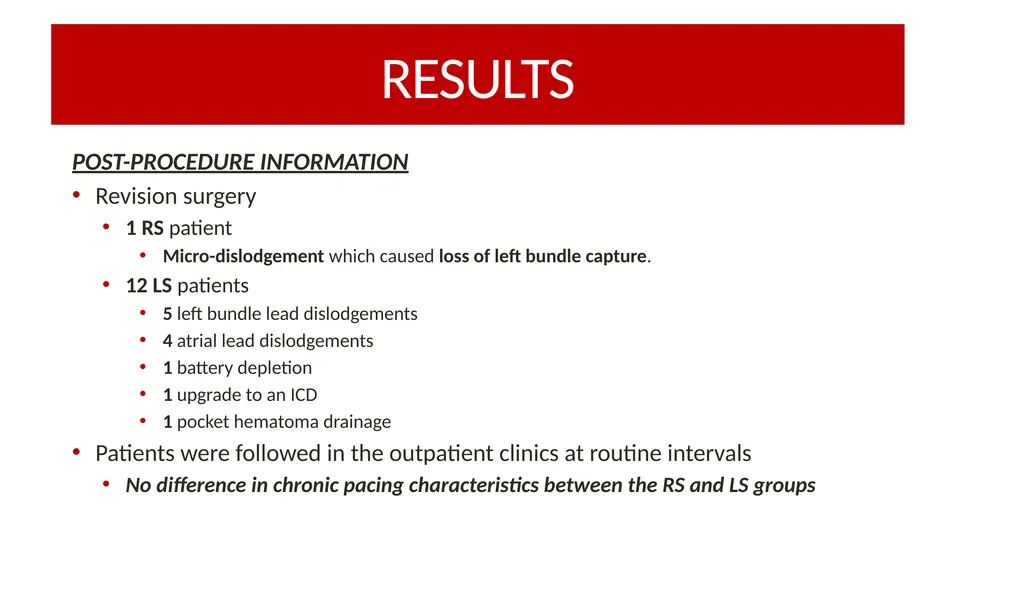
One RS patient had revision surgery due to a micro-dislodgement which caused loss of left bundle capture. Twelve LS patients had revision surgery (5 left bundle lead dislodgements, 4 atrial lead dislodgements, 1 battery depletion, 1 upgrade to an ICD, and 1 pocket hematoma drainage).
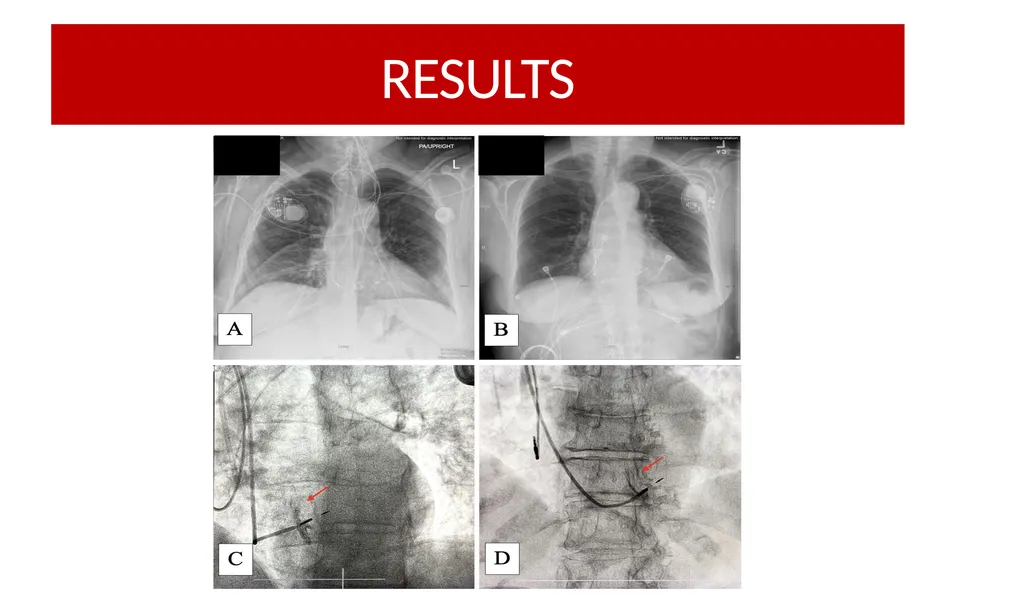
Patients were followed in the outpatient clinics at routine intervals. There was no difference in chronic pacing characteristics between the RS and LS groups. Figure: Top row displays X-rays after successful implantations. Bottom row shows angiograms taken during the procedures. Table: Procedural and pacing characteristics in patients with right-sided vs. left-sided direct conduction system pacemaker implantation. To explore the feasibility and safety of RS implants compared to left-sided (LS) implants and any differences in techniques and to compare pacing parameters acutely and chronically. A and C belong to an RS group patient, while B and D belong to a patient from the LS group. BACKGROUND OBJECTIVE METHODS RESULTS RESULTS (CONT.) CONCLUSIONS<br>
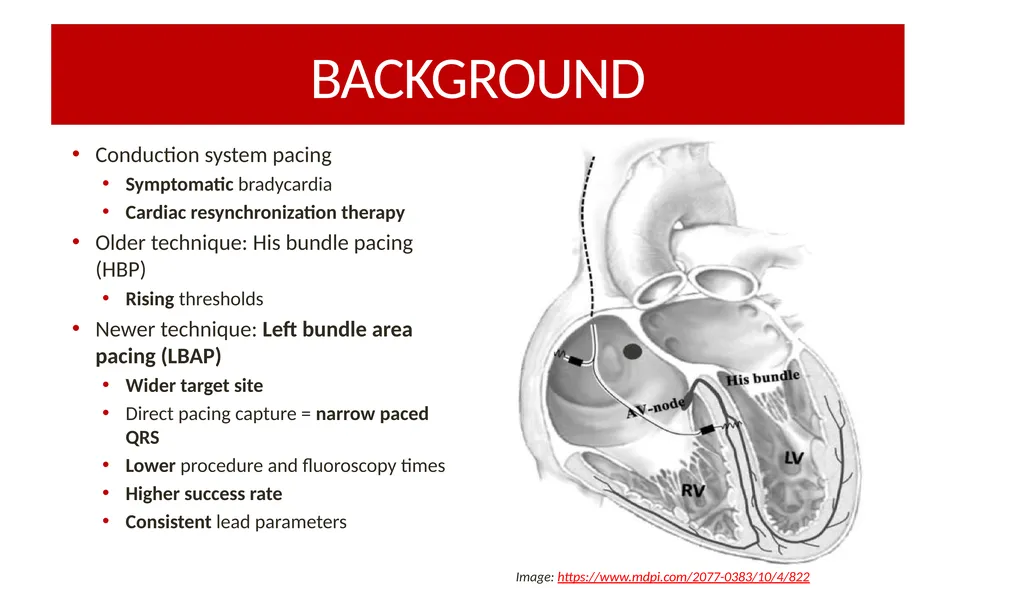
slide2. BACKGROUND Conduction system pacing
Symptomatic bradycardia
Cardiac resynchronization therapy
Older technique: His bundle pacing (HBP)
Rising thresholds
Newer technique: Left bundle area pacing (LBAP)
Wider target site
Direct pacing capture = narrow paced QRS
Lower procedure and fluoroscopy times
Higher success rate
Consistent lead parameters Image: https://www.mdpi.com/2077-0383/10/4/822<br>
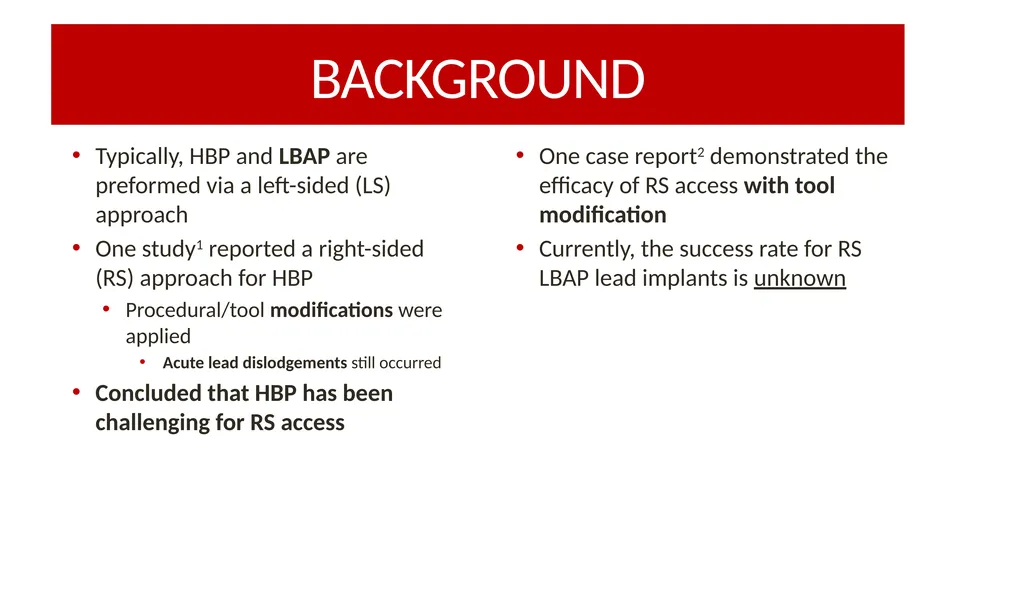
slide3. BACKGROUND Typically, HBP and LBAP are preformed via a left-sided (LS) approach
One study1 reported a right-sided (RS) approach for HBP
Procedural/tool modifications were applied
Acute lead dislodgements still occurred
Concluded that HBP has been challenging for RS access One case report2 demonstrated the efficacy of RS access with tool modification
Currently, the success rate for RS LBAP lead implants is unknown<br>
slide4. OBJECTIVES To explore the feasibility and safety of RS implants compared to left-sided (LS) implants and any differences in techniques.
To compare pacing parameters acutely and chronically.<br>
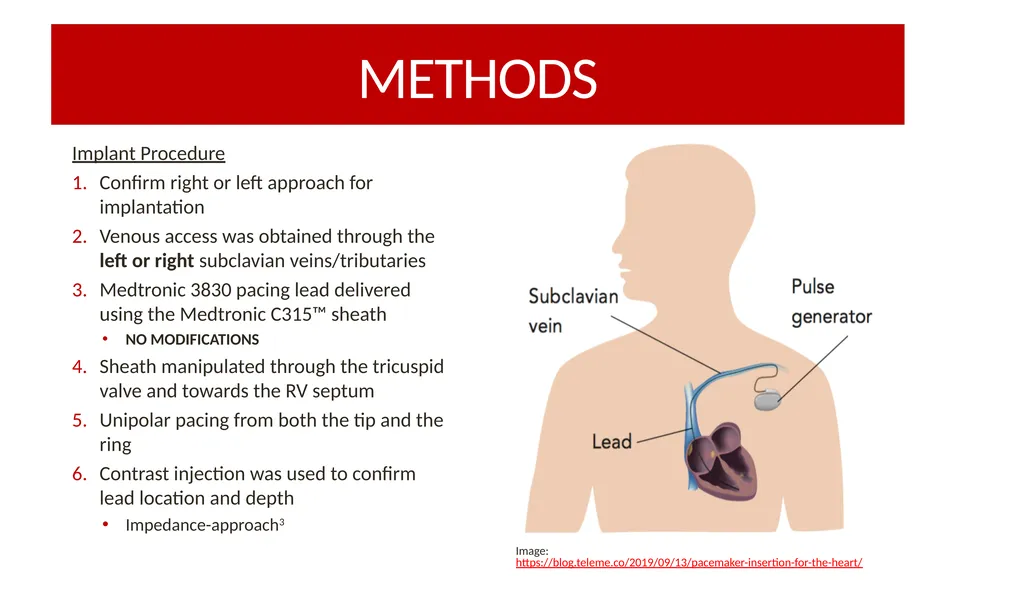
slide5. METHODS Implant Procedure
Confirm right or left approach for implantation
Venous access was obtained through the left or right subclavian veins/tributaries
Medtronic 3830 pacing lead delivered using the Medtronic C315™ sheath
NO MODIFICATIONS
Sheath manipulated through the tricuspid valve and towards the RV septum
Unipolar pacing from both the tip and the ring
Contrast injection was used to confirm lead location and depth
Impedance-approach3 Image: https://blog.teleme.co/2019/09/13/pacemaker-insertion-for-the-heart/<br>
slide6. METHODS This is a retrospective analysis
LBAP procedures between October 2019 and December 2021
245 consecutive patients
Procedural and pacing characteristics and electrophysiology parameters were extracted from medical records
Data on RS implants were compared to LS
Anatomical implant failure was defined as inability to advance the lead into the septum
Electrophysiologic failure was defined as QRS > 130 msec and/or left ventricular activation time > 90 msec<br>
slide7. RESULTS PROCEDURE INFORMATION
31 patients had RS implants and 214 were LS.
Medtronic C315™ sheaths were used in all implants.
Procedural and pacing characteristics between the RS and the LS implants were comparable and excellent with high success rates for LBAP in both groups
Acute lead dislodgment:
NONE in the RS group
5 (2%) patients from the LS group
No other procedural complications were found in either group.<br>
slide8. RESULTS<br>
slide9. RESULTS<br>
slide10. RESULTS POST-PROCEDURE INFORMATION
Revision surgery
1 RS patient
Micro-dislodgement which caused loss of left bundle capture.
12 LS patients
5 left bundle lead dislodgements
4 atrial lead dislodgements
1 battery depletion
1 upgrade to an ICD
1 pocket hematoma drainage
Patients were followed in the outpatient clinics at routine intervals
No difference in chronic pacing characteristics between the RS and LS groups<br>
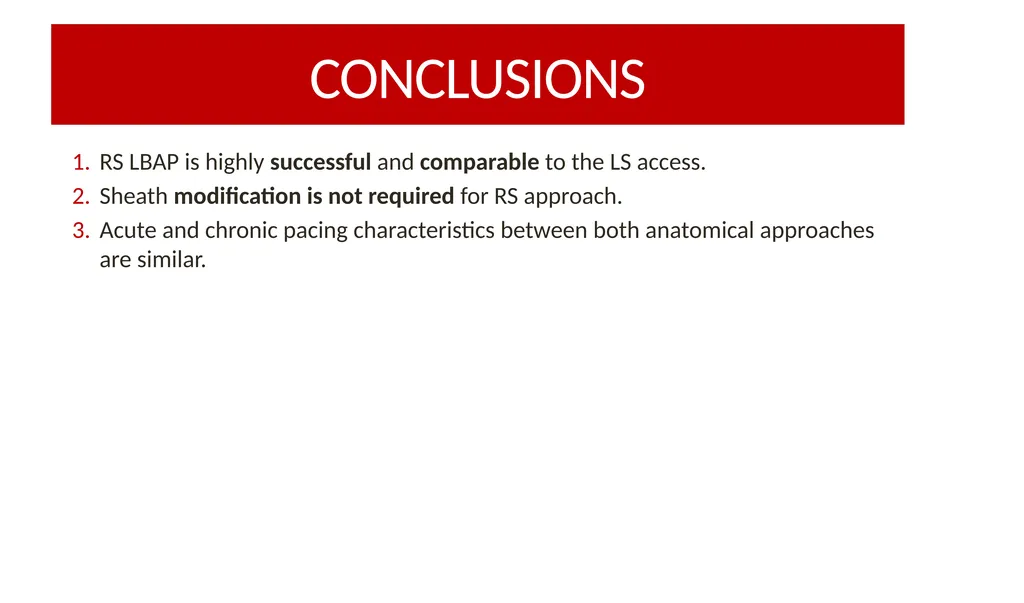
slide11. CONCLUSIONS RS LBAP is highly successful and comparable to the LS access.
Sheath modification is not required for RS approach.
Acute and chronic pacing characteristics between both anatomical approaches are similar.<br>
slide12. REFERENCES Vijayaraman P, Ellenbogen KA. Approach to permanent His bundle pacing in challenging implants. Heart Rhythm 2018;15:1428-1431.
Prolič Kalinšek T, Žižek D. Right-sided approach to left bundle branch area pacing combined with atrioventricular node ablation in a patient with persistent left superior vena cava and left bundle branch block: a case report. BMC Cardiovasc Disord 2022;22:467.
Orlov MV, Nikolaychuk M, Koulouridis I, et al. Left bundle area pacing: Guiding implant depth by ring measurements. Heart Rhythm 2023;20:55-60.<br>
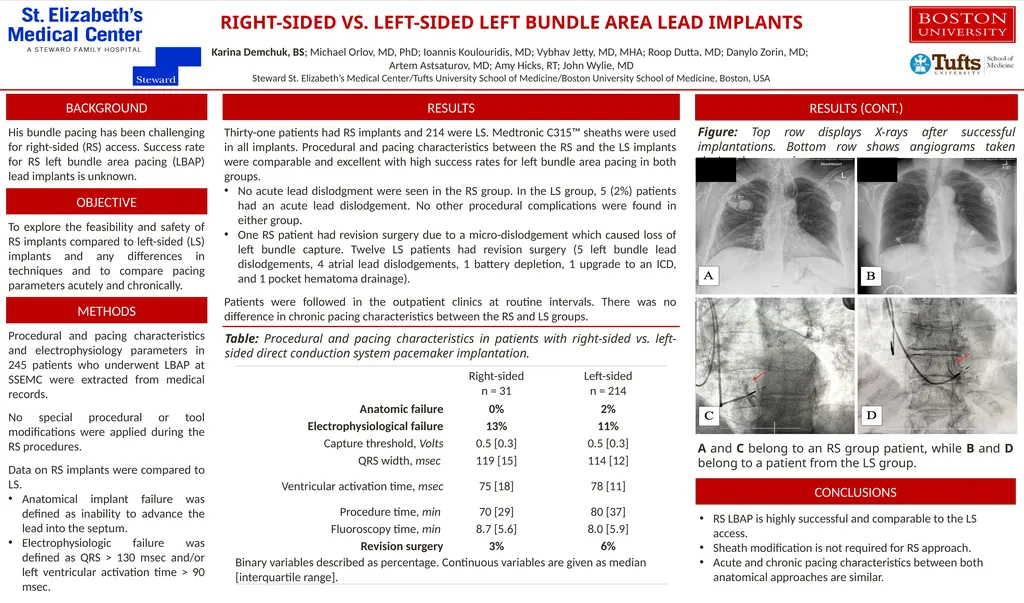
Karina Demchuk, BS; Michael Orlov, MD, PhD; Ioannis Koulouridis, MD; Vybhav Jetty, MD, MHA; Roop Dutta, MD; Danylo Zorin, MD;
Artem Astsaturov, MD; Amy Hicks, RT; John Wylie, MD
Steward St. Elizabeth’s Medical Center/Tufts University School of Medicine/Boston University School of Medicine, Boston, USA His bundle pacing has been challenging for right-sided (RS) access. Success rate for RS left bundle area pacing (LBAP) lead implants is unknown. RS LBAP is highly successful and comparable to the LS access.
Sheath modification is not required for RS approach.
Acute and chronic pacing characteristics between both anatomical approaches are similar. Procedural and pacing characteristics and electrophysiology parameters in 245 patients who underwent LBAP at SSEMC were extracted from medical records.
No special procedural or tool modifications were applied during the RS procedures.
Data on RS implants were compared to LS.
Anatomical implant failure was defined as inability to advance the lead into the septum.
Electrophysiologic failure was defined as QRS > 130 msec and/or left ventricular activation time > 90 msec. Thirty-one patients had RS implants and 214 were LS. Medtronic C315™ sheaths were used in all implants. Procedural and pacing characteristics between the RS and the LS implants were comparable and excellent with high success rates for left bundle area pacing in both groups.
No acute lead dislodgment were seen in the RS group. In the LS group, 5 (2%) patients had an acute lead dislodgement. No other procedural complications were found in either group.
One RS patient had revision surgery due to a micro-dislodgement which caused loss of left bundle capture. Twelve LS patients had revision surgery (5 left bundle lead dislodgements, 4 atrial lead dislodgements, 1 battery depletion, 1 upgrade to an ICD, and 1 pocket hematoma drainage).
Patients were followed in the outpatient clinics at routine intervals. There was no difference in chronic pacing characteristics between the RS and LS groups. Figure: Top row displays X-rays after successful implantations. Bottom row shows angiograms taken during the procedures. Table: Procedural and pacing characteristics in patients with right-sided vs. left-sided direct conduction system pacemaker implantation. To explore the feasibility and safety of RS implants compared to left-sided (LS) implants and any differences in techniques and to compare pacing parameters acutely and chronically. A and C belong to an RS group patient, while B and D belong to a patient from the LS group. BACKGROUND OBJECTIVE METHODS RESULTS RESULTS (CONT.) CONCLUSIONS<br>
slide2. BACKGROUND Conduction system pacing
Symptomatic bradycardia
Cardiac resynchronization therapy
Older technique: His bundle pacing (HBP)
Rising thresholds
Newer technique: Left bundle area pacing (LBAP)
Wider target site
Direct pacing capture = narrow paced QRS
Lower procedure and fluoroscopy times
Higher success rate
Consistent lead parameters Image: https://www.mdpi.com/2077-0383/10/4/822<br>
slide3. BACKGROUND Typically, HBP and LBAP are preformed via a left-sided (LS) approach
One study1 reported a right-sided (RS) approach for HBP
Procedural/tool modifications were applied
Acute lead dislodgements still occurred
Concluded that HBP has been challenging for RS access One case report2 demonstrated the efficacy of RS access with tool modification
Currently, the success rate for RS LBAP lead implants is unknown<br>
slide4. OBJECTIVES To explore the feasibility and safety of RS implants compared to left-sided (LS) implants and any differences in techniques.
To compare pacing parameters acutely and chronically.<br>
slide5. METHODS Implant Procedure
Confirm right or left approach for implantation
Venous access was obtained through the left or right subclavian veins/tributaries
Medtronic 3830 pacing lead delivered using the Medtronic C315™ sheath
NO MODIFICATIONS
Sheath manipulated through the tricuspid valve and towards the RV septum
Unipolar pacing from both the tip and the ring
Contrast injection was used to confirm lead location and depth
Impedance-approach3 Image: https://blog.teleme.co/2019/09/13/pacemaker-insertion-for-the-heart/<br>
slide6. METHODS This is a retrospective analysis
LBAP procedures between October 2019 and December 2021
245 consecutive patients
Procedural and pacing characteristics and electrophysiology parameters were extracted from medical records
Data on RS implants were compared to LS
Anatomical implant failure was defined as inability to advance the lead into the septum
Electrophysiologic failure was defined as QRS > 130 msec and/or left ventricular activation time > 90 msec<br>
slide7. RESULTS PROCEDURE INFORMATION
31 patients had RS implants and 214 were LS.
Medtronic C315™ sheaths were used in all implants.
Procedural and pacing characteristics between the RS and the LS implants were comparable and excellent with high success rates for LBAP in both groups
Acute lead dislodgment:
NONE in the RS group
5 (2%) patients from the LS group
No other procedural complications were found in either group.<br>
slide8. RESULTS<br>
slide9. RESULTS<br>
slide10. RESULTS POST-PROCEDURE INFORMATION
Revision surgery
1 RS patient
Micro-dislodgement which caused loss of left bundle capture.
12 LS patients
5 left bundle lead dislodgements
4 atrial lead dislodgements
1 battery depletion
1 upgrade to an ICD
1 pocket hematoma drainage
Patients were followed in the outpatient clinics at routine intervals
No difference in chronic pacing characteristics between the RS and LS groups<br>
slide11. CONCLUSIONS RS LBAP is highly successful and comparable to the LS access.
Sheath modification is not required for RS approach.
Acute and chronic pacing characteristics between both anatomical approaches are similar.<br>
slide12. REFERENCES Vijayaraman P, Ellenbogen KA. Approach to permanent His bundle pacing in challenging implants. Heart Rhythm 2018;15:1428-1431.
Prolič Kalinšek T, Žižek D. Right-sided approach to left bundle branch area pacing combined with atrioventricular node ablation in a patient with persistent left superior vena cava and left bundle branch block: a case report. BMC Cardiovasc Disord 2022;22:467.
Orlov MV, Nikolaychuk M, Koulouridis I, et al. Left bundle area pacing: Guiding implant depth by ring measurements. Heart Rhythm 2023;20:55-60.<br>