04
Uniform Guidance Title 2 of the Code of Federal Regulations, Part 200 (2 CFR Part 200)
Accepted by the Department of Education in 2 CFR Part 3474<br>
05
“This guidance does not change or modify any existing statute or guidance otherwise based on any existing statute.” Authorities to consider when using 2 CFR Part 200<br>
06
When does 2 CFR Part 200 start? Uniform Guidance (2 CFR Part 200) applies to:
New and Continuation grants awarded on or after December 26, 2014
Former regulations (EDGAR Part 74 or 80 and OMB circulars) apply to:
Grants awarded prior to December 26, 2014<br>
07
Relationships and Key Terms Subaward or Contract?
The relationship, rather than the document title, is the basis for determining which requirements are applicable.
Know the Difference.<br>
08
Definitions: Pass-through entities A non-Federal entity that provides a subaward to a subrecipient to carry out part of a Federal program (§200.74).
At ED:
State-Administered Formula Grants: SEAs, other grantees which make subawards
Discretionary Grants: under EDGAR 75.708 or authorizing statute, some discretionary grantees may make subawards. These are not the same as partnerships.<br>
09
Definitions: Subrecipient and Contractor A pass-through entity must determine the relationship and the applicable requirements:
Subrecipient means a non-Federal entity that receives a subaward from a pass-through entity to carry out part of a Federal program (§200.93).
Contractor means an entity that receives a contract as defined in 200.22 Contract (§200.23).
§200.330 explains the roles of subrecipients and contractors<br>
10
Understanding Risk<br>
11
What is Risk? (GAO – The Green Book) Risk is the possibility that an event will occur and adversely affect the achievement of objectives.<br>
12
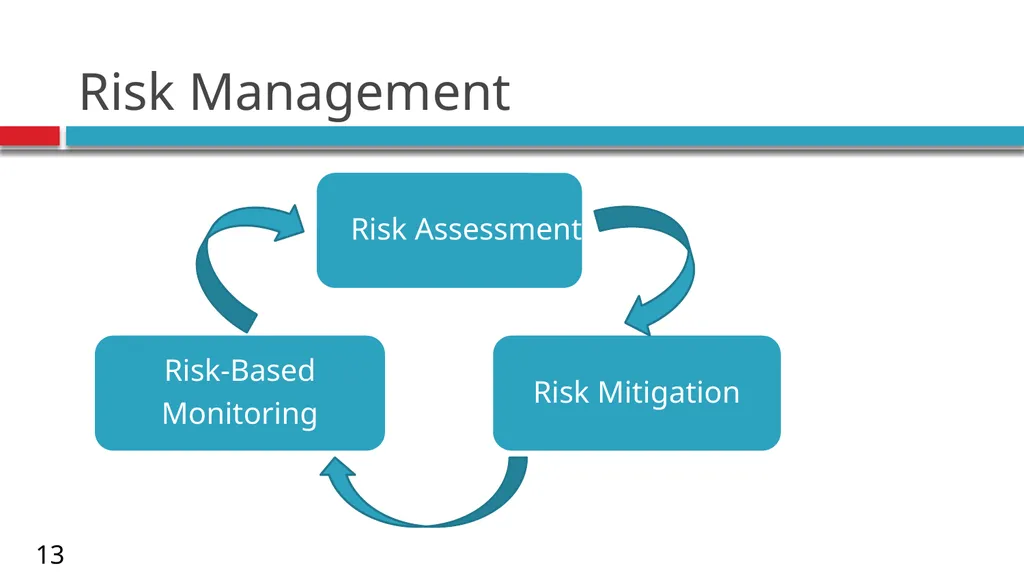
What is Risk Management? (GAO) Risk management can be described as the continuous process of assessing risks, reducing the potential that an adverse event will occur, and putting steps in place to deal with any event that does occur.<br>
14
Risk and Monitoring Key Concepts and Changes in the Uniform Guidance Indicates a new requirement or change to existing requirement for pass-through entities.<br>
15
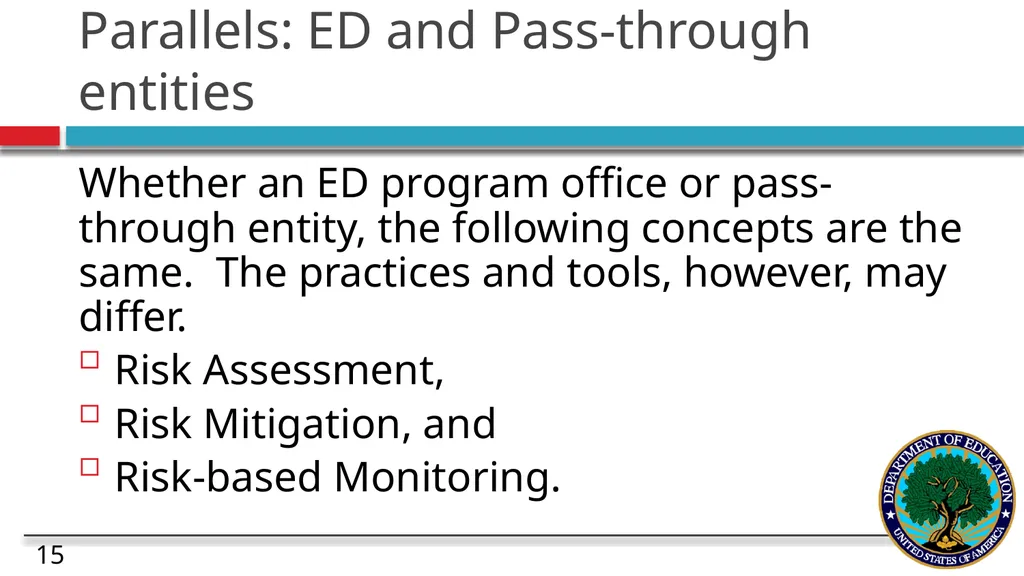
Parallels: ED and Pass-through entities Whether an ED program office or pass-through entity, the following concepts are the same. The practices and tools, however, may differ.
Risk Assessment,
Risk Mitigation, and
Risk-based Monitoring.<br>
16
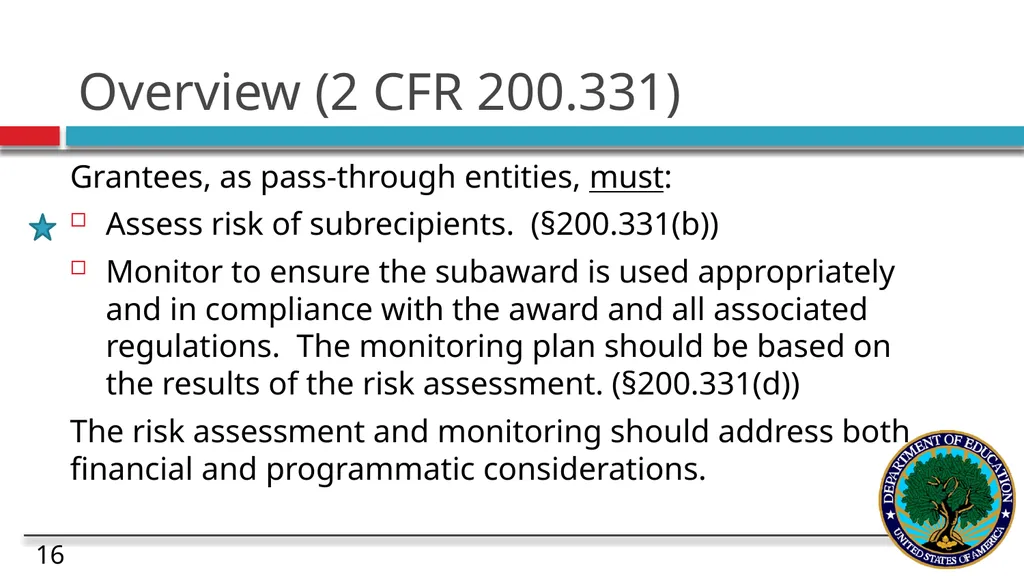
Overview (2 CFR 200.331) Grantees, as pass-through entities, must:
Assess risk of subrecipients. (§200.331(b))
Monitor to ensure the subaward is used appropriately and in compliance with the award and all associated regulations. The monitoring plan should be based on the results of the risk assessment. (§200.331(d))
The risk assessment and monitoring should address both financial and programmatic considerations.<br>
17
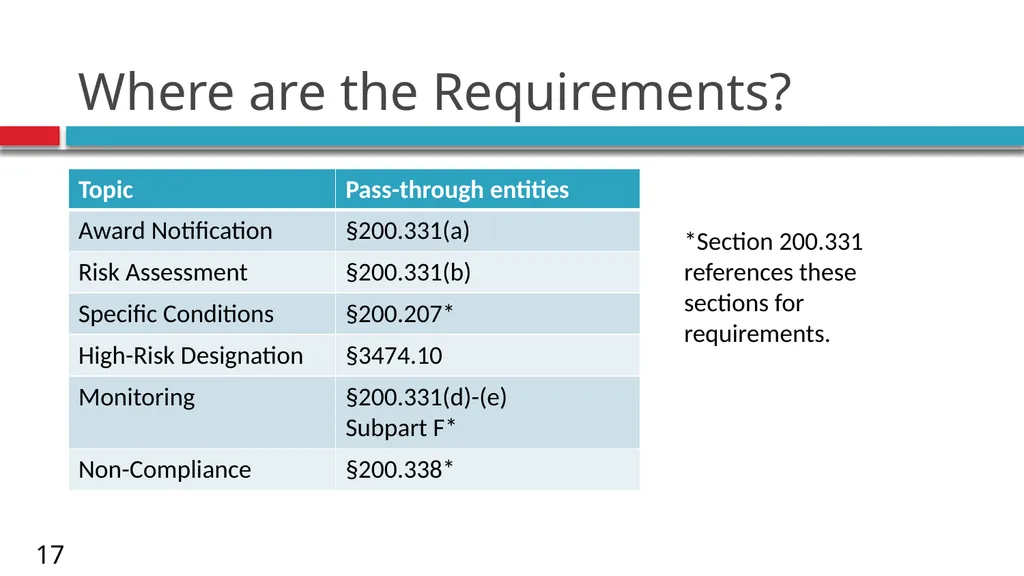
Where are the Requirements? *Section 200.331 references these sections for requirements.<br>
18
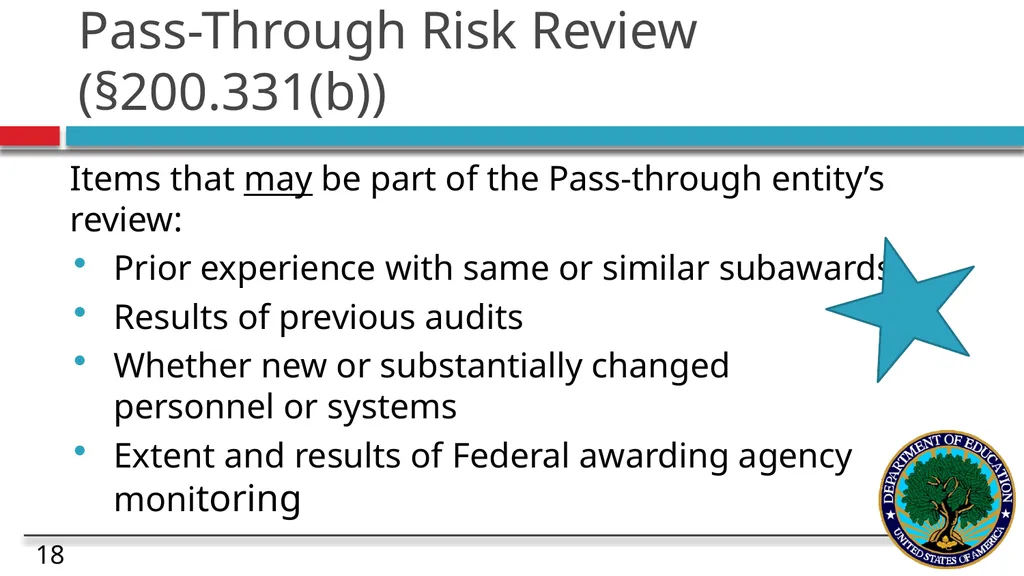
Pass-Through Risk Review (§200.331(b)) Items that may be part of the Pass-through entity’s review:
Prior experience with same or similar subawards
Results of previous audits
Whether new or substantially changed personnel or systems
Extent and results of Federal awarding agency monitoring<br>
19
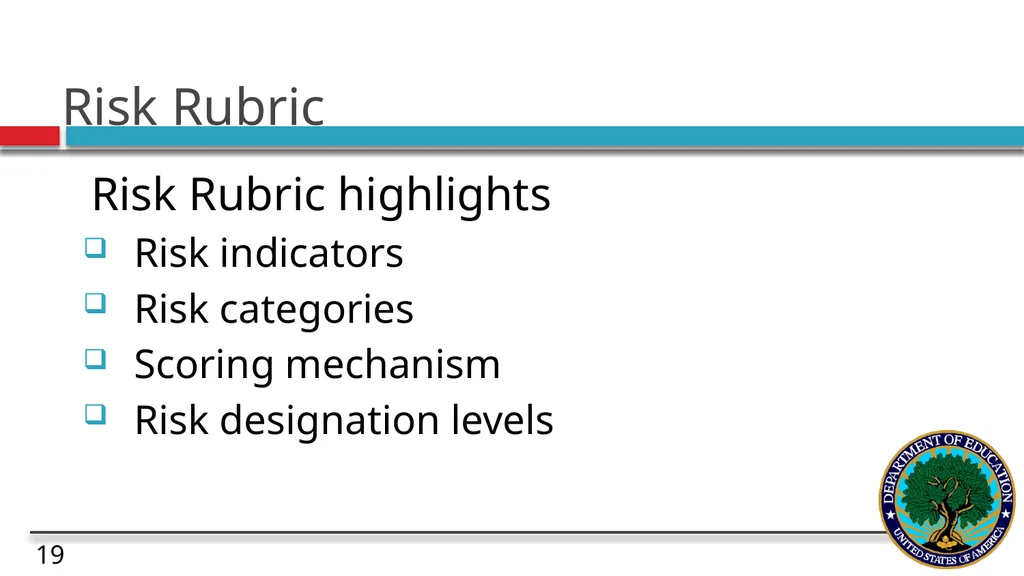
Risk Rubric Risk Rubric highlights
Risk indicators
Risk categories
Scoring mechanism
Risk designation levels<br>
20
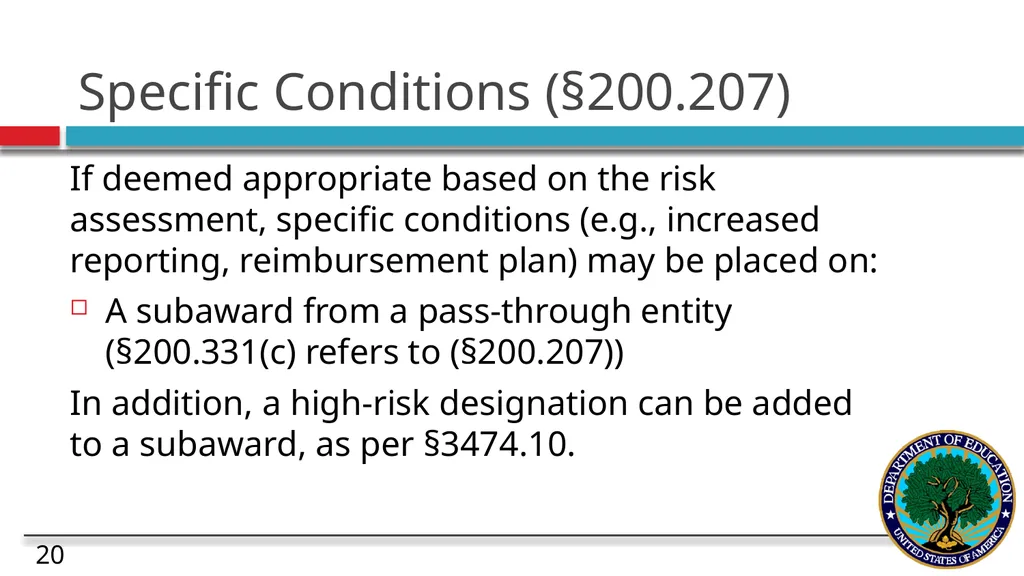
Specific Conditions (§200.207) If deemed appropriate based on the risk assessment, specific conditions (e.g., increased reporting, reimbursement plan) may be placed on:
A subaward from a pass-through entity (§200.331(c) refers to (§200.207))
In addition, a high-risk designation can be added to a subaward, as per §3474.10.<br>
21
Pass-Through Monitoring Procedures When monitoring subrecipients, the pass-through entity must (§ 200.331(d)):
Review reports required by the pass-through entity
Ensure subrecipient takes appropriate action on deficiencies identified through audits, on-site reviews, and other means
Issue a management decision for single-audit findings pertaining to Federal award
Verify audits of subawards (§ 200.331(f))
Threshold for required audits increased to $750,000<br>
22
Pass-Through Entity Monitoring Tools The following tools may be useful, depending upon the risk assessment (§ 200.331(e))
Providing subrecipient training and technical assistance
Performing on-site reviews
Arranging for agreed-upon-procedures engagements under § 200.425, Audit services [in Cost Principles]
The pass-through entity determines which tools to use based upon its assessment of risk<br>
23
Risk-Based Monitoring Plan Monitoring Plan highlights
Assessment methodology
Last Fiscal Year (FY) assessment & monitoring activities
Current FY assessment & monitoring strategies
Resource constraints<br>
24
Audit Requirements Single Audit (2 CFR Part 200 Subpart F)
Alternatives to Single Audits
Program specific audit
Agreed-Upon-Procedures
Additional Audits, as requested by Congress or the Federal Government
GAO Audits
OIG General Audits<br>
25
Other Pass-through Requirements The pass-through entity must provide specific information in the subaward (§200.331 (a)), including but not limited to:
Federal award identification, e.g., DUNS number
Indirect cost rate
Requirements imposed by the pass-through entity
Requirement to provide access to records for audit<br>
26
Continuous Improvement Standard Evaluate annually the risk management process to identify its strengths and weaknesses and refine ability to reduce risk throughout the grant process<br>
28
Compliance: Grantees Responsibility for subawards:
Strong Internal Controls for managing subawards
Communication with ED Staff and with subrecipients
Documentation of all activities
Monitoring subawards
Verifying subgrantees are audited, if required<br>