Risk-Informed, Performance-Based Technology-Inclusive Reactor Licensing and Regulation Anders Gilbertson (hehimhis) Senior Project Manager Office of Nuclear Reactor Regulation October 22, 2024 2 An overview of the Licensing
"Risk-Informed, Performance-Based &" is the property of its rightful owner. Permission is granted to
download and print the materials on this website for personal, non-commercial use only, and to display it
on your personal computer provided you do not modify the materials and that you retain all copyright
notices contained in the materials. By downloading content from our website, you accept the terms of this
agreement.
Presentation Transcript
01
Risk-Informed, Performance-Based & Technology-Inclusive Reactor Licensing and Regulation Anders Gilbertson (he/him/his) Senior Project Manager
Office of Nuclear Reactor Regulation
October 22, 2024<br>
02
2 An overview of the Licensing Modernization Project (LMP) methodology
Implementing LMP under Parts 50 and 52 – ARCAP & TICAP
An alternative licensing framework Presentation Overview<br>
03
3 An Overview of the LMP Methodology<br>
04
4 Overview of LMP – General * See NEI 18-04, Revision 1, “Risk-Informed Performance-Based Technology Inclusive Guidance for Non-Light Water Reactor Licensing Basis Development” (ADAMS Accession No. ML19241A472)<br>
05
5 Frequency-Consequence Target Curve informs –
LBE risk significance
SSC safety classification
DID adequacy evaluation
meeting the LMP design objective Overview of LMP – Risk-Informed & Performance-Based Decision-Making Source: NEI 18-04, Revision 1<br>
06
6 Defense-in-depth adequacy evaluation –
Iterative process informed by PRA and deterministic inputs
Informs SSC safety classification and special treatments Overview of LMP – Wholistic Evaluation Source: NEI 18-04, Revision 1<br>
07
7 Overview of LMP – Consideration of Consequences LMP uses consequences in design and licensing to –
compare 95th percentile to regulatory limits (e.g., 10 CFR 50.34)
compare LBE mean values with the frequency-consequence target curve
compare cumulative risk against Commission policy (e.g., Safety Goals)
individual latent cancer fatality risk (ILCFR) < 2×10⁻⁶/year
individual early fatality risk (IEFR) < 5×10⁻⁷/year
Use of LMP and consequence evaluations can help risk-inform –
siting and safety analysis
emergency preparedness
emergency planning zone sizing (e.g., 10 CFR 50.160)
environmental considerations
severe accident mitigation design alternatives (SAMDAs)<br>
08
8 Overview of LMP – Agency Approval NEI 18-04 Revision 1, was endorsed by the staff in RG 1.233, Revision 0 (ML20091L698)
The LMP methodology was recommended by the ACRS to be adopted and was approved by the Commission
ACRS letter dated March 19, 2019 (ML19078A240), recommends Commission adopt the proposed approach
Commission approved SECY-19-0117 (ML18311A264) in SRM-SECY-19-0117 (ML20147A504)<br>
09
9 LMP Under Parts 50 and 52 – ARCAP & TICAP<br>
10
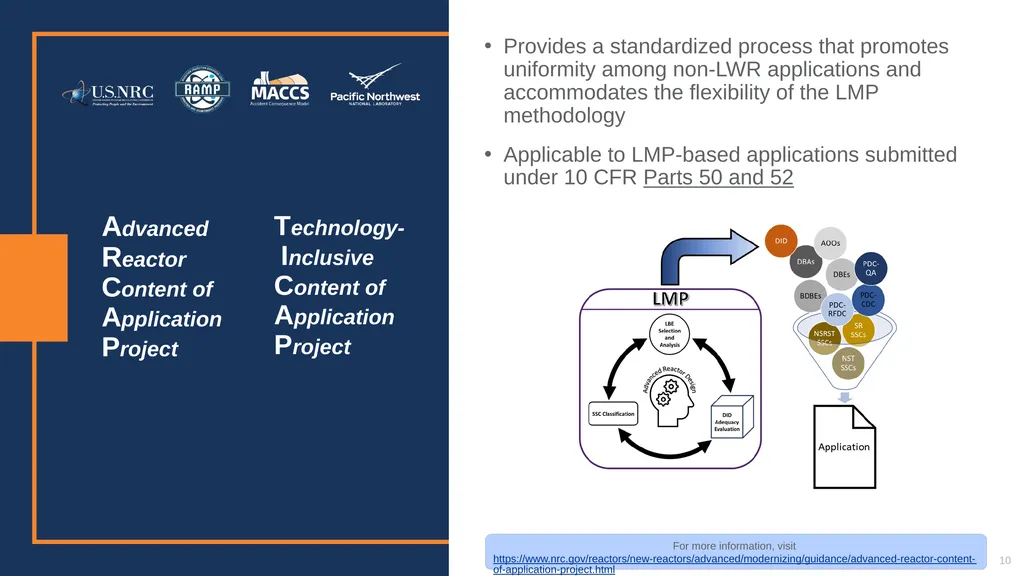
10 Provides a standardized process that promotes uniformity among non-LWR applications and accommodates the flexibility of the LMP methodology
Applicable to LMP-based applications submitted under 10 CFR Parts 50 and 52 Advanced Reactor Content of Application Project Technology- Inclusive Content of Application Project For more information, visit https://www.nrc.gov/reactors/new-reactors/advanced/modernizing/guidance/advanced-reactor-content-of-application-project.html<br>
11
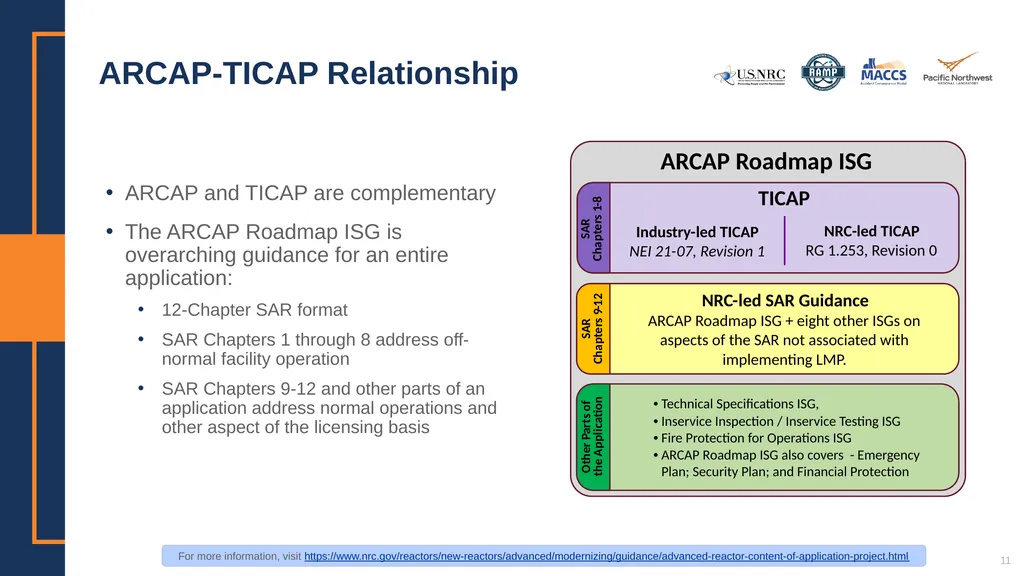
11 ARCAP-TICAP Relationship ARCAP and TICAP are complementary
The ARCAP Roadmap ISG is overarching guidance for an entire application:
12-Chapter SAR format
SAR Chapters 1 through 8 address off-normal facility operation
SAR Chapters 9-12 and other parts of an application address normal operations and other aspect of the licensing basis For more information, visit https://www.nrc.gov/reactors/new-reactors/advanced/modernizing/guidance/advanced-reactor-content-of-application-project.html<br>
12
12 Part 53 Proposed Rule: An Alternative, Technology-Inclusive Regulatory Framework<br>
13
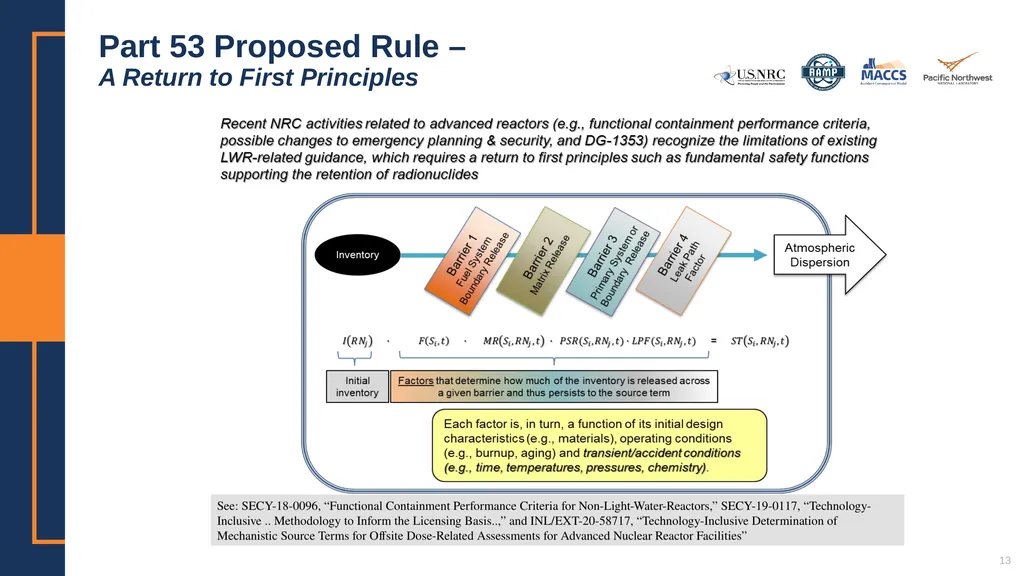
13 Part 53 Proposed Rule – A Return to First Principles<br>
14
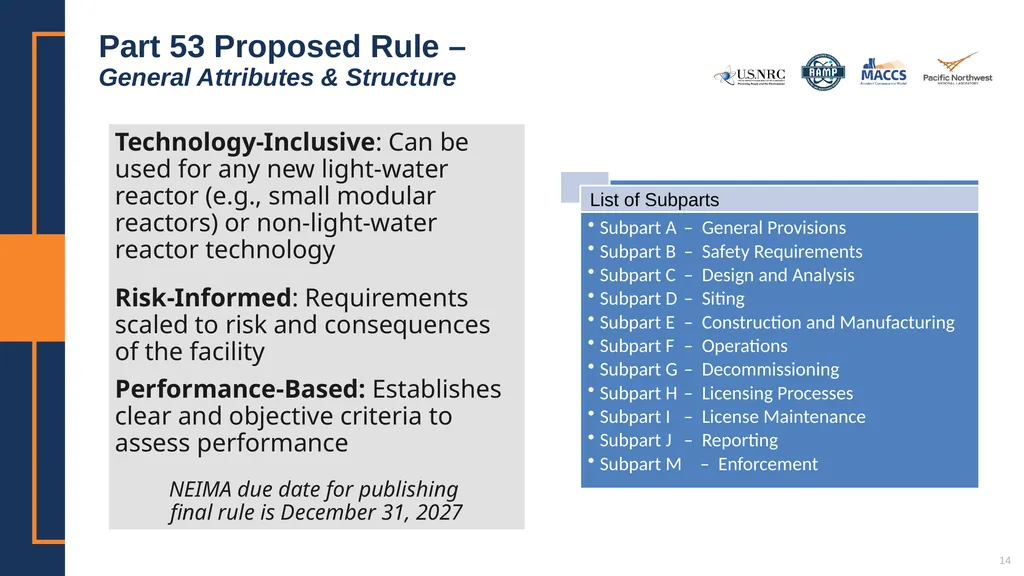
14 Part 53 Proposed Rule – General Attributes & Structure Technology-Inclusive: Can be used for any new light-water reactor (e.g., small modular reactors) or non-light-water reactor technology
Risk-Informed: Requirements scaled to risk and consequences of the facility
Performance-Based: Establishes clear and objective criteria to assess performance
NEIMA due date for publishing
final rule is December 31, 2027<br>
15
15 Part 53 Proposed Rule – Foundations Safety criteria for design-basis accidents (DBAs)
Safety criteria for licensing basis events (LBEs) other than DBAs
Safety functions
Normal operations
Protection of plant workers
Informed by key concepts of LMP:
PRA-informed LBE selection and determining risk significance
Safety classification of SSCs and Special Treatments
Ensuring appropriate Defense in Depth<br>
16
16 Ongoing license application reviews for advanced non-LWRs and LWRs
Ongoing interactions with designers and prospective applicants, including Advanced Reactor Demonstration Project Awardees
Many related activities are underway to support licensing and regulation of advanced reactors, such as:
developing computer codes and analytical tools
Generic Environmental Impact Statement (GEIS)
guidance on fuel qualification
ASME Section III Division 5 Standard (high temperature materials)
ASME/ANS RA-S-1.4–2021, “Probabilistic Risk Assessment Standard for Advanced Non-Light Water Reactor Nuclear Power Plants” endorsed by RG 1.247
coordinating with fuel cycle programs – high-assay low-enriched uranium (HALEU)
revising requirements related to security and emergency planning
international coordination
developing approach for commercial fusion energy systems A Look to the Future…<br>
17
17<br>
18
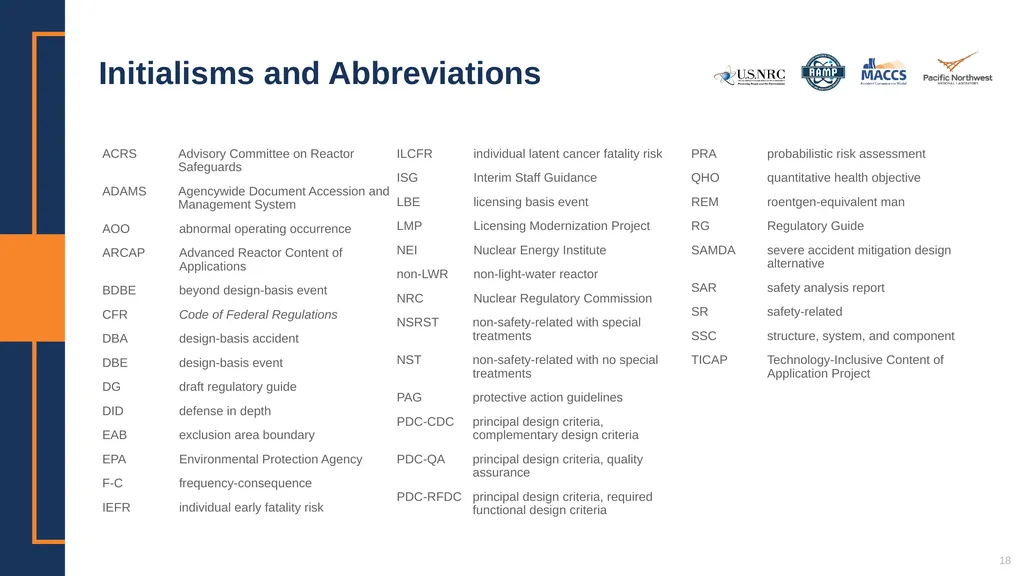
18 Initialisms and Abbreviations ACRS Advisory Committee on Reactor Safeguards
ADAMS Agencywide Document Accession and Management System
AOO abnormal operating occurrence
ARCAP Advanced Reactor Content of Applications
BDBE beyond design-basis event
CFR Code of Federal Regulations
DBA design-basis accident
DBE design-basis event
DG draft regulatory guide
DID defense in depth
EAB exclusion area boundary
EPA Environmental Protection Agency
F-C frequency-consequence
IEFR individual early fatality risk
ILCFR individual latent cancer fatality risk
ISG Interim Staff Guidance
LBE licensing basis event
LMP Licensing Modernization Project
NEI Nuclear Energy Institute
non-LWR non-light-water reactor
NRC Nuclear Regulatory Commission
NSRST non-safety-related with special treatments
NST non-safety-related with no special treatments
PAG protective action guidelines
PDC-CDC principal design criteria, complementary design criteria
PDC-QA principal design criteria, quality assurance
PDC-RFDC principal design criteria, required functional design criteria
PRA probabilistic risk assessment
QHO quantitative health objective
REM roentgen-equivalent man
RG Regulatory Guide
SAMDA severe accident mitigation design alternative
SAR safety analysis report
SR safety-related
SSC structure, system, and component
TICAP Technology-Inclusive Content of Application Project<br>