
RO64 – Enterprise & Marketing Concepts Revision
YM
Published · 34 slides · 0 views

1 / 1



Description
RO64 Enterprise Marketing Concepts Revision lesson Market Segmentation Market segmentation is the process of dividing a market of potential customers into groups, or segments, based on different characteristics The need to segment the
Related Topics
Share
Embed code
Download this presentation From Below
"RO64 – Enterprise & Marketing Concepts Revision" is the property of its rightful owner. Permission is granted to download and print the materials on this website for personal, non-commercial use only, and to display it on your personal computer provided you do not modify the materials and that you retain all copyright notices contained in the materials. By downloading content from our website, you accept the terms of this agreement.
Presentation Transcript
01
RO64 – Enterprise & Marketing Concepts Revision lesson<br>
02
Market Segmentation Market segmentation is the process of dividing a market of potential customers into groups, or segments, based on different characteristics The need to segment the market
Customers require different benefits from a
product
Different customers have different budgets
Different incomes
Expect different quality of goods
Want to buy larger amounts
Want to be able to purchase online or in store<br>
Customers require different benefits from a
product
Different customers have different budgets
Different incomes
Expect different quality of goods
Want to buy larger amounts
Want to be able to purchase online or in store<br>
03
Types Demographic – segmentation according to age, race, religion, gender, family size, ethnicity, income and education.
Age
Gender
Income
Lifestyle
Occupation
Behavioural – based on differences in consumer’s lifestyle, patterns of buying, using, spending.
Psychographic – based on personality traits, values, attitudes, interests and lifestyles.
Geographic – based on geography i.e. area, city, country, region etc.<br>
Age
Gender
Income
Lifestyle
Occupation
Behavioural – based on differences in consumer’s lifestyle, patterns of buying, using, spending.
Psychographic – based on personality traits, values, attitudes, interests and lifestyles.
Geographic – based on geography i.e. area, city, country, region etc.<br>
04
Benefits Ensuring customer needs are matched and met
Increased profit
Increased customer retention
Targeted marketing
Increase in market share<br>
Increased profit
Increased customer retention
Targeted marketing
Increase in market share<br>
05
Market Segmentation What is it?
Examples
How do customer needs differ?
What are the benefits?<br>
Examples
How do customer needs differ?
What are the benefits?<br>
06
Market Research Market research is the gathering of data and information about the market a business operates in
Purpose of market research
Aid decision making (like price, colour)
Reduce risk
Understand the market (competitors)
Promote the organisation
Gain customers’ views and needs
Inform product development<br>
Purpose of market research
Aid decision making (like price, colour)
Reduce risk
Understand the market (competitors)
Promote the organisation
Gain customers’ views and needs
Inform product development<br>
07
Market Research video https://www.youtube.com/watch?v=SHVAoLS9NYw<br>
08
Primary research Primary research – this is research conducted by the business – Research can be tailored to your specific product so more relevant, Results are more likely to be up- to-date, Results not available to competitors, helps make less risky decisions
Questionnaire
Survey
Consumer trial
Observations
Focus groups<br>
Questionnaire
Survey
Consumer trial
Observations
Focus groups<br>
09
Secondary Secondary research – this is research that has been conducted by someone else - Cost of accessing information usually low. Relatively quick to obtain
Internal data
Books/newspapers
trade magazines
Competitors’ data
Government publications and statistics
Mintel reports<br>
Internal data
Books/newspapers
trade magazines
Competitors’ data
Government publications and statistics
Mintel reports<br>
10
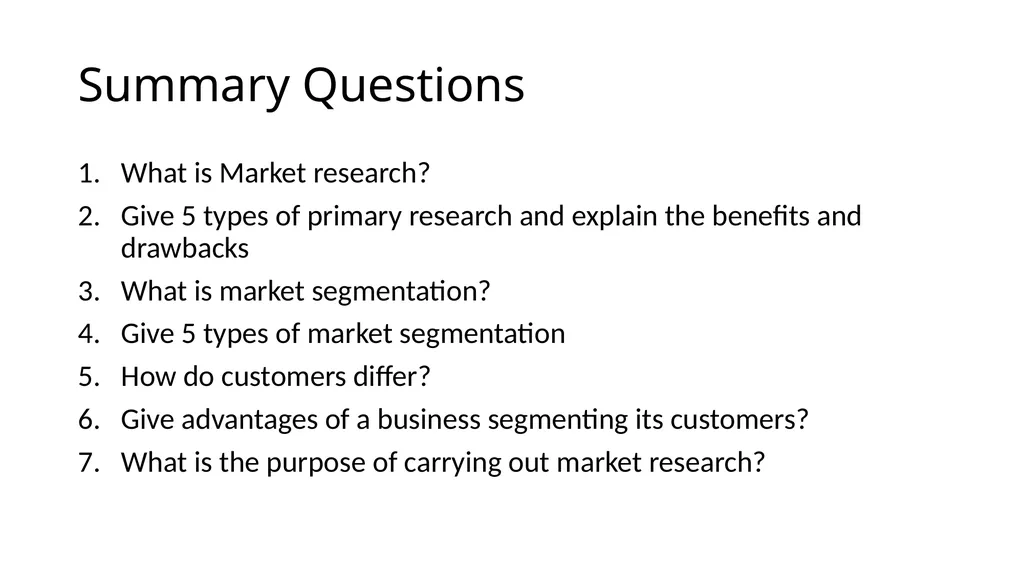
Summary Questions What is Market research?
Give 5 types of primary research and explain the benefits and drawbacks
What is market segmentation?
Give 5 types of market segmentation
How do customers differ?
Give advantages of a business segmenting its customers?
What is the purpose of carrying out market research?<br>
Give 5 types of primary research and explain the benefits and drawbacks
What is market segmentation?
Give 5 types of market segmentation
How do customers differ?
Give advantages of a business segmenting its customers?
What is the purpose of carrying out market research?<br>
11
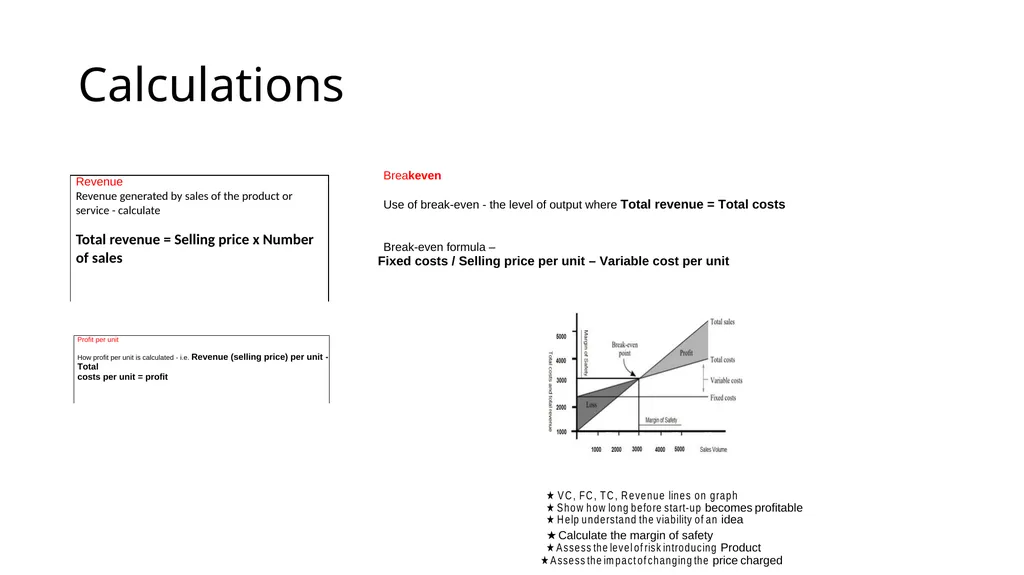
Costs, revenue and profit Fixed costs -Cost of producing the product or service, i.e. Fixed costs i.e. costs that do not vary with output e.g.
Rent rates, insurance, salary
Variable costs - Cost of producing the product or service, i.e. Variable costs i.e. costs that do vary with output e.g. materials, stock, gas electricity, wages
Total Costs -fixed costs + variable costs<br>
Rent rates, insurance, salary
Variable costs - Cost of producing the product or service, i.e. Variable costs i.e. costs that do vary with output e.g. materials, stock, gas electricity, wages
Total Costs -fixed costs + variable costs<br>
12
Calculations<br>
13
Break Even https://www.youtube.com/watch?v=u6bK7vI_IzQ<br>
14
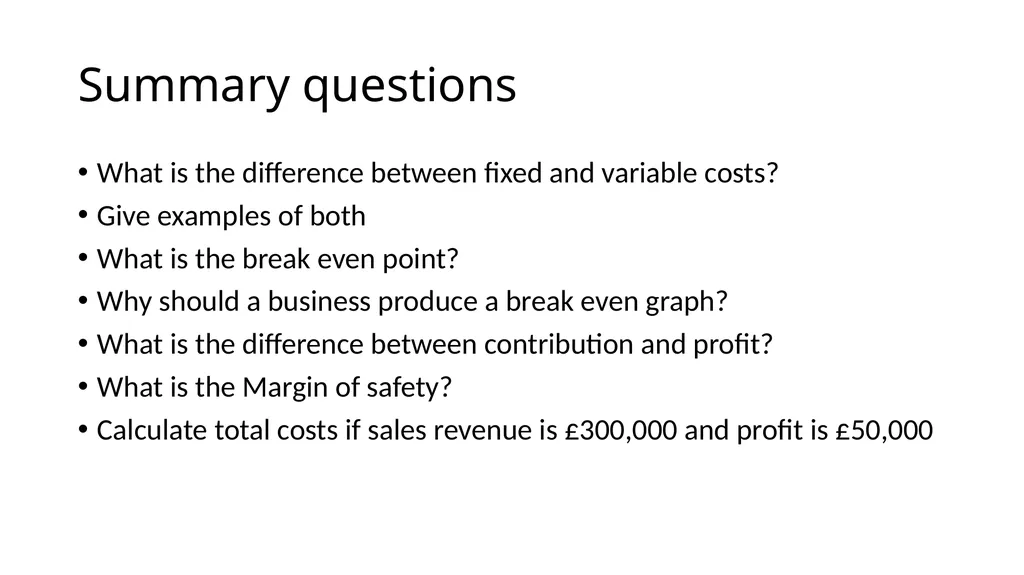
Summary questions What is the difference between fixed and variable costs?
Give examples of both
What is the break even point?
Why should a business produce a break even graph?
What is the difference between contribution and profit?
What is the Margin of safety?
Calculate total costs if sales revenue is £300,000 and profit is £50,000<br>
Give examples of both
What is the break even point?
Why should a business produce a break even graph?
What is the difference between contribution and profit?
What is the Margin of safety?
Calculate total costs if sales revenue is £300,000 and profit is £50,000<br>
15
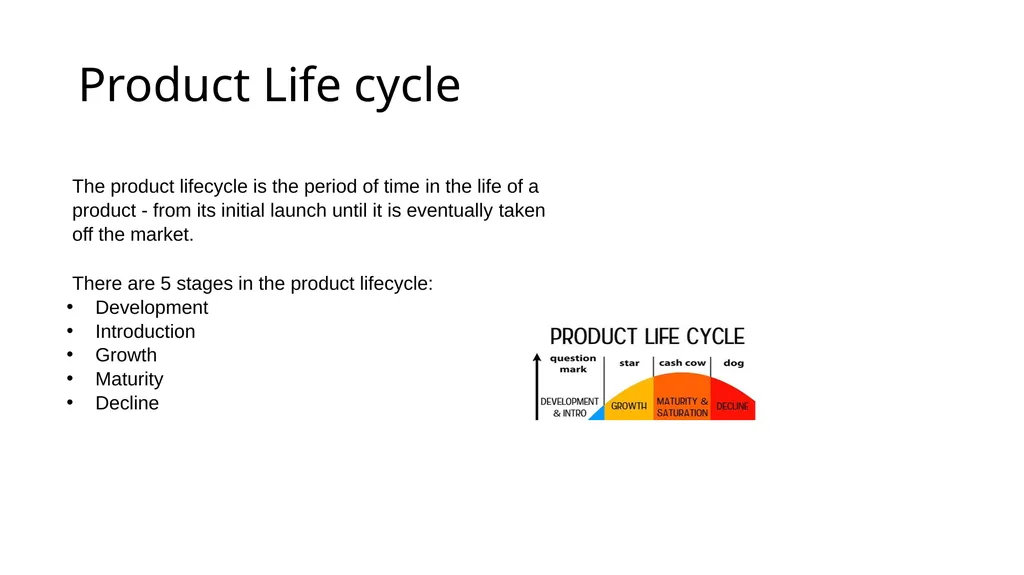
Product Life cycle The product lifecycle is the period of time in the life of a product - from its initial launch until it is eventually taken off the market.
There are 5 stages in the product lifecycle:
Development
Introduction
Growth
Maturity
Decline<br>
There are 5 stages in the product lifecycle:
Development
Introduction
Growth
Maturity
Decline<br>
16
Extension Strategies Before a product reaches the decline stage, the business will try it’s best to extend the life of the product by adding extension strategies such as:
Advertising – help attract new customers, remind existing customers, encourage repeat purchases
Price changes – usually the price is reduced to encourage customers to buy again
Adding value – examples are providing sugar free versions of foods, provide a 1-year warranty
Exploring new markets – sometimes a business will need to find a brand new market for its products
New packaging – provide a fresh new look to encourage existing and new customers to buy again<br>
Advertising – help attract new customers, remind existing customers, encourage repeat purchases
Price changes – usually the price is reduced to encourage customers to buy again
Adding value – examples are providing sugar free versions of foods, provide a 1-year warranty
Exploring new markets – sometimes a business will need to find a brand new market for its products
New packaging – provide a fresh new look to encourage existing and new customers to buy again<br>
17
Product Differentiation Product differentiation is a way of making a product stand out, and be different from competing products.
Methods:-
Branding – this is the visual identity of the product and this is usually a combination of a name, logo or symbol, strapline and a distinct feature. The idea is that it will make it easier to influence customers.
Design mix model – this is what to consider when designing a product:
Function –does the product work? Is it reliable? Does it have more than 1 function?
Aesthetics – how does the product look/feel/smell?
Economics – can the product be made quickly and cost-effectively?
Unique Selling Point (USP) – John Lewis offer life time warranty on their products
Improving a product – features, functions, location, design, selling price, appearance<br>
Methods:-
Branding – this is the visual identity of the product and this is usually a combination of a name, logo or symbol, strapline and a distinct feature. The idea is that it will make it easier to influence customers.
Design mix model – this is what to consider when designing a product:
Function –does the product work? Is it reliable? Does it have more than 1 function?
Aesthetics – how does the product look/feel/smell?
Economics – can the product be made quickly and cost-effectively?
Unique Selling Point (USP) – John Lewis offer life time warranty on their products
Improving a product – features, functions, location, design, selling price, appearance<br>
18
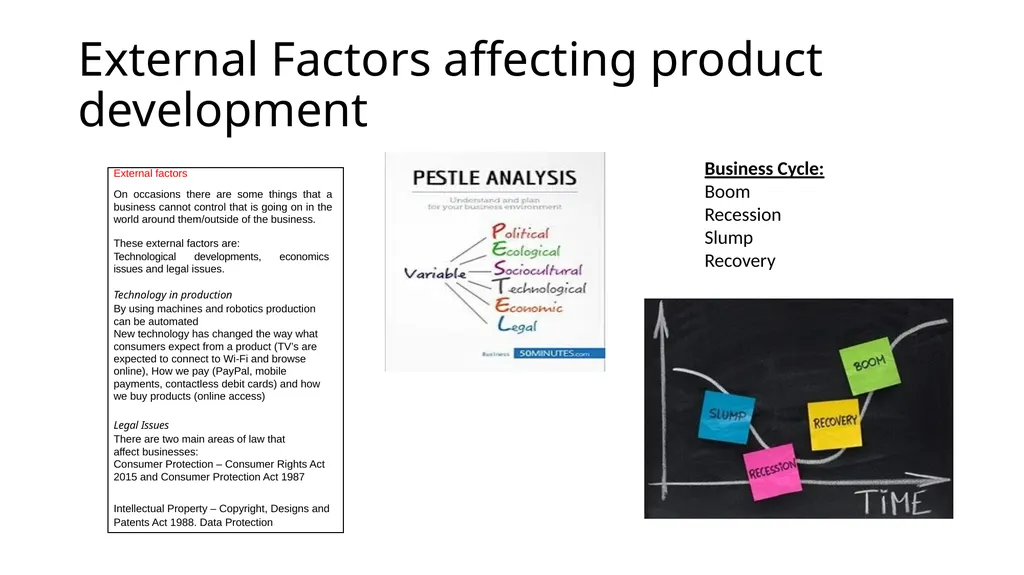
External Factors affecting product development Business Cycle:
Boom
Recession
Slump
Recovery<br>
Boom
Recession
Slump
Recovery<br>
19
Summary questions What are the main stags of product lifecycle?
Explain 2 extension strategies that could be used to extend the life of a product
Define the term Unique selling point. Give an example to support
What is the design mix model?
Explain how a business may use the design mix model
Describe the stages of the business cycle
Describe how each stage of the business cycle may affect the success of a new product launch<br>
Explain 2 extension strategies that could be used to extend the life of a product
Define the term Unique selling point. Give an example to support
What is the design mix model?
Explain how a business may use the design mix model
Describe the stages of the business cycle
Describe how each stage of the business cycle may affect the success of a new product launch<br>
20
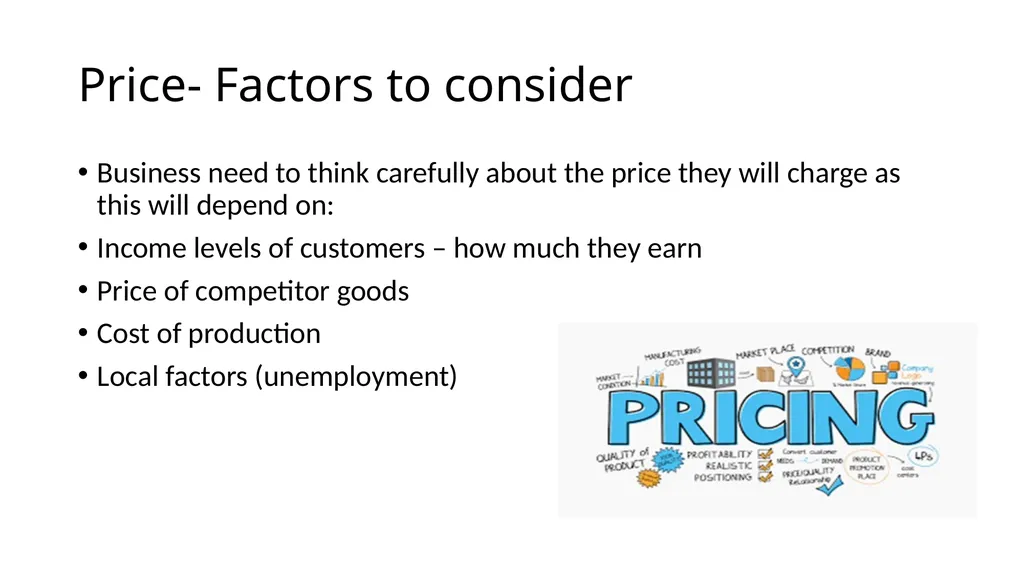
Price- Factors to consider Business need to think carefully about the price they will charge as this will depend on:
Income levels of customers – how much they earn
Price of competitor goods
Cost of production
Local factors (unemployment)<br>
Income levels of customers – how much they earn
Price of competitor goods
Cost of production
Local factors (unemployment)<br>
21
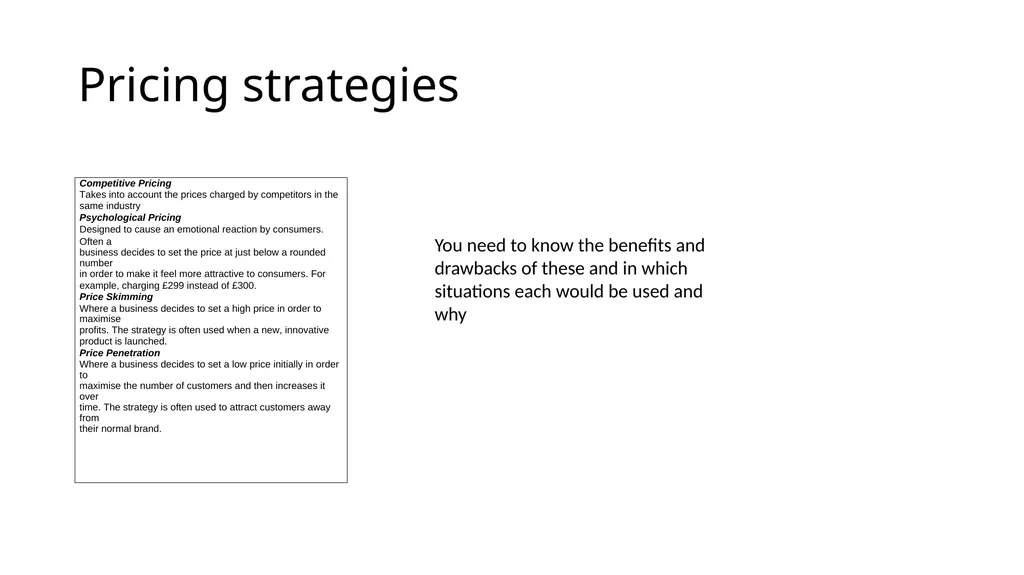
Pricing strategies You need to know the benefits and drawbacks of these and in which situations each would be used and why<br>
22
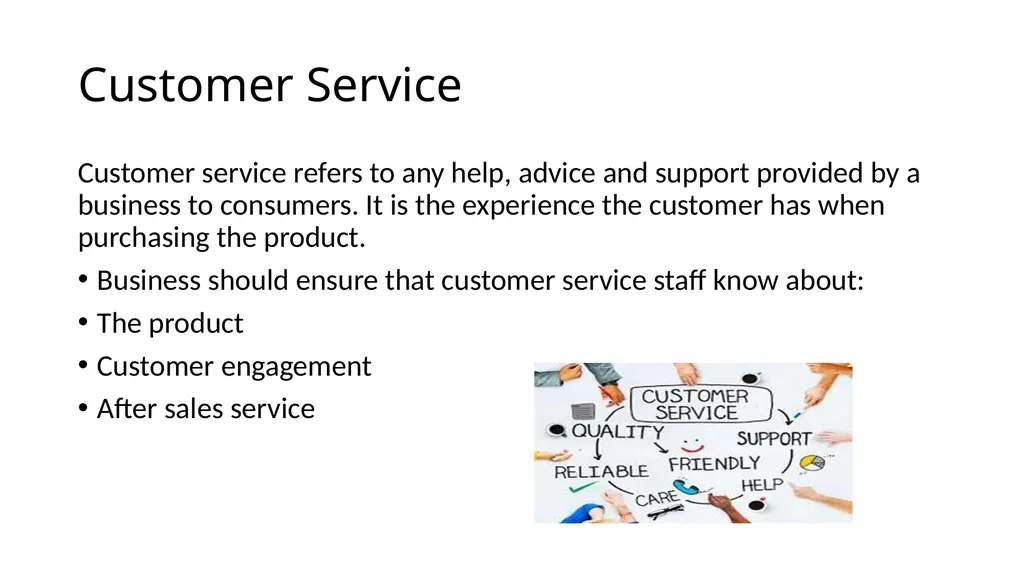
Customer Service Customer service refers to any help, advice and support provided by a business to consumers. It is the experience the customer has when purchasing the product.
Business should ensure that customer service staff know about:
The product
Customer engagement
After sales service<br>
Business should ensure that customer service staff know about:
The product
Customer engagement
After sales service<br>
23
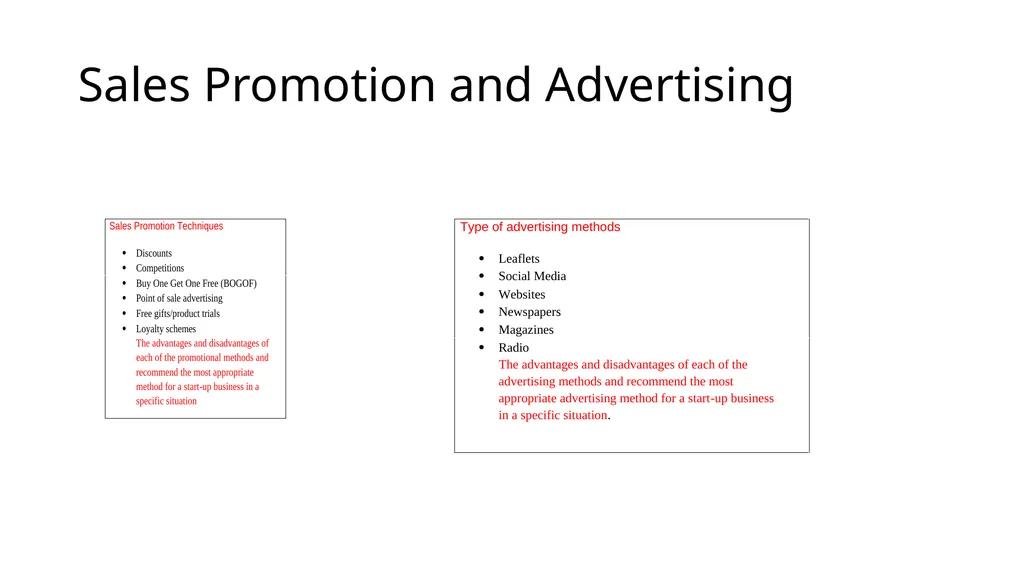
Sales Promotion and Advertising<br>
24
Feedback methods Customer comment card
Social media reviews and comments
Online surveys
Comments made to staff
Telephone or email surveys
Email contact forms<br>
Social media reviews and comments
Online surveys
Comments made to staff
Telephone or email surveys
Email contact forms<br>
25
Summary Questions Explain how the selling price of a product is decided
Define the term penetration pricing and explain when it is used
Identify and explain 3 advertising methods which could be used by a clothing retailer
Identify and describe 3 sales promotion technqiues for a new fast food restaurant opening in a local town
Explain why customer service is important to a small business
Give 3 examples of customer feedback methods<br>
Define the term penetration pricing and explain when it is used
Identify and explain 3 advertising methods which could be used by a clothing retailer
Identify and describe 3 sales promotion technqiues for a new fast food restaurant opening in a local town
Explain why customer service is important to a small business
Give 3 examples of customer feedback methods<br>
26
Ownership & what you need to know Sole trader (1 owner)
Partnership (2-20 owners)
Limited Liability partnerships
Franchise
Features of each form of ownership
Owners
Basic legal requirements to start the business (e.g. business registration, HMRC)
Liability - limited, unlimited
Responsibility for decision making
Distribution of profit to the owners
To include the advantages and disadvantages of each form of ownership<br>
Partnership (2-20 owners)
Limited Liability partnerships
Franchise
Features of each form of ownership
Owners
Basic legal requirements to start the business (e.g. business registration, HMRC)
Liability - limited, unlimited
Responsibility for decision making
Distribution of profit to the owners
To include the advantages and disadvantages of each form of ownership<br>
27
Sources of Capital for Business Start ups Own savings
Friends and family
Loans
Crowd funding
Small Business Grants
Business Angels (investors like Dragons Den)
Know the reasons why additional finance may be required during the first few years of operating a typical new business.
Know the definition and key features of each source of capital/finance.
Know the advantages and disadvantages of each source of capital/finance, and their appropriateness to a specific business and/or situation.<br>
Friends and family
Loans
Crowd funding
Small Business Grants
Business Angels (investors like Dragons Den)
Know the reasons why additional finance may be required during the first few years of operating a typical new business.
Know the definition and key features of each source of capital/finance.
Know the advantages and disadvantages of each source of capital/finance, and their appropriateness to a specific business and/or situation.<br>
28
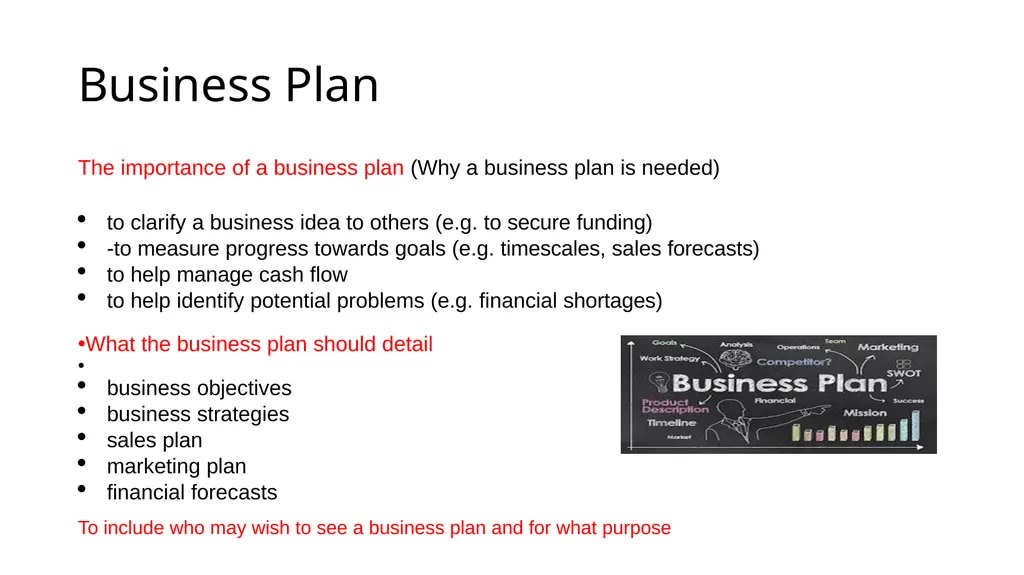
Business Plan The importance of a business plan (Why a business plan is needed)
to clarify a business idea to others (e.g. to secure funding)
-to measure progress towards goals (e.g. timescales, sales forecasts)
to help manage cash flow
to help identify potential problems (e.g. financial shortages)
What the business plan should detail
business objectives
business strategies
sales plan
marketing plan
financial forecasts
To include who may wish to see a business plan and for what purpose<br>
to clarify a business idea to others (e.g. to secure funding)
-to measure progress towards goals (e.g. timescales, sales forecasts)
to help manage cash flow
to help identify potential problems (e.g. financial shortages)
What the business plan should detail
business objectives
business strategies
sales plan
marketing plan
financial forecasts
To include who may wish to see a business plan and for what purpose<br>
29
Summary questions What is a franchise? Give an example
What is the difference between a sole trader and a partnership?
What is meant by the term ‘unlimited liability’?
Give 3 sources of capital for a new business?
What is the difference between crowdfunding and business angels?
What is a business plan?
Why may a business prepare a business plan?<br>
What is the difference between a sole trader and a partnership?
What is meant by the term ‘unlimited liability’?
Give 3 sources of capital for a new business?
What is the difference between crowdfunding and business angels?
What is a business plan?
Why may a business prepare a business plan?<br>
30
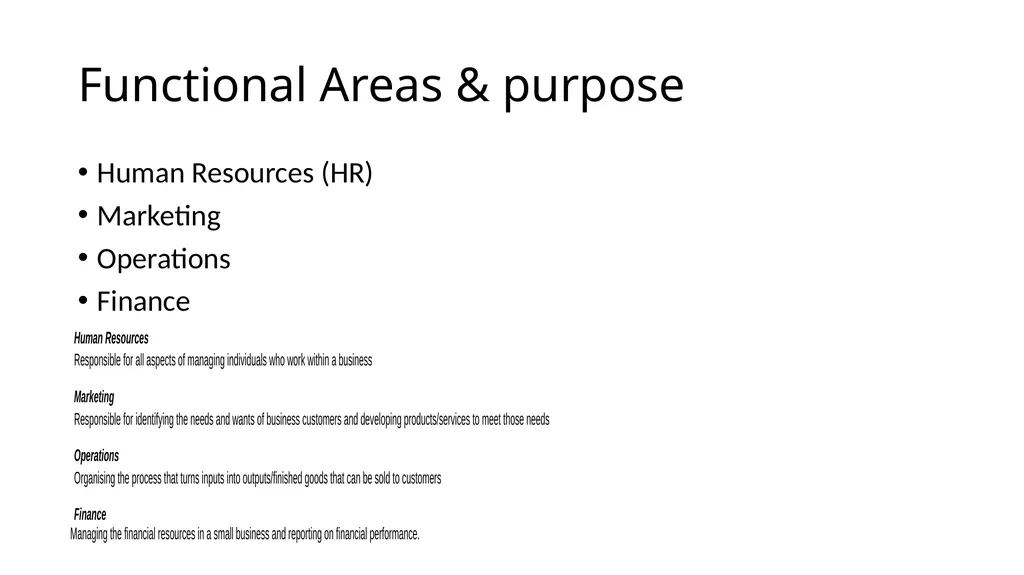
Functional Areas & purpose Human Resources (HR)
Marketing
Operations
Finance<br>
Marketing
Operations
Finance<br>
31
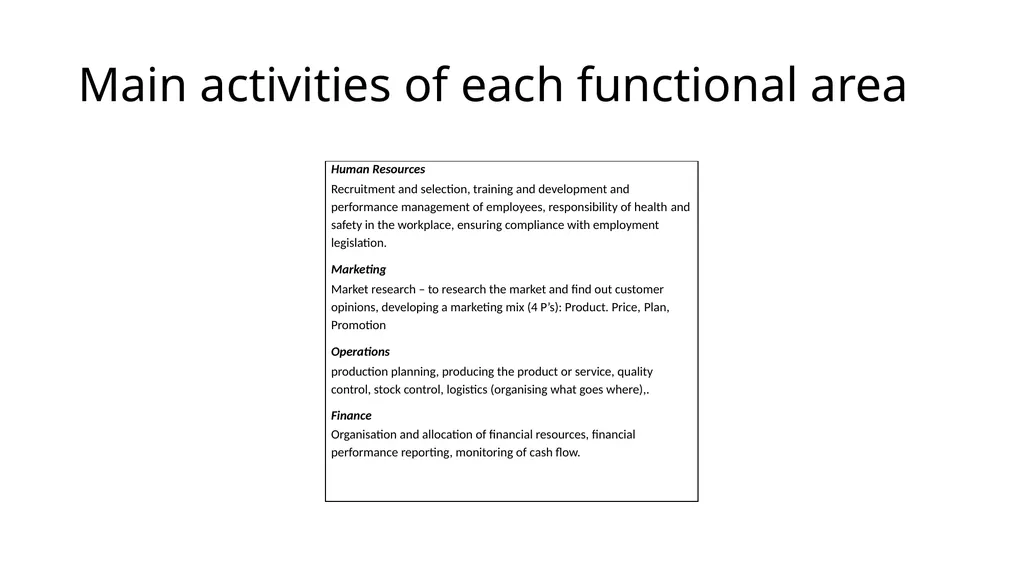
Main activities of each functional area<br>
32
Summary Questions What is a functional area?
Discuss the purpose of the marketing functional area
Explain the role of the operations department
Identify 3 key activities of the HR department
Explain the main activities of the finance department<br>
Discuss the purpose of the marketing functional area
Explain the role of the operations department
Identify 3 key activities of the HR department
Explain the main activities of the finance department<br>
33
Exam question James is considering using either the local newspaper or a local radio station to advertise his butchers shop, to help him compete against a new supermarket.
Recommend which method of advertising you think James should use. Justify your answer (8)<br>
Recommend which method of advertising you think James should use. Justify your answer (8)<br>
34
Exam question – Structure & guidance 7-8 marks
Evaluates more than one method with a justified recommendation based on analysis of both methods of advertising<br>
Evaluates more than one method with a justified recommendation based on analysis of both methods of advertising<br>