
Roadmapping for the Foundation Industries –
SB
Published · 20 slides · 0 views
1 / 1
Description
Roadmapping for the Foundation Industries Outcomes from Workshop TFI Network held its first virtual workshop, bringing the foundation industries together to discuss roadmapping to net zero. The workshop included an overview of the recent
Related Topics
Share
Embed code
Download this presentation From Below
"Roadmapping for the Foundation Industries –" is the property of its rightful owner. Permission is granted to download and print the materials on this website for personal, non-commercial use only, and to display it on your personal computer provided you do not modify the materials and that you retain all copyright notices contained in the materials. By downloading content from our website, you accept the terms of this agreement.
Presentation Transcript
01
Roadmapping for the Foundation Industries – Outcomes from Workshop<br>
02
TFI Network+ held its first virtual workshop, bringing the foundation industries together to discuss roadmapping to net zero. The workshop included an overview of the recent UKRI report on innovation in the foundation industries as well as presentations on energy efficient processes, raw material utilisation and thermal and related sensors.
A recording of the main stage sessions is now available for catch up here:
https://www.youtube.com/watch?v=i20FbwFZGKg
The Network has also compiled a list of pre-existing roadmaps for reference:
https://tfinetworkplus.org/tfi-network-workshop-pre-existing-sector-roadmaps/<br>
https://www.youtube.com/watch?v=i20FbwFZGKg
The Network has also compiled a list of pre-existing roadmaps for reference:
https://tfinetworkplus.org/tfi-network-workshop-pre-existing-sector-roadmaps/<br>
03
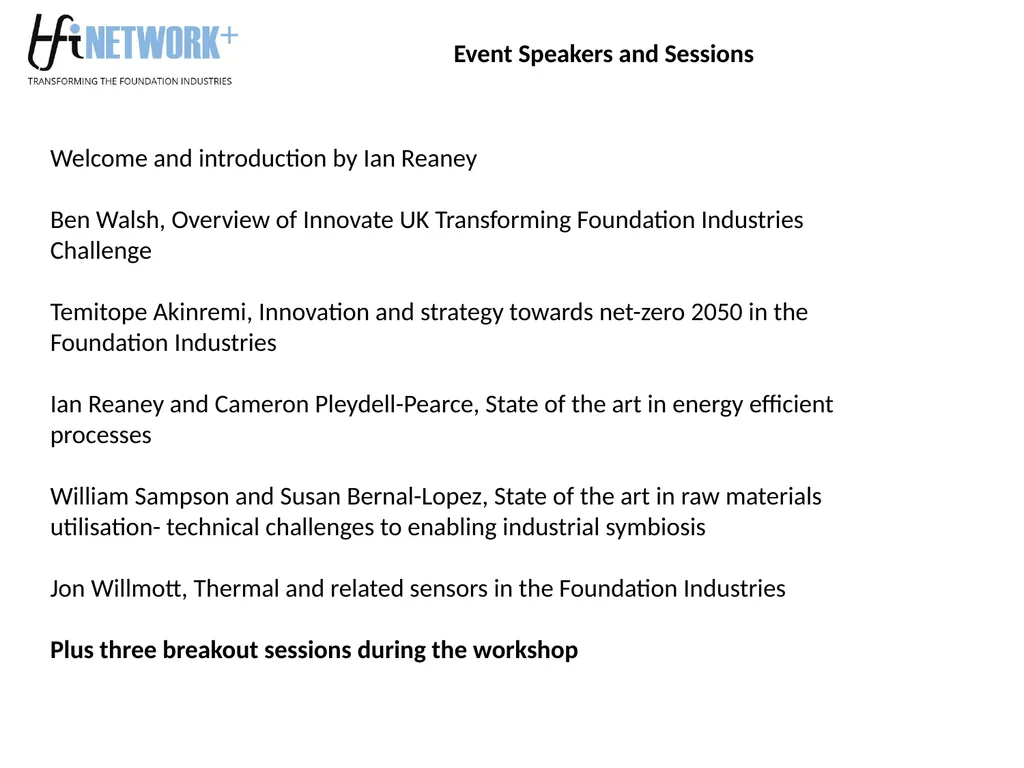
Event Speakers and Sessions Welcome and introduction by Ian Reaney
Ben Walsh, Overview of Innovate UK Transforming Foundation Industries Challenge
Temitope Akinremi, Innovation and strategy towards net-zero 2050 in the Foundation Industries
Ian Reaney and Cameron Pleydell-Pearce, State of the art in energy efficient processes
William Sampson and Susan Bernal-Lopez, State of the art in raw materials utilisation- technical challenges to enabling industrial symbiosis
Jon Willmott, Thermal and related sensors in the Foundation Industries
Plus three breakout sessions during the workshop<br>
Ben Walsh, Overview of Innovate UK Transforming Foundation Industries Challenge
Temitope Akinremi, Innovation and strategy towards net-zero 2050 in the Foundation Industries
Ian Reaney and Cameron Pleydell-Pearce, State of the art in energy efficient processes
William Sampson and Susan Bernal-Lopez, State of the art in raw materials utilisation- technical challenges to enabling industrial symbiosis
Jon Willmott, Thermal and related sensors in the Foundation Industries
Plus three breakout sessions during the workshop<br>
04
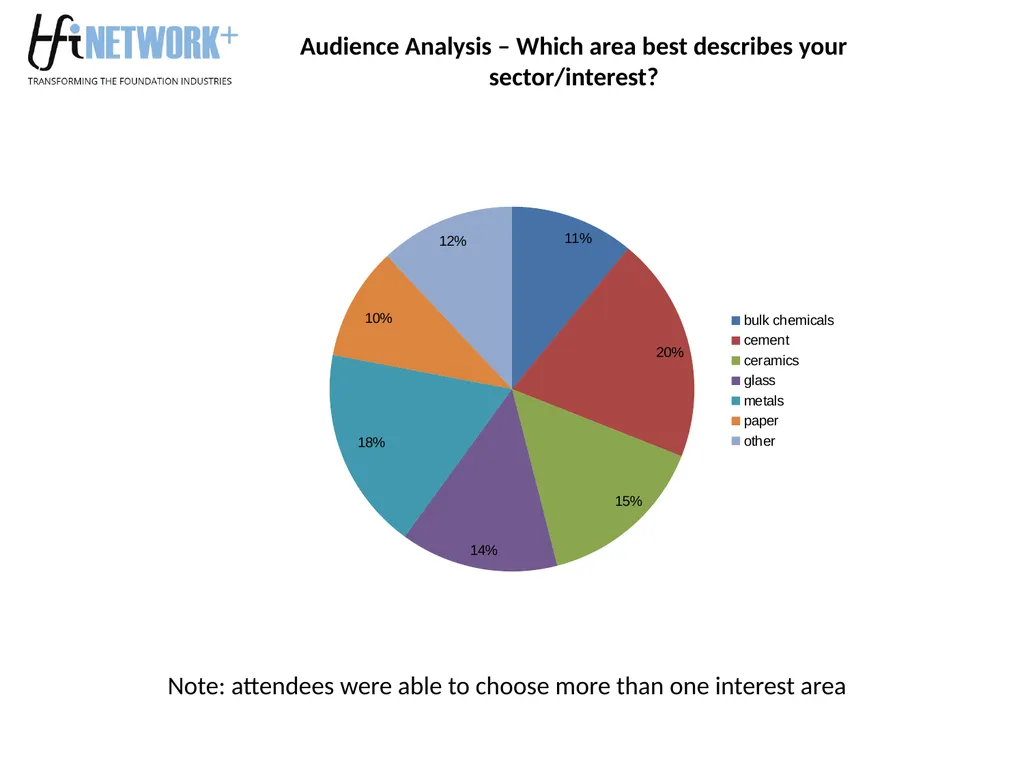
Audience Analysis – Which area best describes your sector/interest? Note: attendees were able to choose more than one interest area<br>
05
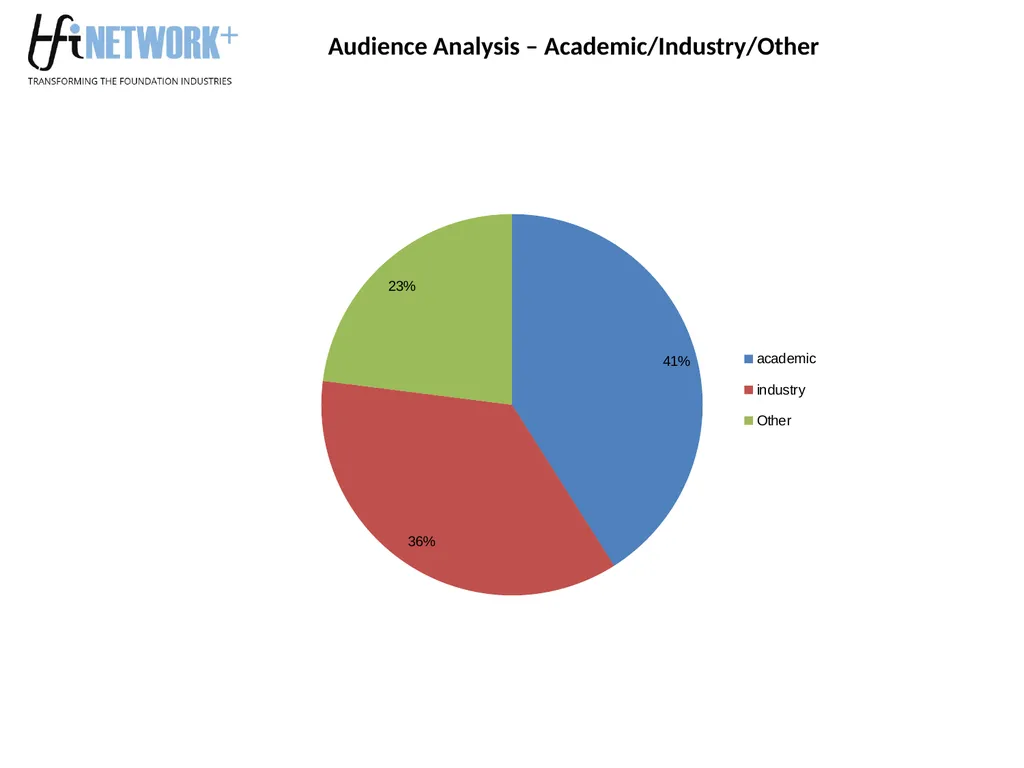
Audience Analysis – Academic/Industry/Other<br>
06
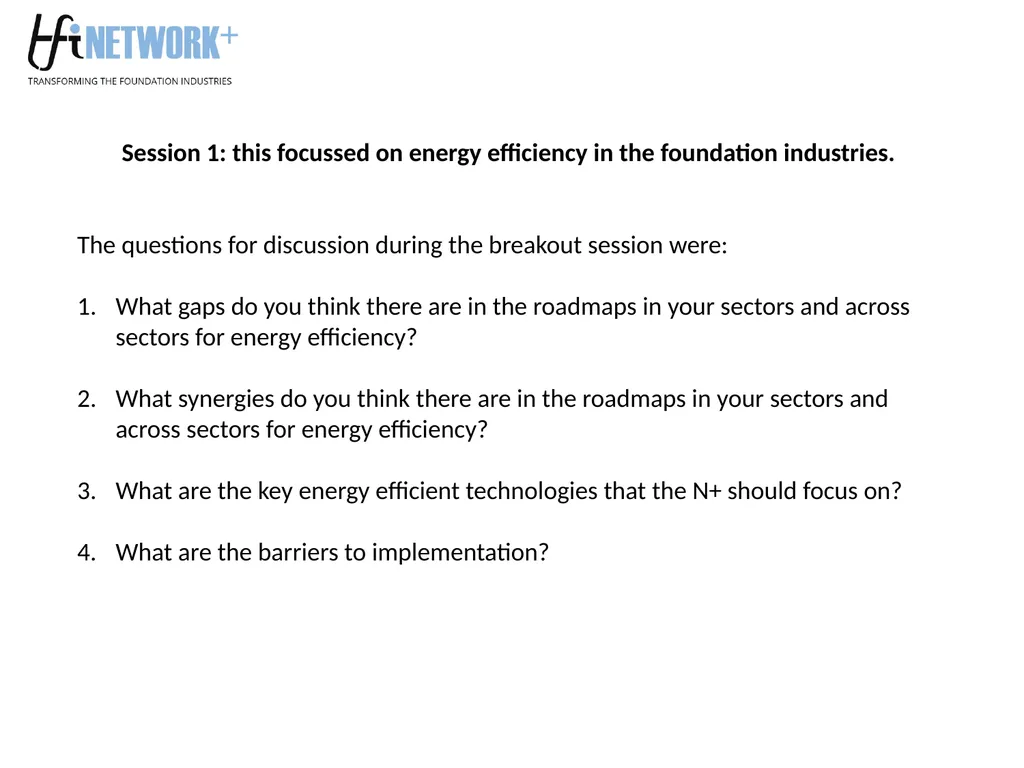
Session 1: this focussed on energy efficiency in the foundation industries.
The questions for discussion during the breakout session were:
What gaps do you think there are in the roadmaps in your sectors and across sectors for energy efficiency?
What synergies do you think there are in the roadmaps in your sectors and across sectors for energy efficiency?
What are the key energy efficient technologies that the N+ should focus on?
What are the barriers to implementation?<br>
The questions for discussion during the breakout session were:
What gaps do you think there are in the roadmaps in your sectors and across sectors for energy efficiency?
What synergies do you think there are in the roadmaps in your sectors and across sectors for energy efficiency?
What are the key energy efficient technologies that the N+ should focus on?
What are the barriers to implementation?<br>
07
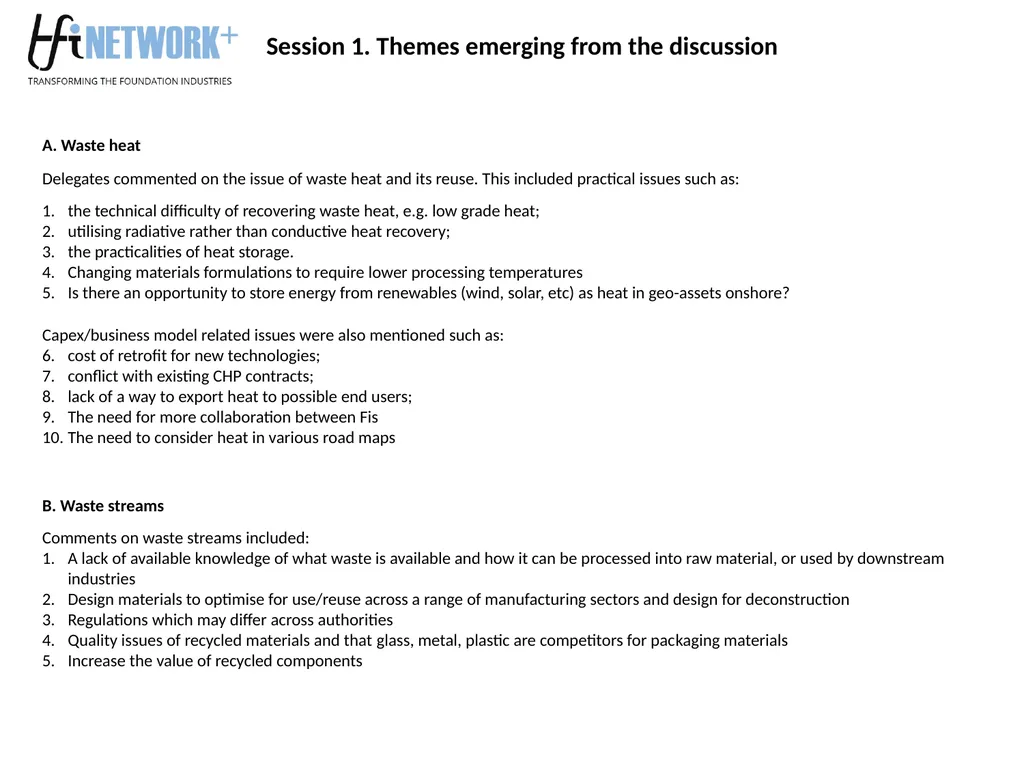
Session 1. Themes emerging from the discussion A. Waste heat
Delegates commented on the issue of waste heat and its reuse. This included practical issues such as:
the technical difficulty of recovering waste heat, e.g. low grade heat;
utilising radiative rather than conductive heat recovery;
the practicalities of heat storage.
Changing materials formulations to require lower processing temperatures
Is there an opportunity to store energy from renewables (wind, solar, etc) as heat in geo-assets onshore?
Capex/business model related issues were also mentioned such as:
cost of retrofit for new technologies;
conflict with existing CHP contracts;
lack of a way to export heat to possible end users;
The need for more collaboration between Fis
The need to consider heat in various road maps B. Waste streams
Comments on waste streams included:
A lack of available knowledge of what waste is available and how it can be processed into raw material, or used by downstream industries
Design materials to optimise for use/reuse across a range of manufacturing sectors and design for deconstruction
Regulations which may differ across authorities
Quality issues of recycled materials and that glass, metal, plastic are competitors for packaging materials
Increase the value of recycled components<br>
Delegates commented on the issue of waste heat and its reuse. This included practical issues such as:
the technical difficulty of recovering waste heat, e.g. low grade heat;
utilising radiative rather than conductive heat recovery;
the practicalities of heat storage.
Changing materials formulations to require lower processing temperatures
Is there an opportunity to store energy from renewables (wind, solar, etc) as heat in geo-assets onshore?
Capex/business model related issues were also mentioned such as:
cost of retrofit for new technologies;
conflict with existing CHP contracts;
lack of a way to export heat to possible end users;
The need for more collaboration between Fis
The need to consider heat in various road maps B. Waste streams
Comments on waste streams included:
A lack of available knowledge of what waste is available and how it can be processed into raw material, or used by downstream industries
Design materials to optimise for use/reuse across a range of manufacturing sectors and design for deconstruction
Regulations which may differ across authorities
Quality issues of recycled materials and that glass, metal, plastic are competitors for packaging materials
Increase the value of recycled components<br>
08
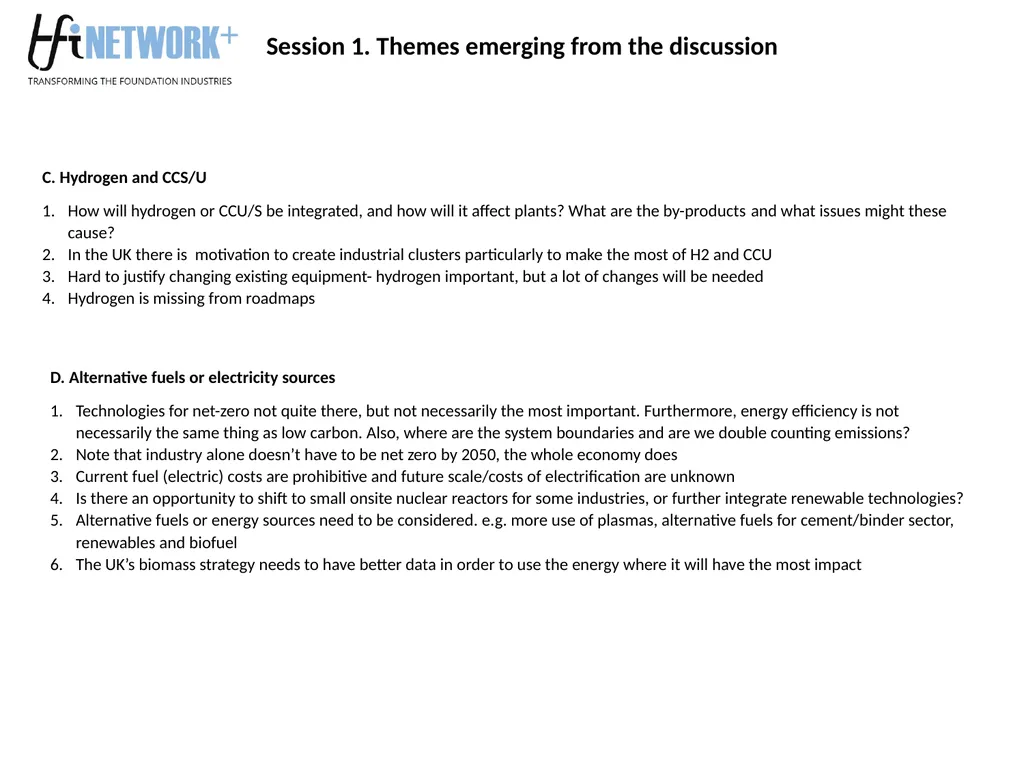
C. Hydrogen and CCS/U
How will hydrogen or CCU/S be integrated, and how will it affect plants? What are the by-products and what issues might these cause?
In the UK there is motivation to create industrial clusters particularly to make the most of H2 and CCU
Hard to justify changing existing equipment- hydrogen important, but a lot of changes will be needed
Hydrogen is missing from roadmaps D. Alternative fuels or electricity sources
Technologies for net-zero not quite there, but not necessarily the most important. Furthermore, energy efficiency is not necessarily the same thing as low carbon. Also, where are the system boundaries and are we double counting emissions?
Note that industry alone doesn’t have to be net zero by 2050, the whole economy does
Current fuel (electric) costs are prohibitive and future scale/costs of electrification are unknown
Is there an opportunity to shift to small onsite nuclear reactors for some industries, or further integrate renewable technologies?
Alternative fuels or energy sources need to be considered. e.g. more use of plasmas, alternative fuels for cement/binder sector, renewables and biofuel
The UK’s biomass strategy needs to have better data in order to use the energy where it will have the most impact Session 1. Themes emerging from the discussion<br>
How will hydrogen or CCU/S be integrated, and how will it affect plants? What are the by-products and what issues might these cause?
In the UK there is motivation to create industrial clusters particularly to make the most of H2 and CCU
Hard to justify changing existing equipment- hydrogen important, but a lot of changes will be needed
Hydrogen is missing from roadmaps D. Alternative fuels or electricity sources
Technologies for net-zero not quite there, but not necessarily the most important. Furthermore, energy efficiency is not necessarily the same thing as low carbon. Also, where are the system boundaries and are we double counting emissions?
Note that industry alone doesn’t have to be net zero by 2050, the whole economy does
Current fuel (electric) costs are prohibitive and future scale/costs of electrification are unknown
Is there an opportunity to shift to small onsite nuclear reactors for some industries, or further integrate renewable technologies?
Alternative fuels or energy sources need to be considered. e.g. more use of plasmas, alternative fuels for cement/binder sector, renewables and biofuel
The UK’s biomass strategy needs to have better data in order to use the energy where it will have the most impact Session 1. Themes emerging from the discussion<br>
09
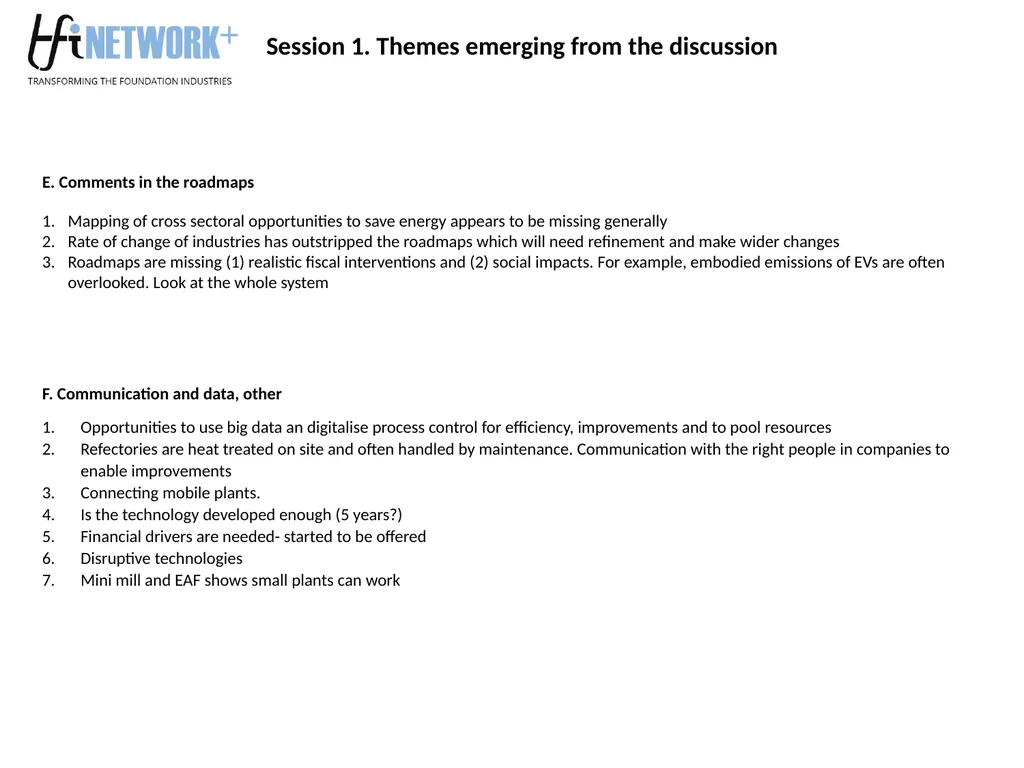
E. Comments in the roadmaps
Mapping of cross sectoral opportunities to save energy appears to be missing generally
Rate of change of industries has outstripped the roadmaps which will need refinement and make wider changes
Roadmaps are missing (1) realistic fiscal interventions and (2) social impacts. For example, embodied emissions of EVs are often overlooked. Look at the whole system F. Communication and data, other
Opportunities to use big data an digitalise process control for efficiency, improvements and to pool resources
Refectories are heat treated on site and often handled by maintenance. Communication with the right people in companies to enable improvements
Connecting mobile plants.
Is the technology developed enough (5 years?)
Financial drivers are needed- started to be offered
Disruptive technologies
Mini mill and EAF shows small plants can work Session 1. Themes emerging from the discussion<br>
Mapping of cross sectoral opportunities to save energy appears to be missing generally
Rate of change of industries has outstripped the roadmaps which will need refinement and make wider changes
Roadmaps are missing (1) realistic fiscal interventions and (2) social impacts. For example, embodied emissions of EVs are often overlooked. Look at the whole system F. Communication and data, other
Opportunities to use big data an digitalise process control for efficiency, improvements and to pool resources
Refectories are heat treated on site and often handled by maintenance. Communication with the right people in companies to enable improvements
Connecting mobile plants.
Is the technology developed enough (5 years?)
Financial drivers are needed- started to be offered
Disruptive technologies
Mini mill and EAF shows small plants can work Session 1. Themes emerging from the discussion<br>
10
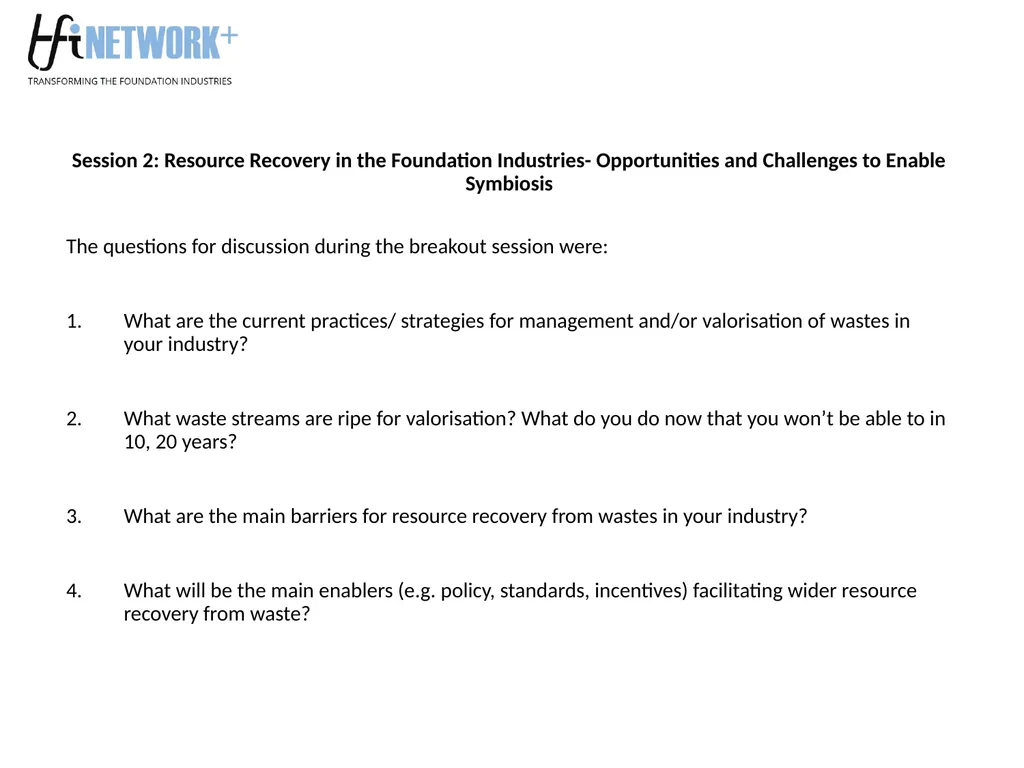
Session 2: Resource Recovery in the Foundation Industries- Opportunities and Challenges to Enable Symbiosis
The questions for discussion during the breakout session were:
What are the current practices/ strategies for management and/or valorisation of wastes in your industry?
What waste streams are ripe for valorisation? What do you do now that you won’t be able to in 10, 20 years?
What are the main barriers for resource recovery from wastes in your industry?
What will be the main enablers (e.g. policy, standards, incentives) facilitating wider resource recovery from waste?<br>
The questions for discussion during the breakout session were:
What are the current practices/ strategies for management and/or valorisation of wastes in your industry?
What waste streams are ripe for valorisation? What do you do now that you won’t be able to in 10, 20 years?
What are the main barriers for resource recovery from wastes in your industry?
What will be the main enablers (e.g. policy, standards, incentives) facilitating wider resource recovery from waste?<br>
11
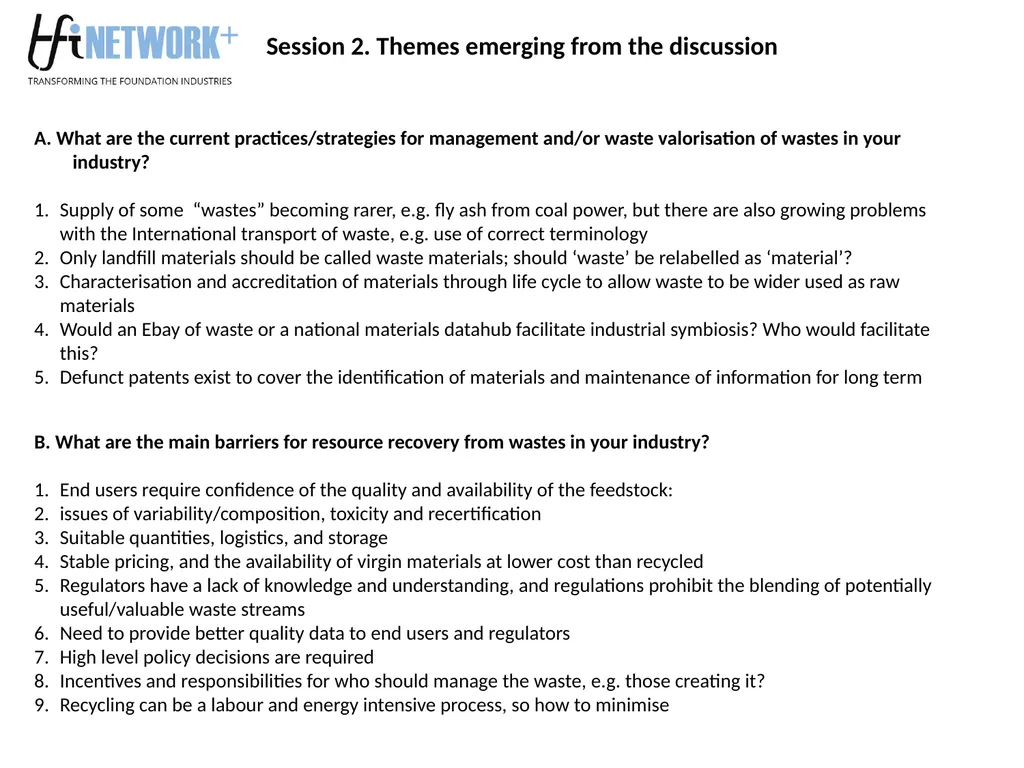
Session 2. Themes emerging from the discussion A. What are the current practices/strategies for management and/or waste valorisation of wastes in your industry?
Supply of some “wastes” becoming rarer, e.g. fly ash from coal power, but there are also growing problems with the International transport of waste, e.g. use of correct terminology
Only landfill materials should be called waste materials; should ‘waste’ be relabelled as ‘material’?
Characterisation and accreditation of materials through life cycle to allow waste to be wider used as raw materials
Would an Ebay of waste or a national materials datahub facilitate industrial symbiosis? Who would facilitate this?
Defunct patents exist to cover the identification of materials and maintenance of information for long term B. What are the main barriers for resource recovery from wastes in your industry?
End users require confidence of the quality and availability of the feedstock:
issues of variability/composition, toxicity and recertification
Suitable quantities, logistics, and storage
Stable pricing, and the availability of virgin materials at lower cost than recycled
Regulators have a lack of knowledge and understanding, and regulations prohibit the blending of potentially useful/valuable waste streams
Need to provide better quality data to end users and regulators
High level policy decisions are required
Incentives and responsibilities for who should manage the waste, e.g. those creating it?
Recycling can be a labour and energy intensive process, so how to minimise<br>
Supply of some “wastes” becoming rarer, e.g. fly ash from coal power, but there are also growing problems with the International transport of waste, e.g. use of correct terminology
Only landfill materials should be called waste materials; should ‘waste’ be relabelled as ‘material’?
Characterisation and accreditation of materials through life cycle to allow waste to be wider used as raw materials
Would an Ebay of waste or a national materials datahub facilitate industrial symbiosis? Who would facilitate this?
Defunct patents exist to cover the identification of materials and maintenance of information for long term B. What are the main barriers for resource recovery from wastes in your industry?
End users require confidence of the quality and availability of the feedstock:
issues of variability/composition, toxicity and recertification
Suitable quantities, logistics, and storage
Stable pricing, and the availability of virgin materials at lower cost than recycled
Regulators have a lack of knowledge and understanding, and regulations prohibit the blending of potentially useful/valuable waste streams
Need to provide better quality data to end users and regulators
High level policy decisions are required
Incentives and responsibilities for who should manage the waste, e.g. those creating it?
Recycling can be a labour and energy intensive process, so how to minimise<br>
12
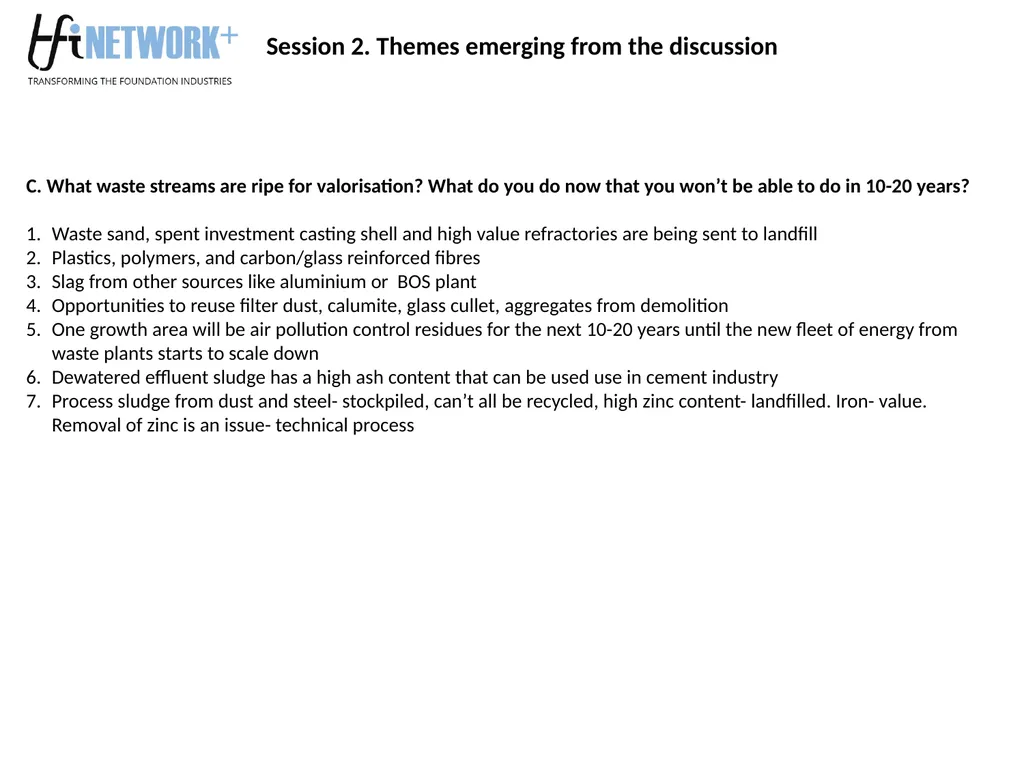
Session 2. Themes emerging from the discussion C. What waste streams are ripe for valorisation? What do you do now that you won’t be able to do in 10-20 years?
Waste sand, spent investment casting shell and high value refractories are being sent to landfill
Plastics, polymers, and carbon/glass reinforced fibres
Slag from other sources like aluminium or BOS plant
Opportunities to reuse filter dust, calumite, glass cullet, aggregates from demolition
One growth area will be air pollution control residues for the next 10-20 years until the new fleet of energy from waste plants starts to scale down
Dewatered effluent sludge has a high ash content that can be used use in cement industry
Process sludge from dust and steel- stockpiled, can’t all be recycled, high zinc content- landfilled. Iron- value. Removal of zinc is an issue- technical process<br>
Waste sand, spent investment casting shell and high value refractories are being sent to landfill
Plastics, polymers, and carbon/glass reinforced fibres
Slag from other sources like aluminium or BOS plant
Opportunities to reuse filter dust, calumite, glass cullet, aggregates from demolition
One growth area will be air pollution control residues for the next 10-20 years until the new fleet of energy from waste plants starts to scale down
Dewatered effluent sludge has a high ash content that can be used use in cement industry
Process sludge from dust and steel- stockpiled, can’t all be recycled, high zinc content- landfilled. Iron- value. Removal of zinc is an issue- technical process<br>
13
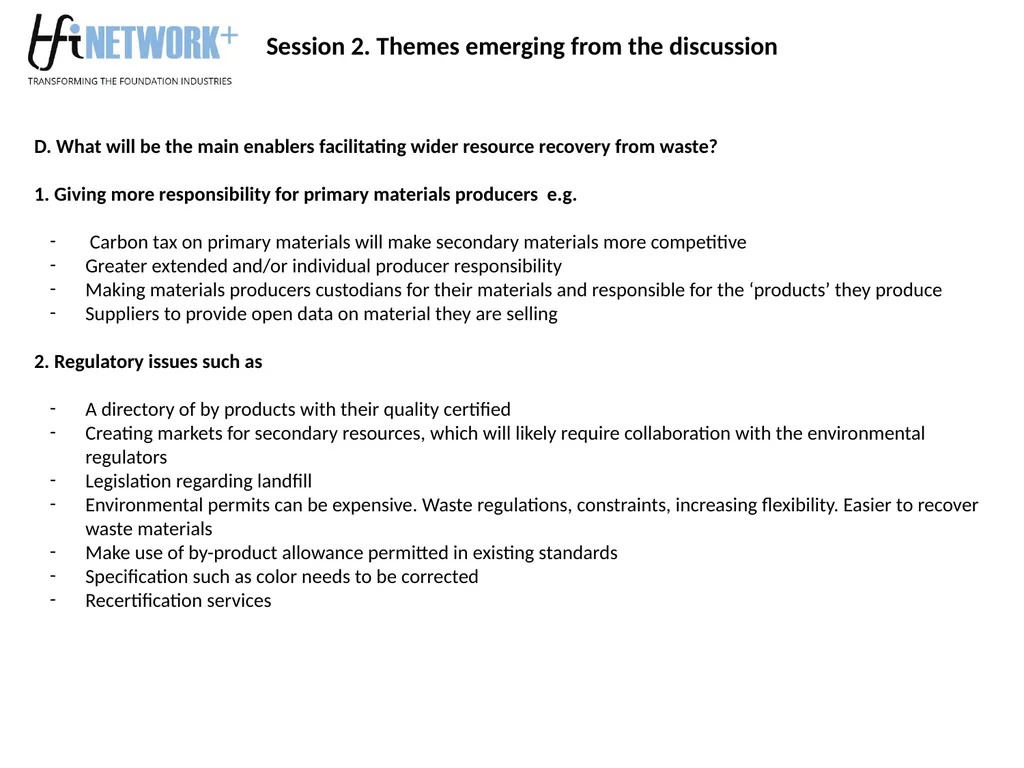
Session 2. Themes emerging from the discussion D. What will be the main enablers facilitating wider resource recovery from waste?
1. Giving more responsibility for primary materials producers e.g.
Carbon tax on primary materials will make secondary materials more competitive
Greater extended and/or individual producer responsibility
Making materials producers custodians for their materials and responsible for the ‘products’ they produce
Suppliers to provide open data on material they are selling
2. Regulatory issues such as
A directory of by products with their quality certified
Creating markets for secondary resources, which will likely require collaboration with the environmental regulators
Legislation regarding landfill
Environmental permits can be expensive. Waste regulations, constraints, increasing flexibility. Easier to recover waste materials
Make use of by-product allowance permitted in existing standards
Specification such as color needs to be corrected
Recertification services<br>
1. Giving more responsibility for primary materials producers e.g.
Carbon tax on primary materials will make secondary materials more competitive
Greater extended and/or individual producer responsibility
Making materials producers custodians for their materials and responsible for the ‘products’ they produce
Suppliers to provide open data on material they are selling
2. Regulatory issues such as
A directory of by products with their quality certified
Creating markets for secondary resources, which will likely require collaboration with the environmental regulators
Legislation regarding landfill
Environmental permits can be expensive. Waste regulations, constraints, increasing flexibility. Easier to recover waste materials
Make use of by-product allowance permitted in existing standards
Specification such as color needs to be corrected
Recertification services<br>
14
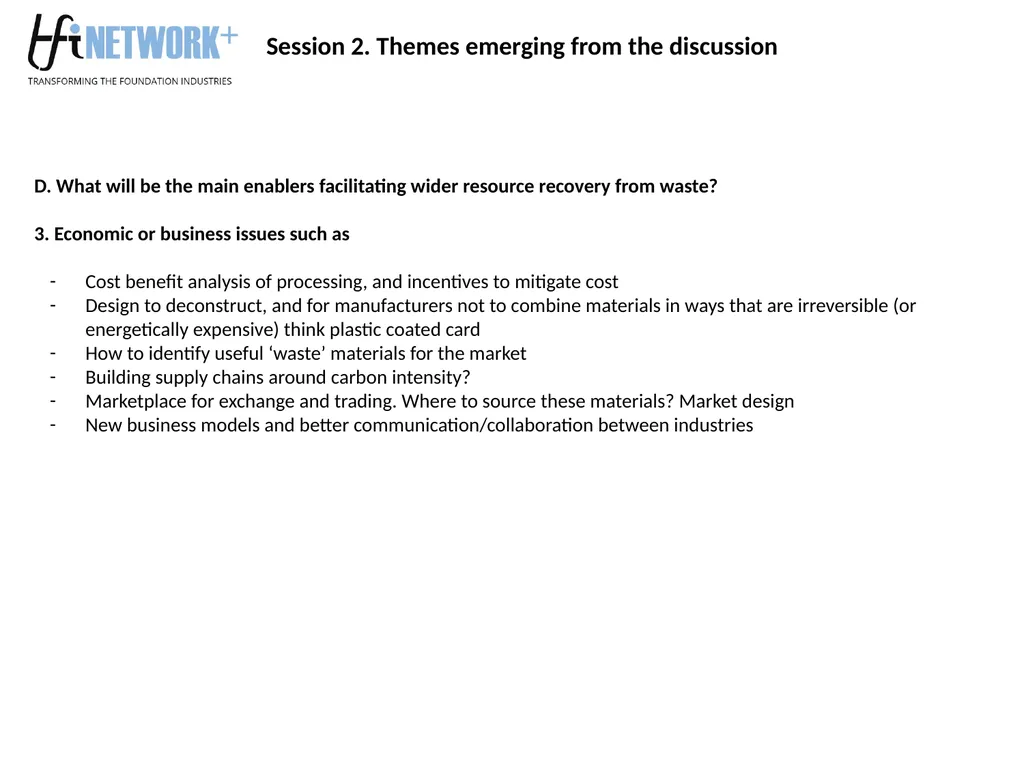
Session 2. Themes emerging from the discussion D. What will be the main enablers facilitating wider resource recovery from waste?
3. Economic or business issues such as
Cost benefit analysis of processing, and incentives to mitigate cost
Design to deconstruct, and for manufacturers not to combine materials in ways that are irreversible (or energetically expensive) think plastic coated card
How to identify useful ‘waste’ materials for the market
Building supply chains around carbon intensity?
Marketplace for exchange and trading. Where to source these materials? Market design
New business models and better communication/collaboration between industries<br>
3. Economic or business issues such as
Cost benefit analysis of processing, and incentives to mitigate cost
Design to deconstruct, and for manufacturers not to combine materials in ways that are irreversible (or energetically expensive) think plastic coated card
How to identify useful ‘waste’ materials for the market
Building supply chains around carbon intensity?
Marketplace for exchange and trading. Where to source these materials? Market design
New business models and better communication/collaboration between industries<br>
15
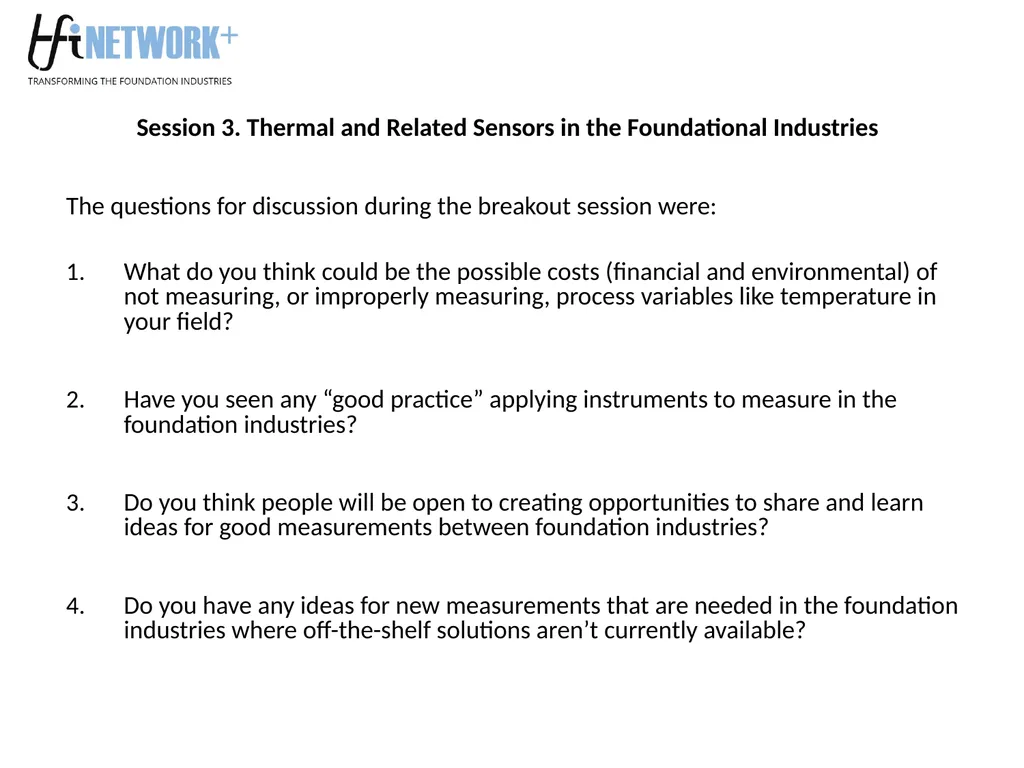
Session 3. Thermal and Related Sensors in the Foundational Industries The questions for discussion during the breakout session were:
What do you think could be the possible costs (financial and environmental) of not measuring, or improperly measuring, process variables like temperature in your field?
Have you seen any “good practice” applying instruments to measure in the foundation industries?
Do you think people will be open to creating opportunities to share and learn ideas for good measurements between foundation industries?
Do you have any ideas for new measurements that are needed in the foundation industries where off-the-shelf solutions aren’t currently available?<br>
What do you think could be the possible costs (financial and environmental) of not measuring, or improperly measuring, process variables like temperature in your field?
Have you seen any “good practice” applying instruments to measure in the foundation industries?
Do you think people will be open to creating opportunities to share and learn ideas for good measurements between foundation industries?
Do you have any ideas for new measurements that are needed in the foundation industries where off-the-shelf solutions aren’t currently available?<br>
16
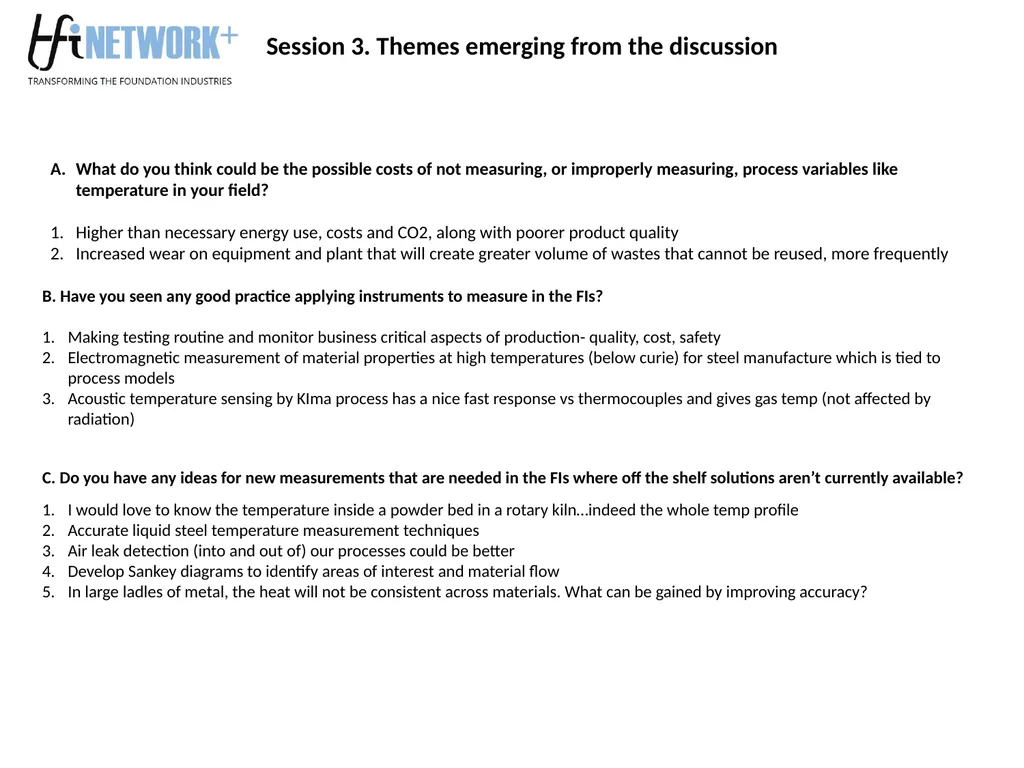
What do you think could be the possible costs of not measuring, or improperly measuring, process variables like temperature in your field?
Higher than necessary energy use, costs and CO2, along with poorer product quality
Increased wear on equipment and plant that will create greater volume of wastes that cannot be reused, more frequently B. Have you seen any good practice applying instruments to measure in the FIs?
Making testing routine and monitor business critical aspects of production- quality, cost, safety
Electromagnetic measurement of material properties at high temperatures (below curie) for steel manufacture which is tied to process models
Acoustic temperature sensing by KIma process has a nice fast response vs thermocouples and gives gas temp (not affected by radiation) C. Do you have any ideas for new measurements that are needed in the FIs where off the shelf solutions aren’t currently available?
I would love to know the temperature inside a powder bed in a rotary kiln…indeed the whole temp profile
Accurate liquid steel temperature measurement techniques
Air leak detection (into and out of) our processes could be better
Develop Sankey diagrams to identify areas of interest and material flow
In large ladles of metal, the heat will not be consistent across materials. What can be gained by improving accuracy? Session 3. Themes emerging from the discussion<br>
Higher than necessary energy use, costs and CO2, along with poorer product quality
Increased wear on equipment and plant that will create greater volume of wastes that cannot be reused, more frequently B. Have you seen any good practice applying instruments to measure in the FIs?
Making testing routine and monitor business critical aspects of production- quality, cost, safety
Electromagnetic measurement of material properties at high temperatures (below curie) for steel manufacture which is tied to process models
Acoustic temperature sensing by KIma process has a nice fast response vs thermocouples and gives gas temp (not affected by radiation) C. Do you have any ideas for new measurements that are needed in the FIs where off the shelf solutions aren’t currently available?
I would love to know the temperature inside a powder bed in a rotary kiln…indeed the whole temp profile
Accurate liquid steel temperature measurement techniques
Air leak detection (into and out of) our processes could be better
Develop Sankey diagrams to identify areas of interest and material flow
In large ladles of metal, the heat will not be consistent across materials. What can be gained by improving accuracy? Session 3. Themes emerging from the discussion<br>
17
Session 3. Themes emerging from the discussion Some common issues identified include:
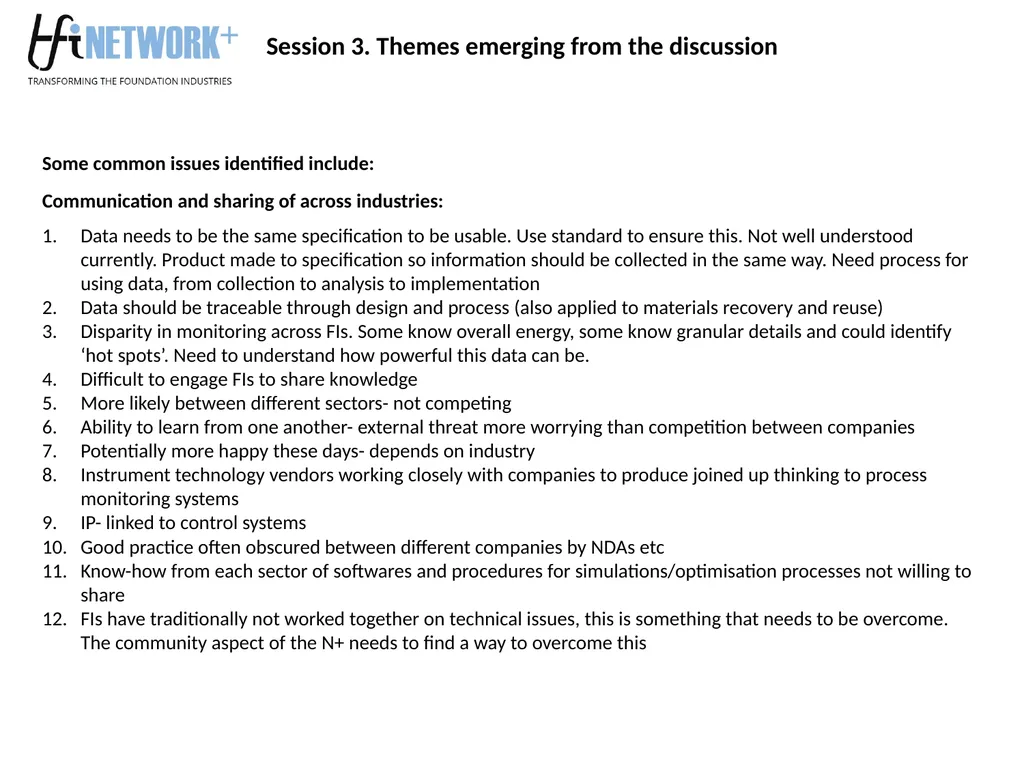
Communication and sharing of across industries:
Data needs to be the same specification to be usable. Use standard to ensure this. Not well understood currently. Product made to specification so information should be collected in the same way. Need process for using data, from collection to analysis to implementation
Data should be traceable through design and process (also applied to materials recovery and reuse)
Disparity in monitoring across FIs. Some know overall energy, some know granular details and could identify ‘hot spots’. Need to understand how powerful this data can be.
Difficult to engage FIs to share knowledge
More likely between different sectors- not competing
Ability to learn from one another- external threat more worrying than competition between companies
Potentially more happy these days- depends on industry
Instrument technology vendors working closely with companies to produce joined up thinking to process monitoring systems
IP- linked to control systems
Good practice often obscured between different companies by NDAs etc
Know-how from each sector of softwares and procedures for simulations/optimisation processes not willing to share
FIs have traditionally not worked together on technical issues, this is something that needs to be overcome. The community aspect of the N+ needs to find a way to overcome this<br>
Communication and sharing of across industries:
Data needs to be the same specification to be usable. Use standard to ensure this. Not well understood currently. Product made to specification so information should be collected in the same way. Need process for using data, from collection to analysis to implementation
Data should be traceable through design and process (also applied to materials recovery and reuse)
Disparity in monitoring across FIs. Some know overall energy, some know granular details and could identify ‘hot spots’. Need to understand how powerful this data can be.
Difficult to engage FIs to share knowledge
More likely between different sectors- not competing
Ability to learn from one another- external threat more worrying than competition between companies
Potentially more happy these days- depends on industry
Instrument technology vendors working closely with companies to produce joined up thinking to process monitoring systems
IP- linked to control systems
Good practice often obscured between different companies by NDAs etc
Know-how from each sector of softwares and procedures for simulations/optimisation processes not willing to share
FIs have traditionally not worked together on technical issues, this is something that needs to be overcome. The community aspect of the N+ needs to find a way to overcome this<br>
18
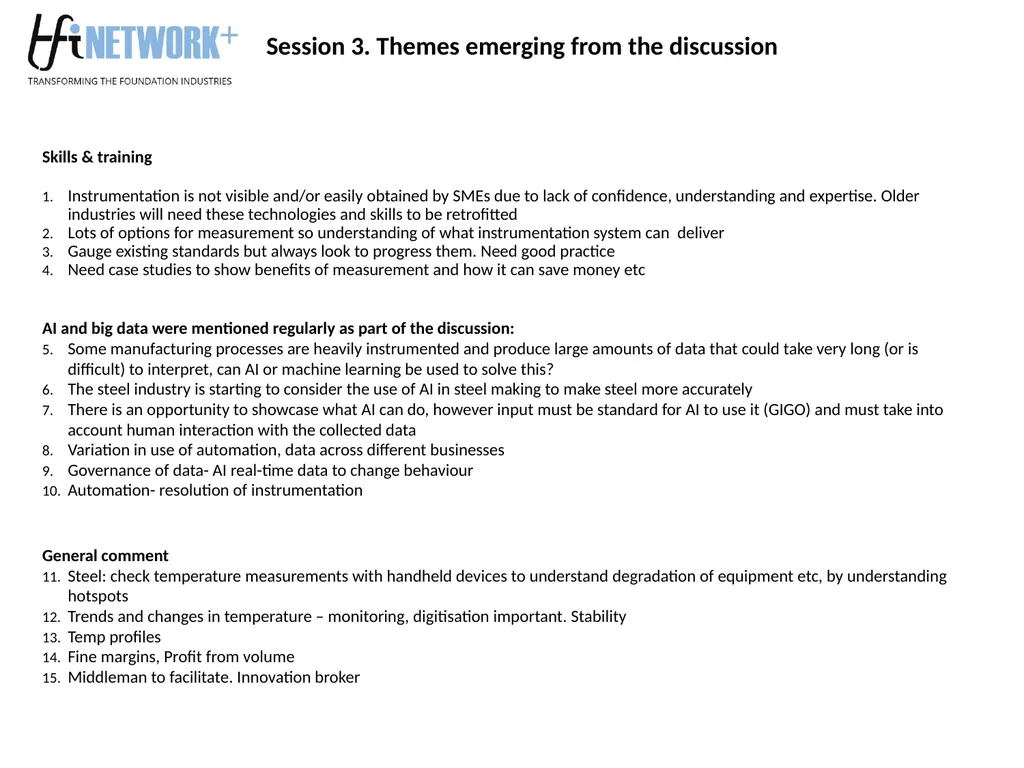
Session 3. Themes emerging from the discussion Skills & training
Instrumentation is not visible and/or easily obtained by SMEs due to lack of confidence, understanding and expertise. Older industries will need these technologies and skills to be retrofitted
Lots of options for measurement so understanding of what instrumentation system can deliver
Gauge existing standards but always look to progress them. Need good practice
Need case studies to show benefits of measurement and how it can save money etc
AI and big data were mentioned regularly as part of the discussion:
Some manufacturing processes are heavily instrumented and produce large amounts of data that could take very long (or is difficult) to interpret, can AI or machine learning be used to solve this?
The steel industry is starting to consider the use of AI in steel making to make steel more accurately
There is an opportunity to showcase what AI can do, however input must be standard for AI to use it (GIGO) and must take into account human interaction with the collected data
Variation in use of automation, data across different businesses
Governance of data- AI real-time data to change behaviour
Automation- resolution of instrumentation
General comment
Steel: check temperature measurements with handheld devices to understand degradation of equipment etc, by understanding hotspots
Trends and changes in temperature – monitoring, digitisation important. Stability
Temp profiles
Fine margins, Profit from volume
Middleman to facilitate. Innovation broker<br>
Instrumentation is not visible and/or easily obtained by SMEs due to lack of confidence, understanding and expertise. Older industries will need these technologies and skills to be retrofitted
Lots of options for measurement so understanding of what instrumentation system can deliver
Gauge existing standards but always look to progress them. Need good practice
Need case studies to show benefits of measurement and how it can save money etc
AI and big data were mentioned regularly as part of the discussion:
Some manufacturing processes are heavily instrumented and produce large amounts of data that could take very long (or is difficult) to interpret, can AI or machine learning be used to solve this?
The steel industry is starting to consider the use of AI in steel making to make steel more accurately
There is an opportunity to showcase what AI can do, however input must be standard for AI to use it (GIGO) and must take into account human interaction with the collected data
Variation in use of automation, data across different businesses
Governance of data- AI real-time data to change behaviour
Automation- resolution of instrumentation
General comment
Steel: check temperature measurements with handheld devices to understand degradation of equipment etc, by understanding hotspots
Trends and changes in temperature – monitoring, digitisation important. Stability
Temp profiles
Fine margins, Profit from volume
Middleman to facilitate. Innovation broker<br>
19
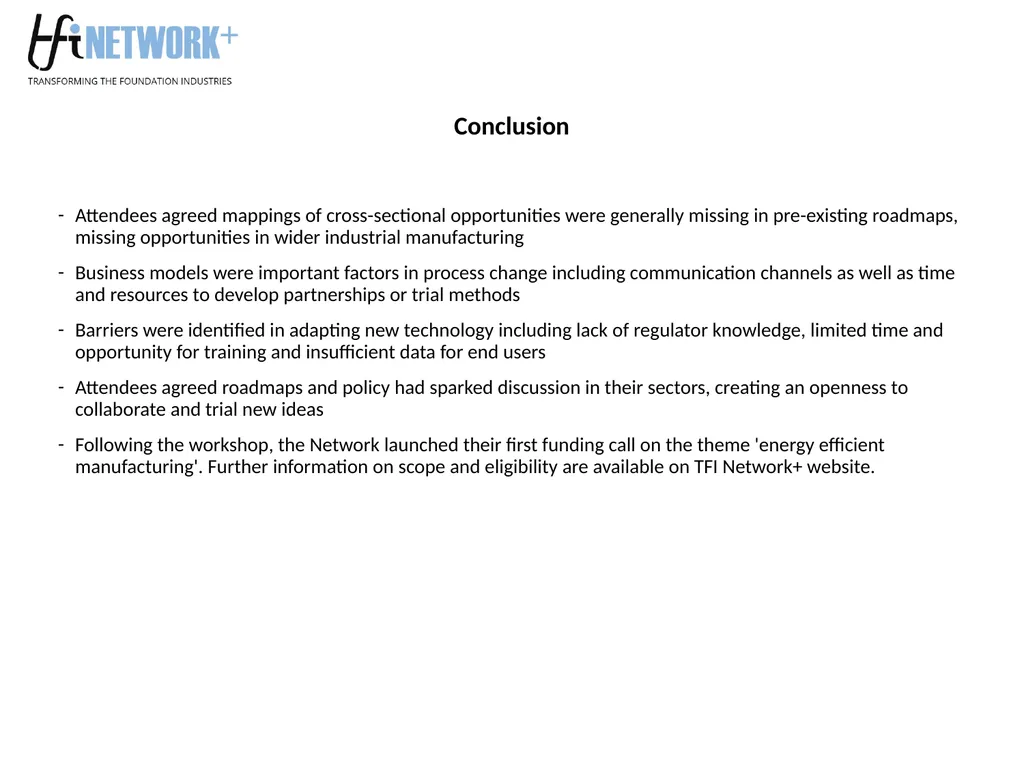
Conclusion Attendees agreed mappings of cross-sectional opportunities were generally missing in pre-existing roadmaps, missing opportunities in wider industrial manufacturing
Business models were important factors in process change including communication channels as well as time and resources to develop partnerships or trial methods
Barriers were identified in adapting new technology including lack of regulator knowledge, limited time and opportunity for training and insufficient data for end users
Attendees agreed roadmaps and policy had sparked discussion in their sectors, creating an openness to collaborate and trial new ideas
Following the workshop, the Network launched their first funding call on the theme 'energy efficient manufacturing'. Further information on scope and eligibility are available on TFI Network+ website.<br>
Business models were important factors in process change including communication channels as well as time and resources to develop partnerships or trial methods
Barriers were identified in adapting new technology including lack of regulator knowledge, limited time and opportunity for training and insufficient data for end users
Attendees agreed roadmaps and policy had sparked discussion in their sectors, creating an openness to collaborate and trial new ideas
Following the workshop, the Network launched their first funding call on the theme 'energy efficient manufacturing'. Further information on scope and eligibility are available on TFI Network+ website.<br>
20
Thank you to all our workshop attendees<br>