Robert Arnold Federal Highway Administration Director, Office of Transportation Management Transportation Systems Cyber-Security Framework A process to Monitor Alert Advise OwnerOperators of ITS deployments From just annoying To
"Robert Arnold Federal Highway Administration" is the property of its rightful owner. Permission is granted to
download and print the materials on this website for personal, non-commercial use only, and to display it
on your personal computer provided you do not modify the materials and that you retain all copyright
notices contained in the materials. By downloading content from our website, you accept the terms of this
agreement.
Presentation Transcript
01
Robert Arnold
Federal Highway Administration
Director, Office of Transportation Management<br>
02
Transportation Systems Cyber-Security Framework A process to
Monitor – Alert – Advise
Owner/Operators of ITS deployments<br>
03
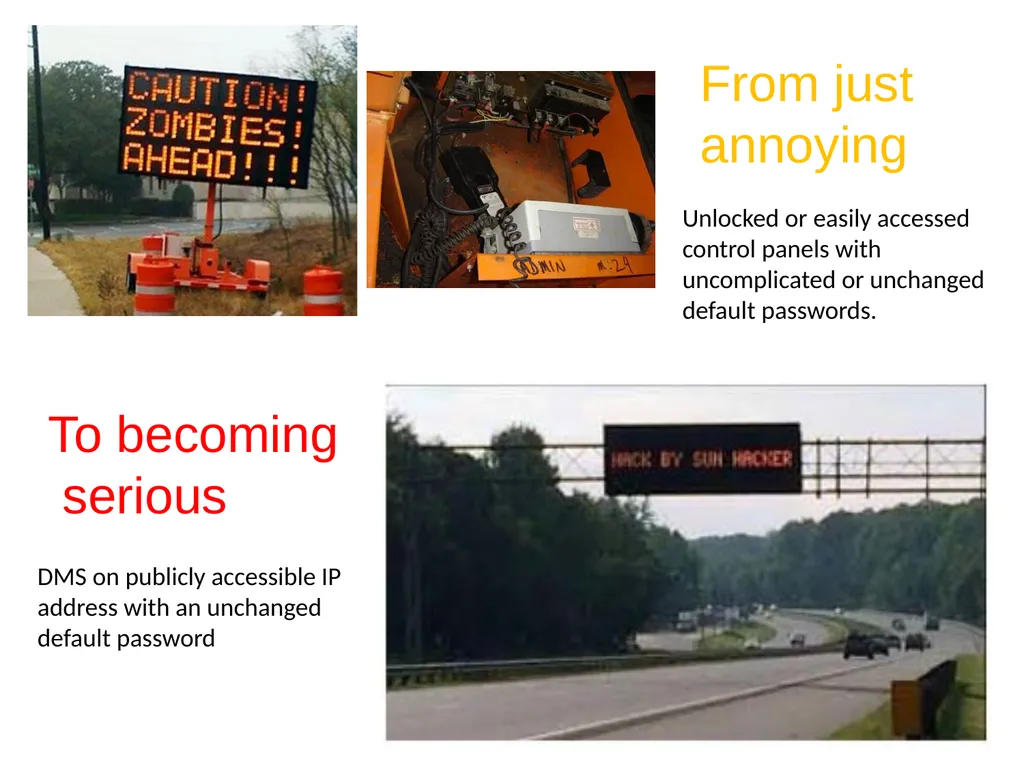
From just annoying To becoming
serious DMS on publicly accessible IP address with an unchanged default password Unlocked or easily accessed control panels with uncomplicated or unchanged default passwords.<br>
04
Proposed Current<br>
05
Purpose Provide transportation system owners/operators a resource for:
Identifying, alerting, and advising on cybersecurity incidents specific to transportation systems and infrastructure
Investigating potential system vulnerabilities
Education and awareness training/information<br>
06
Dimensions of Threat Malicious attack
Non-malicious operational error
Lack of system reliability
Untrustworthy practices by the operator<br>
07
Governing Assumptions Make every effort to provide confidentiality of findings due to the sensitivity of:
Inadvertently assisting cyber attackers through dissemination of unresolved vulnerabilities;
Potential of shutting down information gathering within the ITS and owner/operator community due to receiving unfavorable and critical reports from media sources; and
Work with existing organizations internal to the transportation industry and externally with the cybersecurity and ICS communities.<br>
08
Organizational Platform Multi-organizational cyber security workgroup
Federal, State, and local / public & private sector
Use the National Operations Center for Excellence for:
reporting and alert function
information and expert advice gateway, and
education/awareness portal.<br>
09
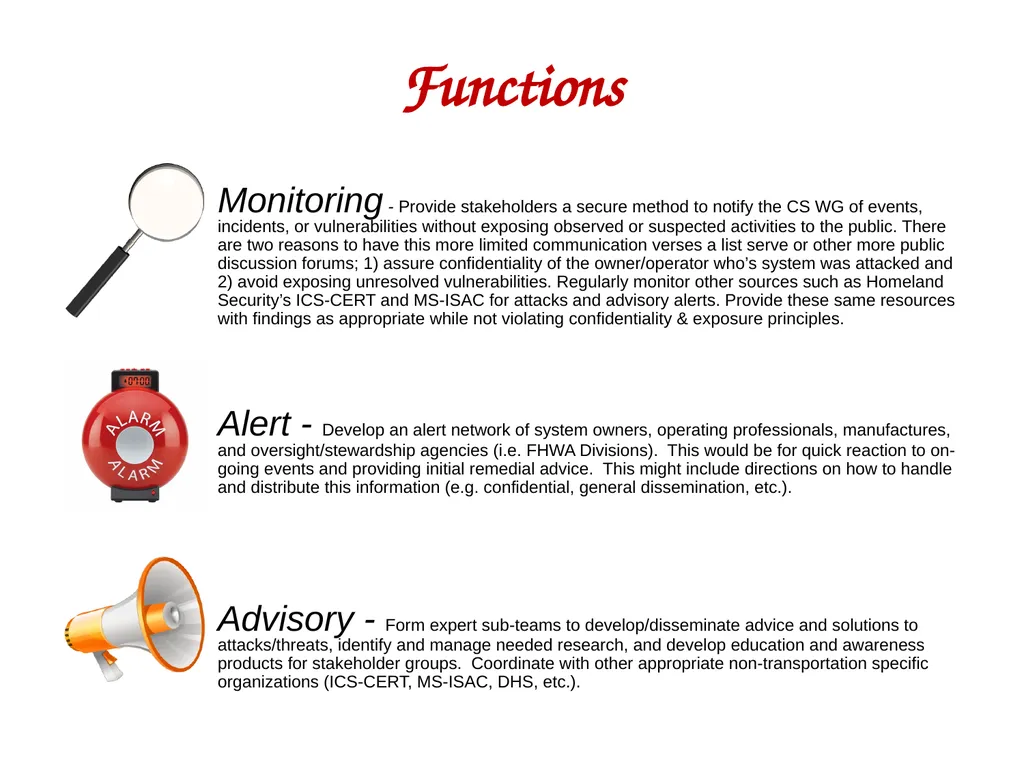
Functions Monitoring - Provide stakeholders a secure method to notify the CS WG of events, incidents, or vulnerabilities without exposing observed or suspected activities to the public. There are two reasons to have this more limited communication verses a list serve or other more public discussion forums; 1) assure confidentiality of the owner/operator who’s system was attacked and 2) avoid exposing unresolved vulnerabilities. Regularly monitor other sources such as Homeland Security’s ICS-CERT and MS-ISAC for attacks and advisory alerts. Provide these same resources with findings as appropriate while not violating confidentiality & exposure principles.
Alert - Develop an alert network of system owners, operating professionals, manufactures, and oversight/stewardship agencies (i.e. FHWA Divisions). This would be for quick reaction to on-going events and providing initial remedial advice. This might include directions on how to handle and distribute this information (e.g. confidential, general dissemination, etc.).
Advisory - Form expert sub-teams to develop/disseminate advice and solutions to attacks/threats, identify and manage needed research, and develop education and awareness products for stakeholder groups. Coordinate with other appropriate non-transportation specific organizations (ICS-CERT, MS-ISAC, DHS, etc.).<br>
10
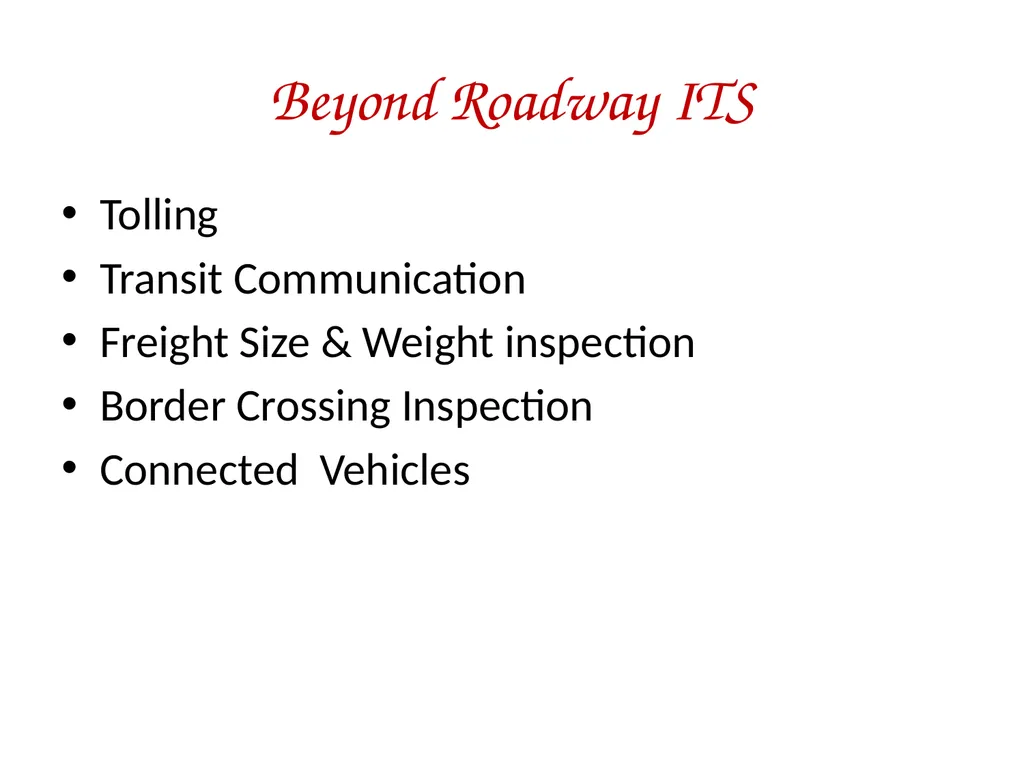
Beyond Roadway ITS Tolling
Transit Communication
Freight Size & Weight inspection
Border Crossing Inspection
Connected Vehicles<br>
11
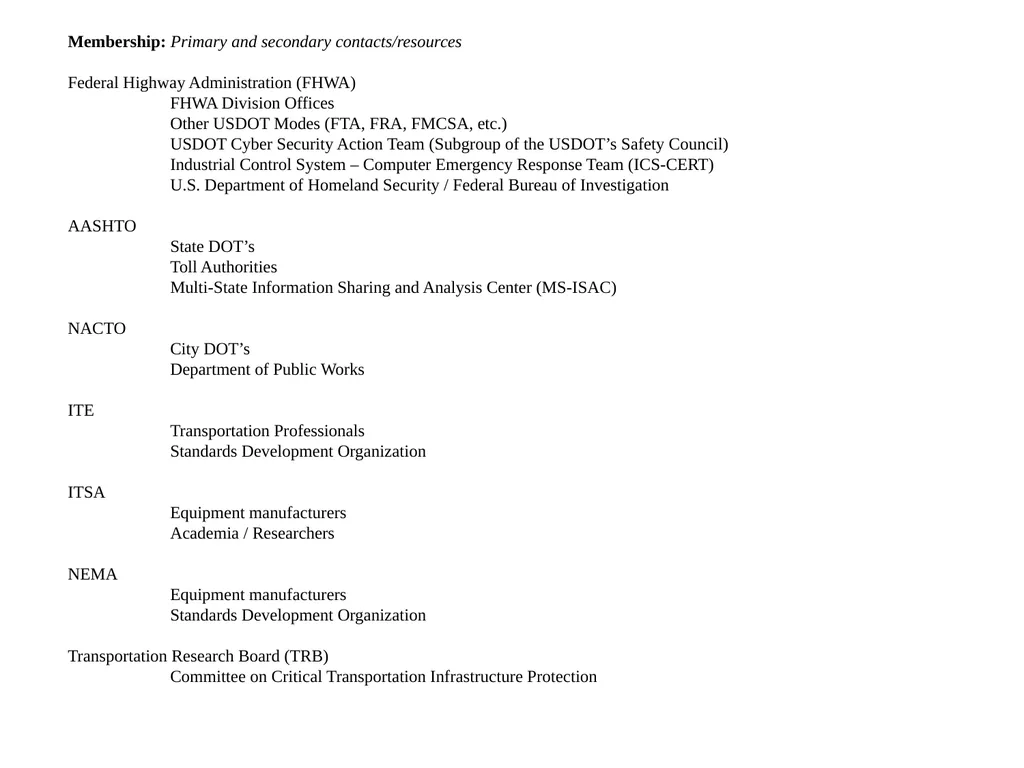
Membership: Primary and secondary contacts/resources
Federal Highway Administration (FHWA)
FHWA Division Offices
Other USDOT Modes (FTA, FRA, FMCSA, etc.)
USDOT Cyber Security Action Team (Subgroup of the USDOT’s Safety Council)
Industrial Control System – Computer Emergency Response Team (ICS-CERT)
U.S. Department of Homeland Security / Federal Bureau of Investigation
AASHTO
State DOT’s
Toll Authorities
Multi-State Information Sharing and Analysis Center (MS-ISAC)
NACTO
City DOT’s
Department of Public Works
ITE
Transportation Professionals
Standards Development Organization
ITSA
Equipment manufacturers
Academia / Researchers
NEMA
Equipment manufacturers
Standards Development Organization
Transportation Research Board (TRB)
Committee on Critical Transportation Infrastructure Protection<br>
12
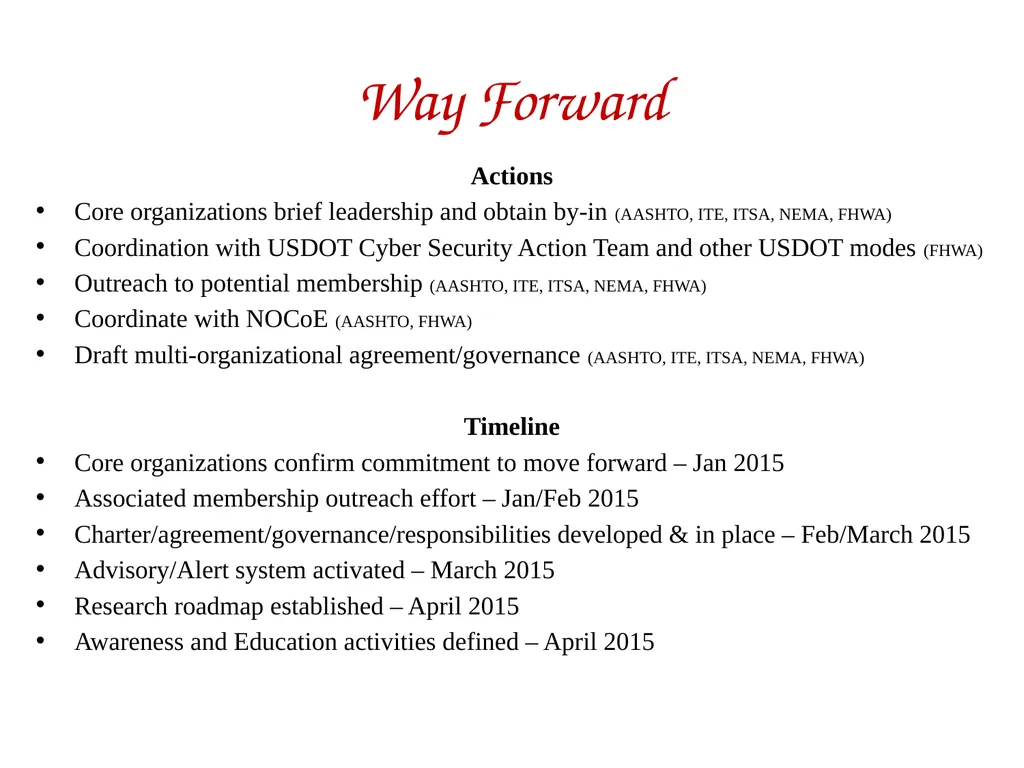
Way Forward Actions
Core organizations brief leadership and obtain by-in (AASHTO, ITE, ITSA, NEMA, FHWA)
Coordination with USDOT Cyber Security Action Team and other USDOT modes (FHWA)
Outreach to potential membership (AASHTO, ITE, ITSA, NEMA, FHWA)
Coordinate with NOCoE (AASHTO, FHWA)
Draft multi-organizational agreement/governance (AASHTO, ITE, ITSA, NEMA, FHWA)
Timeline
Core organizations confirm commitment to move forward – Jan 2015
Associated membership outreach effort – Jan/Feb 2015
Charter/agreement/governance/responsibilities developed & in place – Feb/March 2015
Advisory/Alert system activated – March 2015
Research roadmap established – April 2015
Awareness and Education activities defined – April 2015<br>