Robust Nonrigid Registration by Convex
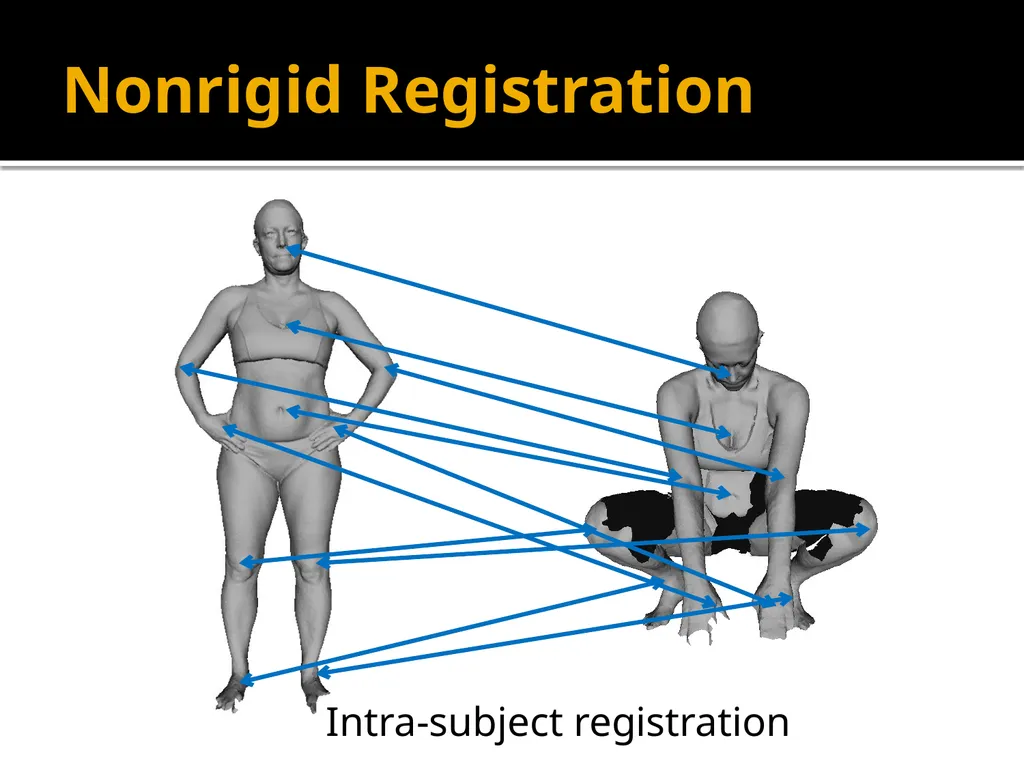
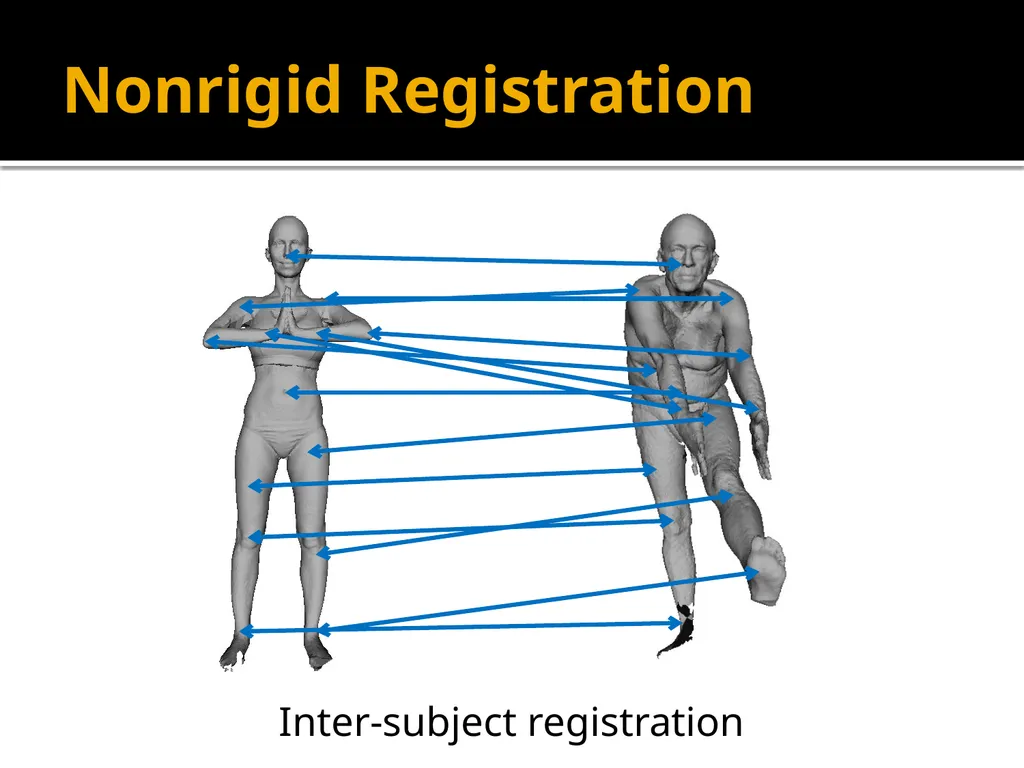
Description: Robust Nonrigid Registration by Convex Optimization Qifeng Chen Stanford University Vladlen Koltun Intel Labs Nonrigid Registration Intra-subject registration Nonrigid Registration Inter-subject registration Uses of Nonrigid Registration

Related Topics
Download Presentation
"Robust Nonrigid Registration by Convex" is the property of its rightful owner. Permission is granted to download and print the materials on this website for personal, non-commercial use only, and to display it on your personal computer provided you do not modify the materials and that you retain all copyright notices contained in the materials. By downloading content from our website, you accept the terms of this agreement.
Presentation Transcript
slide1. Robust Nonrigid Registration by Convex Optimization Qifeng Chen

Stanford University Vladlen Koltun
Intel Labs<br>
slide2. Nonrigid Registration Intra-subject registration<br>
slide3. Nonrigid Registration Inter-subject registration<br>
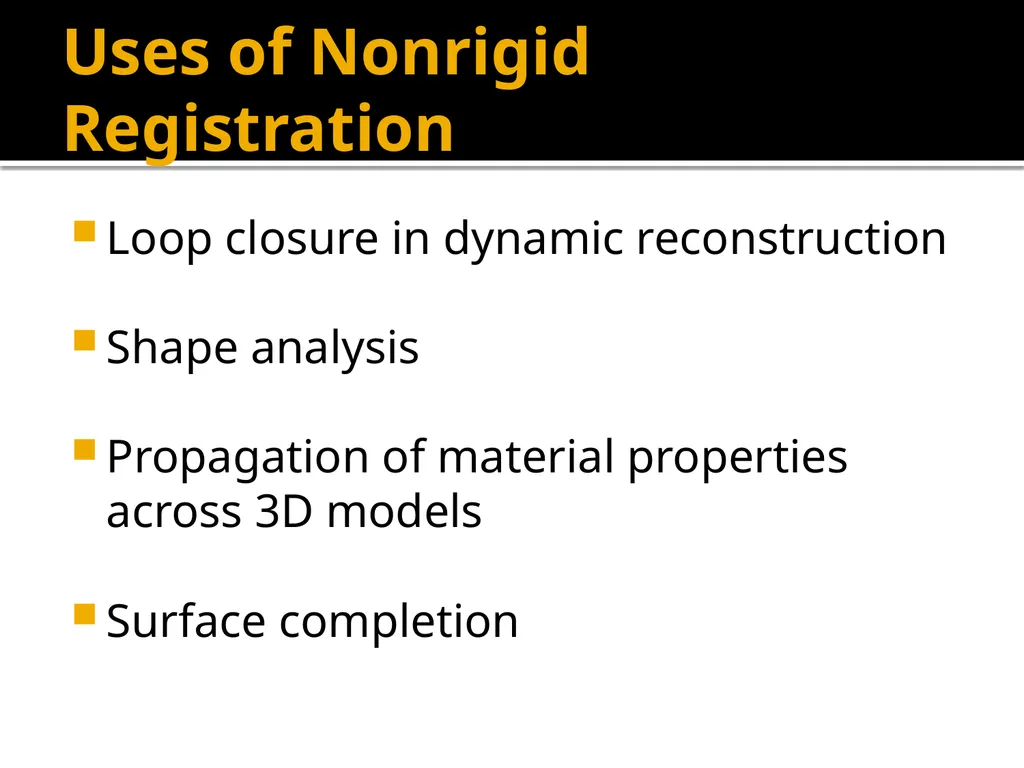
slide4. Uses of Nonrigid Registration Loop closure in dynamic reconstruction
Shape analysis
Propagation of material properties across 3D models
Surface completion<br>
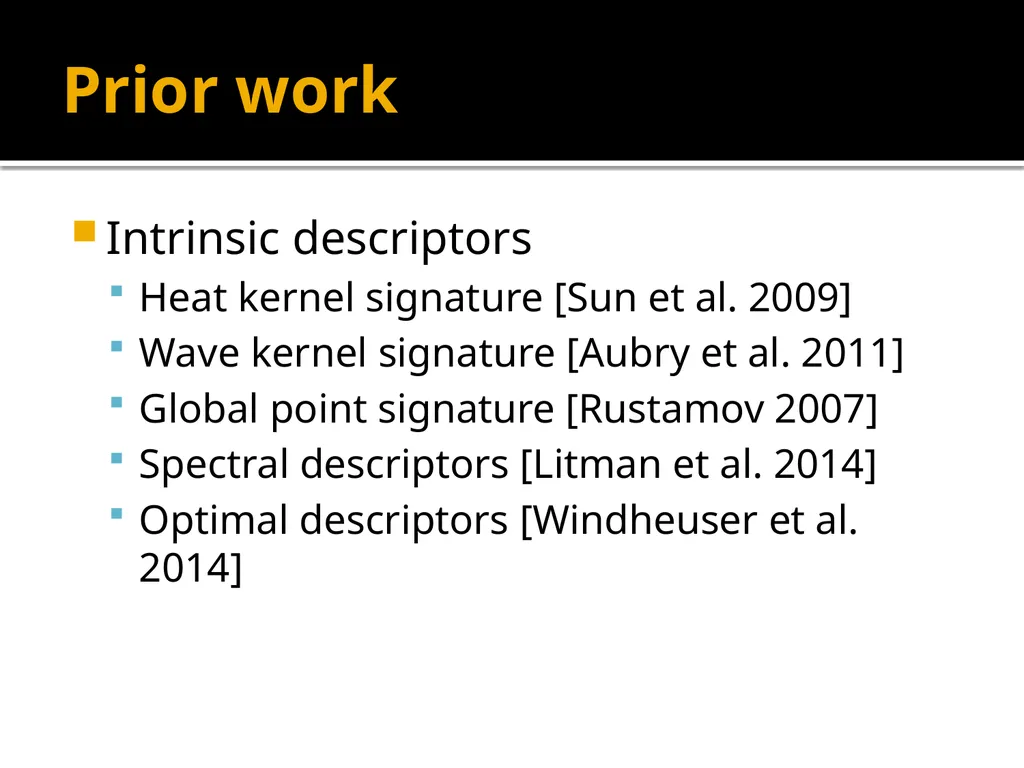
slide5. Prior work Intrinsic descriptors
Heat kernel signature [Sun et al. 2009]
Wave kernel signature [Aubry et al. 2011]
Global point signature [Rustamov 2007]
Spectral descriptors [Litman et al. 2014]
Optimal descriptors [Windheuser et al. 2014]<br>
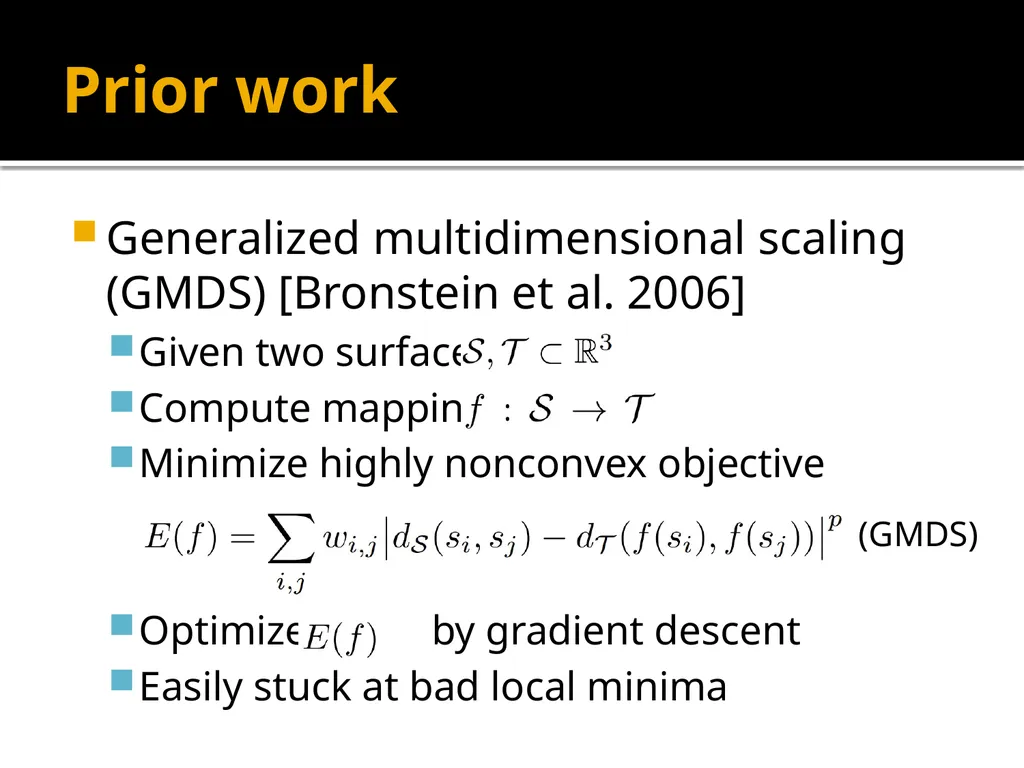
slide6. Prior work Generalized multidimensional scaling (GMDS) [Bronstein et al. 2006]
Given two surfaces
Compute mapping
Minimize highly nonconvex objective
Optimize by gradient descent
Easily stuck at bad local minima (GMDS)<br>
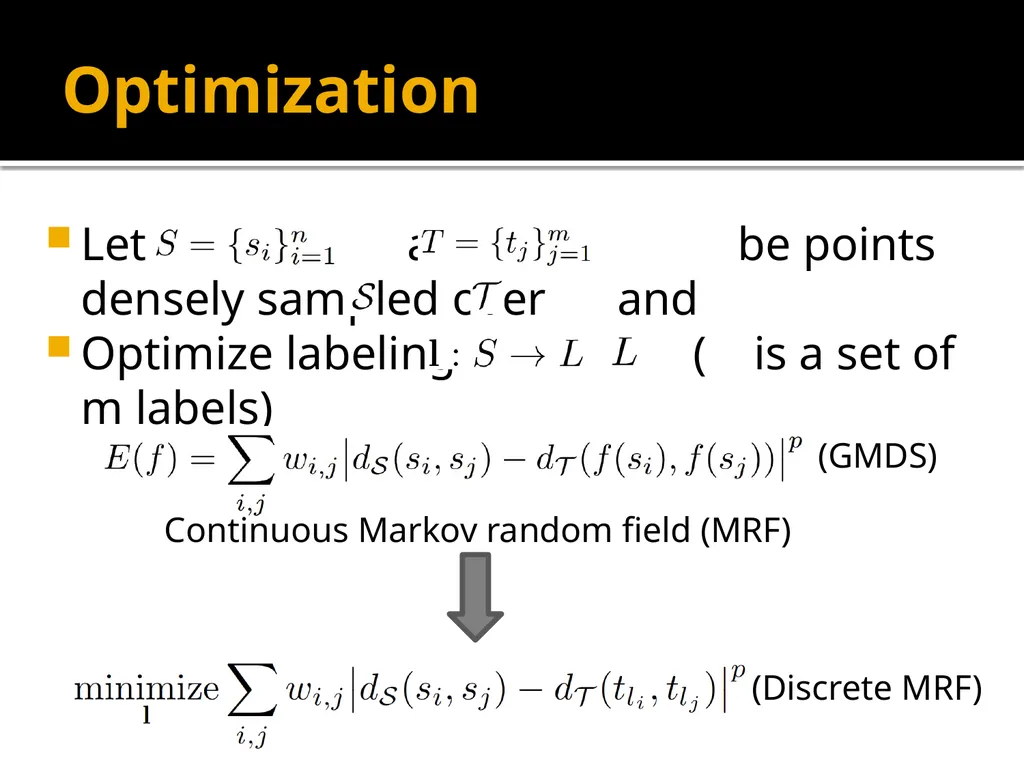
slide7. Optimization Let and be points densely sampled over and
Optimize labeling ( is a set of m labels) (GMDS) (Discrete MRF) Continuous Markov random field (MRF)<br>
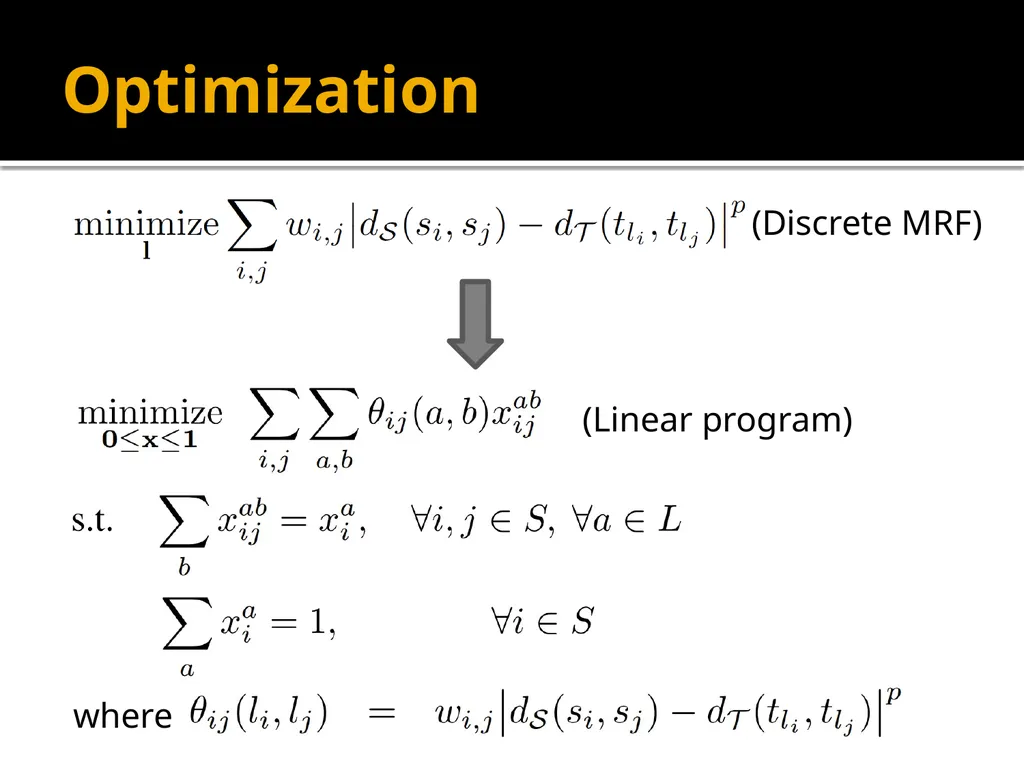
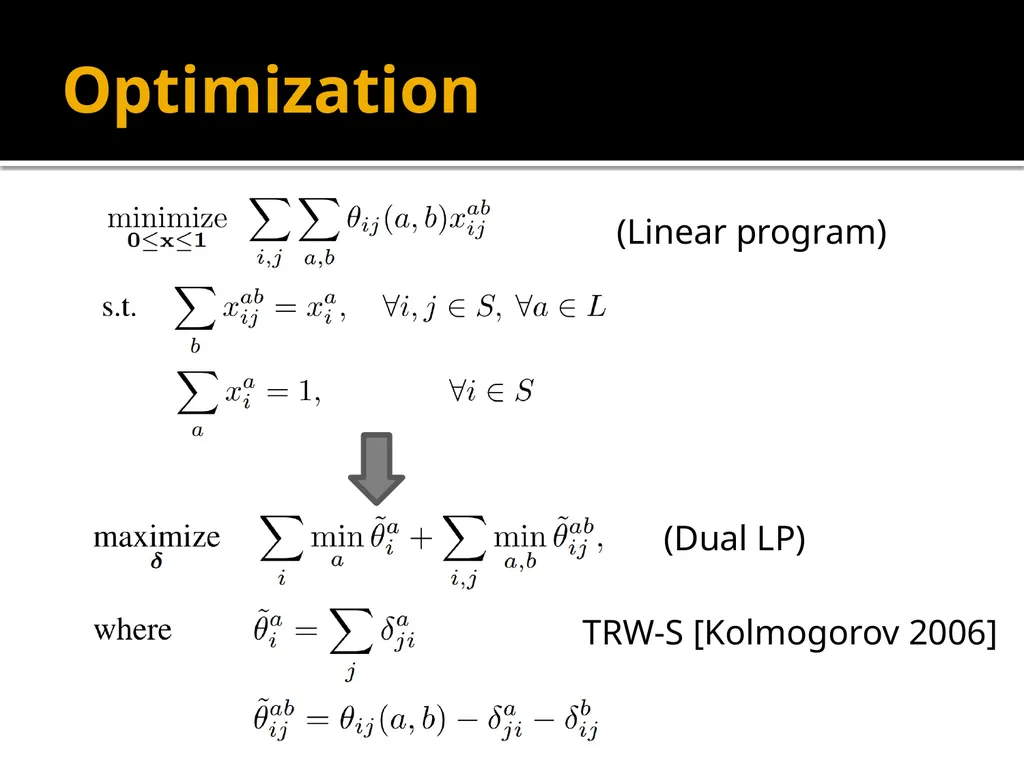
slide8. Optimization (Discrete MRF) (Linear program) where<br>
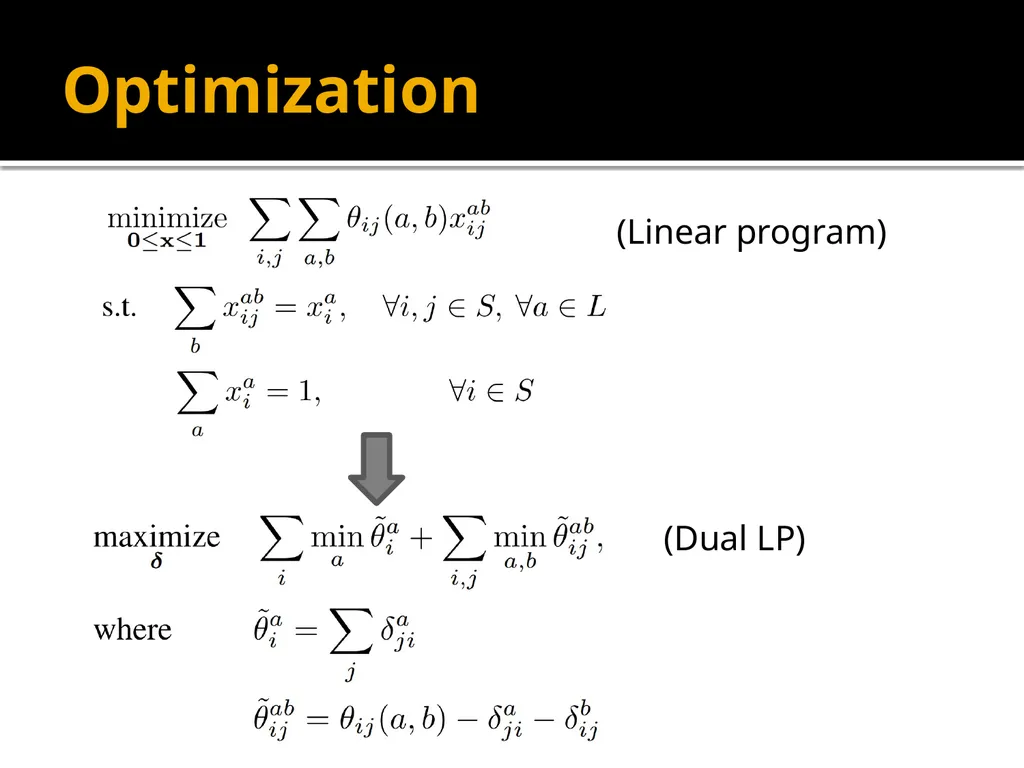
slide9. Optimization (Linear program) (Dual LP)<br>
slide10. Optimization (Linear program) (Dual LP) TRW-S [Kolmogorov 2006]<br>
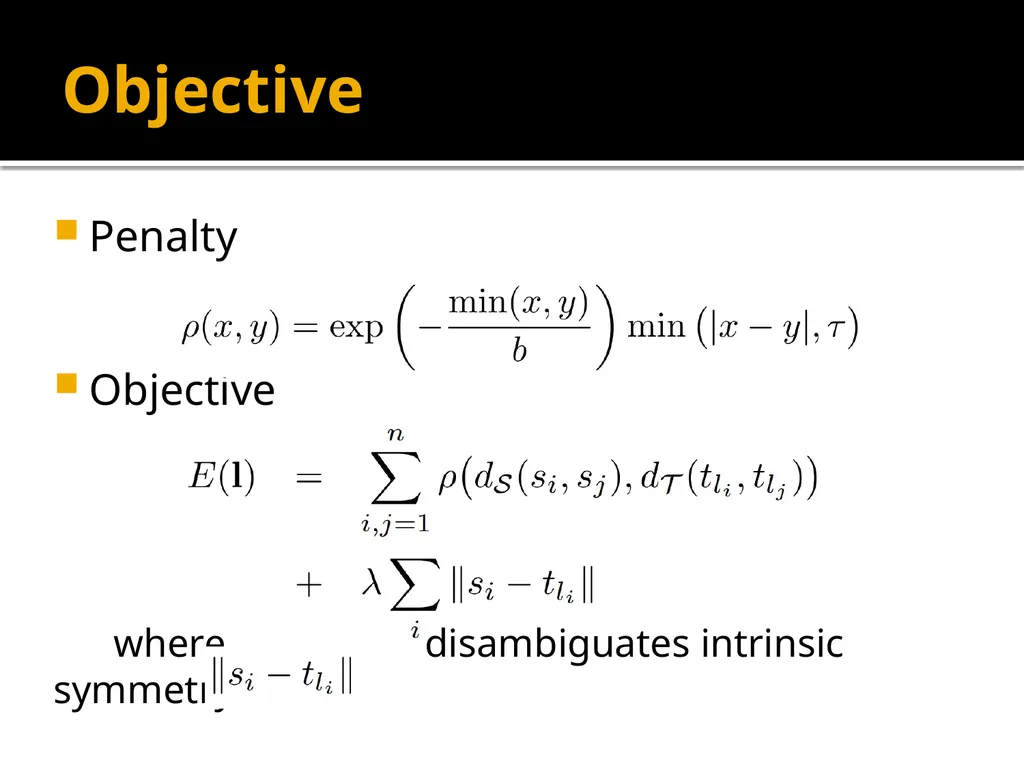
slide11. Objective Penalty
Objective
where disambiguates intrinsic symmetry<br>
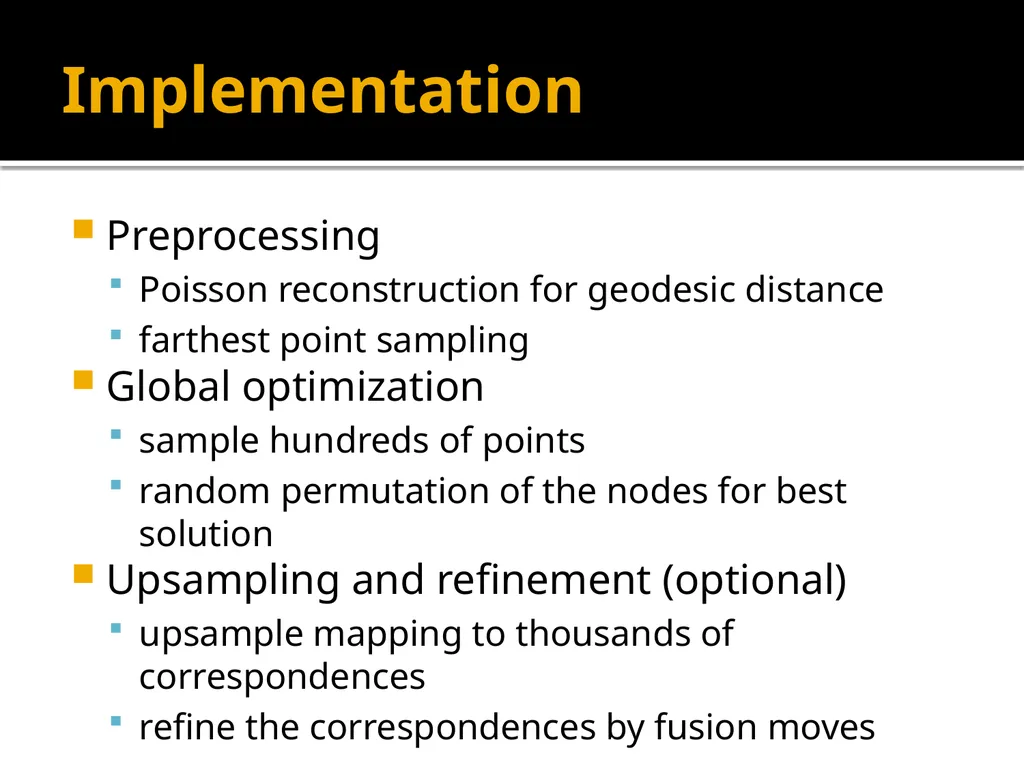
slide12. Implementation Preprocessing
Poisson reconstruction for geodesic distance
farthest point sampling
Global optimization
sample hundreds of points
random permutation of the nodes for best solution
Upsampling and refinement (optional)
upsample mapping to thousands of correspondences
refine the correspondences by fusion moves<br>
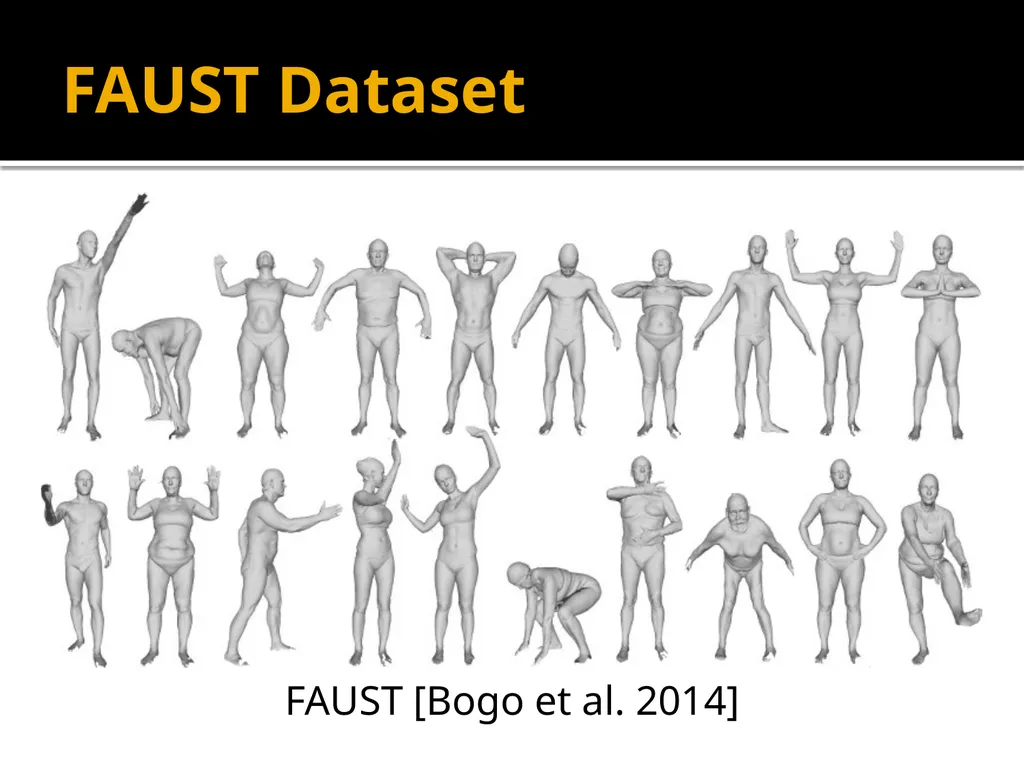
slide13. FAUST Dataset FAUST [Bogo et al. 2014]<br>
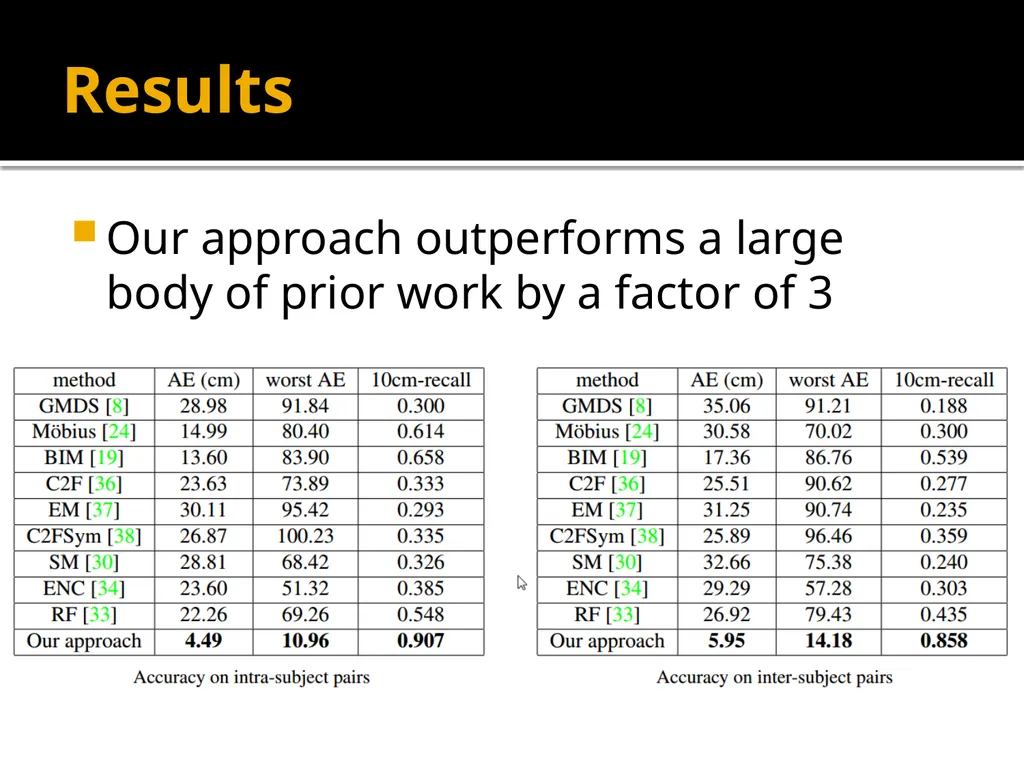
slide14. Results Our approach outperforms a large body of prior work by a factor of 3<br>
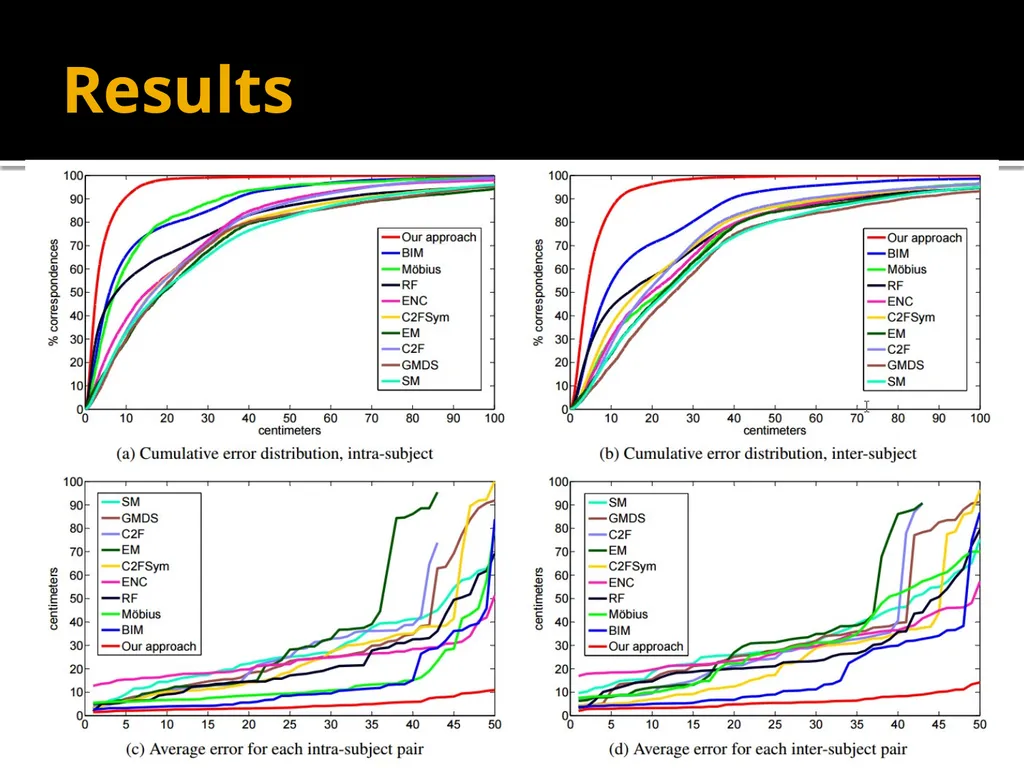
slide15. Results<br>
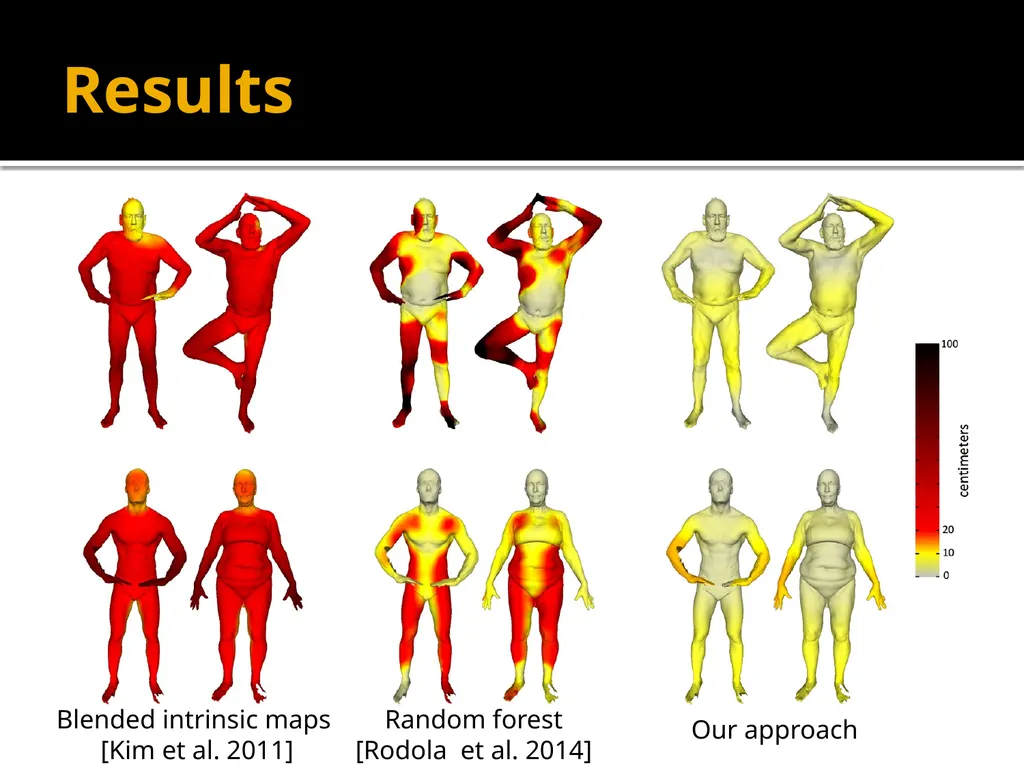
slide16. Results Blended intrinsic maps
[Kim et al. 2011] Random forest
[Rodola et al. 2014] Our approach<br>
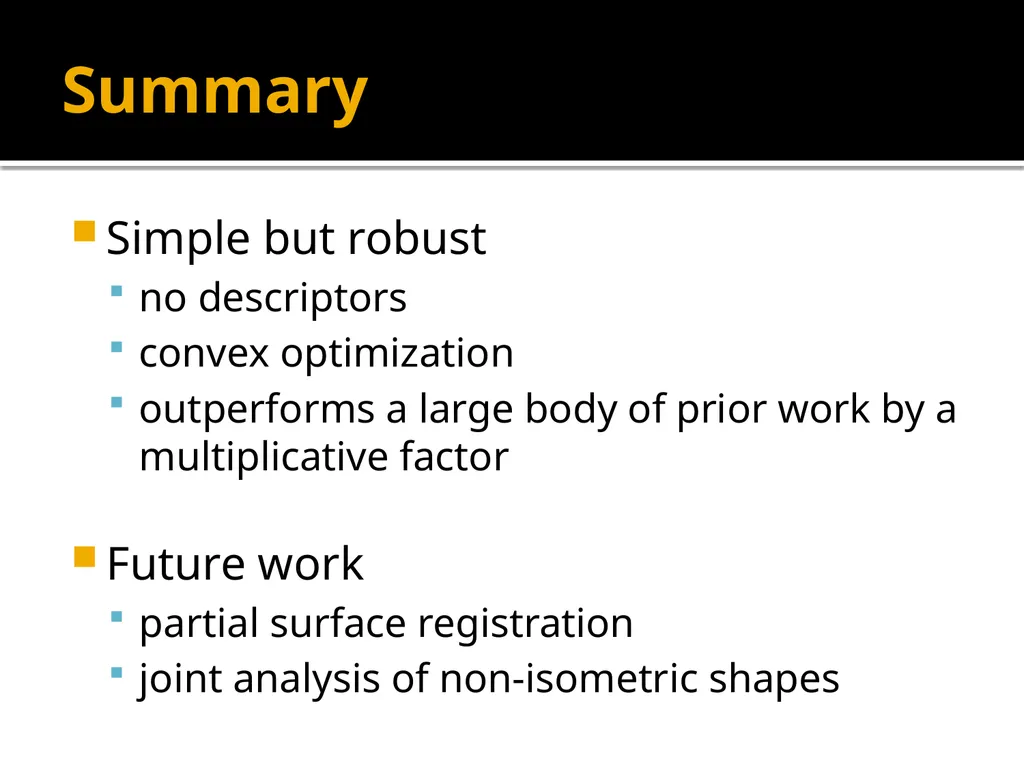
slide17. Summary Simple but robust
no descriptors
convex optimization
outperforms a large body of prior work by a multiplicative factor
Future work
partial surface registration
joint analysis of non-isometric shapes<br>
slide18. Questions? Matlab, C++ code, and data
http://www.stanford.edu/~cqf/convex/<br>
Stanford University Vladlen Koltun
Intel Labs<br>
slide2. Nonrigid Registration Intra-subject registration<br>
slide3. Nonrigid Registration Inter-subject registration<br>
slide4. Uses of Nonrigid Registration Loop closure in dynamic reconstruction
Shape analysis
Propagation of material properties across 3D models
Surface completion<br>
slide5. Prior work Intrinsic descriptors
Heat kernel signature [Sun et al. 2009]
Wave kernel signature [Aubry et al. 2011]
Global point signature [Rustamov 2007]
Spectral descriptors [Litman et al. 2014]
Optimal descriptors [Windheuser et al. 2014]<br>
slide6. Prior work Generalized multidimensional scaling (GMDS) [Bronstein et al. 2006]
Given two surfaces
Compute mapping
Minimize highly nonconvex objective
Optimize by gradient descent
Easily stuck at bad local minima (GMDS)<br>
slide7. Optimization Let and be points densely sampled over and
Optimize labeling ( is a set of m labels) (GMDS) (Discrete MRF) Continuous Markov random field (MRF)<br>
slide8. Optimization (Discrete MRF) (Linear program) where<br>
slide9. Optimization (Linear program) (Dual LP)<br>
slide10. Optimization (Linear program) (Dual LP) TRW-S [Kolmogorov 2006]<br>
slide11. Objective Penalty
Objective
where disambiguates intrinsic symmetry<br>
slide12. Implementation Preprocessing
Poisson reconstruction for geodesic distance
farthest point sampling
Global optimization
sample hundreds of points
random permutation of the nodes for best solution
Upsampling and refinement (optional)
upsample mapping to thousands of correspondences
refine the correspondences by fusion moves<br>
slide13. FAUST Dataset FAUST [Bogo et al. 2014]<br>
slide14. Results Our approach outperforms a large body of prior work by a factor of 3<br>
slide15. Results<br>
slide16. Results Blended intrinsic maps
[Kim et al. 2011] Random forest
[Rodola et al. 2014] Our approach<br>
slide17. Summary Simple but robust
no descriptors
convex optimization
outperforms a large body of prior work by a multiplicative factor
Future work
partial surface registration
joint analysis of non-isometric shapes<br>
slide18. Questions? Matlab, C++ code, and data
http://www.stanford.edu/~cqf/convex/<br>