Round and Round- The Water Cycle Activity 1.) Make groups of two 2.) Resources needed: tablet, computer with internet access 3.) Research the amount of average rainfall that falls in the state of Iowa during each month Questions to Reflect
"Round and Round- The Water Cycle Activity 1.) Make" is the property of its rightful owner. Permission is granted to
download and print the materials on this website for personal, non-commercial use only, and to display it
on your personal computer provided you do not modify the materials and that you retain all copyright
notices contained in the materials. By downloading content from our website, you accept the terms of this
agreement.
Presentation Transcript
01
Round and Round- The Water Cycle<br>
02
Activity 1.) Make groups of two
2.) Resources needed: tablet, computer with internet access
3.) Research the amount of average rainfall that falls in the state of Iowa during each month
Questions to Reflect
1.) What influences rainfall in a certain season?
2.) What influences rainfall in a certain region?
3.) What determines the amount of rainfall?
4.) Do changing amounts of rainfall affect the mammal, plant, insect, or bird populations that seasonally live in Iowa? If so, how?
5.) How can water (excess or lack) affect Earth’s surface?<br>
03
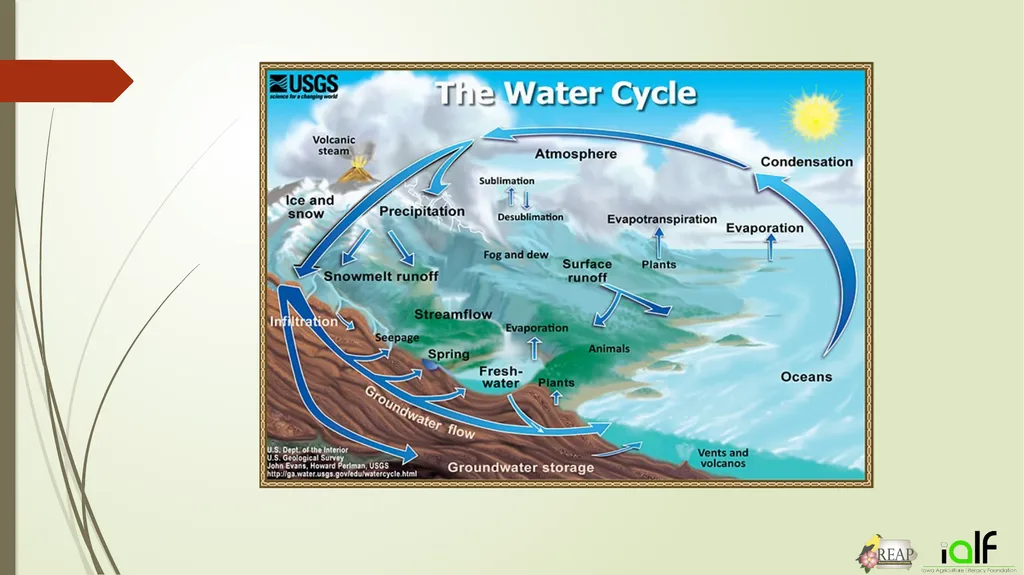
The Water Cycle– How It Works What Is the Water Cycle?
Process that describes the existence and movement of water on, in, and above the Earth.
Powered by the Sun
No starting point because it is a continuous cycle
For explanation purposes we will start with evaporation<br>
04
Steps In the Water Cycle Evaporation
Condensation
Precipitation
Infiltration
Runoff<br>
05
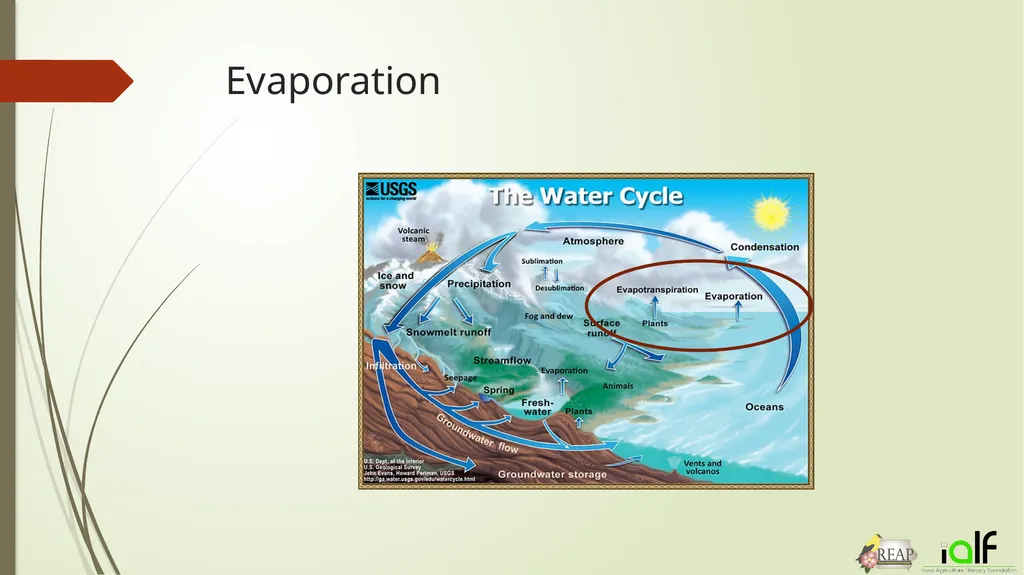
Evaporation<br>
06
Evaporation Evaporation: the process of which water changes from a liquid into a gas or vapor
The sun drives the water cycle process. It begins by heating earth’s surface along with heating the water in lakes, rivers, streams, and the ocean.
Energy from the heat of the sun is used to break the bonds that hold water molecules together.
When water is heated, it begins to turn from the liquid state into the gaseous state (water vapor) and evaporates into the air.
Water vapor is all around us and is known as relative humidity
relative humidity: the amount of water vapor present in air
Evaporation is the primary pathway water moves from liquid state to water vapor<br>
07
Evapotranspiration Evapotranspiration: water that transpires from plants and evaporates from the soil to the atmosphere.
Plants put down roots into the soil to draw water and nutrients up into the stems and leaves. Some of this water is returned to the air by transpiration.
Transpiration: the process where plants absorb water through the roots and give off water vapor through pores in their leaves
Transpiration rates vary depending on weather conditions, such as temperature, humidity, sunlight availability and intensity, precipitation, soil type and saturation, wind, and land slope.<br>
08
Condensation<br>
09
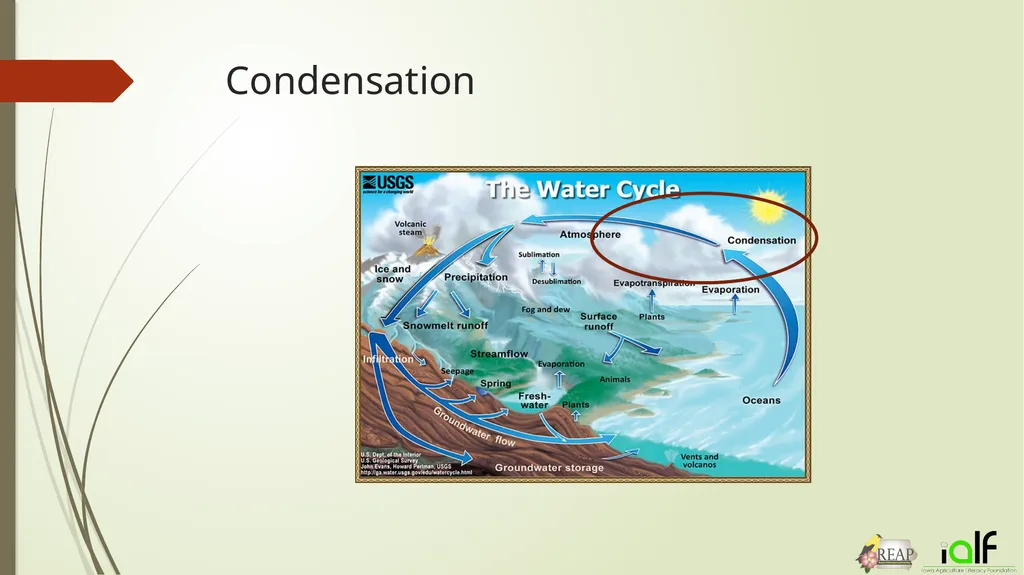
Condensation Condensation: the process in which water is changed from vapor to liquid
The atmosphere high above land is cooler, and as the water vapor rises, it cools.
Cooler temperatures cause it to condense and thus creates the formation of clouds.
Clouds are made up of water vapor and cloud droplets (small drops of condensed water) These droplets are too small to fall as precipitation, but they are large enough to form visible clouds.
When clouds form the process of precipitation can occur.<br>
10
Precipitation<br>
11
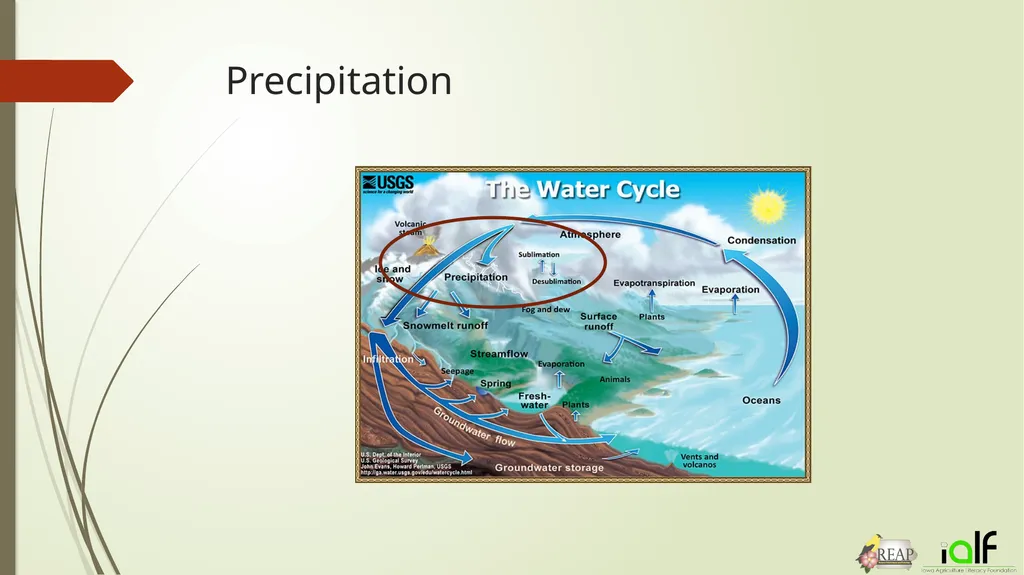
Precipitation Precipitation: water that falls to the Earth in various states such as hail, mist, rain, sleet, snow.
In this process small water droplets attach to small dust, salt, or smoke particles (this acts as the nucleus that holds the water particles together.
Water droplets can then grow in size by colliding with other water particles.
If enough collision occurs to the water droplets, they become heavy enough to fall from the sky to the ground.<br>
12
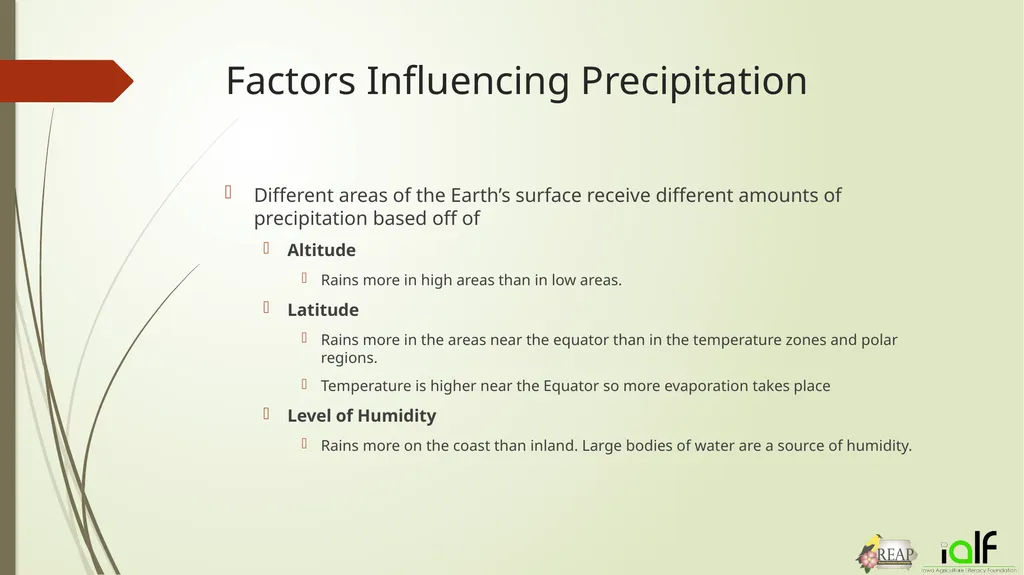
Factors Influencing Precipitation Different areas of the Earth’s surface receive different amounts of precipitation based off of
Altitude
Rains more in high areas than in low areas.
Latitude
Rains more in the areas near the equator than in the temperature zones and polar regions.
Temperature is higher near the Equator so more evaporation takes place
Level of Humidity
Rains more on the coast than inland. Large bodies of water are a source of humidity.<br>
13
Infiltration<br>
14
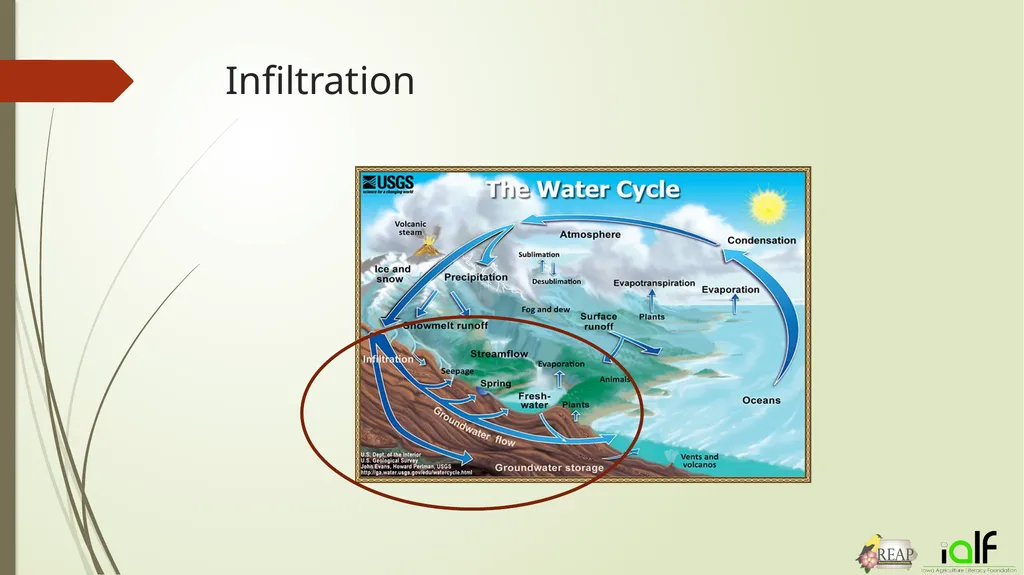
Infiltration Infiltration: the action of a liquid entering or permeating the ground by filtration. (Water from precipitation soaking into the ground)
Permeability: the ability of the ground surface to absorb water.
The less water the ground can absorb, the more runoff on the surface there will be
A surface with high absorption ability has high permeability
A surface with low absorption ability has low permeability<br>
15
Infiltration When infiltration of water reaches the max holding capacity it is known as saturated ground.
Saturation: the state of process that occurs when no more of something can be absorbed, combined with, or added
Ex. Soil becomes saturated when it can no longer hold any more water and runoff or flooding can be a result.<br>
16
Runoff<br>
17
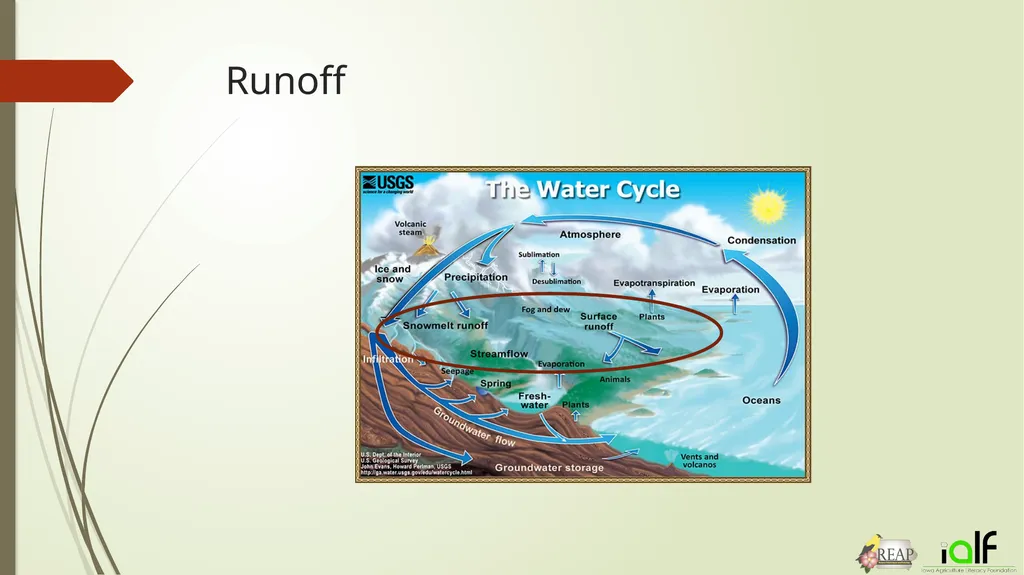
Runoff Runoff: when rain hits saturated or impervious ground and flows overland downhill to a stream, lake, or watershed.
Watershed: the area of land where all of the water that falls in it and drains off of it goes into the same place.
The interaction between precipitation and surface runoff varies according to time and geography.
Surface runoff is affected by both meteorological factors and the physical geology and topography of the land.<br>
18
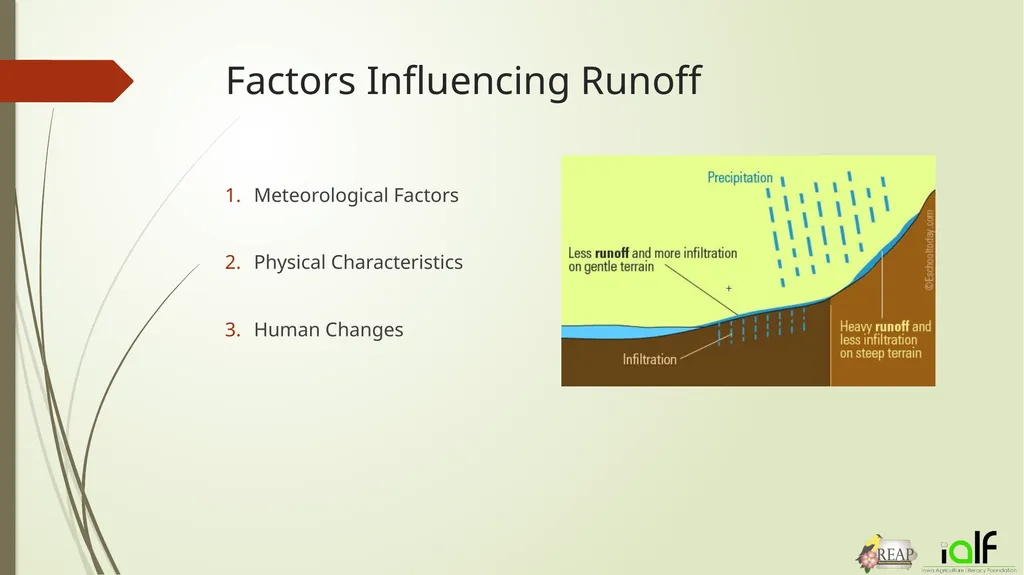
Factors Influencing Runoff Meteorological Factors
Physical Characteristics
Human Changes<br>
19
Meteorological Factors Types of precipitation (rain, snow, sleet, etc.)
Rainfall intensity
Rainfall amount
Rainfall duration
Distribution of rainfall over the drainage basin
Direction of storm movement
Precipitation that occurred earlier and resulting soil moisture
Other meteorological and climatic condition that affect evapotranspiration, such as temperature, wind, relative humidity, and season<br>
20
Physical Characteristics Land use
Vegetation
Soil type
Drainage area
Basin shape
Elevation
Topography, especially the slope of the land
Drainage network patterns
Ponds, lakes, reservoirs, sinks, etc. in the basin, which prevent or delay runoff from continuing downstream<br>
21
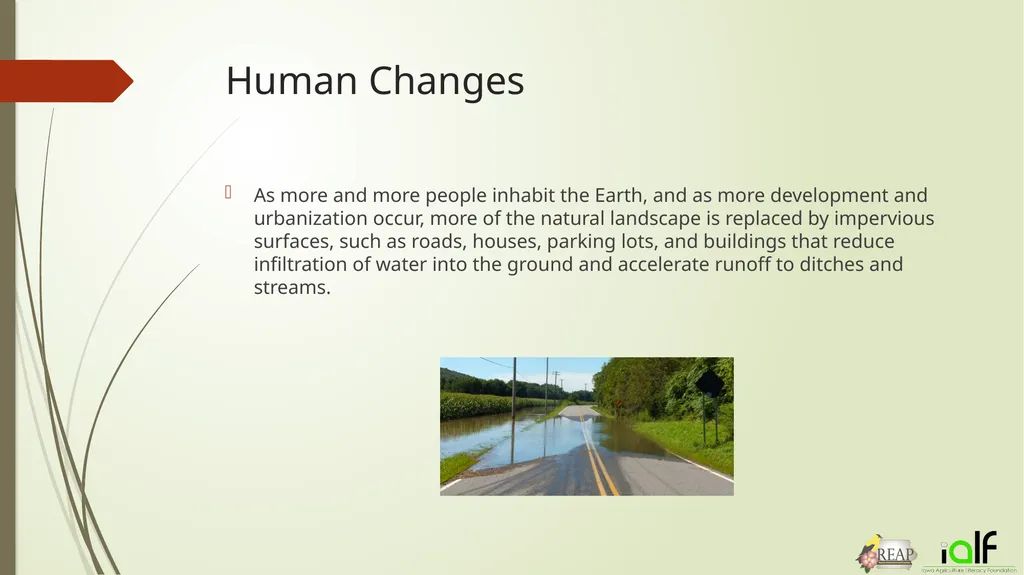
Human Changes As more and more people inhabit the Earth, and as more development and urbanization occur, more of the natural landscape is replaced by impervious surfaces, such as roads, houses, parking lots, and buildings that reduce infiltration of water into the ground and accelerate runoff to ditches and streams.<br>