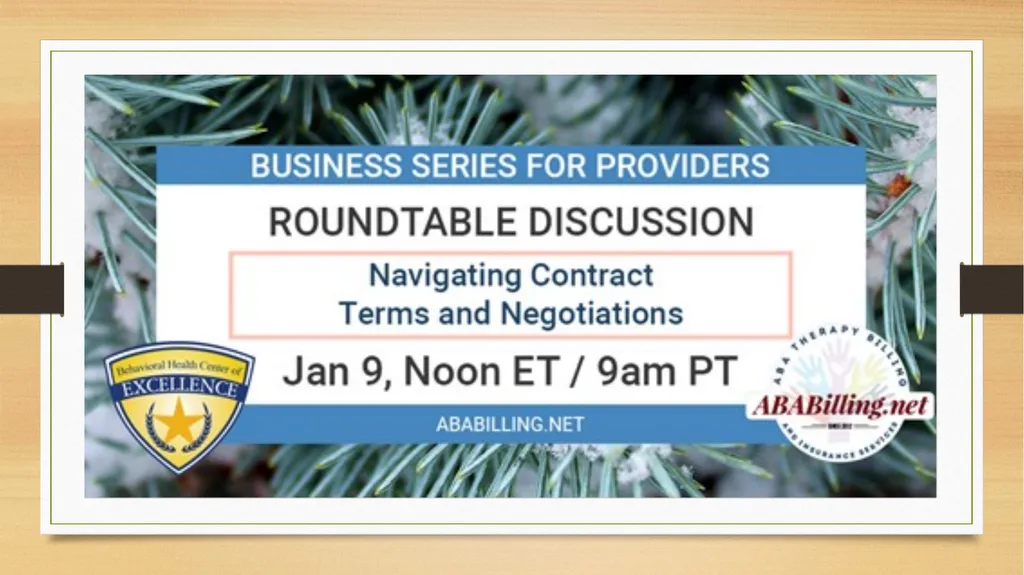
Roundtable Discussion Emily Roche—Director of ABA
Description: Roundtable Discussion Emily RocheDirector of ABA Services Gersh ABA Services Sara Gershfeld Litvak, MA, BCBACEO Behavioral Health Center of Excellence Diana Wolf, MA, BCBA, LBACo-CEO Verbal Beginnings Michele Silcox, CMRSCEO ABA Therapy
Related Topics
Download Presentation
"Roundtable Discussion Emily Roche—Director of ABA" is the property of its rightful owner. Permission is granted to download and print the materials on this website for personal, non-commercial use only, and to display it on your personal computer provided you do not modify the materials and that you retain all copyright notices contained in the materials. By downloading content from our website, you accept the terms of this agreement.
Presentation Transcript
slide2. Roundtable Discussion Emily Roche—Director of ABA Services
Gersh ABA Services
Sara Gershfeld Litvak, MA, BCBA—CEO
Behavioral Health Center of Excellence
Diana Wolf, MA, BCBA, LBA—Co-CEO
Verbal Beginnings
Michele Silcox, CMRS—CEO
ABA Therapy Billing and Insurance Services and MS Consulting, LLC<br>
slide3. General Disclaimer The following presentation is intended as a discussion from four industry professionals providing a view into Navigating Contract Terms and Negotiations.
This presentation reflects our best understanding of the processes.
Providers are encouraged to confirm all information presented by reviewing their own independent contracts, business practices and in payor relations with provider representatives.
This presentation does not reflect opinions of any organization outside of those represented as roundtable presenters.<br>
slide4. Get to Know Your Contracts There’s more to it than rates!
Presented By: Emily Roche<br>
slide5. Careful Consideration and Big Decisions Is accepting insurance right for you business?
What are the ABA guidelines from the payor?
Are they sustainable for your business?
The contract is legally binding for your business, and many of the terms favor the insurance company or the member.
And, the burden is on you to process all authorizations and claims.
Don’t always follow what other companies are doing….
You don’t know if what another company is doing has been financial sustainable, has the same terms, etc.<br>
slide6. Contract Terms to Review “Boilerplate” Contracts: not made specifically for ABA providers
Know your state laws that apply
Read your whole contract!
And, ask for ABA specific guidelines
Know where to find your provider manual
These terms are considered binding along with the contract
Notice of Material Change or Amendment****
How do you receive notice of a material change?
How can you dispute a material change?<br>
slide7. Contract Terms to Review - continued Timely Filing Deadline
How are claims submitted
Electronic, through a portal, paper claims, etc.
Deadline for Appeals
Term of the contract
How long you are locked into the contract?
Period for timely payments
How long can insurance take to pay you?
Interest on late payments<br>
slide8. What Does the Contract Cover? Covered Products: PPO, EPO, HMO, etc.
Does the HMO have additional requirements?
Medicaid and CHP+
Do you have to accept Medicaid or CHP+ members covered by the payor?
Group vs. Individual Contracts
If you plan to grow, attempt to get group contracts
Who handles ABA authorizations?<br>
slide9. Fee Schedules Be sure to ALWAYS have the fee schedule before signing a contract.
Before negotiating rates….
Know how to calculate your profit margins
If using a “tiered” model….
Rates on behavior technician services supply the profit margin
Do not think a high BCBA rate can compensate for a low RBT/BT rate
Calculate how much profit is made on each rate
Then, calculate how many billable hours you provide of each service!
Technician: $25 profit per hour x 400 hours per week x 48 weeks = $480,000
BCBA: $25 profit per hour x 45 billable hours per week x 48 weeks = $54,000<br>
slide10. Reimbursement Rates: Sharing the Value of Your Organization Presented by: Sara Gershfeld Litvak, MA, BCBA<br>
slide11. Readiness is Everything Understand the market and strengths of your own practice
SWOT Analysis
Utilization
Number of new patient referrals per month
Know your market share
Survey patient satisfaction (BHCOE offers this)
Benchmark aspects of your quality & efficiency
Before meeting with representatives of healthcare plans, find out how significant your referral sources and footprint is in their network<br>
slide12. Analyze the Fee Schedule “Quick and Dirty Approach”:
Create a spreadsheet with every CPT code and the number of times it was billed for that payer
Multiply the use of each code by the proposed payment of the payer.
Add together all of these products and divide by the total frequency of all codes to determine the weighted average payment for that payer.
By repeating this process for each payer, you can compare the overall weighted averages of all of your health care plans.<br>
slide13. Next… Determine the break-even point for your practice by adding:
Overhead expenses
Compensation
Dividing this sum by total frequency of all codes for all payers
This will give you the weighted average of your costs, your break-even point, and compare it with weighted average reimbursement for each contract.
You can also do this analysis by service line – some service lines are more profitable than others
You can also compare this as a % compared to Medicaid rates<br>
slide14. Monitor Your Contracts Most contracts are evergreen and automatically renew unless modification is proposed
As the date approaches, analyze the contract and determine changes
It is not advisable to allow contracts to go unchanged for many years.
It’s easier to ask for a 1-3% increase every few years than a 10% increase all at once.
Channel all contact with a healthcare plan through only one person. This person also communicates changes to clinical staff.
Clinicians should not sign paperwork addressing rates, reimbursement, etc. Be careful with this. Do not sign “membership confirmation” letters.<br>
slide15. Determine Your Position Set a bargaining range that includes optimum, minimum and target goal.
Optimum: starting point
Minimum: needed for you to sign
Target: point at which you would like to end up after negotiation
BATNA: Best Alternative to a Negotiated Agreement
Go into negotiations knowing your alternatives
BATNA: option you take if no agreement is met
Your position is weaker if you are primarily servicing one payer.
It’s important to monitor your payer mix annually.<br>
slide16. When Should You Walk Away? Decide on your bottom line ahead of time
Do not accept truly poor contract terms just because it would cause disruption of ongoing care, decrease in new patients or loss of income.
Case study: One business walked away from a poorly written contract that resulted in displacing more than 200 patients. They stuck to their guns, and it was well worth it. Eight month later, the plan said “We want you back in our network.”<br>
slide17. Negotiating the Contract Common Response to Clinicians: “This is what we pay in your market, and you're simply going to have to accept it.”
Contact the plan representative to set a date for a face-to-face meeting at your office.
At the meeting, present well-organized, clear data. Many providers use the BHCOE Accreditation Results for this process.
Make it plain that you have a thorough understanding of the finances of your practice.
Present your requests for changes—asking for your optimum objective—before new terms are offered.
Listen carefully to what they have to say, and do not interrupt.
A basic negotiating principle is to remember that you are negotiating a relationship, not a transaction.5<br>
slide18. Negotiating the Contract Find out the goals of the other party
Find out the biggest issues the payer has and try to address them
Payers want cost control, predictable cost and progress. Show them you can provide that.
Be prepared to share the following:
Practice data – Outcome Data
Patient Satisfaction Data
Staff Turnover & Staff Satisfaction (Happy Staff = Happy Patients)
If you can, negotiate a multi-year contract with escalation of fees every year. This is less burdensome for payers, but ends up at the desired rate.<br>
slide19. What else to negotiate? Authorization process
Period specified for submitting claims (try pushing to 120 vs. 90 days)
Period allowed to appeal a denied claim
Requirements regarding assessments used
Time specified for timely payments, and interest paid for late payment
Period required for providing notice of modifications
Cancellation clause, including advanced notice required<br>
slide20. Preparing for Rate Negotiations Presented by: Diana Wolf MA, BCBA, LBA<br>
slide21. Pre-requisites of Rate Negotiations Have a full understanding of the new CPT codes
Know what is in your contracts
Know your numbers... Your needs
Know the people who will listen and help<br>
slide22. CPT codes What is the intended use of the codes?
APBA webinars
https://www.apbahome.net/store/ListProducts.aspx?catid=694517&ftr
BHCOE webinar
https://bhcoe.org/behavioral-health-virtual-academy/
ABA Therapy Billing and Insurance Services
https://www.ababilling.net/blog/
How are they different from CPT III codes?
What does the CPT manual say?
What does the CPT Assistant article say?<br>
slide23. Contracts – Not knowing can cost you! Medical Necessity provision
Billing outside of an authorization
Balance billing
Timely filing provision
How long insurance companies have to pay you
Fee schedule alterations
Clauses to hold members harmless
Adjustments to payment – overpaid/underpaid
Clause about ineligible members
Notices
Termination
AND MORE! (All are payer specific… know what you’re signing!)<br>
slide24. Know your numbers Get an accountant
Run an analysis of your organization
What exactly is involved in pre-service per code
What exactly is involved in post-service per code
How much time spent for each activity
What are our disposable and non-disposable supplies used
Find out what your company rates are (per code) when they’re “bundled” vs. if you had a separate indirect service code to use<br>
slide26. Who do you contact? Important to build relationships with people on the insurance side
Start with provider relations
Do you have a specific contact?
Do you have a contact through authorization department?
Can they lead you to the right person?
If your contract amendments for new codes are not reflecting a number that would work with your calculations, send a counter-offer with a rationale.
Use your resources
AMA CPT Manual/Assistant article
Webinars and presentations by members of steering committee
Practice Guidelines for Health Funders from the BACB
White Paper explaining effectiveness of ABA from APBA<br>
slide27. Show your worth Explain why you need what you need and why their proposed rates won’t cut it
Show the number of their members your organization is providing services for
Show outcome measures
If accredited, list accreditations and what they mean
Survey your clients – client satisfaction scores go a long way<br>
slide28. Don’t Back Down Most insurance companies know very little about ABA and how the therapy works
Educate your payers
You got this!<br>
slide29. Understanding Intent and Implementation Presented by: Michele Silcox, CMRS<br>
slide30. Remember your WHY WHY do I need to review my contracts?
WHY do I need to know the intent of the codes?
WHY do I need to understand implementation of the codes?
WHY do I need to understand that the full ABA program costs cover all services, overhead and expenses?
WHY do I need a voluntary internal compliance program?<br>
slide31. Intent vs Implementation Intent of Category I codes has been covered by the presentations from Gina Green, APBA and Jenna Minton, Minton Healthcare Strategies from the Steering Committee for the New CPT Codes for Adaptive Behavior Services
Grounding yourself in the Intent will give you an advantage in your payor relation contract and authorization conversations
Implementation of Category I codes is at 100% discretion of the Payor. Having as much knowledge as possible about the codes and your organization will set you up for success in making business decisions and reviewing your contracts<br>
slide32. Example of Implementation for Category III CodesThe View in Billing Code Format - BEFORE TRICARE only- Supervised Fieldwork/ Protocol Modification 0360T/0361T
Supervised Fieldwork
(used in a non Standard way by TRICARE only)
Allowed to be conducted using telehealth
0368T/0369T
Protocol Modification
Possible “underused” by providers while performing these activities naturally during a supervision session Other Health Plans - Supervision/Protocol Modification 0368T/0369T
Supervision/Protocol Modification
Does not require technician be present
Not designed for some non face-to-face supervisory activities not involved in individualized clinical treatment All Health Plans Indirect Services/Treatment Planning Stand-alone codes such as: H0031, H0032, G9012 were present in some payor contracts for case management
TRICARE: 0368T/0369T for treatment team meetings defined in the TOM
Did not require beneficiary be present
Some payors allowed 0368T/0369T for other non face-to-face uses such as team meetings or treatment planning<br>
slide33. Example of Implementation for Category I CodesThe View in Billing Code Format - AFTER TRICARE only –
Protocol Modification Supervised Fieldwork
- No longer required or reimbursed
97155
Adaptive behavior treatment with protocol modification which may include simultaneous direction of technician
Direction allowed only on-site during protocol modification
Meeting TRICARE definition of protocol modification (refer to updated TOM and DHA documentation of changes
Actively engaged with the client Other Health Plans Supervision/Protocol Modification 97155
Adaptive behavior treatment with protocol modification which may include simultaneous direction of technician
Does not require technician be present
Not designed for some non face-to-face supervisory activities not involved in individualized clinical treatment
Actively engaged with the client All Health Plans Indirect Services/Treatment Planning Category I codes do not allow for non face-to-face activities with the exception of 97151 Behavior Identification Assessment
Stand-alone codes such as: H0031, H0032, G9012 may be present in your contract fee schedule with some payors and could be defined as used for treatment planning<br>
slide34. Let’s Do The Math TRICARE through 12/31/18 (face-to-face) *using TRICARE standard published rates as a mathematical example
0360T/0361T or 0368T/0369T
1 hour BCBA = $125 per hour
0364T/0365T
1 hour RBT = $50 per hour
Billable:
$125 per hour TRICARE as of 1/1/19 – Protocol Modification (face-to-face) *using TRICARE standard published rates as a mathematical example
97155
1 hour BCBA = $125 per hour
97153
1 hour RBT = $50 per hour
Billable:
$125 per hour TRICARE as of 1/1/19 – Supervised Fieldwork (face-to-face) *using TRICARE standard published rates as a mathematical example
No Code
1 hour BCBA = $0 per hour
97153
1 hour RBT = $50 per hour
Billable:
$50 per hour
Net change ($75.00) per hour
*when choosing to do Supervised Fieldwork activities that are not covered with 97155 Protocol Modification<br>
slide35. Unanswered Questions Different Interpretation of Codes = Difficult Implementation
With Payors being allowed to interpret the codes for implementation based on individual payor policy, you will need a master grid of information for crosswalking and moving forward in your business
Category I codes do not cover indirect services (non face-to face) with the exception of 97151
There is not a direct crosswalk for treatment planning from Category III to Category I codes
Some Payor were using Category III codes in a non standard way
Seek to obtain a stand-alone code
Things to watch for:
Concurrent billing
Different use of 97155
Treatment by Protocol by QHP (97153 or 97155?) – defined by Payor
Primary/Secondary use of different codes and differing use of same code<br>
slide36. Advocacy Use all available resources to discuss the intent of the codes with Payors
Payor provider reps and claims specialists are learning the codes too
If the Payor Policy is not documented and published, don’t take the guidance in a phone call that is misaligned with the intent without seeking to speak to a decision maker with the health plan and ask for information in writing
Rather than seeking for what you “can do” in writing (eg concurrent billing); utilize the intent and guidance from AMA and the Steering Committee
Advocate for your Business!
Participate in your state ABA Chapter
Become a leader in advocating for the industry<br>
slide37. Voluntary Internal Compliance Program Seven components that provide a solid basis upon which a physician practice can create a voluntary compliance program:
Conducting internal monitoring and auditing;
Implementing compliance and practice standards;
Designating a compliance officer or contact;
Conducting appropriate training and education;
Responding appropriately to detected offenses and developing corrective action;
Developing open lines of communication; and
Enforcing disciplinary standards through well-publicized guidelines.
https://oig.hhs.gov/authorities/docs/physician.pdf<br>
slide38. Questions?<br>
Gersh ABA Services
Sara Gershfeld Litvak, MA, BCBA—CEO
Behavioral Health Center of Excellence
Diana Wolf, MA, BCBA, LBA—Co-CEO
Verbal Beginnings
Michele Silcox, CMRS—CEO
ABA Therapy Billing and Insurance Services and MS Consulting, LLC<br>
slide3. General Disclaimer The following presentation is intended as a discussion from four industry professionals providing a view into Navigating Contract Terms and Negotiations.
This presentation reflects our best understanding of the processes.
Providers are encouraged to confirm all information presented by reviewing their own independent contracts, business practices and in payor relations with provider representatives.
This presentation does not reflect opinions of any organization outside of those represented as roundtable presenters.<br>
slide4. Get to Know Your Contracts There’s more to it than rates!
Presented By: Emily Roche<br>
slide5. Careful Consideration and Big Decisions Is accepting insurance right for you business?
What are the ABA guidelines from the payor?
Are they sustainable for your business?
The contract is legally binding for your business, and many of the terms favor the insurance company or the member.
And, the burden is on you to process all authorizations and claims.
Don’t always follow what other companies are doing….
You don’t know if what another company is doing has been financial sustainable, has the same terms, etc.<br>
slide6. Contract Terms to Review “Boilerplate” Contracts: not made specifically for ABA providers
Know your state laws that apply
Read your whole contract!
And, ask for ABA specific guidelines
Know where to find your provider manual
These terms are considered binding along with the contract
Notice of Material Change or Amendment****
How do you receive notice of a material change?
How can you dispute a material change?<br>
slide7. Contract Terms to Review - continued Timely Filing Deadline
How are claims submitted
Electronic, through a portal, paper claims, etc.
Deadline for Appeals
Term of the contract
How long you are locked into the contract?
Period for timely payments
How long can insurance take to pay you?
Interest on late payments<br>
slide8. What Does the Contract Cover? Covered Products: PPO, EPO, HMO, etc.
Does the HMO have additional requirements?
Medicaid and CHP+
Do you have to accept Medicaid or CHP+ members covered by the payor?
Group vs. Individual Contracts
If you plan to grow, attempt to get group contracts
Who handles ABA authorizations?<br>
slide9. Fee Schedules Be sure to ALWAYS have the fee schedule before signing a contract.
Before negotiating rates….
Know how to calculate your profit margins
If using a “tiered” model….
Rates on behavior technician services supply the profit margin
Do not think a high BCBA rate can compensate for a low RBT/BT rate
Calculate how much profit is made on each rate
Then, calculate how many billable hours you provide of each service!
Technician: $25 profit per hour x 400 hours per week x 48 weeks = $480,000
BCBA: $25 profit per hour x 45 billable hours per week x 48 weeks = $54,000<br>
slide10. Reimbursement Rates: Sharing the Value of Your Organization Presented by: Sara Gershfeld Litvak, MA, BCBA<br>
slide11. Readiness is Everything Understand the market and strengths of your own practice
SWOT Analysis
Utilization
Number of new patient referrals per month
Know your market share
Survey patient satisfaction (BHCOE offers this)
Benchmark aspects of your quality & efficiency
Before meeting with representatives of healthcare plans, find out how significant your referral sources and footprint is in their network<br>
slide12. Analyze the Fee Schedule “Quick and Dirty Approach”:
Create a spreadsheet with every CPT code and the number of times it was billed for that payer
Multiply the use of each code by the proposed payment of the payer.
Add together all of these products and divide by the total frequency of all codes to determine the weighted average payment for that payer.
By repeating this process for each payer, you can compare the overall weighted averages of all of your health care plans.<br>
slide13. Next… Determine the break-even point for your practice by adding:
Overhead expenses
Compensation
Dividing this sum by total frequency of all codes for all payers
This will give you the weighted average of your costs, your break-even point, and compare it with weighted average reimbursement for each contract.
You can also do this analysis by service line – some service lines are more profitable than others
You can also compare this as a % compared to Medicaid rates<br>
slide14. Monitor Your Contracts Most contracts are evergreen and automatically renew unless modification is proposed
As the date approaches, analyze the contract and determine changes
It is not advisable to allow contracts to go unchanged for many years.
It’s easier to ask for a 1-3% increase every few years than a 10% increase all at once.
Channel all contact with a healthcare plan through only one person. This person also communicates changes to clinical staff.
Clinicians should not sign paperwork addressing rates, reimbursement, etc. Be careful with this. Do not sign “membership confirmation” letters.<br>
slide15. Determine Your Position Set a bargaining range that includes optimum, minimum and target goal.
Optimum: starting point
Minimum: needed for you to sign
Target: point at which you would like to end up after negotiation
BATNA: Best Alternative to a Negotiated Agreement
Go into negotiations knowing your alternatives
BATNA: option you take if no agreement is met
Your position is weaker if you are primarily servicing one payer.
It’s important to monitor your payer mix annually.<br>
slide16. When Should You Walk Away? Decide on your bottom line ahead of time
Do not accept truly poor contract terms just because it would cause disruption of ongoing care, decrease in new patients or loss of income.
Case study: One business walked away from a poorly written contract that resulted in displacing more than 200 patients. They stuck to their guns, and it was well worth it. Eight month later, the plan said “We want you back in our network.”<br>
slide17. Negotiating the Contract Common Response to Clinicians: “This is what we pay in your market, and you're simply going to have to accept it.”
Contact the plan representative to set a date for a face-to-face meeting at your office.
At the meeting, present well-organized, clear data. Many providers use the BHCOE Accreditation Results for this process.
Make it plain that you have a thorough understanding of the finances of your practice.
Present your requests for changes—asking for your optimum objective—before new terms are offered.
Listen carefully to what they have to say, and do not interrupt.
A basic negotiating principle is to remember that you are negotiating a relationship, not a transaction.5<br>
slide18. Negotiating the Contract Find out the goals of the other party
Find out the biggest issues the payer has and try to address them
Payers want cost control, predictable cost and progress. Show them you can provide that.
Be prepared to share the following:
Practice data – Outcome Data
Patient Satisfaction Data
Staff Turnover & Staff Satisfaction (Happy Staff = Happy Patients)
If you can, negotiate a multi-year contract with escalation of fees every year. This is less burdensome for payers, but ends up at the desired rate.<br>
slide19. What else to negotiate? Authorization process
Period specified for submitting claims (try pushing to 120 vs. 90 days)
Period allowed to appeal a denied claim
Requirements regarding assessments used
Time specified for timely payments, and interest paid for late payment
Period required for providing notice of modifications
Cancellation clause, including advanced notice required<br>
slide20. Preparing for Rate Negotiations Presented by: Diana Wolf MA, BCBA, LBA<br>
slide21. Pre-requisites of Rate Negotiations Have a full understanding of the new CPT codes
Know what is in your contracts
Know your numbers... Your needs
Know the people who will listen and help<br>
slide22. CPT codes What is the intended use of the codes?
APBA webinars
https://www.apbahome.net/store/ListProducts.aspx?catid=694517&ftr
BHCOE webinar
https://bhcoe.org/behavioral-health-virtual-academy/
ABA Therapy Billing and Insurance Services
https://www.ababilling.net/blog/
How are they different from CPT III codes?
What does the CPT manual say?
What does the CPT Assistant article say?<br>
slide23. Contracts – Not knowing can cost you! Medical Necessity provision
Billing outside of an authorization
Balance billing
Timely filing provision
How long insurance companies have to pay you
Fee schedule alterations
Clauses to hold members harmless
Adjustments to payment – overpaid/underpaid
Clause about ineligible members
Notices
Termination
AND MORE! (All are payer specific… know what you’re signing!)<br>
slide24. Know your numbers Get an accountant
Run an analysis of your organization
What exactly is involved in pre-service per code
What exactly is involved in post-service per code
How much time spent for each activity
What are our disposable and non-disposable supplies used
Find out what your company rates are (per code) when they’re “bundled” vs. if you had a separate indirect service code to use<br>
slide26. Who do you contact? Important to build relationships with people on the insurance side
Start with provider relations
Do you have a specific contact?
Do you have a contact through authorization department?
Can they lead you to the right person?
If your contract amendments for new codes are not reflecting a number that would work with your calculations, send a counter-offer with a rationale.
Use your resources
AMA CPT Manual/Assistant article
Webinars and presentations by members of steering committee
Practice Guidelines for Health Funders from the BACB
White Paper explaining effectiveness of ABA from APBA<br>
slide27. Show your worth Explain why you need what you need and why their proposed rates won’t cut it
Show the number of their members your organization is providing services for
Show outcome measures
If accredited, list accreditations and what they mean
Survey your clients – client satisfaction scores go a long way<br>
slide28. Don’t Back Down Most insurance companies know very little about ABA and how the therapy works
Educate your payers
You got this!<br>
slide29. Understanding Intent and Implementation Presented by: Michele Silcox, CMRS<br>
slide30. Remember your WHY WHY do I need to review my contracts?
WHY do I need to know the intent of the codes?
WHY do I need to understand implementation of the codes?
WHY do I need to understand that the full ABA program costs cover all services, overhead and expenses?
WHY do I need a voluntary internal compliance program?<br>
slide31. Intent vs Implementation Intent of Category I codes has been covered by the presentations from Gina Green, APBA and Jenna Minton, Minton Healthcare Strategies from the Steering Committee for the New CPT Codes for Adaptive Behavior Services
Grounding yourself in the Intent will give you an advantage in your payor relation contract and authorization conversations
Implementation of Category I codes is at 100% discretion of the Payor. Having as much knowledge as possible about the codes and your organization will set you up for success in making business decisions and reviewing your contracts<br>
slide32. Example of Implementation for Category III CodesThe View in Billing Code Format - BEFORE TRICARE only- Supervised Fieldwork/ Protocol Modification 0360T/0361T
Supervised Fieldwork
(used in a non Standard way by TRICARE only)
Allowed to be conducted using telehealth
0368T/0369T
Protocol Modification
Possible “underused” by providers while performing these activities naturally during a supervision session Other Health Plans - Supervision/Protocol Modification 0368T/0369T
Supervision/Protocol Modification
Does not require technician be present
Not designed for some non face-to-face supervisory activities not involved in individualized clinical treatment All Health Plans Indirect Services/Treatment Planning Stand-alone codes such as: H0031, H0032, G9012 were present in some payor contracts for case management
TRICARE: 0368T/0369T for treatment team meetings defined in the TOM
Did not require beneficiary be present
Some payors allowed 0368T/0369T for other non face-to-face uses such as team meetings or treatment planning<br>
slide33. Example of Implementation for Category I CodesThe View in Billing Code Format - AFTER TRICARE only –
Protocol Modification Supervised Fieldwork
- No longer required or reimbursed
97155
Adaptive behavior treatment with protocol modification which may include simultaneous direction of technician
Direction allowed only on-site during protocol modification
Meeting TRICARE definition of protocol modification (refer to updated TOM and DHA documentation of changes
Actively engaged with the client Other Health Plans Supervision/Protocol Modification 97155
Adaptive behavior treatment with protocol modification which may include simultaneous direction of technician
Does not require technician be present
Not designed for some non face-to-face supervisory activities not involved in individualized clinical treatment
Actively engaged with the client All Health Plans Indirect Services/Treatment Planning Category I codes do not allow for non face-to-face activities with the exception of 97151 Behavior Identification Assessment
Stand-alone codes such as: H0031, H0032, G9012 may be present in your contract fee schedule with some payors and could be defined as used for treatment planning<br>
slide34. Let’s Do The Math TRICARE through 12/31/18 (face-to-face) *using TRICARE standard published rates as a mathematical example
0360T/0361T or 0368T/0369T
1 hour BCBA = $125 per hour
0364T/0365T
1 hour RBT = $50 per hour
Billable:
$125 per hour TRICARE as of 1/1/19 – Protocol Modification (face-to-face) *using TRICARE standard published rates as a mathematical example
97155
1 hour BCBA = $125 per hour
97153
1 hour RBT = $50 per hour
Billable:
$125 per hour TRICARE as of 1/1/19 – Supervised Fieldwork (face-to-face) *using TRICARE standard published rates as a mathematical example
No Code
1 hour BCBA = $0 per hour
97153
1 hour RBT = $50 per hour
Billable:
$50 per hour
Net change ($75.00) per hour
*when choosing to do Supervised Fieldwork activities that are not covered with 97155 Protocol Modification<br>
slide35. Unanswered Questions Different Interpretation of Codes = Difficult Implementation
With Payors being allowed to interpret the codes for implementation based on individual payor policy, you will need a master grid of information for crosswalking and moving forward in your business
Category I codes do not cover indirect services (non face-to face) with the exception of 97151
There is not a direct crosswalk for treatment planning from Category III to Category I codes
Some Payor were using Category III codes in a non standard way
Seek to obtain a stand-alone code
Things to watch for:
Concurrent billing
Different use of 97155
Treatment by Protocol by QHP (97153 or 97155?) – defined by Payor
Primary/Secondary use of different codes and differing use of same code<br>
slide36. Advocacy Use all available resources to discuss the intent of the codes with Payors
Payor provider reps and claims specialists are learning the codes too
If the Payor Policy is not documented and published, don’t take the guidance in a phone call that is misaligned with the intent without seeking to speak to a decision maker with the health plan and ask for information in writing
Rather than seeking for what you “can do” in writing (eg concurrent billing); utilize the intent and guidance from AMA and the Steering Committee
Advocate for your Business!
Participate in your state ABA Chapter
Become a leader in advocating for the industry<br>
slide37. Voluntary Internal Compliance Program Seven components that provide a solid basis upon which a physician practice can create a voluntary compliance program:
Conducting internal monitoring and auditing;
Implementing compliance and practice standards;
Designating a compliance officer or contact;
Conducting appropriate training and education;
Responding appropriately to detected offenses and developing corrective action;
Developing open lines of communication; and
Enforcing disciplinary standards through well-publicized guidelines.
https://oig.hhs.gov/authorities/docs/physician.pdf<br>
slide38. Questions?<br>