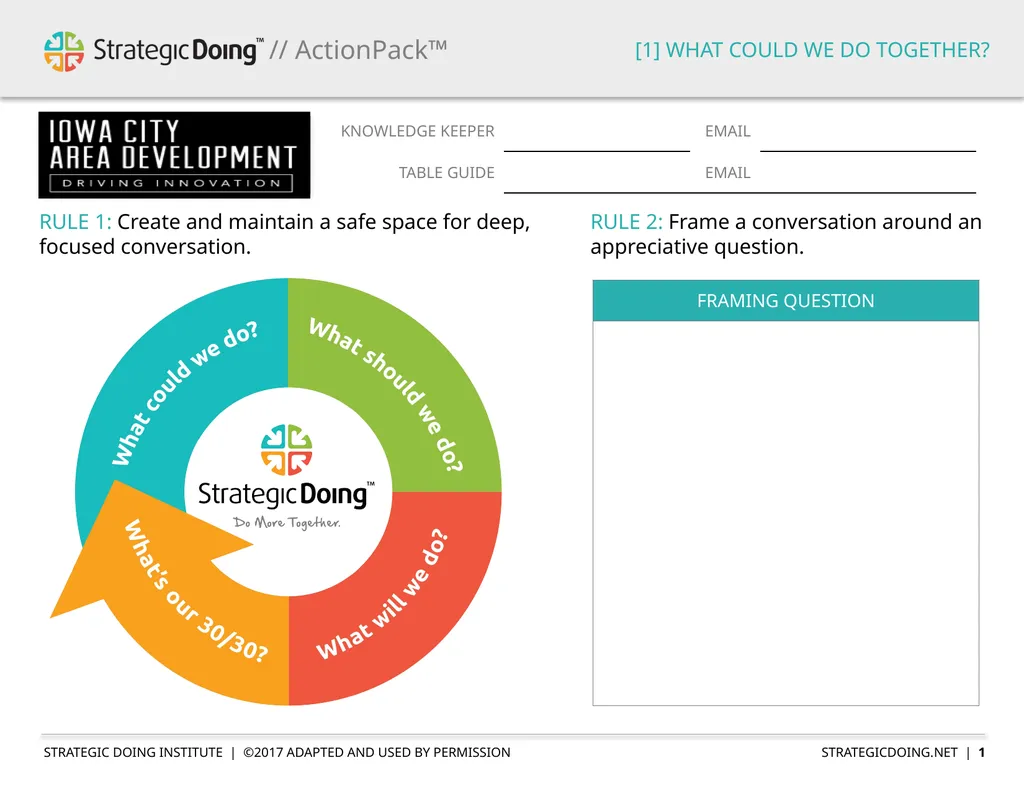
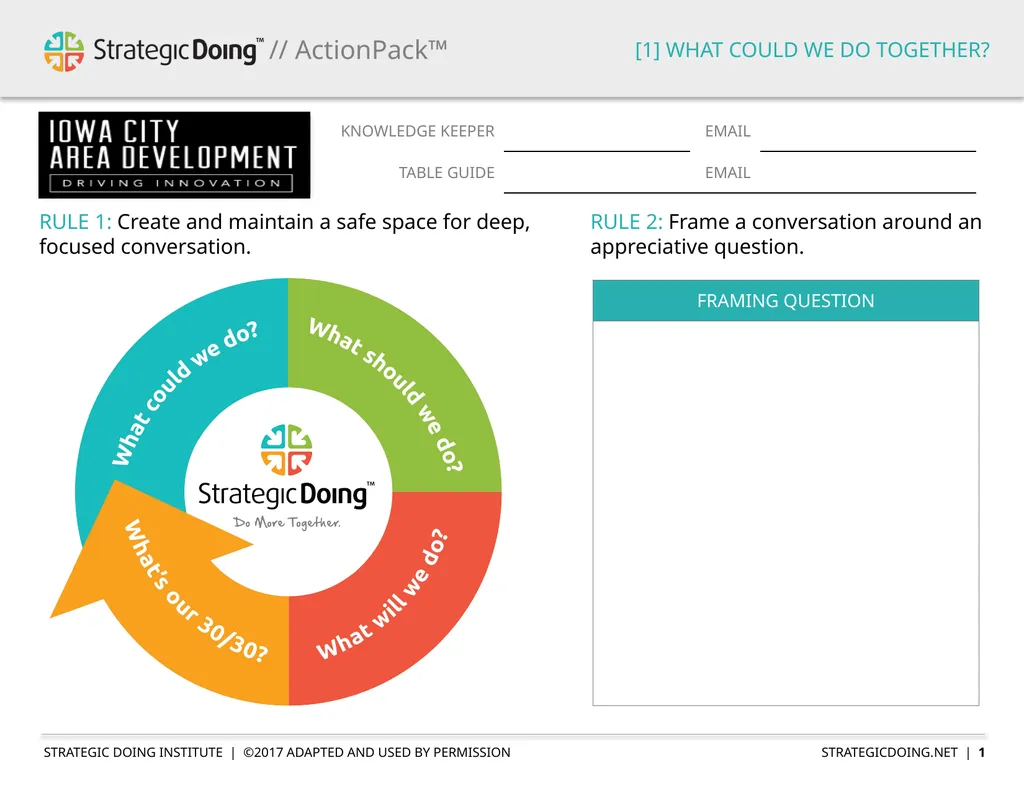
RULE 1: Create and maintain a safe space for deep, focused conversation. RULE 2: Frame a conversation around an appreciative question. 1 WHAT COULD WE DO TOGETHER? What assets is each person willing to share? Focus your conversation not
"RULE 1: Create and maintain a safe space for deep," is the property of its rightful owner. Permission is granted to
download and print the materials on this website for personal, non-commercial use only, and to display it
on your personal computer provided you do not modify the materials and that you retain all copyright
notices contained in the materials. By downloading content from our website, you accept the terms of this
agreement.
Presentation Transcript
01
RULE 1: Create and maintain a safe space for deep, focused conversation. RULE 2: Frame a conversation around an appreciative question. [1] WHAT COULD WE DO TOGETHER?<br>
02
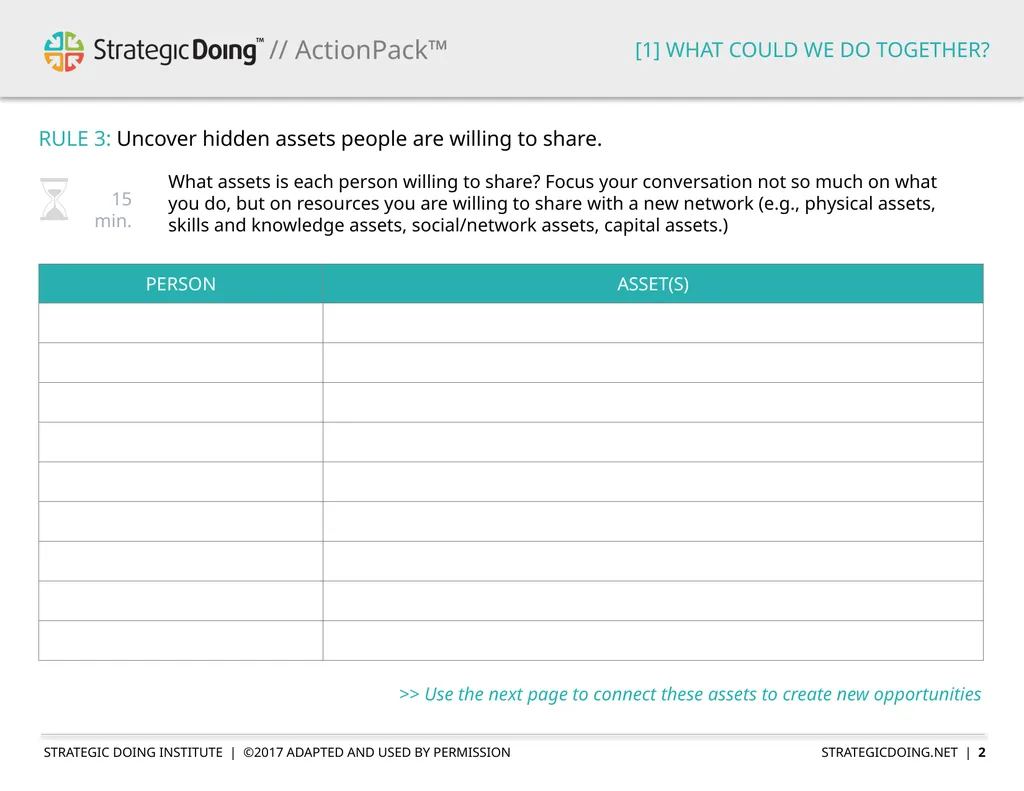
What assets is each person willing to share? Focus your conversation not so much on what you do, but on resources you are willing to share with a new network (e.g., physical assets, skills and knowledge assets, social/network assets, capital assets.) RULE 3: Uncover hidden assets people are willing to share. [1] WHAT COULD WE DO TOGETHER? >> Use the next page to connect these assets to create new opportunities<br>
03
RULE 4: Link and leverage your assets to identify new strategic opportunities (Part 1). Quickly jot down connections that spring up from the discussion. Ask questions like “What would that look like?” or “What if we…?” [1] WHAT COULD WE DO TOGETHER? >> Use the next page to narrow your ideas to three opportunities<br>
04
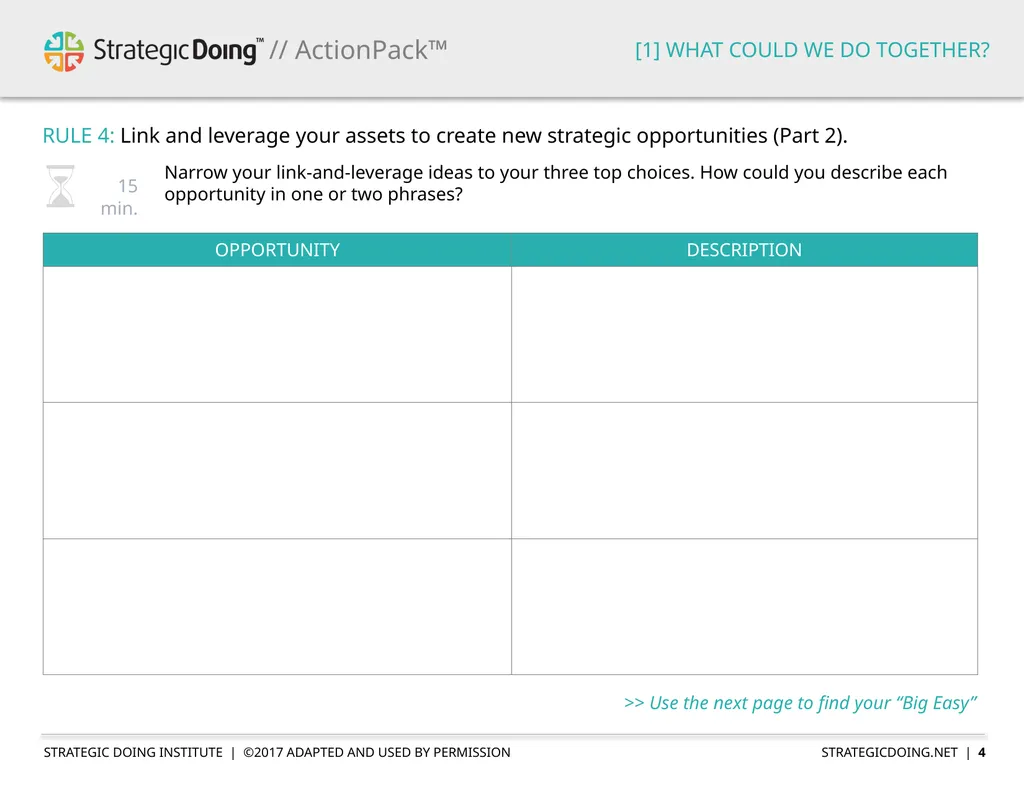
RULE 4: Link and leverage your assets to create new strategic opportunities (Part 2). Narrow your link-and-leverage ideas to your three top choices. How could you describe each opportunity in one or two phrases? [1] WHAT COULD WE DO TOGETHER? >> Use the next page to find your “Big Easy”<br>
05
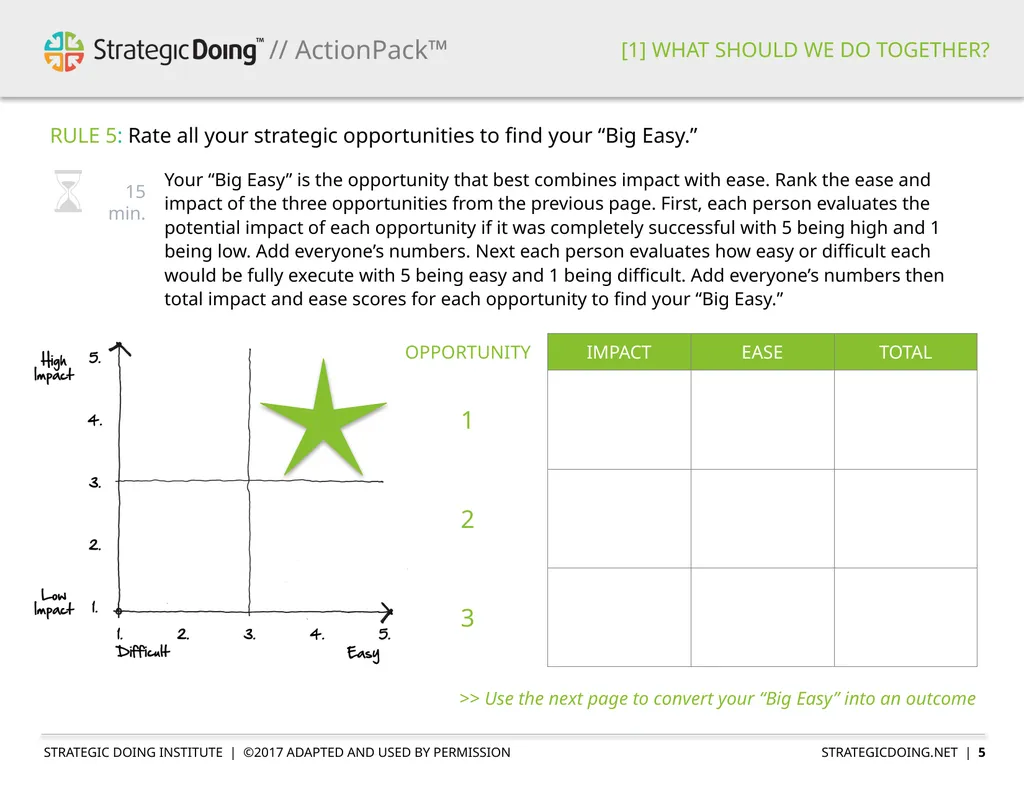
RULE 5: Rate all your strategic opportunities to find your “Big Easy.” Your “Big Easy” is the opportunity that best combines impact with ease. Rank the ease and impact of the three opportunities from the previous page. First, each person evaluates the potential impact of each opportunity if it was completely successful with 5 being high and 1 being low. Add everyone’s numbers. Next each person evaluates how easy or difficult each would be fully execute with 5 being easy and 1 being difficult. Add everyone’s numbers then total impact and ease scores for each opportunity to find your “Big Easy.” [1] WHAT SHOULD WE DO TOGETHER? >> Use the next page to convert your “Big Easy” into an outcome<br>
06
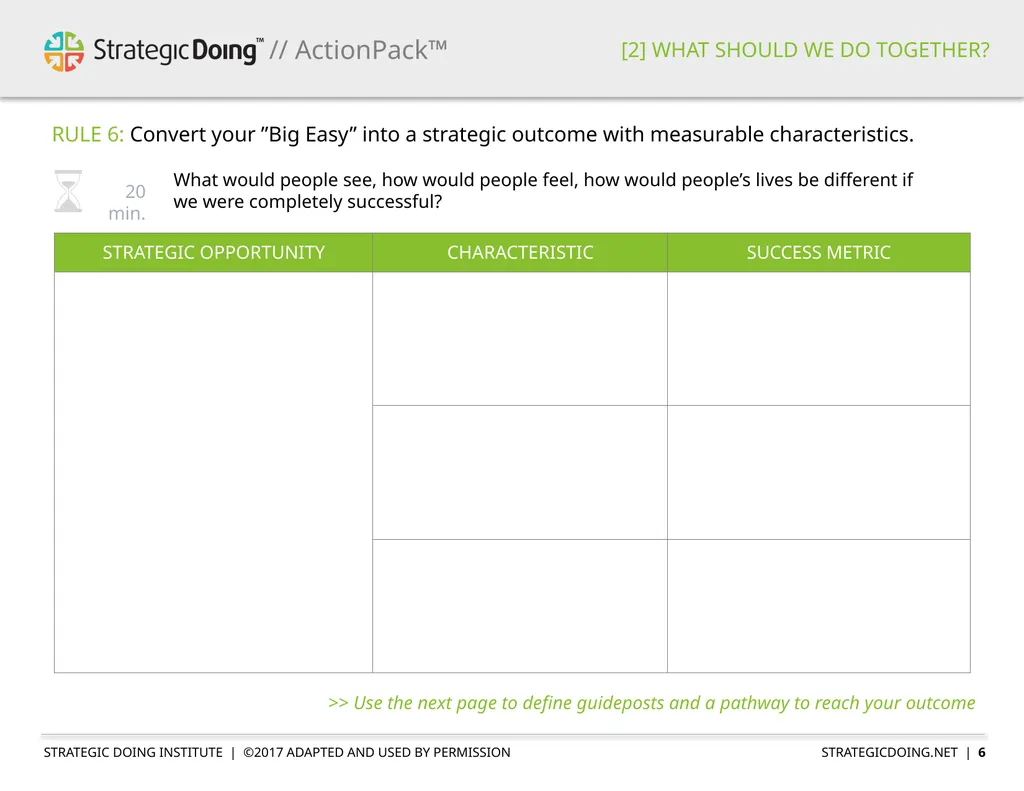
RULE 6: Convert your ”Big Easy” into a strategic outcome with measurable characteristics. What would people see, how would people feel, how would people’s lives be different if we were completely successful? [2] WHAT SHOULD WE DO TOGETHER? >> Use the next page to define guideposts and a pathway to reach your outcome<br>
07
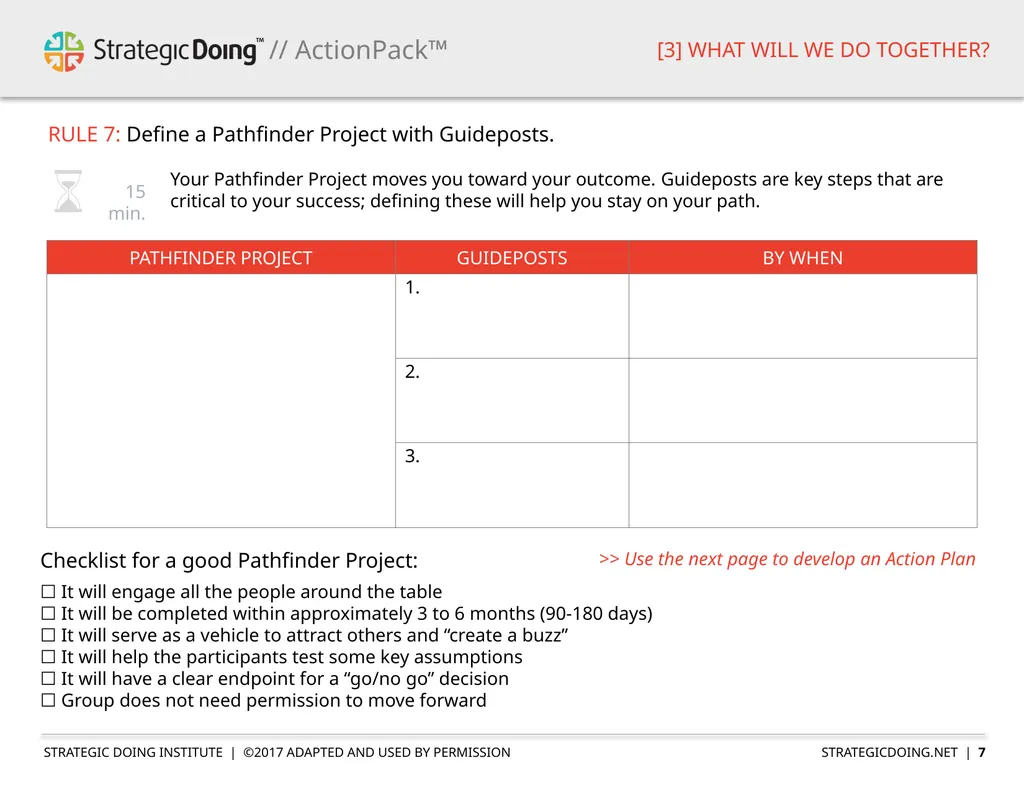
Checklist for a good Pathfinder Project:
☐ It will engage all the people around the table
☐ It will be completed within approximately 3 to 6 months (90-180 days)
☐ It will serve as a vehicle to attract others and “create a buzz”
☐ It will help the participants test some key assumptions
☐ It will have a clear endpoint for a “go/no go” decision ☐ Group does not need permission to move forward RULE 7: Define a Pathfinder Project with Guideposts. Your Pathfinder Project moves you toward your outcome. Guideposts are key steps that are critical to your success; defining these will help you stay on your path. [3] WHAT WILL WE DO TOGETHER? >> Use the next page to develop an Action Plan<br>
08
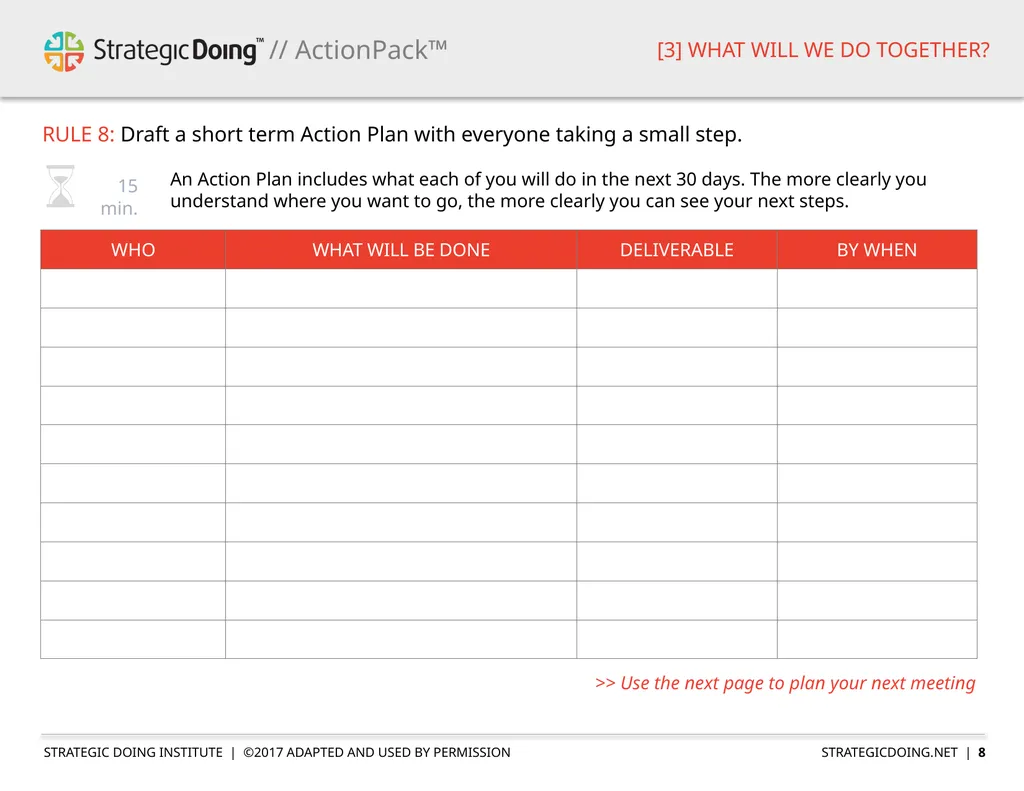
An Action Plan includes what each of you will do in the next 30 days. The more clearly you understand where you want to go, the more clearly you can see your next steps. RULE 8: Draft a short term Action Plan with everyone taking a small step. [3] WHAT WILL WE DO TOGETHER? >> Use the next page to plan your next meeting<br>
09
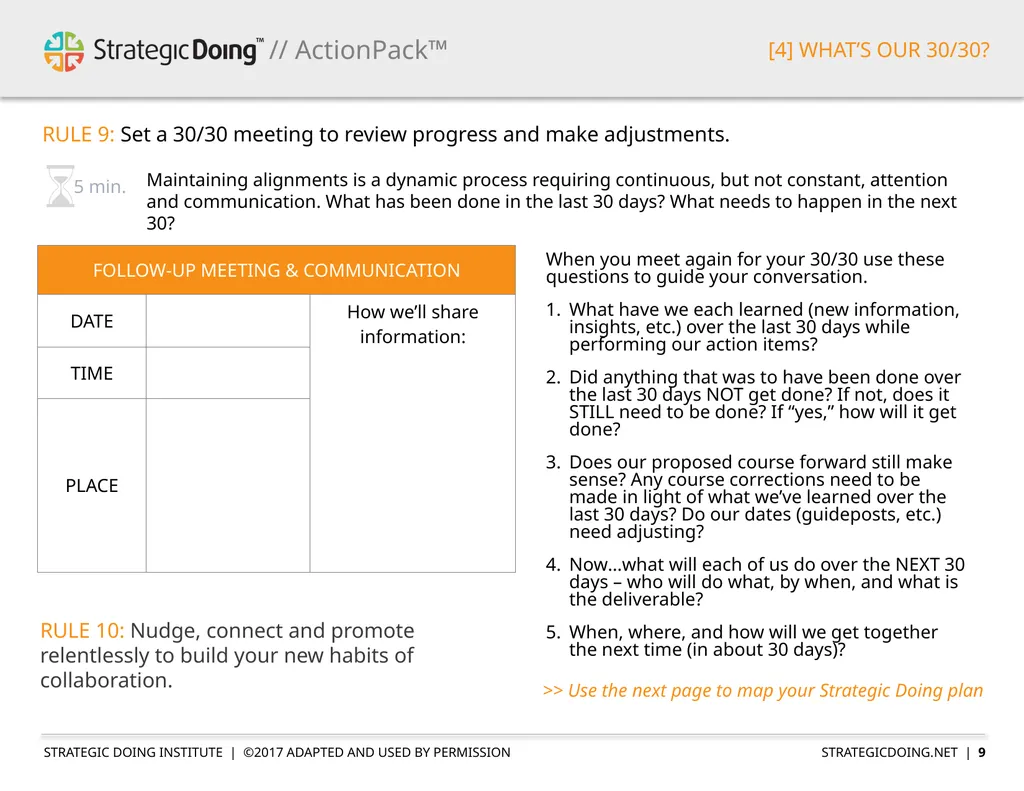
RULE 9: Set a 30/30 meeting to review progress and make adjustments. Maintaining alignments is a dynamic process requiring continuous, but not constant, attention and communication. What has been done in the last 30 days? What needs to happen in the next 30? RULE 10: Nudge, connect and promote relentlessly to build your new habits of collaboration. When you meet again for your 30/30 use these questions to guide your conversation.
What have we each learned (new information, insights, etc.) over the last 30 days while performing our action items?
Did anything that was to have been done over the last 30 days NOT get done? If not, does it STILL need to be done? If “yes,” how will it get done?
Does our proposed course forward still make sense? Any course corrections need to be made in light of what we’ve learned over the last 30 days? Do our dates (guideposts, etc.) need adjusting?
Now…what will each of us do over the NEXT 30 days – who will do what, by when, and what is the deliverable?
When, where, and how will we get together the next time (in about 30 days)? [4] WHAT’S OUR 30/30? >> Use the next page to map your Strategic Doing plan<br>
10
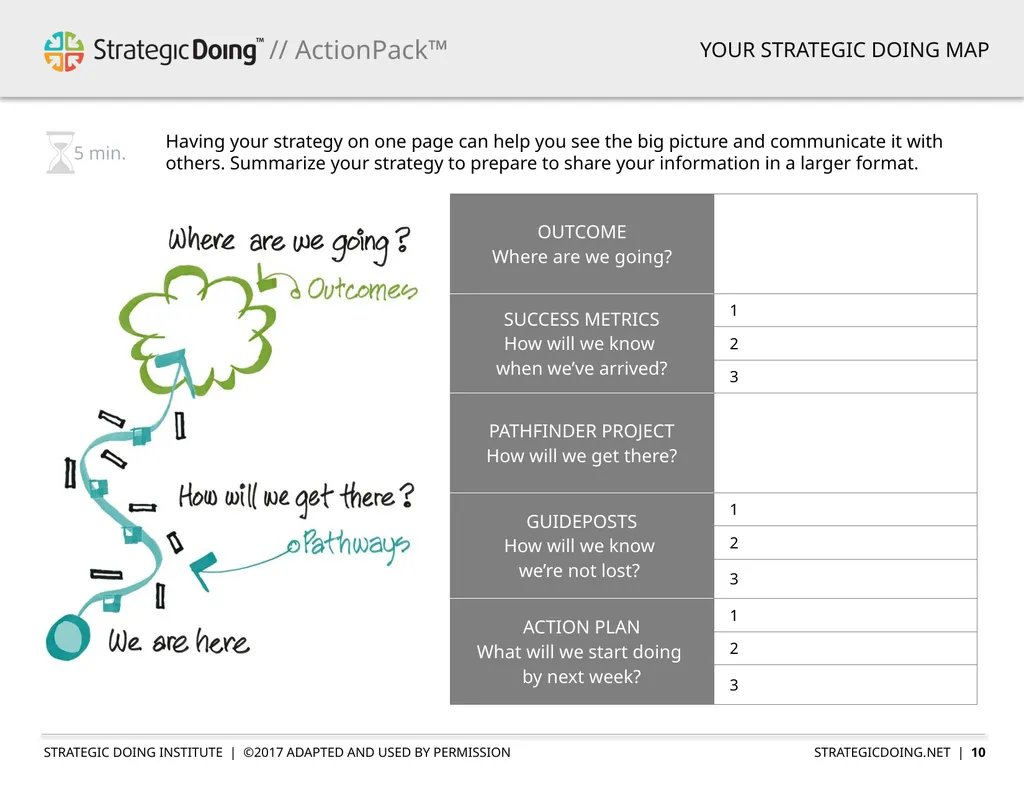
Having your strategy on one page can help you see the big picture and communicate it with others. Summarize your strategy to prepare to share your information in a larger format. YOUR STRATEGIC DOING MAP<br>
11
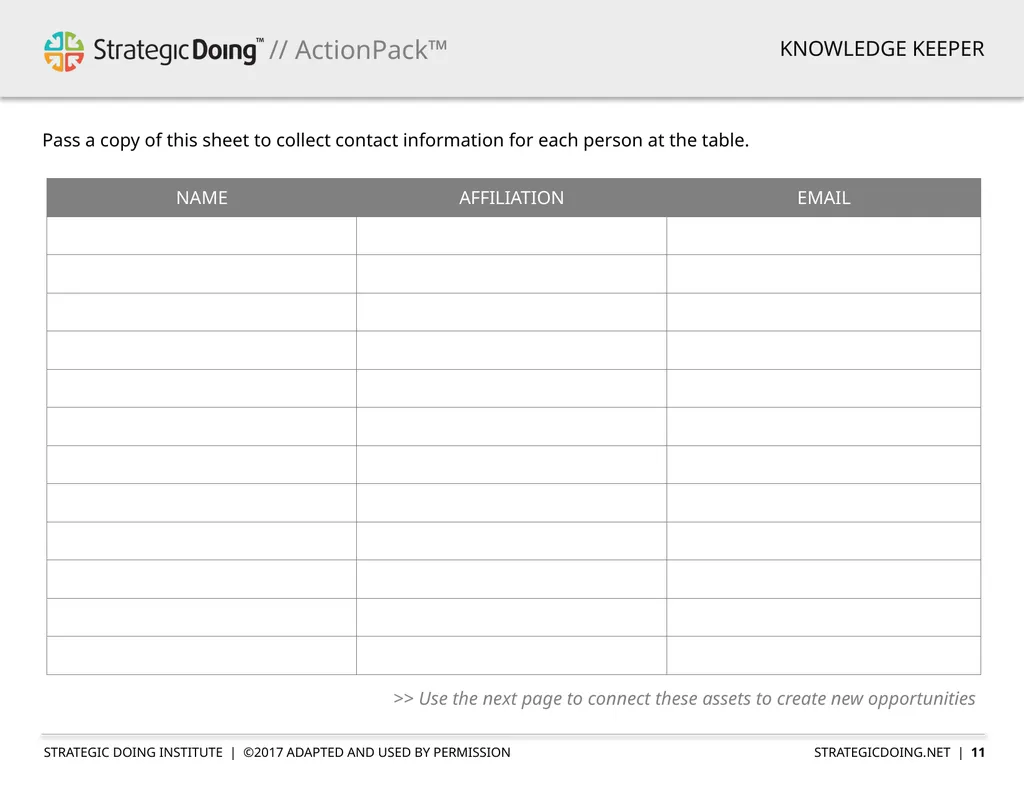
Pass a copy of this sheet to collect contact information for each person at the table. KNOWLEDGE KEEPER >> Use the next page to connect these assets to create new opportunities<br>
12
Our contact info: Tom Banta tbanta@icadgroup.com
Laurie Worden laurie.worden@Kirkwood.edu