Sacred Scripture SACRED SCRIPTURE is the speech of God as it is put down in writing under the breath of the Holy Spirit. Dei Verbum 9 Dogmatic Constitution on Divine Revelation Second Vatican Council Sacred Scripture INSPIRATION A
"Sacred Scripture SACRED SCRIPTURE is the speech of" is the property of its rightful owner. Permission is granted to
download and print the materials on this website for personal, non-commercial use only, and to display it
on your personal computer provided you do not modify the materials and that you retain all copyright
notices contained in the materials. By downloading content from our website, you accept the terms of this
agreement.
Presentation Transcript
01
Sacred Scripture SACRED SCRIPTURE
is the speech of God as it is
put down in writing under
the breath of the Holy Spirit.
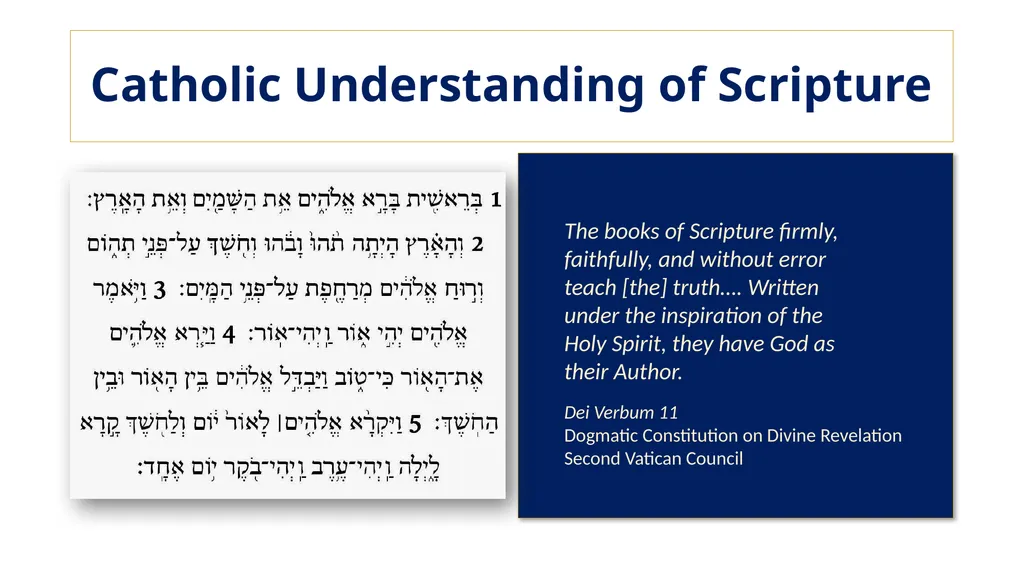
Dei Verbum 9
Dogmatic Constitution on Divine Revelation
Second Vatican Council<br>
02
Sacred Scripture INSPIRATION
A theological term to describe the divine authorship
of the Bible. It means that the Holy Spirit acted
in and through the Bible’s human authors,
moving them to write what God wished to communicate in written form.
-- Catholic Bible Dictionary (p. 381)<br>
03
Sacred Scripture BIBLICAL INSPIRATION:
The gift of the Holy Spirit which assisted a human author to write a biblical book so that it has God
as its author and teaches faithfully, without error,
the saving truth that God has willed to be
Consigned to us.
-- Glossary Catechism of the Catholic Church<br>
04
Sacred Scripture God chose certain men who … made full use of their own faculties and powers so that, though he acted in them and by them, it was as true authors that they consigned to writing whatever he wanted written,
and no more.
Dei Verbum 11
Dogmatic Constitution on Divine Revelation
Second Vatican Council<br>
05
Sacred Scripture God is the author of Sacred Scripture.
“The divinely revealed realities, which are contained and presented in the text of Sacred Scripture,
have been written down under the inspiration
of the Holy Spirit.”
-- § 105 Catechism of the Catholic Church<br>
06
Sacred Scripture All scripture is inspired by God
and is useful for teaching, for reproof,
for correction, and for training in
righteousness, so that everyone who
belongs to God may be proficient,
equipped for every good work.
-- 2 Timothy 3:16-17 --<br>
07
Sacred Scripture The phrase inspired by God comes from
the unique Greek word theópneustos.
Literally translated as “God-breathed”
as in God breathed out the Scriptures.<br>
08
Sacred Scripture First of all you must understand this,
that no prophecy of scripture is a
matter of one’s own interpretation,
because no prophecy ever came by
human will, but men and women moved
by the Holy Spirit spoke from God.
--2 Peter 1:20-21 --<br>
09
Sacred Scripture God is the author of Sacred Scripture
because he inspired its human authors;
he acts in them and by means of them.
He thus gives assurance that their writings
teach without error his saving truth.
-- § 136 Catechism of the Catholic Church<br>
10
Catholic Understanding of Scripture INERRANCY
The understanding of
Scripture as conveying
without error the truth
that God wished to be
recorded for the sake of
our salvation.
(D. J. Harrington, SJ)<br>
11
Catholic Understanding of Scripture INERRANCY Debate/Discussion
Does inerrancy apply to matters
of salvation alone, Or does
inerrancy apply to issues of
history or geography or science?<br>
12
Catholic Understanding of Scripture The books of Scripture firmly,
faithfully, and without error
teach [the] truth…. Written
under the inspiration of the
Holy Spirit, they have God as
their Author.
Dei Verbum 11
Dogmatic Constitution on Divine Revelation
Second Vatican Council<br>
13
Sacred Scripture It is not allowable to say,
‘The author of this book is
mistaken’; but either the
manuscript is faulty, or
the translation is wrong, or
you have not understood.
St. Augustine Bishop of Hippo
Letters 82<br>
14
Sacred Scripture INTERPRETATION
(OF THE BIBLE)
The effort to ascertain the meaning
of the Bible intended by its divine
and human authors.
--Catholic Biblical Dictionary (p. 391)<br>
15
Sacred Scripture HERMENEUTICS:
The field of study that deals with the interpretation of written texts and oral communication.
Hermeneutics is the science of
interpretation; the principles that govern sound biblical interpretation.<br>
16
Sacred Scripture EXEGESIS
To lead out the meaning;
scholarly investigation of the meaning
of a biblical text.<br>
17
EXEGESIS: Four Senses According to an ancient tradition, one can distinguish between two senses of Scripture:
The literal and the spiritual, the latter being subdivided
into the allegorical, moral, and anagogical.
The profound concordance of the four senses guarantees
all its richness to the living reading of Scripture in the
Church.
-- Catechism of the Catholic Church 115 --<br>
18
EXEGESIS: Four Senses The spiritual sense answers the question,
“What does the text mean to me?”
The allegorical sense answers the question,
“In what way does this text point to Christ?”
The moral sense answers the question,
“how should I now live?”
The anagogical sense answers the question,
“What does this text say about our destiny?”<br>
19
EXEGESIS: Four Senses The literal sense answers the questions,
“What did the author mean?” and “How did
the first readers understand him“?
The profound concordance of the four senses
guarantees all its richness to the living reading
of Scripture in the Church.