02
Safety Task Analysis�(STA) What is Safety Task Analysis?
is the analysis of how a task is accomplished, including a detailed description of both manual and mental activities, task and element durations, task frequency, task allocation, task complexity, environmental conditions, necessary clothing and equipment, and any other unique factors involved in or required for one or more people to perform a given task. CURI SAFETY<br>
04
The Five Steps of the STA Stop And Think
Right Tools, Equipment, PPE, Permits, etc
Identify Hazards
Control Hazards
Review STA CURI SAFETY<br>
05
Step 1 – “Stop and Think”��What job are you to do? Break Down the Task Into Small Steps such as these:
Disassembly Assembly Grasping Reaching
Searching Moving Lifting Holding
Positioning Inspecting Testing Operating
Climbing Supporting Pulling Securing CURI SAFETY<br>
06
Step 1 – “Stop and Think”�Are you qualified to perform the task? NFPA 70E Arc Flash Trained Confined Space Entry
Forklift Operation Aerial Lift Operation
Rigging Lock Out (Authorized-Qualified)
Line Breaking SDS-Right to Know
Fall Protection Electrical Testing and Troubleshooting
If you Don’t know STOP and GET HELP CURI SAFETY<br>
07
Step 2 – Right Tools, Equipment, PPE, Permits, Permissions, etc. CURI SAFETY Test Instruments Mechanics Tools
Insulated Tools Pry Bar
Gages Meters
Rigging Blocking
Power Tools Drawings/Schematics
(Examples from the Team)<br>
08
Step 2 – Right Tools, Equipment, PPE, Permits, Permissions, etc. Forklift Aerial Lift
Hand Carts Cart Trucks
Task Lighting Work Table / Area
Drill Press
Welding-Cutting Equip.
(Examples from the Team) CURI SAFETY<br>
09
Step 2 – Right Tools, Equipment, PPE, Permits, Permissions, etc. Gloves Tyvek Suit
Safety Glasses Face Shield
Hearing Protection Thermal Protection
Absorbent Material Personal/Team Lockout
Barricades Caution Tape
(Examples from the Team) CURI SAFETY<br>
10
Step 2 – Right Tools, Equipment, PPE, Permits, Permissions, etc. Confined Space Entry
Electrical STA
Hot Work
Energized Work / Lockout
(Examples from the Team) CURI SAFETY<br>
11
Step 3 – Identification of Hazards What is a hazard?
A hazard is the potential for harm. If left uncontrolled, a hazard could result in injury or loss. A hazard can be a physical object, chemical, noise, radiation, extreme heat or cold, electrical energy or anything else that has the potential to cause harm. CURI SAFETY<br>
12
Step 3 – Identification of Hazards�What can hurt, damage, wreck, crush? Force-Gravity-Weight Frequency-Repetition
Posture-Ergonomics Duration-Fatigue
Contact Stress-Thermal Contact
Environmental (Heat-cold-wind-rain-fumes)
(Examples from the Team) CURI SAFETY<br>
13
Step 3 – Hazard Identification�What are some hazard questions? What is LIKELY to go wrong?
What are the consequences?
How could the hazard arise?
What are other contributing factors?
How likely is it that the hazard will occur CURI SAFETY<br>
14
Step 4 – Contol of Hazards Identified�What is a control? A control is anything that will help reduce the hazard by either preventing it from occurring or minimizing its impact if it does occur. If a hazard cannot be eliminated, steps should be taken so that the consequences of the hazard are as low as reasonably practical.
If a workplace hazard cannot be eliminated or replaced with a non-hazardous substitution, it is necessary to implement hazard controls in order to protect the worker. CURI SAFETY<br>
15
Step 4 – Control of Hazards�Types of Control Methods Engineering Controls: Physically changing the process or access to the hazard
Administrative Controls: Altering the way in which the job is performed
Personal Protective Controls: Altering the workers PPE to remove a hazard or place a barrier between the worker and the hazard CURI SAFETY<br>
16
Step 4 – Control of Hazards ENGINEERING CONTROLS:
Examples of engineering controls include machine guards on mechanical blades/saws, ventilation systems to control fumes, wetting systems to control dust, circuit breakers and automatic shutoff switches on tanks and high pressure systems. CURI SAFETY<br>
17
Step 4 – Control of Hazards ADMINISTRATIVE CONTROLS:
Examples of administrative controls include developing a step by step procedure for performing the job safely, altering worker schedules to a time of day when the hazard is less likely to occur and designing policies such as a buddy-system or lockout system (which then becomes an engineering control once the system is shutdown). Required specialized training and permits are also often included in the “administrative controls” category. CURI SAFETY<br>
18
Step 4 – Control of Hazards PPE CONTROLS: (Last to be used)
If a hazard cannot be eliminated or minimized by using engineering or administrative controls, then use of protective clothing or equipment is warranted.
Examples of PPE include steel toe shoes, long pants, hard hat, high visibility reflective vest, face shield, Tyvek suit, respirator and ear plugs. CURI SAFETY<br>
19
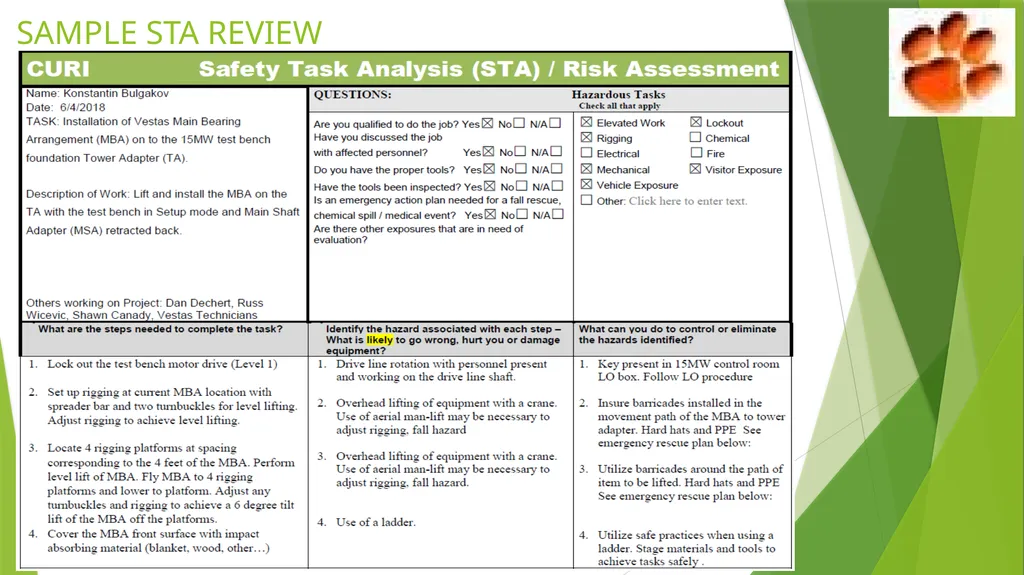
SAMPLE STA REVIEW CURI SAFETY<br>
20
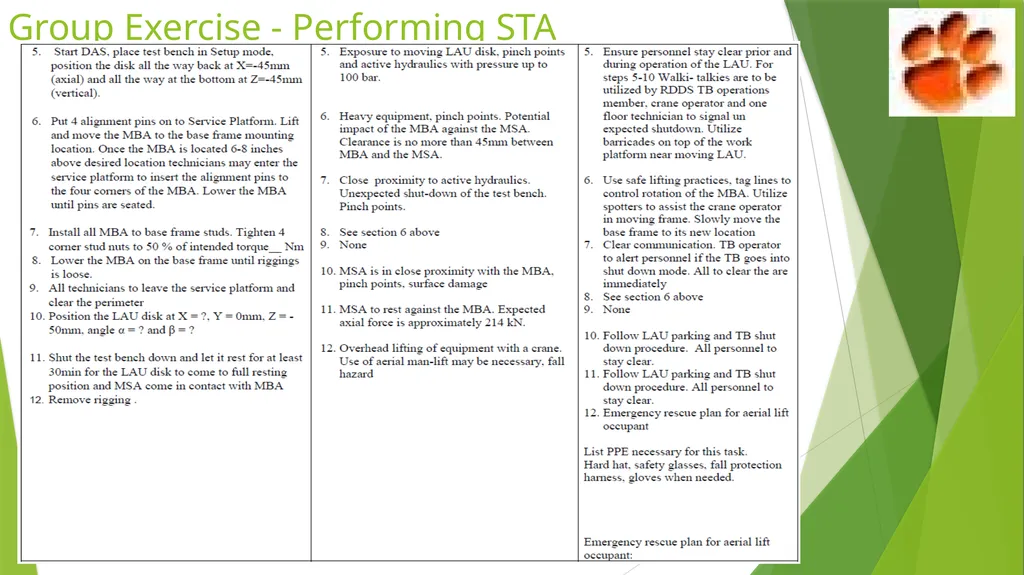
Group Exercise - Performing STA CURI SAFETY<br>
21
Conclusion Take some time and complete a thorough STA
Make sure you follow-up and make the changes after the task is complete
Copy safety for review and to save on the shared drive “STA BANK” for future reviews
Remember the process for other tasks that may not require a written STA CURI SAFETY<br>