
Salil Joshi, Senior Director – Industry
AS
Published · 75 slides · 0 views

1 / 1




Description
Salil Joshi, Senior Director Industry Development GS1 US Successful Implementation of GS1 Standards Step-by-Step Approach October 19, 2016 Antitrust Caution 2 GS1 US is committed to complying fully with antitrust laws. We ask everyone to
Related Topics
Share
Embed code
Download this presentation From Below
"Salil Joshi, Senior Director – Industry" is the property of its rightful owner. Permission is granted to download and print the materials on this website for personal, non-commercial use only, and to display it on your personal computer provided you do not modify the materials and that you retain all copyright notices contained in the materials. By downloading content from our website, you accept the terms of this agreement.
Presentation Transcript
01
Salil Joshi,
Senior Director – Industry Development
GS1 US Successful Implementation of GS1 Standards Step-by-Step Approach October 19, 2016<br>
02
Antitrust Caution 2 GS1 US is committed to complying fully with antitrust laws.
We ask everyone to refrain from discussions in areas of antitrust such as pricing, deal-making, selling, promoting or other activities which could be viewed as anti-competitive.
If anyone believes the discussion is approaching these boundaries, please inform a GS1 US representative.
Please remember to make your own business decisions and that all GS1 standards are voluntary and not mandatory.
Please review the complete GS1 US antitrust policy at: http://www.gs1us.org/gs1-us-antitrust-compliance-policy<br>
We ask everyone to refrain from discussions in areas of antitrust such as pricing, deal-making, selling, promoting or other activities which could be viewed as anti-competitive.
If anyone believes the discussion is approaching these boundaries, please inform a GS1 US representative.
Please remember to make your own business decisions and that all GS1 standards are voluntary and not mandatory.
Please review the complete GS1 US antitrust policy at: http://www.gs1us.org/gs1-us-antitrust-compliance-policy<br>
03
Legal Disclosure 3 GS1 US, Inc. is providing this presentation as a service to interested parties. Although efforts have been made to assure that this presentation is correct, reliable, and technically accurate, GS1 US MAKES NO WARRANTIES, EXPRESS OR IMPLIED, AND ANY SUCH WARRANTIES ARE EXPRESSLY DISCLAIMED, CONCERNING THE ACCURACY OR RELIABILITY OF ANY PRESENTATION CONTENT, NONINFRINGEMENT, MERCHANTABILITY OR FITNESS FOR A PARTICULAR PURPOSE.
GS1 US shall not be liable for any consequential, special, indirect, incidental, exemplary or punitive damages of any kind or nature whatsoever, or any lost income or profits, or other theory of liability, arising out of the use of this presentation content, even if advised of the possibility of such loss or damage or if such loss or damage could have been reasonably foreseen.
GS1 US employees are not representatives or agents of the FDA.<br>
GS1 US shall not be liable for any consequential, special, indirect, incidental, exemplary or punitive damages of any kind or nature whatsoever, or any lost income or profits, or other theory of liability, arising out of the use of this presentation content, even if advised of the possibility of such loss or damage or if such loss or damage could have been reasonably foreseen.
GS1 US employees are not representatives or agents of the FDA.<br>
04
Learning Objectives 4 Gain basic knowledge of the GS1 Standards and the benefits received
Getting started with GS1 Global Location Number (GLN): building, validating and reconciling your GLN hierarchy with suppliers and using them in transactions
Using GS1 Global Trade Item Numbers (GTIN’s) in your item master file and in supply chain transactions
Using the Unique Device Identifier (UDI): GTIN’s and encoded production identifiers for inventory management, meaningful use of electronic health records (EHR) and patient safety<br>
Getting started with GS1 Global Location Number (GLN): building, validating and reconciling your GLN hierarchy with suppliers and using them in transactions
Using GS1 Global Trade Item Numbers (GTIN’s) in your item master file and in supply chain transactions
Using the Unique Device Identifier (UDI): GTIN’s and encoded production identifiers for inventory management, meaningful use of electronic health records (EHR) and patient safety<br>
05
Agenda 5 Who is GS1 and GS1 US?
GS1 System of Standards
Global Location Number (GLN)
Global Trade Item Number (GTIN)
Global Data Synchronization Network (GDSN)
Steps for GS1 Standards Implementation
GS1 Healthcare US Support & Tools<br>
GS1 System of Standards
Global Location Number (GLN)
Global Trade Item Number (GTIN)
Global Data Synchronization Network (GDSN)
Steps for GS1 Standards Implementation
GS1 Healthcare US Support & Tools<br>
06
GS1 US 6<br>
07
110+ Member Organizations
Serving Business Around the World 7<br>
08
Our Guiding Principles 8 We are…
Neutral and not-for-profit
User-driven and governed
Global and local
Inclusive and collaborative<br>
Neutral and not-for-profit
User-driven and governed
Global and local
Inclusive and collaborative<br>
09
The Global Language of Business 9 GS1 Standards make it possible
to identify, capture, and share information automatically and accurately about products, business locations, and more.<br>
10
About GS1 US 10 GS1 US serves more than 300,000 businesses across 25 industries in the United States.
Leading industry initiatives in Apparel and General Merchandise, Foodservice, Healthcare, and Retail Grocery
Administrating the GS1 System of Standards
Providing support services, tools, education, and training
Connecting communities through events and online forums
GS1 US is the pioneer of the Universal Product Code (U.P.C.) and the Electronic Product Code (EPC®).<br>
Leading industry initiatives in Apparel and General Merchandise, Foodservice, Healthcare, and Retail Grocery
Administrating the GS1 System of Standards
Providing support services, tools, education, and training
Connecting communities through events and online forums
GS1 US is the pioneer of the Universal Product Code (U.P.C.) and the Electronic Product Code (EPC®).<br>
11
GS1 By The Numbers 11 2 million companies around the world
use GS1 Standards.
More than 5 billion GS1 barcodes are scanned every day.
10 million products are assigned U.P.C.s in the GS1 US Data Driver® tool.
Over 15 million products are registered by brand owners in the GS1 Global Data Synchronization Network™ (GDSN®).<br>
More than 5 billion GS1 barcodes are scanned every day.
10 million products are assigned U.P.C.s in the GS1 US Data Driver® tool.
Over 15 million products are registered by brand owners in the GS1 Global Data Synchronization Network™ (GDSN®).<br>
12
Who is GS1 Healthcare US 12 GS1 US is dedicated to the adoption and implementation of standards-based, global supply chain solutions in the U.S., serves >300K companies -- 16,000 of which are in healthcare
GS1 Healthcare, with the Global Office in Brussels, Belgium is a voluntary group of stakeholders including manufacturers, wholesalers & distributors, as well as hospitals and pharmacy retailers, regulatory agencies and trade organizations
GS1 Healthcare US began our journey in 2008. We focus on driving the adoption and implementation of GS1 Standards in the healthcare industry to improve patient safety and supply chain efficiency<br>
GS1 Healthcare, with the Global Office in Brussels, Belgium is a voluntary group of stakeholders including manufacturers, wholesalers & distributors, as well as hospitals and pharmacy retailers, regulatory agencies and trade organizations
GS1 Healthcare US began our journey in 2008. We focus on driving the adoption and implementation of GS1 Standards in the healthcare industry to improve patient safety and supply chain efficiency<br>
13
Healthcare House 13<br>
14
Business Case – McKinsey Report 14 Companies using the GS1 System of Standards see measurable benefits:
3.5% higher invoice accuracy for manufacturers.
21% shorter lead time for warehouse operators.
42% lower costs for distribution centers.
32% fewer out-of-stocks for retailers.
Medical providers using GS1 Standards realize significant savings:
30% drop in outstanding days payable.
73% fewer purchase order errors.
80% reduction in obsolete stocks, resulting in increased patient safety in Dutch hospitals. SOURCE: McKinsey & Co report, “Strength in unity: The promise of global standards in healthcare”, October 2012 “Implementing global standards across the entire healthcare supply chain could save 22,000-43,000 lives and avert 0.7 million to 1.4 million patient disabilities”
“Rolling out such standards-based systems globally could prevent tens of millions of dollars’ worth of counterfeit drugs from entering the legitimate supply chain”
[We] “estimate that healthcare cost could be reduced by $40 billion-$100 billion globally” from the implementation of global standards
“Adopting a single set of global standards will cost significantly less than two” (between 10-25% less cost to stakeholders)<br>
3.5% higher invoice accuracy for manufacturers.
21% shorter lead time for warehouse operators.
42% lower costs for distribution centers.
32% fewer out-of-stocks for retailers.
Medical providers using GS1 Standards realize significant savings:
30% drop in outstanding days payable.
73% fewer purchase order errors.
80% reduction in obsolete stocks, resulting in increased patient safety in Dutch hospitals. SOURCE: McKinsey & Co report, “Strength in unity: The promise of global standards in healthcare”, October 2012 “Implementing global standards across the entire healthcare supply chain could save 22,000-43,000 lives and avert 0.7 million to 1.4 million patient disabilities”
“Rolling out such standards-based systems globally could prevent tens of millions of dollars’ worth of counterfeit drugs from entering the legitimate supply chain”
[We] “estimate that healthcare cost could be reduced by $40 billion-$100 billion globally” from the implementation of global standards
“Adopting a single set of global standards will cost significantly less than two” (between 10-25% less cost to stakeholders)<br>
15
Benefits of Standards 15 Key benefits
Improving patient safety
Lowering costs through increased efficiency
Reducing medication errors
Enabling supply chain visibility
Facilitating effective product recalls
Tracking of pharmaceutical products/medical devices
Reducing introduction of counterfeit products
Enhancing inventory management
Linking critical product data to the patient record
Supporting regulatory compliance
Optimizing order, invoice, sales reporting, and chargeback/rebate processes<br>
Improving patient safety
Lowering costs through increased efficiency
Reducing medication errors
Enabling supply chain visibility
Facilitating effective product recalls
Tracking of pharmaceutical products/medical devices
Reducing introduction of counterfeit products
Enhancing inventory management
Linking critical product data to the patient record
Supporting regulatory compliance
Optimizing order, invoice, sales reporting, and chargeback/rebate processes<br>
16
GS1 Standards in Healthcare 16<br>
17
We envision a world where… 17 The supply chain delivers:
the right product
to the right place
at the right time
Healthcare professionals spend their time providing care:
to the right patient
administering the right dose
through the right route
Focus is on reducing error from the process with automation and the use of standard, unique identifiers.
Regulatory efforts since the 1999 Institute of Medicine report
To Error is Human focused on marking products to enable automation and further visibility to protect patients in the event of a product recall.<br>
the right product
to the right place
at the right time
Healthcare professionals spend their time providing care:
to the right patient
administering the right dose
through the right route
Focus is on reducing error from the process with automation and the use of standard, unique identifiers.
Regulatory efforts since the 1999 Institute of Medicine report
To Error is Human focused on marking products to enable automation and further visibility to protect patients in the event of a product recall.<br>
18
Regulations Driving Change 18<br>
19
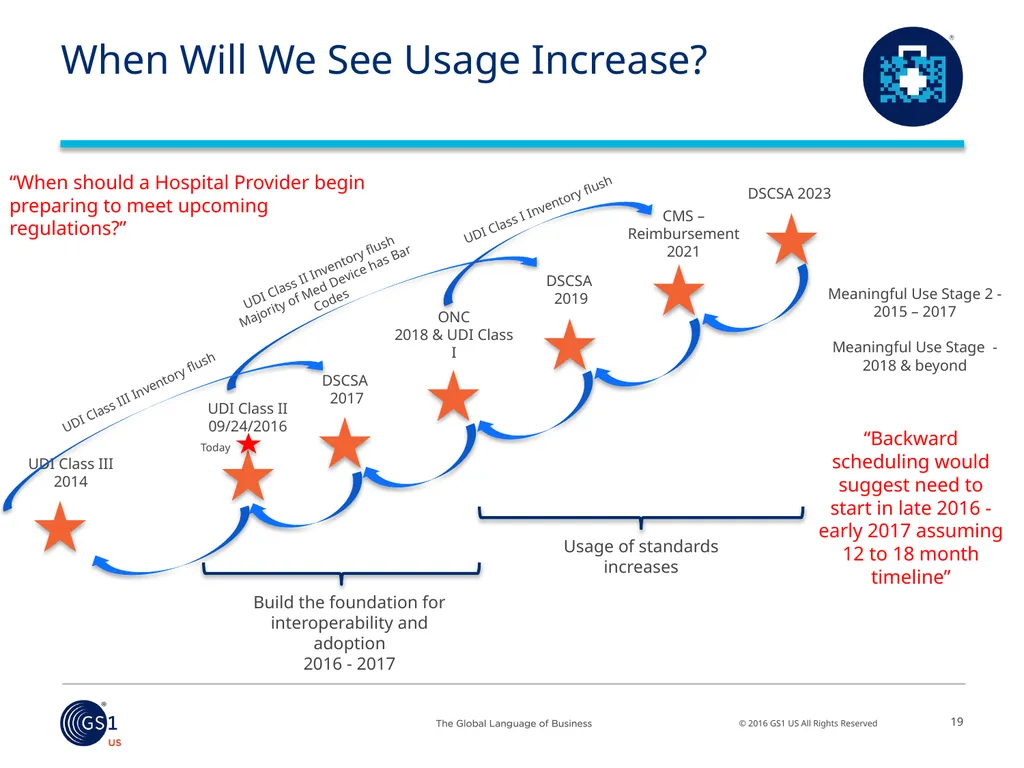
19 CMS – Reimbursement 2021 DSCSA
2019 ONC
2018 & UDI Class I DSCSA
2017 UDI Class II
09/24/2016 UDI Class III
2014 “When should a Hospital Provider begin preparing to meet upcoming regulations?” “Backward scheduling would suggest need to start in late 2016 - early 2017 assuming 12 to 18 month timeline” UDI Class II Inventory flush
Majority of Med Device has Bar Codes UDI Class I Inventory flush Usage of standards increases Build the foundation for interoperability and adoption
2016 - 2017 Today DSCSA 2023 Meaningful Use Stage 2 - 2015 – 2017
Meaningful Use Stage - 2018 & beyond UDI Class III Inventory flush When Will We See Usage Increase?<br>
2019 ONC
2018 & UDI Class I DSCSA
2017 UDI Class II
09/24/2016 UDI Class III
2014 “When should a Hospital Provider begin preparing to meet upcoming regulations?” “Backward scheduling would suggest need to start in late 2016 - early 2017 assuming 12 to 18 month timeline” UDI Class II Inventory flush
Majority of Med Device has Bar Codes UDI Class I Inventory flush Usage of standards increases Build the foundation for interoperability and adoption
2016 - 2017 Today DSCSA 2023 Meaningful Use Stage 2 - 2015 – 2017
Meaningful Use Stage - 2018 & beyond UDI Class III Inventory flush When Will We See Usage Increase?<br>
20
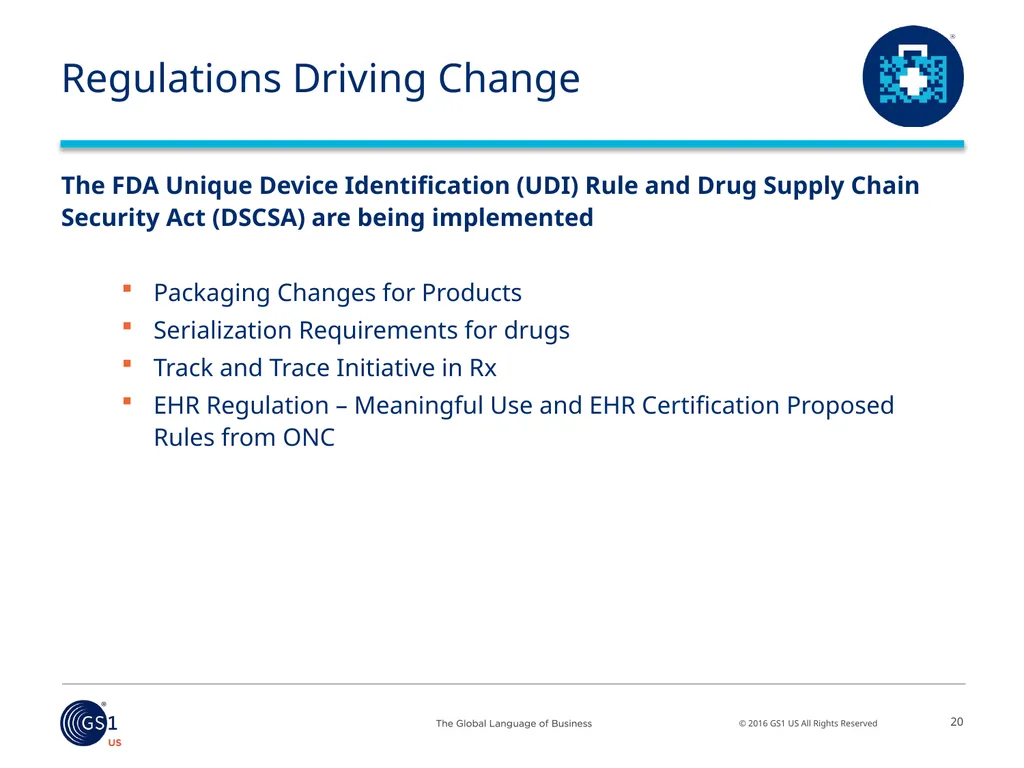
Regulations Driving Change 20 The FDA Unique Device Identification (UDI) Rule and Drug Supply Chain Security Act (DSCSA) are being implemented
Packaging Changes for Products
Serialization Requirements for drugs
Track and Trace Initiative in Rx
EHR Regulation – Meaningful Use and EHR Certification Proposed Rules from ONC<br>
Packaging Changes for Products
Serialization Requirements for drugs
Track and Trace Initiative in Rx
EHR Regulation – Meaningful Use and EHR Certification Proposed Rules from ONC<br>
21
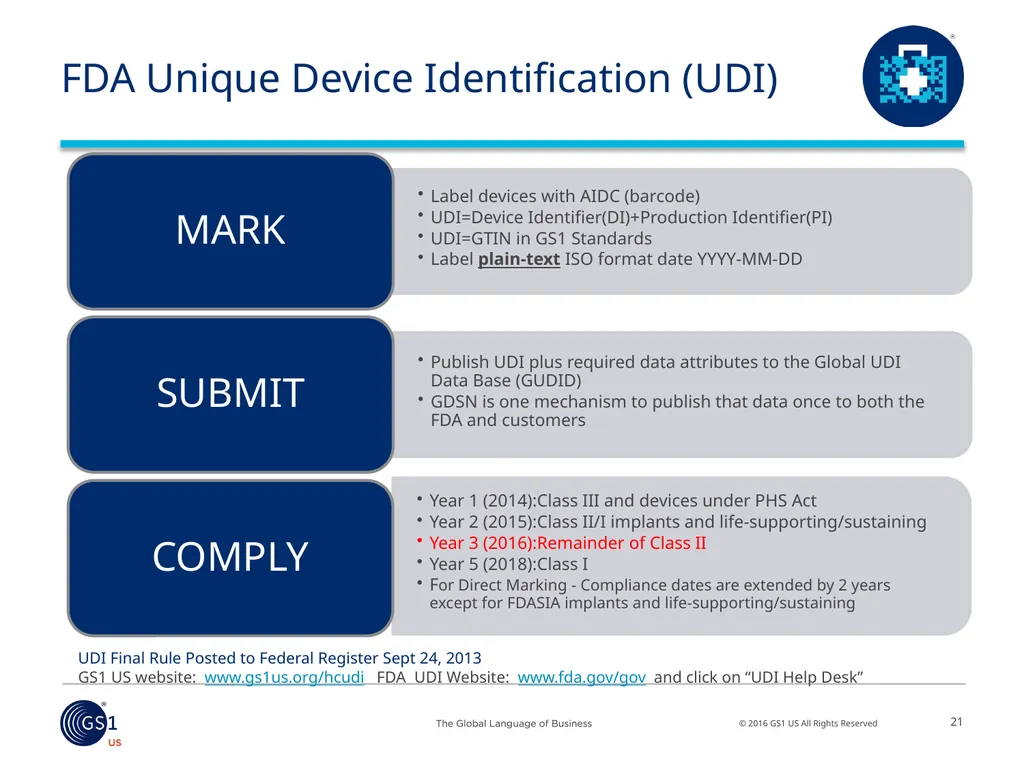
FDA Unique Device Identification (UDI) 21 UDI Final Rule Posted to Federal Register Sept 24, 2013
GS1 US website: www.gs1us.org/hcudi FDA UDI Website: www.fda.gov/gov and click on “UDI Help Desk”<br>
GS1 US website: www.gs1us.org/hcudi FDA UDI Website: www.fda.gov/gov and click on “UDI Help Desk”<br>
22
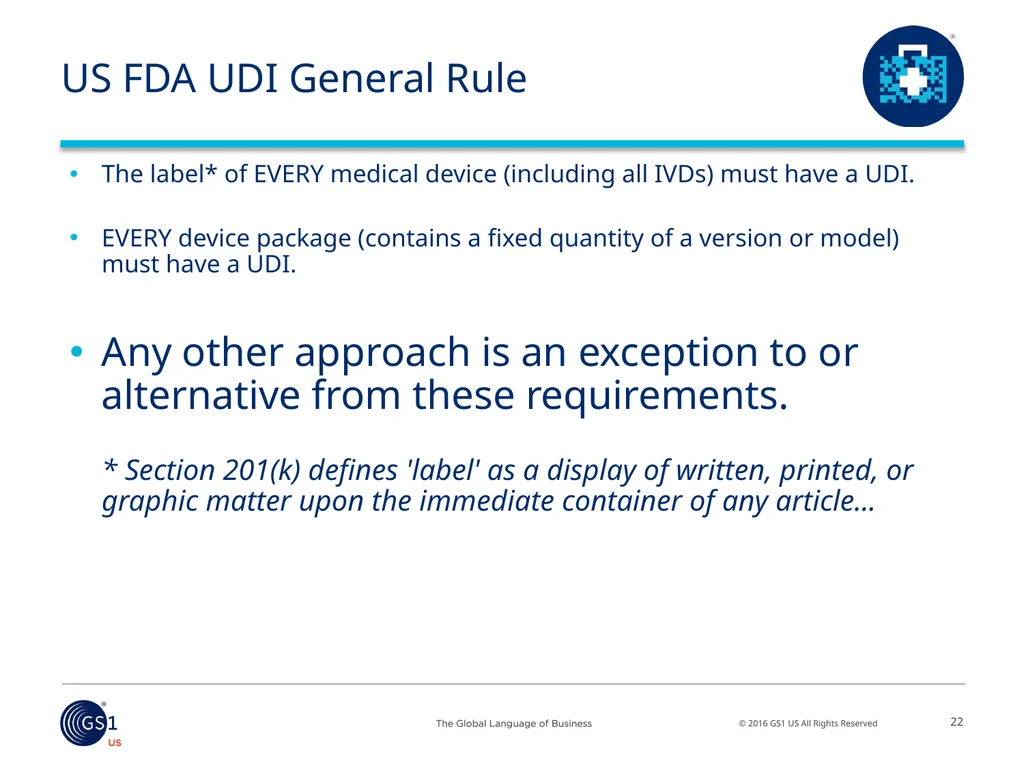
US FDA UDI General Rule 22 The label* of EVERY medical device (including all IVDs) must have a UDI.
EVERY device package (contains a fixed quantity of a version or model) must have a UDI.
Any other approach is an exception to or alternative from these requirements.
* Section 201(k) defines 'label' as a display of written, printed, or graphic matter upon the immediate container of any article...<br>
EVERY device package (contains a fixed quantity of a version or model) must have a UDI.
Any other approach is an exception to or alternative from these requirements.
* Section 201(k) defines 'label' as a display of written, printed, or graphic matter upon the immediate container of any article...<br>
23
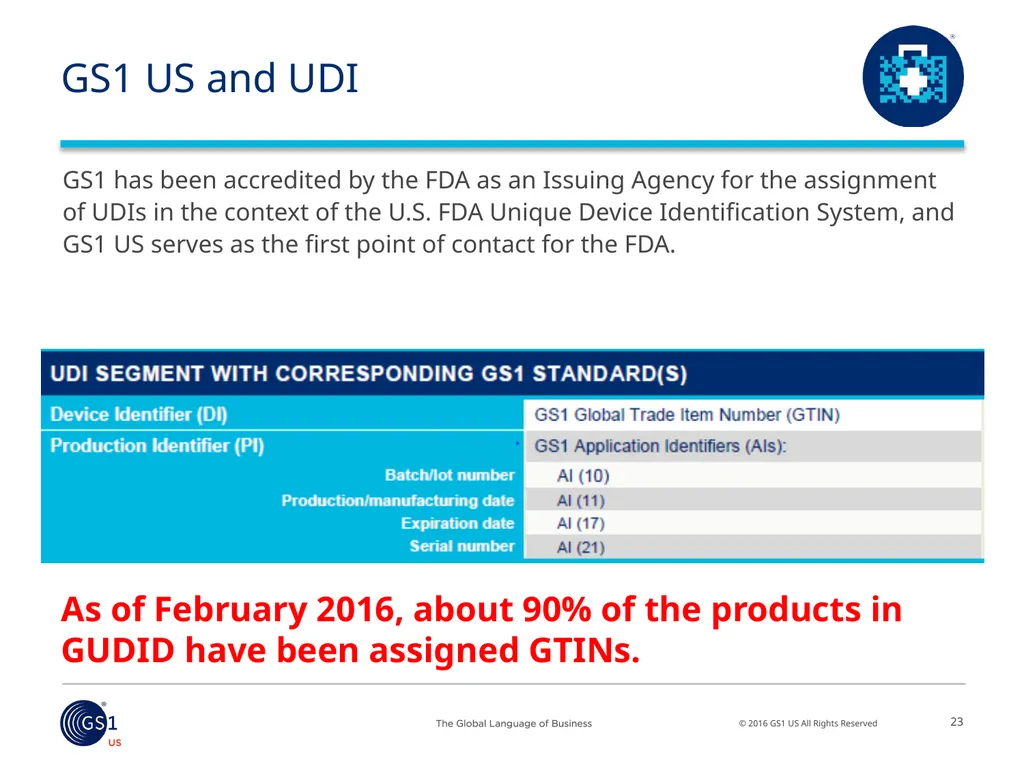
GS1 US and UDI 23 GS1 has been accredited by the FDA as an Issuing Agency for the assignment of UDIs in the context of the U.S. FDA Unique Device Identification System, and GS1 US serves as the first point of contact for the FDA. As of February 2016, about 90% of the products in GUDID have been assigned GTINs.<br>
24
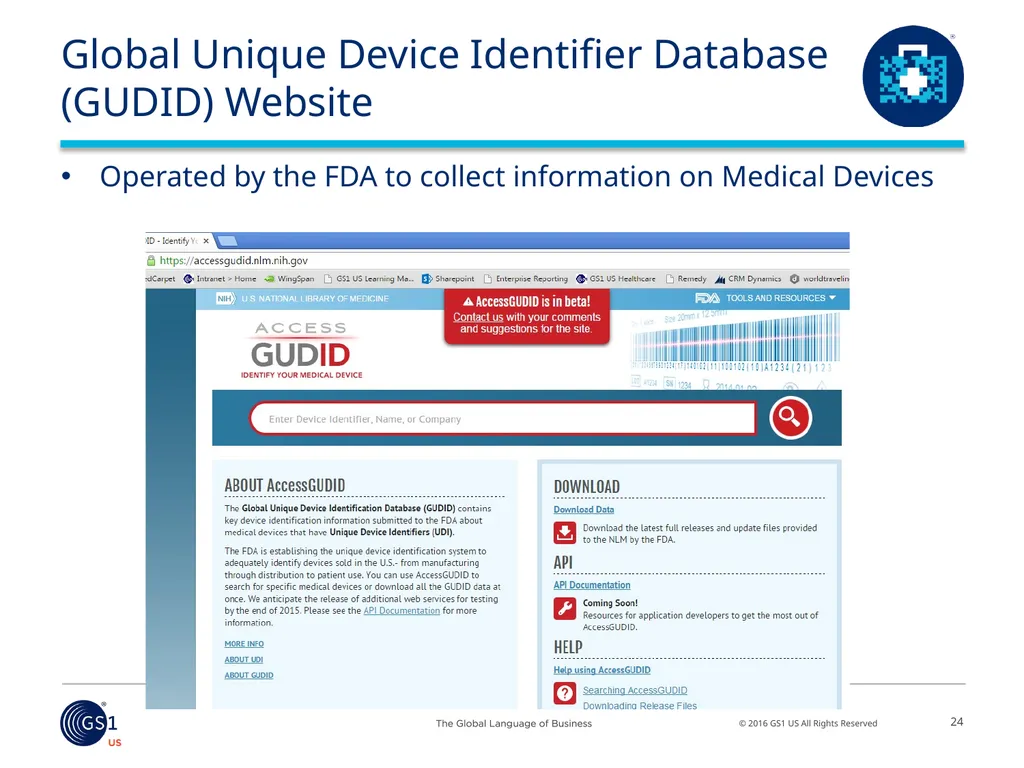
Global Unique Device Identifier Database (GUDID) Website 24 Operated by the FDA to collect information on Medical Devices<br>
25
GUDID 25 Global Device Identifier Database (GUDID)
Operated by the FDA to collect information on Medical Devices
Public facing website to share data with anyone (https://accessgudid.nlm.nih.gov)
Some information submitted to the GUDID will be private (for FDA only)
All medical devices which are regulated under the UDI regulations will be required to be listed in the GUDID
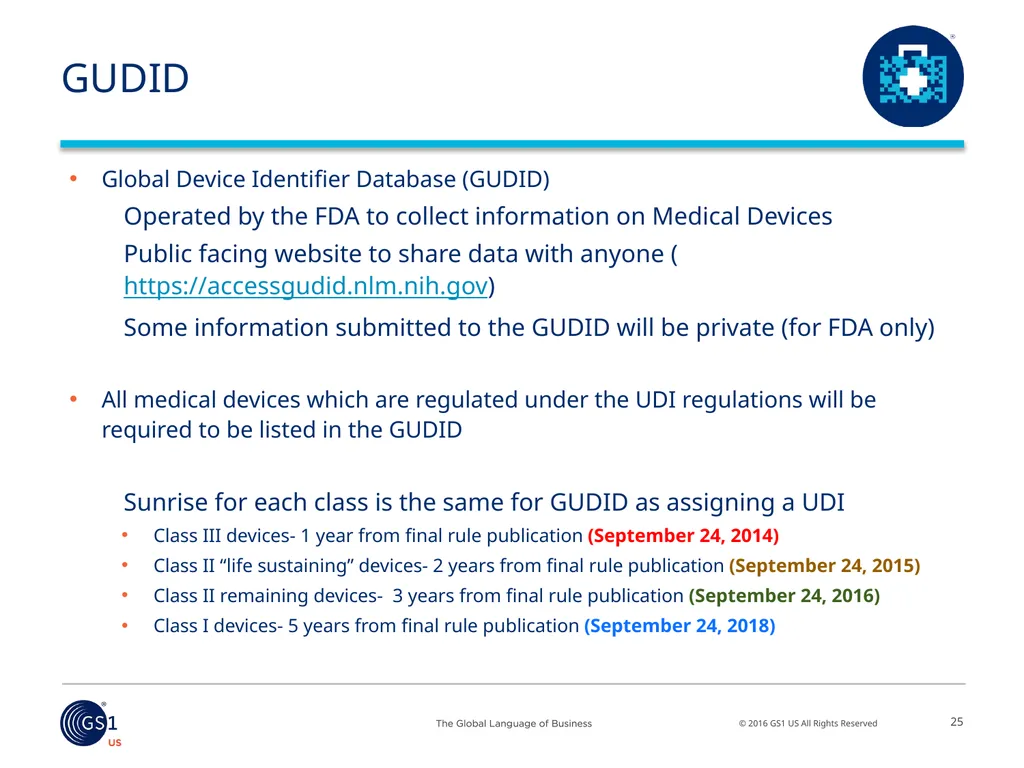
Sunrise for each class is the same for GUDID as assigning a UDI
Class III devices- 1 year from final rule publication (September 24, 2014)
Class II “life sustaining” devices- 2 years from final rule publication (September 24, 2015)
Class II remaining devices- 3 years from final rule publication (September 24, 2016)
Class I devices- 5 years from final rule publication (September 24, 2018)<br>
Operated by the FDA to collect information on Medical Devices
Public facing website to share data with anyone (https://accessgudid.nlm.nih.gov)
Some information submitted to the GUDID will be private (for FDA only)
All medical devices which are regulated under the UDI regulations will be required to be listed in the GUDID
Sunrise for each class is the same for GUDID as assigning a UDI
Class III devices- 1 year from final rule publication (September 24, 2014)
Class II “life sustaining” devices- 2 years from final rule publication (September 24, 2015)
Class II remaining devices- 3 years from final rule publication (September 24, 2016)
Class I devices- 5 years from final rule publication (September 24, 2018)<br>
26
GUDID Loading 26 Data loading responsibility lies with the “Labeler”
FDA defines the “Labeler” as the entity responsible for the contents of the label
In GS1 speak, this is the Brand Owner
Data is loaded for the Device Identifier (DI) Only
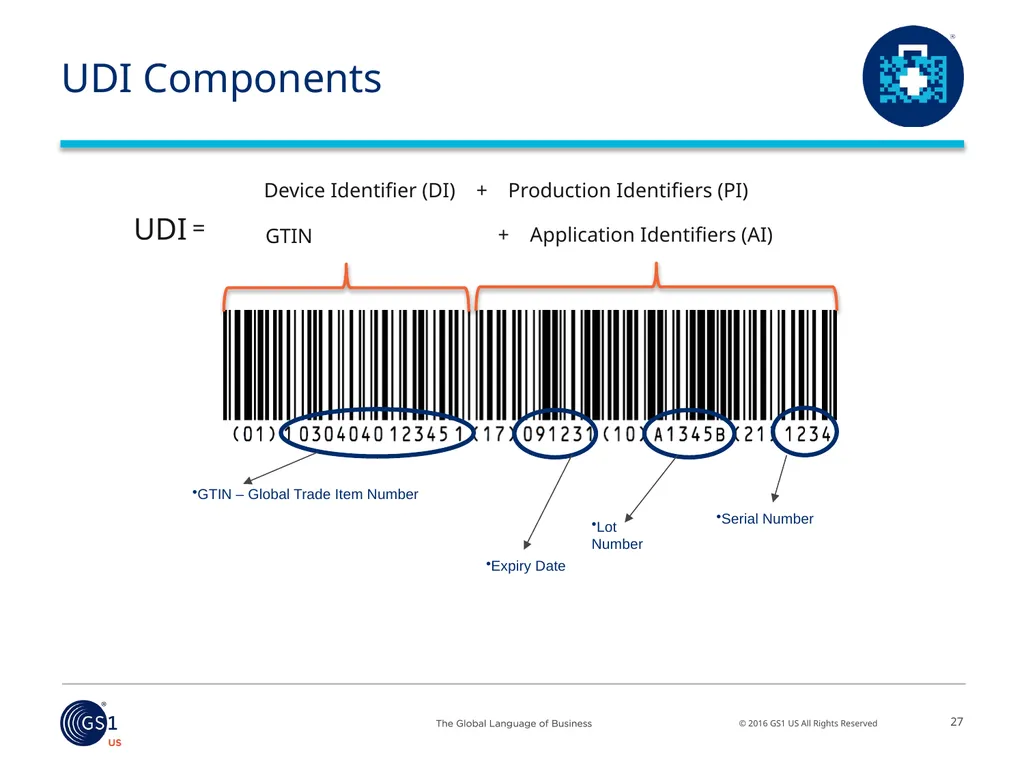
UDI is a Device Identifier (DI) and Production Identifier (PI)
Only the DI is used in the GUDID
Data provided is master data and is used for public consumption, however there are some elements which are for FDA only<br>
FDA defines the “Labeler” as the entity responsible for the contents of the label
In GS1 speak, this is the Brand Owner
Data is loaded for the Device Identifier (DI) Only
UDI is a Device Identifier (DI) and Production Identifier (PI)
Only the DI is used in the GUDID
Data provided is master data and is used for public consumption, however there are some elements which are for FDA only<br>
27
UDI Components 27 UDI = GTIN + Application Identifiers (AI) Device Identifier (DI) + Production Identifiers (PI)<br>
28
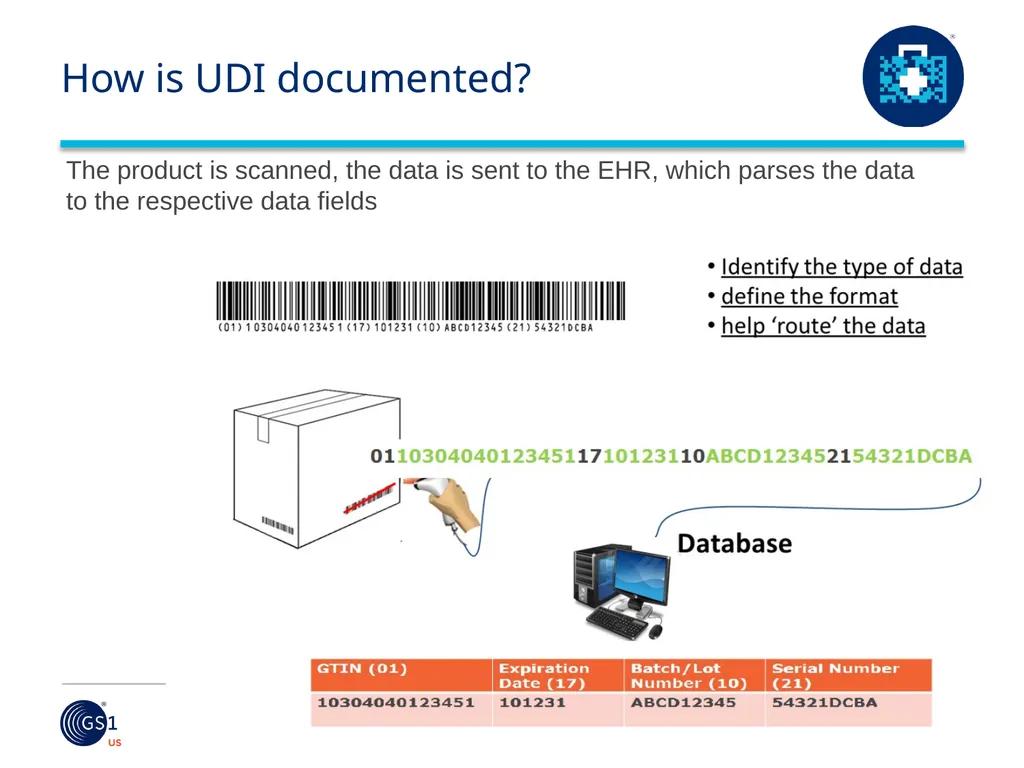
How is UDI documented? 28 The product is scanned, the data is sent to the EHR, which parses the data to the respective data fields<br>
29
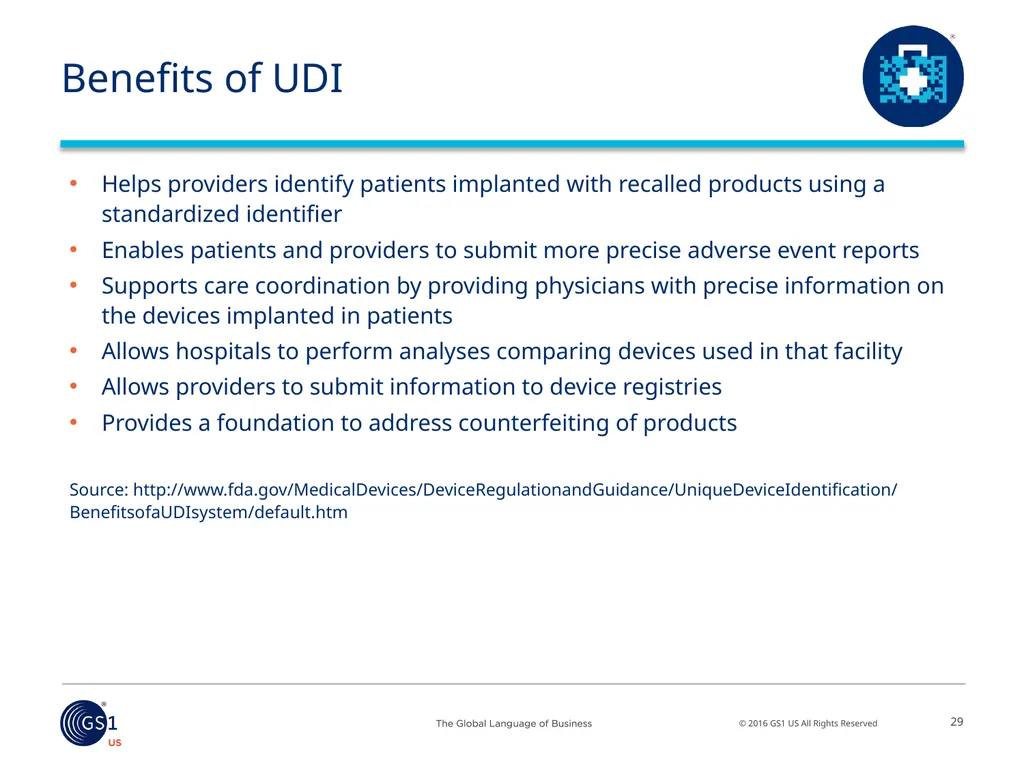
Benefits of UDI 29 Helps providers identify patients implanted with recalled products using a standardized identifier
Enables patients and providers to submit more precise adverse event reports
Supports care coordination by providing physicians with precise information on the devices implanted in patients
Allows hospitals to perform analyses comparing devices used in that facility
Allows providers to submit information to device registries
Provides a foundation to address counterfeiting of products
Source: http://www.fda.gov/MedicalDevices/DeviceRegulationandGuidance/UniqueDeviceIdentification/BenefitsofaUDIsystem/default.htm<br>
Enables patients and providers to submit more precise adverse event reports
Supports care coordination by providing physicians with precise information on the devices implanted in patients
Allows hospitals to perform analyses comparing devices used in that facility
Allows providers to submit information to device registries
Provides a foundation to address counterfeiting of products
Source: http://www.fda.gov/MedicalDevices/DeviceRegulationandGuidance/UniqueDeviceIdentification/BenefitsofaUDIsystem/default.htm<br>
30
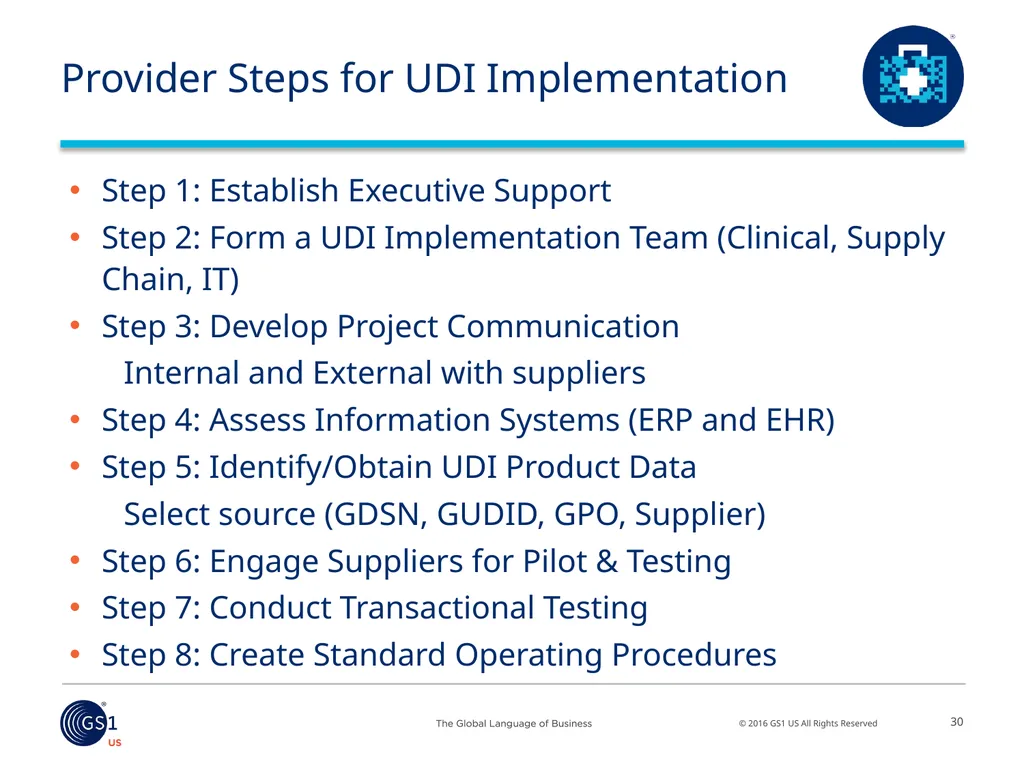
Provider Steps for UDI Implementation 30 Step 1: Establish Executive Support
Step 2: Form a UDI Implementation Team (Clinical, Supply Chain, IT)
Step 3: Develop Project Communication
Internal and External with suppliers
Step 4: Assess Information Systems (ERP and EHR)
Step 5: Identify/Obtain UDI Product Data
Select source (GDSN, GUDID, GPO, Supplier)
Step 6: Engage Suppliers for Pilot & Testing
Step 7: Conduct Transactional Testing
Step 8: Create Standard Operating Procedures<br>
Step 2: Form a UDI Implementation Team (Clinical, Supply Chain, IT)
Step 3: Develop Project Communication
Internal and External with suppliers
Step 4: Assess Information Systems (ERP and EHR)
Step 5: Identify/Obtain UDI Product Data
Select source (GDSN, GUDID, GPO, Supplier)
Step 6: Engage Suppliers for Pilot & Testing
Step 7: Conduct Transactional Testing
Step 8: Create Standard Operating Procedures<br>
31
Successful Implementation of GS1 Standards What Does It Mean for
St. Joseph Health?<br>
St. Joseph Health?<br>
32
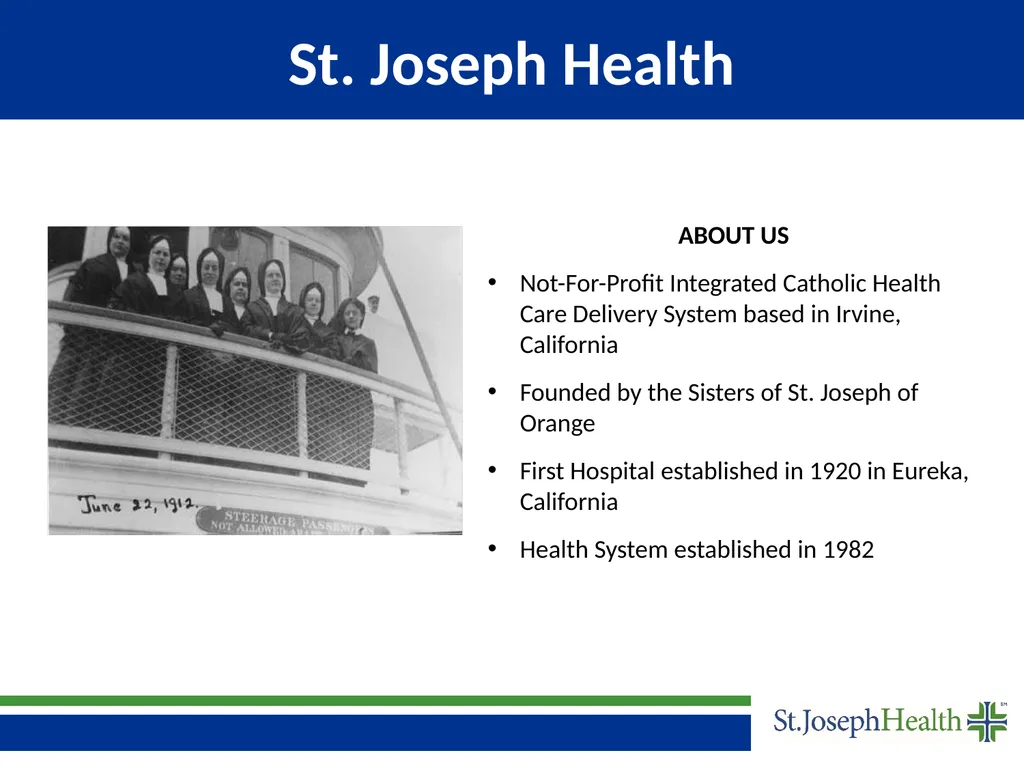
St. Joseph Health ABOUT US
Not-For-Profit Integrated Catholic Health Care Delivery System based in Irvine, California
Founded by the Sisters of St. Joseph of Orange
First Hospital established in 1920 in Eureka, California
Health System established in 1982<br>
Not-For-Profit Integrated Catholic Health Care Delivery System based in Irvine, California
Founded by the Sisters of St. Joseph of Orange
First Hospital established in 1920 in Eureka, California
Health System established in 1982<br>
33
St. Joseph Health Three Geographic Regions: Northern California, Southern California and Texas/Eastern New Mexico
Total Revenue of $5.6 Billion
16 hospitals, as well as home health agencies, hospice care, outpatient services, skilled nursing facilities and physician organizations
Nearly 24,000 employees and more than 1,500 affiliated physicians
Supply Chain spend is $850+ million
Centralized Purchasing/AP<br>
Total Revenue of $5.6 Billion
16 hospitals, as well as home health agencies, hospice care, outpatient services, skilled nursing facilities and physician organizations
Nearly 24,000 employees and more than 1,500 affiliated physicians
Supply Chain spend is $850+ million
Centralized Purchasing/AP<br>
34
St. Joseph Health Our Mission
To extend the healing ministry of Jesus in the tradition of the Sisters of St. Joseph of Orange by continually improving the health and quality of life of people in the communities we serve
Our Vision
To bring people together to provide compassionate care, promote health improvement and create healthy communities<br>
To extend the healing ministry of Jesus in the tradition of the Sisters of St. Joseph of Orange by continually improving the health and quality of life of people in the communities we serve
Our Vision
To bring people together to provide compassionate care, promote health improvement and create healthy communities<br>
35
Why GS1
Standards Adoption?<br>
36
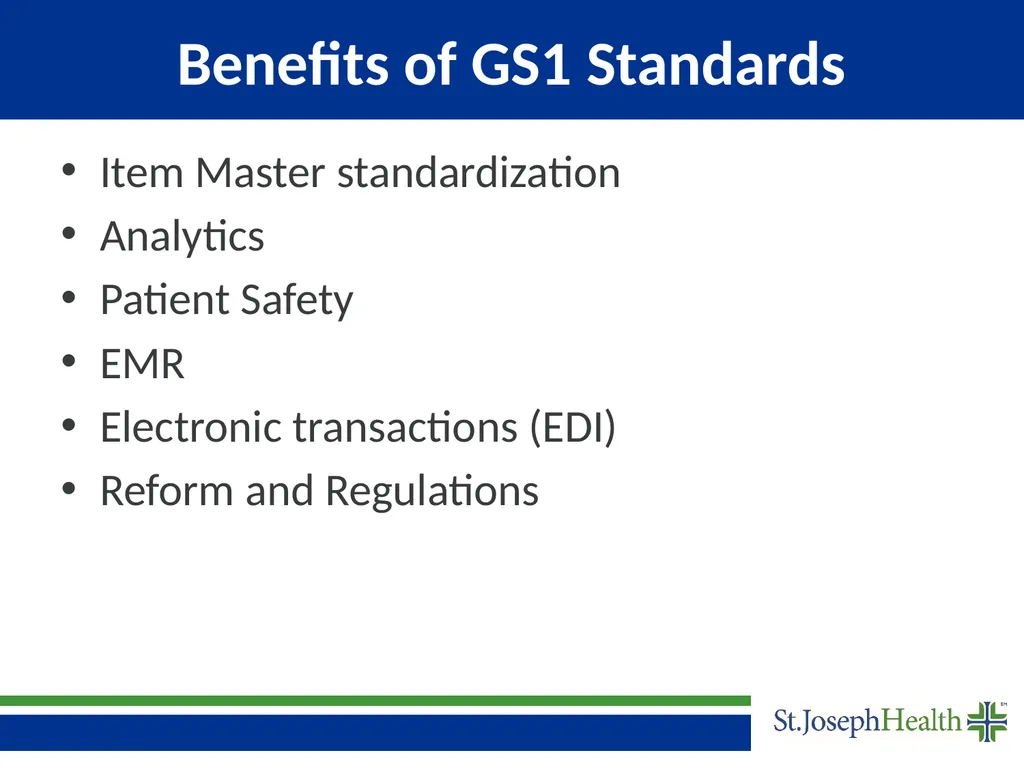
Benefits of GS1 Standards Item Master standardization
Analytics
Patient Safety
EMR
Electronic transactions (EDI)
Reform and Regulations<br>
Analytics
Patient Safety
EMR
Electronic transactions (EDI)
Reform and Regulations<br>
37
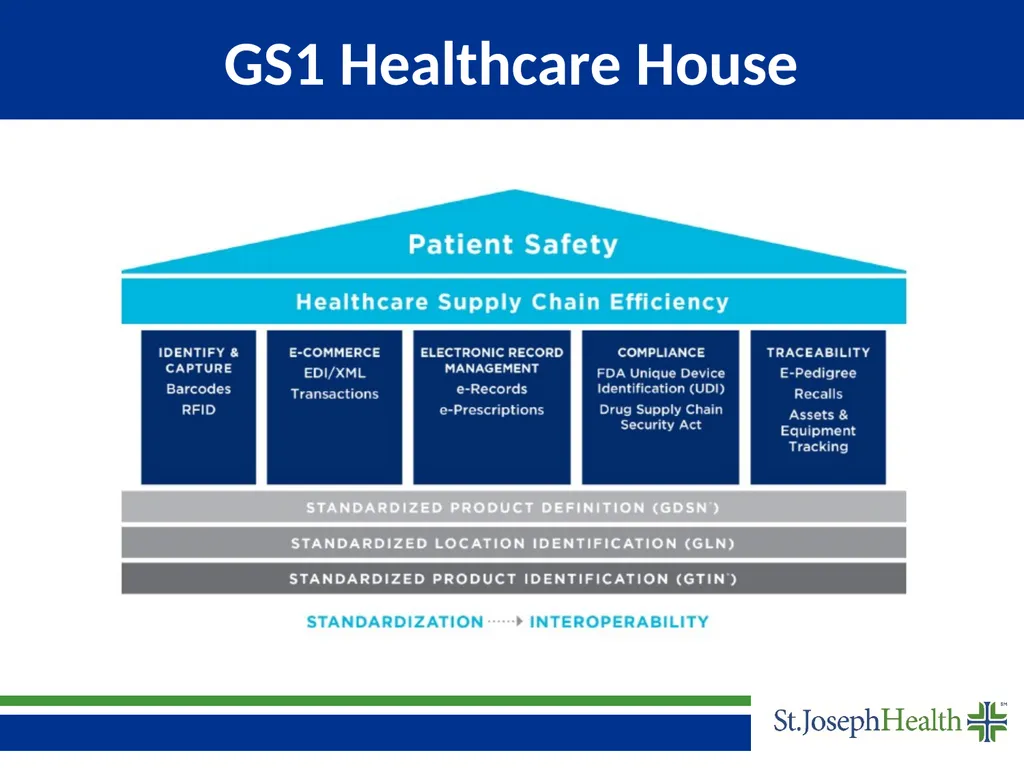
GS1 Healthcare House<br>
38
What was our GS1 Standards implementation process?<br>
39
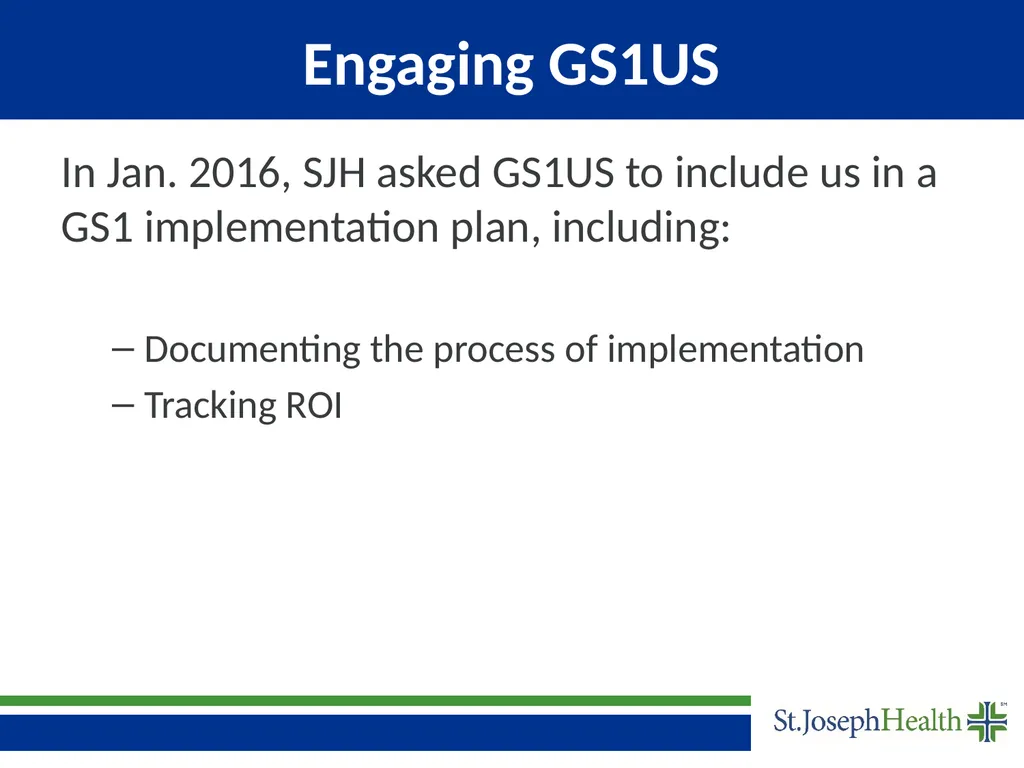
Engaging GS1US In Jan. 2016, SJH asked GS1US to include us in a GS1 implementation plan, including:
Documenting the process of implementation
Tracking ROI<br>
Documenting the process of implementation
Tracking ROI<br>
40
Outside Consumtant Outside consulting firm assisted us with implementing GS1 Standards more quickly and seamlessly, so we can better support efficient and safe patient care.
They assisted us in preparing for our GS1 Standards implementation through:
Cleaning up GLNs
Boarding GLN with GHX
Transacting using both GLN and GTIN
Documenting Step by step business process form maintaining GS1 Standards after go live.<br>
They assisted us in preparing for our GS1 Standards implementation through:
Cleaning up GLNs
Boarding GLN with GHX
Transacting using both GLN and GTIN
Documenting Step by step business process form maintaining GS1 Standards after go live.<br>
41
GLN Clean-Up SJH began the clean-up of our Global Location Number (GLN) and boarding process with GHX:
Clean-up of “ship-to” locations within PMM
Request new GLN when needed
Currently we must go through GPO, but we are working on bringing our GLN maintenance in-house<br>
Clean-up of “ship-to” locations within PMM
Request new GLN when needed
Currently we must go through GPO, but we are working on bringing our GLN maintenance in-house<br>
42
GLN & GTIN Testing In May 2016, SJH began testing the Global Location Number (GLN) and Global Trade Item Number (GTIN) transaction with vendors Cook Medical and Abbott
By the end of May, we had our first complete transaction (850, 855, 810)<br>
By the end of May, we had our first complete transaction (850, 855, 810)<br>
43
What are the next steps?<br>
44
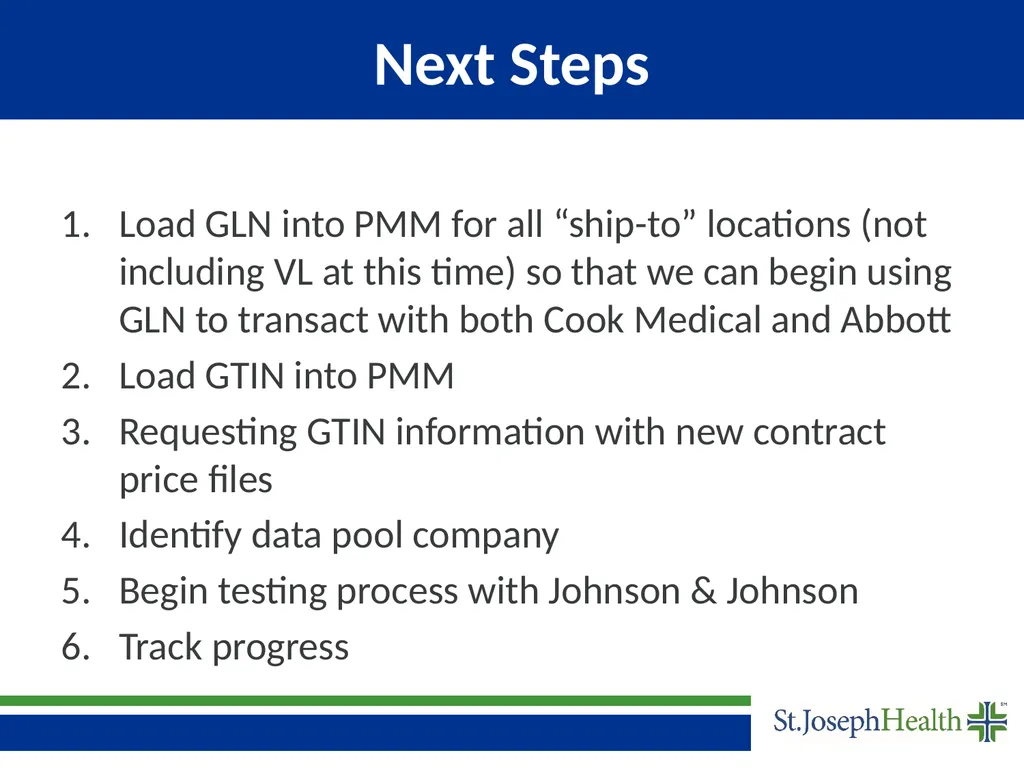
Next Steps Load GLN into PMM for all “ship-to” locations (not including VL at this time) so that we can begin using GLN to transact with both Cook Medical and Abbott
Load GTIN into PMM
Requesting GTIN information with new contract price files
Identify data pool company
Begin testing process with Johnson & Johnson
Track progress<br>
Load GTIN into PMM
Requesting GTIN information with new contract price files
Identify data pool company
Begin testing process with Johnson & Johnson
Track progress<br>
45
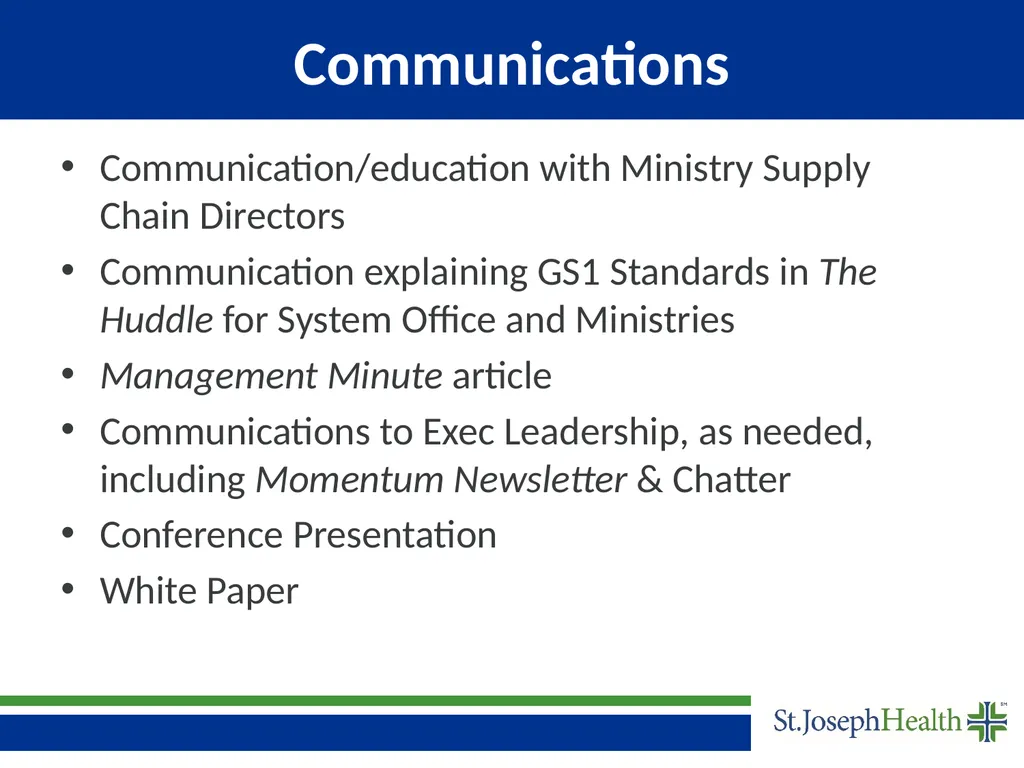
Communications Communication/education with Ministry Supply Chain Directors
Communication explaining GS1 Standards in The Huddle for System Office and Ministries
Management Minute article
Communications to Exec Leadership, as needed, including Momentum Newsletter & Chatter
Conference Presentation
White Paper<br>
Communication explaining GS1 Standards in The Huddle for System Office and Ministries
Management Minute article
Communications to Exec Leadership, as needed, including Momentum Newsletter & Chatter
Conference Presentation
White Paper<br>
46
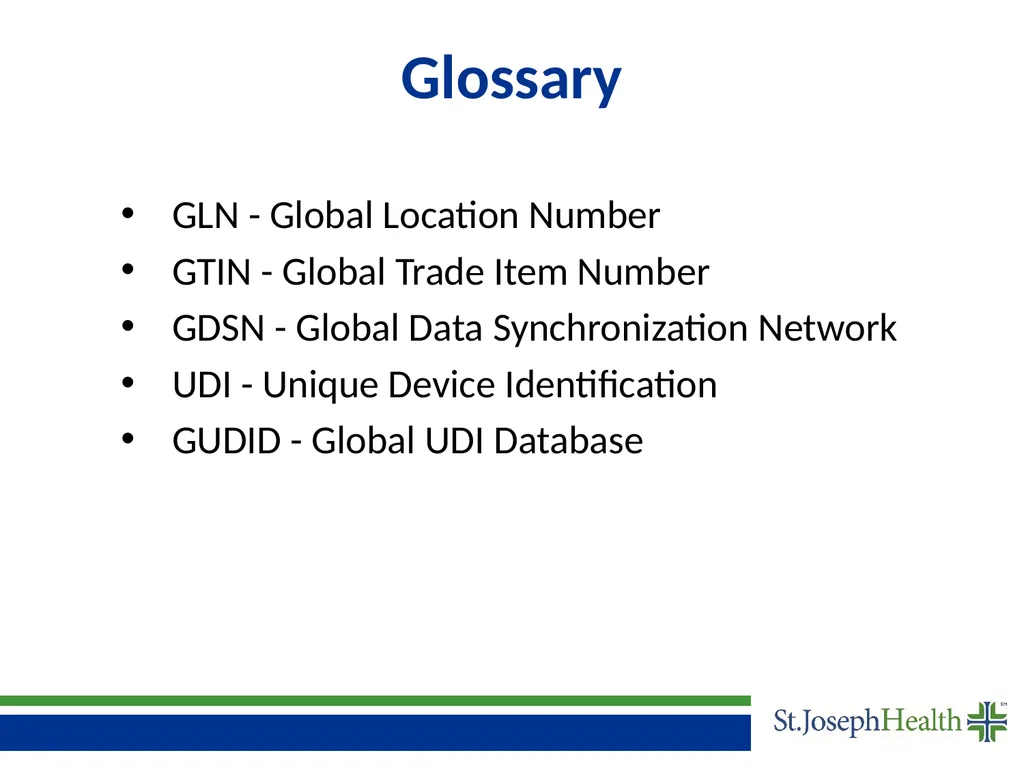
Glossary GLN - Global Location Number
GTIN - Global Trade Item Number
GDSN - Global Data Synchronization Network
UDI - Unique Device Identification
GUDID - Global UDI Database<br>
GTIN - Global Trade Item Number
GDSN - Global Data Synchronization Network
UDI - Unique Device Identification
GUDID - Global UDI Database<br>
47
Questions?<br>
48
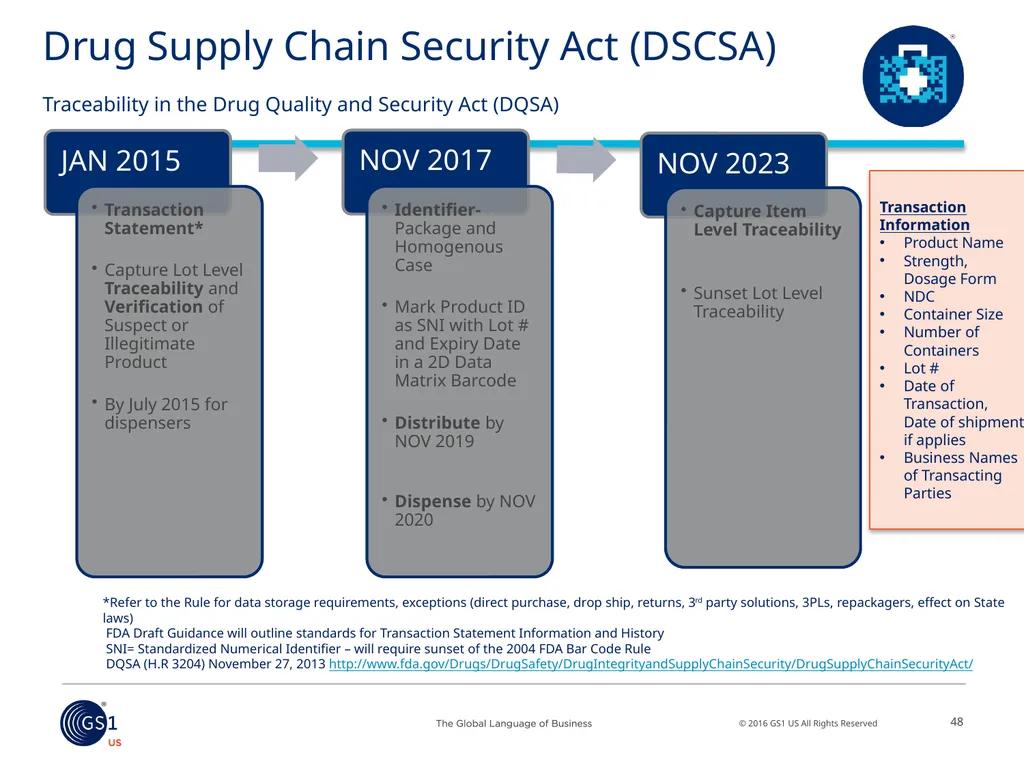
Drug Supply Chain Security Act (DSCSA)
Traceability in the Drug Quality and Security Act (DQSA) 48 *Refer to the Rule for data storage requirements, exceptions (direct purchase, drop ship, returns, 3rd party solutions, 3PLs, repackagers, effect on State laws)
FDA Draft Guidance will outline standards for Transaction Statement Information and History
SNI= Standardized Numerical Identifier – will require sunset of the 2004 FDA Bar Code Rule
DQSA (H.R 3204) November 27, 2013 http://www.fda.gov/Drugs/DrugSafety/DrugIntegrityandSupplyChainSecurity/DrugSupplyChainSecurityAct/ Transaction Information
Product Name
Strength, Dosage Form
NDC
Container Size
Number of Containers
Lot #
Date of Transaction, Date of shipment if applies
Business Names of Transacting Parties<br>
FDA Draft Guidance will outline standards for Transaction Statement Information and History
SNI= Standardized Numerical Identifier – will require sunset of the 2004 FDA Bar Code Rule
DQSA (H.R 3204) November 27, 2013 http://www.fda.gov/Drugs/DrugSafety/DrugIntegrityandSupplyChainSecurity/DrugSupplyChainSecurityAct/ Transaction Information
Product Name
Strength, Dosage Form
NDC
Container Size
Number of Containers
Lot #
Date of Transaction, Date of shipment if applies
Business Names of Transacting Parties<br>
49
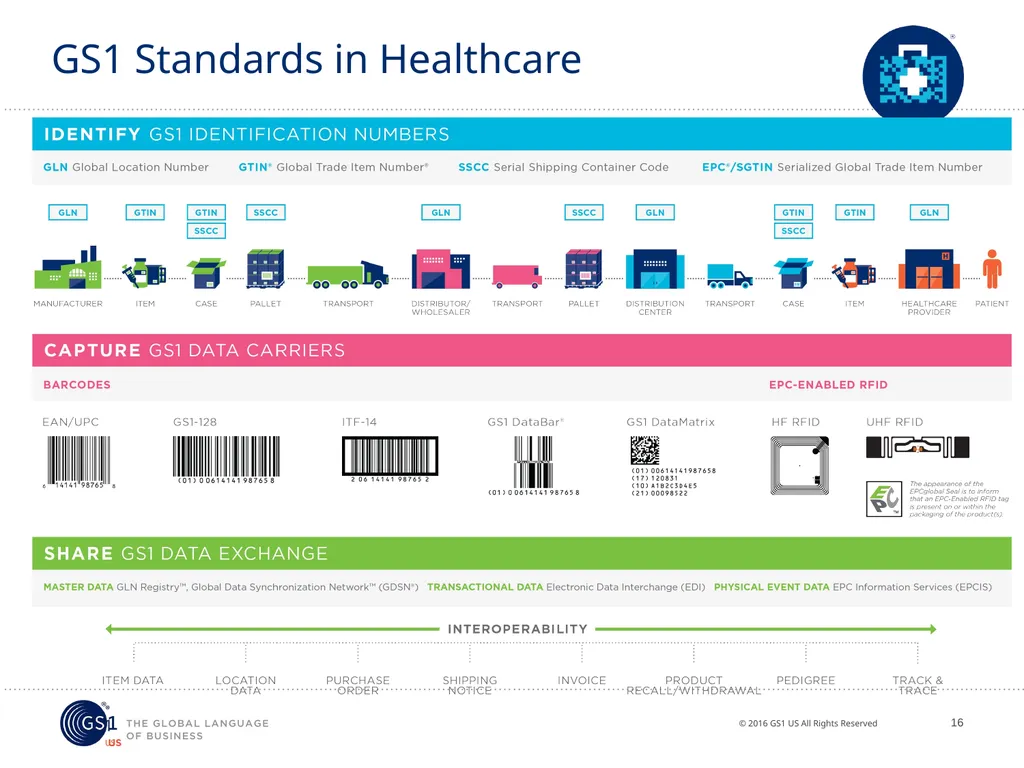
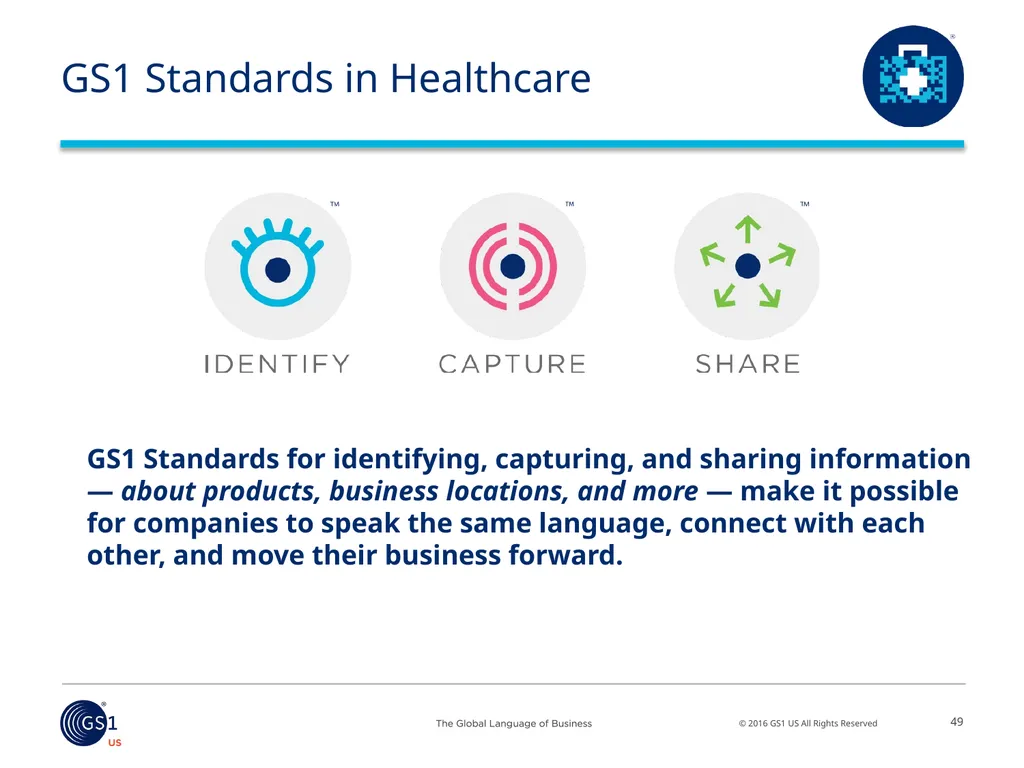
GS1 Standards in Healthcare 49 GS1 Standards for identifying, capturing, and sharing information— about products, business locations, and more — make it possible for companies to speak the same language, connect with each other, and move their business forward.<br>
50
GS1 System of Standards 50<br>
51
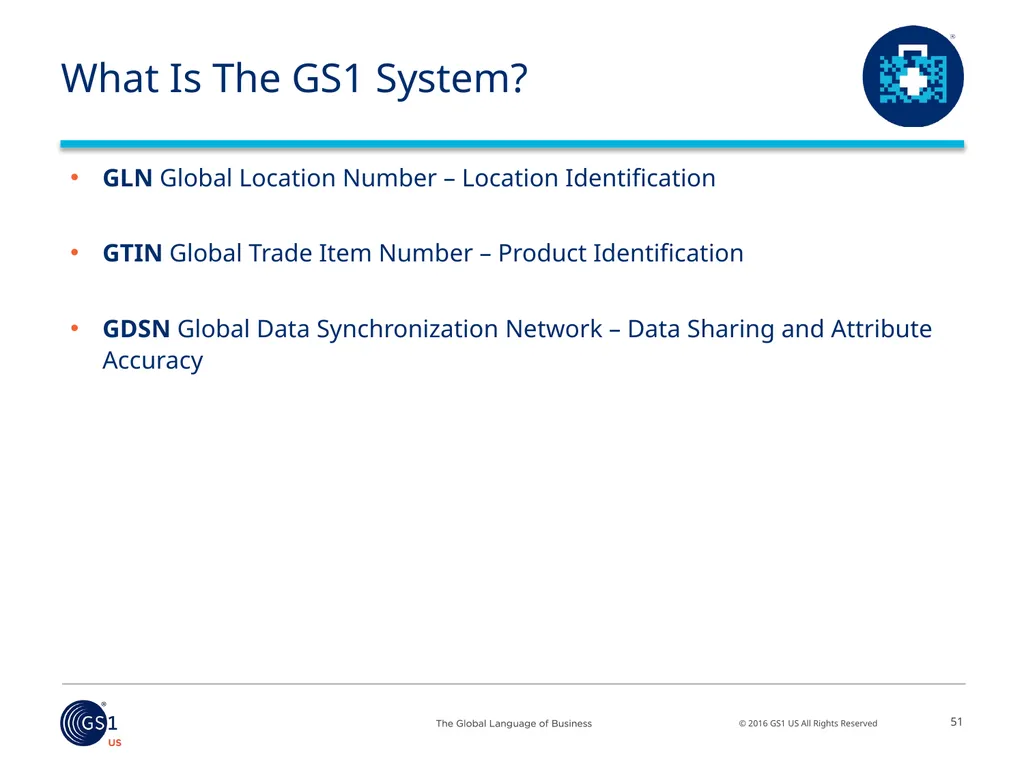
What Is The GS1 System? 51 GLN Global Location Number – Location Identification
GTIN Global Trade Item Number – Product Identification
GDSN Global Data Synchronization Network – Data Sharing and Attribute Accuracy<br>
GTIN Global Trade Item Number – Product Identification
GDSN Global Data Synchronization Network – Data Sharing and Attribute Accuracy<br>
52
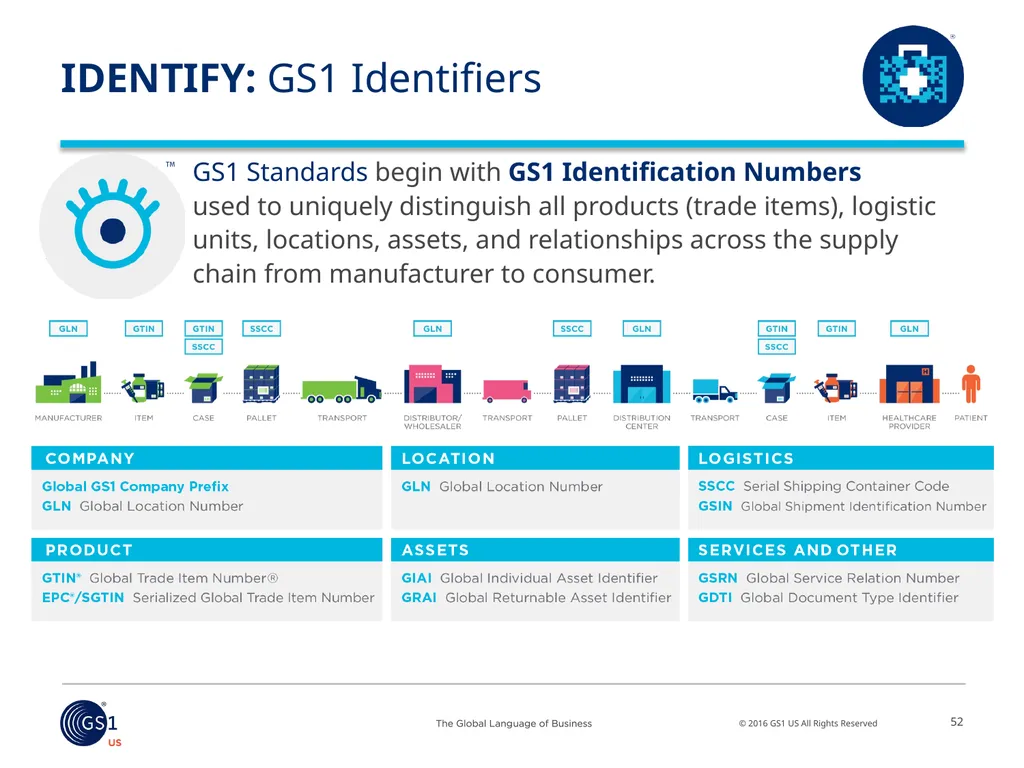
IDENTIFY: GS1 Identifiers 52 GS1 Standards begin with GS1 Identification Numbers
used to uniquely distinguish all products (trade items), logistic units, locations, assets, and relationships across the supply chain from manufacturer to consumer.<br>
53
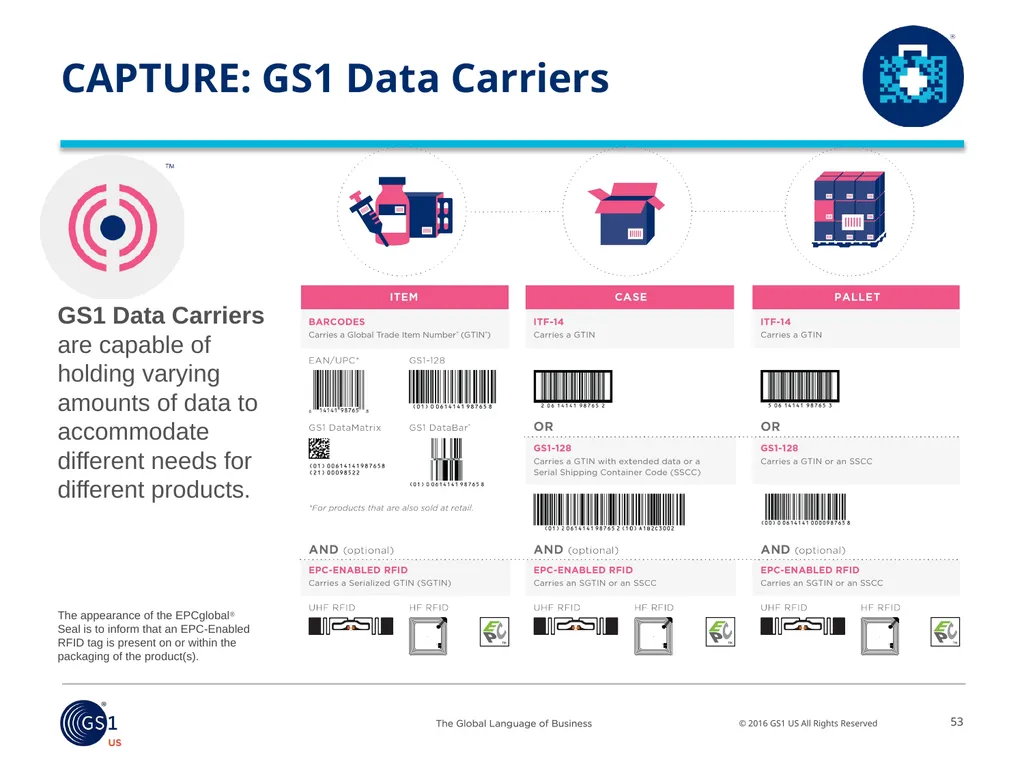
CAPTURE: GS1 Data Carriers 53 GS1 Data Carriers are capable of holding varying amounts of data to accommodate different needs for different products. The appearance of the EPCglobal® Seal is to inform that an EPC-Enabled RFID tag is present on or within the packaging of the product(s).<br>
54
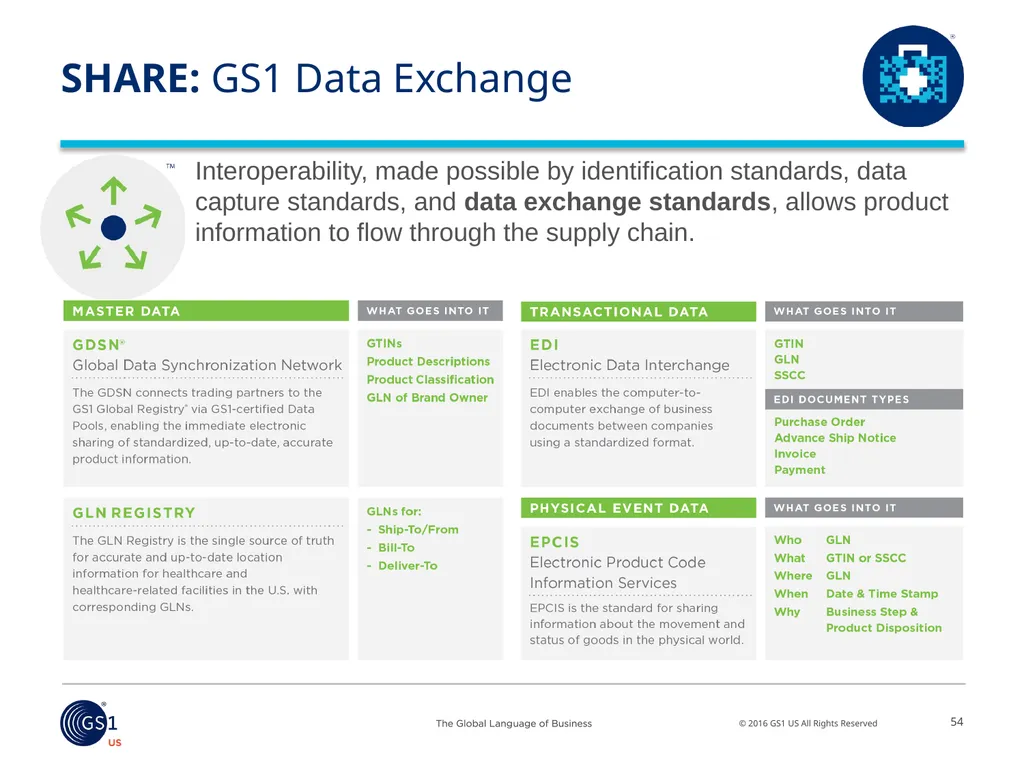
SHARE: GS1 Data Exchange 54 Interoperability, made possible by identification standards, data capture standards, and data exchange standards, allows product information to flow through the supply chain.<br>
55
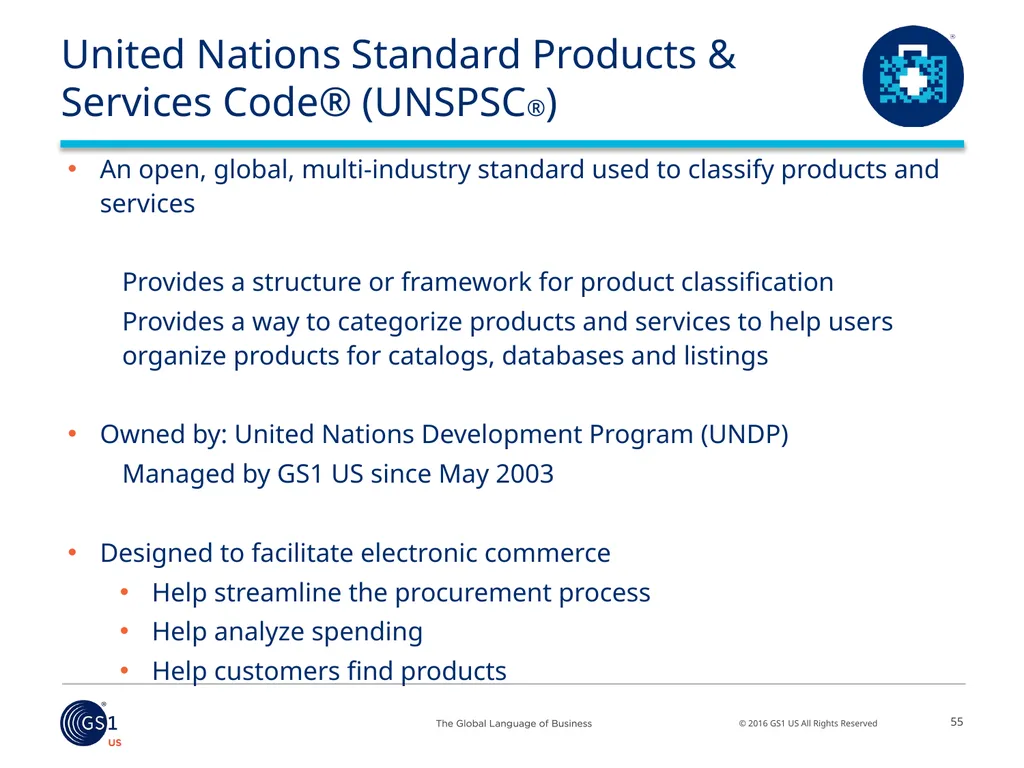
United Nations Standard Products & Services Code® (UNSPSC®) 55 An open, global, multi-industry standard used to classify products and services
Provides a structure or framework for product classification
Provides a way to categorize products and services to help users organize products for catalogs, databases and listings
Owned by: United Nations Development Program (UNDP)
Managed by GS1 US since May 2003
Designed to facilitate electronic commerce
Help streamline the procurement process
Help analyze spending
Help customers find products<br>
Provides a structure or framework for product classification
Provides a way to categorize products and services to help users organize products for catalogs, databases and listings
Owned by: United Nations Development Program (UNDP)
Managed by GS1 US since May 2003
Designed to facilitate electronic commerce
Help streamline the procurement process
Help analyze spending
Help customers find products<br>
56
56 Global Location Number (GLN)<br>
57
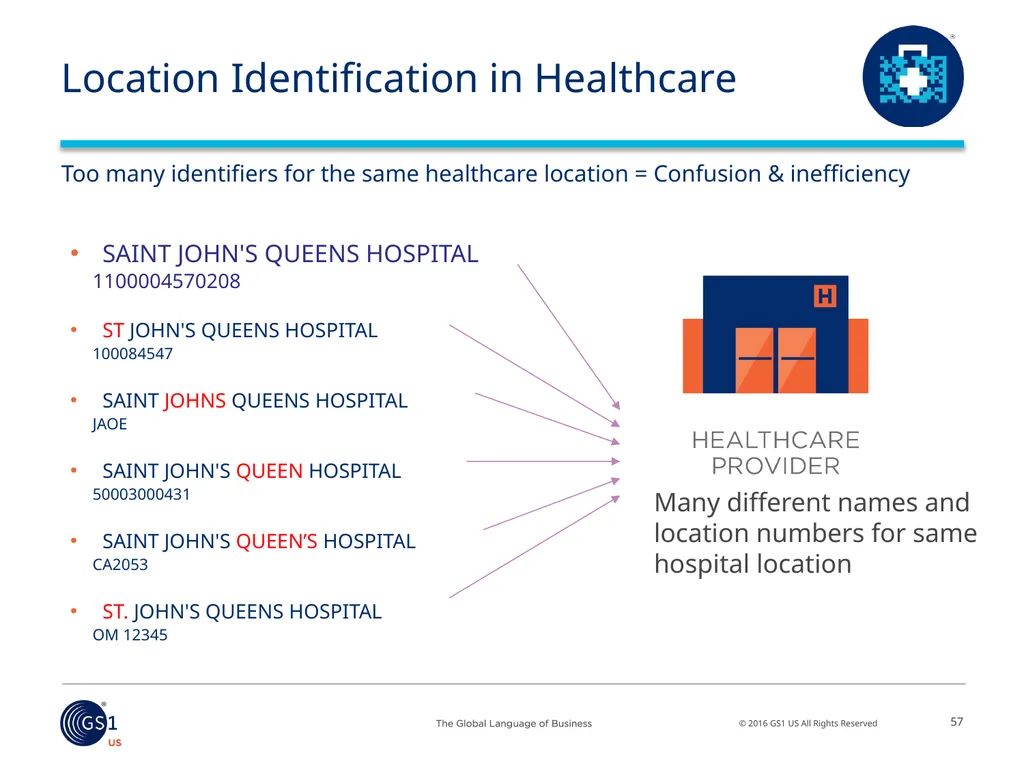
Location Identification in Healthcare 57 Too many identifiers for the same healthcare location = Confusion & inefficiency SAINT JOHN'S QUEENS HOSPITAL
1100004570208
ST JOHN'S QUEENS HOSPITAL
100084547
SAINT JOHNS QUEENS HOSPITAL
JAOE
SAINT JOHN'S QUEEN HOSPITAL
50003000431
SAINT JOHN'S QUEEN’S HOSPITAL
CA2053
ST. JOHN'S QUEENS HOSPITAL
OM 12345 Many different names and location numbers for same hospital location<br>
1100004570208
ST JOHN'S QUEENS HOSPITAL
100084547
SAINT JOHNS QUEENS HOSPITAL
JAOE
SAINT JOHN'S QUEEN HOSPITAL
50003000431
SAINT JOHN'S QUEEN’S HOSPITAL
CA2053
ST. JOHN'S QUEENS HOSPITAL
OM 12345 Many different names and location numbers for same hospital location<br>
58
Global Location Number Overview 58 The use of standardized location identification not only ensures that the right product arrives at the right place at the right time, it also enables more efficient business practices and helps to drive down supply chain costs
Basically the GLN points to a number in a database that references the following criteria:
Who, What and Where
Who controls the GLN; What qualifies or states the context of the relationship of the related data; and Where is the physical address<br>
Basically the GLN points to a number in a database that references the following criteria:
Who, What and Where
Who controls the GLN; What qualifies or states the context of the relationship of the related data; and Where is the physical address<br>
59
What is a Global Location Number (GLN)? 59 A globally unique 13-digit number that identifies:
Legal entities (whole companies, health systems, divisions)
Functional entities or specific department within a legal entity (Pharmacy, receiving department, accounts payable)
Physical locations (Clinics, units, warehouses, loading docks, room/shelf locations)<br>
Legal entities (whole companies, health systems, divisions)
Functional entities or specific department within a legal entity (Pharmacy, receiving department, accounts payable)
Physical locations (Clinics, units, warehouses, loading docks, room/shelf locations)<br>
60
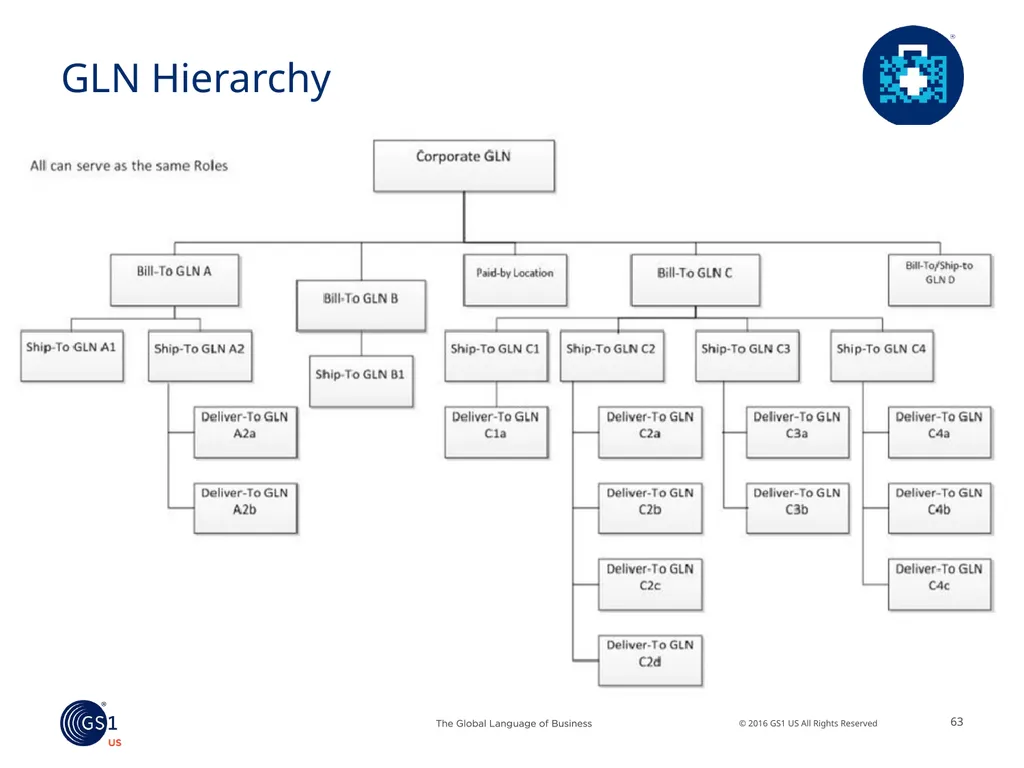
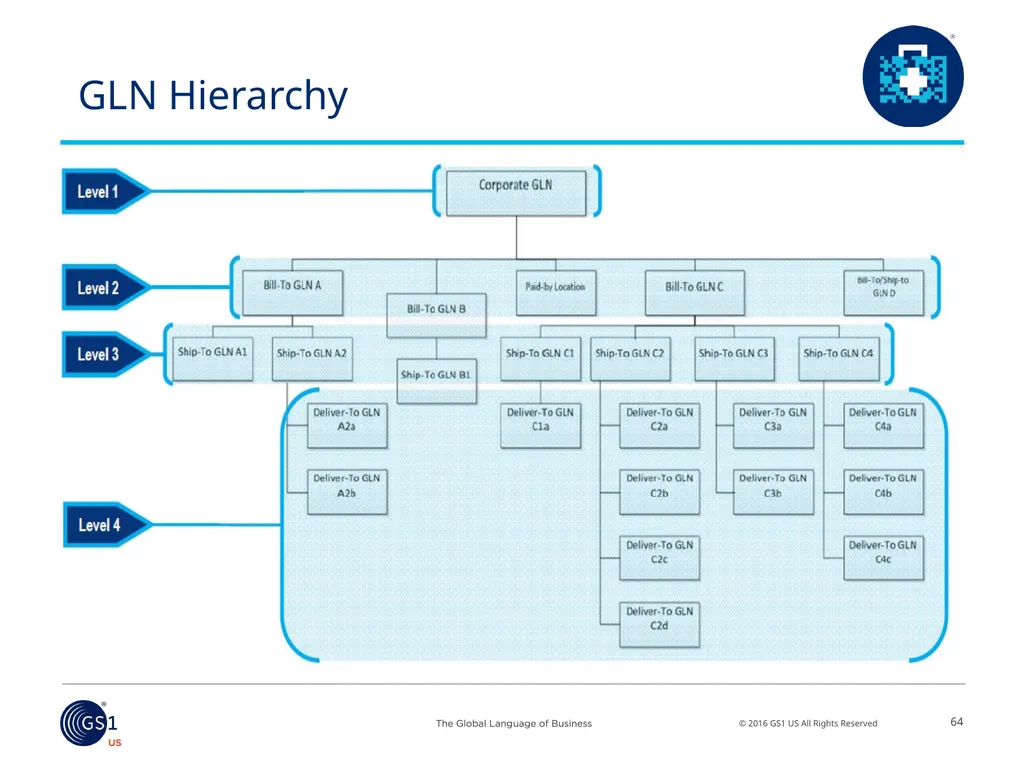
GLN Hierarchies – Getting Started 60 Organizations can assign GLN’s to various supply chain locations in their organization to facilitate precise location identification in a business
Questions to consider
Who is the buying organization?
Where will the products be shipped/received?
Who will receive the invoice?
Who is the selling organization?
Where are the payments sent?<br>
Questions to consider
Who is the buying organization?
Where will the products be shipped/received?
Who will receive the invoice?
Who is the selling organization?
Where are the payments sent?<br>
61
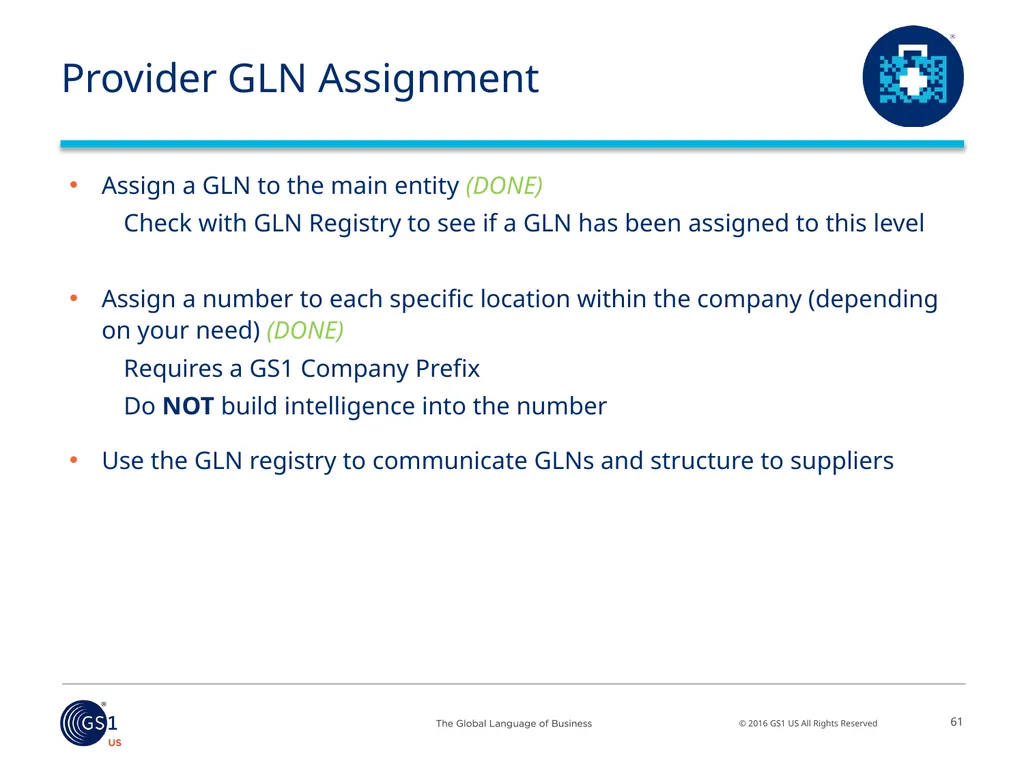
Provider GLN Assignment 61 Assign a GLN to the main entity (DONE)
Check with GLN Registry to see if a GLN has been assigned to this level
Assign a number to each specific location within the company (depending on your need) (DONE)
Requires a GS1 Company Prefix
Do NOT build intelligence into the number
Use the GLN registry to communicate GLNs and structure to suppliers<br>
Check with GLN Registry to see if a GLN has been assigned to this level
Assign a number to each specific location within the company (depending on your need) (DONE)
Requires a GS1 Company Prefix
Do NOT build intelligence into the number
Use the GLN registry to communicate GLNs and structure to suppliers<br>
62
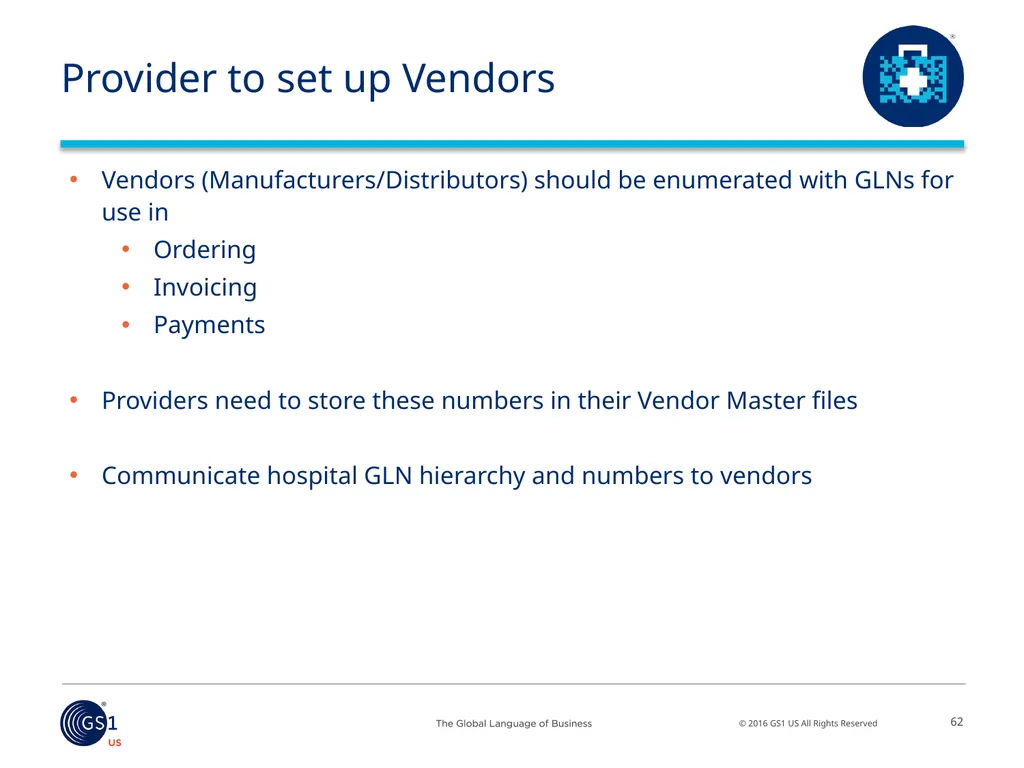
Provider to set up Vendors 62 Vendors (Manufacturers/Distributors) should be enumerated with GLNs for use in
Ordering
Invoicing
Payments
Providers need to store these numbers in their Vendor Master files
Communicate hospital GLN hierarchy and numbers to vendors<br>
Ordering
Invoicing
Payments
Providers need to store these numbers in their Vendor Master files
Communicate hospital GLN hierarchy and numbers to vendors<br>
63
GLN Hierarchy 63<br>
64
64 GLN Hierarchy<br>
65
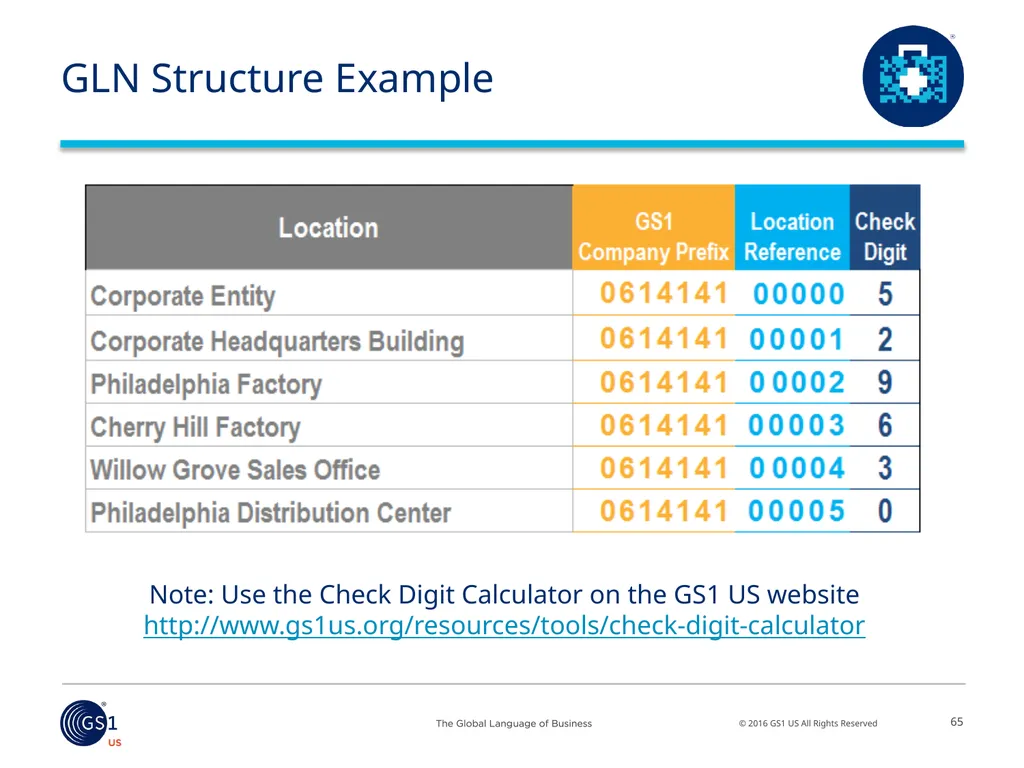
GLN Structure Example 65 Note: Use the Check Digit Calculator on the GS1 US website
http://www.gs1us.org/resources/tools/check-digit-calculator<br>
http://www.gs1us.org/resources/tools/check-digit-calculator<br>
66
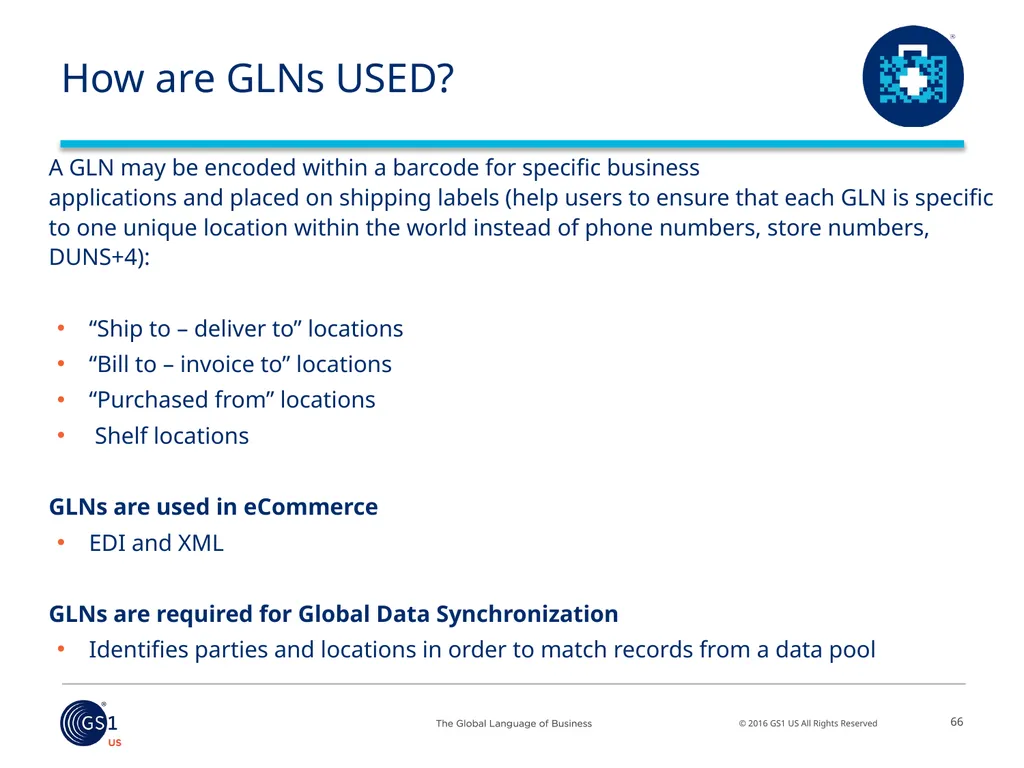
How are GLNs USED? 66 A GLN may be encoded within a barcode for specific business
applications and placed on shipping labels (help users to ensure that each GLN is specific to one unique location within the world instead of phone numbers, store numbers, DUNS+4):
“Ship to – deliver to” locations
“Bill to – invoice to” locations
“Purchased from” locations
Shelf locations
GLNs are used in eCommerce
EDI and XML
GLNs are required for Global Data Synchronization
Identifies parties and locations in order to match records from a data pool<br>
“Ship to – deliver to” locations
“Bill to – invoice to” locations
“Purchased from” locations
Shelf locations
GLNs are used in eCommerce
EDI and XML
GLNs are required for Global Data Synchronization
Identifies parties and locations in order to match records from a data pool<br>
67
GLN Benefits for Providers 67 Simplifies location identification with a single identifier used across all supply chain partners
Enables providers to define and manage their own account and location information to ensure accuracy
Provides an accurate view of the organization as a customer to ensure correct contract pricing eligibility and to streamline rebate processing
Reduces mis-shipments and time spent resolving order and invoice errors
Provides the foundation for traceability to improve product recall processes<br>
Enables providers to define and manage their own account and location information to ensure accuracy
Provides an accurate view of the organization as a customer to ensure correct contract pricing eligibility and to streamline rebate processing
Reduces mis-shipments and time spent resolving order and invoice errors
Provides the foundation for traceability to improve product recall processes<br>
68
Next Steps for GLN Implementation 68 Register for GLN Registry Training
Take ownership of your GLN Registry Records
Contact your GPO or GS1 US for your GLN hierarchy
Review and Update your GLN Registry Records
Synchronize GLNs with Trading Partners
Conduct Pilot Project and Test GLNs in Transactions
Repeat with next supplier
Ongoing Maintenance<br>
Take ownership of your GLN Registry Records
Contact your GPO or GS1 US for your GLN hierarchy
Review and Update your GLN Registry Records
Synchronize GLNs with Trading Partners
Conduct Pilot Project and Test GLNs in Transactions
Repeat with next supplier
Ongoing Maintenance<br>
69
69 Global Trade Item Number (GTIN)<br>
70
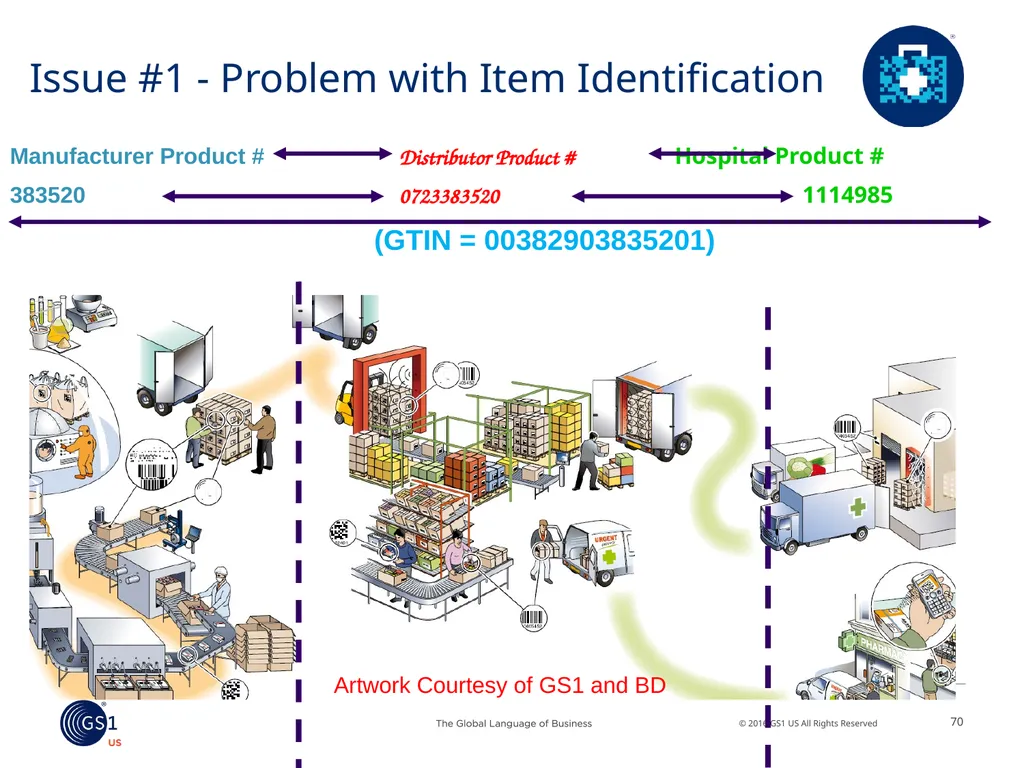
Issue #1 - Problem with Item Identification 70 Manufacturer Product # Distributor Product # Hospital Product #
383520 0723383520 1114985
(GTIN = 00382903835201) Artwork Courtesy of GS1 and BD<br>
383520 0723383520 1114985
(GTIN = 00382903835201) Artwork Courtesy of GS1 and BD<br>
71
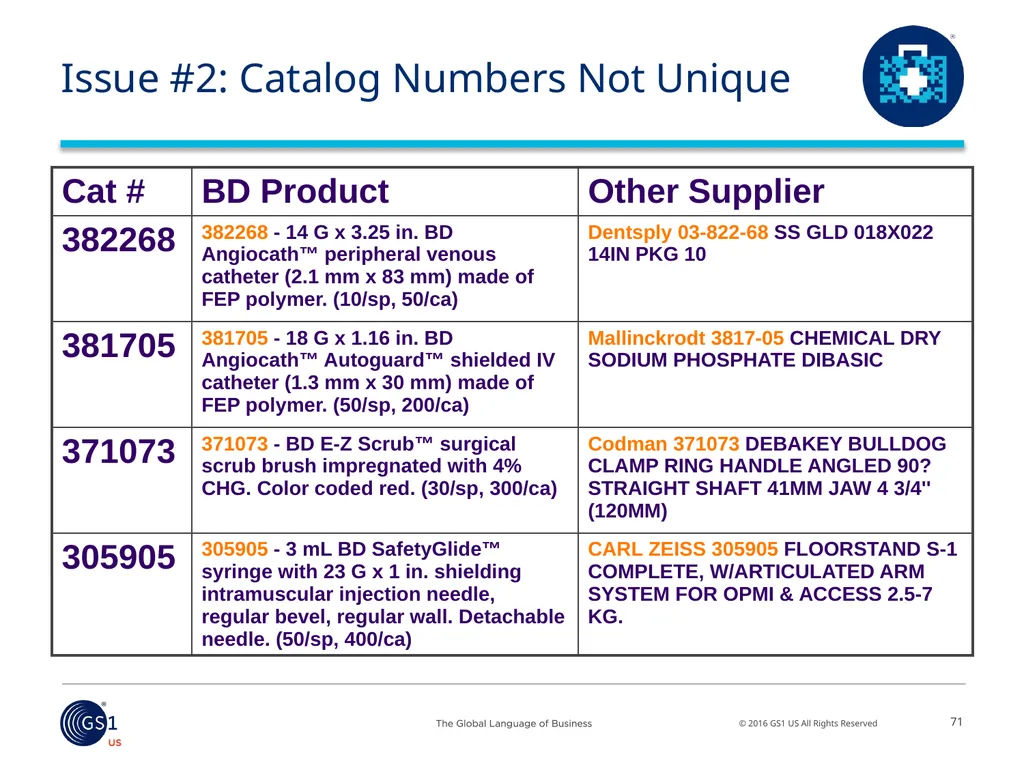
Issue #2: Catalog Numbers Not Unique 71<br>
72
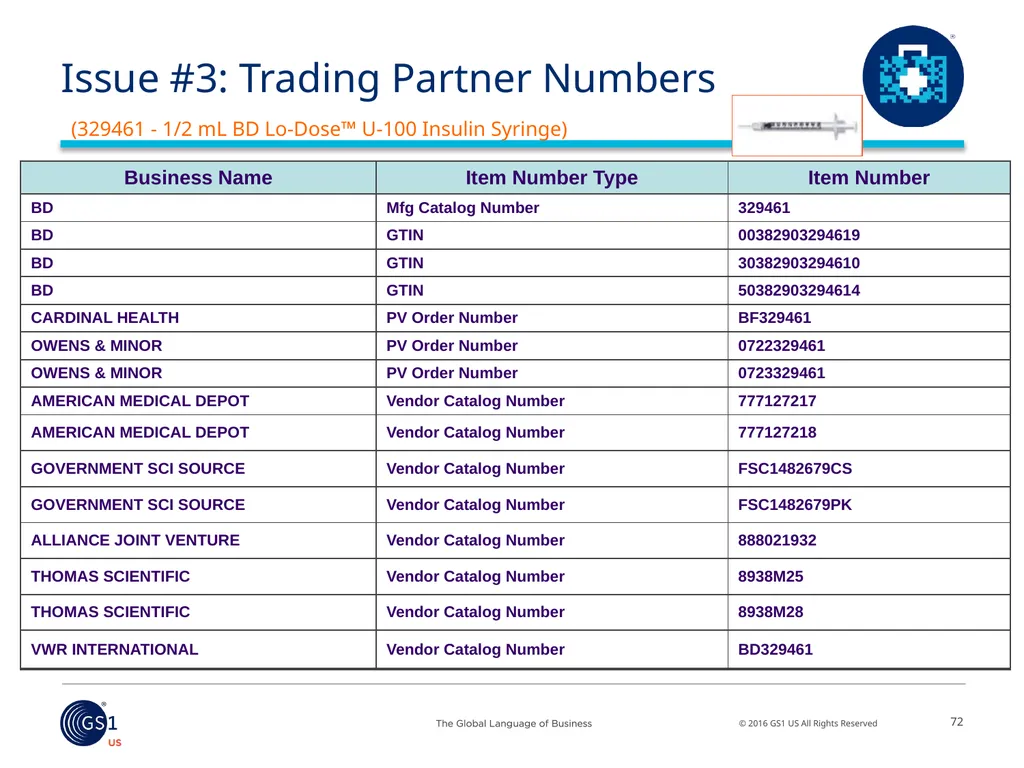
Issue #3: Trading Partner Numbers 72 (329461 - 1/2 mL BD Lo-Dose™ U-100 Insulin Syringe)<br>
73
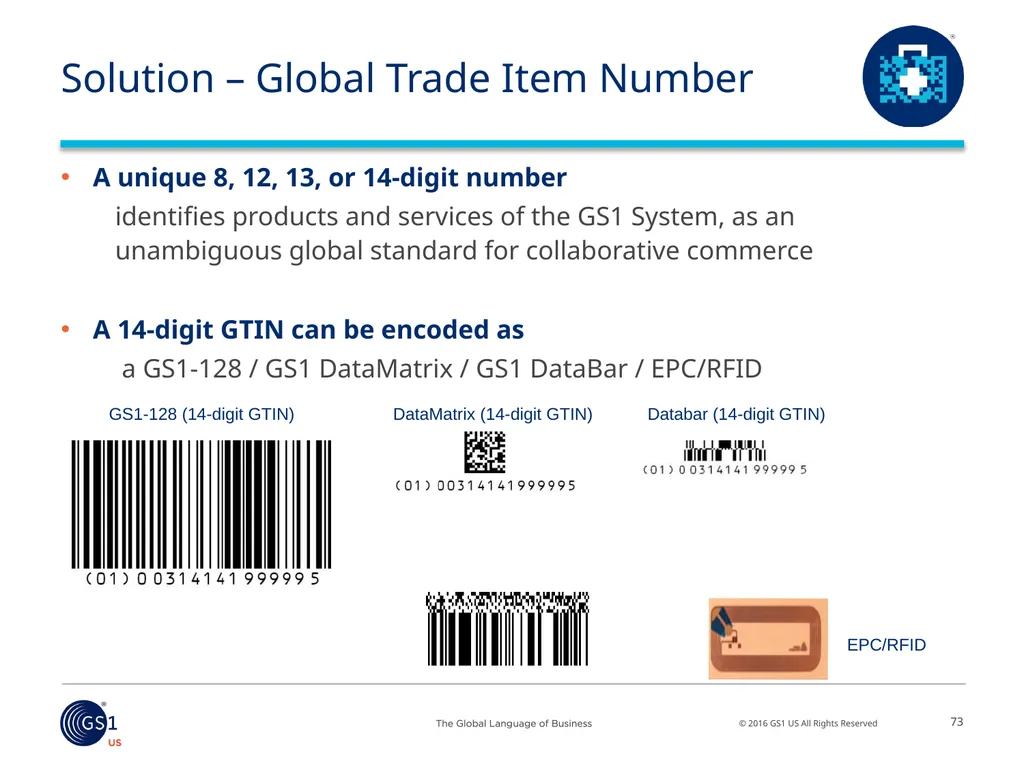
Solution – Global Trade Item Number 73 A unique 8, 12, 13, or 14-digit number
identifies products and services of the GS1 System, as an unambiguous global standard for collaborative commerce
A 14-digit GTIN can be encoded as
a GS1-128 / GS1 DataMatrix / GS1 DataBar / EPC/RFID EPC/RFID<br>
identifies products and services of the GS1 System, as an unambiguous global standard for collaborative commerce
A 14-digit GTIN can be encoded as
a GS1-128 / GS1 DataMatrix / GS1 DataBar / EPC/RFID EPC/RFID<br>
74
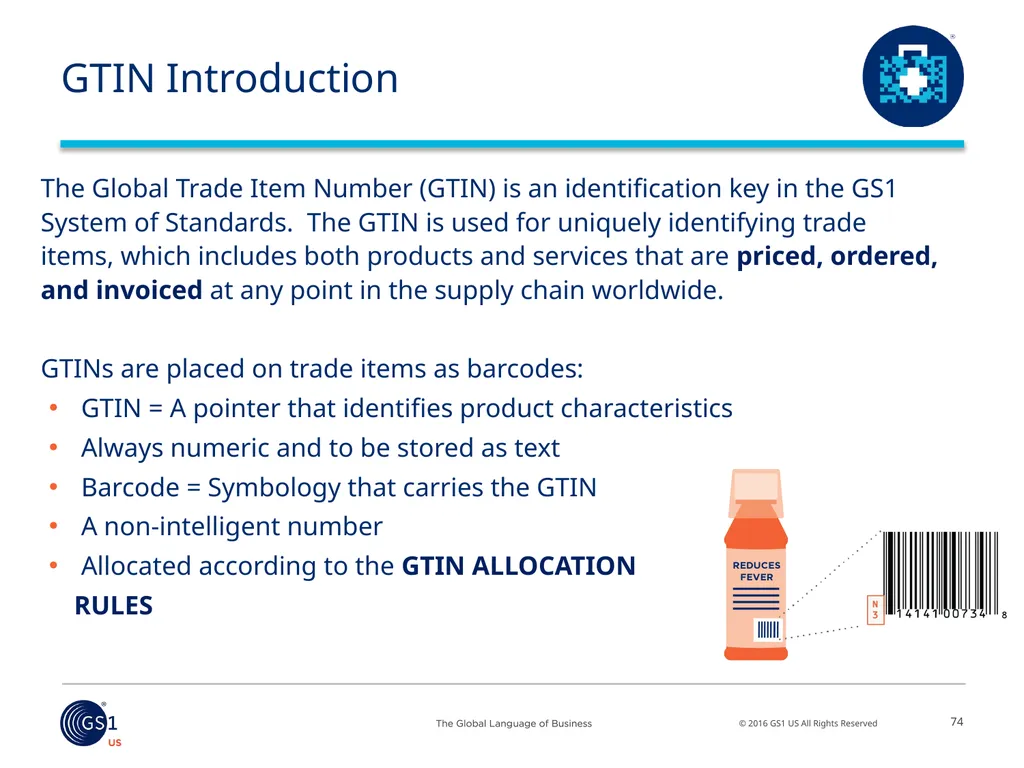
GTIN Introduction 74 The Global Trade Item Number (GTIN) is an identification key in the GS1 System of Standards. The GTIN is used for uniquely identifying trade items, which includes both products and services that are priced, ordered, and invoiced at any point in the supply chain worldwide.
GTINs are placed on trade items as barcodes:
GTIN = A pointer that identifies product characteristics
Always numeric and to be stored as text
Barcode = Symbology that carries the GTIN
A non-intelligent number
Allocated according to the GTIN ALLOCATION
RULES<br>
GTINs are placed on trade items as barcodes:
GTIN = A pointer that identifies product characteristics
Always numeric and to be stored as text
Barcode = Symbology that carries the GTIN
A non-intelligent number
Allocated according to the GTIN ALLOCATION
RULES<br>
75
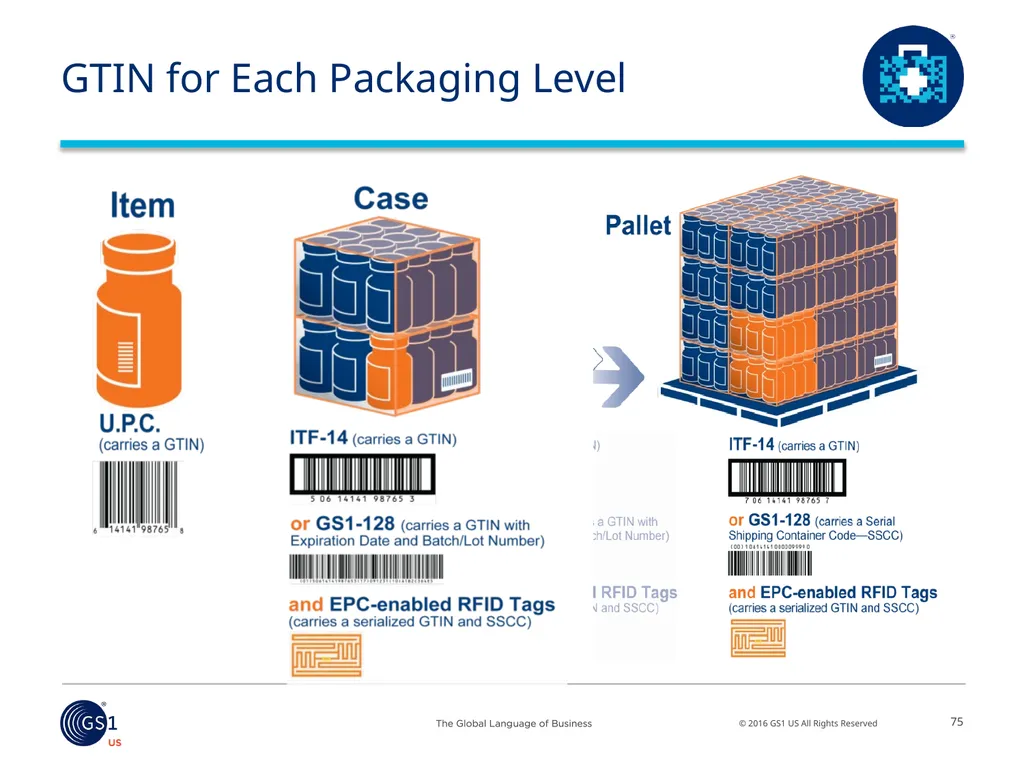
GTIN for Each Packaging Level 75<br>
76
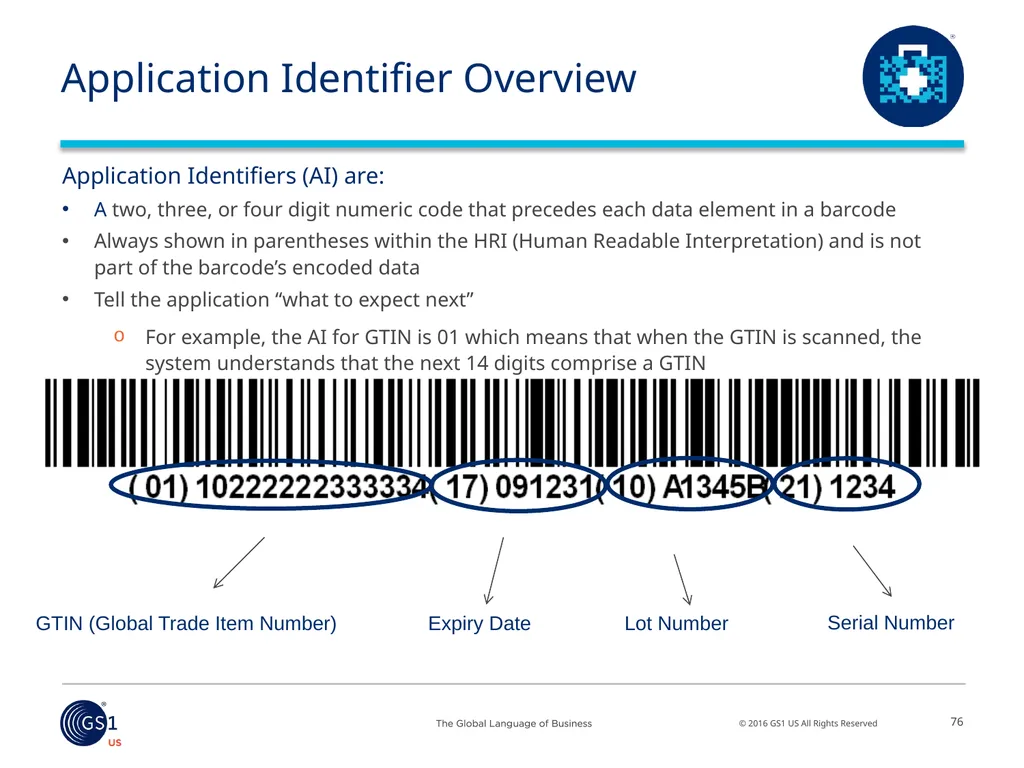
Application Identifiers (AI) are:
A two, three, or four digit numeric code that precedes each data element in a barcode
Always shown in parentheses within the HRI (Human Readable Interpretation) and is not part of the barcode’s encoded data
Tell the application “what to expect next”
For example, the AI for GTIN is 01 which means that when the GTIN is scanned, the system understands that the next 14 digits comprise a GTIN GTIN (Global Trade Item Number) Expiry Date Lot Number Application Identifier Overview 76 Serial Number<br>
A two, three, or four digit numeric code that precedes each data element in a barcode
Always shown in parentheses within the HRI (Human Readable Interpretation) and is not part of the barcode’s encoded data
Tell the application “what to expect next”
For example, the AI for GTIN is 01 which means that when the GTIN is scanned, the system understands that the next 14 digits comprise a GTIN GTIN (Global Trade Item Number) Expiry Date Lot Number Application Identifier Overview 76 Serial Number<br>
77
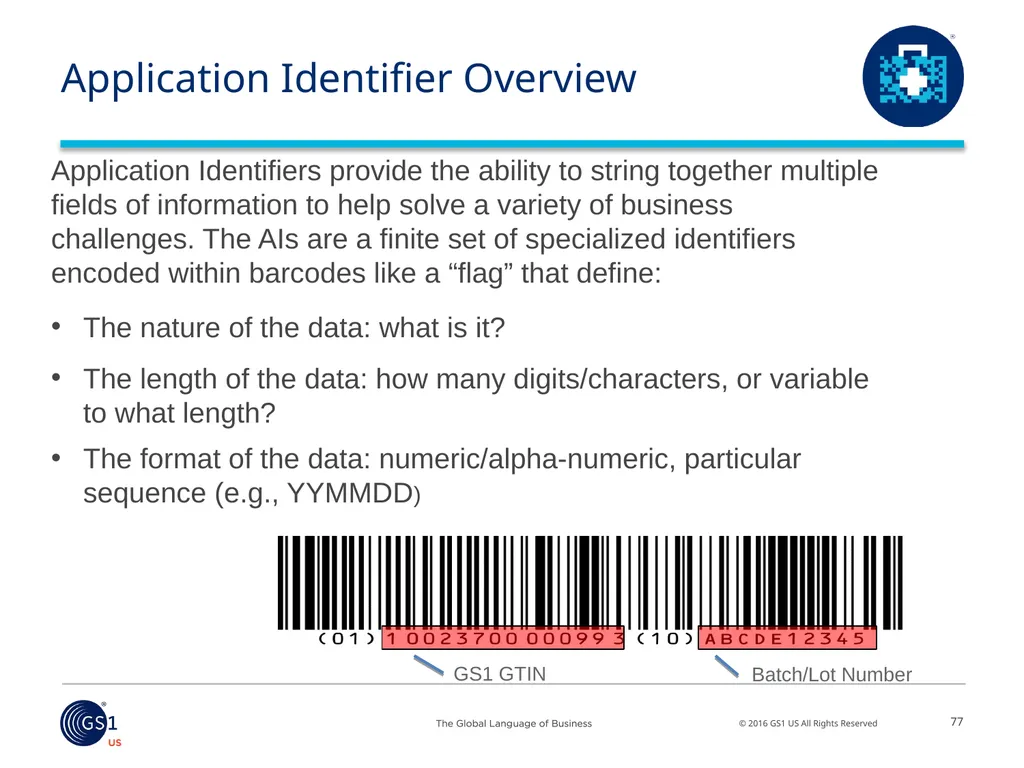
Application Identifier Overview 77 Application Identifiers provide the ability to string together multiple fields of information to help solve a variety of business challenges. The AIs are a finite set of specialized identifiers encoded within barcodes like a “flag” that define:
The nature of the data: what is it?
The length of the data: how many digits/characters, or variable to what length?
The format of the data: numeric/alpha-numeric, particular sequence (e.g., YYMMDD)<br>
The nature of the data: what is it?
The length of the data: how many digits/characters, or variable to what length?
The format of the data: numeric/alpha-numeric, particular sequence (e.g., YYMMDD)<br>
78
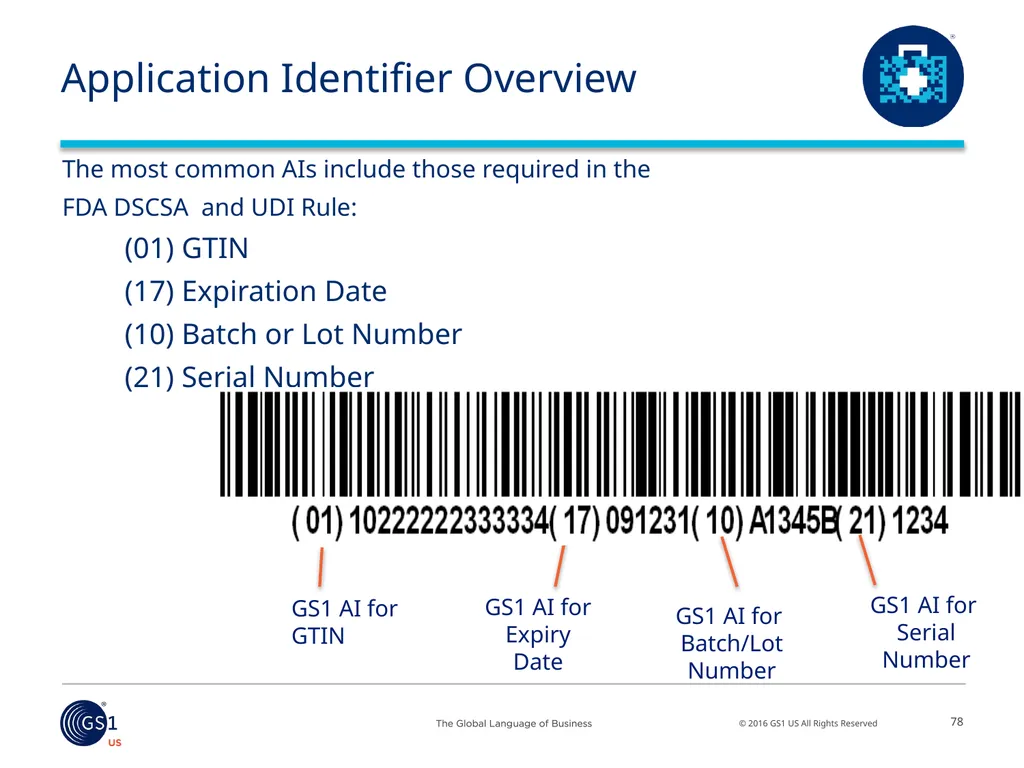
Application Identifier Overview 78 The most common AIs include those required in the
FDA DSCSA and UDI Rule:
(01) GTIN
(17) Expiration Date
(10) Batch or Lot Number
(21) Serial Number GS1 AI for
Batch/Lot Number GS1 AI for Expiry Date<br>
FDA DSCSA and UDI Rule:
(01) GTIN
(17) Expiration Date
(10) Batch or Lot Number
(21) Serial Number GS1 AI for
Batch/Lot Number GS1 AI for Expiry Date<br>
79
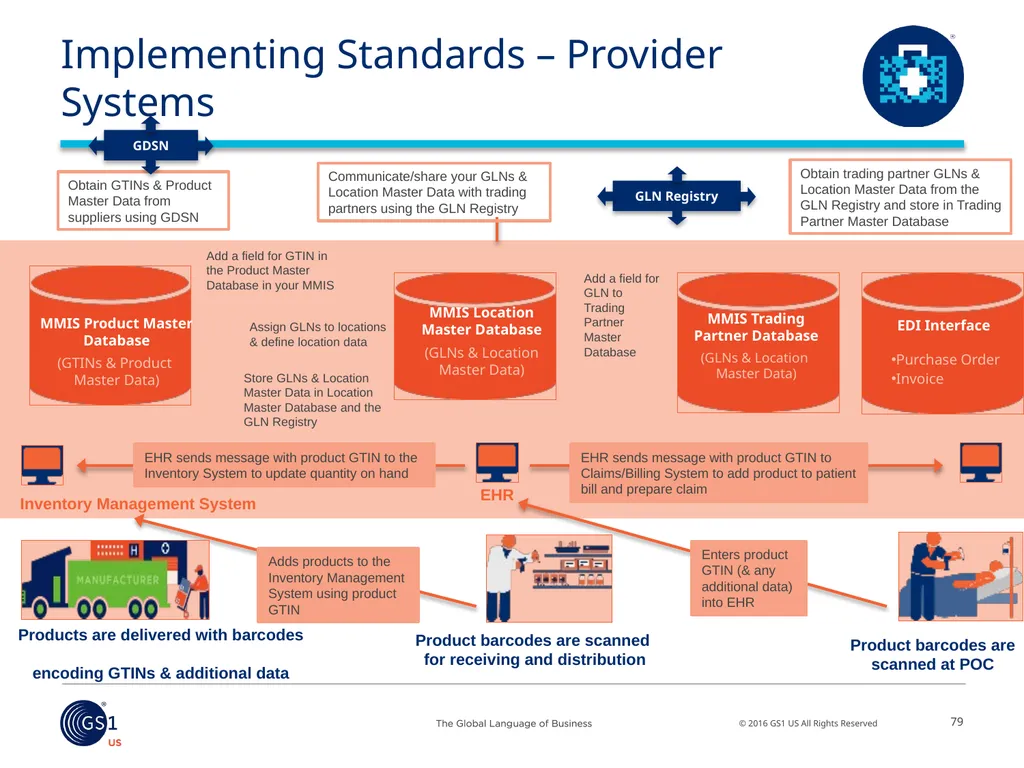
Implementing Standards – Provider Systems 79<br>
80
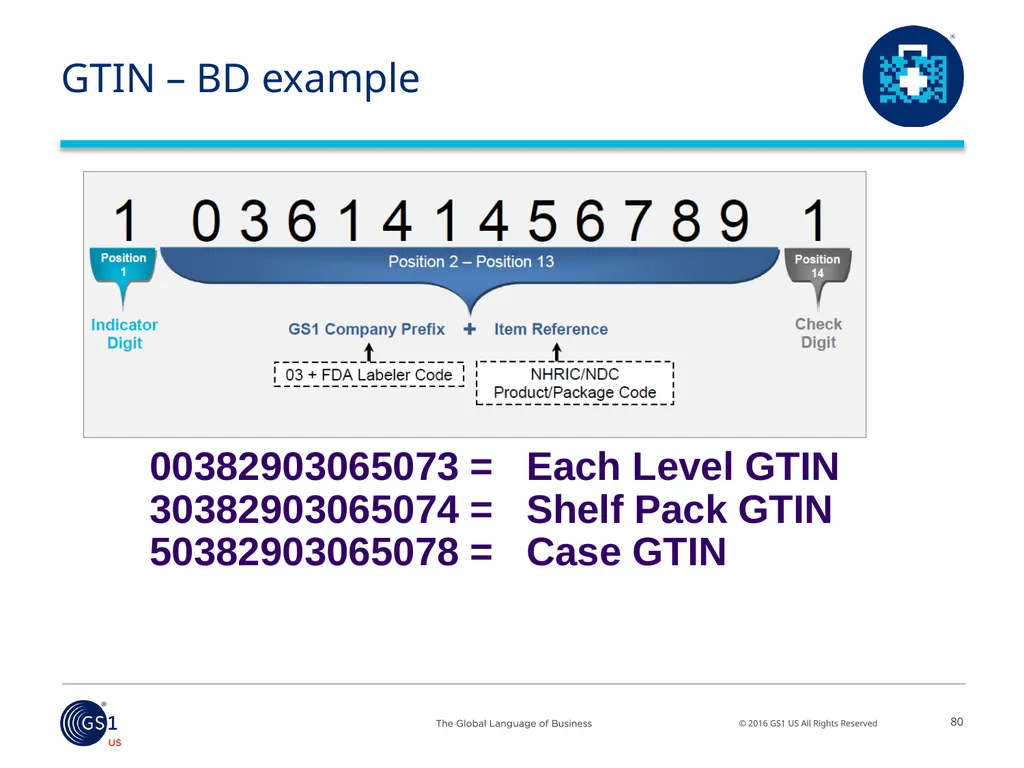
GTIN – BD example 80 00382903065073 = Each Level GTIN
30382903065074 = Shelf Pack GTIN
50382903065078 = Case GTIN<br>
30382903065074 = Shelf Pack GTIN
50382903065078 = Case GTIN<br>
81
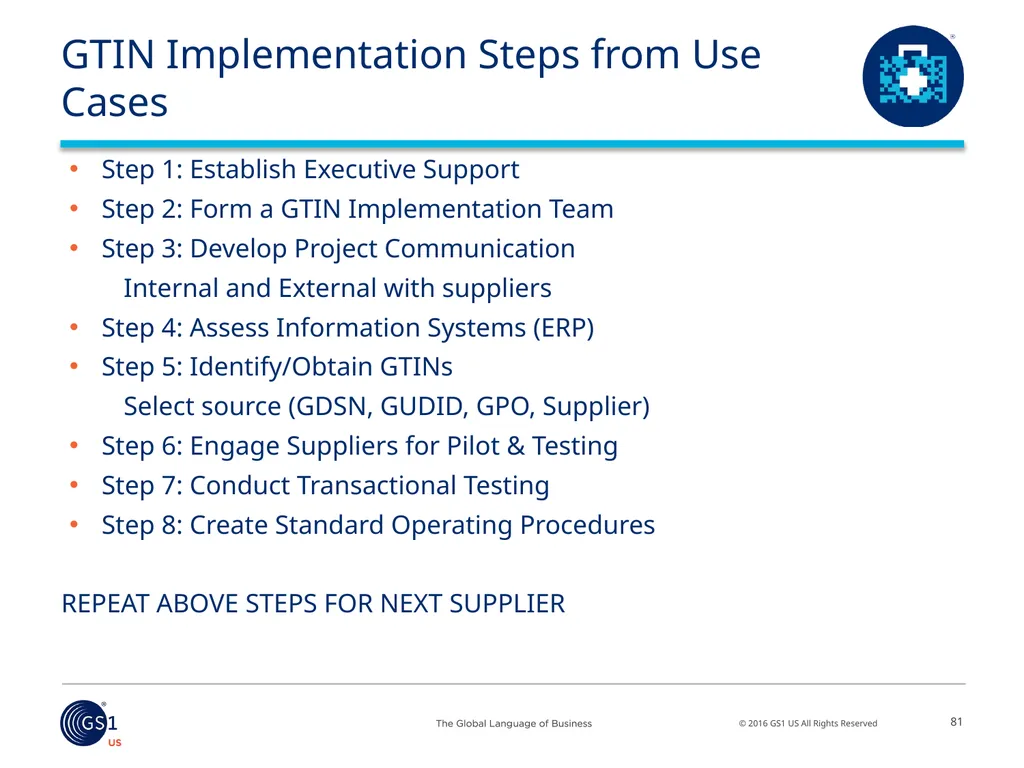
GTIN Implementation Steps from Use Cases 81 Step 1: Establish Executive Support
Step 2: Form a GTIN Implementation Team
Step 3: Develop Project Communication
Internal and External with suppliers
Step 4: Assess Information Systems (ERP)
Step 5: Identify/Obtain GTINs
Select source (GDSN, GUDID, GPO, Supplier)
Step 6: Engage Suppliers for Pilot & Testing
Step 7: Conduct Transactional Testing
Step 8: Create Standard Operating Procedures
REPEAT ABOVE STEPS FOR NEXT SUPPLIER<br>
Step 2: Form a GTIN Implementation Team
Step 3: Develop Project Communication
Internal and External with suppliers
Step 4: Assess Information Systems (ERP)
Step 5: Identify/Obtain GTINs
Select source (GDSN, GUDID, GPO, Supplier)
Step 6: Engage Suppliers for Pilot & Testing
Step 7: Conduct Transactional Testing
Step 8: Create Standard Operating Procedures
REPEAT ABOVE STEPS FOR NEXT SUPPLIER<br>
82
82 Global Data Synchronization Network (GDSN)<br>
83
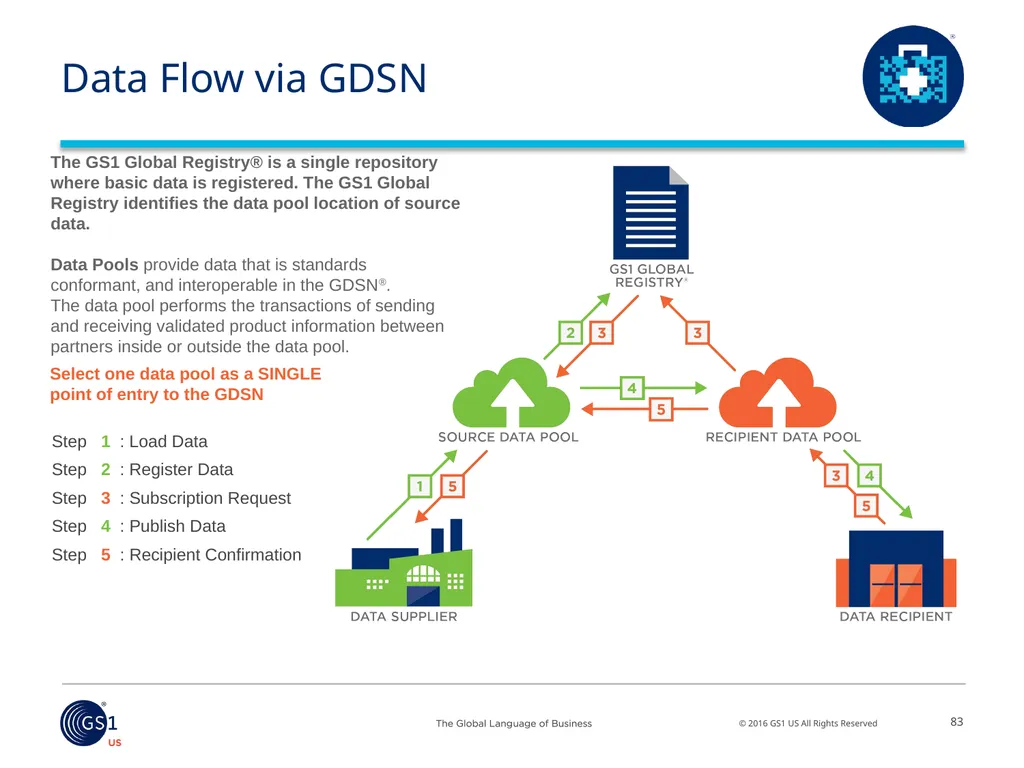
Data Flow via GDSN 83 Select one data pool as a SINGLE point of entry to the GDSN The GS1 Global Registry® is a single repository where basic data is registered. The GS1 Global Registry identifies the data pool location of source data.
Data Pools provide data that is standards conformant, and interoperable in the GDSN®. The data pool performs the transactions of sending and receiving validated product information between partners inside or outside the data pool. Step 1 : Load Data
Step 2 : Register Data
Step 3 : Subscription Request
Step 4 : Publish Data
Step 5 : Recipient Confirmation<br>
Data Pools provide data that is standards conformant, and interoperable in the GDSN®. The data pool performs the transactions of sending and receiving validated product information between partners inside or outside the data pool. Step 1 : Load Data
Step 2 : Register Data
Step 3 : Subscription Request
Step 4 : Publish Data
Step 5 : Recipient Confirmation<br>
84
GS1 Workgroups and Support 84 Support supply chain standardization through adoption of GS1 data standards
Provide GS1 Standards support in your implementations
Collaborate with stakeholders in our community and connect the many colleagues standardizing and utilizing AIDC solutions<br>
Provide GS1 Standards support in your implementations
Collaborate with stakeholders in our community and connect the many colleagues standardizing and utilizing AIDC solutions<br>
85
Workgroup Activity at GS1 US 85 Medical Devices Community Group Calls
Price Accuracy Initiative
GTINs in Practice
(Beth Gibson bgibson@gs1us.org)
Held every two weeks
To join and receive meeting invitations, log into the GS1 Healthcare US Community room at http://community.gs1us.org/apps/org/workgroup/transactions_action/
Healthcare Provider Advisory Group
(Salil Joshi sjoshi@gs1us.org)
Held monthly
To join and receive meeting invitations, log into the GS1 Healthcare US Community room at http://community.gs1us.org/apps/org/workgroup/gs1stds_patcare/
Pharmaceutical Secure Supply Chain Group Call
(Peter Sturtevant PSturtevant@gs1us.org)
Held every other week
To join, just log into the GS1 Healthcare US Community room at http://community.gs1us.org/apps/org/workgroup/rx_securesc/<br>
Price Accuracy Initiative
GTINs in Practice
(Beth Gibson bgibson@gs1us.org)
Held every two weeks
To join and receive meeting invitations, log into the GS1 Healthcare US Community room at http://community.gs1us.org/apps/org/workgroup/transactions_action/
Healthcare Provider Advisory Group
(Salil Joshi sjoshi@gs1us.org)
Held monthly
To join and receive meeting invitations, log into the GS1 Healthcare US Community room at http://community.gs1us.org/apps/org/workgroup/gs1stds_patcare/
Pharmaceutical Secure Supply Chain Group Call
(Peter Sturtevant PSturtevant@gs1us.org)
Held every other week
To join, just log into the GS1 Healthcare US Community room at http://community.gs1us.org/apps/org/workgroup/rx_securesc/<br>
86
Next Steps 86 Engage with your suppliers
Contact your IT vendors (ERP, Clinical, EHR) and check functionality available in systems
Develop Pilot Initiatives and Start Implementation
Any Questions Please Feel Free To Contact me at:
Salil Joshi
sjoshi@gs1us.org
609-620-4522<br>
Contact your IT vendors (ERP, Clinical, EHR) and check functionality available in systems
Develop Pilot Initiatives and Start Implementation
Any Questions Please Feel Free To Contact me at:
Salil Joshi
sjoshi@gs1us.org
609-620-4522<br>
87
87 Questions<br>
88
Contact Information 88 Salil Joshi Senior Director, Industry Engagement – Hospital Providers 609.620.4522 sjoshi@gs1us.org<br>