SALINITY Salinity is defined as the ratio between the weight of the dissolved materials and the weight of the sample sea water. Generally, salinity is defined as the the total amount of solid material in grains contained in one kilogram of
"SALINITY Salinity is defined as the ratio between" is the property of its rightful owner. Permission is granted to
download and print the materials on this website for personal, non-commercial use only, and to display it
on your personal computer provided you do not modify the materials and that you retain all copyright
notices contained in the materials. By downloading content from our website, you accept the terms of this
agreement.
Presentation Transcript
01
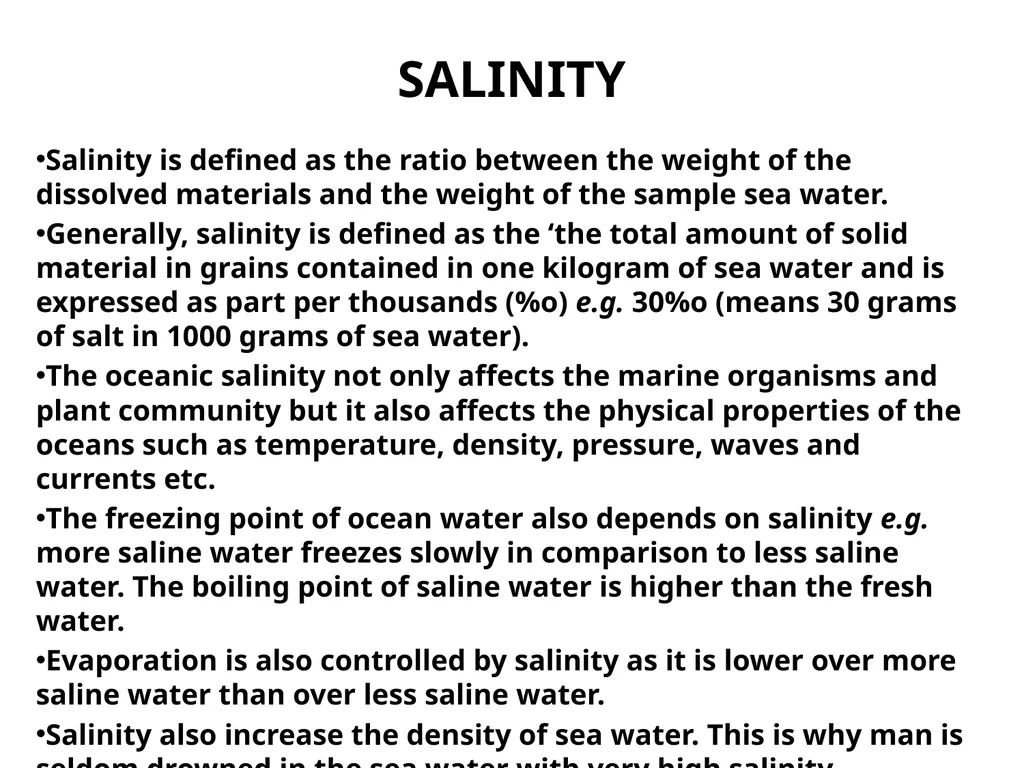
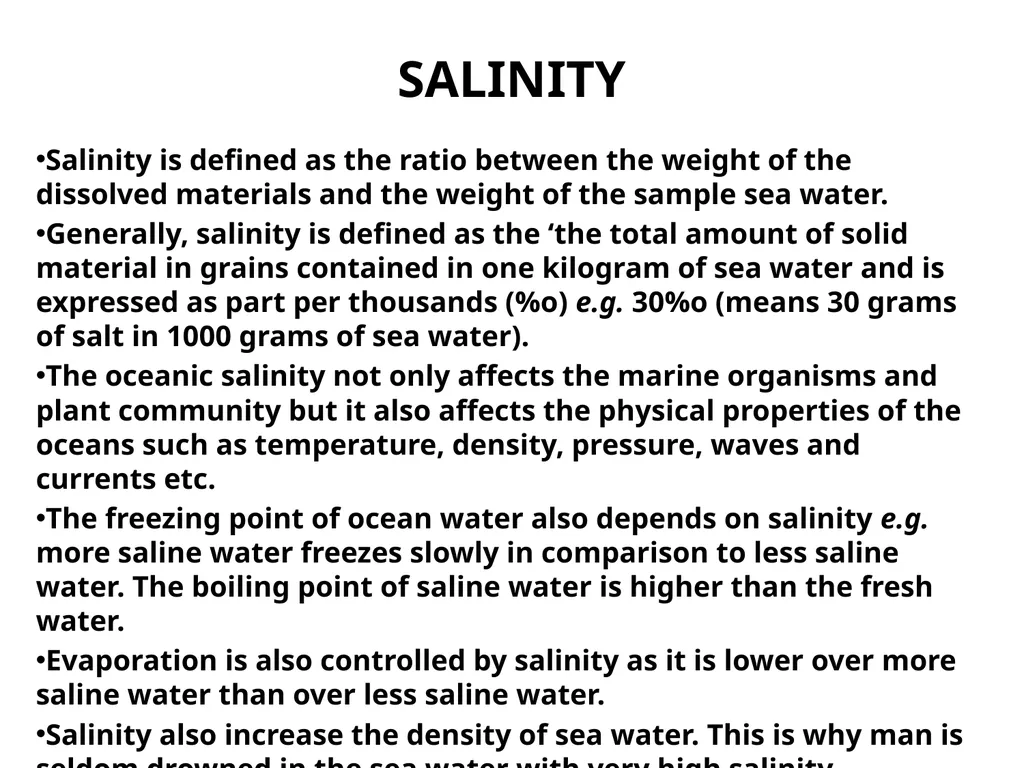
SALINITY Salinity is defined as the ratio between the weight of the dissolved materials and the weight of the sample sea water.
Generally, salinity is defined as the ‘the total amount of solid material in grains contained in one kilogram of sea water and is expressed as part per thousands (%o) e.g. 30%o (means 30 grams of salt in 1000 grams of sea water).
The oceanic salinity not only affects the marine organisms and plant community but it also affects the physical properties of the oceans such as temperature, density, pressure, waves and currents etc.
The freezing point of ocean water also depends on salinity e.g. more saline water freezes slowly in comparison to less saline water. The boiling point of saline water is higher than the fresh water.
Evaporation is also controlled by salinity as it is lower over more saline water than over less saline water.
Salinity also increase the density of sea water. This is why man is seldom drowned in the sea water with very high salinity.<br>
02
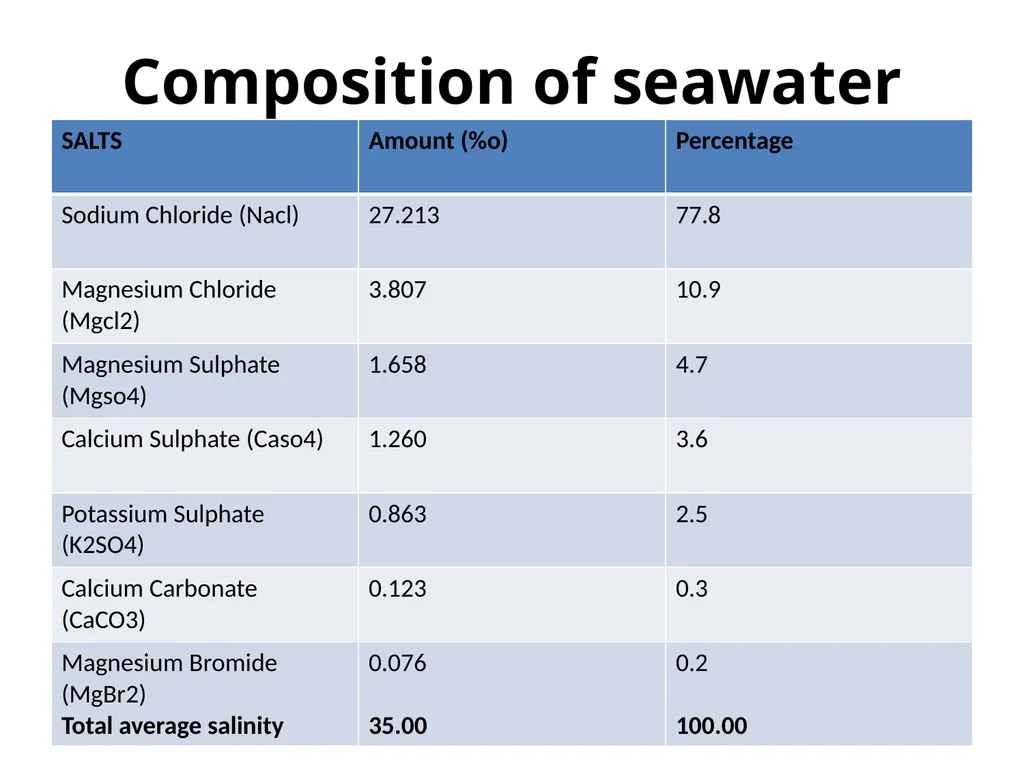
Composition of seawater<br>
03
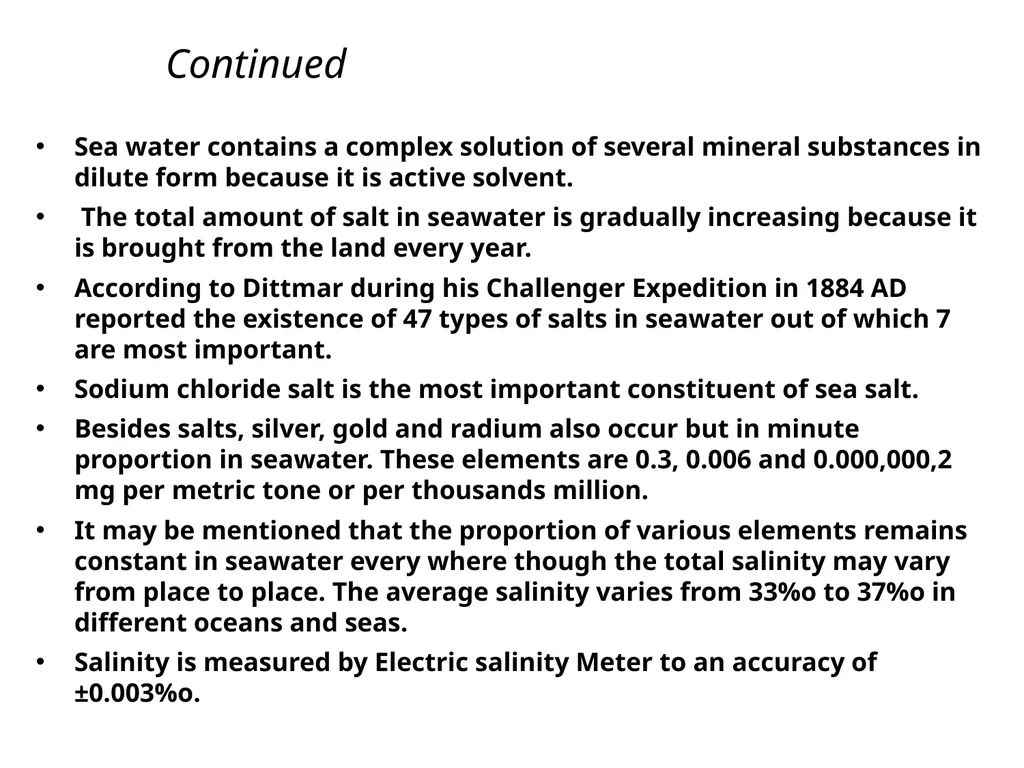
Continued Sea water contains a complex solution of several mineral substances in dilute form because it is active solvent.
The total amount of salt in seawater is gradually increasing because it is brought from the land every year.
According to Dittmar during his Challenger Expedition in 1884 AD reported the existence of 47 types of salts in seawater out of which 7 are most important.
Sodium chloride salt is the most important constituent of sea salt.
Besides salts, silver, gold and radium also occur but in minute proportion in seawater. These elements are 0.3, 0.006 and 0.000,000,2 mg per metric tone or per thousands million.
It may be mentioned that the proportion of various elements remains constant in seawater every where though the total salinity may vary from place to place. The average salinity varies from 33%o to 37%o in different oceans and seas.
Salinity is measured by Electric salinity Meter to an accuracy of ±0.003%o.<br>
04
SOURCES OF OCEANIC SALINITY Basically the source of oceanic salinity is land. Rivers bring salt in solution form, from the continental areas.
Surprisingly, there is a lot of variation in the composition of sea salt and riverine salt as calcium sulphate constitutes 60 per cent of river salinity while sodium chloride dominates in the salinity of the oceans (77.8 per cent of total salinity).
River water contains only 2 per cent of sodium chloride.<br>
05
CONTROLLING FACTORS OF SALINTY There is a wide range of variation in the spatial distribution of salinity within the oceans and the seas.
The factors affecting the amount of salt in different oceans and sea are called as controlling factors of oceanic salinity. These are, Evaporation, Precipitation, Influx of river water, Prevailing winds, ocean currents and sea waves are significant controlling factors.<br>
06
DISTRIBUTION OF SALINITY The average salinity in the oceans and the sea is 35%o but it spatially and temporally varies in different oceans, seas, and lakes.
Salinity also varies from enclosed seas through partially closed seas to open seas.
Thus, the spatial distribution of salinity is studied in two ways (1) Horizontal distribution and (2) Vertical distribution.<br>
07
Horizontal Distribution Horizontal distribution of oceanic salinity is studied in relation to latitudes.
1) Latitudinal distribution: On an average, salinity decrease from equator towards the poles. It may be mentioned that the highest salinity is seldom recorded near the equator though this zone records high temperature and evaporation but high rainfall reduces the relative proportion of salt.
Thus, the equator accounts for only 35%o salinity.
The highest salinity is observed between 20°-40°N (36%o) because this zone is characterized by high temperature, high evaporation but significantly low rain fall.
The average salinity of 35%o is recorded between 10°-30° latitudes in the southern hemisphere.<br>
08
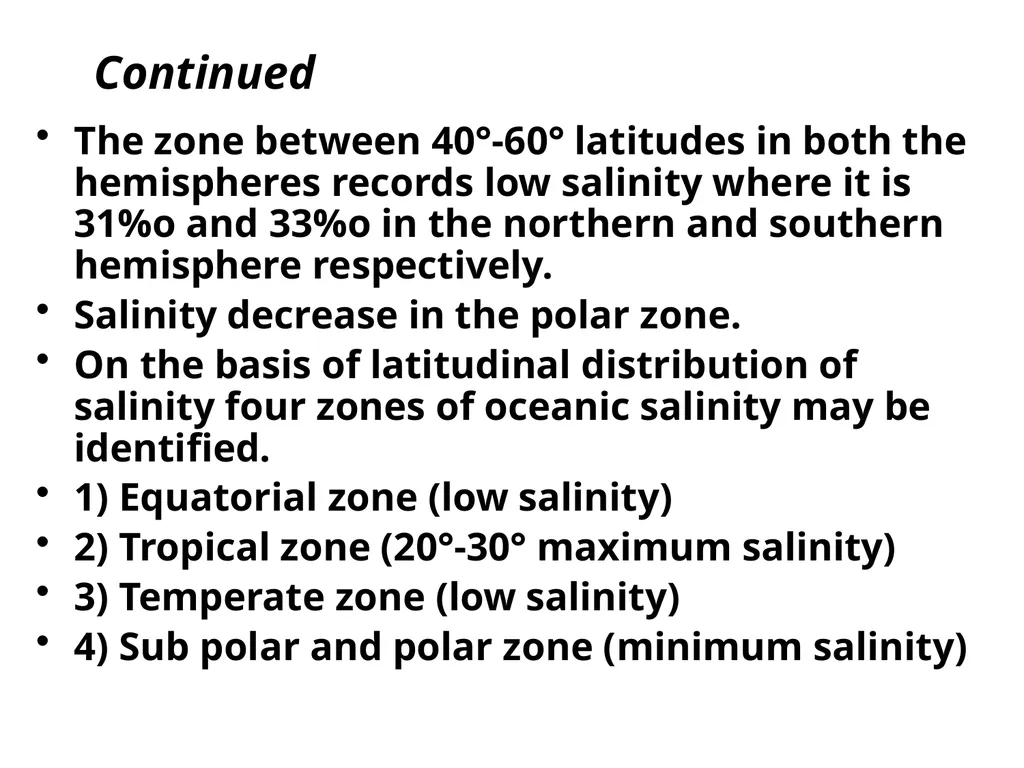
Continued The zone between 40°-60° latitudes in both the hemispheres records low salinity where it is 31%o and 33%o in the northern and southern hemisphere respectively.
Salinity decrease in the polar zone.
On the basis of latitudinal distribution of salinity four zones of oceanic salinity may be identified.
1) Equatorial zone (low salinity)
2) Tropical zone (20°-30° maximum salinity)
3) Temperate zone (low salinity)
4) Sub polar and polar zone (minimum salinity)<br>
09
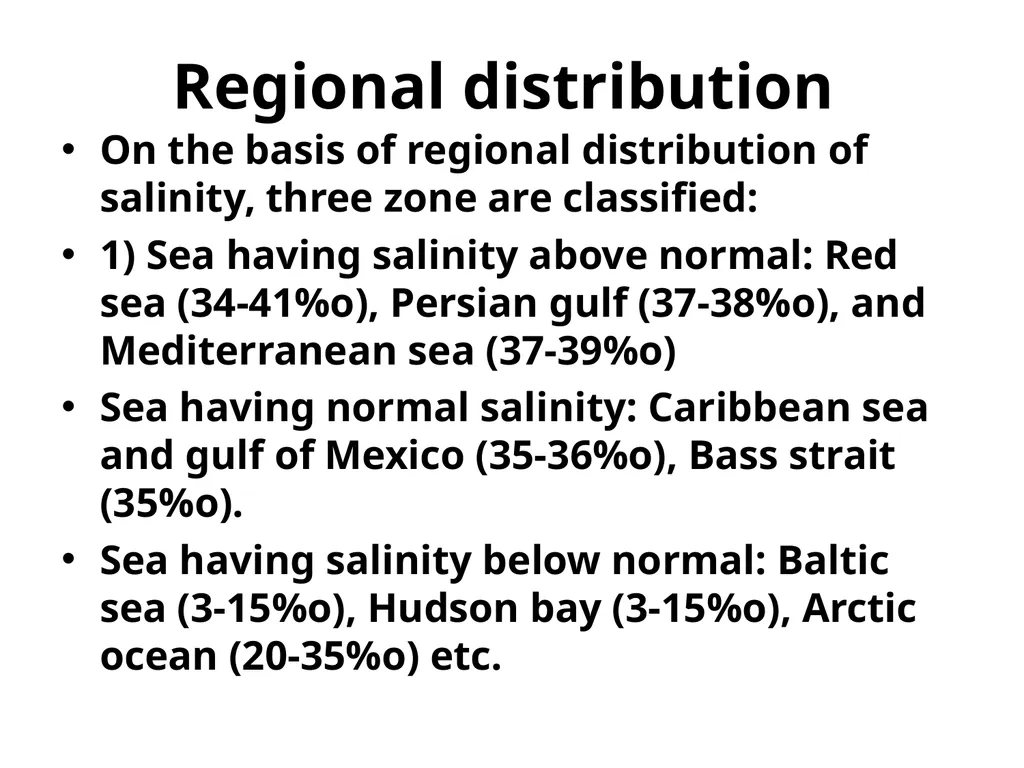
Regional distribution On the basis of regional distribution of salinity, three zone are classified:
1) Sea having salinity above normal: Red sea (34-41%o), Persian gulf (37-38%o), and Mediterranean sea (37-39%o)
Sea having normal salinity: Caribbean sea and gulf of Mexico (35-36%o), Bass strait (35%o).
Sea having salinity below normal: Baltic sea (3-15%o), Hudson bay (3-15%o), Arctic ocean (20-35%o) etc.<br>
10
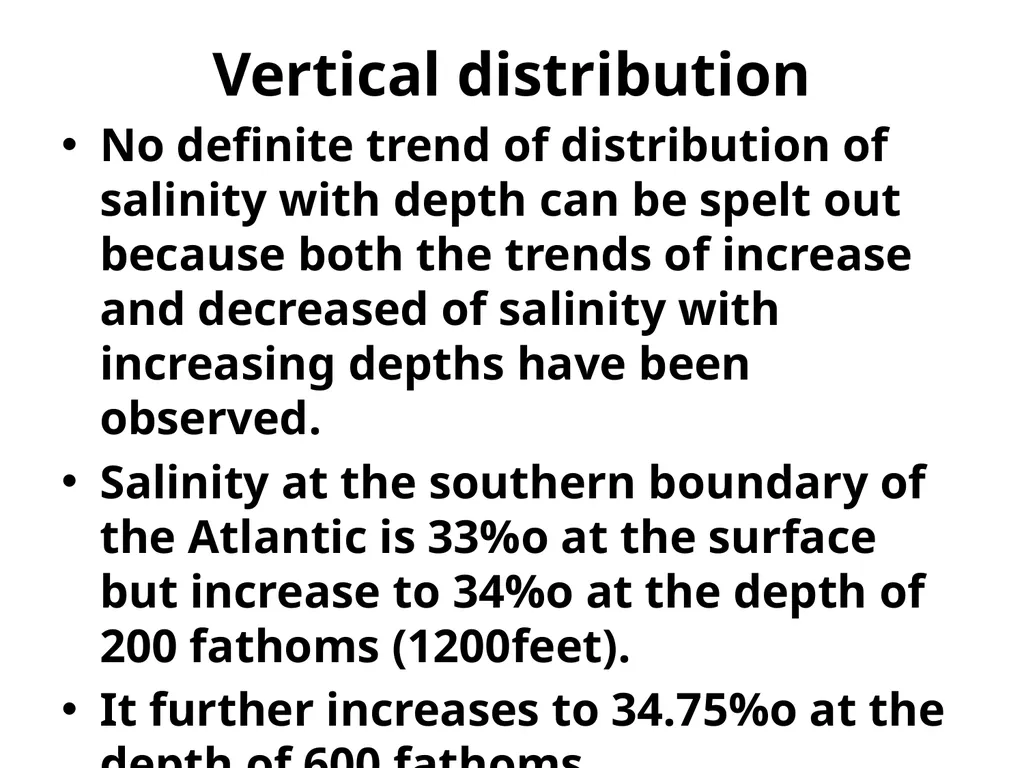
Vertical distribution No definite trend of distribution of salinity with depth can be spelt out because both the trends of increase and decreased of salinity with increasing depths have been observed.
Salinity at the southern boundary of the Atlantic is 33%o at the surface but increase to 34%o at the depth of 200 fathoms (1200feet).
It further increases to 34.75%o at the depth of 600 fathoms.<br>
11
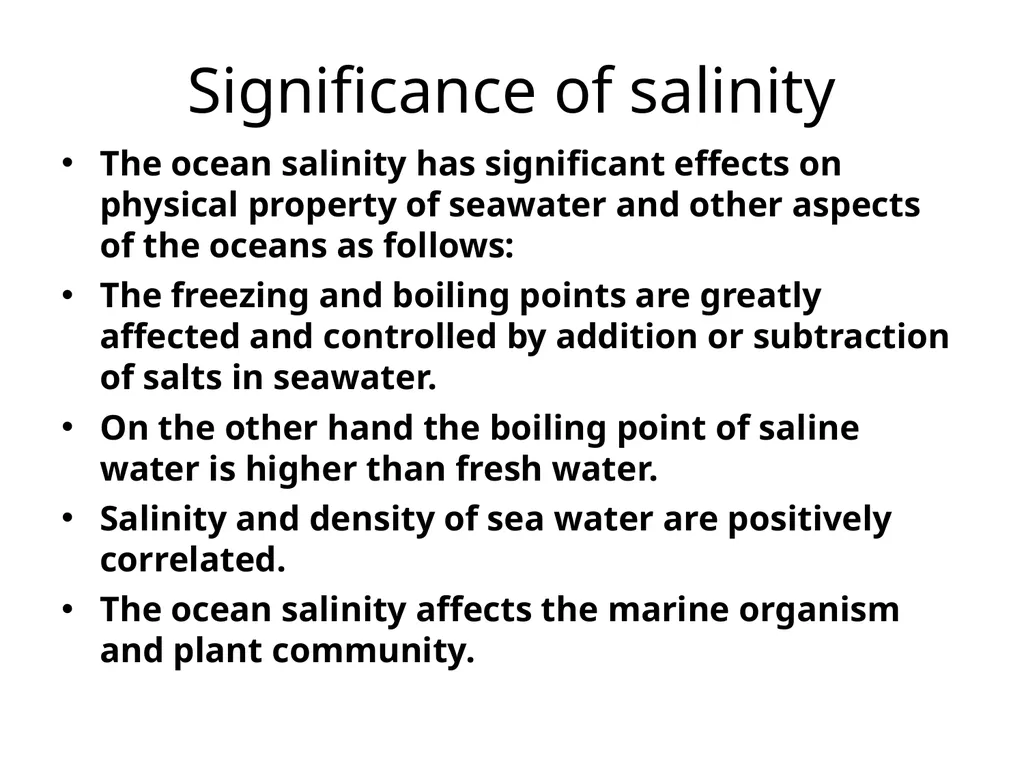
Significance of salinity The ocean salinity has significant effects on physical property of seawater and other aspects of the oceans as follows:
The freezing and boiling points are greatly affected and controlled by addition or subtraction of salts in seawater.
On the other hand the boiling point of saline water is higher than fresh water.
Salinity and density of sea water are positively correlated.
The ocean salinity affects the marine organism and plant community.<br>