Sample preparation and factors affect IR bands The spectrum of a solid can be obtained either as a mull or as an alkali halide pellet. Mulls are obtained by thoroughly grinding 2-5 mg of a solid sample with a drop of mulling agent usually
"Sample preparation and factors affect IR bands The" is the property of its rightful owner. Permission is granted to
download and print the materials on this website for personal, non-commercial use only, and to display it
on your personal computer provided you do not modify the materials and that you retain all copyright
notices contained in the materials. By downloading content from our website, you accept the terms of this
agreement.
Presentation Transcript
01
Sample preparation and factors affect IR bands<br>
02
The spectrum of a solid can be obtained either as a mull or as an alkali halide pellet.
Mulls are obtained by thoroughly grinding 2-5 mg of a solid sample with a drop of mulling agent usually Nujol (mixture of parafinic hydrocarbons) or fluorolube (a completely fluorinate polymer).
The suspended particles must be less than 2 µm to avoid excessive scattering of radiations.
The mull is placed between two sodium chloride plates and plates are subjected to IR beam.
For preparing an alkali halide pellet, 1-2 mg of dry sample is grinded with ~ 100 mg of KBr powder. The mixture is then pressed into a transparent pellet with a special die under a pressure of 10,000-15,000 psi. KBr pellet is then mounted on holder and is placed in sample beam of IR spectrophotometer. Preparation of solid samples<br>
03
Solvents in IR spectroscopy Properties of solvents
Pure solvent is placed in the reference
The spectrum thus obtained is that of the solute except in the region in which the solvent absorbs strongly .
The solvent selected must be dry and transparent in interest .
Types of solvents
Solvent, like carbon tetrachloride (CCl4) a is relatively free of absorption at frequencies above 1333 cm -1 ,
carbon disulfide (CS2) shows little absorption below 1333cm-1
Solvent and solute combinations that react must be avoided . For example :-
CS2 cannot be use as a solvent for primary or secondary amine
Amino alcohol react slowly with CS2 & CCl4 Chloroform (CHCl3 ) shows absorption at all wavelength but its absorption is so high ,so avoid & and used analyses dissolving solvent than neglected<br>
04
Factors affect IR frequencies Inductive and Resonance Effects: The replacement of an alkyl group of the saturated aliphatic ketone by a heteroatom (O, N) shifts the C=O stretching frequencies due to inductive and resonance effects.
In amides, due to the conjugation of lone pair of electrons on nitrogen atom, the resonance effect increases the C=O bond length and reduces the C=O absorption frequency. Therefore, C=O absorption frequencies due to resonance effects in amides are lowered but due to inductive effect in esters are increased than those observed in ketones. In esters, the oxygen due to inductive effect withdraws the electrons from carbonyl group and increases the C=O bond strength and thus the frequency of absorption. What is the effect of inductive and resonance effect at the at Vibration frequencies?<br>
05
Factors affect IR frequencies Inductive and Resonance Effects: The replacement of an alkyl group of the saturated aliphatic ketone by a heteroatom (O, N) shifts the C=O stretching frequencies due to inductive and resonance effects. In acid chlorides, the halogen atom strengthens the C=O bond through inductive effect and shifts the C=O stretching frequencies even higher than are found in esters.
The acid anhydrides give two bands in C=O stretching frequency region due to symmetric (~1820 cm-1) and asymmetric (~1760 cm-1) stretching vibrations.<br>
06
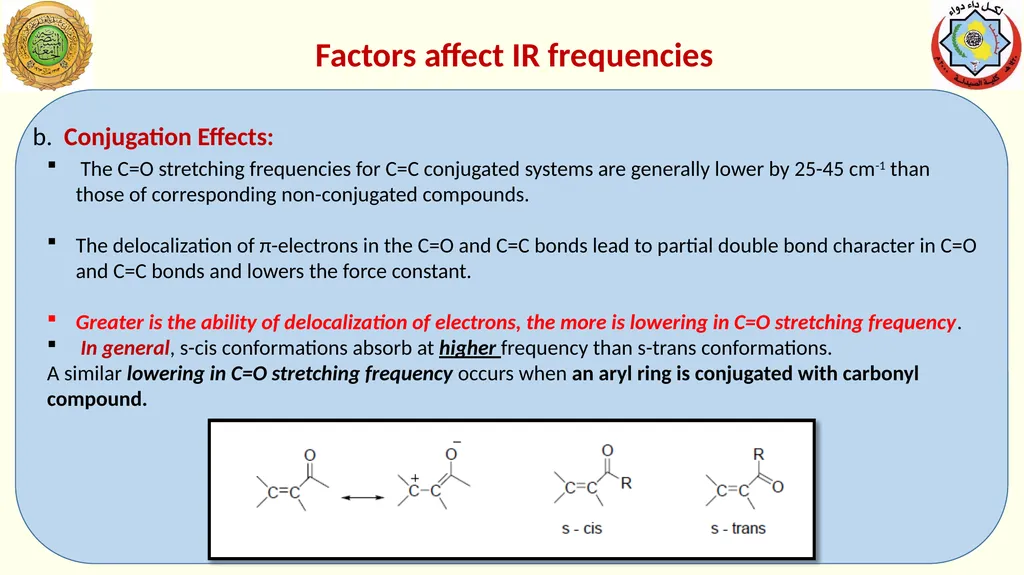
Factors affect IR frequencies b. Conjugation Effects: The C=O stretching frequencies for C=C conjugated systems are generally lower by 25-45 cm-1 than those of corresponding non-conjugated compounds.
The delocalization of π-electrons in the C=O and C=C bonds lead to partial double bond character in C=O and C=C bonds and lowers the force constant.
Greater is the ability of delocalization of electrons, the more is lowering in C=O stretching frequency.
In general, s-cis conformations absorb at higher frequency than s-trans conformations.
A similar lowering in C=O stretching frequency occurs when an aryl ring is conjugated with carbonyl compound.<br>
07
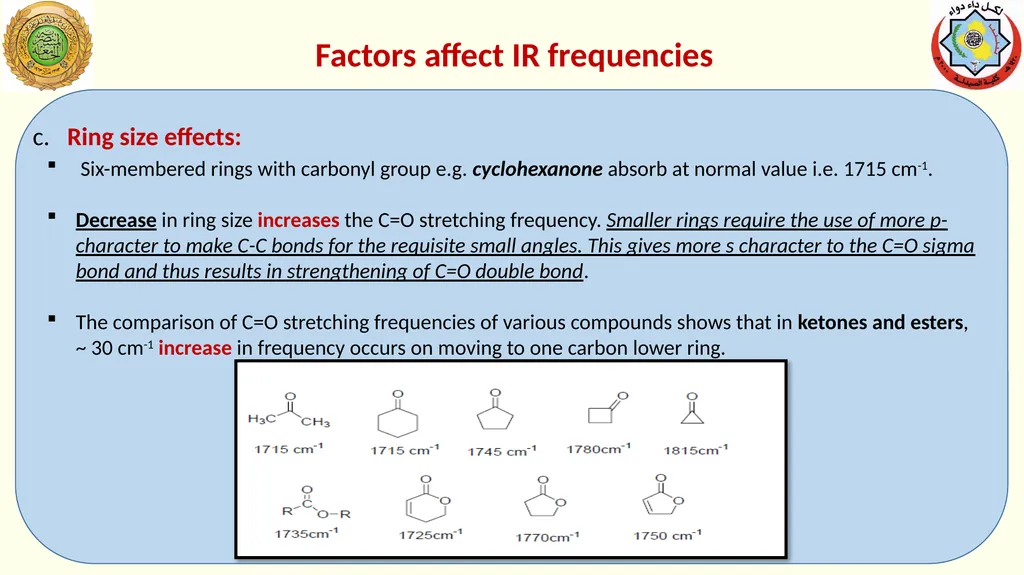
Factors affect IR frequencies c. Ring size effects: Six-membered rings with carbonyl group e.g. cyclohexanone absorb at normal value i.e. 1715 cm-1.
Decrease in ring size increases the C=O stretching frequency. Smaller rings require the use of more p- character to make C-C bonds for the requisite small angles. This gives more s character to the C=O sigma bond and thus results in strengthening of C=O double bond.
The comparison of C=O stretching frequencies of various compounds shows that in ketones and esters, ~ 30 cm-1 increase in frequency occurs on moving to one carbon lower ring.<br>
08
Factors affect IR frequencies d. Hydrogen bonding: The common proton donor group (X) in organic molecules are Carboxyl , hydroxyl , amine or amide group . Common proton acceptor (Y) atoms are oxygen , nitrogen and the halogen ,unsaturated group such as the C=C in linkage.
The strength of Hydrogen bonding decreases as the distance between X & Y increase.
Hydrogen bonding alters the force constant of both groups ,thus, the frequencies of both stretching and bending vibrations are altered
The X-H stretching band move to lower frequencies (longer wavelength )usually with increase intensity and band widening
The stretching frequency of the acceptor group ,for , C=O is also reduced but to a lesser degree than the proton donor group
the H-X bending vibration usually shifts to shorter wavelength when bending occurs ,this shift is less than that of stretching frequency<br>
09
Factors affect hydrogen bonding Temperature since when temp. increases, the H- bonding decreases
Concertation have different affect on both H-bonding result from intermolecular bonding disappear at low conc. While intramolecular bonding has internal effect & so it persist at very low conc.
The relative acidity and basicity of the proton donor and acceptor groups affect the strength of bonding.
Ring strain
Molecular geometry<br>
10
Factors affect position of C=O stretching band The physical state
Electronic and mass effect of neighbouring group
The relative acidity and basicity of the proton donor and acceptor groups affect the strength of bonding.
Ring strain
Conjugation effect
Hydrogen bonding effect
Inductive effect<br>
11
In addition to the fundamental vibrations, other frequencies can be generated by modulations of the fundamental bands
Overtone bands appear at integral multiples of fundamental vibrations. Therefore, the strong absorptions at say 800 cm-1 and 1750 cm-1 will also give rise to weaker absorptions at 1600 cm-1 and 3500 cm-1, respectively.
Combination bands: Two vibrational frequencies (υ 1 and υ 2) in a molecule couple to give rise to a new infrared active frequency. This band is the sum of the two interacting bands (υ combination = υ 1 + υ 2).
Difference bands: A new infrared active frequency arising due to the difference between the two interacting bands (υ difference = υ 1 - υ 2).
Fermi resonance: When a fundamental vibration couples with an overtone or combination band, the coupled vibration is called Fermi resonance. Fermi resonance is often observed in carbonyl compounds.<br>
12
Benzaldehyde (C=O) 1700 cm-1
overtone at 3400 cm-1 Acetophenon (C=O) 1682 cm-1
overtone at 3365 cm-1<br>
13
Example: The carbonyl stretching frequency in RCOCH3 (~1720 cm-1) is lower than acid chloride RCOCl (1750-1820 cm-1).
This change in frequency of the C=O stretching may be arising due to:
Difference in mass between CH3 and Cl
The inductive or mesomeric influence of Cl on the C=O bond
Coupling interactions between C=O and C -Cl bonds
Change in bond angles arising due to steric factors etc.<br>
14
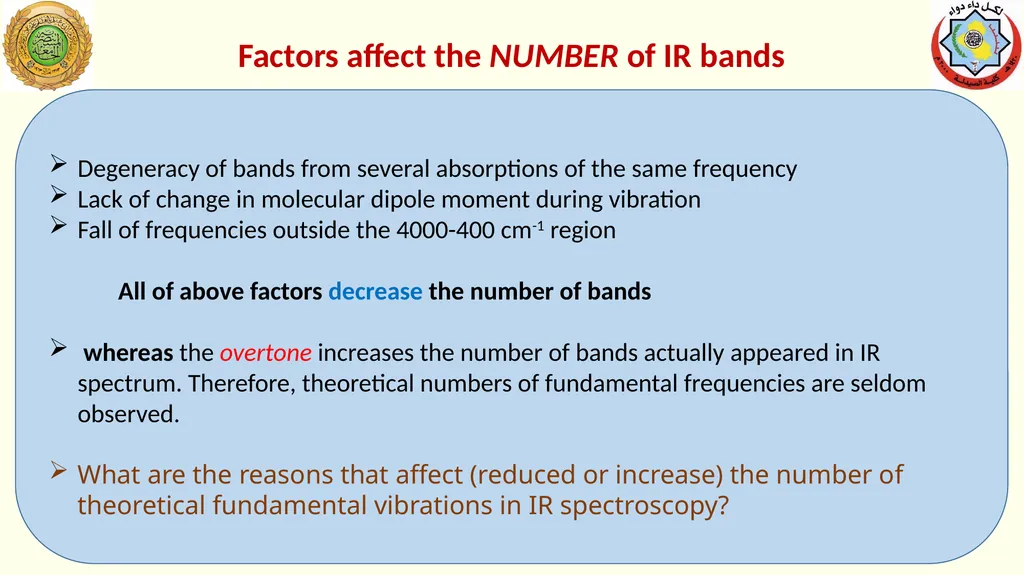
Factors affect the NUMBER of IR bands Degeneracy of bands from several absorptions of the same frequency
Lack of change in molecular dipole moment during vibration
Fall of frequencies outside the 4000-400 cm-1 region
All of above factors decrease the number of bands
whereas the overtone increases the number of bands actually appeared in IR spectrum. Therefore, theoretical numbers of fundamental frequencies are seldom observed.
What are the reasons that affect (reduced or increase) the number of theoretical fundamental vibrations in IR spectroscopy?<br>