
San Diego City Schools Case Study Presented by:
DP
Published · 40 slides · 0 views

1 / 1

Description
San Diego City Schools Case Study Presented by: Walfridus Chaspuri Zhen Guan Kent Ikeda Jun Mei Agiimaa Tsogt 1 Background In 2002, SDCS was the eighth largest urban school district in US and the second largest in CA Serves 142,000 students
Related Topics
Share
Embed code
Download this presentation From Below
"San Diego City Schools Case Study Presented by:" is the property of its rightful owner. Permission is granted to download and print the materials on this website for personal, non-commercial use only, and to display it on your personal computer provided you do not modify the materials and that you retain all copyright notices contained in the materials. By downloading content from our website, you accept the terms of this agreement.
Presentation Transcript
01
San Diego City Schools Case Study Presented by:
Walfridus Chaspuri
Zhen Guan
Kent Ikeda
Jun Mei
Agiimaa Tsogt 1<br>
Walfridus Chaspuri
Zhen Guan
Kent Ikeda
Jun Mei
Agiimaa Tsogt 1<br>
02
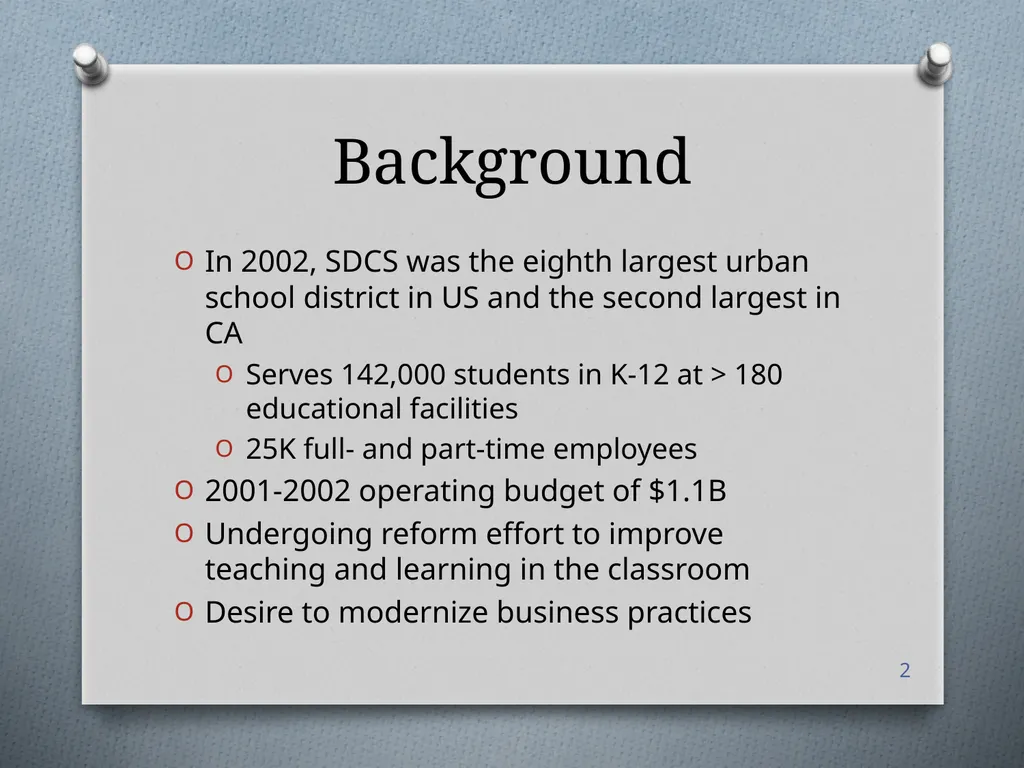
Background In 2002, SDCS was the eighth largest urban school district in US and the second largest in CA
Serves 142,000 students in K-12 at > 180 educational facilities
25K full- and part-time employees
2001-2002 operating budget of $1.1B
Undergoing reform effort to improve teaching and learning in the classroom
Desire to modernize business practices 2<br>
Serves 142,000 students in K-12 at > 180 educational facilities
25K full- and part-time employees
2001-2002 operating budget of $1.1B
Undergoing reform effort to improve teaching and learning in the classroom
Desire to modernize business practices 2<br>
03
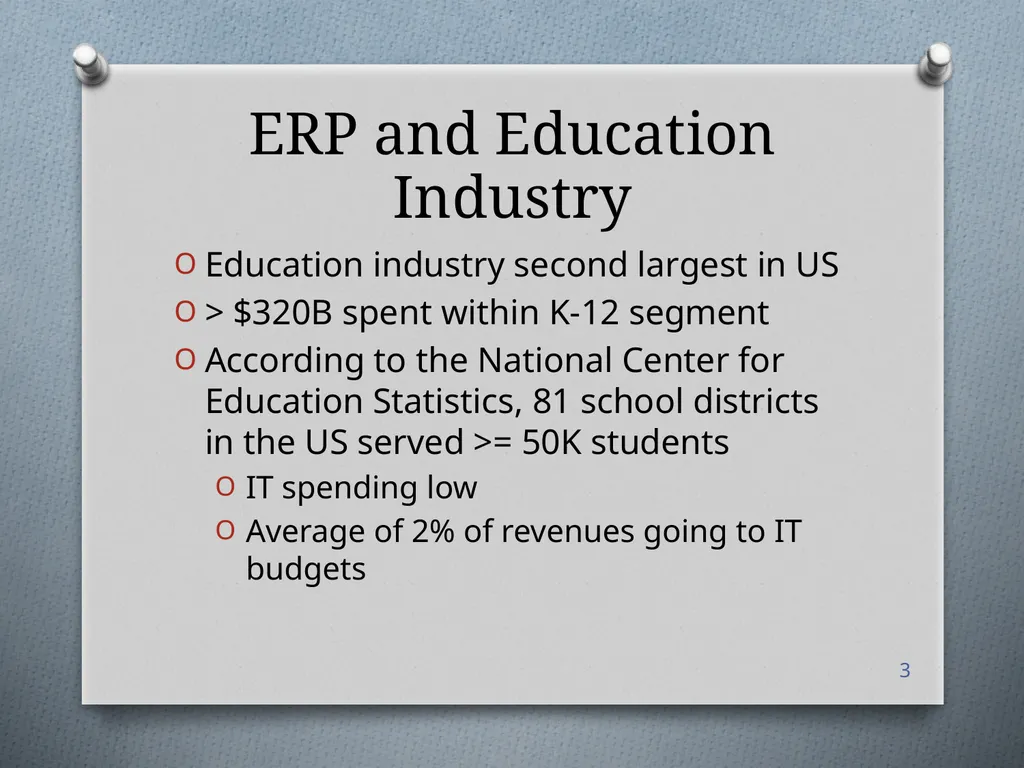
ERP and Education Industry Education industry second largest in US
> $320B spent within K-12 segment
According to the National Center for Education Statistics, 81 school districts in the US served >= 50K students
IT spending low
Average of 2% of revenues going to IT budgets 3<br>
> $320B spent within K-12 segment
According to the National Center for Education Statistics, 81 school districts in the US served >= 50K students
IT spending low
Average of 2% of revenues going to IT budgets 3<br>
04
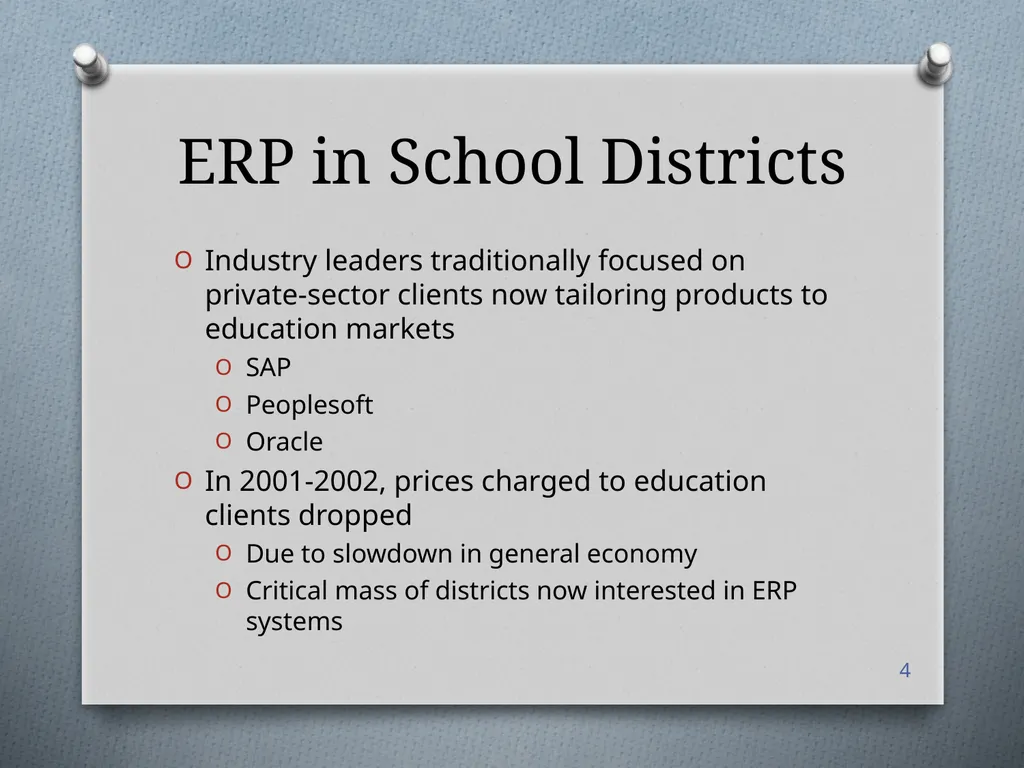
ERP in School Districts Industry leaders traditionally focused on private-sector clients now tailoring products to education markets
SAP
Peoplesoft
Oracle
In 2001-2002, prices charged to education clients dropped
Due to slowdown in general economy
Critical mass of districts now interested in ERP systems 4<br>
SAP
Peoplesoft
Oracle
In 2001-2002, prices charged to education clients dropped
Due to slowdown in general economy
Critical mass of districts now interested in ERP systems 4<br>
05
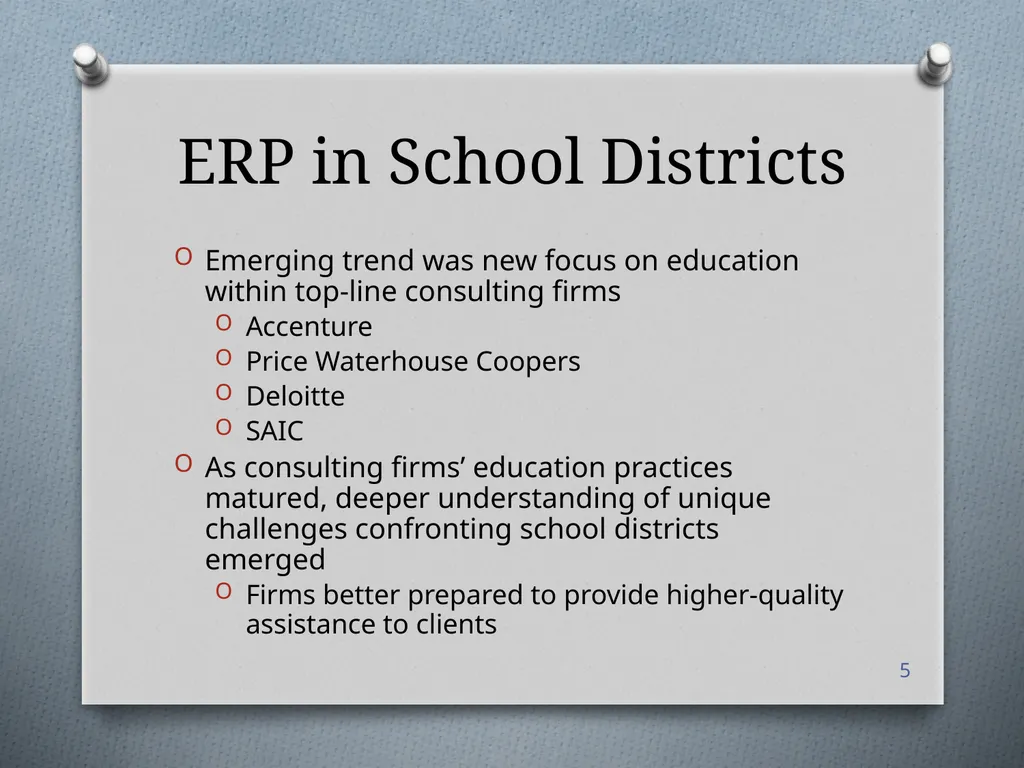
ERP in School Districts Emerging trend was new focus on education within top-line consulting firms
Accenture
Price Waterhouse Coopers
Deloitte
SAIC
As consulting firms’ education practices matured, deeper understanding of unique challenges confronting school districts emerged
Firms better prepared to provide higher-quality assistance to clients 5<br>
Accenture
Price Waterhouse Coopers
Deloitte
SAIC
As consulting firms’ education practices matured, deeper understanding of unique challenges confronting school districts emerged
Firms better prepared to provide higher-quality assistance to clients 5<br>
06
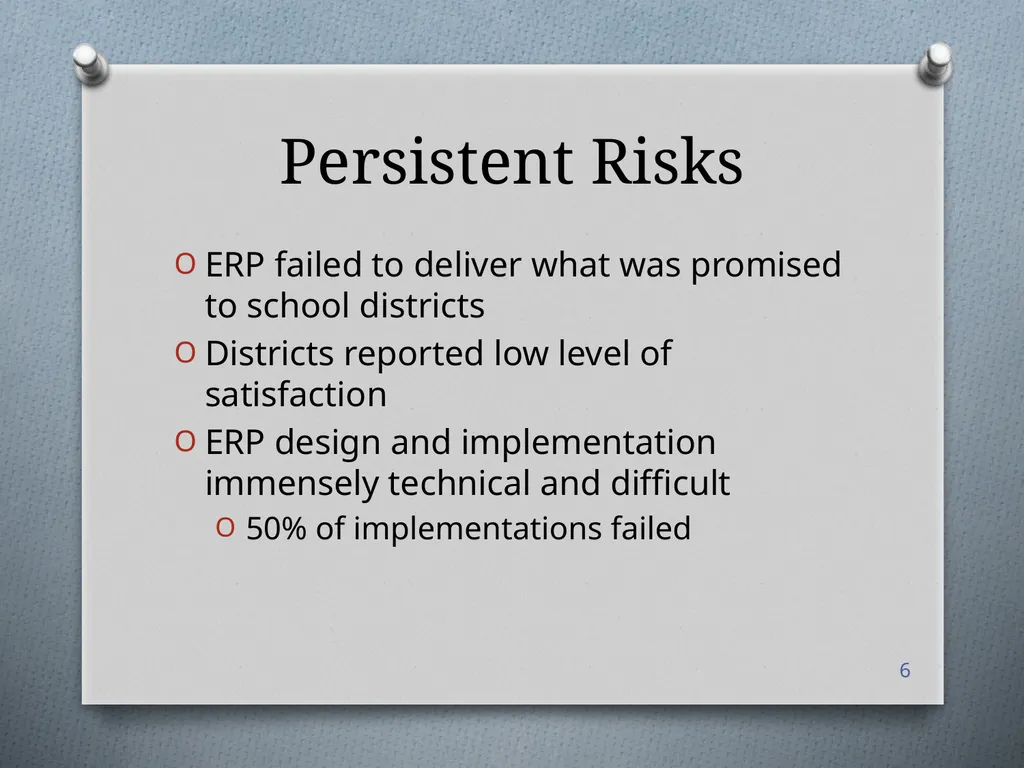
Persistent Risks ERP failed to deliver what was promised to school districts
Districts reported low level of satisfaction
ERP design and implementation immensely technical and difficult
50% of implementations failed 6<br>
Districts reported low level of satisfaction
ERP design and implementation immensely technical and difficult
50% of implementations failed 6<br>
07
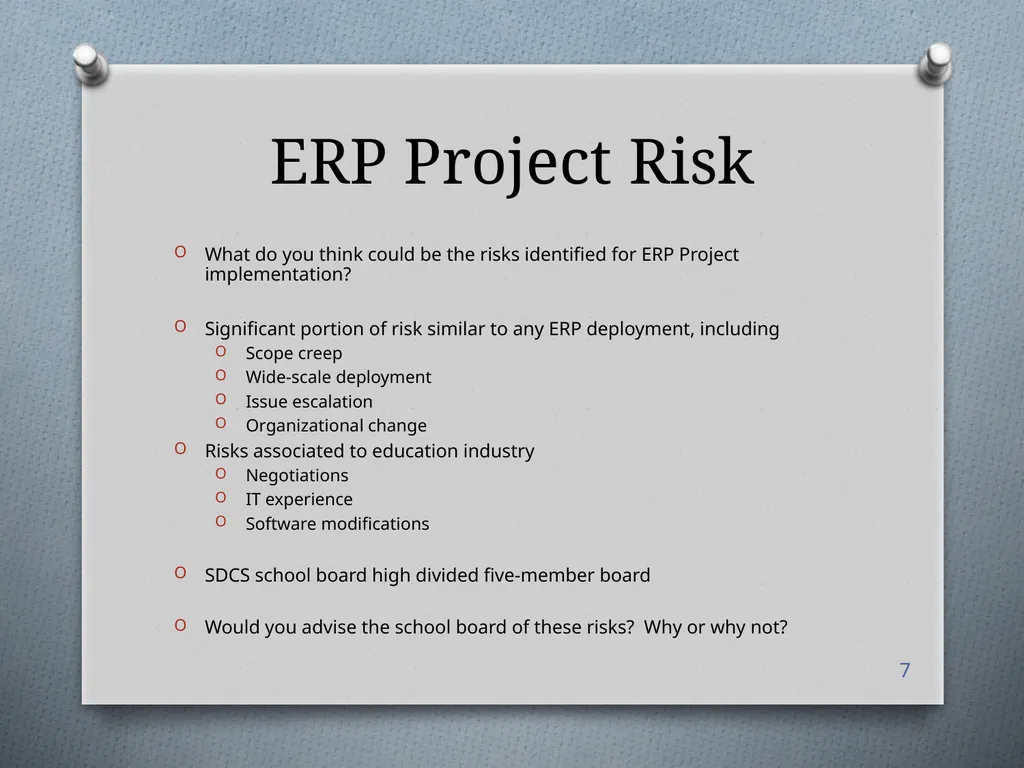
ERP Project Risk What do you think could be the risks identified for ERP Project implementation?
Significant portion of risk similar to any ERP deployment, including
Scope creep
Wide-scale deployment
Issue escalation
Organizational change
Risks associated to education industry
Negotiations
IT experience
Software modifications
SDCS school board high divided five-member board
Would you advise the school board of these risks? Why or why not? 7<br>
Significant portion of risk similar to any ERP deployment, including
Scope creep
Wide-scale deployment
Issue escalation
Organizational change
Risks associated to education industry
Negotiations
IT experience
Software modifications
SDCS school board high divided five-member board
Would you advise the school board of these risks? Why or why not? 7<br>
08
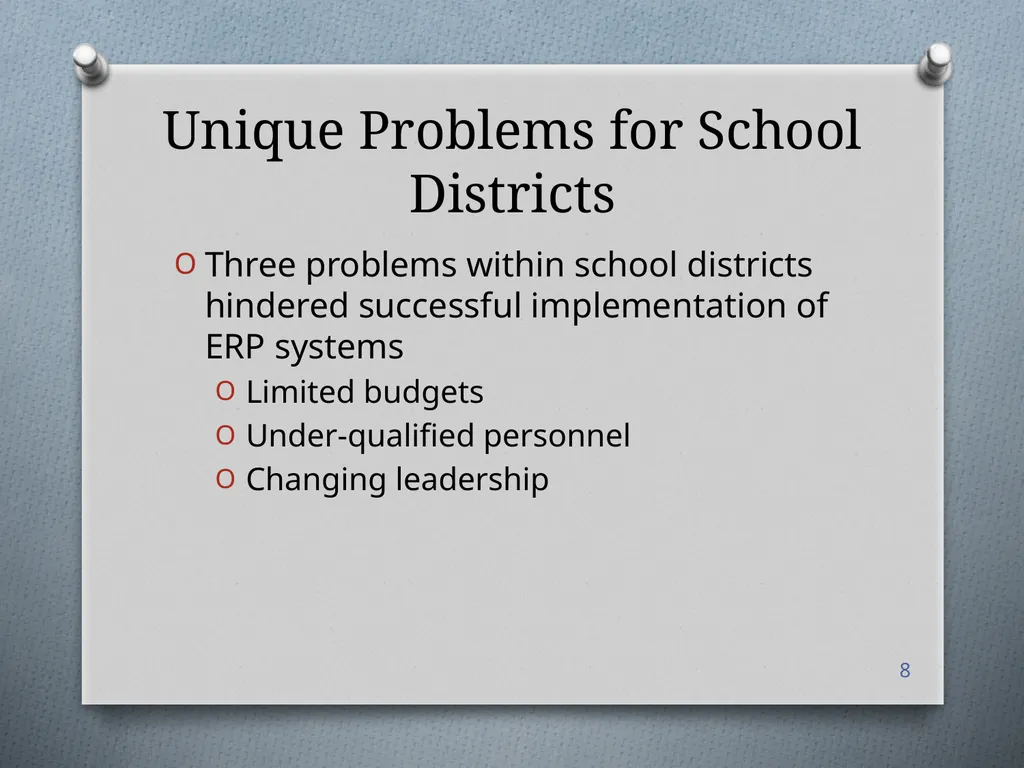
Unique Problems for School Districts Three problems within school districts hindered successful implementation of ERP systems
Limited budgets
Under-qualified personnel
Changing leadership 8<br>
Limited budgets
Under-qualified personnel
Changing leadership 8<br>
09
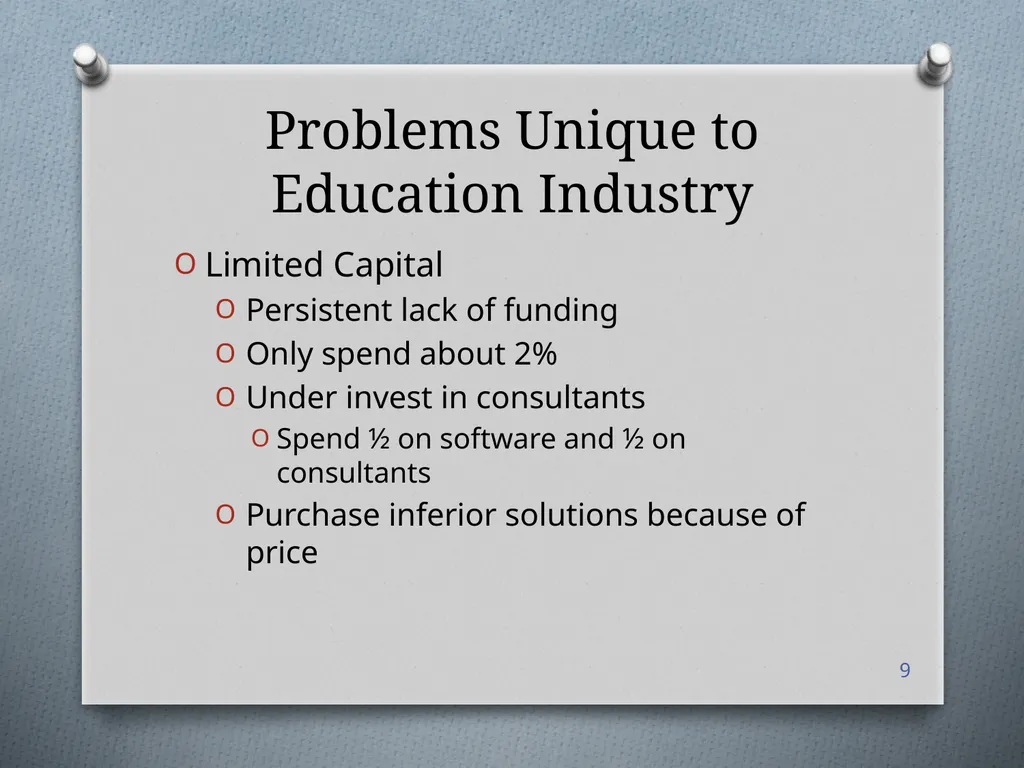
Problems Unique to Education Industry Limited Capital
Persistent lack of funding
Only spend about 2%
Under invest in consultants
Spend ½ on software and ½ on consultants
Purchase inferior solutions because of price 9<br>
Persistent lack of funding
Only spend about 2%
Under invest in consultants
Spend ½ on software and ½ on consultants
Purchase inferior solutions because of price 9<br>
10
Problems Unique to Education Industry Under-Qualified Personnel
IT staff not professionals
Districts over rely on consultants and outside experts because staff members are not trained 10<br>
IT staff not professionals
Districts over rely on consultants and outside experts because staff members are not trained 10<br>
11
Problems Unique to Education Industry Changing Leadership
Longest Superintendent tenure was 6 years
Impacts ERP implementation
Inconsistent support from top management 11<br>
Longest Superintendent tenure was 6 years
Impacts ERP implementation
Inconsistent support from top management 11<br>
12
Problems Scope Creep
Increasing the desired features
Wide Scale Deployment
Deploying
Hardware
Software
User training
Issue Escalation
Snowball effect 12<br>
Increasing the desired features
Wide Scale Deployment
Deploying
Hardware
Software
User training
Issue Escalation
Snowball effect 12<br>
13
Problems Poor Negotiation
The lack of experience when negotiation with solution providers results
Increased costs for software
Decreased benefits in service contracts with the solution provider
Software maintenance cost increases yearly
Starting at around 15-20% and could be as high as 30% of the purchase cost of the software 13<br>
The lack of experience when negotiation with solution providers results
Increased costs for software
Decreased benefits in service contracts with the solution provider
Software maintenance cost increases yearly
Starting at around 15-20% and could be as high as 30% of the purchase cost of the software 13<br>
14
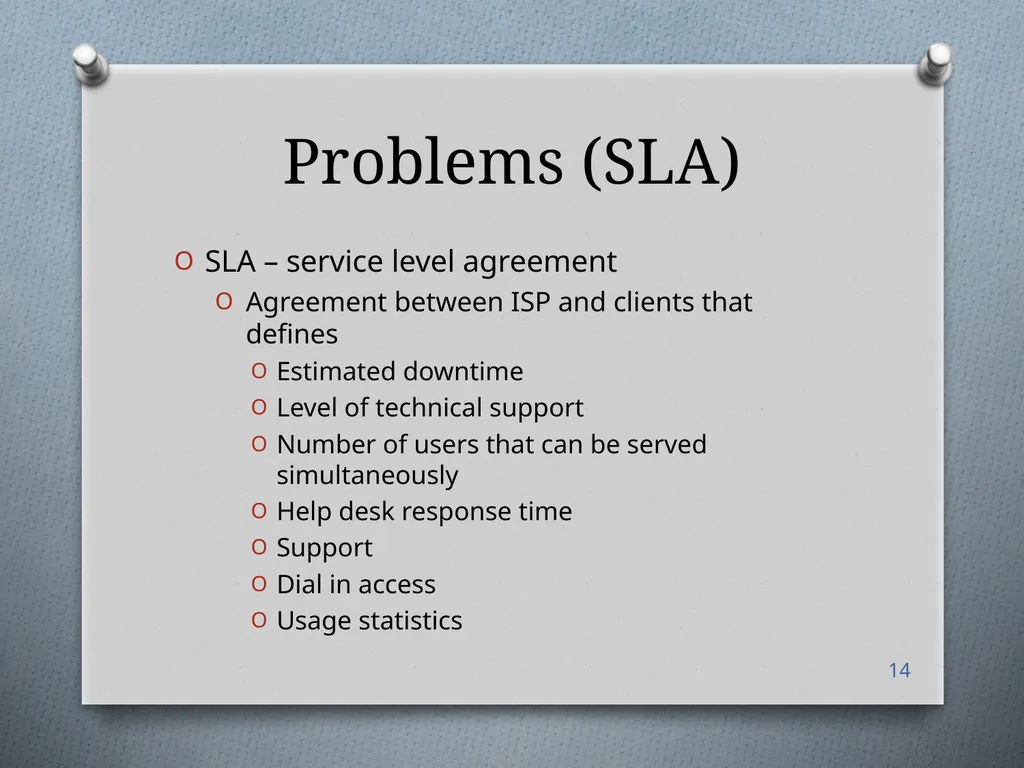
Problems (SLA) SLA – service level agreement
Agreement between ISP and clients that defines
Estimated downtime
Level of technical support
Number of users that can be served simultaneously
Help desk response time
Support
Dial in access
Usage statistics 14<br>
Agreement between ISP and clients that defines
Estimated downtime
Level of technical support
Number of users that can be served simultaneously
Help desk response time
Support
Dial in access
Usage statistics 14<br>
15
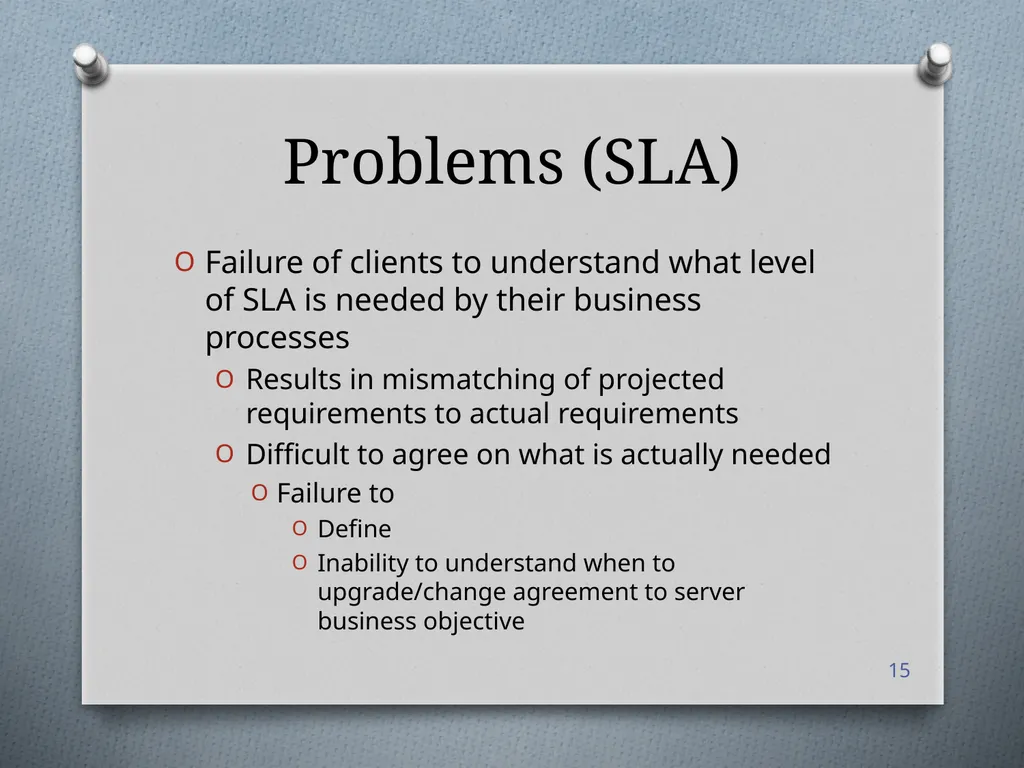
Problems (SLA) Failure of clients to understand what level of SLA is needed by their business processes
Results in mismatching of projected requirements to actual requirements
Difficult to agree on what is actually needed
Failure to
Define
Inability to understand when to upgrade/change agreement to server business objective 15<br>
Results in mismatching of projected requirements to actual requirements
Difficult to agree on what is actually needed
Failure to
Define
Inability to understand when to upgrade/change agreement to server business objective 15<br>
16
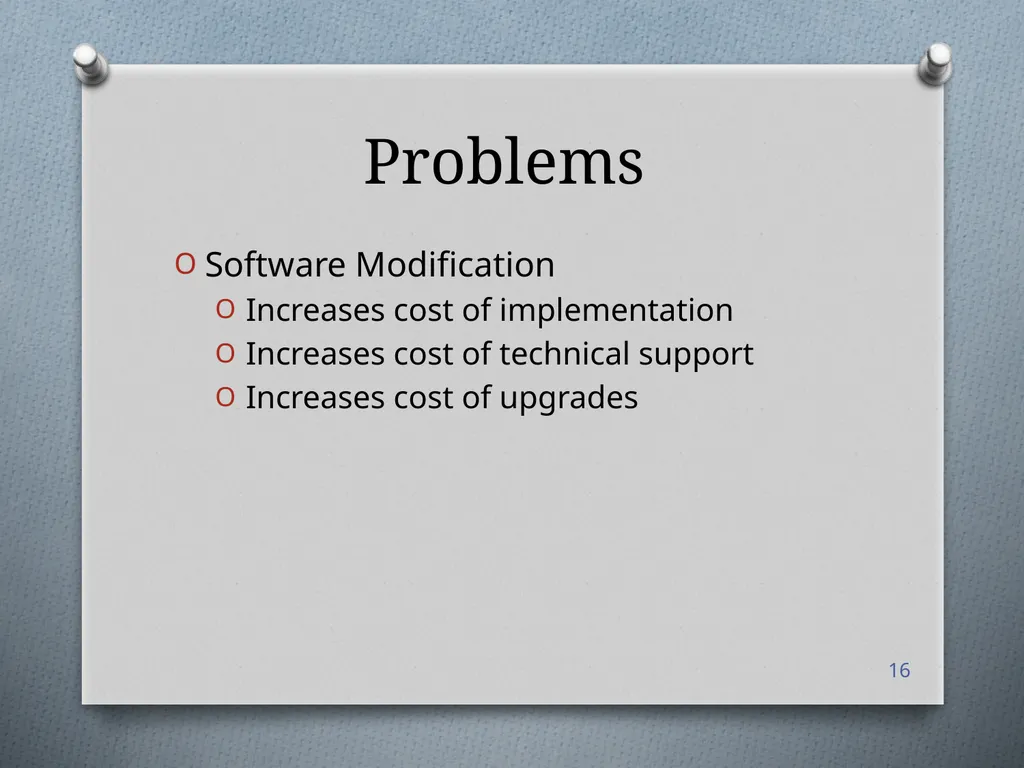
Problems Software Modification
Increases cost of implementation
Increases cost of technical support
Increases cost of upgrades 16<br>
Increases cost of implementation
Increases cost of technical support
Increases cost of upgrades 16<br>
17
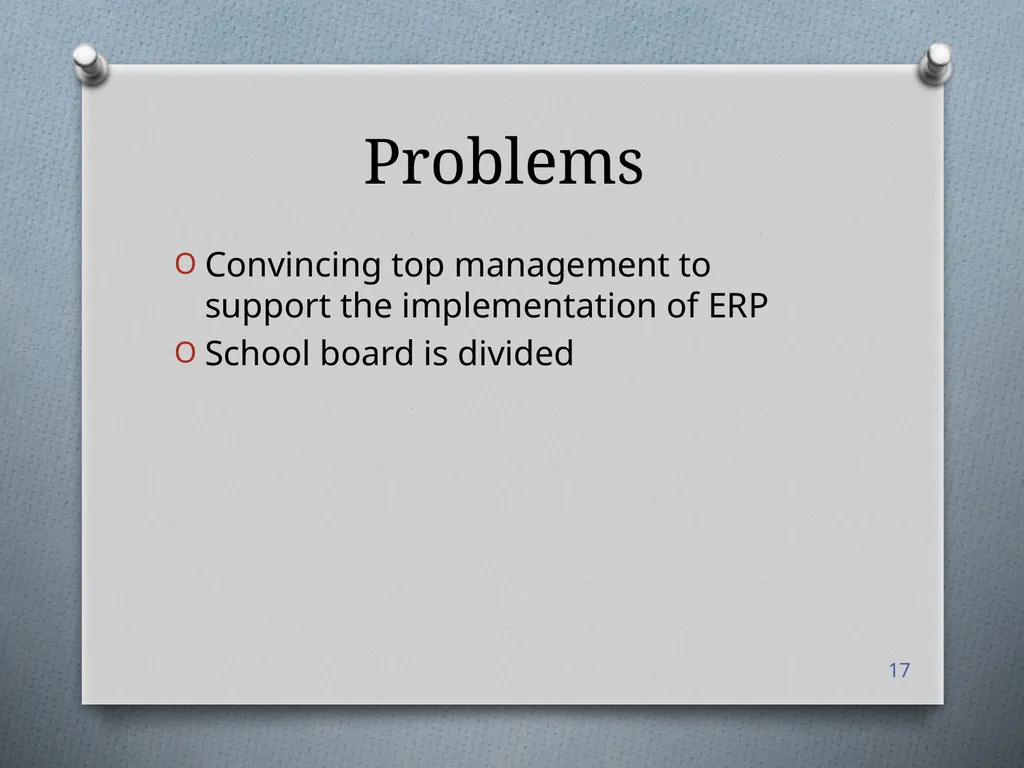
Problems Convincing top management to support the implementation of ERP
School board is divided 17<br>
School board is divided 17<br>
18
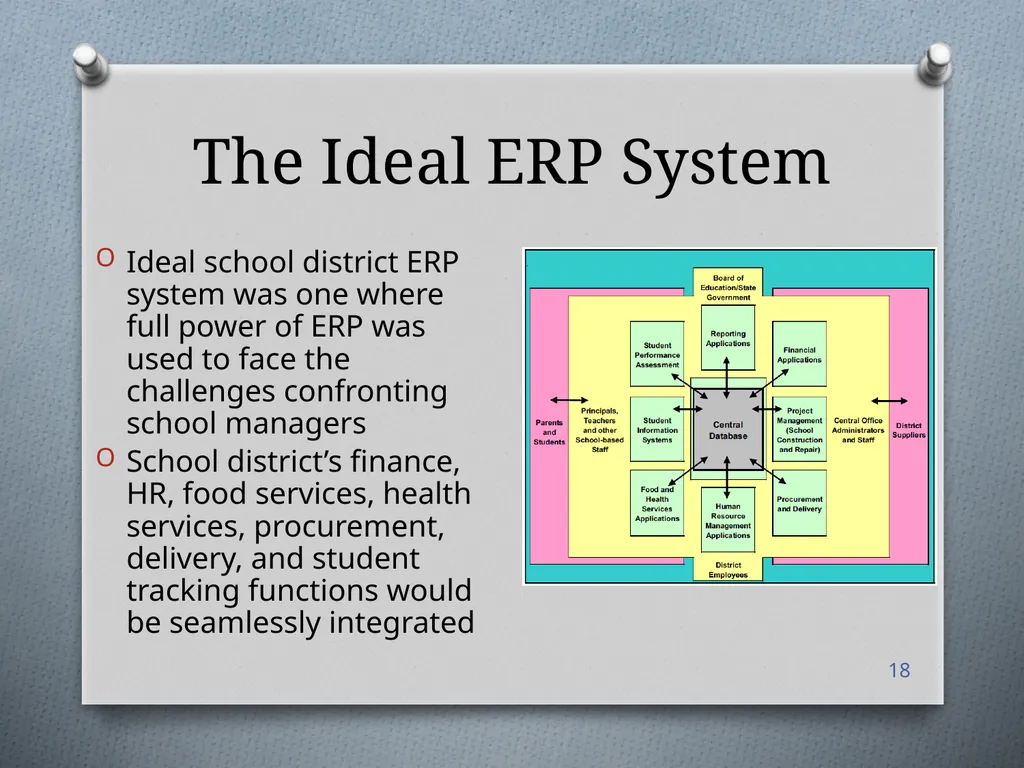
The Ideal ERP System Ideal school district ERP system was one where full power of ERP was used to face the challenges confronting school managers
School district’s finance, HR, food services, health services, procurement, delivery, and student tracking functions would be seamlessly integrated 18<br>
School district’s finance, HR, food services, health services, procurement, delivery, and student tracking functions would be seamlessly integrated 18<br>
19
The ERP Big Picture at SDCS SDCS management sought to develop enterprise-wide system to help reform and modernize district’s business operations
District staff spent 18 months planning implementation of ERP modules in areas of finance, HR, and student information system (SIS)
SIS considered “holy grail” of ERP modules
Initial survey reveled even the best SIS systems offered only 50% of functionality that district required 19<br>
District staff spent 18 months planning implementation of ERP modules in areas of finance, HR, and student information system (SIS)
SIS considered “holy grail” of ERP modules
Initial survey reveled even the best SIS systems offered only 50% of functionality that district required 19<br>
20
Alternatives ERP Vendors
Benefits
Simpler integration process between software module
Less training cost for personnel
Potentially lower cost of ownership
Easier to support the ERP system
Drawbacks
Potential changes in way school district does business
Potential software functionality gap in between modules 20<br>
Benefits
Simpler integration process between software module
Less training cost for personnel
Potentially lower cost of ownership
Easier to support the ERP system
Drawbacks
Potential changes in way school district does business
Potential software functionality gap in between modules 20<br>
21
Alternatives Best-of-Breed
Benefits
Ability to create a more organizational specific functionally of the ERP system
The client is not locked in with one vendor
Reduced potential functionality gaps between modules
Drawbacks
Much more complex system to implement
Will cost much more than just hiring an ERP vendor 21<br>
Benefits
Ability to create a more organizational specific functionally of the ERP system
The client is not locked in with one vendor
Reduced potential functionality gaps between modules
Drawbacks
Much more complex system to implement
Will cost much more than just hiring an ERP vendor 21<br>
22
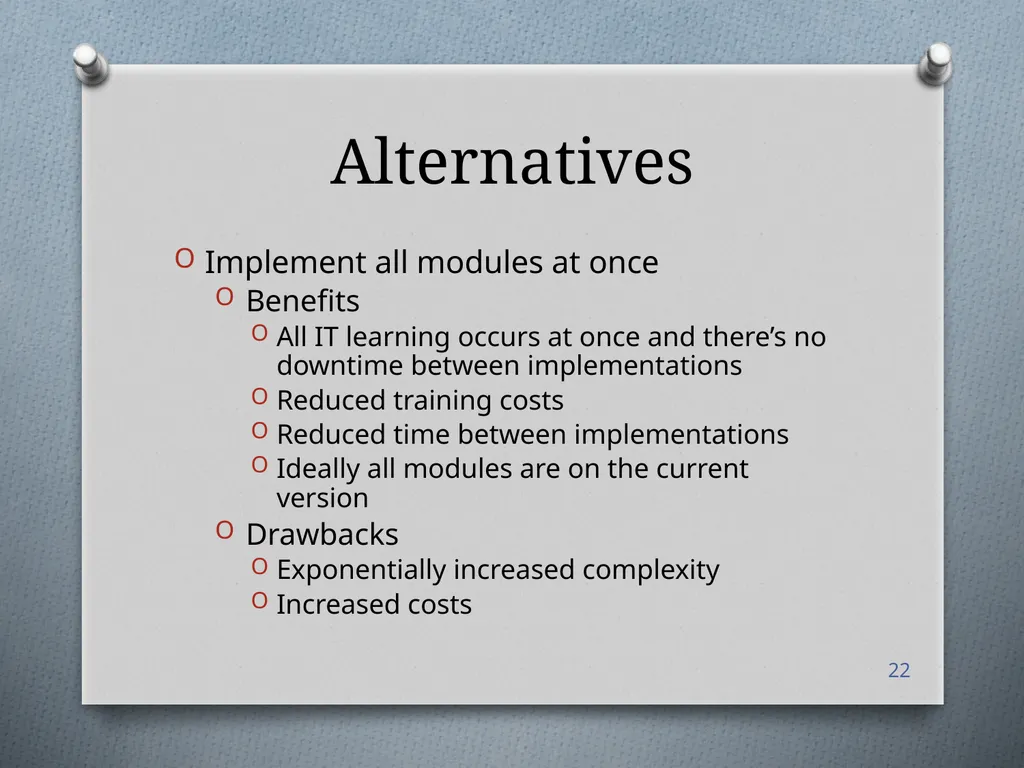
Alternatives Implement all modules at once
Benefits
All IT learning occurs at once and there’s no downtime between implementations
Reduced training costs
Reduced time between implementations
Ideally all modules are on the current version
Drawbacks
Exponentially increased complexity
Increased costs 22<br>
Benefits
All IT learning occurs at once and there’s no downtime between implementations
Reduced training costs
Reduced time between implementations
Ideally all modules are on the current version
Drawbacks
Exponentially increased complexity
Increased costs 22<br>
23
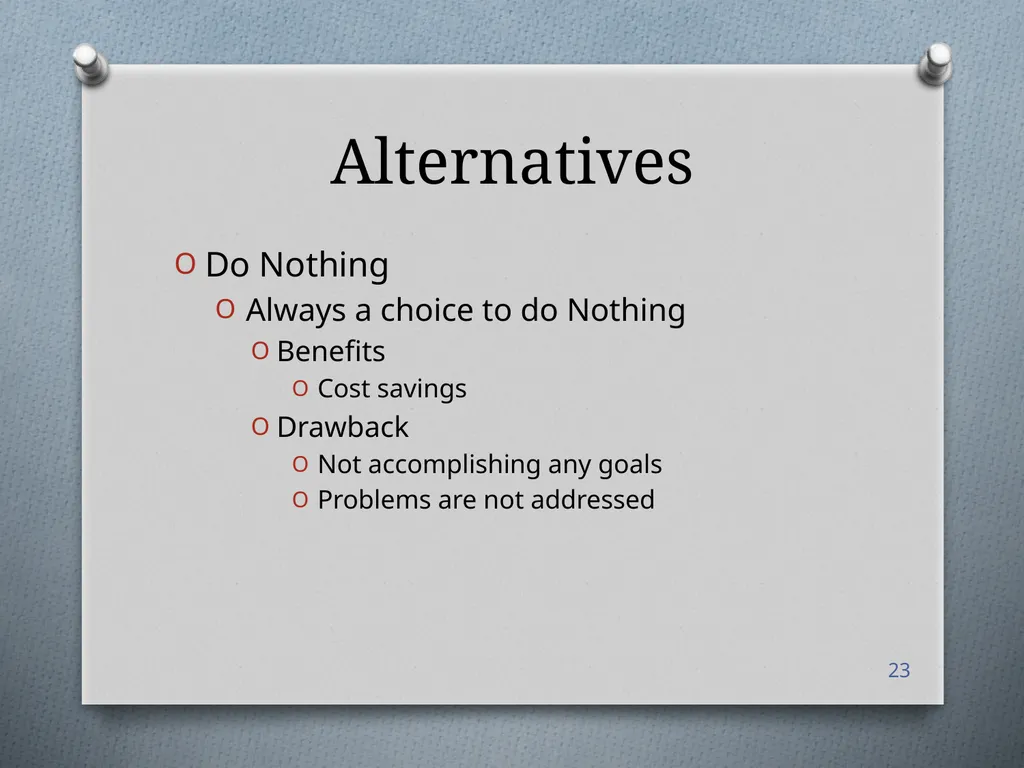
Alternatives Do Nothing
Always a choice to do Nothing
Benefits
Cost savings
Drawback
Not accomplishing any goals
Problems are not addressed 23<br>
Always a choice to do Nothing
Benefits
Cost savings
Drawback
Not accomplishing any goals
Problems are not addressed 23<br>
24
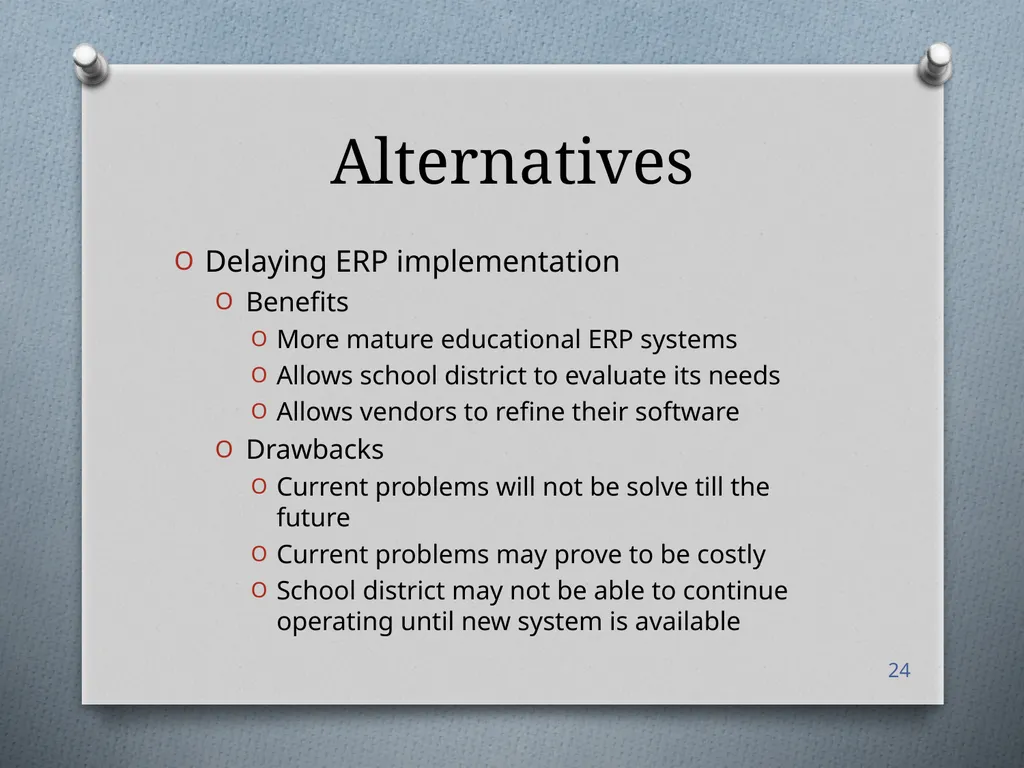
Alternatives Delaying ERP implementation
Benefits
More mature educational ERP systems
Allows school district to evaluate its needs
Allows vendors to refine their software
Drawbacks
Current problems will not be solve till the future
Current problems may prove to be costly
School district may not be able to continue operating until new system is available 24<br>
Benefits
More mature educational ERP systems
Allows school district to evaluate its needs
Allows vendors to refine their software
Drawbacks
Current problems will not be solve till the future
Current problems may prove to be costly
School district may not be able to continue operating until new system is available 24<br>
25
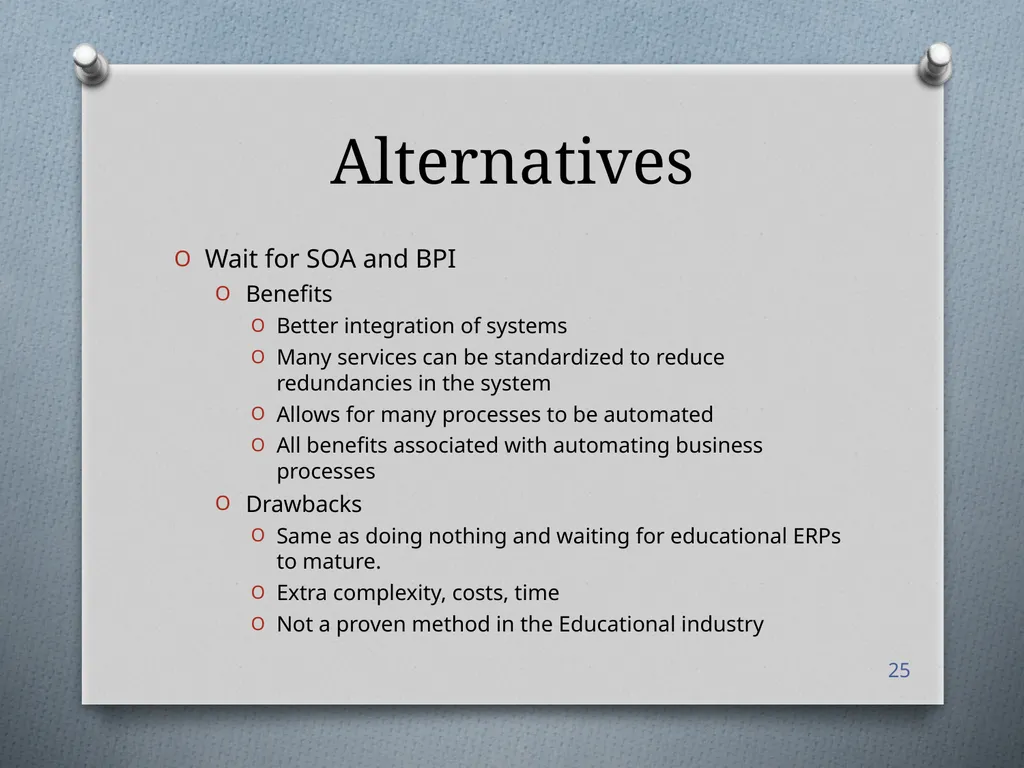
Alternatives Wait for SOA and BPI
Benefits
Better integration of systems
Many services can be standardized to reduce redundancies in the system
Allows for many processes to be automated
All benefits associated with automating business processes
Drawbacks
Same as doing nothing and waiting for educational ERPs to mature.
Extra complexity, costs, time
Not a proven method in the Educational industry 25<br>
Benefits
Better integration of systems
Many services can be standardized to reduce redundancies in the system
Allows for many processes to be automated
All benefits associated with automating business processes
Drawbacks
Same as doing nothing and waiting for educational ERPs to mature.
Extra complexity, costs, time
Not a proven method in the Educational industry 25<br>
26
Alternatives Software Choice
Best of Breed/Single Vendor
Best of Breed – get best solutions but no integration
Single Vendor – great integration however not optimal/best solution for each 26<br>
Best of Breed/Single Vendor
Best of Breed – get best solutions but no integration
Single Vendor – great integration however not optimal/best solution for each 26<br>
27
Discussion Question What module was decided to be implemented first? Why?
HR module was to be implemented first.
District’s head of HR successfully implemented HR module at prior assignment and had hands-on experience
Early success of HR module would build greater buy-in among district staff for future ERP initiatives 27<br>
HR module was to be implemented first.
District’s head of HR successfully implemented HR module at prior assignment and had hands-on experience
Early success of HR module would build greater buy-in among district staff for future ERP initiatives 27<br>
28
SDCS Human Resources ERP Module Current SDCS HRMS mainly composed of 30-year-old legacy mainframe code recently migrated to client/server platform
HRMS included payroll, personnel, and benefit systems
Other stand-alone applications purchased or built over the past decade
No true integration among any of the systems
Sharing of data between systems not automatic
Each functional area responsible for data entry for respective department
Resulted in duplication of data entry 28<br>
HRMS included payroll, personnel, and benefit systems
Other stand-alone applications purchased or built over the past decade
No true integration among any of the systems
Sharing of data between systems not automatic
Each functional area responsible for data entry for respective department
Resulted in duplication of data entry 28<br>
29
Employee Benefits Administration of employee benefits was complex and required significant manual work 29<br>
30
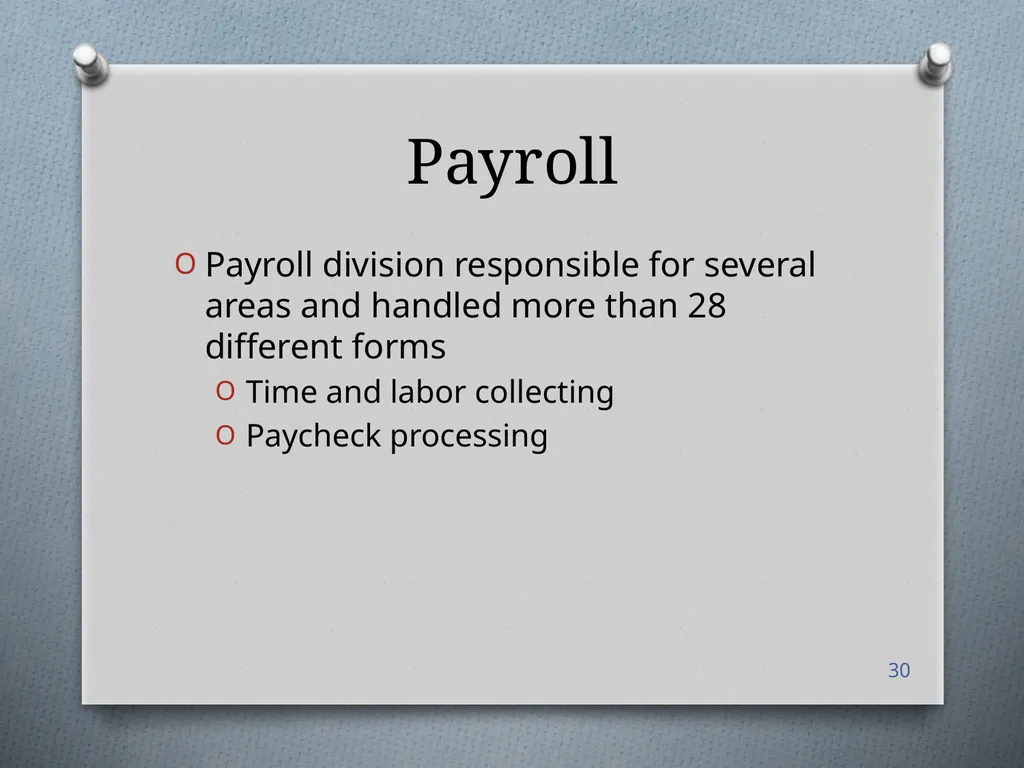
Payroll Payroll division responsible for several areas and handled more than 28 different forms
Time and labor collecting
Paycheck processing 30<br>
Time and labor collecting
Paycheck processing 30<br>
31
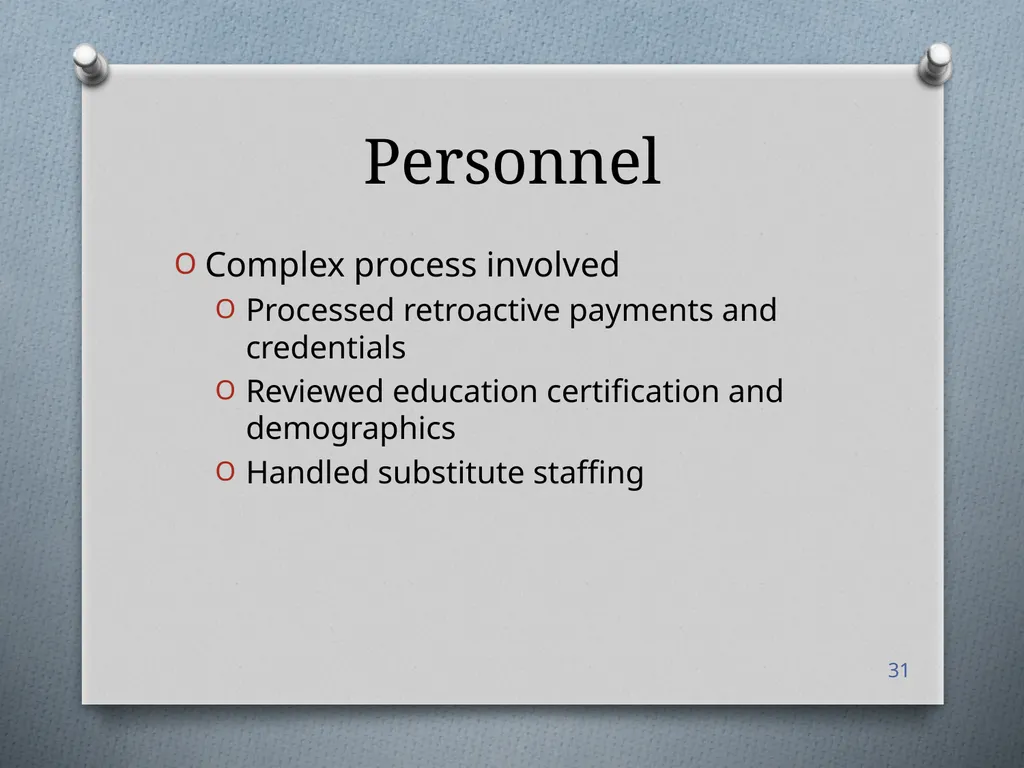
Personnel Complex process involved
Processed retroactive payments and credentials
Reviewed education certification and demographics
Handled substitute staffing 31<br>
Processed retroactive payments and credentials
Reviewed education certification and demographics
Handled substitute staffing 31<br>
32
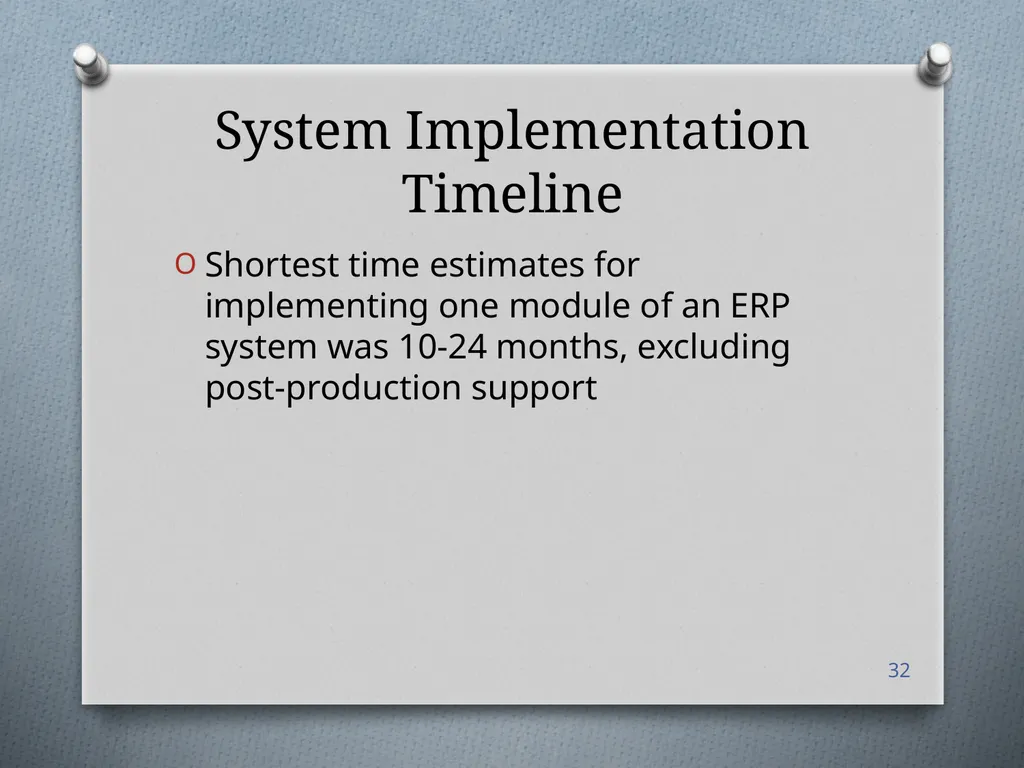
System Implementation Timeline Shortest time estimates for implementing one module of an ERP system was 10-24 months, excluding post-production support 32<br>
33
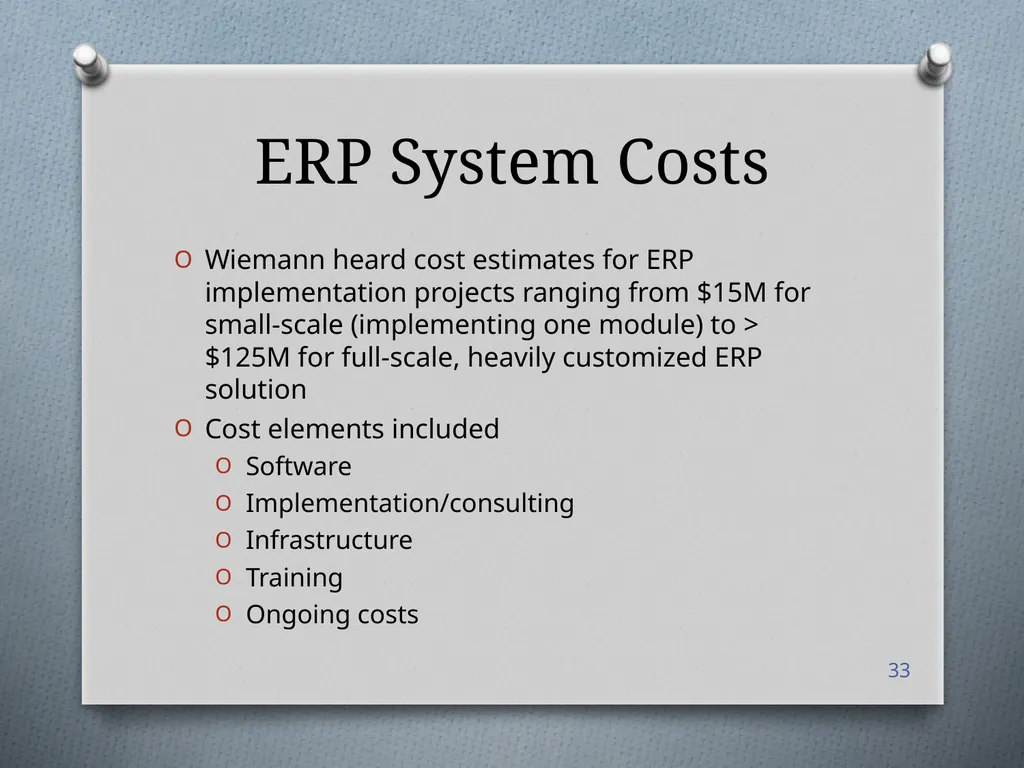
ERP System Costs Wiemann heard cost estimates for ERP implementation projects ranging from $15M for small-scale (implementing one module) to > $125M for full-scale, heavily customized ERP solution
Cost elements included
Software
Implementation/consulting
Infrastructure
Training
Ongoing costs 33<br>
Cost elements included
Software
Implementation/consulting
Infrastructure
Training
Ongoing costs 33<br>
34
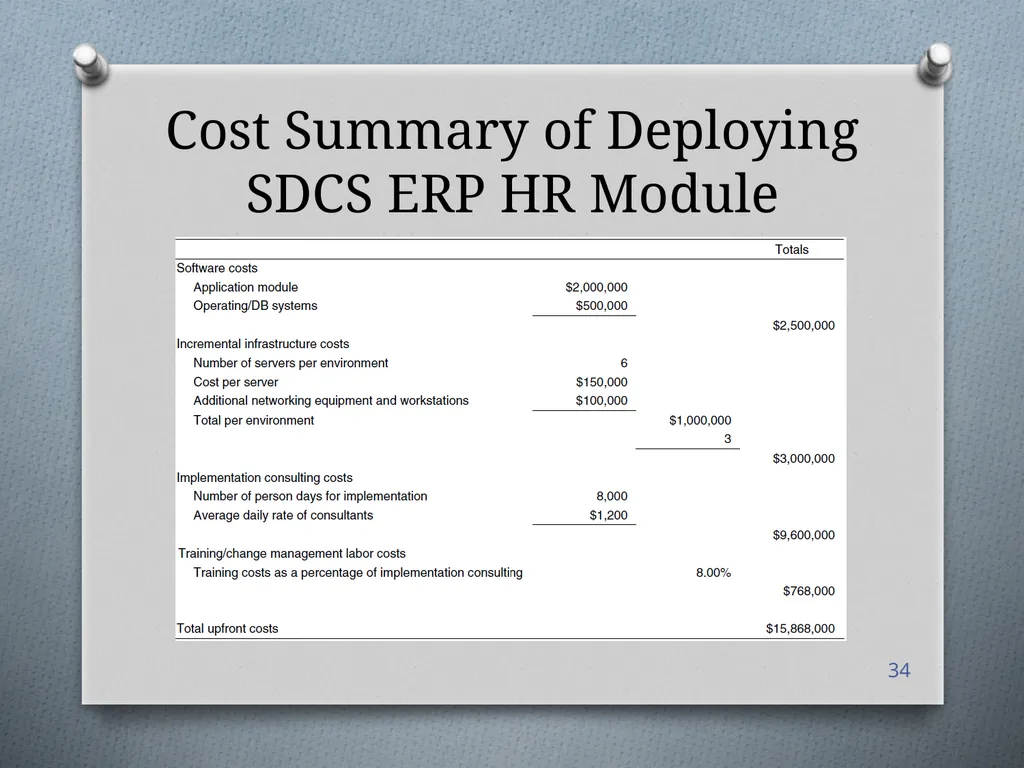
Cost Summary of Deploying SDCS ERP HR Module 34<br>
35
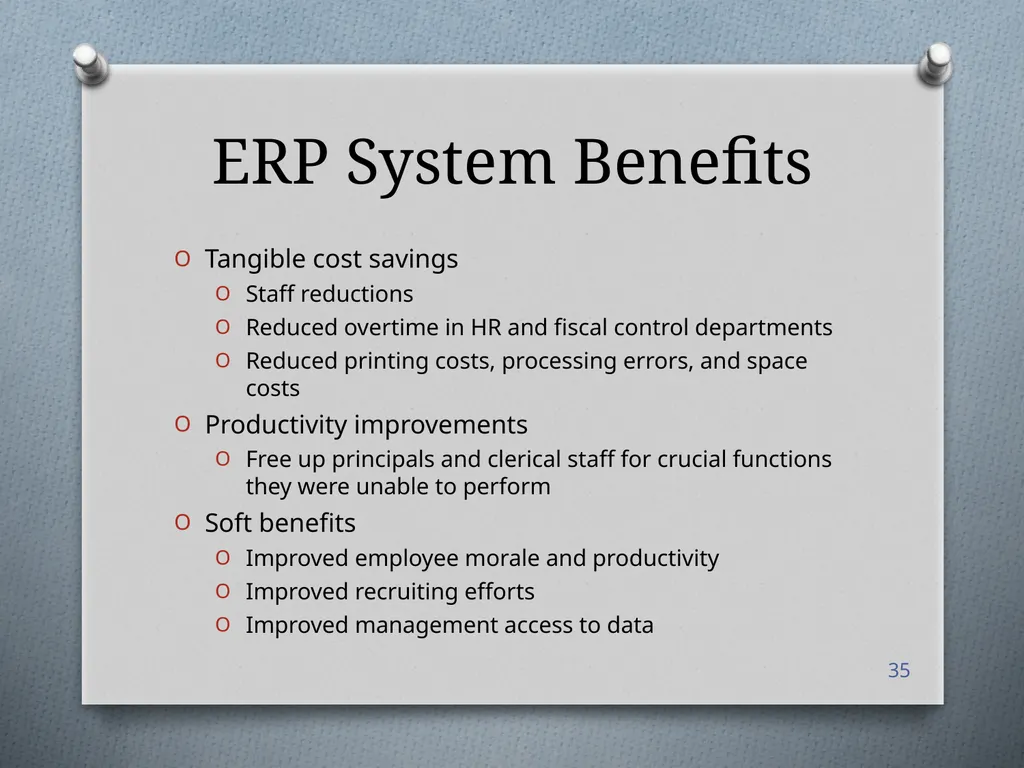
ERP System Benefits Tangible cost savings
Staff reductions
Reduced overtime in HR and fiscal control departments
Reduced printing costs, processing errors, and space costs
Productivity improvements
Free up principals and clerical staff for crucial functions they were unable to perform
Soft benefits
Improved employee morale and productivity
Improved recruiting efforts
Improved management access to data 35<br>
Staff reductions
Reduced overtime in HR and fiscal control departments
Reduced printing costs, processing errors, and space costs
Productivity improvements
Free up principals and clerical staff for crucial functions they were unable to perform
Soft benefits
Improved employee morale and productivity
Improved recruiting efforts
Improved management access to data 35<br>
36
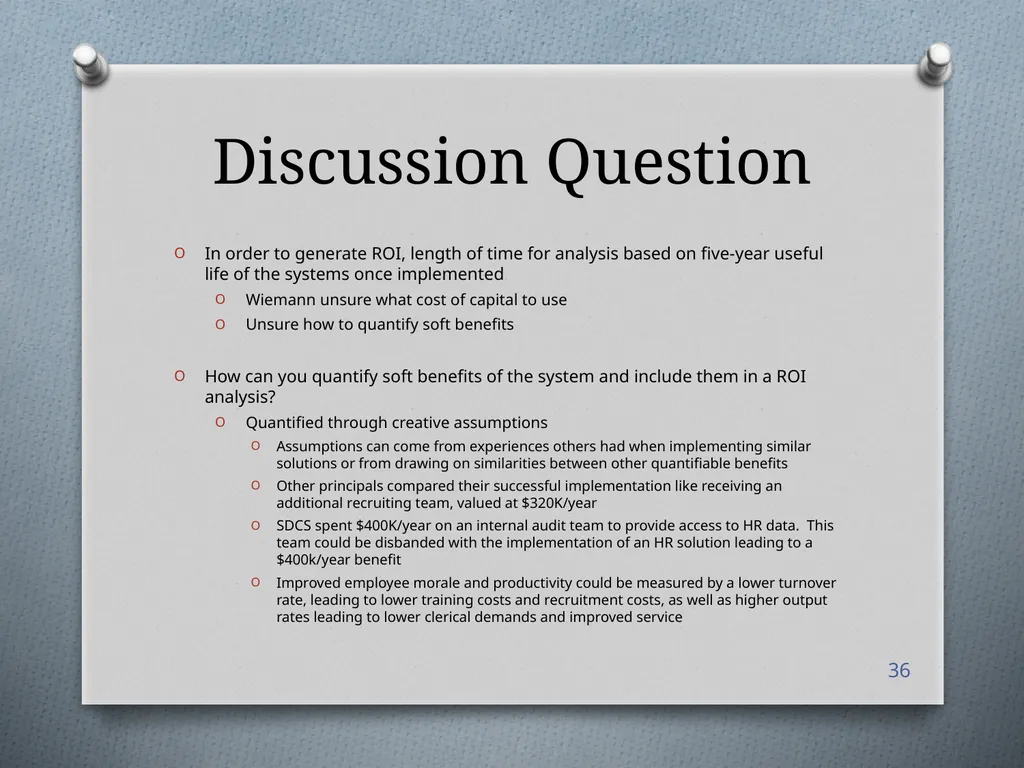
Discussion Question In order to generate ROI, length of time for analysis based on five-year useful life of the systems once implemented
Wiemann unsure what cost of capital to use
Unsure how to quantify soft benefits
How can you quantify soft benefits of the system and include them in a ROI analysis?
Quantified through creative assumptions
Assumptions can come from experiences others had when implementing similar solutions or from drawing on similarities between other quantifiable benefits
Other principals compared their successful implementation like receiving an additional recruiting team, valued at $320K/year
SDCS spent $400K/year on an internal audit team to provide access to HR data. This team could be disbanded with the implementation of an HR solution leading to a $400k/year benefit
Improved employee morale and productivity could be measured by a lower turnover rate, leading to lower training costs and recruitment costs, as well as higher output rates leading to lower clerical demands and improved service 36<br>
Wiemann unsure what cost of capital to use
Unsure how to quantify soft benefits
How can you quantify soft benefits of the system and include them in a ROI analysis?
Quantified through creative assumptions
Assumptions can come from experiences others had when implementing similar solutions or from drawing on similarities between other quantifiable benefits
Other principals compared their successful implementation like receiving an additional recruiting team, valued at $320K/year
SDCS spent $400K/year on an internal audit team to provide access to HR data. This team could be disbanded with the implementation of an HR solution leading to a $400k/year benefit
Improved employee morale and productivity could be measured by a lower turnover rate, leading to lower training costs and recruitment costs, as well as higher output rates leading to lower clerical demands and improved service 36<br>
37
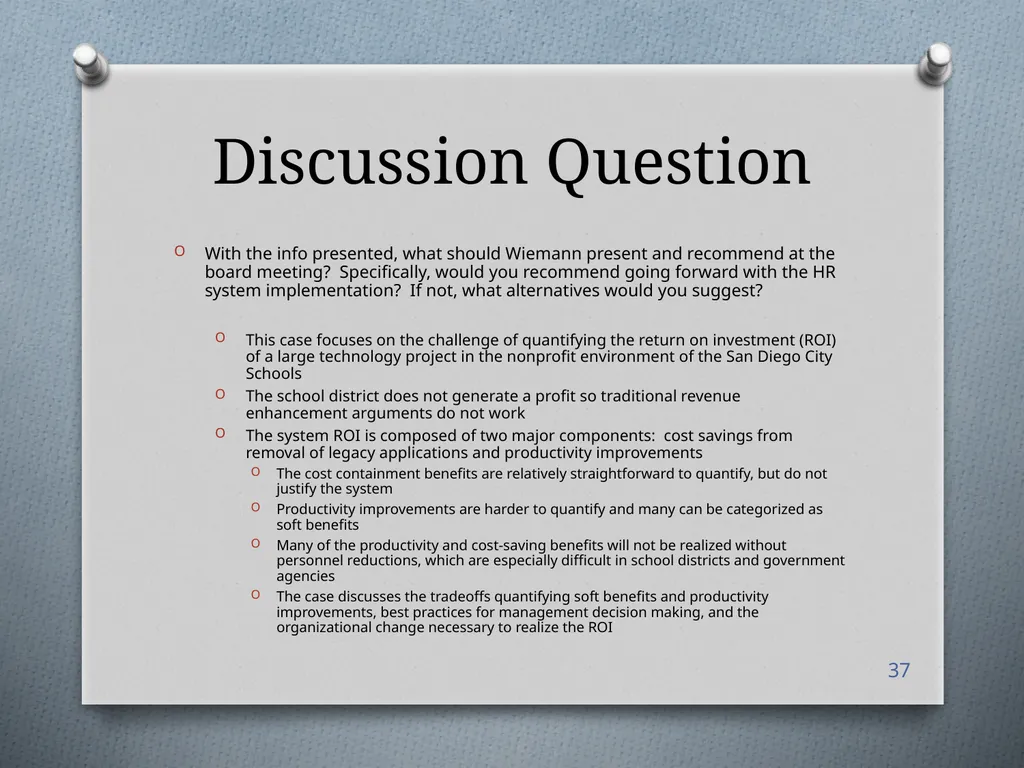
Discussion Question With the info presented, what should Wiemann present and recommend at the board meeting? Specifically, would you recommend going forward with the HR system implementation? If not, what alternatives would you suggest?
This case focuses on the challenge of quantifying the return on investment (ROI) of a large technology project in the nonprofit environment of the San Diego City Schools
The school district does not generate a profit so traditional revenue enhancement arguments do not work
The system ROI is composed of two major components: cost savings from removal of legacy applications and productivity improvements
The cost containment benefits are relatively straightforward to quantify, but do not justify the system
Productivity improvements are harder to quantify and many can be categorized as soft benefits
Many of the productivity and cost-saving benefits will not be realized without personnel reductions, which are especially difficult in school districts and government agencies
The case discusses the tradeoffs quantifying soft benefits and productivity improvements, best practices for management decision making, and the organizational change necessary to realize the ROI 37<br>
This case focuses on the challenge of quantifying the return on investment (ROI) of a large technology project in the nonprofit environment of the San Diego City Schools
The school district does not generate a profit so traditional revenue enhancement arguments do not work
The system ROI is composed of two major components: cost savings from removal of legacy applications and productivity improvements
The cost containment benefits are relatively straightforward to quantify, but do not justify the system
Productivity improvements are harder to quantify and many can be categorized as soft benefits
Many of the productivity and cost-saving benefits will not be realized without personnel reductions, which are especially difficult in school districts and government agencies
The case discusses the tradeoffs quantifying soft benefits and productivity improvements, best practices for management decision making, and the organizational change necessary to realize the ROI 37<br>
38
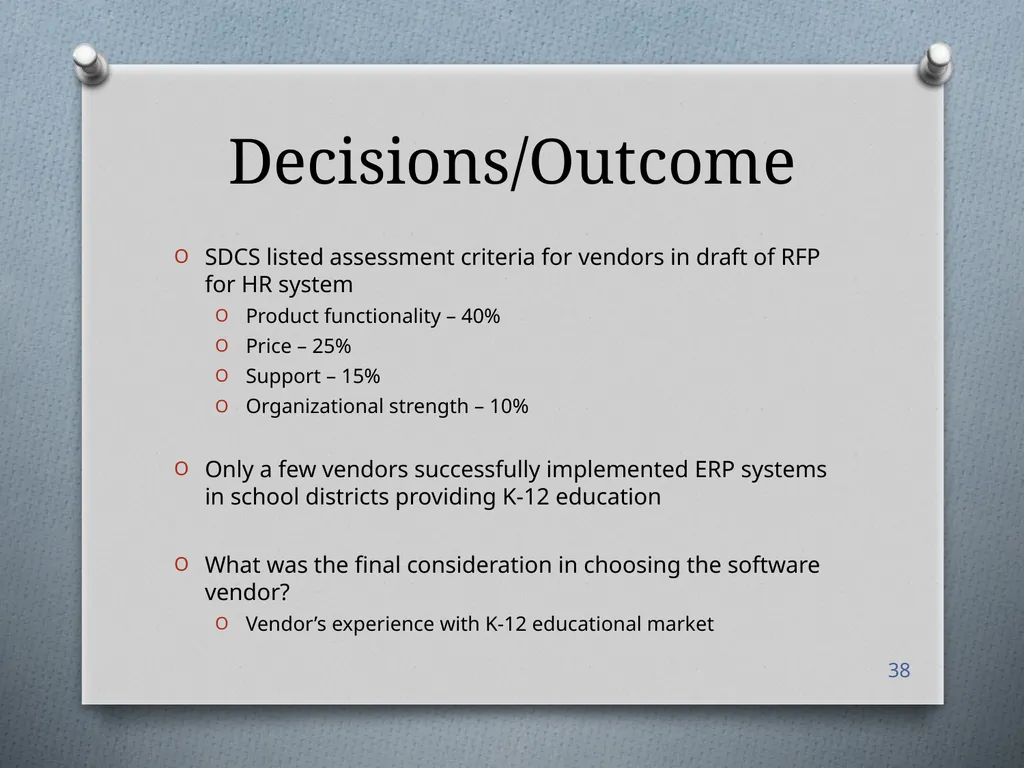
Decisions/Outcome SDCS listed assessment criteria for vendors in draft of RFP for HR system
Product functionality – 40%
Price – 25%
Support – 15%
Organizational strength – 10%
Only a few vendors successfully implemented ERP systems in school districts providing K-12 education
What was the final consideration in choosing the software vendor?
Vendor’s experience with K-12 educational market 38<br>
Product functionality – 40%
Price – 25%
Support – 15%
Organizational strength – 10%
Only a few vendors successfully implemented ERP systems in school districts providing K-12 education
What was the final consideration in choosing the software vendor?
Vendor’s experience with K-12 educational market 38<br>
39
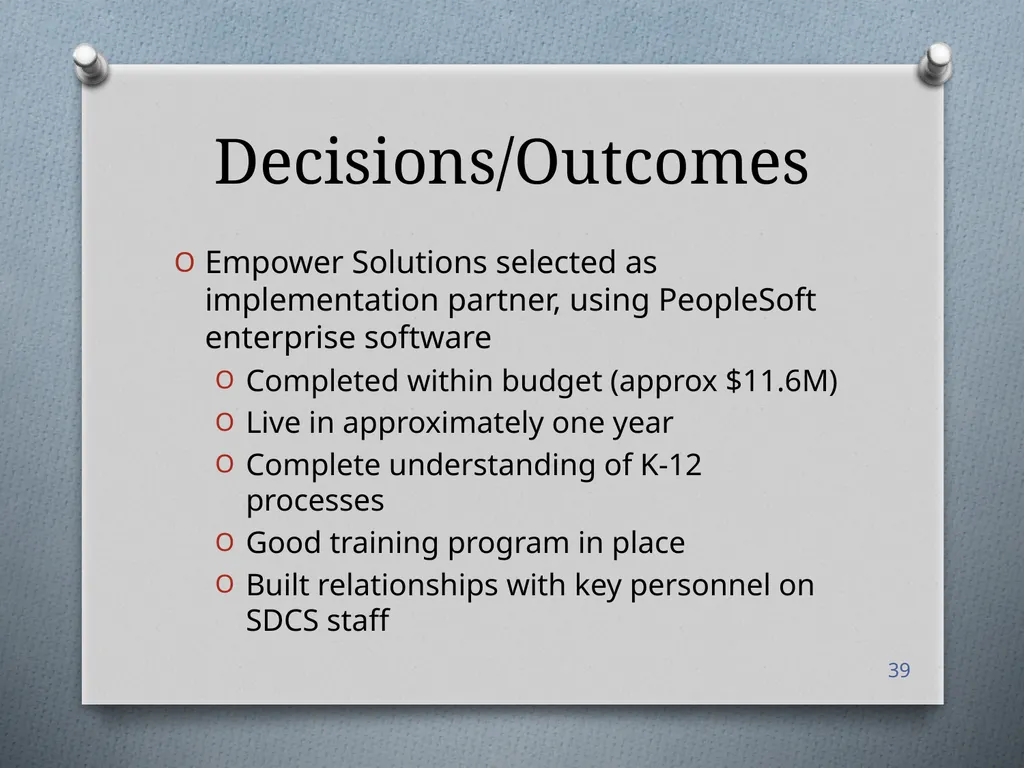
Decisions/Outcomes Empower Solutions selected as implementation partner, using PeopleSoft enterprise software
Completed within budget (approx $11.6M)
Live in approximately one year
Complete understanding of K-12 processes
Good training program in place
Built relationships with key personnel on SDCS staff 39<br>
Completed within budget (approx $11.6M)
Live in approximately one year
Complete understanding of K-12 processes
Good training program in place
Built relationships with key personnel on SDCS staff 39<br>
40
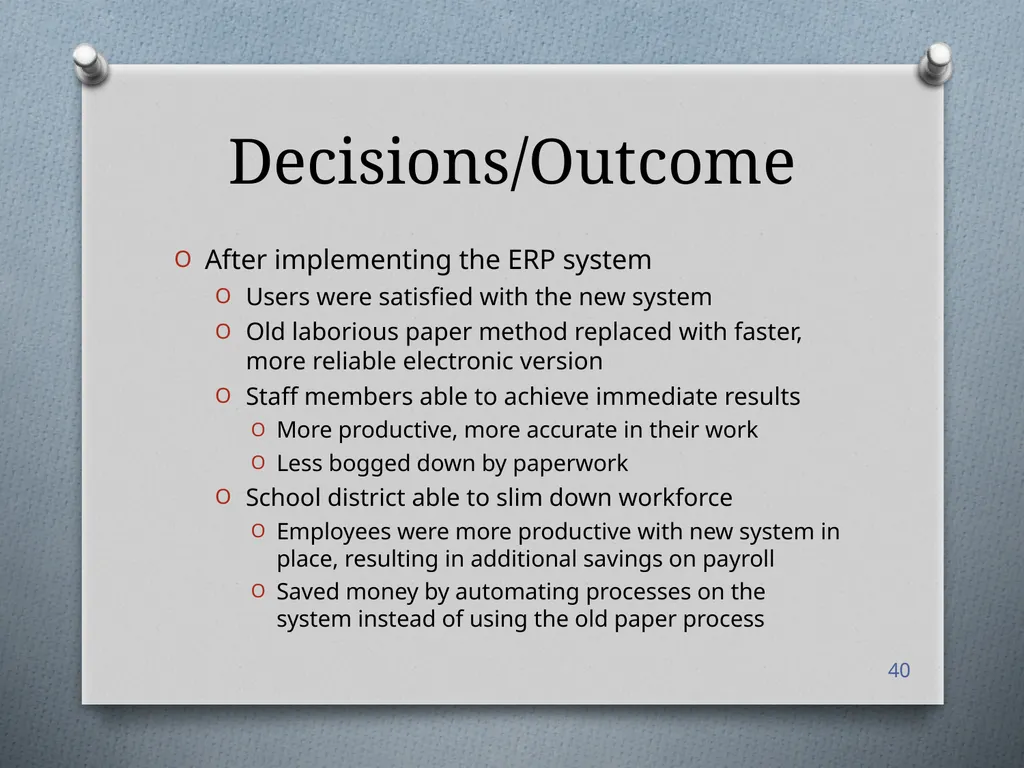
Decisions/Outcome After implementing the ERP system
Users were satisfied with the new system
Old laborious paper method replaced with faster, more reliable electronic version
Staff members able to achieve immediate results
More productive, more accurate in their work
Less bogged down by paperwork
School district able to slim down workforce
Employees were more productive with new system in place, resulting in additional savings on payroll
Saved money by automating processes on the system instead of using the old paper process 40<br>
Users were satisfied with the new system
Old laborious paper method replaced with faster, more reliable electronic version
Staff members able to achieve immediate results
More productive, more accurate in their work
Less bogged down by paperwork
School district able to slim down workforce
Employees were more productive with new system in place, resulting in additional savings on payroll
Saved money by automating processes on the system instead of using the old paper process 40<br>